Hey, hey, Geekly Gang! Kyra Kyle here with another Top 5 Tabletop Game List throughout the years. Today we’re gonna party like it’s 1999. 1999 finishes the decade strong with another major collectible card game release, and Reiner Knizia dominance. Oh! Did Knizia ever own tabletop games in 1999? We’ll get to the games in a bit, but first, let’s review our list’s criteria.
1: Cultural relevance plays as much of a factor as overall quality. A game might make a list that doesn’t hold up to others of its type, but you must admit the game is everywhere.
2: Only one game from a franchise makes the list. This will become more of an issue the closer we get to games with expansions.
3: Longevity plays a role, too. A game doesn’t have to fly off the shelves today, but it had to have some widespread appeal for a decent time.
5: Schotten Totten (1999)
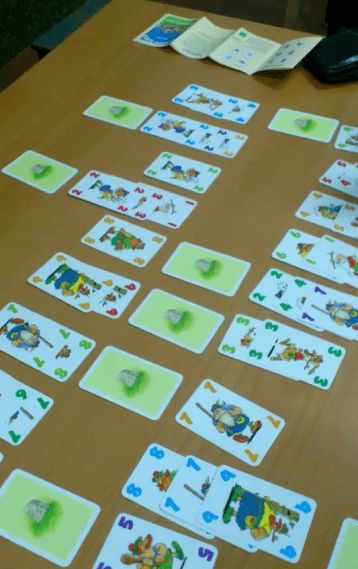
Get ready to hear Reiner Knizia’s name a lot on this list. Schotten Totten is the first Knizia design. In Schotten Totten, players take on the role of Scottish clan leaders. Nine boundary stones lie between you and your opponent. In front of each, you build poker-like formations of three cards on a side. Whoever plays the higher-ranking formation wins the stone. But you may use powers to claim a stone before your opponent has played all three of their cards. Successfully claim five stones, or any three adjacent stones, and you win.
Schotten Totten has received multiple reprints. Its game mechanisms have been reimplemented by many games. There’s even a Schotten Totten 2. Few designers could top Knizia in 1999.
4: Lost Cities (1999)
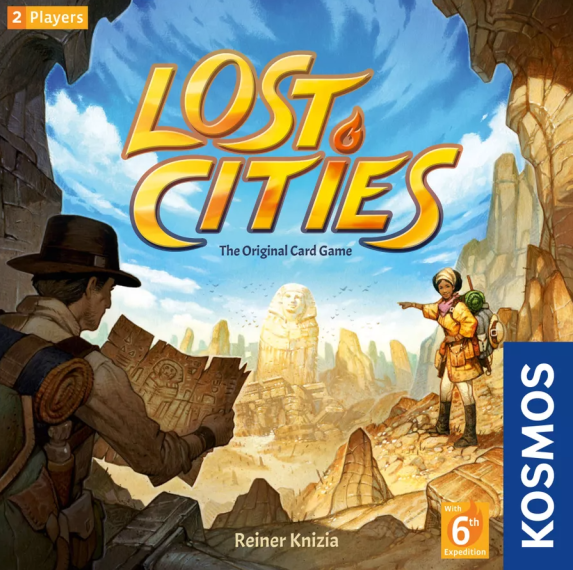
Lost Cities is another Knizia design. Lost Cities also continues Kosmos’ excellent two-player game series. Kahuna (another game from this series) made our 1998 list. I love Lost Cities’ theme. Players mount archaeological expeditions to different sites represented by the cards’ colored suits. Lost Cities incorporates a push-your-luck mechanism, as you can choose to continue an expedition (with the possibility of busting) or you can return to base with what you have (and play it safe). Many games have copied Lost Cities’ formula. Including Knizia himself.
While Lost Cities wasn’t considered for the Spiel des Jahres (German game of the year), Keltis, which reimplemented Lost Cities’ gameplay, took home the Spiel des Jahres in 2008. To this day, I prefer to play Lost Cities to Keltis. Lost Cities has staying power.
3: Yu-Gi-Oh! Trading Card Game (1999)
Speaking of staying power, Yu-Gi-Oh! has that in spades. While new collectible card games (CCGs) continued to be released in the mid to late Nineties, few grabbed hold of the gaming community or stayed longer than a handful of sets. Heck! Even some of the CCGs that made previous lists in this series struggled to make it to ten sets. Yu-Gi-Oh! doesn’t have that issue.
You could argue that Yu-Gi-Oh! at the three spot is a little low. I’ll give you that. What started as the middle ground between Pokémon the card game and Magic: The Gathering has grown into its own dominant brand. From a cultural relevance standpoint, Yu-Gi-Oh! may take 1999’s number one spot.
2: Tikal (1999)
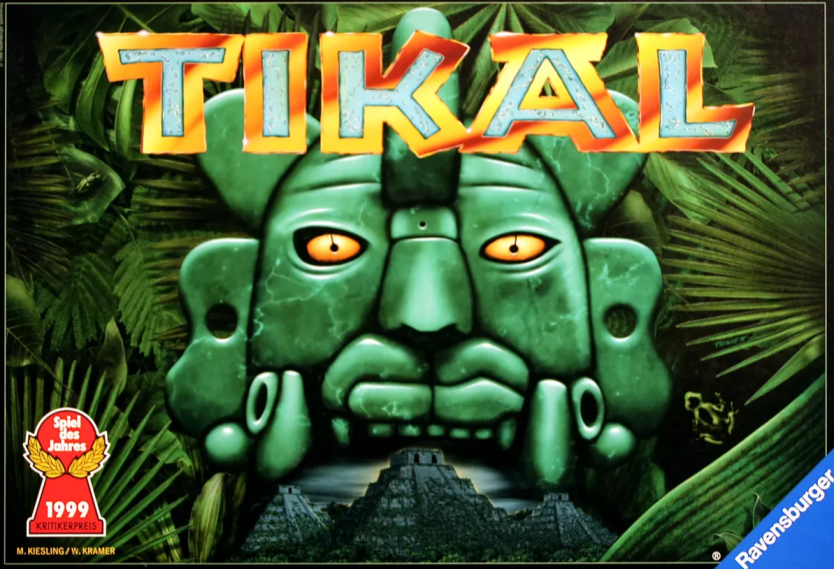
Tikal earned 1999’s Spiel des Jahres. This Walfgang Kramer and Michael Kiesling co-design is a brilliant game. Tikal claims our second spot on this list, but I can see someone switching 1 and 2. Tikal deserved the Spiel des Jahres; I just think another game has more relevance today. Tikal is the first of Kramer and Kiesling’s Mask Trilogy of games: Tikal (1999), Java (2000), and Mexica (2002). Tikal is a game of exploration within the Central American jungles in search of lost temples and treasure.
Players send their team of explorers into the jungle, unearthing more and more of the terrain. Along the way, you’ll find temples that hold secrets and treasure. Players try to score points for occupying temples and holding treasure. I’ve played the Tikal mobile app, and it’s a good implementation of the game. If you like the idea of exploring the jungle, check out Tikal.
1: Ra (1999)
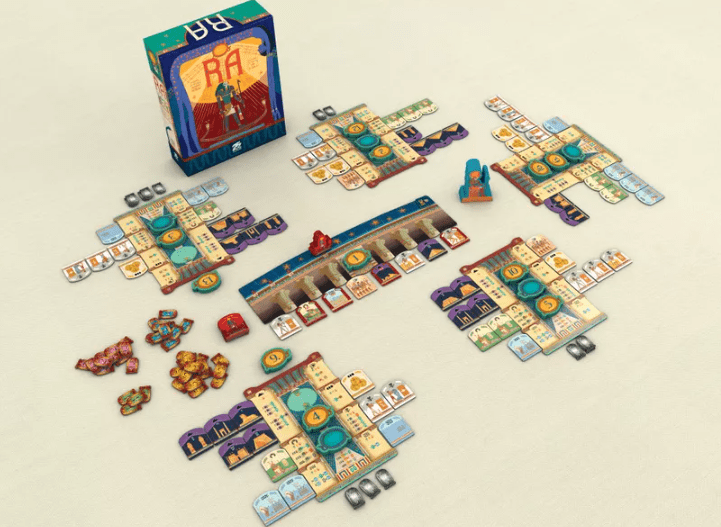
Three! Reiner Knizia has three games on the Top 5 1999 Tabletop Games List, and his auction game Ra takes our top spot. Ra highlights what makes Knizia games excellent. Take one simple concept (in this case, auctions) and do it better than most designs. Ra is an auction and set-collection game with an Ancient Egyptian theme. Players purchase lots of tiles through bidding. While every player can win three lots during an epoch (round), tension builds because an epoch can end before every player obtains three lots. The various tiles either give immediate points, prevent negative points (for not having certain types at game’s end), or give points after the final round. Ra is easy to learn and quick to play.
While overlooked for 1999’s Spiel des Jahres, Ra has proven it has longevity. Ra received a reprint in 2023. This year (2025), Ra was inducted into the BoardGameGeek Hall of Fame. My only guess as to why Ra wasn’t considered for the Spiel des Jahres (yes, Ra wasn’t even considered) is that the committee grew tired of seeing Knizia’s name. To date, Reiner Knizia is the most prolific board game designer in history. I can’t blame the Spiel des Jahres committee for getting Knizia fatigue. I played a few new-to-me board games this year. I thought, wow, that game was great, who’s the designer? Reiner Knizia. Of course. Keep them coming, Knizia.
Did we get the list mostly correct? Let us know which games you’d add in the comments. Thank you for reading, and wherever you are, I hope you’re having a great day.
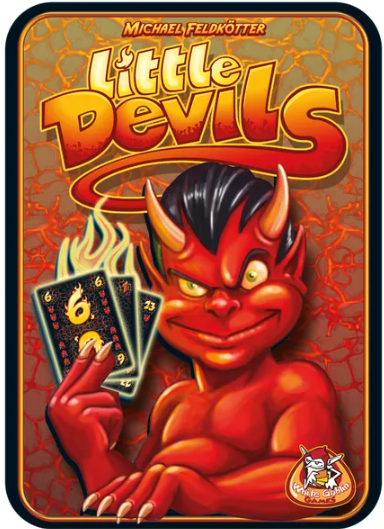
Hey, hey, Geekly Gang! Kyra Kyle here with another board game review. Today’s game is Michael Feldkötter’sLittle Devils, a quick trick-taking game with a twist. Little Devils has no suits. Instead, players must follow the first card (in a series of 54 numbered cards) that’s played per round. The second card dictates which direction every other player must follow (up or down from the original number). The player who either plays in the wrong direction (up instead of down) or plays the furthest number from the original card wins the trick; you’re trying to win as few tricks as possible. Little Devils takes a simple concept and bakes in some interesting choices.
Before we get any further, we’ll get devilish with Little Devils’ details.
The Fiddly Bits
Designer: Michael Feldkötter Publisher: Arclight Games, Stronghold Games, White Goblin Games Date Released: 2012 Number of Players: 3-6 Age Range: 8 and up Setup Time: Less than a minute Play Time: About 15 minutes
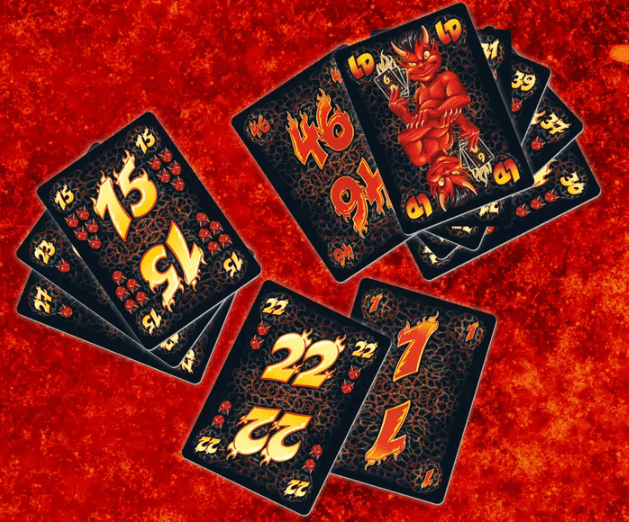
Little Devils consists of a 54-card deck. Depending on the number of players, remove a number of cards numbered between 28-54 from the game. The rulebook will state which specific cards need to be removed at each player count. Ultimately, players will be dealt 9 cards each, which should be the entire deck.
After you’ve prepared the deck, deal out all the cards.
Game Flow
For the first round, the player to the left of the dealer begins the trick; for every round after the first, whoever “won” the previous trick, begins the next trick. The first player starts the trick by playing any card from their hand that doesn’t have five little devils beneath the number. Quick note: most cards in Little Devils will have at least one little devil underneath its number. Players cannot lead a trick with a card with five little devils, unless they have no other card in their hand.
The player to the left of the starting player will play a card from their hand. If the second player plays a higher card, all other players must play cards valued higher than the first card if possible. Whoever played the highest card gets the trick, unless a player is unable to play a higher card. This player will get the trick unless more players are unable to play higher cards. If a player (or players) plays a card in the opposite direction of the second player, the player with the furthest valued card from the original card wins the trick.
After all cards have been played, a round ends. Players score the number of little devils from their tricks. As soon as someone scores 200 points, play ends, and whoever has the fewest points wins.
Review
Little Devils has a built-in catch-up mechanism: the player who wins a trick can’t possibly win the next one; they begin the next trick. I love that. It’s simple and offers plenty of strategic choices. I could play a card closer to the low or high end, thinking the players in front of me (on the scoreboard) might get stuck with a trick or two. There are even cards that have no little devils on them. Often, when I know I’m going to get stuck with a trick, I’ll play one of the one devil or no devils cards to net the fewest little devils I can.
While you could card count during Little Devils, it doesn’t matter that much. Little Devils plays quickly. It’s more fun to play a second game. Even when I’ve finished last (triggered the end game), I feel like I did something if I stiffed someone else with a bunch of points during one round. Little Devils is a great filler game. It may get overshadowed by Cat in the Box (we still need to review that game), but it requires less setup, is an easier teach, and I’ve found more gamers catch on to Little Devils a lot faster.
Too Long; Didn’t Read
Quick to pick up and easy to teach, Little Devils is an excellent trick-taking game that offers plenty of strategic choices, a brilliant built-in catch-up mechanism, and fun gotcha moments.
Hey, hey, Geekly Gang! Kyra Kyle here with another Top 5 Tabletop Games throughout the years. 1998 saw the continued dominance of collectible card games (CCGs). Fewer CCGs were released this year, but established ones kept board game stores afloat. 1998 had a lot of great board games, but many of them didn’t have the same staying power as previous years in this series. There may be more than one forgotten gem on today’s list. We’ll get to the games in a minute, but first, let’s look at our criteria.
1: Cultural relevance plays as much of a factor as overall quality. A game might make a list that doesn’t hold up to others of its type, but you must admit the game is everywhere.
2: Only one game from a franchise makes the list. This will become more of an issue the closer we get to games with expansions.
3: Longevity plays a role, too. A game doesn’t have to fly off the shelves today, but it had to have some widespread appeal for a decent time.
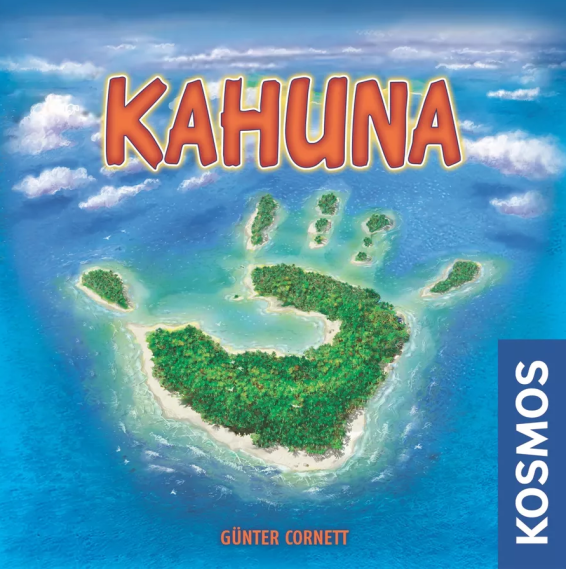
5: Kahuna (1998)
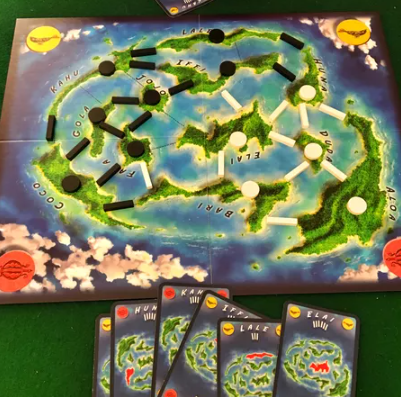
Kahuna fits the bill of a forgotten gem. This two-player game has players assume the role of ancient sorcerers of the Pacific. You compete for dominance of an archipelago consisting of twelve small islands. Players use cards to place bridges between islands and remove opponent’s bridges. If you get the majority of bridges around an island, place one of your marker stones on it and remove any of your opponent’s bridges to that island. This could, in turn, cause your opponent to lose a bridge majority on an adjacent island.
Kahuna plays in three rounds. A round ends when all cards from the face-down deck and the three face-up cards have been used. Kahuna is a fast-paced area control/majority game. It’s one of the better two-player games from this era, but Kahuna’s status as a two-player only game may have prevented it from seeing wider gameplay. Still, Kahuna was a finalist for the Spiel des Jahres (the German game of the year).
4: Elfenland (1998)
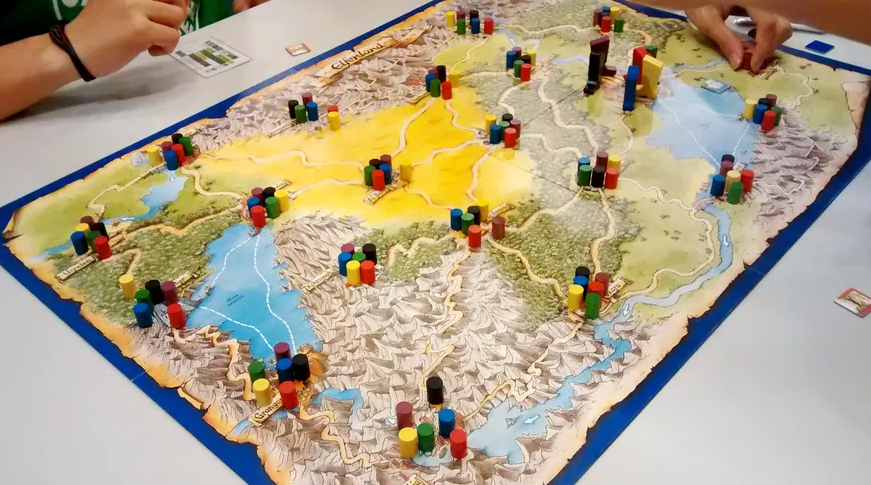
We go from a Spiel des Jahre finalist to 1998’s Spiel des Jahre winner, Elfenland. Elfenland is a redesign of the original White Wind game Elfenroads. The game is set in an elvish world. Players begin in the Elf capital, draw one face down movement tile, and are dealt eight transport cards and a secret “home” city card that they must reach at the end of the fourth round or lose points for each city space away from “home” they are at the end of the game.
Elfenland’s designer, Alan R. Moon (Ticket to Ride), has a knack for route-building games. Elfenland marks the first time Moon has made one of these lists. I may have just spoiled the game, but this won’t be the last time we’ll see Moon on one of these lists. Elfenland shares some similarities with Moon’s more popular Ticket to Ride. Elfenland is another forgotten gem.
3: Guillotine (1998)
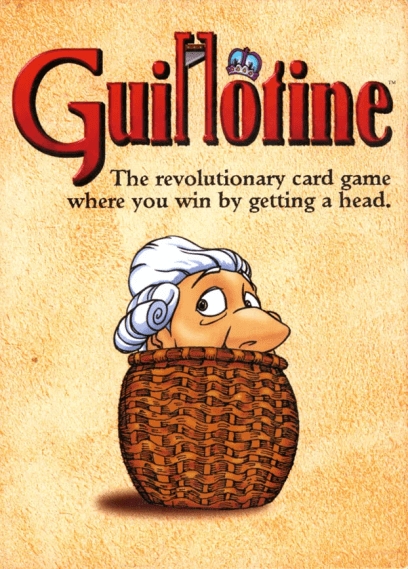
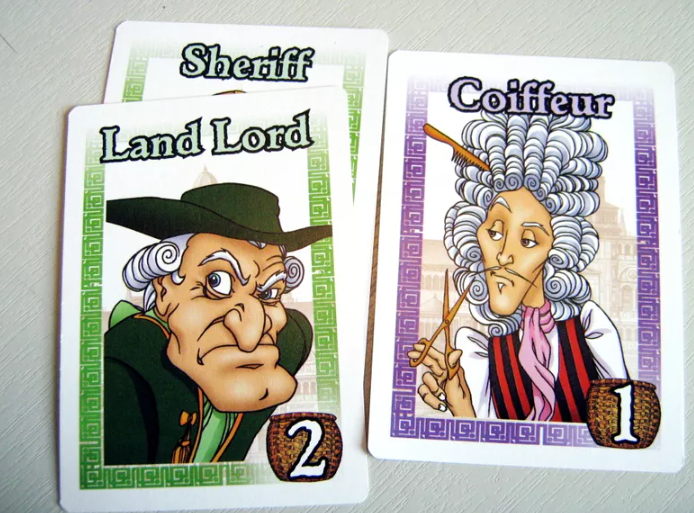
Guillotine is yet another forgotten gem, and its theme is one of the most macabre and interesting of 1998. Players take the role of executioners during the French Revolution. In Guillotine, you’re doing your best to manipulate the execution line and score as many points, claiming the lives of nobles, clergy, and former military as you can. Off with their heads!
If you like Gallow’s humor, you’ll love Guillotine. I say this a lot, but this will not be the last Paul Peterson design to make one of these lists. Peterson has a knack for taking traditional card games in strange and exciting directions. Guillotine is bloody fun.
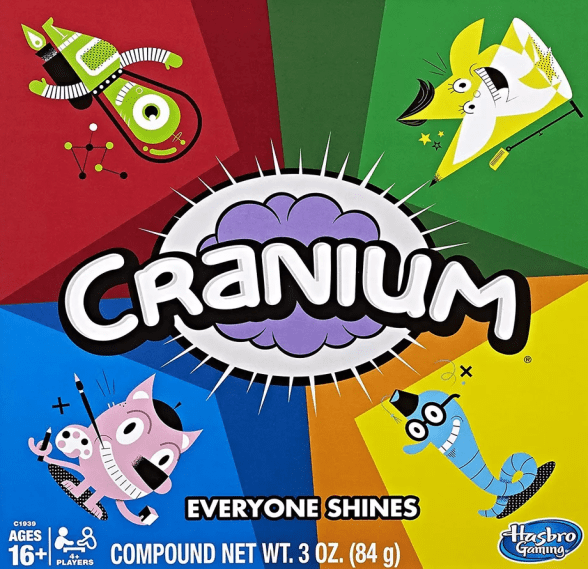
2: Cranium (1998)
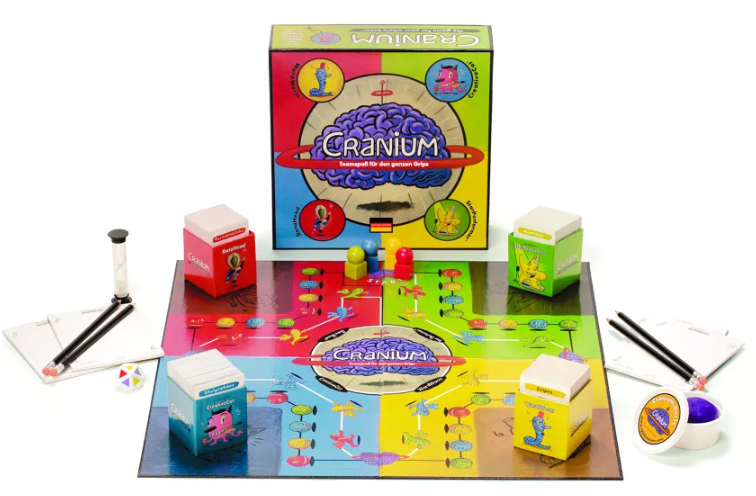
Cranium marks the first mass market board game (a game one can find in department stores) to make one of these lists in several years. While it may have faded in popularity, Cranium took elements from various party games and formed what it claims is “the whole-brain” game. Cranium identifies four main party quiz game elements and gave them names: Creative Cat, Data Head, Word Worm, and Star Performer.
Creative Cat involves sculpting and drawing. Data Head is trivia. Word Worm has players unscrambling words, challenging them to spell a word, and guess definitions. And Star Performer includes whistling songs, impersonating a celebrity, or acting out a clue. Cranium managed to assemble as many party quiz game elements into one game as one can. In fact, I still don’t think a party quiz game has managed to include as many elements as Cranium’s into a single game design.
1: Through the Desert (1998)
Reiner Knizia takes another top spot on one of these lists with Through the Desert. Through the Desert is one of those games players remember fondly and hold in high regard. But I rarely see anyone playing Through the Desert, making it yet another forgotten gem on this list. I’d argue Cranium, despite its status as a mass market board game, is another forgotten gem. This entire list is made up of forgotten gems. Getting back to Through the Desert, it takes inspiration from the classic game of Go. Through the Desert also completes Knizia’s tile-laying trilogy of games: Tigris & Euphrates (1997), Samurai (1998), and Through the Desert (1998).
In Through the Desert, players attempt to score the most points by snaking caravan routes through the desert, trying to reach oases and blocking off sections of the desert. Two to five players control a tribe of nomads vying for control of the desert. Strategy is key in building your tribe’s caravans. There are multiple paths to gain points, but Through the Desert manages to keep its cognitive load low, meaning it’s easy to learn but difficult to master. Through the Desert is deserving of its Spiel des Jahres recommended status.
Did we get the list mostly correct? Let us know which games you’d add in the comments. Thank you for reading, and wherever you are, I hope you’re having a great day.
Happy Friday, Geekly Gang! Kyra Kyle here with another board game design brain dump. I’m taking a break from Rustbucket Riots—which I covered in last month’s brain dump–and discuss a Blackjack Deck Building game I originally made in 2018. Seven years! Yikes! Guess I got the seven-year itch. This Blackjack Deck Builder has gone through multiple minor rule modifications and name changes. The deck, based on a standard playing card deck, doesn’t have jacks and kings, so it’s had the name No Jack and No Kings.
Play Faster
My oldest daughter had a high school friend, who will remain nameless. We’ll call her C. C loved deck building games, but she wouldn’t draw her hand at the end of each turn (allowing her to plan her next turn), and every time she drew cards into her hand, she’d act like she was reading them for the first time. This frustrated my daughter and her friends. I thought of No Jack or No Kings to fix this issue.
A quick explanation of deck building card games: each player begins with the same (or at least similar) small decks and purchase cards from a supply to add to their decks, making each deck unique.
While many starter cards in a deck building game have limited text, cards one would add to their hands could contain a heap of text. This would cause C’s turns to last three minutes or more, as she read the more complicated cards that she added to her deck. So, I took out most text. Standard playing cards have little to no text. Next, C had the issue of not drawing her hand at the end of her turn. What standard card game doesn’t require a hand? Blackjack.
The above sample card (Page of Coins) is a prototype. The end product will hopefully look a lot better. Lol.
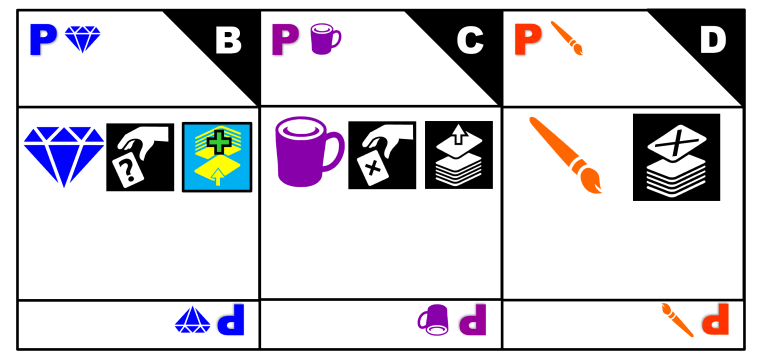
I merged deck building with Blackjack and came up with No Jack or No Kings, and it worked. With the exception of changing the suits, the only cards that look different from a deck of standard playing cards are the face cards. C knew how to play Blackjack. Players would draw cards from the top of their decks, following the standard rules for Blackjack. If you drew over 22 points of cards, you’d bust and lose your turn. If a face card remains in play (without busting) at the end of a turn, the player can move the face card to their tableau and gain its ability. In the case of the page above, every time that player draws a coin suit card, they gain one extra money to purchase other cards. No Jack/No Kings starter decks begin with one face card from one of the four suits. Each suit has a different power.
Trouble with Asymmetry
Most players in deck building games begin with the exact same cards. Choosing to go with asymmetric powers at the onset of this game, however slight, proves difficult to balance. Brushes allow players to cull cards from their discard. Deck building experts see this as overpowered. But Diamonds and Cups have better win percentages. Diamonds allow players to manipulate decks (take cards from a discard and placing them on the bottom). If you’re good at counting cards, you can induce more 21s (or Blackjacks). Cups let players discard a drawn card and draw a new one. This is also strong.
The first page I showed, the Page of Coins, is the weakest of all four. But perception matters. Even though I’ve playtested No Jack/No Kings hundreds of times and found Cups and Diamonds win more often than not, players still “feel” more powerful with Brushes and, to a lesser extent, Coins. Granted, one of my playtest weekends was with someone at a Protospiel. He played No Jack/No Kings throughout the entire weekend (like a few dozen times), hoping to sculpt a deck of only Tens and Aces. This gamer played Brushes in each game and lost every time. Winning didn’t factor into his enjoyment. He wanted to build a near-perfect deck. So, the numbers may be a little skewed.
Does anything need to be changed? Honestly, I don’t know.
How to Win at No Jack/No Kings
I just realized we discussed No Jack/No Kings mechanisms without sharing how to win. There’s a separate deck of Patrons. Every patron can be claimed with a Blackjack (21), but each patron also gives discounts to two suits. If you have a face card from either suit in your tableau and you reach the lower number, you can claim the patron. Every turn, you can either claim a patron or purchase cards from the supply. That’s how the gamer (Protospiel) lost so many times. He would purchase cards if they fit in his “perfect deck” instead of claiming a patron. The first player to claim six patrons wins.
No Theme and Simple Mechanisms
I don’t know why I shelved No Jack/No Kings for almost a decade. My best guess is that I wanted No Jack/No Kings to have more theme or more complexity. I no longer care if No Jack/No Kings has a theme, and any additional mechanisms I added to the game diluted the core gameplay. I was obsessed with everything No Jack/No Kings didn’t have and failed to see what it did have. That same Protospiel (seven years ago, I’m guessing), I only taught the game once. Other gamers taught No Jack/No Kings to the rest of the convention, and the game was played consistently for two and a half days. I need to get out of my own way. Ugh!
I’m finalizing the starter decks and the cost of cards. But there are shockingly few things to balance/tweak after I pin down the starter decks, so I’m left with one question. Which name do you like better, No Jack or No Kings?
Let me know in the comments. Thank you for reading, and wherever you are, I hope you’re having a great day.
You’ll want to shed your hand of cards quicker than anyone else in L.L.A.M.A. The Card Game, but you might not be able to play what you want. Strategic quitting, which freezes the cards in your hand, may be the key to victory in this silly, engaging (German Game of the Year) Spiel des Jahres-nominated game. Don’t get stuck with a llama!
Hey, hey! Kyra Kyle here. I mentioned L.L.A.M.A. The Card Game in a previous Whatcha Playing post and figured we should cover the game with a full review. I’m unsure if we’ll continue doing this with future board game reviews, but I’ve played a lot of L.L.A.M.A. The Card Game (also known as Don’t L.L.A.M.A. The Card Game) in the past several months. Board game design legend Reiner Knizia made another rules-light, fun game, but before we discuss L.L.A.M.A., we don’t want to skip the fine print.
Above is the designer Reiner Knizia dressed as a llama.
The Fiddly Bits
Designer: Reiner Knizia Publisher: AMIGO Date Released: 2019 Number of Players: 2-6 Age Range: 6 and up Setup Time: Almost none Play Time: Less than 20 minutes
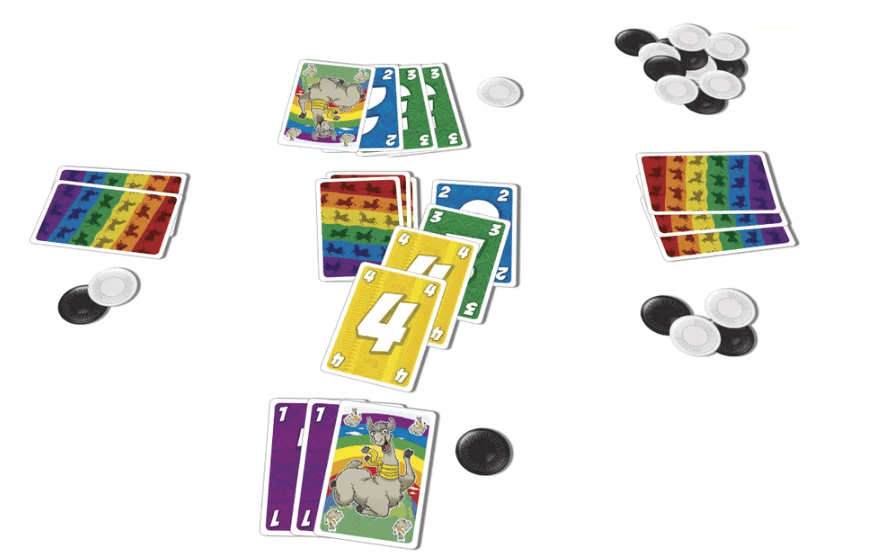
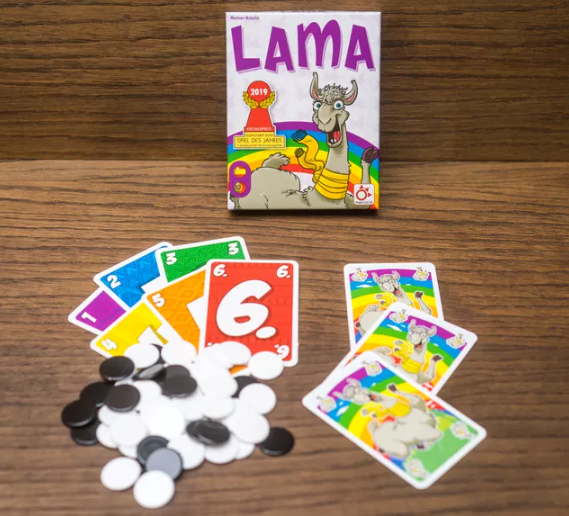
Shuffle all the cards and deal six cards to each player. The remaining cards make up the face-down draw pile. Turn over the top card to start the discard pile. Have the tokens nearby to give all players access, and you’re done.
Game Flow
L.L.A.M.A. has an easy-to-read and brief rulebook, so I’ll borrow heavily from it. L.L.A.M.A. is played over several rounds. Randomly choose who goes first. During your turn, players may take one of these three actions:
* Play a card * Draw a card * Quit
Play a Card
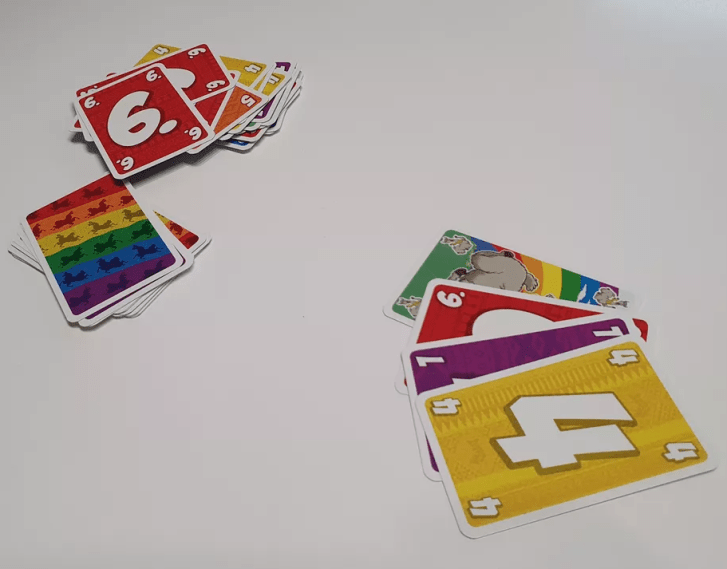
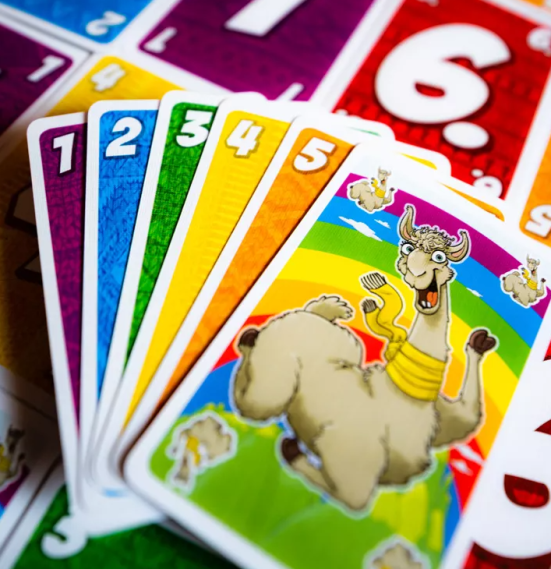
Cards are numbered 1-6, and there’s a seventh, specialty card (the Llama). The top card on the discard pile determines which cards can be played. You can play a card with the same value as the top card or a value that’s one more than the top card. Llamas can be played on 6s or other llamas. On top of a llama, you can play another llama or a 1.
Draw a Card
You may draw 1 card from the draw pile. You can’t play this card on the same turn, so the turn passes to the next player. If the draw pile runs out, don’t create a new one. From now on, you can’t choose this action.
Quit
If you can’t play a card or don’t want to, and you don’t feel like drawing a card either, you can quit for the current round. Place your cards in front of you, face down. You are no longer playing this round.
End of Round
The round ends if:
* One player has played all of their cards. * All players have quit for the round.
If all but one player has quit the round, that player continues on their own. However, this player may no longer draw cards.
Scoring
Your remaining cards give you negative points, no matter if you have them in front of you (quitting) or in your hand. Each card is worth its value in points. Llamas are worth 10 points.
However, you count each card value only once per round, so if you have four 1s, for example, you only get one point. Likewise, all of your llamas would only give you a total of 10 points.
Taking Tokens
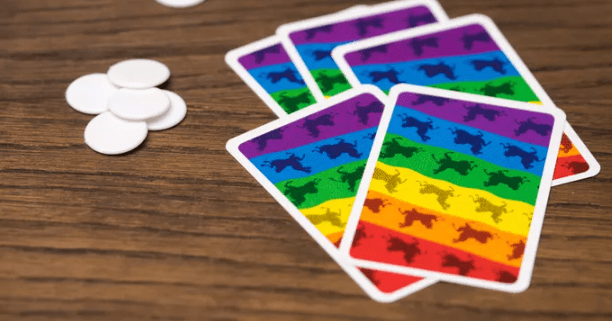
Tokens denote your negative points. There are white 1-point tokens and black 10-point tokens, which you may swap at any time.
Returning Tokens
If you played all your cards during a round and you have tokens from a previous round, you may return one of them (either a 1-point or 10-point token).
Shuffle all the cards and deal another six cards to each player for the next round. Start a new discard pile with the top card from the draw pile. The last player to play a card in the previous round starts off the new round.
End of Game
Continue playing until one of you has collected 40 or more points. The player with the fewest points wins the game. If there is a tie, the players share the victory.
Review
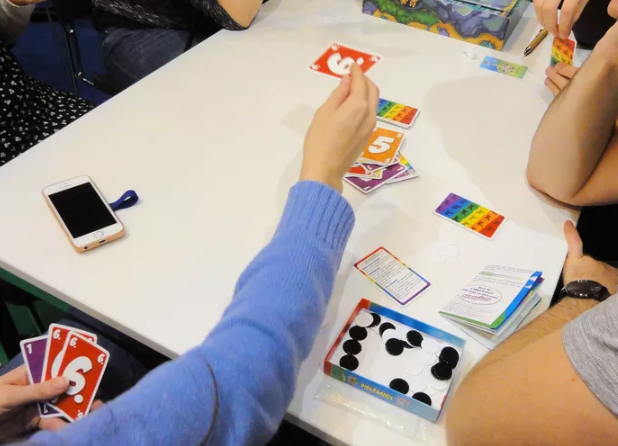
L.L.A.M.A. The Card Game may play a touch like Uno, but it has just enough juice to hold my attention. Players need to shed the cards in their hand, much like Uno, but the option to quit for the round and discarding the right cards makes all the difference. Sure. Most games of L.L.A.M.A. revolve around the right cards showing up in the deck. In fact, the first couple of times I played L.L.A.M.A. I had either forgotten about the quitting rule or the person who taught me the rules forgot to explain the rule. L.L.A.M.A. played without the quitting rule plays like a less backstabby Uno. But after learning about (or remembering) the quitting option, I’ve experienced enough rounds where strategic quitting works.
I’ve been dealt a stellar hand at the beginning of a round (five 1s and another card). As soon as I can play the one card that isn’t a 1, I’d quit for the round and take one point. Quitting puts a ton of pressure on one’s opponents to shed cards quickly and then quit themselves. While it may seem at first like an advantage to be the final player in a round, you can no longer draw cards. If you can’t go out with what’s in your hand, you’re scoring with whatever cards remain, and you don’t want to get caught with any llamas. Hence the game’s alternate name, Don’t L.L.A.M.A..
The game’s odd theme, silly titular mascot, and bright colors add to L.L.A.M.A.’s charm. And llama is a fun word to say. Llama, llama, llama, llama. L.L.A.M.A. is a hit with multiple game group types. I’ve played with numerous demographics and ages. The game is easy enough to quickly grasp and allows for interesting choices for more serious gamers (like strategic quitting or going out one round and discarding a token of your choice). L.L.A.M.A. is light enough that many of my Monday Game Nights begin with this game, and everyone chats while they throw down a card from time to time. It’s games like this that remind us of the social aspect of board games.
Too Long; Didn’t Read
More than just a less cutthroat Uno, L.L.A.M.A. The Card Game adds strategic quitting for the round, which adds pressure to your opponents. While I can’t see myself playing too many rounds of Uno, I’ll gladly play a game or two of L.L.A.M.A. The Card Game.
We had to discuss the Marvel United: Fantastic Four expansion from the Marvel United: X-Men launch. In fact, we’ll begin our coverage of the Marvel United: X-Men wave with this expansion. Hey, hey, Geekly Gang! Kyra Kyle here. We return once again to Marvel United. This is one of those game systems with a heap of expansions. Too many, if you ask me. But we’ll cover the expansions that will either be fan favorites (plenty of people will be interested in adding them to their collection) or good additions because of their gameplay variants. Fortunately, Marvel United: Fantastic Four fits both criteria.
We’ll get to Marvel’s first family in a minute, but first, let’s take a look at Marvel United: Fantastic Four’s less heroic details.
The Fiddly Bits
Designer: Andrea Chiarvesio, Eric M. Lang, and Francesco Rugerfred Sedda Publisher: CMON Global Limited and Spin Master Ltd. Date Released: 2022 Number of Players: 1-5 Age Range: 8 and up Setup Time: 5-10 minutes Play Time: 30-40 minutes
We already covered the Game Setup and Game Flow in our original Marvel United review (here’s a link to that review), so we’ll go over the basics in the following two sections. Let’s cover an abbreviated review of the game setup and rules.
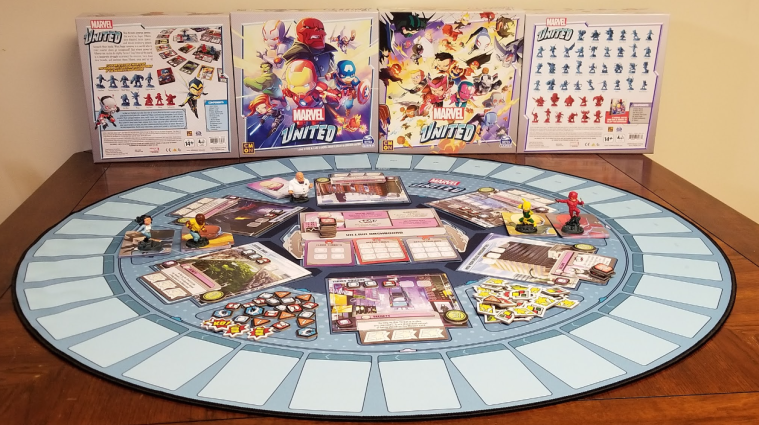
Marvel United: Fantastic Four’s setup can change depending on which Villain(s) and Heroes you choose to play. Each game consists of six locations. Since Marvel United: Fantastic Four is an expansion, only includes four locations, and you’ll need a core set in addition to this expansion to play. You may choose your locations or shuffle them and choose six at random. Each Location card has spaces at the top for civilians and thugs, and a rectangle with a block of text that will state “End of Turn” at the top of the box.
Place civilian/thug tokens on their matching spaces. Shuffle the Villain’s Threat deck and deal out each Threat face-up so that it covers the rectangle at the bottom of each location. You must clear this threat before gaining the “End of Turn” effect printed on a Location. Place health tokens where signified on threat cards and on the Villain dashboard. Place the three mission cards (Defeat Thugs, Rescue Civilians, and Clear Threats) face up under the villain dashboard where the text reads “Unlocked.”
Each player shuffles their hero decks and then draws three cards to form their hands. Shuffle the Villain’s Master Plan deck. Leave the Master Plan deck face down. This will be the villain’s draw pile.
Players place their miniatures on one of the six location cards, usually the centralmost location for each player (easy access). Then, they place the villain on the location card opposing the heroes. If one player chooses to play as the villain, hand the Super Villain cards to them, and the Heroes gain access to Super Hero cards. These new card times can be played if the game state triggers their use (for example, “You play a Master Plan card” or “Any Hero has 4 or more cards in their hand at the end of the Hero turn.” Timing is key.
Game Flow
The villain(s) play first. Draw the top card of their master plan deck. The villain moves the number of spaces indicated. Resolve any BAM! Effects and these effects will be printed on a space within the villain’s dashboard. Then, place the civilian/thug tokens (if any) indicated at the bottom of the card. If a player has taken the role of the villain, they get a hand of cards and can choose which card they play. The heroes get their turn after all the villain’s effects are resolved.
Heroes pick which player goes first, and hero turns will continue around the table clockwise. At the beginning of each game, Heroes will get three turns before the villain receives another turn. During their turn, heroes play one card from their hand.
Resolve actions and the symbols printed at the bottom of the hero’s card in any order. The symbols at the bottom of a hero’s card will be shared with the next player, but any printed action will not be shared. Heroes will use these actions to complete missions. The game begins with three missions in play: Defeat Thugs, Rescue Civilians, and Clear Threats. Each mission card will have spaces for the tokens they require to complete. As soon as these spaces are filled, the card is discarded, and the mission is considered complete. Mission cards can be completed in any order.
After the heroes complete the first mission, the villain panics and will act (play a card) every two hero cards instead of every three hero cards. After the heroes complete the second mission, the villain becomes vulnerable to damage. The heroes can complete the third mission, but it isn’t necessary. If the heroes do complete the third mission, each hero immediately draws 1 card, increasing each player’s hand size by one.
Play continues back and forth until either the villain wins (by completing their unique master plan or anyone, heroes or villains, runs out of cards) or the heroes win by dealing enough damage to the villain after the villain becomes vulnerable to damage.
Review
Marvel United: Fantastic Four has a huge legacy to live up to, and it lives up to the hype. I’m writing this review in June 2025, and Marvel United: Fantastic Four’s BGG score is an 8.5 (out of 10). This makes Fantastic Four the highest-rated Marvel United expansion. Yeah. It’s—pardon the pun—fantastic.
While Marvel United: X-Men Blue and Gold Teams features semi-cooperative play (players compete to clear the most goals), and this gives me strong X-Men: Under Siege vibes (a game I have a soft spot for), Fantastic Four introduces the idea of teamwork, and it does so simply and elegantly. Included in the box is a Fantastic Four team card. Various hero cards (from the members of the Fantastic Four) will add action tokens to the card, and can then use all actions on the Fantastic Four team card with different cards in their deck. This promotes a slow build. It simulates teamwork without using a lot of convoluted rules. I like the Team Cards from Marvel United’s third wave (Multiversus), but the method used in Fantastic Four is easy to follow and makes narrative sense.
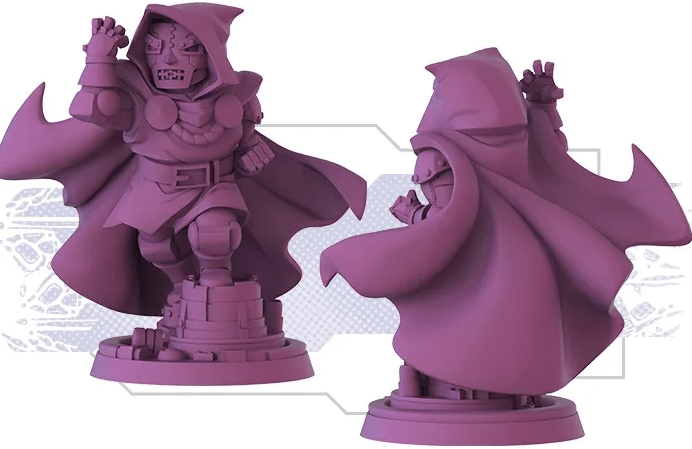
Marvel United: Fantastic Four includes six heroes. One of which is the anti-hero (hero and villain) Doctor Doom. That’s a lot of heroes for one expansion—it’s almost as many as a core box—and each hero illustrates Marvel United’s second wave’s power creep. Granted, to get the most out of the Fantastic Four characters (Mr. Fantastic, Invisible Woman, The Thing, and Human Torch), you’re encouraged to play as the Fantastic Four. The aforementioned Fantastic Four Team Card is amazing, but these characters are still effective outside the team setting.
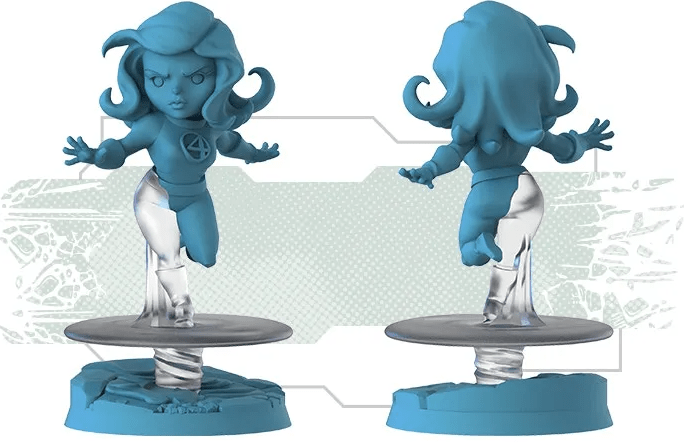
Each member has a unique flavor. Mr. Fantastic is flexible. Get it? Flexible? Ha…ha. Invisible Woman can avoid damage altogether (using her “Invisiblity” card), but she takes herself out of combat, which makes sense. Human Torch can use Nova Flame and deal 2 damage to everything at his location—super useful. And The Thing deals copious amounts of damage and can ignore 1 damage during each Villain Turn. Very nice.
The remaining two heroes, Doctor Doom and Silver Surfer, don’t gain any benefit from the Fantastic Four team card, but they don’t need it. Doom gets tokens for each damage he takes. He can even use the symbols from the 3 previous Hero cards in the Storyline (instead of the previous one). This can generate as many as seven actions on a single turn. Yikes! Silver Surfer has extra card draw, can move anywhere with one of his special abilities, and can exchange a Location in play with one that isn’t in play. What? Silver Surfer can literally yeet any Location for another Location. That’s coconuts.
But Marvel United: Fantastic Four’s villains are just as overpowered as their hero counterparts. Even though Doctor Doom is the marquee villain, we’ll begin with Super-Skrull. Don’t overlook Super-Skrull. He has one of the more unique Special Rules in Marvel United. Whenever he BAM!s, he performs actions based on the symbols on the last Hero card in the Storyline. The heroes have some control over what Super-Skrull can do, but that doesn’t matter. None of Super-Skrull’s BAM! actions are things you want to happen. Super-Skrull attempts to knock out (KO) and hand each in-play hero a KO token, but this isn’t the only way he can win. Super-Skrull can’t be damage if any Crisis tokens exist, and he adds cards from his deck facedown in the Storyline, which leads to a shortened clock.
Super-Skrull is a spiffier version of Green Goblin. He does enough things well that you must split your focus on the various ways he can win, and even though he doesn’t have Henchmen (like Green Goblin), he makes up for it with crazy Threat card abilities that make clearing Thugs and Civilians less efficient, and each Threat card requires one of each action type. Super-Skrull covers all bases. But most people purchase Marvel United: Fantastic Four for Doctor Doom, and Doom delivers.
First off, Doom must be played with Latveria—naturally—and Latveria is the first Location card that has a negative “End of Turn” effect. In fact, Doom only has five Threat cards because Latveria begins the game without one. Latveria marks the first time Marvel United has included an “End of Turn” effect that benefits the villain. “You MUST take 1 damage for each Thug or Doombot in this Location.” Ouch! Latveria begins every game with three Doombot tokens, so if you don’t take out all of the Doombots, you’re discarding your entire hand. Double ouch! Doom’s Threat cards add extra Doombots (sometimes not even in the same place as the Threat card’s location) and can deal extra damage to heroes. Triple ouch!
As for his Villainous Plot, Doc Doom plays like Red Skull but way, way worse. He can increase the Doom Track (changed from the Red Skull’s Threat Track) far more often, and he can’t be damaged if a Doombot is at his Location. In short, Doctor Doom is nasty. You’ll need the Fantastic Four with their Team Card to defeat him. It can be done, but it’s a tough go. I find Doctor Doom tuned to the perfect level of difficulty. He may be one of the many reasons Marvel United: Fantastic Four is the highest-rated Marvel United expansion.
We talked about Latveria, but there’s another Location, Mount Wundagore, that has a negative “End of Turn” effect: Each Hero in this Location MUST discard all cards in their hand and draw the same number of cards (this does not KO). Even though this effect doesn’t count as a KO, it’s another way to shorten the clock. If anyone (including Heroes) runs out of cards in their deck, the heroes lose. Yowza! I like Marvel United: Fantastic Four’s inclusion of villain-centric Locations. We’ll see more of this later in the series, but villain-centric Locations do a lot to shake up Marvel United’s status quo. The remaining Locations have unique “End of Turn” abilities as well. The Baxter Building provides token draw if the character you’re playing was ever a member of the Fantastic Four. This is a boon for anyone who knows the comics. I appreciate that.
I also appreciate the Takeover Challenge card included in Marvel United: Fantastic Four. If a Thug, Civilian, or Doombot token can’t be added to a Location, after resolving Overflow, place the excess tokens on the Takeover card. If the card is full, Heroes immediately lose. The Takeover card has two sides with different difficulties (number of spots for tokens). This Challenge card, like the Fantastic Four’s Team Card, is simple and elegant. It adds just enough difficulty if the game has gotten too predictable.
Too Long; Didn’t Read
Marvel United: Fantastic Four is the highest-rated Marvel United expansion on BoardGameGeek and for good reason. This expansion adds more layers of complexity while staying thematic and not burdening the player with too many over-complicated rules. Every element from the Locations, the Challenge Card, the Heroes, and especially the Villains is well thought out and an excellent addition to any Marvel United collection.
Happy Sunday, Geekly Gang! Kyra Kyle here with another week of Geek News. This past week confirmed a months-long rumor: Warner Bros. is for sale.
Bugs Bunny looks enthused with being on the market. We’ll discuss Warner Bros. posting a for-sale sign and this week’s new releases for board games and video games during this week’s Geek News.
Warner Bros. For Sale
No. Yakko and Wakko aren’t for sale. Warner Bros., as a property, is for sale. After months of speculation that Paramount would purchase all of Warner Bros., Warner Bros. removes all doubt by announcing it intends to sell, but the entertainment giant states it wants as much money as possible. If that means a single party purchases Warner Bros., great, but if Warner Bros. can accrue more money by slicing its properties into smaller pieces, fantastic.
My guess–and this is just a guess–is Warner Bros. will choose to split up its properties. Unless one entity blows away Warner Bros. with an offer for everything, the studio will most likely sell to numerous buyers. Of course, Paramount has expressed interest. The rumors appear to have been true, and Warner Bros. rejected Paramount’s first offer. Apple TV has also expressed interest. And I wouldn’t be surprised if Disney wanted to acquire a property or two. Looney Tunes could be added to classic Disney characters. Marvel and DC Comics could have crossover movies. I could continue. The possibilities are endless; only time will tell what will become of Warner Bros.’s properties.
Geekly tends to cover superhero movies, so we’ll focus on what a Warner Bros. sale would mean for the newly minted DCU. While DCU Chairmen James Gunn and Peter Safran could lose their jobs after DC Studios is sold, I doubt this will actually happen. Love Gunn and Safran’s DCU or hate it, I don’t expect new leadership to pull the plug on a profitable franchise this soon after it launches. And yet, profits may regulate the DCU’s future.
Producing DCU films and shows costs a lot of money. At the moment, Gunn and Safran intend to accelerate the DCU’s slate of projects. Lanterns, Supergirl: Woman of Tomorrow, and Clayface are slated for a 2026 release. We could see another season of Harley Quinn and Creature Commandos next year, too. And the DCU has plenty more scheduled for the not-so-distant future. Wonder Woman: War of the Gods, The Brave and the Bold, The Batman 2, Booster Gold, and Waller have all been rumored or announced for a 2027 release. New ownership may slow down the frequency of upcoming DCU releases.
I don’t believe anything will change with the DCU’s release schedule until after a sale takes place. So, the DCU’s 2026 release schedule should remain mostly untouched. Who knows? Depending on DC Studios’ buyer, nothing may change. Who would you like to purchase DC Studios?
While I wouldn’t mind a single Marvel-DC Comics crossover movie (or even a trilogy of them) or a series, I prefer these two worlds to remain separate. Apple could use the content more than Paramount, but it’d be interesting to see Star Wars and Marvel on one platform, while Star Trek and the DCU were on the other. Share your thoughts in the comments.
Threshold Launches on GameFound
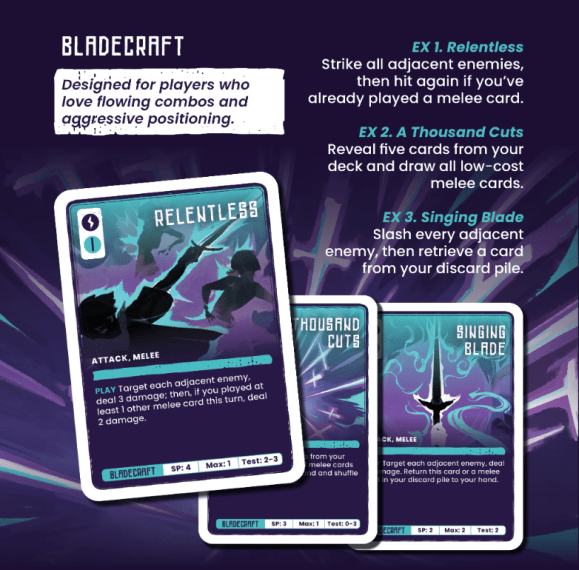
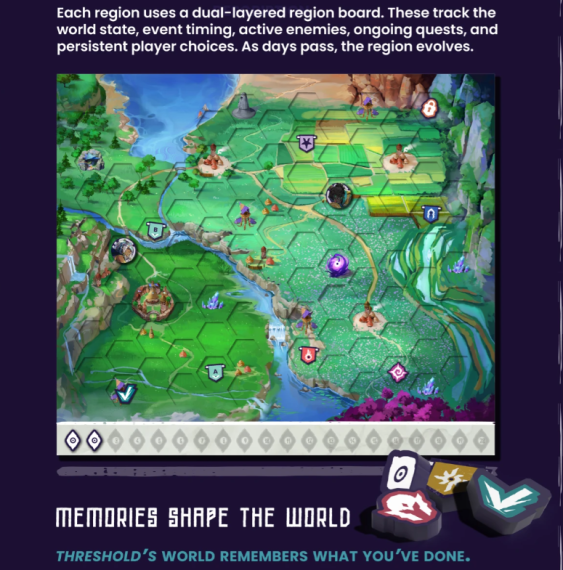
Blending tactical card-based combat, deep character customization, and endless loot, Threshold immerses its players in a massive, open, living world that responds to their choices. While I have yet to play Threshold, player turns appear easy to understand. Each player’s round plays out with the same rhythm: 1) Draw 5 cards from your deck, 2) Spend cards to perform actions, 3) Enemies act, and 4) Advance the day. I like the Threshold’s streamlined design.
As of the writing of this post, Threshold has yet to launch, so I can only speculate on its gameplay. It appears as if players may mismatch the cards in their deck, creating a unique character. If that’s the case, count me in. Combat seems quick and tactical. I like the idea of Threshold’s world adapting to my choices, but I hope that extends beyond combat. Threshold’s description suggests that players will travel from region to region, where dynamic events occur. Could this be a great blend of MMOs and action RPGs?
I’ve been looking for a good RPG in board game form. Threshold piques my interest. If you’re interested in Threshold, check out its GameFound page.
Drawing Dead Launches on GameFound
After meeting an untimely end in a saloon poker game turned deadly, you awake in purgatory. With new powers and a set of poker cards forged from your soul, you must play your way through the three gates of purgatory and ride into the afterlife. Drawing Dead has a killer theme. Pun intended. I love the Solo Game of the Month company. I don’t know how they’re able to produce stellar solo games most months (I’ve seen them skip one or two months here and there). I’ve been playing a ton of Balatro recently, so Drawing Dead is right up my alley.
Drawing Dead’s player deck is a fully functional poker deck. I am down with the four-colored suits and may pick up a few copies of Drawing Dead to play standard card games. Just ignore the special effects printed in the middle of each card. While we don’t yet know the pledge values for Drawing Dead, Solo Game of the Month tends to sell their games for around $30. If you’re interested in Drawing Dead, check out its GameFound page.
Joyride: Full Throttle Speeds onto GameFound
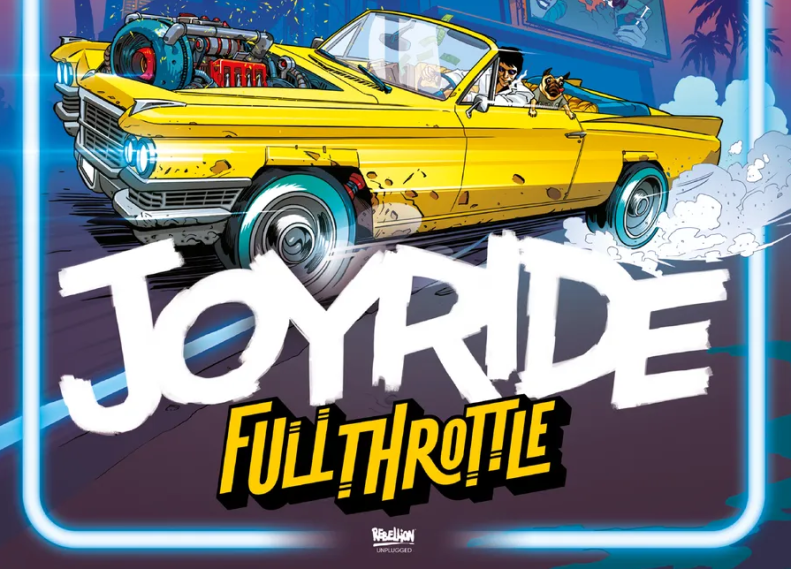
Who wants to play a destruction derby? Joyride: Full Throttle is equal parts Formula D, Mario Kart, and Destruction Derby (this was a Mad Max-like video game back in the day). Comic book artist Ant Williams’ work gives Joyride: Full Throttle character. Joyride: Full Throttle oozes character from its pores. I can’t wait to drift around the beachfront boardwalk and abandoned mall. Each map has its own identity.
And each driver and vehicle has their own vibe, too. And you know I’ll be loading up on Thumpers, Wrenches, and Volleybombs, waiting for the perfect moment to drop them on my opponents.
Push your luck as you take corners at speed. Manipulate dice on your dashboard, balancing precision and speed. Smash into your rivals to knock them off course. I love how interactive Joyride: Full Throttle is. And publisher Rebellion Unplugged just announced full miniatures. I’m certain these will cost extra (as an upgrade) when Joyride: Full Throttle releases its pledge details later this week. We don’t yet know these pledge details, but if you’re interested in Joyride: Full Throttle, check out its GameFound page.
Cascadia: Alpine Lakes Launches on KickStarter
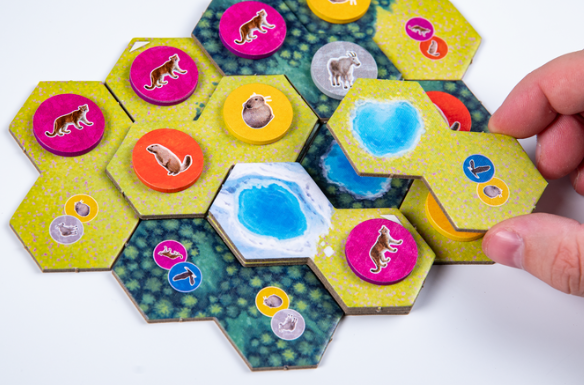
I may need a refreshing dip in a lake after that last entry. Fortunately, Cascadia: Alpine Lakes has you covered. Alpine Lakes is the standalone sequel to the wildly popular Cascadia. Take your tile-laying to new puzzly heights with Cascadia: Alpine Lakes.
Cascadia: Alpine Lakes is designed by Randy Flynn, creator of the original Cascadia. Alpine Lakes shakes up the original gameplay by adding double hex tiles. These tiles add to the strategic nature of the original, and the development team behind Alpine Lakes is the same award-winning team behind Calico, Verdant, Fit to Print, Nocturne, and Knitting Circle (Molly Johnson, Robert Melvin, Shawn Stankewich, and Dylan Mangini). And Beth Sobel returns as the artist.
Cascadia: Alpine Lakes builds off the original in interesting ways. You won’t need the base Cascadia game to play this version, but there is a pledge level that includes the original Cascadia. Pledges range from $39 to $129. If you haven’t yet played the modern classic Cascadia, Cascadia: Alpine Lakes may be a great place to start. If you’re interested in Cascadia: Alpine Lakes, check out its KickStarter page.
Garage Rock Crashes the KickStarter Party
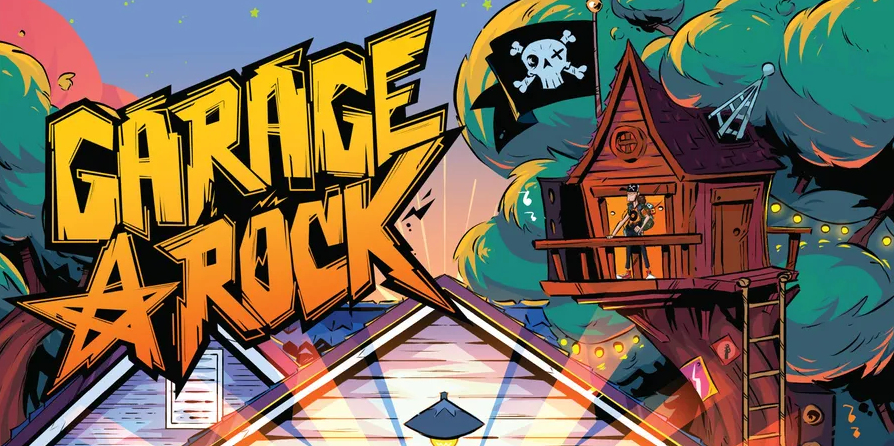
Garage Rock transports gamers back to the 1980s: big hair, cassette tapes, and BMX bikes ruled the neighborhood streets. Garage Rock is a medium-weight, worker-placement game where players step into the shoes of a teenage garage band. Fight for glory in the high-stakes “Battle of the Bands,” hosted by the infamous local pirate radio DJ, Johnny Law.
I love Garage Rock’s table presence. Check out that treehouse dice tower in the middle of the board. The stage (in the top right-hand corner) looks amazing. Garage Rock looks as if it uses a lot of table space, but that’s okay. Its toy factor and theme make up for what appears to be a large game. Who wants to rock out with me?
Compete against other players to perform at gigs. Grow your band’s popularity. And it looks as if Mariposa Games thought of everything for this game’s box insert, even a spot for the Jean Jacket expansion, should you choose to add it to your pledge. Garage Rock looks amazing. The bits are thematic like demo tapes, song tokens, talent ribbons, and 16 unique transparent acrylic instruments. Pledges range from $79 to $250. If you’re interested in Garage Rock, check out its KickStarter page.
Kavango: Lodges Expansion Launches on KickStarter
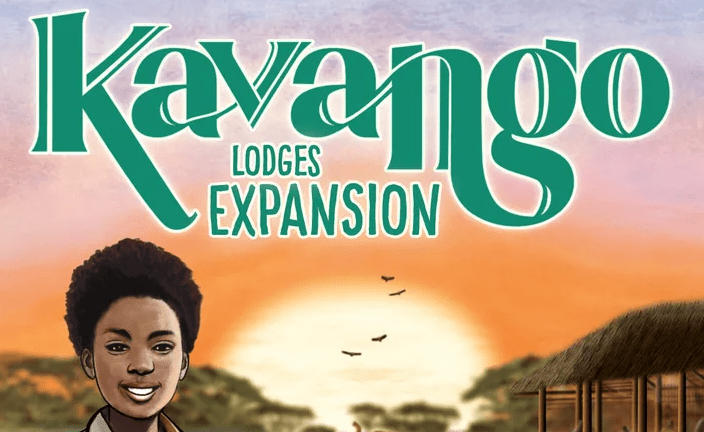
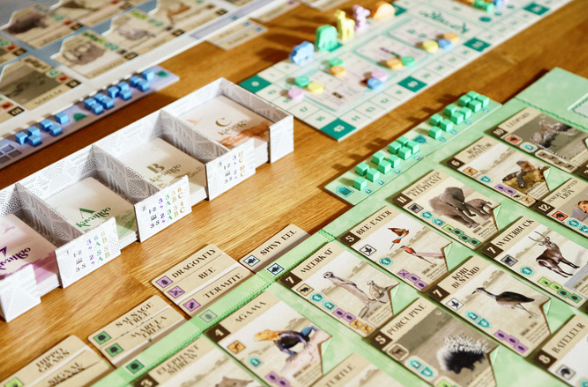
Designed by conservationists, Kavango tells inspirational conservation success stories of southern Africa. In fact, 20% of Kavango’s profits are donated to African-based charities working to safeguard the region’s extraordinary wildlife. The Lodges Expansion marks Kavango’s first major expansion. I have yet to play Kavango, but Season has and swears by this game. Seriously, it’s on her Christmas list. She’s probably editing this post, and I expect a message suggesting we back Kavango: Lodges Expansion for “research.”
Kavango uses simultaneous turns, which I love, because it keeps gameplay fast. Kavango’s theme is an important one, and I also love that Mazaza Games commits to charity. It’s a good feeling knowing your pledge goes toward a worthy cause. Kavango’s pledges are also reasonable: $20 (for just the expansion if you already have the base game), $40 for all the extras without the base game, or $60 for everything, including the original Kavango. If you don’t have the base game, I’d go with the $60 pledge; you get a lot of game for the price point. If you’re interested in Kavango, check out its KickStarter page.
Video Game Round-Up
I already covered six board game releases in quick succession. This week saw a ton of new releases, because we’re ramping up for the holidays. I’m going to go through video games quickly as well. Like the board games, these won’t be the only video games that were released this past week. Consider this section video game new release highlights.
Ninja Gaiden 4 was released over a decade after Ninja Gaiden 3 (2012). According to multiple critics, Ninja Gaiden 4 is a triumphant return to the series and well worth the wait. Like other games in the series, Ninja Gaiden 4 features punishing gameplay. Ninja Gaiden was the video game that made players “Git Gud” before Dark Souls, and 4 continues that brutal legacy. Ninja Gaiden 4 is available on PC, PlayStation 5, and Xbox Series X/S.
Sticking with the theme of older video game titles receiving their first new entry in over a decade, Katamari returns for the first time in 14 years with Once Upon a Katamari. I’ve spent countless hours rolling that funky-shaped ball, trying to get as many objects to stick to the katamari as I can. Once Upon a Katamari has received plenty of positive reviews. So, it looks like we’re two for two with returning franchises this week. I can’t wait to pick up a copy of Once Upon a Katamari. It’s available on PC, Nintendo Switch, PlayStation 5, and Xbox Series X/S.
The streak doesn’t continue, it would seem. Vampire: The Masquerade – Bloodlines fans–like me–have waited 21 years for a proper sequel to the open-world, action role-playing indie. According to many critics, Vampire: The Masquerade – Bloodlines 2 stumbles to live up to the original. This doesn’t surprise me. Bloodlines 2 had a torturous development cycle. The lead game designer changed multiple times. The lead writer was canned over a year before the game’s release. But Bloodlines 2 has a silver lining. From what I’ve heard, the writing is stellar. Any outlet that gives Bloodlines 2 a higher grade will most likely mention how deep and well-written the story’s characters are, but the janky combat and occasionally woeful performance issues make Vampire: The Masquerade – Bloodlines 2 a game I may wait to pick up at a discounted price.
Plants Vs Zombies: Replanted compiles all the game’s various iterations over the past 16 years, but the final product has been leaving critics wanting. Plants Vs Zombies’ original gameplay stays mostly intact–for better and for worse. The original game was fair and balanced most of the time, but the game had some unwarranted difficulty spikes that Replanted does little to quell. Plants Vs Zombies: Replanted tries to update the graphics, but many of the upgrades don’t quite land. Plants Vs Zombies: Replanted’s ending music video may be the most egregious. Players watch the original video on a tube television (picture inside of a picture) with downgraded graphics, which diminishes the ending’s impact.
But Replanted’s best addition may be the Cloudy Day Mode, where gameplay cycles between day and night. I may have found my way of new way to play Plants Vs Zombies. Plants Vs Zombies is available on PC, PlayStation 4, PlayStation 5, Nintendo Switch, Nintendo Switch 2, Xbox One, and Xbox Series X/S.
Ever want to run your own dinosaur theme park? That’s the theme of Jurassic World Evolution 3. Yes. Jurassic World Evolution 3 is the third entry in this popular game series. Jurassic World Evolution 3 has received good reviews. I’m certain Season has played at least one game in this series. Let us know if you’d like to see a future review.
I knew little about Bounty Star before its release this past week. Bounty Star’s subtitle, The Morose Tale of Graveyard Clem, sums up the game’s story. Bounty Star begins with the worst day of Clementine McKinney’s life. She hopped into a mech, tried to save the people she loved, and lost everything. Clementine McKinney died that day. Graveyard Clem was born from the ashes. Graveyard Clem rebuilds her life in the wastes. Bounty Star bounces between mech combat and daily life on a farm, raising chickens and growing crops. Gamers will embody all aspects of the flawed Graveyard Clem. Bounty Star offers two disparate gameplay loops that I can’t wait to try. Equal parts mech combat game and farming sim? Sign me up.
That’s all we have for Geekly News this week. With the holidays around the corner, we may do more quick recaps in the coming weeks. Thank you for reading, and wherever you are, I hope you’re having a great day.
Hey, hey, Geekly Gang! Kyra Kyle here. Last week, we began a series called–for the time being–Writing Brain Dump, and this week is the time to roll out Game Design Brain Dump. The title is a work in progress. Let’s hope I can express my board game design process with this series. Fingers crossed for a cogent thought or two. Strap in for a Board Game Design Brain Dump.
Rustbucket Riots Origins
I’m going a different route from last week’s writing brain dump. Recently, I attended a panel about board game design at Nuke-Con (Omaha’s board game convention) and figured we could begin with what prompted me to begin designing Rustbucket Riots.
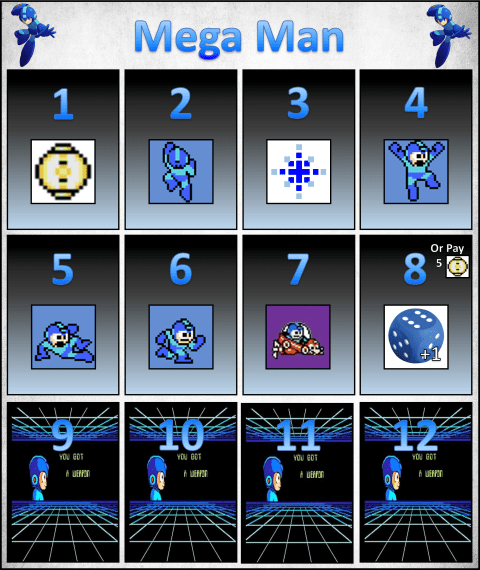
I knew Mega Man: The Board Game by Jasco Games wasn’t the best when I purchased it at a severe discount. Honestly, I wanted the bits. Jasco Games did an amazing job with Mega Man’s miniatures and the look of the game. But good luck finishing a game of Mega Man in under 10 hours. Each robot stage plays like five games of Munchkin played back-to-back, with every other player doing their best to prevent you from completing the stage. And you need to complete multiple boss stages. 10 hours may be too few hours to complete this game. You may need to dedicate a table to preserve your month-long game of Mega Man.
I hope I won’t get copyright claimed for any images. Eek! I began with a simple dice chucker of a game. Players would roll standard six-sided dice (I don’t recall the exact number, but it was likely around four or five) and then place the dice on their player boards. Each space on the player board would grant different abilities, with the final four slots variable for powers obtained by defeating robot bosses. Players could place multiple dice in a single space to combine the rolled result. A six may be played with a single die showing a six or with a two and a four or any other combination of six.
I chose dice chucking because rolling dice and placing them with predetermined spaces made for quick turns. Quick turns lead to a game that one can finish within ten hours. This game worked well. Heck, I even tried it as a real-time game, and it worked extremely well. Games lasted less than 15 minutes. I even saw this Mega Man variant as a game that could be played in tournaments of speed runs. Now that I think about it, I may revisit this variant in the future and give it a reskin. Sorry, the ADHD took the wheel for a second.
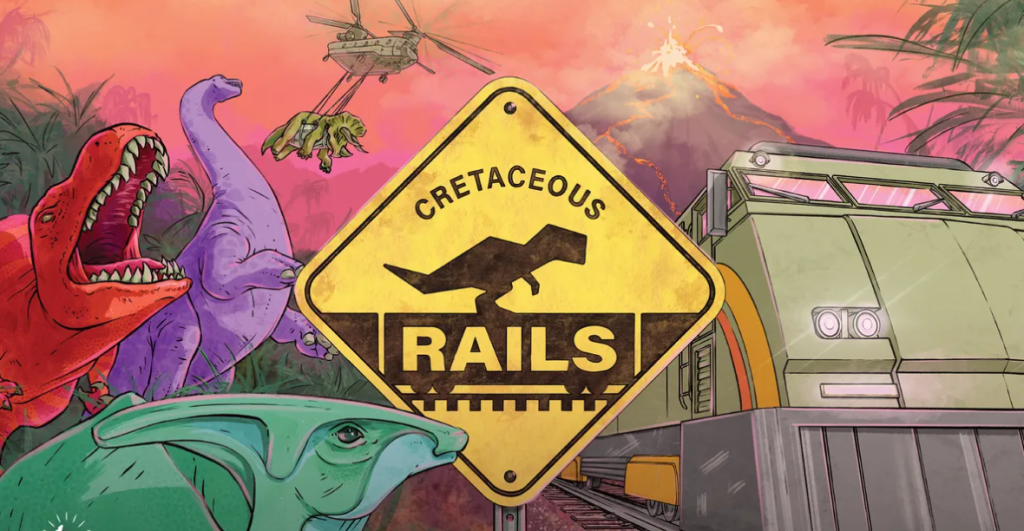
For some reason, I abandoned the above game concept and went in a different direction. I love Cretaceous Rails. Unlike Jasco’s Mega Man, there isn’t much I’d change with this title. Cretaceous Rails makes this list because I wanted to try using one of its core game mechanisms: dual action selection. I even asked Cretaceous Rails’ designer, Ann Journey, if it’d be okay if I borrowed this game mechanism before trying the next Mega Man remix iteration. The result was a game I nicknamed Rondelande.
Oh my goodness. This game wasn’t just a different direction from my first Mega Man remix; it was different in every possible way. I didn’t keep any of Rondelande’s hardcopy versions. I only have the digital files, and it’s difficult to recreate what the game looked like without a physical copy. But I’ll try my best.
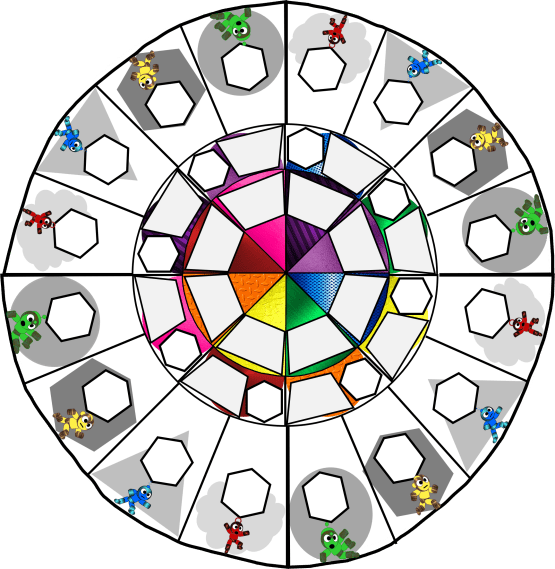
That’s a lot of color going on. Those are supposed to be three rondels (a circular game mechanism with pie wedges representing which actions one may take) stacked on top of one another. Each turn, players would place their gear tokens on one of the hexagon-shaped spaces and take the actions indicated. But before placing gears, players could play up to two cards (depicting one of the actions run, slide, jump, shoot, or climb) underneath the spaces on the outer edge. Players would then be able to take all the actions, including actions on cards, during their turn.
Note: The trapezoid spaces had different actions like draw cards or oil cans (that functioned as wild actions) or even rotating one of the top two rondels, so the action selection could vary.
Rondelande was a lot of fun. It ventured far from what I had originally intended to make. That’s the ADHD brain taking the wheel again. Unfortunately, Rondelande was a space hog. The image above is at least a twentieth of the size of the original game. Despite its size, Rondelande may have been a great game if I had stuck with it. I liked how players could build up the board as they went, benefiting themselves for a turn, but also allowing an opponent to take the same action in a future turn. Players could even refresh (take back their gear tokens) or choose not to refresh for a turn to prevent someone from taking an action their token is currently occupying. Rondelande was great. But something felt off. I wanted interlocking gears for the board because it made sense for a robot theme. I had chosen rondels because they were easier to build. And then I found gears that would work.
I found a file that could work for interlocking gears. Yay! As an aside, I was working on making this file work while producing my Mega Man variant and Rondelande, so a lot of what we’re about to discuss happened concurrently with the previous two games.
At first, I was using a lot of memory foam. Rondelande’s rondels were comprised of foam. I’d print out the digital files (of that rainbow nightmare above) onto full sheet labels and then sticker them over the foam and cut them out. I tried the same concept with the gear pictured above. And it worked…for like one playthrough of the game. Foam likes to shred under friction. Who knew? So, I put the interlocking gears aside until I found a set of wooden gears on Amazon.
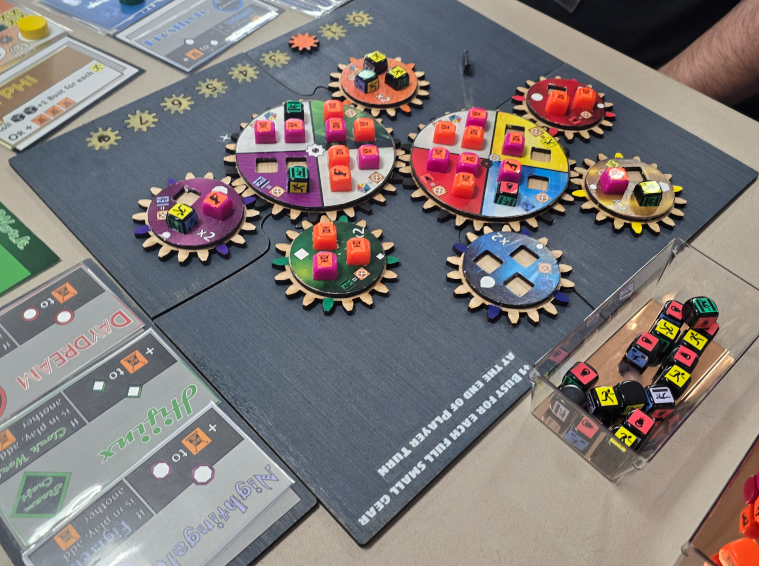
Yes! I was in business. I could continue with Rustbucket Riots. The picture above is a modern version of the game; the first version still used foam for its board (the gears haven’t changed too much). I still have a version of the first game and will include a picture of it in a future post. Rustbucket Riots combines multiple ideas. I brought back dice chucking from Mega Man, only this time, I used specialty dice that included run, slide, climb, shoot, and jump. And I always thought Tzolk’in’s gears didn’t move enough. I could fix two issues I saw in other games. Jasco’s Mega Man took too long, and Tzolk’in (Tzolk’in is an amazing game that earns its spot in BGG; I’m nitpicking) could have gears that frequently turn.
The name Rustbucket Riots came swiftly. Originally, I wanted to make a better Mega Man board game, but I couldn’t copy Mega Man exactly. So, I wondered if I could make the player characters villainous. The Boss Robots attempt to free themselves from an oppressive corporocracy and the humans using them as cheap labor, while the players assume the role of corporate robots tasked with bringing the rogue robots under control. Even though the Boss Robots would view what’s happening as a revolution, we’re playing this game from the viewpoint of corporate robots, and they’d see it as riots. Throw in a slur, and you get Rustbucket Riots.
I think that’s everything up to the idea of Rustbucket Riots materialized. We’ll cover early iterations of the game in the next board game design brain dump. If you’ve made it this far through my rambling, you’re awesome. You know it. Thank you for reading, and wherever you are, I hope you’re having a great day.
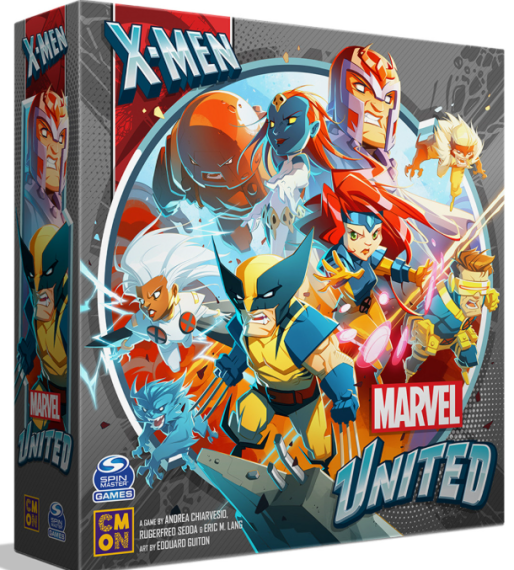
We’ve discussed many Marvel United expansions from the game’s initial set; it’s time to talk about Marvel United: X-Men. This version of Marvel United adds team play and a one versus many option, where one player controls the villain while the others play the heroes. This increases gameplay options and allows for a fifth player to join in on the fun.
Hey, hey! Kyra Kyle here. In Marvel United: X-Men, players act as iconic X-Men heroes who work together to stop the master plan of a powerful villain controlled by the game and in some cases another player. Each villain has a unique master plan, cards that trigger various effects, and threats that make clearing locations difficult. Heroes clear missions, making the villain vulnerable, and finally take on the big bad villain before they complete their master plan. Can you save the day in time? Marvel United: X-Men adds Marvel’s merry mutants to the fray.
Before we get any further, we’ll take a side quest and discuss Marvel United: X-Men’s less heroic details.
The Fiddly Bits
Designer: Andrea Chiarvesio, Eric M. Lang, and Francesco Rugerfred Sedda Publisher: CMON Global Limited and Spin Master Ltd. Date Released: 2021 Number of Players: 1-5 Age Range: 8 and up Setup Time: 5-10 minutes Play Time: 30-40 minutes
We already covered the Game Setup and Game Flow in our original Marvel United review (here’s a link to that review), so we’ll go over the basics in the following two sections. Let’s cover an abbreviated review of the game setup and rules.
Marvel United: X-Men’s setup can change depending on which Villain(s) and Heroes you choose to play. Each game consists of six locations. Eight locations are included because Marvel United: X-Men is a core set. You may choose your locations or shuffle them and choose six at random. Each Location card has spaces at the top for civilians and thugs and a rectangle with a block of text that will state “End of Turn” at the top of the box.
Place civilian/thug tokens on their matching spaces. Shuffle the Villain’s Threat deck and deal out each Threat face-up so that it covers the rectangle at the bottom of each location. You must clear this threat before gaining the “End of Turn” effect printed on a Location. Place health tokens where signified on threat cards and on the Villain dashboard. Place the three mission cards (Defeat Thugs, Rescue Civilians, and Clear Threats) face up under the villain dashboard where the text reads “Unlocked.”
Each player shuffles their hero decks and then draws three cards to form their hands. Shuffle the Villain’s Master Plan deck. Leave the Master Plan deck face down. This will be the villain’s draw pile.
Players place their miniatures on one of the six location cards, usually the centralmost location for each player (easy access). Then, they place the villain on the location card opposing the heroes. If one player chooses to play as the villain, hand the Super Villain cards to them, and the Heroes gain access to Super Hero cards. These new card times can be played if the game state triggers their use (for example, “You play a Master Plan card” or “Any Hero has 4 or more cards in their hand at the end of the Hero Turn.” Timing is key.
Game Flow
The villain(s) play first. Draw the top card of their master plan deck. The villain moves the number of spaces indicated. Resolve any BAM! Effects and these effects will be printed on a space within the villain’s dashboard. Then, place the civilian/thug tokens (if any) indicated at the bottom of the card. If a player has taken the role of the villain, they get a hand of cards and can choose which card they play. The heroes get their turn after all the villain’s effects are resolved.
Heroes pick who goes first, and hero turns will continue around the table clockwise. At the beginning of each game, Heroes will get three turns before the villain receives another turn. During their turn, heroes play one card from their hand.
Resolve actions and the symbols printed at the bottom of the hero’s card in any order. The symbols at the bottom of a hero’s card will be shared with the next player, but any printed action will not be shared. Heroes will use these actions to complete missions. The game begins with three missions in play: Defeat Thugs, Rescue Civilians, and Clear Threats. Each mission card will have spaces for the tokens they require to complete. As soon as these spaces are filled, the card is discarded, and the mission is considered complete. Mission cards can be completed in any order.
After the heroes complete the first mission, the villain panics and will act (play a card) every two hero cards instead of every three hero cards. After the heroes complete the second mission, the villain becomes vulnerable to damage. The heroes can complete the third mission, but it isn’t necessary. If the heroes do complete the third mission, each hero immediately draws 1 card, increasing each player’s hand size by one.
Play continues back and forth until either the villain wins (by completing their unique master plan or anyone, heroes or villains, runs out of cards) or the heroes win by dealing enough damage to the villain after the villain becomes vulnerable to damage.
Review
Marvel United: X-Men features many new game concepts for the United game system. Having one player take on the role of the villain is the most obvious. I like that Spin Master and CMON games include a chart that allows gamers to play villains from the previous set. Since X-Men characters have a knack for flip-flopping their allegiance, it makes sense that Marvel United: X-Men began the trend of purple miniatures (anti-heroes who can be played as heroes or villains). This feature is crucial to the game design, as I forgot it began with Marvel United’s second wave (X-Men). Marvel United: X-Men also adds a team element with its Blue and Gold Team expansions. That doesn’t factor in too much with the core set. We’ll talk more about the X-Men Blue and Gold Teams in the future.
Power creep is a real thing in Marvel United: X-Men. In the original set, players were lucky if they had three unique abilities and anything more than three cards in their deck with special abilities. Marvel United: X-Men heroes have a minimum of four cards in their deck with special abilities and at least two unique special effects, but there are plenty of heroes with way more than four special ability cards. Marvel United: X-Men also includes plenty of powers that deal with crisis tokens. The original set had a few ways to deal with crisis tokens; most of the methods came in the form of Location “End of Turn” abilities. I like the inclusion of heroes with crisis token abilities. The heroes in Marvel United’s second way had plenty of new ways to affect the game state.
Beginning with the anti-heroes (the purple miniatures who can be heroes or villains), let’s get into specific heroes you can find in the Marvel United: X-Men Core Set. Mystique features few Heroics but plenty of Move and Attack. Her two special abilities (two copies of each card) allow her to prevent new tokens (Thugs or Civilians) from being added by the next Master Plan card, and she can redirect damage from herself to Henchmen or Thugs. This plays into Mystique’s ability as an infiltrator. Typically, Marvel United: X-Men does a good job of showing each anti-hero as their heroic and villainous selves. Magneto is the other anti-hero included in the Core Set. Like Mystique, he has little Heroics but can zoom around the board and deal copious amounts of damage. I like Magneto’s ability to convert symbols into Wild symbols. This makes him versatile.
Perhaps because of the increased number of powers within hero decks, Marvel United: X-Men does an even better job of capturing its heroes. Wolverine begins the game with a healing factor. Cyclops uses Leadership, while Beast also has a regenerating factor (not as persistent as Wolverines) and he specializes in heroics and movement. So far, far thematic, but I really like Storm, Jean Grey, and Professor X. Storm can reposition the entire team, Jean Grey can manipulate the Storyline with Telekinesis, and Professor X may be the most powerful hero in the X-Men Core Set. He’s surprisingly mobile with a penchant for heroics. He can also use Telepathy to manipulate the Storyline, give tokens with Leadership, turn symbols into Wilds, and even turn Thugs into Civilians.
In short, the heroes of Marvel United: X-Men have more personality than the previous set. Professor X may be overly powerful. Half of the cards in his deck possess special abilities, and two of the other six cards feature wild symbols. The villains in the X-Men Core Set provide plenty of twists for gameplay, but that’s to be expected from Marvel United villains. The villains have always represented this game’s most intriguing design space. Sabretooth hunts heroes, while Juggernaut charges from one location to the next, damaging everyone in his way. Magneto is especially difficult to stop. He can nullify all Hero effects and hand out crisis tokens to heroes, damaging them for each crisis token the hero possesses. But Mystique may be the most interesting villain from this lot. She targets Senator Kelly, and the heroes lose if she carries out her assassination.
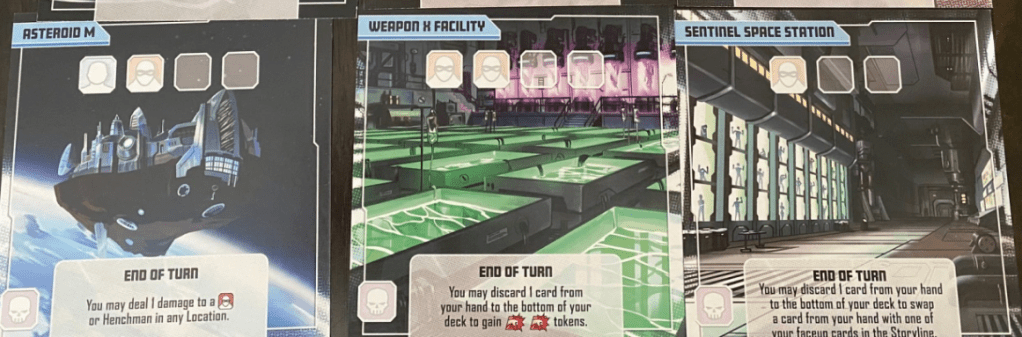
Marvel United: X-Men’s Locations have varied “End of Turn” abilities. Token draw, healing, moving to another location, rescuing a Civilian, and dealing damage to a Thug/Henchman are standard fare by this point, but Marvel United: X-Men’s Locations gives these mechanisms a few twists. But my favorite “End of Turn” ability may be Sentinel Space Station’s. You may discard 1 card from your hand to the bottom of your deck to swap a card from your hand with one of your face-up cards in the Storyline. This ability is a hint of what one can expect in other Marvel United: X-Men expansions.The Marvel United: X-Men Core Set does enough to show what the second United wave of games offers. It does a great job of building on a solid foundation.
Too Long; Didn’t Read
Marvel United: X-Men adds numerous wrinkles to the United Series’ gameplay. A player can take the role of the villain, team play is possible, and antihero characters can be either heroes or villains. The heroes within Marvel United’s second wave have more personality, while the villains remain stellar. Mystique’s mission of assassinating Senator Kelly is fantastic.
Thank you for reading, and wherever you are, I hope you’re having a great day.














































 jkgeekly.com