Game Design Brain Dump: June 5, 2026

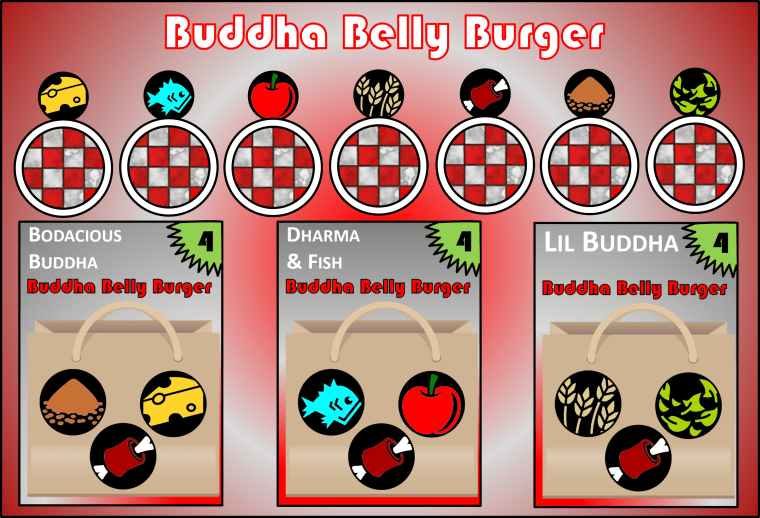
Happy Friday, Geekly Gang! Kyra Kyle here with another board game design brain dump. I’m trying to get back on track with these, and since I’m rusty at writing a game design brain dump, I’ll be jumping topics a bit with today’s post. We’ll begin with Monster Chef. Yes! I’ve kicked around Dungeon Chef and Dungeon Gourmet for this card game, but I Monster Chef fits. Plus, I love this simple logo for Monster Chef.

So Cute! Anyway, several game design brain dumps ago, I mentioned a card-drafting game based on the anime, Delicious in Dungeon. Monster Chef is that game. I just cut the card-drafting aspect of the game, and that led me to board game development. If board game design is like writing a story, board game development is editing that story. So, today’s game design brain dump leans into a very important aspect of design: development.

Sure, some people make a living editing and don’t write as much original material. The same can be said of board game developers. Plenty of developers can make a living (or at least some extra spending cash) by developing other designers’ work. But like writing, a board game’s first developer will be its designer. No matter how much I’d love to hand off Monster Chef to a developer and move on to my next game, I need to find a happy place for Monster Chef. And like writing, often game designers need to “kill their darlings.”

I love card-drafting games. Heck, Monster Chef began as Food Court Hustle, which had an interesting–to me at least–twist of dual-purpose cards. Players would play a card for one effect and discard a different card for another effect, before passing their hands to the next player. With Monster Chef, I took the concept further by allowing players to draw cards into the hands they inherited from other players, giving players more control over the chaos caused by card-drafting. Despite all these factors to “solve” my perceived problem with the card-drafting games, I learned card-drafting was holding back Monster Chef. Card-drafting breeds upheaval. Monster Chef needed stability.

The game wanted to use hand management (players don’t change hands and keep the ones they have dealt to them) instead of card-drafting (in this case, closed card-drafting). Players would often forget to pass their hands after their turns. The physical act of drafting cards meant that players couldn’t preplan their following turns, which slowed gameplay. Some of the choices felt as if they lacked consequences because you didn’t know what your hand would eventually look like, so one wouldn’t care what remained in their hands. And Monster Chef had plenty of other random elements (like not knowing which recipes would get drawn for the display). Hand management affords more control.

With hand management, I added card draw to the Monster Chef’s design space. The game has a faster run time. Players can cycle through the draw decks (dungeon floors) more quickly. And I was able to get rid of the cards few players used, except in edge cases. I may have eliminated most edge cases, which are mechanisms that either have limited viability or can only be used in specific situations. All of Monster Chef’s main actions have obvious usefulness. It depends on how and when players use these actions. That makes for a better game.

I’ll definitely come up with a card-drafting game in the future. I love these types of games. But I must “kill that darling.” Doing so made Monster Chef a better game.

Here’s where I bounce. I’m giving a brief update on the Marvel Multiverse Role-Playing Game module I’m writing for Comic-Con: Nebraska (CCN). I didn’t need to create my own module. Just trying out a few things. Running the Marvel Multiverse Role-Playing Game at last month’s Aftershock event got me thinking that the game could be geared for true RPG beginners. Some of my players had never played a tabletop role-playing game before, or they had played once or twice. While the Marvel Rivals Timestream Adventure is great for a one-shot to introduce new players to the Marvel Multiverse Role-Playing Game, it could do more to welcome truly new role-playing game players.

I was reminded of Legend of the Five Rings. When I ran a game for younger players (who had never played an RPG before) with that game, I resurrected the Rokugan Tournaments (like an Olympic Games for samurai) mentioned in the game’s lore. I had players participate in non-combat events, learning how checks worked in a pseudo-video game tutorial manner, and of course, something fishy was going on with the tournament. Once players discovered the threat, a battle occurred, but this only happened after players knew their characters and how the game worked. I want to do the same for the Marvel Multiverse Role-Playing Game.

So, I chose Mojo and his Mojoverse. X-Men ’97 Season Two will begin releasing soon, so gamers may be familiar with Mojo by the middle of August (in time for CCN). Players will participate in Mojo’s reality TV show-like events (similar to the Legend of the Five Rings tournament), and I can tailor the game to a two-hour window. Perfect for a Comic-Con. If I get players for the Marvel Multiverse Role-Playing Game at CCN, most likely, they will have limited (if any) experience with tabletop role-playing games. Who knows? A quick session with a tutorial may get more potential players interested in the game.

I’ll keep you updated on my progress. Hopefully, I will have finished the module before CCN. I’ll also be working for Extra Life, so if you’re in the area, stop by and say hello.

That’s all I have for today’s game design brain dump. Thank you for reading, and wherever you are, I hope you’re having a great day.

Game Design Brain Dump: April 3, 2026

Hey, hey, Geekly Gang! Kyra Kyle here. I’m just checking because this is when I would typically post a board game design brain dump. I’m skipping this week, but I have a good reason. This week (and next week) are crunch time for my board board game designs. I’ll be submitting them to Great Plains Game Festival’s (GPGF) Playtest to Win event. So, if you’re in the Lincoln, Nebraska area and you’re attending GPGF, you can play Spill the Beans, No Kings, and Whirligig Pets.

I may or may not post a game design brain dump next week either, as I will be attending GPGF. If you’re attending stop by and say, hi.

Game Design Brain Dump: March 6, 2026

Hey, hey, Geekly Gang! Kyra Kyle here with another brain dump. Today’s post will be about board game design, but these brain dumps have a nasty habit of crossing over from writing to game design and back again. I may have found my stride. We’re averaging a brain dump (alternating between game design and writing) every other week. That feels good, so the next writing brain dump should occur on March 20, 2026. Yay! But let’s go to a macro look at game design. That’s right. We’re zooming out and potentially talking about the creative process as a whole.

I read another game designer’s (Ann Journey’s) game diary. She likened her design technique to her writing process, and it rang true. There’s a lot of crossover between game design and writing as both are creative endeavors. She would brainstorm, create an outline, and build her board game based on the outline. This resembles the Plotter approach to writing. Plotters are at one extreme end of the writing spectrum.

Yes. Like most things in life, writing can be depicted as a spectrum. In fact, the opposite extreme ends of the writing spectrum tend to get as hotly debated as political factions. When I say Plotters are at one end of the writing spectrum, we’re talking Ultra Conservative or Wacky Liberal levels of extreme. Plotters like JK Rowling insist that writing without an outline would be like taking a trip without a map. You’ll get lost. That makes sense. Pantsers are at the other end of the spectrum. They never use outlines. Stephen King may be the most famous Pantser. King wrote in On Writing, “Outlines are the last resource of bad fiction writers.” King suggests outlines limit inspiration and the joy of creativity. This also makes sense.

And like most things (like gender identity and sexual orientation), I fall somewhere in the middle. Pantsing and Plotting aren’t the only ways to write or design games. They’re the ones that get all the attention.

I’m somewhere in the purple. I like purple. Yay! We discussed how Plotting works within board game design. Ann Journey uses this method to great effect in Cretaceous Rails. Brainstorm, create an outline, and build a game based on the outline. Euro Games may insist on this method of board game design. Euros lend themselves to following a well-crafted outline and often feature distinct beginnings, middles, and ends.

But you could Pants your way to a good game. In the past, Molly Johnson, Robert Melvin, and Shawn Stankewich shared that they threw various ideas at the wall while designing Point Salad. If it’s cool, it rules, and if it rules, it makes it into the rulebook. That sounds akin to Pantsing. The Point Salad series of games (which also includes Point City and Point Galaxy) tends to be adaptable and demands that players remain flexible. This could be a feature of this method of board game design. I’m just throwing something against the wall here.

Then we get to two alternatives to Pantsing and Plotting: Lighthousing and Blotting. Are these two methods in the purple, or is there a Y-axis to this spectrum that I don’t see? I’m unsure, but I do know that Lighthousing and Blotting are two major alternatives to Pantsing and Plotting. There may be others.

While writing, whenever I Lighthouse, I usually know where my story begins (the opening scene), and I know a Lighthouse scene for the future, a poignant scene I know will make the final story, but I don’t know how to get there yet. This Lighthouse scene informs my decisions, but it also gives me leeway to explore. Early into Mysterium’s development, Oleksandr Nevskiy and Oleg Sidorenko knew how the game would begin and the game’s final turn. Most–if not all–of Mysterium’s design choices were in service of the game flowing from its beginning to that final turn. Lighthousing may be the method you’ll want to use if you have planned an epic final turn or series of turns.

Finally, we get to Blotting. I picture myself with a blank canvas whenever I Blot while writing. In my hand, I have a sopping wet paintbrush, like Bob Ross and his wet-on-wet painting method. I slap a scene on the blank canvas, and it causes a blot. Then I add another and another, and after I’m finished, I have to make sense of the mess by molding these Blots into a cohesive whole. While designing Marvel United, Eric Lang suggested that he knew his theme (Marvel Comics, obviously) and a handful of the game’s mechanisms. He just needed to take those elements and sculpt them into a cohesive gaming experience. Sounds like Blotting to me. Blotting can lead to fun and exciting fusions of disparate elements.

Word of caution for Blotting (and for designing games in general): One can add too many elements to a game. Typically, the fewer gaming elements, the better. The old adage “Less is More” is key.

I’ve used all of these methods for game design and writing. There are some I prefer and others I don’t. I wouldn’t say one method for a creative endeavor always trumps another. Your goal is to find which method works best for you and for your project.

And just because you Pants or Lighthouse your way to a story or game, doesn’t mean you can’t use a reverse outline. Have I talked about reverse outlines? Yes, in a previous writing brain dump. I’ll leave that link right here.

Remember, Stephen King subscribes to Pantsing. He has suggested that one’s reader won’t be surprised if you’re not surprised as the writer. Pantsing induces moments of surprise in King whenever he writes. But King is also known for horror fiction. The element of surprise is important for horror stories. There may be a reason Stephen King chooses the Pantsing method.

If you’ve made it through my rambling, you’re awesome. We all know it. Thank you for reading, and wherever you are, I hope you’re having a great day.
Game Design Brain Dump: January 30, 2026

Happy Friday, Geekly Gang! Today may be the first month where I had two game design brain dumps. Let’s keep the streak going. Yay! Thanks to everyone reading. You’re awesome. We all know it. The past couple of weeks were eventful for a couple of my board game designs. I’ll save Rustbucket Riots’ updates for a future game design brain dump. Instead, let’s discuss the changes for Spill the Beans. I can sum up all the updates in two words: production considerations.

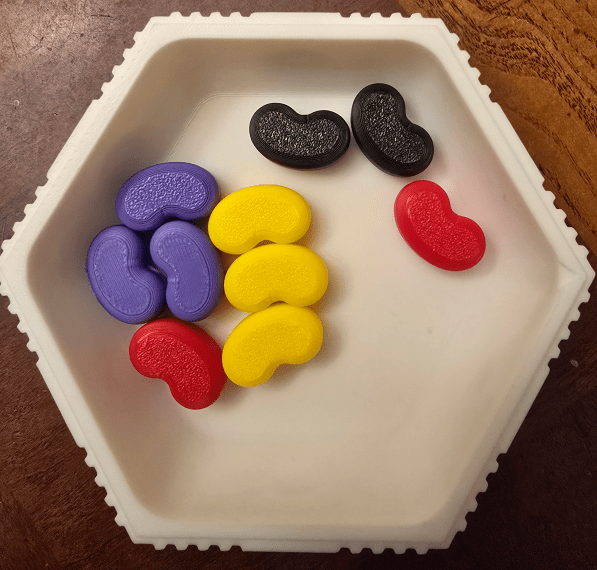
Originally, Spill the Beans featured double-sided jelly bean tokens where most beans had different bean types on both sides. Players would pick beans from their supply, add them to the bean jar, shake beans from the jar, and shed cards from their hands. The game was dumb fun.

Despite being a card-shedding game (like Uno) with extra steps, Spill the Beans worked well. But I thought of how the game worked. I marketed Spill the Beans as a party game. Party games usually accommodate at least six players should be able to play the game, and if I include enough cards for six players, I would’ve needed 120 cards. That’s a lot of cards for a party game. It could work if Spill the Beans only included cards. But I intend on having jelly bean tokens. The card-shedding mechanism also took away focus from the jelly beans. At first, this wasn’t that big of a deal. The jelly bean tokens were flat and circular with jelly beans printed on them. And then, I 3D printed the jelly beans.

The original game had too many cards, and I couldn’t have the cards upstage the cute jelly beans. So, I cut the game mechanisms that no longer worked and reduced Spill the Beans’ game components to the jelly bean tokens, the jar to shake them from, and five mason jar (point-value) cards. Players still shake the jar and try to get so many beans from the jar. Then, they place at least one bean on one of the jar cards and eat the rest (add them to their score pile). As soon as three of the five mason jar cards are filled, play ends. Whichever bean has area majority in each mason jar card, claims that jar’s point value. Then, players score their “eaten” jelly beans. Whoever has the most points wins.

This new ruleset is simple. It puts emphasis on the jelly beans, not card shedding. And the new Spill the Beans scales well at higher player counts. Perfect for a “party game.” And the new game’s toy factor is through the roof. I can’t wait to codify the rules, pitch to publishers, and see Spill the Beans on shelves. Yay!

That’s all I have for this week’s game design brain dump. If you’ve made it this far, you’re awesome. Thank you for reading, and wherever you are, I hope you’re having a great day.
Game Design Brain Dump: January 16, 2026

Happy Friday, Geekly Gang! Kyra Kyle here with another game design brain dump. Our first of the year. Yay! Recently, I watched Netflix’s Delicious in Dungeon. I even shared it during one of our Watcha Watching posts. And instantly, I had a new idea for a board game. Well, Dungeon Chef is a variant of an old game design idea I had years ago. Let’s dish. Great. Now, I’m hungry.

Above is an image of Food Court Hustle’s most recent iteration. Yes, Food Court Hustle was the game’s original name. Food Court Hustle was a card-drafting game where players manage restaurants in a food court. It played quickly, had plenty of Take That elements, and never took itself too seriously. I liked the concept and loved the name. But food courts are a little dated. That was the biggest complaint I heard from playtesters. The concept for Food Court Hustle’s game mechanisms was to give players more control during card drafting. Each round, players would choose one card to play (for its effect) and then choose a card to discard for its ingredients, only every player–not just you–gains the ingredient.

Like most card-drafting games, Food Court Hustle plays swiftly. Simultaneous play helps with game speed. Seriously. This was one of the few games I never felt the need to incessantly time. And that’s a good rule of thumb when designing games. Always time your games. You want to waste as little of your players’ time as possible. I’m not saying you can’t design a two-hour or longer epic board game, but the game should earn its play time. Getting back to Food Court Hustle, something beyond the theme was missing.

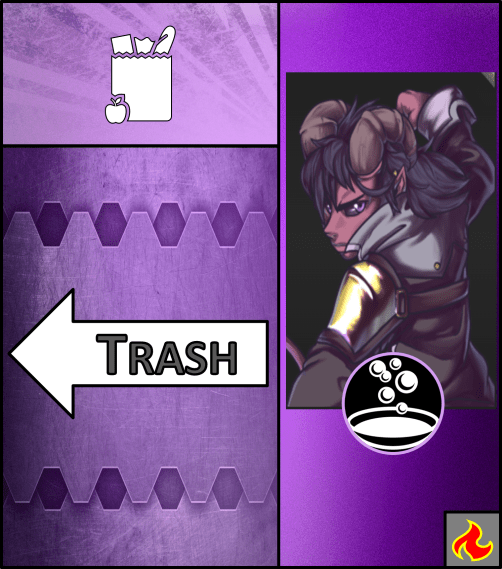
Tangent: the image above is Dungeon Chef’s player board, and the previous image was of a Food Court Hustle player board. The scale of these two images is almost what it should be, so I managed to shrink the player’s space while ditching customers. Yes. The original game included customer cards that wouldn’t always appear when players wanted to make a dish. Another gameplay gripe. You could have the ingredients and not be able to make a meal. Dungeon Chef gets rid of that layer of randomness. I also got rid of a lot of the Take That mechanisms and replaced them with global effects.

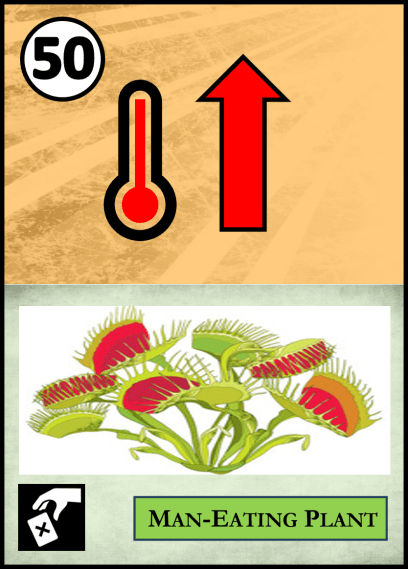
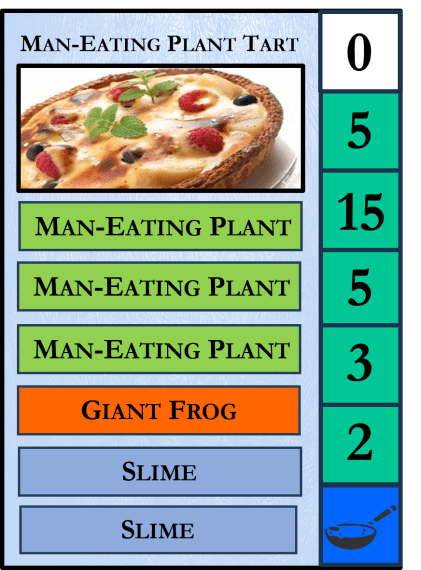
Above is a sample Dungeon Chef card. The top half is the action you may choose to play. The number indicates the player’s initiative for that turn. All cards in the three day decks are numbered 1-50. The higher the number, the quicker the action. I’ve seen players choose a card for its initiative, which is wild. The bottom half is the monster parts you may add to the communal ingredients. You wouldn’t be the only one gaining a man-eating plant. Everyone at the table gains a chunk of man-eating plant. And returning to the action on this card, you can turn up the temperature of the communal stove. That’s right. Most game elements in Dungeon Chef have global effects. Half the game is steering the game state in your direction.

Players can select a recipe by spending the ingredients on the recipe card. Then, they add the recipe to their player board, lining up the wok with the flame. And near the end of each turn, move the recipe card up the number of spaces indicated by the communal stove’s temperature. Players can take their active recipe off the stove and claim the victory points indicated on the card at any time. But beware, if a player leaves their meal on the stove too long, they could burn their meal, and it goes into the trash, costing them 10 points at the end of the game. Whoever has the most points at the end of three days wins. There’s little more to Dungeon Chef. I tried to keep it short, easy to understand, and stick to the Delicious in Dungeon theme as best I could.

We’ll see where this design goes. And who knows? Perhaps I’ll be at a gaming convention near you. Let me know which convention I should attend. If you made it this far, you’re awesome. We all know it. Thank you for reading, and wherever you are, I hope you’re having a great day.

Game Design Brain Dump: November 21, 2025

Happy Friday, Geekly Gang! Kyra Kyle here with another board game design brain dump. I’m taking a break from Rustbucket Riotswhich I covered in last month’s brain dump–and discuss a Blackjack Deck Building game I originally made in 2018. Seven years! Yikes! Guess I got the seven-year itch. This Blackjack Deck Builder has gone through multiple minor rule modifications and name changes. The deck, based on a standard playing card deck, doesn’t have jacks and kings, so it’s had the name No Jack and No Kings.

Play Faster

My oldest daughter had a high school friend, who will remain nameless. We’ll call her C. C loved deck building games, but she wouldn’t draw her hand at the end of each turn (allowing her to plan her next turn), and every time she drew cards into her hand, she’d act like she was reading them for the first time. This frustrated my daughter and her friends. I thought of No Jack or No Kings to fix this issue.

A quick explanation of deck building card games: each player begins with the same (or at least similar) small decks and purchase cards from a supply to add to their decks, making each deck unique.

While many starter cards in a deck building game have limited text, cards one would add to their hands could contain a heap of text. This would cause C’s turns to last three minutes or more, as she read the more complicated cards that she added to her deck. So, I took out most text. Standard playing cards have little to no text. Next, C had the issue of not drawing her hand at the end of her turn. What standard card game doesn’t require a hand? Blackjack.

The above sample card (Page of Coins) is a prototype. The end product will hopefully look a lot better. Lol.

I merged deck building with Blackjack and came up with No Jack or No Kings, and it worked. With the exception of changing the suits, the only cards that look different from a deck of standard playing cards are the face cards. C knew how to play Blackjack. Players would draw cards from the top of their decks, following the standard rules for Blackjack. If you drew over 22 points of cards, you’d bust and lose your turn. If a face card remains in play (without busting) at the end of a turn, the player can move the face card to their tableau and gain its ability. In the case of the page above, every time that player draws a coin suit card, they gain one extra money to purchase other cards. No Jack/No Kings starter decks begin with one face card from one of the four suits. Each suit has a different power.

Trouble with Asymmetry

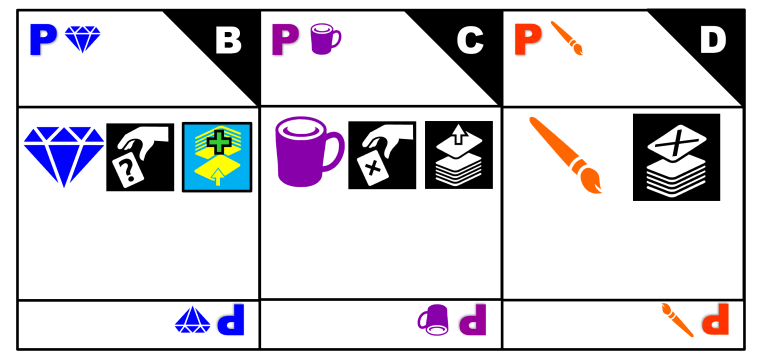
Most players in deck building games begin with the exact same cards. Choosing to go with asymmetric powers at the onset of this game, however slight, proves difficult to balance. Brushes allow players to cull cards from their discard. Deck building experts see this as overpowered. But Diamonds and Cups have better win percentages. Diamonds allow players to manipulate decks (take cards from a discard and placing them on the bottom). If you’re good at counting cards, you can induce more 21s (or Blackjacks). Cups let players discard a drawn card and draw a new one. This is also strong.

The first page I showed, the Page of Coins, is the weakest of all four. But perception matters. Even though I’ve playtested No Jack/No Kings hundreds of times and found Cups and Diamonds win more often than not, players still “feel” more powerful with Brushes and, to a lesser extent, Coins. Granted, one of my playtest weekends was with someone at a Protospiel. He played No Jack/No Kings throughout the entire weekend (like a few dozen times), hoping to sculpt a deck of only Tens and Aces. This gamer played Brushes in each game and lost every time. Winning didn’t factor into his enjoyment. He wanted to build a near-perfect deck. So, the numbers may be a little skewed.

Does anything need to be changed? Honestly, I don’t know.

How to Win at No Jack/No Kings

I just realized we discussed No Jack/No Kings mechanisms without sharing how to win. There’s a separate deck of Patrons. Every patron can be claimed with a Blackjack (21), but each patron also gives discounts to two suits. If you have a face card from either suit in your tableau and you reach the lower number, you can claim the patron. Every turn, you can either claim a patron or purchase cards from the supply. That’s how the gamer (Protospiel) lost so many times. He would purchase cards if they fit in his “perfect deck” instead of claiming a patron. The first player to claim six patrons wins.

No Theme and Simple Mechanisms

I don’t know why I shelved No Jack/No Kings for almost a decade. My best guess is that I wanted No Jack/No Kings to have more theme or more complexity. I no longer care if No Jack/No Kings has a theme, and any additional mechanisms I added to the game diluted the core gameplay. I was obsessed with everything No Jack/No Kings didn’t have and failed to see what it did have. That same Protospiel (seven years ago, I’m guessing), I only taught the game once. Other gamers taught No Jack/No Kings to the rest of the convention, and the game was played consistently for two and a half days. I need to get out of my own way. Ugh!

I’m finalizing the starter decks and the cost of cards. But there are shockingly few things to balance/tweak after I pin down the starter decks, so I’m left with one question. Which name do you like better, No Jack or No Kings?

Let me know in the comments. Thank you for reading, and wherever you are, I hope you’re having a great day.