Hey, hey, Geekly Gang! Kyra Kyle here with another board game design brain dump. This month’s game design dump will mostly be a status update with a tip of the hat to a new productivity tool: a dry-erase calendar. I know. I know. Dry-erase calendars are old news, old tech, but it worked wonders.
New Calendar
The calendar proved necessary because I had become trapped with the idea that everything for Geekly, this blog, was easier and faster than anything else I could do for my career (both board game design and writing). The calendar has spots for weekly items, and I do use these for quite a few things, like my weekly menu (I cook for my household) and other events that occur on specific days of the week (like game design meetups and write-ins, both great resources for game designers and writers).
But the “To Do” section has given me the most focus. I write down the six to seven most important tasks and mark the two quickest/easiest tasks to accomplish first. This keeps me on task. Geekly projects don’t always top the list for quickest or easiest tasks, and I find myself finishing most projects. I do have one item listed for a specific day because that day will be the best time to attempt the project. Overall, this new calendar has streamlined my creative process. I’ve mentioned this in various posts (specifically my Autism Representation Deep Dive series), but I’m neurodivergent. The calendar limits my number of choices. So often, I’ll become paralyzed and continue with what I was working on before, which, for a time, was nothing but Geekly content. This visual reminds me of other goals and gives me a handful of options.
I’ve gushed about my new calendar for long enough. Let’s get to the game updates for this month.
Monster Chef works as a hand management game. I’ve playtested it numerous times over the past month. The new butcher knife ability works well. I noticed the decks running out of cards far quicker than before, and added back in one extra copy of the Groceries cards for each monster. I’ve seen multiple playthroughs where gamers complained that they didn’t see enough of the Grocery card abilities. This solves both potential issues.
Monster Chef also plays at a tight thirty minutes or so. I’m happy with that approximate play time. Now, all I need to do is playtest Monster Chef at various designer meetups and conventions. Nuke-Con (in Omaha, Nebraska) won’t occur until early October. I’ll definitely have a playtest or two or three of Monster Chef planned for that convention. I’ll keep you posted if I attend any other public events before Nuke-Con.
After codifying the game’s ruleset, one of the goals I have set for myself is finishing Monster Chef’s rulebook. Oh, yeah. I see some blind playtests in the near future.
I knew Rustbucket Riots would prove more difficult to complete. It is. But I’ve made plenty of progress. Rustbucket Riots works as a bag building game. Yay! Two major issues cropped up: minions added to player bags is brutal, and gamers felt weaker than they did when the game was strictly dice-rolling (with the lock a result mechanism). Both problems were easily fixed. I lowered the number of minions added by boss robots each turn. Done. That was easy. Making the players feel more powerful was a little difficult to pinpoint, but I’m tackling the issue in two ways. First, increase the number of tokens players grab from their bags each turn. This was easy enough. But drawing fewer tokens was only part of the problem.
When players could reroll dice (dice rolling mechanism), Rustbucket Riots players had more control over their results. Do you really need to roll a Jump result? Reroll any dice that don’t show Jump until you lock in every result. Pulling from a bag is a little trickier. The tokens you pull are the tokens you pull. So, I added a mechanism that allows players to trade in any two tokens for a token of their choice. You’ll need to pull more tokens from your bag, but as I mentioned, players will be pulling more tokens from their bags.
I’m excited by the direction Rustbucket Riots is taking. Now comes the long road of balancing the mechanisms so most games conclude with a tight outcome. Fingers crossed.
That’s all I have for this month’s game design brain dump. Thank you for reading, and wherever you are, I hope you’re having a great day.
Happy Wednesday, Geekly Gang! Kyra Kyle here. Today, our writers share what they’ve been playing over the past month. Feel free to share what you’ve been playing this month, because we’re all part of the Geekly Gang. I’ll get this post started with what I’ve been playing over the past month.
Kyra’s Video Games
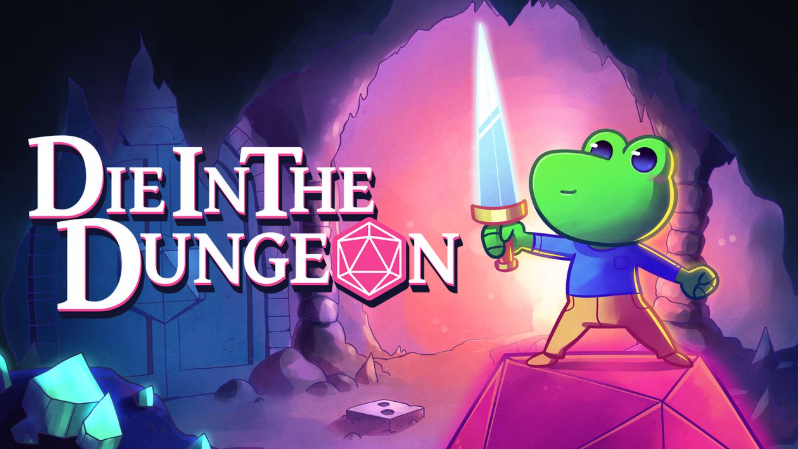
Die in the Dungeon is a dice version of Slay the Spire. Die in the Dungeon is a roguelite where players choose a path in a branching dungeon. Instead of building a deck, you’ll build a dice pool. The computer rolls your dice for you–so that’s a tactical goodness you’ll miss with Die in the Dungeon–and die placement on a 9-space grid shaped like a diamond can be the difference between victory and defeat.
Because it uses dice, Die in the Dungeon feels like it has fewer parts than Slay the Spire. I may be wrong. But dice can only do so much, and each die type is color-coded. Red attack. Blue block. Green heal. Purple dice give bonuses. There are more die types (that have various actions), but usually, if a die has a similar hue to the base dice, the die will be a variant of one of those three basic die types. For example, pink dice are typically splash attacks (attack all enemies). I’m just getting started with Die in the Dungeon, but I can see this one as a good candidate for a Quirky Video Game Review sometime next year.
If you like Slay the Spire, you should give Die in the Dungeon a try. A free demo does exist on Steam. You can try before you buy. I can see Die in the Dungeon getting its own tabletop game adaptation. I really like rolling dice, and while you can reroll dice in Die in the Dungeon, it doesn’t hit the same as clicking a button to roll the dice at the beginning of combat. Sure, Die in the Dungeon saves time by autorolling your dice before each round of battle. But I want to roll dice.
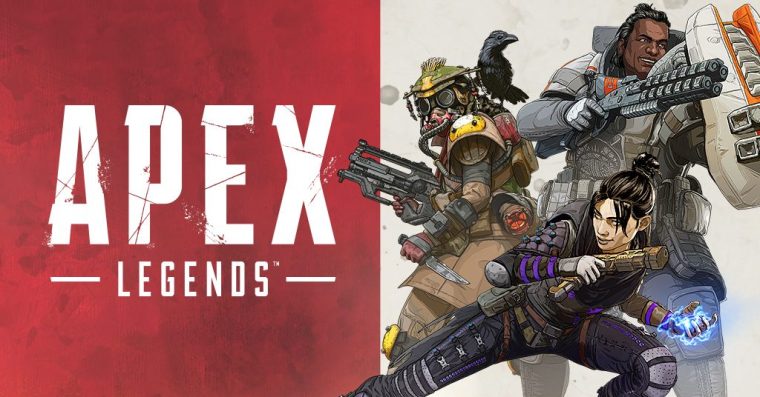
I’ve been keeping up with Apex Legends. The new legend, Axle, is fun. Per usual (for skirmisher legends like Axle), she was released in an overpowered state, and Apex Legends has since nerfed her in line with the rest of the roster. With the launch of the E-District map last season, Apex Legends feels like it’s gained some positive momentum. I wouldn’t mind Respawn alternating new legend, new map, new weapon, and new game mode each season (which spans three months), but it’s Respawn, this is a not-so-sudden influx of new content. While some live-service video games flood their games with an abundance of content (ahem, Fortnite), Apex Legends drags its feet. Longtime fans of the game don’t ask for much. They just want consistent new content.
Apex Legends releases a new legend and map every year and a half. I stopped playing the game for three years, and the weapon pool remains the same. Sure, the game has made tweaks like making the RE-45 an energy pistol, and it added akimbo for the Mozambique and P-2020, but Apex Legends has not had a new weapon since the Bocek. The Bocek was released during the pandemic. The pandemic. That feels like a lifetime ago. I’ll admit. New weapons affect Apex Legends’ gameplay the most. Every character can pick up any of the weapons, so you need to get the balance right. But Apex Legends also hasn’t released a new way to play the game since Gun Run in 2022. The game is still fun. Stale but fun.
Kyra’s Board Games
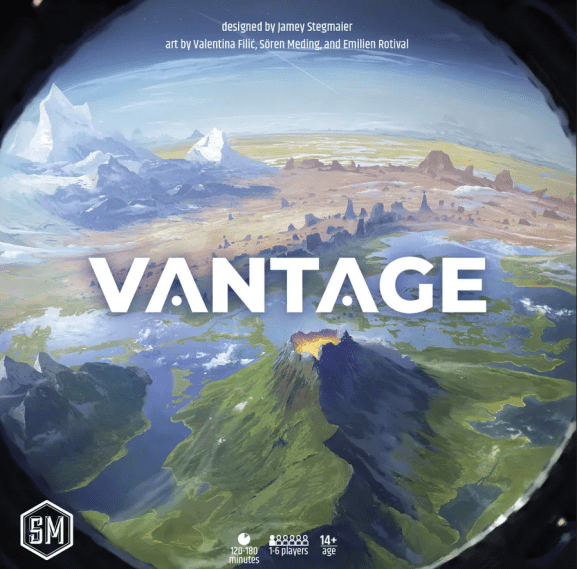
I’ve been playing a bit of solo Vantage. The game plays well as a solo experience, but more players make the game interesting. Like so many board games, the optimal player count rests somewhere in the middle of the lowest and highest player counts. Solo is too lonely. Six players would slow Vantage to a crawl. Three to four players is the happy place.
I may offer to GM Vantage at a future board game convention. If you’re in the Omaha area during Nuke-Con (first weekend in October), stop by and say hi. And if you want to explore a strange and exciting alien planet, we can launch a round of Vantage. I love the game’s system. Vantage’s combination of storybooks and cards makes each session an adventure.
Typically, I don’t mention my games that I’m playtesting, but I will for this month’s post. Monster Chef works as a hand management game. Omitting the card drafting helped. The new ability (Cleaver) allows players to zip through the decks more effectively. Maintaining the same hand helps players plan their next turn. I do wonder if Monster Chef plays better at three players and above. I’ve played plenty of two-player Monster Chef, and it doesn’t have the same pizzazz. It’s still good. But I prefer Monster Chef at 3-5 players. At any player count, Monster Chef doesn’t overstay its welcome. I may have found the right pacing.
Switching Rustbucket Riots from a dice rolling game to a bag building game threw off the game’s balance. At first, I also struggled with the players feeling less powerful. That won’t do. So, I made some crazy rebalancing for the game. Adding minions to player bags is brutal. Players can bust and don’t get what they want. That’s a double whammy. I’m keeping that dynamic–for now–and trying to add fewer minions to the bags each turn. We’ll see where this leads. I love Rustbucket Riots’ bag building. This mechanism allows for quicker onboarding for gamers. Most of an initial teach would be explaining what happens when players roll, lock, place, and spend dice. Now, you grab tokens, place, and spend. Rustbucket Riots is far more streamlined. Now, I just need to finish rebalancing the game.
That’s all I have for this past month. Let’s see what Season and Skye have been playing.
Season’s Video Games
I’ve also been playing Apex Legends recently. I haven’t played in years, so it feels fresher to me than it does for someone who’s played consistently. Normally, I don’t care for FPS games, but Apex Legends is the one exception for me. Seriously, I can’t aim to save my life. I can’t even utilize V.A.T.S well in the Fallout franchise. That’s how bad I am. I like Apex Legends because of the squad element, ping system, and interesting characters.
I’ve been playing Fantasy Life i: The Girl Who Steals Time for a couple of weeks, and I’ve been having a blast. It’s an adventure, farming simulator, dungeon crawler, has MMO elements for multiplayer, and has Animal Crossing aspects to it. It has so much content that I AP’ed trying to figure out where to start. So far, I’m 71% finished with the main story, but that’s just the tip of the iceberg. Fantasy Life i: The Girl Who Steals Time is a lot of fun, and it encourages players to play the game how they’d like.
Skye’s Video Game
I laser-focused on Stardew Valley for weeks. Stardew Valley is a game that’s been in my PlayStation library for years now, but I remembered after coming out of my surgery that I never technically “finished” it. I hadn’t completed all the community center bundles, I hadn’t unlocked all the house upgrades, I hadn’t obtained every variety of livestock, I hadn’t finished the museum collection, and I certainly hadn’t been to every location. After these few weeks, I’ve made it nearly to summer of year 3 and have spent an obscene amount of time managing my farm, building relationships, and desperately trying to renovate the community center. All I have left to do is donate a Fiddlehead Fern and a Pufferfish and it’ll be done, but it’s been more difficult than I expected. Eventually I’ll have the community center back to its former glory. Just you wait.
Hey, hey, Kyra Kyle here again. Those are the games our writers have been playing over the past month. Let us know what you’ve been playing in the comments. Thank you for reading, and wherever you are, I hope you’re having a great day.
Happy Friday, Geekly Gang! Kyra Kyle here with another board game design brain dump. I’ll be honest. This past month, most of my focus has been on writing my personal fiction, blogs, and tabletop RPG. I haven’t even had a chance to playtest the changes I made (to Monster Chef) during the previous game design brain dump. Today’s game design brain dump will center on Rustbucket Riots. Ah! Rustbucket Riots has seen plenty of changes throughout the year and a half I’ve been developing the game. And it looks like Rustbucket Riots could see another change in the near future. Let’s talk about it in today’s Board Game Design Brain Dump.
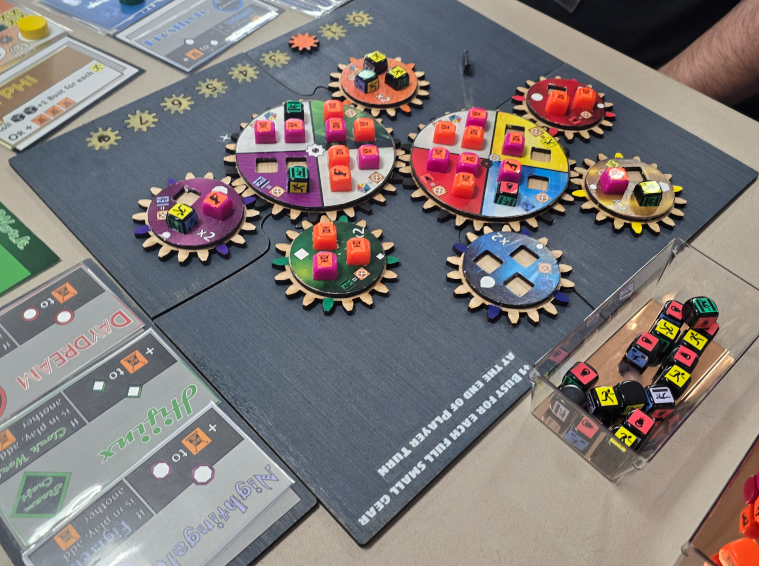
I’ve already made changes to Rustbucket Riots. For those of you who didn’t check the previous link, the above image is what the Rustbucket Riots game board used to look like. This was the board for a good many months–years–until I had it upgraded. I’ll share that picture in a bit, but gaining some space gives anyone perspective.
For the months I haven’t been working on Rustbucket Riots, I’ve been working on Monster Chef. This gave me two things: cognitive distance from Rustbucket Riots, cross-pollination of ideas with Monster Chef. Rustbucket Riots and Monster Chef are nothing alike. One is a cooperative, dice placement game with interlocking gears (Rustbucket Riots), while the other is a competitive, card management game with a cook timing mechanism (Monster Chef). But working on Monster Chef, figuring out how to make that game easier to teach and faster to play made me view Rustbucket Riots in a new light. I needed to look at Rustbucket Riots through the same lens as Monster Chef.
Ah. The board above is beautiful. I forgot how pretty Rustbucket Riots’ current board is, and it’s functional. The board illustrates which region a die belongs. Whatever color the die rests is the region it belongs to, so a die placed in the yellow wedge (of the large gear) will touch the orange and yellow regions. Easy! Before this change, playtesters would complain it was too difficult to tell. I haven’t received that feedback as much after this change. So, it might be time for more change. Players are supposed to simultaneously roll dice, lock them in, place them, and remove the dice from the gear spaces to use the die.
That’s a lot of mechanical things going on at once. The rolling, locking, and placing can get long and difficult to explain. The change I’m thinking of making is replacing dice with tokens, converting Rustbucket Riots from dice placement to a bag builder game. If I do this, this will fundamentally change the game. I won’t change the board, at least not right away. If I go through with this, I’ll make the tokens die-shaped. No. I’m concerned about how this change will affect Rustbucket Riots’ flow. I’ll need to rebalance the game. Some boss robots may need new abilities (many of their current abilities revolve around dice manipulation). And how does busting work in this new setup?
I don’t know. I guess this post lives up to its title of a game design brain dump, emphasis on the brain dump. In the coming weeks, I’ll playtest the current version of Rustbucket Riots and see where these changes could be implemented. Thankfully, I won’t need to change any of Rustbucket Riots’ major set pieces. I can produce die-shaped tokens and alternate cards. We can play the game both ways. See which one flows best. My guess will be the tokens. I’ve spent so much time explaining how die rolling and locking die faces work. Explaining that you just pull out X number of tokens will be a relief. And I could see minions (the orange and pink dice) finding their way into player bags. Perhaps that’s the bust trigger.
Thank you for reading this week’s game design brain dump. You’re awesome. And wherever you are, I hope you’re having a great day.
Happy Friday, Geekly Gang! Kyra Kyle here with another writing brain dump. I haven’t done one of these in a few weeks, because I was trying out some writing exercises, seeing which ones stuck, and I may have found one. I’m still editing the novel based on the Rustbucket Riots. This novel is set years after the events of the Rustbucket Riots, the same ones mentioned in the board game of the same name, but I had written a series of short stories two years ago set during the game’s timeline. I haven’t touched these stories since then and decided to try something new. I noticed similarities in some of these short stories with Shakespearean plays. I’ve been rereading Shakespeare tragedies and comedies over the past month or two and figured I could combine steampunk robots and Shakespeare.
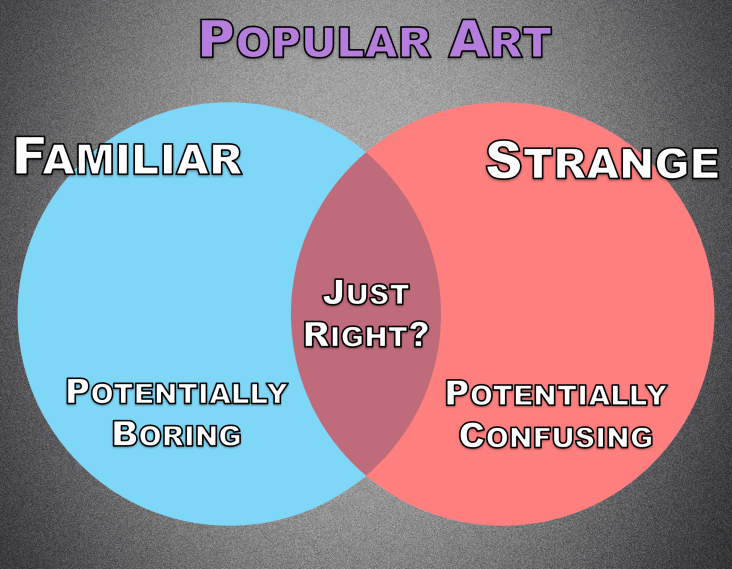
I’m having fun. I don’t know if anything will come of this project, but Robot Shakespeare is a hoot. And this exercise got me thinking of art as a whole. Or at least popular art (pop art). Forgive me for using a Venn diagram.
I found the above to be especially true in board game design. If you follow game design brain dumps, you may see this Venn diagram again. As the diagram illustrates, when elements within the art (in question) veer toward the familiar, they tend to be boring, and when elements venture too far toward the strange, one can find confusion. I’m trying to find the balance. The Rustbucket Riots game teeters toward being too strange. But I have another design, Wildflowers, that may play it too safe. But Spill the Beans (a third design) adds familiar elements while maintaining a fun twist. And that’s what I hope these Robot Shakespeare short stories will accomplish.
I can’t say what these short stories will yield, but I’m having fun. And who knows? I may find a story element or two to explore with the Rustbucket Riots novel.
What’re your thoughts on popular art and art in general? Let me know in the comments. Thank you for reading, and wherever you are, I hope you’re having a great day.
Happy Wednesday, Geekly Gang! Kyra Kyle here. In today’s post, our writers will share the games (board games and video games) they’ve been playing over the past month. Let us know which games you’ve been playing in the comments, because we’re all part of the Geekly Gang. I’ll get things started with the games I’ve been playing over the past month.
Kyra’s Board Games
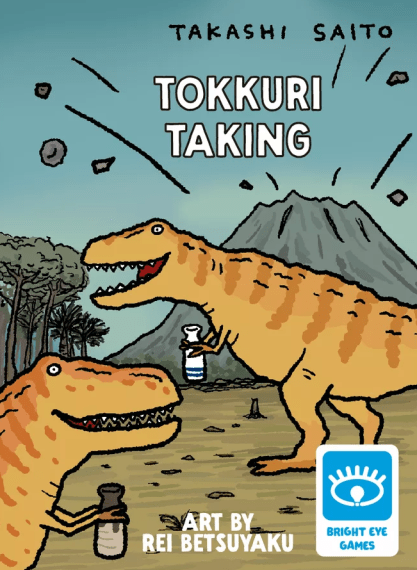
JK Geekly attended Scroogecon (in Lincoln, Nebraska) last month, so many of my board games will be ones I played during that event. Tokkuri Taking was the first game I tried. Dinos drinking sake, what’s not to love? I love this theme. And Tokkuri Taking was fun for a single round. Players score points for each empty tokkuri (the vases used to hold sake). I like plenty of the mechanisms here. I’ve never seen wooden sticks depicting how much sake is in a tokkuri. A round ofTokkuri Taking runs less than 15 minutes, which is what the box says. Unfortunately, Tokkuri Taking ends after numerous rounds. Players begin with ten chips. As soon as one player runs out of chips, the game ends. With players exchanging chips each round, Tokkuri Taking could last anywhere from an hour to two hours. Yikes! I wouldn’t want a two-hour session of Tokkuri Taking. I’ll stick to one or two rounds.
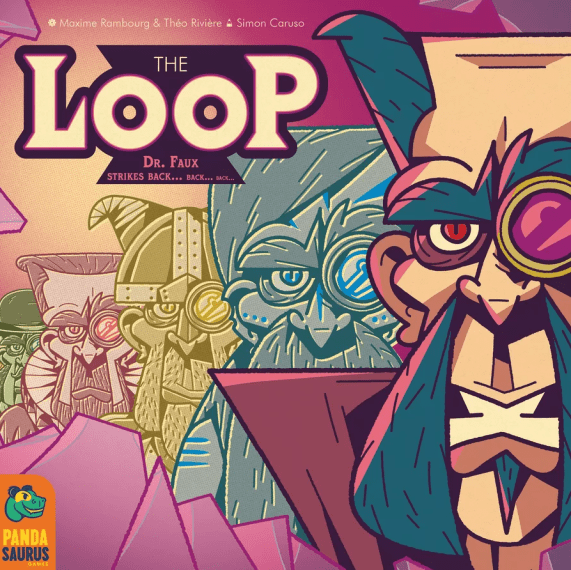
While I enjoyed my single play of The Loop, I don’t know if it’ll make my board game collection anytime soon. The theme and mechanisms are amazing, but I worry about The Loop’s scalability. We played with a full complement of four players. I never felt like we were going to lose this cooperative game. According to boardgamegeek.com, The Loop plays best at 2 players. I believe that. The person who shared The Loop with us said solo games skewed toward being too difficult. I felt four was too easy. Three may not be much better than four. But who knows? The Loop features a lot of variability. We could’ve gotten lucky during this game. I would play The Loop again. It was fun.
River Valley Glassworks is a game I’d gladly add to my collection. All Play Games has a knack for quick, accessible games with quirky mechanisms and themes. River Valley Glassworks meets these criteria. Heck! We played two games. And I got skunked both times. Gamers play as pioneers, drafting glass (acrylic pieces) from the market of river tiles. To claim glass, you must play a piece from your inventory into the river. But beware, each river tile can take one specific shape, and you must play into a space adjacent to where you want to draft. After you pick up your glass and place it on your player board, the river shifts forward, revealing new pieces. Perfection! The mechanisms enhance the theme. And the theme enhances what you do each turn. By the time you’re reading this, I may have already bought a copy of River Valley Glassworks. It looks gorgeous.
The next game I played was playtesting my prototype, Dungeon Chef. It was a smash. And that’s not just me saying that. One of the playtesters asked if Dungeon Chef was print-and-play. They wanted to spend $15 or so and print off a copy of their own. That’s a great sign.
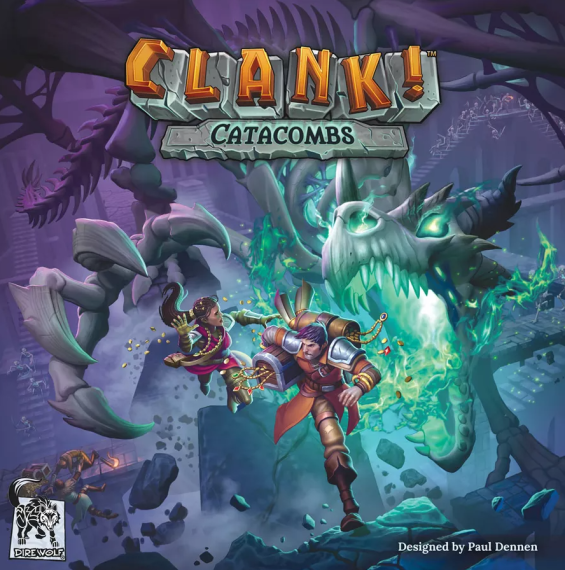
I’ve always wanted to try Clank! or Clank! Catacombs, and finally got my chance during Scroogecon. It was good. But it wasn’t as good as I wanted. Similar to The Loop, another game I’ve wanted to try for some time, Clank! Catacombs may have suffered because we played with a full complement of players: four. Unlike The Loop, Clank! Catacombs played well (balance-wise) at four, but ran long. Honestly, several of us at the table had been playing games all day and had little interest in turns that weren’t our own, and we got distracted. Scroogecon had been quiet most of the day. It got loud when we started Clank! Catacombs. I liked how Clank! Catacombs melded disparate mechanisms into a cohesive whole. I even won the game–by a lot. Beginner’s luck. But it didn’t quite land. Clank! Catacombs is another game I’d give another chance.
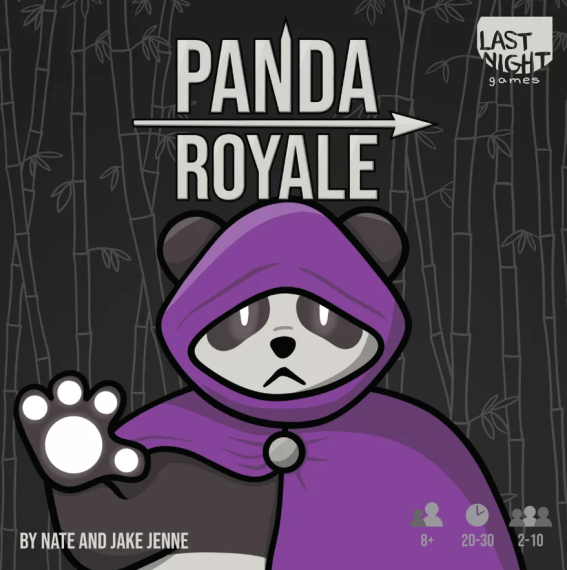
Panda Royale is a cute dice-chucking and drafting game. It plays super fast, and that worked for the limited time we had remaining at the convention. We had fifteen minutes or so before Scroogecon’s raffle drawing. Panda Royale fit nicely into that window. The game has a cute theme, but the mechanisms don’t match the theme. Panda Royale could’ve been titled Yahtzee Royale, but this theme is more appealing. And the title Yahtzee is most likely copyrighted. Panda Royale can get swingy, and the game doesn’t do enough to address a potential runaway winner. Skye cobbled together a handful of consecutive 100-point rounds, and I knew she was going to win halfway through the game. Still, Panda Royale is quick enough to exact revenge. If we had more than fifteen minutes, I would’ve been challenging her to a rematch.
One last note on Panda Royale: I hated the dry erasers. You may need to bring tissues and cleaner whenever you play.
That’s all I have for this past month. Let’s check in with Season.
Season’s Board Game
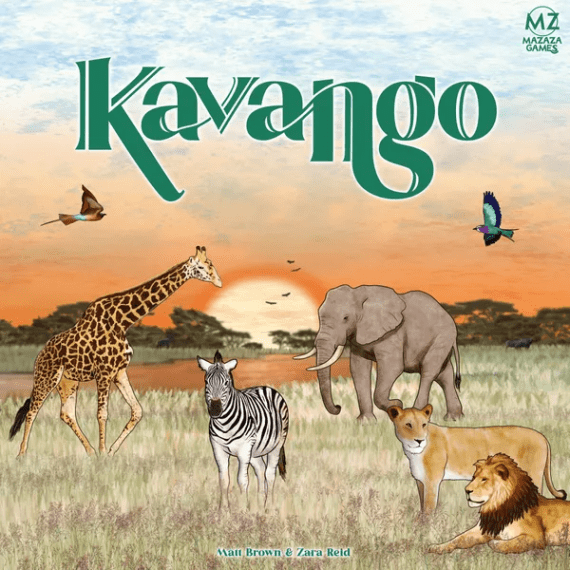
I played Kavango for the first time last year at Nuke Con. Guess what I got for Christmas, Geekly Gang? Kavango has players build their own wildlife reserves in Africa through conservation. Whoever has the most thriving reserve wins. I’ll say this: Kavango isn’t a game you’ll win on your first try unless you’re a board game genius. It looks more intimidating than it is since there are many moving pieces, but it’s got a good flow. Kavango has three rounds with ten turns apiece, but each turn is played simultaneously between players.
The creators of Kavango did research on real-life conservation and included player roles based on their real-life counterparts. The Kickstarter edition (my copy) has a map of wildlife conservation parks across Africa. I’m totally using it for an African wildlife safari that I’m planning for in the distant future.
Seasons Video Game
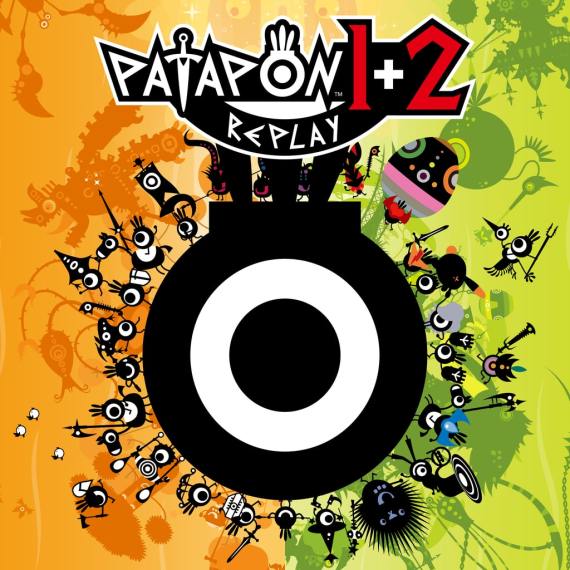
I played the first Patapon on PSP eighteen years ago. I never completed it because it was too difficult for me. Patapon is a rhythm-based side-scrolling game that relies on the player to match their drums (buttons on the controller) to the movements of their Patapon tribe. Maintaining the rhythm allows the player to go into Fever mode. Some of the Patapon tribespeople do more damage and have special abilities when in Fever mode. If the player loses their rhythm, the Patapons glare at the screen and shout, “Huh?” Some of them even fall over. Maintaining Fever mode is difficult when levels throw many enemies and environmental effects at players.
That’s all from me. What are you playing, Skye?
Skye’s Board Games
Rustbucket Riots is a game I’ve been meaning to mention for a while, and I’m glad to finally offer my take on it. For those who’re unfamiliar, Rustbucket Riots is a cooperative dice-placement game created by our very own Kyra Kyle about taking down renegade robots in a not-so-distant dystopian future. While not yet published, I had the pleasure of playing a newly updated version of the game last month, and it’s amazing to see how much progress it’s made over time. The board has become much easier to read, and the flow of the game has been perfected. It goes without saying, but I certainly can’t wait until Rustbucket Riots hits the shelves because I’ll be one of the first to pick up a copy.
Another Kyra Kyle original, Spill the Beans (working title) is a much simpler party game. With the objective of spilling Jellybeans (not too many) out of the jar and placing/eating them in a way that leaves you with the most points. Spill the Beans is fast-paced. It also puts a spin on the idea with the addition of jar-specific abilities depending on where you decide to place your Jellybeans. Spill the Beans is a great pick for some lighthearted party game fun.
Skye’s Video Game
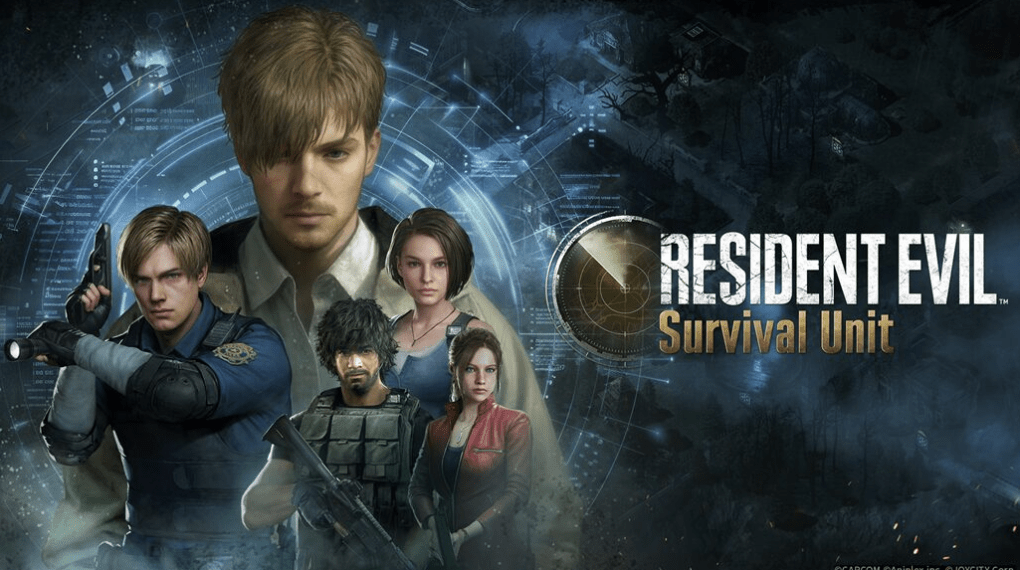
I don’t have a problem. Well, ever since beating Resident Evil 2 and Silent Hill 2 last month, I became transfixed by the world of Resident Evil. I’ll admit there isn’t much that sets Resident Evil: Survival Unit apart from other survival strategy mobile games with the sole exception of it being Resident Evil themed. For that reason, it’s been hard for me to pull myself away from it. Every day I have my construction and research progress in the back of my mind and the urge to participate in alliance raids is too much for me to resist. That and it’s great to see some of my favorite characters still alive in this non-canonical story. I never fully recovered after Marvin; just let me have this.
Hey, hey! Kyra Kyle here again. Those are the games our writers have played this past week. Let us know what you’ve been playing. Thank you for reading, and wherever you are, I hope you’re having a great day.
Happy Friday, Geekly Gang! Kyra Kyle here with another writing brain dump. I’m in the middle of editing my most recent completed novel (based within the Rustbucket Riots board game universe) and had an epiphany. The specifics of the epiphany don’t matter much–two of the main characters are related for the curious folks out there–but how I came to this realization serves as a good reminder that writing ideas can come from anywhere. And you may need to step away from yourself. When the idea struck, I wasn’t at my desk writing. I didn’t have a pad of paper and a pencil at the ready. I was grocery shopping.
Since I’m a veteran, I shop at the local military base’s commissary. The commissary still employs baggers who will carry out your groceries to your car, and on this faithful day, I had a bagger whose past aligned with mine to some extent and even more so with my protagonist. My bagger was half Native American, but you wouldn’t know it by looking at him. He and his brother looked and acted nothing alike. And I have some experience with both of those aspects. It makes sense to adopt some of those elements for my protagonist. Heck. Some of those elements already existed. I just had to give them a sibling. I don’t want to get into too many details. I’m unsure if someone reading this may try and track down my bagger. But talking to others can help with your writing.
By no means am I a social butterfly. I’m happy to spend most hours of many of my days at my desk. I think most writers operate well in isolation, but when you’re stuck with a story/character/scene, stepping outside yourself can help. I may not talk that much when I’m in public, but I love to listen. You’ll never know which found stories (stories a writer finds while in the world) you’ll discover.
The next time I see “Name Redacted,” I may let him know that he helped me with a story. Or I may just listen. Have you found stories by listening to or observing others? Let me know in the comments. Thank you for reading, and wherever you are, I hope you’re having a fantastic day.
Happy Wednesday, Geekly Gang! Today is the rare fifth Wednesday of a month, so our writers will be sharing personal updates over the past few months. I’ll kick things off for this month’s Personal Updates.
Kyra’s Games
I’ve been sick (with the crud) over the past few weeks, but before getting sick, I was featured in a board game design panel at Nuke-Con early this month. While the panel went well, I’d like to expand on it for next year. Be on the look out for Nuke-Con 2026. I also playtested Rustbucket Riots and Whirligig Pets several times during this same convention.
Whirligig Pets (formerly Whistlestop Pets–I need to change the above image) is ready for submission. I still need to find a better way to ramp up the tension in Rustbucket Riots. I think I found a way to tweak the enemy/time cards, so players experience a steadier upward ramp. Before this recent change, evening cards were brutal. I like the new balance, but higher player counts are where balance can get tricky. We’ll see if this new balance sticks.
I won’t go into too much detail with Rustbucket Riots. I already did some of that with this month’s Game Design Brain Dump. If you’re interested, you can see Rustbucket Riots’ origin.
One last important note I discovered during the con: I need to figure out the best way to teach this game. Rustbucket Riots has a lot of odd game mechanisms that many players find unfamiliar, and the spatial puzzle can be overwhelming. I know many of you haven’t played, but here’s a quick rundown on how a round plays:
1) Enemy Turn (Draw Time Cards Equal to Number of Players) 2) Players play one card from their hand 3) Roll and Lock Dice 4) Place Dice (on gears) 5) Spend Dice (by removing dice from gears)
I’ll begin with this and then get into the weeds as the game progresses. Maybe this will help. I hope to see some of you at the gaming table soon.
Kyra’s Writing
Similar to board game design, I posted a writing brain dump earlier this month. I’ll try not to recap too much of what I posted there. I’m still viewing my work in progress through a macro lens. Characters have merged. I combined some characters who could be considered fridged (the character’s sole purpose was to motivate the protagonist) with another character with a larger role. I’m finding character arcs for each major character, and I’ve found I don’t have as many characters as I did prior. This may be an easier editing pass than I first thought. Famous last words.
Novel in November (formerly National Novel Writing Month or NaNoWriMo) begins in a handful of days, and I’ll be attending as many Omaha Writers’ League (OWL) events as I can. Above is a calendar of OWL events. All locations are in Omaha. Events are subject to change. (I believe November 11th is left blank in observance of Veterans’ Day.) If you’re in the local area, I look forward to seeing you at one of these events. I’ll be at many of these events, trying to make sense of my nonsense. There’s a reason I call my updates writing brain dumps.
That’s all I have for this month. Let’s see what Skye’s been doing.
Skye’s Update
I’ve done some interesting things over the past quarter. I became a member of my local library’s board-game community, attended Metropolitan Community College’s annual Inter-Tribal Powwow, and protested the protection of the United States’ founding ideals of “liberty and justice for all,” among other things.
My greatest achievement–in my opinion–in the past quarter was scheduling a date with my surgeon to undergo the final part of my medical transition. I’m scheduled for November of next year (2026), and words can’t describe my immense satisfaction. Advanced warning to y’all: I suspect I’ll be in recovery during that time next year. I’ll do my best to post, but I might be hopped-up on pain meds.
Overall, I would consider the past quarter (Aug-Oct) a productive one. Despite personal obligations, I’ve still enjoyed posting and offering my opinions on JKGeekly with the rest of the Geekly writers. Posting my thoughts online is one of my greatest joys, and I thank everyone for welcoming me into the Geekly Gang.
Here’s to another three months of Geek with y’all. Happy Halloween!
Season’s Update
Hi, Geekly Gang! It’s been a while since I gave an update. I’ve recently started a new full-time job, so I’ve been adjusting to my new schedule. I’ve also been sick with the crud this past week. It’s a good thing I’m writing this update, because my voice is shot. Blegh!
As for writing, I’ve tried to get a couple of pieces published, but no luck yet. They’re a couple of short flash fiction pieces. Maybe I’ll share them here someday. I’m going to keep submitting until I get some bites. Fingers crossed! I’ve also been enjoying writing monthly plushie reviews for you, Geekly Gang. If you have a favorite plushie, please let me know. I’m always down for new plushie recs.
Hey, hey! Kyra Kyle here again. Those are our writers’ updates for the past few months. Feel free to share what you’ve been up to over the past month or three, Geekly Gang. Thank you for reading, and wherever you are, I hope you’re having a great day.
Hey, hey, Geekly Gang! Kyra Kyle here. Last week, we began a series called–for the time being–Writing Brain Dump, and this week is the time to roll out Game Design Brain Dump. The title is a work in progress. Let’s hope I can express my board game design process with this series. Fingers crossed for a cogent thought or two. Strap in for a Board Game Design Brain Dump.
Rustbucket Riots Origins
I’m going a different route from last week’s writing brain dump. Recently, I attended a panel about board game design at Nuke-Con (Omaha’s board game convention) and figured we could begin with what prompted me to begin designing Rustbucket Riots.
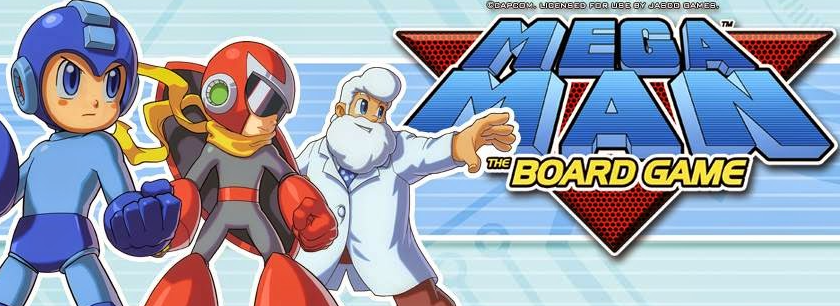
I knew Mega Man: The Board Game by Jasco Games wasn’t the best when I purchased it at a severe discount. Honestly, I wanted the bits. Jasco Games did an amazing job with Mega Man’s miniatures and the look of the game. But good luck finishing a game of Mega Man in under 10 hours. Each robot stage plays like five games of Munchkin played back-to-back, with every other player doing their best to prevent you from completing the stage. And you need to complete multiple boss stages. 10 hours may be too few hours to complete this game. You may need to dedicate a table to preserve your month-long game of Mega Man.
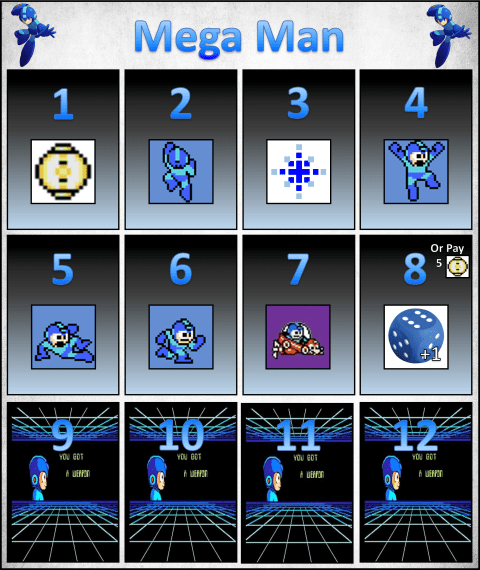
I hope I won’t get copyright claimed for any images. Eek! I began with a simple dice chucker of a game. Players would roll standard six-sided dice (I don’t recall the exact number, but it was likely around four or five) and then place the dice on their player boards. Each space on the player board would grant different abilities, with the final four slots variable for powers obtained by defeating robot bosses. Players could place multiple dice in a single space to combine the rolled result. A six may be played with a single die showing a six or with a two and a four or any other combination of six.
I chose dice chucking because rolling dice and placing them with predetermined spaces made for quick turns. Quick turns lead to a game that one can finish within ten hours. This game worked well. Heck, I even tried it as a real-time game, and it worked extremely well. Games lasted less than 15 minutes. I even saw this Mega Man variant as a game that could be played in tournaments of speed runs. Now that I think about it, I may revisit this variant in the future and give it a reskin. Sorry, the ADHD took the wheel for a second.
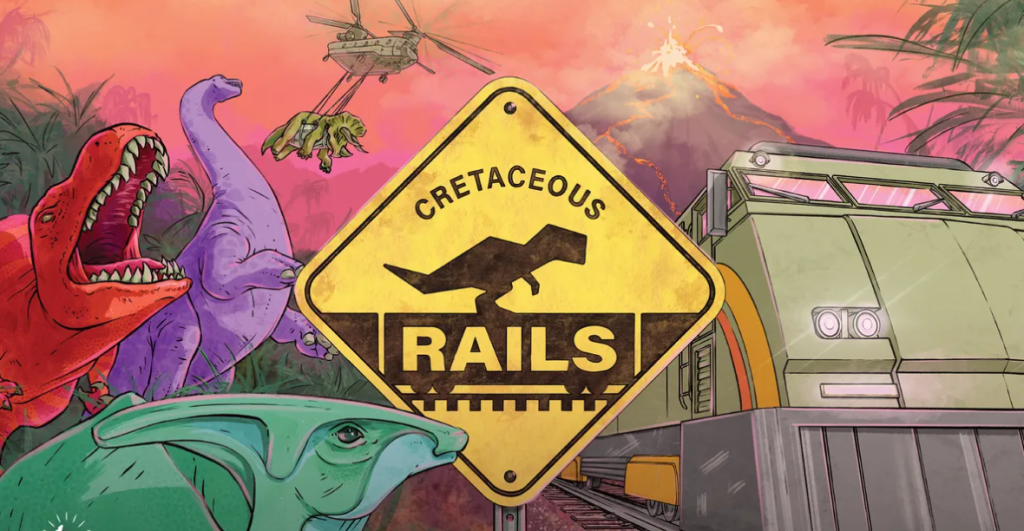
For some reason, I abandoned the above game concept and went in a different direction. I love Cretaceous Rails. Unlike Jasco’s Mega Man, there isn’t much I’d change with this title. Cretaceous Rails makes this list because I wanted to try using one of its core game mechanisms: dual action selection. I even asked Cretaceous Rails’ designer, Ann Journey, if it’d be okay if I borrowed this game mechanism before trying the next Mega Man remix iteration. The result was a game I nicknamed Rondelande.
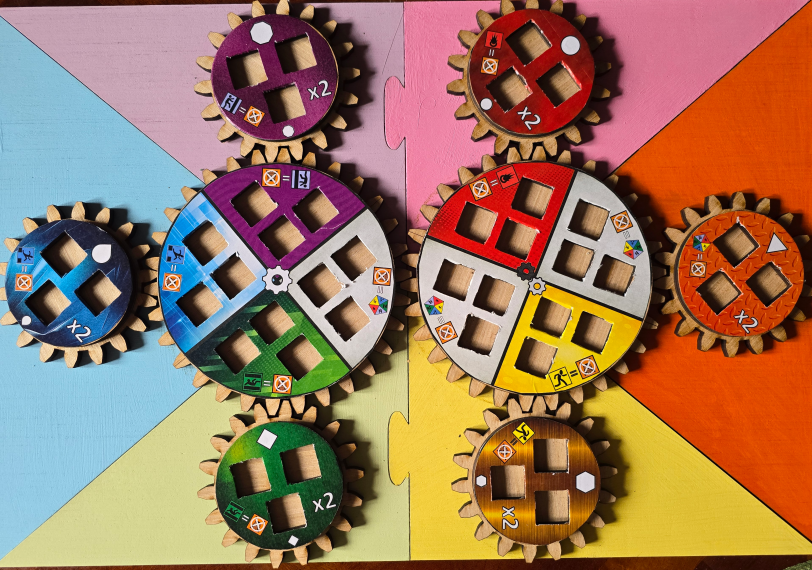
Oh my goodness. This game wasn’t just a different direction from my first Mega Man remix; it was different in every possible way. I didn’t keep any of Rondelande’s hardcopy versions. I only have the digital files, and it’s difficult to recreate what the game looked like without a physical copy. But I’ll try my best.
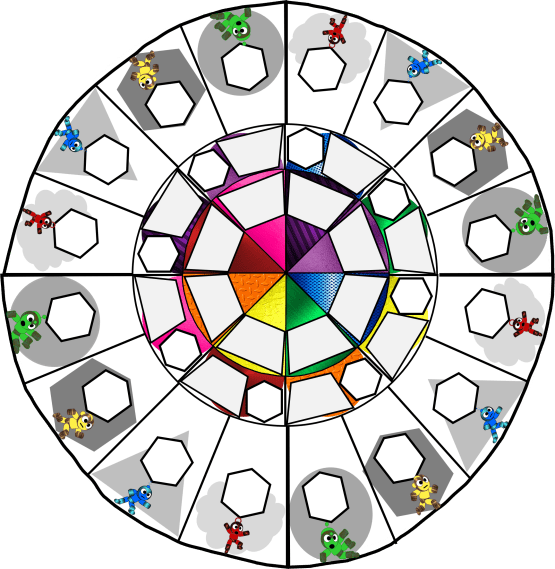
That’s a lot of color going on. Those are supposed to be three rondels (a circular game mechanism with pie wedges representing which actions one may take) stacked on top of one another. Each turn, players would place their gear tokens on one of the hexagon-shaped spaces and take the actions indicated. But before placing gears, players could play up to two cards (depicting one of the actions run, slide, jump, shoot, or climb) underneath the spaces on the outer edge. Players would then be able to take all the actions, including actions on cards, during their turn.
Note: The trapezoid spaces had different actions like draw cards or oil cans (that functioned as wild actions) or even rotating one of the top two rondels, so the action selection could vary.
Rondelande was a lot of fun. It ventured far from what I had originally intended to make. That’s the ADHD brain taking the wheel again. Unfortunately, Rondelande was a space hog. The image above is at least a twentieth of the size of the original game. Despite its size, Rondelande may have been a great game if I had stuck with it. I liked how players could build up the board as they went, benefiting themselves for a turn, but also allowing an opponent to take the same action in a future turn. Players could even refresh (take back their gear tokens) or choose not to refresh for a turn to prevent someone from taking an action their token is currently occupying. Rondelande was great. But something felt off. I wanted interlocking gears for the board because it made sense for a robot theme. I had chosen rondels because they were easier to build. And then I found gears that would work.
I found a file that could work for interlocking gears. Yay! As an aside, I was working on making this file work while producing my Mega Man variant and Rondelande, so a lot of what we’re about to discuss happened concurrently with the previous two games.
At first, I was using a lot of memory foam. Rondelande’s rondels were comprised of foam. I’d print out the digital files (of that rainbow nightmare above) onto full sheet labels and then sticker them over the foam and cut them out. I tried the same concept with the gear pictured above. And it worked…for like one playthrough of the game. Foam likes to shred under friction. Who knew? So, I put the interlocking gears aside until I found a set of wooden gears on Amazon.
Yes! I was in business. I could continue with Rustbucket Riots. The picture above is a modern version of the game; the first version still used foam for its board (the gears haven’t changed too much). I still have a version of the first game and will include a picture of it in a future post. Rustbucket Riots combines multiple ideas. I brought back dice chucking from Mega Man, only this time, I used specialty dice that included run, slide, climb, shoot, and jump. And I always thought Tzolk’in’s gears didn’t move enough. I could fix two issues I saw in other games. Jasco’s Mega Man took too long, and Tzolk’in (Tzolk’in is an amazing game that earns its spot in BGG; I’m nitpicking) could have gears that frequently turn.
The name Rustbucket Riots came swiftly. Originally, I wanted to make a better Mega Man board game, but I couldn’t copy Mega Man exactly. So, I wondered if I could make the player characters villainous. The Boss Robots attempt to free themselves from an oppressive corporocracy and the humans using them as cheap labor, while the players assume the role of corporate robots tasked with bringing the rogue robots under control. Even though the Boss Robots would view what’s happening as a revolution, we’re playing this game from the viewpoint of corporate robots, and they’d see it as riots. Throw in a slur, and you get Rustbucket Riots.
I think that’s everything up to the idea of Rustbucket Riots materialized. We’ll cover early iterations of the game in the next board game design brain dump. If you’ve made it this far through my rambling, you’re awesome. You know it. Thank you for reading, and wherever you are, I hope you’re having a great day.
Happy fifth Wednesday, Geekly Gang! Kyra Kyle here. Since it’s the fifth Wednesday of July, that means our writers will be sharing personal updates. I’ll get things started.
Kyra’s Writing
My writing and game design will sound similar this month. The two center around the same concept. I wrote a first draft of a novel based on one of my board games, Rustbucket Riots, and I’m in the throes of reverse outlining.
Reverse outlining is an important stage of writing/editing that I learned after multiple novels. During the reverse editing stage, I take note of what happens in each chapter/scene, looking at the novel from a macro level, rather than a micro level (like line editing). Reverse outlining allows me to see who the point of view (POV) character is for each chapter (if there’s more than one POV character for the novel). If a character has only one POV chapter, I may need to give them more chapters or consider omitting the chapter or using a different POV character. Jotting down what happens in each chapter makes it easier to see which chapters are pulling their weight (from a narrative perspective), which ones could do more, and which ones may not be needed.
In previous novels, I made the mistake of line editing after writing the first draft. That doesn’t work–at least, not for me. The sunk cost fallacy (the tendency to continue an endeavor because of the time and effort spent on the project) is strong when a writer does this. Slapping together a crappy first draft and then taking a macro look at each chapter makes it easier to “kill one’s darlings.” If I haven’t spent hours editing a chapter, that chapter hasn’t reached the status of one of my darlings. It’s easier to make cuts.
Depending on when you’re reading this, I may be slashing through thousands of words in one keystroke. Can you hear the ink cry?
On a different note, I’m still querying agents. Fingers crossed.
Kyra’s Game Design
I received a ton of great feedback for Rustbucket Riots and Whirligig Pets. Both games are well on their way to being publishable.
I’m continuing to refine my other designs, and I’ll be at Comic Con Nebraska this weekend. If you’re in the area, stop by and say hi. I’ll be in the game room, demoing various designs that will include Rustbucket Riots and Whirligig Pets. I’ll even have JK Geekly badge ribbons.
Tangent: I joined a board game publication and pitching course, so hopefully, my board game pitches will improve in the coming months. Lol
That’s all I have for these past three months. Let’s check in with Skye.
Skye’s Update
Believe it or not, I do have a life. I know, I was surprised too. Not much has happened since the last time I did one of these, but there were a couple of things I wanted to mention.
First, I have a new job at my local movie theater. Y’all know how much I love movies, so this kind of job is right up my alley. There’s a more community-oriented culture at Marcus Theaters with several opportunities to learn and connect with the team, which I love. Of course, there’s also free movie tickets. This means that I can start covering recently released films on my personal blog, TGIMovies, in a more financially responsible way.
Second, I took this summer off from college. So far, I’ve been having a good time relaxing and dedicating my time toward things I love, such as my hobbies, my relationships, and this community. I’ve learned a lot about myself, spent time with those I care about, and started working towards my future. At this point in my life, I’m the most excited I’ve ever been about what’s to come. I’m glad I got to share it with y’all!
Thanks for reading about my experiences and for inviting me to this website. Though I don’t say it often, I’m greatly honored to be a part of this community, to experience geeky content with like-minded people, and to have a platform to offer my thoughts. I’ll see y’all next week with another “Whatcha.” Take care!
Kyra Kyle here again. Season doesn’t have an update for the past three months. She graduated from college with a Bachelor’s and continues to look for work in her field. Fingers crossed that she’ll find something soon. And feel free to share what you’ve been working on over the past three months. We’re all part of the Geekly Gang. Thank you for reading, and wherever you are, I hope you’re having a great day.
Hey, hey, Geekly Gang! Kyra Kyle here. We have a new month and a new Wednesday, so it’s time for Whatcha Playing. The Geekly writers and I will share the games (video games and tabletop games) we’ve been playing over the past month. Feel free to share which games you’ve been playing, because we’re all part of the Geekly Gang.
Kyra’s Games
As always, I won’t include any of the gacha games I typically play. If I ever stop playing Wuthering Waves or Honkai: Star Rail, I’ll let you know. I also don’t include prototypes of tabletop games I’m developing, like Rustbucket Riots, Whirligig Pets, No Jack, Weeds, or Spill the Beans. Of course, I played those. With that disclaimer out of the way, let’s get to the games.
Board Games
I finally got Sky Team to the table, and it’s excellent. This two-player only game features a fast back-and-forth between one player as the pilot and the other as the co-pilot while they attempt to land a plane. Technically, players aren’t supposed to speak during rounds, but I allow minimal communication. Sky Team is a cooperative game, after all. Players simultaneously roll dice and then place them in their designated spaces, blue for the pilot and orange for the co-pilot. Both roles have specific duties.
Naturally, I chose Skye to be part of my first play of Sky Team. You can’t have a Sky Team without Skye. We played the tutorial and narrowly lost. Skye immediately wanted to play again, and we were able to land the plane on our second try. Sky Team includes numerous scenarios, and I can’t wait to try more.
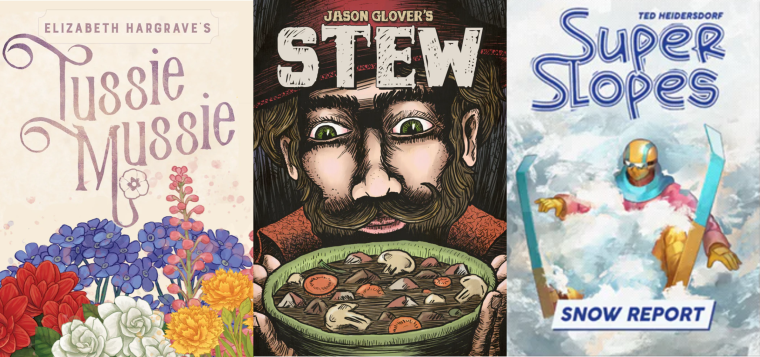
I’ve played many Button Shy Games over the last month, and the above three games are standout titles. Elizabeth Hargrave’s Tussie Mussie has a great push pull of which flower do I want to show my opponent and which to keep secret. Your opponent will choose between the two flowers: known and unknown. Jason Glover’s Stew takes a similar concept of having partial knowledge of what’s in the Stew because you know which cards you’ve played and not the ones your opponents played. If you think there are enough points in the stew, you call stew and count up points; players gain points if they guess correctly, but their opponents gain points if they guess incorrectly. And Ted Heidersdorf’s Super Slopes is a crazy game of branching slaloms down snow-capped mountains.
I’m hooked on Button Shy Games. This company packs a lot of game into a small package, a wallet to be exact. I mentioned Button Shy Games in our Stocking Stuffer Games list in December. These games are great options for that, but for $12 apiece, Button Shy Games are good any month of the year. I love their portability. I can pack twenty to thirty of these in less space than one standard board game.
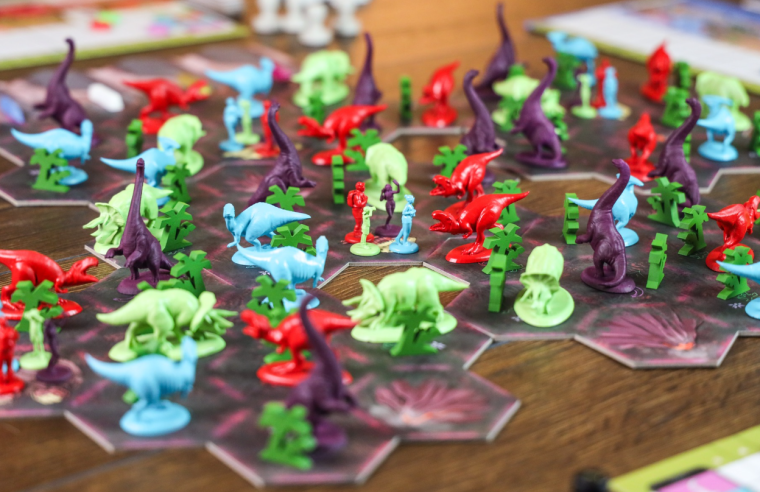
Technically, I haven’t played much Cretaceous Rails over the last month; I demoed the game for countless gaming groups. Dinosaurs and trains together at last! Really? I’m surprised the combination of dinosaurs and trains hasn’t happened before Cretaceous Rails. Anyway, I’ve played plenty of this game in the past. It’s over-the-top in its production value. Who doesn’t love four different train miniatures? Seriously, the train minis aren’t just different colors, they’re different train models.
Cretaceous Rails features dinosaur miniatures. Simply put, it has table presence. You’ll hear this game roar from across the room.
Video Games
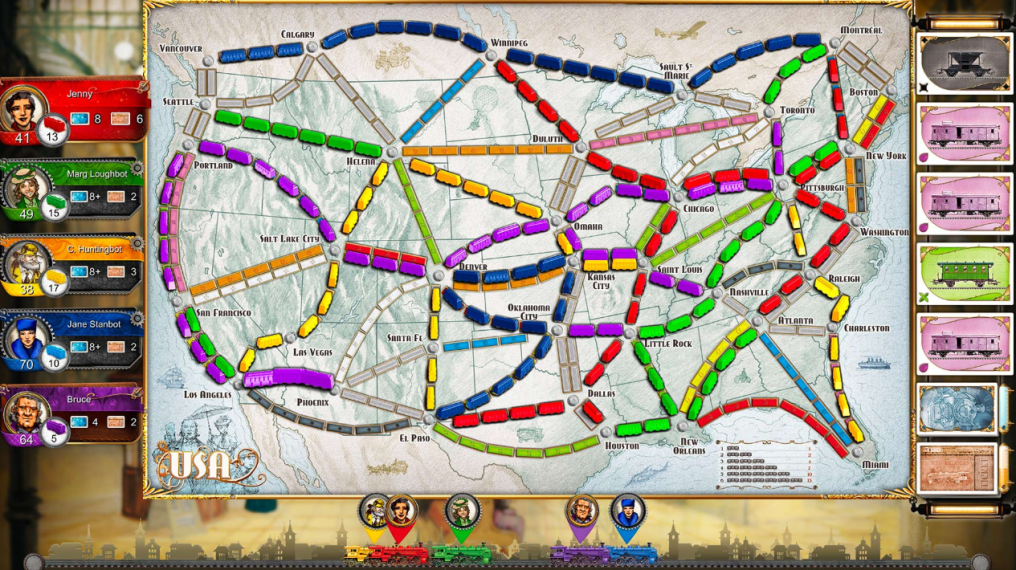
I know. I know. Ticket to Ride is another board game, but I played the version ported to the PlayStation 4, so it counts as a video game. I always loved the simplicity of Ticket to Ride. Collect enough train cards of a single color, match them to routes (between two cities), and connect cities on the ticket cards you have in your hand in a continuous route. Ticket to Ride modernized Rummy for the modern board game community. The PlayStation 4 version of Ticket to Ride is a great port of the game.
While I prefer the physical version of Ticket to Ride to a digital one, the production value is great. The base game includes the classic United States map and the Europe map. I’ve played Ticket to Ride: Europe a few times before last month, but picking up this copy (on the cheap) has led to more plays on the Europe map. I like the USA map more, but that’s because I don’t know if I quite understand how stations work. Whoops!
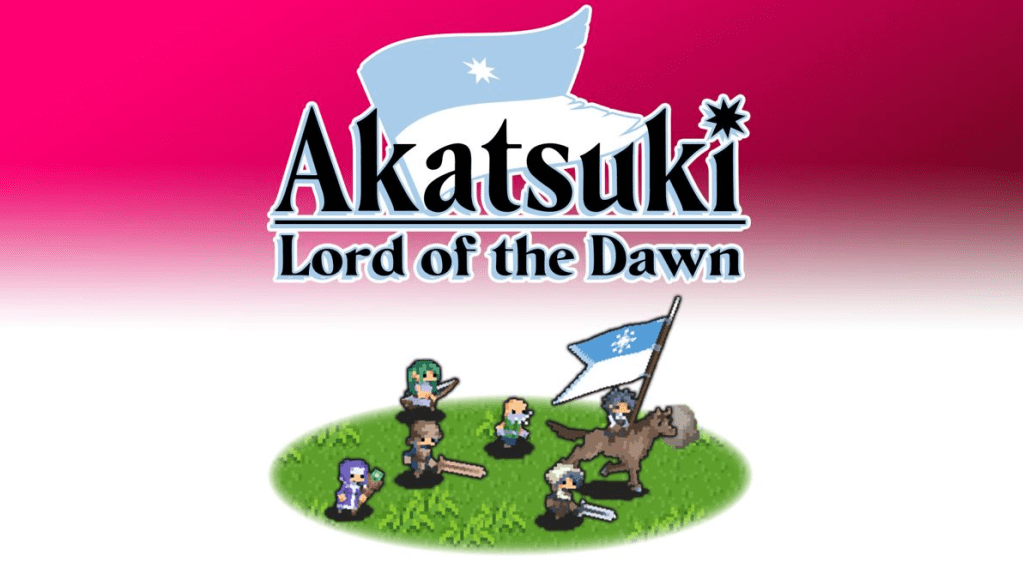
Akatsuki: Lord of the Dawn has a silly name. Akatsuki means dawn in Japanese, so the game’s title is Dawn: Lord of the Dawn. Tee hee! Anyway, Akatsuki: Lord of the Dawn is an army RPG. The story didn’t hold my interest. The game mechanisms were interesting–especially Akatsuki: Lord of the Dawn’s method of combining building an army and a country–but the game overstays its welcome by one island. By the time I finished the penultimate island, I had done all the game had to offer. The final island is four times the size of the previous island, and my final hour or two of gameplay was mindlessly autobattling a hundred or so territory tiles.
On a personal note, I saw a screenshot similar to the one above and thought Akatsuki: Lord of the Dawn used a card-driven combat system and got excited. The bottom left-hand corner looks like it could be a hand of cards, but no, it’s a head’s up display made to look like a hand of cards. Oh, well. Akatsuki: Lord of the Dawn was on sale for super cheap, I picked it up, and aside from the final island, I enjoyed my time with this indie game. Akatsuki: Lord of the Dawn took about twenty hours to finish.
That’s what I played this past month. Let’s check in with Season and Skye.
Skye’s Games
I have good news and bad news. The bad news is that I haven’t played many new video games this month to report to y’all. I got super addicted to Ghost of Tsushima and ended up playing non-stop. At least I have a platinum PlayStation trophy to show for it. The good news is that I spent this past weekend at Protospiel Twin Cities.
I typically don’t play board games unless I’m with my friends or family. Honestly, it doesn’t happen as often as it should. Last weekend, I had a unique opportunity to drive up to Minneapolis with our very own Kyra Kyle and play a host of different prototype board games. Behind these games were several different and talented designers.
Protospiel was an amazing experience. Kyra Kyle has been developing games of their own (which they’ve mentioned before), and I got to play them. I love playing Rustbucket Riots and Whirligig Pets. I even got to demo these games more than once. Co-op dice placement and programming adorable robot dogs and kittens. What’s not to love?
But I also had the pleasure of playtesting countless others. Most of these games have working titles or may not be ready to advertise, so most will be unnamed. Among the board game standouts were a simple and effective airline management game, a goofy cooking show contest game, an international travel game, and Spielcraft’s upcoming Primacy (a resource management/conquest game set in a dystopian future).
One of my favorite prototype games centered on becoming the “Master of the Seasons.” I liked its straightforward gameplay, fast-paced turn system, unique artistic design, and emphasis on strategy/point cultivation. If I ever see that game in stores, you bet I’ll be picking it up.
Season’s Games
board games
Woo-hoo! I was able to get some board game time under my belt. Elizabeth Hargrave’s Finspan got review-bombed before it even hit the shelves. I enjoyed Wyrmspan and have 3D printed resources I bought from someone in my hometown. I decided I’d collect everything in the Span series. Finspan is more streamlined than Wyrmspan and features an open hand mechanic. Players dive into the water, gather resources, and complete objectives. There are a finite number of turns each round (or week), so the game doesn’t drag.
One of my favorite things about Finspan is the attention to detail. The designers tried to be as scientifically accurate as possible to the real-world fish featured in the game. There are some artistic liberties, but you can find all of the fish in Finspan in our oceans today.
Video games
My Pokémon addiction returned when I spotted Pokémon Shining Pearl at my local GameStop. I don’t always keep up with the latest Pokémon games, but I’ll play a new one (well, new to me) every few years. Pokémon Shining Pearl is similar to previous games in the Pokémon franchise, but it features a location called the Grand Underground. After players complete the main game and unlock the National Pokédex, they may access a wider variety of Pokémon. There are way more legendary Pokémon to catch in PokémonShining Pearl than I’m used to in previous games, so that’s been a blast.
Kyra Kyle again. That does it for this month’s Whatcha Playing. What games have you been playing? Let us know in the comments. Thank you for reading, and wherever you are, I hope you’re having a great day.
























 jkgeekly.com