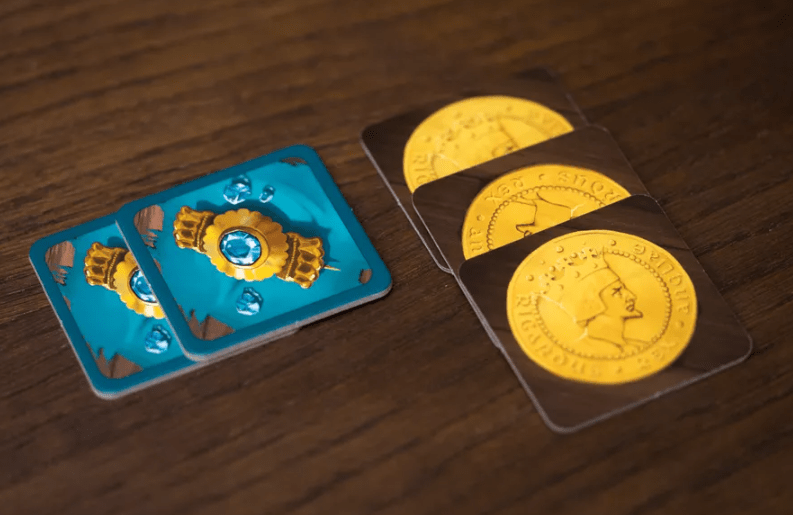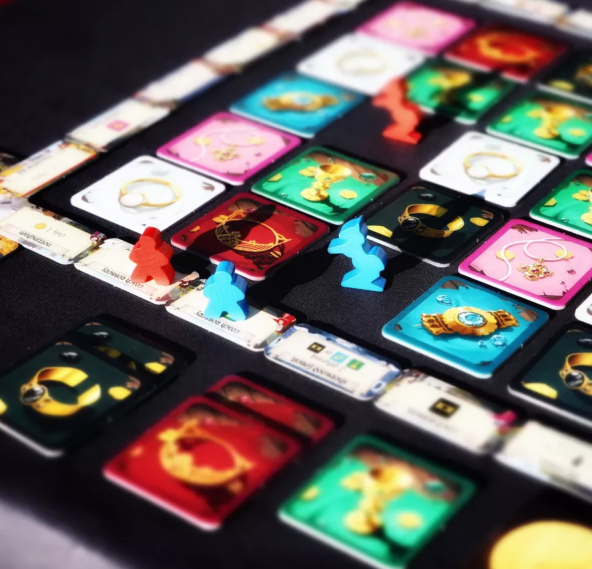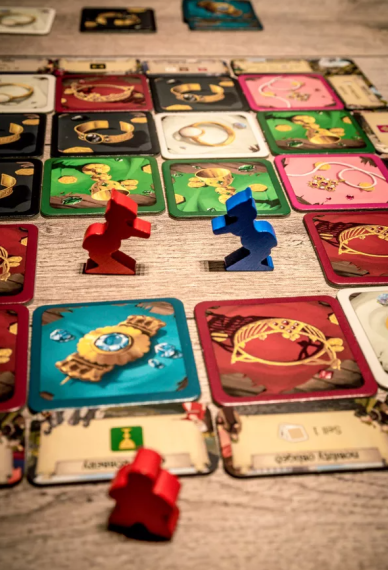
Tabletop Game Review: Spring Meadow

Spring Meadow is the grand finale of Uwe Rosenberg’s puzzle trilogy of games. It follows 2016’ Cottage Garden and 2017’s Indian Summer. The complexity of this game—the most interactive between the players in the trilogy—is set in between those two games. Hey, hey, Geekly Gang! Kyra Kyle here with another tabletop game review. We’ll be placing oddly shaped polyominoes on wintery player boards in today’s game review, Spring Meadow. Uwe Rosenberg’s final game of his puzzle trilogy marks the end of a harsh winter, and the first delicate flowers bloom. Can you have the lushest meadow? We’ll get to Spring Meadow’s review in a bit, but first, let’s talk about the less picturesque elements of the game and discuss Spring Meadow’s credits.
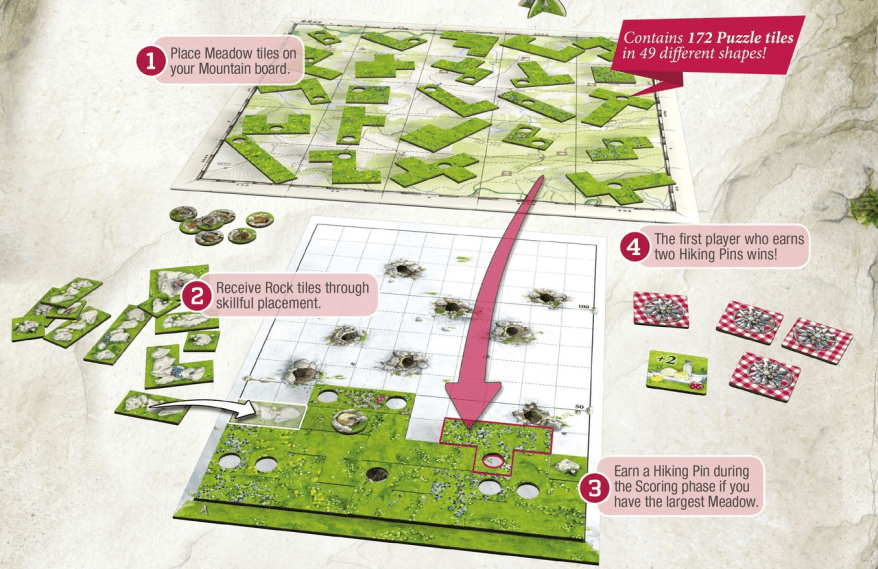
The Fiddly Bits

Designer: Uwe Rosenberg
Publisher: Stronghold Games; Pegasus Spiele; Edition Spielwiese
Date Released: 2018
Number of Players: 1-4
Age Range: 8 and up
Setup Time: 5-10 minutes
Play Time: 15-60 minutes

Game Mechanisms

Grid Coverage
Pattern Building
Tile Placement
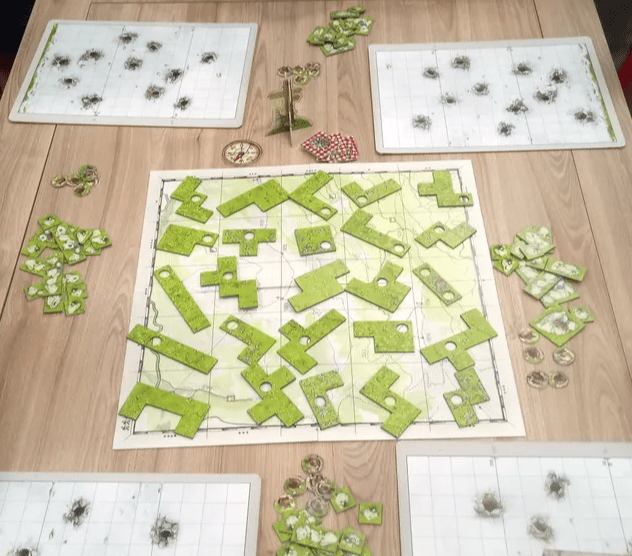
Game Setup

We’ll be paraphrasing the Spring Meadow rule book. The setup is succinct and easy enough to follow.

1) Place the double-sided Hiking Map (shared board featuring the offering of polyominoes) that corresponds to the number of players face up in the center of the table.

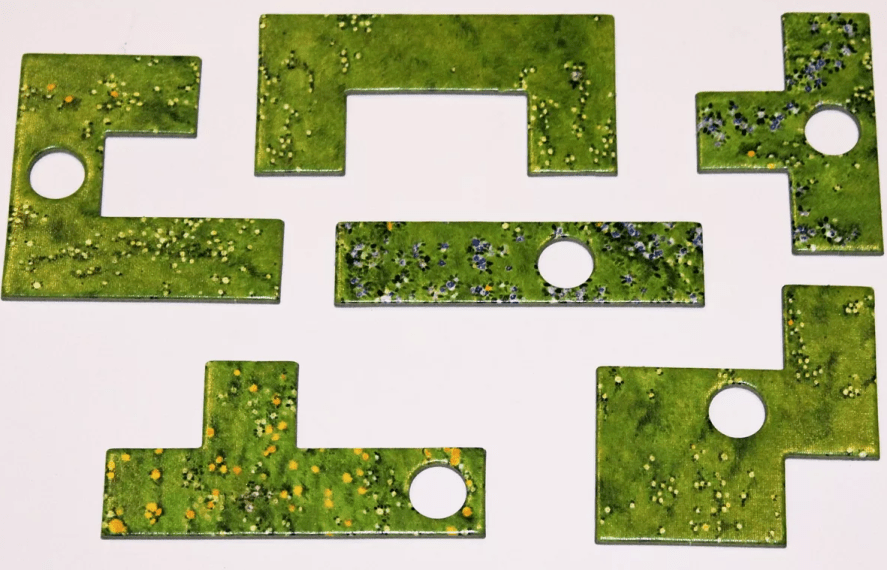
2) Shuffle all Meadow (polyomino) tiles and randomly place one on each of the 25 spaces of the Hiking Map.

3) Return the remaining Meadow tiles to the box. You will need them later to refill the Hiking Map.

4) Place the Rock tiles, Marmots, Picnics/Hiking Pins, and Compass within reach of the players in a common supply.

5) Place the Signpost next to the player count icon on the Hiking Map.

6) Shuffle the double-sided Mountain boards and give one to each player. Orient the Mountain board with the arrow pointing up.

7) Randomly select a starting player. Each successive player will take a Rock tile, the size of which will depend on the player count and the player order.
Game Flow

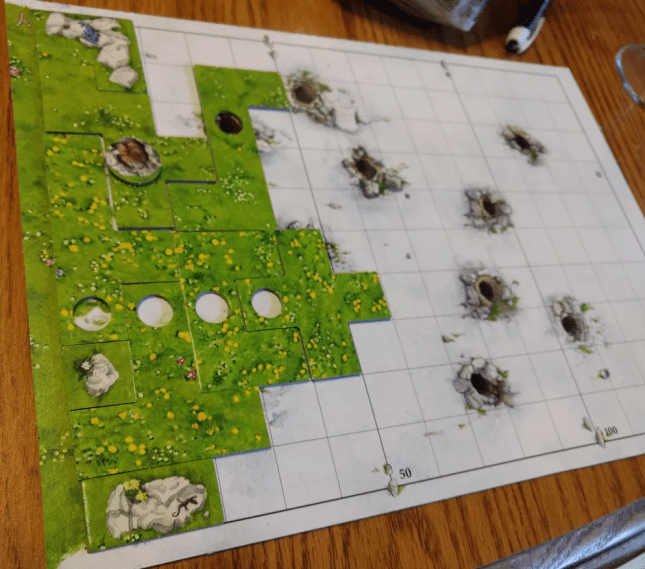
On a turn, the active player chooses 1 Meadow tile from the Signpost Path (noted by the Signpost pawn, you’ll either select from a row or column of polyominoes, depending on the Signpost’s orientation during your turn) on the Hiking Map. Place the tile on your Mountain board.

Pay attention to the Holes in the Meadow tiles and the Burrows on your Mountain board. Burrows will challenge your puzzle skills and placing adjacent Holes will allow you to place extra Rock tiles on your Mountain board.

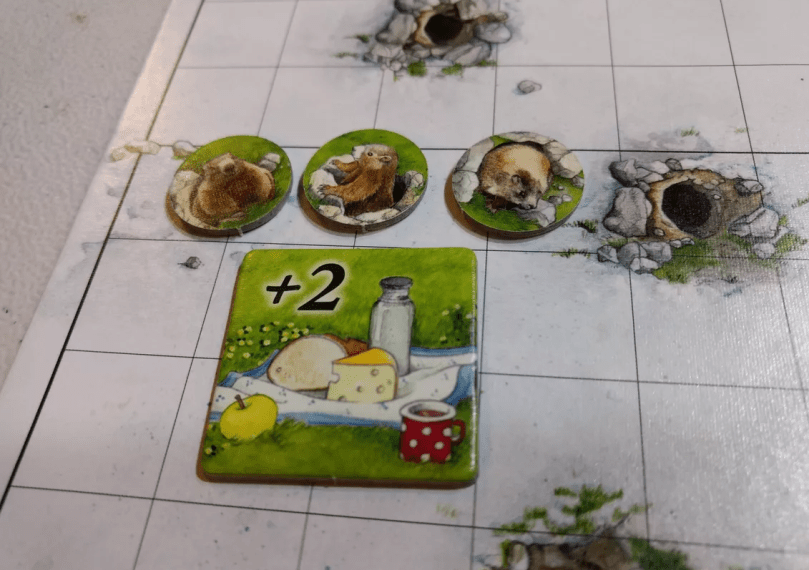
If you wish to cover a Burrow, you must place a Marmot over a Burrow that has already been cleared.

When the Signpost stands next to a Signpost Path (column or row) on the Hiking Map containing zero or one Meadow tile(s), a Scoring phase is triggered.

Starting from the bottom of your Mountain board, count all covered spaces up to and including your first incomplete row to tally your score.

The player with the most points earns a Hiking Pin and must place Marmots over all their cleared Burrows (so they cannot score those Burrows again).

Once scoring is completed, refill the Hiking Map with randomly drawn Meadow tiles afterwards.

The first player to earn their second Hiking Pin wins the game.
Review

It took some time for me to get into Spring Meadow. I appreciated Spring Meadow’s theme. There’s something about the earth waking up from a cold winter. One of my favorite things to do during this time is to stop by the Platte River and hear the ice turn into slush and float on by. Spring Meadow gives me those vibes. And I love polyominoes in general, and Spring Meadow uses them in interesting ways. Kind of like a competitive Tetris, where you want to fill the board with as many blocks as possible. But Spring Meadow has a steep learning curve, and if you play with a new player, that can derail the game.

Sure, at one point, I was that new player. The person who taught me the game had a fun enough time, but he didn’t really find enjoyment in playing Spring Meadow until me and another player from my gaming knew had played a handful of games. He told me as much. And I found the same to be true. Spring Meadow feels unforgiving as the “new player,” but as an “experienced player,” I felt as if I was taking advantage of someone else.
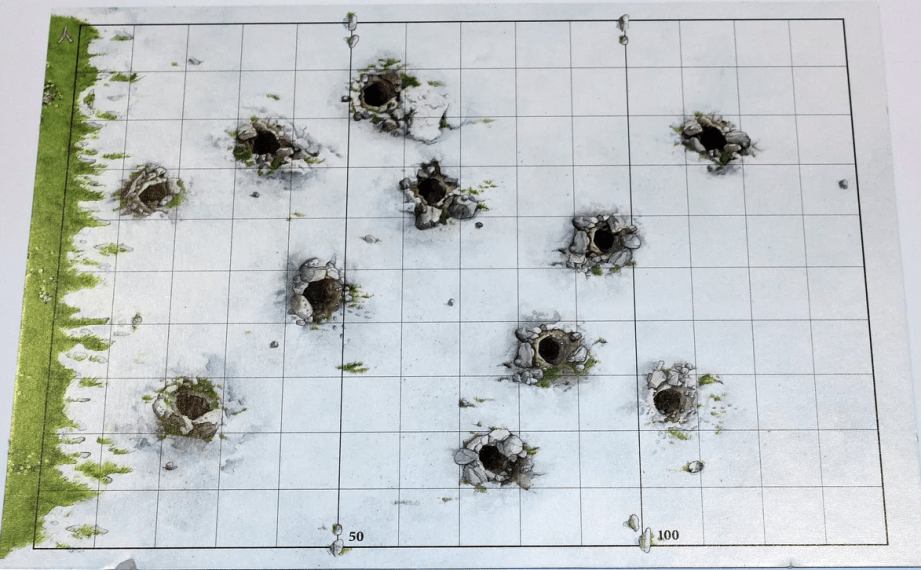
While Spring Meadow’s player (Mountain) boards can be oriented in landscape or portrait, I prefer portrait. There isn’t much difference between the two orientations, but portrait clicks a little better with me. Other players in my gaming group said the opposite, so there’s a chance portrait or landscape orientation could benefit one player over another because of how different brains process information. This doesn’t lower Spring Meadow in my estimation, but I had to mention it.

I’m uncertain if Spring Meadow has a runaway leader problem. Certain plays of Spring Meadow devolve into a runaway leader, especially if you have a veteran player against noobs, but evenly skilled players can keep the game close. Still, I don’t think the Marmots covering cleared Burrows is a big enough penalty or catch-up mechanism. Player boards stay the same in between rounds, so if you’re ahead by fifteen points at the end of one round, all other players need to score fifteen more points than the leader during the second round. Good luck with that.
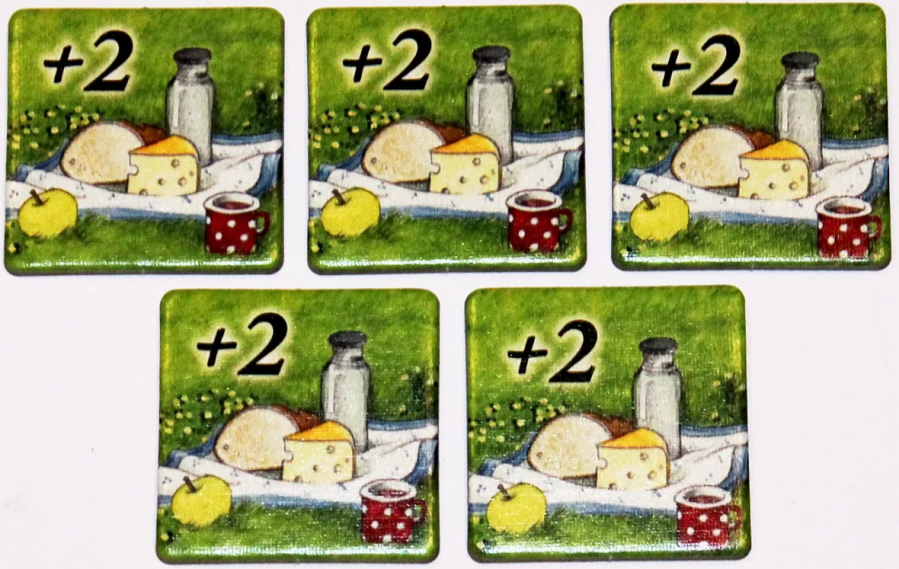
I could see gamers instituting an extra catch-up mechanism of handing players who are behind by more than five points, a one, two, or three rock tile. But that would be a house rule.

I also prefer Spring Meadow with fewer players. The three and four-player variants have one player selecting on the diagonal (instead of a row or column), but it’s the same player picking on the diagonal each time that happens. While picking the Meadow tile you want from a diagonal line may not add extra strategic value for that one player, it feels bad for the players who don’t get to choose from the diagonal, and choosing a tile from a diagonal line gives the illusion of more choice, because you’re literally picking your tile in a manner no one else can.

Despite any minor gripes I may have, I’ve enjoyed my time with Spring Meadow. It’ll be one of those games you’ll need to play multiple times to grasp the game’s nuanced strategy. Fortunately, games of Spring Meadow don’t take that long. Fifteen minutes per player is short. This is another reason why I like playing Spring Meadow with fewer players. A two-player game takes up to thirty minutes. Nice!
Too Long; Didn’t Read

Spring Meadow may have a runaway leader problem, and veteran players have a decided advantage over noobs. But I love the theme and the game uses polyominoes in intriguing ways. Spring Meadow is one of those games you’ll need to play more than once to grapple with its nuanced strategy. Thankfully, games of Spring Meadow don’t take long: fifteen minutes per player.

Tabletop Game Review: Robin of Locksley

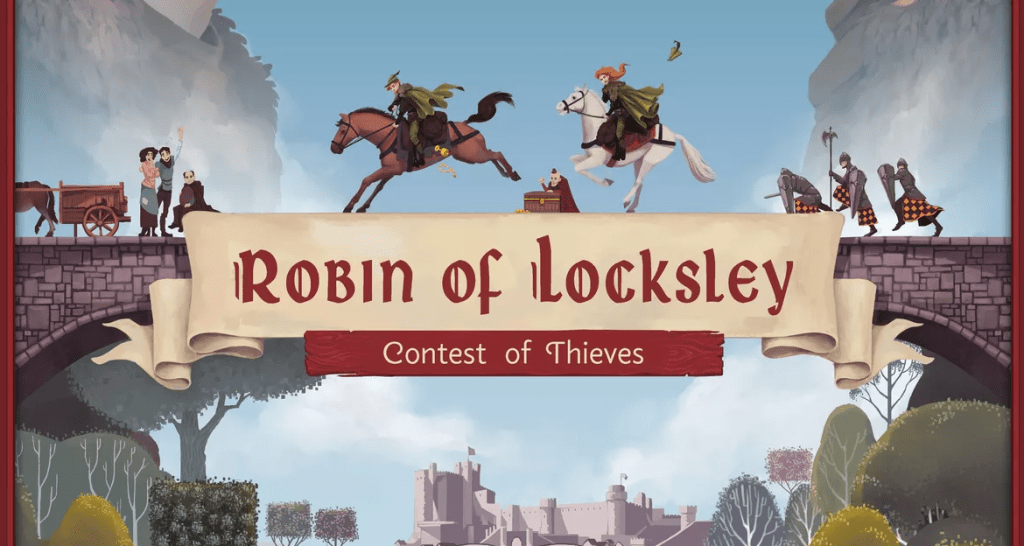
Hey, hey, Geekly Gang! Kyra Kyle here with another board game review. Full disclosure: Today’s game is one of my go-to 2-player board games, Robin of Locksley by Uwe Rosenberg. I’ll try to stay as neutral as possible, but it’ll be difficult. I love this game that functions as a race between two players. You control two pawns, Robin and a Bard. While Robin steals Loot from the rich, that Loot is used to move the Bard on a Race Track. The first player to finish the race wins. We’ll get to the daring do soon, but first, let’s discuss some of the less swashbuckling aspects of Robin of Locksley.

The Fiddly Bits

Designer: Uwe Rosenberg
Publisher: Funforge, Rio Grande Games, Wyrmgold GmbH
Date Released: 2019
Number of Players: 2
Age Range: 8 and up
Setup Time: 5-10 minutes
Play Time: 20-30 minutes

Game Mechanisms

Modular Board
Set Collection

Game Setup

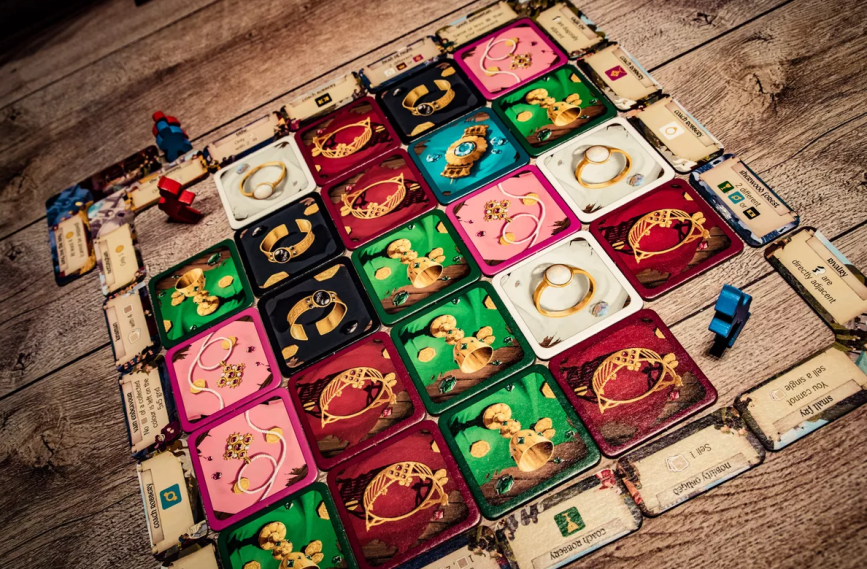
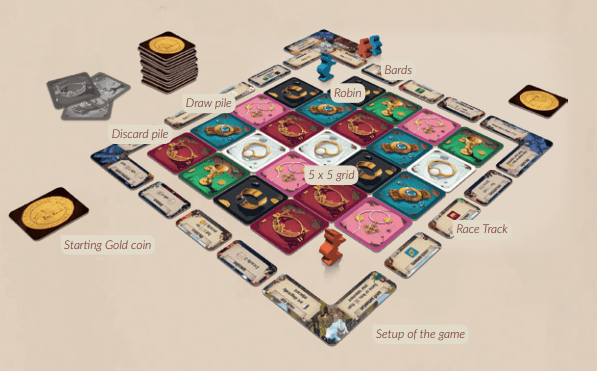
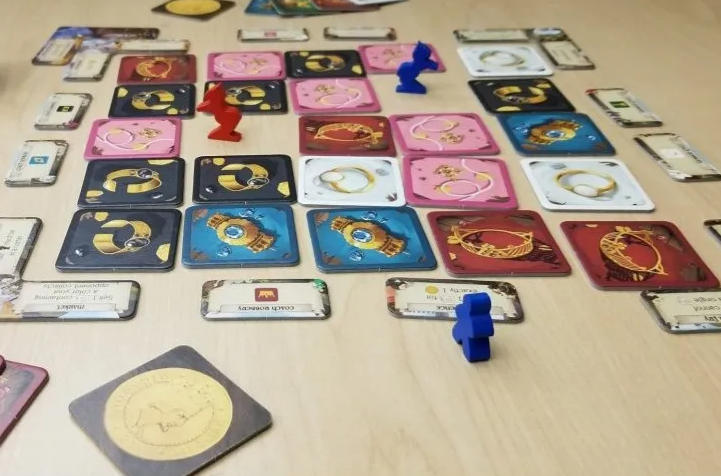
We’ll use Robin of Locksley’s rulebook for this section. I don’t know if words can express how to set up the game. We’ll include the picture the rulebook provides. I always use it when building the board.

* Shuffle all Loot tiles (gold coin side up) and build a 5×5 grid.

* Choose a player to go first. The first player takes one loot tile from any corner of the board. The second player takes the tile from the opposite corner. Each player flips the tile they chose back over to the side showing the gold coin and forms their personal supply.

* The players put their Robins in the now empty corners.

* Place the remaining loot tiles with the gold coin side up in a draw pile.

* Find the corner pieces labelled “The Beginning” (start) and “Long Live the King” (end). Put them together in one of the corners. Place “The Beginning” piece (as shown above) in the inner corner.

* Shuffle the remaining corner pieces, draw three, and put them in the remaining corners.

* The players put their Bards in their color next to the start tile.

* Shuffle the small fame tiles and put three of them between the corners.

* When complete, the game layout should look similar to the picture above.

Game Flow

Moving Robin

* Players alternate turns. The start player begins the game.
* Players move their Robin in the shape of an “L” composed of three tiles (just like the knight’s move in Chess).

* The player takes the tile they landed on into their personal supply.

* At the end of their turn, the player fills the now empty space (the space their Robin left) with a Loot tile from the general supply. Do not fill the square occupied by a Robin.

The Racing Track

Players win the game by moving their Bard along the Racing track (the one surrounding the loot tiles). There are two ways to move with your Bard.

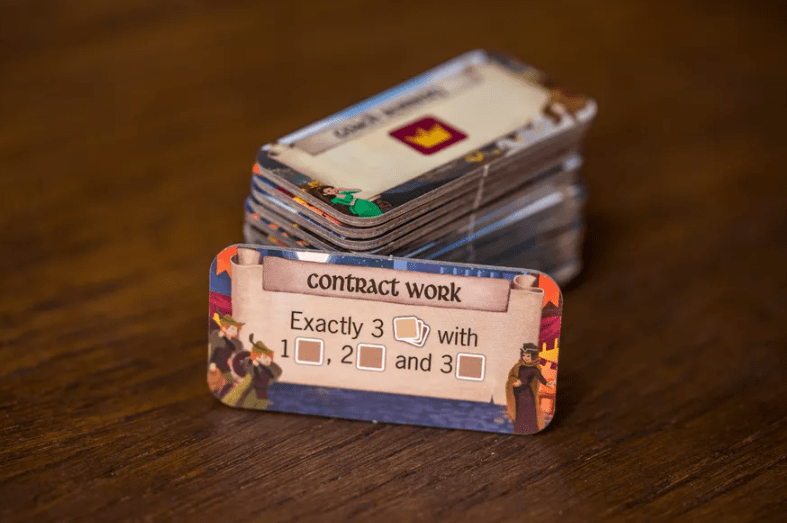
1) Every Fame tile (the ones that compose the Racing Track) shows one task. If the player is able to fulfill the task indicated on the Fame tile, they may move their Bard 1 tile forward on the Race Track. These tasks range from possessing a specific color of Loot or having your Robin in the corner of the 5×5 Loot tile grid.

2) The player may spend 1 Gold coin (and discard it to the open discard pile with the Loot side up) to move their Bard 1 tile forward (clockwise) on the Race Track. The player may continue to move their Bard forward as long as they can meet the requirement or pay the bribe for each tile they encounter.

Loot Collection

A Loot collection is a set of 1 or more Loot tiles of the same color. Loot collections may never be split into smaller collections.

Selling a Loot Collection

Anytime during their turn, players may sell a Loot collection which consists of 3 or more Loot tiles of the same type.

Discard two of the Loot tiles on the open discard pile and collect the remaining ones as Gold coins by turning them over.

Game End and Winning

There are two ways the game can end, and a player can win.

1) The game ends immediately if one player’s Bard “laps” the other player’s Bard on the race track. To “lap” the other player, one player’s Bard must have made a full extra lap around the track thus passing the other player’s Bard a second time. The player whose Bard has passed the other is the winner. If both Bards are on the same spot on the Race Track, the game does not end.

2) The player who first completes two full laps of the Race Track and fulfils the challenge on the goal tile is the winner.

Review

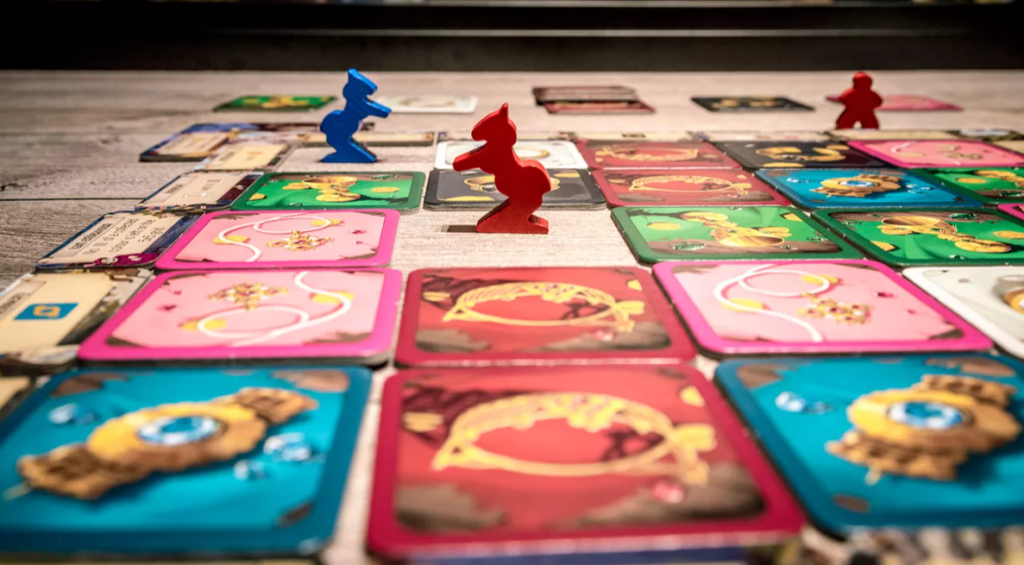
I love the way the Robins move. Robin of Locksley’s new players will have an easier time picking up the move mechanisms, but the way knights in Chess move isn’t straightforward. The Robins have familiarity, and each move functions as a spatial puzzle. One of the Fame tiles (the spaces on the Race Track) requires a player’s Robin to be one move away from their opponent. I don’t know how many times I’ve spent a Coin to skip this requirement, but I get a rush every time I can meet that requirement naturally. Then, it becomes a race, so my opponent can’t finish that Fame tile during their next turn.

The Fame tiles have varied requirements. Robin of Locksley’s modular board ensures no two games will ever be the same. And planning spaces ahead is fun, making each turn meaningful, even if your move this turn won’t help you progress right away. Robin of Locksley also has that volta, a turn where the game shifts, and it’s usually during the mid-point. Players bide their time, collecting Loot, meeting easier requirements, and accruing enough Coins to skip five or six spaces on the Race Track during a single turn. I love this volta (turn). As soon as this happens, the race is on. The other player will pop off a five or six spaces of their own, and Robin of Locksley begins in earnest. Typically, this momentum continues until the game ends.

And games of Robin of Locksley don’t take too long. BoardGameGeek and the rules list games as lasting up to 40 minutes. This hasn’t been my experience. My first game of Robin of Locksley may have taken close to 40 minutes (with the teach), but as soon as you have two players who know what they’re doing, turns take no time at all. Sometimes, I must call time and raise my hand if I want to move those five or six spaces in a turn, because it’s easy to get into a rhythm. The game’s rhythm getting interrupted raises the stakes during the volta. It’s so good.

Looking up a Fame tile’s requirement is one of the few ways a game of Robin of Locksley slows. None of the Fame tiles has any text; they’re all conveyed through icons. The Robin of Locksley rulebook contains a glossary of what each icon means, but it will slow down the game to look up that information during your first lap around the Race Track. Despite this occasional slowdown, I like how both game elements work with each other in Robin of Locksley. It’s a healthy balance of figuring out how best to maximize your Loot with your Robin piece and looking ahead on the Race Track to see what you may need.

Robin of Locksley is my go-to 2-player only game. My spouse and I have played a ton of 2-player games lately, but Robin of Locksley is one of the few competitive 2-player-only games that consistently make our rotation.

Too Long; Didn’t Read

Robin of Locksley has short, punchy turns that lead to a satisfying race to meet Loot (or spatial) requirements. With its modular board, each game is unique, but one thing stays constant: the volta (turn). Each game will have an exciting turn where one player moves multiple spaces, and then the race is on.

Top 5 Tabletop Games from 1999

Hey, hey, Geekly Gang! Kyra Kyle here with another Top 5 Tabletop Game List throughout the years. Today we’re gonna party like it’s 1999. 1999 finishes the decade strong with another major collectible card game release, and Reiner Knizia dominance. Oh! Did Knizia ever own tabletop games in 1999? We’ll get to the games in a bit, but first, let’s review our list’s criteria.

1: Cultural relevance plays as much of a factor as overall quality. A game might make a list that doesn’t hold up to others of its type, but you must admit the game is everywhere.

2: Only one game from a franchise makes the list. This will become more of an issue the closer we get to games with expansions.

3: Longevity plays a role, too. A game doesn’t have to fly off the shelves today, but it had to have some widespread appeal for a decent time.

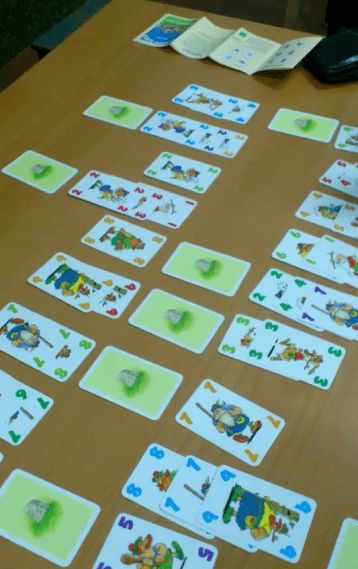
5: Schotten Totten (1999)

Get ready to hear Reiner Knizia’s name a lot on this list. Schotten Totten is the first Knizia design. In Schotten Totten, players take on the role of Scottish clan leaders. Nine boundary stones lie between you and your opponent. In front of each, you build poker-like formations of three cards on a side. Whoever plays the higher-ranking formation wins the stone. But you may use powers to claim a stone before your opponent has played all three of their cards. Successfully claim five stones, or any three adjacent stones, and you win.

Schotten Totten has received multiple reprints. Its game mechanisms have been reimplemented by many games. There’s even a Schotten Totten 2. Few designers could top Knizia in 1999.

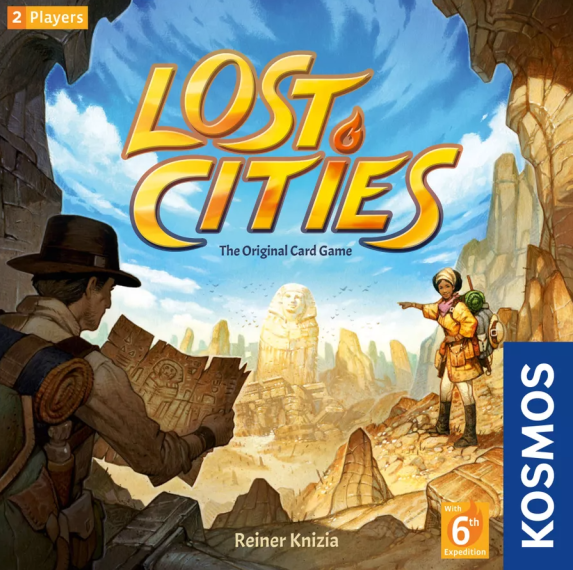
4: Lost Cities (1999)

Lost Cities is another Knizia design. Lost Cities also continues Kosmos’ excellent two-player game series. Kahuna (another game from this series) made our 1998 list. I love Lost Cities’ theme. Players mount archaeological expeditions to different sites represented by the cards’ colored suits. Lost Cities incorporates a push-your-luck mechanism, as you can choose to continue an expedition (with the possibility of busting) or you can return to base with what you have (and play it safe). Many games have copied Lost Cities’ formula. Including Knizia himself.

While Lost Cities wasn’t considered for the Spiel des Jahres (German game of the year), Keltis, which reimplemented Lost Cities’ gameplay, took home the Spiel des Jahres in 2008. To this day, I prefer to play Lost Cities to Keltis. Lost Cities has staying power.

3: Yu-Gi-Oh! Trading Card Game (1999)

Speaking of staying power, Yu-Gi-Oh! has that in spades. While new collectible card games (CCGs) continued to be released in the mid to late Nineties, few grabbed hold of the gaming community or stayed longer than a handful of sets. Heck! Even some of the CCGs that made previous lists in this series struggled to make it to ten sets. Yu-Gi-Oh! doesn’t have that issue.

You could argue that Yu-Gi-Oh! at the three spot is a little low. I’ll give you that. What started as the middle ground between Pokémon the card game and Magic: The Gathering has grown into its own dominant brand. From a cultural relevance standpoint, Yu-Gi-Oh! may take 1999’s number one spot.

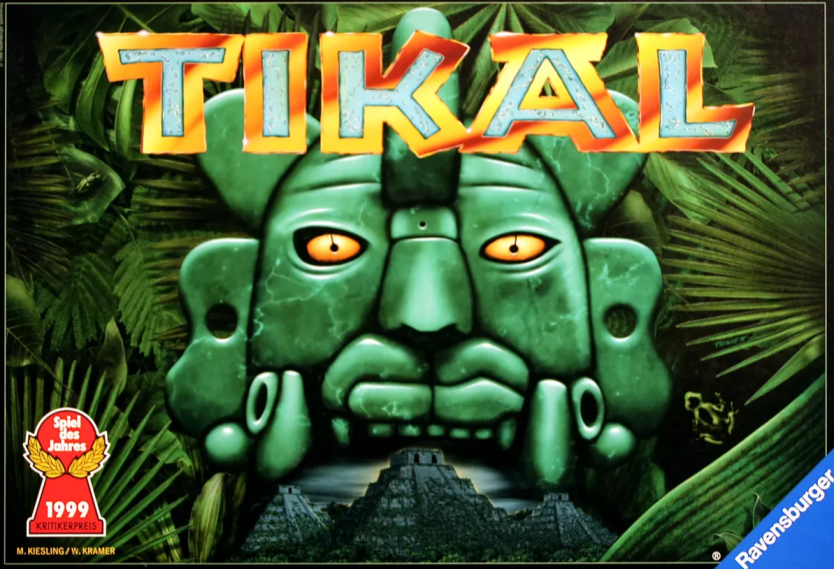
2: Tikal (1999)

Tikal earned 1999’s Spiel des Jahres. This Walfgang Kramer and Michael Kiesling co-design is a brilliant game. Tikal claims our second spot on this list, but I can see someone switching 1 and 2. Tikal deserved the Spiel des Jahres; I just think another game has more relevance today. Tikal is the first of Kramer and Kiesling’s Mask Trilogy of games: Tikal (1999), Java (2000), and Mexica (2002). Tikal is a game of exploration within the Central American jungles in search of lost temples and treasure.

Players send their team of explorers into the jungle, unearthing more and more of the terrain. Along the way, you’ll find temples that hold secrets and treasure. Players try to score points for occupying temples and holding treasure. I’ve played the Tikal mobile app, and it’s a good implementation of the game. If you like the idea of exploring the jungle, check out Tikal.

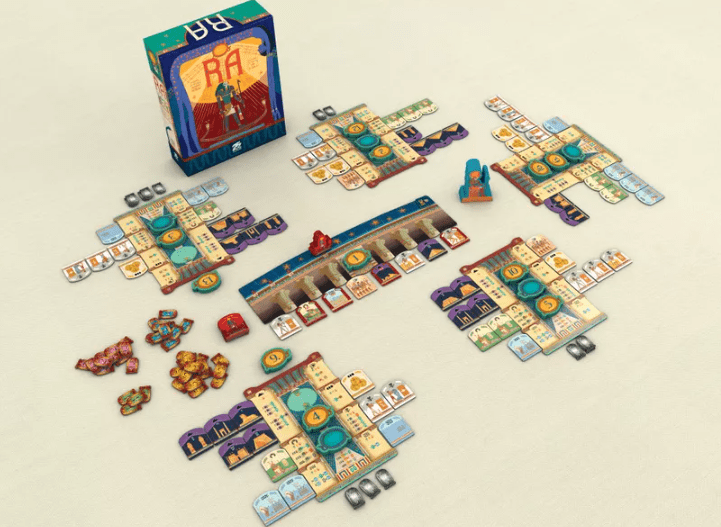
1: Ra (1999)

Three! Reiner Knizia has three games on the Top 5 1999 Tabletop Games List, and his auction game Ra takes our top spot. Ra highlights what makes Knizia games excellent. Take one simple concept (in this case, auctions) and do it better than most designs. Ra is an auction and set-collection game with an Ancient Egyptian theme. Players purchase lots of tiles through bidding. While every player can win three lots during an epoch (round), tension builds because an epoch can end before every player obtains three lots. The various tiles either give immediate points, prevent negative points (for not having certain types at game’s end), or give points after the final round. Ra is easy to learn and quick to play.

While overlooked for 1999’s Spiel des Jahres, Ra has proven it has longevity. Ra received a reprint in 2023. This year (2025), Ra was inducted into the BoardGameGeek Hall of Fame. My only guess as to why Ra wasn’t considered for the Spiel des Jahres (yes, Ra wasn’t even considered) is that the committee grew tired of seeing Knizia’s name. To date, Reiner Knizia is the most prolific board game designer in history. I can’t blame the Spiel des Jahres committee for getting Knizia fatigue. I played a few new-to-me board games this year. I thought, wow, that game was great, who’s the designer? Reiner Knizia. Of course. Keep them coming, Knizia.

Did we get the list mostly correct? Let us know which games you’d add in the comments. Thank you for reading, and wherever you are, I hope you’re having a great day.

Tabletop Game Review: Little Devils

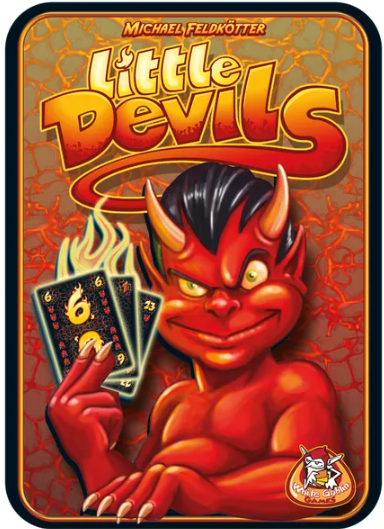
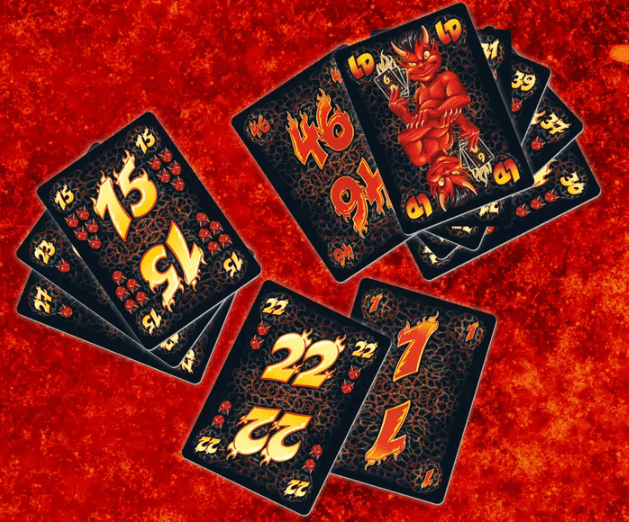
Hey, hey, Geekly Gang! Kyra Kyle here with another board game review. Today’s game is Michael Feldkötter’s Little Devils, a quick trick-taking game with a twist. Little Devils has no suits. Instead, players must follow the first card (in a series of 54 numbered cards) that’s played per round. The second card dictates which direction every other player must follow (up or down from the original number). The player who either plays in the wrong direction (up instead of down) or plays the furthest number from the original card wins the trick; you’re trying to win as few tricks as possible. Little Devils takes a simple concept and bakes in some interesting choices.

Before we get any further, we’ll get devilish with Little Devils’ details.

The Fiddly Bits

Designer: Michael Feldkötter
Publisher: Arclight Games, Stronghold Games, White Goblin Games
Date Released: 2012
Number of Players: 3-6
Age Range: 8 and up
Setup Time: Less than a minute
Play Time: About 15 minutes

Game Mechanisms

Card Game
Trick-Taking

Game Setup

Little Devils consists of a 54-card deck. Depending on the number of players, remove a number of cards numbered between 28-54 from the game. The rulebook will state which specific cards need to be removed at each player count. Ultimately, players will be dealt 9 cards each, which should be the entire deck.

After you’ve prepared the deck, deal out all the cards.

Game Flow

For the first round, the player to the left of the dealer begins the trick; for every round after the first, whoever “won” the previous trick, begins the next trick. The first player starts the trick by playing any card from their hand that doesn’t have five little devils beneath the number. Quick note: most cards in Little Devils will have at least one little devil underneath its number. Players cannot lead a trick with a card with five little devils, unless they have no other card in their hand.

The player to the left of the starting player will play a card from their hand. If the second player plays a higher card, all other players must play cards valued higher than the first card if possible. Whoever played the highest card gets the trick, unless a player is unable to play a higher card. This player will get the trick unless more players are unable to play higher cards. If a player (or players) plays a card in the opposite direction of the second player, the player with the furthest valued card from the original card wins the trick.

After all cards have been played, a round ends. Players score the number of little devils from their tricks. As soon as someone scores 200 points, play ends, and whoever has the fewest points wins.

Review

Little Devils has a built-in catch-up mechanism: the player who wins a trick can’t possibly win the next one; they begin the next trick. I love that. It’s simple and offers plenty of strategic choices. I could play a card closer to the low or high end, thinking the players in front of me (on the scoreboard) might get stuck with a trick or two. There are even cards that have no little devils on them. Often, when I know I’m going to get stuck with a trick, I’ll play one of the one devil or no devils cards to net the fewest little devils I can.

While you could card count during Little Devils, it doesn’t matter that much. Little Devils plays quickly. It’s more fun to play a second game. Even when I’ve finished last (triggered the end game), I feel like I did something if I stiffed someone else with a bunch of points during one round. Little Devils is a great filler game. It may get overshadowed by Cat in the Box (we still need to review that game), but it requires less setup, is an easier teach, and I’ve found more gamers catch on to Little Devils a lot faster.

Too Long; Didn’t Read

Quick to pick up and easy to teach, Little Devils is an excellent trick-taking game that offers plenty of strategic choices, a brilliant built-in catch-up mechanism, and fun gotcha moments.

Top 5 Tabletop Games from 1998

Hey, hey, Geekly Gang! Kyra Kyle here with another Top 5 Tabletop Games throughout the years. 1998 saw the continued dominance of collectible card games (CCGs). Fewer CCGs were released this year, but established ones kept board game stores afloat. 1998 had a lot of great board games, but many of them didn’t have the same staying power as previous years in this series. There may be more than one forgotten gem on today’s list. We’ll get to the games in a minute, but first, let’s look at our criteria.

1: Cultural relevance plays as much of a factor as overall quality. A game might make a list that doesn’t hold up to others of its type, but you must admit the game is everywhere.

2: Only one game from a franchise makes the list. This will become more of an issue the closer we get to games with expansions.

3: Longevity plays a role, too. A game doesn’t have to fly off the shelves today, but it had to have some widespread appeal for a decent time.

5: Kahuna (1998)

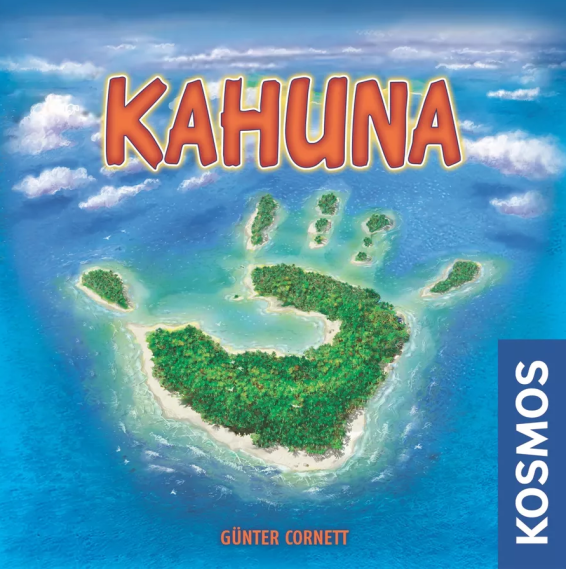
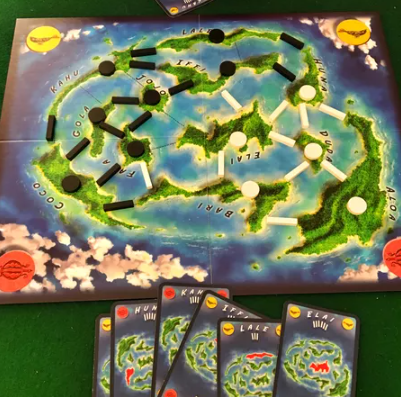
Kahuna fits the bill of a forgotten gem. This two-player game has players assume the role of ancient sorcerers of the Pacific. You compete for dominance of an archipelago consisting of twelve small islands. Players use cards to place bridges between islands and remove opponent’s bridges. If you get the majority of bridges around an island, place one of your marker stones on it and remove any of your opponent’s bridges to that island. This could, in turn, cause your opponent to lose a bridge majority on an adjacent island.

Kahuna plays in three rounds. A round ends when all cards from the face-down deck and the three face-up cards have been used. Kahuna is a fast-paced area control/majority game. It’s one of the better two-player games from this era, but Kahuna’s status as a two-player only game may have prevented it from seeing wider gameplay. Still, Kahuna was a finalist for the Spiel des Jahres (the German game of the year).

4: Elfenland (1998)

We go from a Spiel des Jahre finalist to 1998’s Spiel des Jahre winner, Elfenland. Elfenland is a redesign of the original White Wind game Elfenroads. The game is set in an elvish world. Players begin in the Elf capital, draw one face down movement tile, and are dealt eight transport cards and a secret “home” city card that they must reach at the end of the fourth round or lose points for each city space away from “home” they are at the end of the game.

Elfenland’s designer, Alan R. Moon (Ticket to Ride), has a knack for route-building games. Elfenland marks the first time Moon has made one of these lists. I may have just spoiled the game, but this won’t be the last time we’ll see Moon on one of these lists. Elfenland shares some similarities with Moon’s more popular Ticket to Ride. Elfenland is another forgotten gem.

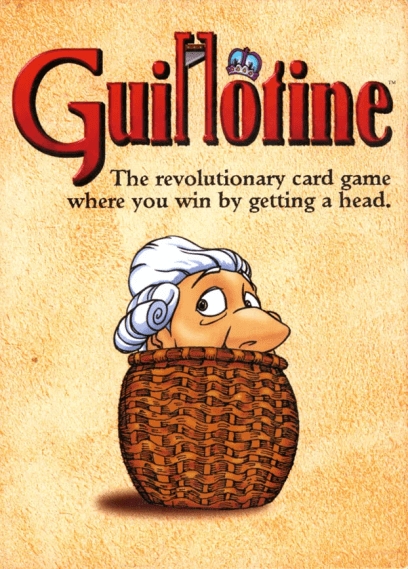
3: Guillotine (1998)

Guillotine is yet another forgotten gem, and its theme is one of the most macabre and interesting of 1998. Players take the role of executioners during the French Revolution. In Guillotine, you’re doing your best to manipulate the execution line and score as many points, claiming the lives of nobles, clergy, and former military as you can. Off with their heads!

If you like Gallow’s humor, you’ll love Guillotine. I say this a lot, but this will not be the last Paul Peterson design to make one of these lists. Peterson has a knack for taking traditional card games in strange and exciting directions. Guillotine is bloody fun.

2: Cranium (1998)

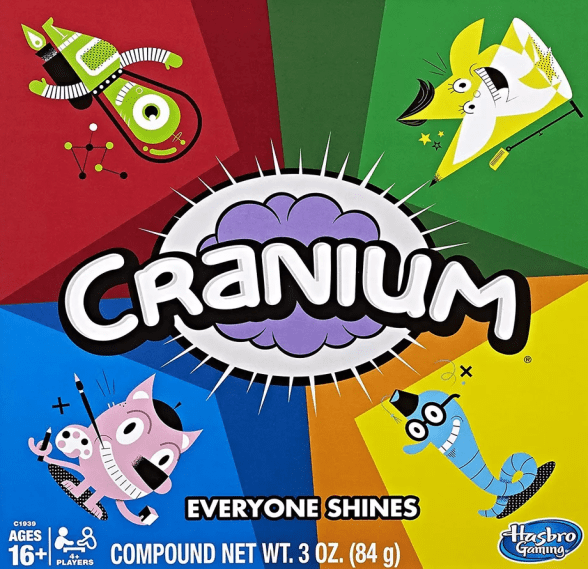
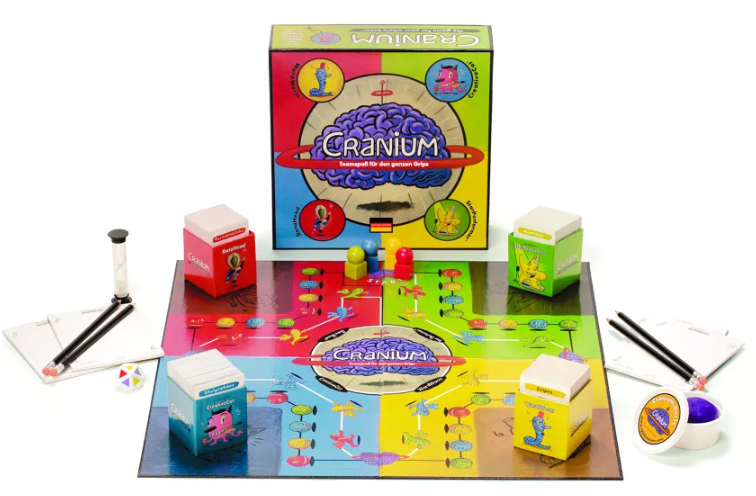
Cranium marks the first mass market board game (a game one can find in department stores) to make one of these lists in several years. While it may have faded in popularity, Cranium took elements from various party games and formed what it claims is “the whole-brain” game. Cranium identifies four main party quiz game elements and gave them names: Creative Cat, Data Head, Word Worm, and Star Performer.

Creative Cat involves sculpting and drawing. Data Head is trivia. Word Worm has players unscrambling words, challenging them to spell a word, and guess definitions. And Star Performer includes whistling songs, impersonating a celebrity, or acting out a clue. Cranium managed to assemble as many party quiz game elements into one game as one can. In fact, I still don’t think a party quiz game has managed to include as many elements as Cranium’s into a single game design.

1: Through the Desert (1998)

Reiner Knizia takes another top spot on one of these lists with Through the Desert. Through the Desert is one of those games players remember fondly and hold in high regard. But I rarely see anyone playing Through the Desert, making it yet another forgotten gem on this list. I’d argue Cranium, despite its status as a mass market board game, is another forgotten gem. This entire list is made up of forgotten gems. Getting back to Through the Desert, it takes inspiration from the classic game of Go. Through the Desert also completes Knizia’s tile-laying trilogy of games: Tigris & Euphrates (1997), Samurai (1998), and Through the Desert (1998).

In Through the Desert, players attempt to score the most points by snaking caravan routes through the desert, trying to reach oases and blocking off sections of the desert. Two to five players control a tribe of nomads vying for control of the desert. Strategy is key in building your tribe’s caravans. There are multiple paths to gain points, but Through the Desert manages to keep its cognitive load low, meaning it’s easy to learn but difficult to master. Through the Desert is deserving of its Spiel des Jahres recommended status.

Did we get the list mostly correct? Let us know which games you’d add in the comments. Thank you for reading, and wherever you are, I hope you’re having a great day.

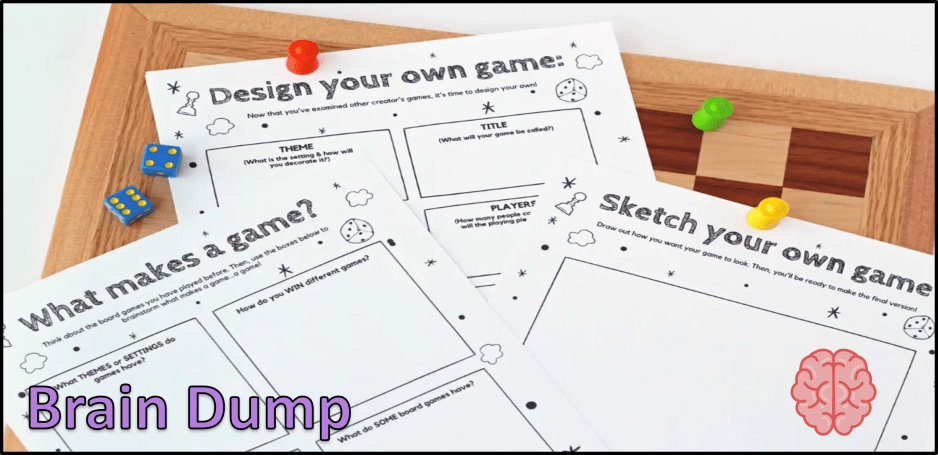
Game Design Brain Dump: November 21, 2025

Happy Friday, Geekly Gang! Kyra Kyle here with another board game design brain dump. I’m taking a break from Rustbucket Riots—which I covered in last month’s brain dump–and discuss a Blackjack Deck Building game I originally made in 2018. Seven years! Yikes! Guess I got the seven-year itch. This Blackjack Deck Builder has gone through multiple minor rule modifications and name changes. The deck, based on a standard playing card deck, doesn’t have jacks and kings, so it’s had the name No Jack and No Kings.

Play Faster

My oldest daughter had a high school friend, who will remain nameless. We’ll call her C. C loved deck building games, but she wouldn’t draw her hand at the end of each turn (allowing her to plan her next turn), and every time she drew cards into her hand, she’d act like she was reading them for the first time. This frustrated my daughter and her friends. I thought of No Jack or No Kings to fix this issue.

A quick explanation of deck building card games: each player begins with the same (or at least similar) small decks and purchase cards from a supply to add to their decks, making each deck unique.

While many starter cards in a deck building game have limited text, cards one would add to their hands could contain a heap of text. This would cause C’s turns to last three minutes or more, as she read the more complicated cards that she added to her deck. So, I took out most text. Standard playing cards have little to no text. Next, C had the issue of not drawing her hand at the end of her turn. What standard card game doesn’t require a hand? Blackjack.

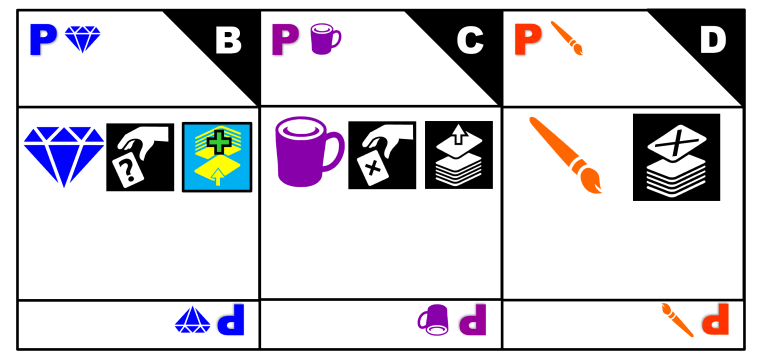
The above sample card (Page of Coins) is a prototype. The end product will hopefully look a lot better. Lol.

I merged deck building with Blackjack and came up with No Jack or No Kings, and it worked. With the exception of changing the suits, the only cards that look different from a deck of standard playing cards are the face cards. C knew how to play Blackjack. Players would draw cards from the top of their decks, following the standard rules for Blackjack. If you drew over 22 points of cards, you’d bust and lose your turn. If a face card remains in play (without busting) at the end of a turn, the player can move the face card to their tableau and gain its ability. In the case of the page above, every time that player draws a coin suit card, they gain one extra money to purchase other cards. No Jack/No Kings starter decks begin with one face card from one of the four suits. Each suit has a different power.

Trouble with Asymmetry

Most players in deck building games begin with the exact same cards. Choosing to go with asymmetric powers at the onset of this game, however slight, proves difficult to balance. Brushes allow players to cull cards from their discard. Deck building experts see this as overpowered. But Diamonds and Cups have better win percentages. Diamonds allow players to manipulate decks (take cards from a discard and placing them on the bottom). If you’re good at counting cards, you can induce more 21s (or Blackjacks). Cups let players discard a drawn card and draw a new one. This is also strong.

The first page I showed, the Page of Coins, is the weakest of all four. But perception matters. Even though I’ve playtested No Jack/No Kings hundreds of times and found Cups and Diamonds win more often than not, players still “feel” more powerful with Brushes and, to a lesser extent, Coins. Granted, one of my playtest weekends was with someone at a Protospiel. He played No Jack/No Kings throughout the entire weekend (like a few dozen times), hoping to sculpt a deck of only Tens and Aces. This gamer played Brushes in each game and lost every time. Winning didn’t factor into his enjoyment. He wanted to build a near-perfect deck. So, the numbers may be a little skewed.

Does anything need to be changed? Honestly, I don’t know.

How to Win at No Jack/No Kings

I just realized we discussed No Jack/No Kings mechanisms without sharing how to win. There’s a separate deck of Patrons. Every patron can be claimed with a Blackjack (21), but each patron also gives discounts to two suits. If you have a face card from either suit in your tableau and you reach the lower number, you can claim the patron. Every turn, you can either claim a patron or purchase cards from the supply. That’s how the gamer (Protospiel) lost so many times. He would purchase cards if they fit in his “perfect deck” instead of claiming a patron. The first player to claim six patrons wins.

No Theme and Simple Mechanisms

I don’t know why I shelved No Jack/No Kings for almost a decade. My best guess is that I wanted No Jack/No Kings to have more theme or more complexity. I no longer care if No Jack/No Kings has a theme, and any additional mechanisms I added to the game diluted the core gameplay. I was obsessed with everything No Jack/No Kings didn’t have and failed to see what it did have. That same Protospiel (seven years ago, I’m guessing), I only taught the game once. Other gamers taught No Jack/No Kings to the rest of the convention, and the game was played consistently for two and a half days. I need to get out of my own way. Ugh!

I’m finalizing the starter decks and the cost of cards. But there are shockingly few things to balance/tweak after I pin down the starter decks, so I’m left with one question. Which name do you like better, No Jack or No Kings?

Let me know in the comments. Thank you for reading, and wherever you are, I hope you’re having a great day.

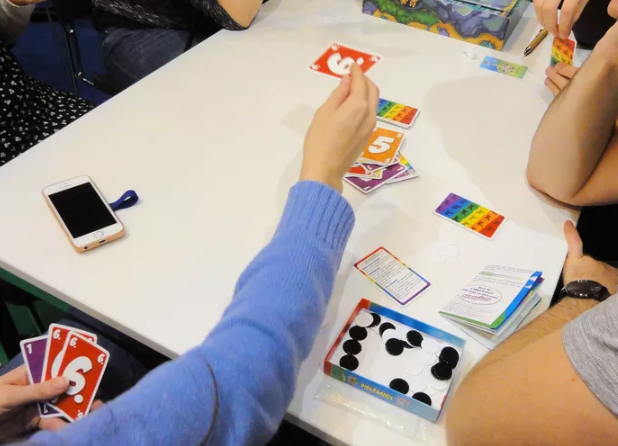
Tabletop Game Review: L.L.A.M.A. Card Game

You’ll want to shed your hand of cards quicker than anyone else in L.L.A.M.A. The Card Game, but you might not be able to play what you want. Strategic quitting, which freezes the cards in your hand, may be the key to victory in this silly, engaging (German Game of the Year) Spiel des Jahres-nominated game. Don’t get stuck with a llama!

Hey, hey! Kyra Kyle here. I mentioned L.L.A.M.A. The Card Game in a previous Whatcha Playing post and figured we should cover the game with a full review. I’m unsure if we’ll continue doing this with future board game reviews, but I’ve played a lot of L.L.A.M.A. The Card Game (also known as Don’t L.L.A.M.A. The Card Game) in the past several months. Board game design legend Reiner Knizia made another rules-light, fun game, but before we discuss L.L.A.M.A., we don’t want to skip the fine print.

Above is the designer Reiner Knizia dressed as a llama.

The Fiddly Bits

Designer: Reiner Knizia
Publisher: AMIGO
Date Released: 2019
Number of Players: 2-6
Age Range: 6 and up
Setup Time: Almost none
Play Time: Less than 20 minutes

Game Mechanisms

Hand Management
Ladder Climbing
Matching
Push Your Luck

Game Setup

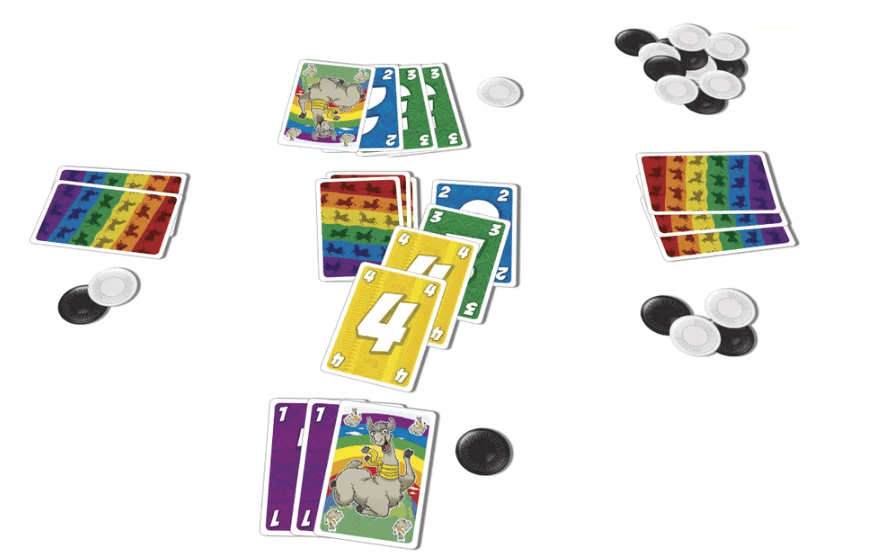
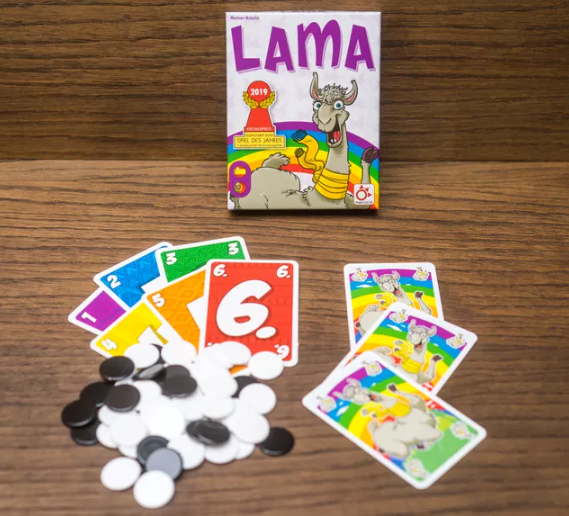
Shuffle all the cards and deal six cards to each player. The remaining cards make up the face-down draw pile. Turn over the top card to start the discard pile. Have the tokens nearby to give all players access, and you’re done.

Game Flow

L.L.A.M.A. has an easy-to-read and brief rulebook, so I’ll borrow heavily from it. L.L.A.M.A. is played over several rounds. Randomly choose who goes first. During your turn, players may take one of these three actions:

* Play a card
* Draw a card
* Quit

Play a Card

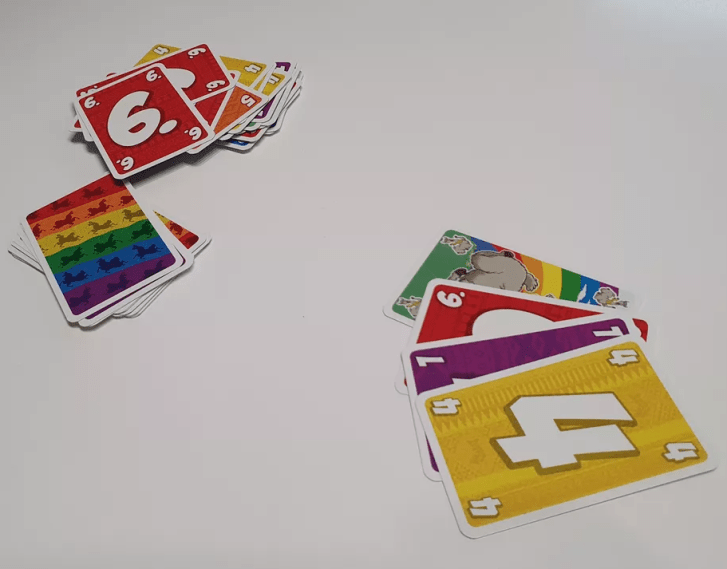
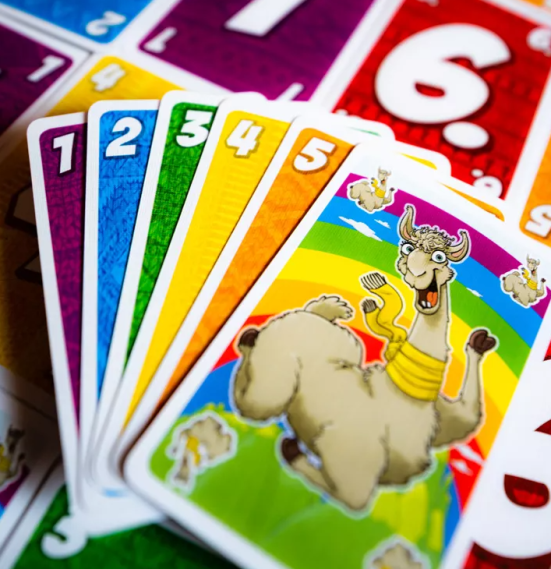
Cards are numbered 1-6, and there’s a seventh, specialty card (the Llama). The top card on the discard pile determines which cards can be played. You can play a card with the same value as the top card or a value that’s one more than the top card. Llamas can be played on 6s or other llamas. On top of a llama, you can play another llama or a 1.

Draw a Card

You may draw 1 card from the draw pile. You can’t play this card on the same turn, so the turn passes to the next player. If the draw pile runs out, don’t create a new one. From now on, you can’t choose this action.

Quit

If you can’t play a card or don’t want to, and you don’t feel like drawing a card either, you can quit for the current round. Place your cards in front of you, face down. You are no longer playing this round.

End of Round

The round ends if:

* One player has played all of their cards.
* All players have quit for the round.

If all but one player has quit the round, that player continues on their own. However, this player may no longer draw cards.

Scoring

Your remaining cards give you negative points, no matter if you have them in front of you (quitting) or in your hand. Each card is worth its value in points. Llamas are worth 10 points.

However, you count each card value only once per round, so if you have four 1s, for example, you only get one point. Likewise, all of your llamas would only give you a total of 10 points.

Taking Tokens

Tokens denote your negative points. There are white 1-point tokens and black 10-point tokens, which you may swap at any time.

Returning Tokens

If you played all your cards during a round and you have tokens from a previous round, you may return one of them (either a 1-point or 10-point token).

Shuffle all the cards and deal another six cards to each player for the next round. Start a new discard pile with the top card from the draw pile. The last player to play a card in the previous round starts off the new round.

End of Game

Continue playing until one of you has collected 40 or more points. The player with the fewest points wins the game. If there is a tie, the players share the victory.

Review

L.L.A.M.A. The Card Game may play a touch like Uno, but it has just enough juice to hold my attention. Players need to shed the cards in their hand, much like Uno, but the option to quit for the round and discarding the right cards makes all the difference. Sure. Most games of L.L.A.M.A. revolve around the right cards showing up in the deck. In fact, the first couple of times I played L.L.A.M.A. I had either forgotten about the quitting rule or the person who taught me the rules forgot to explain the rule. L.L.A.M.A. played without the quitting rule plays like a less backstabby Uno. But after learning about (or remembering) the quitting option, I’ve experienced enough rounds where strategic quitting works.

I’ve been dealt a stellar hand at the beginning of a round (five 1s and another card). As soon as I can play the one card that isn’t a 1, I’d quit for the round and take one point. Quitting puts a ton of pressure on one’s opponents to shed cards quickly and then quit themselves. While it may seem at first like an advantage to be the final player in a round, you can no longer draw cards. If you can’t go out with what’s in your hand, you’re scoring with whatever cards remain, and you don’t want to get caught with any llamas. Hence the game’s alternate name, Don’t L.L.A.M.A..

The game’s odd theme, silly titular mascot, and bright colors add to L.L.A.M.A.’s charm. And llama is a fun word to say. Llama, llama, llama, llama. L.L.A.M.A. is a hit with multiple game group types. I’ve played with numerous demographics and ages. The game is easy enough to quickly grasp and allows for interesting choices for more serious gamers (like strategic quitting or going out one round and discarding a token of your choice). L.L.A.M.A. is light enough that many of my Monday Game Nights begin with this game, and everyone chats while they throw down a card from time to time. It’s games like this that remind us of the social aspect of board games.

Too Long; Didn’t Read

More than just a less cutthroat Uno, L.L.A.M.A. The Card Game adds strategic quitting for the round, which adds pressure to your opponents. While I can’t see myself playing too many rounds of Uno, I’ll gladly play a game or two of L.L.A.M.A. The Card Game.

Tabletop Game Review: Marvel United: Fantastic Four

We had to discuss the Marvel United: Fantastic Four expansion from the Marvel United: X-Men launch. In fact, we’ll begin our coverage of the Marvel United: X-Men wave with this expansion. Hey, hey, Geekly Gang! Kyra Kyle here. We return once again to Marvel United. This is one of those game systems with a heap of expansions. Too many, if you ask me. But we’ll cover the expansions that will either be fan favorites (plenty of people will be interested in adding them to their collection) or good additions because of their gameplay variants. Fortunately, Marvel United: Fantastic Four fits both criteria.

We’ll get to Marvel’s first family in a minute, but first, let’s take a look at Marvel United: Fantastic Four’s less heroic details.

The Fiddly Bits

Designer: Andrea Chiarvesio, Eric M. Lang, and Francesco Rugerfred Sedda
Publisher: CMON Global Limited and Spin Master Ltd.
Date Released: 2022
Number of Players: 1-5
Age Range: 8 and up
Setup Time: 5-10 minutes
Play Time: 30-40 minutes

Game Mechanisms

Cooperative Play
Hand Management
Modular Board
Solo / Solitaire Game
Variable Player Powers

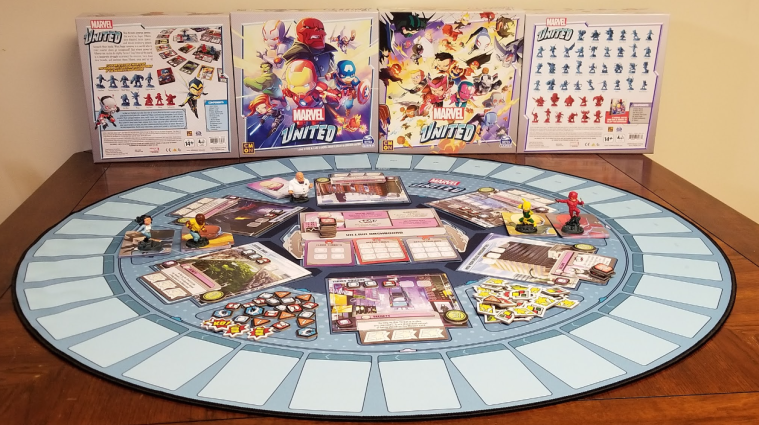
Marvel United Tabletop Game Set Up

Game Setup

We already covered the Game Setup and Game Flow in our original Marvel United review (here’s a link to that review), so we’ll go over the basics in the following two sections. Let’s cover an abbreviated review of the game setup and rules.

Marvel United: Fantastic Four’s setup can change depending on which Villain(s) and Heroes you choose to play. Each game consists of six locations. Since Marvel United: Fantastic Four is an expansion, only includes four locations, and you’ll need a core set in addition to this expansion to play. You may choose your locations or shuffle them and choose six at random. Each Location card has spaces at the top for civilians and thugs, and a rectangle with a block of text that will state “End of Turn” at the top of the box.

Place civilian/thug tokens on their matching spaces. Shuffle the Villain’s Threat deck and deal out each Threat face-up so that it covers the rectangle at the bottom of each location. You must clear this threat before gaining the “End of Turn” effect printed on a Location. Place health tokens where signified on threat cards and on the Villain dashboard. Place the three mission cards (Defeat Thugs, Rescue Civilians, and Clear Threats) face up under the villain dashboard where the text reads “Unlocked.”

Each player shuffles their hero decks and then draws three cards to form their hands. Shuffle the Villain’s Master Plan deck. Leave the Master Plan deck face down. This will be the villain’s draw pile.

Players place their miniatures on one of the six location cards, usually the centralmost location for each player (easy access). Then, they place the villain on the location card opposing the heroes. If one player chooses to play as the villain, hand the Super Villain cards to them, and the Heroes gain access to Super Hero cards. These new card times can be played if the game state triggers their use (for example, “You play a Master Plan card” or “Any Hero has 4 or more cards in their hand at the end of the Hero turn.” Timing is key.

Marvel United Game Flow Board Game Review

Game Flow

The villain(s) play first. Draw the top card of their master plan deck. The villain moves the number of spaces indicated. Resolve any BAM! Effects and these effects will be printed on a space within the villain’s dashboard. Then, place the civilian/thug tokens (if any) indicated at the bottom of the card. If a player has taken the role of the villain, they get a hand of cards and can choose which card they play. The heroes get their turn after all the villain’s effects are resolved.

Heroes pick which player goes first, and hero turns will continue around the table clockwise. At the beginning of each game, Heroes will get three turns before the villain receives another turn. During their turn, heroes play one card from their hand.

Marvel United Sample Hero Turns Gacha Game Review

Resolve actions and the symbols printed at the bottom of the hero’s card in any order. The symbols at the bottom of a hero’s card will be shared with the next player, but any printed action will not be shared. Heroes will use these actions to complete missions. The game begins with three missions in play: Defeat Thugs, Rescue Civilians, and Clear Threats. Each mission card will have spaces for the tokens they require to complete. As soon as these spaces are filled, the card is discarded, and the mission is considered complete. Mission cards can be completed in any order.
After the heroes complete the first mission, the villain panics and will act (play a card) every two hero cards instead of every three hero cards. After the heroes complete the second mission, the villain becomes vulnerable to damage. The heroes can complete the third mission, but it isn’t necessary. If the heroes do complete the third mission, each hero immediately draws 1 card, increasing each player’s hand size by one.
Play continues back and forth until either the villain wins (by completing their unique master plan or anyone, heroes or villains, runs out of cards) or the heroes win by dealing enough damage to the villain after the villain becomes vulnerable to damage.

Review

Marvel United: Fantastic Four has a huge legacy to live up to, and it lives up to the hype. I’m writing this review in June 2025, and Marvel United: Fantastic Four’s BGG score is an 8.5 (out of 10). This makes Fantastic Four the highest-rated Marvel United expansion. Yeah. It’s—pardon the pun—fantastic.

While Marvel United: X-Men Blue and Gold Teams features semi-cooperative play (players compete to clear the most goals), and this gives me strong X-Men: Under Siege vibes (a game I have a soft spot for), Fantastic Four introduces the idea of teamwork, and it does so simply and elegantly. Included in the box is a Fantastic Four team card. Various hero cards (from the members of the Fantastic Four) will add action tokens to the card, and can then use all actions on the Fantastic Four team card with different cards in their deck. This promotes a slow build. It simulates teamwork without using a lot of convoluted rules. I like the Team Cards from Marvel United’s third wave (Multiversus), but the method used in Fantastic Four is easy to follow and makes narrative sense.

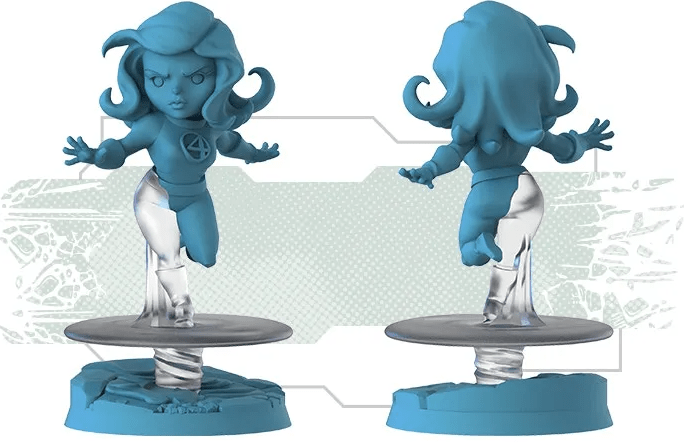
Marvel United: Fantastic Four includes six heroes. One of which is the anti-hero (hero and villain) Doctor Doom. That’s a lot of heroes for one expansion—it’s almost as many as a core box—and each hero illustrates Marvel United’s second wave’s power creep. Granted, to get the most out of the Fantastic Four characters (Mr. Fantastic, Invisible Woman, The Thing, and Human Torch), you’re encouraged to play as the Fantastic Four. The aforementioned Fantastic Four Team Card is amazing, but these characters are still effective outside the team setting.

Each member has a unique flavor. Mr. Fantastic is flexible. Get it? Flexible? Ha…ha. Invisible Woman can avoid damage altogether (using her “Invisiblity” card), but she takes herself out of combat, which makes sense. Human Torch can use Nova Flame and deal 2 damage to everything at his location—super useful. And The Thing deals copious amounts of damage and can ignore 1 damage during each Villain Turn. Very nice.

The remaining two heroes, Doctor Doom and Silver Surfer, don’t gain any benefit from the Fantastic Four team card, but they don’t need it. Doom gets tokens for each damage he takes. He can even use the symbols from the 3 previous Hero cards in the Storyline (instead of the previous one). This can generate as many as seven actions on a single turn. Yikes! Silver Surfer has extra card draw, can move anywhere with one of his special abilities, and can exchange a Location in play with one that isn’t in play. What? Silver Surfer can literally yeet any Location for another Location. That’s coconuts.

But Marvel United: Fantastic Four’s villains are just as overpowered as their hero counterparts. Even though Doctor Doom is the marquee villain, we’ll begin with Super-Skrull. Don’t overlook Super-Skrull. He has one of the more unique Special Rules in Marvel United. Whenever he BAM!s, he performs actions based on the symbols on the last Hero card in the Storyline. The heroes have some control over what Super-Skrull can do, but that doesn’t matter. None of Super-Skrull’s BAM! actions are things you want to happen. Super-Skrull attempts to knock out (KO) and hand each in-play hero a KO token, but this isn’t the only way he can win. Super-Skrull can’t be damage if any Crisis tokens exist, and he adds cards from his deck facedown in the Storyline, which leads to a shortened clock.

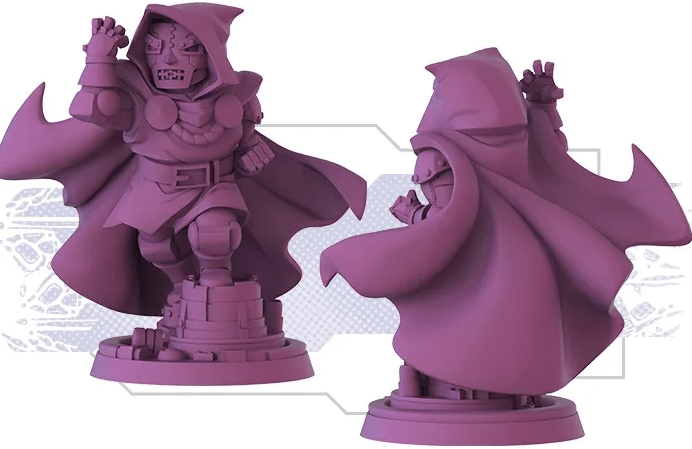
Super-Skrull is a spiffier version of Green Goblin. He does enough things well that you must split your focus on the various ways he can win, and even though he doesn’t have Henchmen (like Green Goblin), he makes up for it with crazy Threat card abilities that make clearing Thugs and Civilians less efficient, and each Threat card requires one of each action type. Super-Skrull covers all bases. But most people purchase Marvel United: Fantastic Four for Doctor Doom, and Doom delivers.

First off, Doom must be played with Latveria—naturally—and Latveria is the first Location card that has a negative “End of Turn” effect. In fact, Doom only has five Threat cards because Latveria begins the game without one. Latveria marks the first time Marvel United has included an “End of Turn” effect that benefits the villain. “You MUST take 1 damage for each Thug or Doombot in this Location.” Ouch! Latveria begins every game with three Doombot tokens, so if you don’t take out all of the Doombots, you’re discarding your entire hand. Double ouch! Doom’s Threat cards add extra Doombots (sometimes not even in the same place as the Threat card’s location) and can deal extra damage to heroes. Triple ouch!

As for his Villainous Plot, Doc Doom plays like Red Skull but way, way worse. He can increase the Doom Track (changed from the Red Skull’s Threat Track) far more often, and he can’t be damaged if a Doombot is at his Location. In short, Doctor Doom is nasty. You’ll need the Fantastic Four with their Team Card to defeat him. It can be done, but it’s a tough go. I find Doctor Doom tuned to the perfect level of difficulty. He may be one of the many reasons Marvel United: Fantastic Four is the highest-rated Marvel United expansion.

We talked about Latveria, but there’s another Location, Mount Wundagore, that has a negative “End of Turn” effect: Each Hero in this Location MUST discard all cards in their hand and draw the same number of cards (this does not KO). Even though this effect doesn’t count as a KO, it’s another way to shorten the clock. If anyone (including Heroes) runs out of cards in their deck, the heroes lose. Yowza! I like Marvel United: Fantastic Four’s inclusion of villain-centric Locations. We’ll see more of this later in the series, but villain-centric Locations do a lot to shake up Marvel United’s status quo. The remaining Locations have unique “End of Turn” abilities as well. The Baxter Building provides token draw if the character you’re playing was ever a member of the Fantastic Four. This is a boon for anyone who knows the comics. I appreciate that.

I also appreciate the Takeover Challenge card included in Marvel United: Fantastic Four. If a Thug, Civilian, or Doombot token can’t be added to a Location, after resolving Overflow, place the excess tokens on the Takeover card. If the card is full, Heroes immediately lose. The Takeover card has two sides with different difficulties (number of spots for tokens). This Challenge card, like the Fantastic Four’s Team Card, is simple and elegant. It adds just enough difficulty if the game has gotten too predictable.

Too Long; Didn’t Read

Marvel United: Fantastic Four is the highest-rated Marvel United expansion on BoardGameGeek and for good reason. This expansion adds more layers of complexity while staying thematic and not burdening the player with too many over-complicated rules. Every element from the Locations, the Challenge Card, the Heroes, and especially the Villains is well thought out and an excellent addition to any Marvel United collection.