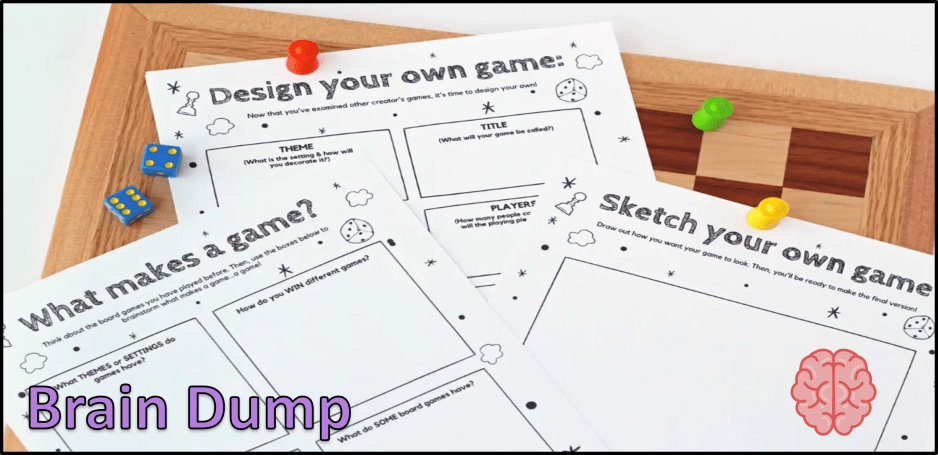
Board Game Design Brain Dump: April 24, 2026

Happy Friday, Geekly Gang! Kyra Kyle here. I’ve been silent on the board game design brain dumps over the past several weeks. It’s been busy. Earlier this month, I attended the Great Plains Gaming Festival (GPGF). We’ll discuss soon, but before we get into that, I’m getting to the fun part: Submitting.

Sell Sheet

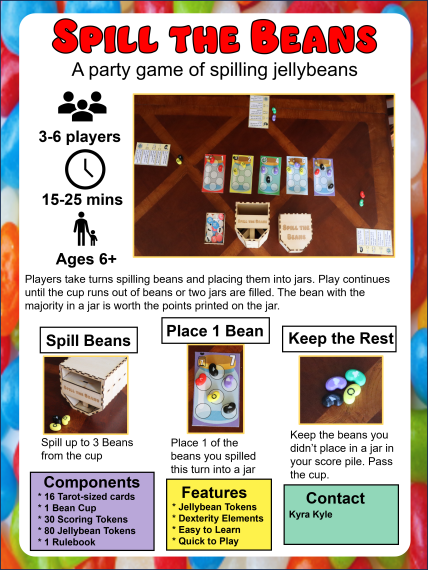
Almost every publisher requires a sell sheet, so I guess I’ll kick off this game design dump with sell sheets. Sell sheets remind the publisher what your game is all about. Below is a sell sheet for Spill the Beans (I omitted my contact information).

This sell sheet could use some more work. I always second-guess my pictures and layout. But this sell sheet contains what it needs: the name of the game, contact info, the hook (what makes the game unique), demographics (age, player count, and time), a list of components, a brief overview, and quick rundown (with visuals) of how the game is played during a turn.

The background picture (of jellybeans) is obscured by a white backdrop, making the text and pictures on top of the white backdrop legible. You don’t need a fancy background or a colored backdrop. I did so here to add a little extra color. Frankly, I may have overdone it a little. Legible text and images (of the game) are key. I like having a logo, but you don’t need one. And the tagline does enough to let publishers know what kind of game Spill the Beans is.

Next, we have an overview picture of the game. Always a plus to have in a sell sheet. Publishers need to see all–or at least most of–the game’s components. Demographics are shown to the left of the overview pic. Again, publishers need to know who the game is for, how many players the game accommodates, and how long the game takes to play. I settled on 15-25 minutes because I noticed some players strategize more than others (sending the game to 25 minutes), but I didn’t include plays of first-time gamers. The time on the sell sheet should reflect the average time it takes to play a game, not teaching the game to new players. So, of course, Spill the Beans will take a few extra minutes when someone first learns the rules. It really doesn’t take long to learn this game.

Under the overview and demographics, we find a brief (three to four sentence) description of the game, and beneath that we find what players will do (mostly) on their turns, giving publishers an idea of the game’s flow. Each turn action has a header, a picture, and a very brief explanation of each action underneath the pics. Do not include too many of the rules. That’s for the rulebook.

Finally, we get components, features, and contact info. Typically, the components section doesn’t need a detailed breakdown of each item. For instance, if your game includes 110 standard cards, potential publishers don’t need to know that half the cards are of one type and the other half is a different type. Publishers are only interested total number of cards and size. In Spill the Beans, I mention 18 Tarot-sized cards. I don’t say that eight of them are player reference cards and the other 10 are jar cards. That’s for the rulebook to explain further. Features are what make your game standout, and contact info should include your name, e-mail address, and phone number. You can see why I didn’t share that here. Lol

Sometimes, the things that aren’t included are just as important as the ones you do include. I don’t include a thorough rules explanation. I’ve seen game designers try to squeeze in their entire rulebook on a sell sheet. No! Don’t do that. Consequently, you don’t want walls of text. They’re intimidating. I don’t believe I included any flowery market language or buzz words in this sell sheet, words like unique, fun, exciting, or sustainigizing.

Wait. That last one wasn’t a word. And I didn’t mention how long I’ve been working on this game. First off, publishers don’t need to know that. It may even hurt your pitch if a publisher finds out you’ve been working on a game for years. Second, I share those details on this blog. If a publisher wants to know the story behind some of these games, they could look them up on this website. Eek!

Overview Video

Years ago, overview videos were nice to have. They are now–almost–industry standard. You can still get away with only have a sell sheet. But even the publishers who don’t require an overview video highly recommend one.

Above is Spill the Beans’ Overview Video. It’s bare bones, but I believe it’s effective. One of our writers, Season, narrates, and you’ll see similarities between the Overview Video and Sell Sheet. Sure, Season goes into the rules in a little more detail, but she really only adds what triggers the end of the game and scoring. Honestly, overview videos help folks who may be more visual learners. A Sell Sheet can only do so much. Overview Videos take the concept further.

A special shoutout to Kenneth Turner at Nerds Making Nerdy Things. Kenneth made the physical design for Spill the Beans’ spilling cup. Nerds Making Nerdy Things takes special orders. If you have an idea for a board game peripheral or even an art project like a shadowbox, feel free to contact Nerds.

I thought of Kenneth while looking at Season handling the Spill the Beans cup. Getting back to the Overview Video, you’ll need several of the same elements you’ll find in a Sell Sheet: the name of your game, the player count and approximate length (like you’ll find in demographics), the theme, the roles players take (if any), the objective, and what players do on their turn and throughout the game, which can include what triggers the end of the game and scoring. Again, we don’t include the full rules. For the fourth or fifth time, that’s why we have a rulebook. You don’t need to include fancy animations or cut-ins. The video above is simple. You also don’t want to talk too much. Show, don’t tell. Season did a good job of avoiding wordiness.

I’ve submitted Spill the Beans to board game publishers. I don’t know if I can share the names of those publishers here yet or not, so they’ll remain anonymous–for now. I’d prefer a program for board game submission that’s similar to Duotrope in the literary world, where submitters share their experiences with publishers (how long the publisher took to give a response, if they ever gave a response) in an attempt to catalogue publishers and their tendencies. I may just create one. But that’s a problem for future Kyra.

Great Plains Gaming Festival

I was triple-booked the weekend of Great Plains Gaming Festival (GPGF), so I didn’t show up for much of the convention. Friday was my big day. But my games attended GPGF all three days as part of the Playtest to Win event. In short, I was a little disappointed. My games didn’t get checked out as much as I would’ve liked. But I can honestly say Spill the Beans, Whirligig Pets, and No Kings were blind playtested. Gamers played these games by reading the rules.

I wasn’t there to explain anything. Heck! I couldn’t be there to explain anything. Spill the Beans and Whirligig Pets are ready for publication. Will they see tweaks in the future? Sure, but the core games are solid. And except for No Kings, the rulebooks make sense. No Kings needs some work to put it mildly. But yay! I can submit the other two with confidence.

My Future Events

I have so many upcoming gaming events in the coming months. You can stop by at any of these and say hi or convince me to play a game or a dozen.

Nuke-Con’s Aftershock Event: May 16, 2026 (I’ll be working one of the tables)
Omaha Gaming Convention: July 10-12, 2026 (I won’t be working this one, but I will be in attendance; let’s get our game on)
Omaha Pride: July 17, 2026 (I’ll be running games for Pride)
O-Con: July 17-19, 2026 (at the Extra Life table; I double-booked myself again, oops–I can’t calendar)

And I think that’s it for the coming months. It’s a little early to advertise Nuke-Con in October. But that’s all I have for today’s Board Game Design Brain Dump. Hopefully, this means I’m back to doing these on a more regular basis. Thank you for reading, and wherever you are, I hope you’re having a great day.
Fifth Wednesday: New Year’s Resolutions

Happy New Year’s…Eve, Geekly Gang! The holiday happens to fall on the fifth Wednesday of December, and whenever a month has five Wednesdays, our writers share personal updates. So, today sounds like a great day for New Year’s Resolutions. Feel free to share your New Year’s Resolutions in the comments. I’ll get us started.

Kyra’s Resolutions

I may have spoiled some of my resolutions with a previous writing brain dump, so you may find some repeats here. I’ll try to keep this short.

1) Write something every week. First, this needs to be something outside Geekly. Yes. I write something every week–or at least most weeks–for the site, so this is personal writing like a short story or chapter in a novel. But this could be as little as a single word. I’m not putting a word count on this resolution. My idea is that one word usually leads to a sentence, which will lead to much more.

2) Work on a game every week. This could be playtesting, developing an existing design, or even designing a new game. Again, the simple act of working on a game every week should lead to more than a single design or development session.

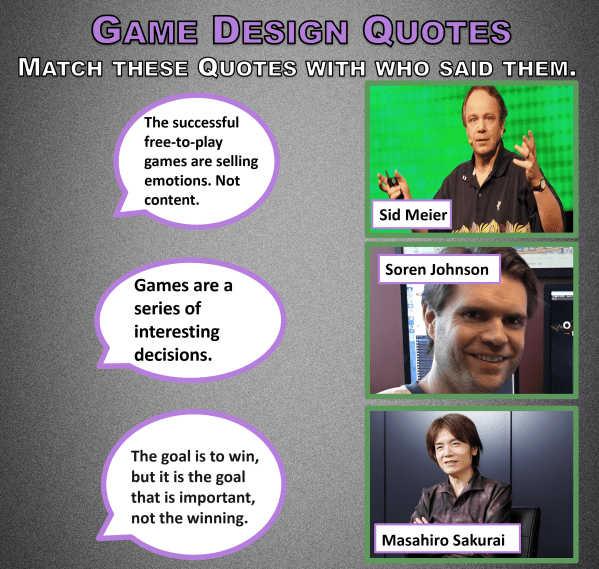
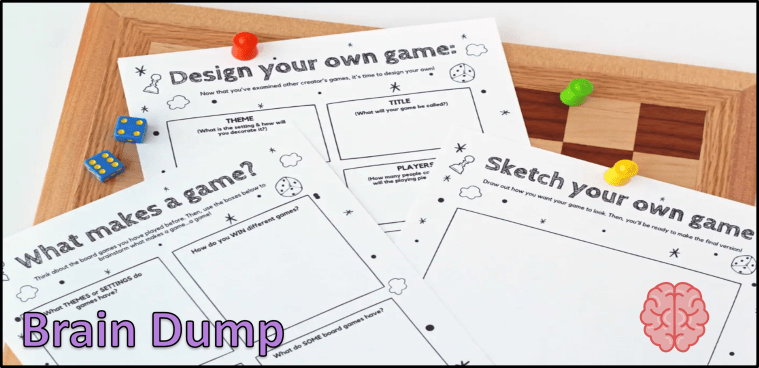
3) The above images remind me that I need to be more consistent with posting brain dumps–at least one of each per month.

4) Read one book a month in a genre that I write or a genre I’m interested in writing. It’s always a good idea to stay current with what sells. And reading helps with one’s writing. Don’t worry about reading another person’s writing impacting your writing. You have your own unique perspective.

5) Read one writing craft book or publishing business book next year. 2025’s book was Strunk and White’s The Elements of Style, and I barely got that one under the wire. Reading about the act of writing is crucial if one wants to write. And I could stand to learn more about the writing/publishing business.

6) Read at least one book next year in a genre I don’t intend to write. This past year, I read I Got Abducted by Aliens and Now I’m Trapped in a Rom-Com. I don’t know if I’ll ever write a romantacy novel, but I’m glad I read this title. Kimberly Lemming did a great job balancing comedy, steamy romance, and social commentary. Kudos! And romantacy sells. I needed to read at least one book from the genre. I may read another one or two in 2026. Romance and fantasy are two of the best-selling genres. Put them together, and you get a powerful combination.

7) Play at least six board games with themes or mechanisms I don’t usually gravitate toward. This is the board game design equivalent of the previous resolution. Nuff said.

8) Get something published. This resolution is largely out of my control, but I’m not so sure. If I don’t share a publication in a literary journal or board game through a publisher in the next twelve months, I may post a short story or poem on JK Geekly by the end of 2026. Let me know if you’d be interested in this style of content. I’ll even offer this invitation to our other Geekly writers. I can’t wait to see what they have in store.

9) I have plenty of other personal goals, like staying active and volunteering more with Extra Life, but I’ll still primarily focus on writing and board game design with these resolutions. Case in point, I’ll be at ScroogeCon in Lincoln, NE, January 10, 2026, with Extra Life. If you’re in the area, stop by and say hi. I helped raise thousands of dollars for the Children’s Hospital in 2025 and hope to raise even more this upcoming year.

Looks like I’m flying solo this week. Season and Skye aren’t sharing any New Year’s Resolutions in this post. I guess that means they won’t fail at any resolutions by next Friday. They don’t have to sweat Quitter’s Day (January 9, 2026). Smart.

What are your New Year’s Resolutions, Geekly Gang? Let us know in the comments. Thank you for reading this past year, and wherever you are, I hope you’re having a fantabulastical New Year’s Celebration.

Game Design Brain Dump: October 10, 2025

Hey, hey, Geekly Gang! Kyra Kyle here. Last week, we began a series called–for the time being–Writing Brain Dump, and this week is the time to roll out Game Design Brain Dump. The title is a work in progress. Let’s hope I can express my board game design process with this series. Fingers crossed for a cogent thought or two. Strap in for a Board Game Design Brain Dump.

Rustbucket Riots Origins

I’m going a different route from last week’s writing brain dump. Recently, I attended a panel about board game design at Nuke-Con (Omaha’s board game convention) and figured we could begin with what prompted me to begin designing Rustbucket Riots.

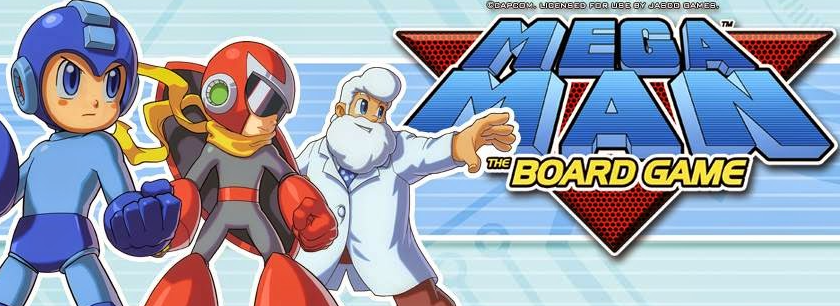
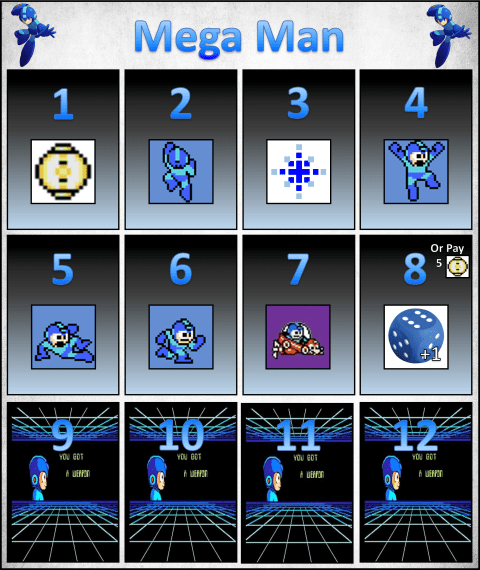
I knew Mega Man: The Board Game by Jasco Games wasn’t the best when I purchased it at a severe discount. Honestly, I wanted the bits. Jasco Games did an amazing job with Mega Man’s miniatures and the look of the game. But good luck finishing a game of Mega Man in under 10 hours. Each robot stage plays like five games of Munchkin played back-to-back, with every other player doing their best to prevent you from completing the stage. And you need to complete multiple boss stages. 10 hours may be too few hours to complete this game. You may need to dedicate a table to preserve your month-long game of Mega Man.

I hope I won’t get copyright claimed for any images. Eek! I began with a simple dice chucker of a game. Players would roll standard six-sided dice (I don’t recall the exact number, but it was likely around four or five) and then place the dice on their player boards. Each space on the player board would grant different abilities, with the final four slots variable for powers obtained by defeating robot bosses. Players could place multiple dice in a single space to combine the rolled result. A six may be played with a single die showing a six or with a two and a four or any other combination of six.

I chose dice chucking because rolling dice and placing them with predetermined spaces made for quick turns. Quick turns lead to a game that one can finish within ten hours. This game worked well. Heck, I even tried it as a real-time game, and it worked extremely well. Games lasted less than 15 minutes. I even saw this Mega Man variant as a game that could be played in tournaments of speed runs. Now that I think about it, I may revisit this variant in the future and give it a reskin. Sorry, the ADHD took the wheel for a second.

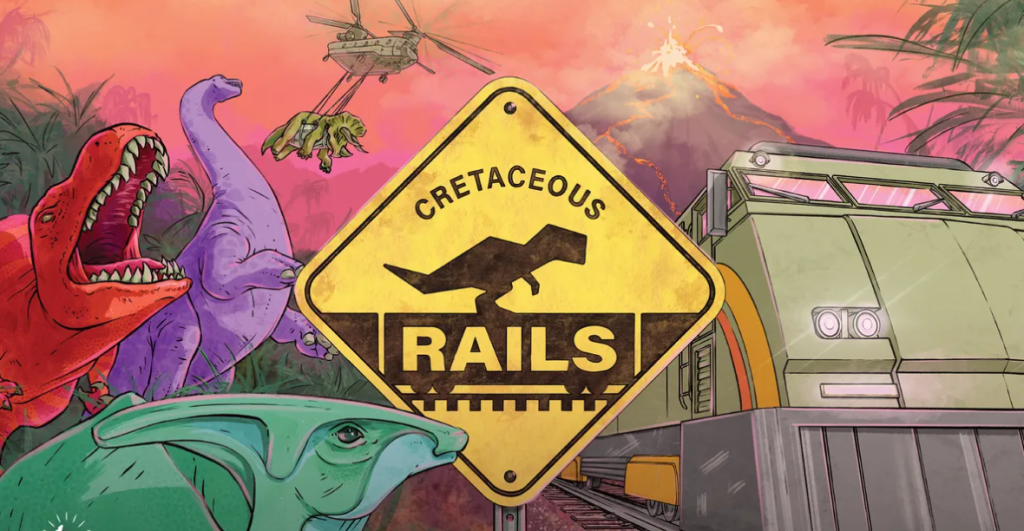
For some reason, I abandoned the above game concept and went in a different direction. I love Cretaceous Rails. Unlike Jasco’s Mega Man, there isn’t much I’d change with this title. Cretaceous Rails makes this list because I wanted to try using one of its core game mechanisms: dual action selection. I even asked Cretaceous Rails’ designer, Ann Journey, if it’d be okay if I borrowed this game mechanism before trying the next Mega Man remix iteration. The result was a game I nicknamed Rondelande.

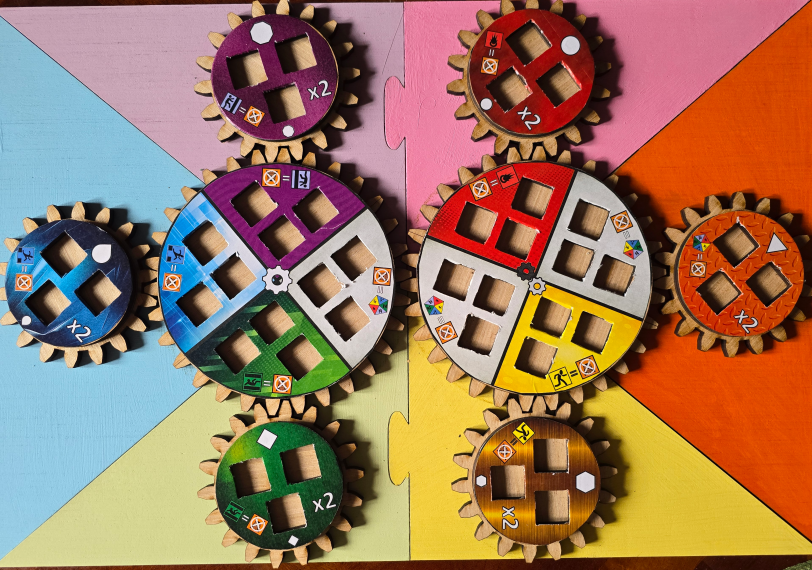
Oh my goodness. This game wasn’t just a different direction from my first Mega Man remix; it was different in every possible way. I didn’t keep any of Rondelande’s hardcopy versions. I only have the digital files, and it’s difficult to recreate what the game looked like without a physical copy. But I’ll try my best.

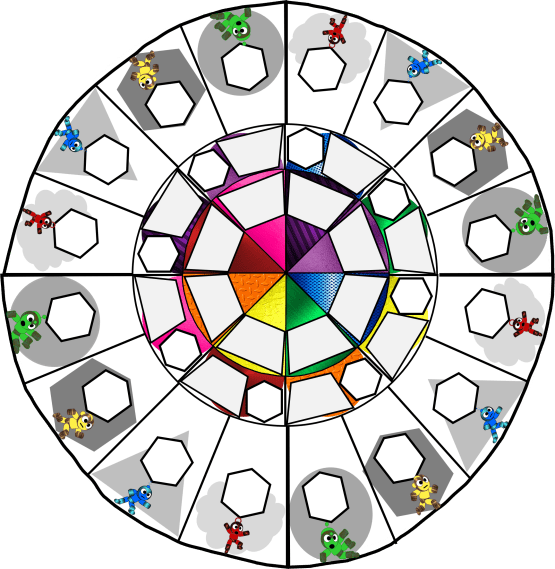
That’s a lot of color going on. Those are supposed to be three rondels (a circular game mechanism with pie wedges representing which actions one may take) stacked on top of one another. Each turn, players would place their gear tokens on one of the hexagon-shaped spaces and take the actions indicated. But before placing gears, players could play up to two cards (depicting one of the actions run, slide, jump, shoot, or climb) underneath the spaces on the outer edge. Players would then be able to take all the actions, including actions on cards, during their turn.

Note: The trapezoid spaces had different actions like draw cards or oil cans (that functioned as wild actions) or even rotating one of the top two rondels, so the action selection could vary.

Rondelande was a lot of fun. It ventured far from what I had originally intended to make. That’s the ADHD brain taking the wheel again. Unfortunately, Rondelande was a space hog. The image above is at least a twentieth of the size of the original game. Despite its size, Rondelande may have been a great game if I had stuck with it. I liked how players could build up the board as they went, benefiting themselves for a turn, but also allowing an opponent to take the same action in a future turn. Players could even refresh (take back their gear tokens) or choose not to refresh for a turn to prevent someone from taking an action their token is currently occupying. Rondelande was great. But something felt off. I wanted interlocking gears for the board because it made sense for a robot theme. I had chosen rondels because they were easier to build. And then I found gears that would work.

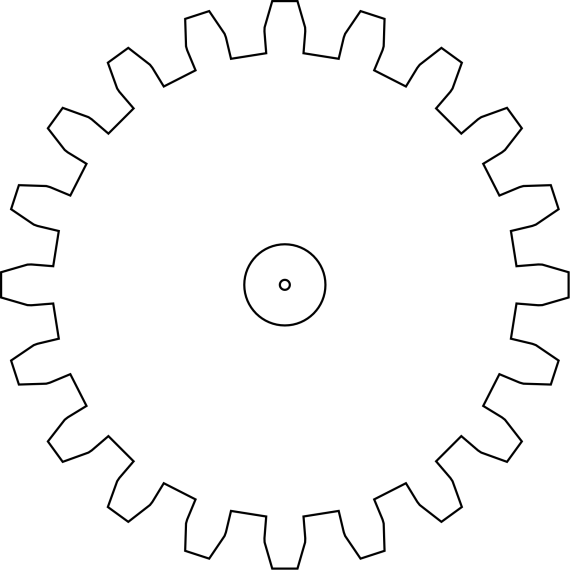
I found a file that could work for interlocking gears. Yay! As an aside, I was working on making this file work while producing my Mega Man variant and Rondelande, so a lot of what we’re about to discuss happened concurrently with the previous two games.

At first, I was using a lot of memory foam. Rondelande’s rondels were comprised of foam. I’d print out the digital files (of that rainbow nightmare above) onto full sheet labels and then sticker them over the foam and cut them out. I tried the same concept with the gear pictured above. And it worked…for like one playthrough of the game. Foam likes to shred under friction. Who knew? So, I put the interlocking gears aside until I found a set of wooden gears on Amazon.

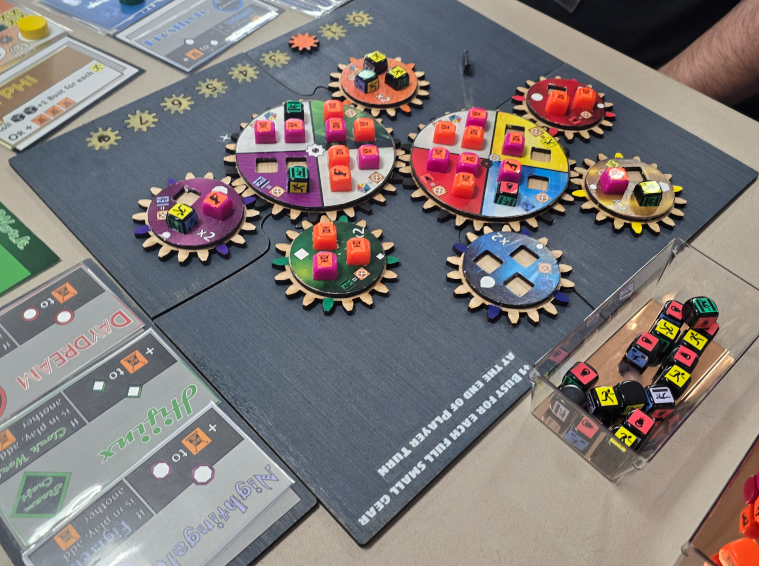
Yes! I was in business. I could continue with Rustbucket Riots. The picture above is a modern version of the game; the first version still used foam for its board (the gears haven’t changed too much). I still have a version of the first game and will include a picture of it in a future post. Rustbucket Riots combines multiple ideas. I brought back dice chucking from Mega Man, only this time, I used specialty dice that included run, slide, climb, shoot, and jump. And I always thought Tzolk’in’s gears didn’t move enough. I could fix two issues I saw in other games. Jasco’s Mega Man took too long, and Tzolk’in (Tzolk’in is an amazing game that earns its spot in BGG; I’m nitpicking) could have gears that frequently turn.

The name Rustbucket Riots came swiftly. Originally, I wanted to make a better Mega Man board game, but I couldn’t copy Mega Man exactly. So, I wondered if I could make the player characters villainous. The Boss Robots attempt to free themselves from an oppressive corporocracy and the humans using them as cheap labor, while the players assume the role of corporate robots tasked with bringing the rogue robots under control. Even though the Boss Robots would view what’s happening as a revolution, we’re playing this game from the viewpoint of corporate robots, and they’d see it as riots. Throw in a slur, and you get Rustbucket Riots.

I think that’s everything up to the idea of Rustbucket Riots materialized. We’ll cover early iterations of the game in the next board game design brain dump. If you’ve made it this far through my rambling, you’re awesome. You know it. Thank you for reading, and wherever you are, I hope you’re having a great day.

Fifth Wednesday Personal Update: July 2025

Happy fifth Wednesday, Geekly Gang! Kyra Kyle here. Since it’s the fifth Wednesday of July, that means our writers will be sharing personal updates. I’ll get things started.

Kyra’s Writing

My writing and game design will sound similar this month. The two center around the same concept. I wrote a first draft of a novel based on one of my board games, Rustbucket Riots, and I’m in the throes of reverse outlining.

Reverse outlining is an important stage of writing/editing that I learned after multiple novels. During the reverse editing stage, I take note of what happens in each chapter/scene, looking at the novel from a macro level, rather than a micro level (like line editing). Reverse outlining allows me to see who the point of view (POV) character is for each chapter (if there’s more than one POV character for the novel). If a character has only one POV chapter, I may need to give them more chapters or consider omitting the chapter or using a different POV character. Jotting down what happens in each chapter makes it easier to see which chapters are pulling their weight (from a narrative perspective), which ones could do more, and which ones may not be needed.

In previous novels, I made the mistake of line editing after writing the first draft. That doesn’t work–at least, not for me. The sunk cost fallacy (the tendency to continue an endeavor because of the time and effort spent on the project) is strong when a writer does this. Slapping together a crappy first draft and then taking a macro look at each chapter makes it easier to “kill one’s darlings.” If I haven’t spent hours editing a chapter, that chapter hasn’t reached the status of one of my darlings. It’s easier to make cuts.

Depending on when you’re reading this, I may be slashing through thousands of words in one keystroke. Can you hear the ink cry?

On a different note, I’m still querying agents. Fingers crossed.

Kyra’s Game Design

I received a ton of great feedback for Rustbucket Riots and Whirligig Pets. Both games are well on their way to being publishable.

I’m continuing to refine my other designs, and I’ll be at Comic Con Nebraska this weekend. If you’re in the area, stop by and say hi. I’ll be in the game room, demoing various designs that will include Rustbucket Riots and Whirligig Pets. I’ll even have JK Geekly badge ribbons.

Tangent: I joined a board game publication and pitching course, so hopefully, my board game pitches will improve in the coming months. Lol

That’s all I have for these past three months. Let’s check in with Skye.

Skye’s Update

Believe it or not, I do have a life. I know, I was surprised too. Not much has happened since the last time I did one of these, but there were a couple of things I wanted to mention.

First, I have a new job at my local movie theater. Y’all know how much I love movies, so this kind of job is right up my alley. There’s a more community-oriented culture at Marcus Theaters with several opportunities to learn and connect with the team, which I love. Of course, there’s also free movie tickets. This means that I can start covering recently released films on my personal blog, TGIMovies, in a more financially responsible way.

Second, I took this summer off from college. So far, I’ve been having a good time relaxing and dedicating my time toward things I love, such as my hobbies, my relationships, and this community. I’ve learned a lot about myself, spent time with those I care about, and started working towards my future. At this point in my life, I’m the most excited I’ve ever been about what’s to come. I’m glad I got to share it with y’all!

Thanks for reading about my experiences and for inviting me to this website. Though I don’t say it often, I’m greatly honored to be a part of this community, to experience geeky content with like-minded people, and to have a platform to offer my thoughts. I’ll see y’all next week with another “Whatcha.” Take care!

Kyra Kyle here again. Season doesn’t have an update for the past three months. She graduated from college with a Bachelor’s and continues to look for work in her field. Fingers crossed that she’ll find something soon. And feel free to share what you’ve been working on over the past three months. We’re all part of the Geekly Gang. Thank you for reading, and wherever you are, I hope you’re having a great day.