Happy Saturday, Geekly Gang! We haven’t done a Top 5 Villains list for a superhero or superhero group since Black Panther late August of last year. Looks like we’re overdue for another list, and since Lanterns is releasing on HBO Max, let’s count down the Top 5 Green Lantern Villains. Green Lantern is almost on Superman’s level in his number of overpowered villains. Heck, some of these Green Lantern villains have their own Corps of Henchmen ready to take down the Emerald Knight. Let’s see who made our list of Top 5 Green Lantern Villains.
5) Larfleeze
Larfleeze might not make a lot of people’s lists of Top 5 Green Lantern Villains because he’s often depicted as comic relief, but Larfleeze’s origin is anything but comical. Deep within the Vega System, Larfleeze of Okaara protects the DC Universe’s only Orange Lantern Power Battery. Fueled by greed, Larfleeze has a desire to take as much power as he can. Larfleeze would kill anyone he believed was trying to steal his Power Batter, and then copy his victims’ image, stealing their identities and have them join his Orange Corps as construct ghosts.
Larfleeze is the embodiment of greed, the emotional power that feeds orange. Under the Orange Light of Greed’s sway, Larfleeze is driven to possess everything.
4) Atrocitus
Another one of Geoff Johns’s creations, Atrocitus represents a different Lantern Corps Spectrum: Red’s Wrath. The murderous Atrocitus and his Red Lantern Corps may be the most feared force in the known, extraterrestrial DC Universe.
The Manhunters killed everyone Atrocitus knew. He became an intergalactic terrorist, wanting to kill the Guardians of the Universe. After numerous bloodthirsty missions, Atrocitus formed his Red Lantern Corps to go toe to toe with the Green Lantern Corps. At his core, Atrocitus executes an extreme form of justice. Too bad his form of justice comes with enough blood to paint the universe.
3) Nekron
Nekron is a demon who is DC Comic’s embodiment of Death. Nekron has power over the souls of everyone who has ever died. He uses these souls to perform godlike abilities like strength, durability, and energy projection. Never content with his deathly realm, Nekron seeks control over the rest of the DC Universe.
Nekron’s right-hand agent, Black Hand, almost made this list, too. Consider Black an honorable mention for Green Lantern’s Top 5 Villains. The two of them concocted the events of “Blackest Night.” They co-created the Black Lantern Corps of death. Using the bodies of formerly dead heroes like Superman and Wonder Woman, Nekron attempted to eliminate all life.
2) Parallax
Yellow’s fear runs counter to Green’s will, so spoiler alert, our top two spots belong to Yellow’s portion of the Emotional Spectrum. Parallax is the embodiment of terror. It derives its power from the yellow light of fear, typically presenting itself as a serpentine creature that acts as a parasite in a host’s mind. The most famous instance of a Parallax infection was Hal Jordan.
That’s right. Parallax turned Hal Jordan into a villain. Jordan adopted Parallax as his villainous persona. While under Parallax’s control, Hal Jordan massacred the rest of the Green Lantern Corps and destroyed his home, Coast City. But Jordan is far from Parallax’s only vessels. It’s taken possession of heroes like Kyle Rayner and The Flash. Whenever Parallax takes control of a hero, its malevolent spirit and power turn the poor soul into one of the DC Universe’s most powerful villains.
1) Sinestro
While Parallax takes temporary control over its host, Sinestro shows how the yellow light of fear can corrupt even the greatest Green Lanterns, completely and forever. When Hal Jordan first joined the Green Lantern Corps, Thaal Sinestro was his mentor. The two developed a bond, but that bond was shattered when Hal discovered Sinestro kept his sector (of the universe) in line through tyranny.
Jordan got Sinestro booted from the Green Lantern, and the Korugarian never forgave Hal, the Green Lantern Corps, or the Guardians of the Universe. Since his dismissal, Sinestro has been one of the DC Universe’s most enduring antagonists. He’s a card-carrying member of the Legion of Doom and the founder of the Sinestro Corps, who also harnesses the yellow light of fear. While he may occasionally commit acts of valor, Sinestro’s hatred, anger, and desire for power define him. We had to go with Sinestro for the top spot. Sometimes one of a character’s original villains are the best.
There are plenty of other Green Lantern Villains we could’ve added to this list. Who would you include? Let us know in the comments. Thank you for reading, and wherever you are, I hope you’re having a great day.
Happy Wednesday, Geekly Gang! Kyra Kyle here, and today, our writers share what they’ve been listening to over the past month. Feel free to share what you’ve been listening to over the past month in the comments, because we’re all all part of the Geekly Gang. I’ll get things started with what I’ve been listening to over the past month.
Kyra’s Tunes
Fiona Apple was never afraid to be herself. Her first album had a placeholder name she thought was funny to switch from Title to Tidal. Get it? But the title–or tidal–fit. From tracks like “Criminal” to “Shadowboxer,” Tidal was a snapshot of someone finding their way in a world never created for them. Decades later, and the groove on “Criminal” still gets me. Many of the tracks are peak RnB. The industry marketed Apple as alternative rock or art pop. But her sound held way more jazz. Apple refused to be categorized. During her acceptance speech for Best Female Rock Performance at the 39th Grammy Awards, some may say she threw away her career. She dared to speak out against the industry and false image it created.
*Sexual Abuse Trigger Warner for the next paragraph*
At the time, what the public didn’t know was that Apple struggled with her self-image, especially after the “Criminal” music video. That’d be the same “Criminal” that earned her first Grammy. In the video, she was young, suggestive, and waif thin. The press wasn’t kind. They equated the character Apple portrayed in the video to her private self. During her acceptance speech, Apple spoke out against the music industry’s false images because she didn’t want someone to think of her as sexy when she suffered from an eating disorder. In interviews, Apple shared that she developed the eating disorder to look as thin as she could so she wouldn’t be attractive. So she wouldn’t be “bait” for the same type of man who raped her outside her Harlem apartment at age twelve.
*End trigger warning*
That subject is unpleasant, but unfortunately, it factors into Apple’s art. How could it not? After the media backlash, Apple remained defiant. She released her second album with a title that’s a literal 444-character poem, often shortened to When the Pawn…. She wasn’t going to be anyone’s pawn. The two singles “Paper Bag” and “Fast as You Can” are two of my favorite tracks. “Fast as You Can” features plenty of key and tempo shifts. It’s so, so good, and a shot of adrenaline. And the images within the lyrics echo what happened to a younger Fiona Apple. “Paper Bag” slows things down with cabaret flare. Seriously, I half expect Sally Bowles to belt the lyrics. And Rolling Stone must agree with me. When the Pawn… was listed as 108 of their 500 Greatest Albums List.
Fiona Apple would release an album every five or six years; her albums never lost their artistry. In fact, her fourth album The Idler Wheel earned Apple yet another Grammy Award and another spot on Rolling Stone’s 500 Greatest Albums Lists. But I’m skipping to her fifth (and as of writing this post) most recent album, 2020’s Fetch the Bolt Cutters. Bolt Cutters is a hint of what to expect. Expect nothing. Expect anything. Apple brandishes anything that can make music, even if the object is a pair of bolt cutters or her pounding a hand against her living room wall. Most of the songs on Fetch the Bolt Cutters delve deep into experimentation. The first two tracks, “I Want You to Love Me” and “Shameika” function as a great handshake to get into Fetch the Bolt Cutters. If you want something a little more dancy, start with the lead single “Shameika.” Each track proves Apple was never afraid of being herself.
One last thing about Fiona Apple before I turn the post over to Season and Skye: I love Fiona Apple’s cover of The Beatles’ “Across the Universe.” On first listen, you won’t notice too much of a difference between the two artists, but the song’s writer, John Lennon, may have something to say about that. Lennon lamented that The Beatles rushed through their recording(s) of “Across the Universe.” He wanted to rerecord the track, giving it the attention it deserved, but Lennon passed away before he ever did. Apple did the song justice.
I had another artist I wanted to share here, but I went longer with Fiona Apple than I expected. I’ll save my other artist for next month.
Well, it looks as if I’m flying solo this month with Geekly Tunes. Our other writers didn’t share any of their tunes. Hopefully, we’ll hear from them next month, but I’ll turn the conversation over to you, Geekly Gang. What have you been listening to over the past month? Let us know in the comments. Thank you for reading, and wherever you are, I hope you’re having a great day.
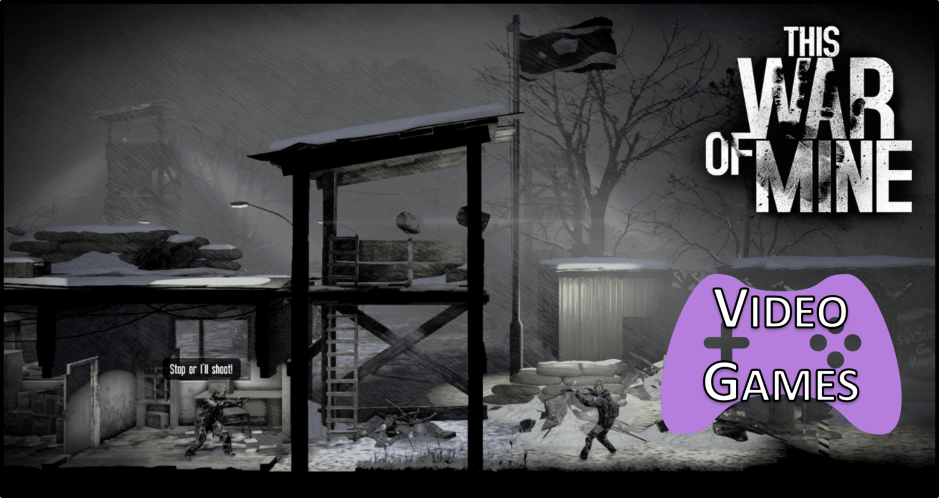
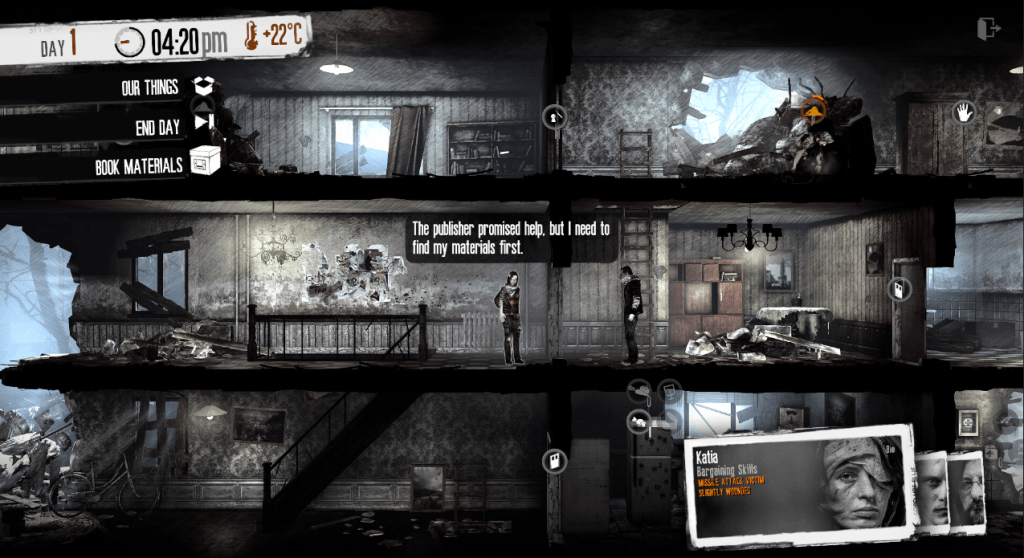
Happy Monday, Geekly Gang! We’re back with another video game review, one that’s overdue. I’ve talked about This War of Mine in various forums, even The Pixels, a few years ago, so it was only a matter of time before we, JK Geekly, would cover the video game in a review.
I love this game. This War of Mine harkens back to my days as an imagery analyst/targeteer. Typically, I’ve seen the world of This World of Mine from a top-down view. This video game made me see the people I affected from a ground level, and I love it for it. But how does This World of Mine rate against JK Geekly’s video game review criteria? Let’s find out.
Mechanisms: 8/10
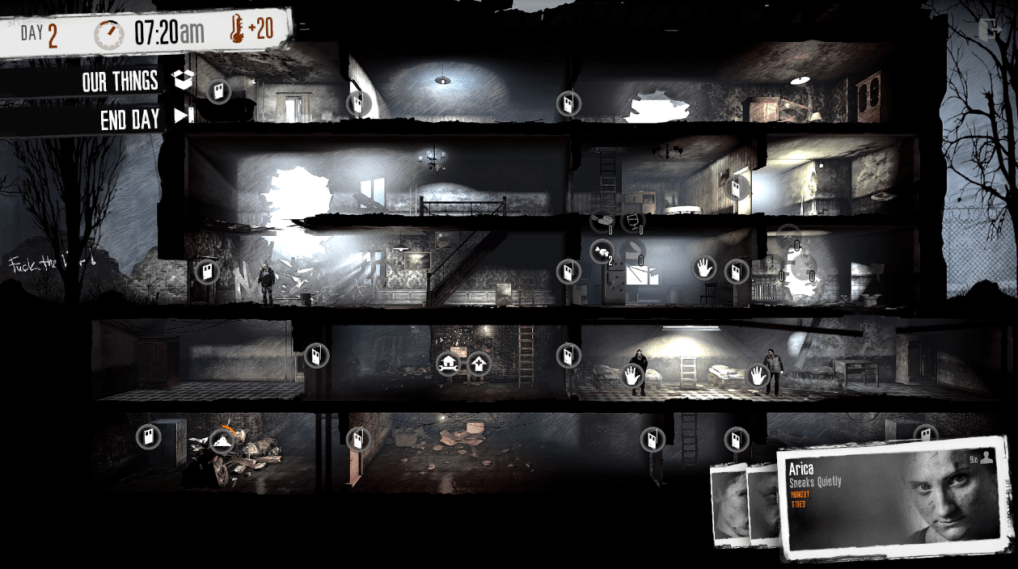
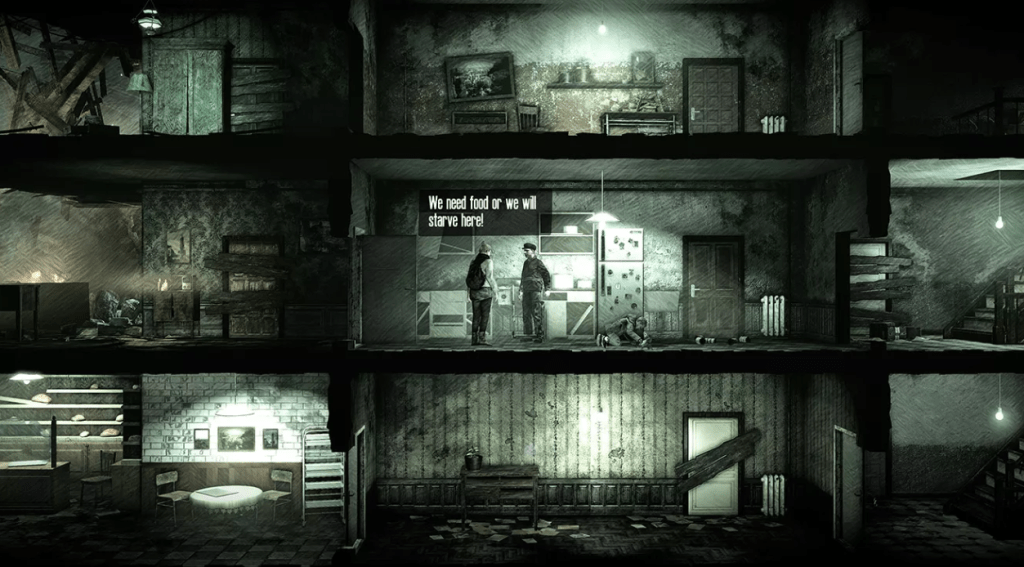
This War of Mine does a great job of balancing the various things you need to survive. Yes. This War of Mine is, first and foremost, a survival game. The denizens of your building attempt to survive the duration of a war, ripping apart this undisclosed Eastern European nation, although with hindsight, we could assign This War of Mine’s setting as Ukraine, circa 2025.
This War of Mine’s game mechanisms are a difficult category to rate. On one hand, This War of Mine offers a singular experience of rummaging through a war-torn nation, while gathering supplies. On the other hand, it uses pre-established game mechanisms to express its subject matter. I’m giving This War of Mine an eight out of ten because it does enough to subvert the typical game mechanisms of acquiring resources. This may play into This War of Mine’s story/narrative, but while the specific mechanisms one can find in this game can be found in other video games, the narrative weight these choices offer makes This War of Mine unique.
Above Image from GameDesigning.Org
Gameplay Loop: 9/10
This War of Mine is addictive. I don’t care if you’re looking through a survival game like Ark: Survival Evolved or The Survivalists, This War of Mine equals or bests these survival games, only with the experience of someone who may have to experience war overseas. Even though you could find a similar gaming experience with any number of survival games, none of them put you in the shoes of someone having to fight for their lives in a real-world scenario.
Few survival games balance the day-to-day survival with the greater good like This War of Mine. I don’t know how many times I’ve had to choose how much I intend to “steal” from an elderly couple, while gathering enough to keep my survivors alive. This War of Mine offers an odd balancing act unseen by most video games. No two plays of This War of Mine will turn out the same. That’s a strength.
Add in the Little Ones expansion, and that adds an extra layer of complexity. Few games have me replaying its core game through a different lens than This War of Mine. This game blends a tasty survival game with an empathy game. I’ve found myself making choices in This War of Mine that I think I’d never make until presented with the scenarios this game includes. This is the This War of Mines’ greatest strength.
Narrative and Storytelling: 9/10
This War of Mine offers a branching narrative that changes each time you play it. I’ve lost count many times I’ve replayed this title and see where the story takes me. This adds to This War of Mine’s narrative and storytelling. It’s a glorified “Choose Your Own Adventure” story with so many branching arcs that it’ll take multiple playthroughs to unearth each one.
Add in expansions that further explore this unnamed Eastern European nation, and This War of Mine has narratives so deep, you can spend months exploring them. But you don’t even need expansions. If you play the game on Steam, This War of Mine is host to a plethora of mods. Any one of them can shake up the gameplay, and sometimes, the story. This War of Mine offers a fertile ground to tell any number of interesting stories set against the backdrop of war.
User Interface: 7/10
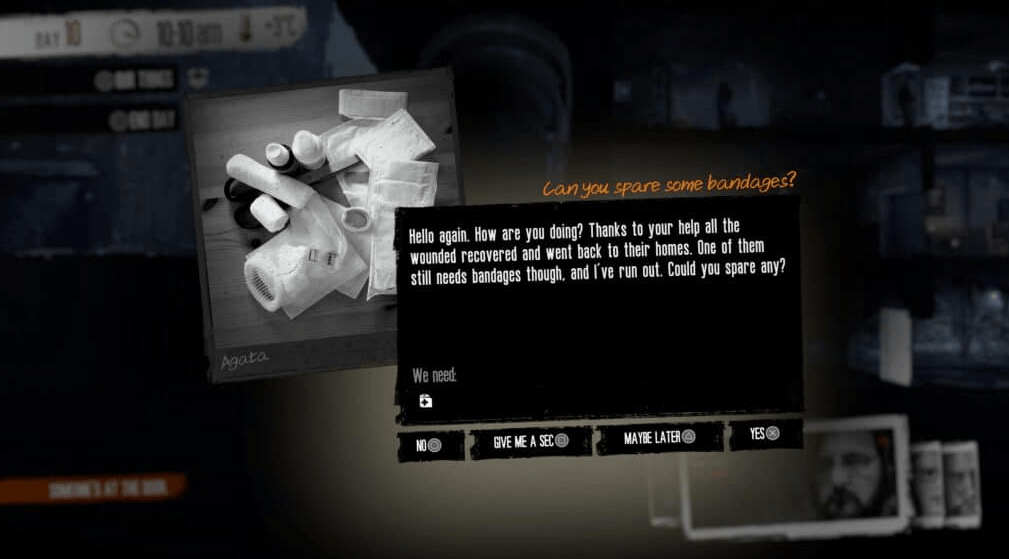
This War of Mine has plenty of menus, and for the most part, it does a great job of presenting these menus to its players. But the sheer volume makes it easy to get confused. Honestly, I’ve had to play portions of This War of Mine a second time because I didn’t understand the ramifications of my actions or choose something I didn’t want to choose from one of the game’s multiple menus and selections within selections of head’s up displays.
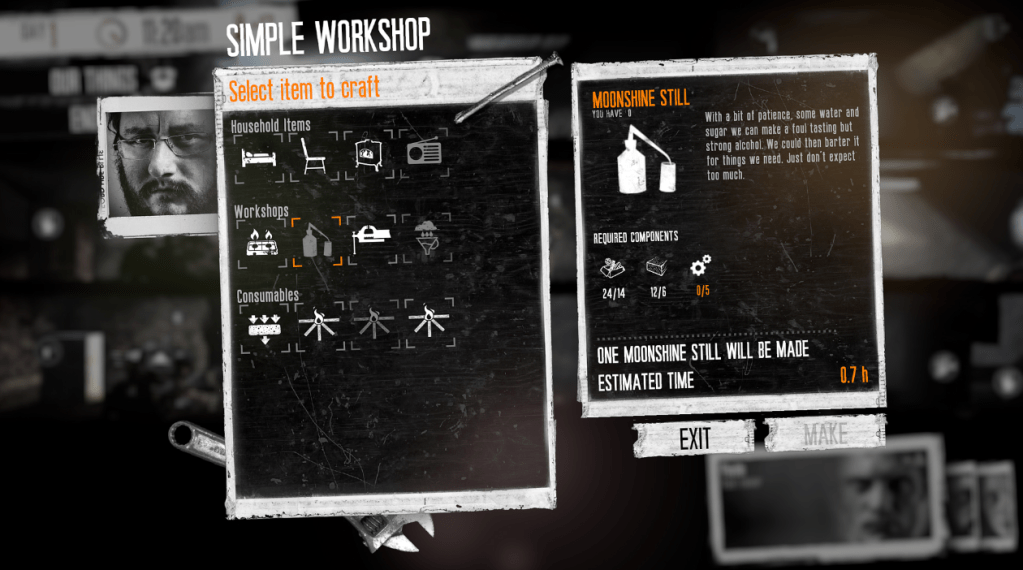
To be fair, it’s easy to get lost in This War of Mine’s multiple workshop (or production area) menus or dialogue exchanges or even its basic movement and interaction with the world around you. This War of Mine includes a steep learning curve, even if the game tries its best to handhold you through the early stages of that steep learning curve. Without these handholding efforts, I would give This War of Mine a below-average rating. Since the game goes out of its way to try and teach you these menus, it gains a well above average rating.
Graphics: 7/10
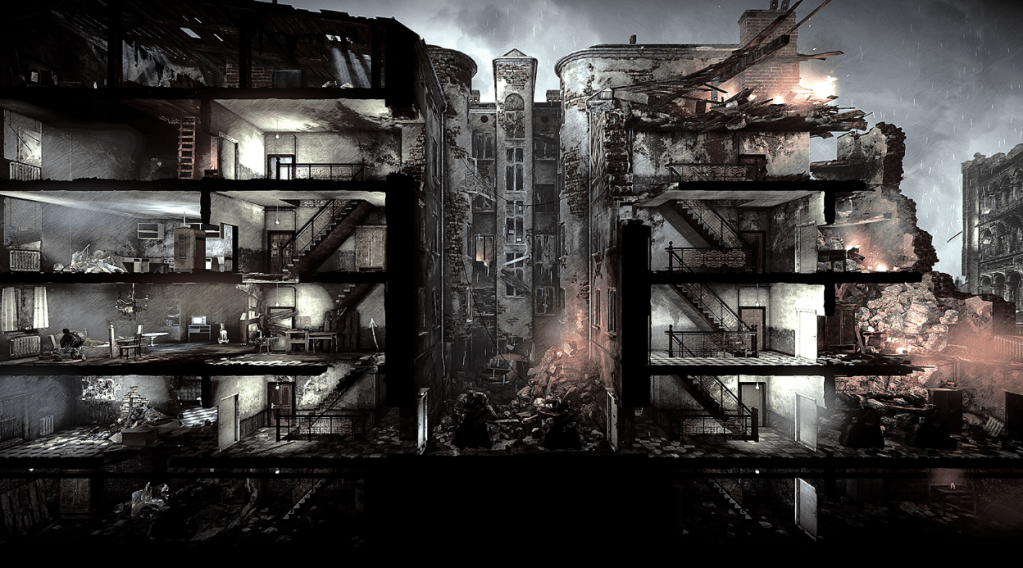
This War of Mine offers above-average graphics, but grading this game’s graphics does it a disservice. Even though the game is over a decade old, This War of Mine is timeless. Even during its 2014 release, This War of Mine harkened back to the past. And oddly enough, the future. Ultimately, it doesn’t matter which war This War of Mine is supposed to represent. By extension, it doesn’t matter how dated This War of Mine’s graphics become. It matters the vibe This War of Mine captures. And if we consider the vibe, This War of Mine may score above a ten.
Audio: 8/10
If you know me, you know I seldom play video games with the sound on, but I make an exception with This War of Mine. This game’s soundtrack does enough to carry me to a war-torn Eastern European nation. I challenge anyone playing this game to listen to This War of Mine’s desolation. It’s haunting.
Replay Factor: 8/10
This War of Mine has so many expansions and mods (from Steam users) that you can play and replay This War of Mine for countless hours. The only reason why I put a damper on This War of Mine’s replay factor is its subject matter. I don’t know how long gamers can play a game meant to show the horrors of war. Each person’s mileage will vary. If you’re sensitive to war, you may not play This War of Mine very long. If you’re interested in putting yourself in the shoes of someone struggling to stay alive in a war-torn nation, This War of Mine will offer thousands of hours of gameplay. This War of Mine won’t be for everyone, but I don’t think that’s the point. Step into the darker, more personal corners of war if you dare.
Aggregated Score: 8
This War of Mine may not be for everyone, and that’s okay. For those who want to explore what they might do if confronted with living in a war-torn Eastern European nation, This War of Mine offers numerous morally gray options.
Happy Sunday, Geekly Gang! Kyra Kyle here with another week of Geek News. I’ll be away this weekend. My spouse and I are celebrating Valentines Day a weekend late to avoid the crowds. We’ll skip a headline story this week, but should have a major MCU update for next week’s Geek News. We have a lot to discuss with Marvel. Until then, enjoy these board game and video game new releases.
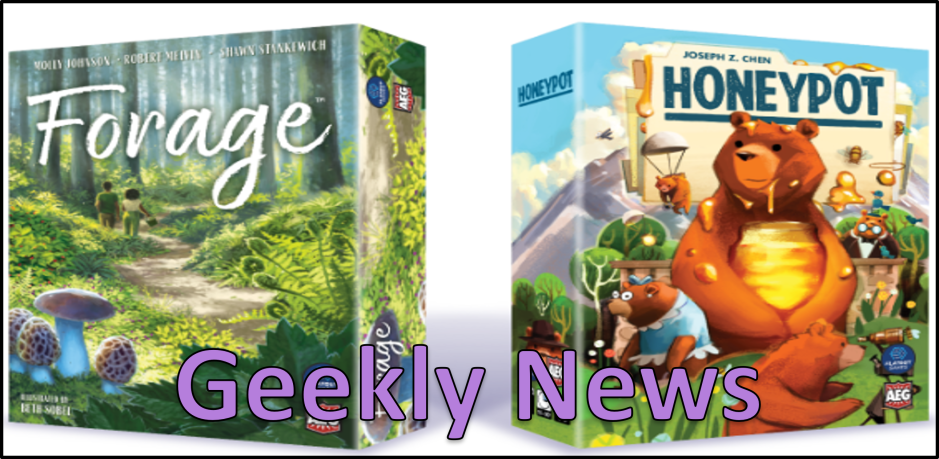
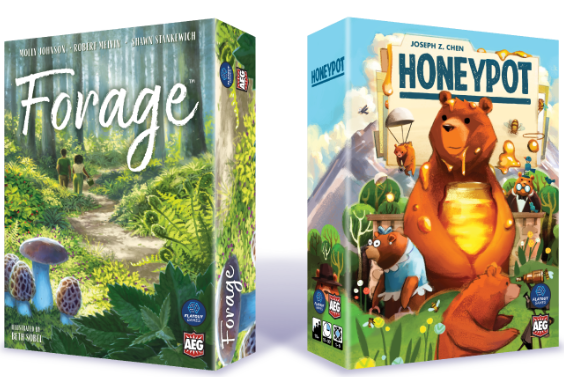
Forage and Honeypot by Flatout Games Launch on KickStarter
I love the Flatout Games creative team, Molly Johnson, Robert Melvin, and Shawn Stankewich, behind the Point Salad series of games. They’ve had a few other hits like Propolis. Each one of their games is a joy. Well, they’re back at it with Forage, and the designer of Fantastic Factories, Joseph Z. Chen, joins the party with his latest offering, Honeypot. Yes! AEG/Flatout Games are known for their combo releases on KickStarter and the pairing of Forage and Honeypot looks to be another great.
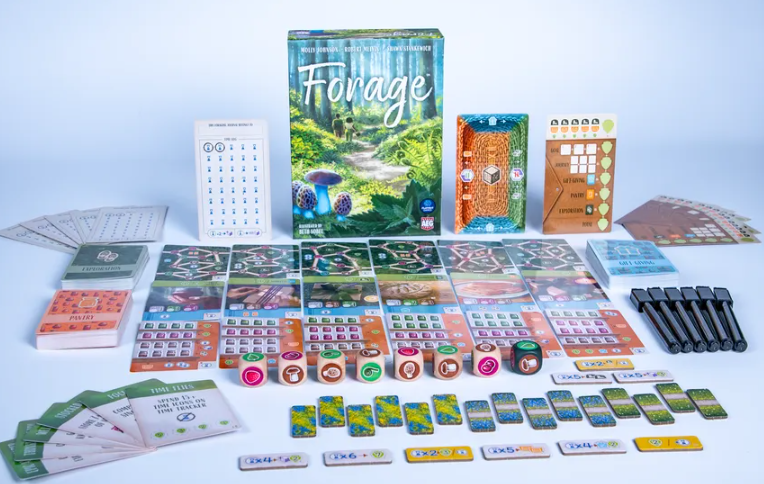
Forage is a puzzly tableau-building roll-and-write game for 1-6 players with gorgeous artwork by Beth Sobel! It is designed and developed by the team that brought you the Calico, Cascadia, and Point Salad series of games!
Rules are simple: Roll the forage dice and reveal a unique journey tile each round. Choose a combination of dice and carry out one of the actions: exploring, storing, or gift-giving. As you carry out actions, you’ll earn bonuses that allow you to power up your future actions or make additional moves to complete your goals! Use your time wisely–there are several journeys you can take to collect knowledge, experience, and prestige. Once you have completed your turn, you’ll choose one of the three types of cards to draw and add to your tableau giving you more ways to combo and complete goals!
The previous was a description provided by Flatout Games. Thank you for the great write-up. While the description continues, I figured I would leave it at about a short hundred words. Forage doesn’t need much more of an introduction; I’m hooked. I’m a sucker for roll-and-writes (Yahtzee-style games), and Forage gives me strong Cascadia roll-and-write vibes. One of the members of my game night owns a copy of the Cascadia roll-and-write, so I may pick up Forage. Games of this ilk can accommodate several players at once. Heck, they may be better with more players. And Flatout Games has a strong history of delivering on simple concepts with fun twists.
And art by Beth Sobel (of Wingspan fame) is always appreciated.
Flatout Games challenges AllPlay for those small box board games that feel like instant classics. Honeypot may just be another fantabulous game, by a designer (Joseph Z. Chen) who, despite being a new game designer, has an impressive resume.
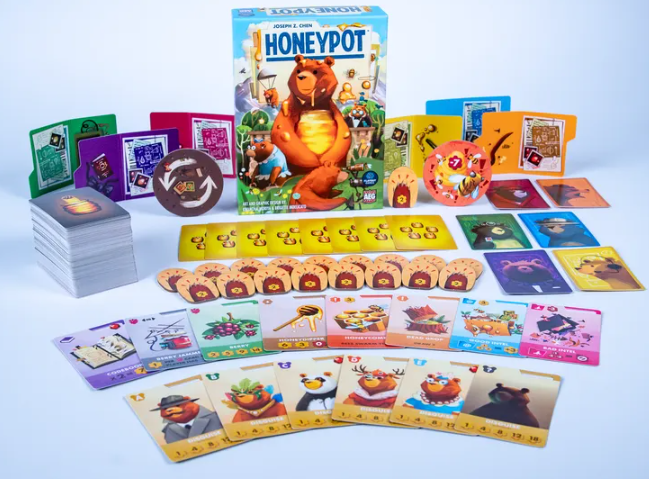
Honeypot is a quick and simple I Stack, You Choose game for 1-6 players with delightful artwork by Kwanchai Moriya!
In Honeypot, players take on the role of secret agent bears trying to gather the best intel and spy supplies without getting stung! Players arrange secret caches for their opponents and carefully sift through the secret caches passed to them. The question is: how far to dig for valuable intel and spy supplies? Have your opponents passed you the sweetest honey, or a swarm of bees? In this thrilling game of setting traps and trying to avoid them, only the agent with the best instincts will capture the best set of items to come out on top!
Again, great description, Flatout Games. Honeypot is another game that looks to play great at higher player counts. Its solo mode intrigues. I can’t wait to dive into a game or two of solo Honeypot, because I love the I Cut, You Choose game mechanism. Remember what I said about Flatout Games giving familiar game mechanisms fun twists? Honeypot looks to do that with I Stack, You Choose. I always thought more games should use the I Cut, You Choose game mechanism. I can’t wait to try an I Stack, You Choose game. Yes, please.
Honeypot and Forage are available with pledges of $19 apiece, or one can buy both at $35. Flatout Games offers a handful of other pledge options, but I’ll let you discover those on your own. If you’re interested in Forage or Honeypot, check out their KickStarter page.
For the Gods! Launches on KickStarter
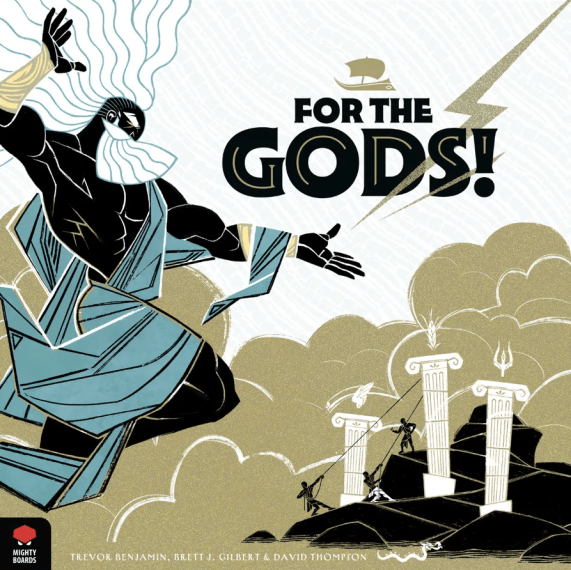
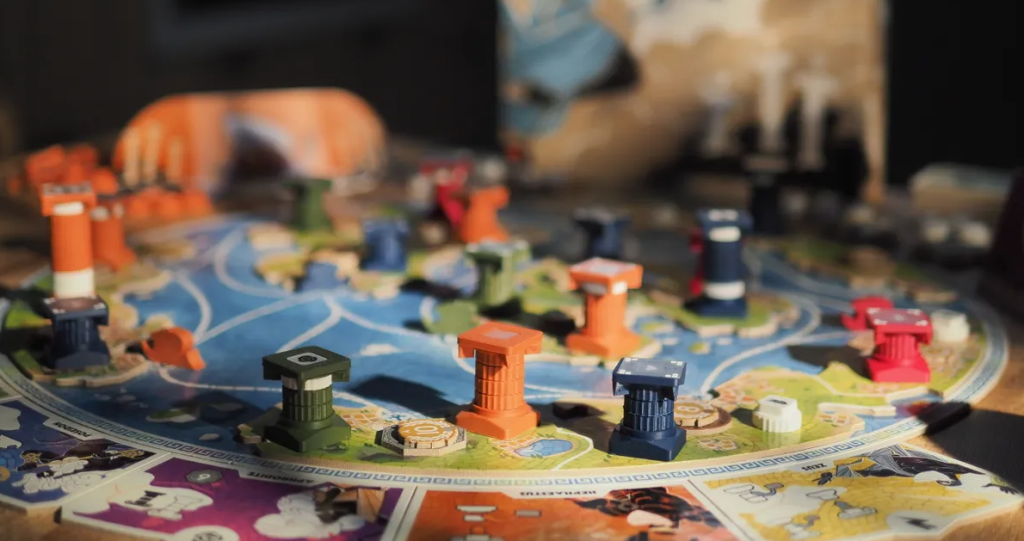
Watch out! Players are building monuments during this visually arresting game, For the Gods! The following pictures will feature For the Gods!’s prototype. I can only imagine what the final product will look like. Before I share my thoughts on this game, let’s hear from the publisher, Mighty Boards, and their description.
As a seafaring builder in ancient Greece, in For the Gods! you’ll navigate the archipelago, constructing towering monuments to the gods and vying for control of sacred islands.
For the Gods! is a tactical area majority game in which every stone shapes your path to victory. The rules are simple: Sail the seas to establish new temples or elevate existing ones. Along the way, collect God stones and unleash their divine powers at the right moment. With twelve unique God powers, each game offers fresh strategies and dynamic gameplay, ensuring high variability.
For the Gods! has table presence. I don’t know if players will be able to build the Greek islands. Look at the space where the columns stand. Those look like potential puzzle pieces. Yes! I’d play the heck out of For the Gods! for the column pieces alone. The God tiles, which offer unique abilities to players on their turns, curve to match For the Gods!’s interior board. You can’t walk past For the Gods! during a convention or a game night without doing a double-take. And publisher Mighty Boards has a strong history of delivering great games. I’m glad that the game is area majority as opposed to “dudes on the map.” I prefer area majority. And with the play area being this small, there should be some impressive battle for supremacy.
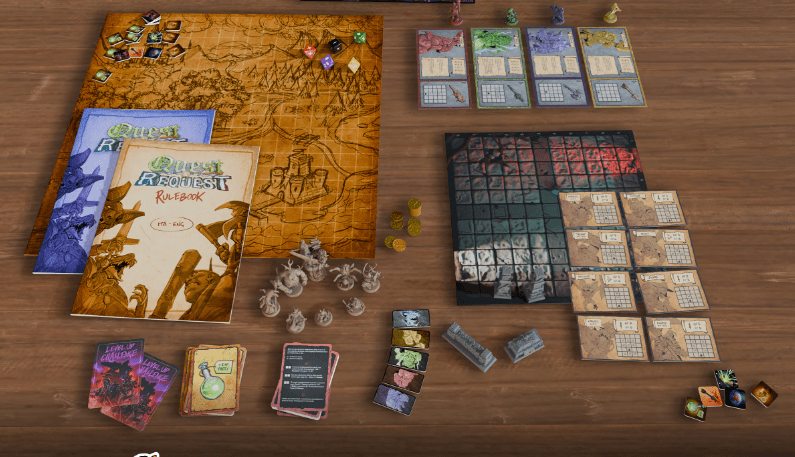
Quest & Request is an easy-to-learn dungeon crawler arena (learnable in 10 minutes) where gamers take the roles of anti-heroes. That’s right. Quest & Request goes dark. Players won’t be playing heroes. According to the publisher, they’ll be looting and killing a world full of innocent monsters, controlled by a benevolent wizard. A role reversal like this could be a hoot.
Unlike a lot of other dungeon crawler board games, set up appears to be quick in Quest & Request. I’m a little confused by the game’s description of a 4 v 1 Cooperative Game. That makes me wonder if Quest & Request can be played as a fully cooperative game or if one player can play as the wizard and monsters. Either way, I’m interested in any game of this type that has an easy setup and teardown. As of writing this post, we don’t have details on Quest & Request’s pledge levels, but if you’re interested in Quest & Request, check out its GameFound page.
Labyrinth: Chronicles Launches on GameFound
Once upon a time, there was a Labyrinth, a magical place full of wonders and mysteries. Adventurers who returned told unbelievable stories of its ever-changing walls and shifting corridors, a mind-boggling challenge indeed that only the bravest could tackle. But it was worth it, they say, as the dark nooks of the Labyrinth hide real treasures. The Labyrinth waits for you. Are you brave enough to enter?
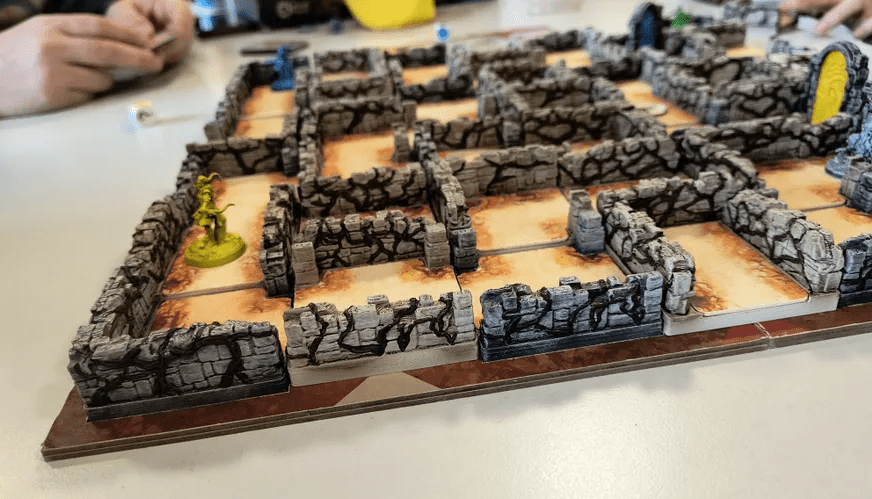
Labyrinth: Chronicles brings a new Co-op Campaign mode to one of the best-selling board games ever. Enter the mysterious Labyrinth, now with a stunning 3D board and graphic design from Awaken Realms, to gather the resources required to help a nearby faefolk village. But beware! Inside dwell grasping goblins who want to snatch valuables before you! As you progress, you will rebuild the damaged village, meet new friends, unlock new skills, and many more!
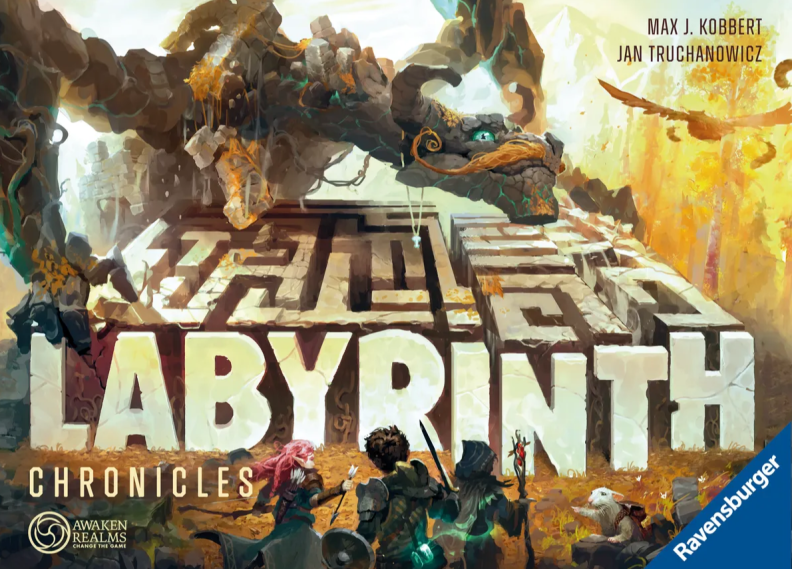
Yes! That was another great description by the publisher. I don’t know how Ravensburger and Awaken Realms managed to turn the classic tile-shifting game, Labyrinth (1986) into a cooperative narrative campaign. What? Labyrinth is one of those titles that I thought could never receive the campaign treatment, but Labyrinth: Chronicles appears to have done just that. And look at the board above. Again, the picture is of a prototype. I can’t imagine how insane the final product will look. But what else would one expect with an Awaken Realms release. They’re known for over-the-top productions.
As you can guess, Labyrinth: Chronicles will cost around $105. Higher price tags are another Awaken Realms hallmark. Even if Labyrinth: Chronicles was a prestige printing of the original Labyrinth, I’d still be interested. I always enjoyed the original. The fact that Labyrinth: Chronicles shakes up the original’s gameplay makes $100 not seem like that much money. If you’re interested in Labyrinth: Chronicles. If you’re interested in Labyrinth: Chronicles, check out its GameFound page.
Cloud War Tales: Nuvitrum Launches on GameFound
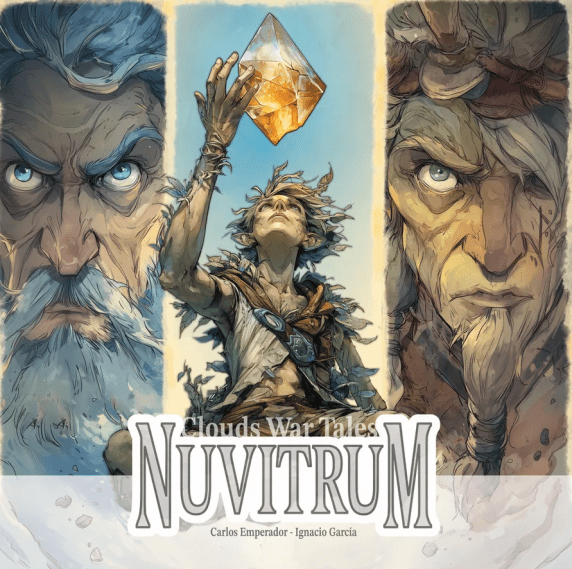
What lies beyond the clouds that shroud the peaks of Nuvitrum? What mysterious power does Croconium hold—an amber mineral hidden deep within the mountains?
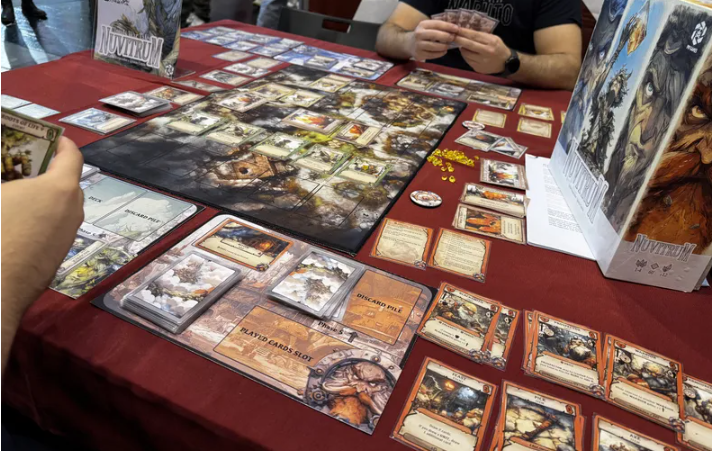
Explore the kingdom and develop your faction to uncover the truth. Nuvitrum is a tactical, asymmetrical deck-building game for 1 to 4 players, playable competitively, cooperatively, or even solo through a narrative campaign that reveals the world’s forgotten history.
Choose your faction, strengthen it, and engage in battle using unique mechanics. Excavate the mountain to unearth rare metals as a Deepdelver, master powerful spells as an Ambathean, or tame monstrous beasts as a Greenblood. Reveal your faction’s core to claim victory!
Alright! Deck-builders are always a fun time. Cloud War Tales: Nuvitrum adds player factions to the concept. Usually, players begin with small decks and choose how they will build those decks, but Nuvitrum starter decks look to have a unique flavor from the start. Throw in some interesting movement and combat, which looks like it may take a page from Summoner Wars, the ability to play Cloud War Tales: Nuvitrum competitively, cooperatively, or solo, and this could make for a versatile deck-builder with legs. As of writing this post, we don’t have pledge values, but if you’re interested in Cloud War Tales: Nuvitrum, check out its Gamefound page.
StarTrek: Voyager – Across the Unknown Releases
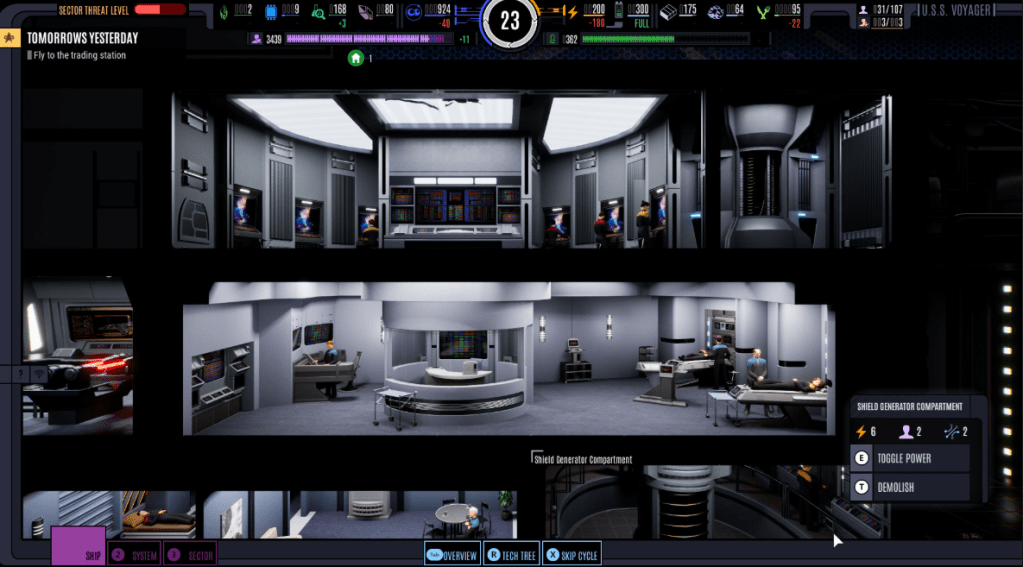
Don’t look now, but the Star Trek universe receives a major video game release. Last week, I mentioned how Rogue-Lites are having a moment. With the release of a Rogue-Lite, survival strategy video game based on Star Trek: Voyager, that trend continues. The player takes control of USS Voyager and manage the starship, including systems and resources, as well as the crew. Can you lead Voyager across 12 sectors of the Delta quadrant. Battle ship-to-ship. Send your away team on missions. And since Star Trek: Voyager – Across the Unknown contains narrative rogue-like elements, each playthrough varies.
Sure. Star Trek: Voyager may not be a Trekkie’s first choice for a Star Trek video game, but Star Trek: Voyager – Across the Unknown sounds amazing. As of writing this post, I have yet to play Star Trek: Voyager – Across the Unknown, but don’t be surprised if it makes a future Whatcha Playing, Geekly post. Star Trek: Voyager – Across the Unknown is available on PC, PlayStation 5, Xbox One, Xbox Series S/X, and Nintendo Switch 2.
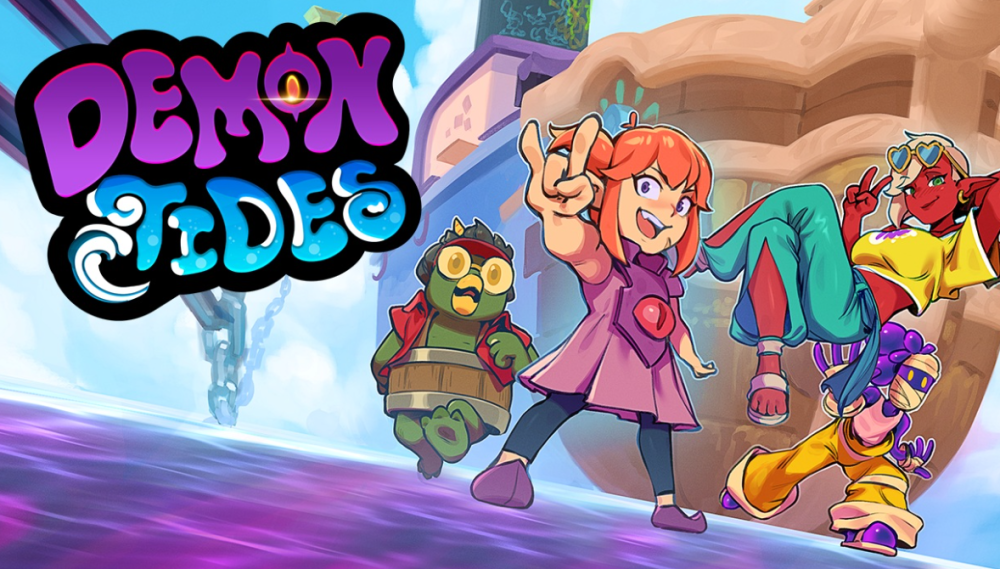
Demon Tides Releases on PC
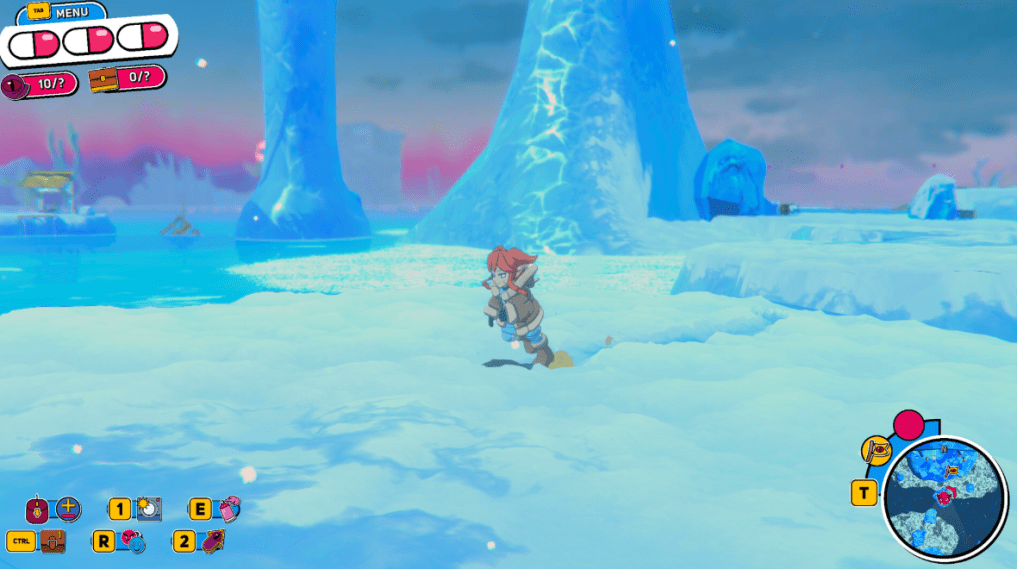
Race across open oceans and uncover a kingdom’s dark secrets. Expressively platform your way across dozens of locales, upgrading your gear and modifying your move-set every step of the way! The previous description comes from the publisher. While I don’t know what “expressively platform” means exactly, Demon Tides’ videos shows multiple ways your character can traverse Demon Tides’ world. 3D platformer games may play better on console–we could see a future Demon Tides console release–but the game looks interesting enough for me to give it a go. Can you even customize your character? You may. Talk about expressively platforming.
Early reviews for Demon Tides have been positive. The Gamer suggests that Demon Tides should be on every platformer fan’s radar. Check! I may even check out Demon Tides’ demo on Steam. Demon Tides is available on PC.
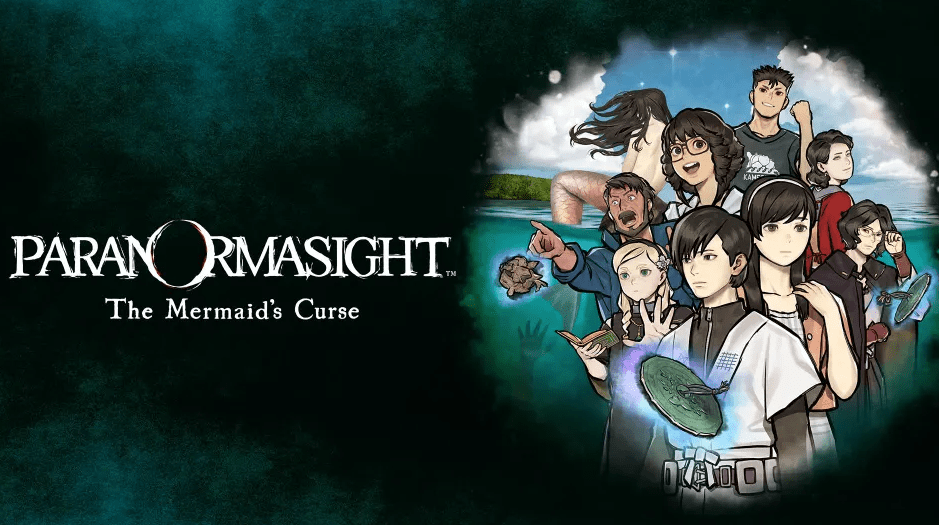
Paranormasight: The Mermaid’s Curse Releases
Usually, we don’t cover visual novels in our video game new releases, but we’re making a rare exception for Paranormasight: The Mermaid’s Curse. The Mermaid’s Curse is a direct sequel to the well-received Paranormasight: The Seven Mysteries of Honjo. Only, this time around, Paranormasight trades in the scares for some emotional depth.
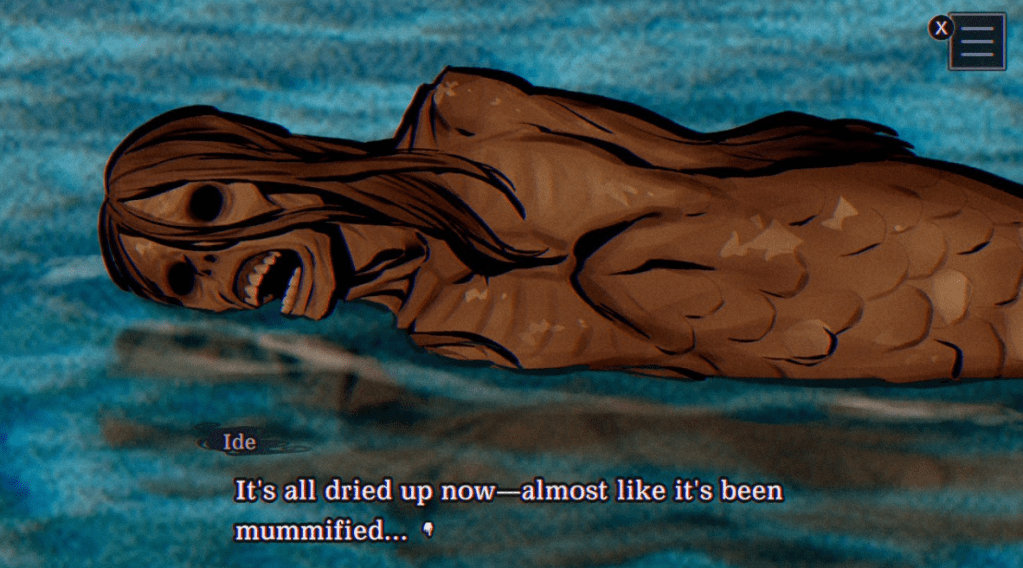
That doesn’t mean that Paranormasight: The Mermaid’s Curse isn’t without its share of horror. Season is our writer who usually plays visual novels, but I may make an exception for the Paranormasight franchise. I may have to go back and play the original, too. Paranormasight: The Mermaid’s Curse is available on PC and Nintendo Switch (yes, the original Switch).
Styx: Blades of Greed Releases
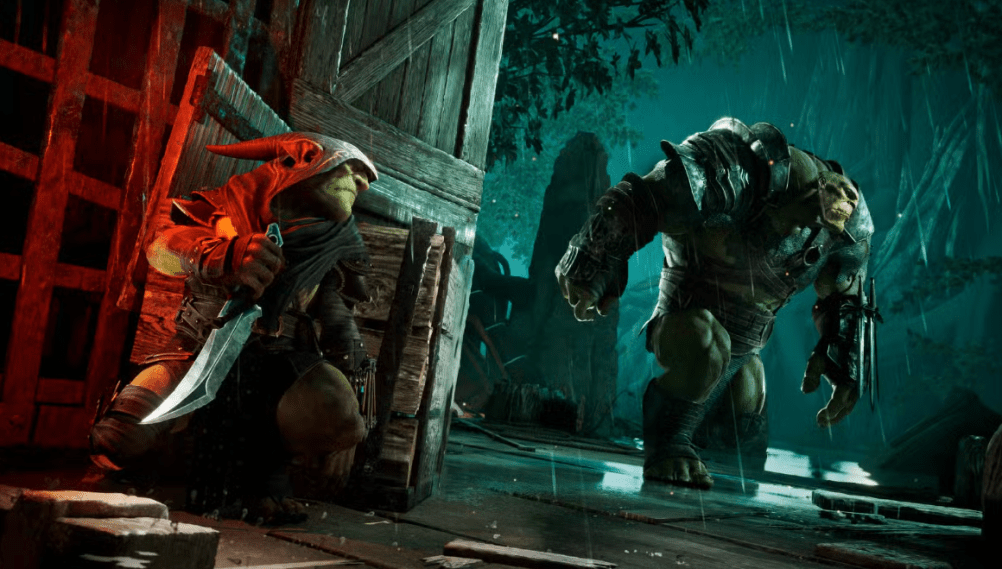
Styx returns for a third installment with Styx: Blades of Greed. I always liked the idea of playing as a goblin. Styx: Blades of Greed allows players to go full goblin mode. While the Styx series has had its ups and downs, it’s one of the better recent additions to the stealth video game genre.
Explore the dizzying heights of the Iserian Continent and cunningly eliminate your enemies. Thanks to your Quartz powers, you are freer than ever. Be creative. Never has it felt so good to be greedy. The wisecracking Styx is always fun to play. There just aren’t enough great stealth games to play. The Styx franchise is one of those great stealth games. Skye’s a huge fan of games like Hitman, so Styx: Blade of Greed might be a great alternative. Heck! I may enter goblin mode soon, too. Styx: Blades of Greed is available on PC, PlayStation 5, and Xbox Series S/X.
That’s all the geek news we have for this week. Thank you for reading, and wherever you are, I hope you’re having a great day.
Happy Friday, Geekly Gang! Kyra Kyle here with another writing brain dump. I haven’t done one of these in a few weeks, because I was trying out some writing exercises, seeing which ones stuck, and I may have found one. I’m still editing the novel based on the Rustbucket Riots. This novel is set years after the events of the Rustbucket Riots, the same ones mentioned in the board game of the same name, but I had written a series of short stories two years ago set during the game’s timeline. I haven’t touched these stories since then and decided to try something new. I noticed similarities in some of these short stories with Shakespearean plays. I’ve been rereading Shakespeare tragedies and comedies over the past month or two and figured I could combine steampunk robots and Shakespeare.
I’m having fun. I don’t know if anything will come of this project, but Robot Shakespeare is a hoot. And this exercise got me thinking of art as a whole. Or at least popular art (pop art). Forgive me for using a Venn diagram.
I found the above to be especially true in board game design. If you follow game design brain dumps, you may see this Venn diagram again. As the diagram illustrates, when elements within the art (in question) veer toward the familiar, they tend to be boring, and when elements venture too far toward the strange, one can find confusion. I’m trying to find the balance. The Rustbucket Riots game teeters toward being too strange. But I have another design, Wildflowers, that may play it too safe. But Spill the Beans (a third design) adds familiar elements while maintaining a fun twist. And that’s what I hope these Robot Shakespeare short stories will accomplish.
I can’t say what these short stories will yield, but I’m having fun. And who knows? I may find a story element or two to explore with the Rustbucket Riots novel.
What’re your thoughts on popular art and art in general? Let me know in the comments. Thank you for reading, and wherever you are, I hope you’re having a great day.





























 jkgeekly.com