Happy Friday, Geekly Gang! Kyra Kyle here with another writing brain dump. I’m still going through a mountain of edits with my own work, and I’ll share more of that in the coming months. The “Ber” season draws near. The “Ber” season refers to all months ending in “ber.” These are the months I pour more work into my fiction, poetry, and essays. Yes! I love this time of year. Can’t wait. Until then, I’ll leave you with some musings on writing hooks. By my count, each novel has two hooks: an external hook and an internal hook. We’ll discuss these two hooks and why I believe romance may be the best genre to read for crafting an internal hook.
The Two Types of Writing Hooks
Like I said, there are two types of writing hooks: an external and an internal hook. While external hooks are the ones that get readers through the door, internal hooks keep readers going. Let’s use Dungeon Crawler Carl as an example. Dungeon Crawler Carl’s external hook is “A dude in his skivvies and magic toe ring traverses an intergalactic dungeon with his talking cat who hurls magic missiles.” Cool! I love this hook by Matt Dinniman. I reached for this book at the store because of its bonkers premise. External hooks can vary wildly. These are the hooks that need to stand out and grab your readers. But I finished Dungeon Crawler Carl because of its internal hook: I cared about Carl and his talking wizard cat Princess Donut. While external hooks vary, typically, internal hooks revolve around the reader caring for a story’s characters. We need to feel a connection.
While writers should read the genre they intend to write, I believe every writer can benefit from reading romance novels/stories. I don’t know when I cared about Carl and Princess Donut. I gave Dungeon Crawler Carl (and I do the same for stories with great external hooks) more leeway because the book had more to share than “do I care about the characters.” For me, I tend to side with vulnerable characters. Since this is the case, I connected with Carl early on. Princess Donut gaining the ability to talk made her instantly likeable as well, but I’m a cat person. I was going to side with the cat whether she talked or not, but I will say that Princess Donut shined more as a character toward the end. She showed that she cared for Carl. She says as much. I’m sold. But I give romance novels/stories less time, and that’s because of the kinds of romantic hooks.
Why Writers Should Read Romance
Often, a romance novel/story internal hook and external hook are the same. If they aren’t, a romance novel’s external hook doesn’t tend to be as thick as other genres. This makes pinpointing the moment you care about the characters easier to do. I might give Dungeon Crawler Carl a good twenty to thirty pages for its characters to grow on me. I’m not as generous with romance novels/stories. If the main thing is the relationship between two characters, I need to care for these characters as soon as possible. Because of this, I may never write romance. I’m too scared. Every writer swims. Romance writers swim with fewer garments. Eek!
But this makes romance novels/stories easier to read for the craft of writing. I should be able to see how and why a romance writer gets me to care about their characters. Or how and why they fail to do so. I don’t read a ton of romance. If you don’t intend to write romance, I don’t suggest reading a lot of romance either. But if you’re struggling with getting your readers to care about your characters, sprinkle in some romance to your to-be-read pile. Typically, every seventh or eighth book I read is a romance or has strong romantic elements. Reading romance novels can help writers find their internal hooks. These are the hooks that make your reader finish your novel. External hooks are only half the battle.
And I figured I’d mention romance novels and internal hooks this month because I’ve been meeting up with my various writing groups again. After all, Ber Season is right around the corner. Many of my fellow writers–at least the writers in my writing groups–look down at romance. Sure, romance has been a top three genre for most of the past fifty years. It’s a popular genre. Perhaps the most popular genre for about half a century, but that doesn’t mean one should discount popular books.
Perhaps it’s the fact that romance novels/stories put their internal hooks (make the reader care about the characters) near the surface that makes them popular. My internal hook theory is one possibility. There could be plenty more, like the promise of a happy ending. Writers delivering on a promise (with the readers) can be powerful. One shouldn’t deride romance because it’s popular. Since romance is so popular, one should study how and why it has popularity.
That’s my writing brain dump for this month. I should have more progress to report next month (Septem”ber”). Woot! Thank you for reading, and wherever you are, I hope you’re having a great day.
Happy Friday, Geekly Gang! Kyra Kyle here with another writing brain dump. I didn’t do one last week because July has five Fridays. I had to skip the 17th or the 24th. I decided to skip the 17th because of familial obligations. Anyway. What have I been doing this past month with my writing practice? In short, I’ve been honing the novel based on Rustbucket Riots.
The novel still doesn’t have a name. I’m getting there. Rustbucket Riots is a working title; the events of the novel take place well after the Rustbucket Riots, so the name can’t possibly work. I’ve used the robot Shakespeare short stories to flesh out the world. The Shakesbot stories do take place during the Rustbucket Riots, by the way. Working on this project also gave me a little bit of distance. It’s not the same as a sequel; I don’t even know if I’ll seek publication for these short stories. But I was able to find the shape I wanted the novel to take. I’m going with multiple timelines.
In last month’s writing brain dump, I mentioned ten shapes a story can take. I’m linking that post here. The more I worked on the Rustbucket Riots novel, the more I felt the story needed a time jump, similar to the one found in Freida McFadden’s The Housemaid. I may need to reread The Housemaid. That novel has its issues, but I can’t deny McFadden deftly used the multiple timelines form. Sometimes, writing requires reading. So, I’ll attempt to read McFadden’s The Housemaid as a writer, taking note of how the two timelines build off of each other. The Rustbucket Riots novel sees a severe change between the protagonist and antagonist. I’m hoping the multiple timelines work to show the difference in these segments. We’ll see.
I don’t have much for this month’s writing brain dump. Last month’s writing brain dump was rather long. And I’m in the thick of rewriting. Fingers crossed that something useful comes out of this draft. Thank you for reading. Good luck with your writing, and wherever you are, I hope you’re having a great day.
Happy Friday, Geekly Gang! Kyra Kyle here with another writing brain dump. Last month, I talked about how I journal. I’ve continued with that journaling method, and it’s helped me get back into writing. Today, I wanted to discuss a story’s shape. I’ve always been interested in the shapes stories can take. Yay! Are you ready to geek out with me about story structure?
Fabula versus Shuzhet
I’m going to borrow a couple of terms from Russian playwriting: fabula and shuzhet. Russians contributed a lot to theater, most notably Konstantin Stanislavski, who recontextualized acting, but the Moscow Art Theatre also had plenty of groundbreaking playwrights who explored the shape of stories. Russian writers like Anton Chekov loved structure. Remember Chekov’s Gun? Anyway, the Russian story shape concept revolves around how the fabula (chronology of events) interacts with the shuzhet (how the writer or playwright arranges the events). In other words, the fabula is the timeline, and the shuzhet is how the writer presents that timeline. I’ll muddy the water even more by saying the fabula could also be viewed as phases divorced from time. What?
Don’t worry. I’m sharing pictures/graphs and will bring up a few examples where the fabula doesn’t fall neatly into time or the chronology of events. These examples will largely be in movie form because the fabula/shuzhet pairing came from the Moscow Art Theatre. But we can still apply these concepts to any writing. Let’s begin with our first narrative structure: three acts.
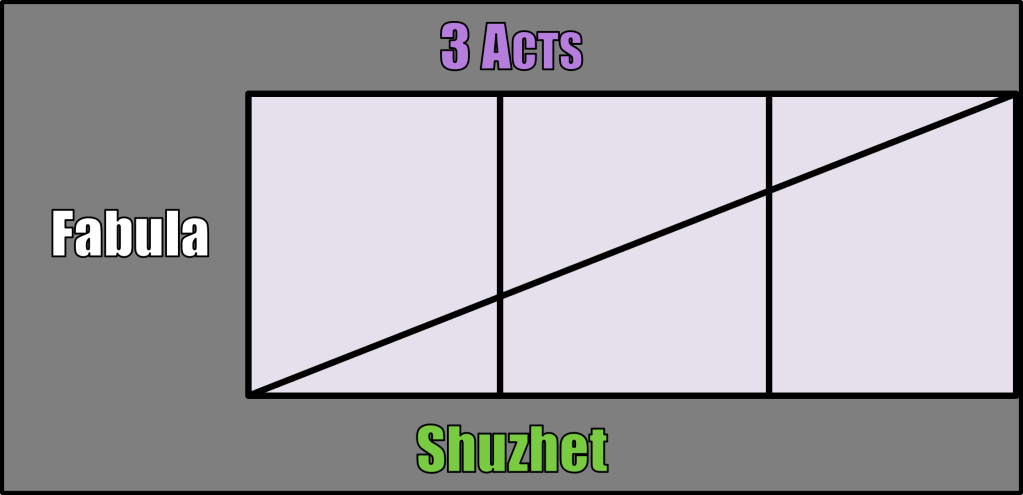
Three Acts
We begin with the easiest story structure to explain, the three-act play. This method is ubiquitous. Most of us have heard of the first act (Setup), the second act (Complication), and the third act (Crisis or Climax) that leads to the denouement (or falling action). Yeah, what’s pictured above doesn’t do the three acts justice. I only included this as a visual representation of what’s happening chronologically (fabula) versus the shuzhet. As you can see, pretty straight-forward.
Stories that use Three Acts:
Die Hard Jaws Raiders of the Lost Ark
All three stories above have well-defined setups, complications, and climaxes. The three-act system is easy to follow. There’s a reason why so many writers choose this story shape. In Die Hard, we receive John McClaine’s backstory in short order (he’s estranged from his wife, and he wants to reconcile). This happens quickly because Die Hard is an action film. The complication occurs when German radical Hans Gruber and his armed team overtake Nakatomi Plaza. The climax takes place near the beginning of the third act before the story ties up loose ends.
Single, Uninterrupted Stream
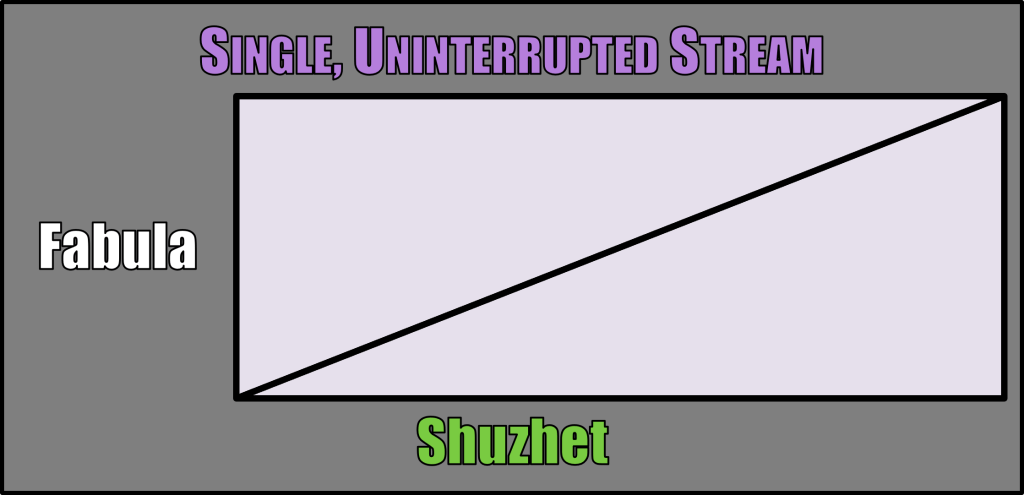
As you can see with the image above, a single, uninterrupted stream behaves similarly to three acts. The big difference is that the scene is uninterrupted. While three acts can edit out any fluff or lulls in the action, a single, uninterrupted stream will not jump any moments.
Stories that use a Single, Uninterrupted Stream:
High Noon 12 Angry Men Before Sunset
I was going to break down High Noon or 12 Angry Men. Both are excellent. Both occur during real time. But I’ll switch gears with a sitcom, my favorite Friends episode, “The One Where No One’s Ready.” You’ll see that this episode also uses a three-act structure, but it occurs in real-time. We get the setup with Ross’s event, and no one else is ready. Complications arise, like Phoebe’s dress getting the hummus. Finally, our climax occurs when, after Ross yelled at her, Rachel refuses to go unless he drinks the fat. Three acts are tidy. They even work on a twenty-minute episode. This episode also happens to occur in real-time without breaks.
Multiple Timeline
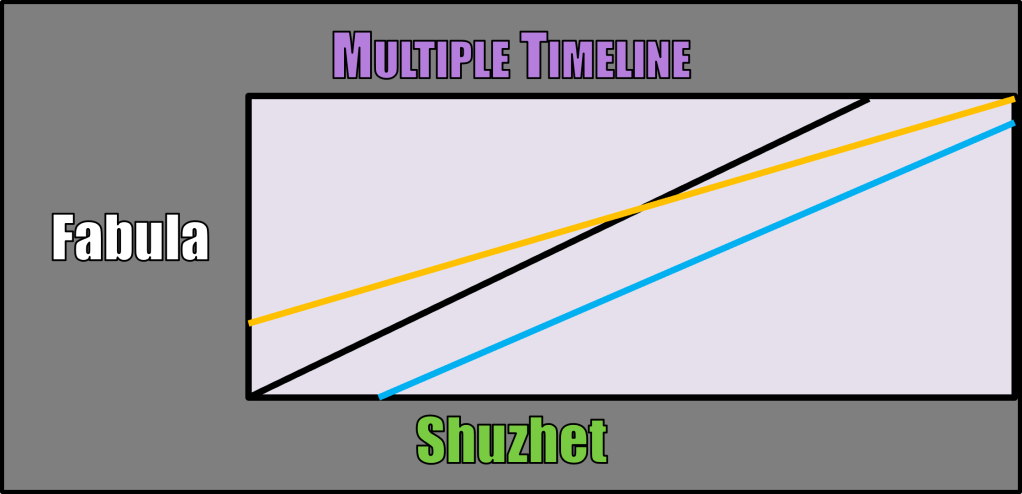
Here’s where things get interesting (from a charting perspective, that is). Multiple timelines do what they suggest. The reader or viewer follows multiple timelines, presumably different characters, but not always. I love what N.K. Jemison did in The Fifth Season, which is a good example of multiple timelines within a novel. The reader follows three timelines of the same main character during different phases of her life. Brilliant! And with this example, you can see how the definition of the fabula or even the shuzhet can shift. There’s always room for a writer to play.
Stories that use a Multiple Timeline Structure:
The Godfather, Part II The Fountain Cloud Atlas
The Godfather, Part II contrasts the lives of Michael (son) and Vito (father) Corleone. We’re introduced to Michael Corleone and wonder how he could become this much of a monster. Watching Vito’s early life unfold informs us of Michael’s past and present. So good. There’s a reason The Godfather, Part II is a classic. It also provides an important question. Ask yourself if the multiple timelines build on one another. If they do, you’re good to go. If not, figure out a way for the timelines to build on one another.
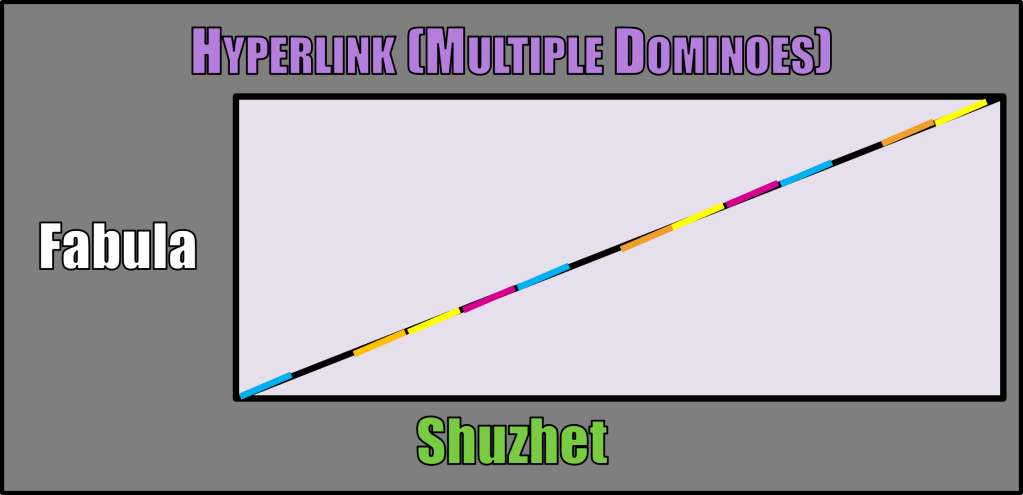
Hyperlink (Multiple Dominoes)
I struggled with how to visually represent the hyperlink story shape. The image above doesn’t quite do it justice. With a hyperlink story, the narrative doesn’t need to progress in a linear fashion. You can expect swirls. Perhaps the term multiple dominoes works better. One domino falls against another, causing a chain reaction. You’ll need to connect the dots for this one, but when it happens, something magical can happen.
Stories that use a Hyperlink Structure:
Ajami Magnolia Under the Skin
It’s been a while since I’ve seen any of the movies I used as an example. I’ll try to recall Ajami as best I can. Ajami was written and directed by Scandar Copti and Yaron Shani. As Palestinian and Jewish people, the two used their lived experiences to explore the animosity between these two groups in Ajami. One act of violence from one group leads to another act of violence by the other. The cycle continues like dominoes until neither side remembers what caused the conflict. I may need to rewatch Ajami. I love its message.
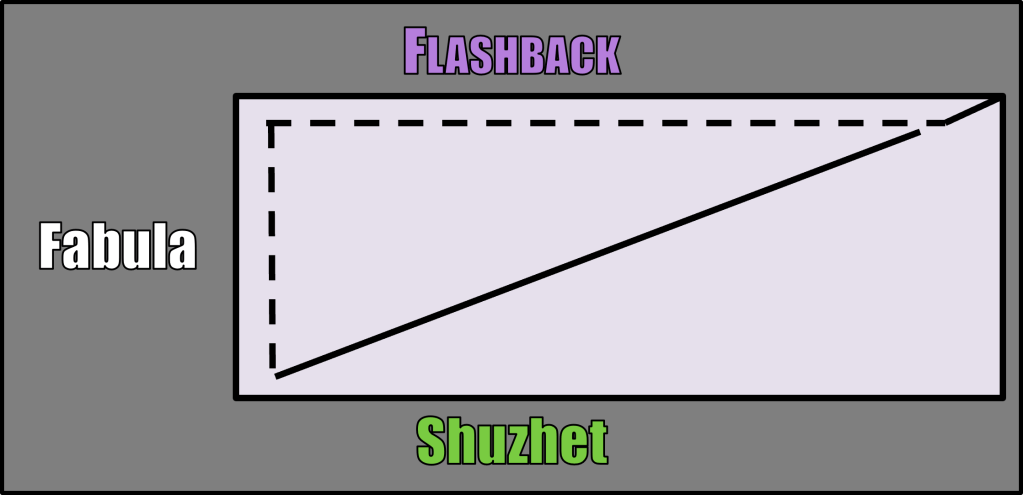
Flashback
Uh oh. These story shapes can be tricky. I’m unsure of what I was trying to do with the image above. It gets better. I swear. Flashback stories start near the end and send us back in time toward the beginning. The story will then progress as usual. While the graphic may make flashback stories look complicated, plenty of stories use them. Like the ones below.
Stories that use a Flashback Structure:
Citizen Kane Fight Club Forest Gump
I’ll stick with another classic, Citizen Kane, for this example. Famously, Citizen Kane begins with the title character’s death. That would be toward the end of a story. Then, we go back in time, watching Kane’s life unfold. We already know what will become of Kane. We watch to understand why.
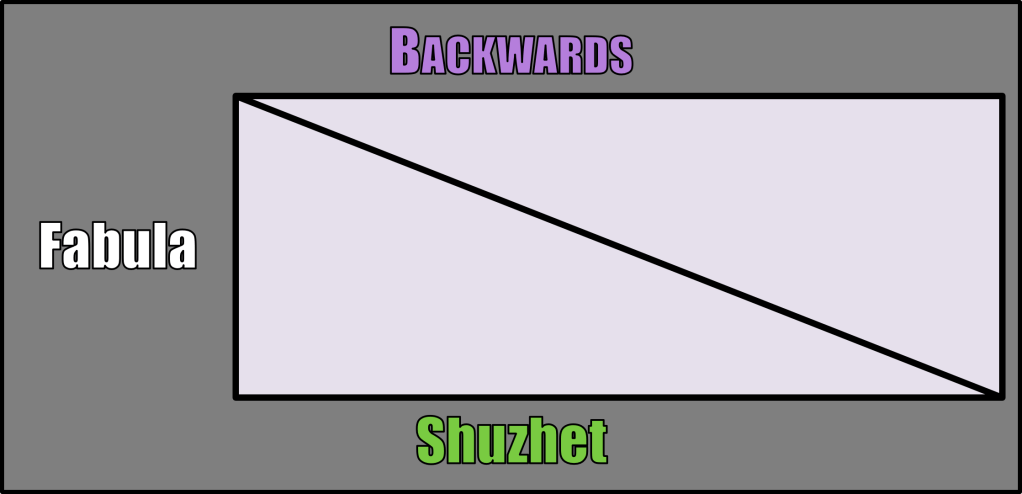
Backwards
This one was easier to represent. Backwards tells its story in reverse. The concept is simple; execution is not simple. You almost need to write the story forward first and then rearrange it so that it’s told in reverse. And if you’re going to do that, you’ll need a compelling reason to do so. Fortunately, we have plenty of stories that do just that.
Stories that use a Backwards Structure:
Irreversible Memento Eternal Sunshine of a Spotless Mind
All three of these stories have some narrative reason why the story would be told backwards. The main character in Memento has short-term memory loss. Eternal Sunshine of a Spotless Mind is a sci-fi movie where people can erase their memories, beginning with the latest. Again, a great reason for telling a story backwards, but I’m going to focus on Irreversible. This French film is difficult to get through.
Trigger and Spoiler Warning: It deals with rape. There will be a scene where you may need to turn away. Irreversible shows a couple on a rampage, and the audience wonders why, only to reveal the couple’s loved one was raped. Before that reveal at the end, the audience questions why anyone would do what the couple we follow does. By the end, you’ll question why they didn’t take it further.
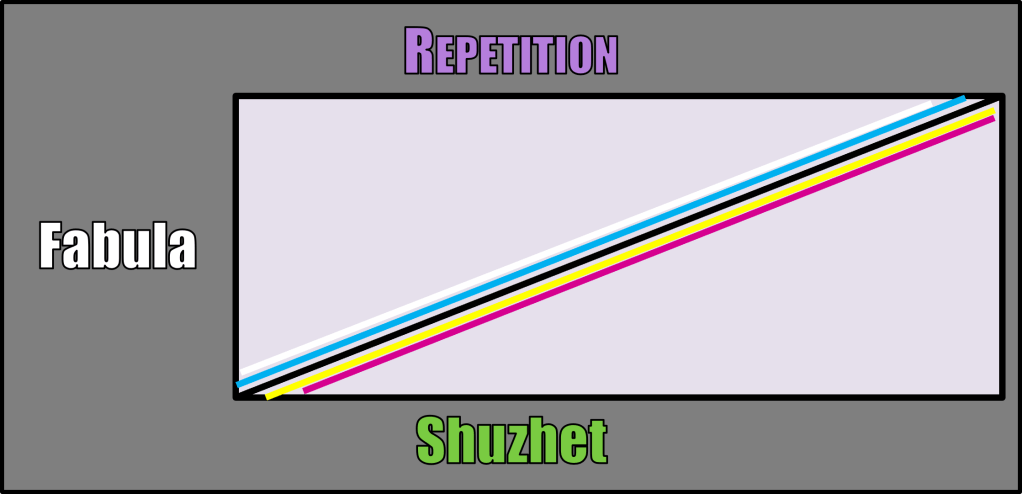
Repetition
Repetition is a powerful tool. Repetition is a powerful tool. Be honest, you read those two lines differently. JK
Repetition more or less repeats the same story or story elements more than once. It can and has been used to remarkable effect. Don’t knock repetition until you try it. If you don’t believe me, check out the following stories that use repetition.
Stories that use Repetition:
Rashomon Mr. Nobody JFK
Akira Kurosawa, the Japanese grand master of film himself, used repetition in his classic Rashomon. The audience receives several stories as to how a samurai died. Each storyteller in Rashomon has their own spin. Any of these stories could be true. Any of them could contain elements of truth. They all could be crap. Ultimately, which story you choose to believe or don’t believe says a lot about you.
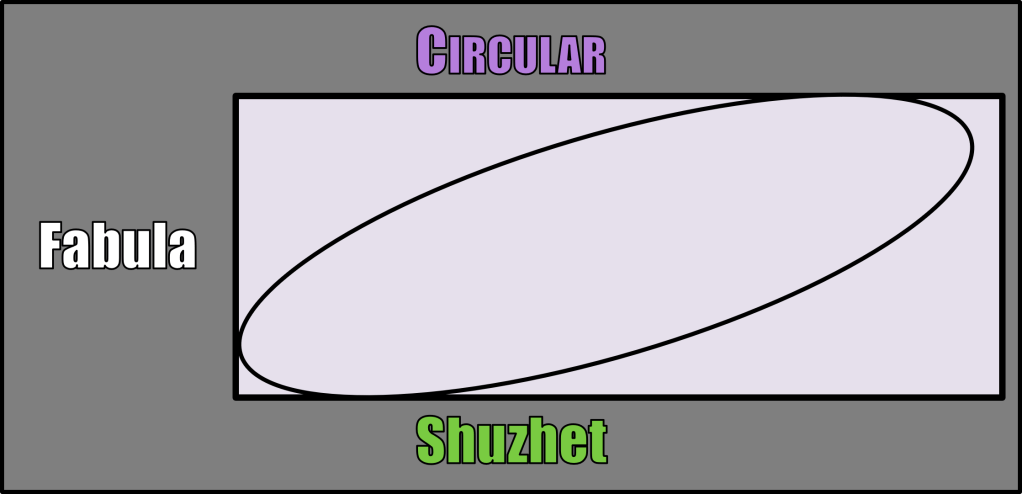
Circular
We’ve gone full circle. I’m sure most of you have your “insert favorite time loop story here” as an example of a story using a circular structure. Sure, time loop stories do use a circular structure, but a time loop isn’t a prerequisite for this type of story.
Stories that use a Circular Structure:
Before the Rain 12 Monkeys Inside Llewyn Davis
Of course, I’m going to use a non-time loop story as my example here. The Serbian film Before the Rain centers on a pair of childhood friends. At first, they’re just friends. When they hit puberty, they become each other’s first lover. War descends, and it drives the pair from their home. After the war, the two became a romantic couple, despite one of them being married. Eventually, the pair discovers they should be just friends. Before the Rain uses the couple’s relationship as the loop, refraining from inventing time travel.
It’s okay if you want to include time travel, but the circular structure does allow for other avenues.
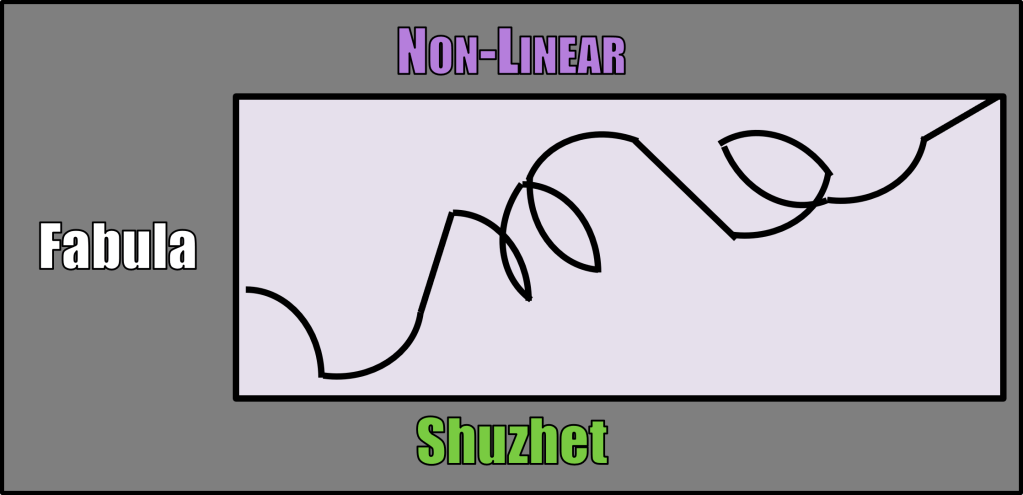
Non-Linear
Non-linear stories go back and forth in time, so you’ll see the fabula doing all sorts of crazy movements. Plenty of stories use non-linear storytelling to great avail. I like thinking of the non-linear structure as the structure for trauma. One thing can trigger another. Soon, you’re experiencing everything all at once.
Stories that use a Non-Linear Structure:
The Sweet Hereafter Pulp Fiction Slaughterhouse-Five
I love all the stories above, but let’s focus on The Sweet Hereafter. The story is about a school bus that careens off an icy bridge. Half the children on the bus survive. The other half don’t. The Sweet Hereafter explores the survivor’s guilt the living children have. Why did they live while their friend across from them died? I’m getting choked up thinking about it. If you do decide to read or watch The Sweet Hereafter, make sure you have tissues ready.
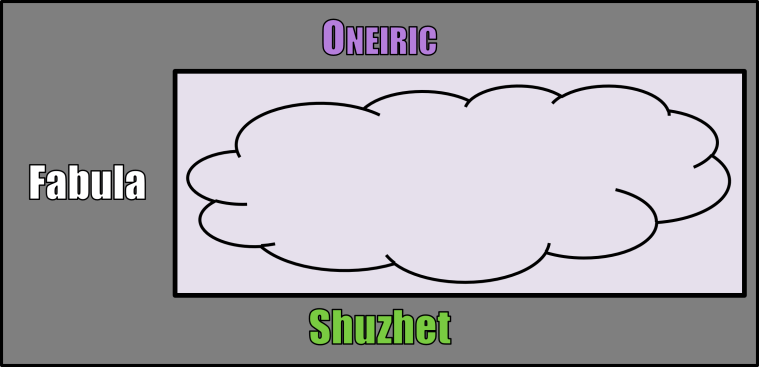
Oneiric
I don’t know how to express oneiric through a chart, so I stuck a cloud in the box. Oneiric pertains to dreams. So, the oneiric structure is one of dreams. Strange, non-sequiturs occur. The dream’s logic may make little sense in the real world, but that doesn’t mean that it doesn’t have its own interior logic. The trick is finding logic in the illogical.
Stories that use an Oneiric Structure:
Mirror Enter the Void Tree of Life
The Adventures of Alice in Wonderland is easily the most famous story that uses an oneiric structure, but I decided to go in a different direction. We started with Russian writers and playwrights, and we’ll end with one. Andrei Tarkovsky’s 1975 film Mirror (or Zerkalo) pushed countless boundaries. Semi-autobiographical (and based on Tarkovsky’s father), Mirror follows a poet nearing death. His memories pop in and out like dreams. The titular mirror doesn’t show what it should. Rain falls inside a house with no obvious hole in the roof. Mirror is one of those films you can watch hundreds of times, never quite know what Tarkovsky meant with some of his imagery, and come away with discovering something new.
Side note: I love a mirror as an object in a poem or story. The possibilities are endless.
And those are ten story structures or shapes. Wow! That was long. If you’ve made it this far, you’re awesome. We all know it. Let me know in the comments if I missed a story structure or another ten. I’m certain I did. Thank you for reading, and wherever you are, I hope you’re having a great day.
Hey, hey, Geekly Gang! Kyra Kyle here. I haven’t written a writing brain dump in a while, because frankly, I haven’t been writing as much fiction over the past month to a month and a half. I’ve been writing plenty for JK Geekly and board game rulebooks, but fiction writing has taken a backseat for a hot minute. And that makes sense for me. Typically, I end my year with writing a ton in the Ber season, the months ending in B-E-R. We’re a lot closer to that season than I originally thought. Anyway, I’ve been getting back into the swing of things by journaling.
Yes! I’ll be sharing a quick journaling method that gets me observing the world around me, and observing the world is necessary for writing fiction, poetry, and creative non-fiction. This journaling method is easy to maintain. It helped me break out of my slump, and it may help you break out of a writing slump.
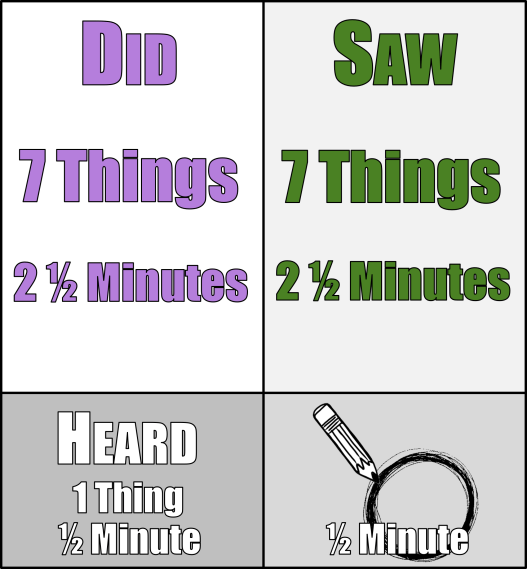
The following is a diagram of a journal page. We’ll discuss it at length in just a minute.
First, I split my journal pages into four unequal parts. The top two sections will be larger than the bottom two. Second, I start with the things I accomplished during the day. What I did during the day always occupies the top left section of my journal page. This grounds me with which day I’m discussing and reminds me that I do plenty of things throughout the day. I spend no more than two and a half minutes on this section. Timing is key.
If you added all four sections together, you’d arrive at six minutes. All it takes is six minutes for this journaling style. Most people have six minutes to spend. Six minutes with a defined format like this makes journaling easy. This helps me relax at the end of the day. When I journal (end of the day) is another reason why I start my journaling with seven things I did. This gives me visual confirmation that I accomplished things and may go to sleep.
Third, I’ll usually write seven things I saw. This also takes two and a half minutes. But here’s where I can shuffle the journaling format a touch. Sure, most days I list what I’ve seen, but sight isn’t the only sense. Some days, when I’m feeling up for it, I’ll list seven things I smelled, tasted, or heard. This section and the next one allow me to describe sensory details. Sensory details are a must for most writing, and most writers use sight as a crutch.
Fourth, I’ll spend half a minute writing about something I heard. Ah! Found dialogue. You won’t believe the fun and inventive turns of phrase I’ll hear. And I’m totally stealing these tidbits of dialogue for a story. Again, I can shake up this section with a different sensory detail. Because this section is so small, I started choosing different sensory details here first, before changing up what I saw.
And finally, I doodle for half a minute. I’m no artist, but I do my best. This is a way to spark creative juices by channeling a different medium. And it’s fun. The doodle can be something related to one of your other sections, or it could be a random doodle. Who cares? You’re the only one reading this journal. Okay. Mrs. Geekly sneaks a peek at my journal when I’m not looking, but I promise your doodles will improve.
That’s all I have for today’s writing brain dump. How do you journal? I’m open to more ideas. Thank you for reading, and wherever you are, I hope you’re having a great day. Happy writing!
Hey, hey, Geekly Gang! Kyra Kyle here. Has it really been about a month since the last Writing Brain Dump? Wow! Time flies. If you follow the board game design brain dump series, today’s topic will sound familiar. I tailored the design post toward board game design, so today’s brain dump will focus on writing. And we’re talking about the writing spectrum.
Most things in life can be expressed through a spectrum. Some people feel most comfortable on one extreme side of the spectrum, while others prefer the other. And then there are the ones like me who live somewhere in between the two extremes. In writing, those extremes are Plotters (or Planners) and Pantsers. Planners (or Plotters) create outlines for their plots and write their stories based on that outline. This may be the way most of us learned how to write. I remember my teachers preaching the importance of outlines. Several famous writers swear by plotting, and some refuse to conform. Rebels. Rebels, I say. You can’t tell them to make an outline. These are your Pantsers, nicknamed from the idiom, flying by the seat of one’s pants. And plenty of writers swear by pantsing.
Both sides make compelling arguments. JK Rowling, a famous Plotter, once suggested that without an outline, one will get lost. You wouldn’t go on a road trip without a map. That makes sense. But Stephen King, a famous Panster, once said never to outline. If you, as the writer, can’t be surprised by your work, you can’t expect your reader to be surprised. This also makes a lot of sense. So, who’s right? Both sides believe their method to be the best. Seriously, there’s a reason I made the above graphic look like a political divide. The writing divide can be just as contentious. Would it bug you if I said neither side is right? Or that both of them are right, given the proper circumstances? You can’t take me off this fence.
But context matters. A novel with numerous intricate plotlines may yearn for an outline. The writer could easily get lost. And pantsing one’s way through a story could help with suspense. Is it a coincidence that Stephen King mentions surprise in his reasoning for pantsing? Horror requires surprise. Of course, the Master of Horror would pants. Rowling’s Harry Potter series began with a school year structure. An outline for that series makes sense because she had to keep to that strict form. Until the final couple of books, where Rowling aged up the characters (to match the aging audience) and ditched the school year structure entirely with The Deathly Hollows. But enough about King and Rowling. Where a writer falls on the writing spectrum depends on the writer.
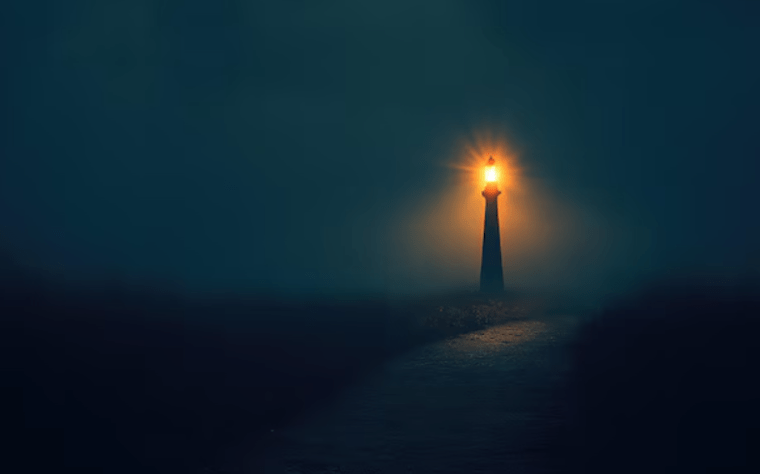
I’ve tried both of these methods. They work for various projects, like the ones I mentioned for the two famous authors. I’ve spelled out why an author may choose one extreme over the other. Pantsing adds surprise (might be good for Horror and Suspense). Plotting provides structure (great for books that follow a rigid structure). But there are two other main ways a writer can write their books/stories: Lighthousing and Blotting. I told you I live in the middle.
Typically, when I Lighthouse, I know what my initial scene will be, and I have a scene I know the story will progress toward, my Lighthouse Scene. This gives an author guide rails (sounds a little like Plotting), but allows the author to meander on their way toward the Lighthouse Scene (giving the flexibility of Pantsing). I love this method. It helps when I have a good idea of where I want to begin, and when I have a scene I’m dying to write. I’ve done this a lot with short stories. The exception for a short story is that you won’t have as many Lighthouse Scenes. You may even have one Lighthouse. If that’s the case, you may drift a little while before finding the point in the story where you’ll need to make your way to the end.
Lighthousing works best for stories where you have a good idea of how they’ll end (or perhaps a great penultimate scene), but you want some freedom to explore. But Lighthousing can get tricky. I’d begin with short stories first. Not enough writers start with short stories; short stories are a great way to explore one’s craft. Oh. I guess this is less of a writing brain dump and more of a craft talk. Whoops!
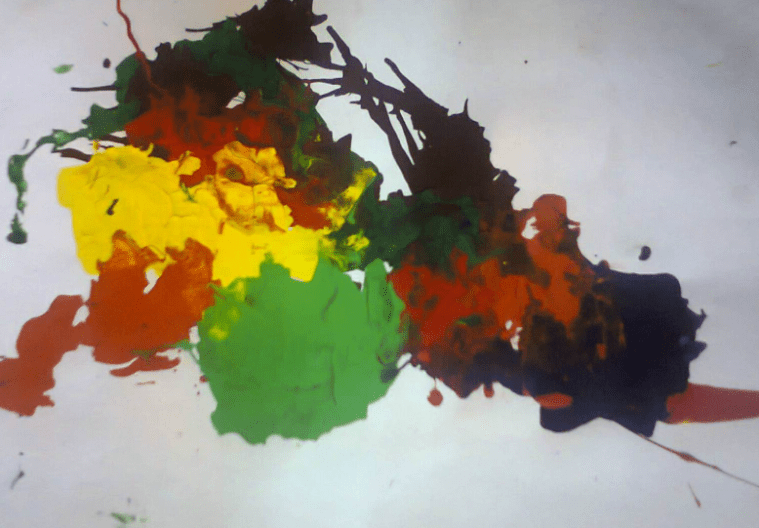
Blotting is the other main way writers can craft their stories, outside of plotting and pantsing. I always view Blotting like I’m a painter with an empty canvas. I have a sopping wet paintbrush in my hand, and I’m slinging the brush on the canvas with something I know I want in my story. This can be an element. This could be multiple scenes. The great thing about Blotting is that you can write the scenes in your story in any order, and then write the rest of the scenes that go in between those scenes. In other words, you can write the cool scenes you want to see in your story, and see what parts of the story remain.
Blotting works really well for non-linear storytelling, but that doesn’t mean it can’t work for a linear one. I blot a lot more when I write longer works. It helps me gain momentum, and writers need momentum for longer works. Get there faster.
So, which method is best? None. All. It depends on the writer and the project. Seriously, I’ve tried all of these; I’ve even used all four of these methods in a single calendar year. And just because you pants or lighthouse or blot, doesn’t mean you can’t reverse outline your book. Reverse outlining is when you take what you’ve written and retroactively place it into an outline. While Plotters could benefit from reverse outlining (you never know if you deviated from your original outline), reverse outlining is a godsend for a Panster, Lighthouser, or Blotter. If a scene doesn’t work in your overall story, why bother line editing that scene? Time is precious. Save as much time as you can.
How do you like to write? Do you have a fifth, sixth, or seventh method of getting your story on the page? Let me know in the comments. Thank you for reading, and wherever you are, I hope you’re having a great day.
Happy Friday, Geekly Gang! Kyra Kyle here with another writing brain dump. I haven’t done one of these in a few weeks, because I was trying out some writing exercises, seeing which ones stuck, and I may have found one. I’m still editing the novel based on the Rustbucket Riots. This novel is set years after the events of the Rustbucket Riots, the same ones mentioned in the board game of the same name, but I had written a series of short stories two years ago set during the game’s timeline. I haven’t touched these stories since then and decided to try something new. I noticed similarities in some of these short stories with Shakespearean plays. I’ve been rereading Shakespeare tragedies and comedies over the past month or two and figured I could combine steampunk robots and Shakespeare.
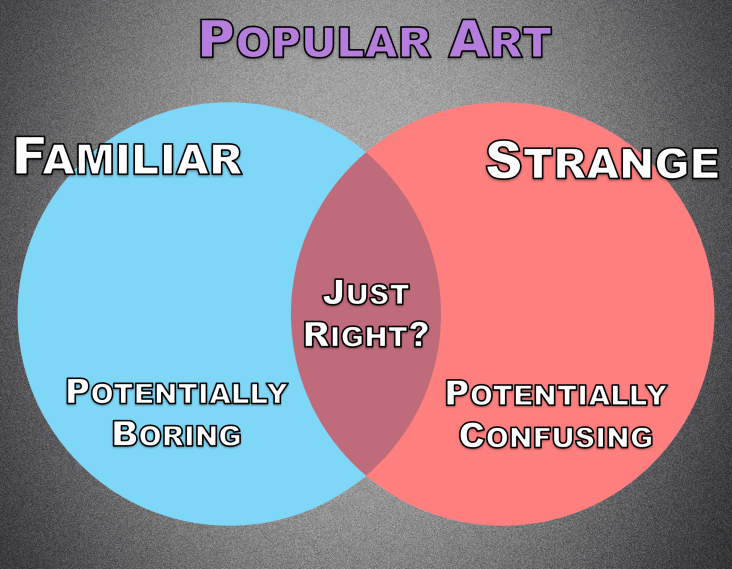
I’m having fun. I don’t know if anything will come of this project, but Robot Shakespeare is a hoot. And this exercise got me thinking of art as a whole. Or at least popular art (pop art). Forgive me for using a Venn diagram.
I found the above to be especially true in board game design. If you follow game design brain dumps, you may see this Venn diagram again. As the diagram illustrates, when elements within the art (in question) veer toward the familiar, they tend to be boring, and when elements venture too far toward the strange, one can find confusion. I’m trying to find the balance. The Rustbucket Riots game teeters toward being too strange. But I have another design, Wildflowers, that may play it too safe. But Spill the Beans (a third design) adds familiar elements while maintaining a fun twist. And that’s what I hope these Robot Shakespeare short stories will accomplish.
I can’t say what these short stories will yield, but I’m having fun. And who knows? I may find a story element or two to explore with the Rustbucket Riots novel.
What’re your thoughts on popular art and art in general? Let me know in the comments. Thank you for reading, and wherever you are, I hope you’re having a great day.
Happy Friday, Geekly Gang! Kyra Kyle here with another writing brain dump. I’m in the middle of editing my most recent completed novel (based within the Rustbucket Riots board game universe) and had an epiphany. The specifics of the epiphany don’t matter much–two of the main characters are related for the curious folks out there–but how I came to this realization serves as a good reminder that writing ideas can come from anywhere. And you may need to step away from yourself. When the idea struck, I wasn’t at my desk writing. I didn’t have a pad of paper and a pencil at the ready. I was grocery shopping.
Since I’m a veteran, I shop at the local military base’s commissary. The commissary still employs baggers who will carry out your groceries to your car, and on this faithful day, I had a bagger whose past aligned with mine to some extent and even more so with my protagonist. My bagger was half Native American, but you wouldn’t know it by looking at him. He and his brother looked and acted nothing alike. And I have some experience with both of those aspects. It makes sense to adopt some of those elements for my protagonist. Heck. Some of those elements already existed. I just had to give them a sibling. I don’t want to get into too many details. I’m unsure if someone reading this may try and track down my bagger. But talking to others can help with your writing.
By no means am I a social butterfly. I’m happy to spend most hours of many of my days at my desk. I think most writers operate well in isolation, but when you’re stuck with a story/character/scene, stepping outside yourself can help. I may not talk that much when I’m in public, but I love to listen. You’ll never know which found stories (stories a writer finds while in the world) you’ll discover.
The next time I see “Name Redacted,” I may let him know that he helped me with a story. Or I may just listen. Have you found stories by listening to or observing others? Let me know in the comments. Thank you for reading, and wherever you are, I hope you’re having a fantastic day.
Happy New Year’s…Eve, Geekly Gang! The holiday happens to fall on the fifth Wednesday of December, and whenever a month has five Wednesdays, our writers share personal updates. So, today sounds like a great day for New Year’s Resolutions. Feel free to share your New Year’s Resolutions in the comments. I’ll get us started.
Kyra’s Resolutions
I may have spoiled some of my resolutions with a previous writing brain dump, so you may find some repeats here. I’ll try to keep this short.
1) Write something every week. First, this needs to be something outside Geekly. Yes. I write something every week–or at least most weeks–for the site, so this is personal writing like a short story or chapter in a novel. But this could be as little as a single word. I’m not putting a word count on this resolution. My idea is that one word usually leads to a sentence, which will lead to much more.
2) Work on a game every week. This could be playtesting, developing an existing design, or even designing a new game. Again, the simple act of working on a game every week should lead to more than a single design or development session.
3) The above images remind me that I need to be more consistent with posting brain dumps–at least one of each per month.
4) Read one book a month in a genre that I write or a genre I’m interested in writing. It’s always a good idea to stay current with what sells. And reading helps with one’s writing. Don’t worry about reading another person’s writing impacting your writing. You have your own unique perspective.
5) Read one writing craft book or publishing business book next year. 2025’s book was Strunk and White’s The Elements of Style, and I barely got that one under the wire. Reading about the act of writing is crucial if one wants to write. And I could stand to learn more about the writing/publishing business.
6) Read at least one book next year in a genre I don’t intend to write. This past year, I read I Got Abducted by Aliens and Now I’m Trapped in a Rom-Com. I don’t know if I’ll ever write a romantacy novel, but I’m glad I read this title. Kimberly Lemming did a great job balancing comedy, steamy romance, and social commentary. Kudos! And romantacy sells. I needed to read at least one book from the genre. I may read another one or two in 2026. Romance and fantasy are two of the best-selling genres. Put them together, and you get a powerful combination.
7) Play at least six board games with themes or mechanisms I don’t usually gravitate toward. This is the board game design equivalent of the previous resolution. Nuff said.
8) Get something published. This resolution is largely out of my control, but I’m not so sure. If I don’t share a publication in a literary journal or board game through a publisher in the next twelve months, I may post a short story or poem on JK Geekly by the end of 2026. Let me know if you’d be interested in this style of content. I’ll even offer this invitation to our other Geekly writers. I can’t wait to see what they have in store.
9) I have plenty of other personal goals, like staying active and volunteering more with Extra Life, but I’ll still primarily focus on writing and board game design with these resolutions. Case in point, I’ll be at ScroogeCon in Lincoln, NE, January 10, 2026, with Extra Life. If you’re in the area, stop by and say hi. I helped raise thousands of dollars for the Children’s Hospital in 2025 and hope to raise even more this upcoming year.
Looks like I’m flying solo this week. Season and Skye aren’t sharing any New Year’s Resolutions in this post. I guess that means they won’t fail at any resolutions by next Friday. They don’t have to sweat Quitter’s Day (January 9, 2026). Smart.
What are your New Year’s Resolutions, Geekly Gang? Let us know in the comments. Thank you for reading this past year, and wherever you are, I hope you’re having a fantabulastical New Year’s Celebration.





 jkgeekly.com