Sentinels of the Multiverse: Infernal Relics

Designer: Christopher Badell, Paul Bender, Richard Launius, and Adam Rebottaro
Publisher: Greater Than Games, LLC
Date Released: 2012

Number of Players: 2-5
Age Range: 13 and up
Setup Time: Less than 10 minutes
Play Time: 10-90 minutes

Game Mechanics:
Cooperative Play
Hand Management
Variable Player Powers

Game flow:
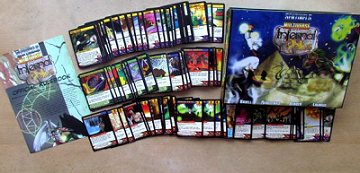
Sentinels of the Multiverse: Infernal Relics is the second expansion for the popular comic book themed card game. I won’t go into detail with the base game flow. If you didn’t catch our Sentinels of the Multiverse: Base Game review, you can read it here. In short, Sentinels of the Multiverse is a cooperative card game, where players team up with each other to beat the stuffing out of a super villain—which has a dummy hand similar to Bridge. Now let’s get to the new stuff in this expansion.

InfernalRelics01Review:
Infernal Relics is a nice departure from the previous Sentinels expansion Rook City and the base game. Like the Rook City heroes, Infernal Relics heroes are highly specialized. But Rook City’s heroes were straightforward one trick ponies, while the Infernal Relics heroes add some nice twists to the gameplay.

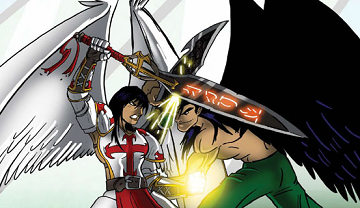
NightMist has deadly offensive powers, but this power can be a double-edged sword. She can damage herself and her teammates. Meanwhile, The Argent Adept is the consummate teammate, aiding anyone in need. He does this through buffing, adding card draw, and healing. But if he’s your team’s leading damage dealer, something’s gone terribly, terribly wrong.

InfernalRelics03Infernal Relics’ environments are breaths of fresh air too. The base game environments ranged from somewhat neutral to leaning toward the heroes, while the Rook City environments punished players. Infernal Relics environments are even handed. Depending on the flow of the game, they can be either beneficial or detrimental to the heroes and villains.

InfernalRelics02And speaking of villains, we have some interesting deck concepts for them in Infernal Relics. Akash’bhuta has a whopping 200 HP, but don’t be too intimidated—there’s sort of a win condition involved with Bhuta. The Ennead is Sentinels first attempt at a super villain team. If that sounds daunting, that’s because it is. Add GloomWeaver and Apostate to the mix and you get an odd and fun mixture of villains.

Verdict: When I first played Infernal Relics, I didn’t like it, but it grew on me. The heroes are more complex than ever before. The villains and environments have great depth too. Infernal Relics shows that Greater Than Games doesn’t just turn out the same old tired mechanics.

Munchkin

Designer: Steve Jackson
Publisher: Steve Jackson Games
Date Released: 2001

Number of Players: 3-6
Age Range: 10 and up
Setup Time: 5-10 minutes
Play Time: about 90 minutes

Game Mechanics:
Card Drafting
Dice Rolling
Hand Management
Variable Player Powers

Game flow:
Steve Jackson Games describes Munchkin in four short sentences: Go down in the dungeon. Kill everything you meet. Backstab your friends and steal their stuff. Grab the treasure and run.

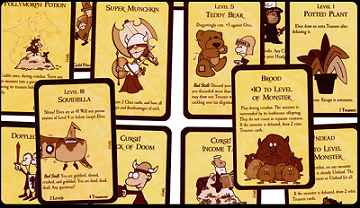
Munchkin03That’s the premise. Based on role playing game clichés, this satirical card game starts its players off as level 1 humans with no class—class as in job or vocation, I’m sure its players have plenty of class. The first player to level 10 wins.

There are only two types of cards: treasure and encounters. Each turn the player whose turn it is “kicks down the door” by drawing from the encounter deck. You’ll usually find a monster. These monsters will have their own levels, and players must defeat them by combining their current level, bonuses from items (usually from the treasure deck), and help from other players. If you can’t beat the monster, you have the option of running away, but sometimes this comes at a price.

Munchkin04If you beat the monster, you gain a level and the number of treasure cards indicated on the monster card. Players keep all the treasure cards if they beat the monster by themselves, but they have to share the earned treasure with the other player who helped them—the treasure card distribution is usually worked out between the two players before the second player agrees to help.

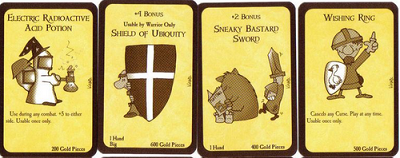
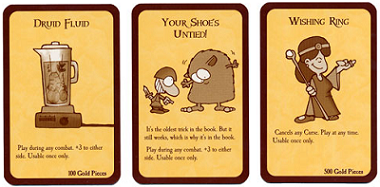
Munchkin05The cards themselves are hilarious. You can use weapons like the Chainsaw of Bloody Dismemberment or the Staff of Napalm and wear outrageous gear like the Boots of Butt-Kicking and the Horny Helmet. One moment you’re a human, male. The next, you can be an elven, female. Yes, there are sex changes in this game as well as Plutonium Dragons.

Review:
Luck plays a big part in Munchkin, and the main strategy is backstabbing your friends. This isn’t a game to play if you have thin skin, and you never want to be in first place. Once players realize that someone has a decided advantage, they’ll crap on first place until they’re last place. I’ve even seen some folks take revenge on someone else during the game for ticking them off earlier in the day. This is definitely not a game to play if someone holds a grudge.

Munchkin06I find Munchkin fun enough, but it can get tedious fast, and luck plays too much of a role in determining a winner. You also have to be in the right headspace for it too. Everyone has to be in a decent mood and not be quibbling with each other. There’s a reason the word backstab was used by the publisher.

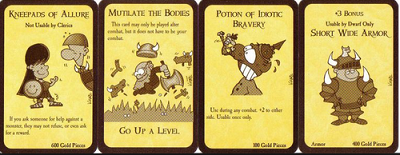
Munchkin02Note: Steve Jackson Games rereleased the game four years ago after The Great 2010 Munchkin Changeover. They reintroduced cards like The Kneepads of Allure so they won’t be as powerful, but I still have the original game, and those kneepads rock. I wonder if Zapp Brannigan’s kneepads would be made of velour.

Verdict: An uneven but fun thematic card game that leans too much on luck and has limited, spotty replayability.

Wahoo

Designer: Uncredited
Publisher: Pressman Toy Corp.
Date Released: 1930

Number of Players: 4-6
Age Range: 6 and up
Setup Time: none
Play Time: less than 45 minutes

Game Mechanics:
Partnerships
Roll, Spin and Move

Game flow:
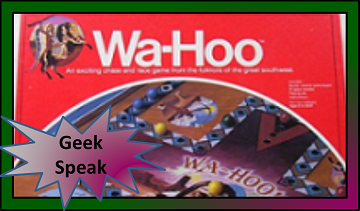
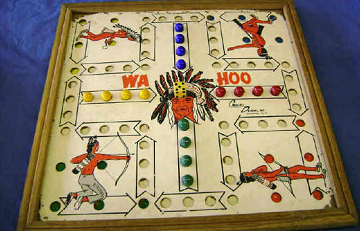
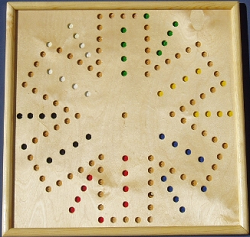
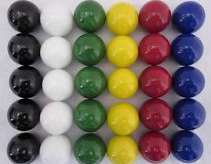
A take on the ancient game of Parcheesi, Wahoo trades Parcheesi’s wooden playing pieces for marbles, and a cloth or cardboard game board for a wooden one with notches whittled out for the marbles to rest. Most of the rules are the same. You roll a single six-sided die and have to get your pieces from your start area to a safe zone.

Wahoo01You can play the game with every person for themselves or in partnerships—with most players teaming up with the player seating across from them. When you play as teams, once one player gets all of their pieces in their safe zone, they can help their teammate on their turn.

Like Parcheesi, you can get a new piece out of your start area by rolling either a one or six, and sixes allow the player to roll again. Pieces can’t occupy the same space, so if you land on an occupied space, you send the piece back to the player’s start area. But Wahoo adds a new wrinkle by including a shortcut.

Wahoo02One piece can occupy the middle space—significantly reducing the number of spaces you’ll have to move—but beware. You have to roll a one or six to get out of the shortcut, and everyone wants to use it.

Review:
I prefer team play to solo play. Solo can be fun too, but you can’t land on your own pieces so you just lose a turn if that happens, and you always know that your opponents will try and send any piece back to start when they have a chance. But team play gives you moments where you have to move a piece a number of spaces and the only valid move you have is to take one of your teammate’s pieces back to start. This leads to someone screaming NO or apologizing profusely.

Wahoo03The only strategic element gained in Wahoo from Parcheesi—and other Parcheesi based games—is the inclusion of the shortcut. But this isn’t a small thing. There are moments when the shortcut is safer than others, and you can gauge when you should take it. Still, luck rules Wahoo unless you have a loaded die.

You’ll find numerous custom Wahoo boards on eBay, but the best boards are ones that you make or the ones someone makes for you. YouTube even has a video on how to make a Wahoo board: How to Make a Wahoo game board.

Verdict: Wahoo uses the classic roll, spin, and move mechanic, but the inclusion of a shortcut, partnership gameplay, and the fact that you’re probably playing on a board someone made for you make Wahoo a fun and personal game.

Kittens in a Blender

Designer: Brian and Brent Knudson
Publisher: Closet Nerd Games
Date Released: 2011

Number of Players: 3-4 (best with four)
Age Range: 8 and up
Setup Time: minimal
Play Time: less than 20 minutes

Game Mechanics:
Hand Management
Rock-Paper-Scissors

Game flow:
You and the other players at the table own a group of kittens—assigned to each player by color (red, green, blue, and yellow)—and we all know that kittens are curious by nature. Unfortunately, your kittens have wandered into a dangerous kitchen with a blender so large it can blend kitties into Frappucinos. You have to save your kittens by getting them into a super-sized box, while dooming your opponents kittens by placing them in the blender and hitting frappe. Sound twisted? It is, but Kittens in a Blender is good, clean, grotesque fun for the whole family.

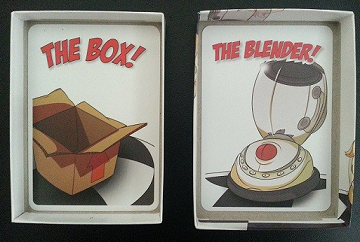
Kittens04You start the game by placing the game box top on the table, open-side up and placing the oversized Blender card in it face up. That’s the Blender. Then, you place the oversized Box card face up in the game box’s base. That’s the Box. Leave a little space between the Blender and the Box, and that space is the Counter. The Blender is considered one space from the Counter, and the Counter is one space from the Box, so the Box is two spaces away from the Blender. (This will make more sense when we get to the different kinds of cards.)

Kittens05You play two cards on your turn and then draw back up to a 6 card hand. Players can play kitten cards on the Counter, in the Blender, or in the Box. All other cards are played face up in front of the player, so everyone knows which cards have been played.

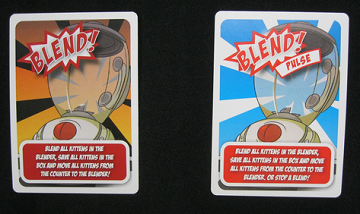
The two most common cards—other than the adorable, ill-fated kittens—are Kitties on the Move and Blend cards. Kitties on the Move moves any number of kittens a total number of spaces equal to what’s printed on the card (1, 2, or 3). Blend cards blend every kitten in the Blender, saves the kittens in the Box, and moves the kittens on the Counter to the Blender. There are some Blend: Pulse cards that allow players to counter another Blend card that’s been played on a turn, so you can save your kitties.

Kittens06Mayhem ensues when you play cards that send all the kittens to the Blender, to the Box, or to the Counter. There’s even a card that allows you to select one players kittens and put just their kittens in the blender. Take that, you sorry so-and-so. And you can throw a complete wrench in the works by playing Dog’s in the Kitchen, which makes each player hand their cards to the player on their left or right.

Play ends when all 16 Blend cards have been played. Saved kittens are worth 2 points, and blended kittens lose you 2 points. The highest score wins.

Kittens02Review:

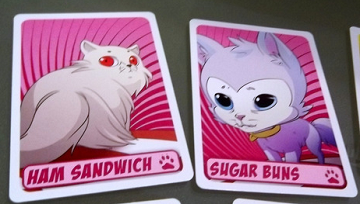
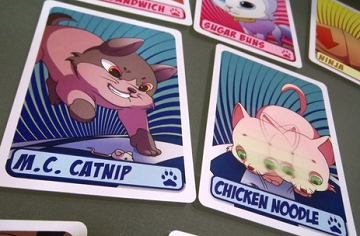
Did I mention that most of these kittens are gut-wrenching cute, and they have awesome names? No. Well, they are and they do, and that makes sentencing these little guys to death all the more reprehensible. You’ll find yourself having to make tough decisions with your own kittens like who do I save, Romeo or Chopsticks? Personally, I’d pick Chopsticks because Romeo’s supposed to die.

Kittens07The gameplay is fast and furious. You won’t find much in the way of strategy as most of the game revolves around how lucky you and your kittens are. Still, Kittens in a Blender is a great way to pass the time. Just make sure you don’t put your real life kittens in a blender and give your kitty at home a hug and apologize for playing such a despicable game.

Kittens03P.S. That’s not my cat. Someone else took the game too far.

Verdict: An easy, quick, cute and raunchy card game that’s fun for a wide range of gamers. If you’re looking for a strategy heavy game or a game with more substance, you’ll have to go somewhere else, but if you’re looking for some kooky fun, Kittens in a Blender might hit the spot.

Settlers of Catan

Designer: Klaus Teuber
Publisher: Mayfair Games
Date Released: 1995

Number of Players: 3-4
Age Range: 10 and up
Setup Time: between 15-20 minutes
Play Time: up to 90 minutes

Game Mechanics:
Dice Rolling
Hand Management
Modular Board
Route/Network Building
Trading

Game flow:
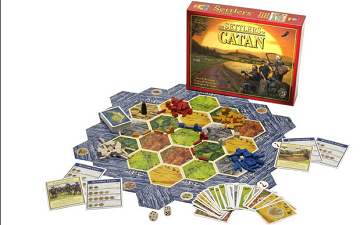
The game that started the whole German/designer game craze that has revitalized the tabletop industry, Settlers of Catan has players pioneer a series of settlements and a network of resources and roads, building up to a civilization. It’s hard to believe, but the modular board game mechanic caught fire with this game.
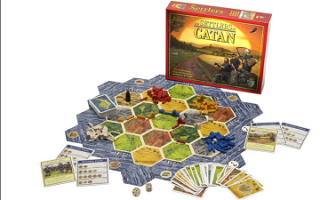
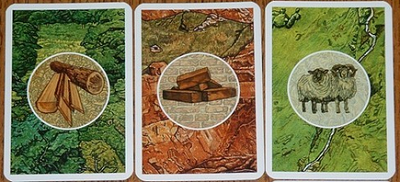
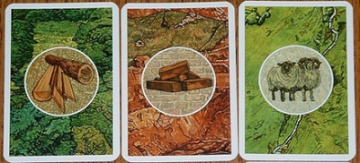
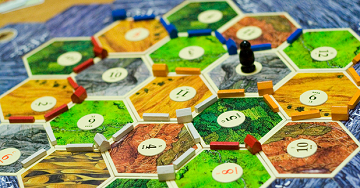
Catan02Unless you play the initial set up (developed to be well-balanced and recommended for beginning players), every game board of Settlers of Catan looks different. The simple yet elegant design has players set up the game by randomly placing land tiles that have different land types—these land types grant different types of resources you need to build things—and number chips that show which number you have to roll on two six-sided dice in order to obtain the resource associated with the land tiles. Players build by spending resources that are represented by resource cards. Mountains provide ore, plains yield grain, farmland gives wool, forests have wood, and hills provide brick.

Catan07Each player starts the game with two settlements and two roads. Since land tiles are hexagonal, settlements are placed on one of the tile’s corners, and the roads go on the border between two tiles. Settlements have to have at least one corner between them, so you have to use your head when placing your settlements. You’ll want to get a combination of resources you can use to drive you to victory, while blocking your opponents from getting the resources they need.
Catan08On each player’s turn he or she rolls the dice. The number on the dice determines which land tiles produce resources that turn. (You can produce resources on other players’ turns.) There’s also a robber token, which starts on the desert tile, and if a player rolls a 7, the robber must be moved to another land tile, and anyone—including the person rolling the die—with more than 7 resource cards in their hand must discard half of their resource cards. Once the robber is moved, any tile he’s moved to ceases to produce resources, and the player who moved the robber gets to steal one resource at random from a player with a settlement on the tile in which the robber was moved.
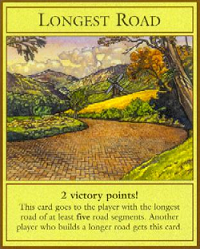
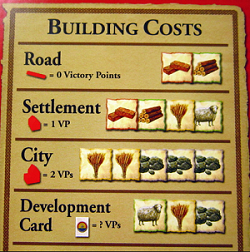
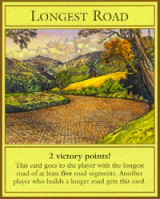
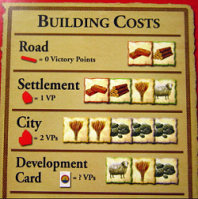
Catan05You earn victory points by building settlements, cities, development cards, owning the largest army, and even the longest continuous road. The first person to 10 victory points wins. You can upgrade your settlements to cities. A settlement only gives you one resource, while a city gives you two resources. Players can draw development cards by turning in one wool, one ore, and one grain to the bank, and there are two ways to earn victory points off of development cards: some cards have a point value (you simply play them for quick points), and knight cards. If you draw into a knight card, you can use the card to move the robber before you roll the dice on your turn. You keep the used knight cards in a stack by you, and if you have three or more knight cards, you earn the largest army, provided no one else has the largest army.
Catan01Then, there’s the trading aspect. You can trade resources with any player on your turn, and only with the player whose turn it is on their turn. You can also trade with the bank, but you have to have 4 or one kind of resource to the get the one you want. This trade ratio to the bank makes trade routes important. If you have a settlement (or city) on a trade route tile, you own the trade route, and there are plenty of routes to be had: there’s a 2:1 ratio for trading each individual resource, and there are 3:1 trade routes for any resource. You’ll find that when you’re close to winning the game, people won’t want to trade with you, so these trade routes can seal a victory.
Catan04Review:

But it’s trading with players that give Settlers its charm. You’ll find plenty of awkward moments when someone starts shouting, “Wood. I need wood. I have sheep, but I need wood.” The Big Bang Theory makes good use out of this common occurrence when Sheldon Cooper asks for the same trade. His friends laugh and tell him that his girlfriend might be able to help him out.

Catan03And you have to love the strategic aspects of Settlers. Everyone has their own opinions on what works best. Wood and Clay are used to build roads, so if you load up on those two resources, you can build the longest route—securing two victory points—and run the tables on your opponent. I prefer to focus on grain. I’ll pick a plain tile with a good number on it—keep in mind that 6s and 8s are rolled more often than 2s and 12s—and even though I may have a slower start to my game, grain is used to build everything except roads. But I’ve even seen someone win by dominating wool—the least useful resource on paper, since it doesn’t have nearly as many uses as the others. One of my military buddies built several cities on wool tiles and owned the 2:1 wool route to the bank. He loaded up on wool and rode the wool train to victory.
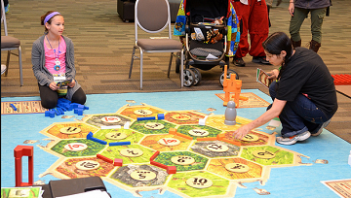
Catan06Despite its age—Settlers turns twenty in 2015—Settlers of Catan continues to delight tabletop gamers. In fact, 2013 saw the fourth large expansion of the game, Catan: Explorers & Pirates.

Verdict: Unlike some evergreen tabletop games Settlers of Catan ages well. The well-balanced combination of a variable board, trading, and a focus on strategic resources make it relevant today as it was twenty years ago.

Giza: The Pyramid Building Game

Designer: Nikki Lum
Publisher: Fun Factory
Date Released: 2005

Number of Players: 2-6
Age Range: 8 and up
Setup Time: nominal
Play Time: 10-20 minutes

Game Mechanics:
Hand Management
Set Collection
Tile Placement

Game flow:
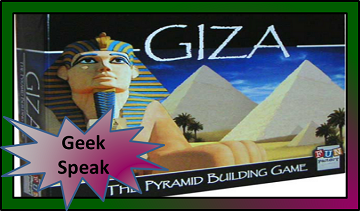
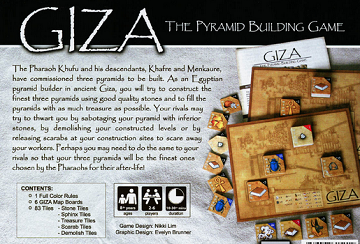
You’re an ancient Egyptian architect and tasked with constructing three fine pyramids. The fast, simple game of Giza builds fun for the whole family.

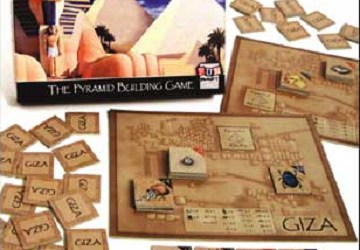
Giza03Each player gets a map board, and each of these map boards has an outline for three pyramids (the pyramids of Menkaure, Khafre, and Khufu) and an outline for the Great Sphinx. These outlines serve as the construction sites upon which players place pyramid, treasure, or sphinx tiles. Players take turns playing tiles from their hands until one player tops off all three of their pyramids. Each tile has its own point value (located in the top right hand corner of the tile), and the player with the highest score wins.

Giza02You get a hand of four tiles, and there are five types of tiles: stone, treasure, demolish, scarab, and sphinx. Stone tiles are used to construct pyramids. Some stone tiles have positive points, and others have negative points. Stone tile point values—and value in terms of physical area—range from 1-5 (positive and negative). Since you’re building a pyramid, you have to place lower value stone tiles on top of higher value stone tiles. As soon as someone has a one or a peak (positive or negative value) on all their three construction sites, the game ends. You can have a pyramid of one tile. Normally, you don’t want to have a short pyramid, but I have seen players win this way.

Giza04Treasure tiles act like the jelly between stones. You can only place a treasure tile on a stone tile of the same value. For example, one of your construction sites has a stone tile that’s a size two, so you can place an ankh (a treasure worth two points) on top of your size two stone and then still build the peak of your pyramid. Treasure tiles are a great way to negate negative value stone tiles as they can be placed on a positive or negative tile bearing the appropriate size.

Giza01Demolish tiles do their name sake. They destroy one placed tile (negative or positive) when played. Scarab tiles disrupt construction. You can put a scarab tile on top of any pyramid, sphinx or even another scarab tile. Players can’t play any stone, sphinx or treasure tiles on this construction site until the scarab tile is removed by skipping a turn.

Then, there are sphinx tiles which are only used to construct the sphinx. Completed sphinxes gives a player a whopping twenty points, but beware, the base of the sphinx gives a player negative points, so you may not want to build the sphinx feet until you have its body in your hand. And there’s only one sphinx head.

On your turn, you can play 1 tile or discard any number of tiles from your hand. Then, you draw up to four tiles at the end of your turn. Giza’s rules are simple, but like all fast, furious, and fun games, it’s deceptively simple.

Giza05Review:

If you get more than three players at the table, the claws come out. You also have to manage your hand like, wondering how long you should hold onto your sphinx pieces or a lower level treasure piece that you can’t place yet. The strategy is dialed down, but the replayability of Giza far outweighs any simplicity.

Verdict: Easy on the strategy and more interesting when you have more players, Giza delivers a quick game that’s fun to play.

Sentinels of the Multiverse: Rook City

Designer: Christopher Badell, Paul Bender, and Adam Rebottaro
Publisher: Greater Than Games, LLC
Date Released: 2012

Number of Players: 2-5
Age Range: 13 and up
Setup Time: Less than 10 minutes
Play Time: 10-90 minutes

Game Mechanics:
Cooperative Play
Hand Management
Variable Player Powers

Game Flow:
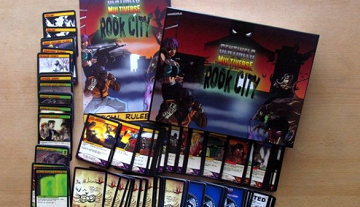
Sentinels of the Multiverse: Rook City is the first expansion for the popular comic book themed card game. I won’t go into detail with the base game flow. If you didn’t catch our Sentinels of the Multiverse: Base Game review, you can read it here. Let’s just say that Sentinels of the Multiverse is a cooperative card game, where players team up with each other to beat the stuffing out of a super villain—which has a dummy hand similar to Bridge. With that out of the way let’s tackle the new stuff in this expansion.

RookCity02


Review:

Rook City does its best to right some wrongs with Sentinels’ gameplay balance. The two super heroes introduced in this set have the flavor of two other heroes (in the base game) but add an extra wrinkle that both improves and hinders their effectiveness.

At first glance, Mister Fixer’s deck looks similar to Bunker’s. It has style cards instead of mode cards, and it also features equipment. But if you look closer, Mister Fixer’s deck focuses on boosting his damage or redirecting damage dealt to him, while Bunker’s deck isn’t as focused—it can do just about anything. This focus defines Mister Fixer’s role but also makes him less of a panacea than most of the heroes introduced in the base game.

RookCity03Expatriette—the other new hero in this set—looks like a cross between The Wraith and Ra. Like The Wraith she has equipment cards, but her cards focus on guns and ammo which leads to damage increases and damage type conversion, and damage manipulation sounds more like Ra. Despite boosted damage, neither one of these new heroes measures up to the studs from the base game. And that’s a good thing.

Conversely, Rook City introduces four spiffed up villains: Plague Rat, Spite, The Chairman/The Operative, and The Matriarch. While all four can trip up our intrepid heroes, The Matriarch and The Chairman/The Operative stand above the rest. Ladies first, so let’s start with The Matriarch.

RookCity04She doesn’t have a special win condition like Baron Blood or Grand Warlord Voss, but she doesn’t need one. It’s fitting that her nemesis is Tachyon because she runs through her deck her hero counterpart. You’ll find it difficult to stop her once she gets her fowl on the board—and she gets her fowl on the board quickly. Imagine fighting twenty or so weenie villains before you can touch The Matriarch—who has a lot of HP by the way—and you might have an understanding of how frustrating she can be. Several fans have named The Matriarch their least favorite villain and have even said that she’s no fun to play against. But she’s not this set’s only tough villain.

RookCity05The Chairman is almost as infuriating with his thugs as The Matriarch is with her fowl. And to make matters worse, The Chairman is immune to damage until you take out so many of his underbosses, and heroes can’t win the game unless they take out The Operative, who runs interference for The Chairman. Yikes! There’s a reason that when Greater Than Games measured the toughness of their villains, The Chairman and The Matriarch were tied for the toughest. Just like the heroes in this set, Sentinels needed these villains so games would become less of a picnic.

RookCity01And speaking of less than a picnic, the two new environments in Rook City favor the villains more so than any one environment in the base game. Pike Industrial Complex can act fairly between the heroes and villains, but the set’s namesake Rook City environment feels like a cancerous Gotham City. Crooks and crooked cops don’t usually help heroes.

Verdict: A great addition for the Sentinels of the Multiverse. Rook City does a great job of addressing gameplay balance in the series, but it may have done too good of a job.

Takenoko

Designer: Antoine Bauza
Publisher: Bombyx
Date Released: 2011

Number of Players: 2-4
Age Range: 8 and up
Setup Time: less than 10 minutes
Play Time: about 45 minutes

Game Mechanics:
Action Point Allowance System
Dice Rolling
Grid Movement
Modular Board
Pattern Building
Set Collection
Tile Placement

Game flow:

Long ago the Chinese emperor offered a giant panda to the Japanese emperor as a symbol of peace. Your job as a member of the Japanese imperial court is to make sure that the panda’s well fed, and that its bamboo garden flourishes.

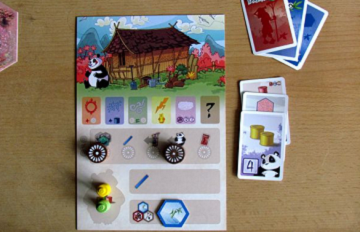
Takenoko01Takenoko—that’s bamboo shoot in kanji—may look like a cute game, but it hides a mean strategy game streak and nuanced gameplay we’ve come to expect from Antoine Bauza games. You start the game with a player sheet, two action chips, and three cards (one from each deck). The objective cards represent what you need to accomplish in order to have the best bamboo garden ever. As soon as one player finishes eight objective cards, they earn the emperor card (as they gained the emperor’s favor for being so awesome), and every other player gets one final turn. But how do you complete objective cards? You perform actions. The player sheet keeps track of your supplies and what type of actions you have at your disposal.

Takenoko03You get two actions a turn—denoted by your action chips—and you can choose from five actions: drawing plot (of land) tiles, picking up an irrigation stick, moving the gardener, moving the panda, and drawing another objective card.

You start with the pond tile (the only blue tile). Every plot tile you place adjacent to the pond tile is considered irrigated. An irrigated plot tile spawns one bamboo shoot (unless it’s fertilized, and then it gets two bamboo shoots). You can use irrigation sticks to irrigate plot tiles that don’t get placed next to the pond. You don’t get charged an action for placing an irrigation stick—you only get charged an action for taking an irrigation stick—so it’s a good idea to grab as many of them as you can. When you choose to draw plot tiles, you draw the top three tiles, play one of them, and then put the other two on the bottom of the pile. Tiles come in three colors: pink, yellow, and green. The bamboo matches the tiles. Now let’s talk more bamboo shoots or takenoko.
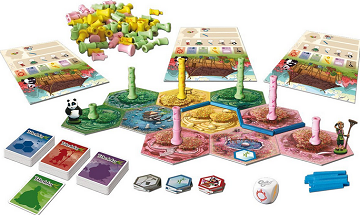
Takenoko02When you move the gardener, you can only move him in a straight line—but you can move him any number of tiles in a straight line. Bamboo shoots grow where ever you place the gardener—the same rules for irrigation apply: the plot must be irrigated, a regular tile gets one shoot, while a fertilized tile gets two shoots—and every adjacent tile that shares the same color as the tile the gardener rests on grows bamboo, too. So if you have a yellow plot tile surrounded by six other yellow plot tiles, the gardener grows bamboo on all seven yellow plot tiles. That’s a lot of bamboo.

And you’ll need plenty of bamboo. The panda moves the same way as the gardener, but he doesn’t behave the same way. Where ever you move the panda, he eats the top most shoot of bamboo. Whenever he does this, you place the bamboo shoot in his belly, located on your player sheet. Now you’re ready to win by completing objective cards.

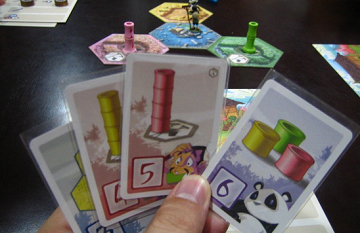
Takenoko04There are three card types: panda cards (purple), gardener cards (red), and tile cards (blue). Each card has a number in the lower left-hand corner, indicating the number of points you earn for completing the card’s objective. You have to move the panda and have him eat a certain color of bamboo to complete a panda card. Gardener cards necessitate a certain number, color, and height of bamboo shoot (you have to match what’s shown on the card exactly). Tile cards require you to match the pattern indicated on the card—again, this has to be exact—and each tile needs to be irrigated. You don’t have to complete these requirements on your turn. If you draw into a tile card or gardener card and the conditions are met, you get credit for the objective.

Takenoko06

Review:

Sounds easy? It isn’t. My wife had a gardener card that showed four green bamboo shoots of a height of three. There were four green bamboo shoots at a height of four when she drew into the gardener card. But she needed four at a height of three, so she had to move the panda to each green tile and have him gobble one shoot off the top. And if the base rules aren’t enough, after the first turn, players roll the weather die.

Takenoko07The weather die adds yet another wrinkle to the gameplay. Each player rolls the die at the beginning of their turn, and they gain an ability based on what they roll. The Sun gives the player an extra action. Rain grows bamboo on one tile. Wind allows a player to take the same action twice—when you usually take two different actions per turn. The Storm scares the panda, and you get a free panda movement that doesn’t follow normal movement rules. And then the player can pick up an improvement chip—indicating automatic irrigation, panda don’t eat (this bamboo), or fertilized—for plot tiles whenever they roll The Clouds.

Takenoko05There’s enough variety to Takenoko that makes each game unique, and you get plenty of strategy. I suggest starting with panda cards in the early game and then switching to either gardener cards or tile cards, depending on how much bamboo exists on the board. If you have a lot of bamboo, choose gardener cards. If you don’t have that much bamboo, choose tile cards. That’s my personal preference, but there are many ways to win with this deceptively deep game.

Verdict: Don’t be fooled by the cute aesthetic. This game delivers the strategy game goods while still offering a fun experience.

Forbidden Desert

Designer: Matt Leacock
Publisher: Gamewright
Date Released: 2013

Number of Players: 2-5 (best with four)
Age Range: 10 and up
Setup Time: less than 10 minutes
Play Time: about 45 minutes

Game Mechanics:
Action Point Allowance System
Cooperative Play
Grid Movement
Modular Board
Set Collection
Variable Player Powers

Game flow and Review:
What makes a great competitive game is having multiple ways to win. What makes a great cooperative game is having multiple ways to lose. Forbidden Desert is a great cooperative game.

ForbiddenDesert01You and your team are stranded in a vast desert. You have to find the parts to a flying contraption—circa Jules Verne—and escape before the sandstorm gets too great, or you or one of your teammates runs out of water, or a sand dune buries you alive.

The gameplay is straightforward and easy to learn, but Forbidden Desert’s complexity lends itself to multiple plays. You can play the game many times and never get the same result twice. Each player has their own ability (variable player power). The water bearer can fetch and carry more water than anyone else and can share it without taking an action, the explorer can move multiple tiles per action (instead of the customary one) if they bring a teammate, and the archeologist can remove more sand per action than anyone else to name a few. Then, there’s the Action Point system that guarantees fluidity.

ForbiddenDesert02Each player is given four actions per turn and you can use these actions for any of the following: movement (1 adjacent tile), fetching water, trading water or gear, excavating a tile (to see what’s beneath the sand), removing excess sand (sand tiles), pick up a part to the flying contraption, and even some special player abilities. Depending on the game’s circumstances, you could use all your action points on the same action four times, or you could mix and match. Keep in mind that you’re playing against the desert.

ForbiddenDesert07The desert has a deck of cards. After a player spends all their action points, they have to draw cards from the desert deck, and the number of cards they draw from the desert deck is indicated on the storm thermometer. You start by drawing two cards a turn, but you can draw as many as six desert cards in one turn. There are three types of cards in the desert deck: tile movement cards, “The Sun Beats Down,” and “The Storm Picks Up.”

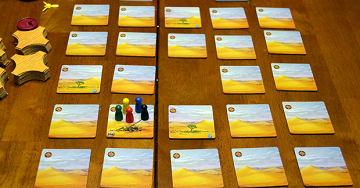
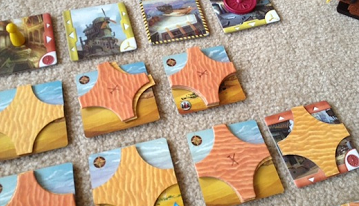
ForbiddenDesert06Every game of Forbidden Desert starts with the desert tiles arranged in a five across, five down pattern with one tile missing in the middle—kind of like those sliding tile puzzles with one tile missing so you can move the other tiles around to solve the puzzle. The one missing tile in Forbidden Desert functions like the missing tile in a sliding tile puzzle. Whenever you draw a movement card, you’ll see one, two, or three tiles and a direction. You have to move the number of tiles indicated on the card in the direction shown if possible—you need to keep the five by five tile shape. If a desert tile is moved, you add a sand token on top of it. If you run out of sand tokens, the desert buries you and you lose, so you’ll want to remove sand tokens from desert tiles before you run out of tokens.

ForbiddenDesert04You also lose if you or any member of your team runs out of water. Each time you draw into “The Sun Beats Down” card in the desert deck, every team member not protected by a tunnel or a sun dome card (gear) loses one water level.

But that’s not the only level you keep track of. The storm thermometer tells you how many desert cards you draw at the end of a player’s turn, and the “Storm Picks Up” cards have you increase the storm’s level. If you reach the top of the storm thermometer, your team loses. So every game has a timer. Eventually, you’ll draw into enough “Storm Picks Up” cards to lose the game. Speed is crucial.

ForbiddenDesert03Let’s talk about winning. You have to excavate in order to win, and when you choose to excavate on your turn, you have to have no sand tokens on the desert tile you want to flip over. The reverse side of each tile can have gear, a well, a mirage, the landing pad (for the flying contraption), or one of two locator tiles for the four items used to construct the flying contraption. It’s the last part that impresses me. Each part (for the contraption) has two tiles that indicate horizontal or vertical location of the part. You have to find both to locate the part. As soon as the second locator tile is revealed, you place the part on the space where the two arrows the locator tiles are pointing to intersect.

ForbiddenDesert05Keep in mind that these parts can shift with the desert sands, and that’s the beauty of Forbidden Desert. A path you thought existed at the end of one turn may change or even disappear by the time your turn comes around. The game does a perfect job of simulating an untamed desert. The game’s difficulty makes it feel like an accomplishment when you win.

Verdict: A tough but fair cooperative game that challenges its players. Deserving of the Mensa Game of the Year, Forbidden Desert has you coming back for more until you win, and you then you set it down for a while because you’ve won, and you rock.

King of Tokyo

Designer: Richard Garfield
Publisher: IELLO
Date Released: 2011

Number of Players: 2-6
Age Range: 8 and up
Setup Time: less than 5 minutes
Play Time: less than 30 minutes

Game Mechanics:
Card Drafting
Dice Rolling
Player Elimination

Game flow:
You play as mutated monsters, colossal robots, and weird aliens. Each creature goes on a rampage to see who can be the King of Tokyo.

KingTokyo02King of Tokyo borrows a lot from the classic playground game King of the Mountain. You gain control of Tokyo if you damage another player while the city remains void of an opponent. The first person to twenty victory points wins the game, and if you have control of Tokyo, you gain bonus victory points at the start of your turn. It pays to be King of Tokyo.

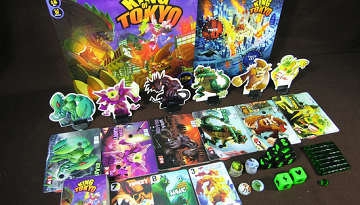
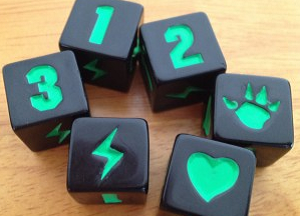
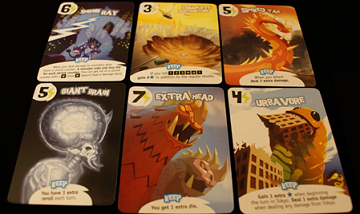
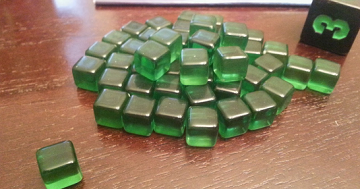
KingTokyo04You begin each turn by rolling six dice. Each die face has a lightning bolt, a claw, a heart, or a number printed on it. You have to roll three of the same kind of number to gain that many victory points, you take one energy cube—which you use as currency for cards—for each lightning bolt you keep, a claw deals one damage to an opponent (all creatures have 10 hit points unless a card says otherwise), and a heart lets you heal one damage. But you can’t heal by means of the die when you’re in Tokyo. Thankfully, some cards let you heal.

KingTokyo03You can reroll each die or some dice twice. Your position on the board dictates which die rolls you’ll keep. If you’re in Tokyo, you won’t want to keep any hearts—they’re worthless. If you’re outside Tokyo and half dead, you may want to roll as many hearts as you can. But if you’re healthy and smell blood dripping from Tokyo, you may want to go for the kill, keeping as many claws as possible.

KingTokyo05

Review:

King of Tokyo doesn’t take long to play—thirty minutes of gameplay is very generous—but it’s a fun thematic game. Too much of the game depends on luck to where the only strategy you’ll find is when you should conquer Tokyo, and when should you stay out of Tokyo and heal.

KingTokyo01Verdict: If you’re looking for a quick, easy and fun thematic game, it doesn’t get better than King of Tokyo. If you’re looking for a game with more strategy or sustenance, you may want to look elsewhere.