Machi Koro

Designer: Masao Suganuma
Publisher: IDW Games
Date Released: 2012

Number of Players: 2-4
Age Range: 8 and up (7 and up on the box)
Setup Time: less than 5 minutes
Play Time: less than 30 minutes

Game Mechanics:
Card Drafting
Dice Rolling

Game flow:
You’re the mayor of Machi Koro, and you’ll have to meet the demands of your citizens. You can build cheese factories, restaurants, radio towers, or even a theme park. This proves difficult as you only start the game with a wheat field, a bakery and a single die.

MachiKoro03Machi Koro marries card drafting with a bit of deck/pool building. I found it difficult to classify the game as either of these mechanics, but card drafting fits a little better. You begin the game with the aforementioned cards and a die, but all players are given a catalog of cards with which to purchase—this is where the deck/pool building mechanic comes into play, but any similarities to deck building end there. Your goal is to be the first to build four major town features: a train station, a shopping mall, an amusement park, and a radio station.
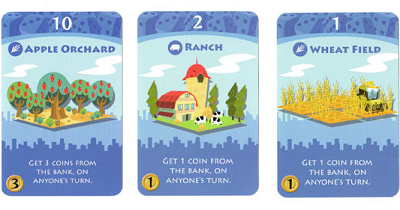
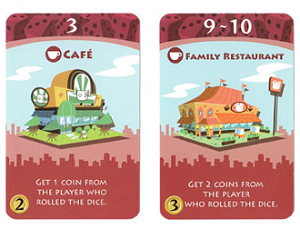
MachiKoro01Gameplay is simple. Similar to Settlers of Catan each player rolls at the beginning of their turn, and then you react to whatever was rolled on the die. Only town features that share a number with what was rolled activate on a turn. For example, Wheat Fields give you one coin from the bank whenever a 1 is rolled by any player, but Bakeries net you one coin from the bank when you roll a 2 or 3 on your turn only. You can buy a new feature with the coins you earn. Each feature card has a coin in the lower left-hand corner with a number in it.

You may want to start by building the train station. It allows you to roll one or two dice in a turn, and you can tell that some numbers—like 9 or 10—are impossible to roll on one six-sided die. But you could stick with the dinky features and nickel and dime your opponents.

MachiKoro05Each feature is color-coded, illustrating how each card works. Blue features work on anyone’s turn. You only collect money from green features when you roll the number indicated on your turn. Red features only work on your opponents’ turn, and you don’t collect coin from the bank, you steal coin from your opponents. Purple features have special abilities that can boost your other features, swap features with your opponents, or even steal a feature outright.

MachiKoro04

Review:

Machi Koro’s gameplay is fast and furious. I put thirty minutes as the play time, but most games don’t take nearly that long. And as I mentioned before, Machi Koro has plenty of strategic elements. What works in one game, may not work in another. One of the issues with Settlers of Catan and other strategy games is that they take a long time to set up and play. Machi Koro does a nice job of condensing a top-notch strategy game into a short window of time. The $20 price tag doesn’t hurt either.
MachiKoro02Verdict: A great strategy game condensed into thirty minutes of gameplay.

Zombie Dice

Designer: Steve Jackson
Publisher: Steve Jackson Games
Date Released: 2010

Number of Players: 2 or more (2-99 on the box)
Age Range: 8 and up (10 and up on the box)
Setup Time: none
Play Time: 10 minutes or less

Game Mechanics:
Dice Rolling
Press Your Luck

Game flow:
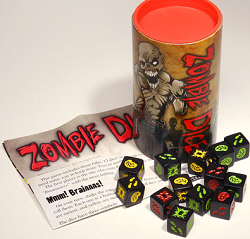
Not many games have you take the role of a zombie, but Zombie Dice does just that. You’re on the hunt for “brains.” Cue the shuffling zombies.

ZombieDice03The goal is simple. You have to collect brains before your victims run away or shoot you. The rules are equally simple. At the start of your turn you grab three zombie dice from the dice canister. Each die has different colors—representing how difficult the victim is to kill with green the easiest, yellow the intermediate victim, and red the hardened cuss of a victim—and these dice have three faces: brain, shotgun blast, and feet.

ZombieDice01You try to roll brains, while not rolling shotgun blasts or feet. If you roll three shotgun blasts, your turn is over and you lose all of the brains you accumulated during the turn. So while it is possible to roll three shotgun blasts in a single roll, you usually won’t get that many, and you’ll have to decide whether or not to press your luck with another roll of three dice. Any feet you roll are returned to the dice canister.

A game ends when one player rolls at least 13 brains. Every other player gets to take one more turn to see if they can tie or beat the player who passed the 13 mark.

Perfect for families, children or even if you want a quick game to fill the time, Zombie Dice doesn’t take long to play, but it’s hard to play just one game.

ZombieDice02

Review:

There isn’t a lot of strategy involved in Zombie Dice besides when to hold the points you accumulated and when you should press your luck and roll another three dice. I’ve found that 12 brains is the best total. You can hover just before the 13 brains that will start the end game and see if you can’t bring your total to 15 or 16 before passing the finish line, or if someone passes you while you have 12 brains, you have a great position to overtake them with your final turn.

Zombie merchandise is hot right now. If you’re looking for an involved zombie game, look elsewhere. But if you’re looking for a fun, easy game, it doesn’t get a lot better than Zombie Dice.

Verdict: A quick, easy game where you are a zombie hungry for brains. It may not have a lot of strategy or complexity, but it makes up this shortcoming with a healthy dose of fun.

Betrayal at House on the Hill

Designer: Rob Daviau, Bruce Glassco, Bill McQuillan, and Mike Selinker
Publisher: Avalon Hill (Hasbro)
Date Released: 2004

Number of Players: 3-6
Age Range: 12 and up
Setup Time: about 10 minutes
Play Time: about 60 minutes

Game Mechanics:
Cooperative Play
Dice Rolling
Modular Board
Partnerships
Tile Placement
Variable Player Powers/Abilities

Game flow:
Betrayal at House on the Hill plays like the movie The Cabin in the Woods and every haunted house story caught in a blender.

Betrayal01Each player picks a character. But each of these characters has varying stats that will help them navigate the house. Speed, might, sanity, and knowledge come into play with the random encounters you face, and when you take damage, you take damage in one of these stats. If any stat reaches zero, you’re character dies.

All the characters are on the same team in the beginning, but as the name suggests, someone will betray the group. No one knows who’ll be the betrayer. That’s decided randomly when the haunt begins, but the haunt doesn’t begin until it’s triggered. And how can you possibly trigger the haunting when, at the start of the game, there are only three rooms: the entrance, the upper landing, and the basement landing.

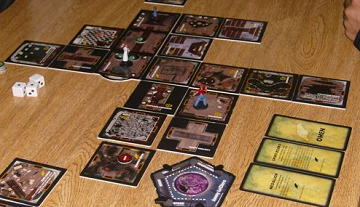
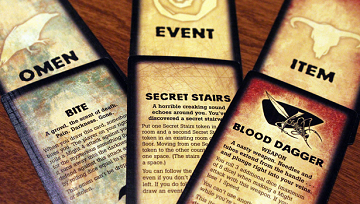
Betrayal02Players explore the house, laying down a new tile adjacent to a door space in the room they currently occupy. Most of the rooms have icons on them, and these icons indicate whether you pick up an item, trigger an event, or get the heeby-jeebies and draw an omen card.

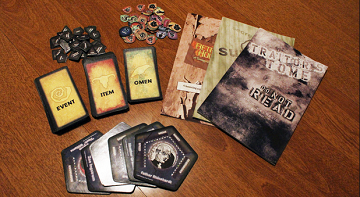
Omen cards stay in play and are linked with triggering the haunt. Most of these cards are pretty useful, granting the character that pulls them with a great ability, but after every drawn omen, you have to make a haunt roll. The player who drew the last omen card counts the total number of omens in play, and then they have to roll a higher number on the dice than there are omens.

Betrayal04Once the haunt begins, Betrayal transforms from an exploration game where everyone’s cooperating, to a competitive game of everyone versus the traitor and whatever evil has just been unleashed. There are only fifty or so combinations of omen cards to rooms with an omen symbol. When the haunt begins, you match the room with the omen to determine which haunt you’ll play. The explorers are given one book, while the traitor gets another. Both sides know certain things about the other, but most of the haunts don’t give away too much of either side. You are literally taking the point of view of either an explorer or a traitor.
Betrayal06

Review:

Taking on the point of view of a character is the beauty of Betrayal at House on the Hill. I’ve played several games where the traitor thinks one thing about the explorers, but the truth the traitor knows about the explorers is way off, and at the same time, what the explorers think the traitor is trying to do is not what they’re trying to accomplish. Mayhem ensues, a win condition is met (variable with each haunt), and usually you’ll be tickled to see how wrong you were about the other side.

Betrayal03Betrayal is very text heavy, so younger players may have trouble. Plus the theme of a haunted house may not go over well with really young players—there is some graphic but not foul language—but for those who love horror movies, this is a must play.

Most major horror movie archetypes—and even some obscure ones—are represented with Betrayal’s fifty haunts. But there doesn’t seem to be a lot of strategy until after the haunt begins. I will say that a larger house makes it easier for the traitor, while a smaller house—or at least finding a route to and from the basement—makes stopping the traitor easier. But who knows who will be the traitor?

Verdict: Fantastic theme game that nails the feeling of exploring a haunted house, and then stepping in some bad juju with the house coming to life.

Zombie Fluxx

Designer: Andrew Looney
Publisher: Looney Labs
Date Released: 2007

Number of Players: 2-6
Age Range: 8 and up
Setup Time: none
Play Time: 10-20 minutes

Game Mechanics:
Hand Management
Set Collection
Take That

Game flow and Review:
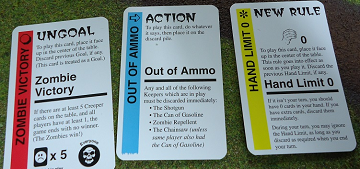
Zombie Fluxx is part of the Fluxx series of card games with ever-changing rules. So essentially, it’s zombie flavored Fluxx. But it has the most interesting card type: Ungoal. The players don’t win. The zombies win.

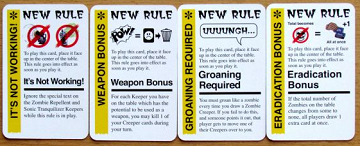
ZombieFluxx06If you haven’t played Fluxx before, it’s a fast-paced card game where the cards themselves determine the current rules of the game. Each game starts with the following rules: draw a card and play a card. But you add to the rules as you go. One player may add play three cards a turn, another may have you draw five cards instead of one, and another still may place a hand limit on all players.

ZombieFluxx05There are six card types: new rules, goals, actions, keepers, creepers, and the type unique to Zombie Fluxx, the ungoal. I explained the new rules already, so let’s get to the next card type, goals. Goals are cards that allow you to win the game. All you have to do is meet the conditions on the card—usually these conditions are what cards (keepers and maybe even creepers) are in front of you at the time—and you win.

ZombieFluxx03Action cards are fairly straightforward. You play the card, do what it says, and then discard it. But these cards can be very useful. Some give you more draw power, grant you the ability to steal a keeper, or allow you to play more cards than your limit for the turn, which in turn gives you more opportunities to play goals, new rules or keeper cards.

ZombieFluxx04You play keeper cards in front of you. Most of them don’t have any special effect—they just count toward your keeper tally when a goal is in play—but some do have some effects. Weapons like a fire axe can be used to kill off zombies. And there are plenty of zombies in this game.

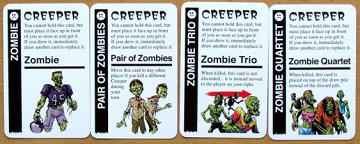
ZombieFluxx02In other versions of Fluxx, creepers can be any nasty thing you don’t want around, but since this is Zombie Fluxx, all the creepers are zombies. When you draw into a creeper, you have to play it immediately. The creeper doesn’t count as a card you drew this turn or a card you played, so you’ll have to draw and play another card to make up for any creepers.

There are some goals that allow you to win with a creeper (zombie) or two, but you have to be careful in this game. Zombie Fluxx has the aforementioned ungoal. When you draw into the ungoal, you have to play it immediately. If there are a certain number of zombies on the table, the zombies win.

ZombieFluxx07Zombie Fluxx takes the manic pace and quirkiness of the original Fluxx and gives it a zombie twist. Classic horror and zombie movie tropes appear throughout the game. One type of keeper you can play into is the friend, but your friends can get infected. There is an action card entitled “if I ever turn into one of those things, shoot me” that allows you to discard your zombified friend.

ZombieFluxx01As with most Fluxx games, Zombie Fluxx moves too fast to have a true strategy to win the game, but that’s not the point of the game. Like the zombies it emulates, Zombie Fluxx is mindless fun. My father played this game and since he’s contrary by nature, he played so the zombies would win. That’s another way to play this game too.

Verdict: You may not have to show off your big “brain” for strategy, but you’ll have fun with this quirky, zombified adaptation of Fluxx.

Cthulhu Dice

Designer: Steve Jackson
Publisher: Steve Jackson Games
Date Released: 2010

Number of Players: 2-6
Age Range: 8 and up
Setup Time: none
Play Time: Less than10 minutes

Game Mechanics:
Dice Rolling

Game flow and Review:
You’re a cultist serving Cthulhu, and life’s good. It’d be great if you didn’t have to worry about all those other pesky cultists out to get your marbles.

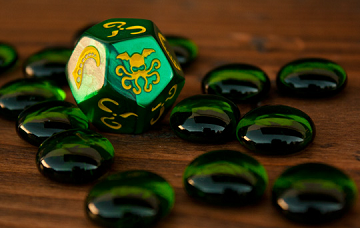
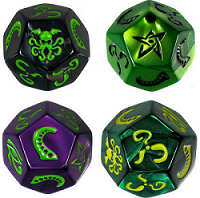
Cthulhu03You have to be the last, sane man standing, and you can lose sanity real quick in Cthulhu Dice. There’s no set-up what so ever. You get one beautiful custom 12-sided die, engraved with tentacles, Elder Signs, and even the visage of Cthulhu himself.

Each player starts this lightning-fast game with three glass marbles, representing their sanity, and then each player challenges another player, rolls the Cthulhu die and takes an action determined by what they rolled.

Cthulhu01If you rolled a yellow sign on your turn, your target player loses 1sanity to Cthulhu (they have to push a sanity marble to the center of the table). If you roll a tentacle, you steal a sanity from your chosen player. Elders sign: gain 1 sanity from Cthulhu (if there’s one to grab). Cthulhu: everyone loses 1 sanity. And the all-seeing Eye allows you to pick your result.

Cthulhu04This game is so easy to learn with very few rules, that anyone can play and enjoy it. If you’re looking for something more substantial, you won’t find it with Cthulhu Dice. But if you’re looking for a great, casual game with a fantastic theme and no set up, Cthulhu Dice is your game.

Verdict: You won’t lose your marbles trying to learn this game, but the quick play and easy to learn rules will have you robbing your opponents of their marbles in no time.

Last Night on Earth, The Zombie Game

Designer: Jason C. Hill
Publisher: Flying Frog Productions
Date Released: 2007

Number of Players: 2-6 (but it works best with 5)
Age Range: 12 and up
Setup Time: less than 15 minutes
Play Time: about 90 minutes

Game Mechanics:
Dice Rolling
Hand Management
Modular Board
Partnerships

Game flow and Review:
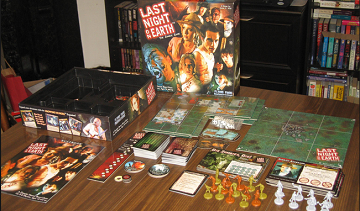
You take the role of either a small-town hero or a zombie horde in this survival horror board game.

LastNight03

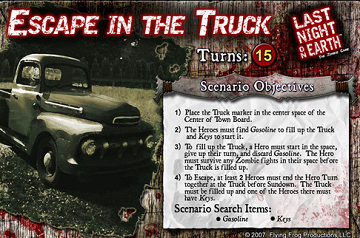
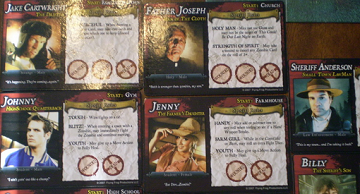
Each game begins with a team of four heroes—if you have 4 or fewer players, some players will have to play more than one hero—and the zombies are controlled by 1 or 2 players. The players pick their heroes—I prefer a blind draw for this so you get some odd hero choices—or color of zombie horde (one horde’s brown, while the other’s green), and then you choose or draw a scenario.

LastNight04While there are only five scenarios, each game of Last Night on Earth varies, because you’re playing on a modular board, which changes the layout of the town and start positions of each hero. You may find yourself burning down the barn or escaping in a truck or going berserk and trying to kill as many zombies as you can before the sun rises.

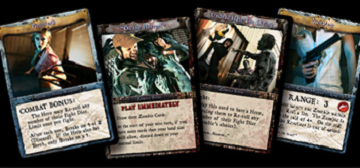
There are two decks—a hero and a zombie deck—that give tactical bonuses to each side. Players resolve combat by using 6-sided dice, but you can find a weapon in the hero deck, and that weapon can modify your combat roll.

LastNight01The game uses photographic artwork that makes you feel like you’re in a horror movie, and Last Night on Earth draws from as many horror/zombie movie tropes as it can, including a card titled “Last Night on Earth.”

LastNight05One game I played as Jenny, The Farmer’s Daughter, while my cousin Chris played Father Joseph, Man of the Cloth. My son—playing as the zombies because who wouldn’t want to play zombies?—drew into the “Last Night on Earth” card and played it. It’s effect had me and my cousin lose a turn: we were playing characters of opposite genders, occupying the same space on the board, and according to the card, our characters wanted to spend some “quality” time with each other because “this could be our last night on earth.”

I never saw my cousin turn that red, and my son couldn’t stop laughing.

LastNight02

You’ll find other fun tropes in this epitome of a thematic game. I’m not sure there’s a whole lot of strategy to this game—just a lot of dumb luck—but it doesn’t matter. If you have a love of horror or zombie films, you should give Last Night on Earth a shot.

Verdict: An enjoyable thriller of a thematic game that changes gameplay each time with its scenarios and modular board. The missions may be straightforward, but you shouldn’t care. It’s all about playing in a zombie movie.

Gloom

Designer: Keith Baker
Publisher: Atlas Games
Date Released: 2005

Number of Players: 2-4
Age Range: 8 and up
Setup Time: minimal
Play Time: 45 minutes or less

Game Mechanics:
Hand Management

Game Flow and Review:
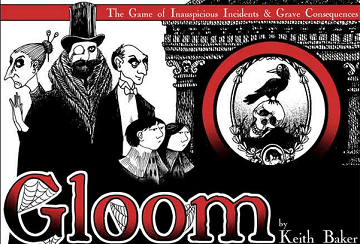
Most people choose happiness over sadness, but that isn’t the case for the families of Gloom. You assume control of one of four miserable families, making each family member as unhappy as possible before they die. An interesting and morbid concept for a game; perfect for Halloween.

Gloom01

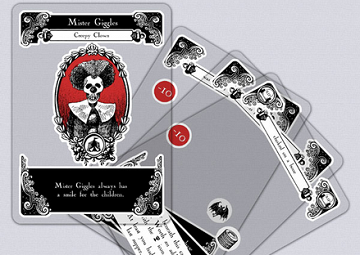
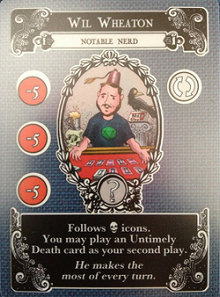
Gloom has four main card types: characters, modifiers, untimely deaths, and events. The character cards have no special effects. They’re just quirky misfits. But the core game mechanic of Gloom lies with the most abundant card type in the deck, the modifiers. In fact, modifier cards are played directly on top of character cards, and that’s the reason why all Gloom cards are printed on transparent plastic.

Gloom03

Each modifier gives a character a negative or positive score. You’ll want to play negative cards on your family and positive cards on your opponents’ families. Remember: the most miserable family wins. Think of it like a game of golf. The most miserable person, who also has the lowest score, wins.

When you have a good, negative score on your character, you can off them with an untimely death card. Now you get two cards that you can play on your turn, but you can’t play an untimely death card as your second card, otherwise you’d just play a negative modifier for your first card, and then kill your character with the very next card. That wouldn’t be very sporting. It might make you feel good, but feeling good goes against the tenor of Gloom.

Gloom02

The final card type differs from the previous three. While every other card type stays in play (they’re permanent cards), event cards are played once and then discarded. There are some event cards that you can play on an opponent’s turn as a response to a card they want to play which further separates event cards from the other three.

Play ends when one player runs out of family members. However many points you accumulated on your dead family members when this happens count toward your score. It don’t mean a thing if it ain’t rotting.

Gloom is easy to pick up and play, and its use of alliteration calls for copious chuckles. I’m not sure if there’s a lot of replayability, and you have to have luck on your side to win.

Gloom04

Verdict: A fun, fascinating, and award-winning card game with a sick sense of slapstick. Gloom will smack a smile on your face, while it puts frowns on your family. But don’t look for too many strong strategic elements.

Hanabi

Designer: Antoine Bauza
Publisher: ABACUSSPIELE
Date Released: 2010

Number of Players: 2-5
Age Range: 8 and up (14+ on the box; 10 for a family game)
Setup Time: minimal
Play Time: 25 minutes or less

Game Mechanics:
Cooperative Play
Hand Management
Memory
Set Collection

Game Flow and Review:
Hanabi is the Japanese word for fireworks, and the game Hanabi revolves around a team of fireworks experts trying to give spectators the most memorable display of their lives.

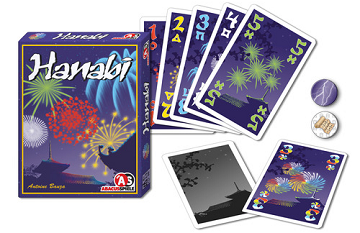
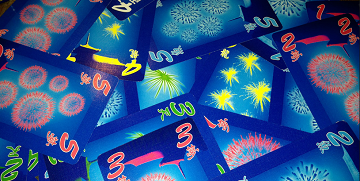
Hanabi01You and your team are trying to set off fireworks in the proper order, and there are five different colors of cards—depicting the various colors of fireworks—with numbers on each card—illustrating the number of colorful blasts at the moment you play the card—ranging from 1-5. Your goal is to place the different colored cards in ascending order. When was the last time a fireworks display started with the big finish?

It sounds easy enough. In fact, you get to see all of your teammates’ cards so you can help them play their cards in the right order. But there’s a catch. You’re not allowed to see your own hand. You’re playing this game blind.

Hanabi04You get three options during your turn: give a teammate a clue, play a card, and discard a card to earn another clue. It gets even more difficult. When you give a teammate a clue, you have to tell them where all their numbers of one type are or where all their same colored cards are. This proves problematic when you’re dealing with a hand with three ones but only one plays and there just so happens to be another card of the same color as the one “one” that plays. Suddenly, Hanabi turns deceptively complex.

You have to feed your teammates plays—while keeping a Poker face—and not leading them to a wrong conclusion about their hand. If you make a wrong play, the firework explodes in your face and you lose a fuse chip.

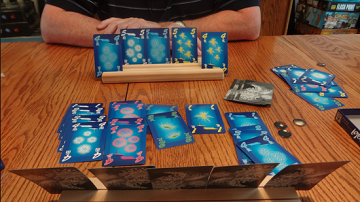
Hanabi05And of course you could always forget which cards are in your hand. You are allowed to shift cards around so you can keep track, and you’ll see players holding their cards between various fingers, grasping multiple sets of cards in their two hands, or staggering how they hold their cards to remember which group of cards are their ones and fives as well as their blues and reds.

Hanabi03The above picture of people playing with card racks instead of holding their cards is cheating in my book. Hold your hand, people.

Hanabi comes with an optional sixth suit of cards: the rainbow or wild cards. You have to determine how you’ll play the cards. If you want to make things easier, you can choose to play them as wild cards. But if you choose to play them as rainbow cards, you just gained another group of fireworks to play in the correct order. The second option is perfect for a group of people who need a bigger challenge.

Hanabi02Leave it Antoine Bauza to create yet another game with wildly different game mechanics and one that also attracts a different kind of gamer. Hanabi starts out easy enough but increases in difficulty and tension as the game progresses.

Verdict: A simple game with a mean streak, Hanabi spells cooperative fun for a group of friends and/or family. And it doesn’t hurt that it only takes twenty minutes or so to play.

VivaJava: The Coffee Game: The Dice Game

Designer: T. C. Petty III
Publisher: Dice Hate Me Games
Date Released: 2014

Number of Players: 1-4
Age Range: 10 and up
Setup Time: about 10 minutes
Play Time: about 30 minutes

Game Mechanics:
Deck/Pool Building
Dice Rolling
Modular Board
Press Your Luck

Game flow and Review:
This is another game we played while waiting for another game to open up at Nuke-con. But this one’s a lot more involved—certainly, not a game to learn, play and master in ten minutes.

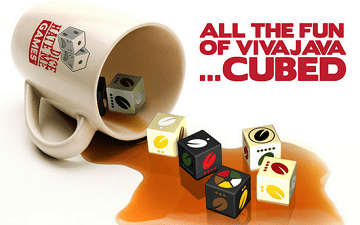
VivaJava: The Coffee Game: The Dice Game (or simply VivaJava Dice) serves as a nice follow up to the board game of the same name. You play the role of a VivaJava CoffeeCo employee, and you’re tasked with finding the best coffee beans and then creating unique and flavorful coffee blends.

VivaJava02

You begin with a pool of six-sided dice (usually your dice pool consists of five dice, but the rules can change the number of dice you roll in a turn). Every die has a number and a color associated with each side, and on your turn you either try to match the color/number of the face of each die for the signature blend, which is worth the most victory points, or roll five different numbers/colors on the dice to make the rainbow blend, which isn’t worth as many victory points as the signature blend but you get to taste the rainbow.

VivaJava03

So the game play works a little like Yahtzee, but instead of scoring points immediately for rolling a lot of the same color but not enough for a signature blend, each color represents a special ability (except for black—black has a constant and powerful ability—but we’ll cover this one later) and you can research the ability, making it stronger, by placing research points into the research track for the corresponding color. Once you master an ability, you lose the ability for the rest of the game, but you score a heap of points. First person to 21 points wins.

VivaJava04

And VivaJava Dice has a ton of plug-and-play research abilities, at least fifty or so, which makes each game unique and changes the strategy to win each play through. But perhaps the best ability comes with the black coffee bean. Blacks are also sixes, so they make the most powerful signature blends, but you can also trade your black coffee bean rolls for black dice. Black dice function similar to the normal dice pool, but you may be able to roll twice as many dice on your next roll.

VivaJava01

We only played one game, and the demo player left a bitter coffee taste in our mouth by marking his research points so light no one could see them. We didn’t know he was about to win the game until we saw his pencil graze the 18 point mark. But still, we can see VivaJava Dice for the dynamic, fun game it is. It blends Yahtzee and other press your luck games with the strategy you get from deck/pool building and grinds up both games with a neat coffee theme. It never felt so good to be a barista.

Verdict: If you like Yahtzee or deck/pool building games, you should give this game a try. You can’t quite place which game it most closely resembles but you wouldn’t want to know what goes into your Frappuccino either. Every game is a fresh brew.
Burgoo

Designer: Dan Manfredini
Publisher: Gizmet Gameworks
Date Released: 2014

Number of Players: 2-5
Age Range: 8 and up (10 and up on the box)
Setup Time: less than 5 minutes
Play Time: 20 minutes or less

Game Mechanics:
Hand Management

Game flow and Review:

We played this game for the first time in the thirty minutes between tournaments at Nuke-con, and it only took that long to learn it, but it’s more difficult to master.

Now a Burgoo is a communal stew usually prepared by a group of people, and this game mimics a Burgoo by having the players get rid of all their ingredients on the table by adding their ingredients to the Burgoo while having the most ingredients in their hand at the end. The first player to get rid of all their ingredients wins. The number of ingredients in your hand acts as the tie-breaker.

Burgoo03Each player in Burgoo starts the game with a line (or batch) of twelve ingredients (two of each of the six types) and one ingredient of each type in his hand. During your turn you have three options: split a batch, add to the stew, or sample the stew.

You can split a batch or line by simply making two smaller lines out of one line. This causes other ingredients to show up at the top and bottom of each of your batches which is advantageous because of the second option on a turn, adding to the stew.

When you choose to add ingredients to the stew, you declare the color of ingredient and whether the ingredient is on the top or bottom of every batch. The player whose turn it is discards the matching color ingredient from their hand, and all players with that color type and location combo move their ingredients into the stew.

Burgoo02So you have to be able to get rid of all your ingredients of a certain type while remaining aware of what kinds of batches your opponents have. You don’t want to help an opponent get rid of their ingredients without paying for them. If a batch is only one ingredient, you can choose to declare that it’s either on the top or bottom, but it isn’t a good idea to split all your ingredients into one tile batches. If your opponent declares an ingredient to add to the stew on their turn and you have a one ingredient batch of that type in front of you, you don’t add your ingredient to the Burgoo; you add it to your opponent’s hand.

But let’s say you messed up and got rid of an ingredient from your hand without getting rid of all the matching ingredients in front of you. You can sample the stew by taking an ingredient from the communal pot to your hand. This wastes a turn, slowing how quickly you can get rid of all your ingredients, but you may be able to get rid of a certain ingredient type before your opponent which can work to your favor.

Burgoo01

No one at the table used the sample the stew option on their turn because we were just learning the rules and playing the game straightforward. I can see many strategies you can use in Burgoo, and that makes an abstract strategy game work.

Verdict: A fun, quick game that should be on your radar if you’re looking for a party, strategy game that doesn’t take long to play.