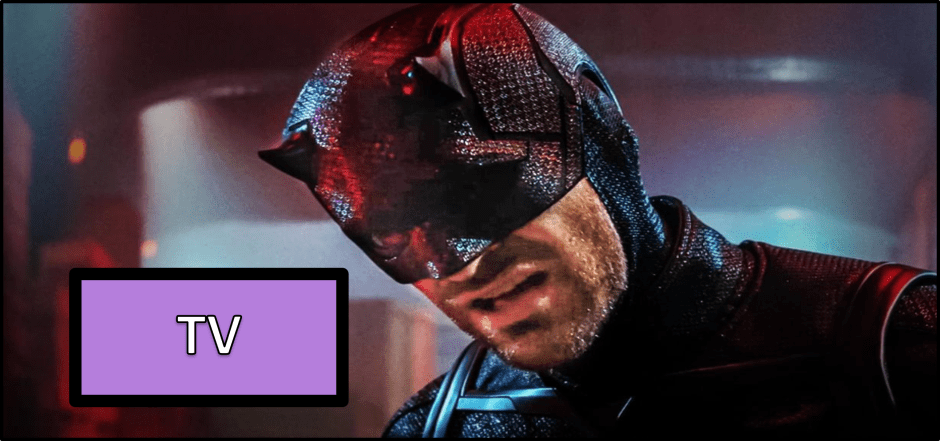
Happy Saturday, Geekly Gang! Kyra Kyle here with another reaction/review of a Daredevil: Born Again episode. This one may be more of a reaction than previous installments in this series. I only had time to watch “Gloves Off” once (getting ready for this weekend’s convention and sprucing up my board games for the Great Plains Gaming Festival’s gaming library has taken a lot of my time this week). As a result, I didn’t give “Gloves Off” my usual two or three viewings before posting a reaction/review. But I don’t think “Gloves Off” needed a second viewing. It was pretty straightforward, and that may be for the best.
I’m sensing a trend with Daredevil: Born Again. The show uses Bullseye as a catalyst for major change: Foggy’s death at the beginning of season one and Dex shooting Matt at the end of season one. We’ll get the spoiler part out of the way real quick. And just in case you have yet to watch “Gloves Off,” consider this a spoiler warning. Bullseye kills Kingpin’s wife, Vanessa, at the end of the episode. Again, Daredevil: Born Again choreographed this development before it happened. And again, I think this was the right move. “Gloves Off” may have other players sprinkled throughout its runtime, but the bulk of this episode focuses on the main cast. Another great development that I don’t think will continue in future episodes. Getting back to Venessa, her meeting with New York’s governor served as a farewell and foreshadowing.
As soon as Governor Marge McCaffrey said, “I can’t put my faith in Mayor Wilson Fisk…but I can put my faith in Mayor and Mrs. Fisk,” she signed Venessa’s death certificate. I knew immediately Venessa would perish. Daredevil: Born Again needed the tension an unleashed Kingpin would provide, and we saw Kingpin’s rage throughout “Gloves Off’s” runtime. The episode literally ends with Wilson Fisk boxing and killing (?) his opponent. Kingpin looked every part the role of someone who could challenge Daredevil to a physical confrontation. And Bullseye also gets portrayed as a competent killer. Most scenes with Bullseye are fun.
Daredevil: Born Again “Gloves Off” has plenty of dynamite scenes. The Bullseye scene at the beginning, where he takes down an entire squad of AVTF (Anti-Vigilante Task Force) members, was epic. I love it when Bullseye gets to cut loose. After watching this, I did question how Fisk could recruit so many people to the AVTF. Bullseye has been systematically killing off AVTF like they’re nameless Stormtroopers. I can’t imagine too many people wanting to sign up for AVTF duty when the survival rate is so low.
But moving on, Bullseye’s current storyline mirrors The Punisher’s from the original Netflix Daredevil. Bullseye is taking an extreme view, going further than Daredevil would ever consider, and the two (Daredevil and Bullseye) share a debate while they fight. Honestly, I think Daredevil: Born Again did a better job of integrating this debate (of killing versus non-lethal means of subduing enemies) in an action sequence than the original Daredevil. If I remember correctly, the bulk of The Punisher and Daredevil’s debate in Netflix’s Daredevil took place with Daredevil tied to a chimney. I much prefer Daredevil: Born Again’s presentation of this debate. At least, so far.
“Gloves Off” did a great job of tying up some loose ends, like the Northern Star’s first mate. It further develops Angela del Toro (soon to be White Tiger) as a member of the resistance, and Daredevil as the resistance’s symbol. “Gloves Off” does a fantastic job of setting up the idea of Kingpin without his wife, showing him to be a formidable foe (from a physical standpoint), and ending with what should be the catalyst for Fisk embracing the Kingpin moniker again. Daredevil: Born Again even did a good job of showing Wilson Fisk’s disdain for New York, calling him Mayor Kingpin through BB’s underground videos. “Gloves Off” is a great example of a standalone Daredevil: Born Again episode.
I do wonder if Daredevil: Born Again intends to continue using Bullseye as a narrative crutch. The show may be training viewers to perceive Daredevil: Born Again episodes that include Bullseye as more consequential. And Bullseye gets injured at the end of “Gloves Off.” We may not see him again until closer to Daredevil: Born Again’s season finale. You can’t see it, but I’m stroking my chin. Hmm. Bullseye may return closer to Daredevil: Born Again’s season finale. Coincidence?
But what do you think about Daredevil: Born Again “Gloves Off?” Let us know in the comments. Thank you for reading, and wherever you are, I hope you’re having a great day.
Happy Sunday, Geekly Gang! Kyra Kyle here with another week of Geek News. We have a slate of new releases, both board games and video games. We’ll get to them soon enough, but first, we’ll discuss our headlines from the previous week. And Disney’s interest in buying Epic Games (Fortnite’s publisher) tops those headlines, so let’s discuss a possible Disney acquisition of Epic Games.
Disney Keen on Buying Epic Games
The news may have dropped originally on April 1st, but this was no April Fool’s Joke. The Mouse House is interested in acquiring Fortnite publisher Epic Games. This leak’s proximity to last week’s story of Epic Games laying off over 1,000 employees is more than a coincidence. Currently, Epic Games isn’t operating from a source of strength. Disney may have found the perfect time to strike.
The claim of Disney being interested in purchasing Epic Games comes from veteran tech reporter Alex Heath, via The Town podcast. Disney has already heavily invested in Epic Games, and Fortnite more specifically. The battle royale giant has already sported crossovers with numerous Disney properties: Star Wars, Marvel, Pixar and Disney animated characters. Fortnite has even included a Disney-specific mode that offers fans the ability to play, watch, create, and shop.
“I know for a fact there are senior executives in Disney who want them to buy Epic and are just waiting for that moment,” Heath said, “and then there are others who think it’s a bad idea. If Epic ever sold, if it ever decided to call it quits on being an independent company, Disney would be the most natural home for it for a lot of reasons.”
If Epic Games were to sell to Disney, the House of Mouse would gain control of the Unreal Engine, which many video game companies use to develop their games. Disney doesn’t have a large footprint in the video game space. Acquiring Epic Games could go a long way toward Disney throwing its hat into the video game landscape. Disney did something similar with its streaming service offerings. Shortly after launching Disney+, they bought 20th Century Fox and its streaming giant Hulu. Disney does produce some games. Epic Games could give Disney the opening it may want to fully enter the world of video games.
Sadie Sink Signs 5-Film Deal for MCU Role
We’ve known Sadie Sink was set to star in a secret role for the upcoming Spider-Man: Brand New Day. Speculation about who Sink would portray exploded in the coming days, weeks, and months. Geekly may have even mentioned who we’d like to see her play. Ahem. Firestar. Ahem. But news of Sink signing a 5-film deal to play an MCU character means she’ll most likely portray someone of importance. So, not Firestar. Some fans still believe Sink could be playing the MCU’s version of Gwen Stacy (Ghost-Spider), but rumors still suggest that Emma Myers (Wednesday) or Kiernan Shipka (The Chilling Adventures of Sabrina) are the most likely candidates to portray Gwen Stacy. The most likely major role Sink could portray is the X-Men’s Jean Grey.
Sure, Geekly discussed Sink playing Mayday Parker (Peter and Mary Jane’s daughter/Spider-Girl) in Spider-Man: Brand New Day, but Mayday may not be a significant enough role for a 5-film deal. Five films? Yikes! Jean Grey is definitely a character whose actor would necessitate a 5-film deal. So, Marvel/Disney may have tipped their hat as to who Sink will play in Spider-Man: Brand New Day. But who knows? Marvel/Disney hasn’t confirmed anything. We’ll have to wait.
Arcs: Beyond the Reach Launches on KickStarter
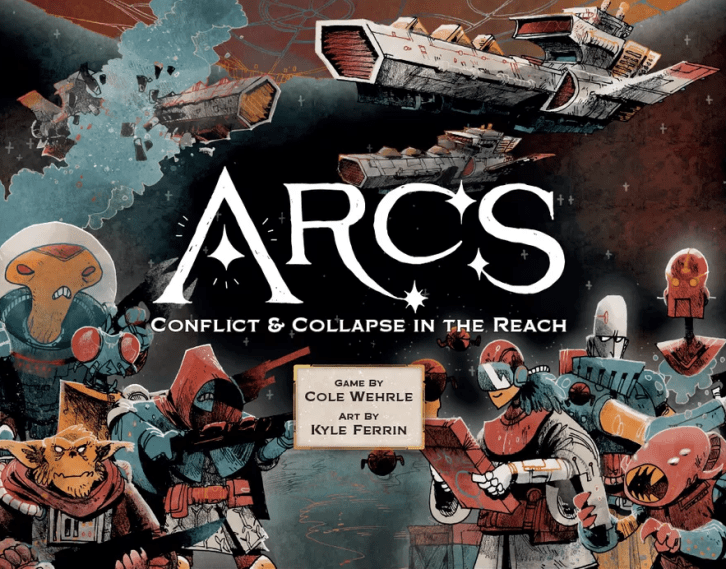
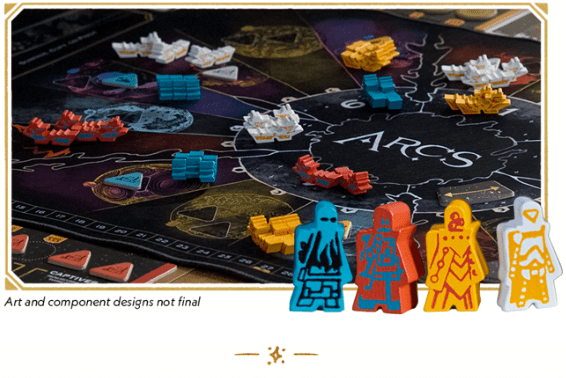
Arcs is a sharp, tactical space opera game set in a dark yet silly universe. Players represent officials from a distant, decaying and neglectful Empire who are now free to vie for dominance whether through battle, gathering scarce resources or diplomatic intrigue. Ready yourself for dramatic twists and turns as you launch into this galactic struggle.
A deck of cards in 4 suits with ranks from 1-7 (2-6 for fewer than 4 players) defines the action selection system. These cards are played in a trick-taking adjacent system to select actions, take the initiative and declare Ambitions. The 3 declared Ambitions are what will score in that deal. Timing is everything. Bad hands must be mitigated by careful card play and benefitting from other players’ card play.
Battles are resolved quickly, with the attacker choosing their level of risk. The defenders must be prepared with adequate defensive ships and cards in their tableau.
Thank you, Leder Games, for Arcs‘ description. Arcs has been on my short list of games to play for some time. It’s a space opera. Check. Factions have asymmetric powers. Double check. And Arcs has a storyline. What? Triple check. And each individual game last less time than a game of Twilight Imperium, but you get the 4X goodness you’d expect from a game of TI. Quadruple Check.
Leder Games consistently produces fabulous games: Root, Fort, Oath, and so many others. Arcs stands just outside the BGG (BoardGameGeek) Top 100. That’s no small feat. And I know several gamers who swear by this game. I wonder if one of them wouldn’t mind showing Arcs‘ ropes. Arcs: Beyond the Reach adds more campaign/story to the core game. This is my kind of expansion. If you’re more of a story-driven gamer, you may want to watch this campaign. This may be the best time to get into Arcs. Arcs: Beyond the Reach offers three pledge levels: $40, $90, and $250. If you’re interested in Arcs: Beyond the Reach, check out its KickStarter page.
Envy Born Games’ Tiny Game Series Two Launches on KickStarter
I’ve said it before, and I’m saying it again, I love the recent board game trend of packaging multiple smaller games to form a series of games. Button Shy Games may have started this trend with their wallet games, but keep them coming. This week marked the second series of Envy Born Games’ Tiny Games Series. Each of these games can fit inside a fanny pack. Who wears fanny packs? Envy Born Games is using the “fits inside a fanny pack” marketing. I don’t know who this is geared toward, but fanny pack does give us an idea of each game’s size. Three games comprise Envy Born Games’ Second Series of Tiny Games: Space Potato, Prowl, and Dragon Roost.
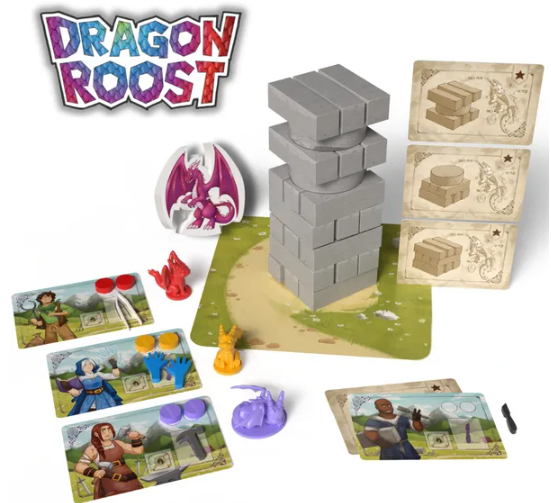
Dragon Roost is a cooperative Jenga. Players work together to build the perfect home for a set of baby dragons. Let’s see what the publisher Envy Born has to say about Dragon Roost.
Greetings, Townsfolk! Your cosy hamlet recently welcomed three new dragon hatchlings, but there’s not enough room for them in the watchtower where mother dragon has chosen to roost. Work together to manipulate the watchtower, to create safe spaces for the baby dragons and to settle the hatchlings in before mother dragon returns…
Working together, use tools to manipulate a tower of wooden pieces. Create enough space to safely balance 3 baby dragon miniatures before running out of tool actions. Finally, place the mother dragon on top of your tower to win. If any baby dragons fall, you lose (but don’t worry; we put up a net to catch them!). Test your skills over dozens of levels with new tower structures and challenge tokens.
Kyra Kyle here again. Thank you, Envy Born, for the description. Jenga has been played out. I like Dragon Roost’s twist on that core gameplay.
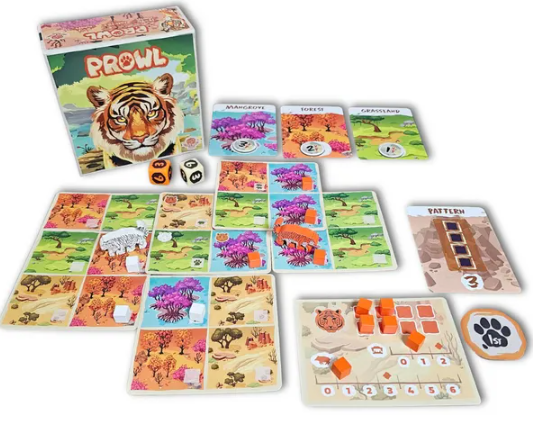
Prowl is a stripped-down, easy-to-learn area control game that adds an element of exploration. The game looks big for one that fits inside a fanny pack-sized box. Let’s hear what Envy Born has to say about Prowl.
Prowl is a compact area control game designed for 2 to 4 players, where each participant vies for dominance over territory with their tiger companion.
In this immersive game, players embody tigers navigating the wilderness, strategically exploring, hunting for sustenance, marking terrain, and initiating challenges to assert their dominance. As you navigate this dynamic landscape, you’ll need to safeguard your territory against rival tigers while seizing opportunities for expansion.
Beware, however, as rival tigers are always poised to challenge for coveted spots, ensuring constant engagement and tension. The survival of the fittest hinges on your ability to outmaneuver opponents and secure the most advantageous land.
Ultimately, victory is determined by accumulating points from controlling valuable territory, ensuring your tiger’s supremacy and survival in the unforgiving wilderness.
Kyra’s back. Back again. Thank you again, Envy Born. Prowl sounds intriguing, and I love how its theme varies wildly–pun intended–from Dragon Roost’s. But we have one final Envy Born game in this set.
Space Potato combines the good, old-fashioned worker placement mechanism and combines it with a resource management system. I like these two mechanisms. Let’s see what Envy Born has to say about Space Potato.
Space Potato is a small box worker placement game. You are stranded in space. Your spaceship was hit by an asteroid, shaped like a massive potato. Now, each of the corporations must mine critically needed resources from the asteroid to make repairs to their shared ship, while simultaneously collecting valuable resources for their companies.
On your turn you will place astronaut workers to take actions, mine the asteroid, or build essential components to repair the ship. Players will also manage their resources on their player boards and refine resources like Gold and Iridium into ingots to get points. Players will be rewarded with points for mining away chunks of the asteroid, refining materials, and repairing parts of the ship.
The player with the most points when the ship is finally repaired wins!
Hey, hey! I’m back, and count me in. It looks like the titular “space potato,” an asteroid, slowly disintegrates as you mine it for resources. Space Potato may be the most interesting of the three cool titles.
I like the idea of all three of these games. Envy Born Games offers pledges of $20 or $40 if you only want two of these titles, but for $49, you can claim all three. They even offer their previous series of Tiny Games in an All-In pledge ($90). If you’re interested in Envy Born Games’ second series of Tiny Games, check out its KickStarter page.
Garden Club Launches on KickStarter
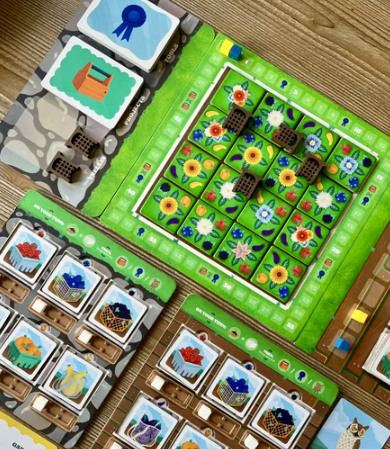
Welcome to the Garden Club, where fruits, veggies, and flowers flourish into clever combinations. Match, grow, and out-bloom your friends in this lighthearted game of strategy and charm!
In Garden Club, players compete to grow the most vibrant and well-balanced garden in the neighborhood. Each tile you place will plant fruits, veggies, and flowers — all carefully arranged to create stunning patterns and score points.
On your turn, you’ll select and place a tile into the collective garden, connecting matching icons to form combos and fulfill unique objectives. Then, you’ll select one tile as a point multiplier for what’s in your garden. The challenge lies in planning your layout — every placement can unlock new scoring opportunities or block a path to a perfect harvest.
Thank you, Chris Couch Games, for the Garden Club description. This week’s crowdfunding games have charm, and Garden Club is no exception. Look at the cute artwork. Garden Club continues multiple different trends in board gaming. It’s a two-player only game. Sometimes, you just want a fantastic two-player experience. This is great for couples. I should know. I’ve spent plenty of game nights playing cute and clever two-player games. Garden Club looks like it fits into that mold. And the nature theme has caught fire.
Garden Club is perfect for a spring crowdfunding project. And Chris Couch Games has a great habit of packaging similar in theme smaller games with its larger titles. Petal looks like another adorable gardening-themed game for two players. And Chris Couch Games are on a roll. Last Christmas’s Holiday Hill/Jingle Bell Roll combination dominated the holiday season. They’re a board game company to watch. Don’t believe me? Jamey Stegmaier (founder of Stonemaier Games) sings Garden Club’s praises. If you’re interested in Garden Club, check out its KickStarter page.
Modern Classic Goa Receives an Update with the Latest GameFound Project
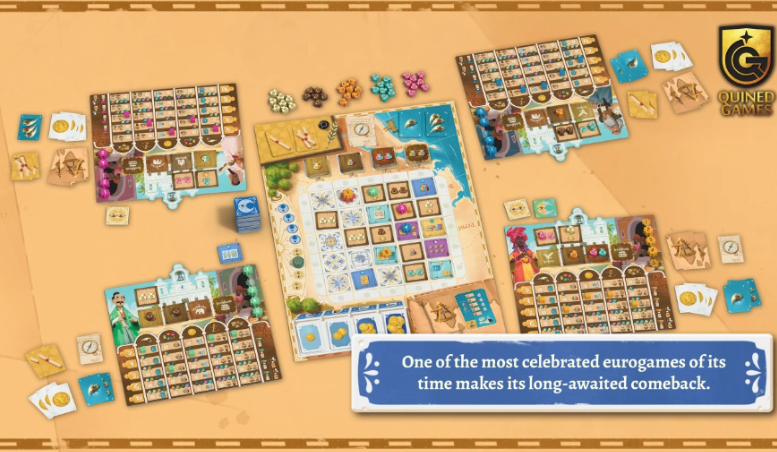
Goa, a strategy game of auctions and resource management, is set at the start of the 16th century: beautiful beaches, a mild climate, and one of the most important trading centers in the world. Competing companies deal in spices, send ships and colonists into the world, and invest money. Are you on top or at the bottom? It depends on how you invest your profits. Will you make your ships more efficient? Enhance your plantations? Recruit more colonists? Only a steady hand in business will help.
Each turn begins with an auction phase, where each player gets to auction one item (and the starting player two items). The first item being auctioned gives the right to go first the next turn (along with a card that gives an extra action). If you buy your own item, you pay it to the bank. If someone else buys the item you sell, they pay you. Items include plantations complete with crops, income tiles (income in money, ships, plantation refills each turn etc.), ships, settlers, and later on tiles that score points for certain achievements.
GameFound is the place for classic games getting a modern facelift. Goa is the latest in the trend, and I like it. So many classic board games get forgotten because they don’t look as nice as modern games. The original Goa didn’t look the best. This update gives it pizzazz. And you know Goa has stellar gameplay. It’s a classic for a reason. If you’re interested in Goa, check out its GameFound page.
Darwin’s Paradox! Releases
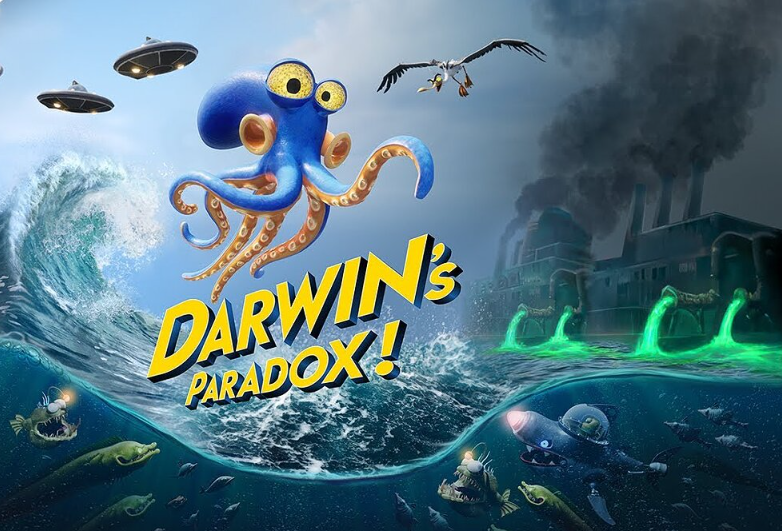
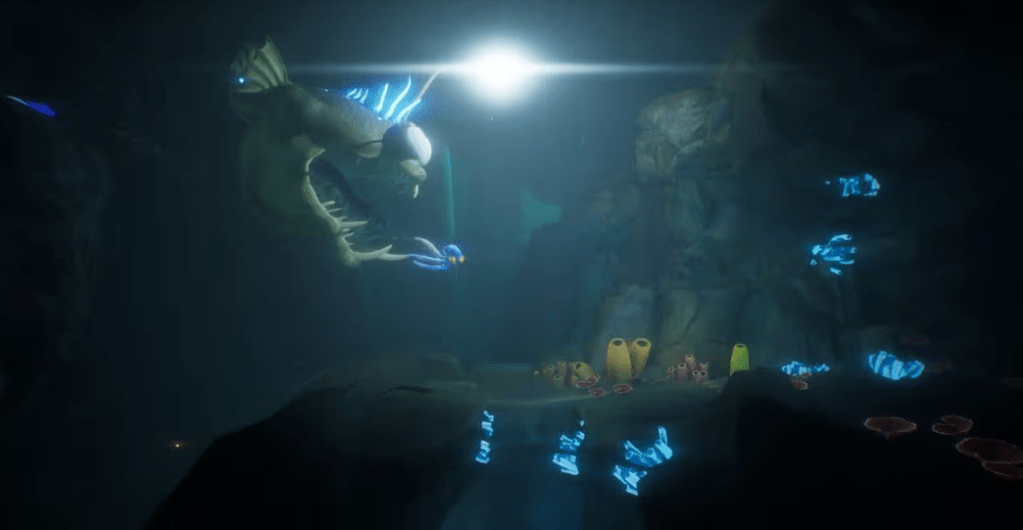
Darwin’s Paradox! is Paris-based developer ZDT Studio’s inaugural release. I wondered how long it would take for an octopus to receive the platformer game treatment. Those extra arms should allow for some interesting gameplay, and critics agree. Darwin’s Paradox! has gotten some solid reviews, especially for a fledgling video game developer like ZDT Studio.
And I like Darwin’s Paradox’s premise. Dive into the adventure with Darwin, an octopus as endearing as he is ingenious, torn from the ocean and trapped in a vast and mysterious industrial complex. Harness his unique talents and abilities to help him overcome the many dangers and traps in this captivating platformer and adventure game.
Darwin’s Paradox! bills itself as a 2.5D platformer. This leads to some interesting camera angles and shifts in perspective. At times, Darwin the octopus will navigate side-scrolling levels, but others, he traverses an almost 3-dimensional world. Gamers can take full advantage of Darwin’s abilities. His legs have suckers, and he can camouflage himself to avoid detection. Despite Darwin’s Paradox! being a platformer, I can see the game sporting some impressive stealth moments. Darwin’s Paradox! is available on PC, PlayStation 5, Nintendo Switch 2, and Xbox Series S/X.
Clean Up Earth Releases
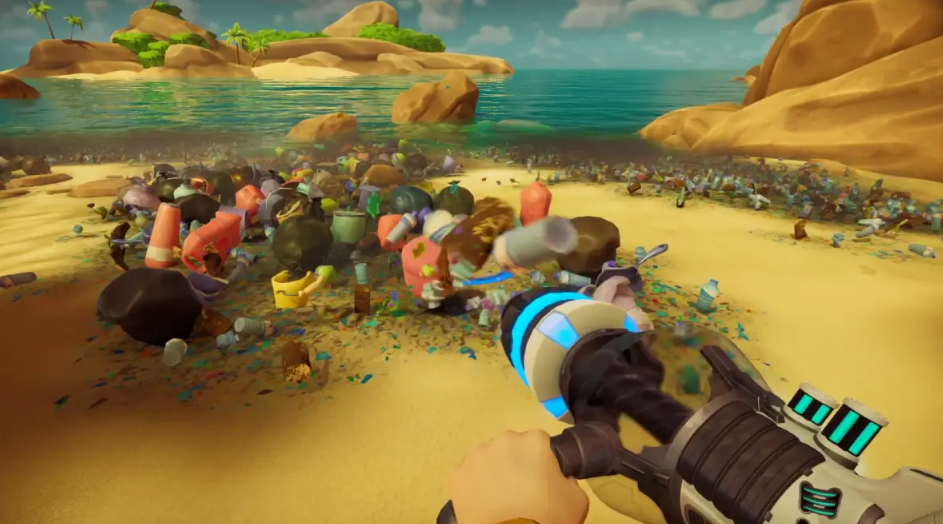
I like the premise of Clean Up Earth. Video games with a restoration theme have taken off over the past several years. I’ve played my share of these games. Geekly has covered Spilled! and Terra Nil this past year. Clean Up Earth gives me strong Slime Rancher vibes. Instead of using a vacuum gun on slimes (on an alien planet), you’re using a vacuum gun to clean up our planet. Clean Up Earth looks intriguing.
Clean Up Earth describes itself as a relaxing co-op restoration game where you vacuum waste, rebuild ecosystems, and watch nature return in real time. Play solo, with friends, or in online multiplayer sessions with up to 25 players. Community gameplay can help support real environmental initiatives with no extra spending required. I don’t know how this works. Clean Up Earth has my attention, but with mixed early reviews, I may wait until after a few patches. You can try out Clean Up Earth’s free demo and see if it’s something you’d enjoy before buying. Clean Up Earth is available on PC, PlayStation 5, and Xbox Series S/X.
That’s all the Geek News we have for you this week. Which games have your interest? Let us know in the comments. Thank you for reading, and wherever you are, I hope you’re having a great day.
Hey, hey, Geekly Gang! Kyra Kyle here for a second round of a Daredevil: Born Again review/reaction. This post will focus on the second season’s third episode, “The Scales and the Sword.” It played out exactly how I thought it would. If you didn’t catch my thought on “Shoot the Moon,” here’s a link to the previous episode’s reaction. While some may say that an episode playing out exactly as someone believed it would is not a good thing, it works in the case of “The Scales and the Sword.” But this fact may have played a role in Daredevil: Born Again’s second and third episodes releasing the same day. They’re two halves of the same episode.
Seriously, I got the sense that Disney/Marvel ended up with an hour and a half to two-hour episode and decided to cut it into two, roughly forty-five-minute episodes. Angela dons White Tiger’s amulet and helps Daredevil escape his infiltration of Red Hook. We even get a trial scene with Duquesne (Swordsman) that goes as well as you’d expect. All of this I predicted. But again, I don’t think this is a bad thing. It proves that Daredevil: Born Again is building toward something. Many of the major plot points have yet to be revealed. And I’m certain we’ll get plenty of twists and turns before the second season’s climax.
I said it before, and I’ll say it again, Heather Glenn serves as a fantastic secondary antagonist to Daredevil. She has a haunting history in the comic books. I won’t spoil that here, but trust me, Daredevil: Born Again could’ve gone a lot darker with her storyline. It still could. I like how she navigates her trauma at the hands of Muse. It makes her sympathetic. She believes she’s doing the right thing. Her scenes around Duquesne trial are great. I loved the quick rundown we got with Heather and Buck at the ball. We may have even gotten a hint that Blake will become The Rose. Buck and Heather could be an interesting couple.
I don’t have much to say beyond what I did with the previous episode’s (“Shoot the Moon”) reaction. It was a joy to watch Daredevil use his powers during the Red Hook infiltration, and I was shocked by how satisfying it was to watch Duquesne fight alongside the Man Without Fear. “Shoot the Moon” could stand on its own as an episode. I don’t believe “The Scales and the Sword” could’ve done the same. Disney/Marvel made the right decision to release both episodes on the same day. If we had gotten “The Scales and the Sword” by itself next week, we might’ve felt a little shortchanged. I’m glad Daredevil: Born Again tied up its early loose ends with this episode, and I hope this frees up the next episode to deliver a few twists.
That’s all I have for my reaction to “The Scales and the Sword.” I did watch the episode twice like I did the previous one, but there isn’t as much to discuss. “The Scales and the Sword” serves as an enjoyable second half to the last episode. But those are my opinions. What do you think? Let us know in the comments. Thank you for reading, and wherever you are, I hope you’re having a great day.
Happy Saturday, Geekly Gang! Kyra Kyle here with another Daredevil: Born Again reaction/review post. Daredevil: Born Again released two episodes this week, so we’ll have a reaction for the next episode, “The Scales & the Sword,” later today. I’m writing this reaction/review of “Shoot the Moon” after watching the episode twice. I like most of the developments in this episode, but Daredevil: Born Again also continues its penchant for adding more story threads and characters we need to follow. Before long, I may need a roadmap.
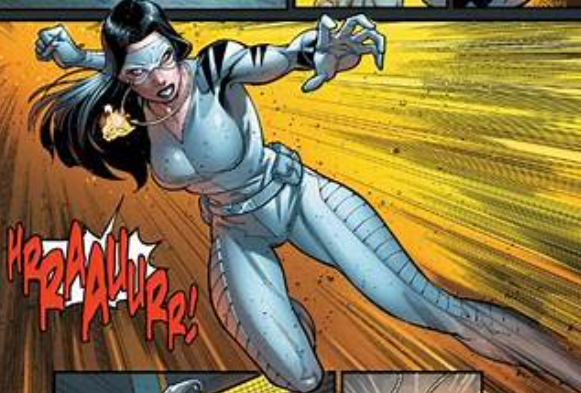
Angela del Toro, niece of Hector Ayala (White Tiger) and definitely the next White Tiger, is reintroduced in this episode. I don’t mind having another White Tiger this quickly. Several characters have donned the White Tiger mantle. I like the story centered around del Toro. It gives ICE in Minnesota vibes. Daredevil: Born Again, Season Two may not have shot these scenes as an homage to ICE in Minnesota, but one can see parallels. I’m down for it. My issue from last week stands. Daredevil: Born Again, Season Two has a massive cast. It does a lot of things great, but I don’t know where to focus. I don’t even know if the show knows to place its focus.
The massive cast was my rant from the previous episode. I don’t know if I mentioned enough of the previous episode’s strengths. I do like how Kirsten McDuffie gets roped into Angela’s superhero origin. McDuffie already fights the legal battles for vigilantes. She’s going to war for vigilantes in the courtroom. I can see her helping Angela as the new White Tiger outside the courtroom. This could mirror Foggy and Matt’s relationship way back in the original Netflix Daredevil. I’m all for that. And it’s confirmed. BB Urich is behind the Mayor Fisk smear campaign, and she’s the one dressing up as Kingpin. I think I called that last week. If I didn’t, I certainly thought BB was behind the Fisk mask. Honestly, the reveal wasn’t that big of a shock, so it’s best that it occurred so soon in the season. But the scene between BB and Deputy Mayor Daniel Blake was fantastic.
I liked Daniel Blake’s portrayal from last season. We lost him in the second season’s first episode, but “Shoot the Moon” highlights why Blake is a dynamic character. Michael Gandolfini shows unlimited range in this episode. He switches from affable to terrifying within the same scene. He’s so good in this role. I don’t care if he is or isn’t Wilson Fisk’s son, Richard Fisk, also known as the supervillain The Rose. There are so many great performances on the Wilson Fisk side of the aisle. Sheila Rivera stands on the precipice of learning who Mayor Kingpin is and watching her navigate which path to take is mesmerizing. Vanessa and Wilson Fisk share several heartfelt moments in “Shoot the Moon.” If they weren’t murderers, you’d swoon.
And “Shoot the Moon” brings back Benjamin “Dex” Poindexter into the fold. It’s fun watching Wilson Bethel’s Bullseye get to work. There are so many delicious layered plot threads introduced in Daredevil: Born Again so far. Bullseye takes down the anti-vigilante task force (AVTF). This obviously hurts Fisk’s AVTF and authority. But it doesn’t do Matt Murdock any favors, because Fisk can blame most of the deaths on Bullseye working alongside Daredevil. And I like how Fisk sends NYC citizens after Murdock because he’s a hero, while siccing his AVTF after Daredevil. The only thing I didn’t care for was Matt explaining what’s happening to Karen because whoever wrote the script didn’t trust the audience would pick up on Fisk playing both sides. This was Kingpin acting like Kingpin. There’s a reason we love the big guy. Vincent D’Onofrio is brilliant.
And that brings me back to Venessa and Wilson, and I’ll add Matt and Karen. I like the parallels between these two couples. There’s a reason why the Heather Glenn/Matt Murdock relationship felt like it would be short-lived. The two didn’t have chemistry. Matt Murdock and Karen Page’s relationship is the one that could rival Venessa and Wilson’s, and it’s great to see them together in Daredevil: Born Again. But I do like Heather Glenn as a secondary antagonist. The Vigilante Trials should play a huge role in Daredevil: Born Again’s Second Season. I’m watching these episodes one at a time, so I may contradict myself in the next post. In fact, I’m going to make some predictions before I watch the next episode, “The Scales & the Sword.”
Sword makes me wonder if the Swordsman will get involved. We may see Duquesne, but I think we’re more likely to see him in court, the aforementioned Vigilante Trials, because Scales and the Sword is also the symbol for justice. Red Hook was built up in this episode, so we’ll see Daredevil attempt to infiltrate the facility. And there’s an outside chance del Toro will don the White Tiger amulet. Most likely, she won’t wear an outfit…yet.
I may have focused a lot on the first episode’s shortcomings, but I do like Daredevil: Born Again’s, Second Season. There are a lot of interesting characters and plotlines. I just hope we get some satisfying payoffs. But what do you think? Let us know in the comments. Thank you for reading, and wherever you are, I hope you’re having a great day.
Happy Monday, Geekly Gang! Kyra Kyle here with a review/reaction to Daredevil: Born Again, Season Two’s premiere, “The Northern Star.” Daredevil: Born Again’s second season begins well, but one issue persists: the show feels off-balance. I’ll get to the good stuff soon (and there is a lot to like about “The Northern Star”), but I can see Daredevil: Born Again’s showrunners’ original vision of making seasons one and two of Daredevil: Born Again a single season. I don’t yet know if this show could’ve worked better with these first two seasons squeezed into a single season, but I’ve been on the record stating that Daredevil: Born Again Season One did a better job developing Kingpin’s side of the narrative, while shortchanging Daredevil’s. Yeah. This season, or at least during this season’s premiere, the roles reversed.
Daredevil: Born Again has a balancing issue. Both “seasons” could’ve benefited from evenly spreading the love for Daredevil and Kingpin’s story. Granted, “The Northern Star” is season two’s premiere, and I didn’t rewatch Daredevil: Born Again’s first season. But I shouldn’t have to rewatch a show’s previous season. Again, this is the first episode of the new season. All may be revealed in future episodes. But that’s also my point. We had to wait a full calendar year for Foggy Nelson’s death to find meaning. Sure, Karen Page left Hell’s Kitchen for most of last season, but the first season spent too much time trying to develop new characters. Matt Murdock seldom grieved the loss of his friend.
He does in “The Northern Star,” though. What a difference twelve real-world months can make. Matt’s story glossing over Foggy’s death may have sparked a lot of last season’s doubts. It wasn’t that the showrunners couldn’t kill Foggy. It was that no one seemed to care he died. I’m glad that we finally see Matt and Karen grieving the loss. And that makes me wonder what this story could’ve looked like where this episode part of the first season. We would’ve seen this catharsis sooner, and I wouldn’t be playing catch-up, trying to remember who everyone is, with Kingpin’s characters. Were there always this many characters? Yikes! I may have mentioned the volume of new characters in the previous season, but returning to Daredevil: Born Again after a year requires flashcards. Who are these people?
And we’re not done introducing more characters like Mr. Charles, Matthew Lillard’s character, who works for CIA director Valentina Allegra de Fontaine. That’s a mouthful. Try saying that name three times fast. Mr. Charles is on Kingpin’s side of the narrative. We also get introduced to Ariana, who owns the Aegean Gardens, and aids in witness protection. Didn’t know that was a thing. That’s cool. BB Urich has more time to develop. I still don’t like the BB Report segments (the people on the street interviews with a shaky cam), but it’s clear, through a scene between Urich and Page, that she’s also the one behind the gorilla news stories defaming Mayor Fisk. This story angle has legs.
But that’s another minor issue. Many of these story angles have interesting ways they could go, but will Daredevil: Born Again season two have enough runtime to explore all of them? It’ll have to cut certain threads. I haven’t even mentioned Heather Glenn’s full heel turn. We got a whiff of Glenn (Murdock’s therapist girlfriend from last year) changing sides by the end of Daredevil: Born Again season one, but it was nice to see the show explore plenty of gray areas. Glenn may do the wrong things, but she believes she’s in the right. She suffers from PTSD after the attack by Muse. While I didn’t like how quickly Daredevil: Born Again dispatched Muse, I love how he continues to haunt the series.
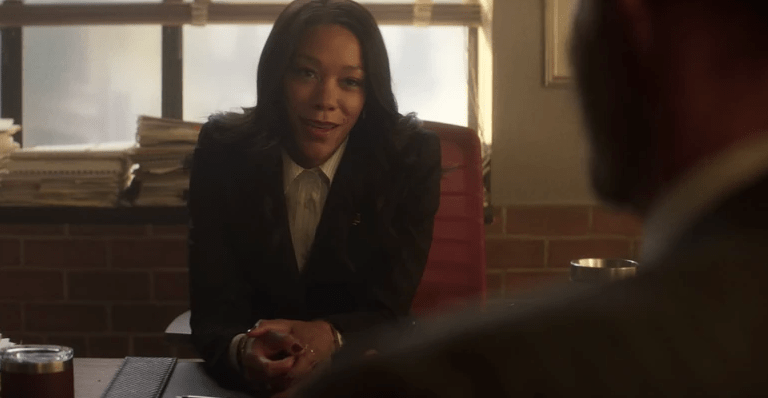
And then there’s Murdock’s new law firm partner, Kirsten McDuffie (pictured above), who has an interesting interaction with one of Fisk’s lawyers, Benjamin Hochberg. And there’s also Cherry, the retired cop turned Murock’s personal investigator, who gets more to do in this episode. And Bullseye’s return gets teased. And the antivigilante task force continues its insane mission. And did I mention that the poignant Page-Urich scene is available because of a lead Page gets from Jessica Jones? Well, it is. And Krysten Ritter will return as Jessica Jones in Daredevil: Born Again season two. There’s a lot to unpack in “The Northern Star.” I watched this episode four or five times; that’s why this reaction got postponed from Saturday to Monday. I needed the weekend to digest.
Most of these are great developments. I’d love to see Ritter return as Jones. The Bullseye tease has me hyped. So many of these character developments are fun: McDuffie’s, Cherry’s, Page’s, the AVTF, most of Fisk’s entourage, and Glenn’s PTSD and struggling with remaining objective. I don’t know how Daredevil: Born Again season two plans to tie up some of these loose ends. Thankfully, Daredevil: Born Again will receive a third season; they’re already filming the third season. But I don’t want another Lost situation. For those who don’t know, the television show Lost presented numerous great ideas and seldom finished any of them.
Daredevil: Born Again should make good on many of its premises, but Matt did get shot (by Bullseye) at the end of last season, and we didn’t see the shot’s effects in the second season’s first episode. Something tells me we’ll get flashbacks and flash sideways and flash forwards to fill us in with Matt recovering from his gunshot. I’ll just leave this here: Lost used a lot of flashbacks and flash sideways and flash forwards, too. Uh oh. Let’s hope we don’t get too many flash somewheres.
That’s all I have for “The Northern Star.” Oddly enough, this episode could’ve used more guidance from something like a northern star. Daredevil: Born Again’s Season Two premiere was a solid beginning. I just hope the season can stick the landing. But what did you think? Let us know in the comments. Thank you for reading, and wherever you are, I hope you’re having a great day.
Hey, hey, Geekly Gang! Kyra Kyle here again. I had intended to split my reaction to the MCU’s Wonder Man miniseries into two halves, but it wasn’t a long series, and I got into the series. In short, Wonder Man is one of the best Marvel television shows in years.
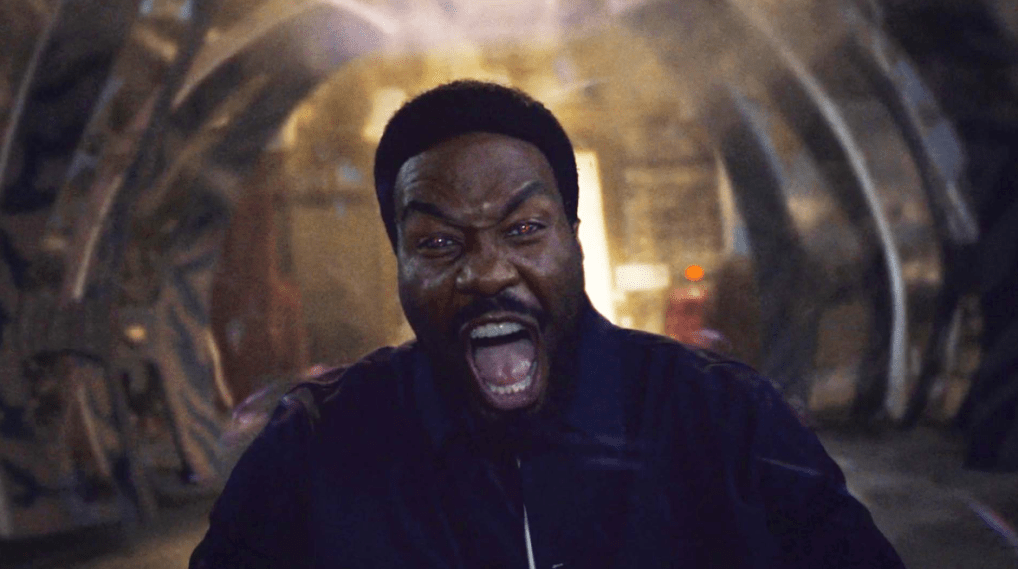
First, Wonder Man is only the second Marvel project to receive the Marvel Spotlight moniker; Echo was the first. The idea behind Marvel Spotlight projects is that one doesn’t need to know much about the MCU to understand and enjoy the show. While Wonder Man has some references to the greater MCU (most notably Ben Kingsley’s Trevor Slattery, the fake Mandarin from Iron Man 3), it does a great job of weaving in the information you need to know about the character during the series’ runtime. Second, Wonder Man abandons most superhero tropes. This is a superhero show for people who don’t like or are tired of superhero shows. The show centers around Trevor Slattery and Simon Williams’s (portrayed by Yahya Abdul-Mateen II) relationship.
The two of them are theater nerds, trying their best to break it in Hollywood. Their chemistry is electric. I’m struggling not to give away any spoilers. There will be some. You’ve been warned. Captured by the United States Department of Damage Control, Slattery is tasked with fetching enough dirt on Williams to lock him away for dangerous superpowers. But Williams only wants to be an actor. Unfortunately for Williams, there’s a ban on people with superpowers from becoming actors ever since Josh Gad–the actual actor, not a character Gad was portraying–disappeared into Darius “Doorman” Davis. There’s an episode in the middle of Wonder Man that chronicles Doorman’s exploits. It was a standout episode in a series filled with standouts.
Wonder Man manages to maintain tension and intrigue, despite the title character refusing to use his powers through most of the show’s runtime. This is one of the few Marvel shows that avoids an awkward middle. You know what I mean. MCU shows are notorious for losing their way and including filler episodes somewhere around the halfway point. The aforementioned Doorman episode occurs right when most MCU shows would falter. And it’s so good.
While it helped to already enjoy Kingley’s Trevor Slattery, pairing him with Badul-Mateen’s Simon Williams is brilliant. They make an unlikely pair of friends. But that’s skin deep. If you know the two of them, they’re more alike than one might guess. They’re both outsiders. Both have few if any true friends. They need each other, and their personalities play extremely well off each other. Trev is more laid-back, and Simon lives in his head. Heck, Simon overthinks everything. Trev helps Simon to relax; he literally teaches Simon the box breathing exercise. But Simon reminds Trev how rewarding acting can be; with Simon’s help, Trev rediscovers his passion.
The rest of Wonder Man’s cast is fantastic. While the show does include comedic moments (How can you not with Kingsley’s Slattery in the production?), it never loses sight of its emotional center. Wonder Man is one of the rare Marvel shows that avoids undercutting scenes with emotional weight with a bad joke. Kudos! I was not expecting that. Honestly, I thought Trevor Slattery would ham up every scene in which he was involved. I am happy to be wrong Unlike a lot of other Marvel shows, I’m going to return to this one. Wonder Man is worth your time. It reminds us of what the MCU can be. Fingers crossed that we’ll get other great Marvel Spotlight shows in the future.
What did you think of Wonder Man? Let us know in the comments. Thank you for reading, and wherever you are, I hope you’re having a great day.




















 jkgeekly.com