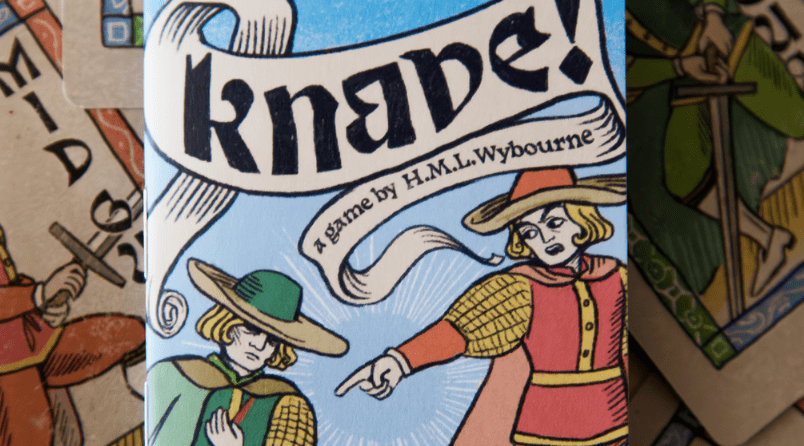

Happy Friday, Geekly Gang! Kyra Kyle here with another board game design brain dump. I’m taking a break from Rustbucket Riots—which I covered in last month’s brain dump–and discuss a Blackjack Deck Building game I originally made in 2018. Seven years! Yikes! Guess I got the seven-year itch. This Blackjack Deck Builder has gone through multiple minor rule modifications and name changes. The deck, based on a standard playing card deck, doesn’t have jacks and kings, so it’s had the name No Jack and No Kings.
Play Faster
My oldest daughter had a high school friend, who will remain nameless. We’ll call her C. C loved deck building games, but she wouldn’t draw her hand at the end of each turn (allowing her to plan her next turn), and every time she drew cards into her hand, she’d act like she was reading them for the first time. This frustrated my daughter and her friends. I thought of No Jack or No Kings to fix this issue.
A quick explanation of deck building card games: each player begins with the same (or at least similar) small decks and purchase cards from a supply to add to their decks, making each deck unique.
While many starter cards in a deck building game have limited text, cards one would add to their hands could contain a heap of text. This would cause C’s turns to last three minutes or more, as she read the more complicated cards that she added to her deck. So, I took out most text. Standard playing cards have little to no text. Next, C had the issue of not drawing her hand at the end of her turn. What standard card game doesn’t require a hand? Blackjack.
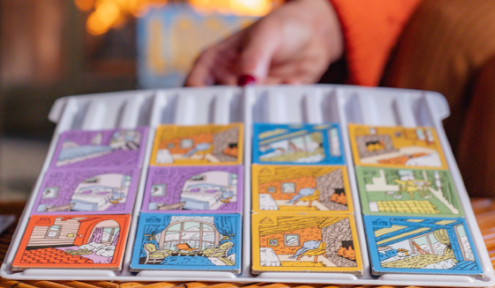
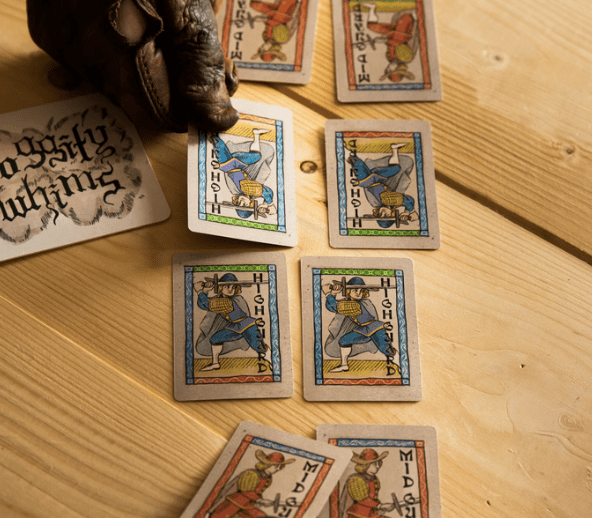
The above sample card (Page of Coins) is a prototype. The end product will hopefully look a lot better. Lol.
I merged deck building with Blackjack and came up with No Jack or No Kings, and it worked. With the exception of changing the suits, the only cards that look different from a deck of standard playing cards are the face cards. C knew how to play Blackjack. Players would draw cards from the top of their decks, following the standard rules for Blackjack. If you drew over 22 points of cards, you’d bust and lose your turn. If a face card remains in play (without busting) at the end of a turn, the player can move the face card to their tableau and gain its ability. In the case of the page above, every time that player draws a coin suit card, they gain one extra money to purchase other cards. No Jack/No Kings starter decks begin with one face card from one of the four suits. Each suit has a different power.
Trouble with Asymmetry
Most players in deck building games begin with the exact same cards. Choosing to go with asymmetric powers at the onset of this game, however slight, proves difficult to balance. Brushes allow players to cull cards from their discard. Deck building experts see this as overpowered. But Diamonds and Cups have better win percentages. Diamonds allow players to manipulate decks (take cards from a discard and placing them on the bottom). If you’re good at counting cards, you can induce more 21s (or Blackjacks). Cups let players discard a drawn card and draw a new one. This is also strong.
The first page I showed, the Page of Coins, is the weakest of all four. But perception matters. Even though I’ve playtested No Jack/No Kings hundreds of times and found Cups and Diamonds win more often than not, players still “feel” more powerful with Brushes and, to a lesser extent, Coins. Granted, one of my playtest weekends was with someone at a Protospiel. He played No Jack/No Kings throughout the entire weekend (like a few dozen times), hoping to sculpt a deck of only Tens and Aces. This gamer played Brushes in each game and lost every time. Winning didn’t factor into his enjoyment. He wanted to build a near-perfect deck. So, the numbers may be a little skewed.
Does anything need to be changed? Honestly, I don’t know.
How to Win at No Jack/No Kings
I just realized we discussed No Jack/No Kings mechanisms without sharing how to win. There’s a separate deck of Patrons. Every patron can be claimed with a Blackjack (21), but each patron also gives discounts to two suits. If you have a face card from either suit in your tableau and you reach the lower number, you can claim the patron. Every turn, you can either claim a patron or purchase cards from the supply. That’s how the gamer (Protospiel) lost so many times. He would purchase cards if they fit in his “perfect deck” instead of claiming a patron. The first player to claim six patrons wins.
No Theme and Simple Mechanisms
I don’t know why I shelved No Jack/No Kings for almost a decade. My best guess is that I wanted No Jack/No Kings to have more theme or more complexity. I no longer care if No Jack/No Kings has a theme, and any additional mechanisms I added to the game diluted the core gameplay. I was obsessed with everything No Jack/No Kings didn’t have and failed to see what it did have. That same Protospiel (seven years ago, I’m guessing), I only taught the game once. Other gamers taught No Jack/No Kings to the rest of the convention, and the game was played consistently for two and a half days. I need to get out of my own way. Ugh!
I’m finalizing the starter decks and the cost of cards. But there are shockingly few things to balance/tweak after I pin down the starter decks, so I’m left with one question. Which name do you like better, No Jack or No Kings?
Let me know in the comments. Thank you for reading, and wherever you are, I hope you’re having a great day.
Happy Sunday, Geekly Gang! Kyra Kyle here. I’m still on a pseudo-hiatus with Novel in November. I just shared a writing update a couple days ago, but this means that Geek News will mostly be video game and board game new releases. Let’s begin with board game new releases.
Exactly as Planned Sneaks Onto GameFound
I love it when a publisher/designer allows players to demo their game. Exactly As Planned offers a solo, cake-walk heist to whet gamers’ whistles. You can play the game by checking out Exactly As Planned’s GameFound page. And it won’t take long. Exactly As Planned lasts exactly 5-minutes. Gamers on the clock, attempting to play the correct cards to pull off their semi-coordinated heist.
I love Exactly As Planned’s box art. The off-centered “As” is hilarious. Once gamers become accustomed to Exactly As Planned’s ruleset, they can add a little spice to the proceedings. One team member may be speaking only in questions, a second might have to stare at the ceiling, and a third may be restricted to saying only “yes” and “no.” If Exactly As Planned sounds like chaotic fun, check out its GameFound page.
Arydia: The Paths We Dare Tread Journeys to GameFound
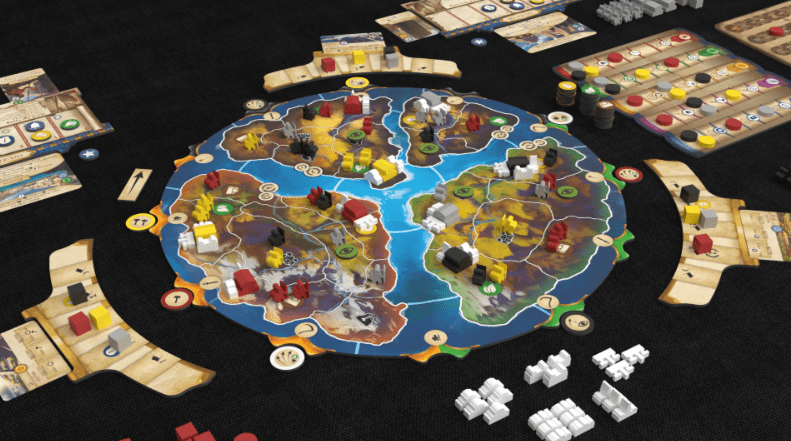
Arydia: The Paths We Dare Tread is another big box, fantasy, open-world, and open-ended exploration board game. So, what separates Arydia from other board games like it that we’ve covered over the past handful of months? Prowess.
Publisher Far Off Games and designer Cody Miller of Xia: Legends of a Drift System are well known for immersive, exploration board games. Despite being over a decade old, Xia maintains a top 200 spot on BGG. And Arydia: The Paths We Dare Tread brings this same scale and grandeur to a fantasy setting. This GameFound campaign is Arydia’s second printing. The game sports a whopping 9.1 out 10 on BGG, where most games are lucky to get a 7. And I love the idea of a “green legacy” game. Far Off Games notes that Arydia features all the hallmarks of a legacy game–packages to open, hidden information, progression, discovery, and exploration–but allows you to reset the game when you complete it so that you can start again or pass it on to someone else.
We need more “green legacy” games. While it can be cool to burn your board game after playing (like I’ve seen others do with Pandemic Legacy), it’s also a waste. And look at the dice. I don’t know if the dice signal how a unit can move or where a spell casts its area of effect, but I’d like to find out. Arydia comes with plenty of detailed miniatures and other game components. If you’re interested in Arydia, check out its GameFound page.
Chants for the Old Ones Lurks on GameFound
Chants for the Old Ones is another second printing making its way onto GameFound, this time with two new expansions: The Eye of Dagon and The New Orders’ Reckoning. Players control unique cults with various paths to earn victory and unleash the power of the Old Ones. Perform dark rituals. Control key areas of the city. Do your worst in this deck-building and worker placement game set in the Cthulhu Mythos.
I like Chants for the Old Ones’ combination of deck building and worker placement. Those are two fantastic game mechanisms. Playing a Lovecraftian cult is a bonus. And I like how The New Orders’ Reckoning expansion adds a playable cult for the King in Yellow (Hastur) himself. If you’d like to get your Cthulhu on, check out Chants for the Old Ones’ GameFound page.
Elements of Truth Launches on KickStarter
Elements of Truth shakes up the traditional trivia game. The game includes four question types for each of its 250 cards: More or Less, Multiple Choice, Number Line, and True or False. Multiple Choice and True and False need no introduction. More or Less has players choose whether one “fill-in-the-blank” has more or less of something than another “fill-in-the-blank” thing. But Number Line has me most intrigued. Players write an answer on the (provided) whiteboard to see if they can get as close to the numerical correct answer.
Elements of Truth offers five expansion packs (four pictured above). Each question pack includes an additional 200 question cards in a particular subject. My history of playing Trivial Pursuit makes me wonder if gamers will want to pick up at least one of these expansion packs. 250 question cards are easy to memorize after a few plays. The base game pledge is $39. Players can get the first question pack (Veritasium, which isn’t pictured above) in addition to the base game for $59. Or go all-in for $99. If you’re interested in Elements of Truth, check out its KickStarter page.
Anno 117: Pax Romana Releases
The Anno series of city-building real-time strategy games continues with the earliest setting for the franchise. Gamers are given the choice to build the Roman Empire (Latium) or the Celtic kingdom (Albion). You’ll have the choice between paths of loyalty or rebellion. You can focus on military might or economic growth. And, for the first time, gamers will be able to play Anno 117: Pax Romana in first-person.
This option alone piques my interest for Anno 117: Pax Romana. I’ve played numerous city-building games and always wondered what it would be like to experience my city at ground level. Anno 117: Pax Romana has received good reviews from critics. Rome has been built (and torn down) in many video games. I may try my hand at building the Celtic Kingdom. Anno 117: Pax Romana is available on PC, PlayStation 5, and Xbox Series X/S.
Lumines Arise Releases on Steam and PlayStation
I’ve been a fan of the Lumines series ever since it was first released on the PlayStation Portable, and Lumines Arise is the first new title in the series since 2012. More than just a Tetris clone, Lumines gives the familiar formula a new twist. Every block is 2×2, but they contain up to two colors. The blocks slide into spaces left in the puzzle, and gamers must match colors (in 2×2 blocks or better) before they explode.
I’ve always enjoyed Lumines’s slick design. At first glance, you may find Lumines confusing, but you’ll get used to the game’s aesthetics soon enough. Lumines Arise includes numerous game modes, ensuring ample replayability. The classic Journey mode returns. Gamers will play over 35 stages, called skins. Each skin has its own theme with music and visuals to match the stage’s vibe. I love the themes that use vegetables. What?
After gamers complete the Journey, they unlock a new mode called Survival. Players play endlessly–or at least until they top out–with the skins transitioning as they reach certain milestones. That could get trippy with Lumines Arise’s bizarre skins. Lumines Arise also offers Training Missions, Challenges (various game states with goals and some variations on gameplay), Time Attack (clear enough blocks in the allotted time), and Dig Down where the blocks come from below. Trippy.
I can’t wait to get my hands on Lumines Arise. It’s received good to great reviews from most critics, with a slight edge given to the PlayStation 5 version over the PC version. Honestly, I always intended to pick up this title for PS5 anyway.
That’s all the Geek News we have for this week. Thank you for reading, and wherever you are, I hope you’re having a great day.
Happy Sunday, Geekly Gang! Kyra Kyle here. I’m still on my pseudo-hiatus for the Novel in November event, so this week’s Geek News will include board games and video games that released this past week. Let’s start this week’s Geek News with board game new releases.
Employee Disposal Program Launches on KickStarter
Who needs political correctness? Employee Disposal Program–awesome name by the way–offers a light, party game, which pokes fun at a corporation’s HR Department. Players begin with two sanity and five action cards. A player’s sanity is their health and once a player loses all their sanity, they’re eliminated from the game.
The above card, “Ethnic Confusion Effect,” is a good example of Employee Disposal Program’s politically incorrectness. Employee Disposal Program won’t be for everyone. I’m not the biggest fan of Take That (backstabby) party games, but Employee Disposal Program plays quickly, and if a card entitled “Karen From Human Resources” tickles your funny bone, Employee Disposal Program may be worth looking into. Pledges range from about $26 (publisher Pleiades Interactive is headquartered in Australia) to about $127. If you’re interested in Employee Disposal Program, check out its KickStarter page.
Zeit Heist Sneaks Onto KickStarter
Publisher Blue Rondo Games has released a couple of quirky, easy-to-learn board games, and Zeit Heist looks to continue that trend. Players build a heist team. The first one to successfully complete a victory condition wins. But Zeit Heist includes multiple victory conditions. You could sneak into the museum before it opens with the Scientist, the Spy, and Lockpicker. Or break into the museum after it opens with the Driver, Muscle, and an Inside Man. Or one could even sway the Police, Detective, and Undercover Cop to confiscate the Zeitnium in your name. Oh, yeah. The object you’re trying to steal is named Zeitnium. Nice!
In Zeit Heist, players can manipulate time. Speed up time. Slow it down. Or freeze it. Time is a Tool. Zeit Heist’s box looks intriguing. A timer comes included in the box lid. Zeit Heist’s production value looks great, and at a swift fifteen-minute playtime, Zeit Heist doesn’t outstay its welcome. If you’re interested in Zeit Heist, check out its KickStarter page.
Snowdonia: Grand Tour Chugs Onto GameFound
The original Snowdonia is a classic, 2012 board game, but many newer board gamers have yet to play Snowdonia. Snowdonia: Grand Tour may be the perfect place to first experience this game. Naylor Games has done a great job giving this dated game a facelift. While most reprints only focus on making the game look nice, Snowdonia: Grant Tour adds a range of scenarios and other game elements to make Snowdonia: Grand Tour enticing for long-time Snowdonia players.
Each scenario comes with its own map board. Snowdonia: Grand Tour streamlines the original’s setup. And there’s a compatibility pack just in case you own the original. What’s not to love? If you’ve ever been interested in this classic worker placement, railroad construction game, Snowdonia: Grand Tour may be perfect. If you’re interested in Snowdonia: Grand Tour, check out its GameFound page.
Restless Journeys Onto GameFound
We’ve seen a lot of roleplaying game in a boxes in recent years. Restless applies this idea to a storybook gameplay, and I’m here for it. Restless looks amazing. I love its idea of quick saves. While Restless plays out over three acts, gamers can save their game within the box and in between each act. Awesome!
Depending on your playstyle and the magical species you plan to play as, a gamer’s experience in Restless greatly varies. This gives me Harmonies vibes. Unlike Harmonies, Restless is semi-cooperative. I don’t know exactly how that works. I imagine players can help each other complete their individual storylines. If so, fun! Restless lasts forty-five minutes per player, per act. And it can be played as a solo experience. If you’re interested in Restless, check out its GameFound page.
Europa Universalis V Releases
The Europa Universalis game series is not for the faint of heart. Gamers guide their chosen country through world history. In the latest game of the series, Europa Universalis V, time spans from April 1, 1337, to January 1, 1837. Typically, Europa Universalis offers greater granular strategic choices than games in the Civilization series. While Civilization has streamlined its gameplay, allowing for a wider audience, Europa Universalis is more like “Git Gud.”
Choosing a starting nation is crucial in Europa Universalis V. Each nation has its own unique skills and benefits, and if you find one of the 314 nations that best suits your playstyle, you can conquer most–if not all–of Europe. Fortunately, Europa Universalis V offers more automation than previous titles in the series. Players can choose to focus on certain aspects of governing, while allowing the game’s AI to tackle parts that interest them less. I like this inclusion. Sometimes, I want to focus on trade over military, or the other way around. It’s great to have options.
One can get lost in the sheer volume of things they can control. Europa Universalis V makes Civilization look like Tic-Tac-Toe. Being able to focus on a couple of things, while automating the rest, is a godsend. I’ll say it again, great addition. Europa Universalis V has received great reviews and is available on PC. I will most likely pick up Europa Universalis V in the future (when it goes on sale), play on the easiest setting, and still find a way to finish in last place. I like this game series a lot, but I am not gud. Womp-womp.
Hyrule Warriors: Age of Imprisonment Releases
The Warriors series is more my speed, and specifically, the Hyrule Warriors corner of the Warriors series is one of the strongest. Hyrule Warriors: Age of Imprisonment was released exclusively on the Nintendo Switch 2. I’ll have to wait until after I pick up a Switch 2. But look-it! Zelda is a playable character. What?
I love a good hack-and-slash video game, and that’s what the Hyrule Warriors series is. I can’t wait to fight hordes of enemies as Princess Zelda. Hyrule Warriors: Age of Imprisonment has received favorable reviews. Sounds like a great time.
Unbeatable Releases Today on Multiple Platforms
I saved the most interesting video game for last. Unbeatable takes place in a world where music has been outlawed by a fascist agency known as H.A.R.M. (Harmonious Audio Reduction Maintenance). Nice! Gamers take the role of Beat, a mysterious vocalist who spends her time producing new songs and fighting the occasional cop. She plays in a band with guitarist Quaver, keyboardist Treble, and percussionist Clef. Unbeatable blends a rhythm game–naturally–with plenty of adventure.
I love Unbeatable’s aesthetics. We haven’t gotten a great rhythm game in years, so I can’t wait to get my hands on Unbeatable. The theme sounds cool. The graphics and gameplay look amazing. Unbeatable’s demo received great reviews. Rock Paper Shotgun may agree with me as they wrote in their review (of the demo), “Unbeatable has the best hook of any game ever.” Since Unbeatable is releasing the day of this post, we’ll have to wait for full reviews. This one’s a fresh, new game. Unbeatable is available on PC, PlayStation 5, and Xbox Series X/S.
That’s all the news we have for you this week. I’m Geek News short during November. Novel in November has been a slow roll, but I’m making some progress with my edits from this past year’s book. Thank you for reading, and wherever you are, I hope you’re having a great day.
You’ll want to shed your hand of cards quicker than anyone else in L.L.A.M.A. The Card Game, but you might not be able to play what you want. Strategic quitting, which freezes the cards in your hand, may be the key to victory in this silly, engaging (German Game of the Year) Spiel des Jahres-nominated game. Don’t get stuck with a llama!
Hey, hey! Kyra Kyle here. I mentioned L.L.A.M.A. The Card Game in a previous Whatcha Playing post and figured we should cover the game with a full review. I’m unsure if we’ll continue doing this with future board game reviews, but I’ve played a lot of L.L.A.M.A. The Card Game (also known as Don’t L.L.A.M.A. The Card Game) in the past several months. Board game design legend Reiner Knizia made another rules-light, fun game, but before we discuss L.L.A.M.A., we don’t want to skip the fine print.
Above is the designer Reiner Knizia dressed as a llama.
The Fiddly Bits
Designer: Reiner Knizia Publisher: AMIGO Date Released: 2019 Number of Players: 2-6 Age Range: 6 and up Setup Time: Almost none Play Time: Less than 20 minutes
Shuffle all the cards and deal six cards to each player. The remaining cards make up the face-down draw pile. Turn over the top card to start the discard pile. Have the tokens nearby to give all players access, and you’re done.
Game Flow
L.L.A.M.A. has an easy-to-read and brief rulebook, so I’ll borrow heavily from it. L.L.A.M.A. is played over several rounds. Randomly choose who goes first. During your turn, players may take one of these three actions:
* Play a card * Draw a card * Quit
Play a Card
Cards are numbered 1-6, and there’s a seventh, specialty card (the Llama). The top card on the discard pile determines which cards can be played. You can play a card with the same value as the top card or a value that’s one more than the top card. Llamas can be played on 6s or other llamas. On top of a llama, you can play another llama or a 1.
Draw a Card
You may draw 1 card from the draw pile. You can’t play this card on the same turn, so the turn passes to the next player. If the draw pile runs out, don’t create a new one. From now on, you can’t choose this action.
Quit
If you can’t play a card or don’t want to, and you don’t feel like drawing a card either, you can quit for the current round. Place your cards in front of you, face down. You are no longer playing this round.
End of Round
The round ends if:
* One player has played all of their cards. * All players have quit for the round.
If all but one player has quit the round, that player continues on their own. However, this player may no longer draw cards.
Scoring
Your remaining cards give you negative points, no matter if you have them in front of you (quitting) or in your hand. Each card is worth its value in points. Llamas are worth 10 points.
However, you count each card value only once per round, so if you have four 1s, for example, you only get one point. Likewise, all of your llamas would only give you a total of 10 points.
Taking Tokens
Tokens denote your negative points. There are white 1-point tokens and black 10-point tokens, which you may swap at any time.
Returning Tokens
If you played all your cards during a round and you have tokens from a previous round, you may return one of them (either a 1-point or 10-point token).
Shuffle all the cards and deal another six cards to each player for the next round. Start a new discard pile with the top card from the draw pile. The last player to play a card in the previous round starts off the new round.
End of Game
Continue playing until one of you has collected 40 or more points. The player with the fewest points wins the game. If there is a tie, the players share the victory.
Review
L.L.A.M.A. The Card Game may play a touch like Uno, but it has just enough juice to hold my attention. Players need to shed the cards in their hand, much like Uno, but the option to quit for the round and discarding the right cards makes all the difference. Sure. Most games of L.L.A.M.A. revolve around the right cards showing up in the deck. In fact, the first couple of times I played L.L.A.M.A. I had either forgotten about the quitting rule or the person who taught me the rules forgot to explain the rule. L.L.A.M.A. played without the quitting rule plays like a less backstabby Uno. But after learning about (or remembering) the quitting option, I’ve experienced enough rounds where strategic quitting works.
I’ve been dealt a stellar hand at the beginning of a round (five 1s and another card). As soon as I can play the one card that isn’t a 1, I’d quit for the round and take one point. Quitting puts a ton of pressure on one’s opponents to shed cards quickly and then quit themselves. While it may seem at first like an advantage to be the final player in a round, you can no longer draw cards. If you can’t go out with what’s in your hand, you’re scoring with whatever cards remain, and you don’t want to get caught with any llamas. Hence the game’s alternate name, Don’t L.L.A.M.A..
The game’s odd theme, silly titular mascot, and bright colors add to L.L.A.M.A.’s charm. And llama is a fun word to say. Llama, llama, llama, llama. L.L.A.M.A. is a hit with multiple game group types. I’ve played with numerous demographics and ages. The game is easy enough to quickly grasp and allows for interesting choices for more serious gamers (like strategic quitting or going out one round and discarding a token of your choice). L.L.A.M.A. is light enough that many of my Monday Game Nights begin with this game, and everyone chats while they throw down a card from time to time. It’s games like this that remind us of the social aspect of board games.
Too Long; Didn’t Read
More than just a less cutthroat Uno, L.L.A.M.A. The Card Game adds strategic quitting for the round, which adds pressure to your opponents. While I can’t see myself playing too many rounds of Uno, I’ll gladly play a game or two of L.L.A.M.A. The Card Game.
Happy Sunday, Geekly Gang! Kyra Kyle here with another month of Whatcha Playing. Our writers will be sharing what they’ve been playing–board games and video games–over the past month. Feel free to share what you’ve been playing over the past month, because you’re part of the Geekly Gang, too. I’ll start by sharing my month’s games.
Kyra’s Video Games
I mentioned Slime Rancher 2 a couple of months ago, during one of these lists, but I finally finished the game this past month. In fact, I picked up Slime Rancher 2’s platinum trophy on PlayStation 5. Oh, yeah!
While I like Slime Rancher 2’s new method of farming for materials (just use your vacuum to harvest science material like wild honey or jelly stone), Slime Rancher 2’s map took longer to click than the original’s, and I didn’t care for how rare drones became. I do appreciate Slime Rancher 2 adding drones back into the gameplay; Monomi Park included drones in Slime Rancher 2’s final update. I love automating my ranch.
The original Slime Rancher will always hold a special place for me. Despite eliminating certain features (the speed run mode is missing, and all special gameplay modes like glitch slimes and quicksilver slimes disappeared), Slime Rancher 2 does a great job of building on the original. Still, fewer gameplay elements can make the game repetitive. I never realized how much I’d miss Viktor’s research. I didn’t care for Slime Rancher 2’s puzzles as much. The reflector puzzles within the Gray Labyrinth pulled attention away from the slimes. That’s why I liked the special gameplay modes from the original. The focus never wavered from the slimes.
Slime Rancher 2 is an amazing game. I just don’t see myself returning to the title as much as I did the original.
I don’t know if I’ve played any new video games this past month. I have a few on my to be played list. Looks like they’ll have to wait until December.
Kyra’s Board Games
I played all the monsters in Horrified: Dungeons & Dragons. Each one perfectly captures the monster. Of course, the Red Dragon has a horde. The Beholder is a menace with all of its eyebeam powers. Gamers need to discover the Mimic by revealing treasure. Yes! Similarly, Horrified: Dungeons & Dragons does a great job with hero abilities. The Wizard can zip around the board through teleportation spells. The Fighter gets a boost in combat. And the Bard can beckon villagers to their call. Unfortunately, these powers can place the game on easy mode, especially if you’re facing weaker monsters.
Balance issues can crop up as they did with the previous Horrified entry: World of Monsters. But I’ve had a blast playing Horrified: Dungeons & Dragons. I may have had the most fun against the Red Dragon. We had no chance of winning. Woo hoo!
Deadlines is an interesting party game. It includes over 200 cards with famous people. On one side, you get the person’s name (and a quick description of who they were), and then, you must place them in one of three columns: Birth, Death, or Lifespan. You’ll need to place the person on your card in chronological order based on when they were born, when they died, or how long they lived (going shortest to longest). For instance, Napoleon was certainly born before Princess Diana, so you would place Napoleon’s card before Princess Diana’s. Deadlines was a blast. It’s unlike most trivia games, and you can get some fun interactions.
During one turn, I picked up Janis Joplin. I knew she was a member of the 27 Club (rock ‘n rollers who died at 27 years old), and placed her between someone who died at 23 years old (River Phoenix) and another who passed at 30. Ka-ching! If you screw up the timeline, you keep the card. It counts as a point. The player with the fewest points wins. But some cards, like Janis Joplin’s, will allow you to say (or guess) how they died. If you get the cause of death correct, you can add one of your kept cards to one of the available columns for free. This accelerates the game as a column can only be 12 cards long. We played with columns of 10.
Deadlines won’t be for everyone. But I liked it a lot. We may need to get Deadlines to the table more often.
I love certain elements of Nevermore. The Edgar Allen Poe theme shines through Nevermore, and the game’s better for it. But Nevermore–at its core–is a Take That game. I’m not a big fan of Take That games, especially ones that last longer than twenty minutes or so. Nevermore took over an hour to play with the teach.
Despite my dislike of longer Take That games, Nevermore has one of the most interesting card drafting mechanisms. Most card drafting games (like Sushi Go) have players pick one card, pass the rest, and then play the card they picked. In Nevermore, you draft every card for your hand upfront, and then play your hand of cards. Begin by picking two cards to keep and then pass the other three to the next player. Then, you pick three cards in your hand to keep and pass two. Finally, you pick four cards to keep in your hand and pass one. This final hand is yours. I love building my hand over time.
And I love the idea–in theory–of claiming an action by having the most cards of that action-type. If you have the most daggers, you can stab another player. If you have the most hearts, you can heal damage. And so forth. I just wish there wasn’t so much Take That in Nevermore, or that Nevermore took less time to play. Take That games can get mean, especially when gamers play cutthroat. I don’t like being in that headspace for long.
Still, I love many of Nevermore’s gaming elements.
I check in with Season and Skye, and it looks as if they didn’t play too many new games last month because they were dealing with an illness. Yikes! We’ll give them a week to recover. But feel free to share which games (video games and board games) you’ve been playing this past month, Geekly Gang.
Thank you for reading, and wherever you are, I hope you’re having a great day.

Happy Sunday, Geekly Gang! Kyra Kyle here, and I’m in the middle of some major edits and rewrites with my work in progress–more on that in the coming weeks–so I won’t have as much time to cover Geek News topics like previous months. But we still have some new board game and video game releases to discuss. I’ll try to be brief. Let’s begin with board game new releases.
Punch Bowl Splashes onto KickStarter
Punch Bowl looks amazing. It’s won multiple awards, featuring giant fruits that players must turn into giant punch. All the fruit in Punch Bowl is made of gorgeous acrylic. Throw in some ice cubes and seltzer acrylic game pieces, and you have a party. Players can learn this area management game in less than seven minutes, but Punch Bowl offers plenty of replayability. Just look at these punch glasses.
You’ll be filling your glass like a champ in no time with Punch Bowl. Every player begins with the same hand of cards. You must choose which card you’ll play and which to discard each round. You can gather fruit, but make sure you don’t keep it too long, or else your fruit will rot. I love that twist. Fruit Punch pledges range from $35 to $98. If you’re interested in Punch Bowl, check out its KickStarter page.
Dicey Devices Hatches Its Masterplan on KickStarter
I’ve seen Dicey Devices at numerous Protospiels and even featured a time or two on the Break My Game Discord server, and I’m glad this awesome game is seeing production on KickStarter. Publisher Oragami Whale is new to the tabletop game space, but they’re looking to make a splash, and Dicey Devices certainly does that. Players take on the role of mad scientists.
Activate your laboratory, collect devices, deploy robots, and upgrade your death ray to defeat your mad scientist rivals in Dicey Devices. There’s only room for one ultimate scientist in this engine builder with set collection. If you’re interested in Dicey Devices, check out its KickStarter page.
Bug Fight Takes on KickStarter
Bug Fight reminds me a lot of the classic Battle Line or Schotten Totten. I love these games, so this is a great thing. Players battle for multiple lanes of cards in a tense tug-of-war. The player who controls the most lanes at the end of the game, wins.
Build your team of powerful bugs in Bug Fight. And I just noticed the inclusion of Area Cards. That gives me strong Smash Up vibes, and I’m here for it. These Area Cards may spice up gameplay, causing plenty of potential upsets. Bug Fight looks like a fun, colorful 2-player only game. If you’re interested in Bug Fight, check out its KickStarter page.
Button Shy Games Reprints Some of Their Out Of Print Games on GameFound
Button Shy Games has a simple premise for its line of games: restrict designers to 18 cards. And the results are amazing. Some of board games’ greatest designers have produced games for Button Shy Games, and each game fits inside a wallet. I have a copy of Tussie Mussie and Skulls of Sedlec, but these are Button Shy Games that can be found in print. Button Shy’s upcoming GameFound campaign will feature plenty of out-of-print games. Yes!
Even better, backers will vote on which games they’d like to see get a reprint. I found a handful in the picture above I wouldn’t mind adding to my collection. Stew is fantastic, and Sprawlopolis has been on my radar for years. Few details exist for this campaign. We’ll know more after Button Shy’s Campaign goes live in a few days. If you’re interested in Button Shy’s Reprint Campaign, check out its page on GameFound.
Terra Mystica Returns on GameFound
Terra Mystica has been a member of BoardGameGeek’s Top 50 games ever since it was first released thirteen years ago (2012), and it’s the latest game to receive the GameFound glow-up. I’m liking this trend. Take a game many players love and give it a definitive version. Agricola’s release earlier this year looked amazing. I’m expecting similar things with Terra Mystica, even though we’ve seen few images of what we should find in the box. What’s in the box?!
Terra Mystica has plenty of expansions, and if its updated version follows Agricola’s footsteps (fingers crossed), we should see a new expansion or two. Steamforged Games has a great track record of giving good old games a fresh coat of paint. If you’re interested in Terra Mystica, check out its GameFound page.
Movers & Shakers Launches on GameFound
You know how I was interested in Sprawlopolis earlier? Publisher Quined Games co-published Sprawlopolis with Button Shy Games, and Movers & Shakers is their latest production. Since Movers & Shakers is a new game, we have plenty of pictures.
Movers & Shakers features plenty of gorgeous set pieces and crunchy strategic play. We’re talking Splotter Game (like Food Chain Magnate) levels of strategy in Movers & Shakers, and I would expect nothing less than a train game, wanting to make a mark.
We know little about Movers & Shakers’ gameplay, but the cards appear to be dual-purpose. Always a plus. I love the idea of contracts in a game of pick up and deliver. And spending resources to move is always appreciated. I may not know much–yet–about Movers & Shakers, but the game piques my interest. If it does the same for you, check out Movers & Shakers’ GameFound page.
The Outer Worlds 2 Releases
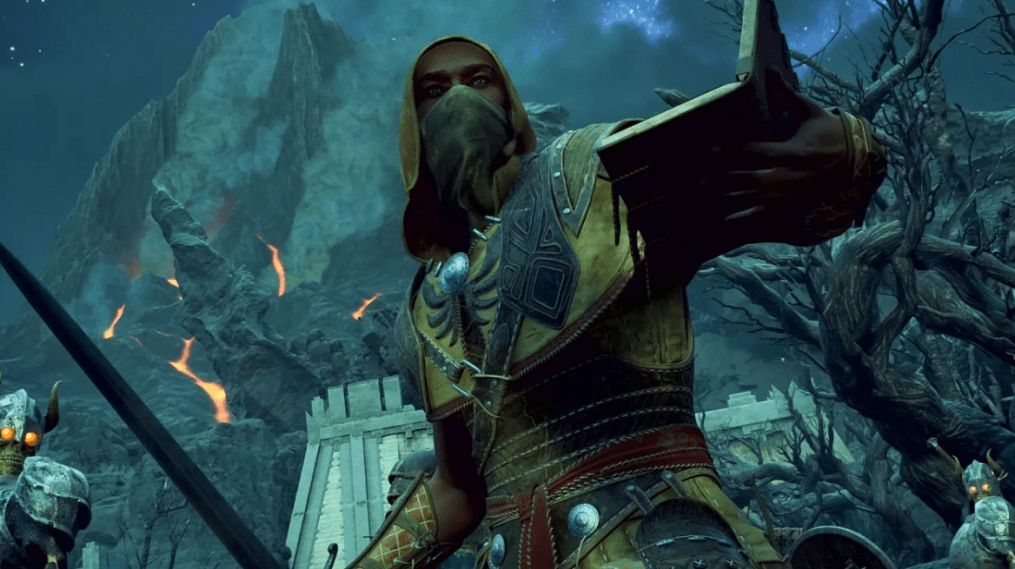
I enjoyed my time with Obsidian’s The Outer Worlds. It did a great job fusing elements from Shadowrun (companies took over governments with corporatocracies) and various other sci-fi universes by terraforming distant planets into their own images. Add in a dash of Fallout (some of Obsidian’s founders co-created the Fallout series), and you get a tasty diversion in The Outer Worlds.
I can’t wait to get my hands on The Outer Worlds 2. While the original may not have shaken role-playing games to their core, it was a fantastic, single-player experience. And I love it when modern video game companies commit to single-player experiences. Too many video game companies have gone all-in on video games as a service or live-service games. The Outer Worlds 2 has received good to great reviews. I would expect nothing less from an Outer Worlds’ follow-up. The Outer Worlds 2 is available on PC, PlayStation 5, and Xbox Series X/S.
ARC Raiders Releases
Speaking of live-service games, The Finals developer Embark Studios released its follow-up, ARC Raiders, this past week. While The Finals is a free-to-play title, ARC Raiders is a $40 multiplayer experience. Set in a distant future Earth, where mysterious and deadly “ARC” robots have taken over the surface, ARC Raiders puts gamers in the role of rescuers going topside to collect resources, sell, and ultimately save as many survivors as they can.
Embark Studios jump from looter shooter (in The Finals) to ARC Raiders’ extraction shooter is a logical one. With battle royales losing their luster, first-person shooter gamers have been looking for a worthy replacement. Extraction shooters seem to be a good alternative, but there has yet to be one title to capture the community’s imagination. Time will tell if ARC Raiders will become the definitive extraction shooter. It’s available on PC, PlayStation 5, and Xbox Series X/S.
Dragon Quest I & II HD-2D Remake Releases
SquareEnix has had back-to-back stellar remakes these past couple of months. Last month’s Final Fantasy Tactics: The Ivalice Chronicles and this past week’s Dragon Quest I & II HD-2D Remake prove that SquareEnix has some of the greatest back catalogues in video game history. These titles also show that SquareEnix can go back to basics and deliver a wonderful role-playing experience.
Dragon Quest I & II HD-2D Remake manages to give the older games a facelift while maintaining the originals’ charm. SquareEnix even manages to throw in some added content to pad the games’ short runtime, and Dragon Quest I & II HD-2D Remake completes the original Dragon Quest Trilogy. Last year’s Dragon Quest III HD-2D Remake is available on modern game systems. It’s great seeing these titles available for new gamers. Dragon Quest I & II HD-2D Remake is available on PC, Nintendo Switch, Nintendo Switch 2, PlayStation 5, and Xbox Series X/S.
That’s all the Geek News we have for this week. I’ll be busy with writing and editing on my work in progress, so we may have mostly new releases over the next few weeks. Thank you for reading, and wherever you are, I hope you’re having a great day.
We had to discuss the Marvel United: Fantastic Four expansion from the Marvel United: X-Men launch. In fact, we’ll begin our coverage of the Marvel United: X-Men wave with this expansion. Hey, hey, Geekly Gang! Kyra Kyle here. We return once again to Marvel United. This is one of those game systems with a heap of expansions. Too many, if you ask me. But we’ll cover the expansions that will either be fan favorites (plenty of people will be interested in adding them to their collection) or good additions because of their gameplay variants. Fortunately, Marvel United: Fantastic Four fits both criteria.
We’ll get to Marvel’s first family in a minute, but first, let’s take a look at Marvel United: Fantastic Four’s less heroic details.
The Fiddly Bits
Designer: Andrea Chiarvesio, Eric M. Lang, and Francesco Rugerfred Sedda Publisher: CMON Global Limited and Spin Master Ltd. Date Released: 2022 Number of Players: 1-5 Age Range: 8 and up Setup Time: 5-10 minutes Play Time: 30-40 minutes
We already covered the Game Setup and Game Flow in our original Marvel United review (here’s a link to that review), so we’ll go over the basics in the following two sections. Let’s cover an abbreviated review of the game setup and rules.
Marvel United: Fantastic Four’s setup can change depending on which Villain(s) and Heroes you choose to play. Each game consists of six locations. Since Marvel United: Fantastic Four is an expansion, only includes four locations, and you’ll need a core set in addition to this expansion to play. You may choose your locations or shuffle them and choose six at random. Each Location card has spaces at the top for civilians and thugs, and a rectangle with a block of text that will state “End of Turn” at the top of the box.
Place civilian/thug tokens on their matching spaces. Shuffle the Villain’s Threat deck and deal out each Threat face-up so that it covers the rectangle at the bottom of each location. You must clear this threat before gaining the “End of Turn” effect printed on a Location. Place health tokens where signified on threat cards and on the Villain dashboard. Place the three mission cards (Defeat Thugs, Rescue Civilians, and Clear Threats) face up under the villain dashboard where the text reads “Unlocked.”
Each player shuffles their hero decks and then draws three cards to form their hands. Shuffle the Villain’s Master Plan deck. Leave the Master Plan deck face down. This will be the villain’s draw pile.
Players place their miniatures on one of the six location cards, usually the centralmost location for each player (easy access). Then, they place the villain on the location card opposing the heroes. If one player chooses to play as the villain, hand the Super Villain cards to them, and the Heroes gain access to Super Hero cards. These new card times can be played if the game state triggers their use (for example, “You play a Master Plan card” or “Any Hero has 4 or more cards in their hand at the end of the Hero turn.” Timing is key.
Game Flow
The villain(s) play first. Draw the top card of their master plan deck. The villain moves the number of spaces indicated. Resolve any BAM! Effects and these effects will be printed on a space within the villain’s dashboard. Then, place the civilian/thug tokens (if any) indicated at the bottom of the card. If a player has taken the role of the villain, they get a hand of cards and can choose which card they play. The heroes get their turn after all the villain’s effects are resolved.
Heroes pick which player goes first, and hero turns will continue around the table clockwise. At the beginning of each game, Heroes will get three turns before the villain receives another turn. During their turn, heroes play one card from their hand.
Resolve actions and the symbols printed at the bottom of the hero’s card in any order. The symbols at the bottom of a hero’s card will be shared with the next player, but any printed action will not be shared. Heroes will use these actions to complete missions. The game begins with three missions in play: Defeat Thugs, Rescue Civilians, and Clear Threats. Each mission card will have spaces for the tokens they require to complete. As soon as these spaces are filled, the card is discarded, and the mission is considered complete. Mission cards can be completed in any order.
After the heroes complete the first mission, the villain panics and will act (play a card) every two hero cards instead of every three hero cards. After the heroes complete the second mission, the villain becomes vulnerable to damage. The heroes can complete the third mission, but it isn’t necessary. If the heroes do complete the third mission, each hero immediately draws 1 card, increasing each player’s hand size by one.
Play continues back and forth until either the villain wins (by completing their unique master plan or anyone, heroes or villains, runs out of cards) or the heroes win by dealing enough damage to the villain after the villain becomes vulnerable to damage.
Review
Marvel United: Fantastic Four has a huge legacy to live up to, and it lives up to the hype. I’m writing this review in June 2025, and Marvel United: Fantastic Four’s BGG score is an 8.5 (out of 10). This makes Fantastic Four the highest-rated Marvel United expansion. Yeah. It’s—pardon the pun—fantastic.
While Marvel United: X-Men Blue and Gold Teams features semi-cooperative play (players compete to clear the most goals), and this gives me strong X-Men: Under Siege vibes (a game I have a soft spot for), Fantastic Four introduces the idea of teamwork, and it does so simply and elegantly. Included in the box is a Fantastic Four team card. Various hero cards (from the members of the Fantastic Four) will add action tokens to the card, and can then use all actions on the Fantastic Four team card with different cards in their deck. This promotes a slow build. It simulates teamwork without using a lot of convoluted rules. I like the Team Cards from Marvel United’s third wave (Multiversus), but the method used in Fantastic Four is easy to follow and makes narrative sense.
Marvel United: Fantastic Four includes six heroes. One of which is the anti-hero (hero and villain) Doctor Doom. That’s a lot of heroes for one expansion—it’s almost as many as a core box—and each hero illustrates Marvel United’s second wave’s power creep. Granted, to get the most out of the Fantastic Four characters (Mr. Fantastic, Invisible Woman, The Thing, and Human Torch), you’re encouraged to play as the Fantastic Four. The aforementioned Fantastic Four Team Card is amazing, but these characters are still effective outside the team setting.
Each member has a unique flavor. Mr. Fantastic is flexible. Get it? Flexible? Ha…ha. Invisible Woman can avoid damage altogether (using her “Invisiblity” card), but she takes herself out of combat, which makes sense. Human Torch can use Nova Flame and deal 2 damage to everything at his location—super useful. And The Thing deals copious amounts of damage and can ignore 1 damage during each Villain Turn. Very nice.
The remaining two heroes, Doctor Doom and Silver Surfer, don’t gain any benefit from the Fantastic Four team card, but they don’t need it. Doom gets tokens for each damage he takes. He can even use the symbols from the 3 previous Hero cards in the Storyline (instead of the previous one). This can generate as many as seven actions on a single turn. Yikes! Silver Surfer has extra card draw, can move anywhere with one of his special abilities, and can exchange a Location in play with one that isn’t in play. What? Silver Surfer can literally yeet any Location for another Location. That’s coconuts.
But Marvel United: Fantastic Four’s villains are just as overpowered as their hero counterparts. Even though Doctor Doom is the marquee villain, we’ll begin with Super-Skrull. Don’t overlook Super-Skrull. He has one of the more unique Special Rules in Marvel United. Whenever he BAM!s, he performs actions based on the symbols on the last Hero card in the Storyline. The heroes have some control over what Super-Skrull can do, but that doesn’t matter. None of Super-Skrull’s BAM! actions are things you want to happen. Super-Skrull attempts to knock out (KO) and hand each in-play hero a KO token, but this isn’t the only way he can win. Super-Skrull can’t be damage if any Crisis tokens exist, and he adds cards from his deck facedown in the Storyline, which leads to a shortened clock.
Super-Skrull is a spiffier version of Green Goblin. He does enough things well that you must split your focus on the various ways he can win, and even though he doesn’t have Henchmen (like Green Goblin), he makes up for it with crazy Threat card abilities that make clearing Thugs and Civilians less efficient, and each Threat card requires one of each action type. Super-Skrull covers all bases. But most people purchase Marvel United: Fantastic Four for Doctor Doom, and Doom delivers.
First off, Doom must be played with Latveria—naturally—and Latveria is the first Location card that has a negative “End of Turn” effect. In fact, Doom only has five Threat cards because Latveria begins the game without one. Latveria marks the first time Marvel United has included an “End of Turn” effect that benefits the villain. “You MUST take 1 damage for each Thug or Doombot in this Location.” Ouch! Latveria begins every game with three Doombot tokens, so if you don’t take out all of the Doombots, you’re discarding your entire hand. Double ouch! Doom’s Threat cards add extra Doombots (sometimes not even in the same place as the Threat card’s location) and can deal extra damage to heroes. Triple ouch!
As for his Villainous Plot, Doc Doom plays like Red Skull but way, way worse. He can increase the Doom Track (changed from the Red Skull’s Threat Track) far more often, and he can’t be damaged if a Doombot is at his Location. In short, Doctor Doom is nasty. You’ll need the Fantastic Four with their Team Card to defeat him. It can be done, but it’s a tough go. I find Doctor Doom tuned to the perfect level of difficulty. He may be one of the many reasons Marvel United: Fantastic Four is the highest-rated Marvel United expansion.
We talked about Latveria, but there’s another Location, Mount Wundagore, that has a negative “End of Turn” effect: Each Hero in this Location MUST discard all cards in their hand and draw the same number of cards (this does not KO). Even though this effect doesn’t count as a KO, it’s another way to shorten the clock. If anyone (including Heroes) runs out of cards in their deck, the heroes lose. Yowza! I like Marvel United: Fantastic Four’s inclusion of villain-centric Locations. We’ll see more of this later in the series, but villain-centric Locations do a lot to shake up Marvel United’s status quo. The remaining Locations have unique “End of Turn” abilities as well. The Baxter Building provides token draw if the character you’re playing was ever a member of the Fantastic Four. This is a boon for anyone who knows the comics. I appreciate that.
I also appreciate the Takeover Challenge card included in Marvel United: Fantastic Four. If a Thug, Civilian, or Doombot token can’t be added to a Location, after resolving Overflow, place the excess tokens on the Takeover card. If the card is full, Heroes immediately lose. The Takeover card has two sides with different difficulties (number of spots for tokens). This Challenge card, like the Fantastic Four’s Team Card, is simple and elegant. It adds just enough difficulty if the game has gotten too predictable.
Too Long; Didn’t Read
Marvel United: Fantastic Four is the highest-rated Marvel United expansion on BoardGameGeek and for good reason. This expansion adds more layers of complexity while staying thematic and not burdening the player with too many over-complicated rules. Every element from the Locations, the Challenge Card, the Heroes, and especially the Villains is well thought out and an excellent addition to any Marvel United collection.
Happy Sunday, Geekly Gang! Kyra Kyle here with another week of Geek News. This past week confirmed a months-long rumor: Warner Bros. is for sale.
Bugs Bunny looks enthused with being on the market. We’ll discuss Warner Bros. posting a for-sale sign and this week’s new releases for board games and video games during this week’s Geek News.
Warner Bros. For Sale
No. Yakko and Wakko aren’t for sale. Warner Bros., as a property, is for sale. After months of speculation that Paramount would purchase all of Warner Bros., Warner Bros. removes all doubt by announcing it intends to sell, but the entertainment giant states it wants as much money as possible. If that means a single party purchases Warner Bros., great, but if Warner Bros. can accrue more money by slicing its properties into smaller pieces, fantastic.
My guess–and this is just a guess–is Warner Bros. will choose to split up its properties. Unless one entity blows away Warner Bros. with an offer for everything, the studio will most likely sell to numerous buyers. Of course, Paramount has expressed interest. The rumors appear to have been true, and Warner Bros. rejected Paramount’s first offer. Apple TV has also expressed interest. And I wouldn’t be surprised if Disney wanted to acquire a property or two. Looney Tunes could be added to classic Disney characters. Marvel and DC Comics could have crossover movies. I could continue. The possibilities are endless; only time will tell what will become of Warner Bros.’s properties.
Geekly tends to cover superhero movies, so we’ll focus on what a Warner Bros. sale would mean for the newly minted DCU. While DCU Chairmen James Gunn and Peter Safran could lose their jobs after DC Studios is sold, I doubt this will actually happen. Love Gunn and Safran’s DCU or hate it, I don’t expect new leadership to pull the plug on a profitable franchise this soon after it launches. And yet, profits may regulate the DCU’s future.
Producing DCU films and shows costs a lot of money. At the moment, Gunn and Safran intend to accelerate the DCU’s slate of projects. Lanterns, Supergirl: Woman of Tomorrow, and Clayface are slated for a 2026 release. We could see another season of Harley Quinn and Creature Commandos next year, too. And the DCU has plenty more scheduled for the not-so-distant future. Wonder Woman: War of the Gods, The Brave and the Bold, The Batman 2, Booster Gold, and Waller have all been rumored or announced for a 2027 release. New ownership may slow down the frequency of upcoming DCU releases.
I don’t believe anything will change with the DCU’s release schedule until after a sale takes place. So, the DCU’s 2026 release schedule should remain mostly untouched. Who knows? Depending on DC Studios’ buyer, nothing may change. Who would you like to purchase DC Studios?
While I wouldn’t mind a single Marvel-DC Comics crossover movie (or even a trilogy of them) or a series, I prefer these two worlds to remain separate. Apple could use the content more than Paramount, but it’d be interesting to see Star Wars and Marvel on one platform, while Star Trek and the DCU were on the other. Share your thoughts in the comments.
Threshold Launches on GameFound
Blending tactical card-based combat, deep character customization, and endless loot, Threshold immerses its players in a massive, open, living world that responds to their choices. While I have yet to play Threshold, player turns appear easy to understand. Each player’s round plays out with the same rhythm: 1) Draw 5 cards from your deck, 2) Spend cards to perform actions, 3) Enemies act, and 4) Advance the day. I like the Threshold’s streamlined design.
As of the writing of this post, Threshold has yet to launch, so I can only speculate on its gameplay. It appears as if players may mismatch the cards in their deck, creating a unique character. If that’s the case, count me in. Combat seems quick and tactical. I like the idea of Threshold’s world adapting to my choices, but I hope that extends beyond combat. Threshold’s description suggests that players will travel from region to region, where dynamic events occur. Could this be a great blend of MMOs and action RPGs?
I’ve been looking for a good RPG in board game form. Threshold piques my interest. If you’re interested in Threshold, check out its GameFound page.
Drawing Dead Launches on GameFound
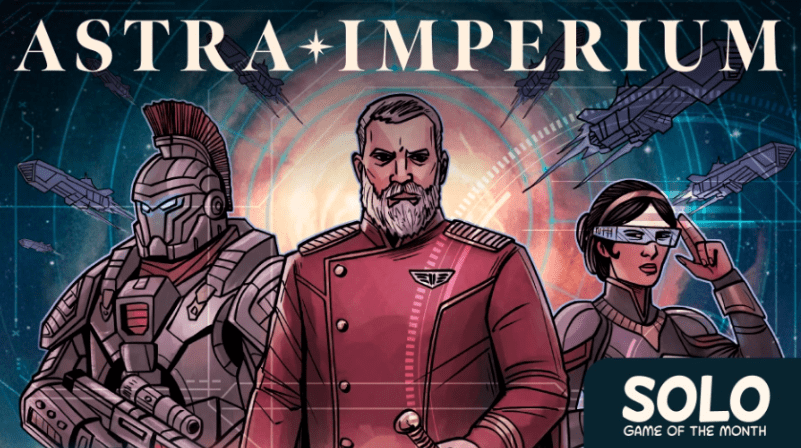
After meeting an untimely end in a saloon poker game turned deadly, you awake in purgatory. With new powers and a set of poker cards forged from your soul, you must play your way through the three gates of purgatory and ride into the afterlife. Drawing Dead has a killer theme. Pun intended. I love the Solo Game of the Month company. I don’t know how they’re able to produce stellar solo games most months (I’ve seen them skip one or two months here and there). I’ve been playing a ton of Balatro recently, so Drawing Dead is right up my alley.
Drawing Dead’s player deck is a fully functional poker deck. I am down with the four-colored suits and may pick up a few copies of Drawing Dead to play standard card games. Just ignore the special effects printed in the middle of each card. While we don’t yet know the pledge values for Drawing Dead, Solo Game of the Month tends to sell their games for around $30. If you’re interested in Drawing Dead, check out its GameFound page.
Joyride: Full Throttle Speeds onto GameFound
Who wants to play a destruction derby? Joyride: Full Throttle is equal parts Formula D, Mario Kart, and Destruction Derby (this was a Mad Max-like video game back in the day). Comic book artist Ant Williams’ work gives Joyride: Full Throttle character. Joyride: Full Throttle oozes character from its pores. I can’t wait to drift around the beachfront boardwalk and abandoned mall. Each map has its own identity.
And each driver and vehicle has their own vibe, too. And you know I’ll be loading up on Thumpers, Wrenches, and Volleybombs, waiting for the perfect moment to drop them on my opponents.
Push your luck as you take corners at speed. Manipulate dice on your dashboard, balancing precision and speed. Smash into your rivals to knock them off course. I love how interactive Joyride: Full Throttle is. And publisher Rebellion Unplugged just announced full miniatures. I’m certain these will cost extra (as an upgrade) when Joyride: Full Throttle releases its pledge details later this week. We don’t yet know these pledge details, but if you’re interested in Joyride: Full Throttle, check out its GameFound page.
Cascadia: Alpine Lakes Launches on KickStarter
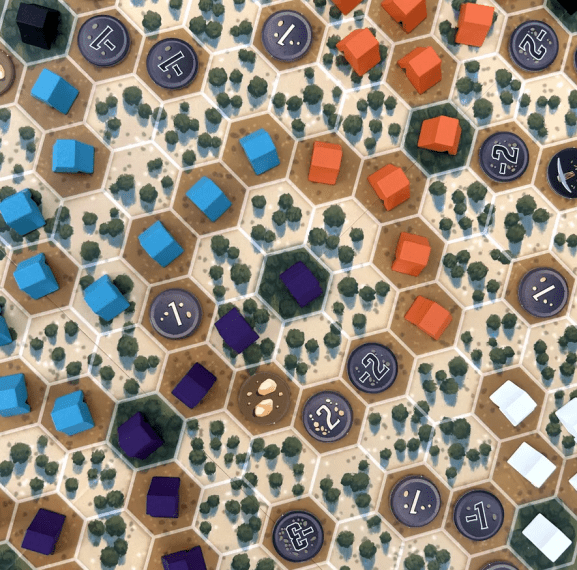
I may need a refreshing dip in a lake after that last entry. Fortunately, Cascadia: Alpine Lakes has you covered. Alpine Lakes is the standalone sequel to the wildly popular Cascadia. Take your tile-laying to new puzzly heights with Cascadia: Alpine Lakes.
Cascadia: Alpine Lakes is designed by Randy Flynn, creator of the original Cascadia. Alpine Lakes shakes up the original gameplay by adding double hex tiles. These tiles add to the strategic nature of the original, and the development team behind Alpine Lakes is the same award-winning team behind Calico, Verdant, Fit to Print, Nocturne, and Knitting Circle (Molly Johnson, Robert Melvin, Shawn Stankewich, and Dylan Mangini). And Beth Sobel returns as the artist.
Cascadia: Alpine Lakes builds off the original in interesting ways. You won’t need the base Cascadia game to play this version, but there is a pledge level that includes the original Cascadia. Pledges range from $39 to $129. If you haven’t yet played the modern classic Cascadia, Cascadia: Alpine Lakes may be a great place to start. If you’re interested in Cascadia: Alpine Lakes, check out its KickStarter page.
Garage Rock Crashes the KickStarter Party
Garage Rock transports gamers back to the 1980s: big hair, cassette tapes, and BMX bikes ruled the neighborhood streets. Garage Rock is a medium-weight, worker-placement game where players step into the shoes of a teenage garage band. Fight for glory in the high-stakes “Battle of the Bands,” hosted by the infamous local pirate radio DJ, Johnny Law.
I love Garage Rock’s table presence. Check out that treehouse dice tower in the middle of the board. The stage (in the top right-hand corner) looks amazing. Garage Rock looks as if it uses a lot of table space, but that’s okay. Its toy factor and theme make up for what appears to be a large game. Who wants to rock out with me?
Compete against other players to perform at gigs. Grow your band’s popularity. And it looks as if Mariposa Games thought of everything for this game’s box insert, even a spot for the Jean Jacket expansion, should you choose to add it to your pledge. Garage Rock looks amazing. The bits are thematic like demo tapes, song tokens, talent ribbons, and 16 unique transparent acrylic instruments. Pledges range from $79 to $250. If you’re interested in Garage Rock, check out its KickStarter page.
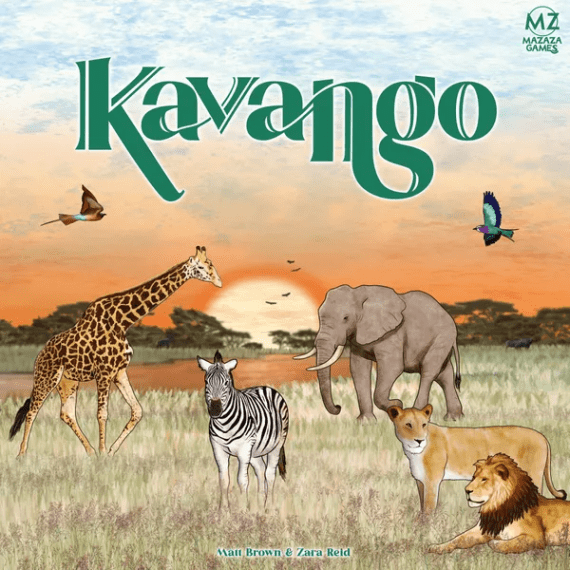
Kavango: Lodges Expansion Launches on KickStarter
Designed by conservationists, Kavango tells inspirational conservation success stories of southern Africa. In fact, 20% of Kavango’s profits are donated to African-based charities working to safeguard the region’s extraordinary wildlife. The Lodges Expansion marks Kavango’s first major expansion. I have yet to play Kavango, but Season has and swears by this game. Seriously, it’s on her Christmas list. She’s probably editing this post, and I expect a message suggesting we back Kavango: Lodges Expansion for “research.”
Kavango uses simultaneous turns, which I love, because it keeps gameplay fast. Kavango’s theme is an important one, and I also love that Mazaza Games commits to charity. It’s a good feeling knowing your pledge goes toward a worthy cause. Kavango’s pledges are also reasonable: $20 (for just the expansion if you already have the base game), $40 for all the extras without the base game, or $60 for everything, including the original Kavango. If you don’t have the base game, I’d go with the $60 pledge; you get a lot of game for the price point. If you’re interested in Kavango, check out its KickStarter page.
Video Game Round-Up
I already covered six board game releases in quick succession. This week saw a ton of new releases, because we’re ramping up for the holidays. I’m going to go through video games quickly as well. Like the board games, these won’t be the only video games that were released this past week. Consider this section video game new release highlights.
Ninja Gaiden 4 was released over a decade after Ninja Gaiden 3 (2012). According to multiple critics, Ninja Gaiden 4 is a triumphant return to the series and well worth the wait. Like other games in the series, Ninja Gaiden 4 features punishing gameplay. Ninja Gaiden was the video game that made players “Git Gud” before Dark Souls, and 4 continues that brutal legacy. Ninja Gaiden 4 is available on PC, PlayStation 5, and Xbox Series X/S.
Sticking with the theme of older video game titles receiving their first new entry in over a decade, Katamari returns for the first time in 14 years with Once Upon a Katamari. I’ve spent countless hours rolling that funky-shaped ball, trying to get as many objects to stick to the katamari as I can. Once Upon a Katamari has received plenty of positive reviews. So, it looks like we’re two for two with returning franchises this week. I can’t wait to pick up a copy of Once Upon a Katamari. It’s available on PC, Nintendo Switch, PlayStation 5, and Xbox Series X/S.
The streak doesn’t continue, it would seem. Vampire: The Masquerade – Bloodlines fans–like me–have waited 21 years for a proper sequel to the open-world, action role-playing indie. According to many critics, Vampire: The Masquerade – Bloodlines 2 stumbles to live up to the original. This doesn’t surprise me. Bloodlines 2 had a torturous development cycle. The lead game designer changed multiple times. The lead writer was canned over a year before the game’s release. But Bloodlines 2 has a silver lining. From what I’ve heard, the writing is stellar. Any outlet that gives Bloodlines 2 a higher grade will most likely mention how deep and well-written the story’s characters are, but the janky combat and occasionally woeful performance issues make Vampire: The Masquerade – Bloodlines 2 a game I may wait to pick up at a discounted price.
Plants Vs Zombies: Replanted compiles all the game’s various iterations over the past 16 years, but the final product has been leaving critics wanting. Plants Vs Zombies’ original gameplay stays mostly intact–for better and for worse. The original game was fair and balanced most of the time, but the game had some unwarranted difficulty spikes that Replanted does little to quell. Plants Vs Zombies: Replanted tries to update the graphics, but many of the upgrades don’t quite land. Plants Vs Zombies: Replanted’s ending music video may be the most egregious. Players watch the original video on a tube television (picture inside of a picture) with downgraded graphics, which diminishes the ending’s impact.
But Replanted’s best addition may be the Cloudy Day Mode, where gameplay cycles between day and night. I may have found my way of new way to play Plants Vs Zombies. Plants Vs Zombies is available on PC, PlayStation 4, PlayStation 5, Nintendo Switch, Nintendo Switch 2, Xbox One, and Xbox Series X/S.
Ever want to run your own dinosaur theme park? That’s the theme of Jurassic World Evolution 3. Yes. Jurassic World Evolution 3 is the third entry in this popular game series. Jurassic World Evolution 3 has received good reviews. I’m certain Season has played at least one game in this series. Let us know if you’d like to see a future review.
I knew little about Bounty Star before its release this past week. Bounty Star’s subtitle, The Morose Tale of Graveyard Clem, sums up the game’s story. Bounty Star begins with the worst day of Clementine McKinney’s life. She hopped into a mech, tried to save the people she loved, and lost everything. Clementine McKinney died that day. Graveyard Clem was born from the ashes. Graveyard Clem rebuilds her life in the wastes. Bounty Star bounces between mech combat and daily life on a farm, raising chickens and growing crops. Gamers will embody all aspects of the flawed Graveyard Clem. Bounty Star offers two disparate gameplay loops that I can’t wait to try. Equal parts mech combat game and farming sim? Sign me up.

That’s all we have for Geekly News this week. With the holidays around the corner, we may do more quick recaps in the coming weeks. Thank you for reading, and wherever you are, I hope you’re having a great day.