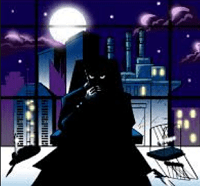
Spotlight: The Chairman

First Appearance: Sentinels of the Multiverse: Rook City
Who he is: The Kingpin of the Multiverse’s The Organization
Note: This villain is more of a two for one villain. The Chairman has a right-hand woman named The Operative, and we’ll discuss her first, since heroes can’t win while she’s still alive and kicking.
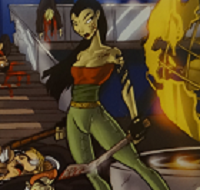
OperativeName: The Operative: Assassin
Initial Power: Whenever a villain card is destroyed, The Operative deals the hero with the highest HP (H), where H is equal to the number of heroes, minus 2 melee damage. At the end of the villain turn, reveal cards from the top of the villain deck until an underboss card is revealed. Put it into play. Shuffle the rest of the revealed cards back into the villain deck.


Advanced Power: Reduce damage to The Chairman and The Operative by 1.
Incapacited Side: Increase damage dealt by The Chairman by 1.
Advanced Power (Incapacited Side): At the end of the villain turn, The Chairman deals the hero with the highest HP (H) minus 2 melee damage.
Chairman04Name: The Chairman
Initial Side: Master of the Underworld
Innate Power (Initial Side): The Chairman is immune to damage.
Advanced Power (Initial Side): At the start of the villain turn, if there are any underbosses in the villain trash, flip The Chairman’s villain character cards
Villain Cards that Begin Game in Play: The Operative, and that’s enough.
How he flips to his other side: If there are at least 3 underbosses in the villain trash.
Nemesis: Mister Fixer
Second Side: Chairman Pike
Innate Power (Second Side): The Chairman is immune to damage from environment cards. Increase damage dealt by thugs by X. The first time The Chairman is dealt damage each turn, deal the source of that damage X melee damage. X on this card = (H) minus 2.
Advanced Power (Second Side): X on this card = (H)

TheChairman01Most Fiendish Ongoing Card: There are no ongoing cards outside of villain target cards.
Most Fiendish One-Shot Card: Prison Break: Put all of the underboss cards from the villain trash into play.
Most Fiendish Villain Target Card: The Muscle (8 HP): At the start of the villain turn, this card deals each hero target 2 melee damage. At the end of the villain turn, search the villain trash for a card named Enforcer. Put it into play.
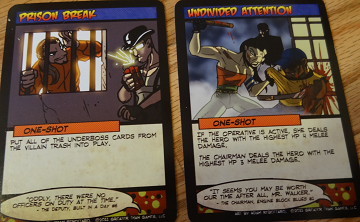
TheChairman03How to Defeat The Chairman: You’re not really battling The Chairman as much as your taking on The Organization, and this villain works like taking down an organization. You have to defeat The Operative before you can take down The Chairman, but the underbosses beneath The Operative can cause plenty of problems, so you may want to wipe them out first. But then there’s also Thug cards—who are put into play by underbosses—that throw a wrench in the whole works.
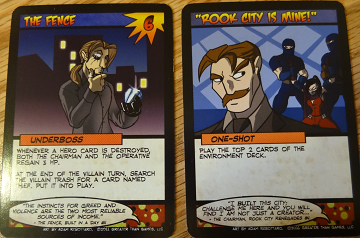
TheChairman02Even though there is a hierarchy, take out The Operative as soon as you can. Once she’s gone, you may have to take care of underbosses and thugs with global damage effects before touching The Chairman. You may be thrown off of your game if enough underbosses and thugs enter the battlefield. In that case, you’ll have to take down a few of them before The Operative. Then, there’s the fact that thugs gain more damage when The Chairman flips—and he will flip over at some point—so you’ll want to eliminate any thugs in play after The Chairman flips. But The Operative is the key to victory.
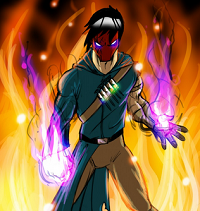
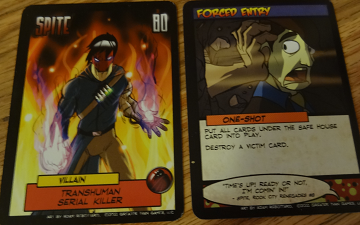
Spotlight: Spite

Spite04First Appearance: Sentinels of the Multiverse: Rook City
Who he is: The performance enhancement drug serial killer (Bane) of Rook City
Initial Side: Transhuman Serial Killer
Innate Power (Initial Side): When Spite deals damage, he regains that much HP. At the end of the villain turn, play the top card of the villain deck. The, Spite deals the hero target with the highest HP (H), where H is equal to the number of heroes, minus 1 energy damage.
Advanced Power (Initial Side): At the start of the villain turn, Spite regains (H) plus 2 HP.
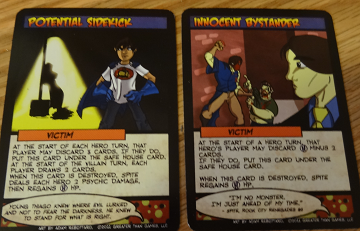
Villain Cards that Begin Game in Play: Safe House: When this card enters play, reveal cards from the top of the villain deck. Until a victim card is revealed. Put it into play. Shuffle the rest of the revealed cards back into the villain deck. When Spite flips to his “Drug-Wracked Monstrosity” side, he deals himself X toxic damage, where X = the number of cards under this card times 5. This card and cards under this card are indestructible. Cards under this card have no text.

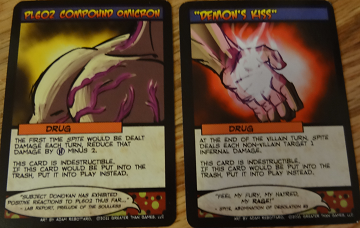
Spite01How he flips to his other side: There are 5 drug cards in play.
Nemesis: The Wraith
Second Side: Drug-wracked Monstrosity
Innate Power (Second Side): Whenever a villain card would be played, instead Spite deals each hero target other than the hero target with the lowest HP 1 projectile damage.
Advanced Power (Second Side): When Spite flips to this side, he regains (H) times 5 HP. Reduce damage dealt to Spite by 1.

Spite02Most Fiendish Ongoing Card: PL531 Compound Upsilon: Increase damage dealt by Spite by 1 at the start of the villain turn, put (H) minus 2 hero ongoing and/or equipment cards back into their player’s hand. This card is indestructible. If this card would be put into the trash, put it into play instead.
Most Fiendish One-Shot Card: Lab Raid: Destroy all environment cards. Reveal cards from the top of the villain deck until X drug cards are revealed, where X = the number of environment cards destroyed by this card plus 1. Put the revealed drug cards into play. Shuffle the rest of the revealed cards into the villain deck.
Most Fiendish Villain Target Card: There aren’t any. Yay! Kinda.

Spite03How to Defeat Spite: You don’t want Spite to get all of his drug cards in play. Usually, you won’t be able to stop this from happening, but the Visionary’s “Suggestion” and “Brain Burn” could hold off the tide as they place cards from the villain’s trash on the top of the villain deck. Otherwise, you’re stuck with dealing Spite copious amounts of damage so his healing abilities don’t gain traction. For the most part, I’d avoid saving Victim cards. Sure, if you let Spite discard Victim cards, he regains HP, but mitigating this heal mechanic by saving Victim cards doesn’t typically outweigh the cost of saving Victims. Of course this is a case by case basis. If you’re playing with a forgiving environment deck, you may want to save Victims.

Geekly TV: December 05, 2014

TheFlash

The Flash

Kyle’s Review

Given the episode’s title, “Flash vs Arrow,” it delivers the goods. With versus in the name, you had to show the two characters fighting each other, and the action sequence was what you’d expect: explosive.

I never thought they’d turn to Roy G. Bivolo (that’s a play on the ROY G BIV colors of the rainbow) as the villain who’d turn the two heroes against each other. Caitlin was right about Bivolo’s codename Rainbow Raider—Prism is another DC Comics villain—and that’s the reason why I was surprised to him: Rainbow Raider was one of JK Geekly’s Lame Super Villains last month. He may have ditched his magic goggles for metahuman powers, but he’s still lame enough to not warrant showing the two heroes taking him into custody. This episode was all about the Flash and Arrow.

The two titular characters play off each other well. Their differences shine as we even get the classic line from Ollie that despite Barry’s speed, he’s always late. The two couldn’t be more different: from the way they train (or lack thereof) to the way they view the world. Those of us who’ve watched the last season and a half of Arrow don’t see Ollie as the hardnosed vigilante who kills anymore, but of course people in this universe would color him that way.

The Flash has his name besmirched—and his would-be girlfriend Iris falling out of like with him—when he lets out his rage on Eddie. Eddie in turn gets his Flash task force approved by Captain Singh. I can’t wait to see these two butt heads. I figured it would happen sooner or later. Despite all these good developments, there was some problem with cross-pollination.

What has plagued Arrow this season has traveled to The Flash and vice versa. The Flash had too many people who knew his identity and now the Flash’s cadre knows who Arrow is, and Arrow had way too many heroes clogging up his show and we had a teaser for another hero at the end of The Flash. I won’t say who he is here. If you want to read more, check out our Flash spoilers’ link here. I’m also concerned about the Flash’s story lines. Jim mentioned last week that a superhero losing his powers was a cliche. Well, there’s also the cliche of a superhero getting brainwashed and attacking his comrades — miracuru comes to mind and heck, there’s a certain color of kryptonite that realigns Superman’s morality — so I think it’s a misstep to go to the cliche well on back to back episodes.

But I am glad The Flash went back to another well. Arrow fans should recognize who the lady was at Jitters. She was the pregnant woman Ollie’s mom bought off to leave Starling City and never come back during a second season flashback. If you recall, the lady in question told Mrs. Queen that she had family in Central City, The Flash’s city. So the eight or nine-year-old kid she was talking to was Ollie’s.

Verdict: Some great tie-ins, even better action sequences, and the two heroes go together like chocolate and peanut butter. Even though the villain was an afterthought, this was a fun episode.

Jim’s Take

Really solid episode. Ollie and Barry have a great dynamic, and I enjoyed seeing some of the insecurities Barry harbors about being a super-powered superhero bubble to the surface. Rainbow Raider isn’t a great villain (let’s leave it at that), but he served as a decent catalyst to bring that about. Some of the tension between Barry and Ollie’s respective support teams felt a little forced, but with Diggle’s priceless reactions to “metahuman” abilities, there was also a lot of charm to be found.

Arrow

Arrow

Kyle’s Review

“Sometimes bravery isn’t enough. Sometimes we need to be bold.” Lyla said this in a poignant part of this week’s Arrow, and it should come as no surprise that this episode’s title shares the same name as the classic DC Comics team up book The Brave and The Bold.

Like the other Arrow/Flash crossover, this episode lives up to its title, but the title in question looms bigger than a simple showdown. We get the Arrow’s darkness in harmony with the Flash’s light and travel down a philosophical tale reminiscent of the best Green Arrow stories.

I’ve been rating The Flash higher than Arrow this season because of Arrow’s inability to find its footing and the electricity of The Flash’s debut season, but Arrow got the better end of this crossover: the story was more cohesive, the villain more engaging (even though boomerangs strike a smidge more fear than a Rainbow Raider), the flashbacks worked to give Ollie’s internal conflict depth, and the show had more balance.

I never got tired seeing the Flash get to the scene before Arrow, and the other cast mates had some great moments, too. Even though Roy wasn’t featured (he wasn’t even the focal point when he thought he killed Sara), I liked how he blended with Cisco and Caitlin. He started off annoyed but quickly accepted them. I’m sure that Cisco complimenting his suit because it’s red didn’t hurt.

My only complaint is that both crossover episodes tied up too neatly. I know we haven’t seen the last of the Flash/Arrow crossovers, but it would’ve been nice if this story could have led somewhere in both series. I also would love to see Captain Boomerang again. He’d make a nice recurring villain. I won’t say why here (I’ll save that for our Arrow spoilers page), but it bodes well that he occupies the same prison as another Arrow villain.

Let’s hope that this shot of adrenaline will get Arrow going in the right direction. As this episode illustrated, Arrow needs to be more than just darkness. He needs to be the voice of reason, the outspoken hero of the common man.

Verdict: The better half of the Arrow/Flash crossover. Hopefully, Arrow has found its footing.

Jim’s Take

This was another successful teamup. Personally, I thought Flash’s leg of the two-parter was the more successful one. I think Tuesday’s show did a better job blending the gritty with the light-hearted, but Arrow didn’t drop the ball by any reckoning. As is sometimes the case with Arrow, the show’s message about torture and Ollie’s humanity felt heavy-handed and preachy, but I’m hopeful this crossover will give Arrow some momentum moving forward. The mention of Captain Boomerang being imprisoned with Slade gave me hope for a really big development there. Can I just mention, though, how weird is it that Deathstroke is Australian in the Arrow-verse, and Captain Boomerang is not? All-in-all, this may have been Arrow‘s strongest showing of season 3. Let’s hope it continues.

Flash Spoilers: Week of December 5, 2014

Central City’s Burning Man
A few weeks ago, Iris mentioned a metahuman in Central City with the ability to catch his body on fire. Eddie derisively called him the Burning Man. We actually catch a glimpse of him at end of this episode. It’s no accident that we see Caitlin looking at her former fiancé before we see him. The Burning Man is Ronnie Raymond, better known in the DC Comics Universe as one half of Firestorm. Obviously, he’s the fire half.

Captain Singh
Up to this point, we’ve only see Captain Singh yell at Barry for being late, but in this week’s episode the CCPD’s fearless leader talks about his personal life. He mentions that his boyfriend wants him to eat better and he can only eat junk food at work. I’m not sure if Captain Singh’s boyfriend is the same one in the comics, but if he is, we may have a teaser for another Flash villain The Pied Piper.

More on Ollie’s Baby Momma
Comic fans know her as Sandra Hawke, who mothered a child with Oliver. Eventually, Ollie finds out he’s a daddy, and he takes his son under his wing. Ollie’s son will assume the family business—no, not Queen Consolidated, but the Arrow—and fight alongside his dad before becoming the second Green Arrow.

Arrow Spoilers: Week of December 5, 2014

It’s more of a Squad

Captain Boomerang was a left for dead member of the Suicide Squad. At episode’s end, he finds himself in the same tropical prison as Deathstroke, and Deathstroke has appeared in the new Suicide Squad comic. Here’s hoping for a Deathstroke/Suicide Squad sighting in the not so distant future.

What do they call that?

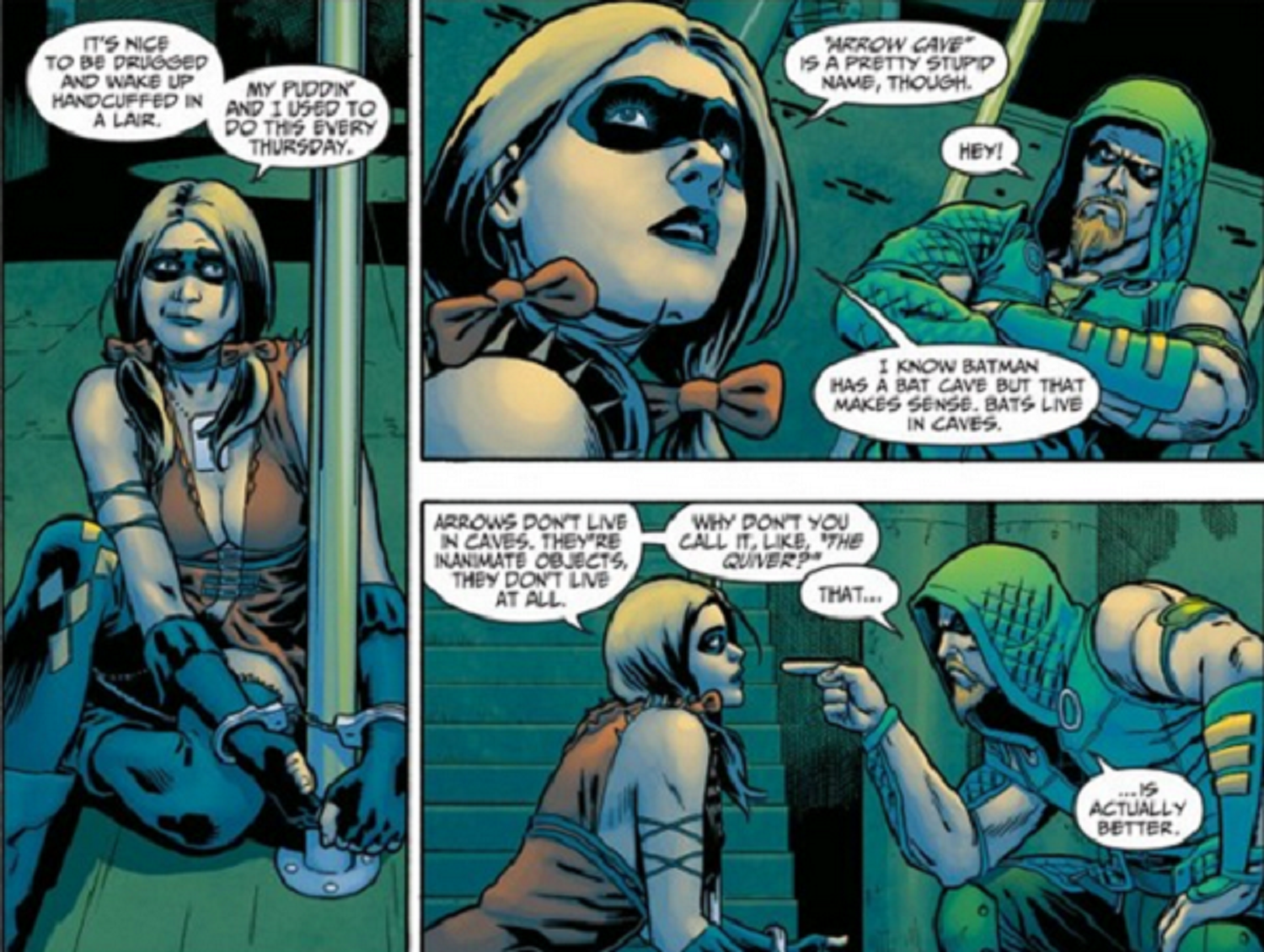
The Flash crew made some comments about an “Arrow Cave,” but Felicity shot them down with a “We don’t call it that. Ever.” But in the comics, Green Arrow does call his lair the “Arrow Cave.” He even had an “Arrow Car” in the forties.

Now he doesn’t call his hideout the “Arrow Cave” often, but there’s a really great scene between Harley Quinn and Green Arrow about the “Arrow Cave.”

ArrowAndHarleyLance has the right Impulse but the wrong name

It might seem that Detective Lance calling Barry Allen “Bart” was an innocent goof, but comic book readers know better. Bart Allen was the fourth Flash, but he’s best known as Barry’s sidekick, Impulse.

Who is Speedy anyway?

Lyla calls The Flash “Speedy” in this episode, and Arrow thinks she’s referring to Roy. This doesn’t ring true for me, since his nickname for Thea is Speedy. Is Roy “Arsenal” or “Speedy?”

He’s at the Corner of Infantino and Adams

Arrow fans know that the show works in clever tributes to comic book writers and artists into their script, but tonight’s episode topped them all. The warehouse Arrow and the Flash find Klaus Markos is at the corner of Infantino and Adams.

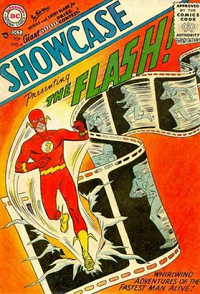
FlashFirstIssueCarmine Infantino created the Flash’s iconic red and yellow costume that he uses today, while Neil Adams penciled several DC Comics greats, including Green Arrow and The Flash. Perhaps Adams is best known for his work on the seminal comic classic Green Arrow/Green Lantern series. A philosophical series that questions what makes a hero. This is a story arc I hope Arrow’s moving toward.

Munchkin

Designer: Steve Jackson
Publisher: Steve Jackson Games
Date Released: 2001

Number of Players: 3-6
Age Range: 10 and up
Setup Time: 5-10 minutes
Play Time: about 90 minutes

Game Mechanics:
Card Drafting
Dice Rolling
Hand Management
Variable Player Powers

Game flow:
Steve Jackson Games describes Munchkin in four short sentences: Go down in the dungeon. Kill everything you meet. Backstab your friends and steal their stuff. Grab the treasure and run.

Munchkin03That’s the premise. Based on role playing game clichés, this satirical card game starts its players off as level 1 humans with no class—class as in job or vocation, I’m sure its players have plenty of class. The first player to level 10 wins.

There are only two types of cards: treasure and encounters. Each turn the player whose turn it is “kicks down the door” by drawing from the encounter deck. You’ll usually find a monster. These monsters will have their own levels, and players must defeat them by combining their current level, bonuses from items (usually from the treasure deck), and help from other players. If you can’t beat the monster, you have the option of running away, but sometimes this comes at a price.

Munchkin04If you beat the monster, you gain a level and the number of treasure cards indicated on the monster card. Players keep all the treasure cards if they beat the monster by themselves, but they have to share the earned treasure with the other player who helped them—the treasure card distribution is usually worked out between the two players before the second player agrees to help.

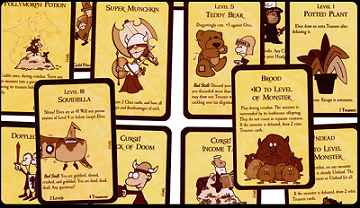
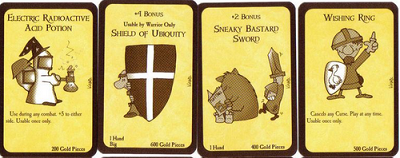
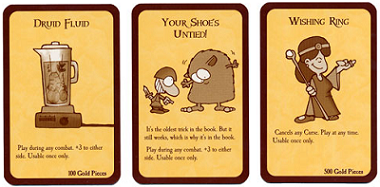
Munchkin05The cards themselves are hilarious. You can use weapons like the Chainsaw of Bloody Dismemberment or the Staff of Napalm and wear outrageous gear like the Boots of Butt-Kicking and the Horny Helmet. One moment you’re a human, male. The next, you can be an elven, female. Yes, there are sex changes in this game as well as Plutonium Dragons.

Review:
Luck plays a big part in Munchkin, and the main strategy is backstabbing your friends. This isn’t a game to play if you have thin skin, and you never want to be in first place. Once players realize that someone has a decided advantage, they’ll crap on first place until they’re last place. I’ve even seen some folks take revenge on someone else during the game for ticking them off earlier in the day. This is definitely not a game to play if someone holds a grudge.

Munchkin06I find Munchkin fun enough, but it can get tedious fast, and luck plays too much of a role in determining a winner. You also have to be in the right headspace for it too. Everyone has to be in a decent mood and not be quibbling with each other. There’s a reason the word backstab was used by the publisher.

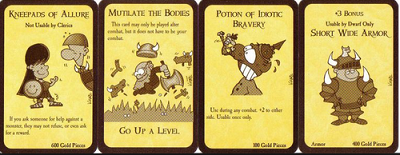
Munchkin02Note: Steve Jackson Games rereleased the game four years ago after The Great 2010 Munchkin Changeover. They reintroduced cards like The Kneepads of Allure so they won’t be as powerful, but I still have the original game, and those kneepads rock. I wonder if Zapp Brannigan’s kneepads would be made of velour.

Verdict: An uneven but fun thematic card game that leans too much on luck and has limited, spotty replayability.

Quiz Answers: Silver Age Super Villains

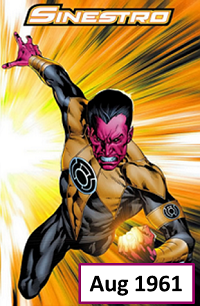
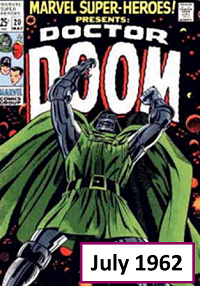
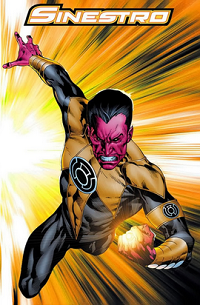
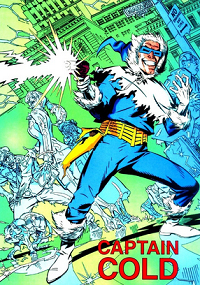
CaptCold02  Sinestro02  DocDoom02

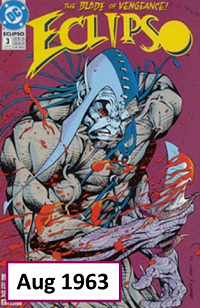
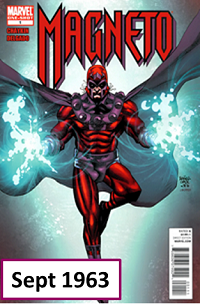
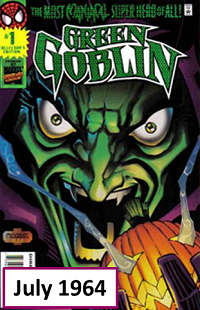
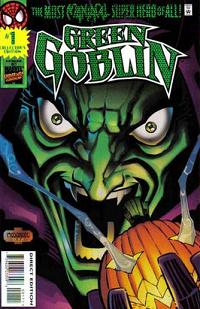
Eclipso02    Magneto02    GreenGoblin02

The Silver or Marvel Age of Comics saw a lot of iconic super villains. How well did you know your villains? Let’s see how we did.

All 6 correct) You don’t feel fear. You are fear.

4-5 correct) You either know a lot about villains, or you’re possessed by a malevolent force.

2-3 correct) You were so close to victory but got too cocky, and your goblin glider impaled you. On the bright side, you can’t keep a good villain down for long.

0-1 correct) What? You didn’t score well. Such insolence shall not be tolerated.

Timeline: Silver Age Super Villains

Last week we covered some of the Silver Age super heroes, so this week we’ll take on Silver Age super villains. Name the following villains in the order in which they first appeared.

Sinestro01  Magneto01  GreenGoblin01

DocDoom01  CaptCold01  Eclipso01

GeeklyAnswers

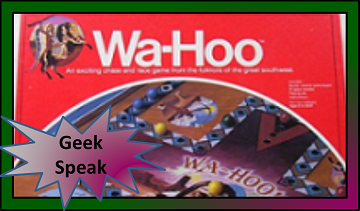
Wahoo

Designer: Uncredited
Publisher: Pressman Toy Corp.
Date Released: 1930

Number of Players: 4-6
Age Range: 6 and up
Setup Time: none
Play Time: less than 45 minutes

Game Mechanics:
Partnerships
Roll, Spin and Move

Game flow:
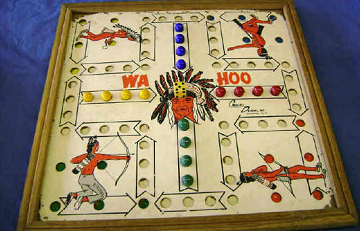
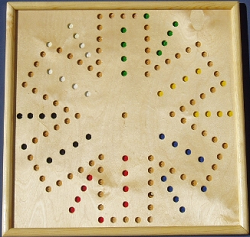
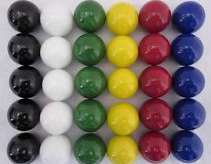
A take on the ancient game of Parcheesi, Wahoo trades Parcheesi’s wooden playing pieces for marbles, and a cloth or cardboard game board for a wooden one with notches whittled out for the marbles to rest. Most of the rules are the same. You roll a single six-sided die and have to get your pieces from your start area to a safe zone.

Wahoo01You can play the game with every person for themselves or in partnerships—with most players teaming up with the player seating across from them. When you play as teams, once one player gets all of their pieces in their safe zone, they can help their teammate on their turn.

Like Parcheesi, you can get a new piece out of your start area by rolling either a one or six, and sixes allow the player to roll again. Pieces can’t occupy the same space, so if you land on an occupied space, you send the piece back to the player’s start area. But Wahoo adds a new wrinkle by including a shortcut.

Wahoo02One piece can occupy the middle space—significantly reducing the number of spaces you’ll have to move—but beware. You have to roll a one or six to get out of the shortcut, and everyone wants to use it.

Review:
I prefer team play to solo play. Solo can be fun too, but you can’t land on your own pieces so you just lose a turn if that happens, and you always know that your opponents will try and send any piece back to start when they have a chance. But team play gives you moments where you have to move a piece a number of spaces and the only valid move you have is to take one of your teammate’s pieces back to start. This leads to someone screaming NO or apologizing profusely.

Wahoo03The only strategic element gained in Wahoo from Parcheesi—and other Parcheesi based games—is the inclusion of the shortcut. But this isn’t a small thing. There are moments when the shortcut is safer than others, and you can gauge when you should take it. Still, luck rules Wahoo unless you have a loaded die.

You’ll find numerous custom Wahoo boards on eBay, but the best boards are ones that you make or the ones someone makes for you. YouTube even has a video on how to make a Wahoo board: How to Make a Wahoo game board.

Verdict: Wahoo uses the classic roll, spin, and move mechanic, but the inclusion of a shortcut, partnership gameplay, and the fact that you’re probably playing on a board someone made for you make Wahoo a fun and personal game.

Strange Games 1

Strange games have found us. There are plenty of tabletop games that have had odd game mechanics or a weird game premise. Every Monday during the month of December we’ll give you six games with their game premise/mechanics. Can you name which of these games are real and which ones are fabrications?

Kanga-Roo
You take on the role of a Joey looking for his or her momma.

Baby Boomer
Your newborn just nabbed an automatic weapon and gunned down the family dog. Now he’s aiming at you.

Antler Island
You’re a stag and you’re trying to get with a doe.

Conception
A mix-and-match game of genetic proportions.

Busen Memo
The game of Memory: women’s breasts edition.

HotFlashh! The Menopause Game
All the fun of Menopause in a tabletop game.

GeeklyAnswers