
Marvel United: Fantastic Four – The Coming of Galactus was one of the main reasons I backed Marvel United Multiverse (the third wave of Marvel United), and it’s one of the better Marvel United expansions. It offers a ton of variable play options. With last summer’s Fantastic Four: First Steps featuring Galactus, I jumped the line of Marvel United reviews to cover this specific expansion from the third wave. I mean, it’s Galactus. He’s kind of a big deal.
We’ll get to Marvel’s planet-eater in a minute, but first, let’s take a look at Marvel United: Fantastic Four – The Coming of Galactus’s less cosmic details.

The Fiddly Bits
Designer: Andrea Chiarvesio and Eric M. Lang
Publisher: CMON Global Limited and Spin Master Ltd.
Date Released: 2024
Number of Players: 1-5
Age Range: 8 and up
Setup Time: 5-10 minutes
Play Time: 30-40 minutes
Game Mechanisms
Cooperative Play
Hand Management
Modular Board
Solo / Solitaire Game
Variable Player Powers
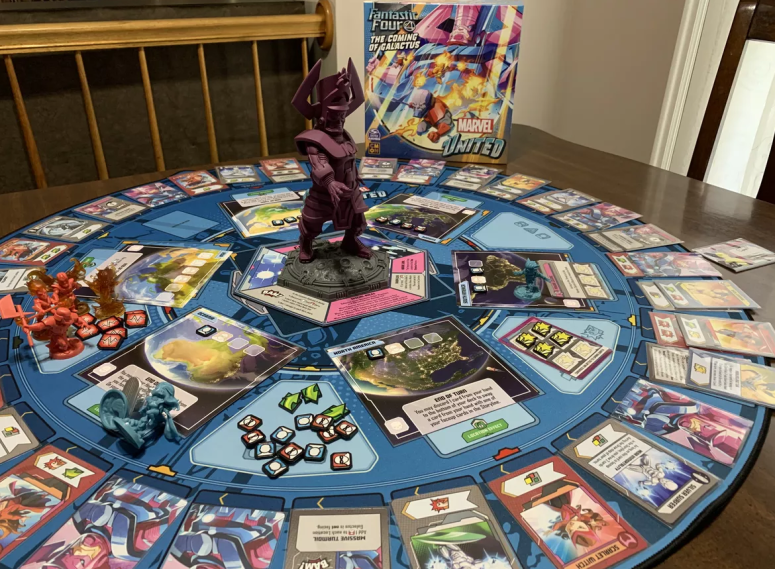
Game Setup
We already covered the Game Setup and Game Flow in our original Marvel United review (here’s a link to that review), so we’ll go over the basics in the following two sections. Let’s cover an abbreviated review of the game setup and rules.
Marvel United: Fantastic Four – The Coming of Galactus’s setup can change depending on which Villain(s) and Heroes you choose to play. Each game consists of six locations. Unlike most other expansions, Marvel United: Fantastic Four – The Coming of Galactus includes six locations, but they’re built specifically for battling Galactus. If you choose to fight Galactus’s heralds one on one or as a group, you may want to pick six locations from a different box. You may choose your locations or shuffle them and choose six at random. Each Location card has spaces at the top for civilians and thugs, and a rectangle with a block of text that will state “End of Turn” at the top of the box.
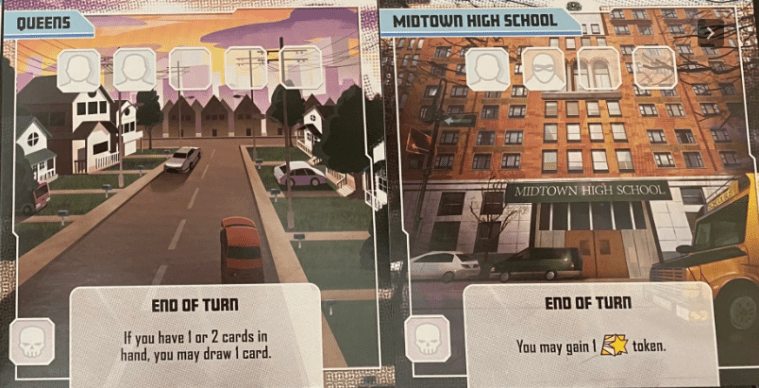
Place civilian/thug tokens on their matching spaces. Shuffle the Villain’s Threat deck and deal out each Threat face-up so that it covers the rectangle at the bottom of each location. You must clear this threat before gaining the “End of Turn” effect printed on a Location. Place health tokens where signified on threat cards and on the Villain dashboard. Place the three mission cards (Defeat Thugs, Rescue Civilians, and Clear Threats) face up under the villain dashboard where the text reads “Unlocked.”
Each player shuffles their hero decks and then draws three cards to form their hands. Shuffle the Villain’s Master Plan deck. Leave the Master Plan deck face down. This will be the villain’s draw pile.
Players place their miniatures on one of the six location cards, usually the centralmost location for each player (easy access). Then, they place the villain on the location card opposing the heroes.
If one player chooses to play as the villain, hand the Super Villain cards to them, and the Heroes gain access to Super Hero cards. These new card times can be played if the game state triggers their use (for example, “You play a Master Plan card” or “Any Hero has 4 or more cards in their hand at the end of the Hero turn.” Timing is key.
Special Galactus Setup Rules
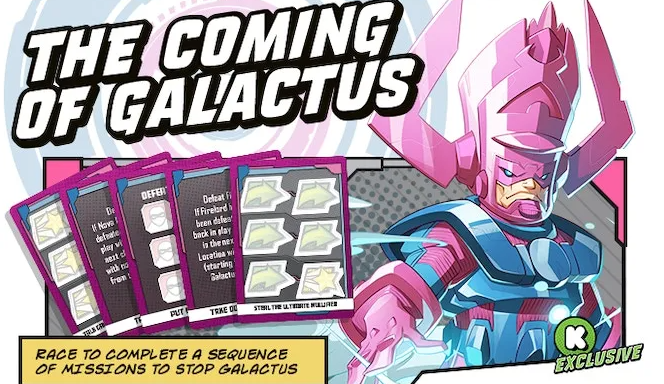
Follow the rules on the back of Galactus’s hexagon-shaped dashboard to build the Stop Galactus Missions deck. “Convince Galactus to Spare Earth” will always be the bottom card. And then reveal the top Mission.
Shuffle the Master Plan deck and remove 6 random cards from the game.
Heroes start in the Location corresponding to the continent where they are playing.
Set aside the 2 New Herald Threat cards, placing the others as usual.
Place Galactus on the back of his dashboard in the middle of the 6 Locations, facing the Heroes’ starting Location.
Split the printed action tokens among the players in any fashion.
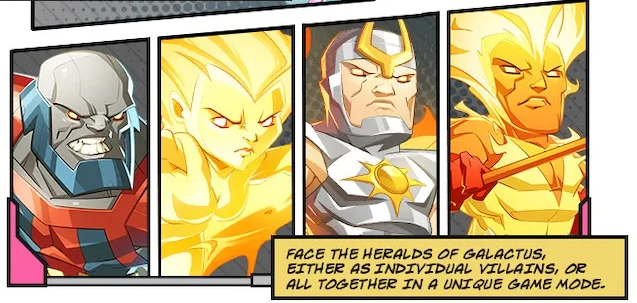
Heralds of Galactus Setup Rules
Place the 4 Heralds’ Villain (individual) Dashboards nearby the group’s dashboard, each with Health depending on the number of players.
Randomly place the 4 Herald tokens faceup, each in a different slot on the Herald Group Dashboard.
The Heroes start the game in any 2 opposite Locations (splitting as they wish). Then, randomly place 1 Herald in each other Location.
Create a Crisis token pool within reach of the players. The number of Crisis tokens will be dictated by how difficult the players want the game. Players will then split a total of 2 wild action tokens, however they see fit.
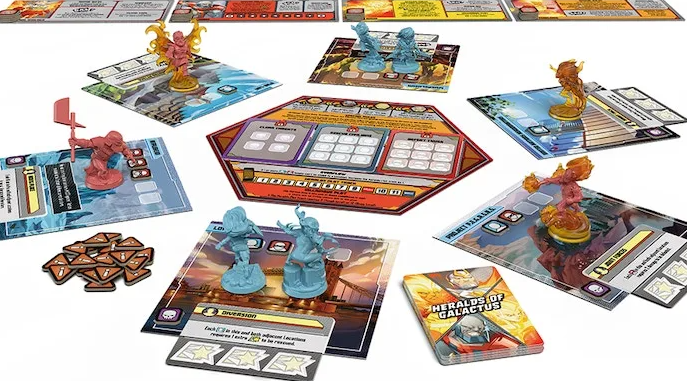
Game Flow
The villain(s) play first. Draw the top card of their master plan deck. The villain moves the number of spaces indicated. Resolve any BAM! Effects and these effects will be printed on a space within the villain’s dashboard. Then, place the civilian/thug tokens (if any) indicated at the bottom of the card. If a player has taken the role of the villain, they get a hand of cards and can choose which card they play. The heroes get their turn after all the villain’s effects are resolved.
Heroes pick which player goes first, and hero turns will continue around the table clockwise. At the beginning of each game, Heroes will get three turns before the villain receives another turn. During their turn, heroes play one card from their hand.

Resolve actions and the symbols printed at the bottom of the hero’s card in any order. The symbols at the bottom of a hero’s card will be shared with the next player, but any printed action will not be shared. Heroes will use these actions to complete missions. The game begins with three missions in play: Defeat Thugs, Rescue Civilians, and Clear Threats. Each mission card will have spaces for the tokens they require to complete. As soon as these spaces are filled, the card is discarded, and the mission is considered complete. Mission cards can be completed in any order.

After the heroes complete the first mission, the villain panics and will act (play a card) every two hero cards instead of every three hero cards. After the heroes complete the second mission, the villain becomes vulnerable to damage. The heroes can complete the third mission, but it isn’t necessary. If the heroes do complete the third mission, each hero immediately draws 1 card, increasing each player’s hand size by one.
Play continues back and forth until either the villain wins (by completing their unique master plan or anyone, heroes or villains, runs out of cards) or the heroes win by dealing enough damage to the villain after the villain becomes vulnerable to damage.
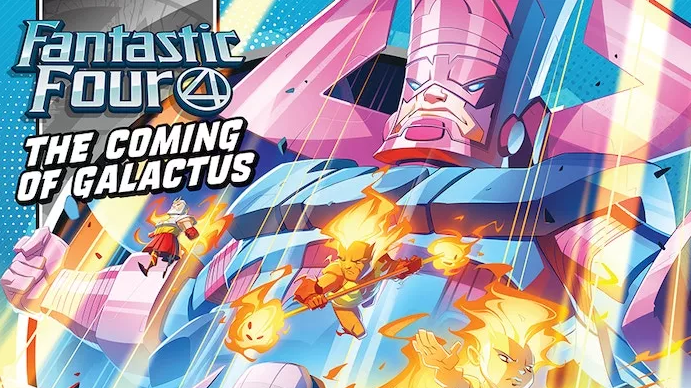
Review
Like its predecessor, Marvel United: Fantastic Four, Marvel United: Fantastic Four – The Coming of Galactus lives up to the hype. I seriously considered not backing any part of Marvel United Multiverse, but a few highlights from the stretch goals, a couple of other expansions, and, first and foremost, The Coming of Galactus, made Marvel United’s third wave fun and exciting.
Let’s begin with the big man himself. Galactus’s scale is intimidating and thematic. Despite multiple Sentinels in the X-Men (second wave of Marvel United), Galactus is by far the largest miniature for the game. He should be. At first, when I heard that Galactus would begin the game on the same space as the Heroes, and the Heroes begin the game on the continent where the gamers are playing, I rolled my eyes. That’s silly. But watching the big purple guy staring at my home continent when the game began made it more real. It’s weird. It was creepy, bizarre, thematic, and loads of fun.
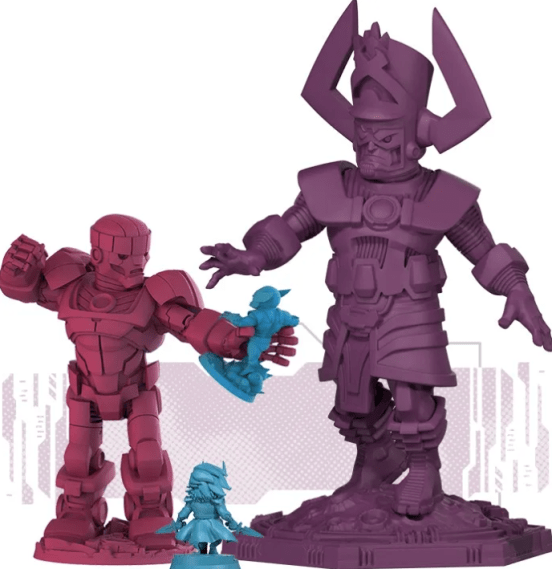
Galactus never becomes Under Pressure, so Heroes don’t need to worry about speeding up Galactus’s clock, but Galactus cannot be damaged. You’re not defeating Galactus. You’re convincing him not to devour Earth. To do that, you need to complete nine—that’s nine—missions instead of the usual two, plus dealing damage to the main villain. This makes the lack of speeding up Galactus’s clock moot. You’ll need every card and round you can to tackle his hunger.
The Missions vary with each element Marvel United offers: Heroics, Movement, Damage, Rescuing Civilians, Defeating Thugs and Henchmen. You’ll need a well-balanced group of Heroes to consider taking on Galactus. Fortunately, the Fantastic Four fit that bill, and they’re the classic Galactus opponent.
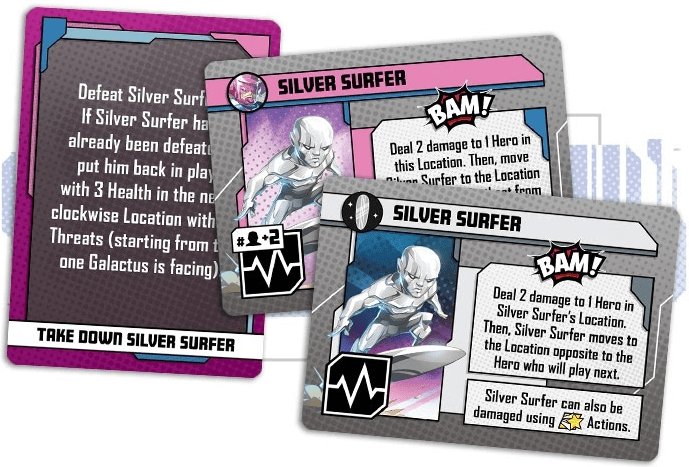
I like how Marvel United: Fantastic Four – The Coming of Galactus includes a Silver Surfer Herald Threat Card, so you can use Silver Surfer as one of Galactus’s heralds. That’s awesome and a great touch. Galactus adds a heap of Civilians and Thugs to the board each one of his turns; he adds one or the other to each Location he’s not facing. This applies plenty of pressure. At first, I wondered why the Heroes were given six action tokens to split among themselves. Yeah, you’ll need every last one to defeat Galactus. The few Master Plan cards that don’t add copious tokens shake up the game by bringing back defeated threats of a certain type or adding brand new Heralds. Yay!
I could go on about Galactus for another 400 words or so. He alone makes The Coming of Galactus worth it as an expansion, but this expansion ups the ante of variable playstyles. You can battle the Heralds of Galactus without including the big man himself. What? Marvel United adds an extra dash of spice anytime it includes a villain team. The Heralds of Galactus are no different. The Herald tokens dictate which villain does what during the villain’s turn. The first spot is the Villain who acts as if they played the Master Plan card for the turn. The other three Heralds add tokens: a Thug, a Civilian, and a Crisis Token. Players lose if they gain too many Crisis tokens, so you’re already at a huge disadvantage.
I love how Marvel United’s game system allows for simple but elegant solutions to potential problems. It could be boring if the Heralds did the same things each turn, but the Herald tokens shift positions after each Villain turn, so each Herald will have a chance to perform the four actions.
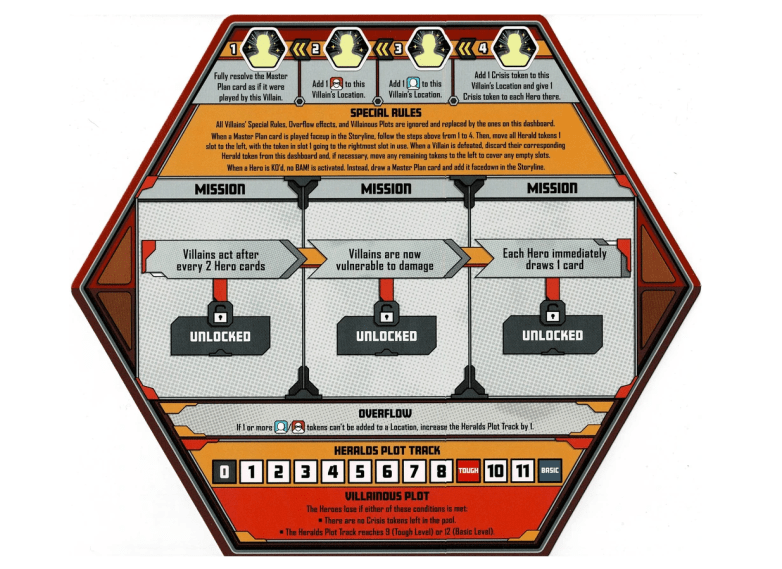
I’ll be honest. I haven’t played nearly as many games of Heralds of Galactus as I have The Coming of Galactus—for obvious reasons—but don’t sleep on this game mode. The Heralds of Galactus team adds a heap of extra value to The Coming of Galactus expansion.
Before we get into the individual Heralds as solo villains, let’s take a quick look at the six unique Locations and the lone hero in The Coming of Galactus. I’ll start with the western hemisphere and work my way east. Each one of these continent Locations has a ridiculous “End of Turn” ability. I advise only playing with these Locations if you intend to take on Galactus, his Heralds as a team, or another crazy strong opponent. But the choice is yours. Ultimately, you do you. Just know these abilities are crazy strong.
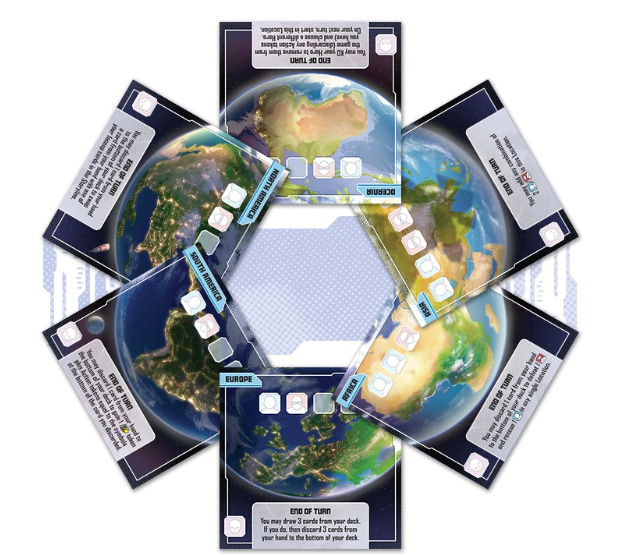
We begin with North America, and this Location may have the tamest ability of the six. North America allows you to swap a card from your hand with one of your faceup cards in the Storyline. This is good, but other Locations and character abilities have done something similar in the past. South America allows you to discard a card, gain 1 Wild token, and Action tokens equal to the symbols of the card you discarded. Now we’re talking.
Europe allows you to draw a new hand. Simple but great. Africa’s ability to discard a card to the bottom of your deck to defeat 1 Thug and rescue 1 Civilian anywhere is one of the best ways to prevent overflow, a common issue. Asia adds multiple Thugs and/or Civilians to itself, but Asia can house a game-high six tokens. Yikes! Sometimes you need extra Tokens to accomplish goals. And Oceania may have the single most broken ability. You may KO your Hero to remove them from the game (discarding any Action tokens you have) and choose a different Hero. What? Oceania may be the only way you can keep a game with Galactus going. Oh, I’m almost out of cards. KO. New hero. Talk about an insane power.
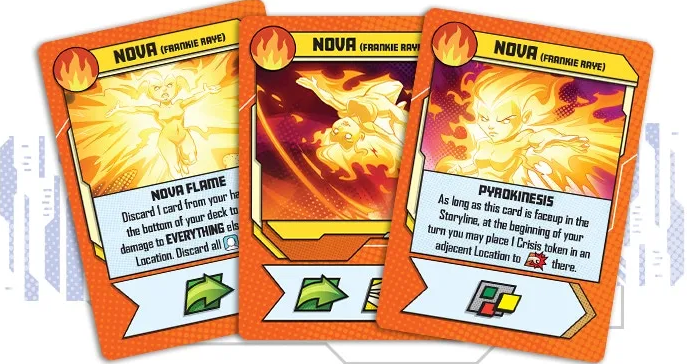
Nova (Frankie Raye), one of Galactus’s Heralds, can also be played as a hero. She offers a bunch of move, a large amount of damage, and little Heroics. Her special abilities can be great in certain situations. “Nova Flame” deals one damage to Everything at her Location, while also discarding (not rescuing) Civilians. This is a good way to clear a Location. But her starting card “Pyrokinesis” begs to be played first. As long as “Pyrokinesis” is faceup in the Storyline, at the beginning of your turn, you may place 1 Crisis token in an adjacent Location to deal an extra damage there. If the villain(s) you’re facing don’t use Crisis tokens, no problem. If they do use Crisis tokens, you could be in trouble.
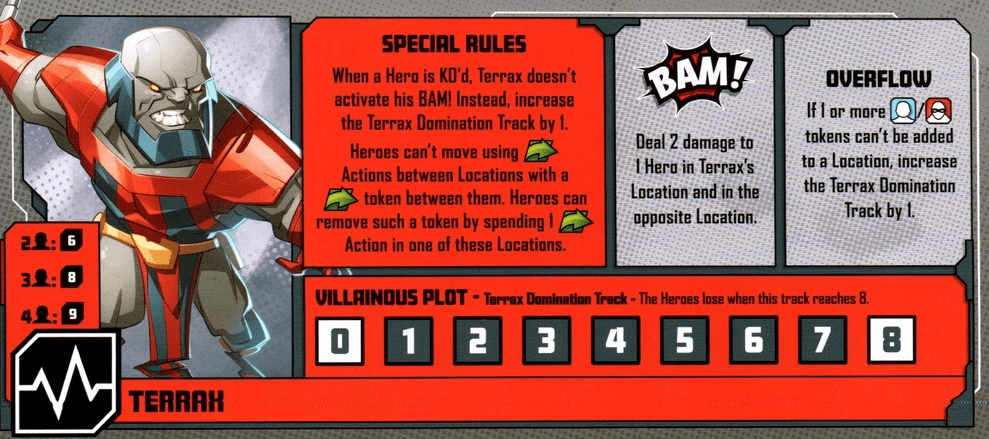
The Coming of Galactus features two new major shakeups to gameplay: Galactus and his Heralds as a team. But the Heralds can be played as solo villains, and there are some more interesting gameplay mechanisms to be found with each. Terrax takes an interesting approach to a progression track. His gameplay centers around causing numerous overflows, and he can even slow down by adding Movement tokens in between Locations. Air-Walker wins by adding Crisis tokens to Heroes. He can be annoying because each one of his Threats allows him to move away from Heroes, making extra Movement a necessity. And Nova wins by adding Crisis tokens to each Location. She does this in multiple ways; however, she may deal the most damage to Heroes by causing damage if a Hero lands in a Location with a Crisis token. Uh oh!
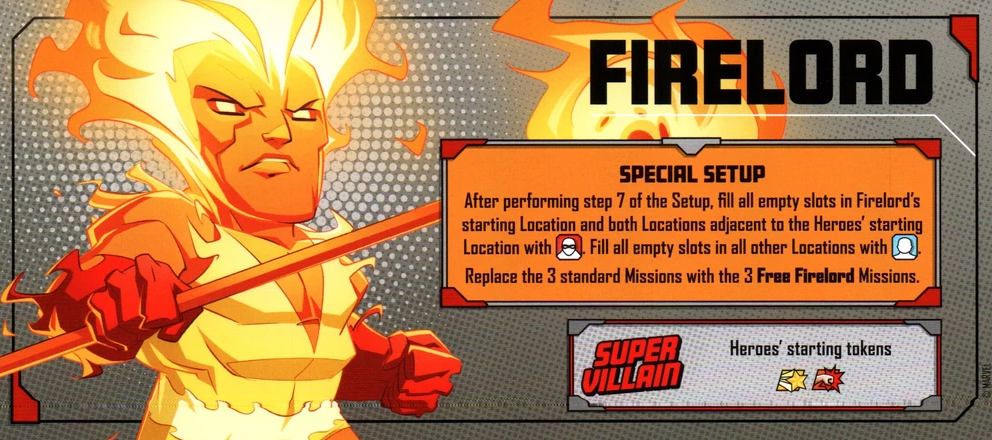
But Firelord is the most interesting of all the Heralds as villains. The Heroes are trying to rescue Firelord. Like Galactus, Firelord can’t receive damage. In specific cases, Firelord’s BAM ability can actually help the heroes, furthering the idea that Firelord doesn’t want to harm humanity. This is a nice touch. As you can see, The Coming of Galactus offers a bunch of replay value to Marvel United in a relatively small box. Honestly, the box is that big to accommodate the Galactus mini. That box’s size is a hundred percent the big purple guy.
Too Long; Didn’t Read
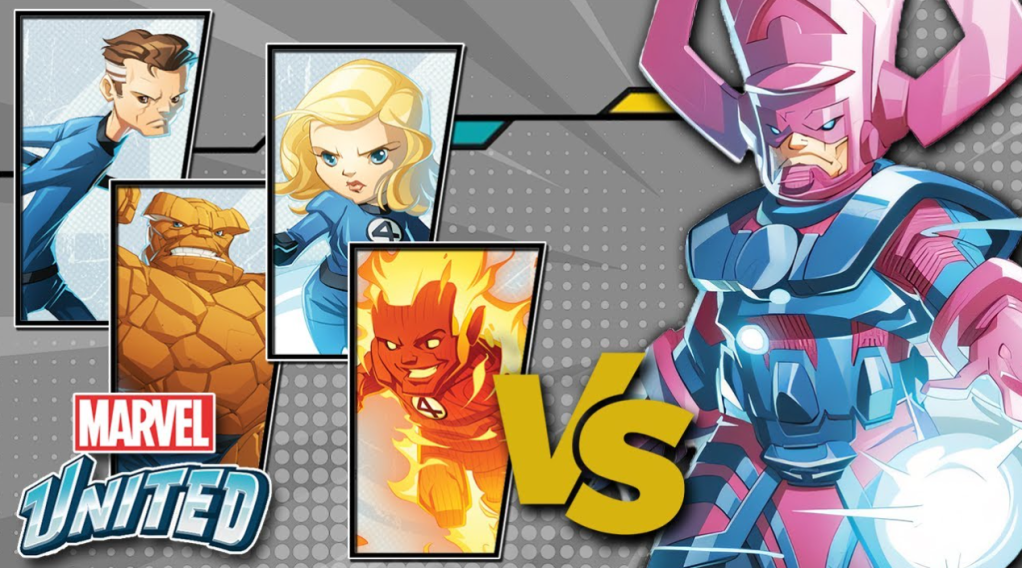
As of the writing of the review, Marvel United: Fantastic Four – The Coming of Galactus replaced Marvel United: Fantastic Four as the highest-rated Marvel United expansion on BoardGameGeek and for good reason. This expansion adds more game modes than any other single expansion of Marvel United. And Galactus is terrifying and hoot to play against.
 jkgeekly.com