
Trapped on an Airplane with the Justice League

Happy Wednesday, Geekly Gang! Kyra Kyle here. Wait. It’s Christmas Eve. Happy-happy to everyone who celebrates Christmas. One more day. Yay! Today, our writers share what they’ve been listening to over the past month. Feel free to share what you’ve been listening to over the past month. We’re all part of the Geekly Gang. I’ll get things started with what I’ve been listening to this past month.

I’m trying something a little different and including one podcast/YouTube channel in this post. I’ve been watching/listening to John at Falstaff Books. I’m originally from Georgia/South Carolina, so John’s cadence sounds like home. But I can see folks who won’t care for his delivery. Regardless, John at Falstaff Books gives great writing advice and an inside look at the publishing industry. Both are important if you want to “get gud” as a professional writer, who hopefully gets published one day.
Yesterday, John at Falstaff Books shared a set of writing resolutions that actually work. I may adopt some of these.
1) Write something each week.
The hard part is getting something on the page. If you’re not meeting a deadline, don’t put undue stress on your writing practice. Write a word. That word may become two or three, a sentence, or even a short story or chapter.
2) Read one book a month in a genre you intend to write
I’ve heard too many writers state they don’t want to read books in their genre because the book may color how they write. That’s dumb. You need to read books in your intended genre to see where the industry is headed. And how will you know if something already exists in a genre if you don’t read that genre? Also, reading in your genre gives you comp (comparable) titles for agents and publishers when you get to that stage.
3) Read one book a year on the writing craft or publishing industry
Podcasts are great, but you still need to read a book or two on the writing craft. I wouldn’t go crazy with this. One book a year sounds like a doable goal.
4) Read one book a year outside your intended genre
You never know what may spark something. You may not care for romance, but what if you wrote something in your intended genre that’s based on a romance you read? The two books wouldn’t be the same. They reside in different genres.
5) Attend one workshop, conference, or critique group during the year
This one should be self-explanatory. One gets better at writing by writing. Local workshops/conferences are nice. I live near Omaha, and there are plenty. But even if you can’t physically make a conference, online groups exist.
Yep. You may see points on this list next week, when our writers share their New Year’s Resolutions. Tee hee!

I’m sure each of our writers will mention Mannheim Steamroller in this week’s post. We just watched Mannheim in concert a few days ago. They were electric. And they’ve been a holiday tradition for decades. My first CD was Mannheim Steamroller Christmas (1984). Ah! So many memories.
But I’m going to let Skye and Season get into more detail with Mannheim Steamroller. I’ve been relistening to a lot of the artists I’ve mentioned throughout the year, so December has almost functioned like a musical recap: Replacements, REM, Gorillaz, The B-52s, Wet Leg, Chappell Roan, and of course, Mannheim Steamroller. I’ve gotta get my “Bring a Torch, Jeanette, Isabella” fix.
That’s what I’ve been listening to this past month. Let’s check in with Skye.
The Black Panther Soundtrack has been the unofficial theme of the past three weeks. I’ve loved this album ever since I picked it up, but lately, I’ve been listening to it repeatedly. The soundtrack helped me love Black Panther on a whole new level with songs like “All the Stars,” “X,” “The Way,” “Opps,” and “I Am.” My favorites have been stuck in my head and giving me energy during some tough holiday shifts. Some, like “I Am,” even remind me of important life lessons I often forget. So yes, Black Panther Soundtrack’s got everything: danceable tunes, memorable melodies, unique tone, and thoughtful lyrics. 10/10 would recommend.
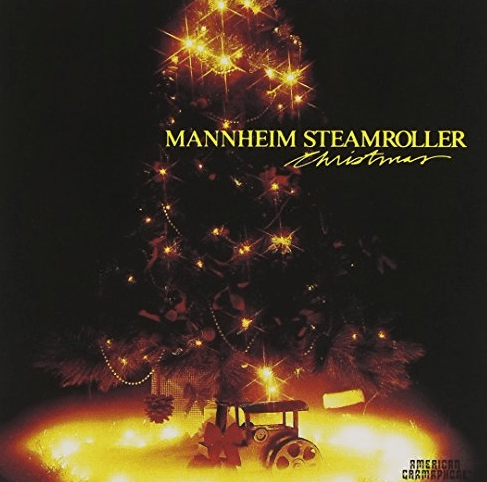
It’s that time of year, so can you blame me? Mannheim Steamroller has been a familial holiday staple, but ever since last year, I’ve been blessed with the vinyl. Christmas reminds me of waking up on Christmas morning 15 years ago. This album played when I walked into the living room to open presents. I was also lucky enough to see Mannheim Steamroller in concert this past Sunday, which was just what my inner child needed. My favorite tracks include “God Rest Ye Merry Gentlemen,” and “Good King Wenceslas,” so you can be sure I could barely contain myself when I saw them played live.

I, too, have been listening to Mannheim Steamroller. Sweet Memories is a CD one of my elementary school teachers gave me during a class Christmas party. The only song it has in common with Mannheim Steamroller’s original 1984 Christmas album is “Good King Wenceslas.” There are a few tracks I’m not as fond of, such as “The First Noel,” but most of them are fun. Not going to lie, my main reason for liking Sweet Memories as a kid was because there were horses on the album cover.
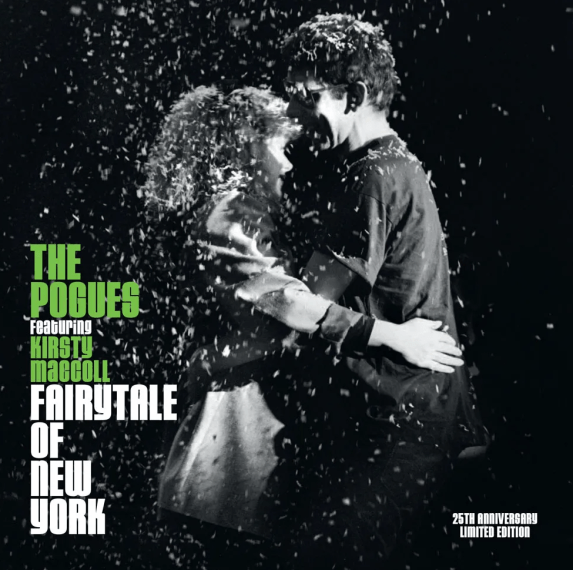
“Fairytale of New York” isn’t a traditional Christmas song, but that’s why I like it. Most people don’t think of immigrants failing to make their dreams come true in the United States when they think of Christmas. “Fairytale of New York” has an upbeat tempo while hitting on harsh realities for Irish immigrants, but the concept can be applied to any immigrant.
“Fairytale of New York” took over two years to complete. The Pogues didn’t like many of the recordings, so they tabled it for a while. They toured the US in 1986, with their first destination being New York City. The lead singer, Shane MacGowan, got inspiration to write new lyrics for the song. Featuring Kirsty MacColl, “Fairytale of New York” was published in 1987 and became a classic. Rest in peace, Kirsty and Shane.
Hey, hey! Kyra Kyle here again. And now I need to listen to “Fairytale of New York.” Thanks, Season. Happy holidays, and let us know what you’ve been listening to over the past month, Geekly Gang. Thank you for reading, and wherever you are, I hope you’re having a great day.







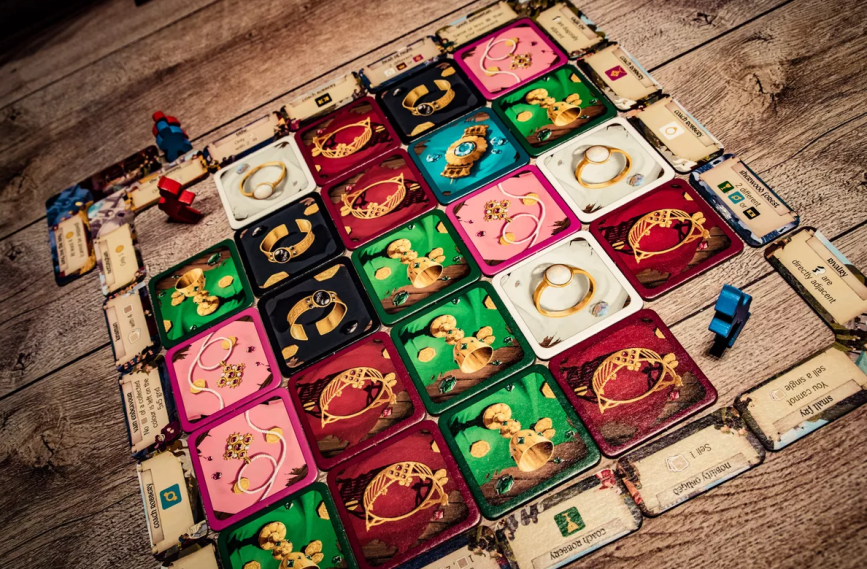
Hey, hey, Geekly Gang! Kyra Kyle here with another board game review. Full disclosure: Today’s game is one of my go-to 2-player board games, Robin of Locksley by Uwe Rosenberg. I’ll try to stay as neutral as possible, but it’ll be difficult. I love this game that functions as a race between two players. You control two pawns, Robin and a Bard. While Robin steals Loot from the rich, that Loot is used to move the Bard on a Race Track. The first player to finish the race wins. We’ll get to the daring do soon, but first, let’s discuss some of the less swashbuckling aspects of Robin of Locksley.

Designer: Uwe Rosenberg
Publisher: Funforge, Rio Grande Games, Wyrmgold GmbH
Date Released: 2019
Number of Players: 2
Age Range: 8 and up
Setup Time: 5-10 minutes
Play Time: 20-30 minutes
We’ll use Robin of Locksley’s rulebook for this section. I don’t know if words can express how to set up the game. We’ll include the picture the rulebook provides. I always use it when building the board.
* Shuffle all Loot tiles (gold coin side up) and build a 5×5 grid.
* Choose a player to go first. The first player takes one loot tile from any corner of the board. The second player takes the tile from the opposite corner. Each player flips the tile they chose back over to the side showing the gold coin and forms their personal supply.
* The players put their Robins in the now empty corners.
* Place the remaining loot tiles with the gold coin side up in a draw pile.
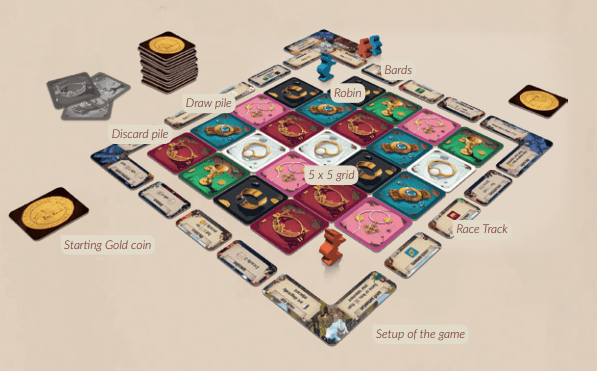
* Find the corner pieces labelled “The Beginning” (start) and “Long Live the King” (end). Put them together in one of the corners. Place “The Beginning” piece (as shown above) in the inner corner.
* Shuffle the remaining corner pieces, draw three, and put them in the remaining corners.
* The players put their Bards in their color next to the start tile.
* Shuffle the small fame tiles and put three of them between the corners.
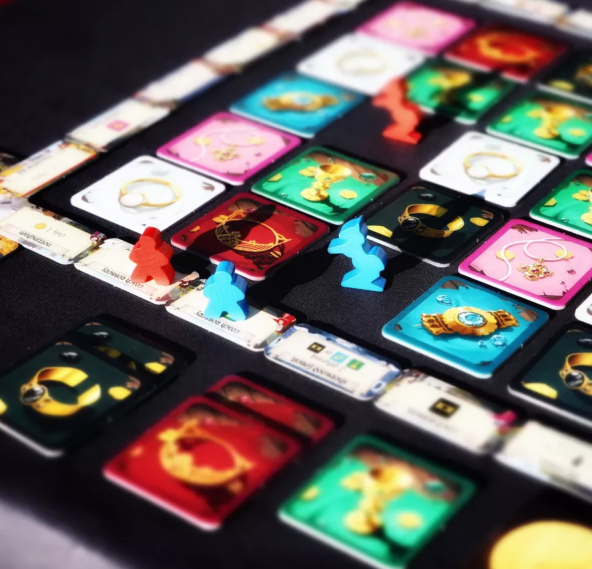
* When complete, the game layout should look similar to the picture above.
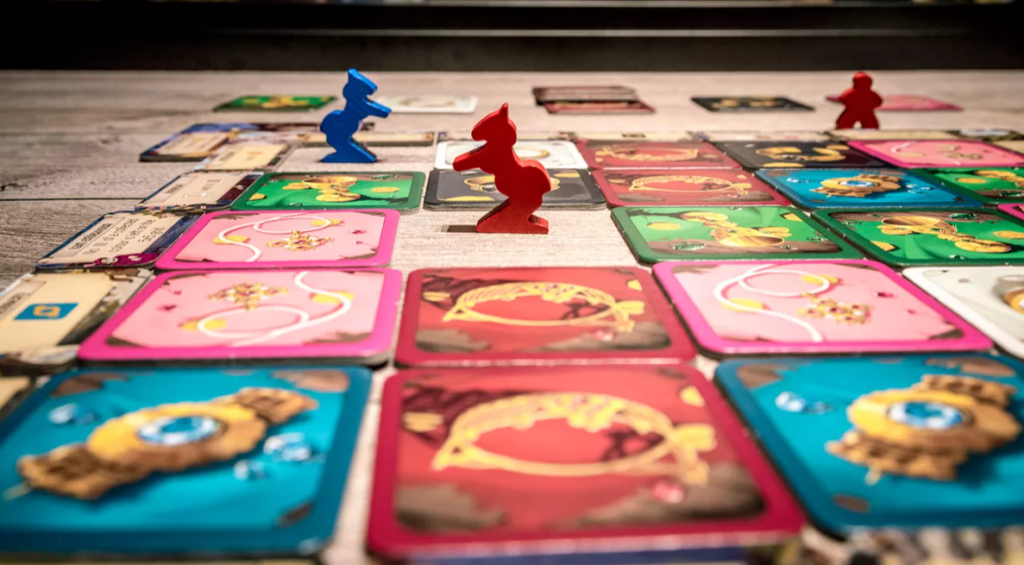
Moving Robin
* Players alternate turns. The start player begins the game.
* Players move their Robin in the shape of an “L” composed of three tiles (just like the knight’s move in Chess).
* The player takes the tile they landed on into their personal supply.
* At the end of their turn, the player fills the now empty space (the space their Robin left) with a Loot tile from the general supply. Do not fill the square occupied by a Robin.
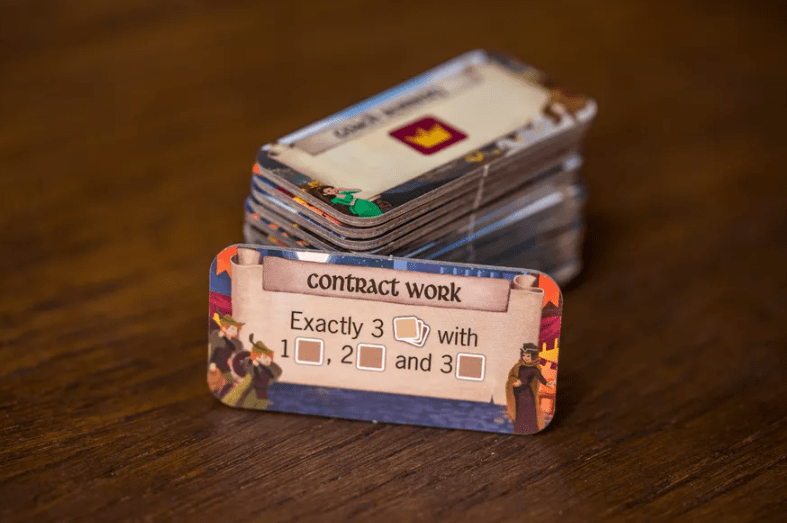
Players win the game by moving their Bard along the Racing track (the one surrounding the loot tiles). There are two ways to move with your Bard.
1) Every Fame tile (the ones that compose the Racing Track) shows one task. If the player is able to fulfill the task indicated on the Fame tile, they may move their Bard 1 tile forward on the Race Track. These tasks range from possessing a specific color of Loot or having your Robin in the corner of the 5×5 Loot tile grid.
2) The player may spend 1 Gold coin (and discard it to the open discard pile with the Loot side up) to move their Bard 1 tile forward (clockwise) on the Race Track. The player may continue to move their Bard forward as long as they can meet the requirement or pay the bribe for each tile they encounter.
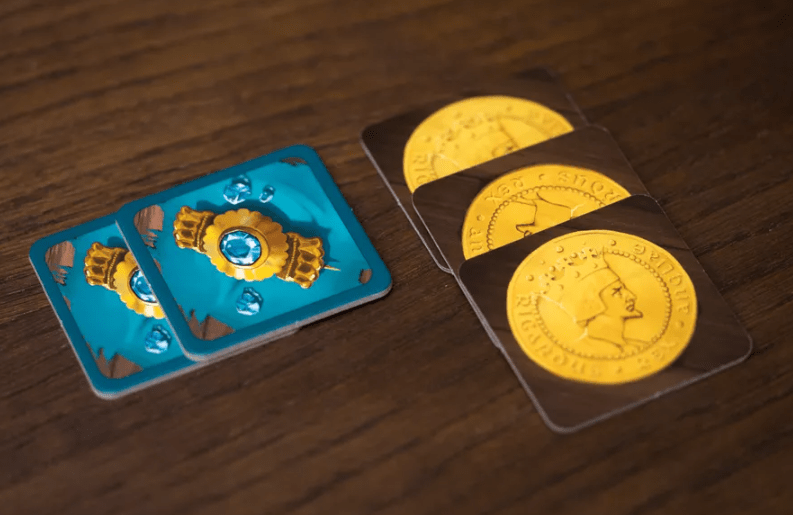
A Loot collection is a set of 1 or more Loot tiles of the same color. Loot collections may never be split into smaller collections.
Anytime during their turn, players may sell a Loot collection which consists of 3 or more Loot tiles of the same type.
Discard two of the Loot tiles on the open discard pile and collect the remaining ones as Gold coins by turning them over.
There are two ways the game can end, and a player can win.
1) The game ends immediately if one player’s Bard “laps” the other player’s Bard on the race track. To “lap” the other player, one player’s Bard must have made a full extra lap around the track thus passing the other player’s Bard a second time. The player whose Bard has passed the other is the winner. If both Bards are on the same spot on the Race Track, the game does not end.
2) The player who first completes two full laps of the Race Track and fulfils the challenge on the goal tile is the winner.

I love the way the Robins move. Robin of Locksley’s new players will have an easier time picking up the move mechanisms, but the way knights in Chess move isn’t straightforward. The Robins have familiarity, and each move functions as a spatial puzzle. One of the Fame tiles (the spaces on the Race Track) requires a player’s Robin to be one move away from their opponent. I don’t know how many times I’ve spent a Coin to skip this requirement, but I get a rush every time I can meet that requirement naturally. Then, it becomes a race, so my opponent can’t finish that Fame tile during their next turn.
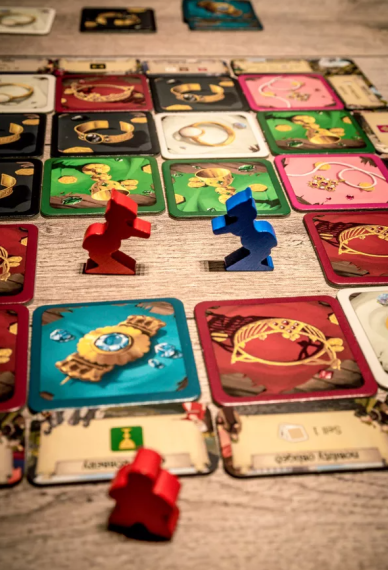
The Fame tiles have varied requirements. Robin of Locksley’s modular board ensures no two games will ever be the same. And planning spaces ahead is fun, making each turn meaningful, even if your move this turn won’t help you progress right away. Robin of Locksley also has that volta, a turn where the game shifts, and it’s usually during the mid-point. Players bide their time, collecting Loot, meeting easier requirements, and accruing enough Coins to skip five or six spaces on the Race Track during a single turn. I love this volta (turn). As soon as this happens, the race is on. The other player will pop off a five or six spaces of their own, and Robin of Locksley begins in earnest. Typically, this momentum continues until the game ends.
And games of Robin of Locksley don’t take too long. BoardGameGeek and the rules list games as lasting up to 40 minutes. This hasn’t been my experience. My first game of Robin of Locksley may have taken close to 40 minutes (with the teach), but as soon as you have two players who know what they’re doing, turns take no time at all. Sometimes, I must call time and raise my hand if I want to move those five or six spaces in a turn, because it’s easy to get into a rhythm. The game’s rhythm getting interrupted raises the stakes during the volta. It’s so good.
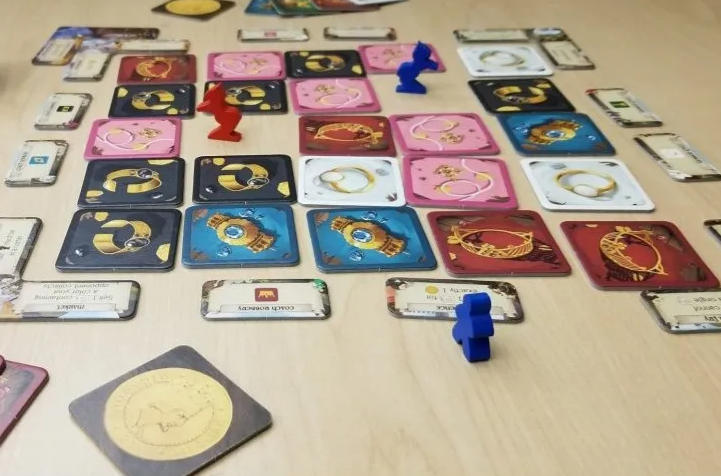
Looking up a Fame tile’s requirement is one of the few ways a game of Robin of Locksley slows. None of the Fame tiles has any text; they’re all conveyed through icons. The Robin of Locksley rulebook contains a glossary of what each icon means, but it will slow down the game to look up that information during your first lap around the Race Track. Despite this occasional slowdown, I like how both game elements work with each other in Robin of Locksley. It’s a healthy balance of figuring out how best to maximize your Loot with your Robin piece and looking ahead on the Race Track to see what you may need.
Robin of Locksley is my go-to 2-player only game. My spouse and I have played a ton of 2-player games lately, but Robin of Locksley is one of the few competitive 2-player-only games that consistently make our rotation.
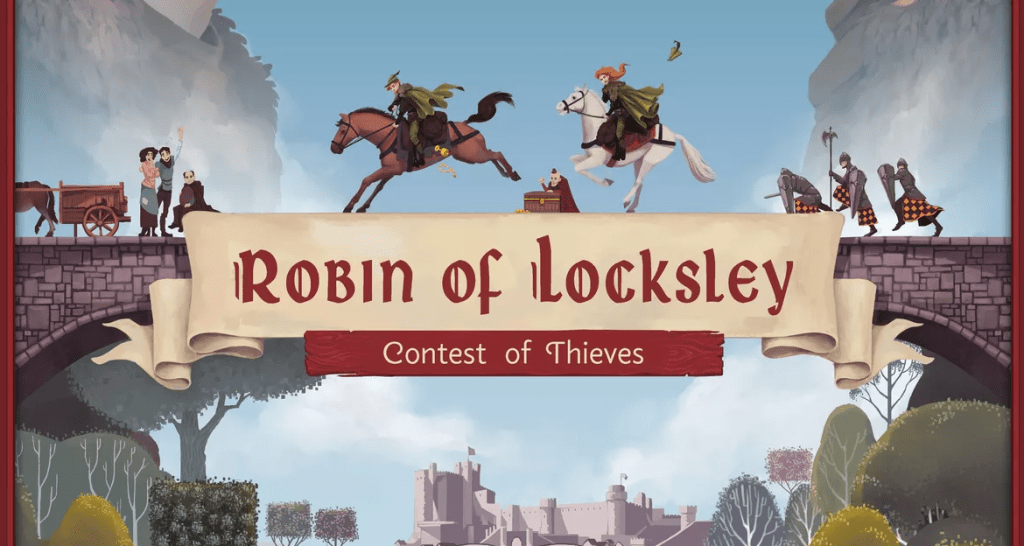
Robin of Locksley has short, punchy turns that lead to a satisfying race to meet Loot (or spatial) requirements. With its modular board, each game is unique, but one thing stays constant: the volta (turn). Each game will have an exciting turn where one player moves multiple spaces, and then the race is on.




Happy Wednesday, Geekly Gang! Kyra Kyle here. Today, our writers share what they’ve been watching over the past month. Coincidentally, Skye has watched a handful of Rob Reiner films this month, and I’m certain she’ll write a memorial for him. We lost a legend. RIP, Rob Reiner. Feel free to share what you’ve been watching this past month, because we’re all part of the Geekly Gang. I’ll get things started.

Delicious in Dungeon marks the first anime I’ve watched in about a decade. Seriously. I haven’t found a single anime to spark my interest in almost ten years. Delicious in Dungeon’s premise is simple. What would various mythological creatures taste like, and how would one prepare them? There’s more to Delicious in Dungeon than that, but most viewers will watch for the interesting mystical meals. They look scrumptious.
I can’t wait to try a real-life–modified, of course–version of any one of these meals. Yum! The idea of eating mythical creatures has sparked another board game concept. I’m still in the early phases of game development, but I’ll share this game soon. Getting back to Delicious in Dungeon, the storyline is easy enough to follow. One adventurer’s sibling gets eaten by a red dragon, and the adventurer quests for their missing sister before the red dragon can digest her. The party has little to no supplies, so they must eat the flora and fauna they meet in the dungeon. Hence, Delicious in Dungeon.
The show ventures into corny territory more than once. I get a kick out of adventurers performing their best because “they got enough sleep, ate three balanced meals, and exercised.” Delicious in Dungeon often feels like a Saturday morning cartoon with a message for kids. But I’m here for it. One can’t help but eat a healthy snack while watching. I don’t always eat the best. Thank you for the reminder to eat balanced meals, Delicious in Dungeon.
Delicious in Dungeon only has one season (on Netflix), and after finishing that season twice, I switched to a show I once covered on this website when it first aired, Grimm. Grimm’s first season oddly goes with Delicious in Dungeon. A set of characters harvests bodies for medicinal purposes. This CW made for a perfect follow-up to Delicious in Dungeon, especially since I was finishing my mythic monster cooking game prototype.
I always graded Grimm on a curve. It’s a stellar show for a CW show. Yes. Grimm suffers from plenty of CW melodrama. But Grimm is less CW of a show than most CW shows. I like the premise. Grimms are mythical police officers; Grimms do their best to keep the peace between wesen (mythical creatures who look human to us normies, but Grimms can see through their built-in illusion magic). As you can surmise, Grimm borrows more than a little bit from the comic book series, Fables. One of the titular Grimm’s besties is a “Big Bad Wolf.”
But Grimm does enough to hold my interest almost a decade and a half after its initial release. It may have had the best CGI of a CW show, and that’s saying a lot. The Arrowverse put a ton of money into CGI. Strike that. No. Flash had the best CGI, but Grimm’s sparse use of CGI made it look better. Most of Grimm’s CGI was used to make human faces look animalistic. I’ve only watched most of the first season, but so far, I’m enjoying the ride.

Finally, I watched Sean Combs: The Reckoning on Netflix. It was eye-opening, disturbing, and well-done as most Netflix limited series are, but I’m unsure how many revelations I found in Sean Combs: The Reckoning. Since he’s a hip hop insider, producer 50 Cent has connections. I also appreciate it when a documentary openly shares its bias. Sean Combs: The Reckoning reminds me of the old essay adage: tell the truth, but tell it slant. Don’t be afraid to lean completely into your beliefs. It’s clear the director wants people to believe Sean Combs had something to do with Tupac’s murder. Sean Combs: The Reckoning does a great job of presenting the theory as fact.
And I’ll be honest. There’s more than a zero percent chance that Sean Combs had something to do with Tupac’s murder. I’m just not as certain as Sean Combs: The Reckoning appears to be. To be fair, Sean Combs: The Reckoning does state the Tupac murder theory as a theory. The one thing I know Sean Combs: The Reckoning adds to hip hop history is its inclusion of security camera footage during Biggie’s murder. I had to look away. I can’t stand that kind of senseless violence.
And Sean Combs: The Reckoning does a great job of illustrating the moments leading up to Biggie’s death. One can’t walk away and not feel like Combs had plenty to do with Biggie’s death. The fact that Combs made Biggie’s mom pay for his funeral was shameful. I didn’t care for Puff Daddy before this docuseries. I’m more of a Tupac and Biggie fan. Sean Combs: The Reckoning does enough that I don’t ever want to hear another Sean Combs track. I may act like Combs whenever a Tupac song plays on the radio. Yo! Change that!
That’s all I have for what I’ve been watching this past month. Let’s check in with Skye.

I had been meaning to watch Misery for a while, and I finally got the opportunity a couple of weeks ago. And I haven’t been able to stop thinking about Misery ever since. Putting aside Kathy Bates’ iconic and Oscar-winning performance as Annie Wilkes, I know that’s a big ask, Misery is a great tale about the danger of getting too involved in our fandoms. Even with that powerful and necessary lesson for adults, Misery also delivers plenty of suspense. There were several moments I was grinding my teeth after Paul escaped his room while Annie was away, and the small, intimate setting of the Wilkes estate makes the sense of urgency feel even more real.
Misery also serves as a testament to one of our greatest modern filmmakers: Rob Reiner. With his recent passing, along with his producer and spouse, Michele Singer Reiner, I wish their family the best in the healing process. I now watch their old works, remembering what a gift they were to cinema, and I’ll remember their creations fondly. Rest in peace.

Eternal Sunshine of the Spotless Mind happened to appear on my list of films to watch. It turned out to be much different from what I was expecting. What was I expecting? I don’t remember, but from what I saw, Eternal Sunshine seemed to be a charming flick. Upon first viewing, I had a hard time figuring out what Eternal Sunshine was trying to be, but I was able to get into it after the big reveal. Eternal Sunshine can be schmaltzy at times, but I was moved. The only thing I still don’t follow is how technology to remove specific memories from someone’s brain casually exists. I might give Eternal Sunshine another watch to fill in those memory gaps.

I love Pixar. It was only a matter of time before I watched Elio. Y’all might remember my “Top 5 Pixar Movies” this year. I’m surprised it took me this long to watch Elio, and it ended up slightly above average. Unlike certain other Disney Disappointments™, Elio had a well thought-out script. It only became frustrating when the film didn’t follow through on some ideas and opted for a standard family-friendly space adventure. No harm would be done if you played Elio for your kids, but it would still be depriving them of the best Pixar has to offer. Please, Pixar, be better than Disney. I miss you.
Hey, hey! Kyra Kyle here again. That’s all our writers watched this past month. Feel free to share your opinions on these movies and shows in the comments. Thank you for reading, and wherever you are, I hope you’re having a great day.



 jkgeekly.com