
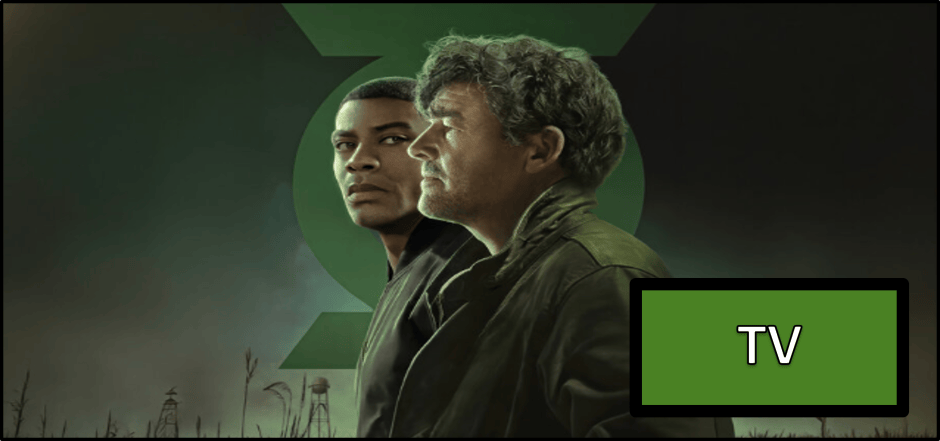
Hey, hey, Geekly Gang! Kyra Kyle here with another another review/reaction of this week’s episode of Lanterns, “Dirt and Stars.” If you want to see our thoughts on last week’s episode, “The Jordan Boys Legacy,” here’s a link to that review. “Dirt and Stars” tidied up most of Lanterns‘ loose ends. Did it tie up those ends in the best way. Maybe, maybe not. But the show’s finale does what Lanterns has been doing this entire season, keeping the narrative focused on its characters.
I loved the moment in the car between John Stewart and Noah (Kerry’s son and the Manhunter’s grandson). Lanterns has explored upbringing and the concept of nature versus nurture this entire season. Kudos to Lanterns for doing that. Did I like the reveal of Noah as the last remaining Manhunter. Yeah. It was good. It tied into the events of Rushville. Having a Manhunter as the “final boss” (so to say) was better than trying to shoehorn Parallax into the final three episodes. Did I like the fake out of Kerry being the one who killed Hal? Not as much. It made sense for her character, but Kerry loses something as a character when she impulsively shoots Hal after Hal talks about moving Noah. Clearly, Hal doesn’t want to harm Noah; he wouldn’t have suggested moving. Kerry may be a mother, but she’s also a sheriff. While I could see Kerry shooting Hal in defense, I don’t know if this scene sold why she’d do so.
Again, the acting was phenomenal. You couldn’t have asked for a better cast. I love all of the main cast here. Lanterns (from a writing a direction standpoint) did a fantastic job of conveying these characters. Most of them are flawed and that makes them compelling. Sure, I took Lanterns to task for adding full episodes of backstory for its characters. This caused the show to mark time and not propel its narrative forward. Most creative writing instructors would advise against taking this action. But the characters are so intriguing that I didn’t mind. I wanted to know more about John and Hal’s upbringing. And I think setting Lanterns on Earth was a good move. Would I like to see interstellar Green Lantern stories in the future? Of course. Setting Lanterns on Earth reduces budget costs. I can see the DCU containing its live-action television series to Earth, while its movies explore the cosmos.
Despite grounding the characters (on Earth), Lanterns does a good enough job of adapting the Green Lantern from the comics. I don’t read too many other reviewers’ posts until after I finished reviewing a movie or show myself, but I can imagine a lot of reviewers and specifically reviewers who are comic book readers, complaining that Lanterns should’ve been set in the cosmos. If you plan to make a Green Lantern television series, that series needs to be set in space. I agree with that to some extent, but Green Lantern has had terrestrial stories as well. I remind you of the groundbreaking Green Lantern/Green Arrow comic book series of the 1970s by Dennis O’Neal and Neal Adams. Lanterns made more than one reference to this series, most notably the scene between the Guardian and John’s mother. So good.
Arguing about how Lanterns does or does not adapt the comics plays out like a windshield wiper. It doesn’t work because of this, but it does work because of that. And so on. I return to the characters. Kyle Chandler does a phenomenal job as a broken Hal Jordan. While Aaron Pierre’s John Stewart borrows a few elements from another Green Lantern (Kyle Raynor’s artist abilities), Lanterns does a great job of weaving those elements into John’s character. I’m always down for more Nathan Fillion as Guy Gardner, and I can’t wait to see if Gardner gets his red power ring. From the main cast to recurring characters and supporting characters, most, if not all, the actors do a great job. I enjoyed this show. Is it a perfect representation of Green Lantern from the comics. Not exactly. But I draw your attention to DC Comics’ Elseworlds. It’s the multiverse without the interconnection. The characters are close enough to their comic book counterparts.
John Stewart was a military veteran and had an odd upbringing. Guy Gardner always had a chip on his shoulder and suffered from an inferiority complex. While he spent most of his life as a hero, Hal Jordan did become a villain. It’s the online chatter about Jordan that makes me laugh.
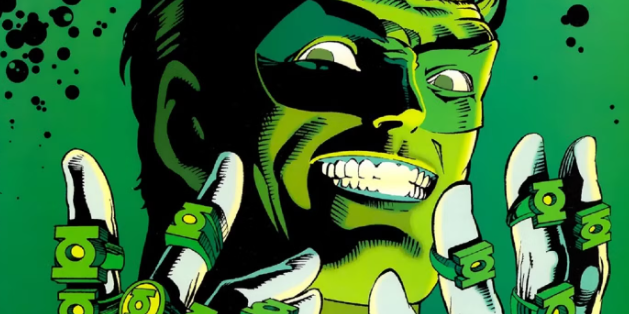
In the comics, Hal Jordan killed all but one Guardian (in Lanterns, Jordan’s mentor Sinestro killed a single Guardian), and then Hal began killing every Green Lantern and claiming their rings for himself. That’s where we get the iconic image above. Fans became so outraged, claiming Hal would never do those heinous acts. This isn’t my Hal. Hal’s a hero. He isn’t broken. The complaints became so loud that DC Comics backtracked the story. Instead of Hal becoming Parallax, they made Hal possessed by Parallax. It wasn’t Hal’s fault. It was someone else’s. LOL Lanterns had shades of Hal as Parallax, and Green Lantern fans are doing the same thing online in 2026 as they did in the 1990s. My time machine works. It’s the 1990s again.
See what I mean? We can go on for hours like a windshield wiper with Lanterns being a “good adaptation” of Green Lantern. Most points have counterpoints. I will add that Lanterns did set up the concepts of the emotional spectrum (what each color of power ring represents) in subtle ways. I can’t wait to see how Lanterns explores the emotional spectrum in the future (if it gets renewed for a second season, that is). I mentioned Guy gaining a red power ring. Red power rings are fueled by rage. He’s a list of DC Comics’ Emotional Electromagnetic Spectrum:
Red/Rage
Orange/Avarice
Yellow/Fear
Green/Will
Blue/Hope
Indigo/Compassion
Violet/Love
Grey/Sorrow
Black/Death
White/Life
The lantern John uses to power up his ring has yellow streaks: fear. Sinestro mentions that fear can be the most powerful force in the universe. Of course he’d say that, he’s the most famous wearer of a yellow power ring. While in bed, Hal says to Kerry that he “wills” her to stay. This is a great nod to what powers the green power ring; it’s another great moment of Hal trying to reclaim his hero status after his fall. And I mentioned in previous reviews that Parallax (DC Comics’ living embodiment of fear) was hinted at more than once in Lanterns. The show eases viewers into this concept. An emotional spectrum is odd, but I can’t wait to see what the DCU has in store for the emotional spectrum’s future.
Yes. Guy gains a red power ring, but he may be the one character who has worn the most unique color of power rings. I’d like to see the DCU explore Guy’s character arc with these various rings. I’d also love to see the DCU adapt Supergirl gaining a red power ring. This dovetails into 2026’s Supergirl. So many people derided Supergirl because the main character was too angry. During a comic book event when most DC characters gained a power ring, Supergirl gets a red power ring. Buried under the weight of expectations (superhero, member of the House of El, part of the Superman family, and various gender roles as a woman), Supergirl embraced the red power ring by saying “F#@% this S#!t.” It was a joy to see an unleashed Supergirl.
I enjoyed Lanterns season one. The show had flaws. I mentioned several weeks ago that I couldn’t see how Lanterns could regain its momentum after the events of Rushville (episode five), and the show struggled to do just that. The momentum slowed to a crawl. I’d say the first five episode of this season were fantastic. I’d gladly rewatch them. The last three episodes leave a little to be desired, but overall, Lanterns season one held my interest.
Those are my thoughts on Lanterns “Dirt and Stars” and the show as a whole. Thank you for reading, and wherever you are, I hope you’re having a great day.

