
Happy Wednesday, Geekly Gang! Today, our writers share which games they’ve been playing over the past month. Feel free to share what you’ve been playing over the past month, too, because we’re all part of the Geekly Gang. I’ll get things started with the games I’ve been playing over the past month.

Kyra’s Board Games
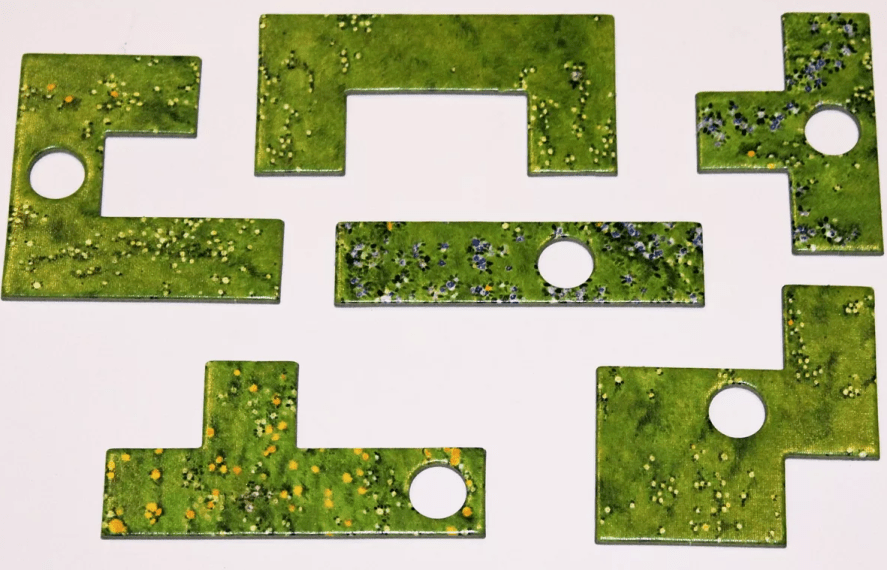
Skye mentioned this game in last month’s Whatcha Playing; I just wanted to share a few thoughts on Planet. Of course, I love the idea of the planet component. The 3-D planet each player builds gives Planet a huge toy factor. Planet does do a few things to differentiate itself from a 3-D Cascadia. The array of animals you may attract to your planet makes players’ strategies evolve. If an animal (with a scoring mechanism) doesn’t score during a round, it gets moved to the next round. Brilliant!
The scoring mechanisms also prevent players from playing one specific way. I had the Arctic Planet role and wanted as many Ice spaces on my planet as possible. But there are scoring mechanisms that reward a player for having the largest collection of ice spaces, and another for the most unique instances of ice spaces. I’m constantly being pulled one direction or another great. This was fantastic. I will echo Skye’s complaint that the planets aren’t designed the best from a physical standpoint. It was too easy to break my planet. The tokens would consistently fall off as I was turning my planet over to score each animal scoring mechanism. It’s a small thing. I’d love to see Planet get an updated second edition.

Family visited us over the past month, so we played more party games than we usually do. I’ve covered some of these titles in the past (some may have reviews on the site), so I’ll try to keep these write-ups brief. Sixes is an interesting take on Scattergories. Given one or six categories (depending on the round), players alternate trying to match other players’ answers or come up with a unique answer. My brother-in-law shared that he liked how Sixes didn’t make him feel as inadequate as Scattergories. Switching from matching to unique answers matters. It makes Sixes more approachable.

I haven’t made a Just One review yet. Good to know. You may expect one early next year. Tee hee! Anyway, Just One has a simple concept. One player is the guesser. They choose a number between 1 and 5. There will be a single word clue that corresponds to that number. All the other players (the ones who aren’t the guesser) write one-word clues. Before the guesser can see these clues, the clue givers compare their clues. If they match, they erase their clues. After that’s done, the guesser tries to guess the clue word from the clues.
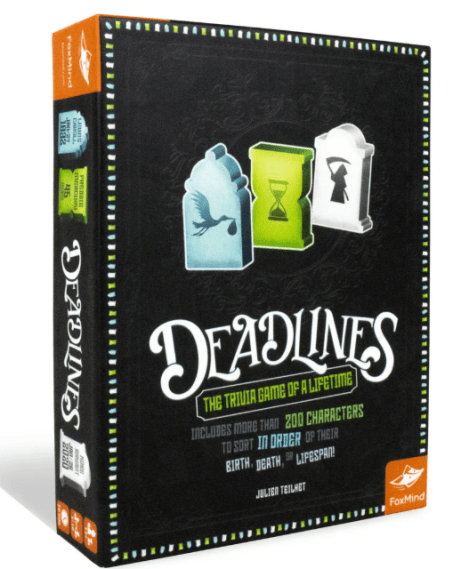
Woah! Deadlines is another game we don’t have a review for…yet. Love this one. It’s morbid in the best ways. Each card has a famous person listed on it. On the back, players will receive a clue as to who the person is. There are hundreds of famous people on these cards; you won’t know all of them. On the front, each card will say when the person was born, how long they lived, and when they died. The player must pick one of those three attributes and add their card to a growing timeline. Er, Deadline. If you get the Deadline wrong, you keep the card. It counts as a point. You don’t want points. As soon as a column reaches a certain number (it’s supposed to always be twelve, but I adjust the column length by the number of players), the column is finished. As soon as the final column is finished, whoever has the least points wins.

We’ve reached the one new-to-me board game on my list this month: Verdant. I liked this puzzly game. I only played it once, and I was worried about my car (it was in the shop at the time), but I’d like to play Verdant again. Soon. Players build a house in a 5×5 grid, alternating room cards and plant cards. Verdant has a supply line (a display) of five room cards and five plant cards. In between those two lines sit tiles. Some tiles give you abilities, like a watering can, while others are objects you can put on a room card. Each room card has space for one object. You’ll want to match colors (of objects and rooms), place plant cards beside room cards of the same color. It gets very puzzly.
Since room cards and plant cards are in pairs, whichever card wasn’t selected by a player receives a green thumb token. Green thumbs can be used for special abilities. Great! I don’t know how many times I picked up a room or plant that didn’t necessarily fit because two or three players passed on the card, and I received two or three green thumbs. Twenty-five turns (every player needs to build their 5×5 grid of cards) feels like it would take a long time, but Verdant has quick, snappy turns. I can’t wait to play it again. Maybe with fewer distractions next time.

Kyra’s Video Game
I knew Voidling Bound would make one of these Watcha Playing posts. I’m not the only one playing. I’m sure Season will have plenty to say about Voidling Bound. And Geekly may need to do a full video game review in the not-so-distant future. Voidling Bound is everything good and bad about classic Skylanders. Note: I enjoyed Skylanders. Instead of needing to collect toys, Voidling Bound opts for tech trees for each of its critters (voidlings). The gameplay loop is addictive. You can drop hours playing this game and not know where the time went. Voidling Bound is grindy in the best possible ways.
But let’s get back to the Skylanders comparison. Like Skylanders, Voidling Bound exploration levels use a three-star system. Complete the stage for one star, collect everything for a second star, and speed run the level for the third and final star. So, I found myself playing an exploration level slowly the first time (to collect everything), and I’ll complete it the second time as fast as I can. Rinse and repeat. It’s a fantastic gameplay loop. I also love the tech trees and want to unlock all the paths for each voidling.
My issues with this title begin with repetitive enemies. I have yet to beat Voidling Bound, but I’ve played for a while and have only encountered two types of enemies: oozes and robots. That’s not a deal breaker. Plenty of great video games offer a small variety in enemies: the original BioShock and the Kingdom Hearts series. My second issue: ranged voidlings are much better than melee voidlings. This was an issue with Skylanders; it’s an issue with Voidling Bound. Granted, one can grind long enough to make a voidling type viable, but some are innately better than others. This also isn’t a deal breaker for me; I could see it frustrate some gamers. My third issue: I’d also like some more variety in the stages. Again, I’m not done with the main game. I hope I get more control the area missions. Those were a nice twist on survival stages.
I’m writing this segment super early. I picked up Voidling Bound yesterday and played about ten hours, and I’m enjoying the ride. While I could see the game wear out its welcome, the adorable voidlings will bring me back. That tech tree and the Skylanders’ three-star system are a winning combination.
But how am I supposed to finish some of these levels in less than three minutes? I’m directionally challenged. Yikes! That’s all I have. Let’s check in with Season.
Season’s Video Games
I also have yet to beat Voidling Bound, but it’s a lot of fun unlocking the variations of voidlings in the trees and getting unique variants from gold eggs. Outside of getting three stars in exploration levels, Voidling Bound has fewer puzzles and unique ways of finishing levels, unlike Skylanders. Voidling Bound asks players to scour the entire map by jumping ridiculous heights to find collectibles. I don’t mind this, but this is the majority of exploration. There are a few doors that require players to defeat the surrounding enemies before they unlock, but I don’t consider that a puzzle.
I love the tech and evolution trees in Voidling Bound. There are so many things to unlock and, once an ability is unlocked for a species of voidling, it stays unlocked for every voidling of that species the player has.

I love time management games, and I used to play them alongside my mom when I was a kid. Cake Mania is one of those titles. Players bake cakes and serve them to customers before their mood meter runs out. Players get more money the higher the mood meter is and the more complex the cake. Upgrades for equipment are also available for purchase as players complete levels.
Cake Mania is a good time killer game and scratches that nostalgia itch.
Hey, hey! Kyra Kyle here again. That’s what our writers have been playing this past month. What have you been playing? Let us know in the comments. Thank you for reading, and wherever you are, I hope you’re having a great day.