Hey, hey, Geekly Gang! Kyra Kyle with another board game design brain dump. I’m still submitting designs to various publishers. I’ve received a couple of rejections. Brotherwise Games gave me a prompt response. I’ve given up on a handful of publishers (like Lucky Duck Games), marking them down as “never responded” in my spreadsheet. Seriously, I wish there was a submission tracker like Duotrope for board games, so designers could share notes on which publishers are more responsive than others. I guess I can do that here. While I don’t particularly care for Brotherwise Games’ submission manager (they use Google Forms and pics), I do like how prompt they were with a response. And that’s another thing the board game community could use, a more standardized online submission manager program like Submittable.
Anyway, I’ve made tweaks to Spill the Beans. My goal is making Spill the Beans more enjoyable at lower player counts, and I think I’ve accomplished this by having players “bust” if they spill too many of the same bean type. Love it! Spill the Beans is still a party game at its core, but I’ve playtested multiple smaller player count games at designer meet-ups and received good feedback. You would think a player may get lucky, pushing their luck by spilling out more beans and not busting, and that does occur, but the game evens out over time. And smaller player count games take little time at all. Spilling out more beans per turn means that the game concludes a lot faster at smaller player counts (a problem the game had before this change). Players are just as likely to run out of beans as they are to fill two jars.
Enough about Spill the Beans, I’ve also been submitting Whirligig Pets to various publishers. I’ve had fewer responses for Whirligig Pets than Spill the Beans. I may be submitting to the wrong publishers. Or I may need to submit games during conventions. Or it could be something else entirely. Again, board games need a submission tracker and submission manager program like Duotrope and Submittable.
I wrote the Monster Chef rulebook. It’s up for review with multiple design groups. I’m getting close to submission with this title. I can’t wait. Monster Chef has plenty of theme and could tie in well with the upcoming season of Delicious in Dungeon (2027). I’m also exploring expansions for this title. Monster Chef is a joy to develop.
The same isn’t always true of Rustbucket Riots. I’m still playtesting this game’s shift from dice placement to bag builder. I like what I’ve seen so far, but balance has become an issue. If I can unknot Rustbucket Riots’ balancing issues, it could proceed to a similar state to Monster Chef.
And we come to two newer designs that don’t even have names–yet–and I may want to help a fellow game designer get one of their title’s published. I won’t name her design here, but I love the game’s quilting theme. One of my new titles doesn’t have a theme. Well, I don’t care for the theme of flowers that it currently has. Too many games use a flower theme, so I may need to shake up a few things. My second title is fallout shelter game includes multi-use tetrominoes and spinners. Oh, yeah. We’re gonna get freaky.
That second title has been on the backburner for over a year. I wanted to get Spill the Beans, Whirligig Pets, and Monster Chef to good states before starting another project. I can’t wait to take the fallout shelter game to conventions. Woo hoo!
That’s all I’ve been working on over the past month. I should have more updates next month. Nuke-Con (in Omaha) is on the horizon. I’ll be attending with Spielmasons. If you’re going, stop by and say hi. Thank for reading, and wherever you are, I hope you’re having a great day.
Hey, hey, Geekly Gang! Kyra Kyle here with another board game design brain dump. This month’s game design dump will mostly be a status update with a tip of the hat to a new productivity tool: a dry-erase calendar. I know. I know. Dry-erase calendars are old news, old tech, but it worked wonders.
New Calendar
The calendar proved necessary because I had become trapped with the idea that everything for Geekly, this blog, was easier and faster than anything else I could do for my career (both board game design and writing). The calendar has spots for weekly items, and I do use these for quite a few things, like my weekly menu (I cook for my household) and other events that occur on specific days of the week (like game design meetups and write-ins, both great resources for game designers and writers).
But the “To Do” section has given me the most focus. I write down the six to seven most important tasks and mark the two quickest/easiest tasks to accomplish first. This keeps me on task. Geekly projects don’t always top the list for quickest or easiest tasks, and I find myself finishing most projects. I do have one item listed for a specific day because that day will be the best time to attempt the project. Overall, this new calendar has streamlined my creative process. I’ve mentioned this in various posts (specifically my Autism Representation Deep Dive series), but I’m neurodivergent. The calendar limits my number of choices. So often, I’ll become paralyzed and continue with what I was working on before, which, for a time, was nothing but Geekly content. This visual reminds me of other goals and gives me a handful of options.
I’ve gushed about my new calendar for long enough. Let’s get to the game updates for this month.
Monster Chef works as a hand management game. I’ve playtested it numerous times over the past month. The new butcher knife ability works well. I noticed the decks running out of cards far quicker than before, and added back in one extra copy of the Groceries cards for each monster. I’ve seen multiple playthroughs where gamers complained that they didn’t see enough of the Grocery card abilities. This solves both potential issues.
Monster Chef also plays at a tight thirty minutes or so. I’m happy with that approximate play time. Now, all I need to do is playtest Monster Chef at various designer meetups and conventions. Nuke-Con (in Omaha, Nebraska) won’t occur until early October. I’ll definitely have a playtest or two or three of Monster Chef planned for that convention. I’ll keep you posted if I attend any other public events before Nuke-Con.
After codifying the game’s ruleset, one of the goals I have set for myself is finishing Monster Chef’s rulebook. Oh, yeah. I see some blind playtests in the near future.
I knew Rustbucket Riots would prove more difficult to complete. It is. But I’ve made plenty of progress. Rustbucket Riots works as a bag building game. Yay! Two major issues cropped up: minions added to player bags is brutal, and gamers felt weaker than they did when the game was strictly dice-rolling (with the lock a result mechanism). Both problems were easily fixed. I lowered the number of minions added by boss robots each turn. Done. That was easy. Making the players feel more powerful was a little difficult to pinpoint, but I’m tackling the issue in two ways. First, increase the number of tokens players grab from their bags each turn. This was easy enough. But drawing fewer tokens was only part of the problem.
When players could reroll dice (dice rolling mechanism), Rustbucket Riots players had more control over their results. Do you really need to roll a Jump result? Reroll any dice that don’t show Jump until you lock in every result. Pulling from a bag is a little trickier. The tokens you pull are the tokens you pull. So, I added a mechanism that allows players to trade in any two tokens for a token of their choice. You’ll need to pull more tokens from your bag, but as I mentioned, players will be pulling more tokens from their bags.
I’m excited by the direction Rustbucket Riots is taking. Now comes the long road of balancing the mechanisms so most games conclude with a tight outcome. Fingers crossed.
That’s all I have for this month’s game design brain dump. Thank you for reading, and wherever you are, I hope you’re having a great day.
Happy Wednesday, Geekly Gang! Kyra Kyle here. Today, our writers share what they’ve been playing over the past month. Feel free to share what you’ve been playing this month, because we’re all part of the Geekly Gang. I’ll get this post started with what I’ve been playing over the past month.
Kyra’s Video Games
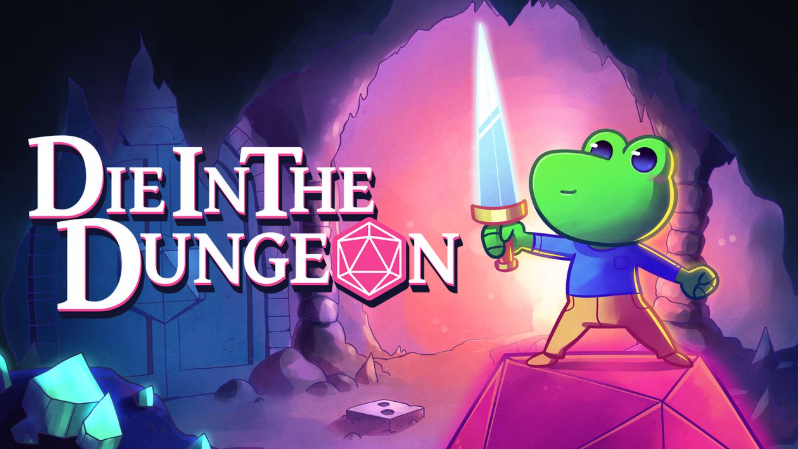
Die in the Dungeon is a dice version of Slay the Spire. Die in the Dungeon is a roguelite where players choose a path in a branching dungeon. Instead of building a deck, you’ll build a dice pool. The computer rolls your dice for you–so that’s a tactical goodness you’ll miss with Die in the Dungeon–and die placement on a 9-space grid shaped like a diamond can be the difference between victory and defeat.
Because it uses dice, Die in the Dungeon feels like it has fewer parts than Slay the Spire. I may be wrong. But dice can only do so much, and each die type is color-coded. Red attack. Blue block. Green heal. Purple dice give bonuses. There are more die types (that have various actions), but usually, if a die has a similar hue to the base dice, the die will be a variant of one of those three basic die types. For example, pink dice are typically splash attacks (attack all enemies). I’m just getting started with Die in the Dungeon, but I can see this one as a good candidate for a Quirky Video Game Review sometime next year.
If you like Slay the Spire, you should give Die in the Dungeon a try. A free demo does exist on Steam. You can try before you buy. I can see Die in the Dungeon getting its own tabletop game adaptation. I really like rolling dice, and while you can reroll dice in Die in the Dungeon, it doesn’t hit the same as clicking a button to roll the dice at the beginning of combat. Sure, Die in the Dungeon saves time by autorolling your dice before each round of battle. But I want to roll dice.
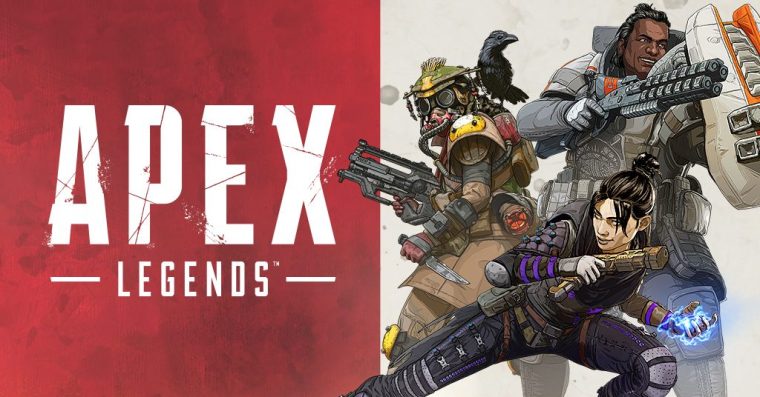
I’ve been keeping up with Apex Legends. The new legend, Axle, is fun. Per usual (for skirmisher legends like Axle), she was released in an overpowered state, and Apex Legends has since nerfed her in line with the rest of the roster. With the launch of the E-District map last season, Apex Legends feels like it’s gained some positive momentum. I wouldn’t mind Respawn alternating new legend, new map, new weapon, and new game mode each season (which spans three months), but it’s Respawn, this is a not-so-sudden influx of new content. While some live-service video games flood their games with an abundance of content (ahem, Fortnite), Apex Legends drags its feet. Longtime fans of the game don’t ask for much. They just want consistent new content.
Apex Legends releases a new legend and map every year and a half. I stopped playing the game for three years, and the weapon pool remains the same. Sure, the game has made tweaks like making the RE-45 an energy pistol, and it added akimbo for the Mozambique and P-2020, but Apex Legends has not had a new weapon since the Bocek. The Bocek was released during the pandemic. The pandemic. That feels like a lifetime ago. I’ll admit. New weapons affect Apex Legends’ gameplay the most. Every character can pick up any of the weapons, so you need to get the balance right. But Apex Legends also hasn’t released a new way to play the game since Gun Run in 2022. The game is still fun. Stale but fun.
Kyra’s Board Games
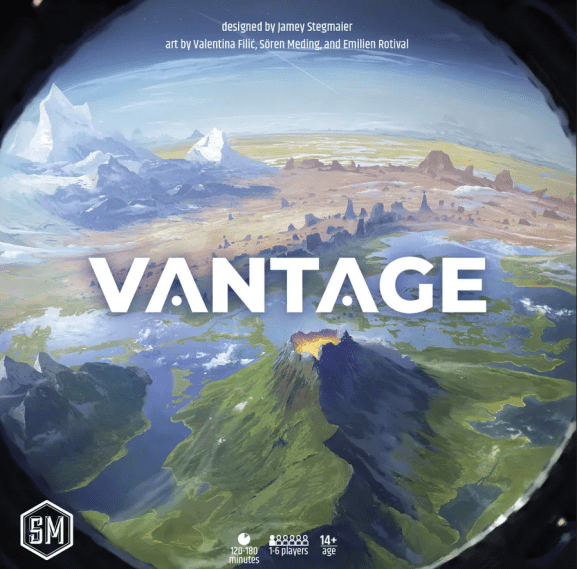
I’ve been playing a bit of solo Vantage. The game plays well as a solo experience, but more players make the game interesting. Like so many board games, the optimal player count rests somewhere in the middle of the lowest and highest player counts. Solo is too lonely. Six players would slow Vantage to a crawl. Three to four players is the happy place.
I may offer to GM Vantage at a future board game convention. If you’re in the Omaha area during Nuke-Con (first weekend in October), stop by and say hi. And if you want to explore a strange and exciting alien planet, we can launch a round of Vantage. I love the game’s system. Vantage’s combination of storybooks and cards makes each session an adventure.
Typically, I don’t mention my games that I’m playtesting, but I will for this month’s post. Monster Chef works as a hand management game. Omitting the card drafting helped. The new ability (Cleaver) allows players to zip through the decks more effectively. Maintaining the same hand helps players plan their next turn. I do wonder if Monster Chef plays better at three players and above. I’ve played plenty of two-player Monster Chef, and it doesn’t have the same pizzazz. It’s still good. But I prefer Monster Chef at 3-5 players. At any player count, Monster Chef doesn’t overstay its welcome. I may have found the right pacing.
Switching Rustbucket Riots from a dice rolling game to a bag building game threw off the game’s balance. At first, I also struggled with the players feeling less powerful. That won’t do. So, I made some crazy rebalancing for the game. Adding minions to player bags is brutal. Players can bust and don’t get what they want. That’s a double whammy. I’m keeping that dynamic–for now–and trying to add fewer minions to the bags each turn. We’ll see where this leads. I love Rustbucket Riots’ bag building. This mechanism allows for quicker onboarding for gamers. Most of an initial teach would be explaining what happens when players roll, lock, place, and spend dice. Now, you grab tokens, place, and spend. Rustbucket Riots is far more streamlined. Now, I just need to finish rebalancing the game.
That’s all I have for this past month. Let’s see what Season and Skye have been playing.
Season’s Video Games
I’ve also been playing Apex Legends recently. I haven’t played in years, so it feels fresher to me than it does for someone who’s played consistently. Normally, I don’t care for FPS games, but Apex Legends is the one exception for me. Seriously, I can’t aim to save my life. I can’t even utilize V.A.T.S well in the Fallout franchise. That’s how bad I am. I like Apex Legends because of the squad element, ping system, and interesting characters.
I’ve been playing Fantasy Life i: The Girl Who Steals Time for a couple of weeks, and I’ve been having a blast. It’s an adventure, farming simulator, dungeon crawler, has MMO elements for multiplayer, and has Animal Crossing aspects to it. It has so much content that I AP’ed trying to figure out where to start. So far, I’m 71% finished with the main story, but that’s just the tip of the iceberg. Fantasy Life i: The Girl Who Steals Time is a lot of fun, and it encourages players to play the game how they’d like.
Skye’s Video Game
I laser-focused on Stardew Valley for weeks. Stardew Valley is a game that’s been in my PlayStation library for years now, but I remembered after coming out of my surgery that I never technically “finished” it. I hadn’t completed all the community center bundles, I hadn’t unlocked all the house upgrades, I hadn’t obtained every variety of livestock, I hadn’t finished the museum collection, and I certainly hadn’t been to every location. After these few weeks, I’ve made it nearly to summer of year 3 and have spent an obscene amount of time managing my farm, building relationships, and desperately trying to renovate the community center. All I have left to do is donate a Fiddlehead Fern and a Pufferfish and it’ll be done, but it’s been more difficult than I expected. Eventually I’ll have the community center back to its former glory. Just you wait.
Hey, hey, Kyra Kyle here again. Those are the games our writers have been playing over the past month. Let us know what you’ve been playing in the comments. Thank you for reading, and wherever you are, I hope you’re having a great day.
Happy Friday, Geekly Gang! Kyra Kyle here with another board game design brain dump. I’ll be honest. This past month, most of my focus has been on writing my personal fiction, blogs, and tabletop RPG. I haven’t even had a chance to playtest the changes I made (to Monster Chef) during the previous game design brain dump. Today’s game design brain dump will center on Rustbucket Riots. Ah! Rustbucket Riots has seen plenty of changes throughout the year and a half I’ve been developing the game. And it looks like Rustbucket Riots could see another change in the near future. Let’s talk about it in today’s Board Game Design Brain Dump.
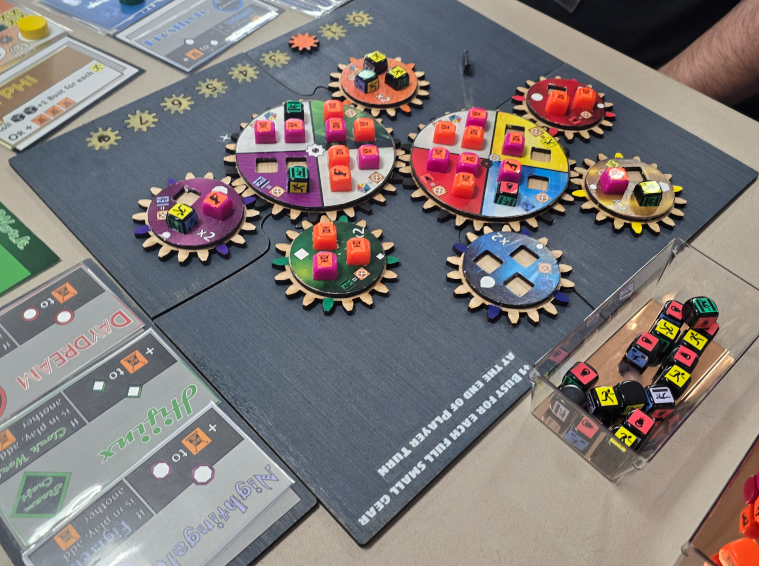
I’ve already made changes to Rustbucket Riots. For those of you who didn’t check the previous link, the above image is what the Rustbucket Riots game board used to look like. This was the board for a good many months–years–until I had it upgraded. I’ll share that picture in a bit, but gaining some space gives anyone perspective.
For the months I haven’t been working on Rustbucket Riots, I’ve been working on Monster Chef. This gave me two things: cognitive distance from Rustbucket Riots, cross-pollination of ideas with Monster Chef. Rustbucket Riots and Monster Chef are nothing alike. One is a cooperative, dice placement game with interlocking gears (Rustbucket Riots), while the other is a competitive, card management game with a cook timing mechanism (Monster Chef). But working on Monster Chef, figuring out how to make that game easier to teach and faster to play made me view Rustbucket Riots in a new light. I needed to look at Rustbucket Riots through the same lens as Monster Chef.
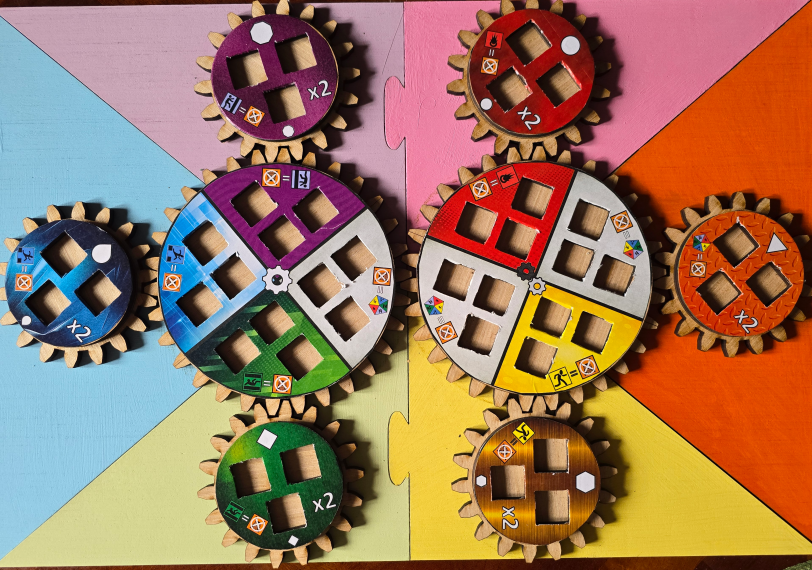
Ah. The board above is beautiful. I forgot how pretty Rustbucket Riots’ current board is, and it’s functional. The board illustrates which region a die belongs. Whatever color the die rests is the region it belongs to, so a die placed in the yellow wedge (of the large gear) will touch the orange and yellow regions. Easy! Before this change, playtesters would complain it was too difficult to tell. I haven’t received that feedback as much after this change. So, it might be time for more change. Players are supposed to simultaneously roll dice, lock them in, place them, and remove the dice from the gear spaces to use the die.
That’s a lot of mechanical things going on at once. The rolling, locking, and placing can get long and difficult to explain. The change I’m thinking of making is replacing dice with tokens, converting Rustbucket Riots from dice placement to a bag builder game. If I do this, this will fundamentally change the game. I won’t change the board, at least not right away. If I go through with this, I’ll make the tokens die-shaped. No. I’m concerned about how this change will affect Rustbucket Riots’ flow. I’ll need to rebalance the game. Some boss robots may need new abilities (many of their current abilities revolve around dice manipulation). And how does busting work in this new setup?
I don’t know. I guess this post lives up to its title of a game design brain dump, emphasis on the brain dump. In the coming weeks, I’ll playtest the current version of Rustbucket Riots and see where these changes could be implemented. Thankfully, I won’t need to change any of Rustbucket Riots’ major set pieces. I can produce die-shaped tokens and alternate cards. We can play the game both ways. See which one flows best. My guess will be the tokens. I’ve spent so much time explaining how die rolling and locking die faces work. Explaining that you just pull out X number of tokens will be a relief. And I could see minions (the orange and pink dice) finding their way into player bags. Perhaps that’s the bust trigger.
Thank you for reading this week’s game design brain dump. You’re awesome. And wherever you are, I hope you’re having a great day.
Happy Friday, Geekly Gang! Kyra Kyle here with another board game design brain dump. I’m trying to get back on track with these, and since I’m rusty at writing a game design brain dump, I’ll be jumping topics a bit with today’s post. We’ll begin with Monster Chef. Yes! I’ve kicked around Dungeon Chef and Dungeon Gourmet for this card game, but I Monster Chef fits. Plus, I love this simple logo for Monster Chef.
So Cute! Anyway, several game design brain dumps ago, I mentioned a card-drafting game based on the anime, Delicious in Dungeon. Monster Chef is that game. I just cut the card-drafting aspect of the game, and that led me to board game development. If board game design is like writing a story, board game development is editing that story. So, today’s game design brain dump leans into a very important aspect of design: development.
Sure, some people make a living editing and don’t write as much original material. The same can be said of board game developers. Plenty of developers can make a living (or at least some extra spending cash) by developing other designers’ work. But like writing, a board game’s first developer will be its designer. No matter how much I’d love to hand off Monster Chef to a developer and move on to my next game, I need to find a happy place for Monster Chef. And like writing, often game designers need to “kill their darlings.”
I love card-drafting games. Heck, Monster Chef began as Food Court Hustle, which had an interesting–to me at least–twist of dual-purpose cards. Players would play a card for one effect and discard a different card for another effect, before passing their hands to the next player. With Monster Chef, I took the concept further by allowing players to draw cards into the hands they inherited from other players, giving players more control over the chaos caused by card-drafting. Despite all these factors to “solve” my perceived problem with the card-drafting games, I learned card-drafting was holding back Monster Chef. Card-drafting breeds upheaval. Monster Chef needed stability.
The game wanted to use hand management (players don’t change hands and keep the ones they have dealt to them) instead of card-drafting (in this case, closed card-drafting). Players would often forget to pass their hands after their turns. The physical act of drafting cards meant that players couldn’t preplan their following turns, which slowed gameplay. Some of the choices felt as if they lacked consequences because you didn’t know what your hand would eventually look like, so one wouldn’t care what remained in their hands. And Monster Chef had plenty of other random elements (like not knowing which recipes would get drawn for the display). Hand management affords more control.
With hand management, I added card draw to the Monster Chef’s design space. The game has a faster run time. Players can cycle through the draw decks (dungeon floors) more quickly. And I was able to get rid of the cards few players used, except in edge cases. I may have eliminated most edge cases, which are mechanisms that either have limited viability or can only be used in specific situations. All of Monster Chef’s main actions have obvious usefulness. It depends on how and when players use these actions. That makes for a better game.
I’ll definitely come up with a card-drafting game in the future. I love these types of games. But I must “kill that darling.” Doing so made Monster Chef a better game.
Here’s where I bounce. I’m giving a brief update on the Marvel Multiverse Role-Playing Game module I’m writing for Comic-Con: Nebraska (CCN). I didn’t need to create my own module. Just trying out a few things. Running the Marvel Multiverse Role-Playing Game at last month’s Aftershock event got me thinking that the game could be geared for true RPG beginners. Some of my players had never played a tabletop role-playing game before, or they had played once or twice. While the Marvel Rivals Timestream Adventure is great for a one-shot to introduce new players to the Marvel Multiverse Role-Playing Game, it could do more to welcome truly new role-playing game players.
I was reminded of Legend of the Five Rings. When I ran a game for younger players (who had never played an RPG before) with that game, I resurrected the Rokugan Tournaments (like an Olympic Games for samurai) mentioned in the game’s lore. I had players participate in non-combat events, learning how checks worked in a pseudo-video game tutorial manner, and of course, something fishy was going on with the tournament. Once players discovered the threat, a battle occurred, but this only happened after players knew their characters and how the game worked. I want to do the same for the Marvel Multiverse Role-Playing Game.
So, I chose Mojo and his Mojoverse. X-Men ’97 Season Two will begin releasing soon, so gamers may be familiar with Mojo by the middle of August (in time for CCN). Players will participate in Mojo’s reality TV show-like events (similar to the Legend of the Five Rings tournament), and I can tailor the game to a two-hour window. Perfect for a Comic-Con. If I get players for the Marvel Multiverse Role-Playing Game at CCN, most likely, they will have limited (if any) experience with tabletop role-playing games. Who knows? A quick session with a tutorial may get more potential players interested in the game.
I’ll keep you updated on my progress. Hopefully, I will have finished the module before CCN. I’ll also be working for Extra Life, so if you’re in the area, stop by and say hello.
That’s all I have for today’s game design brain dump. Thank you for reading, and wherever you are, I hope you’re having a great day.