
Happy Friday, Geekly Gang! Kyra Kyle here with another board game design brain dump. I’ll be honest. This past month, most of my focus has been on writing my personal fiction, blogs, and tabletop RPG. I haven’t even had a chance to playtest the changes I made (to Monster Chef) during the previous game design brain dump. Today’s game design brain dump will center on Rustbucket Riots. Ah! Rustbucket Riots has seen plenty of changes throughout the year and a half I’ve been developing the game. And it looks like Rustbucket Riots could see another change in the near future. Let’s talk about it in today’s Board Game Design Brain Dump.
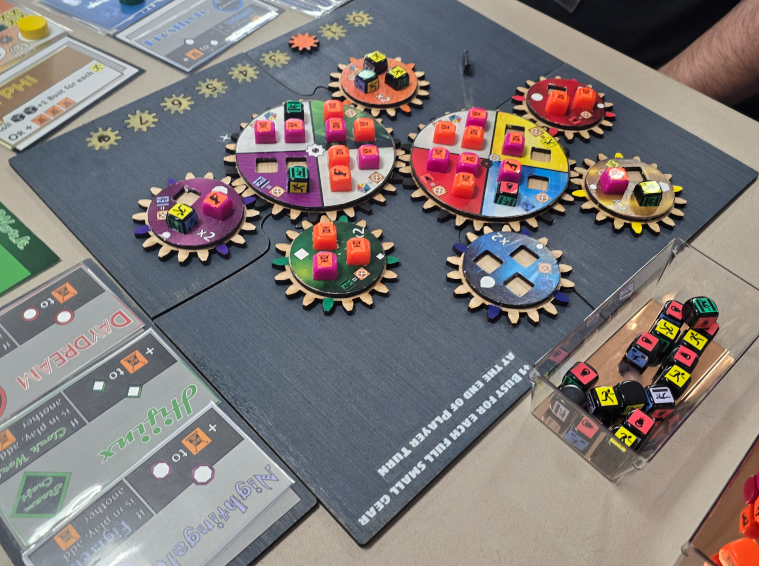
I’ve already made changes to Rustbucket Riots. For those of you who didn’t check the previous link, the above image is what the Rustbucket Riots game board used to look like. This was the board for a good many months–years–until I had it upgraded. I’ll share that picture in a bit, but gaining some space gives anyone perspective.
For the months I haven’t been working on Rustbucket Riots, I’ve been working on Monster Chef. This gave me two things: cognitive distance from Rustbucket Riots, cross-pollination of ideas with Monster Chef. Rustbucket Riots and Monster Chef are nothing alike. One is a cooperative, dice placement game with interlocking gears (Rustbucket Riots), while the other is a competitive, card management game with a cook timing mechanism (Monster Chef). But working on Monster Chef, figuring out how to make that game easier to teach and faster to play made me view Rustbucket Riots in a new light. I needed to look at Rustbucket Riots through the same lens as Monster Chef.
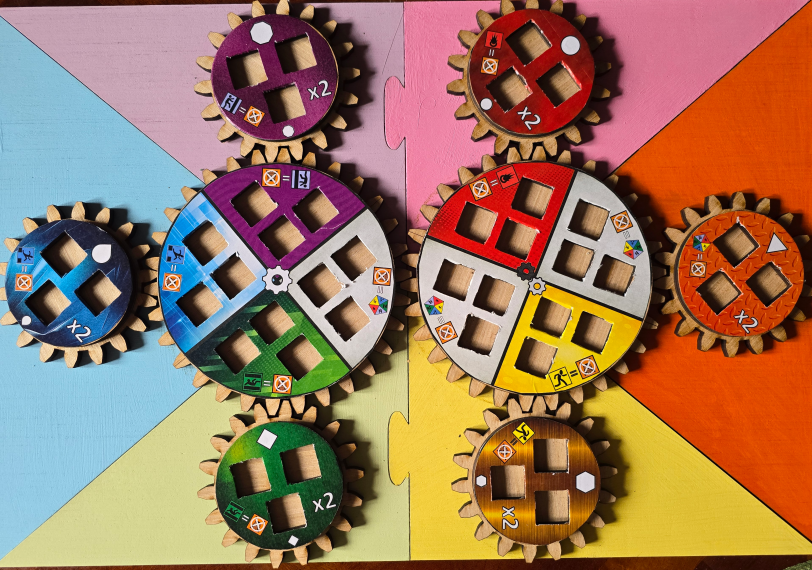
Ah. The board above is beautiful. I forgot how pretty Rustbucket Riots’ current board is, and it’s functional. The board illustrates which region a die belongs. Whatever color the die rests is the region it belongs to, so a die placed in the yellow wedge (of the large gear) will touch the orange and yellow regions. Easy! Before this change, playtesters would complain it was too difficult to tell. I haven’t received that feedback as much after this change. So, it might be time for more change. Players are supposed to simultaneously roll dice, lock them in, place them, and remove the dice from the gear spaces to use the die.
That’s a lot of mechanical things going on at once. The rolling, locking, and placing can get long and difficult to explain. The change I’m thinking of making is replacing dice with tokens, converting Rustbucket Riots from dice placement to a bag builder game. If I do this, this will fundamentally change the game. I won’t change the board, at least not right away. If I go through with this, I’ll make the tokens die-shaped. No. I’m concerned about how this change will affect Rustbucket Riots’ flow. I’ll need to rebalance the game. Some boss robots may need new abilities (many of their current abilities revolve around dice manipulation). And how does busting work in this new setup?

I don’t know. I guess this post lives up to its title of a game design brain dump, emphasis on the brain dump. In the coming weeks, I’ll playtest the current version of Rustbucket Riots and see where these changes could be implemented. Thankfully, I won’t need to change any of Rustbucket Riots’ major set pieces. I can produce die-shaped tokens and alternate cards. We can play the game both ways. See which one flows best. My guess will be the tokens. I’ve spent so much time explaining how die rolling and locking die faces work. Explaining that you just pull out X number of tokens will be a relief. And I could see minions (the orange and pink dice) finding their way into player bags. Perhaps that’s the bust trigger.
Thank you for reading this week’s game design brain dump. You’re awesome. And wherever you are, I hope you’re having a great day.

