
Happy Friday, Geekly Gang! Kyra Kyle here with another board game design brain dump. I’m trying to get back on track with these, and since I’m rusty at writing a game design brain dump, I’ll be jumping topics a bit with today’s post. We’ll begin with Monster Chef. Yes! I’ve kicked around Dungeon Chef and Dungeon Gourmet for this card game, but I Monster Chef fits. Plus, I love this simple logo for Monster Chef.

So Cute! Anyway, several game design brain dumps ago, I mentioned a card-drafting game based on the anime, Delicious in Dungeon. Monster Chef is that game. I just cut the card-drafting aspect of the game, and that led me to board game development. If board game design is like writing a story, board game development is editing that story. So, today’s game design brain dump leans into a very important aspect of design: development.
Sure, some people make a living editing and don’t write as much original material. The same can be said of board game developers. Plenty of developers can make a living (or at least some extra spending cash) by developing other designers’ work. But like writing, a board game’s first developer will be its designer. No matter how much I’d love to hand off Monster Chef to a developer and move on to my next game, I need to find a happy place for Monster Chef. And like writing, often game designers need to “kill their darlings.”
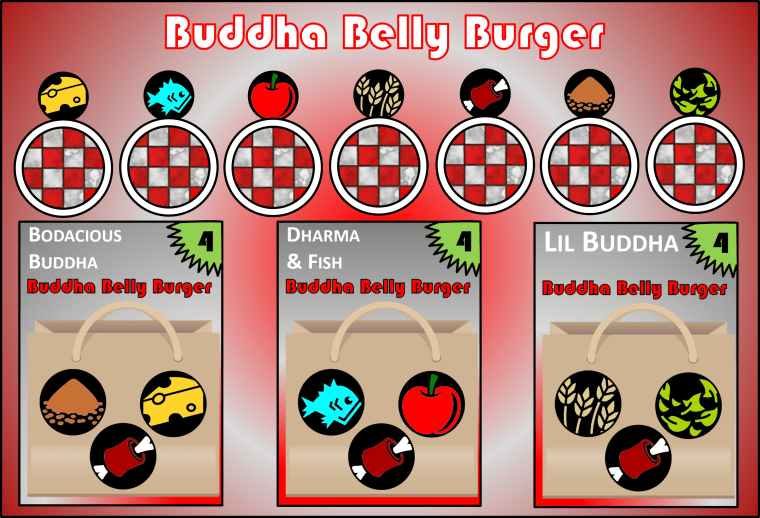
I love card-drafting games. Heck, Monster Chef began as Food Court Hustle, which had an interesting–to me at least–twist of dual-purpose cards. Players would play a card for one effect and discard a different card for another effect, before passing their hands to the next player. With Monster Chef, I took the concept further by allowing players to draw cards into the hands they inherited from other players, giving players more control over the chaos caused by card-drafting. Despite all these factors to “solve” my perceived problem with the card-drafting games, I learned card-drafting was holding back Monster Chef. Card-drafting breeds upheaval. Monster Chef needed stability.
The game wanted to use hand management (players don’t change hands and keep the ones they have dealt to them) instead of card-drafting (in this case, closed card-drafting). Players would often forget to pass their hands after their turns. The physical act of drafting cards meant that players couldn’t preplan their following turns, which slowed gameplay. Some of the choices felt as if they lacked consequences because you didn’t know what your hand would eventually look like, so one wouldn’t care what remained in their hands. And Monster Chef had plenty of other random elements (like not knowing which recipes would get drawn for the display). Hand management affords more control.
With hand management, I added card draw to the Monster Chef’s design space. The game has a faster run time. Players can cycle through the draw decks (dungeon floors) more quickly. And I was able to get rid of the cards few players used, except in edge cases. I may have eliminated most edge cases, which are mechanisms that either have limited viability or can only be used in specific situations. All of Monster Chef’s main actions have obvious usefulness. It depends on how and when players use these actions. That makes for a better game.
I’ll definitely come up with a card-drafting game in the future. I love these types of games. But I must “kill that darling.” Doing so made Monster Chef a better game.
Here’s where I bounce. I’m giving a brief update on the Marvel Multiverse Role-Playing Game module I’m writing for Comic-Con: Nebraska (CCN). I didn’t need to create my own module. Just trying out a few things. Running the Marvel Multiverse Role-Playing Game at last month’s Aftershock event got me thinking that the game could be geared for true RPG beginners. Some of my players had never played a tabletop role-playing game before, or they had played once or twice. While the Marvel Rivals Timestream Adventure is great for a one-shot to introduce new players to the Marvel Multiverse Role-Playing Game, it could do more to welcome truly new role-playing game players.
I was reminded of Legend of the Five Rings. When I ran a game for younger players (who had never played an RPG before) with that game, I resurrected the Rokugan Tournaments (like an Olympic Games for samurai) mentioned in the game’s lore. I had players participate in non-combat events, learning how checks worked in a pseudo-video game tutorial manner, and of course, something fishy was going on with the tournament. Once players discovered the threat, a battle occurred, but this only happened after players knew their characters and how the game worked. I want to do the same for the Marvel Multiverse Role-Playing Game.
So, I chose Mojo and his Mojoverse. X-Men ’97 Season Two will begin releasing soon, so gamers may be familiar with Mojo by the middle of August (in time for CCN). Players will participate in Mojo’s reality TV show-like events (similar to the Legend of the Five Rings tournament), and I can tailor the game to a two-hour window. Perfect for a Comic-Con. If I get players for the Marvel Multiverse Role-Playing Game at CCN, most likely, they will have limited (if any) experience with tabletop role-playing games. Who knows? A quick session with a tutorial may get more potential players interested in the game.
I’ll keep you updated on my progress. Hopefully, I will have finished the module before CCN. I’ll also be working for Extra Life, so if you’re in the area, stop by and say hello.
That’s all I have for today’s game design brain dump. Thank you for reading, and wherever you are, I hope you’re having a great day.

