Tabletop Game Review: On Tour

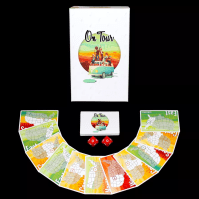
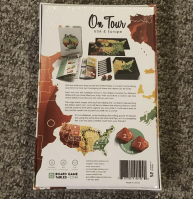
On Tour puts you in a rock band. You’re living the dream. You must schedule the band’s stops over your 100-day tour, visiting as many states (or countries depending on the map you choose) as possible. Roll the dice and chart a course with the most concerts.

Hey, hey! Kyra Kyle here. Today’s tabletop game review is the roll-and-write game by All Play (BoardGameTables.com at the time of its original print) On Tour. We’ll set off on our tour soon, but first, let’s handle some of On Tour’s behind-the-scenes details.

The Fiddly Bits

Designer: Chad DeShon
Publisher: BoardGameTables.com
Date Released: 2019
Number of Players: 1-8
Age Range: 8 and up
Setup Time: Less than a minute
Play Time: 20 minutes

Game Mechanisms

Bingo
Dice Rolling
Line Drawing
Network and Route Building
Push Your Luck
Simultaneous Action Selection
Solo/Solitaire Game

Game Setup

1) Give each player their own player board and a dry-erase marker.

2) Shuffle the cards and place them in the center of the table.

3) Roll the dice (2 large 10-sided dice). For setup only, re-roll doubles.

4) Combine the results to form two different 2-digit numbers (i.e. 1 & 4 combine to form 14 & 41).

5) One player draws a card. All players write the lower dice combination on that state.

6) Draw another card and all players write the higher dice combination on that state.

7) Each player circles both numbers.

8) Repeat steps 3-7.

9) Remove the four cards from the game.

Choose a player to begin the game by rolling the dice first.

Game Flow

With each turn, the rolling player draws 3 cards and reveals the cards for all players. If the deck ever empties, reshuffle the deck to form a new deck.

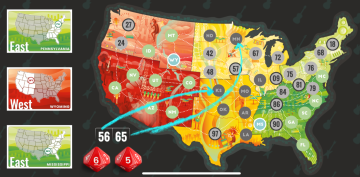
The rolling player rolls both dice. Combine the results to form two different 2-digit numbers (i.3. 5 & 6 combine to form 56 & 65). All players simultaneously write each of those numbers in two empty states (or countries) on their board.

When writing numbers, players choose two of the three cards. The numbers must be written in one of the regions on the displayed cards (like North and Central). If you write a number on the same state displayed on the card, circle it. When writing numbers, a different card must be used for each number.

If all three cards display the same region OR if doubles are rolled, each player draws one star in any one empty state on their board instead of writing numbers. The state must be in the same region as shown on the card. You may still circle the star if you use an exact state from a card.

When all players have written their two numbers, discard the revealed cards and pass the dice to the next person clockwise.

When only one or two empty states remain, do not flip cards, instead roll dice. Players may freely write numbers in any remaining states, following the usual rules.

When all states are filled, the game ends. Beginning in any state, draw a continuous route for your tour. The line must continue to any adjacent state with a number equal to or greater than the previous state you started in. Stars are wild and count as any number.

You can never return to a state that you have already visited. You can never go to a state with a lower number.

Score one point for each state you visit and an additional point for each circled star or number on your route. The highest score is the winner.

Review

First, I didn’t change much from the rulebook in the game setup and game flow sections. I always use a game’s rulebook as a point of reference when writing these sections. Typically, I need to reword or condense multiple passages in a board game’s rulebook to make it easier to read or to get the gist of how a game is played. On Tour’s rulebook, like many other All Play (formerly boardgametables.com) rulebooks, is easy to read. The company has a mission of making board games accessible to more people. Their well-written rulebooks go a long way toward that end.

I like On Tour’s twist on the roll-and-write or flip-and-write mechanism. Note: roll-and-writes have Yahtzee as a basis, where players roll dice and then fill in the results on their player boards, while flip-and-writes typically replace dice with cards. On Tour combines both mechanisms flawlessly and that leads to each game playing differently. I’ve played plenty of On Tour, mostly solo, and each game presents a different challenge. I may get the card I need, but not the right numbers or I may get the numbers I need, but not the right card. Some combination of this will happen in every game but each game feels fresh.

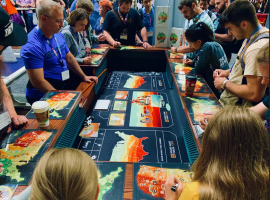
I enjoy On Tour’s solo mode, but the game plays better with multiple players. Like most roll-and-writes, players fill in their maps at the same time and this accommodates larger player counts. Playing with a full complement of eight players may only add ten or so gameplay minutes. Knowing the map helps make decisions easier. I don’t take long to fill in my map, but a new player would take a hot second to make their decision. But I wouldn’t say that knowing a map gives a player an unfair advantage. It’s an advantage but not a huge one. I’ve lost plenty of times to noobs. That may say more about my inability to play On Tour well.

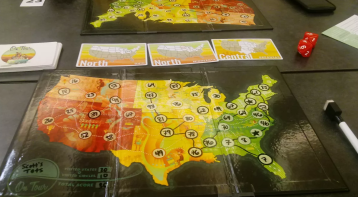
The player boards are two-sided. One side depicts the United States, while the other is a map of Europe. New players should start with the United States. The regions are easier to spot (North, South, East, West, and Central). The straight boundaries of Colorado, Wyoming, and other mid-western and western states help.

I add a rules variant and allow players to chart their route as they fill in states (countries). You can always erase a route if you choose to go in a different direction. The end game (of figuring out which route you’ll take) can take almost as long as the game itself. Filling in a tentative route as you go shortens the time you need for final scoring. It also leads to table talk where someone undoubtedly says, “Well, I guess I’m cut off from Washington (or some other state).” Since you’re using a dry-erase marker, these tentative routes can be altered.

I often bring On Tour while on vacation. While On Tour is one of All Play’s standard box-size games, these boxes are still roughly 7 x 11 inches, making it easy to pack in a suitcase. And its price of $40 is nice. All Play games skew toward wider appeal (code for lighter games), but one can’t question the company’s quality of games and its commitment to cheaper price points.

Too Long, Didn’t Read

On Tour blends roll-and-write and flip-and-write mechanisms for a fresh take on both game mechanisms. While knowing one of the maps can help with making faster decisions, veteran players don’t gain too much of an advantage over newer players. The game plays well as a solo game but sings at large player counts. On Tour continues All Play games’ mission of making board games accessible to a wider audience.

Geekly News: March 30, 2025, Blade Movie Cancelled

Hey, hey! Kyra Kyle here. We’ll go lighter on Geekly News for the next few weeks. Protospiel Kansas City is next weekend. We’re keeping our fingers crossed that we don’t miss a News post.

MCU Cancels Blade Movie

On one hand, the MCU cancelling Blade comes as a surprise. A trusted insider announced a day prior that Blade had a new director, but then another trusted insider, World of Reel, made the announcement that Blade was nixed. No one has questioned World of Reel’s claim…yet. Blade has had the worst luck in the past few years. Actors have committed and then de-committed. The same goes for directors. And the script has been chopped up and rewritten so many times that it looks like someone tried to reconstruct a ream of paper from the confetti dumped on Times Square during New Year’s. In short, the MCU’s Blade was cursed.

I’m glad Marvel ended the failing production. Blade should return. He’s a popular character, and I’d like to see the MCU’s take on Blade. Rumors persist that Blade will appear in a team-up movie like Avengers: Doomsday or Midnight Sons. But if Blade were to get his own vehicle, perhaps Marvel could give him a Special on Disney+. Marvel hasn’t released a Special on the streaming platform since 2022’s Guardians of the Galaxy Christmas Special. I didn’t care for the Christmas Special; it played like the Star Wars Christmas Special. Yuck! But Marvel’s previous special, October 2022’s Werewolf By Night, was among the best productions in the MCU’s Phase Four.

Werewolf By Night saw even more success after it became part of 2023’s Huluween. This proves that the format works and has legs. An annual (or a series of annual) Marvel After Dark Special(s) could also work to organize the MCU’s release schedule. Spectacles get movie releases. Street-level heroes receive a TV series. Horror/macabre characters feature in Marvel Specials. Blade would fit in with Werewolf By Night, Man-Thing, and Elsa Bloodstone. We’ll see many of these characters (including Blade) in Midnight Sons, but I’d like to see more of Marvel’s darkest corners. Even though Blade won’t get a solo movie, and that’s disappointing, it could lead to something special.

Black Panther 3 to be Released February 2028

Ryan Coogler, director of the first two Black Panther films, said in an interview (with Shannon Sharpe and Chad Ochocinco) that Black Panther 3 is closer than movie-goers think. The MCU plans to introduce Prince T’Challa, Chadwick Boseman’s character’s son, in the upcoming movies. Avengers: Doomsday is a little soon, but Prince T’Challa could make an appearance in Avengers: Secret Wars.

Two Marvel comic book crossover series have been named “Secret Wars,” one in 1984 and another in 2015. The Russo brothers have stated that they will pull from both comics. T’Challa plays a pivotal role in the second “Secret Wars,” so it would make sense if Prince T’Challa is in play for that movie or both films: Doomsday and Secret Wars.

In a previous Geekly News post, we shared that Denzel Washington will feature in Black Panther 3. We mentioned a few characters Washington could portray. Here’s a quick recap. Achebe is a brilliant and unhinged adversary from the Black Panther comics. The First Black Panther Bashenga could explore Wakanda’s lore. Or perhaps he could play the Shadow King, a powerful telepathic mutant villain.

But (in that same interview with Sharpe and Ochocinco) Coogler teased that Washington could portray a role that could shake the entire MCU. He dropped a few hints, and internet sleuths have deduced that Coogler could be alluding to Denzel Washington playing Magneto. This wouldn’t be the first time that Wakanda went head-to-head with a leader who only wants what’s best for their people and may take drastic measures to protect them. 2022’s Black Panther: Wakanda Forever’s Namor strikes a similar chord. Washington would be a great choice for Magneto. Regardless of Washington’s role, we can’t wait for Black Panther 3.

Six Sojourns: An Eight-Minute Empire Game

Red Raven Games revisits one of their earliest designs, Eight-Minute Empire. Six Sojourns builds on the short area control game. The original game’s title is a misnomer. It takes about forty minutes to play Six Sojourns, not eight minutes, but forty minutes is a short game for the game type. Six Sojourns features tough choices, allows for creative strategies and tactics, and promotes high player interaction.

Ryan Laukat serves as the illustrator and game designer of Six Sojourns. He’s had board game hits like Above and Below, Near and Far, Sleeping Gods, and Now or Never. Six Sojourns showcases Laukat’s unique artwork. My favorite feature from Six Sojourns is its three double-sided maps: Red Rock Islands, Volcano, and Northern Seas. Six Sojourns is available now on Gamefound.

G.I. Joe: Operation Cobra

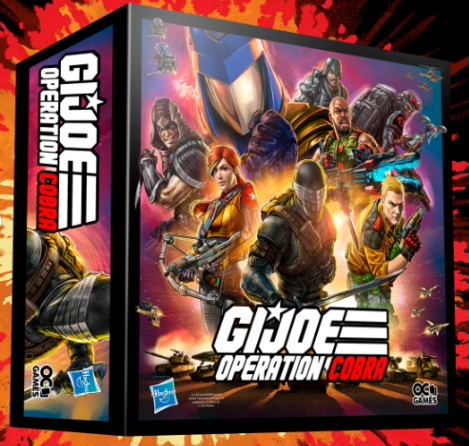
OC Games launched G.I. Joe: Operation Cobra this past week. The game features cooperative tactical action and has plenty of miniatures. OC Games was founded last year, so G.I. Joe: Operation Cobra is one of their first releases. The company focuses on adapting intellectual properties from the 80s and 90s into board games. I can’t speak to the quality of their games yet, but they did capture the look of G.I. Joe from the 80s.

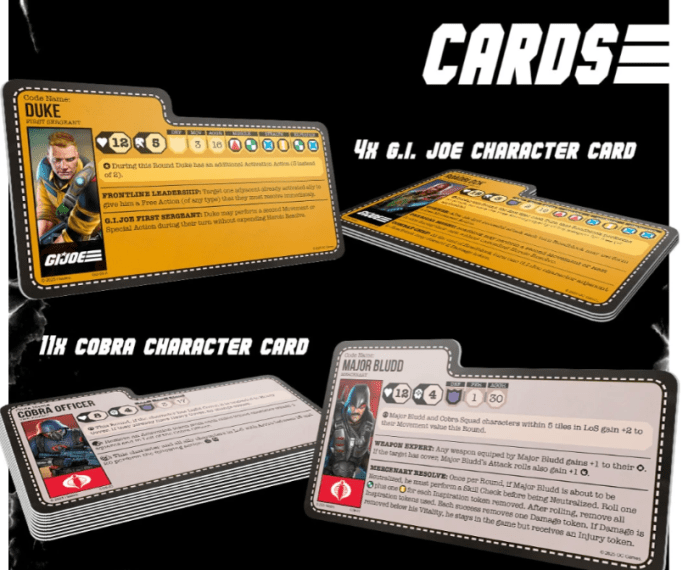
The character cards look like the cards one could cut out from the back of a G.I. Joe toy. OC Games has a knack for tapping into nostalgia. At one point, OC Games had posted G.I. Joe: Operation Cobra on Tabletop Simulator (TTS) so players could demo the game. OC Games’ website has loading issues, I’ll post their update on Gamefound for their Tabletop Simulator announcement. If you’d like to see the game’s pretty miniatures, check out the game’s page on Gamefound.

Funko Bitty Pop Arcade

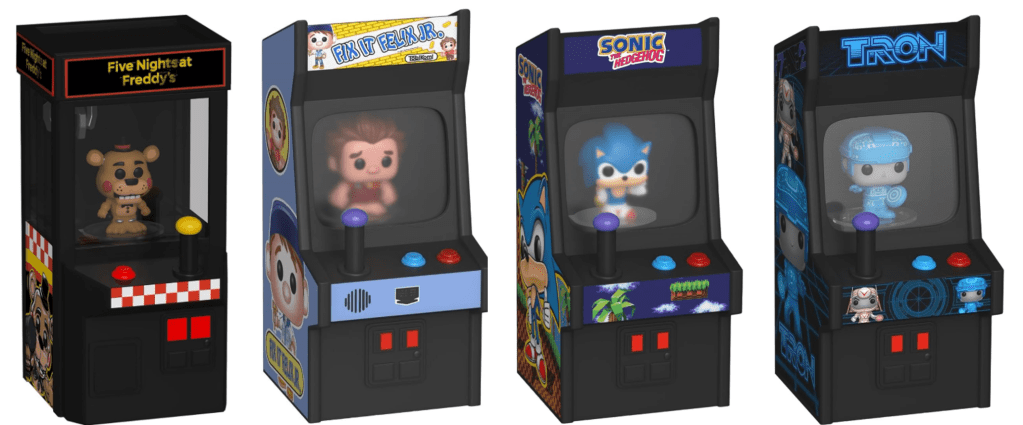
Funko Pop expands its number of collectible series with Funko Bitty Pop Arcade. Classic cabinet arcade systems inspire these collectibles. The first series of Funko Bitty Pop Arcade will include Wreck-It Ralph, Sonic the Hedgehog, Tron, and Five Nights at Freddy’s. The Five Nights at Freddy’s collectible is the oddball of the bunch as it resembles a claw machine. At $8 apiece, Funko Bitty Pop Arcades are a frugal way to start a collection. These items will be released in early July 2025, and you can pre-order them from Amazon.

That’s all the geek news we have for this week. Hopefully, we’ll have a news post next week. Until next time, thank you for reading, and wherever you are, I hope you’re having a great day.

Top 5 Members of Marvel Comics’ Illuminati

Hey, hey! Kyra Kyle here. The MCU introduced Marvel Comic’s Illuminati in Doctor Strange in the Multiverse of Madness. I don’t know if the Illuminati will continue in the MCU, but they’ve done a lot of work behind the scenes during major Marvel Comics crossovers. The Illuminati’s first appearance (New Avengers #7, July 2005) features each member of the group protecting one of the Infinity Gems. The Illuminati also factor into 2015’s Secret Wars. So, there’s a chance we’ll see more of them on the big screen. Who are the best characters from this group of Marvel Comic’s most powerful beings working in secret, shaping the superhuman world and protecting Earth from catastrophe?

But first, an honorable mention or two. I like Tony Stark/Iron Man a lot as a character. He’s also done a lot with the Illuminati, but he’s not the first name I think of when discussing the Illuminati, even though he’s a founding member. You’ll find another major exclusion on this list: Doctor Strange. His story may have introduced the Illuminati to the MCU, but I think the Illuminati works best when it’s composed of people who represent different demographics, kind of like a Marvel Comics version of the United Nations. And most of the Illuminati’s members fit this bill.

Let’s see who made the list.

5: Black Bolt

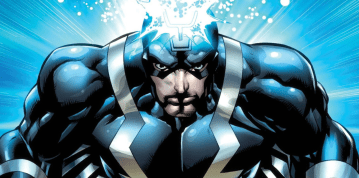
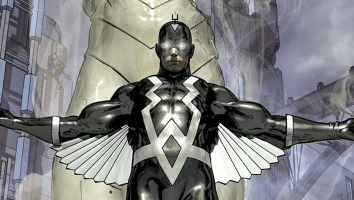
The Inhumans occupy an important part of the Marvel Universe. They may have existed before humanity or at least they had a higher level of intelligence and awareness before humanity during Earth’s earliest history. This history also involved extraterrestrial and cosmic encounters. Enter Black Bolt. He’s the Inhumans’ current monarch and boasts incredible power. Black Bolt was born with a voice so strong that it can obliterate planets. Since this is the case, he seldom speaks, opting to have Medusa, another powerful Inhuman, speak on his behalf.

Fortunately, the Illuminati’s creator, Brian Michael Bendis, shared his reasoning for each of the original member’s inclusion. Here’s what Bendis has to say about Black Bolt (I’m paraphrasing to some extent):

“King of the Inhumans, who are an important part of Marvel history and play an important part in events that have not yet come to pass. He also represents a ruler/king archetype.”

The Inhumans television show didn’t fare well, but let’s hope the Inhumans will find new life in some other form. They’re too important to vanish from the MCU entirely.

4: Namor

Namor is yet another monarch. He rules the underwater nation of Atlantis and adds a different perspective for the Illuminati. The ocean claims more area than land on Earth, and Namor is its unquestioned ruler. He’s a member of another ancient civilization, one featured in Black Panther: Wakanda Forever, but missing from the Illuminati’s brief stint in Doctor Strange in the Multiverse of Madness. Like the Inhumans, I hope we get to see more of Namor in future MCU projects.

Let’s see why Bendis included Namor in the original Illuminati:

“Namor is the King of Atlantis and the Seven Oceans and represents the antihero mindset.”

He certainly does that. Namor is an ally to none. His only wish is to have his people’s voices heard. Namor served on Norman Osborn’s Cabal at the same time as his stint on the Illuminati. His role in the Illuminati mirrors his earlier team-up with the Invaders. The Invaders signaled Atlantis’s desire to be known to the outside world, the world of the land dwellers. The Invaders could be another group that could factor into the MCU’s future.

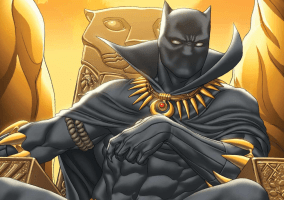
3: Black Panther

Black Panther is the only member of the Illuminati (on this list) who wasn’t in the original roster, but that wasn’t from lack of trying. Tony Stark recruited T’Challa to become an original member and the representative of Wakanda, but T’Challa turned Stark down. Black Panther would later join the Illuminati to face the Incursions.

Wakanda is one of the most prosperous nations on Earth and the main supplier of the world’s Vibranium. Black Panther is calm, fair, and reasonable while boasting no ego. In short, T’Challa differs from most members of the Illuminati. You can call Tony Stark, Mr. Fantastic, and Dr. Strange many things, but ego-less is not one of them.

T’Challa’s relationship with the others in the group can get strained because of the others’ lack of control. Black Panther isn’t easily manipulated. Again, Black Panther is another character I’d like to see more of in the MCU. If that includes a second incarnation of the Illuminati, so be it.

2: Professor X

Professor X needs no introduction. He’s the founder and leader of the X-Men and fights for equal rights for mutant-kind. Charles Xavier boasts a level of intellect and wisdom that’s rarely matched. His ability to read minds, while usually not used against members of the group, proves vital when obtaining intelligence. Because of his role as peacemaker and arbitrator, Professor X often takes a prominent leadership role in the Illuminati.

Eventually, future events in the comics prevent Xavier from participating in the Illuminati, which leads to the group’s gradual demise. Yeah. The comic book version of the Illuminati didn’t dissolve because an omega-powered mutant turned rogue and killed them all in a fit of rage. Spoilers for Doctor Strange in the Multiverse of Madness.

Let’s have Bendis weigh in on why he included Professor X in the Illuminati:

“Leader of the X-Men, Charles Xavier is in the group on behalf of the mutant community.”

Fair enough. And with mutants playing a larger role in the MCU going forward, Professor X’s inclusion in a second Illuminati could prove fruitful.

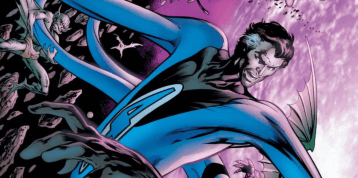
1: Mister Fantastic

Reed Richards (Mister Fantastic) is the one entry that doesn’t represent a group of people, a country, or both. Reed is only one of the smartest minds on the planet and the leader of the Fantastic Four. He has a long history in the Marvel Universe. Richards’s scientific capabilities are almost unmatched and his desire to see a better tomorrow makes him a prominent member within the Illuminati. He meshes well with Tony Stark, but the two can often butt heads because they can’t put aside their egos.

Reed even reasoned with Iron Man’s original proposition for the Illuminati as a “United Nations” of superheroes. Richards argued that the idea presented too many logistical and bureaucratic issues, but he also acknowledged the need for efficient information exchange between the world’s greatest minds. Mister Fantastic represents the scientific community of the Marvel Universe. He knows more about alternate realms and the cosmos than most, usually because he conducts reckless experiments and kicks a hornet’s nest or two. Annihilus wouldn’t know humans or Earth existed if Reed hadn’t bumbled into the Negative Zone. Thanks, Reed.

I can’t wait for the Fantastic Four to make their MCU debut. I wouldn’t mind more Mister Fantastic screen time. A second Illuminati could give us more FF goodness.

Which member of the Illuminati do you think should’ve made the list? Let us know in the comments. And wherever you are, I hope you’re having a great day.

Daredevil: Born Again, “Excessive Force” Review

Daredevil: Born Again’s second episode this week, “Excessive Force,” ties several loose ends, and Daredevil makes his triumphant return in costume. Hey, hey! Kyra Kyle here. I apologize for the delay this week. Everything ran smoothly with the family issue on Wednesday, so we’re back with more Daredevil: Born Again.

This week’s tandem of episodes had a similar feel to Daredevil: Born Again’s debut. If Disney+ had only released “With Interest,” fans may have been miffed (the first episode didn’t go far with the main storyline), but the streaming service dropped two episodes this week with “Excessive Force,” and I can see fans happier with the second offering. I enjoyed “Excessive Force.” As I said in the intro, it ties up several loose ends. That’s always appreciated. Wilson Fisk and Matt Murdock’s journey to find their true selves, their inner Kingpin and Daredevil, mirrors each other’s journey.

The inevitable fight sequence at the end has choreography that harkens to the original Daredevil Netflix series. Kingpin unleashes his baser instincts on Adam, the man with whom Fisk’s wife, Vanessa, cheated on him, while Daredevil rescues Angela Del Toro, Hector Ayala’s (White Tiger’s) niece, from Muse. Both scenes are earned. Earlier in “Excessive Force,” Vanessa and Wilson have an exchange that suggests Kingpin has Vanessa’s okay to revert to his mob boss ways, while Del Toro approached Murdock for help, letting him know where her uncle thinks a serial killer (Muse) is hiding, and Murdock has the idea to “f*** it” and rescue Del Toro himself as Daredevil. Since the police killed her uncle, Del Toro doesn’t trust the police.

I liked that Daredevil: Born Again brought back Angela Del Toro. In the comics, Del Toro dons her uncle’s White Tiger costume, and there’s a chance that Camila Rodriguez (who portrays Del Toro) could do the same. Del Toro does a good job of giving Murdock the kick he needs in the hindside. Running parallel to Del Toro’s mistrust of the police is that Fisk runs the police, and he’s formed a task force of dirty cops to find Muse. As I said, plenty of loose ends. Hamish Allan-Headley’s Officer Powell joins the newly formed task force. Powell has been one of the better side characters introduced in Daredevil: Born Again, but that’s because he’s had a handful of pivotal scenes. And that’s where Daredevil: Born Again has had issues.

Matt’s love interest (Heather Glenn) asks him if he knows any vigilantes he could introduce her to for a book she plans to write about vigilantes. While this could’ve worked, it came out of nowhere. We’ve met Heather Glenn more often than Officer Powell, and this is the first we’ve heard of this intention. Officer Powell’s motives are better developed. Angela Del Toro approaching Matt Murdock to help stop Muse makes sense (her character is well developed despite this episode being her second appearance), but Cherry (Matt’s ex-cop friend/employee) serves little more than a plot device when he warns Murdock against fighting Muse as Daredevil. We know next to nothing about Cherry. Even though he’s physically been in the series three times as much as Del Toro, I forgot he existed.

I mentioned the vlogger vignettes in a previous review. The shaky-cam on the street works better in a Spider-Man property. It’s out of place in Daredevil: Born Again, but further than that, it doesn’t do enough to show New York’s citizens. I don’t know if the audience should know who the vlogger is and follows them as another character (perhaps a friend of Murdock’s) or if the vlogger could attempt to interview Mayor Fisk, which could serve double-duty as a scene transition, or omit those scenes and show Murdock serve more citizens (than the one Fiddle Faddle thief) as a lawyer. Personally, I’d choose the latter. Showing Murdock trying to fix NYC’s issues as a lawyer, but needing to do more, would further the idea that the city needs Daredevil.

Those couple of sticky points aside, Daredevil: Born Again is a great Marvel show. “Excessive Force” saw the return of Tony Dalton’s Jack Duquesne/Swordsman. He’s an underused superhero (last seen in 2021’s Hawkeye as Kate Bishop’s wealthy stepfather), and I’m glad he gets another chance to shine. Thank you, MetalAusten (on BlueSky), for straightening out Geekly’s misunderstanding of Daredevil: Born Again’s schedule. The show WILL return next week, and we can’t wait. Thank you for reading, and wherever you are, I hope you’re having a great day.

Daredevil: Born Again, “With Interest” Review

Brief schedule alert: Geekly will cover the first of the Daredevil: Born Again two-episode finale today and the second episode on Friday. Kyra, who covers Daredevil: Born Again, has a family issue on Wednesday morning and will need another day or two to cover the second episode. With that said, let’s discuss the first of Daredevil: Born Again’s finale, “With Interest.”

Hey, hey! Kyra Kyle here. Daredevil: Born Again nears the close of its first season break. I’m still unsure how the program plans to continue after this. The last I heard, Daredevil: Born Again will have another four or six episodes next year, hopefully near the beginning of next year. Will this be the second half of season one? Since there’s a year gap in release, wouldn’t that make those next four or six episodes season two? Anyway, “With Interest” serves as a divergence if you’re charitable. It’s a filler episode if you’re less charitable. I lean more towards the former, but I was left wanting. “With Interest” shows Matt Murdock continuing down the crime-fighter path, and weaves his story into the greater MCU, and it’s the weaving of Daredevil: Born Again into the greater MCU that chafes.

Yusuf Khan, Kamala Khan’s (Ms. Marvel’s) father, makes a guest appearance in “With Interest.” This episode’s story revolves around Khan and the bank where he works. Bank robbers begin a heist immediately after Khan denies Murdock a loan for Murdock & McDuffie (Matt’s new law firm). Convenient. Before then, Khan talks about his daughter Kamala, Jersey City, and Jersey City’s own superhero Ms. Marvel. He spills the tea about what Kamala is up to (visiting friends in California, which could be Kamala recruiting Kate Bishop in San Francisco), and I half-expected him to brag that his daughter and Ms. Marvel were one and the same when he dug out his Ms. Marvel Funko Pop.

Matt chuckles at Khan’s antics. He gives him an annoyed chuckle that mirrors my own. Don’t get me wrong. I like Mohan Japur’s portrayal of Yusuf. He does a good job of conveying a doting father. My issue is with Khan’s inclusion. It felt forced. While a solidly written, acted, and directed episode, “With Interest” isn’t needed. One could’ve omitted “With Interest,” and season one of Daredevil: Born Again would’ve remained the same. It felt like a bottle episode that didn’t need to happen. I felt the showrunner marking time for the final episode.

The only two things I can say that “With Interest” adds to this season’s story are that Murdock’s law firm matches his (eventual) crimefighting, and Daredevil: Born Again exists within the MCU. Thank you for making it abundantly clear that Daredevil: Born Again exists within the MCU. Other nods occurred earlier this season to suggest that, but perhaps some viewers in the back row needed to be force-fed that information. As Yusuf says in this episode, Murdock takes on a lot of cases that don’t make enough money to sustain his business. That reinforces the idea that Matt does things because they’re the right things to do, kind of like his crimefighting. From a storytelling standpoint, the latter has more merit.

But I could’ve seen this played out in a smaller or different scene. I know it sounds like I didn’t care for “With Interest.” The opposite is true. Taken by itself, “With Interest” is a fun romp. Matt Murdock thwarts a group of bank robbers and saves the hostages within the bank. There may be something I didn’t catch with the bank robbers themselves. The one who orchestrated the heist gets away. I hope she plays a bigger role later. My opinion of “With Interest” could change slightly if that’s the case. But until that happens, I’m viewing “With Interest” as a fun diversion before the main meal.

That main meal will have to wait. I won’t be reviewing the second episode of Daredevil: Born Again’s finale until Friday, March 28th. Until then, feed me some fake or real spoilers for the final episode. Thank you for reading, and wherever you are, I hope you’re having a great day.

Tabletop Game Review: Comic Hunters

Comic Hunters casts players as comic book collectors trying to collect the most impressive comic book collection over a single weekend. Comic Hunters also marks the first of several games I picked up over Christmas. I’ve had enough time to play these games for a review so be on the lookout for more games I picked up over the holidays.

Hey, hey! Kyra Kyle here. We’re taking a break from playing as superheroes to collecting the works in which they appear. Comic Hunters has an intriguing premise. It also features a heap of iconic Marvel comic book covers. I can’t want to get into the review, but before we get any further, let’s look at Comic Hunters’ fine print.

The Fiddly Bits

Designer: Robert Coelho
Publisher: Arcane Wonders and Spin Master Ltd.
Date Released: 2020
Number of Players: 1-4
Age Range: 10 and up
Setup Time: 5-10 minutes
Play Time: 45 minutes

Game Mechanisms

Auction: Turn Order Until Pass
Closed Drafting
Hand Management
Open Drafting
Set Collection

Game Setup

Comic Hunters has special setup rules for games with fewer than four players. It even has a solo game variant. These rules aren’t too difficult (mostly removing cards and other bits from play that relate to the removed cards). We won’t include those special rules here. We’ll continue the game setup section as if you’re playing with four players.

Comic Hunters has three card types that represent different comic book eras: level 1 (2000-present), level 2 (1980s and 1990s), and level 3 (1960s and 1970s). Each of these card types (with unique card backings) also represents locations: level 1 (comic book stores), level 2 (flea markets), and level 3 (auction websites). Shuffle each one of these three decks separately. Without looking at the cards, take ten cards from each of these decks to make a fourth deck. Shuffle this fourth deck. This will be the convention deck.

Place the checkmark token in the first Schedule box of the first round. You will play rounds according to the Schedule.

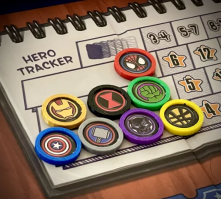
Assemble and organize the 8 Hero Tokens on the Hero Tracker Table. In a 4-player game, draw and place 1 Hero token for the first row, 3 Hero Tokens for the second row, and 4 Hero Tokens for the third row. The value of these heroes’ comic books will vary with the top row being the most valuable and the bottom the least valuable.

Each player takes their Player Token of their chosen color and places it on the “15” space of the Secret Stash track. This will be your money with which to buy lots during auctions. Any of your remaining stash becomes victory points at the end of the game.

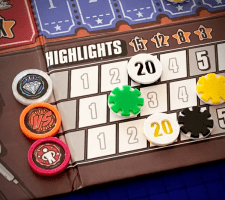
Next, setup the Highlights section. Draw one of the Highlight Tokens and place it on the leftmost space of the top row. Do the same for the next two rows. Each of these Highlight Tokens denotes something special about a comic book. They can be a character’s first appearance, the first issue of a series, an epic battle, a new look (for a character), or a special edition. Players will score points depending on who has the most comic books that match the in-play highlights. Since there are five tokens and you’ll only play with three Highlight tokens, scoring changes from game to game.

Finally, hand one player the First-Player Token. The rules suggest that the player who’s last seen a Marvel Movie or read a Marvel Comic should go first, but you can choose the first player randomly.

Game Flow

Comic Hunters is divided into 3 rounds. Each round has 2 stages: Treasure Hunting and Assemble Your Collections. During the Treasure Hunting stage, players will visit 3 of the 4 possible locations to acquire comic book cards. All you must do is follow the rules of the location indicated by the schedule. Once the first location is played move the schedule to the next location. Each location plays differently from the next.

Treasure Hunting

Comic Book Store

The comic book store plays with classic closed drafting rules (like Sushi Go). Players get dealt four cards from the level 1 deck. They select one card and pass the cards they didn’t choose to the player to their left. This continues until there are no more cards left to pass.

Flea Market

In this location, players take turns, clockwise, starting with the player holding the “First-Player” token. To set up the Flea Market, make a column from the level 2 deck equal to the number of players. Reveal a card from the level 2 deck to place in the first position of each Row. When it’s your turn, you must perform one of two possible actions: reveal a card from the deck and place it to the right of the rightmost, available space in one of the rows, or pick up all the cards from one Row of your choice. Rows can have up to four cards.

Auction Website

To set up the auction website, lay out four rows of the level 3 cards. The first row must contain 5 cards. The last row must contain 3 cards. The middle two rows contain 4 cards. These rows are Lots up for auction. The player with the First Player Token selects which Lot to bid during the round. They open the bidding with at least 1 (of their secret stash). The auction website plays like a traditional “bid or pass auction.” On their turn, a player either bids higher than the current bid or passes (and they’re out for the rest of the auction). Highest bid wins. Whenever one lot remains, the player who hasn’t obtained a lot gains the last lot. They must spend three of their secret stash if they can.

Convention

To set up the Convention, take 24 cards from the top of the Convention deck and arrange them into a grid with 5 columns and 5 rows, leaving the center position empty. Starting with the first player and then going clockwise, each player will take turns doing the following in order: slide one card left, right, up, or down in the grid, moving it through the empty spaces to a new position, and then select all the cards in a column or row that contain the same hero you name. So, you could select all the Spider-Man comics in a row or all the Black Panther comics in a column and so forth. Each player will have two opportunities to perform this action. The catch is that the player who selects last will select twice in a row and the second selection will occur in reverse turn order.

Assemble Your Collections

In this selection, player put cards from their hands down on the table, starting comic book collections for a specific hero or adding comic book cards to existing collections. Player will pay the market value for each card (1 for level 1 cards, 2 for level 2 cards, etc.) with an equal number of cards of that same value. So, you could pay for 3 level 1 cards by discarding 1 level 3 cards. Any cards that you discard or choose not to buy will be added and then shuffled into the Convention deck. Cards in your hand do not carry over to the next round, only cards in collections remain.

Final Scoring

After the final “Assemble Your Collections” action on the schedule, players score their collections. There are several ways to score: collection size (and value of specific heroes), varied collections (collections of different heroes), highlights, and secret stash. I won’t go into detail for each of these here, but there are plenty of ways to score a bucket of points. The person with the most buckets of points wins.

Review

Comic Hunters uses a lot of ways to accrue cards and just as many ways to score those cards after you obtain them. For the most part, the various locations work well enough to simulate the experience of their locations. An auction mechanism is a no-brainer for an auction website. The flea market feels right. And comic book conventions can be the wild, wild west when it comes to what kind of comics are on offer. So, the random comic book cards found during the Convention phases track. I enjoy all of that, but it comes at a cost. The various ways of acquiring cards can get clunky.

I struggle to shift from one mode to the next. While I like the variety, I focused means of acquiring cards could’ve worked better. I would’ve gotten into a better flow state faster with Comic Hunters. These various means with which to obtain cards also made setup and explaining the rules more difficult. Each ruleset is easy enough to explain, but the best way I found for teaching the game was giving a quick rules explanation before each location like I’m the “about the game” page before a Mario Party minigame. And these disparate mechanisms made Comic Hunters feel like a collection of minigames instead of a cohesive experience.

You may have gathered by how I explained the rules above, but the comic book store and auction website locations are lackluster. I like them from the standpoint that I could point to other games that use those same mechanisms, but those mechanisms are old hat. The flea market and convention locations are a lot more interesting and fun. I would’ve loved to play those two locations multiple times (lowering the number of minigames from four to two). I also like the idea that you must spend card values to play cards into a collection. This was a clever touch and lowers the number of bits needed. Despite any of its shortcomings, I enjoyed Comic Hunters. When it tries new things, those new things are fun.

But I can’t move to the verdict without mentioning the quality, or lack of quality, of Comic Hunters’ components. I’ve seen board game manufacturers’ sample products, and most of these companies don’t offer punch board as thin as the tokens found in Comic Hunters. Furthermore, the cards are off-center so you can see the white space between cards, and they slant at odd angles. The card material feels cheap. I don’t usually care about component quality, I’ve played my fair share of prototypes with ripped pieces of paper as chits, but I was shocked by the shoddiness of Comic Hunters’ production value.

Too Long; Didn’t Read

Comic Hunters has a fun premise and contains some interesting game mechanisms. Unfortunately, the game also deploys some tired game mechanisms that feel clunky, and the production value leaves much to be desired. Still, its low price point ($20-$25) means that Comic Hunters packs a lot of game per penny.

Geekly News: March 23, 2025, D&D Sunsets Sigil

Hey, hey! Kyra Kyle here. We’re a little light on geek news this week. I’m sure things will heat up as we approach convention season, spring replacement shows, and summer blockbusters.

On a personal note, I’ve been preparing for upcoming conventions, so my focus is split at the moment. 😅 I’ll be sharing some updates in the coming weeks.

Dungeons & Dragons Sunsets Its 3D Virtual Tabletop Sigil

Sunset is a fancy and nice way of saying shutting down. Had Dungeons & Dragons adopted a 3D virtual tabletop five years earlier during the pandemic lockdown, Sigil would’ve been used by every D&D gaming group. Sigil uses the Unreal 5 engine while integrating the game’s online database D&D Beyond. The graphics and physics of the system impress, but the product is rough around the edges, and with the announcement that D&D plans to shudder the project, Sigil will never reach its lofty expectations. Wizards of the Coast claimed that Sigil would be like you were meeting in person for a tabletop RPG. But let’s be real. Playing a tabletop RPG is best done in person.

A virtual tabletop can only go so far. If anything, D&D was hoping for a second pandemic or another wave of the previous pandemic and that’s a risky business move. During the pandemic, people were willing to take on new hobbies. They were willing to accept a virtual tabletop with all its flaws and often used virtual tabletops inferior to Sigil. Had Sigil released over five years ago, tens of thousands, if not hundreds of thousands, of gamers, would’ve downloaded Sigil. Many of those same gamers may have continued to use the system after the quarantine lifted. Sigil missed its window. Unfortunately, Wizards of the Coast announced that they laid off the 30-person team behind Sigil. Best of luck to these talented designers. They did a great job with an unfinished Sigil.

Point Galaxy and Propolis Available on Kickstarter

The Point series returns with Point Galaxy. Like Point Salad and Point City before it, players draft double-sided cards to build their galaxies in Point Galaxy. This time, whenever you draft a card, you choose to add the card to an existing galaxy or create a new galaxy. The front of the cards will have celestial bodies like planets and suns, but the card backs will feature unique ways for players to score with the galaxies they build. Spaceship tokens add more complexity to the scoring, making Point Galaxy fast-paced and strategic. I’ve always liked Point Salad. Point Galaxy builds on the base game. Flatout Games manages to put a lot of game in a small box.

Propolis, also from Flatout Games, has me intrigued. It combines worker placement and resource management, two game mechanisms found in heavy European games (games with a lot of strategic choices) in another fast and approachable game. The design team of Molly Johnson, Robert Melvin, and Shawn Stankewich is one to keep on a gamer’s radar. They’re also behind the Point series. In Propolis, players control worker bees. You may place your bees on actions and gain resources or use those resources to build structures. Structures give workers bonuses and score points at the end of the game. Simple and fun.

My favorite game mechanism in Propolis is that at the end of each round, players gain a wild resource for each row where they have the most workers. This serves as quick area majority or area control. It can turn the tide but not break the game. Point Galaxy and Propolis are live on Kickstarter and can be purchased separately or together. Individually, they cost $19. Together, players can pledge $35.

RuPaul’s Drag Race Clue

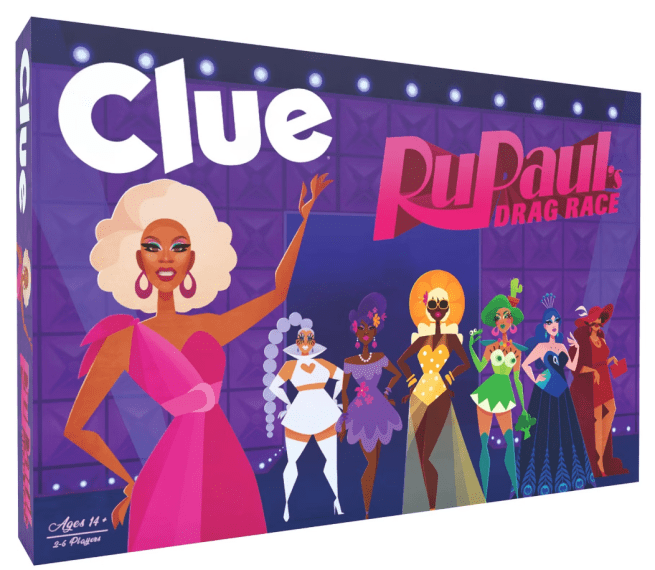
Ordinarily, Geekly wouldn’t report on a new version of Clue being released, but this is RuPaul’s Drag Race, and Season will spend $45 to snag a copy. One of six drag queens has stolen the crown. Figure out who stole the crown, where the crown was discovered, and what dazzling accessory helped the thief escape.

Instead of the standard Clue pawns, Clue: RuPaul’s Drag Race includes standees of the various queens you can play and accuse. The six characters include Madam Mustard, Pepper La Peacock, Crystal White, Sir Lady Scarlet, Marsha P. Plum, and Geraldine Green. All of these drag names are fabulous. My favorite is Marsha P. Plum. I call dibs. Sashay away to iconic Drag Race locations like the main stage, the untucked lounge, and the ladies’ room when Clue: RuPaul’s Drag Race releases later this year.

That’s all we have for this week in geek news. Thank you for reading, and wherever you are, I hope you’re having a great day.

Ten Common Board Game Mechanisms

Board gamers tend to see the same game mechanisms from one game to another, so it made us wonder which board game mechanisms are the most common. Knowing this will allow new players (and older players) the kinds of game mechanisms they can expect to find in board games. Fortunately, the data required for this list is a lot easier to obtain and compile than our most common fantasy creatures post last year. Thank you, Board Game Geek.

Hey, hey! Kyra Kyle here. I checked the hundreds—and I mean hundreds—of game mechanisms listed on Board Game Geek and ran quick searches to see how many games are listed on the site with each mechanism. At the time of this post (early 2025), Board Game Geek caps its search results to the top 5,000 games that fit a search’s criteria. Almost thirty of the hundreds of game mechanisms searched yielded 5,000 results, which means each of these mechanisms could be in hundreds, if not thousands, of more games. Yikes!

Some mechanisms found in at least 5,000 games are movement-based or mundane, like “it uses paper and pencil” or “dice rolling,” which means that the game includes dice. We won’t bother covering those game mechanisms. But that still leaves dozens of interesting game mechanisms for multiple posts like this. We’ll cap this first post to ten of the most used game mechanisms. This doesn’t include mechanisms with over 3500 games like worker placement. I think this means that we need more worker placement games. I like worker placement games, so it’ll probably make the next list. But which board game mechanisms made this list? Let’s find out.
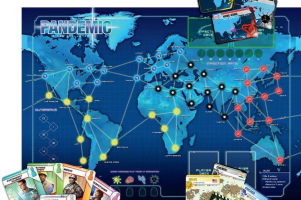
Action Points

Board games that use action points grant players a supply of action points each turn. Players may choose to use these action points in a variety of ways, typically there’s a list of options. Usually, players can spend their points any way they please. You could take the same action multiple times (or even take the same action for their entire turn) or mix and match actions from the player’s options. The options may cost the same number of action points, or their point value can differ.

Thoughts

Action points give players agency. Your turn can look completely different than your opponent/teammate. I mention “teammate” here because I’ve seen several cooperative board games use action points. The agency (giving players a meaningful choice, which affords those players power) granted by the action points game mechanism is why this game mechanism is so popular in board games. Everyone likes to feel as if they have some control.

Games that use this mechanism

Pandemic, Takenoko, Horrified, Dinosaur Island, and Sleeping Gods

Deck, Bag, and Pool Building

Usually, games that include deck/bag/pool building begin with each player owning a similar deck of cards (if the game uses cards) or a similar number and type of chits or dice (if the game uses a bag or pool). Over time, players will acquire new cards (or the like) and add them to their deck, bag, or pool. Eventually, each player will own a deck or bag unique to them. Each player will use their deck to pursue their path toward victory.

Deck building differs from deck construction (another popular game mechanism) because players build their deck during the game, while decks within a deck construction game have players build their decks before playing.

Thoughts

When done well, deck, bag, and pool building games offer endless replays, due to the countless ways players can build their decks. The best players are the ones who can adapt. They’re the ones who can see patterns form with the cards and what may counter an opponent’s deck. Because of this, veteran players of specific deck building games can exploit their knowledge to gain an edge, but there is a hint of randomness. You must draw into what you need. This randomness evens the playing field a touch.

Games that use this mechanism

Dominion, Orleans, Challengers!, Thunderstone, and Aeon’s End
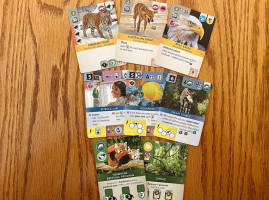
Hand Management

Games that use hand management reward players for playing their cards in certain sequences or groups. The optimal sequence may vary depending on board position, cards held, and cards played by opponents. Managing your hand means that you gain the most value out of available cards given your current circumstance. Often, these cards have multiple purposes, so this further complicates an “optimal” sequence.

Thoughts

Hand management could’ve been dismissed as a mundane game mechanism. Any game that includes a hand of cards will innately have hand management. But hand management is unique from this subset of board game mechanisms. Other mechanisms like dice rolling and paper and pencil mean that these physical elements exist within a game. Hand management suggests that players must take an active role in this game mechanism. And as the description says, this game mechanism is rewarding when players find the perfect sequence for their circumstances. Hand management also happens to show up the most on Board Game Geek’s Top 10-ranked games.

Games that use this mechanism

Brass: Birmingham, Ark Nova, Gloomhaven, Terraforming Mars, and Twilight Struggle
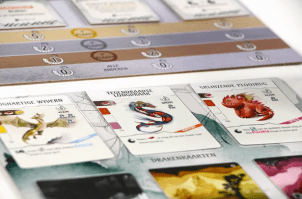
Open Drafting

Board games using open drafting have players pick (or purchase) cards (or tiles, dice, etc.) from a common pool to gain an advantage or assemble collections that meet objectives. Since the drafting occurs in the open, the identity of these cards (or other similar item) is known to other players. Drafting gives players a choice and the ability to gain a card another player may want, denying them something they wanted.

Open drafting differs from closed drafting, which is also known as “select and pass.” Everyone can see the item you gain as you obtain it.

Thoughts

Open drafting provides an immediate back-and-forth between players. Since you know what your opponents select each turn, and your opponents know what you select, a meta-game (or game within the game) takes shape. Like the two previous game mechanisms, players must adapt to what options are available during their turns and what they believe their opponents are planning to do. This back-and-forth can lead to table talk (talking between players at the table about the game they’re playing) and builds tension.

Games that use this mechanism

The Castle of Burgundy, Everdell, Wingspan, Blood Rage, and Splendor
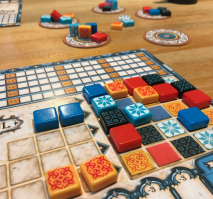
Pattern Building

Games that use pattern building task players with configuring game components to achieve sophisticated patterns. These patterns can score points or trigger actions. Unlike most other game mechanisms on this list, pattern building is synonymous with another game mechanism on this list (tile placement), which we’ll cover later. Often, players want to link similar component types together or as mentioned above, create elaborate patterns.

Thoughts

Pattern building is the most puzzle-based mechanism on this list. The shifting tiles (and sometimes cards) lead to tasty combinations. So many games that fall into this category can be visually stunning. If you must build a pattern, the pattern should be easy on the eyes. This leads to why a lot of modern games use pattern building. Puzzle + Beautiful Patterns = Popular Game.

Games that use this mechanism

Azul, Cascadia, The Isle of Cats, Harmonies, and Welcome To…

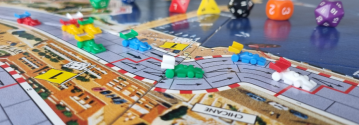
Push Your Luck

With push your luck games, players decide between settling for existing gains or risking them all for further rewards. Games of this type feature an amount of output randomness or luck. We mention the two types of luck in a previous post (link to the two types of luck, input and output luck here). Players focus on progressing and maximizing their results. But typically, the stakes rise. If things go wrong, you lose it all.

Thoughts

Push your luck can add spice to an otherwise dull series of mechanisms. Double or quit, keep going or stop, cash your gains or bet them. This isn’t a new idea. Plenty of gambling games, like Blackjack, make use of the push your luck mechanism. Heck. Many of you may have read the description and immediately thought of Blackjack. Gambling games aren’t the only games that use the push your luck mechanisms. In fact, board games that use the push your luck mechanism can be good for gamers who want the feeling of gambling without involving any real-world money. These games can create a similar rush.

Games that use this mechanism

Heat: Pedal to the Metal, King of Tokyo, The Quacks of Quedlinburg, Lost Cities, and Return to Dark Tower
Roll/Spin and Move

Roll/spin and move games deploy the use of dice (rolling) or spinners (spin) and then move in some capacity. Historically, players roll or spin and move their playing pieces per the number (or other result) rolled (or spun). Countless classic board games have used the roll/spin and move mechanism as a key ingredient. Most people outside the board game community may expect roll/spin and move within all board games. A roll/spin and move game is what most people outside the board game community think of when they think of board games. Board games like Monopoly and The Game of Life popularized roll/spin and move.

Thoughts

People within the board game community often use “roll/spin and move” as a derogatory term. People who do this imply that there is no thought involved with this mechanism. While this is the case for a lot of older games (there are some exceptions like Backgammon), modern board games have taken the roll/spin and move mechanism into new territory. I agree that players lose their agency (power and ability to make meaningful choices) if they must roll or spin and move the spaces indicated on a die (or spinner) with no additional input. But some newer games add other forms of movement to this formula. Other newer games allow players to manipulate the results. Even more modern board games have players roll dice ahead of a turn and then assign the dice results to an array of actions.

Roll/spin and move isn’t an inherently poor mechanism. How a designer uses roll/spin and move makes all the difference. The key to making roll/spin and move work is maintaining a player’s agency.

Games that use this mechanism (well)

Jamaica, Camel Up, Formula D, Stuffed Fables, and Colosseum

Set Collection

Board games that use the set collection mechanism often make the set worth points. The value of the items is dependent on being part of a set. These sets can either be the quantity of a specific item type or a type’s variety. In some cases, board games can use contracts that urge players to pick up certain items to fulfill the contract.

Thoughts

The set collection mechanism breeds external tension between players. One may pick up a resource or item to prevent an opponent from fulfilling a contract or gaining more points by having more of a resource (or item) than anyone else. Or two players may fight each other for the ability to pick up these items because they both want to accomplish the same goal.

The set collection mechanism by itself may fall flat, but set collection seldom shows up on its own. Set collection complements a host of other board game mechanisms. It can give a built-in reason for players to choose a course of action or a sudden gain of a lot of one item or an array (variety) of items can tempt players to change their strategy or tactics. Board gamers often overlook the value of the set collection mechanism, but several popular games use set collection.

Games that use this mechanism

Great Western Trail, Ticket to Ride, 7 Wonders, Lords of Waterdeep, and Tokaido
Tile Placement

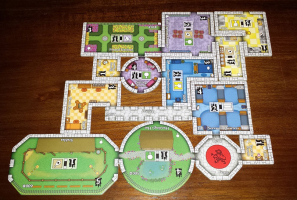
Tile placement games feature placing a piece (or tile) to score victory points or trigger actions. Usually, adjacent pieces or pieces in the same group/cluster or keying off non-spatial properties like color, a feature’s completion, and cluster size trigger the action or scoring. Pattern building often accompanies tile placement, but there are some notable exceptions, specifically, games that use modular boards and exploration.

Thoughts

While some tile placement games (like 1986’s Labyrinth and Dominos) existed before the modern board game boom (the mid-1990s and beyond), tile placement (and a few other mechanisms like worker placement and deck building) have taken the place of the roll/spin and move mechanism as modern board games’ dominant game mechanism. Just because the tile placement mechanism can be found in countless modern board games doesn’t mean that each game uses the mechanism the same way. Some games have a shared space for players to place tiles. Other games give each player a private building space. And several games do a little bit of both. Despite tile placement’s explosion after Carcassonne popularized it as a central game mechanism in 2000, tile placement remains a vibrant board game mechanism.

Games that use this mechanism

Carcassonne, A Feast for Odin, Galaxy Trucker, Betrayal on House on the Hill, and Castles of Mad King Ludwig

Variable Player Powers

The variable player powers game mechanism grants different abilities or paths to victory to each player. Each player has a unique power. Games that use variable player powers reward players who exploit their unique abilities while compensating for their abilities’ shortcomings.

Thoughts

The variable player powers game mechanism is perfect for any player who wants to stand out from their opponents. Because each character (or faction) within the game plays differently from each other, games that use variable player powers have a lot of replay opportunities. On a similar note, players may gel with a specific power over another one so playing a second game and trying a different player power could lead to better results.

Unlike other game mechanisms on this list (except for deck building and Dominion), variable player powers haven’t been around as long. Games that use the variable player powers mechanism also dominate Board Game Geek’s Top 10 ranked board games.

Games that use this mechanism

Gloomhaven, Twilight Imperium: Fourth Edition, Dune: Imperium, Pandemic Legacy: Season 1, and Cosmic Encounter
Closing Thoughts

This was a longer list than I expected. It would be even longer if I didn’t cut the list of common board game mechanisms in half or into thirds. Let me know if you’d like to see more lists like this in the future.

Looking at the board game mechanisms listed on Board Game Geek allows for a macro view of the board game hobby. We can see trends. We can examine what makes a board game mechanism popular. A lot of these board game mechanisms grant some form of player choice or player empowerment. But that’s what I think. What do you think? Let us know in the comments.

Geekly may have another series in the offing. We’ll craft another set of surveys and reach out to board game designers to discover their thoughts about each of these game mechanisms (and game mechanisms that may find themselves on a future list like this one). I hope you found something useful in the post. And wherever you are, I hope you’re having a great day.

Harley Quinn: “The Mess Is the Point” Review

Season’s Thoughts

I’ll be the first to admit I teared up during the latter half of “The Mess Is the Point.” Harley Quinn managed to, once again, subvert my expectations while being comical.

“The Mess Is the Point” was another heavy episode, but it felt a bit lighter than “Bottle Episode (But Not a ‘Bottle Episode’).” I think that’s because I expected Harley and crew to be rescued in one way or another, so there was going to be a silver lining.

I never thought I’d say it, but I think I’d prefer Kyra’s prediction last week to how Frankette would get Harley and crew out of the bottle as opposed to what actually happened. By a small margin. I’m not overly attached to Frankette because she’s a new character, but seeing a baby get hurt is upsetting regardless of species. Frankette eating the Luthor siblings was par for the course.

Superman coming back to save the day was something I expected. I was really hoping he’d say some cheesy line about his and Lois’ Morse code exchanges to lean into Harley Quinn’s type of comedy. All he said was, “It sure is nice to be needed again.” Okay. I’ll admit it. That’s a line I expect out of superhero cartoons from decades ago, and I appreciate this inclusion.

Brainiac really tugged on my heartstrings this time around, too. I was tearing up when he sat with his family for the last time. He had so much buildup, but he didn’t seem like a villain. I was sad to see him go, but I don’t think Harley Quinn can do anything else with his character after season five. It seems like Harley and Ivy are staying in Metropolis. If there is a season six, I’m curious to see which of Metropolis’ rogues Harley Quinn will explore next.

Kyra’s Take

I agree with Season. Brainiac’s ending was heartfelt and fitting. Even though we didn’t spend too much time with Brainiac this season, he had a fleshed-out character arc. Harley Quinn did a good job juggling Brainiac and Lena’s storylines and tying them together at the end. I also don’t see Harley Quinn doing much with Brainiac beyond this season. Point of clarification: Harley and Ivy moved back to Gotham City by the end of “The Mess Is the Point.” Ivy claims that she stole the place from Cyborg. It may appear that Harley and Ivy stayed in Metropolis because Superman had placed Metropolis next to Gotham after he rescued the city from the bottle.

Speaking of cities in bottles, Harley Quinn can dip into countless DC Universe stories with the other cities Brainiac captured. This could lead Harley Quinn into Green Lantern, Blue Beetle, Hawkman/Hawkgirl, Legion of Superheroes, and Martian Manhunter storylines, just to name a few. Harley and Ivy even mention they will restore these cities in the future. And the Harley Quinn creative team has carte blanche to do whatever they want in the Harleyverse. It doesn’t affect the Canonverse. Max hasn’t officially announced a sixth season for Harley Quinn yet but with the show’s popularity and a desire by everyone involved in the project (per multiple entertainment news sources like Coming Soon who interviewed showrunner Dean Lorey), this may be a matter of time.

And speaking of time, allow me to time warp to season 5’s finale. It felt like a finale. Harley Quinn’s last two seasons failed to tie up loose ends. Season 3 focused on Harley becoming a superhero and her failing. Plot lines were dropped in season 4 after Nightwing gets killed and the ladies form the Gotham City Sirens. And that plot line got dropped in season 5’s opening minutes. Harley Quinn season 5 tied up all its Metropolis shenanigans while setting up potential future storylines. This ending tied up things so well that it made me wonder if Harley Quinn would be renewed for a sixth season. If Harley Quinn were to end with season 5, fans would at least have closure.

That said, I’m not ready to say goodbye to these characters yet. I’m rooting for a season 6. The show can go in plenty of directions. Let’s assume Harley Quinn gets renewed. The audience got a hint of space during the season finale. Let’s see more intergalactic mayhem. Add a dash of some familiar madness, too. Harley’s mom has moved in with Harley and Ives. That should spice up their living conditions. Harley/Ivy, King Shark, Bruce, Joker, and Bane all have children. The show could mine these relationships further. And was Bane’s wife pregnant? Oh my! That’ll be interesting.

Harley Quinn season 5 was one of the series’ best and most cohesive seasons. Fingers crossed that we’ll see a sixth season. Thank you for reading, and wherever you are, I hope you’re having a great day.

Daredevil: Born Again, “Sic Semper Systema” Review

Daredevil: Born Again released another episode last night, “Sic Semper Systema,” and Geekly’s here to share their thoughts. Hey, hey! Kyra Kyle here. Daredevil: Born Again approaches its season finale (or at least the cliffhanger before its break for the second half of the season), and the show manages to turn up the heat.

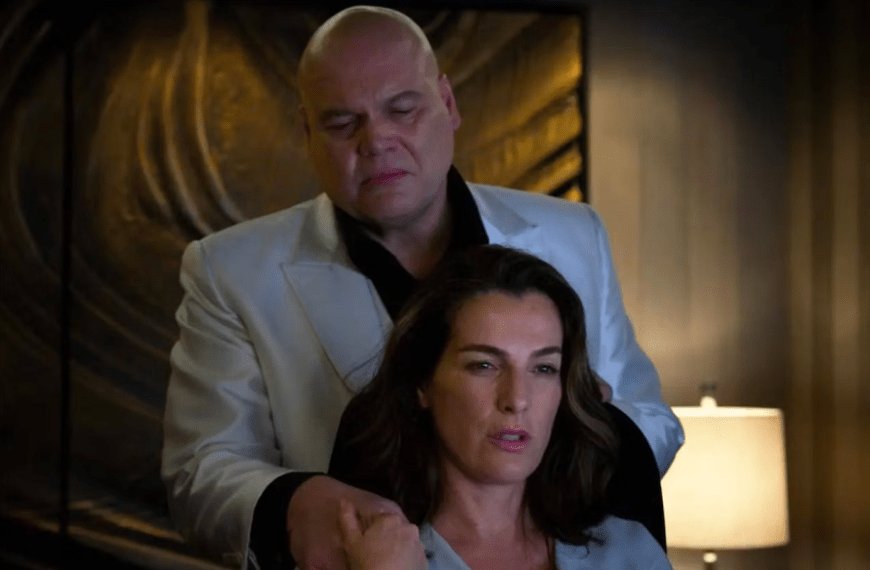
With four episodes in, Daredevil: Born Again proves it can build off the previous show’s success. The new series works best when it centers on Murdock and Fisk. With a few exceptions, the best moments are rooted in characters who originate from the original Netflix series. Wilson and Vanessa scenes have me hooked. I feared for Vanessa’s well-being whenever she and Wilson discussed her infidelity. That mistrust is rewarded in “Sic Semper Systema’s” closing. I won’t spoil it here, but there’s a great payoff.
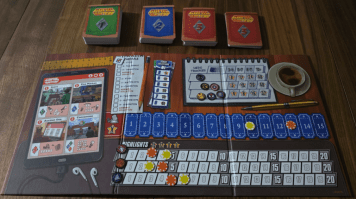
Is it me or does Matt Murdock’s love interest Heather Glenn work better as the Fisk’s therapist than she does Daredevil’s lover? I love Margarita Levieva’s performance with the Fisks. I don’t know if Daredevil: Born Again has done enough to establish her as Murdock’s significant other. And I think that’s an issue with the new series. Again, four episodes in, and patterns emerge. Daredevil: Born Again had to rid itself of Karen Page and Foggy Nelson because they knew Murdock’s secret identity and would eventually support his vigilante work. Heck. Karen suggests that Matt don the cowl in the first episode. The new series wanted Murdock to fight returning as Daredevil. But it hasn’t done enough to build the new recurring characters in Murdock’s life. There are some exceptions.

As I said, I do like Heather as the Wilson’s therapist. Mayor Fisk’s advisors Daniel and Sheila are fantastic. “Sic Semper Systema” shows Kingpin’s former “business” peeking through his day-to-day as mayor. You know how the old Fisk would’ve handled Daniel’s mistake. Daredevil: Born Again does a great job of building this tension. And then throwing in a dark comedic moment. After Mayor Fisk says he won’t fire Daniel for his incompetence and Daniel insists that he’ll never be able to make amends, Sheila tells Daniel, that’s nice, now shut up. She put her job on the line for him and I saw in Sheila’s reaction to Fisk and Daniel’s “talk” that she feared for her and Daniel’s lives. Zabryna Guevara (Sheila) and Michael Gandolfini (Daniel) give great performances.

I also enjoyed one of “Sic Semper Systema’s” one-off characters. Charlie Hudson III’s Leroy Bradford works to show Murdock as a lawyer and the corruption of the legal system. Hudson is only on-screen for around ten minutes, but these moments are powerful.

Hamish Allan-Headley’s Officer Powell has been a standout for this young series. The scenes that include Officer Powell illustrate NYPD’s corruption. Powell serves as a great foil. He doesn’t factor into White Tiger’s murder (that we know of), but someone with connections to the NYPD is behind White Tiger’s death. Evidently, The Punisher has fans within the NYPD. The scene where Matt finds the casing from the bullet used to murder White Tiger is pitch-perfect. I don’t want to spoil it here, but moments like this hint at Murdock’s return as Daredevil. Sure, we physically see Murdock practice martial arts toward the end of “Sic Semper Systema,” but his investigative skills impressed.

Daredevil: Born Again handled The Punisher’s inclusion well. As I suspected, he wasn’t behind White Tiger’s murder. I’m glad he doesn’t steal too much screen time, and Frank Castle pushes Murdock’s buttons. Again, I’ll try not to spoil the scene, but The Punisher gives Murdock the push he needs to dust off his Daredevil attire. Jon Bernthal is a fan favorite for good reason. He embodies The Punisher. Daredevil: Born Again does a great job of hinting that The Punisher continues to fight the good fight. I can’t wait to see him in a future series.

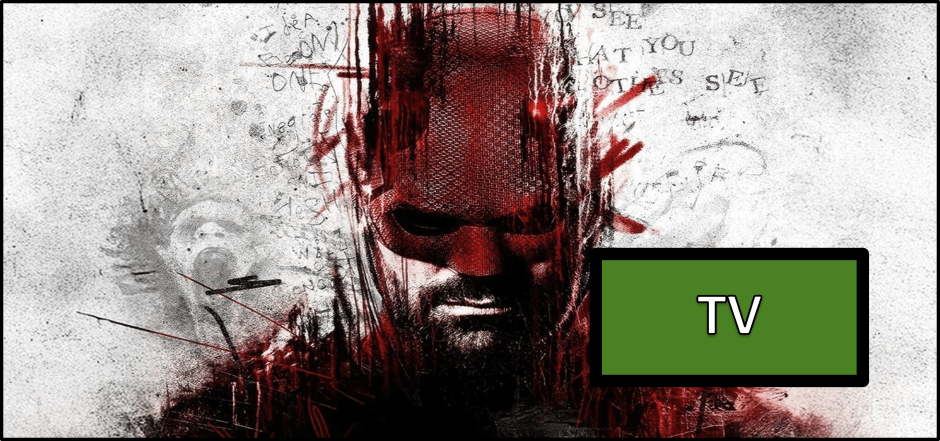
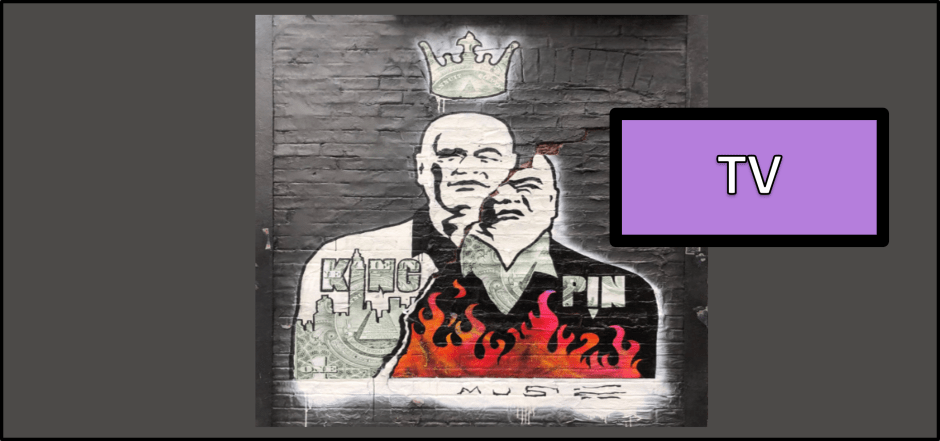
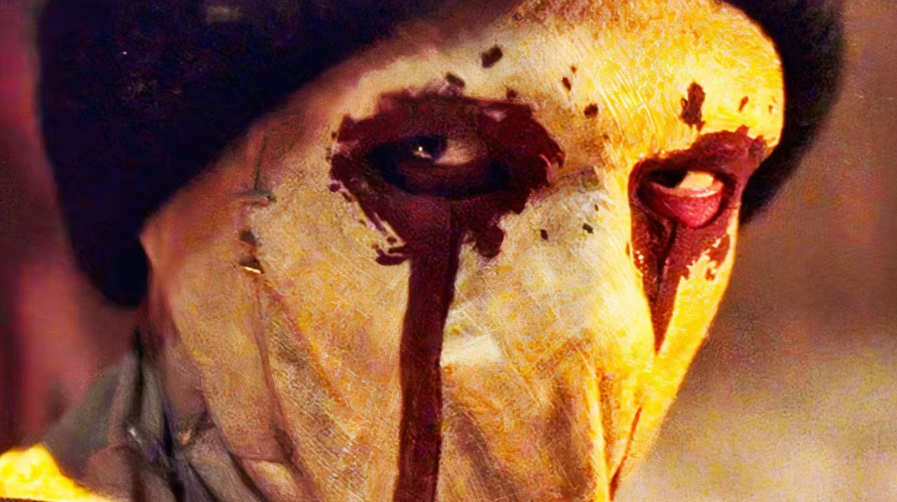
And that brings us to this season’s main villain Muse. Our featured image above is one of Muse’s murals. You can see his name at the bottom right. I may be heading into mild spoiler territory here. Beware. We don’t see much of Muse. Daredevil: Born Again is holding him back for the final two episodes before it goes on break, and that’s a good choice.

In the comics, Muse is active while Wilson Fisk is mayor (Daredevil comics, circa 2016). He paints his murals with human blood, so the red “paint” above (and in this week’s featured image) derives from the blood of his victims. Also in the comics, Muse had superpowers like heightened strength and increased reflexes. He’s an inhuman and also targeted other inhumans. This could be a way to tie Muse (and Daredevil) into the greater MCU and potentially reintroduce the Inhumans. I wouldn’t be surprised if Muse was a standard-issue human, but I’d be a little disappointed if he didn’t have the last and most significant of his superpowers: imperceptibility.

People don’t notice Muse is around because his body is a sensory void. This ability also works on Daredevil. Daredevil: Born Again mentions Spider-Man repeatedly and one of Spidey’s greatest enemies is Venom. Low key, Venom’s best ability is that he doesn’t trigger Peter Parker’s spider-sense. Muse plays a similar role to Daredevil, and the series (specifically the scene when Matt does detective work) is building up to a reveal that no one can sense Muse.

“Sic Semper Systema” generates a lot of speculation. That’s a great thing for Daredevil: Born Again. The series had a rocky start, but there’s hope for a strong cliffhanger next week. Thank you for reading, and wherever you are, I hope you’re having a great day.