Tabletop Game Review: Fabled Fruit

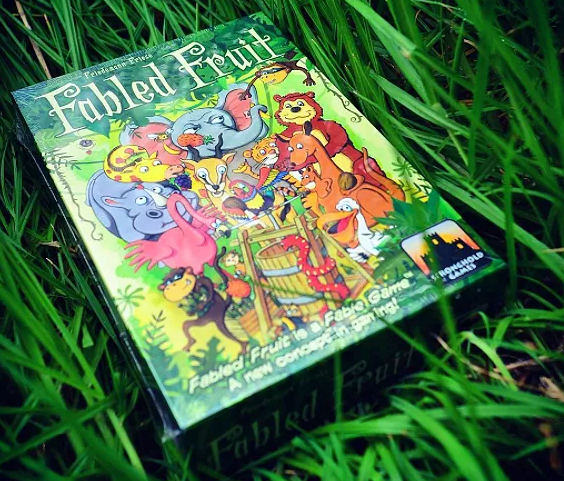
Hey, hey, Geekly Gang! Kyra Kyle here with another board game review. Today, we’re discussing Fabled Fruit.

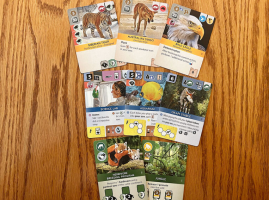
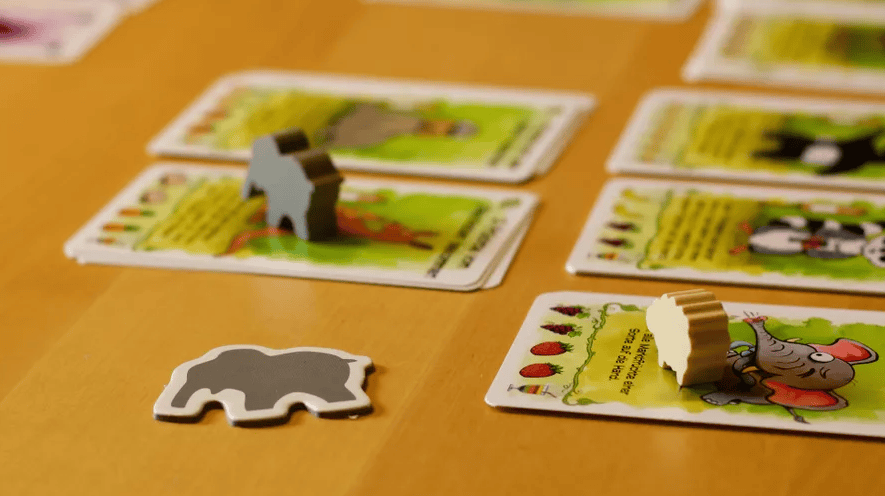
Fabled Fruit is a “fable” game. Gameplay starts simple and evolves after each game. Most of the new rules introduced in Fabled Fruit come on the 240 Location Cards. Players place their animal meeple (animeeple, if you will) on an action they want to take, and take that action, or if they have enough fruit, they can juice (by turning in enough fruit cards to the bank) at that Location, flipping over the Location Card and turning it into a Juice Card. Juice enough Location Cards, and you could win.

Since Fabled Fruit evolves after each play, it’s great to have a dedicated game group. Fortunately, for me, I have such a game group, and we’ve been playing through Fabled Fruit’s mountain of Location Cards. We’ll get to game setup and game flow in a bit, but first, let’s take a look at Fabled Fruit’s fine print.
The Fiddly Bits

Designer: Friedemann Friese
Publisher: Stronghold Games
Date Released: 2016
Number of Players: 2-5
Age Range: 8 and up
Setup Time: Less than 5 minutes
Play Time: 20-30 minutes

Game Mechanisms

Set Collection
Worker Placement
Game Setup

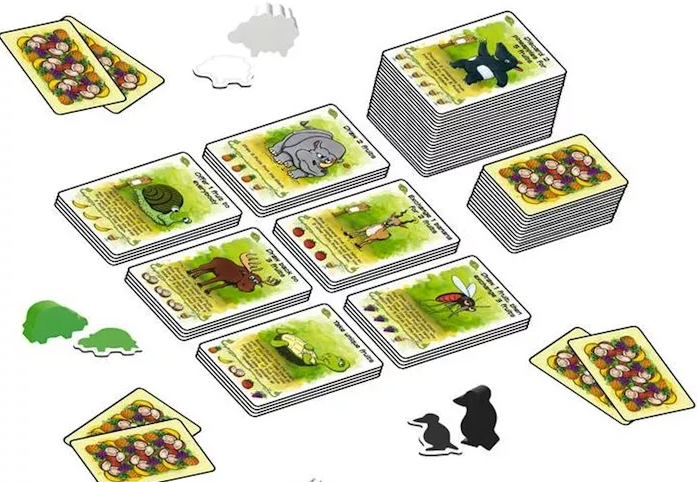
Game setup changes slightly after each game of Fabled Fruit. We’ll begin with a version of the first game setup rules, printed in the rulebook. Just know that the top 24 cards of the Location deck will be used in each game. Whenever a player “Juices” a Location Card, it acts as end-game scoring, and the card gets removed for the next game, forcing players to dig deeper into Fabled Fruit’s Location Deck.

1) Do Not Shuffle These Locations! All Locations are presorted, so you only need to place the huge Locations stack in the center of the table, with Location #1 visible on top and #59 on the bottom.
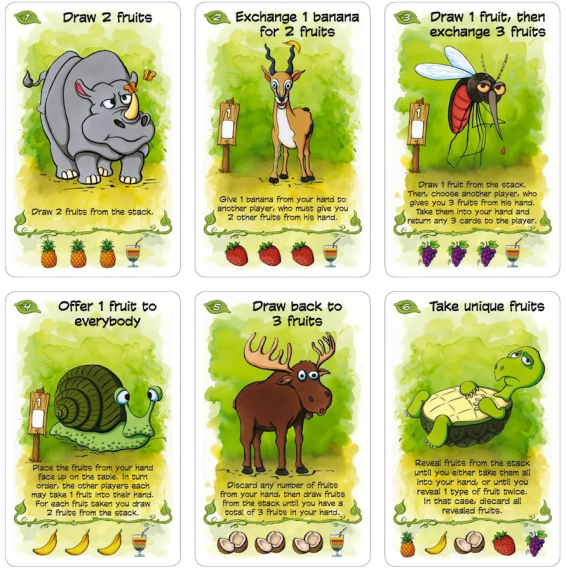
2) Draw all cards of Locations #1-#6 (which will be 24 cards) and place them in separate stacks next to the Location Deck. Each of these small stacks contains four cards all with the same Location number.
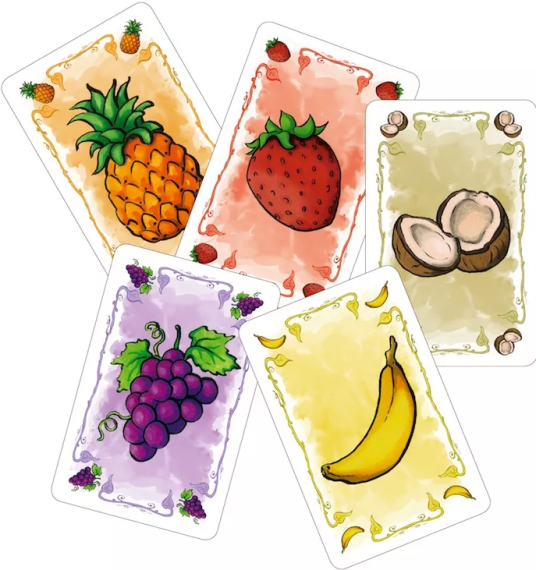
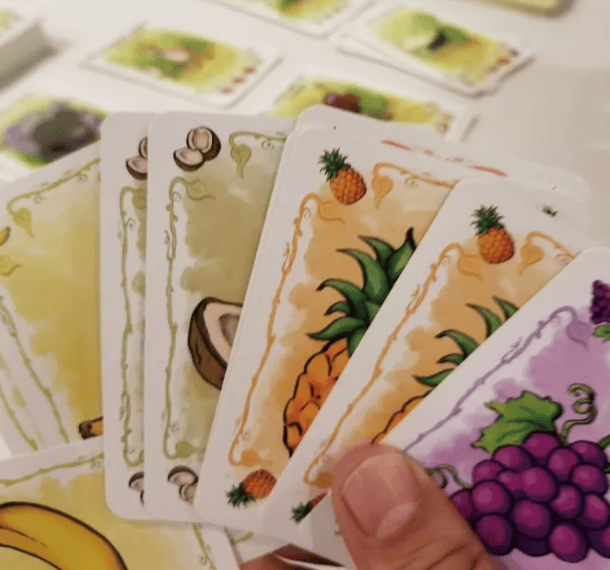
3) Shuffle all 60 fruit cards. We will now call them “fruits.” Deal two cards to each player, which they take into their hands. Place the remaining fruits in a face-down deck next to the huge Locations Deck. You will need some space for a discard pile.

4) All players choose an animal piece along with its matching cardboard token. The game comes with six different animals, so you could have the opportunity to find your favorite animal.

5) Place all remaining game components for the moment to the side: the thief, the five fruit tokens, the double turn tokens, the three wild tokens, and the ten fruit-mix cards. They are not used during the first game. You will play with them in later games, as new Locations will appear.

6) Choose a start player.
Game Flow

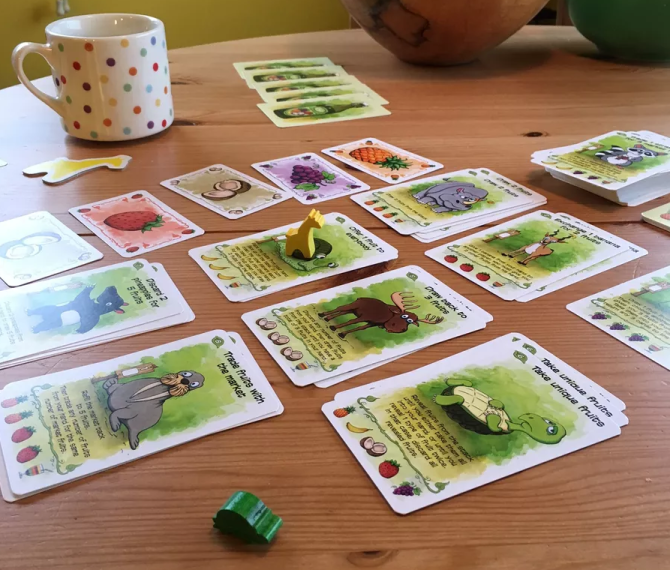
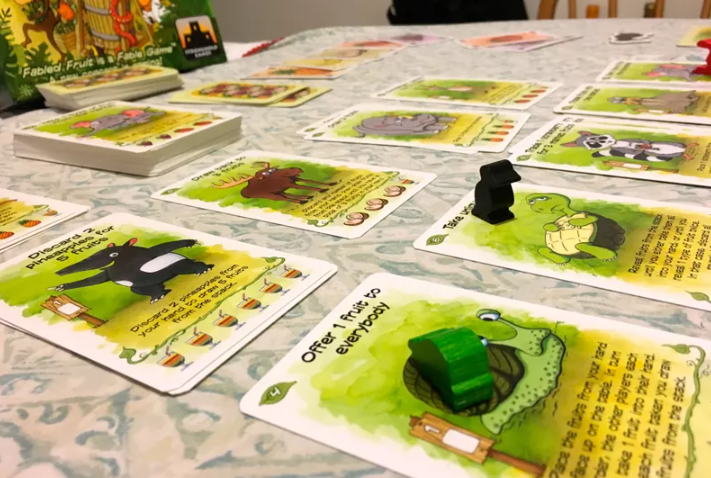
On your turn, you will move your animal piece to a new Location, and take one of two actions: Use the Location’s action, or Juice at the Location.

Moving to a new Location.
On your turn, you must move your animal to a new Location. No staying at the same Location. Place your animal on any available Location.

If one or more of the other players are already at your new Location, you must give one fruit of your choice from your hand face down to each of them, which they take into their hands. If you don’t have enough fruits in your hand for all players, you must give away all your remaining fruits but choose the players who will each receive a fruit. If you don’t have any fruits in your hand, you can move to any new Location occupied by other players without giving them fruits.
Use the Location’s Action
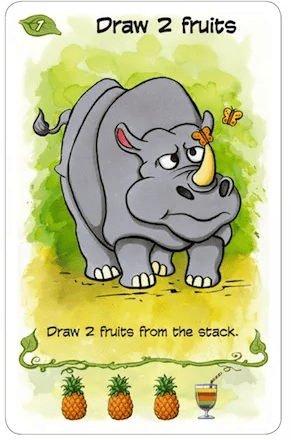
After moving, you use the action as explained on the Location card. All of these actions help you collect a lot of fruits. There is no hand limit, so you can collect any number of fruits.

Juice at the Location
If you have the required fruits needed to “juice” at the Location (fruits pictured at the bottom of the Location card), you can discard the required fruits, flip the Location over to its Juice side, and add it to your score pile. After a Location is “Juiced”

After every time a player juices a Location card, draw a new Location card from the top of the Location deck. If this Location doesn’t match a Location already in play, create a new stack for this Location number.

Game End

As soon as the first player has the required number of Fabled Juices (the number varies depending on player count), you finish the current round, so all players have the same number of turns. The player to the right of the start player receives the last turn.

The player with the most Fabled Juices wins the game. In case of a tie, the tied player with more remaining fruits in their hand wins the game. If there is still a tie, these tied players share the victory.
Review

Fabled Fruit is one of those games where you want to play one more round. Digging through the Location deck can be a joy. Friedmann Friese does a great job of presenting easy-to-understand rules for the starting Locations and then introducing more complicated Locations deeper in the deck. What does the thief token do? You’ll have to find out. Which Location introduces the fruit-mix cards? It’s closer to #59 than #1. Fabled Fruit’s evolving ruleset reminds me of Fluxx, but it has a more measured cadence. The rules change only after a player “juices” enough of one Location.

And some Locations will live in the ruleset for countless games. My game group avoided juicing the Rhino Location (Location #1) that lets players draw two fruits from the deck. I asked why most players avoided juicing at that Location. Their answer was simple. How else will I gain a lot of fruits quickly? Yeah, there is a little bit of a logjam problem with Fabled Fruit. I believe the Walrus Location establishes “The Market,” a set of five cards from the fruits deck that are drawn face up, and players can then interact with the market using other Locations. But you need a Location or two before that becomes a viable strategy.
But oh, do I love these evolving rules. I glossed over the “measured cadence” of Fabled Fruit’s ruleset. This is a slow, satisfying burn. Sure, the first new Location occurs after the very first Location a player juices, but every Location after that will need four juiced Locations before they make an appearance. The new combinations that develop during a single game, after several games, keep Fabled Fruit a fresh gaming experience. I love the agonizing choice of having enough fruits to juice at a Location, but the Location is one of my favorites. I also love the idea of purposefully juicing a Location another player has been exploiting. Hate juicing for the win.

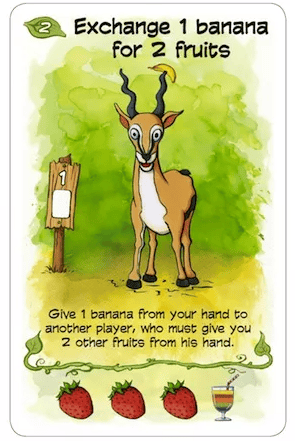
Some of the rules can be confusing. I screwed up on a Location’s rules on more than one occasion. It took me three or four games to figure out the give a Banana to an opponent (not the bank) and then receive two fruits in return. Basically, in the game, I finally figured out that rule, the fourth Location of that type got juiced, and it left play forever. Great.

Fabled Fruit suffers from some edge case issues. These are problems that crop up with an unexpected combination of Locations reveal themselves. Heck, the Locations that interact with the Market get weakened after the Walrus Location disappears.  Seriously, the Walrus Location sets up the Market. If it leaves play completely, there isn’t a Market for the remaining cards. Fortunately, numerous cards have a card sign printed on them. These Locations allow players to forgo the Location’s ability and draw a card from the fruits deck. A lot of the Market Locations have this secondary ability.
I love Fabled Fruit. It’s easy to get into and learn. It scratches a similar itch as a legacy game, without the card or board destruction. You can always reset the game to its original state and begin again. Exploring the Location deck is exciting. Discovering new Location combos is fantastic. But Fabled Fruit won’t be for everyone. You’ll need a dedicated game group to get the full experience or to even to get through half of the Location deck. I didn’t always have that group, and I’ve had Fabled Fruit in my collection for years. I’m only now reviewing the game, because I was finally able to log in enough plays.

If you have the game group, dig into Fabled Fruit’s Locations and thank me later.
Too Long; Didn’t Read

Fabled Fruit is easy to get into and learn. It scratches a similar itch as a legacy game, without the card or board destruction. Its evolving ruleset reminds me of Fluxx, but Fabled Fruit has a more measured cadence that allows for interesting action combos to emerge. But you will need a dedicated game group to see more of what Fabled Fruit has to offer.
Ten Common Board Game Mechanisms

Board gamers tend to see the same game mechanisms from one game to another, so it made us wonder which board game mechanisms are the most common. Knowing this will allow new players (and older players) the kinds of game mechanisms they can expect to find in board games. Fortunately, the data required for this list is a lot easier to obtain and compile than our most common fantasy creatures post last year. Thank you, Board Game Geek.

Hey, hey! Kyra Kyle here. I checked the hundreds—and I mean hundreds—of game mechanisms listed on Board Game Geek and ran quick searches to see how many games are listed on the site with each mechanism. At the time of this post (early 2025), Board Game Geek caps its search results to the top 5,000 games that fit a search’s criteria. Almost thirty of the hundreds of game mechanisms searched yielded 5,000 results, which means each of these mechanisms could be in hundreds, if not thousands, of more games. Yikes!

Some mechanisms found in at least 5,000 games are movement-based or mundane, like “it uses paper and pencil” or “dice rolling,” which means that the game includes dice. We won’t bother covering those game mechanisms. But that still leaves dozens of interesting game mechanisms for multiple posts like this. We’ll cap this first post to ten of the most used game mechanisms. This doesn’t include mechanisms with over 3500 games like worker placement. I think this means that we need more worker placement games. I like worker placement games, so it’ll probably make the next list. But which board game mechanisms made this list? Let’s find out.

Action Points

Board games that use action points grant players a supply of action points each turn. Players may choose to use these action points in a variety of ways, typically there’s a list of options. Usually, players can spend their points any way they please. You could take the same action multiple times (or even take the same action for their entire turn) or mix and match actions from the player’s options. The options may cost the same number of action points, or their point value can differ.

Thoughts

Action points give players agency. Your turn can look completely different than your opponent/teammate. I mention “teammate” here because I’ve seen several cooperative board games use action points. The agency (giving players a meaningful choice, which affords those players power) granted by the action points game mechanism is why this game mechanism is so popular in board games. Everyone likes to feel as if they have some control.

Games that use this mechanism

Pandemic, Takenoko, Horrified, Dinosaur Island, and Sleeping Gods

Deck, Bag, and Pool Building

Usually, games that include deck/bag/pool building begin with each player owning a similar deck of cards (if the game uses cards) or a similar number and type of chits or dice (if the game uses a bag or pool). Over time, players will acquire new cards (or the like) and add them to their deck, bag, or pool. Eventually, each player will own a deck or bag unique to them. Each player will use their deck to pursue their path toward victory.

Deck building differs from deck construction (another popular game mechanism) because players build their deck during the game, while decks within a deck construction game have players build their decks before playing.

Thoughts

When done well, deck, bag, and pool building games offer endless replays, due to the countless ways players can build their decks. The best players are the ones who can adapt. They’re the ones who can see patterns form with the cards and what may counter an opponent’s deck. Because of this, veteran players of specific deck building games can exploit their knowledge to gain an edge, but there is a hint of randomness. You must draw into what you need. This randomness evens the playing field a touch.

Games that use this mechanism

Dominion, Orleans, Challengers!, Thunderstone, and Aeon’s End

Hand Management

Games that use hand management reward players for playing their cards in certain sequences or groups. The optimal sequence may vary depending on board position, cards held, and cards played by opponents. Managing your hand means that you gain the most value out of available cards given your current circumstance. Often, these cards have multiple purposes, so this further complicates an “optimal” sequence.

Thoughts

Hand management could’ve been dismissed as a mundane game mechanism. Any game that includes a hand of cards will innately have hand management. But hand management is unique from this subset of board game mechanisms. Other mechanisms like dice rolling and paper and pencil mean that these physical elements exist within a game. Hand management suggests that players must take an active role in this game mechanism. And as the description says, this game mechanism is rewarding when players find the perfect sequence for their circumstances. Hand management also happens to show up the most on Board Game Geek’s Top 10-ranked games.

Games that use this mechanism

Brass: Birmingham, Ark Nova, Gloomhaven, Terraforming Mars, and Twilight Struggle

Open Drafting

Board games using open drafting have players pick (or purchase) cards (or tiles, dice, etc.) from a common pool to gain an advantage or assemble collections that meet objectives. Since the drafting occurs in the open, the identity of these cards (or other similar item) is known to other players. Drafting gives players a choice and the ability to gain a card another player may want, denying them something they wanted.

Open drafting differs from closed drafting, which is also known as “select and pass.” Everyone can see the item you gain as you obtain it.

Thoughts

Open drafting provides an immediate back-and-forth between players. Since you know what your opponents select each turn, and your opponents know what you select, a meta-game (or game within the game) takes shape. Like the two previous game mechanisms, players must adapt to what options are available during their turns and what they believe their opponents are planning to do. This back-and-forth can lead to table talk (talking between players at the table about the game they’re playing) and builds tension.

Games that use this mechanism

The Castle of Burgundy, Everdell, Wingspan, Blood Rage, and Splendor

Pattern Building

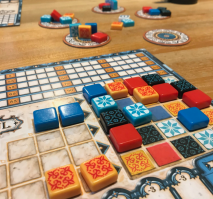
Games that use pattern building task players with configuring game components to achieve sophisticated patterns. These patterns can score points or trigger actions. Unlike most other game mechanisms on this list, pattern building is synonymous with another game mechanism on this list (tile placement), which we’ll cover later. Often, players want to link similar component types together or as mentioned above, create elaborate patterns.

Thoughts

Pattern building is the most puzzle-based mechanism on this list. The shifting tiles (and sometimes cards) lead to tasty combinations. So many games that fall into this category can be visually stunning. If you must build a pattern, the pattern should be easy on the eyes. This leads to why a lot of modern games use pattern building. Puzzle + Beautiful Patterns = Popular Game.

Games that use this mechanism

Azul, Cascadia, The Isle of Cats, Harmonies, and Welcome To…

Push Your Luck

With push your luck games, players decide between settling for existing gains or risking them all for further rewards. Games of this type feature an amount of output randomness or luck. We mention the two types of luck in a previous post (link to the two types of luck, input and output luck here). Players focus on progressing and maximizing their results. But typically, the stakes rise. If things go wrong, you lose it all.

Thoughts

Push your luck can add spice to an otherwise dull series of mechanisms. Double or quit, keep going or stop, cash your gains or bet them. This isn’t a new idea. Plenty of gambling games, like Blackjack, make use of the push your luck mechanism. Heck. Many of you may have read the description and immediately thought of Blackjack. Gambling games aren’t the only games that use the push your luck mechanisms. In fact, board games that use the push your luck mechanism can be good for gamers who want the feeling of gambling without involving any real-world money. These games can create a similar rush.

Games that use this mechanism

Heat: Pedal to the Metal, King of Tokyo, The Quacks of Quedlinburg, Lost Cities, and Return to Dark Tower

Roll/Spin and Move

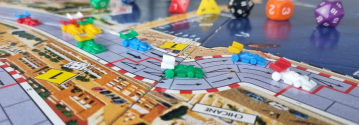
Roll/spin and move games deploy the use of dice (rolling) or spinners (spin) and then move in some capacity. Historically, players roll or spin and move their playing pieces per the number (or other result) rolled (or spun). Countless classic board games have used the roll/spin and move mechanism as a key ingredient. Most people outside the board game community may expect roll/spin and move within all board games. A roll/spin and move game is what most people outside the board game community think of when they think of board games. Board games like Monopoly and The Game of Life popularized roll/spin and move.

Thoughts

People within the board game community often use “roll/spin and move” as a derogatory term. People who do this imply that there is no thought involved with this mechanism. While this is the case for a lot of older games (there are some exceptions like Backgammon), modern board games have taken the roll/spin and move mechanism into new territory. I agree that players lose their agency (power and ability to make meaningful choices) if they must roll or spin and move the spaces indicated on a die (or spinner) with no additional input. But some newer games add other forms of movement to this formula. Other newer games allow players to manipulate the results. Even more modern board games have players roll dice ahead of a turn and then assign the dice results to an array of actions.

Roll/spin and move isn’t an inherently poor mechanism. How a designer uses roll/spin and move makes all the difference. The key to making roll/spin and move work is maintaining a player’s agency.

Games that use this mechanism (well)

Jamaica, Camel Up, Formula D, Stuffed Fables, and Colosseum

Set Collection

Board games that use the set collection mechanism often make the set worth points. The value of the items is dependent on being part of a set. These sets can either be the quantity of a specific item type or a type’s variety. In some cases, board games can use contracts that urge players to pick up certain items to fulfill the contract.

Thoughts

The set collection mechanism breeds external tension between players. One may pick up a resource or item to prevent an opponent from fulfilling a contract or gaining more points by having more of a resource (or item) than anyone else. Or two players may fight each other for the ability to pick up these items because they both want to accomplish the same goal.

The set collection mechanism by itself may fall flat, but set collection seldom shows up on its own. Set collection complements a host of other board game mechanisms. It can give a built-in reason for players to choose a course of action or a sudden gain of a lot of one item or an array (variety) of items can tempt players to change their strategy or tactics. Board gamers often overlook the value of the set collection mechanism, but several popular games use set collection.

Games that use this mechanism

Great Western Trail, Ticket to Ride, 7 Wonders, Lords of Waterdeep, and Tokaido

Tile Placement

Tile placement games feature placing a piece (or tile) to score victory points or trigger actions. Usually, adjacent pieces or pieces in the same group/cluster or keying off non-spatial properties like color, a feature’s completion, and cluster size trigger the action or scoring. Pattern building often accompanies tile placement, but there are some notable exceptions, specifically, games that use modular boards and exploration.

Thoughts

While some tile placement games (like 1986’s Labyrinth and Dominos) existed before the modern board game boom (the mid-1990s and beyond), tile placement (and a few other mechanisms like worker placement and deck building) have taken the place of the roll/spin and move mechanism as modern board games’ dominant game mechanism. Just because the tile placement mechanism can be found in countless modern board games doesn’t mean that each game uses the mechanism the same way. Some games have a shared space for players to place tiles. Other games give each player a private building space. And several games do a little bit of both. Despite tile placement’s explosion after Carcassonne popularized it as a central game mechanism in 2000, tile placement remains a vibrant board game mechanism.

Games that use this mechanism

Carcassonne, A Feast for Odin, Galaxy Trucker, Betrayal on House on the Hill, and Castles of Mad King Ludwig

Variable Player Powers

The variable player powers game mechanism grants different abilities or paths to victory to each player. Each player has a unique power. Games that use variable player powers reward players who exploit their unique abilities while compensating for their abilities’ shortcomings.

Thoughts

The variable player powers game mechanism is perfect for any player who wants to stand out from their opponents. Because each character (or faction) within the game plays differently from each other, games that use variable player powers have a lot of replay opportunities. On a similar note, players may gel with a specific power over another one so playing a second game and trying a different player power could lead to better results.

Unlike other game mechanisms on this list (except for deck building and Dominion), variable player powers haven’t been around as long. Games that use the variable player powers mechanism also dominate Board Game Geek’s Top 10 ranked board games.

Games that use this mechanism

Gloomhaven, Twilight Imperium: Fourth Edition, Dune: Imperium, Pandemic Legacy: Season 1, and Cosmic Encounter

Closing Thoughts

This was a longer list than I expected. It would be even longer if I didn’t cut the list of common board game mechanisms in half or into thirds. Let me know if you’d like to see more lists like this in the future.

Looking at the board game mechanisms listed on Board Game Geek allows for a macro view of the board game hobby. We can see trends. We can examine what makes a board game mechanism popular. A lot of these board game mechanisms grant some form of player choice or player empowerment. But that’s what I think. What do you think? Let us know in the comments.

Geekly may have another series in the offing. We’ll craft another set of surveys and reach out to board game designers to discover their thoughts about each of these game mechanisms (and game mechanisms that may find themselves on a future list like this one). I hope you found something useful in the post. And wherever you are, I hope you’re having a great day.