Spotlight: Time Cataclysm

SentinelsOfTheMultiverseTimeCataclysmFirst Appearance: Sentinels of the Multiverse: Shattered Timelines
Where it is: A disjointed region of metaphysical space that’s out of time with reality.
Primary Damage Type: Melee
Secondary Damage Type: Toxic and Infernal
Deck Concept: Most of Time Cataclysm’s effects are global, targeting heroes, villains and even environment cards alike. While most environment decks make sure they don’t target their own cards, Time Cataclysm throws that caution to the wind.
Biggest Global Effect: Marsquake!: At the end of environment turn, deal each target 2 melee damage. At the start of the environment turn, destroy 1 villain ongoing card, 1 hero ongoing card, and 1 environment card.
Worst Card (for the Heroes): Crushing Hallway: At the end of the environment turn, 1 player may discard their hand to destroy this card. At the start of the environment turn, deal each target 4 melee damage and destroy all hero ongoing cards.

SentinelsOfTheMultiverseRiftInTimeTimceCataclysm
Odd Ways to Win (Achievement Time):
Charging Triceratops (8HP): Reduce damage dealt to this card by 1. At the start of the environment turn, this card deals the target other than itself with the second lowest HP 3 melee damage.
Surprise Shopping Trip: Whenever a card enters play, deal each target 1 melee damage. At the start of the environment turn, destroy this card.
Crushing Hallway: At the end of the environment turn, 1 player may discard their hand to destroy this card. At the start of the environment turn, deal each target 4 melee damage and destroy all hero ongoing cards.
Marsquake!: At the end of environment turn, deal each target 2 melee damage. At the start of the environment turn, destroy 1 villain ongoing card, 1 hero ongoing card, and 1 environment card.

How to Escape:
Time Cataclysm is perhaps the most evenhanded environment deck to date. I’d deal with Crushing Hallway as soon as possible. Destroying all hero ongoing cards hurts a ton. You’ll also want to get rid of Marsquake! too but the only way to do so is with a hero that targets environment and/or ongoing cards. The Visionary and countless others can help get rid of environment cards, but Time Cataclysm does have a reset card of sorts.

Rift in Time allows you to destroy 1 environment card at the beginning of the environment turn, so that circumvents the need to play as a hero that can destroy environment cards, but you have to be really lucky to top deck Rift in Time. You could always keep one copy of Rift in Time in play just in case you encounter a less desirable environment card in the future. The worst thing Rift in Time does is play an additional environment card per environment turn.

Outside of that strategy, I’d be weary of Surprise Shopping Trip as it deals each target 1 melee damage each time a card enters play, but it only last for one round—you could just not play a card that round—and Passing Tumbleweed provides yet another means to destroy environment cards. Unfortunately, it only has 1 HP and there’s only one copy of Passing Tumbleweed in the deck, so it’ll be more difficult to keep it in play than it is to draw into and keep Rift in Time in play, but Passing Tumbleweed is a cheaper means to get rid of environment cards should you devise a way to redirect damage. I’m thinking Legacy or The Scholar are your best bet for damage redirection.
Spotlight: The Block

TheBlockSentinelsOfTheMultiverseFirst Appearance: Sentinels of the Multiverse: Shattered Timelines
Where it is: It’s a high-tech prison
Primary Damage Type: Melee
Secondary Damage Type: Projectile, Fire, Toxic, and Lightning
Deck Concept: The Block forgoes dealing direct damage to heroes and villains like other environments and opts to create a secondary battle between two factions in the environment, agents and inmates. Heroes and villains get caught in the crossfire.
Biggest Global Effect: Defensive Displacement: Reduce all damage by 2. At the start of the environment turn, if there are no inmates in play, destroy this card.
Worst Card (for the Heroes): Prison Riot: When this card enters play, reveal cards from the top of the environment deck until (H)—where H is equal to the number of heroes—minus 1 inmates are revealed. Put them into play. Discard the other revealed cards. At the end of the environment turn, destroy this card.

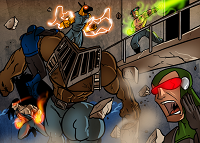
TheBlockActionScene
Odd Ways to Win (Achievement Time):
Char (14HP): At the start of the environment turn, this card deals each non-inmate target 2 fire damage and 2 toxic damage.
F.I.L.T.E.R. Officer (9HP): At the end of the environment turn, this card deals the non-agent target with the second lowest HP (H) minus 1 projectile damage.
Block Guard (7HP): At the end of the environment turn, this card deals the non-agent target with the lowest HP (H) minus 2 lightning damage. A target dealt damage this way cannot deal damage until the start of the environment turn.
Time-Crazed Prisoner (4HP): At the start of the environment turn, this card deals the non-inmate target with the second highest HP X melee damage, where X = the number of cards in the environment trash.
How to Escape:
Inmates tend to deal more damage to heroes than agents, although agents can damage heroes too, so you’ll want to manage the number of inmates in play. Defensive Displacement makes this difficult, but imagine if you draw into Defensive Displacement (reduces all damage unless you have no inmates) with several inmates already in play. You might as well forfeit the game.

Prison Riot further complicates matters, but Warden Hoefle can manage these inmates. You’ll want to keep the Warden in the game as long as you can. I also don’t care for the Block Guard, another agent card. He not only can deal you damage, he can prevent you from dealing damage.

Comics for the Week of 3/4/2015

It was another light week for the pull file, at least in terms of the number of books, but there were some pretty high-profile releases to talk about.

If you haven’t been following the Star Wars books, I can tell you you’re missing out. Even if you’re not a huge devotee of the franchise, these are quality books. The main title has been surprisingly good, and the Vader spinoff has been a nice addition to the narrative. That’s why I had some pretty high hopes for Leia’s solo title. With Waid writing it, and Dodson handling the art, it seemed promising. The end result, at least for the debut issue, disappointed me. It wasn’t a bad book, not exactly, but it wasn’t nearly as good as I expected, let alone hoped. Between Star Wars, Vader, and now Leia, I didn’t expect, or even want a uniformity to the art, but the differences in Leia’s approach weren’t just limited to style. Dodson’s work, specifically with regard to character faces is so flat, there is seriously nothing but hair-color to set one character apart from another. The expressions are flat, the features are washed out, and even the page layouts sometimes confuse the action. The problems are not limited to the book’s aesthetics, either. Waid’s writing is shockingly awkward and expositional. It wants the gravitas of Alderaan’s destruction without earning it. It has Leia talking out of both sides of her mouth in an effort to make her both a woman of the people, and a princess. Seriously, I was actually expecting her to utter the words, “I command you to treat me like a normal person” at some point. The resolution to this issue’s big conflict was lazily handled off screen, and it did nothing to serve the larger story. Here’s hoping the second issue finds its footing.

Ever since the “Icarus” storyline, I’ve been pretty happy with Detective Comics. The Anarky story made use some of the lesser-known villains, and it was more effective than not, but the finale to the arc seemed to fall flat. Manapul’s art continued to impress, but there were some real cringeworthy moments of dialogue. As is usually the case with shoddy dialogue, there was some exposition shoe-horned in, but it went further than that. Some of the things Batman says as he leaps into action have the ring of something a Batman doll would say if you pulled a string in its back. Once again, the resolution to the story felt too simple and unsatisfying, but I will say that a smaller story, centered around a more grounded Batman universe provides a nice alternative to what is being done in Snyder’s Batman title.

All-New Hawkeye #1 also came up this week. I appreciate that although there is a lot of reference to what has been happening in recent Hawkeye books, this is enough of a jumping-on point to justify being called a #1. The wildly different art-styles add a layer of contrast between the present-day and flashback sequences, and the dynamic between Kate and Clint makes for a nice read. This may be the strongest title I’ve read this week.

Agricola

Settle the land. Build a farm and a home. Raise animals. Start a family.

If any of these things appeal to you, Agricola will strike your fancy bone. Even if none of the things above sound tempting, Agricola’s solid gameplay, get-you-playing-in-five-minutes rules, and more versatility than you can shake a Swiss army knife at will put a smile on your face.

We’ll get to the review in a bit but we have to feed you some tech speak.

Designer: Uwe Rosenberg
Publisher: Z-Man Games
Date Released: 2007
Number of Players: 1-5
Age Range: 12 and up (14+ on the box; 10 for a family game)
Setup Time: 5-10 minutes
Play Time: 45-60 minutes (less for a family game)
Game Mechanisms:
Area Enclosure
Card Drafting
Hand Management
Worker Placement or Action Drafting

Agricola04
Game Flow:
Players start the game with a plot of land, a two room wooden house, two family members (a momma and a papa), and a hand composed of occupation and minor improvement cards. Players take turns improving their homestead with a catalog of actions, available to all the players, and with the cards in their hand. Once a player selects one of the cataloged actions, by placing one of their family member playing piece on the action space, no other player can take that action that round, and there are fourteen rounds.

AgricolaActionSelection
Overview of Possible Actions

Your workers can improve your land by gathering supplies, plowing fields, building fences for pastures, adding more rooms to your house and upgrading the house you have. Animals give you options for food, but you must have fences for your animals. Children give you more actions per turn, but you must have room in your house for the newborn and you have to be able to feed all the members of your family come harvest time.

Every action is tied to multiple other actions. This forces players to plan their farms carefully and allows the player who picks before you the option to screw you over by selecting the action you needed that round.

Review:
There are now two phases to Uwe Rosenberg’s career: pre and post Agricola. Every game of Rosenberg’s prior to Agricola played nothing like a worker placement game, but every game Rosenberg has designed after Agricola plays off the worker placement mechanism. I’m not sure if it’s for better or for worse.

On first play I enjoyed Agricola. I like the farming theme and judging from the millions of people who traded virtual livestock on Farmville several years back, so do others. I also like the worker placement mechanism a lot, so of course I liked Agricola. But the shine has worn off the game for me.

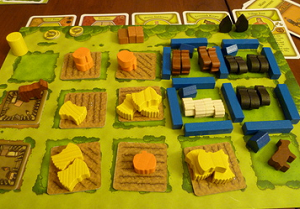
AgricolaOverviewOfAFarm
Overview of a Farm

I feel anxious, struggling to feed my family members every harvest season (the fourth, seventh, ninth, eleventh, thirteenth, and fourteenth rounds), and you can’t specialize in any one thing—you have to have a little bit of everything. So what if I want to be a shepherd and corner the market with cute, wooden sheep. I should be able to specialize in something if I want, but Agricola punishes me for not having boar, cattle, grain, and veggies in addition to sheep. Rosenberg has since corrected some of these issues with Le Havre (specialization) and Caverna (less stressful means of feeding workers), which further tarnishes Agricola.

AgricolaOccupationAndImprovementCards
Examples of Occupation and Improvement Cards

Don’t get me wrong. I still wouldn’t say no to a game of Agricola, but I don’t ask to play the game with any regularity. It still has addictive gameplay and there are so many variants for playing the game that if you enjoy the core mechanics, you’ll find several hours of fun.

If you don’t mind the lack of specialization and the stress of feeding your family, Agricola is still a solid game. But if you want to eliminate one of these detractors, consider Rosenberg’s own Le Havre or Caverna.

Verdict:
Still a strong game, but two Rosenberg games have replaced Agricola as his top worker placement offering.

Fairy Tale

Four mystical faction face off for domination of the fairy tale land: dragons, fairies, knights, and the realm of shadows. You have control of which one will reign supreme by drafting cards, choosing your forces, and affecting the cards your opponents have at their disposal. Who comes out on top of this Fairy Tale? You decide.

We’ll get back to the fantastic in a bit but first, here’s some technical jargon.

The Fiddly Bits
Designer: Satoshi Nakamura
Publisher: Z-Man Games
Date Released: 2004
Number of Players: 2-5
Age Range: 10 and up
Setup Time: minimal
Play Time: around 20 minutes
Game Mechanisms:
Card Drafting
Hand Management
Set Collection
Simultaneous Action Selection

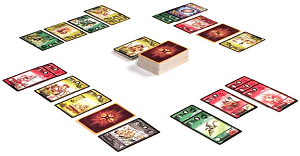
FairyTaleCardDraftingGame
Game Flow:
There are four rounds of card drafting in a game of Fairy Tale and most of the game revolves around card drafting.

Play begins with a round of drafting and during each round, players are dealt five cards. They pick one card they want to keep, places the card they have chosen face down in front of them and passes the remaining cards to the next player (the player to their left, if it’s the first or third round of drafting, or the player to their right during the second or fourth rounds). You repeat these steps for all five cards in your hand and then you reach the play phase.

Once the play phase begins, you pick up the cards in front of you to form a new hand. You only get to play three of the five cards you chose during the drafting process and each of the cards you play are placed in front of you face up, making your tableau. (A tableau’s a term used in gaming, referring to the area of cards in front of you that you control.)

FairyTaleOverview
Fairy Tale Overview

Every card has a point value that’ll score you points and bring you closer to victory, but some cards have special powers. The most common powers are flipping and unflipping other cards. A card is considered flipped if it’s face down and unflipped if it’s face up. Since face up cards are the only ones that score points, you can prevent some of your opponents from scoring points with the cards in their tableau, while flipping over more cards of your own.

After four rounds have passed, each player tallies the points in front of them and the player with the most points wins.

Review:
I love the card drafting mechanism, and Fairy Tale does a great job of implementing it. By drafting cards you not only dictate which cards you’ll get but influence the cards your opponents choose.

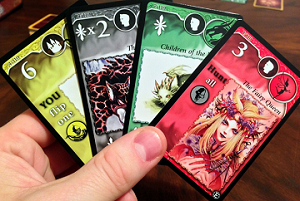
FairyTaleExampleOfAllFourFactions
Example of the four factions

Most of the colored factions score you more points if you’ve collected more of the set of cards—I have seven “Children of the Dragon” in front of me so each of them counts seven points, representing the number of “Children of the Dragon” I own. If you see your opponent stocking up on one of these factions, you can put the kibosh on them in a hurry by either flipping their cards (card powers) or picking up a few of these cards so the cards won’t ever reach their hand. Set collection and card drafting play off each other well in this game. Fairy Tale also has more advanced cards, marked with an “E.”

Advanced cards have additional powers (mainly Hunt and Draw) as well as more set collection possibilities. I prefer the base game without these added goodies, but if you’ve played a lot of Fairy Tale and have gotten bored with it, the advanced cards add just enough spice to keep the game fresh for several more plays.

FairyTaleExampleOfFairyCards
Example of Fairy Cards

My only complaint with Fairy Tale is the same one I have for 7 Wonders, a game that borrowed a lot of the game mechanisms from Fairy Tale. This game has very little theme. It’s a pretty game about dragons and fairies, but you don’t feel like you’re playing dragons and fairies. Even so, Fairy Tale’s a lot of game for fifteen to twenty dollars.

Verdict:
The predecessor of a lot of modern card drafting games, Fairy Tale sets the standard as it marries card drafting with set collection.
If you’re interested in Fairy Tale, you can download the iTunes app and play the basic rules game for free here.

Spotlight: La Capitan

LaCapitanSentinelsOfTheMultiverseFirst Appearance: Sentinels of the Multiverse: Shattered Timelines
Who she is: A time traveling pirate captain of the La Paradoja Magnifica
Initial Side: Time Corsair
Innate Power (Initial Side): Whenever a hero card is destroyed by a villain card, put it under this card. At the end of the villain turn, La Capitan deals the hero target with the highest HP (H), where H is equal to the number of heroes, minus 1 projectile damage.
Advanced Power (Initial Side): At the start of the villain turn, destroy a hero ongoing or equipment card.
Villain Cards that Begin Game in Play: La Paradoja Magnifica (15 HP): At the end of the villain turn, play the top card of the villain deck. At the start of the villain turn, shuffle the villain trash into the villain deck.
How she flips to her other side: If there are 3 or more cards under this card.
Nemesis: The Sentinels
Second Side: Split Across Time

LaCapitanMariaHelenasRevenge
La Capitan and Maria Helena’s Revenge

Innate Power (Second Side): At the start of the villain turn, each villain target regains X HP, where X = the number of cards under this card. Whenever La Capitan would be dealt damage, move a card from under this card to the appropriate trash. If you do, prevent that damage. At the end of the villain turn, if there are no cards under this card, flip La Capitan’s villain character cards.
Advanced Power (Second Side): The first time La Capitan would be dealt damage each round, redirect that damage to the non-villain target with the highest HP.

FinalBreathLaPardojaMagnificA
Final Breath and La Paradoja Magnifica

Most Fiendish Ongoing Card: Maria Helena’s Revenge: Whenever a villain target is destroyed, La Captain deals each hero target (H) minus 1 psychic damage.
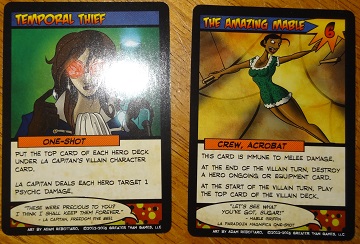
Most Fiendish One-Shot Card: Temporal Thief: Put the top card of each hero deck under La Capitan’s villain character card. La Capitan deals each hero target 1 psychic damage.
Most Fiendish Villain Target Card: The Amazing Mable (6HP): This card is immune to melee damage. At the end of the villain turn, destroy a hero ongoing or equipment card. At the start of the villain turn, play the top card of the villain deck.

TemporalTheifTheAmazingMable
Temporal Thief and The Amazing Mable

How to Defeat La Capitan: La Capitan’s deck revolves around discarding hero cards and placing them under her villain card. If she gets three cards under her villain card, she flips over. You don’t want her to do that.

Several heroes (Omnitron-X for example) have game mechanics that allow them to destroy equipment cards, so if there are any hero equipment cards under La Capitan’s villain card, you can thin out the stack. You could pair this tactic with manipulating the villain deck – which is always a good thing.

If La Capitan does flip, you’ll want to use cards and powers that have multiple occurrences of damage. The hero cards beneath her villain card block any amount of damage. Focus on getting rid of those cards by striking her several times.

La Capitan also has a lot of villain targets in her deck. You’ll want at least one hero with some great global effects to mow down these guys. Tempest, Tachyon, and Omnitron-X have plenty of damage to burn.

Geekly TV: March 2, 2015

Bobs
Bob’s Burgers
Kyle’s Review

This week’s episode of Bob’s Burgers used the common theme in animated sitcoms of random stories, making references of other intellectual properties, but unlike other animated shows, Bob’s Burgers gave us context for these “Gayle Tales.”

We discover that the three kids (Tina, Louise, and Gene) did something to earn their mother’s wrath but we don’t know what they did yet. As Linda’s about to explain why she grounded the three to Bob, Aunt Gayle walks into the store to save the day. This is the first appearance for Gayle this season, but even if you’ve never seen the show or forgot who she was as a character, you learn everything you need to know about her in an instant when Louise says, “Hey, there’s Aunt Gayle and surprise, surprise, she’s crying again.” Gayle needs cheering up and a new date for the theater. The kids are more than happy to accompany Gayle, and a conflicting Linda wants to make her sister happy but also wants to uphold her punishment of the kids. Eventually, Linda challenges the kids to write essays that include their Aunt Gayle and a Scott Bakula reference (because Gayle loved him in Quantum Leap), and that’s where the goofy stories about other intellectual properties come into play.

I won’t go into detail about each of the three stories—I will say that one of them prompts Bob to butt into the tale and ask Louise (his youngest child) if she’s been watching Game of Thrones—but in less than three minutes, Bob’s Burgers established well-defined motivations before launching into these story parodies. Once we get to the various tales, we see how each child views the other characters in town and in their family, and we get the payoff at the end of what the kids did to tick off Linda. I won’t spoil it but it’s pretty minor and involves Linda feeling embarrassed and having to purchase a month’s supply of maxi pads.

Verdict: Other animated sitcoms have used the retelling of other intellectual properties before, but Bob’s Burgers does it the best.

Spotlight: Kismet

KismetSentinelsOfTheMultiverseFirst Appearance: Sentinels of the Multiverse: Shattered Timelines
Who she is: A thief with uncanny luck
Initial Side: Charmed Scoundrel
Innate Power (Initial Side): If Kismet did not flip this turn, she deals each hero target 1 psychic damage. Whenever a hero target deals another hero target 4 or more damage, destroy 1 jinx card. At the end of the villain turn, reveal the top card of the villain deck. If it is a lucky card, put it into play. If not, shuffle it into the villain deck.
Advanced Power (Initial Side): At the start of the villain turn, Kismet deals each hero affected by a jinx card 2 psychic damage.
Villain Cards that Begin Game in Play: The Talisman, Enchanted Heirloom (7 HP): When flipped to this side, restore this card to 7 HP and put it in the villain play area. This card is indestructible. When reduced to 0 or fewer HP, flip this card. Increase damage dealt by Kismet by X, where X = the number of jinx cards in play.
How she flips to her other side: If the talisman is in front of a hero.
Nemesis: Setback
Second Side: Deranged Miscreant

KismetTheTalisman
Kismet and The Talisman

Innate Power (Second Side): If Kismet did not flip this turn, she deals the talisman 2 irreducible psychic damage. At the end of the villain turn, Kismet regains 1 HP for each lucky card in play. Then, Kismet deals the hero target with the highest HP X psychic damage, where X = 9 minus the HP of the talisman.
Advanced Power (Second Side): Increase damage dealt by Kismet by (H), where H is equal to the number of heroes, minus 2.

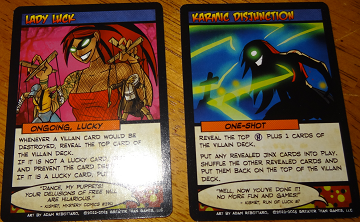
LadyLuckKarmicDisjunction
Lady Luck and Karmic Disjunction

Most Fiendish Ongoing Card: Lady Luck: Whenever a villain card would be destroyed, reveal the top card of the villain deck. If it is not a lucky card, discard it and prevent the card destruction. If it is a lucky card, put it into play.
Most Fiendish One-Shot Card: Karmic Disjunction: Reveal the top (H) plus 1 cards of the villain deck. Put any revealed jinx cards into play. Shuffle the other revealed cards and put them back on the top of the villain deck.
Most Fiendish Villain Target Card: The Talisman, Stolen Charm (7HP): When flipped to this side, restore this card to 7 HP and put it in front of the hero with the highest HP. This card is indestructible. When reduced to 0 or fewer HP, flip this card. The hero this card is in front of gains the following power: Reveal the top 3 cards of any 1 deck. Put them back on top of that deck in any order.

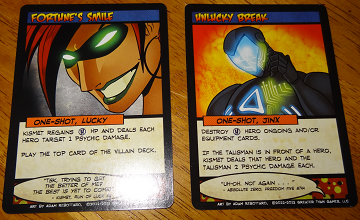
FortunesSmileUnluckyBreak
Fortune’s Smile and Unlucky Break

How to Defeat Kismet: Take out the talisman, and once the talisman is in front of a hero, have that hero use the talisman’s ability to dictate which cards are on top of the villain deck. This will limit the amount of damage Kismet can deal.

Then, you want to make sure the talisman stays in front of the heroes as long as you can. Kismet deals two damage to the talisman at the beginning of her turn, so you’ll have to dedicate some healing for the talisman or find a way to redirect damage like Legacy’s Lead from the Front and Heroic Interception.
If Kismet manages to get her talisman back, repeat the process until you whittle her down.

Spotlight: Iron Legacy

IronLegacySentinelsOfTheMultiverseFirst Appearance: Sentinels of the Multiverse: Shattered Timelines
Who he is: The twisted version of the Freedom Five’s Legacy
Initial Side: Ironclad Tyrant
Innate Power (Initial Side): Iron Legacy is immune to environment damage. At the end of the villain turn, Iron Legacy deals each hero target 3 melee damage.
Advanced Power (Initial Side): All damage dealt by Iron Legacy is irreducible.
Villain Cards that Begin Game in Play: (H), where H is equal to the number of heroes, of ongoing cards from the villain deck.
How he flips to his other side: When he starts his turn with 20 or fewer HP.
Nemeses: Tachyon, Absolute Zero, Tempest, The Wraith, Unity, Bunker
Second Side: Motivated by Desperation

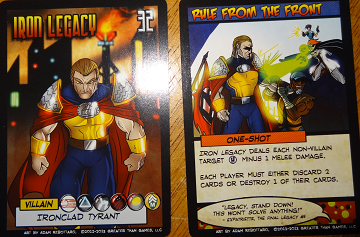
IronLegacyRuleFromTheFront
Iron Legacy and Rule from the Front

Innate Power (Second Side): Reduce damage dealt to Iron Legacy by 1. At the end of the villain turn, Iron Legacy deals the hero target with the lowest HP (H) minus 1 melee damage and regains (H) plus 1 HP.
Advanced Power (Second Side): The first time Iron Legacy would be dealt damage each turn, redirect that damage to the hero target with the highest HP.

SuperhumanRedirectionFinalEvolution
Superhuman Redirection and Final Evolution

Most Fiendish Ongoing Card: Superhuman Redirection: The first time Iron Legacy would be dealt 5 or more damage from a single source each turn, redirect that damage to the hero target with the highest HP.
Most Fiendish One-Shot Card: Rule from the Front: Iron Legacy deals each non-villain target (H) minus 1 melee damage. Each player must either discard 2 cards or destroy 1 of their cards.
Most Fiendish Villain Target Card: His deck doesn’t have any villain target cards, but he doesn’t need any.

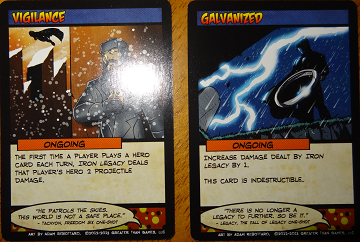
VigilanceGalvanize
Vigilance and Galvanized

How to Defeat Iron Legacy: Don’t let Iron Legacy’s low HP count fool you. He delivers a wallop. You’ll have to mitigate the damage Iron Legacy deals you each turn—both his innate abilities and his ongoing villain cards. Keep in mind that Iron Legacy begins the game with some ongoing villain cards in play.

A player that can affect the villain deck (The Visionary or Omnitron-X) can help as can the ones that get rid of ongoing cards (Argent Adept as well as the aforementioned Visionary and Omnitron-X). Your team will need a healer, and Ra may help if you can convert all damage to fire damage, make him immune to fire damage and direct as much damage to him as you can.

You’ll need a lot of luck to defeat Iron Legacy. I’ve played as the Freedom Six (Iron Legacy’s arch-nemeses), and the game only took ten minutes. Each hero had single digit health points after Iron Legacy’s first turn, and we epically lost. A second game didn’t help matters either.

What works best – if there is anything – is assigning distinct roles to each hero. Treat a game against Iron Legacy like an MMORPG. Someone has to heal. Someone else has to deal damage. Another hero has to be the tank. A fourth hero has to contend with Iron Legacy’s auxiliary cards.