

Geekly TV: March 20, 2015

iZombie

iZombie

Kyle’s Review

iZombie upheld the CW’s season of outstanding pilots. It blended more genres in a tasty way than a Long Island Iced Tea mixes liquor.

The protagonist Liv comes off as an undead Veronica Mars: acerbic and unaffected. She even narrates as she goes along. Then iZombie infuses the zombie motif and I say motif because there’s just enough of a hint of zombie so you know that she’s undead but the focus isn’t on brain eating. That may be a deal breaker for true zombie fans but I’m not so sure. At the heart of every zombie fan is the feeling that you don’t belong—werewolves are the jocks; vampires are the heartthrobs everyone wants to be with—so iZombie captures the essence of being a zombie while not showcasing the gore. But my favorite genre twist is iZombie’s inclusion of a police procedural. Even though you get plenty of the buddy cop flavor, iZombie turns the genre on its ear by having one of the partners a zombie, masquerading as a psychic.

Who knew that there could be side effects from eating brains? Liv gains the memories, proclivities and abilities of the people whose brains are in her system. She found out who killed a Jane Doe by using visions from the victim’s memory, became a kleptomaniac that also factored in pinpointing the victim, and her sudden knowledge of Romanian helped in the interrogation process. In a word, Genius.

I even like how iZombie used comic panel stills just to remind folks that this is yet another great addition to the DC Comics TV Universe. Okay, iZombie comes from a DC Comics subsidiary Vertigo but it’s still a great show.

Verdict:

Another wonderful DC Comics TV Universe (err…Vertigo) pilot and it makes me yearn for the CW programming shifting to non-stop DC Comics shows.

TheFlash

The Flash

Jim’s Review

Well, as we get closer to the end of Flash’s first season, the show is doing a couple of really nice things. I like that after this week’s episode, Iris finally knows Barry’s big secret. On the one hand, it can be argued that far too many people know Flash’s identity, but Iris being clued in feels overdue. Additionally, I’m glad that there wasn’t some big moment to it. It felt like it came out because it had to, and really, it did.

The other nice thing this show is doing is raising the stakes. If last week’s episode has a big knock against it, it’s that the second Weather Wizard was underwhelming, to say the least. Dr. Wells’ big moment with Cisco did something to pick that slack up, though.

With the device of time travel introduced, it’s hard to imagine Cisco’s death being a permanent development, but I will say the scene was effective nonetheless. I think the only disappointment with Wells’ character is that because we saw him stare down the yellow suit a number of episodes ago, I wanted the truth behind his identity to be a little more complicated than it has proven to be. Still, this week’s episode provided some very real momentum for the show’s first season, and I am anticipating a strong finish.

Kyle’s Take

Stop me if this sounds familiar. This week’s villain of the week didn’t do a whole lot–stop. But Harrison Wells saved the tension by giving us some great moments–stop. Yeah, those two things have happened a lot this season.

I’m also not convinced that Cisco’s death will stay permanent because of the time travel element but the same can be said of Iris knowing Barry’s secret. Anything of note in this episode occurred after Barry met his speed mirage, so if Barry changes the pattern of events, Cisco will no longer be dead, Captain Singh won’t be in the hospital, the Weather Wizard will not have gone wild in Central City yet, Harrison Wells will not have revealed his identity (I agree that it was too straight forward of any explanation anyway), and Iris won’t know that Barry’s the Flash.

The only thing that happened prior to the speed mirage is that horrible double date at the bowling alley. For all its fireworks, this episode could be null and void, except for the first and last few minutes.

Verdict:

An exciting show that may or may not have made progress.

Do you want more Flash? Check out our secrets page here.

Powers

Powers

Kyle’s Review

Powers continued its upward swing this week with the curiously named episode “Devil in a Garbage Bag.” All heck broke loose when Wolfe ran amok in the Powers prison and all the threads that were introduced in the previous three episodes germinated in this one.

Johnny Royalle revealed the secret behind his Sway and how his actions aided in Wolfe’s escape. The great thing is that Royalle didn’t plan Wolfe’s escape as hinted at the end of last week’s episode; it was a mistake. Johnny resumed his role of misunderstood villain, while Wolfe added his name to that list.

Wolfe proved to be a Galactus type. He doesn’t mean to hurt people; he’s just hungry. He even viewed himself as a boy throughout the episode and hurt the people who had been hurting him. I loved following him through the labyrinth of a prison, trying to remember why and how he was placed there, but I’m not sure if Powers can continue this arc for another six episodes. Still, there’s plenty to work with the Walker-Wolfe angle.

Walker and Pilgrim looked like they had finally bridged the gap between awkward partners to full-fledged partners when Walker took Sway, trying to regain his lost powers. We knew it was only a matter of time before he tried something like that. Long story short: it didn’t end well for Walker. He spent most of the episode psychically linked with Wolfe—that’s how we see Wolfe’s depiction of himself as a child. We’re not sure how Walker and Royalle plan to deal with Wolfe—and that’s a good thing.

We found out how Triphammer and Retro-Girl intended to deal with Wolfe. Triphammer’s drainer took center stage, while Retro-Girl exited stage right. Sprinkle in some good airtime for Calista and Krispen and you get the most engaging episode of Powers yet.

Powers’ first season may act a lot like Arrow’s inaugural season. It started off shaky and now it may have found its legs.

Verdict:

Powers continues to get better week after week. Let’s hope it doesn’t peak too soon.

Arrow

Arrow

Kyle’s Review

This week’s episode of Arrow, “The Offer,” suffers from one key plot device but there were some good, small developments. Let’s get the one major weakness out of the way first.

I didn’t buy Ra’s Al Ghul slumming it, asking Ollie to be the next Demon’s Head before the spring break (How do you go from the DC Comics icon Batman to the tertiary character Green Arrow?), and I don’t believe Ra’s trying to sabotage the Arrow’s gig in Starling City now. Arrow’s asking me to suspend disbelief a little too much. And I while think Ra’s tearing down Ollie has enough legs to propel Arrow to the end of the season, this feels like a series reboot. Captain Lance didn’t like Arrow in the first season and a half and hunted him, and now it looks like he’ll start hunting Arrow again by this season’s end. With that aside, I did like some of the other developments.

Thank you, Ollie, for cementing Roy’s crime fighting nickname. He’s officially Arsenal and there was much rejoicing. Roy had a particularly good episode as he and Thea got back together. It was only a matter of time and it felt right here. I’m not sure about Thea’s mental state—I don’t think she is either—and she needs a rock. Outside of Diggle, Roy’s the well-adjusted member of Team Arrow. But Roy and Thea are two characters I like. Let’s talk about one member of Team Arrow I wished wasn’t part of the cast.

Laurel had few lines—that’s good. She had a lot of over-the-top action sequences—that’s better. And she asked a Nyssa without a home to be her new trainer. Nyssa as Laurel’s trainer is both smart for Laurel—we don’t say that too often about her—and Arrow needed a friendly link to Ra’s. Ra’s daughter Nyssa aiding Ollie should even out Ra’s trying to damage Ollie’s reputation.

Verdict:

Arrow took some steps toward a solid end game, but it wasn’t the end game we wanted.

Check out our Arrow secrets page here.

The Flash Secrets: March 20, 2015

ClydeAndMarkMardonTheFlash

Mark Mardon Madness

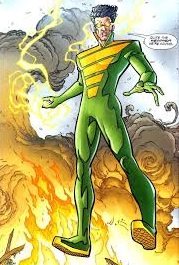
Weather Wizard was the villain in The Flash debut but if you listened closely to some of the dialogue, you would’ve known that Clyde—the Weather Wizard from the pilot—was on the lamb with his brother Mark. It looks like Mark has similar powers to his younger brother but they’re more accurate.

This story arc of Wizard brothers parallels comic book history. Mark became the Weather Wizard after finding his scientist brother dead of a heart attack. He discovered his brother’s notes on controlling the weather using a wand.

MarkMardonWeatherWizardAndWeatherWand

The Weather Wand—But in Reverse

Sure, the TV show turned both Weather Wizards into metahumans but in the comics, Mark Mardon needs a weather wand to control the weather. The show tips its hat to the classic Weather Wizard by having Cisco craft an anti-weather wand.

EobardThawneReverseFlash

Here’s Eobard

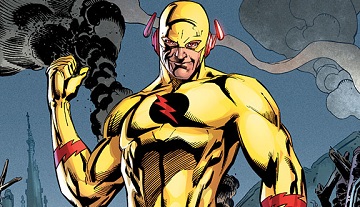
We’ve known Harrison Wells is the Reverse-Flash for quite some time, but this week one of the main characters found out and paid for the knowledge with his life. I’m not sure if Cisco’s going to stay a root inspector—comic characters have a knack for not saying dead—but we also learn Wells’ real name, Eobard Thawne. I gave a fist pump when I heard Eobard as he’s the one most closely linked with the Reverse-Flash from the pre-New 52 DC Comics Universe.

In the comics, Eobard is insane, while the show’s Eobard portrays him as a man lost in time and willing to do anything to get home.

SpeedMirageTheFlash

Speed Mirage

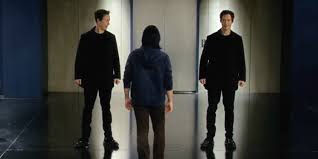
The idea of using speed to create a mirror image of yourself was referenced early in this week’s episode as a possible reason why Barry saw himself, and then Zoom actually used it.

Let’s do the time warp

Well, Barry has gone back in time, before most of the pivotal moments in this week’s episode. That means that Cisco is still alive and Barry could save him. Captain Singh hasn’t been struck by lightning. And Iris and Barry haven’t kissed—which also means that Barry hasn’t told her his secret.

We’ll have to see what next week holds.

Head back to our Flash review here.

Arrow Secrets: March 20, 2015

Murmur

Was that a Murmur we heard?

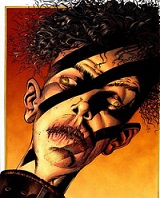
Tonight’s Arrow villain Murmur is actually a Flash villain but he was deemed too dark for the show. Murmur works better with Arrow and yet the TV version of the villain is still tamer than the one in the comics. Arrow’s version of Murmur has him sew his lips together. The Flash comic has Murmur cut out his tongue and then sew his mouth shut. The comic Murmur also doesn’t have a thing against cops. He’s a serial killer, short and sweet—or not so sweet.

We’ll have to see if Arrow’s Murmur inherits his comic book namesake’s knack for escaping prison.

Captain Lance and Arrow

So Captain Lance had a falling out with Arrow. How long before Lance comes after Ollie? We’ve mentioned it before in these pages—Captain Lance chooses not to know Ollie’s secret because he doesn’t want to know it, which is kind of like Commissioner Gordon and Batman—but since he knows that Roy Harper is Arsenal, Lance has to know that Ollie’s Arrow. What’s keeping Lance from throwing Ollie in jail?

Roy has a name

This week’s episode was the first time Arrow called Roy by his nickname, Arsenal. I guess it’s official. Roy has his sidekick name.

LazarusPitRasAlGhulArrow

Lazarus Pits

We had another official name drop in this week’s episode. The Lazarus Pits do exist in the DC Comics TV Universe. You might think that this is a small thing, but the presence of a Lazarus Pit means that Sarah could be brought back from the dead.

CW has plans for an Arrow/The Flash spinoff next Fall. One of the rumors has Sarah rising from the dead. This might be how she does it.

Here’s our review of this week’s Arrow. Enjoy.

Ticket to Ride

Take a cross-country train adventure. Collect and play matching train cards to claim railways across North America.

This simple premise and core gameplay has resulted in a new renaissance of U.S. board games. Ticket to Ride exploded into game stores in 2004, ten years prior to this review, spawned over ten spin-offs and expansions to date and fueled its publisher Days of Wonder to become one of the modern board game industry’s giants.

Designer: Alan R. Moon
Publisher: Days of Wonder
Date Released: 2004
Number of Players: 2-5
Age Range: 8 and up
Setup Time: 5-10 minutes
Play Time: 45 minutes or less
Game Mechanics:
Hand Management
Route/Network Building
Set Collection

Game Flow:

Each player begins the game with a collection of colored, plastic train pieces (each player chooses their color), a hand of four train cards (color-coded to match the point-to-point routes between the cities on the game board), and five destination ticket cards. Five train cards are dealt face-up for a draw pile.

TicketToRideOverview
Overview of Ticket to Ride

At the start of the game, players keep which destinations they have in their hand that they think they can complete, and return the rest of the cards to the ticket pile. A destination ticket has two cities printed on it, and if the player chooses to complete the ticket, earning the points indicated on the card, they must construct a continuous route with their plastic train pieces across North America from one of the two cities to the other. Obviously, a route from New York to Los Angeles would be worth more points than a route from Vancouver, Canada to Portland, Oregon. But you lose points, equal to the points you would’ve gained, for every ticket you don’t complete.

TicketToRideDestinationCards
Destination Cards

Each connection between the two cities has a color-coded route, and players must match the colored route with the same colored train cards in their hand. Locomotive cards are wild and extremely valuable.

A player can do one of three things on their turn: claim a route with their train pieces, draw more train cards from either the draw pile or the deck, or draw more destination tickets (they have to keep at least one ticket). Play continues until someone runs out of train pieces.

Game Review:

Ticket to Ride is simple, elegant and difficult to master. Even though other games have overtaken Ticket to Ride as the gateway game (cooperative games have flooded the market and they’re excellent gateways), this game continues to go strong more than ten years after its original release.

TicketToRideTrainCards
Train Cards

Ticket to Ride could be this generation of game’s Monopoly, and what a beautiful Monopoly it makes.

Verdict:

I don’t play this game as often as I once did, but I’ll rarely say no to a game of Ticket to Ride. You can learn the rules in minutes, but it’ll take you a while to master the game, especially if you have the USA 1910 expansion.

Pandemic: The Cure

I’m on the road but still delivering reviews.

Matt Leacock took the disease curing fun of Pandemic and condensed it into a fast paced dice game. I’m sold, but let’s give Pandemic: The Cure a closer look because who knows which of these two games is better or if you should pick up both.

We’ll get to the game review in a bit, but we have to pay homage to the game detail demigods first.

The Fiddly Bits
Designer: Matt Leacock
Publisher: Z-Man Games
Date Released: 2014
Number of Players: 2-5
Age Range: 8 and up
Setup Time: less than 5 minutes
Play Time: around 30 minutes
Game Mechanisms:
Cooperative Play
Dice Rolling
Press Your Luck
Variable Player Powers

Game Flow:

You set up the game with the pandemic track (the ring-shaped, plastic piece) in the middle and six coasters—representing different areas of the world—around it. Area 1 is North America, Area 2 is Europe, and so forth. Pandemic: The Cure has four colored dice (red, blue, yellow, and black) that resemble ordinary six-sided dice, but don’t let them fool you. These dice represent the different diseases you must cure, and they aren’t numbered one through six.

PandemicTheCureCloseupOfDiseaseDice
Close up of disease dice

Whatever number you roll corresponds to the numbered coaster (one of the six areas). For example, South America is Area 6, and you can roll a six with either a blue or red die. No, I didn’t look at the individual dice, the ratio of what you can roll on a die is located by a grid on the bottom of each area coaster. So, you begin the game with thirteen disease dice in play.

PandemicTheCureOverview
Overview of Pandemic: The Cure Setup

The pandemic track is interesting because you’re keeping score of not only the outbreaks (whenever you would place more than three dice of a color on a coaster) that occur but also the infection rate (you can roll an infection on a player die—more on that later). You track the disease’s progress with green syringe-shaped pegs and every time you trigger an event that creates an outbreak or would increase the infection rate, the pegs move closer to a red space, marked with a skull and crossbones. If either track reaches the skull, you lose.

ResearcherCloseUpOfRoleCardAndDice
Close up of Pandemic: The Cure role card and dice

Players select their role—either at random or by some other means—and each of these roles has its own ability (listed on the card) and its own set of dice. Player dice have various abilities, but most have die faces that allow you to move, treat diseases (removing dice from coasters), bottle cultures so you can find a cure, or increase the infection rate. Players work together to cure all four diseases and if they do so before either green peg reaches the skull, they win.

PandemicTheCureAllDiseasesCured
All diseases cured

Game Review:

The phrases “Extra Strength Dice Game” and “Fast-Acting” grace the game box, but these are more than just tongue-in-cheek references to medication. Pandemic: The Cure does convert all the strategic fun and disease fighting of the original and puts it into a quick dice game.

The randomness of dice rolling prevents the puzzle like quality of the original from showing. Some Pandemic showed how they’d play out in five or six turns and it was only a matter of the players adjusting to the puzzle and solving it. That doesn’t exist in Pandemic: The Cure. The unpredictability of the dice and smaller regions can cause the game to flip on its ear in a single turn. These diseases are stronger but so is the cure.

PandemicTheCureCloseupOfPandemicRing
Close up of pandemic track ring

Okay, that was a bad cure pun, but players do feeling both more in control (because of the improved strength of their roles) and less in control because things can turn bad in a hurry.

Verdict:

I love this game as much as the original. Matt Leacock did a great job capturing the idea of Pandemic in a dice game.

Geekly TV: March 16, 2015

We’re a little late publishing our Geekly TV for Monday. I’m kicking it in Iowa City, visiting the University of Iowa. Go Hawkeyes!

And here goes today’s TV reviews.

Powers

Powers

Kyle’s Review

Playstation Network (PSN) launches its original television programming with Powers. I was skeptical of Powers until I found out that its producers are the same as the ones for Breaking Bad. They also assembled an excellent cast: Sharlto Copley (District 9), Eddie Izzard (Hannibal and United States of Tara), Noah Taylor (Game of Thrones and Peaky Blinder), and Michelle Forbes (True Blood and Orphan Black) to name a few. And then there’s the fact that Playstation is owned by Sony and if any of the big three game consoles can pull off original television, it’s Playstation.

PSN released the first three episodes this week, so we’ll give some quick reviews of each one.

The Pilot (Episode 1)

The Powers pilot starts off rocky. We get a lot thrown at us at once—that’s code for exposition heavy—but the pilot does a good job setting up the main character, Christian Walker. Walker used to have superpowers and he lost them somehow—we later find out that they were stolen by another character—and he’s since joined the police force’s Powers division, a special task force that monitors humans with superpowers.

I’ll borrow from the Superman (1978) tagline. You’ll believe a man can fly. Only, you believe in the superpowers of Powers half the time and the rest of the time, the powers feel like they belong to another world. The special effects are clunky, but they work for the most part but I take more issue with the overuse of Calista, a wayward teen, as a go-between for these two worlds. Calista loves Powers and wishes she had them but Walker already serves as a conduit between normal people and Powers, so I don’t see the need in Calista as a character.

The Powers pilot suffered from small doses of overacting and the cast didn’t feel connected to their characters and each other at times. I also would’ve preferred more of a noir aesthetic as opposed to an eighties cop show vibe.

Like a Power (Episode 2)

The actors eased into their roles in the second episode of Powers, “Like a Power,” and it didn’t hurt that Michelle Forbes joined the cast. She has so much screen presence that some of it can’t help but rub off. My only complaint about Forbes’s Retro-Girl is that she got colored as just Walker’s ex in this episode. That’s a waste for such a talented actor.

Despite that shortcoming, I liked the overall direction of “Like a Power.” Johnny Royalle (Noah Taylor) showed more of his hand in this episode. He single-handedly drove the story. Whether he incited Walker for swiping one of his favorite ties or he manipulated Calista to join him, Royalle had onscreen chemistry with most cast members.

Pilgrim (Susan Heyward) added some spicy hot-headedness this week. I loved how she charged toward a Power named Zerotron, who has electric-based powers, but she didn’t smooth the rough edges with her partner Walker. Unfortunately, these rough edges aren’t partners learning how to work together, these rough edges deal with the lack of chemistry between the two actors. I like both characters, but they can’t get it together. I’m wondering if Calista giving them the slip several times doesn’t contribute to this shortcoming.

And speaking of Calista, I still don’t buy her as the bridge between the haves and the have-nots, especially since “Like a Power” introduced Krispen, who lost loved ones as a result of two Powers fighting. He comes from the source material—fans of the comic should’ve recognized his Kaotic Chic graffiti—and did more to ground the world in the dangers of people with superpowers.

Mickey Rooney Cries No More (Episode 3)

The third episode of the Powers (the oddly named “Mickey Rooney Cries No More”) manages to fix a lot of the series early ailments. Sure, the show still focuses on Calista as a go-between, but we gain a clearer view of what drives this world and its characters. Some folks love Powers, others hate them.

Triphammer, the Batman or Ironman of the Powers universe, made his debut in this episode. He doesn’t have powers and takes a strong anti-Powers stance. He doesn’t hate villains as much as the general idea of superpowers and has devoted his technological prowess to creating a Powers “draining” beam. This arc played well off the reveal of the true effects of Johnny Royalle’s drug.

Up to this point we’ve seen Royalle’s drug kill people but this episode actually saw it enhance a Powers’ ability. Royalle improving works as the perfect counterweight to Triphammer stripping away these same powers, and this duality shows up again between two non-Powers: Calista and Krispen.

I still don’t see the necessity of Calista as a character—she’s only served to show how inept Walker and Pilgrim are at their job—but she does work well with Krispen, the teen boy who lost family because of a fight between two Powers. Calista’s upbringing differed a lot from Krispen’s and these two characters are two sides of the same hero-worshipping coin. I also like how they ran off together at the end of the episode.

But before Krispen and Calista could run off together, we had the continuance of the frustrating tug-of-war between Retro-Girl, Royalle and Walker trying to control Calista. I guess Calista does serve as a good pawn and illustrates the depravity of the three main Powers. All three old friends want Calista for their own selfish reasons. We get a tense stare down between the three at Royalle’s new Here and Gone Club, and fittingly, Calista ends up with none of them, but not before plenty of character development.

I like how they built on Retro-Girl and how she tires from the fame of her Powers. Royalle digs deep in his past to show why he might actually care about Calista. We even saw awkward signs of a relationship between Walker and Pilgrim as they bonded over being losers, but I don’t know if Walker earned his tantrum of not being a good cop; he rushed from lamenting his powers to hating his ineptitude as a lawman. But the cop drama transitioned for the better.

I keep forgetting that Walker and Pilgrim are investigating Olympia’s death because the murder mystery is too much of a side note. I like how Wolfe escapes captivity at the end of this episode. He’s the big, bad Wolfe that can drive the rest of the series. Even so I didn’t care for he absorbed bio-kinetic energy. I thought of Wolfe’s absorption as more of a figurative eating as opposed to the literal eating of people that we saw in the show’s final moments. Ew.

Verdict:

Powers started off rocky—like a lot of other pilots—but found its footing by the third episode. It’s heading in the right direction. Character development without a rush of exposition helps with that.

Archer

Archer

Kyle’s Review

I had to binge watch Archer in order to catch up with its sixth season, so I’ll give you a quick rundown of the show so far. The fifth season—the previous season—of Archer rebooted the series, casting the main characters as members of a drug cartel, but this, the sixth season unrebooted—Is unrebooted a word?—the series and returned the cast to their incompetent, secret agent roots.

This next nugget will be a spoiler for folks who haven’t devoured Archer season five on Netflix or DVD, so avert your eyes if you don’t want to know that Lana’s baby-daddy is Sterling Archer. Okay, that wasn’t much of a spoiler. I thought Archer was the father from the beginning, but I still loved how, during the reveal, baby Archer mimicked her daddy’s hold that thought finger, while she was breastfeeding.

With a baby introduced into the cast, parenthood is the main topic for Archer’s sixth season. Archer has to come to terms that he’s a father and needs to learn how to be a dad even though he never knew his own father. This has led to some extraordinary soul searching from the titular character, and Lana and Archer have rekindled their relationship. Given the context Lana and Sterling getting back together sounds anything but farfetched and yet this is the sixth season, and we’ve never seen them together and it’s a little unsettling—until this week’s episode “Reignition Sequence.”

Katya, Sterling’s ex-girlfriend, challenges Archer’s fidelity, but we see Archer resist her, and not in the pigheaded manner he might have in seasons past, Archer shows his growth by respectfully declining Katya’s advances. All looks well until we find out that Katya left something behind—we won’t say what, but it’s hilarious.

I’m enjoying this season a lot. I thought the previous season Archer Vice took risks few shows that have a strong following wouldn’t take, and this current season continues to take risks. How many animated characters are allowed to grow?

“Reignition Sequence” showcases Archer’s growth and adds to an already stellar season.

Verdict:

Yet another great episode of Archer and this week’s cliffhanger leaves you thirsty for next week’s episode. Thursday can’t get here quick enough.

Bobs

Bob’s Burgers

Kyle’s Review

We may have seen the adults and children split up several times on Bob’s Burgers and allusions to eighties movies—like this week’s “Adventures in Chinchilla Sitting”—are par for the course. Even so I enjoyed this week’s episode.

The adults are given license to act poorly. Bob and Linda cheat at trivia night. That’s a bad choice for a date night, Bob, and that’s coming from a guy who enjoys trivia games. The kids don’t fare much better.

Louise babysits her classroom’s chinchilla, and the pet escapes in short order—like we couldn’t see that coming—and that forces the kids out of the house with Wayne, a modern take on the classic Warner Brothers cartoon Abominable Snowman, in tow. Wayne is the chinchilla’s primary caretaker and he complicates the chinchilla problem.

Eventually, the kids recover the pet and in a rare act of kindness, Louise hands over the chinchilla to Wayne, but the level of kindness open for debate. The small pet gets a little too much hugging and squeezing from Wayne.

We’ve seen this story type numerous times with Bob’s Burgers, but even though “Adventures in Chinchilla Sitting” doesn’t cover new ground, it’s still solid.

Verdict:

A good but predictable episode.

Top 5 Sentinels of the Multiverse Heroes

We’ve covered many of the Sentinels of the Multiverse heroes, so I guess we should give our picks for the top 5 heroes. Just to make things interesting let’s limit the number of heroes from a particular expansion, base game or promo to one, that way we don’t end up with a lot of base game heroes. If you’ve been reading our spotlight series on the Sentinels of the Multiverse, you’ll know that many heroes in the base game are overpowered, so they’d dominate this list.

As a result, there’s a lot of heroes that didn’t make our list that I wouldn’t mind adding. Tempest can own any villain, Legacy and The Visionary make our best teammates but miss this list, and despite my love for the double-edged sword of Fanatic’s mechanisms, I had to include a different hero from the base set.

NumberFiveSentinelsHeroMisterFixer

5) Mister Fixer

Rook City’s own Mister Fixer leads off our list. Even though his contemporary Expatriette is a damage machine, Mister Fixer has the versatility to burn. He can manipulate the type of damage he deals, handles other threats that arise, and consistently deals damage each turn.

Sure, he doesn’t deal a lot of damage and can get bogged down with enemy shielding, which renders him less than effective, but of the two heroes from the Rook City expansion, he’s the Swiss Army Knife.

NumberFourSentinelsHeroTheScholar

4) The Scholar

We skipped the Shattered Timelines expansion heroes because it’s too hard to pick between the overpowered Omnitron-X and the “I hit once and then I hit you harder” Chrono Ranger. Instead, we’re going with the promo card hero, The Scholar. Like Mister Fixer before him, The Scholar has several ways to help out his team, but he’s best known for damage control.

The bearded one can reduce copious amounts of damage applied to him and then redirect all damage his teammates would receive to himself. It’s always nice to have a shield, especially when you have an injury prone hero like Fanatic on the team.

NumberThreeSentinelsHeroSetback

3) Setback

I love game mechanisms that have you give up something for something else—too bad Fanatic didn’t make the list—so Setback’s a must add. Crashing on the Sentinels scene in Vengeance, Setback has you discarding cards from your hand or dealing damage to him in order to power up his attacks or fuel his other abilities.

Unlike a lot of other heroes that incorporate mechanisms that force you to push your luck, Setback can target ongoing cards and help out his teammates in many other ways. His large amount of health points also allows him to absorb the misfortunes he’ll encounter.

NumberTwoSentinelsHeroTheWraith

2) The Wraith

I went back and forth between The Wraith and Fanatic from the base game. I like Fanatic for the same reason I like Setback, but The Wraith is too good not to make the list. Tempest might be slightly more powerful and dependable, but so long as The Wraith doesn’t encounter a villain or environment card that causes her to discard in-play equipment cards, she can do anything.

Most early games our group played of Sentinels had someone playing as The Wraith. The Rook City expansion couldn’t stop The Wraith from making the table, Infernal Relics slowed her down, and Shattered Timelines made it so she made an appearance every other game. Even now, someone will ask to play her if she hasn’t made a game in a while.

You just can’t beat a female Batman…or can you?

NumberOneSentinelsHeroNightMist

1) NightMist

The second expansion, Infernal Relics, slowed down The Wraith because it introduced NightMist. This magical, mystery woman incorporated massive damage, a touch of versatility, and the push your luck mechanism that I love so much.

Unfortunately, NightMist can deal damage to her entire team when her abilities backfire. I won’t lie. It sucks when NightMist’s abilities get the best of her. But she can take out a villain in one turn or fully heal a teammate that’s close to death.

The rewards far outweigh the risks and there are ways to minimize the risks. Omnitron-X allows you to look at the top card of any deck, so you’ll have few surprises when NightMist’s abilities explode—and they will explode.

Did we get the list right? Let us know how we did and feel free to give us more ideas for future Top Fives.

Quarriors!

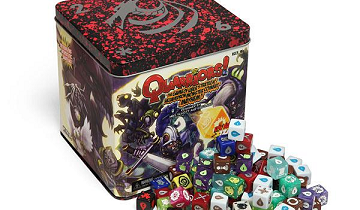
Take one of the hottest game mechanisms, deck building, add the random mayhem and speed of dice rolling, throw in a lot of Q words that aren’t actually words, and you get one exciting game: Quarriors. Should I throw in the title’s exclamation point? What the heck. Quarriors!

We’ll get to the fun stuff in a bit, but here’s some technical speak that we add into every review.

The Fiddly Bits

Designer: Mike Elliott and Eric M. Lang
Publisher: WizKids Games
Date Released: 2011
Number of Players: 2-4
Age Range: 12 and up (14+ on the box)
Setup Time: About 10 minutes
Play Time: 30 minutes or less

Game Mechanisms:

Deck/Pool Building
Dice Rolling

QuarriorsLogo

Game Flow:

Each player starts the game with a pool of basic dice. These dice aren’t sexy but they even the playing field. We’ll get to what happens on a turn in a bit, but first let’s cover the sides of the dice you’ll see on these basic dice. Quidity, which looks like a raindrop and has a number inside the drop, allows you to pay for other, more impressive dice. Creatures have their own unique die icon and stats like health and attack.

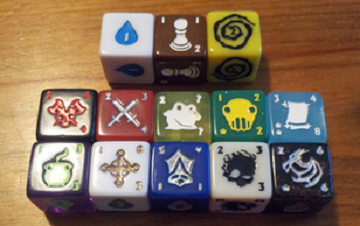
QuarriorsExampleOfQuidityDice
Example of quidity

Here’s what happens on a turn. First, you score glory with the creatures you have in play from the previous turn—bigger creatures garner more glory. Second, you grab five dice from your dice bag and then roll them. Third, you may play the creatures you rolled this turn. Then, you attack your opponents’ creatures with your creatures—your creatures attack strengths are dealt to each of your opponents simultaneously and attacking is not optional. And finally, your turn ends with you purchasing new dice from the wilds, a communal market of dice available to all players. Play then shifts to the player to your left.

QuarriorsExampleOfCreatureDice
Example of creature dice

The first one to reach the necessary victory points—the goal’s different depending on how many players are in the game—wins.

Review:

I wonder if the first time someone combined chocolate and peanut butter felt as good as this combination of deck building and dice rolling. I like both mechanisms a lot and I’m glad Quarriors! happened. The game plays like a dream. Sure, someone can roll into several creatures early in the game and dominate because their opponents can’t roll into anything, but the game’s relatively balanced.
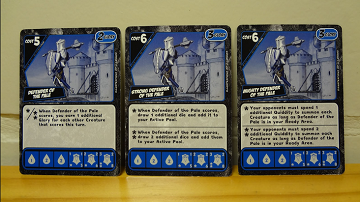
QuarriorsExampleOfCreatureCards
Example of different levels of creature cards

I love the inclusion of multiple cards for the dice. These cards change each die’s effect and leads to some interesting combinations. The sheer volume of these combinations means that you won’t play the same game twice no matter how hard you try, and that’s always a great thing. I’ve also never seen anyone suffer from analysis paralysis—the inability to make a decision because of the sheer volume of options—even though Quarriors! has a lot going on.

QuarriorsOverviewOfATypicalGameLayout
Overview of a Typical Game Layout

But the game does have some balancing issues. Inequality in creature powers happens. The big, bad dragon beats everything no matter what kind of dragon it is. If I’ve played too many games in a row with a dragon, I’ll take him out of the deck. There’s plenty more creatures to choose from. On the small end of the spectrum, the goblin type that adds the number of goblins you have in play to its strength is one of the few smaller creatures that’s worth picking up, but despite this inequity, Quarriors! doesn’t beat down players too much if they don’t have these creatures.

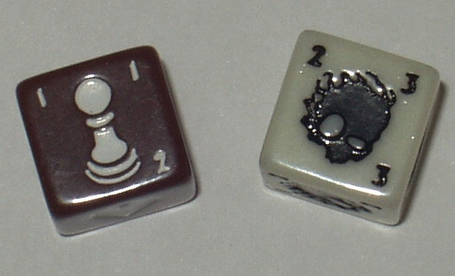
QuarriorsCloseUpOfOriginalDice
Close-up of Original Set Dice

When I first covered Quarriors!, Marvel: Dice Masters just hit stores and in the last eight months or so, a lot of folks would say that Dice Masters, which now includes Dungeons & Dragons and Yu-Gi-Oh spin offs, has replaced Quarriors! as the dice building game of choice. I say, no.

I like both Dice Masters and Quarriors!, and the two games are different enough to warrant space on your shelf. Even though Dice Masters has a low price point ($1 for a booster and $20 for a base set), it’s still a collectible game and you can sink a lot of money on it. Quarriors! is self-contained. You can choose whether or not to buy the new expansions that come out every quarter or so.

QuarriorsOverviewOfOriginalCollectorsTin
Original collectors tin

Also, Quarriors! speeds up the deck building mechanism, while there are some collectible games that move faster than Dice Masters.

Verdict:

Quarriors! provides a tasty blend of deck building and dice rolling—a great play.

Sentinels of the Multiverse: Vengeance

Adding a fourth major expansion, the Sentinels of the Multiverse’s train continues to plow through the competition. But this expansion goes where no Sentinels of the Multiverse expansion has gone before; a team of superheroes facing off against a team of supervillains.

We’ll get to the superhero action in a bit but first, let’s get to the nitty-gritty.

The Fiddly Bits

Designer: Christopher Badell, Paul Bender, and Adam Rebottaro
Publisher: Greater Than Games, LLC
Date Released: 2014
Number of Players: 2-5
Age Range: 10 and up (13 and up on the box)
Setup Time: less than 10 minute
Play Time: 10-90 minutes

Game Mechanisms: 

Cooperative Play
Hand Management
Variable Player Powers

SentinelsOfTheMultiverseVengeance

Game Flow:

Sentinels of the Multiverse: Vengeance is the fourth expansion for the popular comic book themed card game. I won’t go into detail how the base game usually flows. If you didn’t catch our Sentinels of the Multiverse: Base Game review, you can read it here. In short, Sentinels of the Multiverse is a cooperative card game, where players team up with each other to beat the stuffing out of a super villain—which has a dummy hand similar to Bridge. The major change in Vengeance is the inclusion of supervillain team mechanisms.

Instead of having a villain turn and then the heroes taking all of their turns, Vengeance has one villain take their turn and then a hero and then another villain takes a turn and then another hero and so on, until all villains and heroes have taken their turns. Play then shifts to the environment as usual and after the environment takes its turn, the process begins again.

SentinelsOfTheMultiverseVengeanceVillains
Villains from the Sentinels of the Multiverse: Vengeance expansion

Review:

The inclusion of a villain team shakes up Sentinels of the Multiverse more than any other expansion. The mechanisms play smoother and faster than you’d expect, add another level of difficulty missing from previous expansions, and work with the theme of superhero/supervillain fights as many comics have supervillain teams. But don’t be fooled. None of these villains are any good on their own. They’re meant to be played all at once. I would’ve liked some standalone villains, but this is a small gripe.

Another small grievance is that the environments are bland and on the light side. This might be because you need an easier environment when you face five villains, so I dig that, but surprisingly, the heroes in Vengeance shine. I expected great villains in this set, but the heroes add a lot to the overall gameplay.

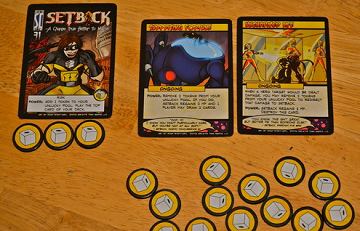
SentinelsOfTheMultiverseVengeanceSetbackAndHisUnluckyTokens
Setback and his unlucky tokens

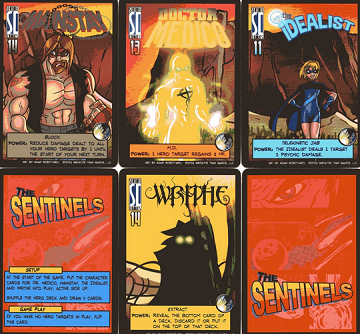
I love mechanisms that have you sacrifice something in order to get something and ones that press your luck. Setback’s mechanisms fit both of these criteria, so I can see him as one of my new favorite sentinels. And speaking of Sentinels, the mini-team The Sentinels allows you to control a lot of smaller heroes, which gives you plenty of options and options are a great thing to have, but I’ve even played five heroes with three players before and that’s where The Sentinels come in handy.

Three players controlling five heroes used to mean that one person played one hero, while the other two players played two. With The Sentinels you can play the game in this manner and all three players get to play multiple heroes. Greater Than Games must be reading their fan messages, because I’m not the only one who plays the game like this.

SentinelsOfTheMultiverseVengeanceTheSentinelsMiniTeam
The Sentinels mini-team within a team

The other heroes in this set are great as well. The Naturalist has interesting animal form mechanisms—and that fills a common superhero trope—while Parse fulfills another major superhero archetype, the archer. Sentinels had to include an archer with the popularity of Green Arrow and Hawkeye at all-time highs.

Overall, Vengeance is a great expansion that builds on superhero mythos and the game’s mechanisms.

Verdict:

While I’m tempted to say that Vengeance is the best Sentinels expansion, I think Infernal Relics keeps that title by a smidge, but you’ve got to love the direction Sentinels of the Multiverse is headed.

Geekly TV: March 9, 2015

Bobs

Bob’s Burgers

Kyle’s Review

Bob’s Burgers shook up the family dynamic in this week’s episode “Lil Hard Dad.” We rarely see the Belcher family split up according to gender (Louise and Tina tend to play off the two sides of their father Bob, while Gene’s musical flair pairs him with his mother Linda), but this week didn’t just have a division of gender, it questioned what it means to be an adult.

Even though Bob usually serves as the straight man to the rest of the cast’s antics, he switches his even keel for Gene’s manic pace when he declares war on someone who did him wrong. Gene may not pal around with his dad, but he looks up to him—we’ve seen enough evidence in prior episodes and seasons—so we buy Gene’s desire to be more like Bob, especially when Bob’s acting like Gene. The conflict escalates to cartoonish levels—pun intended—and it’s Gene who channels his inner Bob and convinces his dad to forgive and forget. Both male characters reversed their typical roles, but the ladies didn’t have as much of a dramatic turn.

Tina confesses that she’s a slow reader—that tracks because she’s slow at everything—and she didn’t finish The Call of the Wild for school. Linda chimes in with a “You can’t judge a book by its cover—its front cover—but you can judge it by its back cover.” Linda’s the weaker of the two parents—moral compass wise—so this isn’t a departure for her. She takes the scant information from the back cover and the picture on the front to make up a musical. Apparently, this is how she got Bs and Cs in school.

I kept waiting for Linda to see the errors of her ways and she did for a split second, but that was only because her mischievous daughter Louise agreed with her too much. I also kept waiting for Tina to do the right thing—she was three-quarters through the book with the sun still out—but she didn’t return to her usual form. She went to class, dressed as a wolf, and freaked out. But this wasn’t a normal Tina freak-out, she got violent and destroyed her props. Fortunately, the teacher thought this was part of the book report and passed Tina, but unfortunately, Linda didn’t from Tina’s book report debacle. She even tried to claim a best parent this week award, but the rest of the family was there and they set her straight.

Yes, Gene, you were the best parent this week, and this episode of Bob’s Burgers proves that you can learn from your children.

Verdict:

Another great episode of Bob’s Burgers that shows the Belchers as a living and growing family.