Happy Saturday, Geekly Gang! We haven’t done a Top 5 Villains list for a superhero or superhero group since Black Panther late August of last year. Looks like we’re overdue for another list, and since Lanterns is releasing on HBO Max, let’s count down the Top 5 Green Lantern Villains. Green Lantern is almost on Superman’s level in his number of overpowered villains. Heck, some of these Green Lantern villains have their own Corps of Henchmen ready to take down the Emerald Knight. Let’s see who made our list of Top 5 Green Lantern Villains.
5) Larfleeze
Larfleeze might not make a lot of people’s lists of Top 5 Green Lantern Villains because he’s often depicted as comic relief, but Larfleeze’s origin is anything but comical. Deep within the Vega System, Larfleeze of Okaara protects the DC Universe’s only Orange Lantern Power Battery. Fueled by greed, Larfleeze has a desire to take as much power as he can. Larfleeze would kill anyone he believed was trying to steal his Power Batter, and then copy his victims’ image, stealing their identities and have them join his Orange Corps as construct ghosts.
Larfleeze is the embodiment of greed, the emotional power that feeds orange. Under the Orange Light of Greed’s sway, Larfleeze is driven to possess everything.
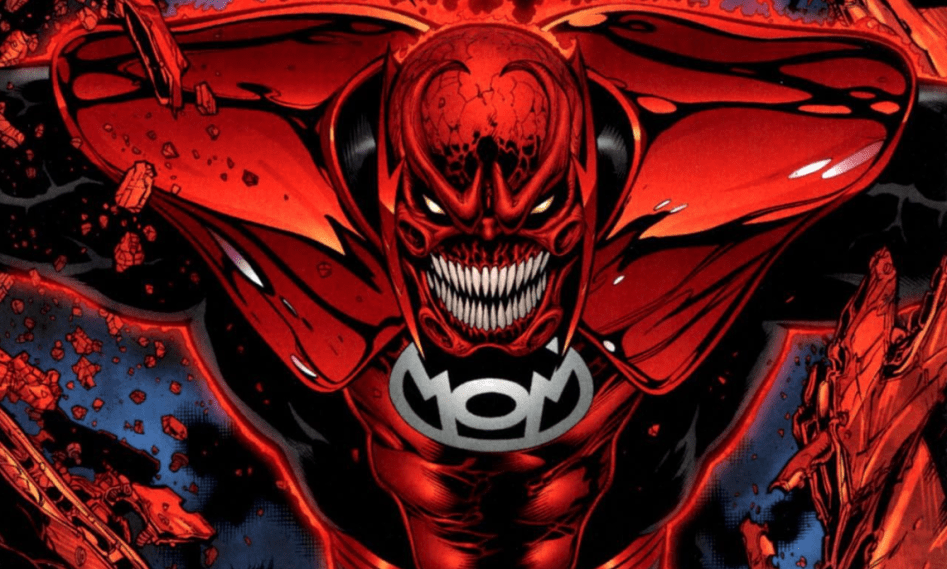
4) Atrocitus
Another one of Geoff Johns’s creations, Atrocitus represents a different Lantern Corps Spectrum: Red’s Wrath. The murderous Atrocitus and his Red Lantern Corps may be the most feared force in the known, extraterrestrial DC Universe.
The Manhunters killed everyone Atrocitus knew. He became an intergalactic terrorist, wanting to kill the Guardians of the Universe. After numerous bloodthirsty missions, Atrocitus formed his Red Lantern Corps to go toe to toe with the Green Lantern Corps. At his core, Atrocitus executes an extreme form of justice. Too bad his form of justice comes with enough blood to paint the universe.
3) Nekron
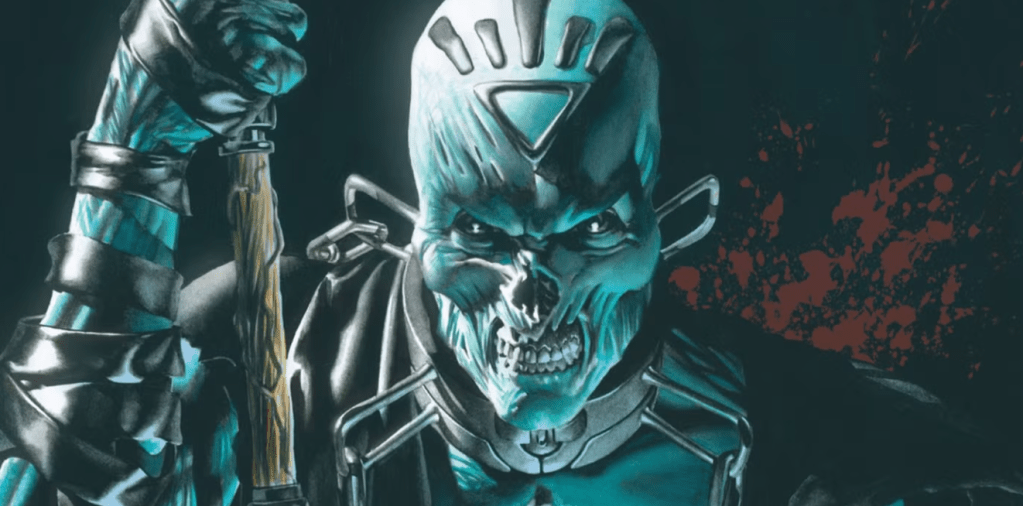
Nekron is a demon who is DC Comic’s embodiment of Death. Nekron has power over the souls of everyone who has ever died. He uses these souls to perform godlike abilities like strength, durability, and energy projection. Never content with his deathly realm, Nekron seeks control over the rest of the DC Universe.
Nekron’s right-hand agent, Black Hand, almost made this list, too. Consider Black an honorable mention for Green Lantern’s Top 5 Villains. The two of them concocted the events of “Blackest Night.” They co-created the Black Lantern Corps of death. Using the bodies of formerly dead heroes like Superman and Wonder Woman, Nekron attempted to eliminate all life.
2) Parallax
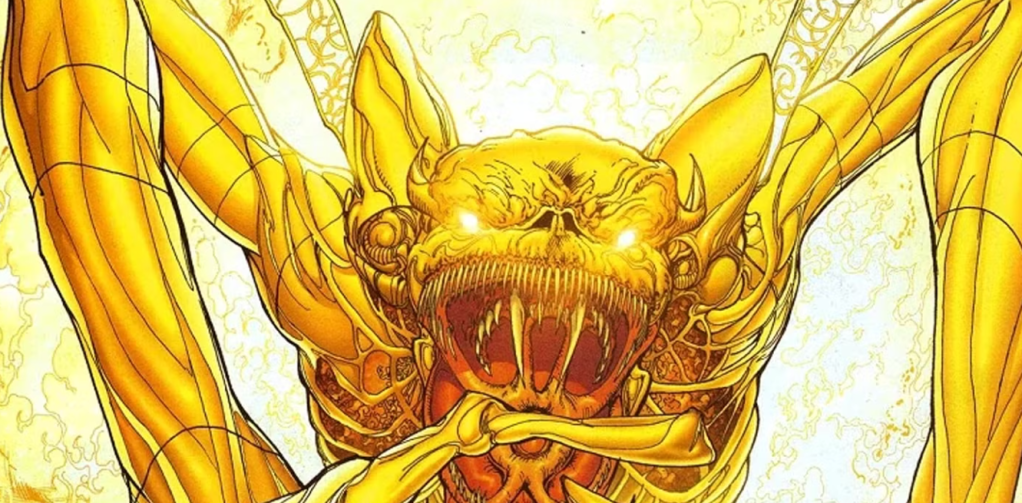
Yellow’s fear runs counter to Green’s will, so spoiler alert, our top two spots belong to Yellow’s portion of the Emotional Spectrum. Parallax is the embodiment of terror. It derives its power from the yellow light of fear, typically presenting itself as a serpentine creature that acts as a parasite in a host’s mind. The most famous instance of a Parallax infection was Hal Jordan.
That’s right. Parallax turned Hal Jordan into a villain. Jordan adopted Parallax as his villainous persona. While under Parallax’s control, Hal Jordan massacred the rest of the Green Lantern Corps and destroyed his home, Coast City. But Jordan is far from Parallax’s only vessels. It’s taken possession of heroes like Kyle Rayner and The Flash. Whenever Parallax takes control of a hero, its malevolent spirit and power turn the poor soul into one of the DC Universe’s most powerful villains.
1) Sinestro
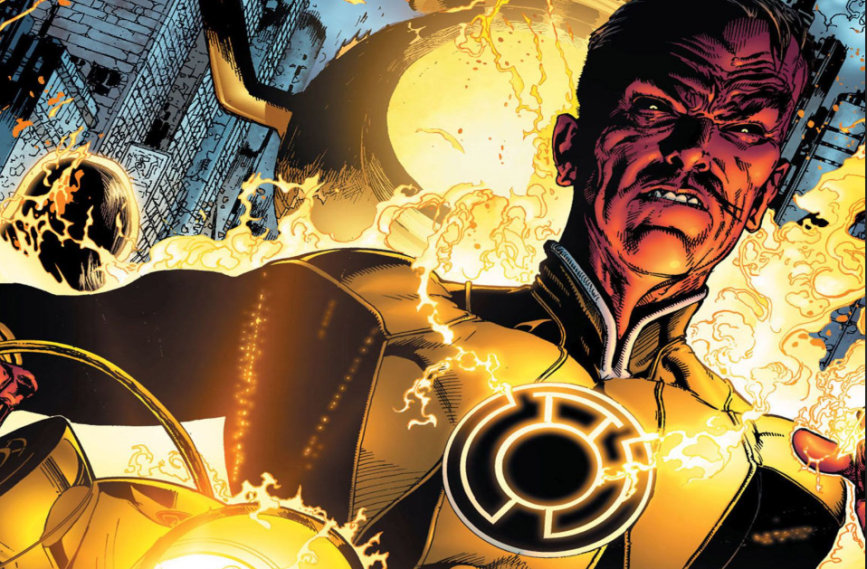
While Parallax takes temporary control over its host, Sinestro shows how the yellow light of fear can corrupt even the greatest Green Lanterns, completely and forever. When Hal Jordan first joined the Green Lantern Corps, Thaal Sinestro was his mentor. The two developed a bond, but that bond was shattered when Hal discovered Sinestro kept his sector (of the universe) in line through tyranny.
Jordan got Sinestro booted from the Green Lantern, and the Korugarian never forgave Hal, the Green Lantern Corps, or the Guardians of the Universe. Since his dismissal, Sinestro has been one of the DC Universe’s most enduring antagonists. He’s a card-carrying member of the Legion of Doom and the founder of the Sinestro Corps, who also harnesses the yellow light of fear. While he may occasionally commit acts of valor, Sinestro’s hatred, anger, and desire for power define him. We had to go with Sinestro for the top spot. Sometimes one of a character’s original villains are the best.
There are plenty of other Green Lantern Villains we could’ve added to this list. Who would you include? Let us know in the comments. Thank you for reading, and wherever you are, I hope you’re having a great day.
Spring Meadow is the grand finale of Uwe Rosenberg’s puzzle trilogy of games. It follows 2016’ Cottage Garden and 2017’s Indian Summer. The complexity of this game—the most interactive between the players in the trilogy—is set in between those two games. Hey, hey, Geekly Gang! Kyra Kyle here with another tabletop game review. We’ll be placing oddly shaped polyominoes on wintery player boards in today’s game review, Spring Meadow. Uwe Rosenberg’s final game of his puzzle trilogy marks the end of a harsh winter, and the first delicate flowers bloom. Can you have the lushest meadow? We’ll get to Spring Meadow’s review in a bit, but first, let’s talk about the less picturesque elements of the game and discuss Spring Meadow’s credits.
The Fiddly Bits
Designer: Uwe Rosenberg Publisher: Stronghold Games; Pegasus Spiele; Edition Spielwiese Date Released: 2018 Number of Players: 1-4 Age Range: 8 and up Setup Time: 5-10 minutes Play Time: 15-60 minutes
We’ll be paraphrasing the Spring Meadow rule book. The setup is succinct and easy enough to follow.
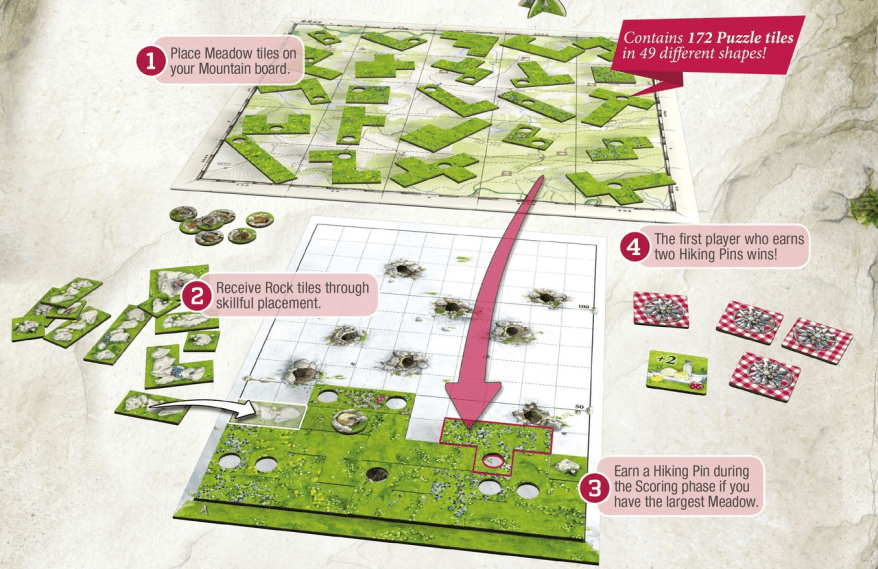
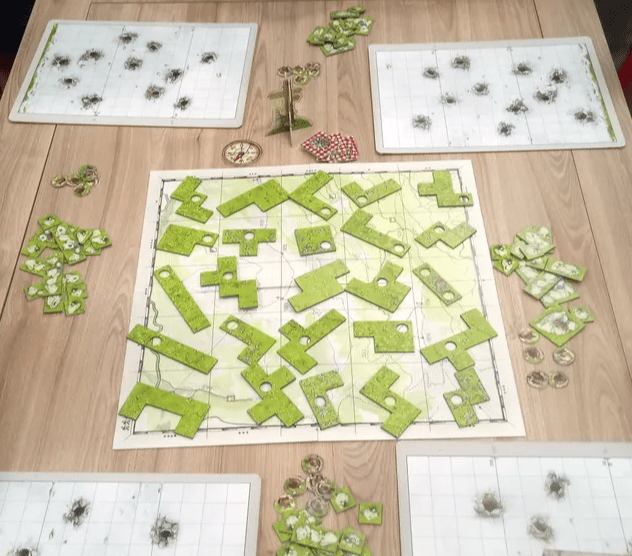
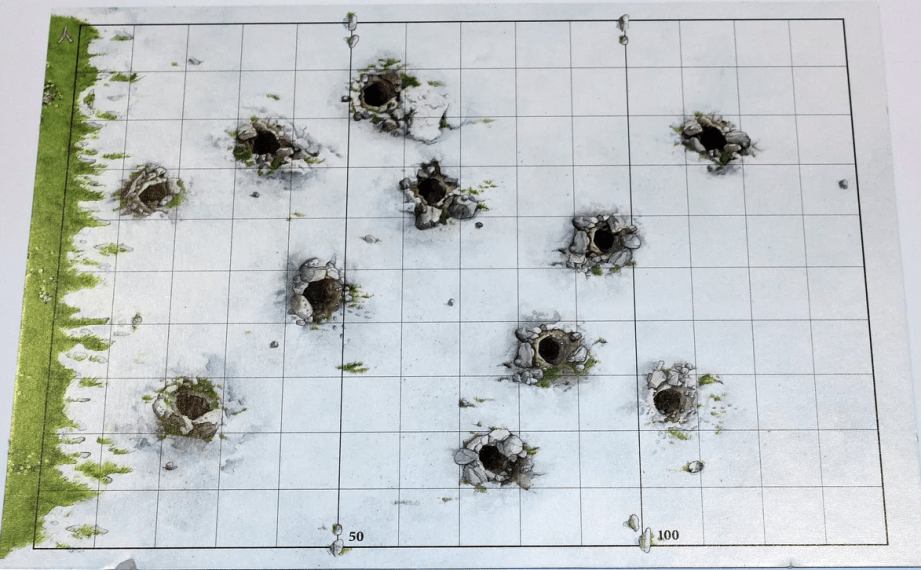
1) Place the double-sided Hiking Map (shared board featuring the offering of polyominoes) that corresponds to the number of players face up in the center of the table.
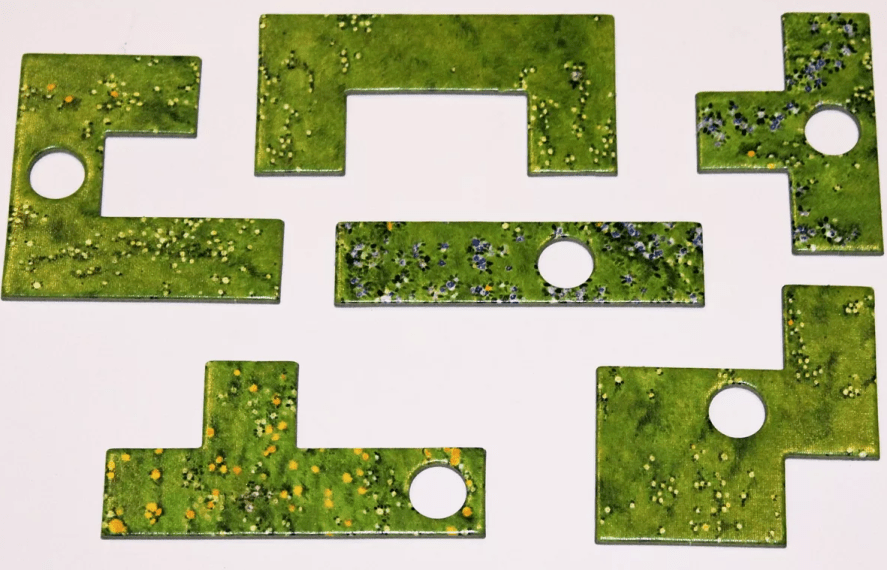
2) Shuffle all Meadow (polyomino) tiles and randomly place one on each of the 25 spaces of the Hiking Map.
3) Return the remaining Meadow tiles to the box. You will need them later to refill the Hiking Map.
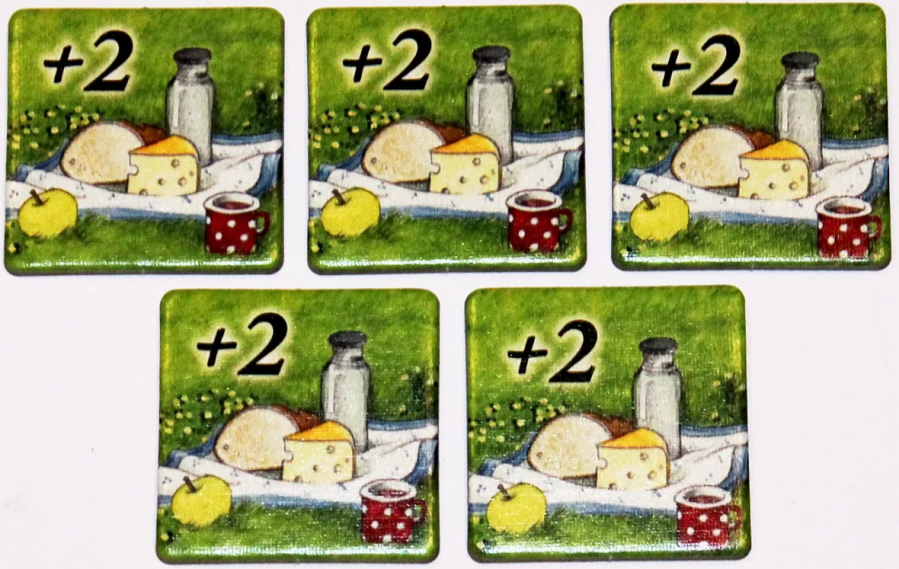
4) Place the Rock tiles, Marmots, Picnics/Hiking Pins, and Compass within reach of the players in a common supply.
5) Place the Signpost next to the player count icon on the Hiking Map.
6) Shuffle the double-sided Mountain boards and give one to each player. Orient the Mountain board with the arrow pointing up.
7) Randomly select a starting player. Each successive player will take a Rock tile, the size of which will depend on the player count and the player order.
Game Flow
On a turn, the active player chooses 1 Meadow tile from the Signpost Path (noted by the Signpost pawn, you’ll either select from a row or column of polyominoes, depending on the Signpost’s orientation during your turn) on the Hiking Map. Place the tile on your Mountain board.
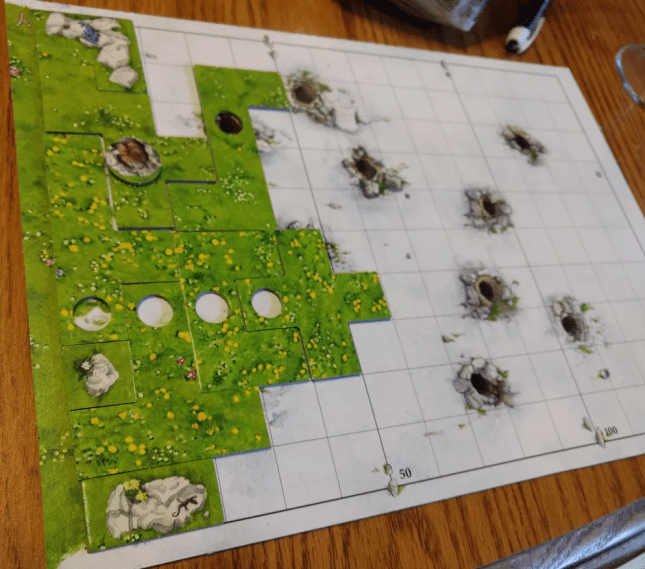
Pay attention to the Holes in the Meadow tiles and the Burrows on your Mountain board. Burrows will challenge your puzzle skills and placing adjacent Holes will allow you to place extra Rock tiles on your Mountain board.
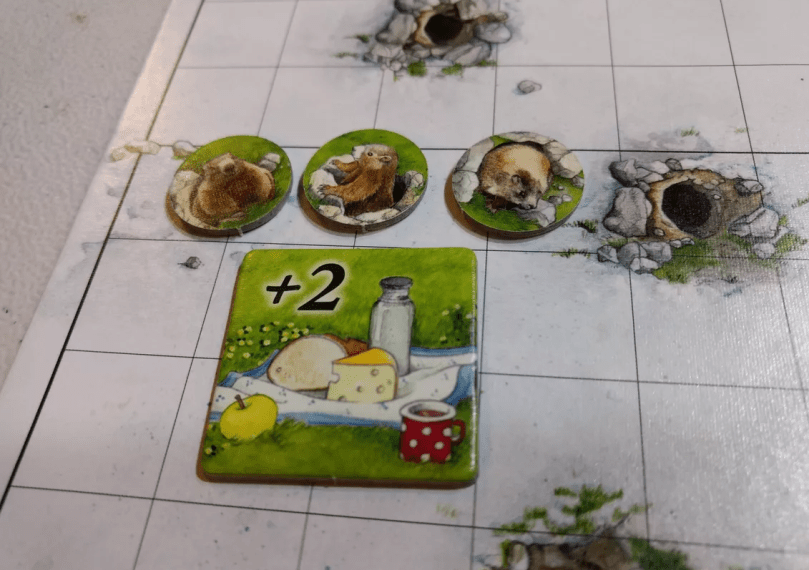
If you wish to cover a Burrow, you must place a Marmot over a Burrow that has already been cleared.
When the Signpost stands next to a Signpost Path (column or row) on the Hiking Map containing zero or one Meadow tile(s), a Scoring phase is triggered.
Starting from the bottom of your Mountain board, count all covered spaces up to and including your first incomplete row to tally your score.
The player with the most points earns a Hiking Pin and must place Marmots over all their cleared Burrows (so they cannot score those Burrows again).
Once scoring is completed, refill the Hiking Map with randomly drawn Meadow tiles afterwards.
The first player to earn their second Hiking Pin wins the game.
Review
It took some time for me to get into Spring Meadow. I appreciated Spring Meadow’s theme. There’s something about the earth waking up from a cold winter. One of my favorite things to do during this time is to stop by the Platte River and hear the ice turn into slush and float on by. Spring Meadow gives me those vibes. And I love polyominoes in general, and Spring Meadow uses them in interesting ways. Kind of like a competitive Tetris, where you want to fill the board with as many blocks as possible. But Spring Meadow has a steep learning curve, and if you play with a new player, that can derail the game.
Sure, at one point, I was that new player. The person who taught me the game had a fun enough time, but he didn’t really find enjoyment in playing Spring Meadow until me and another player from my gaming knew had played a handful of games. He told me as much. And I found the same to be true. Spring Meadow feels unforgiving as the “new player,” but as an “experienced player,” I felt as if I was taking advantage of someone else.
While Spring Meadow’s player (Mountain) boards can be oriented in landscape or portrait, I prefer portrait. There isn’t much difference between the two orientations, but portrait clicks a little better with me. Other players in my gaming group said the opposite, so there’s a chance portrait or landscape orientation could benefit one player over another because of how different brains process information. This doesn’t lower Spring Meadow in my estimation, but I had to mention it.
I’m uncertain if Spring Meadow has a runaway leader problem. Certain plays of Spring Meadow devolve into a runaway leader, especially if you have a veteran player against noobs, but evenly skilled players can keep the game close. Still, I don’t think the Marmots covering cleared Burrows is a big enough penalty or catch-up mechanism. Player boards stay the same in between rounds, so if you’re ahead by fifteen points at the end of one round, all other players need to score fifteen more points than the leader during the second round. Good luck with that.
I could see gamers instituting an extra catch-up mechanism of handing players who are behind by more than five points, a one, two, or three rock tile. But that would be a house rule.
I also prefer Spring Meadow with fewer players. The three and four-player variants have one player selecting on the diagonal (instead of a row or column), but it’s the same player picking on the diagonal each time that happens. While picking the Meadow tile you want from a diagonal line may not add extra strategic value for that one player, it feels bad for the players who don’t get to choose from the diagonal, and choosing a tile from a diagonal line gives the illusion of more choice, because you’re literally picking your tile in a manner no one else can.
Despite any minor gripes I may have, I’ve enjoyed my time with Spring Meadow. It’ll be one of those games you’ll need to play multiple times to grasp the game’s nuanced strategy. Fortunately, games of Spring Meadow don’t take that long. Fifteen minutes per player is short. This is another reason why I like playing Spring Meadow with fewer players. A two-player game takes up to thirty minutes. Nice!
Too Long; Didn’t Read
Spring Meadow may have a runaway leader problem, and veteran players have a decided advantage over noobs. But I love the theme and the game uses polyominoes in intriguing ways. Spring Meadow is one of those games you’ll need to play more than once to grapple with its nuanced strategy. Thankfully, games of Spring Meadow don’t take long: fifteen minutes per player.
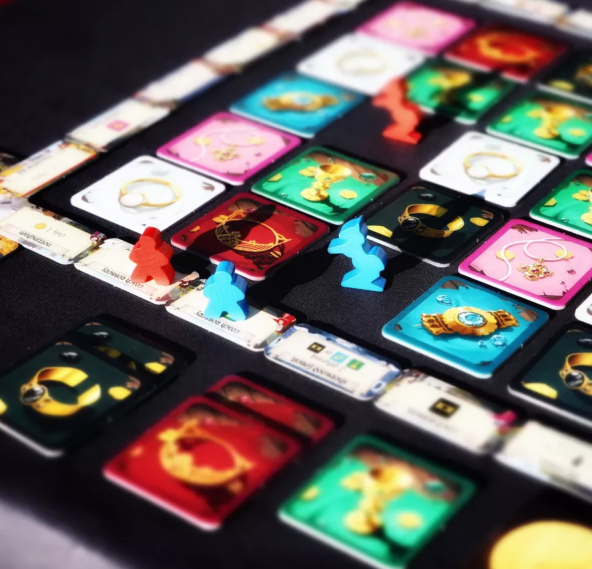
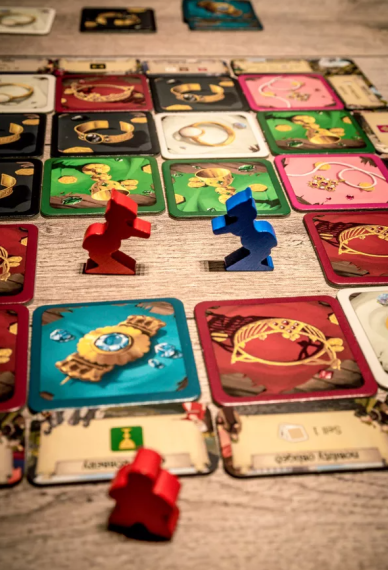
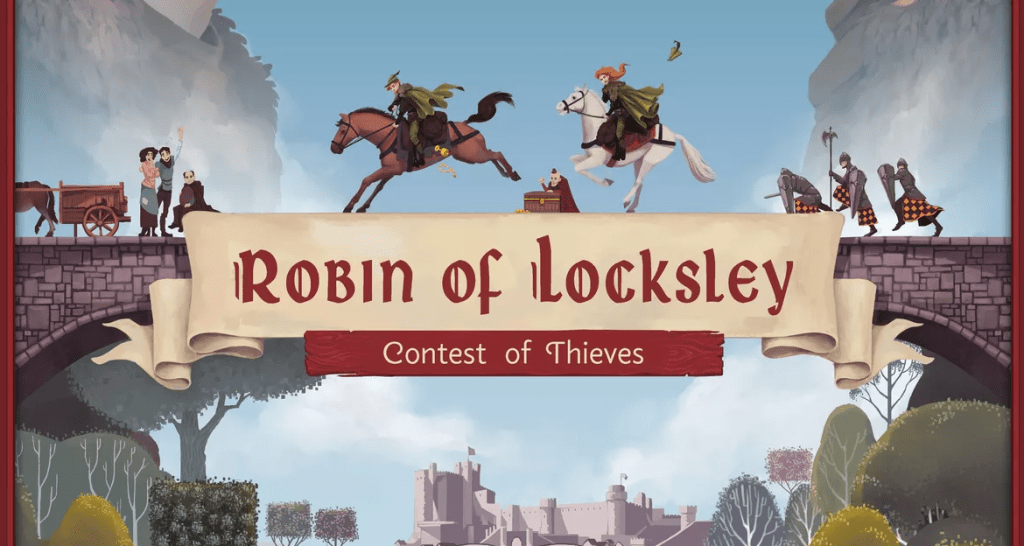
Hey, hey, Geekly Gang! Kyra Kyle here with another board game review. Full disclosure: Today’s game is one of my go-to 2-player board games, Robin of Locksley by Uwe Rosenberg. I’ll try to stay as neutral as possible, but it’ll be difficult. I love this game that functions as a race between two players. You control two pawns, Robin and a Bard. While Robin steals Loot from the rich, that Loot is used to move the Bard on a Race Track. The first player to finish the race wins. We’ll get to the daring do soon, but first, let’s discuss some of the less swashbuckling aspects of Robin of Locksley.
The Fiddly Bits
Designer: Uwe Rosenberg Publisher: Funforge, Rio Grande Games, Wyrmgold GmbH Date Released: 2019 Number of Players: 2 Age Range: 8 and up Setup Time: 5-10 minutes Play Time: 20-30 minutes
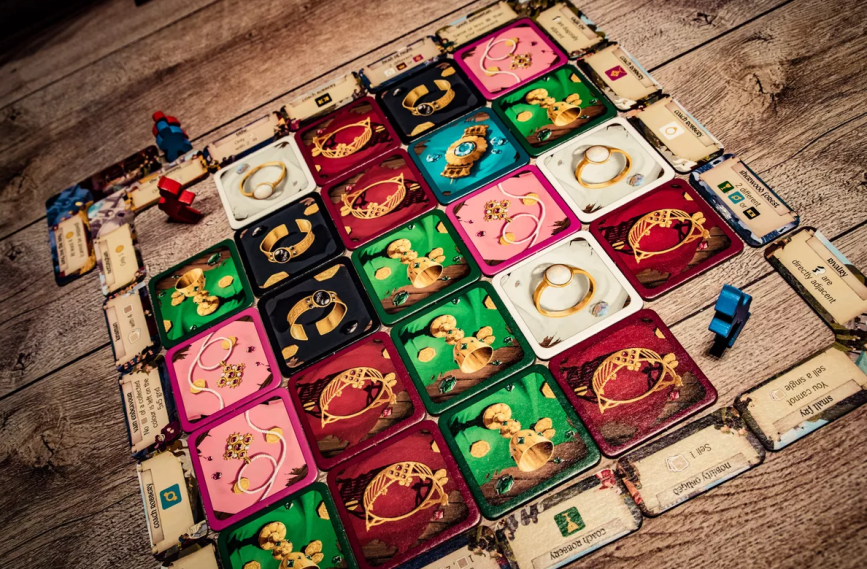
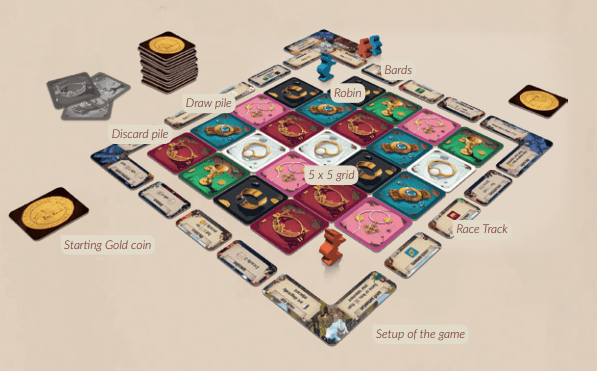
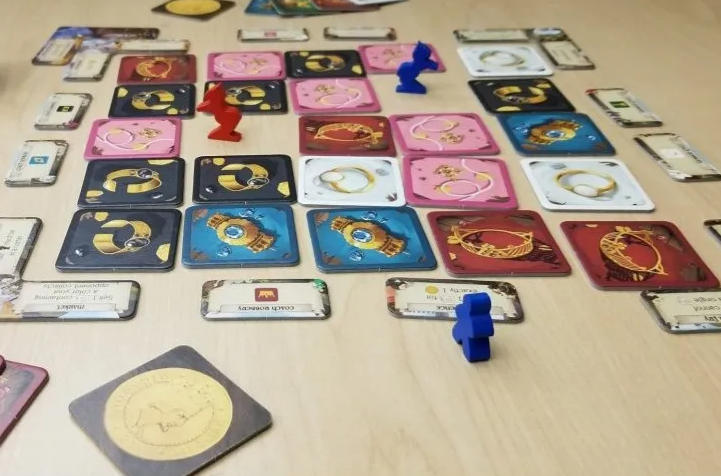
We’ll use Robin of Locksley’s rulebook for this section. I don’t know if words can express how to set up the game. We’ll include the picture the rulebook provides. I always use it when building the board.
* Shuffle all Loot tiles (gold coin side up) and build a 5×5 grid.
* Choose a player to go first. The first player takes one loot tile from any corner of the board. The second player takes the tile from the opposite corner. Each player flips the tile they chose back over to the side showing the gold coin and forms their personal supply.
* The players put their Robins in the now empty corners.
* Place the remaining loot tiles with the gold coin side up in a draw pile.
* Find the corner pieces labelled “The Beginning” (start) and “Long Live the King” (end). Put them together in one of the corners. Place “The Beginning” piece (as shown above) in the inner corner.
* Shuffle the remaining corner pieces, draw three, and put them in the remaining corners.
* The players put their Bards in their color next to the start tile.
* Shuffle the small fame tiles and put three of them between the corners.
* When complete, the game layout should look similar to the picture above.
Game Flow
Moving Robin
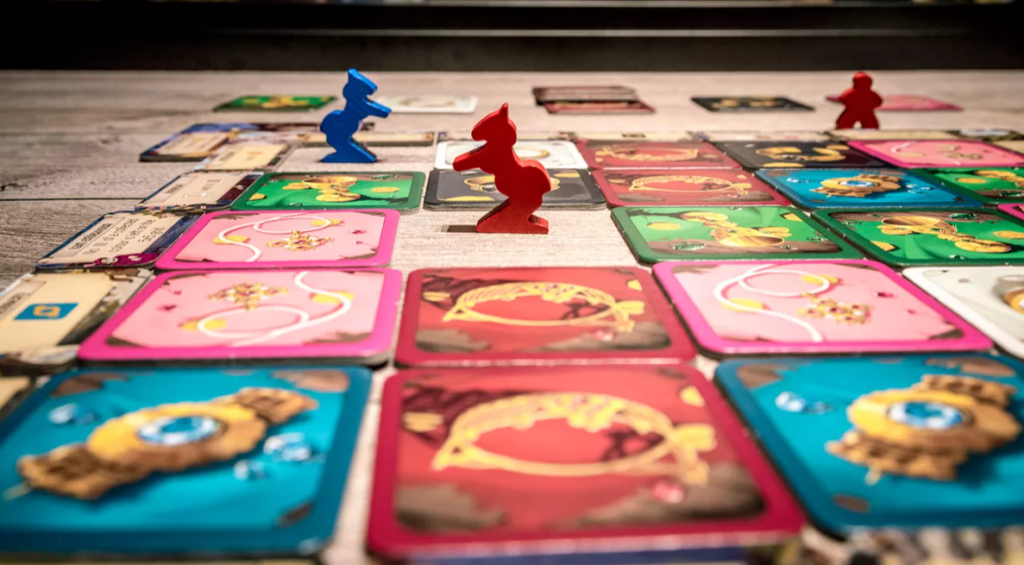
* Players alternate turns. The start player begins the game. * Players move their Robin in the shape of an “L” composed of three tiles (just like the knight’s move in Chess).
* The player takes the tile they landed on into their personal supply.
* At the end of their turn, the player fills the now empty space (the space their Robin left) with a Loot tile from the general supply. Do not fill the square occupied by a Robin.
The Racing Track
Players win the game by moving their Bard along the Racing track (the one surrounding the loot tiles). There are two ways to move with your Bard.
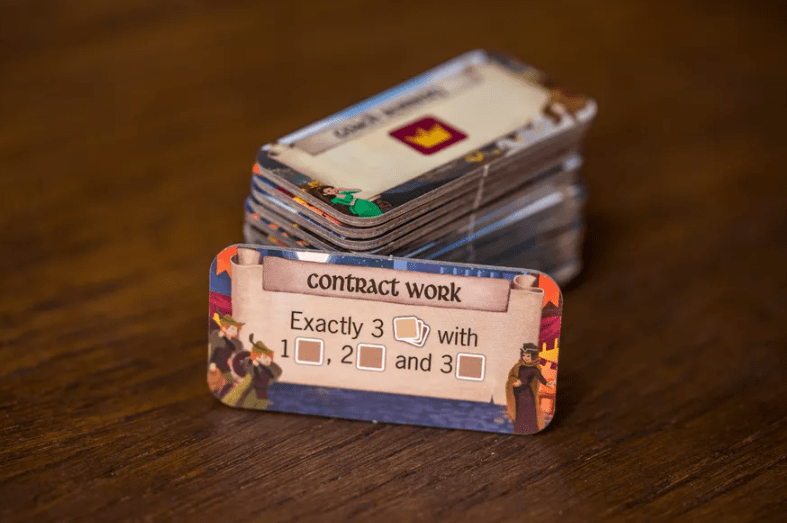
1) Every Fame tile (the ones that compose the Racing Track) shows one task. If the player is able to fulfill the task indicated on the Fame tile, they may move their Bard 1 tile forward on the Race Track. These tasks range from possessing a specific color of Loot or having your Robin in the corner of the 5×5 Loot tile grid.
2) The player may spend 1 Gold coin (and discard it to the open discard pile with the Loot side up) to move their Bard 1 tile forward (clockwise) on the Race Track. The player may continue to move their Bard forward as long as they can meet the requirement or pay the bribe for each tile they encounter.
Loot Collection
A Loot collection is a set of 1 or more Loot tiles of the same color. Loot collections may never be split into smaller collections.
Selling a Loot Collection
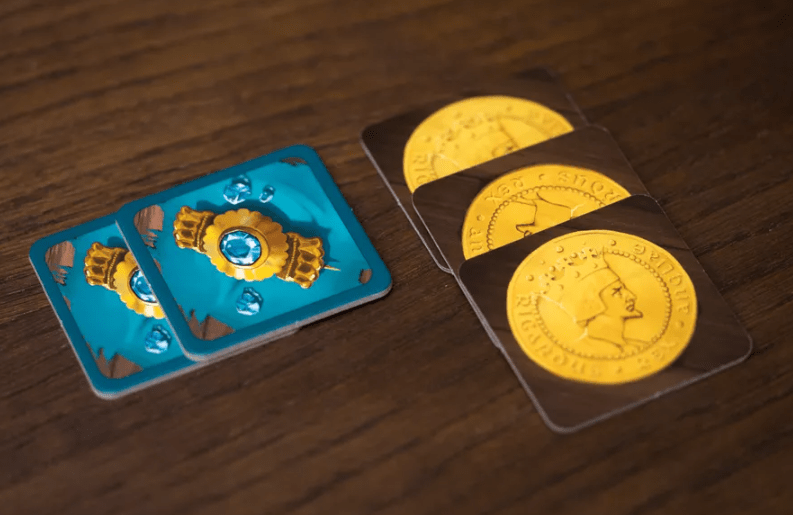
Anytime during their turn, players may sell a Loot collection which consists of 3 or more Loot tiles of the same type.
Discard two of the Loot tiles on the open discard pile and collect the remaining ones as Gold coins by turning them over.
Game End and Winning
There are two ways the game can end, and a player can win.
1) The game ends immediately if one player’s Bard “laps” the other player’s Bard on the race track. To “lap” the other player, one player’s Bard must have made a full extra lap around the track thus passing the other player’s Bard a second time. The player whose Bard has passed the other is the winner. If both Bards are on the same spot on the Race Track, the game does not end.
2) The player who first completes two full laps of the Race Track and fulfils the challenge on the goal tile is the winner.
Review
I love the way the Robins move. Robin of Locksley’s new players will have an easier time picking up the move mechanisms, but the way knights in Chess move isn’t straightforward. The Robins have familiarity, and each move functions as a spatial puzzle. One of the Fame tiles (the spaces on the Race Track) requires a player’s Robin to be one move away from their opponent. I don’t know how many times I’ve spent a Coin to skip this requirement, but I get a rush every time I can meet that requirement naturally. Then, it becomes a race, so my opponent can’t finish that Fame tile during their next turn.
The Fame tiles have varied requirements. Robin of Locksley’s modular board ensures no two games will ever be the same. And planning spaces ahead is fun, making each turn meaningful, even if your move this turn won’t help you progress right away. Robin of Locksley also has that volta, a turn where the game shifts, and it’s usually during the mid-point. Players bide their time, collecting Loot, meeting easier requirements, and accruing enough Coins to skip five or six spaces on the Race Track during a single turn. I love this volta (turn). As soon as this happens, the race is on. The other player will pop off a five or six spaces of their own, and Robin of Locksley begins in earnest. Typically, this momentum continues until the game ends.
And games of Robin of Locksley don’t take too long. BoardGameGeek and the rules list games as lasting up to 40 minutes. This hasn’t been my experience. My first game of Robin of Locksley may have taken close to 40 minutes (with the teach), but as soon as you have two players who know what they’re doing, turns take no time at all. Sometimes, I must call time and raise my hand if I want to move those five or six spaces in a turn, because it’s easy to get into a rhythm. The game’s rhythm getting interrupted raises the stakes during the volta. It’s so good.
Looking up a Fame tile’s requirement is one of the few ways a game of Robin of Locksley slows. None of the Fame tiles has any text; they’re all conveyed through icons. The Robin of Locksley rulebook contains a glossary of what each icon means, but it will slow down the game to look up that information during your first lap around the Race Track. Despite this occasional slowdown, I like how both game elements work with each other in Robin of Locksley. It’s a healthy balance of figuring out how best to maximize your Loot with your Robin piece and looking ahead on the Race Track to see what you may need.
Robin of Locksley is my go-to 2-player only game. My spouse and I have played a ton of 2-player games lately, but Robin of Locksley is one of the few competitive 2-player-only games that consistently make our rotation.
Too Long; Didn’t Read
Robin of Locksley has short, punchy turns that lead to a satisfying race to meet Loot (or spatial) requirements. With its modular board, each game is unique, but one thing stays constant: the volta (turn). Each game will have an exciting turn where one player moves multiple spaces, and then the race is on.
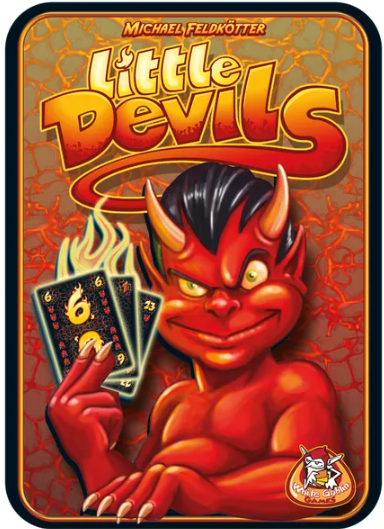
Hey, hey, Geekly Gang! Kyra Kyle here with another board game review. Today’s game is Michael Feldkötter’sLittle Devils, a quick trick-taking game with a twist. Little Devils has no suits. Instead, players must follow the first card (in a series of 54 numbered cards) that’s played per round. The second card dictates which direction every other player must follow (up or down from the original number). The player who either plays in the wrong direction (up instead of down) or plays the furthest number from the original card wins the trick; you’re trying to win as few tricks as possible. Little Devils takes a simple concept and bakes in some interesting choices.
Before we get any further, we’ll get devilish with Little Devils’ details.
The Fiddly Bits
Designer: Michael Feldkötter Publisher: Arclight Games, Stronghold Games, White Goblin Games Date Released: 2012 Number of Players: 3-6 Age Range: 8 and up Setup Time: Less than a minute Play Time: About 15 minutes
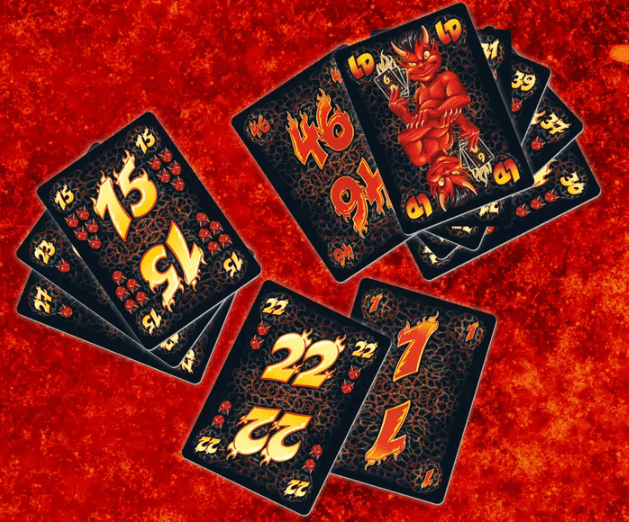
Little Devils consists of a 54-card deck. Depending on the number of players, remove a number of cards numbered between 28-54 from the game. The rulebook will state which specific cards need to be removed at each player count. Ultimately, players will be dealt 9 cards each, which should be the entire deck.
After you’ve prepared the deck, deal out all the cards.
Game Flow
For the first round, the player to the left of the dealer begins the trick; for every round after the first, whoever “won” the previous trick, begins the next trick. The first player starts the trick by playing any card from their hand that doesn’t have five little devils beneath the number. Quick note: most cards in Little Devils will have at least one little devil underneath its number. Players cannot lead a trick with a card with five little devils, unless they have no other card in their hand.
The player to the left of the starting player will play a card from their hand. If the second player plays a higher card, all other players must play cards valued higher than the first card if possible. Whoever played the highest card gets the trick, unless a player is unable to play a higher card. This player will get the trick unless more players are unable to play higher cards. If a player (or players) plays a card in the opposite direction of the second player, the player with the furthest valued card from the original card wins the trick.
After all cards have been played, a round ends. Players score the number of little devils from their tricks. As soon as someone scores 200 points, play ends, and whoever has the fewest points wins.
Review
Little Devils has a built-in catch-up mechanism: the player who wins a trick can’t possibly win the next one; they begin the next trick. I love that. It’s simple and offers plenty of strategic choices. I could play a card closer to the low or high end, thinking the players in front of me (on the scoreboard) might get stuck with a trick or two. There are even cards that have no little devils on them. Often, when I know I’m going to get stuck with a trick, I’ll play one of the one devil or no devils cards to net the fewest little devils I can.
While you could card count during Little Devils, it doesn’t matter that much. Little Devils plays quickly. It’s more fun to play a second game. Even when I’ve finished last (triggered the end game), I feel like I did something if I stiffed someone else with a bunch of points during one round. Little Devils is a great filler game. It may get overshadowed by Cat in the Box (we still need to review that game), but it requires less setup, is an easier teach, and I’ve found more gamers catch on to Little Devils a lot faster.
Too Long; Didn’t Read
Quick to pick up and easy to teach, Little Devils is an excellent trick-taking game that offers plenty of strategic choices, a brilliant built-in catch-up mechanism, and fun gotcha moments.
We had to discuss the Marvel United: Fantastic Four expansion from the Marvel United: X-Men launch. In fact, we’ll begin our coverage of the Marvel United: X-Men wave with this expansion. Hey, hey, Geekly Gang! Kyra Kyle here. We return once again to Marvel United. This is one of those game systems with a heap of expansions. Too many, if you ask me. But we’ll cover the expansions that will either be fan favorites (plenty of people will be interested in adding them to their collection) or good additions because of their gameplay variants. Fortunately, Marvel United: Fantastic Four fits both criteria.
We’ll get to Marvel’s first family in a minute, but first, let’s take a look at Marvel United: Fantastic Four’s less heroic details.
The Fiddly Bits
Designer: Andrea Chiarvesio, Eric M. Lang, and Francesco Rugerfred Sedda Publisher: CMON Global Limited and Spin Master Ltd. Date Released: 2022 Number of Players: 1-5 Age Range: 8 and up Setup Time: 5-10 minutes Play Time: 30-40 minutes
We already covered the Game Setup and Game Flow in our original Marvel United review (here’s a link to that review), so we’ll go over the basics in the following two sections. Let’s cover an abbreviated review of the game setup and rules.
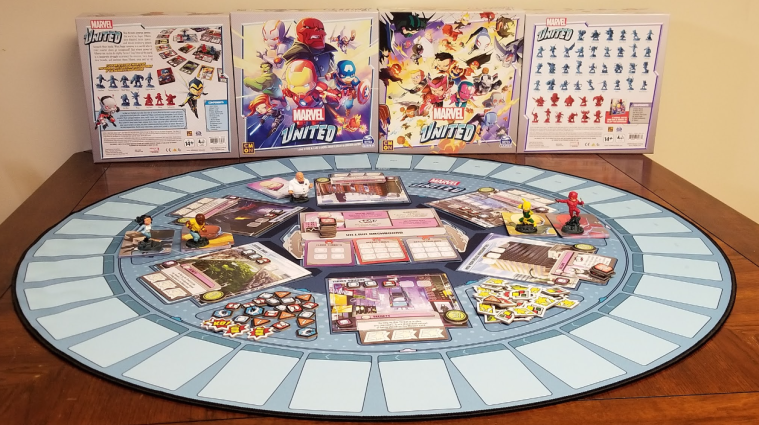
Marvel United: Fantastic Four’s setup can change depending on which Villain(s) and Heroes you choose to play. Each game consists of six locations. Since Marvel United: Fantastic Four is an expansion, only includes four locations, and you’ll need a core set in addition to this expansion to play. You may choose your locations or shuffle them and choose six at random. Each Location card has spaces at the top for civilians and thugs, and a rectangle with a block of text that will state “End of Turn” at the top of the box.
Place civilian/thug tokens on their matching spaces. Shuffle the Villain’s Threat deck and deal out each Threat face-up so that it covers the rectangle at the bottom of each location. You must clear this threat before gaining the “End of Turn” effect printed on a Location. Place health tokens where signified on threat cards and on the Villain dashboard. Place the three mission cards (Defeat Thugs, Rescue Civilians, and Clear Threats) face up under the villain dashboard where the text reads “Unlocked.”
Each player shuffles their hero decks and then draws three cards to form their hands. Shuffle the Villain’s Master Plan deck. Leave the Master Plan deck face down. This will be the villain’s draw pile.
Players place their miniatures on one of the six location cards, usually the centralmost location for each player (easy access). Then, they place the villain on the location card opposing the heroes. If one player chooses to play as the villain, hand the Super Villain cards to them, and the Heroes gain access to Super Hero cards. These new card times can be played if the game state triggers their use (for example, “You play a Master Plan card” or “Any Hero has 4 or more cards in their hand at the end of the Hero turn.” Timing is key.
Game Flow
The villain(s) play first. Draw the top card of their master plan deck. The villain moves the number of spaces indicated. Resolve any BAM! Effects and these effects will be printed on a space within the villain’s dashboard. Then, place the civilian/thug tokens (if any) indicated at the bottom of the card. If a player has taken the role of the villain, they get a hand of cards and can choose which card they play. The heroes get their turn after all the villain’s effects are resolved.
Heroes pick which player goes first, and hero turns will continue around the table clockwise. At the beginning of each game, Heroes will get three turns before the villain receives another turn. During their turn, heroes play one card from their hand.
Resolve actions and the symbols printed at the bottom of the hero’s card in any order. The symbols at the bottom of a hero’s card will be shared with the next player, but any printed action will not be shared. Heroes will use these actions to complete missions. The game begins with three missions in play: Defeat Thugs, Rescue Civilians, and Clear Threats. Each mission card will have spaces for the tokens they require to complete. As soon as these spaces are filled, the card is discarded, and the mission is considered complete. Mission cards can be completed in any order.
After the heroes complete the first mission, the villain panics and will act (play a card) every two hero cards instead of every three hero cards. After the heroes complete the second mission, the villain becomes vulnerable to damage. The heroes can complete the third mission, but it isn’t necessary. If the heroes do complete the third mission, each hero immediately draws 1 card, increasing each player’s hand size by one.
Play continues back and forth until either the villain wins (by completing their unique master plan or anyone, heroes or villains, runs out of cards) or the heroes win by dealing enough damage to the villain after the villain becomes vulnerable to damage.
Review
Marvel United: Fantastic Four has a huge legacy to live up to, and it lives up to the hype. I’m writing this review in June 2025, and Marvel United: Fantastic Four’s BGG score is an 8.5 (out of 10). This makes Fantastic Four the highest-rated Marvel United expansion. Yeah. It’s—pardon the pun—fantastic.
While Marvel United: X-Men Blue and Gold Teams features semi-cooperative play (players compete to clear the most goals), and this gives me strong X-Men: Under Siege vibes (a game I have a soft spot for), Fantastic Four introduces the idea of teamwork, and it does so simply and elegantly. Included in the box is a Fantastic Four team card. Various hero cards (from the members of the Fantastic Four) will add action tokens to the card, and can then use all actions on the Fantastic Four team card with different cards in their deck. This promotes a slow build. It simulates teamwork without using a lot of convoluted rules. I like the Team Cards from Marvel United’s third wave (Multiversus), but the method used in Fantastic Four is easy to follow and makes narrative sense.
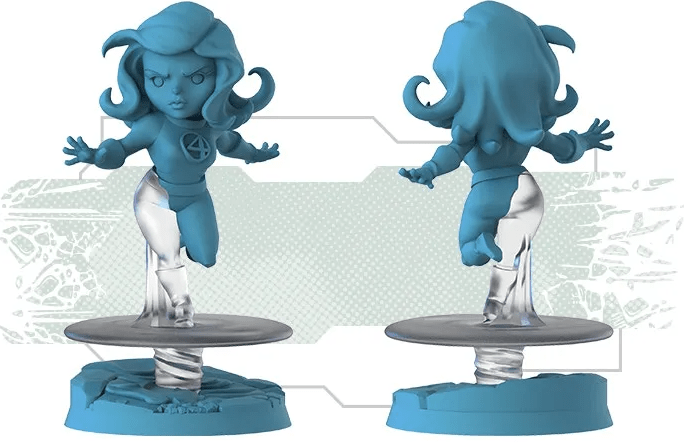
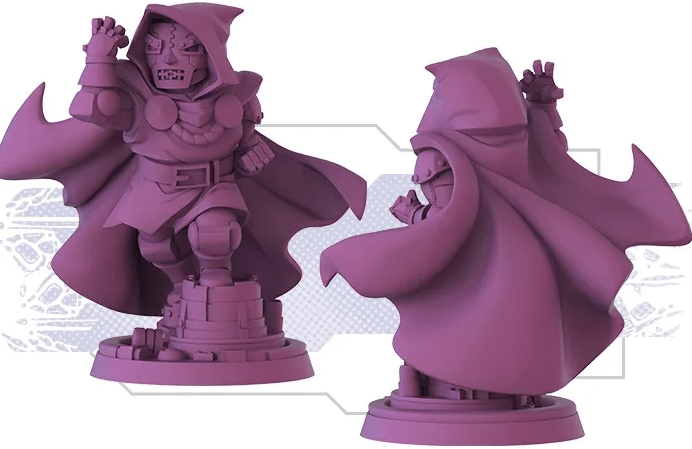
Marvel United: Fantastic Four includes six heroes. One of which is the anti-hero (hero and villain) Doctor Doom. That’s a lot of heroes for one expansion—it’s almost as many as a core box—and each hero illustrates Marvel United’s second wave’s power creep. Granted, to get the most out of the Fantastic Four characters (Mr. Fantastic, Invisible Woman, The Thing, and Human Torch), you’re encouraged to play as the Fantastic Four. The aforementioned Fantastic Four Team Card is amazing, but these characters are still effective outside the team setting.
Each member has a unique flavor. Mr. Fantastic is flexible. Get it? Flexible? Ha…ha. Invisible Woman can avoid damage altogether (using her “Invisiblity” card), but she takes herself out of combat, which makes sense. Human Torch can use Nova Flame and deal 2 damage to everything at his location—super useful. And The Thing deals copious amounts of damage and can ignore 1 damage during each Villain Turn. Very nice.
The remaining two heroes, Doctor Doom and Silver Surfer, don’t gain any benefit from the Fantastic Four team card, but they don’t need it. Doom gets tokens for each damage he takes. He can even use the symbols from the 3 previous Hero cards in the Storyline (instead of the previous one). This can generate as many as seven actions on a single turn. Yikes! Silver Surfer has extra card draw, can move anywhere with one of his special abilities, and can exchange a Location in play with one that isn’t in play. What? Silver Surfer can literally yeet any Location for another Location. That’s coconuts.
But Marvel United: Fantastic Four’s villains are just as overpowered as their hero counterparts. Even though Doctor Doom is the marquee villain, we’ll begin with Super-Skrull. Don’t overlook Super-Skrull. He has one of the more unique Special Rules in Marvel United. Whenever he BAM!s, he performs actions based on the symbols on the last Hero card in the Storyline. The heroes have some control over what Super-Skrull can do, but that doesn’t matter. None of Super-Skrull’s BAM! actions are things you want to happen. Super-Skrull attempts to knock out (KO) and hand each in-play hero a KO token, but this isn’t the only way he can win. Super-Skrull can’t be damage if any Crisis tokens exist, and he adds cards from his deck facedown in the Storyline, which leads to a shortened clock.
Super-Skrull is a spiffier version of Green Goblin. He does enough things well that you must split your focus on the various ways he can win, and even though he doesn’t have Henchmen (like Green Goblin), he makes up for it with crazy Threat card abilities that make clearing Thugs and Civilians less efficient, and each Threat card requires one of each action type. Super-Skrull covers all bases. But most people purchase Marvel United: Fantastic Four for Doctor Doom, and Doom delivers.
First off, Doom must be played with Latveria—naturally—and Latveria is the first Location card that has a negative “End of Turn” effect. In fact, Doom only has five Threat cards because Latveria begins the game without one. Latveria marks the first time Marvel United has included an “End of Turn” effect that benefits the villain. “You MUST take 1 damage for each Thug or Doombot in this Location.” Ouch! Latveria begins every game with three Doombot tokens, so if you don’t take out all of the Doombots, you’re discarding your entire hand. Double ouch! Doom’s Threat cards add extra Doombots (sometimes not even in the same place as the Threat card’s location) and can deal extra damage to heroes. Triple ouch!
As for his Villainous Plot, Doc Doom plays like Red Skull but way, way worse. He can increase the Doom Track (changed from the Red Skull’s Threat Track) far more often, and he can’t be damaged if a Doombot is at his Location. In short, Doctor Doom is nasty. You’ll need the Fantastic Four with their Team Card to defeat him. It can be done, but it’s a tough go. I find Doctor Doom tuned to the perfect level of difficulty. He may be one of the many reasons Marvel United: Fantastic Four is the highest-rated Marvel United expansion.
We talked about Latveria, but there’s another Location, Mount Wundagore, that has a negative “End of Turn” effect: Each Hero in this Location MUST discard all cards in their hand and draw the same number of cards (this does not KO). Even though this effect doesn’t count as a KO, it’s another way to shorten the clock. If anyone (including Heroes) runs out of cards in their deck, the heroes lose. Yowza! I like Marvel United: Fantastic Four’s inclusion of villain-centric Locations. We’ll see more of this later in the series, but villain-centric Locations do a lot to shake up Marvel United’s status quo. The remaining Locations have unique “End of Turn” abilities as well. The Baxter Building provides token draw if the character you’re playing was ever a member of the Fantastic Four. This is a boon for anyone who knows the comics. I appreciate that.
I also appreciate the Takeover Challenge card included in Marvel United: Fantastic Four. If a Thug, Civilian, or Doombot token can’t be added to a Location, after resolving Overflow, place the excess tokens on the Takeover card. If the card is full, Heroes immediately lose. The Takeover card has two sides with different difficulties (number of spots for tokens). This Challenge card, like the Fantastic Four’s Team Card, is simple and elegant. It adds just enough difficulty if the game has gotten too predictable.
Too Long; Didn’t Read
Marvel United: Fantastic Four is the highest-rated Marvel United expansion on BoardGameGeek and for good reason. This expansion adds more layers of complexity while staying thematic and not burdening the player with too many over-complicated rules. Every element from the Locations, the Challenge Card, the Heroes, and especially the Villains is well thought out and an excellent addition to any Marvel United collection.
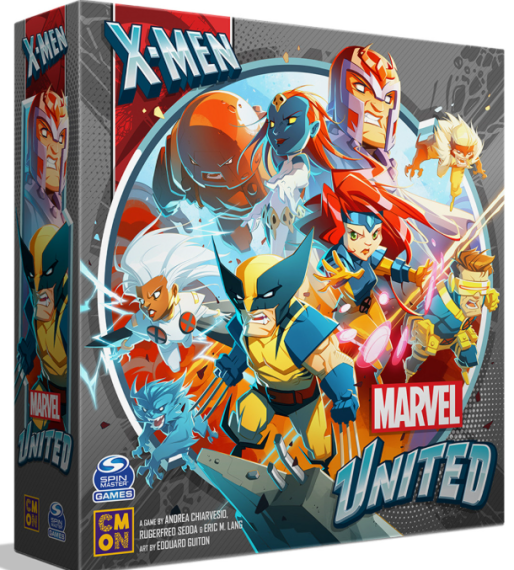
We’ve discussed many Marvel United expansions from the game’s initial set; it’s time to talk about Marvel United: X-Men. This version of Marvel United adds team play and a one versus many option, where one player controls the villain while the others play the heroes. This increases gameplay options and allows for a fifth player to join in on the fun.
Hey, hey! Kyra Kyle here. In Marvel United: X-Men, players act as iconic X-Men heroes who work together to stop the master plan of a powerful villain controlled by the game and in some cases another player. Each villain has a unique master plan, cards that trigger various effects, and threats that make clearing locations difficult. Heroes clear missions, making the villain vulnerable, and finally take on the big bad villain before they complete their master plan. Can you save the day in time? Marvel United: X-Men adds Marvel’s merry mutants to the fray.
Before we get any further, we’ll take a side quest and discuss Marvel United: X-Men’s less heroic details.
The Fiddly Bits
Designer: Andrea Chiarvesio, Eric M. Lang, and Francesco Rugerfred Sedda Publisher: CMON Global Limited and Spin Master Ltd. Date Released: 2021 Number of Players: 1-5 Age Range: 8 and up Setup Time: 5-10 minutes Play Time: 30-40 minutes
We already covered the Game Setup and Game Flow in our original Marvel United review (here’s a link to that review), so we’ll go over the basics in the following two sections. Let’s cover an abbreviated review of the game setup and rules.
Marvel United: X-Men’s setup can change depending on which Villain(s) and Heroes you choose to play. Each game consists of six locations. Eight locations are included because Marvel United: X-Men is a core set. You may choose your locations or shuffle them and choose six at random. Each Location card has spaces at the top for civilians and thugs and a rectangle with a block of text that will state “End of Turn” at the top of the box.
Place civilian/thug tokens on their matching spaces. Shuffle the Villain’s Threat deck and deal out each Threat face-up so that it covers the rectangle at the bottom of each location. You must clear this threat before gaining the “End of Turn” effect printed on a Location. Place health tokens where signified on threat cards and on the Villain dashboard. Place the three mission cards (Defeat Thugs, Rescue Civilians, and Clear Threats) face up under the villain dashboard where the text reads “Unlocked.”
Each player shuffles their hero decks and then draws three cards to form their hands. Shuffle the Villain’s Master Plan deck. Leave the Master Plan deck face down. This will be the villain’s draw pile.
Players place their miniatures on one of the six location cards, usually the centralmost location for each player (easy access). Then, they place the villain on the location card opposing the heroes. If one player chooses to play as the villain, hand the Super Villain cards to them, and the Heroes gain access to Super Hero cards. These new card times can be played if the game state triggers their use (for example, “You play a Master Plan card” or “Any Hero has 4 or more cards in their hand at the end of the Hero Turn.” Timing is key.
Game Flow
The villain(s) play first. Draw the top card of their master plan deck. The villain moves the number of spaces indicated. Resolve any BAM! Effects and these effects will be printed on a space within the villain’s dashboard. Then, place the civilian/thug tokens (if any) indicated at the bottom of the card. If a player has taken the role of the villain, they get a hand of cards and can choose which card they play. The heroes get their turn after all the villain’s effects are resolved.
Heroes pick who goes first, and hero turns will continue around the table clockwise. At the beginning of each game, Heroes will get three turns before the villain receives another turn. During their turn, heroes play one card from their hand.
Resolve actions and the symbols printed at the bottom of the hero’s card in any order. The symbols at the bottom of a hero’s card will be shared with the next player, but any printed action will not be shared. Heroes will use these actions to complete missions. The game begins with three missions in play: Defeat Thugs, Rescue Civilians, and Clear Threats. Each mission card will have spaces for the tokens they require to complete. As soon as these spaces are filled, the card is discarded, and the mission is considered complete. Mission cards can be completed in any order.
After the heroes complete the first mission, the villain panics and will act (play a card) every two hero cards instead of every three hero cards. After the heroes complete the second mission, the villain becomes vulnerable to damage. The heroes can complete the third mission, but it isn’t necessary. If the heroes do complete the third mission, each hero immediately draws 1 card, increasing each player’s hand size by one.
Play continues back and forth until either the villain wins (by completing their unique master plan or anyone, heroes or villains, runs out of cards) or the heroes win by dealing enough damage to the villain after the villain becomes vulnerable to damage.
Review
Marvel United: X-Men features many new game concepts for the United game system. Having one player take on the role of the villain is the most obvious. I like that Spin Master and CMON games include a chart that allows gamers to play villains from the previous set. Since X-Men characters have a knack for flip-flopping their allegiance, it makes sense that Marvel United: X-Men began the trend of purple miniatures (anti-heroes who can be played as heroes or villains). This feature is crucial to the game design, as I forgot it began with Marvel United’s second wave (X-Men). Marvel United: X-Men also adds a team element with its Blue and Gold Team expansions. That doesn’t factor in too much with the core set. We’ll talk more about the X-Men Blue and Gold Teams in the future.
Power creep is a real thing in Marvel United: X-Men. In the original set, players were lucky if they had three unique abilities and anything more than three cards in their deck with special abilities. Marvel United: X-Men heroes have a minimum of four cards in their deck with special abilities and at least two unique special effects, but there are plenty of heroes with way more than four special ability cards. Marvel United: X-Men also includes plenty of powers that deal with crisis tokens. The original set had a few ways to deal with crisis tokens; most of the methods came in the form of Location “End of Turn” abilities. I like the inclusion of heroes with crisis token abilities. The heroes in Marvel United’s second way had plenty of new ways to affect the game state.
Beginning with the anti-heroes (the purple miniatures who can be heroes or villains), let’s get into specific heroes you can find in the Marvel United: X-Men Core Set. Mystique features few Heroics but plenty of Move and Attack. Her two special abilities (two copies of each card) allow her to prevent new tokens (Thugs or Civilians) from being added by the next Master Plan card, and she can redirect damage from herself to Henchmen or Thugs. This plays into Mystique’s ability as an infiltrator. Typically, Marvel United: X-Men does a good job of showing each anti-hero as their heroic and villainous selves. Magneto is the other anti-hero included in the Core Set. Like Mystique, he has little Heroics but can zoom around the board and deal copious amounts of damage. I like Magneto’s ability to convert symbols into Wild symbols. This makes him versatile.
Perhaps because of the increased number of powers within hero decks, Marvel United: X-Men does an even better job of capturing its heroes. Wolverine begins the game with a healing factor. Cyclops uses Leadership, while Beast also has a regenerating factor (not as persistent as Wolverines) and he specializes in heroics and movement. So far, far thematic, but I really like Storm, Jean Grey, and Professor X. Storm can reposition the entire team, Jean Grey can manipulate the Storyline with Telekinesis, and Professor X may be the most powerful hero in the X-Men Core Set. He’s surprisingly mobile with a penchant for heroics. He can also use Telepathy to manipulate the Storyline, give tokens with Leadership, turn symbols into Wilds, and even turn Thugs into Civilians.
In short, the heroes of Marvel United: X-Men have more personality than the previous set. Professor X may be overly powerful. Half of the cards in his deck possess special abilities, and two of the other six cards feature wild symbols. The villains in the X-Men Core Set provide plenty of twists for gameplay, but that’s to be expected from Marvel United villains. The villains have always represented this game’s most intriguing design space. Sabretooth hunts heroes, while Juggernaut charges from one location to the next, damaging everyone in his way. Magneto is especially difficult to stop. He can nullify all Hero effects and hand out crisis tokens to heroes, damaging them for each crisis token the hero possesses. But Mystique may be the most interesting villain from this lot. She targets Senator Kelly, and the heroes lose if she carries out her assassination.
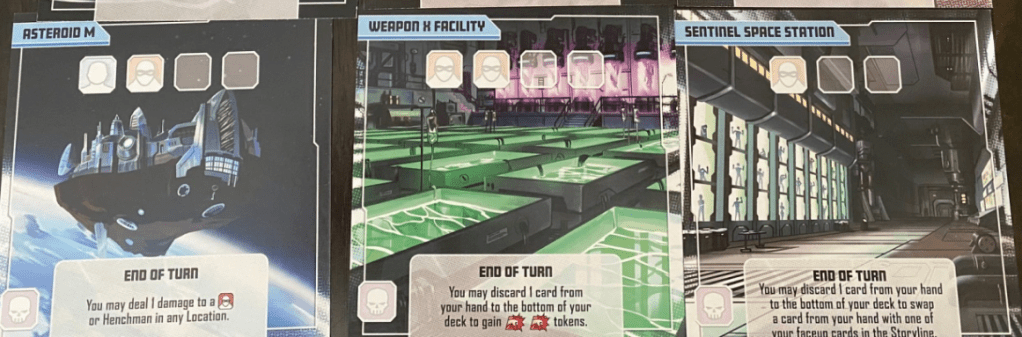
Marvel United: X-Men’s Locations have varied “End of Turn” abilities. Token draw, healing, moving to another location, rescuing a Civilian, and dealing damage to a Thug/Henchman are standard fare by this point, but Marvel United: X-Men’s Locations gives these mechanisms a few twists. But my favorite “End of Turn” ability may be Sentinel Space Station’s. You may discard 1 card from your hand to the bottom of your deck to swap a card from your hand with one of your face-up cards in the Storyline. This ability is a hint of what one can expect in other Marvel United: X-Men expansions.The Marvel United: X-Men Core Set does enough to show what the second United wave of games offers. It does a great job of building on a solid foundation.
Too Long; Didn’t Read
Marvel United: X-Men adds numerous wrinkles to the United Series’ gameplay. A player can take the role of the villain, team play is possible, and antihero characters can be either heroes or villains. The heroes within Marvel United’s second wave have more personality, while the villains remain stellar. Mystique’s mission of assassinating Senator Kelly is fantastic.
Thank you for reading, and wherever you are, I hope you’re having a great day.
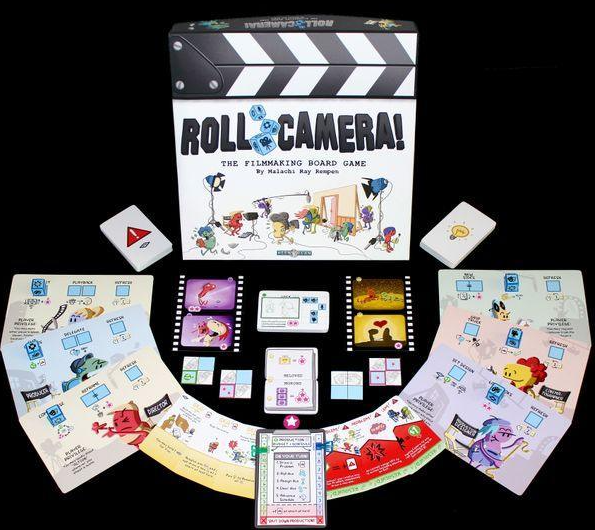
Get ready to make a cinematic masterpiece by rolling dice and placing them in Roll Camera!. Players work for a struggling film production company. The company’s on the verge of bankruptcy and one successful film can turn around the company’s fortunes. It’s up to you to make the best movie you possibly can before time—and money—run out. We’ll get into Roll Camera! in just a bit, but let’s cover some of Roll Camera!’s details.
The Fiddly Bits
Designer: Malachi Ray Rempen Publisher: Keen Bean Studio Date Released: 2021 Number of Players: 1-6 Age Range: 10 and up Setup Time: 5-10 minutes Play Time: 45-90 minutes
Game Mechanisms
Cooperative Game Dice Placement Events Open Drafting Pattern Building Set Collection Solo/Solitaire Game Variable Player Powers
Game Setup
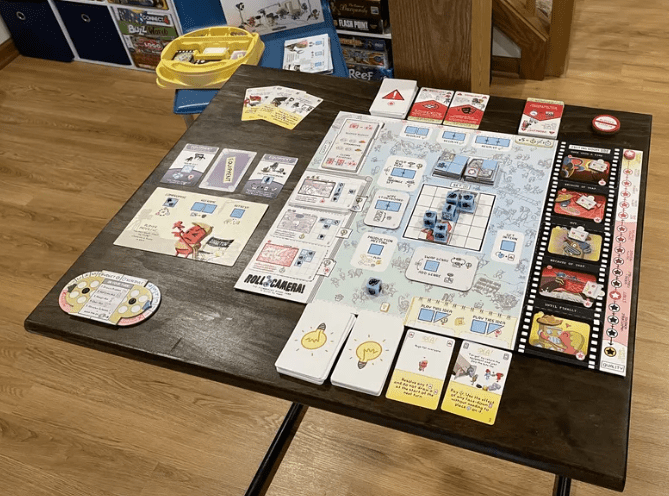
Roll Camera! doesn’t have the best rulebook; it’s a little cluttered. I’ll mention this again in the review section. Fortunately, the game board is easy to navigate, and the company (Keen Bean Studio) produced How-to-play and Turn-by-Turn Walkthrough videos. These videos help a lot. I’ll do my best to convey the information contained within the rulebook.
1) Place the main game board in the middle of the table.
2) Choose or randomly assign one player board to each player. You may use either side. Give each player the Player Aid card that corresponds to their player board.
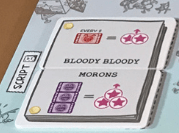
3) Shuffle the top and bottom script cards separately, then randomly select five of each to form two Script decks. Place each deck face-up in the corresponding spots on the board. Return the remaining Script cards to the box; they will not be needed.
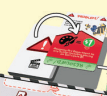
4) Shuffle the Problem deck and then place it in its space above the board (the space marked with a red triangle and exclamation point).
5) Shuffle the Idea deck and then place it in its space below the board (the space marked with a yellow lightbulb).
6) Shuffle the Scene deck and then place it on the topmost Storyboard space on the board with the “sketch” side up. Draw two Scenes from the top of this deck and place them in the two empty Storyboard slots below the Scene deck.
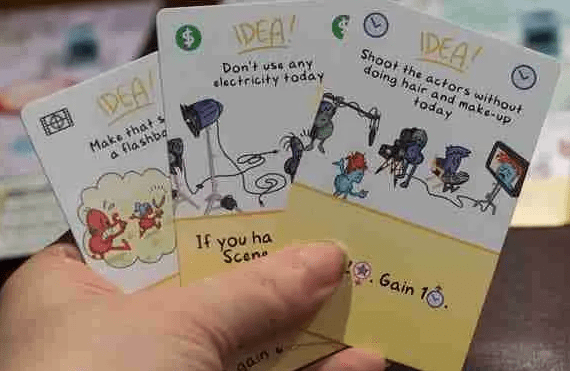
7) Deal each player three Idea cards. Even though Roll Camera! is a cooperative game, keep these cards hidden. You will always have three Idea cards in your hand.
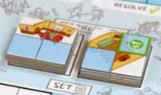
8) Mix up the Set Piece titles and place them face-up in two even stacks on their designated grey spaces on the main board, above the Set.
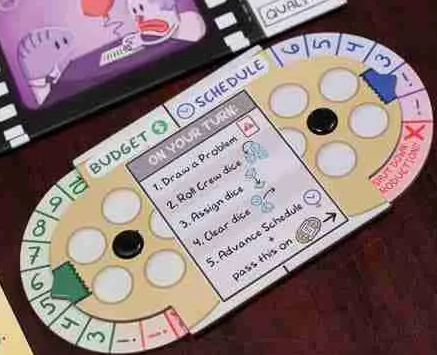
9) Adjust the Budget and Schedule dials according to the difficulty setting and number of players. The Difficulty settings are printed on the reverse side of the dials.
10) Place the pink Quality marker on the START space on the Quality track.
11) Place the “Blocked” tokens next to the Problem deck within reach. 12) Choose someone to be the starting player, giving them the six Crew dice and the Budget/Schedule dials.
Game Flow
Player turns in Roll Camera! consists of five simple steps:
1) Draw a Problem Card 2) Roll the Crew dice 3) Assign the Crew dice and take actions 4) Clear the Crew dice 5) Advance the Schedule and pass the dials
1) Draw a Problem Card
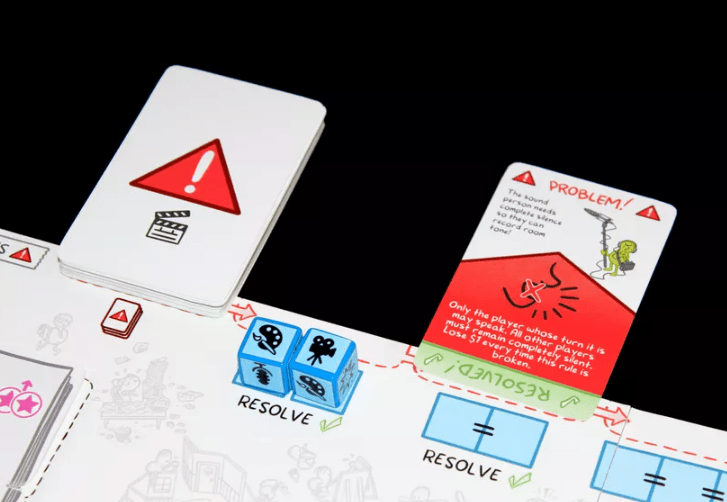
Draw one card from the Problem deck and put it in the slot immediately to the right of the Problem deck.
The Problem Queue has three slots. New Problems are added to the leftmost slot. Any existing Problems are pushed to the right. Problems never move back to the left, even if others are resolved to create a gap in the left or middle space.
If the Problem queue is filled with three problems, you don’t need to draw another one at the start of the next turn. However, you also cannot take actions, play Idea cards or gain bonuses that require drawing a Problem card if the queue is full.
2) Roll the Crew dice
Roll the Crew dice, which determine what cast and crew you’ll have available this turn.
Usually, you’ll roll all six Crew dice, but it is possible that some Crew dice have been “locked in” onto a Set Piece during a previous player’s turn. If so, you’ll roll fewer dice. At any point, you may choose to re-roll and reassign dice that were locked in on a previous turn.
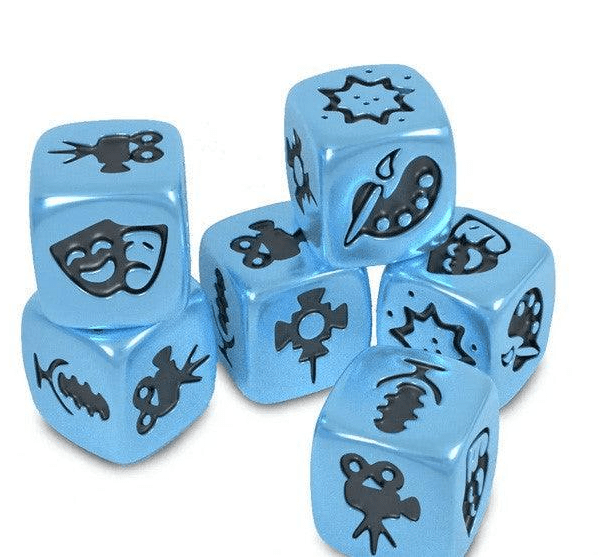
Each Crew die has six faces: Camera, Light, Sound, Actors, Art Department, and Visual Effects (or VFX, whose symbols are white to denote that it’s considered a “Wild” die face).
3) Assign the Crew dice and take actions
Take as many actions as you have dice to assign for available spaces. You can use the blue action spaces on the main board, on Set Pieces (tiles), and on your player board. You cannot use the actions on another player’s board, nor can you use an action again if its space(s) are already filled with dice.
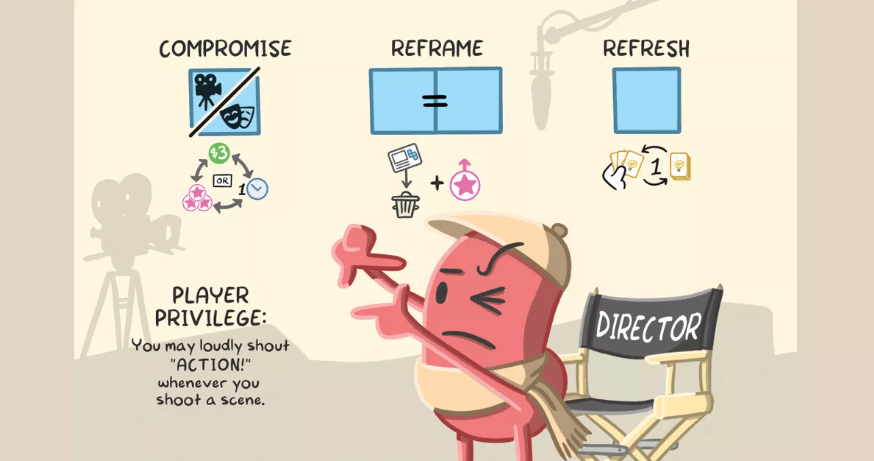
Actions will require specific dice. Refer to the following pictures, keeping in mind that the VFX die face is wild and can be used as any die face.
You don’t have to use all the Crew dice on your turn if you can’t or don’t want to; however, the next player will still re-roll any unused dice on their turn.
Locking In Dice) You may also choose to “Lock in” any of the dice you place if you aren’t able to complete an action’s requirements. Another player could then complete those requirements on a future turn.
If you do this, the next player will roll fewer dice.
4) Clear the Crew dice
Once you’ve taken all the actions you want, clear the dice, leaving any locked-in dice on their spaces, and hand the dice to the next player.
5) Advance the Schedule and pass the dials
Turn the Schedule dial to lower your remaining time by one and hand the dials to the player to your left. Your turn is over; it’s now the next player’s turn, and they begin with Step 1).
Ending the Game
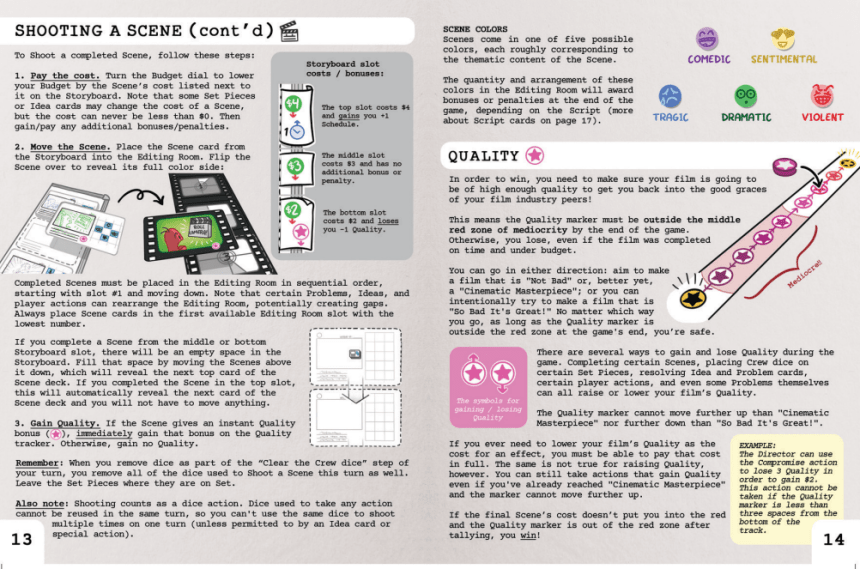
Play continues as above until players finish five scenes in the Editing Rooms and the movie is in one of the white sections on the Quality track. It is possible to create a “So Bad, It’s Good” movie. The game can also end if you run out of time on the dial. If this happens, you don’t get to finish your movie. Sad times.
Review
I’ll begin by reiterating that Roll Camera!’s rulebook is—at best—confusing. Thank goodness there are multiple videos explaining how to play the game. I recommend watching the rules video at least before attempting to play the game or even reading the rules as written.
The cluttered rulebook runs counter to Roll Camera!’s game board. One could almost figure out how to play by the symbols on the board. That’s the mark of great graphic design. I’m shocked this didn’t carry over to the rulebook. I get it. Writing a rulebook is my least favorite part of designing and developing a board game, but Roll Camera!’s rulebook is borderline unreadable.
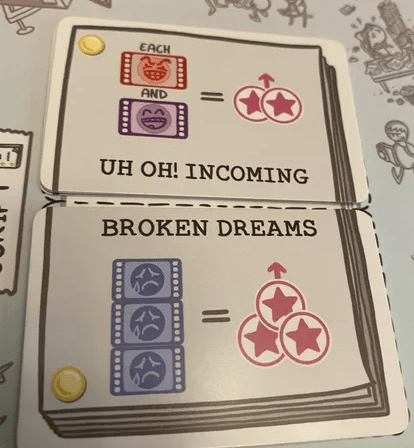
That’s a lot of text for a few images. Yikes!
There are a lot of individual mechanisms contained within Roll Camera!’s gameplay, but they all work together toward a cohesive whole. Player boards (with their unique abilities) make sense for player roles. Production design can improve the movie’s quality by expending an art department die face, the editor can move scenes around after they’re shot to meet requirements set by the script, and the producer can cut corners, generating money and an extra problem. Since the player abilities are tied neatly within Roll Camera!’s theme, it makes the abilities intuitive.
The requirements for placing dice are similar to those used in numerous dice placement games (like Alien Frontiers). That’s a strength. Similar symbols added with me learning how to play Roll Camera!. The Set Pieces made for an interesting puzzle the group must solve. Do we build a Set Piece with more blue, but specific blue spaces (like only actors can be placed on a space), or do we go for limited spaces with which to place dice, but when we do place dice on those spaces, you gain a bonus (like more money or more time)? These may seem like small choices, but these small choices add up to plenty of variables.
Roll Camera! even includes bad die roll mitigation. A player may choose the “Get Intern” action, setting a die to any die face but gaining a problem. Ah! The dangers of hiring interns. Roll Camera! uses its theme with most—if not every—design decision.
The most interesting action a player can choose during a turn may be “Production Meeting.” Players (including the active player) donate one idea card each to the active player. The active player will then choose which idea card to play, which one to save for later (you can replace another saved idea card if needed), and which idea card to discard. This is an interesting way to keep players engaged even when it’s not their turn as the active player. I may have to steal this game mechanism for a future game. Lol. Technically, the active player could play more than one idea card in a single turn. Saved idea cards can be played by placing dice on the spaces above their save space. The concept that you can play one die at a penalty versus playing an idea card for no penalty if you place two dice is brilliant.
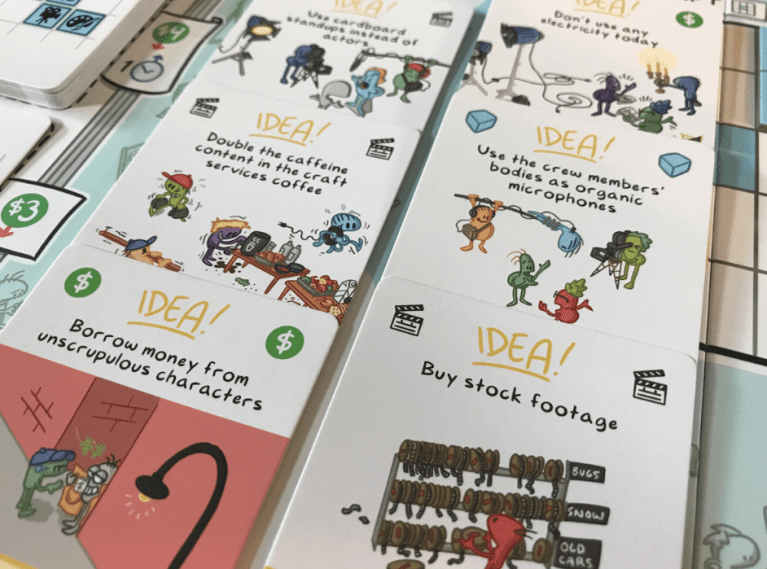
Idea and problem cards uphold the theme. I don’t know how many times I chuckled when an editing-specific problem occurred while I played as the Editor or a directing-specific problem happened during the Director’s turn. Roll Camera! does what it sets out to do. It takes the world of cinematography and applies it to a fast-paced dice placement game.
I don’t even mind when my team and I fail, and we make a “So Bad, It’s Good” movie. In fact, those may be the best games of Roll Camera!.
Too Long; Didn’t Read
Dreadful rulebook aside (watch the how-to-play video instead), Roll Camera! takes the world of movies and turns it into a fast-paced dice placement game. Roll Camera! incorporates a lot of mechanisms, but each one works to form a cohesive whole that captures the essence of the game’s theme. Roll Camera! may be one of the few games I don’t mind losing. Heck! I like making a movie that’s “So Bad, It’s Good.”
1997 was another stellar year for tabletop games. There were so many games to choose from that we have an honorable mention for the first time in a couple of yearly lists. Hey, hey, Geekly Gang! Kyra Kyle here. We’re back with another Top 5 Tabletop Games throughout the years; today’s list is the top five board games of 1997. We’ll talk about 1997’s board game list soon, but let’s review the ground rules for which games make these lists before we begin.
1: Cultural relevance plays as much of a factor as overall quality. A game might make a list that doesn’t hold up to others of its type, but you must admit the game is everywhere.
2: Only one game from a franchise makes the list. This will become more of an issue the closer we get to games with expansions.
3: Longevity plays a role, too. A game doesn’t have to fly off the shelves today, but it had to have some widespread appeal for a decent time.
Honorable Mention: Mississippi Queen (1997)
Yep. 1997’s winner of the Spiel des Jahres (German Game of the Year) just misses our list. Mississippi Queen puts gamers in the role of a paddlewheeler captain in a race down the Mississippi River in 1871. Mississippi Queen won numerous awards, not just the Spiel, and it’s a stellar game, but the other games that made this list have had longer staying power. Still, Mississippi Queen is a satisfying racing game.
5: Tigris and Euphrates (1997)
The incomparable Reiner Knizia makes another one of these lists with Tigris and Euphrates. Many gamers may balk at this game being this low. Tigris and Euphrates is often dubbed a “gamer’s game.” It centers on a clash between neighboring dynasties along the Tigris and Euphrates Rivers. Funny, both of the first games we’re talking about are named after famous rivers. Anyway, Tigris and Euphrates offers tactical and strategic objectives, where immediate (tactical) goals are more realistic at larger but smaller player counts allow for long-term planning.
Tigris and Euphrates features drawing tiles from a bag. Players may redraw tiles if they don’t like the ones they drew by spending an action point (players have two action points per turn). After drawing tiles, players will place tiles and leaders onto the board, creating and expanding regions and kingdoms. During the game, players collect points in each of the four tile colors, prompting players to balance the tile types they play. Tigris and Euphrates has a lot more conflict than most German games during this time. It’s a classic.
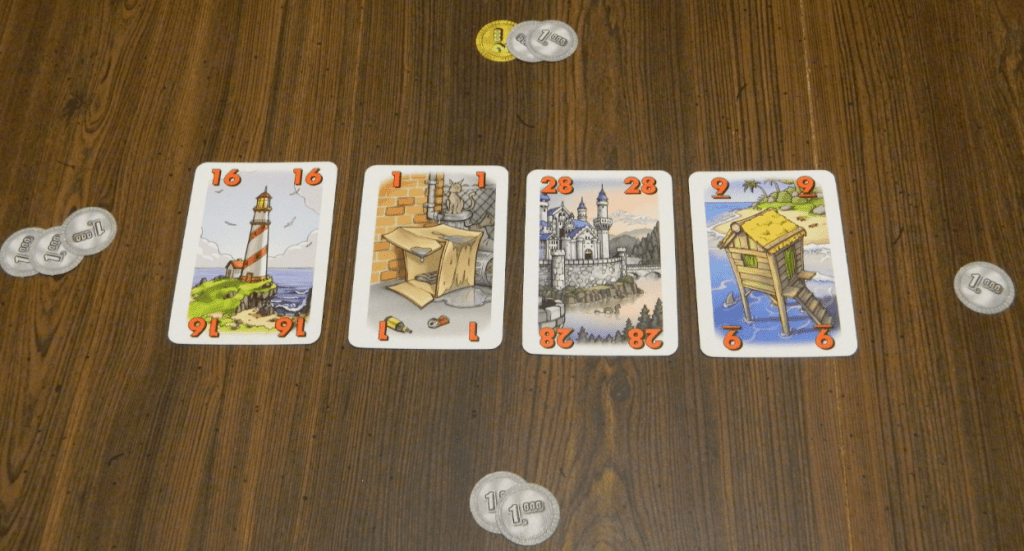
4: For Sale (1997)
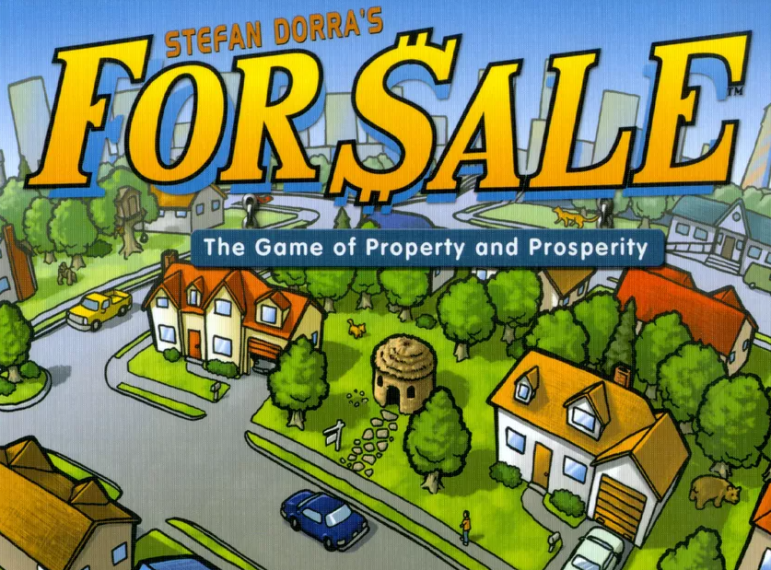
For Sale is a fast-paced auction card game about real estate. It’s played in two phases. During the first phase, players bid for several buildings. After all the properties are purchased, the second phase begins, and players sell their buildings for the highest profit. For Sale is one of those easy-to-teach, easy-to-learn, and difficult-to-master card games.
In short, For Sale may be the opposite of Tigris and Euphrates. Both are stellar games, but I’m giving For Sale the slight nod for its accessibility.
3: GIPF (1997)
GIPF is the first abstract strategy game to make one of these lists in several posts. GIPF was recommended for the Spiel des Jahres in 1998. It has plenty of accolades, but GIPF makes this list because it began a series of abstract strategy board games by designer Kris Burm named the GIPF Project. TZAAR, ZERTZ, DVONN, YINSH, PUNCT, LYNGK, and MATRX GIPF are great games that use various game mechanisms. But we’re talking about GIPF, the game of pushing.
GIPF takes a board that looks like it could belong in Chinese Checkers. Players introduce a new piece (disc) on the hexagonal game board and push their piece in a straight line. GIPF involves no luck. It’s a straight-up brain burner, and it reintroduced the gaming community to abstract strategy games akin to Go or Othello.
2: Bohnanza (1997)
Uwe Rosenberg makes his first appearance on one of these lists with Bohnanza. The game’s title is a pun on the German word Bohne (for bean) and the English word bonanza (for an exceptionally large and rich mineral deposit). Players plant bean cards and then harvest them to earn coins. Each player begins with a random hand of bean cards, and each card has a number on it corresponding to the number of that type of beans in the deck. Modern card game darling, Flip 7, may have borrowed that idea from Bohnanza. Cards with fewer copies in the deck are more difficult to collect, but players don’t need as many copies of the cards to harvest (or make a set).
Bohnanza features trading and can get political. Get ready to make your case. More so than any other game on this list—so far—I’ve seen Bohnanza played in game shops and board game cafés.
1: Twilight Imperium (1997)
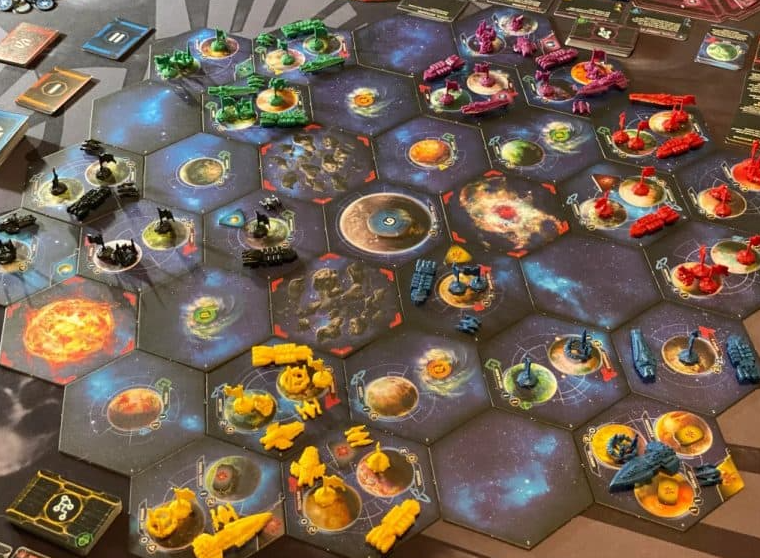
Twilight Imperium is a board game space opera. Twilight Imperium is the closest thing to a board game version of Star Wars. Twilight Imperium is a classic 4X board game: explore, expand, exploit, and exterminate. You choose how your civilization will settle the cosmos. Twilight Imperium is not for the faint of heart. Games run a minimum of five hours. This is one of the reasons why I’ve only observed games of Twilight Imperium. There’s a lot going on, but if you want to control every move of an intergalactic kingdom, few games do as good a job of capturing that vibe as Twilight Imperium.
You can even dive into Twilight Imperium’s world with its novel series published by Aconyte Books or play the tabletop role-playing game spinoff. Twilight Imperium is a game that some board gamers play exclusively. And there may be a good reason for that. As recently as last year (2024), Nerdist and Polygon dubbed Twilight Imperium as one of the greatest board games ever made. Twilight Imperium easily tops our 1997 list of tabletop games.
Did we get the list mostly correct? Let us know which games you’d add in the comments. Thank you for reading, and wherever you are, I hope you’re having a great day.
1996 was a weaker year for board games than the past handful of years, but a banner year for collectible card games. As a result, we’re lifting the CCG embargo for the 1996 list. There will be more than one CCG entry for the top 5 tabletop games from 1996, and it’s a doozy of a collectible card game. Woo hoo!
Hey, hey! Kyra Kyle here. We’re back with another Top 5 Tabletop Games. We’ll talk about 1996’s board game list soon, but let’s recap the ground rules for which games make these lists before we start.
1: Cultural relevance plays as much of a factor as overall quality. A game might make a list that doesn’t hold up to others of its type, but you must admit the game is everywhere.
2: Only one game from a franchise makes the list. This will become more of an issue the closer we get to games with expansions.
3: Longevity plays a role, too. A game doesn’t have to fly off the shelves today, but it had to have some widespread appeal for a decent time.
5: Mythos Collectible Card Game (1996)
We begin this list with an interesting collectible card game, Mythos. Based on the Cthulhu Mythos stories of horror author H.P. Lovecraft, Mythos is also an adaptation of the Call of Cthulhu role-playing game. Mythos combines elements of some traditional card games like Rummy and borrows other concepts from previous CCGs. While the game is playable by two players, the intent is for Mythos to be played by a larger number of players. The main objective of Mythos is to collect points by completing adventures. Adventures are cards that include keywords derived from different card names and types. Once the required cards are in the player’s story deck or on the table, the player can play the adventure and receive its points.
Mythos differs from many collectible card games because of its lack of a combat focus. This is a CCG that attempts to tell a story. Unfortunately, Mythos faltered after its initial release. Later expansions, most notably the non-collectible Standard Game Set, confused consumers and forced the publisher Chaosium to discontinue Mythos only one year after the game’s original release. Still, Mythos shows what collectible card games can achieve. It earned its distinction as one of Pyramid magazine’s The Millennium’s Best Card Games.
4: Mad Gab (1996)
Lately, we haven’t included too many mass-market board games in these lists. Mad Gab bucks this trend. It does so, not just because 1996 was a weaker year for board games like I mentioned, but because it was a cultural cornerstone. Mad Gab uses puzzles known as mondegreens (misheard words that could mean something else) and contain small words that, when put together, make a word or a phrase. For example, “These If Hill Wore” when pronounced quickly sounds like “The Civil War.” Mad Gab had two levels, easy and hard. The faster players solve the puzzles, the more points they score.
Mad Gab uses phonetics. It tests players’ ability to process sounds based on simpler English-written sounds into a meaningful word or phrase. Players must read the words aloud. Reading the phrases silently won’t allow someone to decode the puzzles’ meaning because the sounds need to be decoded.
3: Kill Doctor Lucky (1996)
We covered Mystery of the Abbey on our last week, and that game revamped Cluedo (or Clue for the United States). Kill Doctor Lucky flips the idea of Clue on its head. Kill Doctor Lucky features a sprawling mansion filled with a variety of dangerous weapons. Cluedo begins after the murder has been committed, and players compete to solve it; Kill Doctor Lucky ends with the murder, and players attempt to kill the titular character, Doctor Lucky.
Players must find a secluded room before slaying Doctor Lucky. You can even gain extra points if you pair a weapon with a specific room. For example, if you kill Doctor Lucky in the wine cellar with a trowel, you’ll gain extra points, alluding to Poe’s short story “The Cask of Amontillado.” As soon as I heard that Clue: The Movie could receive a remake, I wondered why Hollywood didn’t choose to go with a Kill Doctor Lucky movie. Why not lean into the silliness?
2: Netrunner (1996)
We have yet another Richard Garfield collectible card games that make one of these lists. Garfield has a knack for stretching the boundaries of collectible card games. That makes sense. He did create this form of game. Like Mythos, Netrunner doesn’t have a focus on combat. It takes place in the Cyberpunk 2020 role-playing game universe (which is also the basis for Cyberpunk 2077) and pits players against each other in asymmetric roles. One player assumes the role of a runner, who tries to break through and steal hidden plans (hacking) of the mega-corporations (the Corp) that run the world. The other player assumes the role of the Corp and attempts to catch the runner.
Beyond its focus on non-combat, Netrunner was unique because most collectible card games are framed as a battle between peers. Netrunner has two very different sides facing off against each other. While the collectible card game only ran for a few years, in 2012, Fantasy Flight Games adapted Netrunner into Android: Netrunner, which is a living card game that ran until 2019. Netrunner has a long and storied history. Its fans are fierce. But it doesn’t claim our top spot on this list. A different collectible card game has that honor.
1: Pokémon Trading Card Game (1996)
Pokémon had to claim the top spot for 1996. It’s the second-longest-running collectible card game in history. When Pokémon first released, it sold out so fast that all the trading card manufacturers in the world postponed their other orders (like baseball, football, and basketball cards) to fill the demand for new Pokémon cards. Releasing later the same year as Pokémon Red, Blue, and Yellow (the original Pokémon video games on the Game Boy) helped catapult Pokémon to legendary status.
Play alternates between players who take several actions during their turn, including playing Basic Pokémon, evolving Pokémon, attaching an Energy card, playing Trainer cards, and using Pokémon abilities and attacks. The first Pokémon Trading Card Game sets played like simplified Magic: The Gathering decks. This helped Pokémon and built a pipeline for Magic. Wizards of the Coast, the producer of Magic: The Gathering, didn’t mind because the Pokémon Company licensed the Pokémon Trading Card Game to Wizards of the Coast, who published eight expansion sets between 1998 and 2003, after which the licensing transferred back to The Pokémon Company. The Pokémon Trading Card Game is one of the few games of this type from the original trading card boom that has stayed in continuous production. I haven’t played Pokémon in years, but I have fond memories. This game’s legacy demands that it takes our top spot.
Did we get the list mostly correct? Let us know which games you’d add in the comments. Thank you for reading, and wherever you are, I hope you’re having a great day.
Flip 7 takes the premise of Blackjack and extends it to party game proportions. Flip over cards one by one without flipping the same number twice. While the game choices are simple (hit or stay), the ramifications of your actions aren’t. Are you the type of player to play it safe and bank points before you bust, or will you risk it all for the bonus by flipping over seven unique cards in a row? Hey, hey! Kyra Kyle here. We’ll review Flip 7 in a moment, but before we draw our first card, let’s discuss Flip 7’s fine print.
The Fiddly Bits
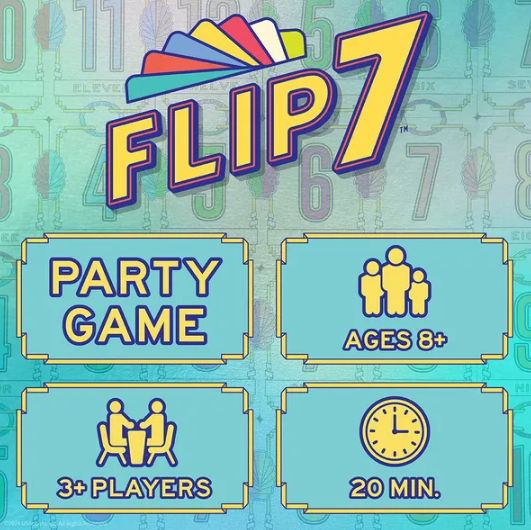
Designer: Eric Olsen Publisher: The Op Games; KOSMOS Date Released: 2024 Number of Players: 3-18 Age Range: 6 and up Setup Time: Nominal Play Time: 10-20 minutes
Shuffle the deck and choose a player to be the Dealer for the round.
In turn order, the Dealer deals one card face up to each player, including themselves. If an Action card is drawn, resolve it immediately (more on Action cards in the Game Flow section). Once any Action cards are resolved, continue dealing until everyone has been dealt a card. Not everyone will have a Number card (a card with a number). Some players may have multiple cards because of other Action cards.
Game Flow
The Dealer now offers each player in turn the option to “Hit” (deal them another card) or “Stay” (exit the round and bank their points). If you Hit, put the Number cards in a single row with Score Modifier cards.
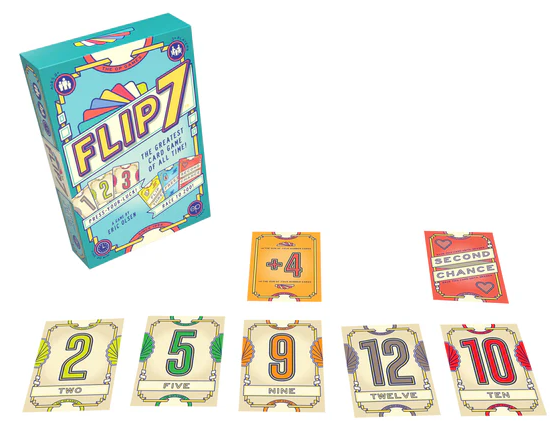
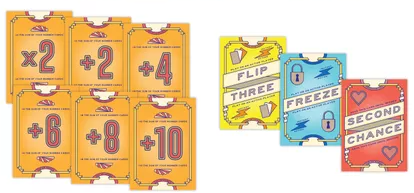
Flip 7 features a special deck of cards. It’s Number cards range from 0 to 12. There are copies of each card equal to the card’s value. For example, there are 12 copies of the 12 Number card and 5 copies of the 5 Number card. Zero is the only exception; there’s only one copy of the 0 Number card. Flip 7’s deck also contains Score Modifier cards (Times 2 which doubles your point value and the rest adding a flat number to your score). Flip 7 also has three Action cards: Freeze, Flip Three, and Second Chance. Second Chance allows you to ignore one bust (drawing the same Number card). Flip Three allows the player to choose a player (even themselves) to draw three cards in a row. Freeze cards are given to a player to force them to stay for the round (they will not be able to draw more cards).
Remember: Players bust (don’t receive points and are eliminated from the round) if they draw two of the same Number card.
The round continues until one of two criteria are met. 1) There are no active players because all players have busted or chosen to stay. 2) One player can Flip 7 number cards, ending the round immediately.
At the end of each round, players score points. Add the value of all your Number cards. Adjust your score with any Score Modifier cards. If you Flip 7 Number cards during the round, score an additional 15 points.
When starting the next round, set all cards from the previous round aside. Do not shuffle them back into the deck. Pass the remaining cards in the deck to the left, that player becomes the new Dealer. When the deck runs out, shuffle all discards to form a new deck. If you need to reshuffle mid-round, leave all cards in front of the players where they are.
At the end of the round when at least one player reaches 200 points, the player with the most points wins.
Review
Flip 7 has taken the tabletop gaming community by storm. I can see why. It has a simple premise (party game Blackjack) and easy-to-understand choices each turn and round. Flip 7 is necessary for the tabletop community. In practice, Flip 7 is the game I can play with my grandma and my four-year-old niece. It’s the most gateway of gateway games.
Since this is the case, I’ve played Flip 7 a ton over the past several months. Seriously, Flip 7 was released during the holiday season (December 2024), I’m writing this in early May (we write many of our reviews weeks, if not months, in advance), and I’ve played this game with 10 different game groups and over 150 times. That’s about 30 times every month. I’ve almost played Flip 7 once every day. One of those months was February, so I’ve definitely played Flip 7 once every day. Frankly, I’m sick of playing Flip 7. It’s a good filler game, but I haven’t seen a game with this much crossover appeal.
And that’s a strength for Flip 7. It’s one of the few games I can get everyone on board playing. That’s why it’s necessary for the tabletop community and for tabletop gaming. But does it convince non-gamers to try other games that aren’t Flip 7? I’m unsure.
But I do like the inclusion of Action cards. There are three copies of each Action card. Freeze seems mean, but it could be pivotal in stopping someone who had an easy rise to the top of the scoring track; it’s a decent catch-up game mechanism of sorts but this can devolve into targeting the leader (like Munchkin). Players can only hold onto one Second Chance. I don’t know how many times I’ve seen a player forced to give a second copy of Second Chance to an opponent. Those cards have a way of finding the same player. But Flip Three has the most strategic value. During the early game, you may want to target yourself. Later in the game, you’ll want to choose someone else and force them to bust. Is this enough strategy? Probably not for many tabletop gamers.
I can see that people who can count cards have an advantage in Flip 7, but that takes the fun out of the game. While the rules don’t forbid someone from looking at the discard, it goes against the soul of Flip 7. The Number cards value equaling the number of copies in the deck is clever, and the game doesn’t overstay its welcome—unless you’ve played it over 150 times in a handful of months.
Flip 7’s box says 3+ players. Its entry on BoardGameGeek lists it as 3-99 players. The rulebook suggests that if you have more than a dozen players, use a second copy of Flip 7. While this may be technically true, the game plays best at 5-6 players. Flip 7 would overstay its welcome if you included over a dozen players. It would take forever for twelve people to determine whether they should hit or stay. There isn’t much else to Flip 7, but I’d be bored if I had to wait for eleven other people to make that simple choice. And forget 98 other people. I’d walk away from the table.
Too Long; Didn’t Read
While not my first or second choice of filler game, Flip 7 has enough crossover appeal to appease the masses. It doesn’t have enough strategy for hardcore tabletop gamers, but Flip 7 is the kind of game I can get my grandma or four-year-old niece to play. Therefore, Flip 7 is a good game to keep on hand for non-gamers.

















































 jkgeekly.com