Top 5 Tabletop Games from 1997

1997 was another stellar year for tabletop games. There were so many games to choose from that we have an honorable mention for the first time in a couple of yearly lists. Hey, hey, Geekly Gang! Kyra Kyle here. We’re back with another Top 5 Tabletop Games throughout the years; today’s list is the top five board games of 1997. We’ll talk about 1997’s board game list soon, but let’s review the ground rules for which games make these lists before we begin.

1: Cultural relevance plays as much of a factor as overall quality. A game might make a list that doesn’t hold up to others of its type, but you must admit the game is everywhere.

2: Only one game from a franchise makes the list. This will become more of an issue the closer we get to games with expansions.

3: Longevity plays a role, too. A game doesn’t have to fly off the shelves today, but it had to have some widespread appeal for a decent time.

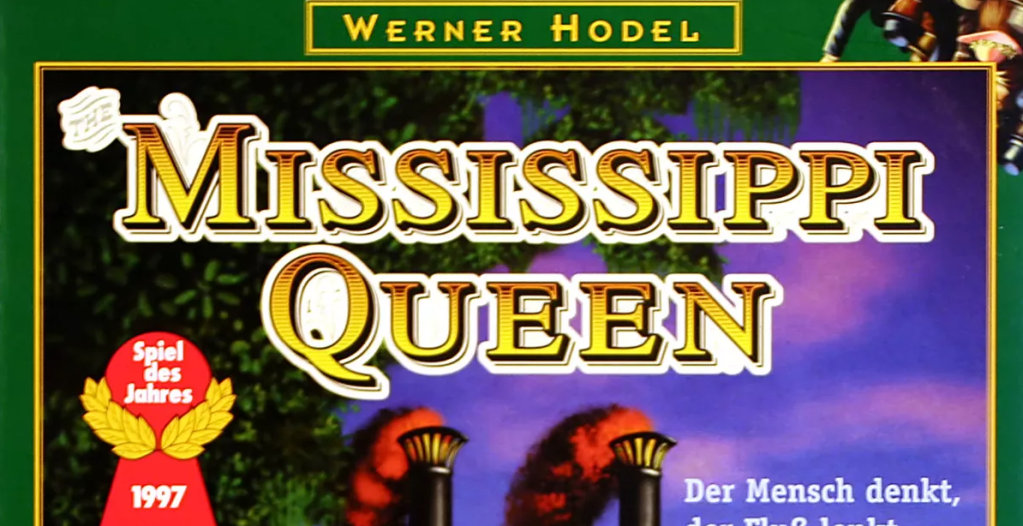
Honorable Mention: Mississippi Queen (1997)

Yep. 1997’s winner of the Spiel des Jahres (German Game of the Year) just misses our list. Mississippi Queen puts gamers in the role of a paddlewheeler captain in a race down the Mississippi River in 1871. Mississippi Queen won numerous awards, not just the Spiel, and it’s a stellar game, but the other games that made this list have had longer staying power. Still, Mississippi Queen is a satisfying racing game.

5: Tigris and Euphrates (1997)

The incomparable Reiner Knizia makes another one of these lists with Tigris and Euphrates. Many gamers may balk at this game being this low. Tigris and Euphrates is often dubbed a “gamer’s game.” It centers on a clash between neighboring dynasties along the Tigris and Euphrates Rivers. Funny, both of the first games we’re talking about are named after famous rivers. Anyway, Tigris and Euphrates offers tactical and strategic objectives, where immediate (tactical) goals are more realistic at larger but smaller player counts allow for long-term planning.

Tigris and Euphrates features drawing tiles from a bag. Players may redraw tiles if they don’t like the ones they drew by spending an action point (players have two action points per turn). After drawing tiles, players will place tiles and leaders onto the board, creating and expanding regions and kingdoms. During the game, players collect points in each of the four tile colors, prompting players to balance the tile types they play. Tigris and Euphrates has a lot more conflict than most German games during this time. It’s a classic.

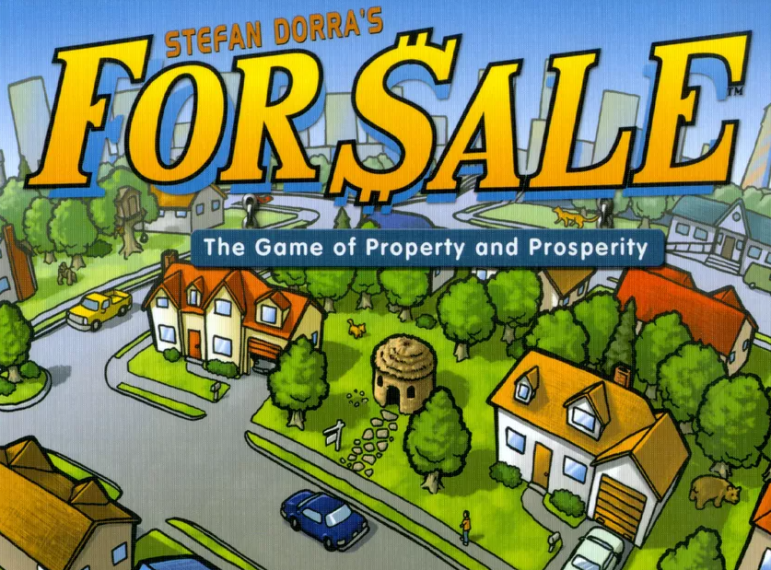
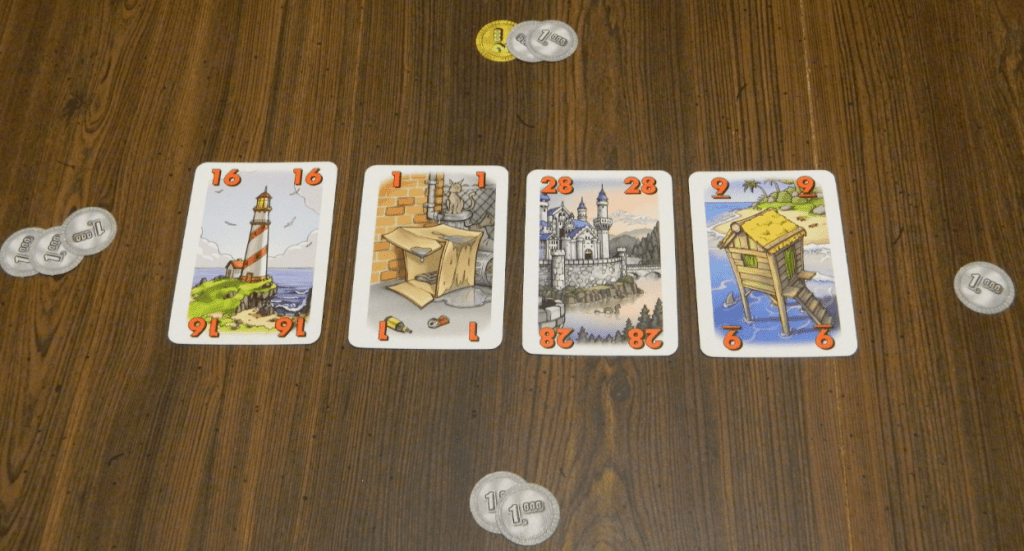
4: For Sale (1997)

For Sale is a fast-paced auction card game about real estate. It’s played in two phases. During the first phase, players bid for several buildings. After all the properties are purchased, the second phase begins, and players sell their buildings for the highest profit. For Sale is one of those easy-to-teach, easy-to-learn, and difficult-to-master card games.

In short, For Sale may be the opposite of Tigris and Euphrates. Both are stellar games, but I’m giving For Sale the slight nod for its accessibility.

3: GIPF (1997)

GIPF is the first abstract strategy game to make one of these lists in several posts. GIPF was recommended for the Spiel des Jahres in 1998. It has plenty of accolades, but GIPF makes this list because it began a series of abstract strategy board games by designer Kris Burm named the GIPF Project. TZAAR, ZERTZ, DVONN, YINSH, PUNCT, LYNGK, and MATRX GIPF are great games that use various game mechanisms. But we’re talking about GIPF, the game of pushing.

GIPF takes a board that looks like it could belong in Chinese Checkers. Players introduce a new piece (disc) on the hexagonal game board and push their piece in a straight line. GIPF involves no luck. It’s a straight-up brain burner, and it reintroduced the gaming community to abstract strategy games akin to Go or Othello.

2: Bohnanza (1997)

Uwe Rosenberg makes his first appearance on one of these lists with Bohnanza. The game’s title is a pun on the German word Bohne (for bean) and the English word bonanza (for an exceptionally large and rich mineral deposit). Players plant bean cards and then harvest them to earn coins. Each player begins with a random hand of bean cards, and each card has a number on it corresponding to the number of that type of beans in the deck. Modern card game darling, Flip 7, may have borrowed that idea from Bohnanza. Cards with fewer copies in the deck are more difficult to collect, but players don’t need as many copies of the cards to harvest (or make a set).

Bohnanza features trading and can get political. Get ready to make your case. More so than any other game on this list—so far—I’ve seen Bohnanza played in game shops and board game cafés.

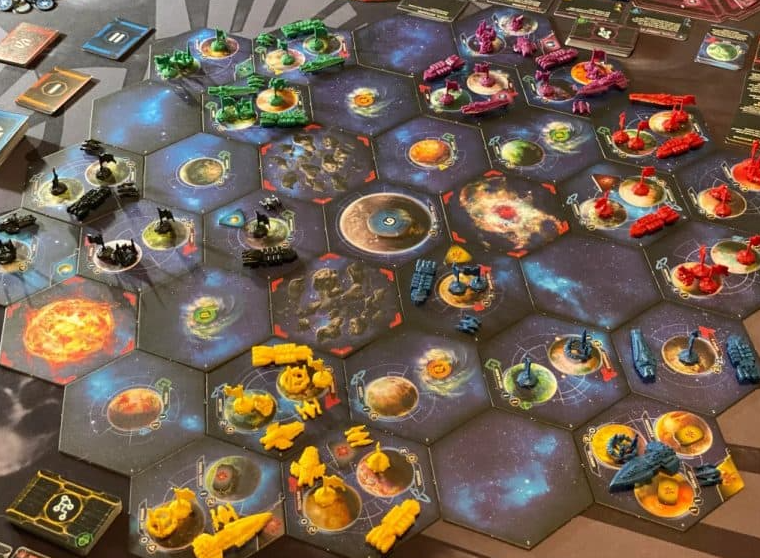
1: Twilight Imperium (1997)

Twilight Imperium is a board game space opera. Twilight Imperium is the closest thing to a board game version of Star Wars. Twilight Imperium is a classic 4X board game: explore, expand, exploit, and exterminate. You choose how your civilization will settle the cosmos. Twilight Imperium is not for the faint of heart. Games run a minimum of five hours. This is one of the reasons why I’ve only observed games of Twilight Imperium. There’s a lot going on, but if you want to control every move of an intergalactic kingdom, few games do as good a job of capturing that vibe as Twilight Imperium.

You can even dive into Twilight Imperium’s world with its novel series published by Aconyte Books or play the tabletop role-playing game spinoff. Twilight Imperium is a game that some board gamers play exclusively. And there may be a good reason for that. As recently as last year (2024), Nerdist and Polygon dubbed Twilight Imperium as one of the greatest board games ever made. Twilight Imperium easily tops our 1997 list of tabletop games.

Did we get the list mostly correct? Let us know which games you’d add in the comments. Thank you for reading, and wherever you are, I hope you’re having a great day.

Check out the other lists in this series:
Top 5 Tabletop Games Prior to the 1930s
Top 5 Tabletop Games of the 1930s
Top 5 Tabletop Games of the 1940s-50s
Top 5 Tabletop Games from the Early 1960s
Top 5 Tabletop Games from the Late 1960s
Top 5 Tabletop Games from the Early 1970s
Top 5 Tabletop Games from 1980-1981
Top 5 Tabletop Games from 1982-1983
Top 5 Tabletop Games from 1984-1985
Top 5 Tabletop Games from 1986-1987
Top 5 Tabletop Games from 1988-1989
Top 5 Tabletop Games from 1990-1991
Top 5 Tabletop Games from 1992
Top 5 Tabletop Games from 1993
Top 5 Tabletop Games from 1994
Top 5 Tabletop Games from 1995
Top 5 Tabletop Games from 1996

Top 5 Tabletop Games from 1996

1996 was a weaker year for board games than the past handful of years, but a banner year for collectible card games. As a result, we’re lifting the CCG embargo for the 1996 list. There will be more than one CCG entry for the top 5 tabletop games from 1996, and it’s a doozy of a collectible card game. Woo hoo!

Hey, hey! Kyra Kyle here. We’re back with another Top 5 Tabletop Games. We’ll talk about 1996’s board game list soon, but let’s recap the ground rules for which games make these lists before we start.

1: Cultural relevance plays as much of a factor as overall quality. A game might make a list that doesn’t hold up to others of its type, but you must admit the game is everywhere.

2: Only one game from a franchise makes the list. This will become more of an issue the closer we get to games with expansions.

3: Longevity plays a role, too. A game doesn’t have to fly off the shelves today, but it had to have some widespread appeal for a decent time.

5: Mythos Collectible Card Game (1996)

We begin this list with an interesting collectible card game, Mythos. Based on the Cthulhu Mythos stories of horror author H.P. Lovecraft, Mythos is also an adaptation of the Call of Cthulhu role-playing game. Mythos combines elements of some traditional card games like Rummy and borrows other concepts from previous CCGs. While the game is playable by two players, the intent is for Mythos to be played by a larger number of players. The main objective of Mythos is to collect points by completing adventures. Adventures are cards that include keywords derived from different card names and types. Once the required cards are in the player’s story deck or on the table, the player can play the adventure and receive its points.

Mythos differs from many collectible card games because of its lack of a combat focus. This is a CCG that attempts to tell a story. Unfortunately, Mythos faltered after its initial release. Later expansions, most notably the non-collectible Standard Game Set, confused consumers and forced the publisher Chaosium to discontinue Mythos only one year after the game’s original release. Still, Mythos shows what collectible card games can achieve. It earned its distinction as one of Pyramid magazine’s The Millennium’s Best Card Games.

4: Mad Gab (1996)

Lately, we haven’t included too many mass-market board games in these lists. Mad Gab bucks this trend. It does so, not just because 1996 was a weaker year for board games like I mentioned, but because it was a cultural cornerstone. Mad Gab uses puzzles known as mondegreens (misheard words that could mean something else) and contain small words that, when put together, make a word or a phrase. For example, “These If Hill Wore” when pronounced quickly sounds like “The Civil War.” Mad Gab had two levels, easy and hard. The faster players solve the puzzles, the more points they score.

Mad Gab uses phonetics. It tests players’ ability to process sounds based on simpler English-written sounds into a meaningful word or phrase. Players must read the words aloud. Reading the phrases silently won’t allow someone to decode the puzzles’ meaning because the sounds need to be decoded.

3: Kill Doctor Lucky (1996)

We covered Mystery of the Abbey on our last week, and that game revamped Cluedo (or Clue for the United States). Kill Doctor Lucky flips the idea of Clue on its head. Kill Doctor Lucky features a sprawling mansion filled with a variety of dangerous weapons. Cluedo begins after the murder has been committed, and players compete to solve it; Kill Doctor Lucky ends with the murder, and players attempt to kill the titular character, Doctor Lucky.

Players must find a secluded room before slaying Doctor Lucky. You can even gain extra points if you pair a weapon with a specific room. For example, if you kill Doctor Lucky in the wine cellar with a trowel, you’ll gain extra points, alluding to Poe’s short story “The Cask of Amontillado.” As soon as I heard that Clue: The Movie could receive a remake, I wondered why Hollywood didn’t choose to go with a Kill Doctor Lucky movie. Why not lean into the silliness?

2: Netrunner (1996)

We have yet another Richard Garfield collectible card games that make one of these lists. Garfield has a knack for stretching the boundaries of collectible card games. That makes sense. He did create this form of game. Like Mythos, Netrunner doesn’t have a focus on combat. It takes place in the Cyberpunk 2020 role-playing game universe (which is also the basis for Cyberpunk 2077) and pits players against each other in asymmetric roles. One player assumes the role of a runner, who tries to break through and steal hidden plans (hacking) of the mega-corporations (the Corp) that run the world. The other player assumes the role of the Corp and attempts to catch the runner.

Beyond its focus on non-combat, Netrunner was unique because most collectible card games are framed as a battle between peers. Netrunner has two very different sides facing off against each other. While the collectible card game only ran for a few years, in 2012, Fantasy Flight Games adapted Netrunner into Android: Netrunner, which is a living card game that ran until 2019. Netrunner has a long and storied history. Its fans are fierce. But it doesn’t claim our top spot on this list. A different collectible card game has that honor.

1: Pokémon Trading Card Game (1996)

Pokémon had to claim the top spot for 1996. It’s the second-longest-running collectible card game in history. When Pokémon first released, it sold out so fast that all the trading card manufacturers in the world postponed their other orders (like baseball, football, and basketball cards) to fill the demand for new Pokémon cards. Releasing later the same year as Pokémon Red, Blue, and Yellow (the original Pokémon video games on the Game Boy) helped catapult Pokémon to legendary status.

Play alternates between players who take several actions during their turn, including playing Basic Pokémon, evolving Pokémon, attaching an Energy card, playing Trainer cards, and using Pokémon abilities and attacks. The first Pokémon Trading Card Game sets played like simplified Magic: The Gathering decks. This helped Pokémon and built a pipeline for Magic. Wizards of the Coast, the producer of Magic: The Gathering, didn’t mind because the Pokémon Company licensed the Pokémon Trading Card Game to Wizards of the Coast, who published eight expansion sets between 1998 and 2003, after which the licensing transferred back to The Pokémon Company. The Pokémon Trading Card Game is one of the few games of this type from the original trading card boom that has stayed in continuous production. I haven’t played Pokémon in years, but I have fond memories. This game’s legacy demands that it takes our top spot.

Did we get the list mostly correct? Let us know which games you’d add in the comments. Thank you for reading, and wherever you are, I hope you’re having a great day.

Check out the other lists in this series:
Top 5 Tabletop Games Prior to the 1930s
Top 5 Tabletop Games of the 1930s
Top 5 Tabletop Games of the 1940s-50s
Top 5 Tabletop Games from the Early 1960s
Top 5 Tabletop Games from the Late 1960s
Top 5 Tabletop Games from the Early 1970s
Top 5 Tabletop Games from 1980-1981
Top 5 Tabletop Games from 1982-1983
Top 5 Tabletop Games from 1984-1985
Top 5 Tabletop Games from 1986-1987
Top 5 Tabletop Games from 1988-1989
Top 5 Tabletop Games from 1990-1991
Top 5 Tabletop Games from 1992
Top 5 Tabletop Games from 1993
Top 5 Tabletop Games from 1994
Top 5 Tabletop Games from 1995

Tabletop Game Review: Flip 7

Flip 7 takes the premise of Blackjack and extends it to party game proportions. Flip over cards one by one without flipping the same number twice. While the game choices are simple (hit or stay), the ramifications of your actions aren’t. Are you the type of player to play it safe and bank points before you bust, or will you risk it all for the bonus by flipping over seven unique cards in a row? Hey, hey! Kyra Kyle here. We’ll review Flip 7 in a moment, but before we draw our first card, let’s discuss Flip 7’s fine print.

The Fiddly Bits

Designer: Eric Olsen
Publisher: The Op Games; KOSMOS
Date Released: 2024
Number of Players: 3-18
Age Range: 6 and up
Setup Time: Nominal
Play Time: 10-20 minutes

Game Mechanisms

Card Game
Party Game

Push Your Luck

Game Setup

Shuffle the deck and choose a player to be the Dealer for the round.

In turn order, the Dealer deals one card face up to each player, including themselves. If an Action card is drawn, resolve it immediately (more on Action cards in the Game Flow section). Once any Action cards are resolved, continue dealing until everyone has been dealt a card. Not everyone will have a Number card (a card with a number). Some players may have multiple cards because of other Action cards.

Game Flow

The Dealer now offers each player in turn the option to “Hit” (deal them another card) or “Stay” (exit the round and bank their points). If you Hit, put the Number cards in a single row with Score Modifier cards.

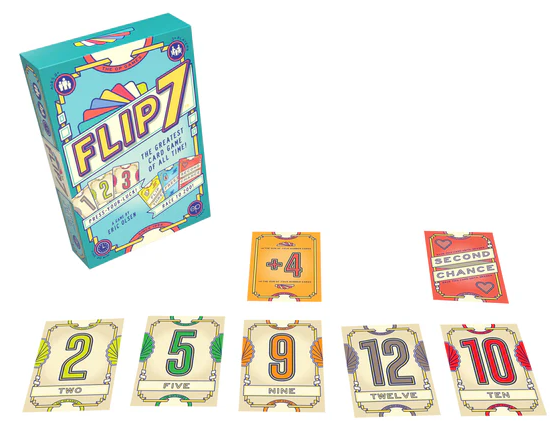
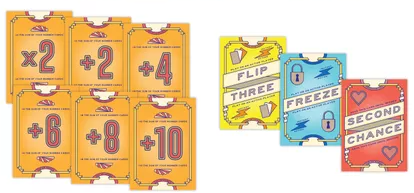
Flip 7 features a special deck of cards. It’s Number cards range from 0 to 12. There are copies of each card equal to the card’s value. For example, there are 12 copies of the 12 Number card and 5 copies of the 5 Number card. Zero is the only exception; there’s only one copy of the 0 Number card. Flip 7’s deck also contains Score Modifier cards (Times 2 which doubles your point value and the rest adding a flat number to your score). Flip 7 also has three Action cards: Freeze, Flip Three, and Second Chance. Second Chance allows you to ignore one bust (drawing the same Number card). Flip Three allows the player to choose a player (even themselves) to draw three cards in a row. Freeze cards are given to a player to force them to stay for the round (they will not be able to draw more cards).

Remember: Players bust (don’t receive points and are eliminated from the round) if they draw two of the same Number card.

The round continues until one of two criteria are met. 1) There are no active players because all players have busted or chosen to stay. 2) One player can Flip 7 number cards, ending the round immediately.

At the end of each round, players score points. Add the value of all your Number cards. Adjust your score with any Score Modifier cards. If you Flip 7 Number cards during the round, score an additional 15 points.

When starting the next round, set all cards from the previous round aside. Do not shuffle them back into the deck. Pass the remaining cards in the deck to the left, that player becomes the new Dealer. When the deck runs out, shuffle all discards to form a new deck. If you need to reshuffle mid-round, leave all cards in front of the players where they are.

At the end of the round when at least one player reaches 200 points, the player with the most points wins.

Review

Flip 7 has taken the tabletop gaming community by storm. I can see why. It has a simple premise (party game Blackjack) and easy-to-understand choices each turn and round. Flip 7 is necessary for the tabletop community. In practice, Flip 7 is the game I can play with my grandma and my four-year-old niece. It’s the most gateway of gateway games.

Since this is the case, I’ve played Flip 7 a ton over the past several months. Seriously, Flip 7 was released during the holiday season (December 2024), I’m writing this in early May (we write many of our reviews weeks, if not months, in advance), and I’ve played this game with 10 different game groups and over 150 times. That’s about 30 times every month. I’ve almost played Flip 7 once every day. One of those months was February, so I’ve definitely played Flip 7 once every day. Frankly, I’m sick of playing Flip 7. It’s a good filler game, but I haven’t seen a game with this much crossover appeal.

And that’s a strength for Flip 7. It’s one of the few games I can get everyone on board playing. That’s why it’s necessary for the tabletop community and for tabletop gaming. But does it convince non-gamers to try other games that aren’t Flip 7? I’m unsure.

But I do like the inclusion of Action cards. There are three copies of each Action card. Freeze seems mean, but it could be pivotal in stopping someone who had an easy rise to the top of the scoring track; it’s a decent catch-up game mechanism of sorts but this can devolve into targeting the leader (like Munchkin). Players can only hold onto one Second Chance. I don’t know how many times I’ve seen a player forced to give a second copy of Second Chance to an opponent. Those cards have a way of finding the same player. But Flip Three has the most strategic value. During the early game, you may want to target yourself. Later in the game, you’ll want to choose someone else and force them to bust. Is this enough strategy? Probably not for many tabletop gamers.

I can see that people who can count cards have an advantage in Flip 7, but that takes the fun out of the game. While the rules don’t forbid someone from looking at the discard, it goes against the soul of Flip 7. The Number cards value equaling the number of copies in the deck is clever, and the game doesn’t overstay its welcome—unless you’ve played it over 150 times in a handful of months.

Flip 7’s box says 3+ players. Its entry on BoardGameGeek lists it as 3-99 players. The rulebook suggests that if you have more than a dozen players, use a second copy of Flip 7. While this may be technically true, the game plays best at 5-6 players. Flip 7 would overstay its welcome if you included over a dozen players. It would take forever for twelve people to determine whether they should hit or stay. There isn’t much else to Flip 7, but I’d be bored if I had to wait for eleven other people to make that simple choice. And forget 98 other people. I’d walk away from the table.

Too Long; Didn’t Read

While not my first or second choice of filler game, Flip 7 has enough crossover appeal to appease the masses. It doesn’t have enough strategy for hardcore tabletop gamers, but Flip 7 is the kind of game I can get my grandma or four-year-old niece to play. Therefore, Flip 7 is a good game to keep on hand for non-gamers.

Tabletop Game Review: Cretaceous Rails

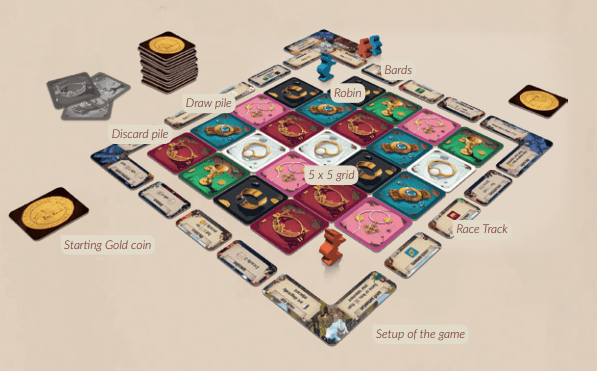
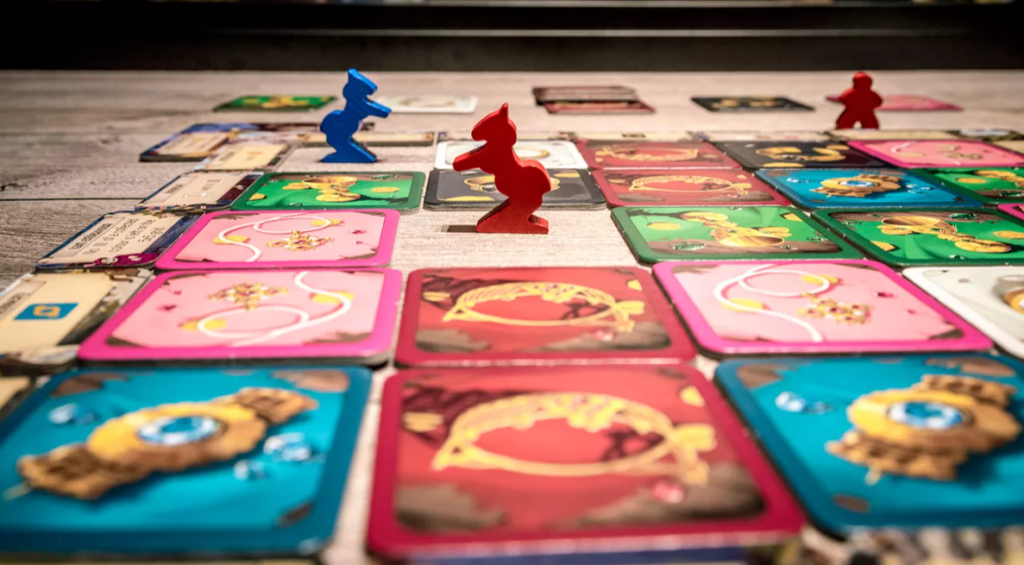
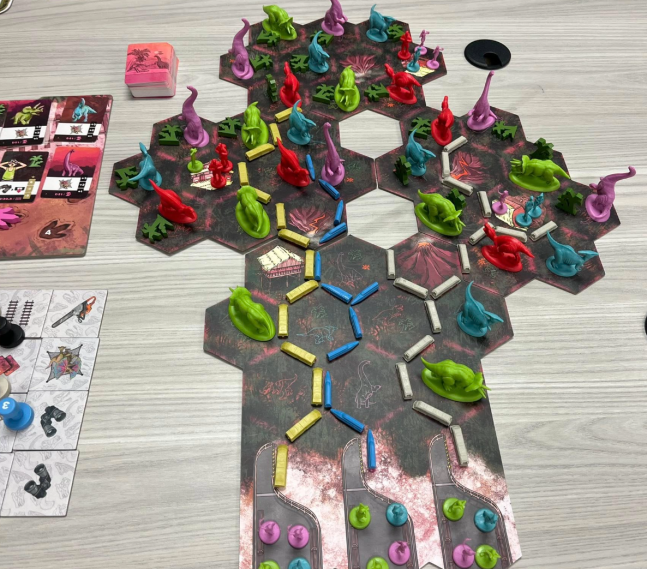
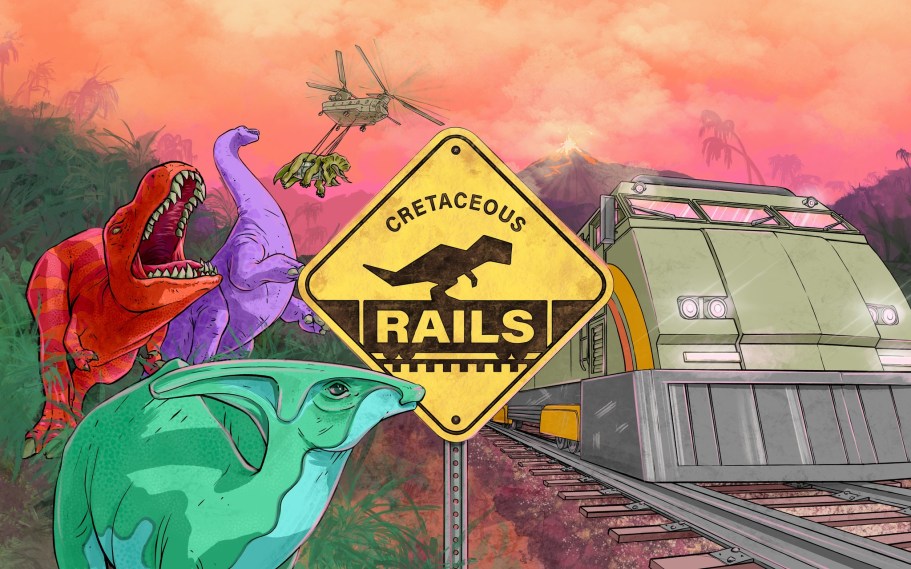
Cretaceous Rails combines trains and dinosaurs in one board game. Holy Fish Heads! That may or may not be a direct quote from the Cretaceous Rails game designer. Hey, hey! Kyra Kyle here. I’m doing something a little different with today’s board game review. As you might be able to tell, I know Cretaceous Rails’ game designer, Ann Journey, and the publisher Spielcraft Games. I’ll attempt to stay unbiased, but I wanted to be upfront about that relationship. In Cretaceous Rails, people have learned that dinosaur parks built in the modern world are too deadly. Instead, they send people back in time to witness dinosaurs in their natural habitat. Players compete to create the best dino safari resort experience. We’ll get to the game, but first, let’s discuss some disclaimers.

The Fiddly Bits

Designer: Ann Journey
Publisher: Spielcraft Games
Date Released: 2025
Number of Players: 1-4
Age Range: 14 and up
Setup Time: 10-15 minutes
Play Time: 45-120 minutes (depending on the number of players)

Game Mechanisms

Modular Board
Network and Route Building
Pick-up and Deliver
Worker Placement

Game Setup

Cretaceous Rails’ rulebook has a streamlined setup section, so I’ll be using the rulebook as the basis for this section.

Action Tiles

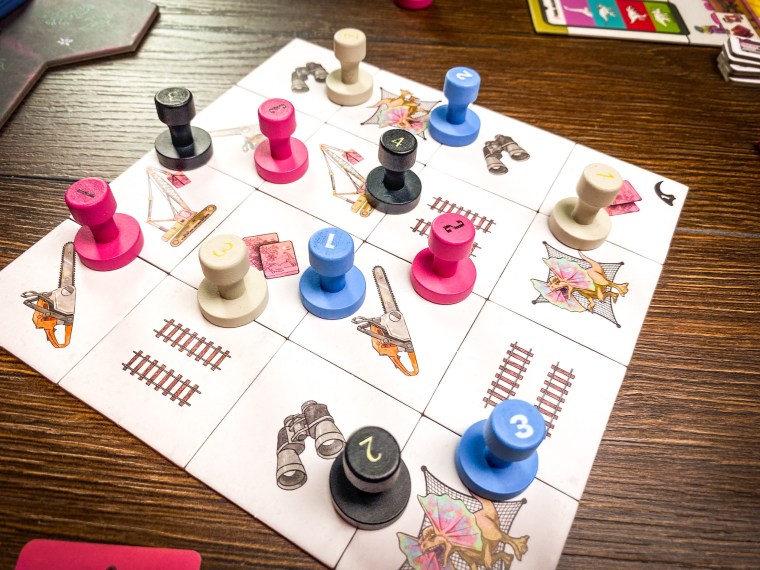
* Shuffle all 16 action tiles and randomly place them face up in a 4×4 grid within reach of all players to create the action grid.

* Place the first player marker on the Draw Cards action tile with the first player marker icon (shaped like a raptor claw).

Resort Card Display

* Place the resort card display board within reach of all players.

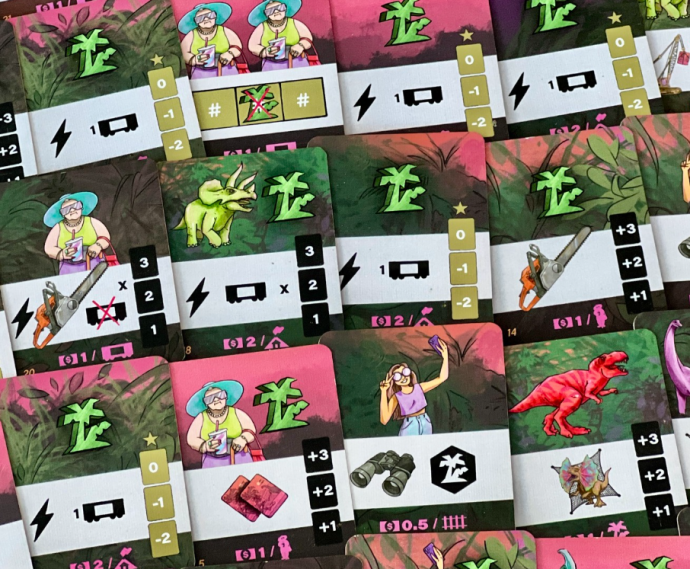
* Shuffle all 84 resort cards and place them face down in the resort card deck space near the resort card display board.

* Deal eight cards from the deck face up onto the eight spaces of the resort card display board.

* Place the round tracker on the dinosaur footprint labeled “1.”

Player Setup

Each player chooses a company. The only difference among the companies is the starting dinosaur, the beginning point value of dinosaurs, and aesthetics. None of these differences significantly affect the gameplay, so pick the company that looks cool or begins the game with your favorite dinosaur.

Each company gets:
* 1 Player board (all other items must match your company’s color and design)
* 4 Executives
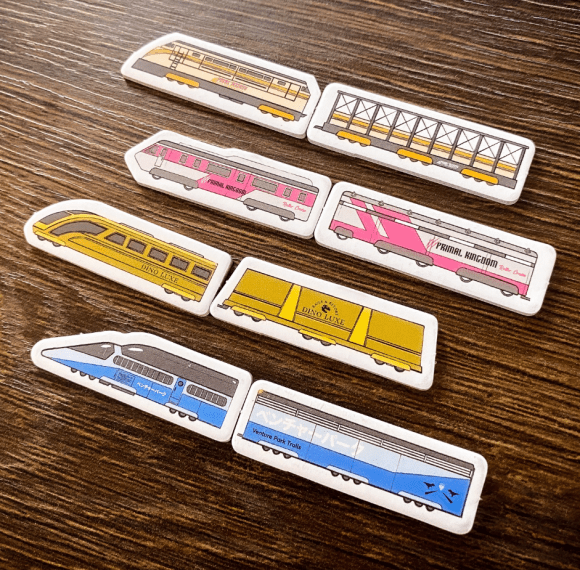
* 30 Rails
* 1 Train Engine Tile
* 8 Train Car Tiles

* Place your Train Engine in front of your player board. This begins your train, but doesn’t count as storage.

* Place 2 Train Car Tiles behind your Train Engine Tile to form your starting train.

* Draw 1 card at random from the resort card deck and add it to your hand.

* Place the remaining Train Car Tiles, 30 Rails, and 4 Executives off to one side within reach.

* Take the tourist, dinosaur, and jungle token indicated by the icons on your player board and place them on their respective icons on your player board.

* Place the remaining tourists in the tourist sack.

Map Setup

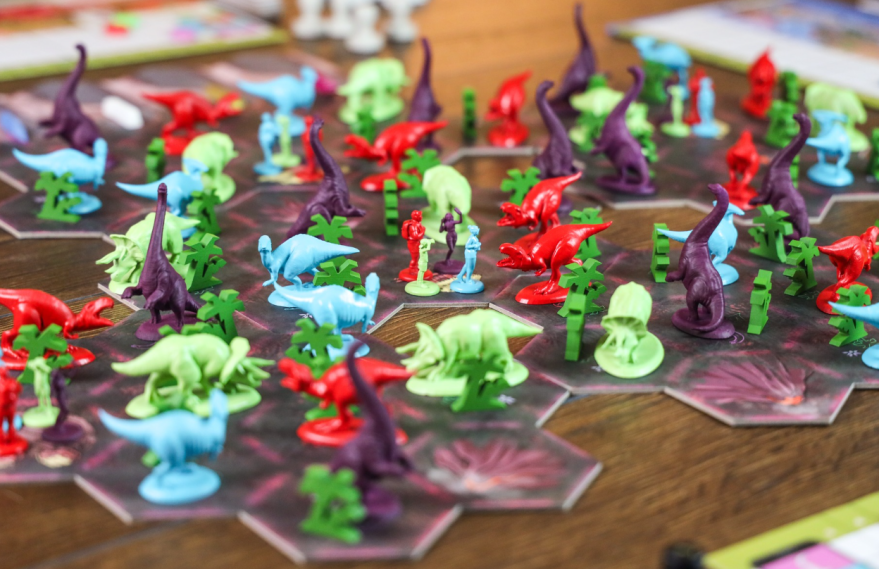
* Place the starting map tile for the appropriate player count in the center of the table within reach of all players.

* Place 1 randomly-selected jungle map tile per player beside the starting map tile to form the map.

* Place one jungle token on each hex marked with a jungle token icon.

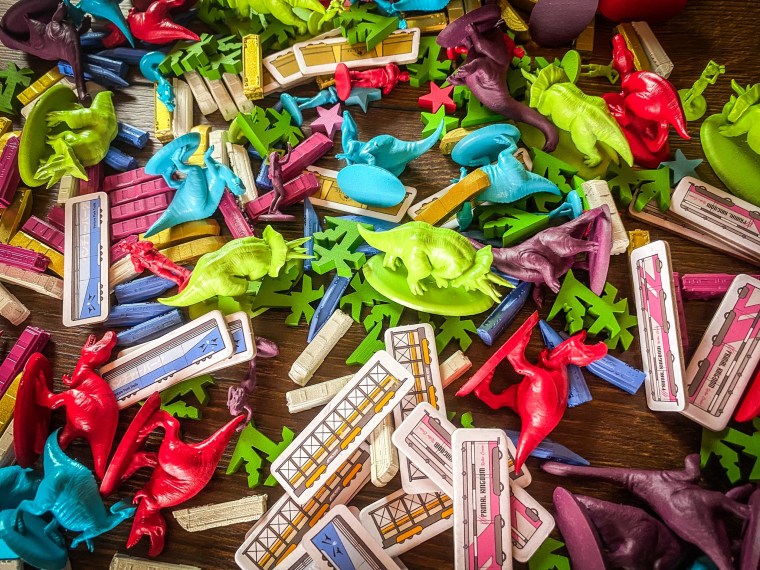
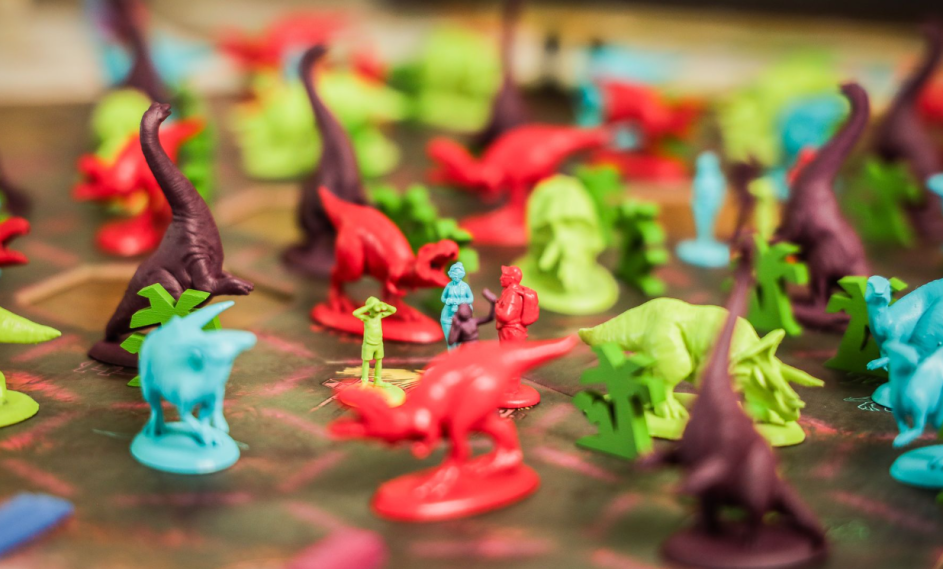
* Place a matching dinosaur miniature on each hex marked with a dinosaur icon. Each tile has two of Tyrannosaurus Rex, Triceratops, Titanosaurus, and Parasaurolophus.

* Randomly place 4 tourists from the Tourist Sack on each cabin hex and each player’s home hex.

Starting Positions

* Randomly select who goes first. Play will proceed clockwise from the first player.

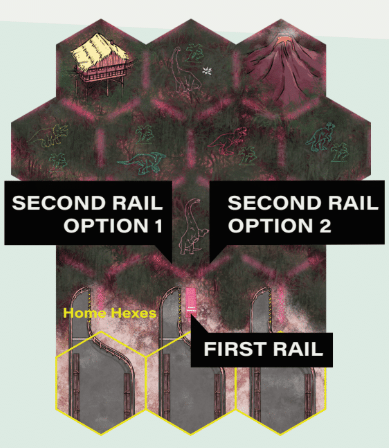
* In reverse turn order, starting with the last player, select home hexes on the starting map tile.

* When you select a home hex, place two Rails on the starting map tile. Place the first Rail on the line pointing out of your chosen home hex, and the second Rail on the line going to the left or right in front of the first rail.

HINT: Choose your home hex based on the dinosaurs and volcanoes near it, the tourists on it, and your plans for building your rail network into the jungle.

Game Flow

Cretaceous Rails is played over four rounds. Each player receives four turns per round.

Each turn, players will place an Executive on a vacant action space between two action tiles. Players will take both actions adjacent to the Executive they just placed. You may choose the order in which to take your two actions each turn. You can also forgo one of your actions and unload your Train Cars onto your player board.

Outside of unloading your Train Cars, there are six actions depicted on the Action cards: Lay Rails, Draw Resort Cards, Build Resort Cards, Clear Jungle, Safari, and Capture Dinosaur.

Lay Rails allows players to place two Rails (train minis) on the map, extending their company’s rail network.

Draw Resort Cards lets players draw Resort cards from the Resort Card Display Board.

If you meet any number of Resort Card requirements and take the Build Resort Cards action, you may build any number of Resort Cards in your hand that you can legally place. The third (top) row can only hold as many Resort Cards as the number of Resort Cards in the second row. The second (middle) row can only have as many Resort Cards placed in it as the number of Resort Cards in the first (bottom) row. The bottom row has no restrictions. Go nuts! But most Resort Cards receive bigger boosts in higher rows.

The remaining three actions will add items to your Train Car Tiles that you will then have to unload in your player boards. These actions may cause you to replace one of your adjacent actions with empty Train Cars.

Clear Jungle has the player take a jungle token from any hex adjacent to their rail network. You must place the jungle token on one of your empty Train Cars. Jungle tokens aren’t refilled throughout the game. Once they’re gone, they’re gone. You cannot take the Clear Jungle action if you don’t have at least one empty Train Car.

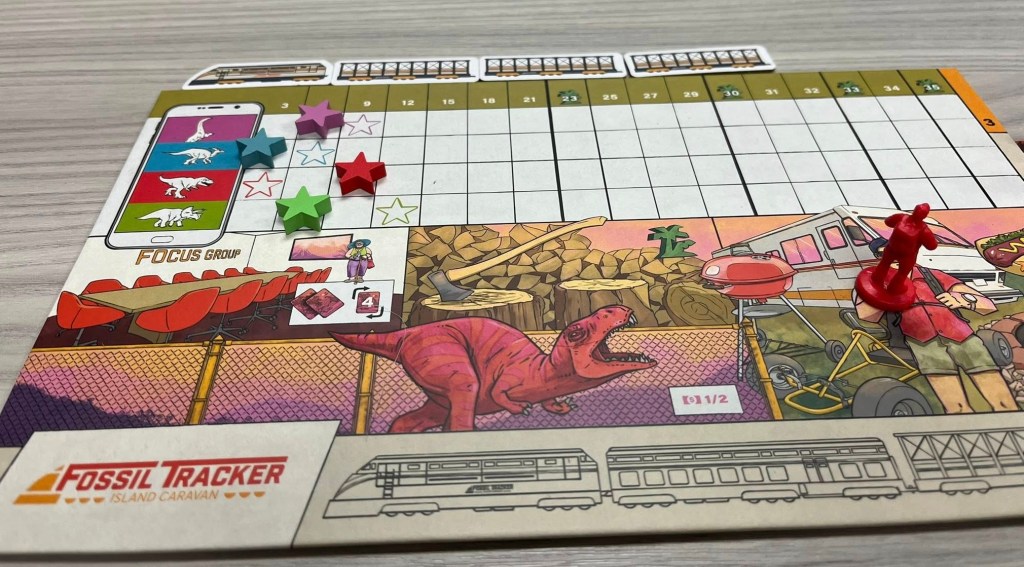
The Safari action has a couple of steps. Take a tourist from any hex adjacent to your network and place it in one of your empty Train Cars. Again, if you don’t have at least one empty Train Car, you cannot take the Safari action. You may not take a tourist from another player’s home hex. When you take a tourist, add up the number of dinosaurs adjacent to your rail network of the color and type that corresponds to the tourist you picked. Only count dinosaurs in hexes with no jungle tokens (your tourists can’t see through dense jungle). Each volcano adjacent to your rail network counts as a dinosaur of that type. Move the rating marker on your player board for that dinosaur color/type up the rating track that number of spaces. This number determines the value of each dinosaur in your resort.

Capture Dinosaur allows players to take a dinosaur from any hex adjacent to their rail network with no jungle token and place it in one of their empty Train Cars. Again, you cannot take the Capture Dinosaur action if you don’t have at least one empty Train Car.

End of Round

A round ends after all players have taken four turns each.

At the end of each round, perform these steps, in this order (skip these steps in the final round):
* Each player performs the Unload Train Cars action.

* Each player takes back all four of their Executives.

* Discard all eight Resort Cards in the display.
* Refill the display with eight new Resort Cards from the deck.
* Pick up all of the Action Tiles, shuffle them, and randomly distribute them into a new action grid.
* The player who took the First Player Marker this round places it back on its draw cards Action Tile. That player will go first next round.

End of Game

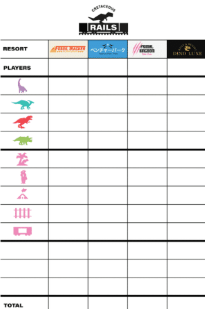
Each player performs the Unload Train Cars action one final time. Then, each player tallies their score. There are two sources of victory points: Captured Dinosaurs and Resort Card Scoring Multipliers. Players can use the scoring guide and pad to keep track of each player’s victory points. Whoever has the most victory points at the end of the game wins.

Review

Cretaceous Rails has two standout elements: the Action Grid and Resort Cards. Ann Journey says that she got the idea of the Action Grid from another game, but I haven’t seen this version of worker placement. It’s quick. The Action Grid gets shuffled and reformed, resulting in varied gameplay from round to round. What may be a good tactic in an early round may not be that good of a tactic in later rounds. The actions themselves are balanced and provide a lot of strategic possibilities. I can lessen someone’s safari bonus by capturing dinosaurs. I can play keep away by taking resources from the main map, while reserving my home hex’s tourists. And all of these actions work well with the Resort Card system.

I love how Resort Cards are placed. The bottom rows needing to be larger than the ones above them makes thematic sense if one thinks of the player board as one’s resort, which it is. You can’t have a top-heavy structure. The Resort Cards themselves are multi-use, and that’s one of my favorite game mechanisms, and a trend I like continued in more board games. Each Resort Card has three rows. The top shows what the player needs to place on the Resort Card to construct it. Any Dinosaurs placed on Resort Cards are worth their full value, while Dinos left on Player Boards are worth half points, rounded down. This does enough to entice players to build Resort Cards, even if they don’t stand to gain as much from the Resort Card’s effect.

The Resort Card’s effect is indicated in the middle row of each card. Many of these effects have levels that are determined based on which row you build the card. This adds even more tactical choices to each game of Cretaceous Rails. I don’t know how many times I took a penalty (like lowering a dinosaur’s rating) because I needed the effect of a Resort Card. And each Resort Card has endgame scoring modifiers at the bottom. Again, I’ve spent plenty of Cretaceous Rails games building Resort Cards that I only wanted for the endgame scoring. Players only score the Resort Cards they managed to build. This is the magic of multi-use cards. Love, love, love.

My main critique of Cretaceous Rails is that the game can run a little long. While individual player turns don’t take long, analysis paralysis can be an issue. I tend to plan my turns in advance and then adapt if someone takes the set of actions I want, but other players don’t play that way, and certain players—you know the type—can take extremely long turns. Cretaceous Rails is one of those games (specifically at higher player counts) where the board state can change a lot before you receive another turn, and I have second-guessed my decision on several turns.

The Cretaceous Rails box lists the game’s runtime as 30 minutes per player. However, it’s more like 45 minutes at the lowest player count and 30 minutes for each additional player after the first. Upkeep between rounds can take a hot minute. Typically, I have one player handle one part of the setup (like shuffling Action Tiles and resetting the Action Grid), while another player handles another part of the in-between round setup (like wiping the Resort Card Board and setting up the new round’s Resort Card Board). While Cretaceous Rails doesn’t have a lot of setup between rounds, it does slow down gameplay.
Despite the occasional gameplay slowdown, Cretaceous Rails does a wonderful job combining trains and dinosaurs, and that’s what the game sets out to do. Trains and dinosaurs together at last! The Rails (train minis) play out like a fusion of Ticket to Ride and Catan. Experienced gamers will have an idea of how they work; players new to the board game hobby may struggle. I also like how the trains are two-fold. While the network plays like Ticket to Ride, the Train Car Tiles provide a tasty dollop of resource management. Since every player unloads their Cars at the end of each round (even the last one), you’ll want to time when you unload your Train Cars in the middle of each round. So, time is a hidden secondary resource one must manage. I love it.

One final note: Cretaceous Rails’ production value is phenomenal. That’s something you can expect from Spielcraft Games. I know. I have a relationship with Spielcraft Games’ owner, but it’s true. Alex Wolf puts in a lot of work to ensure his games look top-notch. Getting back to Cretaceous Rails, if you’ve ever wanted to play a combination of trains and dinosaurs, Cretaceous Rails is your game.

Too Long; Didn’t Read

Cretaceous Rails captures its theme of gamers running a dino safari resort experience. While the game mechanisms interestingly converge, the multi-use Resort Cards and the Action Grid stand out. Cretaceous Rails offers plenty of ways to win, but that can also cause analysis paralysis and may not be the best for gamers who are new to the board game hobby.

Five More Common Board Game Mechanisms

Board gamers find the same game mechanisms in many games. We covered the topic of common board game mechanisms a couple of months ago and last month we addressed some underused board game mechanisms. Here are links to those previous posts (10 Common Board Game Mechanisms and 5 Underused Board Game Mechanisms). Once again, we’re headed to Board Game Geek.

Hey, hey! Kyra Kyle here. I checked the hundreds—and I mean hundreds with a capital H—of game mechanisms listed on Board Game Geek and ran quick searches to see how many games are listed on the site with each mechanism. I won’t rehash the search criteria. If you’re interested, you can check out the previous Common Board Game Mechanisms post. Even though the previous list had ten mechanisms, it had some notable omissions. I also promised to cover the worker placement mechanism in the last list, so I included it in this set of mechanisms. Let’s see which five mechanisms made the second list.

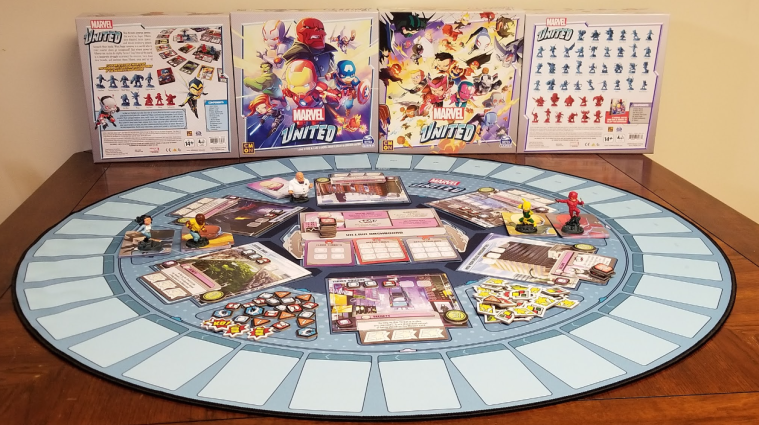
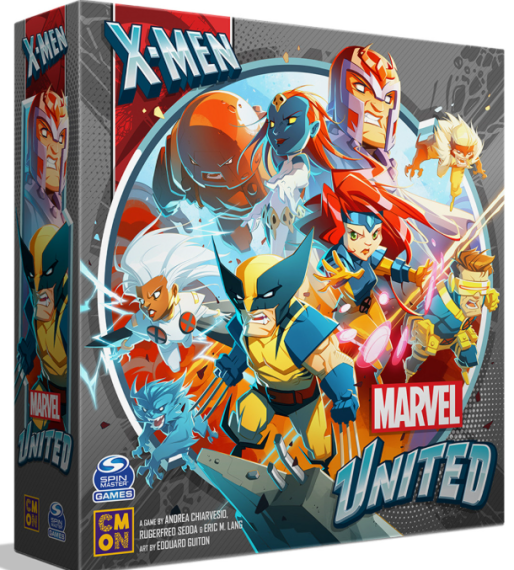
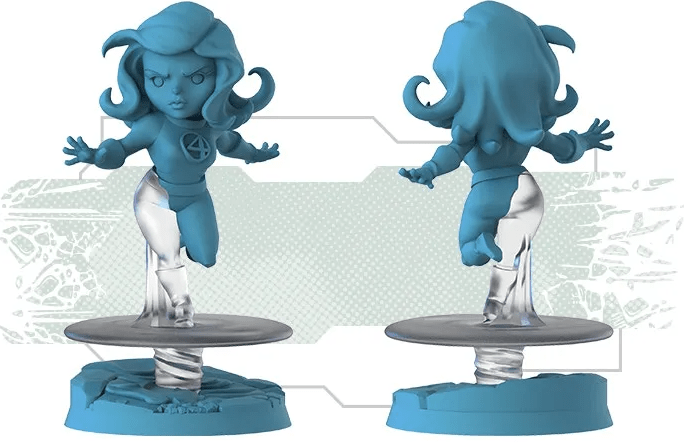
Marvel United Tabletop Game Set Up

Cooperative Games

Description

Players work together in a cooperative game to achieve a common win condition or win conditions. Players all win or lose the game together.

Thoughts

More than just a mechanism, cooperative board games may be more of a game classification. Cooperative games took off in popularity with Pandemic. Some cooperative games existed before then, but there were significantly fewer. Cooperative games have exploded in the past two decades or so. I tend to teach a lot of board games, and cooperative board games tend to be easier to teach than competitive board games because all players have a common goal. I feel as if I need to overexplain a competitive game because I don’t want someone to think that I’m trying to gain a competitive advantage by omitting information. I stand to gain nothing from withholding information while teaching a cooperative board game. I also find that the table starts playing a cooperative board game sooner. It’s more acceptable to learn as we go.

Easier and faster rules explanation aside, cooperative board games can sometimes feel like players are trying to solve a complex puzzle. If puzzles don’t appeal to you, you might not care for cooperative games. Another common issue with cooperative board games is that they can lead to a dominant player. One player could become the self-appointed leader and everyone else follows along. But a lead player token that players pass each round can combat this tendency. I’ve found other variations on this idea, and they can work.

Games that use this mechanism

Pandemic, Spirit Island, Kingdom Death: Monster, Marvel United, and Sleeping Gods

Modular Board

Description

Games with modular boards don’t have a typical board. These games compose their boards with multiple pieces, often tiles or cards. These pieces can be randomized or reconfigured to form different scenarios (which is another popular game mechanism or classification). The malleability of the “board” can lead to different strategies, exploration, and other possibilities. Some games that use modular boards will have multiple pieces that aren’t used simultaneously, which preserves table space. Unused pieces remain out of play until they’re needed.

Thoughts

I love the variability of a modular board. As the description mentioned, these games can also use scenarios or missions that can tell a story. Or you may be able to shuffle the pieces (tiles, cards, or whatever) and form hundreds of board variations. Despite playing a game hundreds, if not thousands of times, modular boards can make the same board game feel new.

Like cooperative games, there is a downside to this mechanism. Some games that use modular boards may have specific layouts with a labeling system. This can slow down the gameplay or increase setup time while players sift through the pieces necessary to build the board. But this is a nitpick. When executed well, modular boards can add extra spice.

Games that use this mechanism

Catan, Mansions of Madness: Second Edition, Betrayal at House on the Hill, Memoir ‘44, and Gaia Project

Simultaneous Action Selection

Description

Games that use simultaneous action selection have players plan their turn secretly and simultaneously. Then, the players reveal their plans at the same time.

Thoughts

Put simply, simultaneous action selection speeds up gameplay. It may not be the first game mechanism I look for in a board game, but it’s one that I’m glad exists. Simultaneous action selection eliminates a board game’s “turns.” Everyone has a turn at the same time or at least everyone chooses what they’re going to do at the same time.

That last distinction can’t be overstated. Gloomhaven has players select their actions and a player’s initiative for the round simultaneously, but each player has a designated turn. Even with this wrinkle, it’s a player’s planning for a turn that takes the most time, so I still say that a game like Gloomhaven speeds up player turns even if players don’t execute their turns simultaneously. For the games that do allow for the simultaneous execution of turns, they can be lightning-fast.

Games that use this mechanism

Heat: Pedal to the Metal, Orleans, Gloomhaven, The Quacks of Quedlinburg, and Sushi Go!

Take That

Description

Take That are competitive maneuvers that directly target one opponent’s progress toward victory but don’t directly eliminate any characters or components representing the opponent. Take That mechanisms can include stealing, nullifying, or force-discarding of one opponent’s resources, actions, or abilities. Take That maneuvers can lead to dramatic changes in a player’s position of power over a short period.

Thoughts

Not going to lie. As a rule, Take That is my least favorite game mechanism on this list, but I may be in the minority. Numerous games include Take That as one of their mechanisms. It got me thinking what does Take That mean? Any maneuver that can weaken one of your opponents can be considered Take That. Thousands of games include mechanisms like that. Most games with a combat element would have Take That because anything that weakens your opponent for a moment would qualify and that happens a lot in that game type.

So, I should clarify. I don’t care for games centered around the Take That game mechanism. But again, many of these games, like Munchkin or Uno, are wildly popular. But since the definition of Take That can encompass a lot of design space, Take That may have the most room to grow. Is it possible for a game focused on the Take That mechanism to not feel like people taking turns backstabbing each other? Perhaps it’s the length of a predominantly Take That game that matters. Part of why I don’t care for Munchkin is because the game can drag. After all, players are incentivized to tear down the leader, artificially extending the game’s length. I’m torn. Share your thoughts about the Take That mechanism in the comments.

Games that use this mechanism

Munchkin, Uno, Scythe, Blood Rage, and Love Letter

Worker Placement

Description

Worker Placement is a stylized form of Action Drafting where players place tokens (typically the person-shaped “meeple”) to trigger an action from a set of actions available to all players, generally one-at-a-time and in turn order. Some games achieve the same effect in reverse: the turn begins with action spaces filled by markers, which are claimed by players for some cost. Each player usually has a limited number of tokens with which to participate in the process, although these may increase as the game progresses.

There is usually * a limit on the number of times a single action may be taken. Once that limit for an action is reached, it typically either becomes more expensive to take again or can no longer be taken for the remainder of the round. As such, not all action can be taken by all players in a given round, and “action blocking” occurs. If the game is structured in rounds, then all actions are usually refreshed at the start or end of each round so that they become available again.

Thoughts

The Worker Placement mechanism had the longest and most complicated description of the bunch. I mostly used Board Game Geek’s definition. I always check BGG for mechanism definitions and put them in my own words, but I couldn’t describe Worker Placement. It’s a great mechanism but a difficult one to put into words. And where I placed the asterisk (*) is a point of contention. The use of the word “usually” in this context can be controversial. Many players will claim that a worker placement game doesn’t need to place limits on the number of times an action can be taken during a round and dislike the inclusion of “action blocking” in the definition. Others swear that “action blocking” is a defining element of worker placement.

And that might be one downside to the Worker Placement mechanism: hate drafting. Some players will choose an action, not because it helps them, but so they can block an action for an opponent. This is why the inclusion of “action blocking” is controversial.

Typically, I enjoy games that include the Worker Placement mechanism. I was surprised that this mechanism fell short of the original list. Worker Placement games are popular but not as prevalent as one might expect. There’s a tactile joy about managing your workers. Tension builds whenever the board fills up and worrying if you’ll be able to choose the action you want for a round. That would be a positive mark for “limits to the number of times a single action may be taken.”

The Worker Placement mechanism may be the most difficult mechanism to convey than any other game mechanism on this list, but the idea of managing your resources, workers, and time makes games that use this mechanism special, especially when the mechanism is used well. In short, bring on more Worker Placement.

Games that use this mechanism

Everdell, A Feast for Odin, Dune: Imperium, Lords of Waterdeep, and Stone Age

Closing Thoughts

This mechanism grouping had more of a mixed bag. I may need to challenge my ideas on Take That. I enjoyed using a wider lens to look at board games. I hope you found something useful in the post. Feel free to share your thoughts on any of these game mechanisms and let us know which game mechanisms you’d like for us to discuss in a future post. Thank you for reading, and wherever you are, I hope you’re having a great day.

Tabletop Game Review: Marvel United, Rise of the Black Panther

Has it been long enough since we’ve covered a Marvel United expansion? It’s been one month? Eh, why not cover one of the final expansions from the original release, Rise of the Black Panther? Like I said in our last expansion review, Geekly won’t be covering every Marvel United expansion, but we will review the ones worth your time or the ones we believe people will most likely purchase. In short, you may want to consider these expansions.

Hey, hey! Kyra Kyle here. In Marvel United, take on the roles of iconic Marvel heroes who work together to stop the master plan of a powerful villain controlled by the game. Each villain has a unique master plan, cards that trigger various effects, and threats that make clearing locations difficult. Heroes clear missions, making the villain vulnerable, and finally take on the mastermind before they complete their evil plot. Can you save the world from impending doom? Let’s find out with Rise of the Black Panther.


Wait. Before we leap into the fray, we should look at Rise of the Black Panther’s fine print.

Marvel United Box Close Up Board Game Review

The Fiddly Bits

Designer: Andrea Chiarvesio and Eric M. Lang
Publisher: CMON Global Limited and Spin Master Ltd.
Date Released: 2021
Number of Players: 1-4
Age Range: 8 and up
Setup Time: 5-10 minutes
Play Time: 30-40 minutes

Game Mechanisms

Cooperative Play
Hand Management
Modular Board
Solo / Solitaire Game
Variable Player Powers

Marvel United Tabletop Game Set Up

Game Setup

We already covered the Game Setup and Game Flow in our Marvel United review (here’s a link to that review), so we’ll go over the basics in the following two sections. Let’s cover an abbreviated review of the game setup and rules.

Marvel United’s setup can change depending on which Villain and Heroes you choose to play. Each game consists of six locations. Typically, core sets have eight locations. Since Rise of the Black Panther is an expansion, it only has six. You may choose your locations or shuffle them and choose six at random. Each Location card has spaces at the top for civilians and thugs and a rectangle with a block of text that will state “End of Turn” at the top of the box.

Place civilian/thug tokens on their matching spaces. Shuffle the Villain’s Threat deck and deal out each Threat face-up so that it covers the rectangle at the bottom of each location. You must clear this threat before gaining the “End of Turn” effect printed on a Location. Place health tokens where signified on threat cards and on the Villain dashboard. Place the three mission cards (Defeat Thugs, Rescue Civilians, and Clear Threats) face up under the villain dashboard where the text reads “Unlocked.”

Each player shuffles their hero decks and then draws three cards to form their hands. Shuffle the Villain’s Master Plan deck. Leave the Master Plan deck face down. This will be the villain’s draw pile.

Players place their miniatures on one of the six location cards, usually the centralmost location for each player (easy access). Then, they place the villain on the location card opposing the heroes.

Marvel United Game Flow Board Game Review

Game Flow

The villain(s) play first. Draw the top card of their master plan deck. The villain moves the number of spaces indicated. Resolve any BAM! Effects and these effects will be printed on a space within the villain’s dashboard. Then, place the civilian/thug tokens (if any) indicated at the bottom of the card. After all these effects are resolved, the heroes get their turn.

Heroes pick who goes first, and hero turns will continue around the table clockwise. At the beginning of each game, Heroes will get three turns before the villain receives another turn. During their turn, heroes play one card from their hand.

Resolve actions and the symbols printed at the bottom of the hero’s card in any order. The symbols at the bottom of a hero’s card will be shared with the next player, but any printed action will not be shared. Heroes will use these actions to complete missions. The game begins with three missions in play: Defeat Thugs, Rescue Civilians, and Clear Threats. Each mission card will have spaces for the tokens they require to complete. As soon as these spaces are filled, the card is discarded, and the mission is considered complete. Mission cards can be completed in any order.

Marvel United Three Mission Cards Board Game Review

After the heroes complete the first mission, the villain panics and will act (play a card) every two hero cards instead of every three hero cards. After the heroes complete the second mission, the villain becomes vulnerable to damage. The heroes can complete the third mission, but it isn’t necessary. If the heroes do complete the third mission, each hero immediately draws 1 card, increasing each player’s hand size by one.

Play continues back and forth until either the villain wins (by completing their unique master plan or anyone, heroes or villains, runs out of cards) or the heroes win by dealing enough damage to the villain after the villain becomes vulnerable to damage.

Review

Rise of the Black Panther has some stellar heroes in its ranks. The Challenge Card uses some interesting game elements that I haven’t seen Marvel United use before or since. Killmonger can be a tricky villain and one of my favorites to defeat. It’s an accomplishment to defeat Killmonger. But Rise of the Black Panther’s Locations may be the biggest reason why Geekly’s covering this specific expansion. We’ll start with Locations.

Jabari Village and Warrior Falls have solid “End of Turn” abilities. One gives you a Wild token while the other allows you to deal one damage at that Location. Not bad. But it doesn’t hold a candle to the remaining four Locations. Golden City lets players move to any other Location at the end of their turn. This gives players extra movement. I love that. That gives me one less resource to manage and I can focus on Heroics and Attack. Royal Palace allows players to search their deck for a card and place that card at the top of their deck. Fantastic! This would be a strong ability in most card games with decks. But the Great Mound and Shuri’s Lab puts Rise of the Black Panther Locations over the top.

Great Mound is one of the only ways to manipulate Crisis Tokens in the original Marvel United release. Full stop. If you have a villain who has pesky Crisis Token abilities (one of those is Killmonger included in Rise of the Black Panther) and you only have the original Marvel United release, Great Mound is a must. Its “End of Turn” ability allows players to discard a card from their hand to the bottom of their deck to remove 1 Crisis Token anywhere. Shuri’s Lab creates a great tandem of Location abilities. Its “End of Turn” ability grants players the ability to draw up to their maximum hand size, negating any ill effects from the Great Mound and giving players a way to heal. I like Enter the Spider-Verse’s Locations a lot, but they pale in comparison to Rise of the Black Panther’s.

As mentioned in previous Marvel United reviews, Challenge cards provide optional rules to spice up the core gameplay. Rise of the Black Panther’s “Endangered Locations” is a simple and engaging rule twist. During Setup, Each Hero is linked to a different Location by using the included Endangered Location tokens. During play, each time Overflow is triggered in a Location, the Hero with its matching token takes 1 damage. This makes each Location mean something to certain players. This Challenge card could influence players to keep one Location clear of tokens over another Location. I love it because it raises the stakes and adds a dash of strategy and something else for players to navigate.

Killmonger Marvel United

We’ll get to the heroes in a bit, but let’s talk about one of the MCU’s better villains, Killmonger. Killmonger also happens to be an intriguing villain in Marvel United. He wins when four or more Locations have 3 or more Crisis Tokens, and he adds Crisis Tokens in various ways. His Overflow and BAM! abilities replace Civilian/Thug Tokens with Crisis Tokens, which will make clearing missions (in order to make Killmonger vulnerable to damage) more difficult. The “Weapon Smuggling” Threat card has a similar action. And his Master Plan deck adds plenty of Civilian/Thug tokens, which can trigger Overflows, while his “Overthrow” ability can convert multiple Civilian tokens into Crisis Tokens. In short, Killmonger can turn the tide of battle in short order.

Furthermore, Killmonger has plenty of ways of dealing additional damage to Heroes, which can cause players to race toward Shuri’s Lab for some heals. Killmonger has one of the higher potential damage outputs of Marvel United’s original set. As I said prior, beating Killmonger is an accomplishment.

Rise of the Black Panther’s Heroes are darn good and should be up for the task of defeating Killmonger. Black Panther tends to focus on giving himself bonus actions, but his Movement is so good that he’s a good choice for teams choosing specialists (All Attack or All Heroics), and the other two Heroes in this expansion happen to be specialists. Winter Soldier is one of the better pure damage dealers from Marvel United’s original set. His deck tends to be the most self-centered of the Rise of the Black Panther heroes. He gives himself Attack tokens. This can also make Winter Soldier the easiest Hero to play. Of the Rise of the Black Panther heroes, Shuri is easily my favorite.

Shuri has a stunning five cards with Wild symbols on the bottom. This gives her and her teammates options whenever they take their turns. The remainder of her deck centers around Heroics. Winter Soldier is the fighter; Shuri is the helping hand. And Shuri’s one special effect “Young Genius” certainly lends a helping hand. She gives one Hero (she can target herself) a wild token and the player may draw cards until they have 3 cards. Not only does she hand out an extra wild token, but Shuri heals a Hero up to their full health. This is huge. I don’t know how many times Shuri’s ability saved my party’s bacon. She is Rise of the Black Panther’s standout Hero.

Too Long, Didn’t Read

Rise of the Black Panther has some of the original Marvel United set’s best Locations. Its Challenge card adds a simple but compelling wrinkle to gameplay. Killmonger is a worthy adversary. The Heroes provide variety, but Shuri can turn the tide of battle.

Tabletop Game Review: We’re Doomed!

Earth is doomed. The leaders of the world’s most powerful nations have created a scenario where humans need to escape in a rocket ship before the planet implodes. You play the role of one of the world’s leaders. That’s the premise of today’s tabletop game review, We’re Doomed!.

Hey, hey! Kyra Kyle here. Geekly hasn’t had a new board game review in quite some time. Today’s game is a silly party game with a quirky theme. Played in a real-time 15 minutes (the game includes a 15-minute hourglass), We’re Doomed! tasks players with generating enough resources to build a rocket ship big enough for all the players at the table or if you have the most influence and there’s only seating for one player, you become the only one to board the rocket ship. The choice is yours. Work together or backstab the other players.

Before we go any further, let’s prepare this rocket for takeoff and discuss We’re Doomed!’s details.

The Fiddly Bits

Designer: Mike Horton
Publisher: Breaking Games; Magellan
Date Released: 2019
Number of Players: 4-10
Age Range: 12 and up
Setup Time: Less than a minute
Play Time: 15 minutes (timed)

Game Mechanisms

Party Game
Card Game
Negotiation
Player Elimination
Variable Player Powers

Game Setup

We’re Doomed! has a minimal setup. Each player receives one Leader card that they display for others to see. Form piles of influence and resource tokens so every player can access them. The hourglass is set up so that all the sand is on the bottom (before it gets flipped), and the first player token rests on top of the hourglass.

Randomly select one player to go first, or someone could flip over the hourglass and claim the first-player token for themselves. You have 15 minutes before time runs out. Go!

Game Flow

We’re Doomed! is played in rounds until time runs out. Each round is split into two phases: Actions and Contribution. The action phase is played in turn order, starting with the first player. Unless the rules (which can evolve) say otherwise, each player has access to the same five actions: Produce, Indoctrinate, Propagandize, Invade, and Nuke. The first four actions revolve around gaining resources, which can be used to build seats on the rocket ship or gain influence, denoting who’s first to board the ship. The first two (Produce and Indoctrinate) allow players to take resources or influence from the supply. The second set of two (Propagandize and Invade) lets players steal those tokens from other players. The Nuke action allows players to spend resources to eliminate a player.

Each nation’s leader has a bonus for one of these five actions. For example, whenever the Democracy “Invades” they steal 2 Resources from another player for free instead of having to spend an influence token. The Theocracy gets a bonus Influence whenever they “Indoctrinate,” and the Technocracy gains an additional resource whenever they “Produce.”

After each player chooses one of the five actions, play moves to the Contribution Phase. In this phase, players simultaneously choose how many of their resources they donate to the Project, building a bigger rocket ship. The player who donates the most for the round gains the first player token (and will begin the Action phase next round), earns an influence token from the supply, and draws an event card.

There are two types of event cards: ones read aloud and ones read privately. Follow the rules on the card (reading aloud if you are told to read aloud) and after the event is resolved, the new round begins. Keep going until time runs out.

Review

If you’re anything like me, seeing the “player elimination” game mechanism waved a red flag, but remember, We’re Doomed! is a real-time game that lasts exactly 15 minutes. I don’t mind player elimination as a game mechanism if the game is short. And the idea that you can nuke another player is fun and thematic. We’re Doomed! is a fun and thematic game.

Given the proper gaming group, that’d be gamers who don’t mind backstabbing, negotiating, and loose alliances, We’re Doomed! can be a hit. Quick and tense turns are a feature. We didn’t mention this in the game flow, but there is an additional rule where players can claim another player is taking too long (or stalling). If this happens, everyone takes a vote, counting to three, and votes thumbs up or down to eliminate the player. This makes sense because time is of the essence in We’re Doomed. A similar voting system is used whenever there’s a tie during an event card.

Speaking of the event cards, they can swing the game wildly, making We’re Doomed! a fragile game. Fragile in the sense that the wrong combination of event cards can break the game in an unintended manner. During one playthrough, the first event negated influence. The player who became “The Executor” dictated the sequence of who boarded the rocket ship. Then, the very next event “Too Big To Fail” gave one player (I was voted to be that player) six resources at the beginning of the round if they had no resources. Since I was the Technocracy, that meant that I produced nine resources each round. I could’ve eliminated players (spend 8 resources) and nuke them all or donate all the resources, rescuing everyone. I chose to do the latter. Even though we played a five-player game, we had enough resources for ten.

Typically, I don’t care for games that can be this fragile, but We’re Doomed! isn’t meant to be taken seriously. It’s great for some dumb—and I mean dumb—fun. As I said before, with the proper gaming group, We’re Doomed! can be a hit. But with the wrong gaming group, it can be doomed to fail. We’re Doomed! isn’t a game for everyone. Heck. I must be in the right headspace for the game to land, but when it does land, it’s good for a laugh. One of my favorite chuckles came from someone drawing the “Trickle Down Economics” event card that reads, take six resources from The Project. You may choose to keep the resources or distribute them with any number of players. The person who drew the card asked, why wouldn’t I just pocket the resources? This card’s effect doesn’t seem right. Another player responded that’s why the card name is “Trickle Down Economics.” That sounds like Reagan. We’re Doomed!’s strength is that it doesn’t take itself too seriously.

Verdict

While not for everyone, We’re Doomed! can be a bunch of fun with the right gaming group. The game takes no more than 15 minutes (timed with an hourglass). Your gaming group must like backstabbing, negotiating, and loose alliances…and like games that don’t take themselves too seriously.

Top 5 Tabletop Games from 1994

Magic: The Gathering dominated 1993 and in 1994, dozens of new collectible card games hit the market. Even though 1994 produced more than one collectible card game on its list, we still have one honorable mention collectible card game, Illuminati: New World Order. I always loved Illuminati’s sense of humor; it’s a shame that neither the original game (released in the early 1980s) nor the CCG made the cut. That just shows these lists’ competition.

Hey, hey! Kyra Kyle here. Back with another Top 5 Tabletop Games. We’ll talk about the board games that this year’s list soon, but let’s recap the ground rules for which games make these lists before we start.

1: Cultural relevance plays as much of a factor as overall quality. A game might make a list that doesn’t hold up to others of its type, but you must admit the game is everywhere.

2: Only one game from a franchise makes the list. This will become more of an issue the closer we get to games with expansions.

3: Longevity plays a role, too. A game doesn’t have to fly off the shelves today, but it had to have some widespread appeal for a decent time.

5: Star Trek Customizable Card Game (1994)

Illuminati: New World Order’s lack of staying power contributed to its absence from this list. The Star Trek Customizable Card Game doesn’t have that issue. I never knew The Star Trek Customizable Card Game stayed in print for over a decade. The game may have gone out of print in 2007, but a group of dedicated fans still play.  Peter Ludwig was crowned the 2023 Star Trek Customizable Card Game World Champion.

The Star Trek Customizable Card Game pitted players against each other to assemble a team, a ship, and equipment to complete missions. The first player to complete 100 points worth of missions/objectives wins. The 1st Edition, which ran from 1994-2001, only had the option of a two-player game, just like Magic. 2002 saw the Star Trek Customizable Card Game’s second edition. This version allowed for more players to join in the fun.

On a personal note, I knew one of the original designers of the Star Trek Customizable Card Game. Rest in peace, Rollie.

4: I’m the Boss! (1994)

I struggled with placing the 2-4 ranked games on this list. Honestly, you can shuffle these games in any order, and I wouldn’t fight you. The first game we’ll cover comes from a familiar face, Sid Sackson. We haven’t seen Sackson on one of these lists in a while, but he was productive during this period. I’m the Boss! is a negotiation game where players compete and cooperate to put together profitable business deals. Gameplaywise, I’m the Boss! splits the difference between luck and skill. One must be able to negotiate and needle their way into the best deals.

Not going to lie, I’m not the best at I’m the Boss! But if you like games where you can pull the wool over someone else’s eyes and rob them blind through a one-way deal. I’m the Boss! can give you those moments. Sackson has a knack for business games. His most famous creation was Acquire, which featured on our Top Tabletop Games from the Early Sixties. (Check out the link here.)

3: Vampire: The Eternal Struggle (1994)

Richard Garfield wasn’t done with collectible card games after 1993. Vampire: The Eternal Struggle, which was originally published as Jyhad (changed to distance the game’s name from the Islamic term jihad), puts players in the role of Methuselah (ancient) vampires, controlling lesser vampires to complete machinations and wrest control of the Camarilla, the society of vampires featured in the role-playing game Vampire: The Masquerade. Garfield wanted to show the versatility of collectible card games as a genre, and he succeeded in doing so with Vampire: The Eternal Struggle.

Magic games are quick. Vampire: The Eternal Struggle games can take up to two hours. Magic forces players to play lands from their deck to cast spells. Vampire: The Eternal Struggle allows players, who are Methuselah vampires, to spend their blood points to play cards, but be careful, your blood points are also your life and if you run out, you lose. Magic has players draw one card at the beginning of a player’s turn (you can have cards that allow you to draw more). Vampire allows players to draw cards as soon as they play cards. Magic started as a two-player game. Vampire was always a 2-5-player game. The two games couldn’t be more different.

Despite their differences, or maybe because of them, both games found a wide audience. Depending on how one views it, Vampire is the second longest-running CCG, only to Magic, if you include the five or so years when the game was transformed into a living card game. Or Pokémon, which (Spoiler Alert) will make a future list, takes the second spot, and Vampire takes the spot for the third longest-running CCG. Either way, Vampire: The Eternal Struggle has staying power.

2: Manhattan (1994)

Manhattan received the 1994 Spiel des Jahres award, so I gave it the nod over the previous two games. The concept is simple. Players construct and control Manhattan skyscrapers that will award points. Manhattan benefits from 3-D components. When you’re constructing skyscrapers, they will stretch vertically. This gives Manhattan table presence.

Manhattan may have a game concept based on a New York City borough, but it took Mayfair Games two years to make the game accessible to the United States. Manhattan was designed by Andreas Seyfarth. At the time, Seyfarth was an unknown game designer, but eventually, he’d add several more board game gems: Puerto Rico, San Juan, and Thurn and Taxis (which he codesigned with his Karen). This may not be the last time we’ll see Andreas Seyfarth’s name on one of these lists.

Despite earning the Spiel des Jahres, Manhattan has received mixed reviews. Previous critics have questioned the game’s components and scalability. Others claim that the game’s mechanisms are dated and too abstract, chaotic, and luck-driven. But still, others insist that Manhattan has broad appeal and praise the game’s engagement and accessibility. What does this tell us? Gamers can’t agree on anything, and one likes what one likes. If you like the idea of building skyscrapers, you may want to give Manhattan a try.

1: RoboRally (1994)

I promised that Richard Garfield would make this list again, and he claims the second number-one spot in consecutive years. Richard Garfield started a tabletop revolution with Magic: The Gathering in 1993 and kept busy in 1994. RoboRally is a robot demolition derby. Players attempt to guide their robots through a dangerous widget factory filled with moving gears, course-altering conveyor belts, metal-melting laser beams, bottomless pits, crushers, and more obstacles.

I say that players attempt to guide their robots because RoboRally is notorious for how chaotic the races get. The more players, the more mayhem ensues. The box reads that RoboRally plays for up to two hours. That’s generous. It may play longer than that, but RoboRally is another modern classic and shows Garfield, like the game type he invented (the collectible card game), is no one-trick pony. Richard Garfield has one of the most diverse board game catalogs and isn’t afraid to take chances.

Did we get the list mostly correct? Let us know which games you’d add in the comments. Thank you for reading, and wherever you are, I hope you’re having a great day.

Check out the other lists in this series:
Top 5 Tabletop Games Prior to the 1930s
Top 5 Tabletop Games of the 1930s
Top 5 Tabletop Games of the 1940s-50s
Top 5 Tabletop Games from the Early 1960s
Top 5 Tabletop Games from the Late 1960s
Top 5 Tabletop Games from the Early 1970s
Top 5 Tabletop Games from 1980-1981
Top 5 Tabletop Games from 1982-1983
Top 5 Tabletop Games from 1984-1985
Top 5 Tabletop Games from 1986-1987
Top 5 Tabletop Games from 1988-1989
Top 5 Tabletop Games from 1990-1991
Top 5 Tabletop Games from 1992
Top 5 Tabletop Games from 1993

Tabletop Game Review: Marvel United, Tales of Asgard

We haven’t covered a Marvel United expansion in a couple of months. It’s about time we returned to the series. Geekly won’t be covering every Marvel United expansion, but we will review the ones worth your time or the ones we believe people will most likely purchase. So, you could consider the Marvel United expansions we cover as ones you may want on your radar.

Hey, hey! Kyra Kyle here. In Marvel United, players act as iconic Marvel heroes who work together to stop the master plan of a powerful villain controlled by the game. Each villain has a unique master plan, cards that trigger various effects, and threats that make clearing locations difficult. Heroes clear missions, making the villain vulnerable, and finally take on the big bad villain before they complete their dastardly plan. Can you save the day in time? Tales of Asgard casts players as Marvel versions of Nordic mythology.

Hark, brave do-gooder. Before we doth continue further, thou must first indulge Tales of Asgard’s finest of prints.

Marvel United Box Close Up Board Game Review

The Fiddly Bits

Designer: Andrea Chiarvesio and Eric M. Lang
Publisher: CMON Global Limited and Spin Master Ltd.
Date Released: 2021
Number of Players: 1-4
Age Range: 8 and up
Setup Time: 5-10 minutes
Play Time: 30-40 minutes

Game Mechanisms

Cooperative Play
Hand Management
Modular Board
Solo / Solitaire Game
Variable Player Powers

Marvel United Tabletop Game Set Up

Game Setup

We already covered the Game Setup and Game Flow in our Marvel United review (here’s a link to that review), so we’ll go over the basics in the following two sections. Let’s cover an abbreviated review of the game setup and rules.

Marvel United’s setup can change depending on which Villain and Heroes you choose to play. Each game consists of six locations. Typically, core sets have eight locations. Since Tales of Asgard is an expansion, it only has six. You may choose your locations or shuffle them and choose six at random. Each Location card has spaces at the top for civilians and thugs and a rectangle with a block of text that will state “End of Turn” at the top of the box.

Place civilian/thug tokens on their matching spaces. Shuffle the Villain’s Threat deck and deal out each Threat face-up so that it covers the rectangle at the bottom of each location. You must clear this threat before gaining the “End of Turn” effect printed on a Location. Place health tokens where signified on threat cards and on the Villain dashboard. Place the three mission cards (Defeat Thugs, Rescue Civilians, and Clear Threats) face up under the villain dashboard where the text reads “Unlocked.”

Each player shuffles their hero decks and then draws three cards to form their hands. Shuffle the Villain’s Master Plan deck. Leave the Master Plan deck face down. This will be the villain’s draw pile.

Players place their miniatures on one of the six location cards, usually the centralmost location for each player (easy access). Then, they place the villain on the location card opposing the heroes.

Marvel United Game Flow Board Game Review

Game Flow

The villain(s) play first. Draw the top card of their master plan deck. The villain moves the number of spaces indicated. Resolve any BAM! Effects and these effects will be printed on a space within the villain’s dashboard. Then, place the civilian/thug tokens (if any) indicated at the bottom of the card. After all these effects are resolved, the heroes get their turn.

Heroes pick who goes first, and hero turns will continue around the table clockwise. At the beginning of each game, Heroes will get three turns before the villain receives another turn. During their turn, heroes play one card from their hand.

Marvel United Sample Hero Turns Gacha Game Review

Resolve actions and the symbols printed at the bottom of the hero’s card in any order. The symbols at the bottom of a hero’s card will be shared with the next player, but any printed action will not be shared. Heroes will use these actions to complete missions. The game begins with three missions in play: Defeat Thugs, Rescue Civilians, and Clear Threats. Each mission card will have spaces for the tokens they require to complete. As soon as these spaces are filled, the card is discarded, and the mission is considered complete. Mission cards can be completed in any order.

After the heroes complete the first mission, the villain panics and will act (play a card) every two hero cards instead of every three hero cards. After the heroes complete the second mission, the villain becomes vulnerable to damage. The heroes can complete the third mission, but it isn’t necessary. If the heroes do complete the third mission, each hero immediately draws 1 card, increasing each player’s hand size by one.

Play continues back and forth until either the villain wins (by completing their unique master plan or anyone, heroes or villains, runs out of cards) or the heroes win by dealing enough damage to the villain after the villain becomes vulnerable to damage.

Review

In the comics and the MCU’s first phase, Thor is a part of the core three Avengers: Captain America, Iron Man, and Thor. We’re mostly covering the Tales of Asgard expansion because plenty of people will want to have Thor as part of their heroic line-up, especially since the original core box contains Cap and Iron Man. That said, I think the gameplay highlights for Tales of Asgard are its villain, Loki, and oddly enough the Challenge card. Let’s begin with this unique Challenge.

Traitor Challenge Marvel United

The Traitor Challenge is a hint of what would come in the X-Men Marvel United set. Each player gets 1 Allegiance card, 1 Suspicion Token, and a Wild Token. Three Allegiance cards show “Loyal,” while one is a “Traitor.” The Traitor card must be in play and shuffled with enough Loyal cards to hand out to every other player. Naturally, there’s a three-player minimum with this challenge. If you play a two-player game, it’s obvious who the traitor is. Players may choose to play a Hero card facedown (gaining no benefit from it) to discard their Suspicion Token. This matters because once 2 Missions are complete, all Loyal Heroes still with a Suspicion Token take damage until they’re KO’d. This leads to players who are loyal wanting to discard their Suspicion Token. A player who doesn’t care to do that may be the traitor.
Another thing that happens after 2 missions are complete is that the players guess who the Traitor is. If correct, each Loyal Hero gains 1 Wild Token. The Traitor’s hero is removed from play and now plays as the Villain, drawing 2 Master Plan cards and playing 1 each turn. This is the hint of X-Men Marvel United. Marvel United’s next set allows players to assume a villainous role. The Traitor Challenge is a precursor to this playstyle, and it still works even with future sets. If you enjoy the idea of one player being the Traitor, this challenge is perfect. And it works well with Tales of Asgard’s villain. Loki often assumes the visage of others, so the Traitor Challenge is thematic.

Loki Marvel United

Loki’s a great villain whether you choose to play with the Traitor Challenge or not. Loki is a bit faster than the villains found in the original core set. That makes sense. He’ll hop around the map, making it difficult to deal damage after he’s vulnerable. He also has an “Illusion” Threat Card that makes dealing damage to Loki (while he’s at that location) impossible. While not as powerful as some villains (who have Threat Cards that make their villains impervious to damage for the card existing at all on the board), this, combined with Loki’s movement, makes him a challenge.

Loki Henchman 01 Frost Giants Marvel United

The “Master Trickster” and “Frost Giant” Threats are standard fare. Effective but nothing too special. The “Frost Giant” has more health (5) than most Henchmen, so they can be a chore to dispatch. Loki’s Master Plan deck features a lot of “Each Hero alone in their Location” or “Each Hero not alone in their Location” takes 1 damage, and if the previous statement is untrue, draw another Master Plan card and add it facedown in the Storyline. Both actions can prove fatal because Loki likes running out of cards in his deck by placing Master Plan cards facedown and dealing damage to Heroes whittles a player’s hand and feeds into Loki trying to speed up the clock.

Loki Overflow Effect Marvel United

Loki’s Overflow ability can also get annoying. If 1 or more Tokens can’t be added to a Location, Loki gains 1 additional Health (may go above his starting value). While Loki has below-average health for a main villain, his Overflow ability gives him more survivability. Loki surviving an extra round could mean that he may run out of cards and win.

I mentioned that Loki has a lot of movement. Fortunately, the Locations included in the Tales of Asgard expansion sport a lot of movement for their “End of Turn” abilities. “Heimdall’s Observatory,” “Throne Room,” and “Bifrost Bridge” have some form of mass movement. That’ll help when trying to catch up with Loki. The “Odin’s Vault” and “Valhalla” Locations have card draw which can be helpful, while “Asgardian Palace” has an underwhelming “You may add up to 2 Civilian and/or 2 Thug Tokens to any Location.” “Asgardian Palace” can help if you’re facing a Villain who doesn’t place enough Tokens, but most Marvel United villains place ample Tokens, and other Locations allow players to add a Token and clear a token in one action.

Valkyrie Marvel United

I waited long enough. Here are the Heroes. Surprisingly, Valkyrie is the most balanced character of the bunch. She has a fair amount of Heroics and plenty of movement with her “Warsong” special abilities. The other two Heroes from the base Tales of Asgard expansion, Thor and Korg, focus on Attack. While this makes sense, they do come off as one-note characters. Thor has a little more Heroics and Movement, while Korg allows players to target multiple enemies at once. Both Heroes are situational, but I’d give Thor the nod as a more universal character.

But Thor doesn’t quite claim the top spot as a Hero. If you happen to get the Kickstarter exclusive of Tales of Asgard, you’ll also get Beta Ray Bill. Bill is almost identical to Thor, but I prefer his “Stormbreaker” ability to Thor’s “Mjolnir.” I know, that’s sacrilege. Mjolnir beats Stormbreaker. But “Stormbreaker” gives players more choice with where they assign damage and grants more card draw. Both of those edge out Thor’s “Mjolnir.” Even without the Kickstarter exclusive, Tales of Asgard has some solid Heroes.

Too Long Didn’t Read

The Kickstarter version of Tales of Asgard includes one of the better characters in this expansion, Beta Ray Bill, but Thor and Bill are close enough to each other and serve a similar purpose. The Traitor Challenge Card shows where Marvel United will go in the future, while Loki serves as an interesting villain.

Five Underused Board Game Mechanisms

Geekly discussed commonly used board game mechanisms last month (here’s a link to that post if you missed it), so let’s switch things up and talk about some interesting, underused game mechanisms. We turned to Board Game Geek again to find some good board game mechanisms that don’t appear in enough board games. Thank you again, Board Game Geek.

Hey, hey! Kyra Kyle here. I scoured the hundreds—and I mean hundreds—of game mechanisms listed on Board Game Geek and ran searches to see how many games are listed on the site with each mechanism. Several game mechanisms have thousands of games that use them. That’s a lot. We aren’t looking at those today. We’re giving some love to those game mechanisms that are used in less than 300 games. I baseline like most of these mechanisms. It helps a game mechanism to make this list if I like it, but I included some mechanisms that I thought were in a lot more games. Which board game mechanisms made this list? Let’s find out.

Crayon Rail System

Number of games

171

Description

The Crayon Rail System is a subcategory of Route/Network Building. This game mechanism uses crayons or another non-permanent method of drawing lines on a board. Typically, the route/network constructed in games that use this mechanism are railroad tracks. Empire Builder is the most popular Crayon Rail game.

Thoughts

We begin this list with a game mechanism that’s a subcategory or variant of a more prominent game mechanism. The Crayon Rail System deviates from Route/Network Building just enough. I like Route/Network Building, and by extension, the Crayon Rail System. Real talk. The mechanism has one major issue: most games that use the Crayon Rail System are almost always train games. I like train games. I have over a dozen train games and have played dozens more. However, a game mechanism needs more than one theme to be used by more games. The Crayon Rail System is too niche.

I’ve played a handful of games that use the Crayon Rail System mechanism. The ones I’ve played were a joy. There must be themes other than trains that can use this mechanism. Free the Crayon Rail System.

Games that use this mechanism

Empire Builder, Iron Dragon, Nippon Rails, Eurorails, and Empire Express

I Cut, You Choose

Number of Games

175

Description

I Cut, You Choose is a game mechanism where one player divides a set of resources into different groups, and then, the other players choose which group they want first. Typically, drafting continues with the player who divides the resources into the groups receiving the final group. A group could include abstract resources, like turn order. Stamp Swap includes a first-player token. Many other games that use the I Cut, You Choose mechanism will include a “swap rule” to minimize a first-player advantage. In Hex, after the first player moves, the second player can choose to switch sides (taking over the first player’s color as well as their first move).

Thoughts

Less than 200 games use the I Cut, You Choose game mechanism. That’s shocking. Okay. Technically, the I Cut, You Choose mechanism is a drafting variant (like the Crayon Rail System is a variant of Route Building), but I Cut, You Choose adds so much to the drafting game mechanism that it feels unique. I love playing head games with my opponents. I Cut, You Choose is almost like playing Chicken with your opponents. Can I nudge you to pick one group over another? Can I psyche you out over picking a group because you’re worried about why I split the groups the way I did? Games that use the I Cut, You Choose game mechanism often have a lot of table talk. Table talk gives board games a spark.

Before my research, I didn’t know of Hex. I may have to try that one or a game that allows for the second player to swap moves with the first player. That sounds like another layer of messing with one’s opponent. Why did they pick that move? Should I swap with them? I love that kind of tension.

Games that use this mechanism

New York Slice, Dice Hospital, Castles of Mad King Ludwig, Tussie Mussie, and Stamp Swap

Mancala

Number of Games

208

Description

Typically, a game featuring the Mancala mechanism will have players picking up tokens in one space and then place them one-by-one in spaces in a specific direction around a circle with the space that receives the last token having special significance. The Mancala mechanism gets its name from the original game Kalah which dates back to Ancient Egypt.

Thoughts

Several games using the Mancala mechanism have been released recently. I was shocked the Mancala game mechanism made this list. Is it a favorite of mine? Not exactly. The Mancala game mechanism is elegant. I respect the heck out of it. But something with this game mechanism and my brain doesn’t click. Lol, I stink at games that use the Mancala game mechanism. Picking a game that uses the Mancala game mechanism when you play against me is the easiest way to secure a victory.

My inability to play games with this mechanism well aside, more games should include the Mancala mechanism. I like the tactile feel of dropping tokens one-by-one in consecutive spaces. Games that use the Mancala mechanism also include playing head games with your opponent. Spatial awareness is key. Because you move tokens into spaces one-by-one on your turn, making a move could empower your opponent to make an even better move on their turn. I love it when a game gives me feedback on how I lost. You can lose some board games and tally it up to luck. In games that feature a Mancala mechanism, you give your opponent the ability to defeat you.

Games that use this mechanism

Five Tribes: The Djinns of Naqala, Trajan, A Fistful of Meeples, Gold West, and Finca

Programmed Movement

Number of Games

267

Description

Typically, board games that feature programmed movement have players simultaneously program movement, reveal, and then execute their movement. Chaos can ensue, and players who have good spatial relations tend to benefit from programmed movement. Robo Rally uses this game mechanism to good effect.

Thoughts

The description of programmed movement took me by surprise. I gathered these definitions from various sources, including Board Game Geek, so I can’t take sole credit. The simultaneous nature of programmed movement is what got me. This eliminates games like Space Alert (I checked BGG and as of the time of this post; it doesn’t qualify as having the programmed movement). Space Alert has players select actions for their characters in real-time (there’s an actual countdown that occurs) and after the timer sounds, they execute their actions. Except for “revealing and then executing movement,” the mechanism works the same. It’s a head-scratcher.
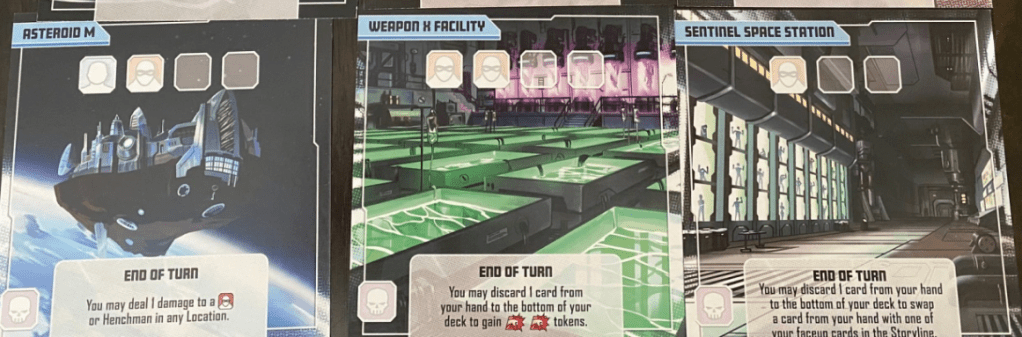
Space Alert isn’t alone with its programmed movement adjacent mechanism. This could be why there are fewer games with programmed movement as a mechanism, but even if one made the description broader, games with programmed movement would still have fewer than 400 games.  Getting back to the mechanism as defined, I like programmed movement a lot. The chaotic nature of programming something and then watching your plans crumble can cause frustration, but it can be a joy.

Games that use this mechanism

Robo Rally, Mechs vs. Minions, Flamme Rouge, Colt Express, and Space Cadets

Rondel

Number of Games

268

Description

Rondels are wheel-shaped game mechanisms that contain multiple actions players can take. Player choice is limited to their ability to move around the rondel and select the action depicted on the rondel’s wedge. Typically, the rondel mechanism prevents players from taking the same action in consecutive turns. Board games that feature rondels tend to allow players to move further around the rondel by paying a cost.

Thoughts

While many games include a “don’t take the same action in consecutive turns,” rondel games are subtle. They don’t tell you, “Don’t take the same action.” Rondels nudge players not to play the same action and to try more of the actions the game has to offer.

Many rondel games do allow players to pay for additional movement around the rondel, but making a complete trip around the rondel (to claim the same action) is usually cost-prohibitive. I hope you really want that action because it’ll cost you half your victory points or in-game currency to claim it again. I always thought of the rondel mechanism as one of those game designer’s game mechanisms. I enjoy rondels. I also thought they showed up in thousands of games because the circles I play games with love talking about the latest game that uses a rondel. I agree with them. Game designers need to increase the number of games that use rondels. Double the number of games. Triple them!

Games that use this mechanism

Planet Unknown, Wonderland’s War, Unconscious Mind, Merchants of the Dark Road, and New York Zoo

Closing Thoughts

We shortened this list from the 10 Common Board Game Mechanisms list a month ago. Ten may have been too many mechanisms. While some of these mechanisms make sense that they wouldn’t show up in too many games, I’m looking at you, Crayon Rail System, others like the Mancala game mechanism should be in a lot more games. I’m shocked that with the tabletop game industry’s current climate that the Mancala mechanism doesn’t have at least 500 games to its name.

Like the game mechanisms that made the most popular list, we’ll be handing out board game designers a questionnaire to get their thoughts on each game mechanism. This may still be a month or two away from happening, but we’ll let you know when this series is ready. Until then, let us know of any board game mechanisms you think should be in more games. I hope you found something useful in the post. And wherever you are, I hope you’re having a great day.