Geekly Tunes: Whatcha Listening To for May 2025

Hey, hey, Geekly Gang! Kyra Kyle here. We’re back with another Geekly Tunes post for May 2025. This is the post where our writers share what music we’ve listened to over the past month. You’re part of the Geekly Gang, too, so feel free to share what music you’ve been listening to over the last month.

Kyra’s Tunes

I’ve been listening to a lot of punk. The Damned has been in my rotation. The Sex Pistols have historically taken the Damned’s shine, and that’s a shame. I like the Pistols, but The Damned came first; they were the first UK punk band to release an album, 1977’s Damned, Damned, Damned. I think they liked saying the word “damned.” The band’s first single, “New Rose,” was a power-pop-punk track. Even though the Buzzcocks would solidify the pop-punk genre a few years later (more on them in a minute), the Damned kicked off the UK’s punk revolution.

“New Rose” and “Neat Neat Neat” are fantastic tracks. Rest in peace, Brian James, who passed away a couple of months ago. James is the original The Damned guitarist and principal song writer for the band’s first two albums. Captain Sensible took over song writing duties with The Damned’s third album, Machine Gun Etiquette. I love both parts of “Smash It Up.” Part 1 is a wistful instrumental that proves the band knew how to play their instruments, while Part 2 captures punk’s essence. “Smash It Up” stalled at number 35 on the UK charts because record executives feared the song promoted anarchy.

But I may like The Damned’s cover of The Beatles’ “Help” best. I may actually prefer the cover to the original. “Help’s” lyrics lend themselves to a pop-punk song, and The Damned plays “Help” at double the speed. Oh yeah!

The Buzzcocks combine simple but catchy guitar riffs with lyrics to match. They’re one of those bands where you can listen to a song and sing along during your first listen. “What Do I Get?,” “Everybody’s Happy Nowadays,” and “Ever Fallen In Love (With Someone You Shouldn’t Have Fallen In Love With)?” may be their most well-known numbers, but feel free to listen deeper into the Buzzcocks’ catalogue. You’ll hear their influence on pop-punk bands like Green Day, Sum 41, Blink-182, and Emo bands like My Chemical Romance. The Buzzcocks may not get political like other punk bands on my list. But sometimes, you just want a love song and joy.

Bad Religion began as a hardcore punk band in 1980. It still is one today–Bad Religion released Age of Unreason in 2019 and is in the studio for a follow-up album–but something changed with the band’s 1988 album Suffer. Bad Religion added melodic guitar riffs to hardcore punk and pioneered the melodic hardcore subgenre. Lyrics turned introspective and often political. If you want to hear the difference between Bad Religion’s original hardcore sound and after they incorporated melodic guitar riffs, try listening to “We’re Only Gonna Die” (from 1982’s How Could Hell Be Any Worse?) and the title track from 1988’s Suffer.

But I’ll admit my favorite Bad Religion tune, 2001’s “Sorrow,” was released after the band achieved commercial success. Bad Religion wrote about the world’s suffering through the lens of the Biblical figure Job. “Sorrow” was first released shortly after September 11, 2001. Guitarist and songwriter Gurewitz said that it was difficult to account for suffering in the world from a theological perspective (given the state of the world at the time), but “Sorrow” may have been the right song at the right time.

Finally, I’ll give the Dead Kennedys a quick shoutout. Their debut album, Fresh Fruit for Rotting Vegetables, is a hardcore punk classic. With tracks like “Kill the Poor,” “California Uber Allies,” and “Holiday in Cambodia,” Dead Kennedys wore their political views on their sleeves. They didn’t care what anyone thought about them, and what’s more punk than that? Also, “Holiday in Cambodia” has one of the top five sickest punk bass lines. It gets stuck in my head.

That’s all I have for this month. Let’s check in with Season and Skye.

Skye’s Tunes

The Killers’ Hot Fuss is a classic from my childhood. Much like Costello Music, Hot Fuss is what got me into The Killers and created several jammin’ good memories. I remember several car trips in the mid-2000s listening to songs like “Mr. Brightside” and “Somebody Told Me.” Naturally, this was another must-have for my vinyl collection. Good times. If you aren’t familiar with it, The Killers’ Hot Fuss is an album I strongly recommend.

The Fleetwoods is a band I had never heard of until 3 years ago. Their Greatest Hits! album was recommended to me by my parents, and I’ve loved it ever since. My favorite thing about their sound is the calming/chill vibes each one carries with it. Whenever I need to take a breather, The Fleetwoods always help me find my center. Even now, “Graduation Song” is stuck in my head and I’m getting flashbacks to my High School days. In a good way, I promise.

Yep, even in a post about music, I still managed to circle around to movies. You’re welcome. My favorite thing about the Edward Scissorhands soundtrack is its haunting yet majestic tone. Elfman himself has even claimed Edward Scissorhands was his favorite score he’d made. I’m inclined to agree with him, considering the complex emotions I get when I listen to it. I often want to cry, but I also feel peaceful, creeped out, and hopeful. It’s an interesting blend that matches the Edward Scissorhands film perfectly.

Creedence Clearwater Revival’s Chronicle has been my go-to album for this month. I always have 1 album I listen to on repeat, and this month it was CCR. As someone with varying tastes, I often go in and out of phases with different genres. The same applies to literature, movies, and video games. Simply put, my vibe for the past month has been Creedence Clearwater Revival. Chronicle includes some classic hits like “Proud Mary,” “Bad Moon Rising,” “Down on the Corner,” and many others. Even now, “Lodi” just crept its way back into my head. No regrets!

Season’s Tunes

Kyra mentioned that The Buzzcocks influenced bands like Sum 41. Funnily enough, Sum 41’s album Underclass Hero is one I’ve listened to a lot lately. It’s easy to listen to, especially when I’m playing games or working. There aren’t many albums I enjoy listening to all the way through without skipping a song or two. I prefer some Underclass Hero songs over others, such as “Walking Disaster” over “The Jester.” I still don’t skip them.

I’ve always been a fan of video game soundtracks and have a myriad of them saved on my Spotify account. Katamari Damacy’s soundtrack is up there with one I’d recommend to anyone who enjoys wacky music with catchy tempos. Two of my favorite songs on this album are “The Na Na Song” and “Moon and Prince.” I’ve only listened to the soundtrack from the original Katamari Damacy, so I’m not familiar with the soundtracks from the sequels.

My final entry for this week is special to me. It’s not this album, but the song “Chakkiri Bushi” 「ちゃっきり節」is a song that’s sung in Japan’s Shizuoka prefecture during tea picking season. Shizuoka produces around forty percent of Japan’s tea, and singing while working makes the job go by quicker. I’m not sure if people still sing this song today while they pick tea, but many of the older locals of Shizuoka know it. My favorite version is sung by Ichimaru-san, who originally recorded the song in 1931.

Hey, hey! Kyra Kyle again. That’s all we have for Geekly Tunes this month. Let us know what music you’ve been listening to. You’re part of the Geekly Gang, too. Thank you for reading, and wherever you are, I hope you’re having a great day.
Quirky Video Game Review: Stacklands

Stacklands merges a survival/civilization game with the skeleton of a collectible card game, and the results are interesting. Developed by indie designer Sokpop Collective, Stacklands takes these disparate themes and mechanisms and makes sense of them. Prepare to drag cards on a board and stack them on top of each other for numerous interactions.

Hey, hey! Kyra Kyle here. Today, I’m reviewing a quirky video game I’ve meant to cover for a while. Full disclosure: I’ve played a heap of Stacklands on Steam. I purchased all the DLC–we’ll only touch on some of the bonus content–and spent countless hours watching my card-sharped citizens build an empire. But how does Stacklands stack up against our review criteria? Let’s find out.

Mechanisms

Game Mechanisms: 10/10

Quirky indie video games tend to sport fresh game mechanisms, and Stacklands is no different. Stacklands combines a collectible card game and a civ builder into a cohesive whole. The experience is a great loop of exploration and optimization for your villagers. I’ve never had this much fun stacking one card on top of another card and getting something in return. One chicken on top of another chicken yields an egg. Place that egg card on a campfire and produce a cooked egg. Sounds simple, but a multitude of these actions may occur at once. Players must manage the timers for each interaction and generate enough food at the end of the day to feed their civilians. Any items you don’t use or can’t use may be sold for coins that are used to purchase new card packs. Card packs contain new items and ideas.

The gameplay loop and exploration (of what I can put together to make something exciting and new) are addictive. Earlier versions of Stacklands proved difficult to manage some of these elements, but later patches fixed many of these issues. I have as much fun optimizing my little village as I do discovering new ideas. If you were to construct a hotpot, you could place food into the pot that you wish for your villagers to eat first. This way, you can keep more valuable food items. Small upgrades like this add strategy.

And Stacklands is full of small and large upgrades ready to make your village strong enough to fight off invaders. Yes. There will be invaders who will randomly attack your village, but usually after the first five or six moons (or days). Enemy cards are indicated by red backgrounds. You may choose to fight these enemies unarmed (like the picture below) or upgrade your Villagers with weapons that will change their job title from Villager to something fancier, like Warrior or Swordsman.

Stacklands also has a knack for ramping up the difficulty. Most difficulty spikes happen organically; you won’t face a stronger creature unless you spend money to buy a more expensive pack that may contain the stronger creature. The largest of these difficulty spikes is at the player’s discretion. I don’t know how many times. I’ve accidentally summoned a demon and watched in horror as the demon decimated my villagers.

But I was the one who summoned the Demon. I’ll know for next time not to do the thing that summoned the Demon until after I’m prepared to defeat an enemy with 300 health. Like many survival games, you’ll need to restart your Stacklands village when you have no more living Villagers, but when you do restart your village, you don’t need to relearn skills and ideas. I don’t mind this. It lessens the danger, and often, I’ll have a better item I’ve unlocked and can outfit my villagers with better gear or a more optimized village. Heck. I’ve let a larger enemy torpedo my village, so I could start over.

Gameplay Loop

Above Image from GameDesigning.Org

Gameplay Loop: 10/10

I’ve already mentioned Stacklands’ gameplay loop. Combining collectible card packets with building a civilization of card villagers is fantastic. Stacklands also manages its difficulty spikes well. Players have more control over what they’ll face. Buying more expensive packs could mean stronger enemies appear, but you’ll want to unlock every card in each packet type and as quickly as possible.

Collecting cards like Pokémon mixed with exploration is a potent combination. And since Stacklands has so many hidden tech trees (the game doesn’t spell out its tech trees in a diagram), you’ll find hours of enjoyment reverse engineering a recipe. How do I get a gold bar? I need a smelter and gold ore. How do I make a smelter, and which booster pack contains gold ore? Stacklands has so many rabbit holes to explore.

Story or Narrative

Narrative: 6/10

Stacklands has a few side stories that make up a somewhat larger narrative, but it doesn’t have a traditional storyline. There’s the demon I mentioned earlier. The demon isn’t too difficult to defeat if you have the proper equipment and a large enough army. You’ll also have to challenge a witch who summons monsters from a strange portal. Defeating the witch is the closest thing the base Stacklands game has to a larger story.

Players must construct a stable portal so they can enter the witch’s realm and fight her seemingly endless army of baddies. The army the player sends may choose to return home after each level of witch minions. Defeat the final level and then the witch. Players will receive a “you completed the game” notification, but that’s not the end. You may continue playing Stacklands and its DLC. The only location you can access without buying DLC is the island. This has a “story” similar to the witch on the mainland, but it’s the paid DLC that has fleshed out stories. I’m not including the DLC in this review, but if I did, this score would rise a point or two.

Storytelling

Storytelling: 5/10

Stacklands‘ storytelling is no better than average. I promised I wouldn’t include the paid DLC (which only costs a few dollars) in this score. The base game’s story is okay. The DLC ventures into some interesting territory. I talk briefly about them. One alternate plane deals with waste; you’ll need to optimize your village so you won’t produce too much pollution. Another plane centers around death. A third pivots hard into combat and rage. Stacklands‘ DLC is well worth the price (if you like the base game), but it’s the base game’s storytelling we’re grading here, so it’s average.

User Interface: 9/10

While Stacklands has a lot going on at once, it does a good job of presenting these options to the player. In the top left, you’ll find tabs for Quests and Ideas. The quests are self-explanatory. If you don’t know what to do next, check out your active quests.

Ideas are the recipes you know. Stacklands does a great job of grouping similar recipes into tabs. You may expand these tabs to see individual recipes or collapse them if you’re not looking for that recipe type.

In the far right corner, you’ll find out which day (moon) you’re on, and the symbol on the right of this box lets you dictate how fast time moves. To the left of the moon, you’ll find your village’s vitals (food, coin, and how many cards you may have in your village–booster packs don’t count toward this total). The image above may be from Moon 5, so there aren’t as many cards in play, but Stacklands has so many ways to optimize your village that you can build one that minimizes your number of cards and is almost automatic.

Once you find a consistent source of food, you’ll be able to focus on other things Stacklands offers, and there are plenty of choices. Stacklands rewards trial and error. Don’t be afraid to make mistakes.

Graphics: 6/10

While I enjoy Stacklands‘ graphics, they are minimal. Stacklands chooses legibility over style. Even though that’s the right choice for a game like this, I can’t tell you that Stacklands has amazing graphics. The game’s graphics are crisp, at times adorable, and most importantly, functional.

Audio: 7/10

You like lo-fi chill jams, don’t you? Who am I kidding? Of course you do. Stacklands’ soundtrack makes great background music. To be honest, I hardly notice it while I’m playing. Where this score gets a bump is when considering Stacklands’ sound effects: card shuffling, ripping open a booster pack, the little bloopy combat noises, and adorable animal calls. Sokpop Collective took time and care with Stacklands’ sound effects, and it shows.

Replay Factor: 9/10

Stacklands has plenty of DLC, and that DLC has its own puzzles for you to solve. The DLC adds a good ten to twenty gameplay hours. But the base game has tons of replay value in its own right. Even if you defeat the witch and the demon, you may want to beat the time it took you to defeat the witch and the demon. I’ve also discovered numerous recipes after beating these two, which then prompted another playthrough. Sure, I beat the game, but I figured out how to make a resource magnet. That would optimize my village to the fullest.

Again, I may be biased. I put a heap of time into Stacklands, but it has a fair amount of replay value. Each new play can lead to a different path to success.

Aggregated Score: 6.9

Geekly News: May 20, 2025, Sadie Sink’s Role in Spider-Man: Brand New Day

Hey, hey, Geekly Gang! Kyra Kyle here. My partner and I are celebrating our 28th anniversary, and it happens to be Memorial Day weekend as well, so we’ll have a shorter Geekly News than usual. But that doesn’t mean that we don’t have anything to talk about. Let’s get to this week’s Geek News.

Sadie Sink’s Role in Spider-Man: Brand New Day

A leak about Sadie Sink’s role in Spider-Man: Brand New Day occurred the day last week’s Geekly News posted, so we’re a little late with this update. Geekly has also covered Sink’s role in Spider-Man: Brand New Day in a previous geek news post, but we may have been bamboozled. A month ago, we learned that Sink’s character would be a mutant. Geekly assumed that meant that Sink would tie into the X-Men in some fashion (possibly Jean Grey, more likely Firestar). Now, it appears that Sink’s character will be connected with Tobey Maguire’s Spider-Man, but Sink could still be a mutant.

Marvel kept a tight wrap on who Sadie Sink would play until Podcaster and MCU insider John Rocha revealed on The Hot Mic podcast that Sink will be playing Mayday Parker, the daughter of Tobey Maguire’s Peter Parker/Spider-Man. This reveal lines up with Maguire’s Spider-Man in Spider-Man: No Way Home. While Garfield and Holland’s Spider-Men (Spider-Mans?) complain about not being lucky in love, Maguire’s Spider-Man suggests that he’s married. In the comics, the Spider-Baby (the child of Earth-982’s Peter and Mary Jane Parker) becomes Spider-Girl. This would also track with what we learn about Maguire’s Spider-Man in No Way Home. Maguire’s Spider-Man is retired. Why would he need to fight crime when his daughter is Spider-Girl?

Sink as Spider-Girl solidifies Spider-Man: Brand New Day as a Multiverse story. This also makes sense. The MCU will need to tie up loose ends to its Multiverse Saga before it can begin the Mutant Saga. And Spider-Girl could still count as a mutant. If she inherited her abilities from her father, Peter, this version of Mayday Parker would’ve been born as Spider-Girl. May Parker would be a mutant.

Murder on the Rocks Launches on Kickstarter

Murder on the Rocks looks amazing, even if the game doesn’t appear to be one I typically like. Gamers take on quirky roles at a cocktail, masquerade party. One player is a murderer. The murderer attempts to kill each partygoer one by one, while the other partygoers try to deduce who the murderer is. In short, Murder on the Rocks sounds like it plays similarly to Werewolf. If you like Werewolf, Mafia, or any tabletop game with hidden roles, you should check out Murder on the Rocks.

I like the inclusion of red and green vials. If the partygoers get aspects of the murder correct, they add drops from the green vial. Whenever the murderer claims a victim, they add drops from the red vial. I assume the red and green liquids inside the vials are food coloring, so gamers should be able to add more “envy” or “blood” to each vial. Players also wear blindfolds (masquerade masks). That could be a fun twist on Werewolf. And Murder on the Rocks ditches a game box for a drink mixer. Oddly shaped game containers can be difficult to store, but this container strengthens the game’s theme.

Pledge values for Murder on the Rocks range from $32 for the base set (Straight Up) to $116 if you want the Reserve Collector. Murder on the Rocks has a lot of cool bits. I’ve never seen vials used like this in a game. If you’re interested in Murder on the Rocks, check out their Kickstarter page.

Knight Moves Kicks Off on Gamefound

I like what I’m seeing from the board game producer, Solo Game of the Month. The company does what it says, it releases about one solo game every month. We covered Dicemancy last month on Geekly News, and Solo Game of the Month is at it again with Knight Moves. This adorable solo game features double-sided stage and boss cards. The player cards are also double-sided because gamers may choose melee or ranged attacks. Players program their knight and then execute their actions.

You can place and move barrels, defeat enemies, and upgrade your knight. Multiple scenarios provide plenty of replay value. Most games take about 45 minutes, which is a good length for a solo game. And the price tag of $25 makes Knight Moves a lot of game for not a lot of money. I’m impressed by Solo Game of the Month’s dedication to providing great solo-gamer experiences. Solo games are exploding in tabletop games. I also love the art. Solo Game of the Month keeps things clean, easy-to-read, and charming. If you’d like to pledge for Knight Moves, check out its Gamefound page.

Netflix Announces Clash of Clans Animated Series

Netflix continues a growing trend of turning popular video games into television series. The streaming giant announced this week that it intends to release an animated series based on Clash of Clans.

Clash of Clans will join Angry Birds, Splinter Cell, Cuphead, Castlevania, Dragon’s Dogma, and many more on Netflix. The streamer hasn’t given a timeframe for Clash of Clans’ release. Geekly’s guess–and it is a guess–will be that the show will release some time before May 2026.

That’s all the news we have for this week. Thank you for reading, and wherever you are, I hope you’re having a great day.
Tabletop Game Review: Marvel United, Tales of Asgard

We haven’t covered a Marvel United expansion in a couple of months. It’s about time we returned to the series. Geekly won’t be covering every Marvel United expansion, but we will review the ones worth your time or the ones we believe people will most likely purchase. So, you could consider the Marvel United expansions we cover as ones you may want on your radar.

Hey, hey! Kyra Kyle here. In Marvel United, players act as iconic Marvel heroes who work together to stop the master plan of a powerful villain controlled by the game. Each villain has a unique master plan, cards that trigger various effects, and threats that make clearing locations difficult. Heroes clear missions, making the villain vulnerable, and finally take on the big bad villain before they complete their dastardly plan. Can you save the day in time? Tales of Asgard casts players as Marvel versions of Nordic mythology.

Hark, brave do-gooder. Before we doth continue further, thou must first indulge Tales of Asgard’s finest of prints.

Marvel United Box Close Up Board Game Review

The Fiddly Bits

Designer: Andrea Chiarvesio and Eric M. Lang
Publisher: CMON Global Limited and Spin Master Ltd.
Date Released: 2021
Number of Players: 1-4
Age Range: 8 and up
Setup Time: 5-10 minutes
Play Time: 30-40 minutes

Game Mechanisms

Cooperative Play
Hand Management
Modular Board
Solo / Solitaire Game
Variable Player Powers

Marvel United Tabletop Game Set Up

Game Setup

We already covered the Game Setup and Game Flow in our Marvel United review (here’s a link to that review), so we’ll go over the basics in the following two sections. Let’s cover an abbreviated review of the game setup and rules.

Marvel United’s setup can change depending on which Villain and Heroes you choose to play. Each game consists of six locations. Typically, core sets have eight locations. Since Tales of Asgard is an expansion, it only has six. You may choose your locations or shuffle them and choose six at random. Each Location card has spaces at the top for civilians and thugs and a rectangle with a block of text that will state “End of Turn” at the top of the box.
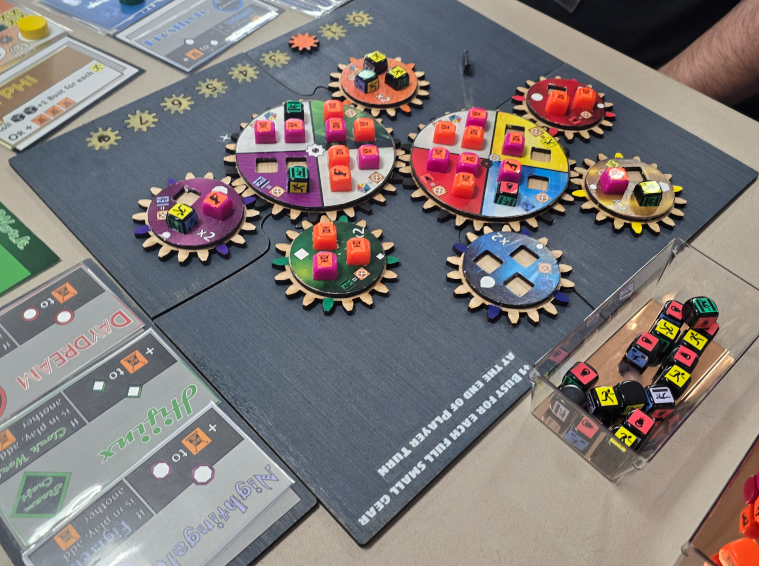
Place civilian/thug tokens on their matching spaces. Shuffle the Villain’s Threat deck and deal out each Threat face-up so that it covers the rectangle at the bottom of each location. You must clear this threat before gaining the “End of Turn” effect printed on a Location. Place health tokens where signified on threat cards and on the Villain dashboard. Place the three mission cards (Defeat Thugs, Rescue Civilians, and Clear Threats) face up under the villain dashboard where the text reads “Unlocked.”

Each player shuffles their hero decks and then draws three cards to form their hands. Shuffle the Villain’s Master Plan deck. Leave the Master Plan deck face down. This will be the villain’s draw pile.

Players place their miniatures on one of the six location cards, usually the centralmost location for each player (easy access). Then, they place the villain on the location card opposing the heroes.

Marvel United Game Flow Board Game Review

Game Flow

The villain(s) play first. Draw the top card of their master plan deck. The villain moves the number of spaces indicated. Resolve any BAM! Effects and these effects will be printed on a space within the villain’s dashboard. Then, place the civilian/thug tokens (if any) indicated at the bottom of the card. After all these effects are resolved, the heroes get their turn.

Heroes pick who goes first, and hero turns will continue around the table clockwise. At the beginning of each game, Heroes will get three turns before the villain receives another turn. During their turn, heroes play one card from their hand.

Marvel United Sample Hero Turns Gacha Game Review

Resolve actions and the symbols printed at the bottom of the hero’s card in any order. The symbols at the bottom of a hero’s card will be shared with the next player, but any printed action will not be shared. Heroes will use these actions to complete missions. The game begins with three missions in play: Defeat Thugs, Rescue Civilians, and Clear Threats. Each mission card will have spaces for the tokens they require to complete. As soon as these spaces are filled, the card is discarded, and the mission is considered complete. Mission cards can be completed in any order.

After the heroes complete the first mission, the villain panics and will act (play a card) every two hero cards instead of every three hero cards. After the heroes complete the second mission, the villain becomes vulnerable to damage. The heroes can complete the third mission, but it isn’t necessary. If the heroes do complete the third mission, each hero immediately draws 1 card, increasing each player’s hand size by one.

Play continues back and forth until either the villain wins (by completing their unique master plan or anyone, heroes or villains, runs out of cards) or the heroes win by dealing enough damage to the villain after the villain becomes vulnerable to damage.

Review

In the comics and the MCU’s first phase, Thor is a part of the core three Avengers: Captain America, Iron Man, and Thor. We’re mostly covering the Tales of Asgard expansion because plenty of people will want to have Thor as part of their heroic line-up, especially since the original core box contains Cap and Iron Man. That said, I think the gameplay highlights for Tales of Asgard are its villain, Loki, and oddly enough the Challenge card. Let’s begin with this unique Challenge.

Traitor Challenge Marvel United

The Traitor Challenge is a hint of what would come in the X-Men Marvel United set. Each player gets 1 Allegiance card, 1 Suspicion Token, and a Wild Token. Three Allegiance cards show “Loyal,” while one is a “Traitor.” The Traitor card must be in play and shuffled with enough Loyal cards to hand out to every other player. Naturally, there’s a three-player minimum with this challenge. If you play a two-player game, it’s obvious who the traitor is. Players may choose to play a Hero card facedown (gaining no benefit from it) to discard their Suspicion Token. This matters because once 2 Missions are complete, all Loyal Heroes still with a Suspicion Token take damage until they’re KO’d. This leads to players who are loyal wanting to discard their Suspicion Token. A player who doesn’t care to do that may be the traitor.

Another thing that happens after 2 missions are complete is that the players guess who the Traitor is. If correct, each Loyal Hero gains 1 Wild Token. The Traitor’s hero is removed from play and now plays as the Villain, drawing 2 Master Plan cards and playing 1 each turn. This is the hint of X-Men Marvel United. Marvel United’s next set allows players to assume a villainous role. The Traitor Challenge is a precursor to this playstyle, and it still works even with future sets. If you enjoy the idea of one player being the Traitor, this challenge is perfect. And it works well with Tales of Asgard’s villain. Loki often assumes the visage of others, so the Traitor Challenge is thematic.

Loki Marvel United

Loki’s a great villain whether you choose to play with the Traitor Challenge or not. Loki is a bit faster than the villains found in the original core set. That makes sense. He’ll hop around the map, making it difficult to deal damage after he’s vulnerable. He also has an “Illusion” Threat Card that makes dealing damage to Loki (while he’s at that location) impossible. While not as powerful as some villains (who have Threat Cards that make their villains impervious to damage for the card existing at all on the board), this, combined with Loki’s movement, makes him a challenge.

Loki Henchman 01 Frost Giants Marvel United

The “Master Trickster” and “Frost Giant” Threats are standard fare. Effective but nothing too special. The “Frost Giant” has more health (5) than most Henchmen, so they can be a chore to dispatch. Loki’s Master Plan deck features a lot of “Each Hero alone in their Location” or “Each Hero not alone in their Location” takes 1 damage, and if the previous statement is untrue, draw another Master Plan card and add it facedown in the Storyline. Both actions can prove fatal because Loki likes running out of cards in his deck by placing Master Plan cards facedown and dealing damage to Heroes whittles a player’s hand and feeds into Loki trying to speed up the clock.

Loki Overflow Effect Marvel United

Loki’s Overflow ability can also get annoying. If 1 or more Tokens can’t be added to a Location, Loki gains 1 additional Health (may go above his starting value). While Loki has below-average health for a main villain, his Overflow ability gives him more survivability. Loki surviving an extra round could mean that he may run out of cards and win.

I mentioned that Loki has a lot of movement. Fortunately, the Locations included in the Tales of Asgard expansion sport a lot of movement for their “End of Turn” abilities. “Heimdall’s Observatory,” “Throne Room,” and “Bifrost Bridge” have some form of mass movement. That’ll help when trying to catch up with Loki. The “Odin’s Vault” and “Valhalla” Locations have card draw which can be helpful, while “Asgardian Palace” has an underwhelming “You may add up to 2 Civilian and/or 2 Thug Tokens to any Location.” “Asgardian Palace” can help if you’re facing a Villain who doesn’t place enough Tokens, but most Marvel United villains place ample Tokens, and other Locations allow players to add a Token and clear a token in one action.

Valkyrie Marvel United

I waited long enough. Here are the Heroes. Surprisingly, Valkyrie is the most balanced character of the bunch. She has a fair amount of Heroics and plenty of movement with her “Warsong” special abilities. The other two Heroes from the base Tales of Asgard expansion, Thor and Korg, focus on Attack. While this makes sense, they do come off as one-note characters. Thor has a little more Heroics and Movement, while Korg allows players to target multiple enemies at once. Both Heroes are situational, but I’d give Thor the nod as a more universal character.

But Thor doesn’t quite claim the top spot as a Hero. If you happen to get the Kickstarter exclusive of Tales of Asgard, you’ll also get Beta Ray Bill. Bill is almost identical to Thor, but I prefer his “Stormbreaker” ability to Thor’s “Mjolnir.” I know, that’s sacrilege. Mjolnir beats Stormbreaker. But “Stormbreaker” gives players more choice with where they assign damage and grants more card draw. Both of those edge out Thor’s “Mjolnir.” Even without the Kickstarter exclusive, Tales of Asgard has some solid Heroes.

Too Long Didn’t Read

The Kickstarter version of Tales of Asgard includes one of the better characters in this expansion, Beta Ray Bill, but Thor and Bill are close enough to each other and serve a similar purpose. The Traitor Challenge Card shows where Marvel United will go in the future, while Loki serves as an interesting villain.

Whatcha Watching, Geekly? May 2025

Hey, hey, Geekly Gang! Kyra Kyle here. It’s another Wednesday, and Geekly will be discussing the shows and movies we watched over the past month. I won’t be including Thunderbolts* in this post because I’ve already written a review about that movie. And as usual, we’re all part of the Geekly Gang. Feel free to share what you’ve been watching over the last month.

Kyra’s Shows

Ten minutes into watching Love & Death, it dawned on me that I had already watched a show with this same premise, Candy. So, I decided to do something a little different with this month’s Whatcha Watching. I rewatched Candy after finishing Love & Death and compared the two shows. Candy and Love & Death differ in two key ways: narrative structure and whose side of the story is told.

Candy (released in 2022 on Hulu) and Love & Death (released in 2023 on Max) follow Candy Montgomery, who was charged with the murder of Betty Gore in 1980. Candy pleaded not guilty based on self-defense. Both mini-series (with some alterations) share the basic details of the case. Candy Montgomery and Allan Gore (Betty’s husband) had an affair that ended amicably. Betty finds out about the affair a year later and accosts Candy with an axe, and Candy defends herself. Both shows also share specific details, such as Candy’s attorney quoting John Steinbeck in his closing arguments, but the two shows couldn’t be any more different.

Love & Death frames its story chronologically. This happens, and then this, and then this. It’s easy to follow. The structure and the time Love & Death spends on developing characters provide a window into who the characters (or real-life people) are and why they may do what they do, and when we finally see the death scene (which happens beyond the halfway point), the murder scene carries a lot of weight.

Conversely, Candy uses non-linear storytelling, bouncing from the present to the past and back again. I’m unsure why Candy chose this style of storytelling. Non-linear narrative structure is often nicknamed the narrative structure of trauma. Perhaps that was what they were going for. Candy shows the murder weapon within the first fifteen minutes and a glimpse of the murder within the first thirty minutes. It’s easy to get lost when something is supposed to happen because Candy shifts timelines.

Narrative structure isn’t the only way these shows differ. Love & Death attempts to stay neutral for all parties involved but leans toward sympathy for Candy Montgomery. Candy leans further into siding with the victim, Betty Gore. Betty’s ghost is even present during the reading of Candy’s verdict. What? There are some head-scratching choices made with Candy, but the show is still a good watch.

Before we move on, I have one other note: Candy uses the commonly seen “Based on a true story” at the beginning of each episode, while Love and Death uses the less common “This is a true story.” I didn’t know where to discuss this; it’s odd. The producers of Love & Death must be wagging their fingers at the producers of Candy. Tsk tsk. I’m unsure how I feel about Love & Death’s assertion, but I am sure that I prefer Love & Death slightly more than Candy.

Both are solid shows, and it was fun watching them back to back. Even though I watched Candy years ago, I forgot the show’s particulars. Watching Love & Death first before rewatching Candy allowed me to keep the timeline straight.

Candy’s narrative structure doesn’t help the story. There were scenes where I wondered if Candy’s husband was distant (like he was in Love & Death), and that’s why Candy cheated, or that Candy cheated on a man trying to make their marriage work (which seemed to be the direction Candy had gone). Candy’s non-linear narrative makes it difficult to track Pat Montgomery (Candy’s husband). Pat learns things about Candy, and he changes over time. Love & Death shows this well. Candy makes it unnecessarily murky at times.

Even so, I love Candy’s set design and atmosphere. Jessica Biel looks the part of Candy Montgomery. And I like that Candy is a trippy mini-series. But I lean toward Love & Death as the better series, even if they may be reaching with “This is a true story.” Biel may look more like Candy, but Elizabeth Olsen has the space and story to embody the character…I mean, real person.

I’ve watched other shows, but I wanted to share my thoughts on these two shows about the same topic that were released a year apart. Let’s see what Season and Skye have been watching.

Skye’s Movies

Blade Runner

I’ve been catching up on my movies. After several trips to my local Barnes & Noble, I’ve gotten a few DVDs. Among them is the original Blade Runner. This is a film that’s been on my watchlist for a while, and I’m glad I watched it, but I must admit I have complicated feelings. This is a movie I want to like, but I don’t know if I can.

I’ve heard an abundance of praise for the original Blade Runner, and I was hoping it would live up to expectations. Blade Runner’s look and feel are amazing, but plot-wise, I don’t know what it’s about. A few things likely went over my head. Before solidifying my opinion, I’d prefer to watch it at least one more time. I’ll gladly give Blade Runner a second chance.

Se7en

I’ve already seen Se7en, but I didn’t own it on DVD. Since I picked it up at Barnes & Noble, I needed to recapture the magic. Needless to say, Se7en holds up pretty well. It’s one of those movies that makes me question my reality and the value we place on morality. How do we determine objectively good morals, and how do we enforce them?

Since humans are imperfect, does anyone have the right to enforce morality? I know that’s deep, but these were the questions running through my head after first viewing Se7en. Of course, they came right back when I rewatched it. If you’re in the mood for an eerie, mysterious, and brutal tale detailing the human condition, Se7en is for you. Find out what’s in the box.

The Secret World of Arrietty

I’ve been on a Studio Ghibli kick, so it’s a great time to watch The Secret World of Arrietty. My favorite thing about the film is the worldbuilding. Focusing on a family of little people living inside a normal sized house, there’s a lot of inventive gadgetry they come up with to maneuver around the place. Each item was clever and cute when I saw them on screen.

Outside of that, I couldn’t get into The Secret World of Arrietty’s story. Mostly because there wasn’t much of a story. I respect The Secret World of Arrietty for trying to embrace a non-traditional plot structure, but in the process, it lost the personal connection. This movie is very cute (one that kids will love), but there unfortunately isn’t much substance to it. Since it’s a Ghibli film, you can bet The Secret World of Arrietty has plenty of breathtaking animation.

Season’s Movie

Hey, Geekly Gang! I’ve been watching more anime than usual lately, which isn’t something I’ve done in a while. I watched The Rose of Versailles (2025) because I saw some clips on Instagram and thought it looked interesting. I had no idea what it was about. The Rose of Versailles is a period piece set during the French Revolution in which a woman leads an army and storms the Bastille (which was a pivotal moment in the actual French Revolution). The Rose of Versailles follows the themes of empowering women and romance. Apparently.

I say “apparently” for the romance because I didn’t care for it. Spoiler alert: The female lead (Oscar) dies at the end of the movie and wants to be with the man she fell in love with. It wasn’t necessarily out of nowhere because the guy she fell in love with grew up with her. But it was shoved in toward the end after she was adamant that she wouldn’t marry and live for her country.

On a different note, Aya Hirano was cast as Marie Antoinette in the Japanese version. I enjoyed watching her in something again after she’d received threats from former fans. I watched a lot of anime she was in when I was a teenager. Some of her notable work includes Fairy Tail (Lucy), The Melancholy of Haruhi Suzumiya (Haruhi), and Death Note (Misa).

Season’s Show

It was a matter of time before I started watching the Ranma 1/2 remake. I loved the original anime. This remake has a lot to live up to. Right off the bat, they faked me out with the intro song. It opened with Genma hitting a gong, but the song was completely different, so I’m docking points for that. Outside of that, the Ranma 1/2 remake stayed true to both the original anime and the manga. I’m watching the English dub first because that’s how I first watched the original when I was younger. I’ll probably re-watch Ranma 1/2 in Japanese at some point.

Speaking of the English dub, what the heck is up with Nabiki’s voice? Her voice used to be smooth and cool-sounding in the original anime, but they made Nabiki sound screechy in the remake. On the flip side, girl Ranma is more palatable to listen to this time. The original anime didn’t finish the manga’s story and ended in a weird place. I think this had something to do with the producer at the time. I hope the Ranma 1/2 remake sees the full story through to the end.

Hey, hey! Kyra Kyle again. Feel free to share what you’ve been watching over the last month, because you’re part of the Geekly Gang, too. Thank you for reading, and wherever you are, I hope you’re having a great day.