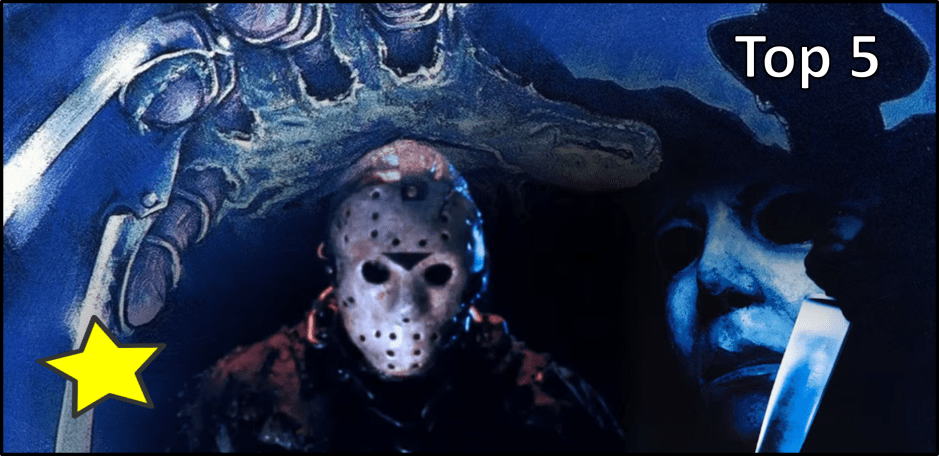
It’s Monday the 13th. OoooOOoooo! Happy Spooky Season, Geekly Gang! Kyra Kyle here. We’re continuing our Halloween coverage with slash films. Grease your chainsaws. Sharpen your machetes. It’s time to discuss the five best slasher film villains of all time. All time!
5) Art the Clown (Terrifier Franchise)
Art the Clown is a demented killer clown mime who kills people on Halloween nights. He carries a multitude of crude weapons and mutilates his victims in gruesome ways. Art the Clown’s manner of killing–which includes lots of kills and gore–cause his movies to verge on torture porn (popularized by the Saw franchise), but the Terrifier films maintain their slasher film status because of Art the Clown at their center.
Art the Clown has appeared in three movies and two shorts, and in a short time span, he’s become a horror icon. He’s easily the best slasher villain of the past decade. Given enough time, Art the Clown could climb this list, but I’m not so sure. The names above him are horror mainstays. Still, Art the Clown and the movies that feature him are more hardcore than most slasher killers throughout the years. He causes a glorious mess with every kill.
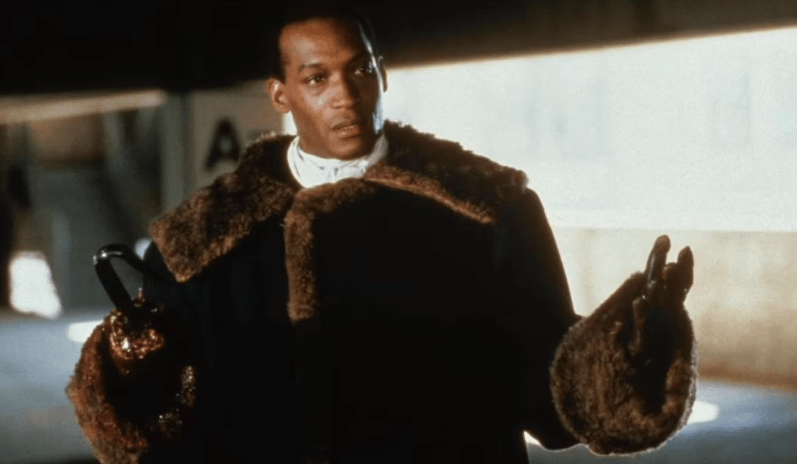
4) Candyman (Candyman Franchise)
Candyman, or Daniel Robitaille, is as much an urban legend or myth as he is a slasher villain. This is only one way he stands out. He’s tragic backstory goes beyond slasher movie tropes. Rooted in themes of racial violence and injustice, Candyman’s origin adds a layer of empathy, making his vengeful actions terrifying and, in an odd way, justified. His phrase, “Be my victim,” adds to the sense of dread and serves as a reminder of buried societal traumas.
The Candyman series had me scared to say his name five times. The first Candyman film remains the best. Tony Todd (rest in peace) gave Candyman a sense of purpose and grace that separated him from any slasher villain of his era. The second film went deeper into Candyman’s lore, while the fourth movie, produced by Jordan Peele, brought back the iconic killer while honoring the Black culture within the story. I love the Candyman series. Its villain just misses out on our top three, but the top three are horror movie royalty.
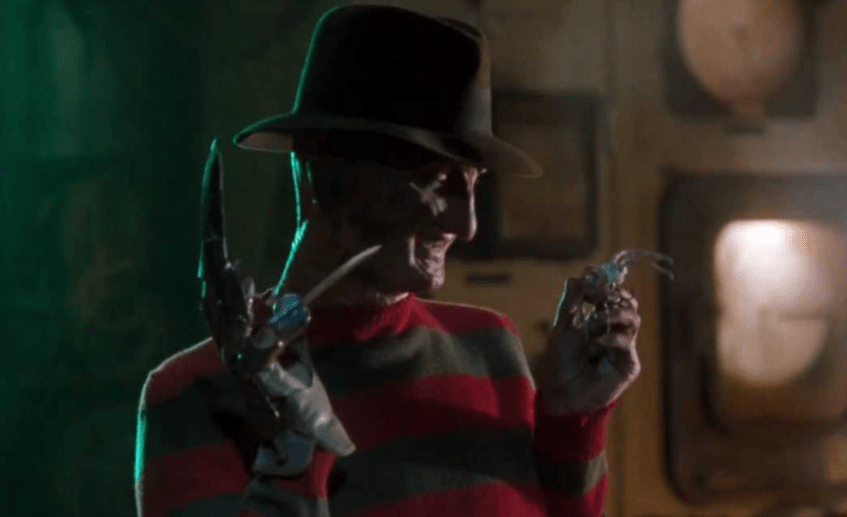
3) Freddy Krueger (A Nightmare on Elm Street Franchise)
Freddy Krueger’s ability to invade dreams sets him apart from other slasher movie villains. He transforms the safe haven of sleep into a terrifying killing ground. With his burned face, razor-sharp blades, and sinister laugh, Freddy taps into primal fears. He is the boogie man under the bed, in the bed, above the bed, hiding in the closet, and so much more. But Freddy isn’t all horror. He adds enough dark humor and charisma to make him repulsive and magnetic.
There’s no escape from Freddy. He follows victims into their most vulnerable state. Created by Wes Craven, Freddy Krueger will haunt the audience’s dreams long after his movies end. I’m haunted by the children’s song that serves as Freddy’s preamble. One, two, Freddy’s coming for you. Three, four, better lock your door. Five, six, grab your crucifix. Seven, Eight, gonna stay up late. Nine, ten, never sleep again. Try singing that right before you go to bed. You may just stay up an extra hour or two or five.
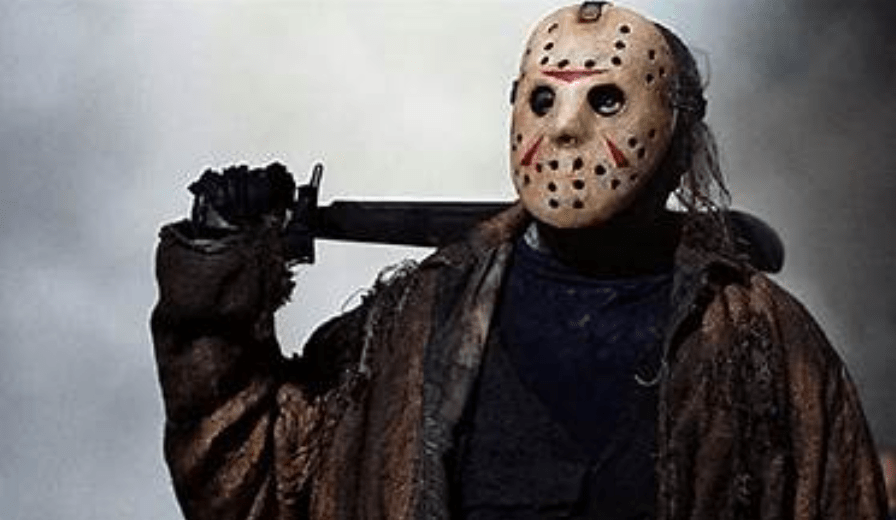
2) Jason Voorhees (Friday the 13th Franchise)
At the end of the first Friday the 13th movie, and after his mother died, Jason rose from the depths of Camp Crystal Lake to become the franchise’s new villain. He machetes his way through the camp and into the audience’s hearts with his bloody kills. Jason is a killing artist. He became more flamboyant through the years. He’s been killed and reanimated more times than a comic book hero, which actually matches his demeanor of an unstoppable zombie-like killer.
Interestingly, Jason is the more sympathetic character in his big crossover movie with Freddy Krueger, despite Jason being an unfeeling killing machine in his solo movies. Few slasher villains are more prolific than Jason. We can only think of one other slasher villain who tops his kill count and takes the number one spot as the true face of evil.
1) Michael Myers (Halloween Franchise)
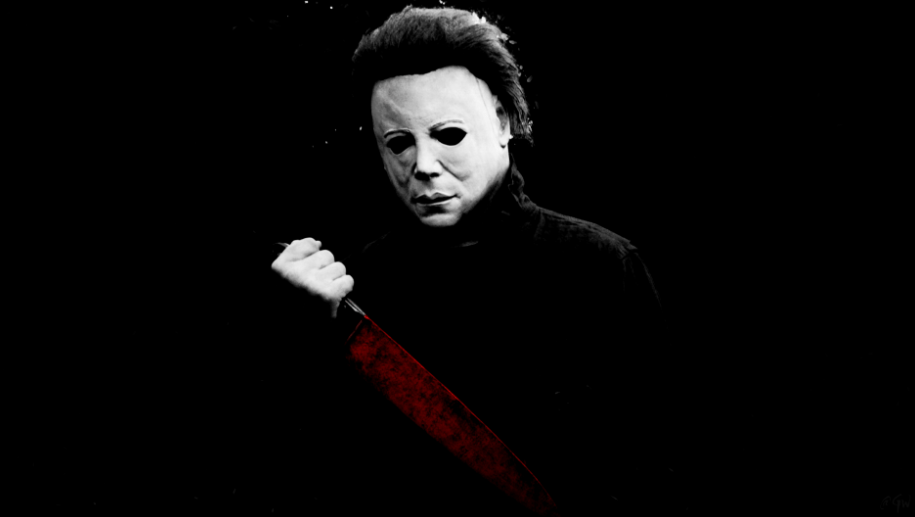
Black Christmas may have come first, but Halloween’s Michael Myers is the first name and face people think of when they think of a slasher villain. There’s something about a bleached William Shatner mask. Michael Myers completes the slasher villain big three of Michael, Jason, and Freddy. Michael Myers doesn’t claim our haunting number one spot because he’s physically imposing. He’s the shape of evil. He’s the one who began killing when he was a child and never stopped.
John Carpenter’s 1978 Halloween didn’t create the slasher subgenre. The genre bloomed in the wake of Michael Myers’ butcher knife. This horrifying classic had a simple premise. A silent serial killer stalks a quiet town. After decades of movies (and more on the way, we’re sure), Michael Myers petrifies audiences. Michael’s theme music is the stuff of legend. As soon as I wrote this post’s title, it played in my head. Not going to lie, I played the song. Pure movie magic.
That’s our list of the top five slasher film villains. Did we get the list right? Who would you add or take away? Let us know in the comments. Thank you for reading, and wherever you are, we hope you’re having a great day.
Hey, hey, Geekly Gang! Kyra Kyle here. Last week, we began a series called–for the time being–Writing Brain Dump, and this week is the time to roll out Game Design Brain Dump. The title is a work in progress. Let’s hope I can express my board game design process with this series. Fingers crossed for a cogent thought or two. Strap in for a Board Game Design Brain Dump.
Rustbucket Riots Origins
I’m going a different route from last week’s writing brain dump. Recently, I attended a panel about board game design at Nuke-Con (Omaha’s board game convention) and figured we could begin with what prompted me to begin designing Rustbucket Riots.
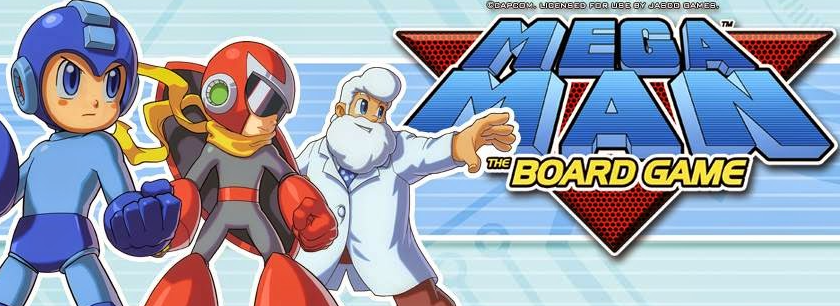
I knew Mega Man: The Board Game by Jasco Games wasn’t the best when I purchased it at a severe discount. Honestly, I wanted the bits. Jasco Games did an amazing job with Mega Man’s miniatures and the look of the game. But good luck finishing a game of Mega Man in under 10 hours. Each robot stage plays like five games of Munchkin played back-to-back, with every other player doing their best to prevent you from completing the stage. And you need to complete multiple boss stages. 10 hours may be too few hours to complete this game. You may need to dedicate a table to preserve your month-long game of Mega Man.
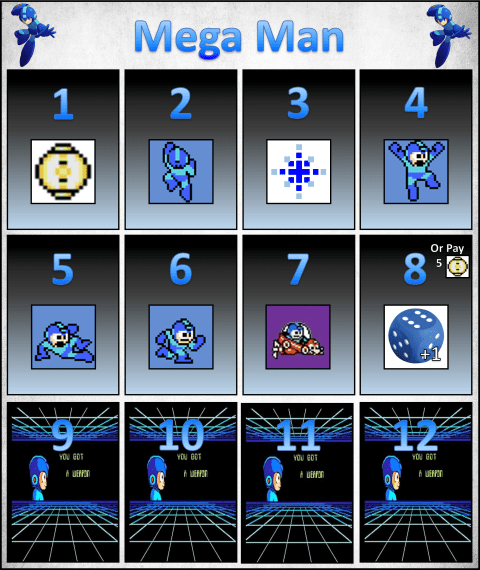
I hope I won’t get copyright claimed for any images. Eek! I began with a simple dice chucker of a game. Players would roll standard six-sided dice (I don’t recall the exact number, but it was likely around four or five) and then place the dice on their player boards. Each space on the player board would grant different abilities, with the final four slots variable for powers obtained by defeating robot bosses. Players could place multiple dice in a single space to combine the rolled result. A six may be played with a single die showing a six or with a two and a four or any other combination of six.
I chose dice chucking because rolling dice and placing them with predetermined spaces made for quick turns. Quick turns lead to a game that one can finish within ten hours. This game worked well. Heck, I even tried it as a real-time game, and it worked extremely well. Games lasted less than 15 minutes. I even saw this Mega Man variant as a game that could be played in tournaments of speed runs. Now that I think about it, I may revisit this variant in the future and give it a reskin. Sorry, the ADHD took the wheel for a second.
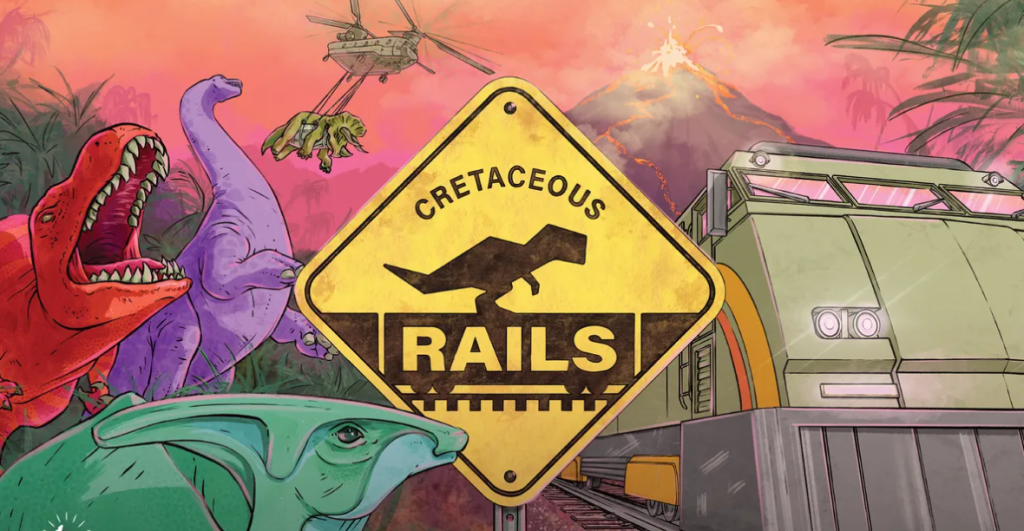
For some reason, I abandoned the above game concept and went in a different direction. I love Cretaceous Rails. Unlike Jasco’s Mega Man, there isn’t much I’d change with this title. Cretaceous Rails makes this list because I wanted to try using one of its core game mechanisms: dual action selection. I even asked Cretaceous Rails’ designer, Ann Journey, if it’d be okay if I borrowed this game mechanism before trying the next Mega Man remix iteration. The result was a game I nicknamed Rondelande.
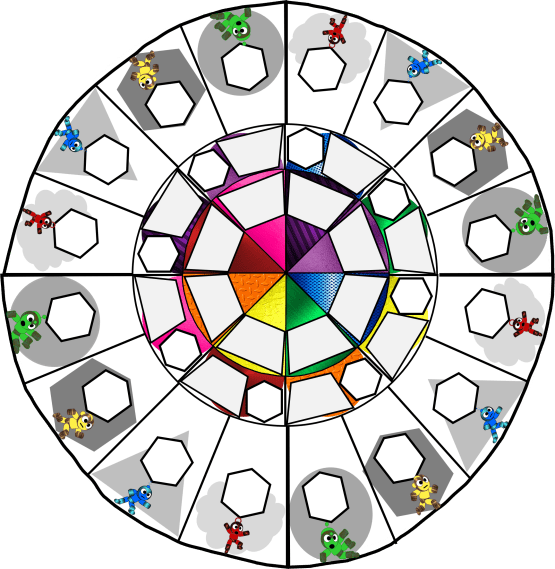
Oh my goodness. This game wasn’t just a different direction from my first Mega Man remix; it was different in every possible way. I didn’t keep any of Rondelande’s hardcopy versions. I only have the digital files, and it’s difficult to recreate what the game looked like without a physical copy. But I’ll try my best.
That’s a lot of color going on. Those are supposed to be three rondels (a circular game mechanism with pie wedges representing which actions one may take) stacked on top of one another. Each turn, players would place their gear tokens on one of the hexagon-shaped spaces and take the actions indicated. But before placing gears, players could play up to two cards (depicting one of the actions run, slide, jump, shoot, or climb) underneath the spaces on the outer edge. Players would then be able to take all the actions, including actions on cards, during their turn.
Note: The trapezoid spaces had different actions like draw cards or oil cans (that functioned as wild actions) or even rotating one of the top two rondels, so the action selection could vary.
Rondelande was a lot of fun. It ventured far from what I had originally intended to make. That’s the ADHD brain taking the wheel again. Unfortunately, Rondelande was a space hog. The image above is at least a twentieth of the size of the original game. Despite its size, Rondelande may have been a great game if I had stuck with it. I liked how players could build up the board as they went, benefiting themselves for a turn, but also allowing an opponent to take the same action in a future turn. Players could even refresh (take back their gear tokens) or choose not to refresh for a turn to prevent someone from taking an action their token is currently occupying. Rondelande was great. But something felt off. I wanted interlocking gears for the board because it made sense for a robot theme. I had chosen rondels because they were easier to build. And then I found gears that would work.
I found a file that could work for interlocking gears. Yay! As an aside, I was working on making this file work while producing my Mega Man variant and Rondelande, so a lot of what we’re about to discuss happened concurrently with the previous two games.
At first, I was using a lot of memory foam. Rondelande’s rondels were comprised of foam. I’d print out the digital files (of that rainbow nightmare above) onto full sheet labels and then sticker them over the foam and cut them out. I tried the same concept with the gear pictured above. And it worked…for like one playthrough of the game. Foam likes to shred under friction. Who knew? So, I put the interlocking gears aside until I found a set of wooden gears on Amazon.
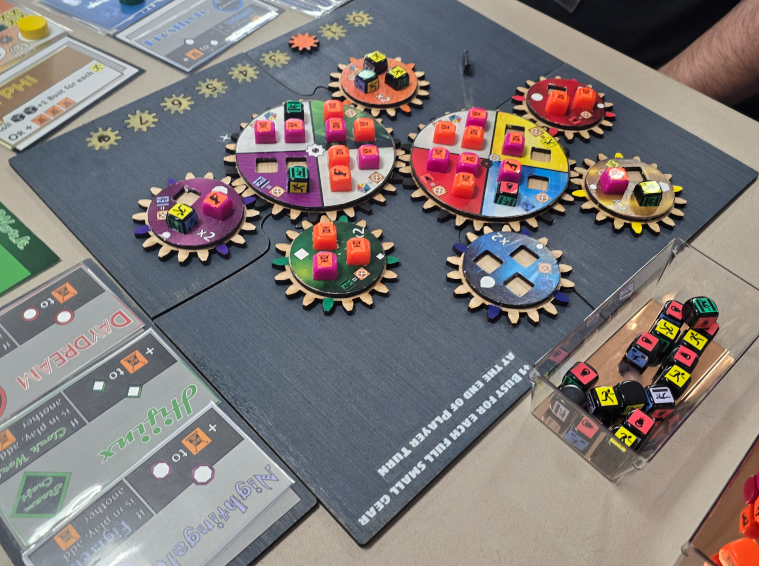
Yes! I was in business. I could continue with Rustbucket Riots. The picture above is a modern version of the game; the first version still used foam for its board (the gears haven’t changed too much). I still have a version of the first game and will include a picture of it in a future post. Rustbucket Riots combines multiple ideas. I brought back dice chucking from Mega Man, only this time, I used specialty dice that included run, slide, climb, shoot, and jump. And I always thought Tzolk’in’s gears didn’t move enough. I could fix two issues I saw in other games. Jasco’s Mega Man took too long, and Tzolk’in (Tzolk’in is an amazing game that earns its spot in BGG; I’m nitpicking) could have gears that frequently turn.
The name Rustbucket Riots came swiftly. Originally, I wanted to make a better Mega Man board game, but I couldn’t copy Mega Man exactly. So, I wondered if I could make the player characters villainous. The Boss Robots attempt to free themselves from an oppressive corporocracy and the humans using them as cheap labor, while the players assume the role of corporate robots tasked with bringing the rogue robots under control. Even though the Boss Robots would view what’s happening as a revolution, we’re playing this game from the viewpoint of corporate robots, and they’d see it as riots. Throw in a slur, and you get Rustbucket Riots.
I think that’s everything up to the idea of Rustbucket Riots materialized. We’ll cover early iterations of the game in the next board game design brain dump. If you’ve made it this far through my rambling, you’re awesome. You know it. Thank you for reading, and wherever you are, I hope you’re having a great day.
Happy Wednesday, Geekly Gang! Kyra Kyle here. Today, our writers will share what they’ve been reading over the past month. Feel free to share what you’ve been reading, because we’re all part of the Geekly Gang. I’ll kick off this post.
Kyra’s Reads
Kyra’s Comics
Returning to Saga was like reuniting with an old friend. For context, I read Saga in trades (graphic novel format), so I can go at least three months between reading volumes. I seldom need to reread previous volumes, even when Brian K. Vaughn and Fiona Staples took more than a year hiatus from the series, and that’s a testament to Saga’s excellence.
And there happens to be time hops between volumes. That helps. Hazel, Alana, and Squire continue their interstellar circus/casino odyssey. The two children (Hazel and Squire) have hit puberty, and this volume explores the difficulties of being a teen while also on the run from numerous entities. I love Saga and highly recommend it. There’s a reason it’s been nominated and won numerous Hugo Awards. But beware of the ninth volume, the one just before Saga’s extended hiatus. Volume Nine ends with what may be one of Sci-Fi’s greatest gut punches.
That last statement wasn’t even close to hyperbole.
Kyra’s Fiction
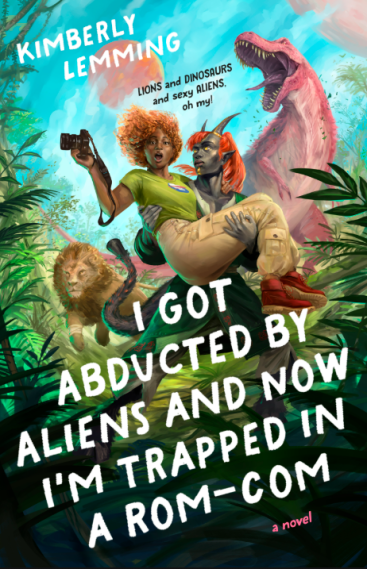
Kimberly Lemming’s I Got Abducted by Aliens and Now I’m Trapped in a Rom-Com is the first monster romance I’ve read. Heck, it’s the first romantasy I’ve read. While I may not be I Got Abducted by Aliens and Now I’m Trapped in a Rom-Com’s target audience, I can see why novels like this are swoon-worthy. I wish I could write scenes as steamy as the ones you can find in I Got Abducted by Aliens and Now I’m Trapped in a Rom-Com.
The book’s title says all you need to know about the novel’s premise. The tagline elaborates further. (Talking) Lions and Dinosaurs and sexy Aliens, oh my! Outside the scenes that led to cold showers, Lemming has a knack for comedic timing. I Got Abducted by Aliens and Now I’m Trapped in a Rom-Com delivers.
I’m listening to Brandon Sanderson’s The Way of Kings in audiobook format. I find audiobooks a great way of reading an extra book or two. My two favorite streaming (does it count as streaming?) sites are Libby and Hoopla. All you need is a library card (from a participating library) for both, and you can check out audiobooks, e-books, and other digital content.
Audiobooks totally count for read books for the month. I’m counting The Way of Kings. Audiobooks make for more interesting walks. It only takes almost getting run over twice while reading a physical book and walking at the same time to get you to switch to audiobooks. Anyway, I love how Sanderson introduces the hard magic system in The Stormlight Archive. Sanderson dips just enough information about how magic works for the reader to follow along, while avoiding massive walls of expository text. The Way of Kings is a fun read. And you should check out Libby and Hoopla.
Those are all the books I’ve read over the past month, and it looks as if I’m the only one of our writers with entries. Season began a new job and hasn’t read much beyond instruction booklets. Skye’s rereading a handful of books. Perhaps she’ll share some of those next month.
In the comments, let us know what you’ve been reading this past month and if you count audiobooks as books you’ve read. Thank you for reading, and wherever you are, I hope you’re having a great day.
Today marks the beginning of Dance Week, so we’ll kick off this dance off with five great video game dances. Hey, hey, Geekly Gang! Kyra Kyle here. I didn’t know Dance Week existed, but I’m here for it. Video games have featured so many dances. There are even entire games, like Dance, Dance Revolution and Just Dance, that are about dancing. Some of those video games could make this list, but I prefer dances from video games that don’t feature dancing, so we may get more than one dance from a role-playing game. Let’s get to the list.
Honorable Mention: The Sheppard Shuffle (Mass Effect Series)
We begin this list with one honorable mention, the Sheppard Shuffle. This dance isn’t exactly good, let alone great, but it is iconic. The Mass Effect series is an all-time great Sci-Fi video game series, and the game’s protagonist, Sheppard, is at the game’s center, but it’s not for their dancing ability. Sheppard’s dance move (they only have one), the Sheppard Shuffle, is so half-baked that the Citadel DLC makes fun of it. Still, the Sheppard Shuffle is seared into my brain.
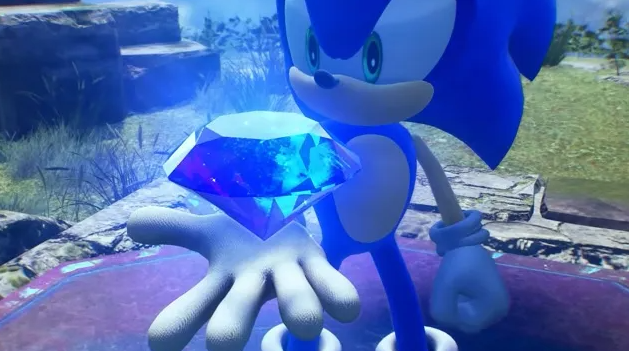
5) Celebrate Chaos (Sonic: The Hedgehog Series)
Sonic: The Hedgehog was always the “cool” video game mascot. Shortly after his release, he developed a dance, a simple two-step with some flair, every time he obtained an objective. Over the years, Sonic became more brooding. Goofiness was no longer “cool,” but no matter what phase the blue ball of lightning has taken, he finds a way to incorporate that little two-step dance.
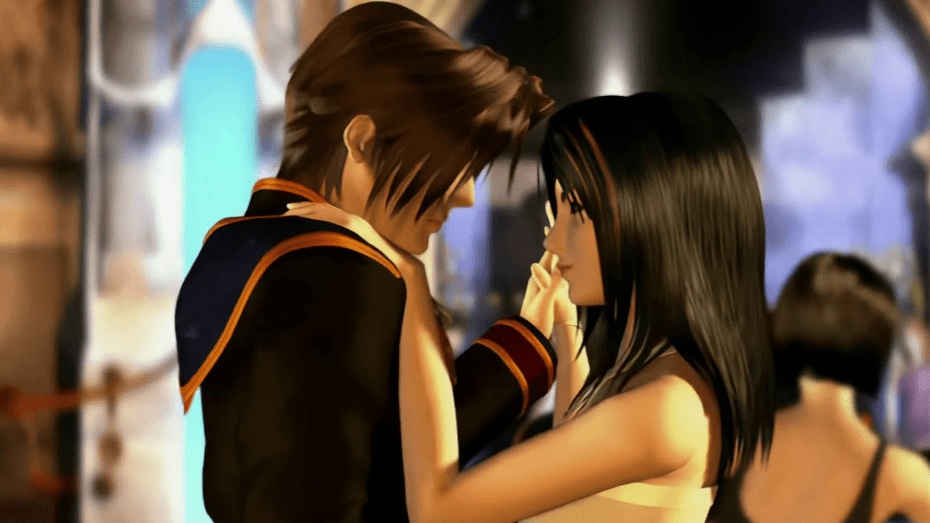
4) Waltz for the Moon (Final Fantasy VIII)
Ah! I love the Waltz for the Moon from Final Fantasy VIII. This iconic scene is what got me hyped for FFVIII. It featured in almost every teaser or trailer for the game. This dance did a great job introducing the main characters, and it’s gorgeous. Even after several video game generations, the graphics hold up well. The fireworks peaking through the moon roof take my breath away. On a personal note, my favorite track from Mannheim Steamroller’s 1984 Christmas album is “Bring a Torch, Jeanette, Isabella,” and whenever I hear that song, Waltz for the Moon dances in my head.
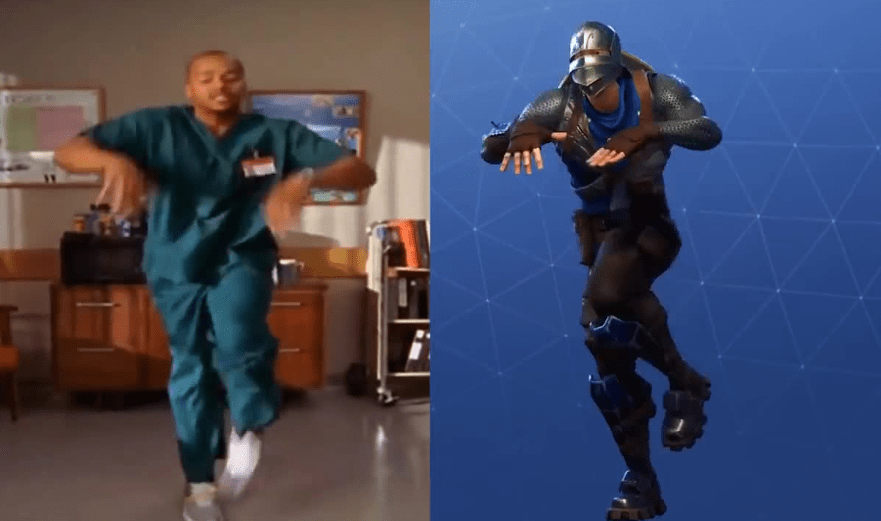
3) Poison Dance (Fortnite)
We could’ve included any number of dances from Fortnite–I swear this battle royale doubles as a dancing game–but we landed on the Poison Dance. Originally, this dance was featured in the sitcom Scrubs. Fortnite pays homage to this dance by including it as an emote. You get extra points if you use the Poison Dance emote while playing with a Poison Ivy skin in Fortnite. That girl is poison. On second thought, a Poison Ivy skin may be too on the nose.
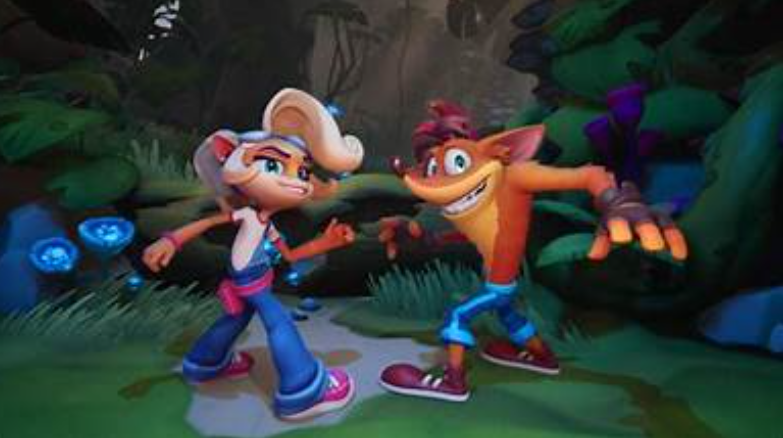
2) Crash Dance (Crash Bandicoot Series)
Similar to Sonic: The Hedgehog, Crash Bandicoot was the mascot (for a time) for the cooler and newer gaming system (PlayStation), so of course, he was going to incorporate a special dance every time he finished an objective. But Crash has never taken himself too seriously. Throughout the Crash Bandicoot series, he pelvic thrusts, shuffles until his back is to the player, and then coyly turns and smiles. He’s even gotten his teammates to join in the fun.
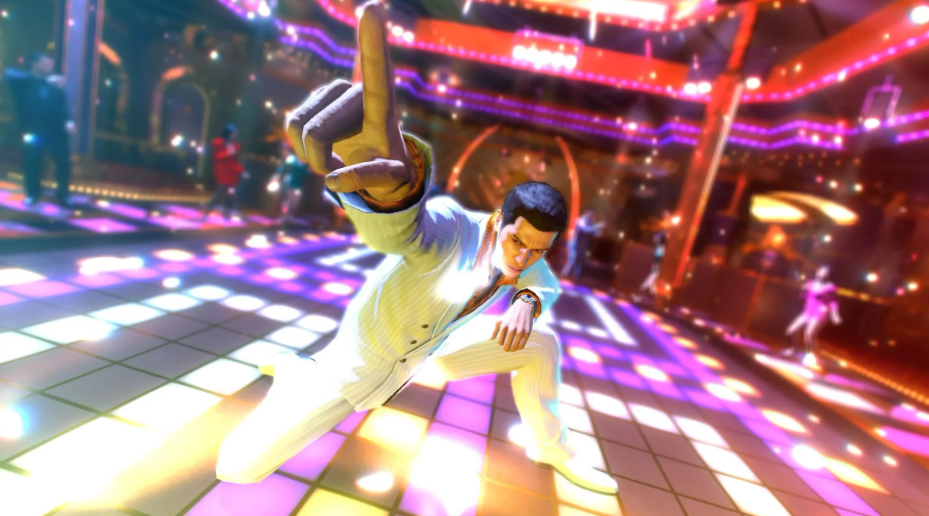
1) Friday Night (Yakuza 0)
Any song from Yakuza 0’s disco minigame prompts Kiryu to do his hilarious entry on the stage before recycling through the same move again and again during his dance, but “Friday Night” is by far this minigame’s best song. “Friday Night” is the one song I jam out to while trying to complete this challenging disco minigame. Seriously! Yakuza 0’s disco minigame is so difficult, I feel like I learned the dance in real life. Now, watch me break a hip.
Happy Dance Week, Geekly Gang! We hope you enjoyed this list of five great video game dances. What are some of your favorites? Let us know in the comments. Thank you for reading, and wherever you are, I hope you’re having a great day.
Happy Sunday, Geekly Gang! By the time this post goes live, I should be participating in a board game design panel at Nuke-Con, so I’m writing this Geek News post in advance. It may be shorter than usual, but I’ve said that in the past and ended up with a standard-length post. Let’s start this week’s Geek News with the MCU canceling its Unnamed Fall 2027 film.
MCU Cancels Untitled 2027 Film
The movie slot in the fall of 2027 Marvel Studios has been holding for years has just been cancelled this past week. Per Variety, The Simpsons 2 movie takes its place. There are a couple of things to unpack with this tidbit of news. First, by the time the sequel releases, The Simpsons will not have had a movie in 20 years; the first Simpsons film was released in 2007. That’s a significant gap between films. The first Simpsons film wasn’t as bad as some say, but it wasn’t stellar either. While I’m willing to give The Simpsons 2 a chance, I don’t have high hopes. At this point, The Simpsons are a four-decade-old property (the show debuted in 1989, and the family first appeared earlier than that). Multiple generations of television watchers has yet to live in a time without The Simpsons. Second, I like the MCU’s direction.
In a recent interview, Marvel Studios’ CEO Kevin Feige mentioned that the public needs to miss the MCU. As the old saying goes, absence makes the heart grow fonder. No one can miss the MCU if the franchise pumps out multiple movies every year. According to some interviews, Feige never intended the MCU to release as many films and shows as it did in the previous phase or two. With the launch of Disney+, Disney pressured Marvel Studios (and the Star Wars franchise) to produce more shows and movies. Feige has insisted the MCU will slow down its production schedule. The announcement of the 2027 film cancellation solidifies Feige’s position. There will be no MCU film that releases between Avengers: Doomsday and Avengers: Secret Wars.
Honestly, I love the break. The MCU squeezed in two films in between the last Avengers’ crossover event. Captain Marvel and Ant-Man and The Wasp were released in the gap between Avengers: Infinity War and Avengers: Endgame. Those two releases felt rushed. Any film released between Avengers: Doomsday and Avengers: Secret Wars could face the same fate.
And I agree with Feige. Make the public miss you. It’s difficult to miss someone or something when it never leaves.
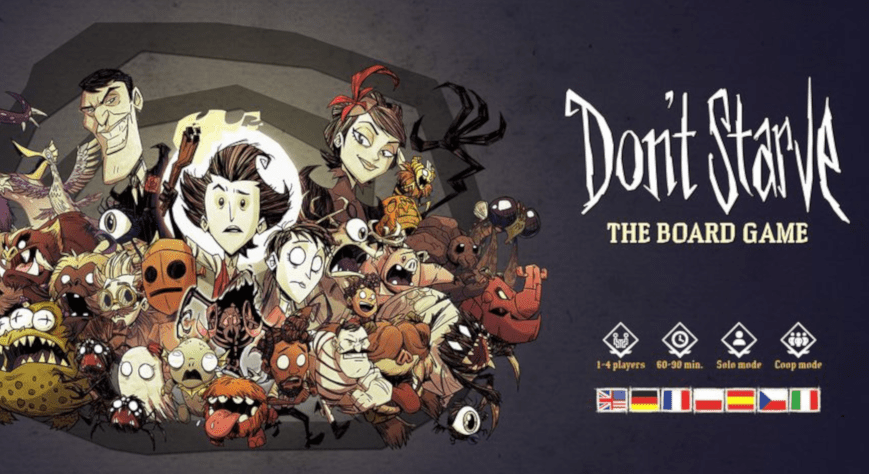
Don’t Starve: The Board Game Launches on KickStarter
Glass Cannon Unplugged launches its latest board game adaptation of a video game classic, Don’t Starve. I’ve playtested a few rounds of this game’s prototype. It was so long ago, I thought the game had already been released. By the way, if you’re interested in playtesting upcoming Glass Cannon Unplugged (GCU) board games like Apex Legends and Frostpunk, feel free to join their Discord channel. GCU has a great habit of uploading its upcoming board games online, so you can remotely playtest.
Anyway, Don’t Starve: The Board Game does a fantastic job of translating what made the video game fun into a board game format. It’s a 1-4 player rogue-like, cooperative game worthy of the name Don’t Starve. If you’re a fan of the video game, you owe it to yourself to at least check out Don’t Starve: The Board Game’s KickStarter page. Pledges range from $79-129. The game features beautiful miniatures/standees–standard with most GCU games–exploration, survival, and crafting. Oh, yeah.
Heroes of Might and Magic: The Card Game Storms GameFound
We go from one board game company (GCU) known for its video game adaptations to another one in Archon Studios. Heroes of Might and Magic: The Card Game is the brainchild of the same company that gave us the Wolfenstein and He-Man: Masters of the Universe Board Game. Unlike Don’t Starve, I can’t speak to Heroes of Might and Magic: The Card Game’s quality, but Archon Studios has an amazing track record.
Heroes of Might and Magic: The Card Game gives me similar vibes to the classic card battler board game, Summoner Wars. Akin to Chess meeting Magic: The Gathering. Heroes of Might and Magic: The Card Game touts numerous video game references–even small ones–and the card art (and design) looks spot on. Heroes of Might and Magic: The Card Game sports a ton of expansions. I’m certain gamers will have plenty of pledge options to choose from once the campaign launches in the middle of next week. We don’t yet know what price points Heroes of Might and Magic: The Card Game offers, but if you’re interested in the game, check out its GameFound page.
Final Fantasy Tactics: The Ivalice Chronicles Releases
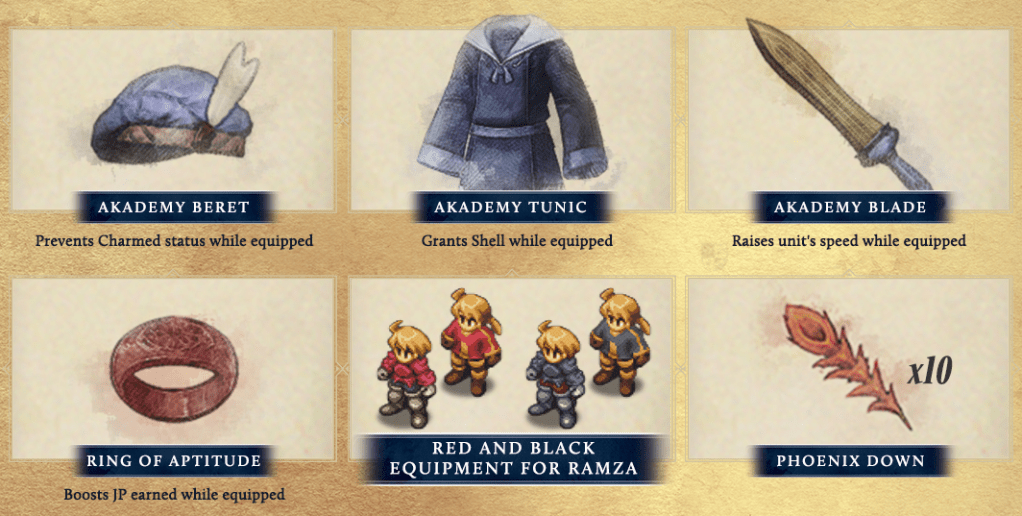
Final Fantasy Tactics is one of my favorite games. I’ve picked up the title each time it’s been remade/remastered, so it’s only a matter of time until I return to Ivalice. In Final Fantasy Tactics: The Ivalice Chronicles, players assume the role of Ramsa, a forgotten warrior who brought peace to the land. Players recruit party members and train them through a job system in this tactical JRPG. Western Zodiac signs dictate how well your team synergizes and how much damage they deal to enemies. Most strong enemies in Final Fantasy Tactics: The Ivalice Chronicles have a fire sign, so picking a birthday (for Ramsa) with a water sign puts the game on easy mode. I didn’t know this until recently. My birthday happens to be under a water sign, and it would confuse me when folks would say Final Fantasy Tactics was difficult.
Final Fantasy Tactics: The Ivalice Chronicles is available on PC, PlayStation 5, PlayStation 4, Nintendo Switch, and Nintendo Switch 2. DLC (pictured above) is available. If you’ve never played the classic JRPG Final Fantasy Tactics, I highly suggest giving this game a try.
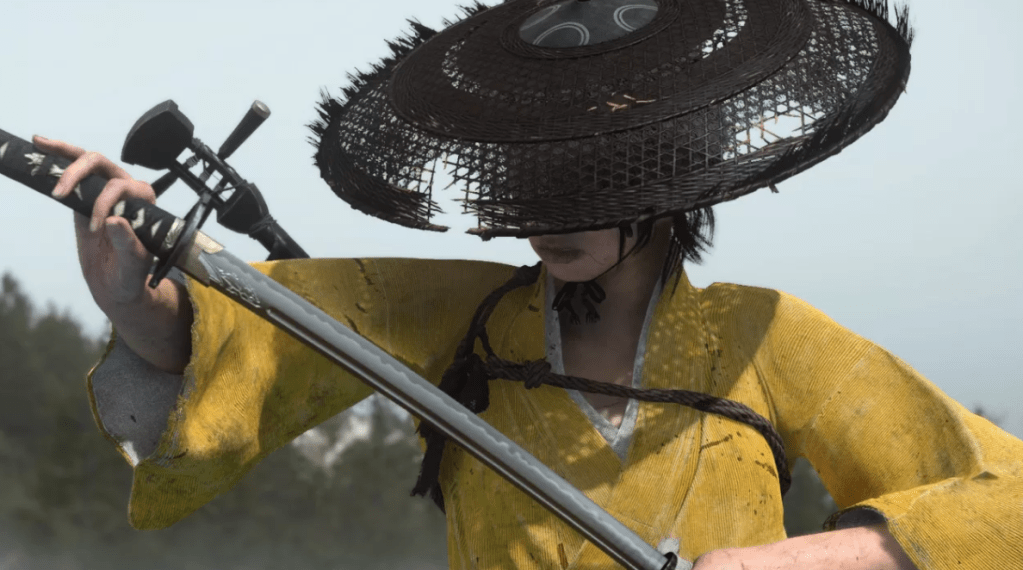
Ghost of Yotei Releases on PlayStation 5
As of writing this post (I’m writing this early), Ghost of Yotei has yet to be released, but it will be in time for the weekend. I can’t wait to play this PlayStation 5 exclusive. Skye swears by Ghost of Tsushima. She covered the first game in this series in a previous month’s Watcha Playing. This series’ combat is second to none. I was about to borrow Skye’s copy of Ghost of Tsushima and begin playing when I remembered Ghost of Yotei was on the horizon. I’m unsure if I’ll miss anything if I begin with the second game in the series. We’ll have to see.
That’s all the Geek News we have for this week. By the time this write-up posts, I’ll be at a board game design panel at Nuke-Con. If you’re in the Omaha area, stop by and say hello. Thank you for reading, and wherever you are, I hope you’re having a great day.
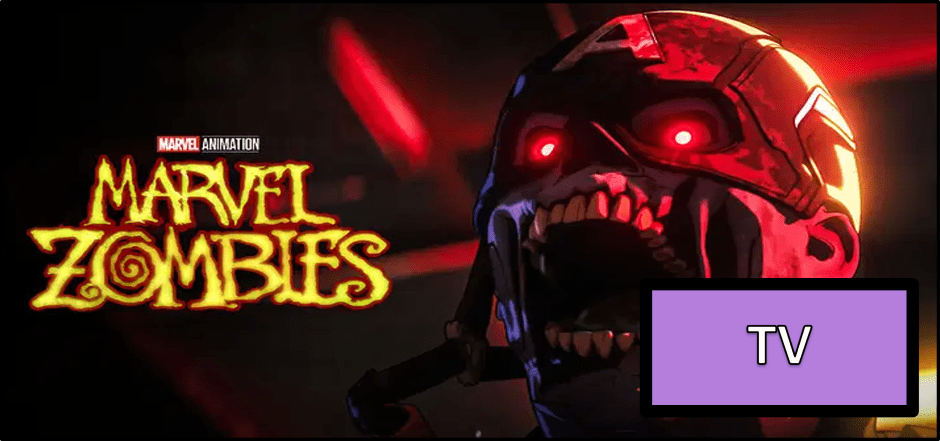
Happy Weekend, Geekly Gang! Kyra Kyle here, and I’m sharing my thoughts on Marvel Zombies on Disney+. Honestly, I didn’t think Marvel Zombies was necessary. I got enough of this world during the episode or two of What If? that featured Marvel Zombies. The concept is simple. Most Marvel superheroes become zombies.
The original comic book series managed to strike a balance where readers cared about the characters and had a healthy dose of hope. Most of that is dashed at some point, but readers could hold onto some hope for at least a little time. The animated series is rushed (there are only four episodes), so any hope lasts approximately five minutes. Without hope, there are no stakes. Everything becomes futile. I don’t believe this world to be anything but “let’s see all the MCU turn into zombies.” Mission accomplished, I guess. Instead of any real hope that could lead to stakes, let’s throw in all the least serious characters in the MCU, so they’re dropping one-liners every few seconds. But laughs don’t make for a compelling story.
Marvel Zombies’ short run means that it’s over quickly. That’s a plus. If you want to burn an hour and a half, there are worse ways to do it. I can’t recommend this series, but wait, Marvel Zombies could be getting a second season. Great.
Some will enjoy Marvel Zombies. You do get to watch MCU characters turn into zombies, and that can be fun. Some of the ways they turn are inventive. The animation is phenomenal. Marvel Animation Studios is knocking things out of the park, so you could watch Marvel Zombies for the visuals alone. And I do like that Marvel Zombies is a standalone story. We don’t need another show in the connected universe.
One last positive: Marvel Zombies makes Zombie Hawkeye a menace. Hawkeye is terrifying. Most of Hawkeye’s scenes are in the first episode, and I would recommend watching this version of Hawkeye. Heck, I’d watch a show with Zombie Hawkeye (the only zombie is Hawkeye) hunting superheroes.
I’ll keep this Marvel Zombies review short. Thank you for reading, and wherever you are, I hope you’re having a great day.
Hey, hey, Geekly Gang! Kyra Kyle here. I didn’t know how to start this type of post. Heck, I don’t even know if I’m sold on the title “Writing Brain Dump.” It’s a work in progress. Hopefully, I can express how my writing has been going over the past couple of weeks. I’ll be spouting random ideas about writing/editing I’ve found in between each of these posts. Perhaps, you’ll find a cogent thought here somewhere. Buckle up for a Writing Brain Dump.
Reverse Outlining
I’m continuing to reverse outline last year’s novel, set in the same world as my board game Rustbucket Riots. I’ve struggled with this part of the editing process, but reverse outlining and the next section I’ll mention are invaluable.
I began with a spreadsheet that includes the following headings:
Scene Description Characters Setting Point of Scene Themes Scene Length Actionable Item
You may add or subtract a heading or two (or five), but these seven headings help me stay focused. I’m a hybrid pantser (someone who writes without a plot) and a plotter (someone who writes with a plot). My best analogy would be a lighthouse writer or lighthouser. Most stories I write have a scene or two that serve as Lighthouses; I’m building toward these scenes, and while I’m writing a first draft, I need to find the scenes that connect the Lighthouses.
The difficult part of the reverse outline was going back through my manuscript. I waited long enough to gain distance and objectivity. A month or more is a good time period to wait before diving back into a project. But I may have waited long enough to wonder if anything in the manuscript was any good. LOL.
After some emotional cutting (I’m only slightly exaggerating), I found direction, and the reverse outline helped. “Scene Description” allows me to revisit each scene. Sometimes, I need to mark scenes as incomplete. And that’s okay for now. This was an early draft.
“Characters” and “Setting” remind me of the scene’s who and where. I can glance and see when a Character is first introduced or if I’m returning to the same Setting for multiple scenes, and if that’s necessary or not. Or if a character only shows up in one scene, is that character needed? Can I combine the one-off character with another character, tightening the manuscript? I did this more than once.
“Point of Scene” and “Themes” differ subtly. Point of Scene shows whether the scene progresses the story (or plot), while Theme is more the scene’s emotional weight (What’s the scene’s takeaway?). Scene Length is another glance to make sure the pacing for the scene feels right. And during Actionable Item, I suggest something I could do to improve the scene.
Sometimes, a scene doesn’t do enough to progress the story, and I scrap it. Why line-edit a scene that doesn’t do anything for the story? Reverse outlines can be difficult—correction, reverse outlines are difficult—but I need them to keep me on task. I wouldn’t know where to begin editing without a reverse outline. After each draft, I begin a new reverse outline. Elements change.
Some of you may be plotters, but reverse outlines may be a great way to see your story from the other side. Reading your manuscript with fresh eyes may yield themes or points of a scene you didn’t know were there. While a reverse outline helps pantsers or lighthousers (or plantsers), they can still help plotters. Like I said, I begin a new reverse outline after each draft because storytelling elements change.
Timeline
While one could combine a reverse outline and a timeline, I prefer to have these as two separate documents. Chronology is important. You don’t want to say something would take a week when it takes two weeks or vice versa. Going back to “Scene Length,” the manuscript’s pacing also needs to match the timeline. A week needs to feel like a week, however that week feels for the character(s). I forget how many time warps I’ve caused. Hopefully, I will avoid time warps altogether by starting a timeline while I write the first draft. If only I’d remember to start a timeline while writing a first draft.
Always Be Escalating (ABE)
I promised a Writing Brain Dump, and here we go. I’m kinda bouncing back to the first topic (Reverse Outlines), but through a different lens or two. One of George Saunders’s 9 Rules of Thumb is “Always Be Escalating” or ABE, and a hidden benefit to the “Point of Scene” header in a reverse outline is showing that your story’s stakes increase with each scene. Escalating scenes propel the story. They’re the secret sauce to page-turners.
Causality
“Causality” is another one of Saunders’s Rules of Thumb. Saunders often links causality to Chekov’s River. Many of you may know Chekov’s Gun. Quick Recap: If a gun is shown in the first act, it must be fired by the third act. Chekov’s River follows a similar path, but in terms of causality. One character choice should directly lead to another choice by the character, like a river of character choices. Chekov’s River gives characters agency. It also minimizes coincidences.
Coincidence versus Choice
Coincidences at the beginning of a story aren’t so bad, but if a story relies too heavily on coincidences, they become a crutch, and the advancement feels unearned. Batman (1989) will always have a special place in my heart, but it relies on coincidence. Jack Napier (Jack Nickolson’s Joker) falls into a vat of chemicals; he blames Batman. This is a coincidence, but this happens at the beginning. It isn’t too bad—yet.
Then, Joker happens to read a newspaper with a picture of Vicki Vale (Batman’s love interest) and falls in love with her as well, putting the two characters at odds. Why wouldn’t Batman and Joker already be at odds because of their chosen vocations? Make it a choice, not a coincidence. But yes, let’s go with a bizarre love triangle.
Fun Factoid: Because not all parties in a typical Love Triangle are in love with each other, most Love Triangles are actually Love Bipods.
I promised a brain dump. Consider yourself brain-dumped.
Finally, Joker meets Batman (as Bruce Wayne) and threatens him with a gun while saying, “Have you ever danced with the devil by the pale moonlight?” which happens to be the phrase the Waynes’ killer used. So, Batman surmises the Joker killed his parents. Sure. As you can see, each coincidence cheapens the story.
I suppose there is causality with Joker killing Batman’s parents, and then Batman “making” The Joker, but even Joker dubs this story absurd. “You made me. I made you. How childish can you get?” Batman also leans heavily on flashbacks, which also takes away from the present story. Ground the characters with their choices in the story you’re telling, not choices during flashbacks.
And I’m saying don’t use too many flashbacks when my first novel, Crooked as a Dogwood, features a character skin-walking through their past and their relatives’ past. Ugh! I may need to rethink that novel. LOL
In short, character choice should impact the story more than coincidences. Try to minimize coincidences and flashbacks. Grant characters agency.
I’ve lost the plot. Maybe I need to reverse outline this post. Oh well. I promised a writing brain dump, and this may qualify. Thank you for reading, and wherever you are, happy writing and have a fantabulastical day.
Happy Wednesday, Geekly Gang! Today, our writers share the games they’ve been playing over the last month. Feel free to share what you’ve been playing, because we’re all part of the Geekly Gang. I’ll get things started.
Kyra’s Games
Kyra’s Video Games
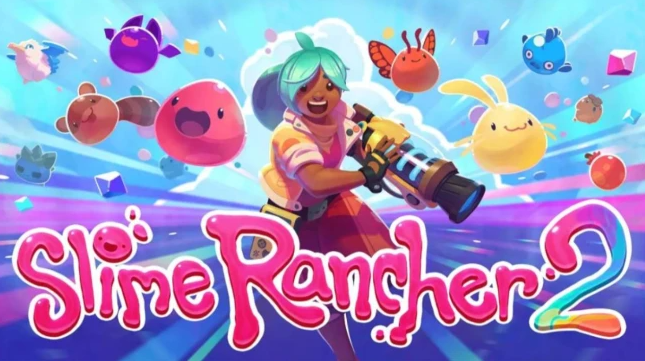
Slime Rancher 2 received a full release this past week, so I’ve returned to Rainbow Island. First, I’m overjoyed with the return of drones. This must be a relatively new addition to Slime Rancher 2. While I appreciate the ability to quickly accrue more drones in the original Slime Rancher, even the smaller number of drones makes managing your ranch a lot easier. I started a new game and refuse to build up a second or third location (even though I’ve purchased them) before I have enough resources to build another drone to help me manage my cutie slimes. Slime Rancher 2 is addictive.
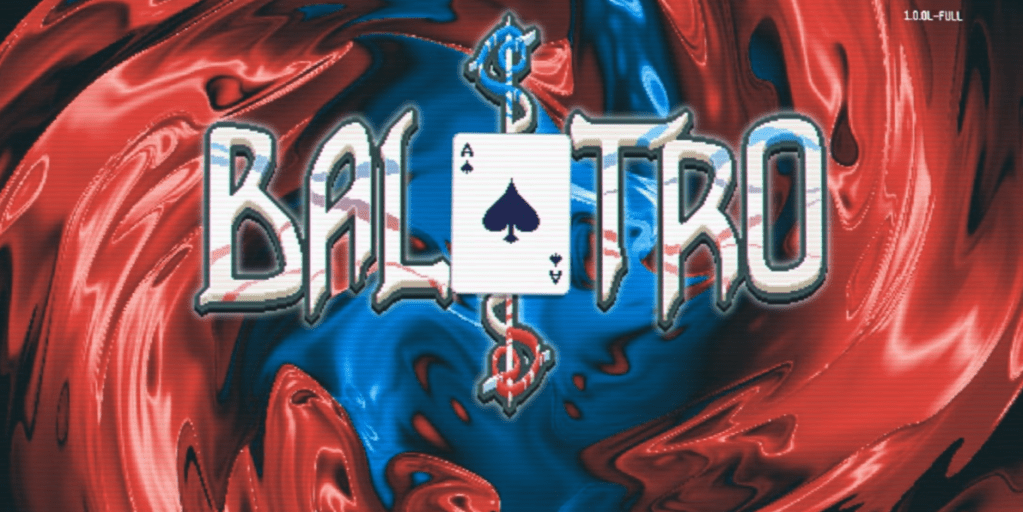
Balatro is a fabulous rogue-like poker deck-building game akin to Slay of the Spire. It has all the trappings of an addictive game, and I sunk plenty of hours into Balatro this past month. In short, there’s a reason Balatro is one of the highest-rated games on Steam. But I do have one gripe. There may be too many options. Balatro shares this issue with Auto Chess. Balatro requires players to balance Planet cards (upgrading the point value for Poker hands), Joker cards (giving a constant point-value boost), and the cards in the deck. Certain combos require specific cards, and Balatro’s staggering number of options means you may never see the cards you need for a combo. Despite this minor issue, I love Balatro.
Speaking of Auto Chess, I’ve played plenty of Auto Chess over the past month, too. The issue I listed in my Balatro write-up rears its head here, but certain game modes (like Solo mode) in Auto Chess allow players to limit the type of units they will receive from the bank. Unfortunately, I don’t care for Solo mode. It’s too slow for my taste. Auto Chess has players buy units, upgrade those units by purchasing three of the same unit, and combo units together with like species (like elves, dwarves, and undead) and classes (like Hunter, Warrior, and Mage). And this last feature introduces yet another issue: balance.
Not all combos are created equal. You can have up to 10 units (if you buy experience to increase your unit count) on the field at one time. Some of the synergies (combos) can be as high as 9 units of the same type. These 9-unit synergies can be overpowered, specifically undead (named Egersis in Auto Chess). A 9-unit undead synergy has an opponent’s dead units resurrect into zombies of the same level. This can double your unit count during battle. It’s unfair and unfun. I’ve played as Egersis, and it’s unfun to play with these unit types. Despite this added issue, Auto Chess is a lot of fun, so long as no one in the lobby plays Egersis. I love setting up my army, leaving for a while to do something else, and then managing my team in between rounds. Heck, I’ll read while my units take care of business.
Kyra’s Board Games
Skye’s going to mention Raccoon Tycoon in her write-up; I’ll let her go into more detail about the game. I love Raccoon Tycoon’s variable market, dual-purpose cards, and auction system. Each card a player uses will increase a resource’s value (or resources’ values) and allow the player to produce resources. Whenever a player sells a resource, they do so at the resource’s current value, and then the player lowers the resource’s value by the amount of those resources sold. And the auction system is simple but great. You can drive up the price of a railroad your opponent wants, but if you raise the price too much, you may get stuck with the railroad. Raccoon Tycoon is a ton of fun.
I’ll be running Raccoon Tycoon and Flamecraft for a charity event during Nuke-Con in two days, so I played both to remind myself how to play so I can teach each game. If you’re in the Omaha area this weekend, feel free to stop by my table. Anyway, Flamecraft is a game Season will mention in her write-up this week, but I’m including it. It’s a great gateway game. Flamecraft features enough common game mechanisms in modern board gaming, while introducing them in a lighthearted, easy-to-understand manner. And the art is adorable. Who doesn’t want to make artisanal crafts with cute dragons?
And yes, I will be playtesting and demoing my prototypes at Nuke-Con as well. Rustbucket Riots and Whirligig Pets are on the official schedule, but I’ll bring a few other board and card games I’m working on. If you’re going to Nuke-Con, make sure you stop by the Extra Life tables and say hi. We’ll have badge ribbons and prizes.
That’s all I have for the games I’ve played this past month. Let’s see what Skye has been playing.
Skye’s Games
Skye’s Board Games
Who wants to be an entrepreneur, trash panda? I do. Now you can live out your dream with your friends and family in Racoon Tycoon. I played Racoon Tycoon for the first time and really enjoyed it. The straightforward mechanics, simple gameplay and charming theme make Racoon Tycoon a game that I’d happily return to. Like most games I play for the first time, I sucked, but that doesn’t matter. I may have lost the battle, but the animal economy war has only just begun. Walrus St. isn’t ready for this determined ring-tailed faux cat.
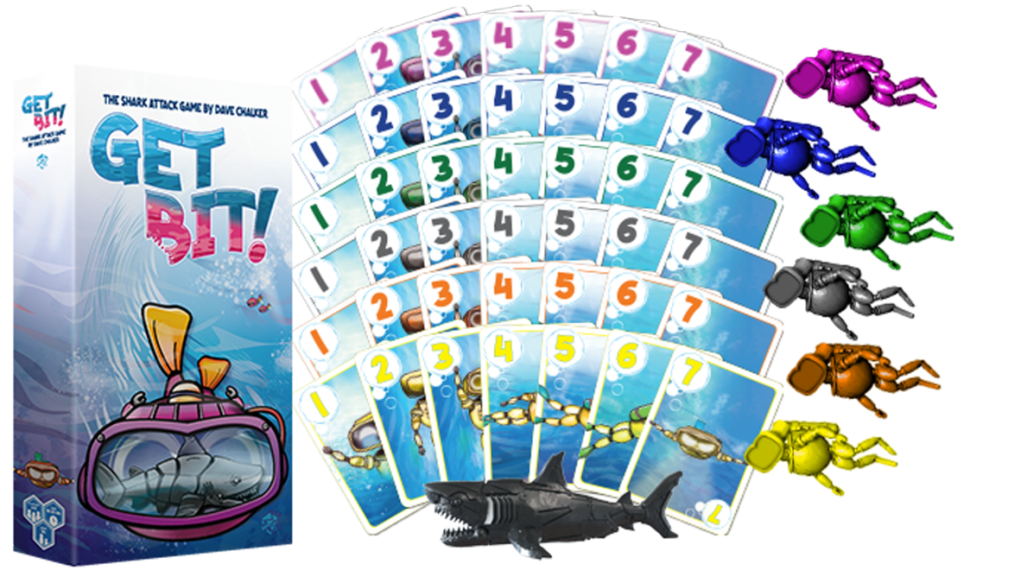
Ah, the wonders of being eaten by a shark. That’s Get Bit’s scenario. Get Bit is easy enough to understand. Don’t get eaten, and you win. The gameplay itself is different than what I was expecting. The goal is to stay as far away from the shark as possible (duh), but you accomplish this by playing cards that are numbered 1 through 7. The person who played the lowest card gets to move the farthest away first, followed by the next lowest card, and so on. Get Bit is a bit odd, but there are fair amounts of strategy and luck involved to keep you on the edge of your seat. Just make sure you sort out your least-favorite limbs ahead of time.
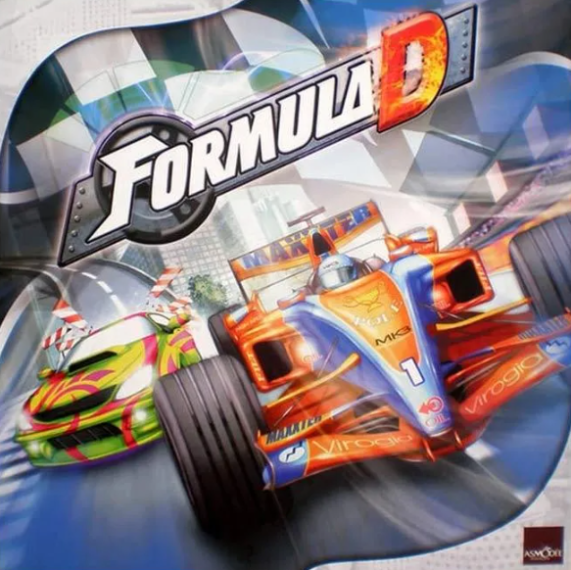
This month was the most fun I’ve had with Formula D in a while. We played Formula D with a large group of people, and it was a completely different experience. When I’ve played Formula D in the past, I’ve only played with 2 or 3 other people at most. With 8 players, we were cracking jokes, being ridiculous, and generally having a good time. The only downside was that the game took much longer than usual because of the number of players. I was so into Formula D, my car and I went to sleep with the fish. It was relaxing.
Skye’s Video Game
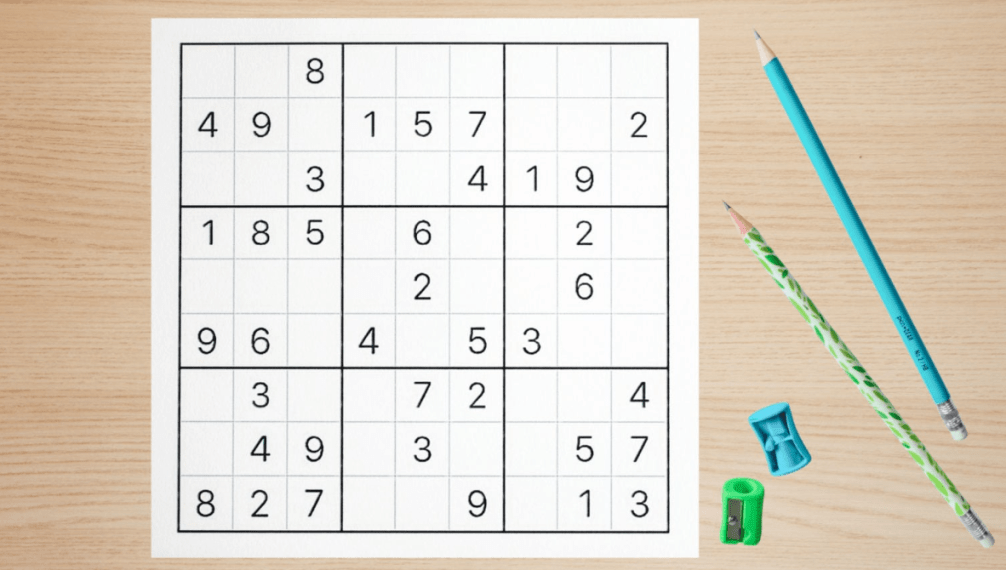
Speaking of relaxing, Sudoku never fails to make me chill out and vibe. I don’t always play Sudoku regularly; I came across a puzzle in my local library that I’ve felt compelled to play online puzzles again. Sometimes I’ll get the urge to test my brain power, and Sudoku has been my go-to. Honestly, there isn’t much to say about it. It’s Sudoku. Y’all know what I mean.
Season’s Games
season’s board games
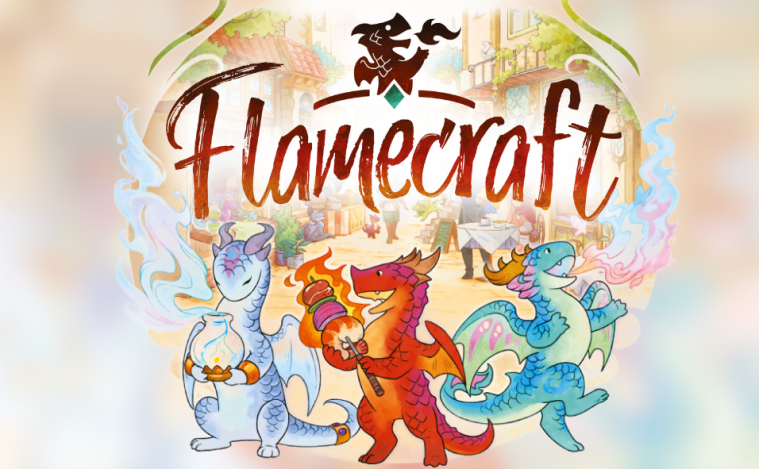
Of course, I’m mentioning Flamecraft. I won’t go into too much detail, so here’s a quick overview. Your goal is to fill shops with dragons who produce resources. You use the resources to create enchantments and gain reputation. Many different dragon effects affect your score, and the game ends when you’ve run out of dragons. I’d forgotten how much I enjoyed this game until it hit the table last Monday.
I’m a certified dragon lover, and the small dragons in Flamecraft are adorable. ‘Nuff said.
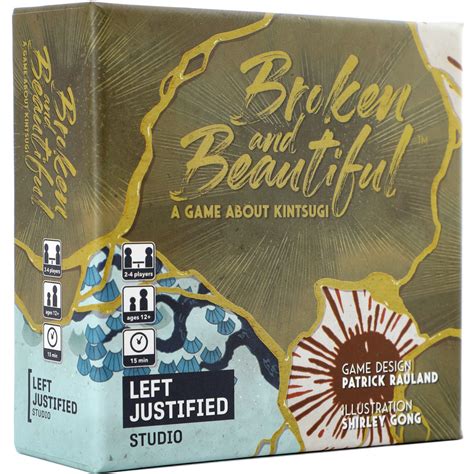
Broken and Beautiful is a set collection game. However, it has a unique way of increasing your score–if you play it correctly. Broken and Beautiful’s theme is based on kintsugi, a Japanese art form of repairing broken pottery with lacquer mixed with gold, silver, or platinum. It makes the object useful again while highlighting its imperfections to celebrate them. In Broken and Beautiful, players draft cards from a tableau using the snake draft method (starting with the first player and reversing player order after the last player). They try to collect sets of pottery based on type (sometimes pattern). The remaining card that doesn’t get drafted and the card on the top of the deck dictate which types of pottery break at the end of the round. Players can spend gold to fix their broken pottery and generate more points.
Normally, I’m not a huge fan of card drafting set collection games since I rarely feel the theme of the game. As in, if I play Sushi Go!, I don’t feel like I’m making a plate of sushi. In Broken and Beautiful, the theme of kintsugi is more evident to me. I also enjoyed the extra layer of strategy in Broken and Beautiful.
season’s video games
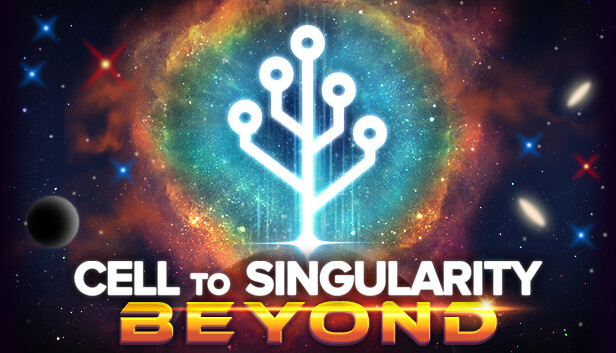
I’ve been playing a lot of Cell to Singularity on my phone. I love learning, and I enjoy idle games. That’s exactly what Cell to Singularity is. You start with discovering amino acids and work your way through evolution. The premise revolves around the game being a simulation of evolution, so some what-ifs about evolution crop up the further you progress. There are also offshoot simulations. The two permanent ones are Mesozoic Valley (dinosaurs) and Beyond (outer space). Every few days, limited simulations are available to play, too. I’ve just finished learning way more about mushrooms than I ever planned to learn. Worth it.
I go in and out of playing Ark: Survival Evolved. No. I don’t have Ark: Survival Ascended. I don’t think my PC can run it. Eh-heh. I enjoy taming my favorite creatures and building different bases every time I play. I have a few mods to spice things up. There are many fun, player-made maps to play on, and unique creatures, too. There are also mods that improve quality-of-life and let players build things that aren’t part of vanilla Ark: Survival Evolved. There’s no better feeling in Ark: Survival Evolved than starting a new game and seeing what happens.
Don’t forget to swing by Nuke-Con this weekend at the Mid-America Center in Council Bluffs, IA, and visit Kyra at the Extra Life booth. They’d love to meet you. What are you playing this week, Geekly Gang? Let us know in the comments.
Hey, hey, Geekly Gang! Kyra Kyle here. The MCU has a history of making short films (One-Shots) that would tie into feature-length films. These One-Shots differ from Marvel Specials like Werewolf By Night. Typically, One-Shots last between five and fifteen minutes, so one could watch all the Marvel One-Shots in the time it would take to watch Werewolf By Night. Originally airing from 2011-2014, Marvel One-Shots were included as bonus features on MCU Blu-ray and DVDs. A couple of these One-Shots would inspire television shows. Geekly has never ranked MCU One-Shots. Let’s change that.
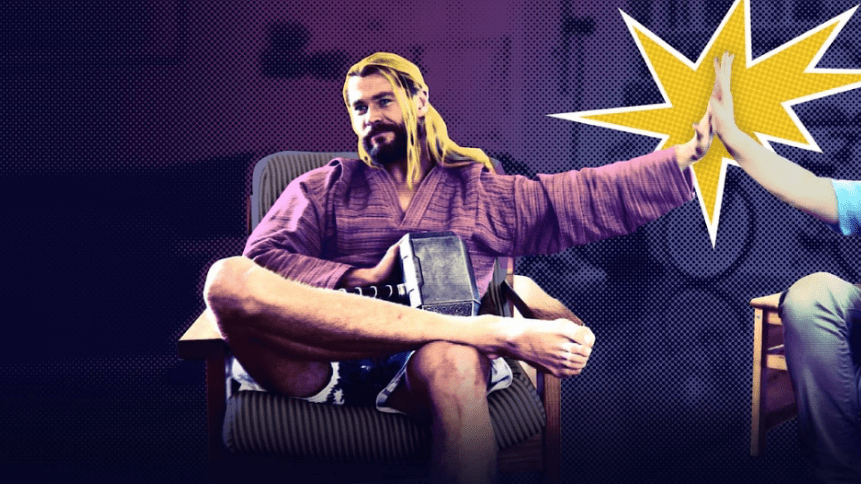
6-8) Team Thor Parts One & Two and Team Darryl (2016-2017)
There’s some debate as to whether Team Thor Parts One and Two and Team Darryl qualify as Marvel One-Shots. All three shorts were released after 2014, two years after the MCU officially said Marvel One-Shots aired, so I’m guessing they don’t count, which works for me. All three of these One-Shots are five-minute comedy routines with Thor or the Grandmaster adapting to life on Earth with a human named Darryl. People’s mileage with these jokes may vary, but all three are okay at best and groan worthy at worst.
I prefer the first one (Team Thor Part One) because it came first, and all three shorts use the same type of jokes, so they get progressively less funny. Should we call these three One-Shots honorable mentions?
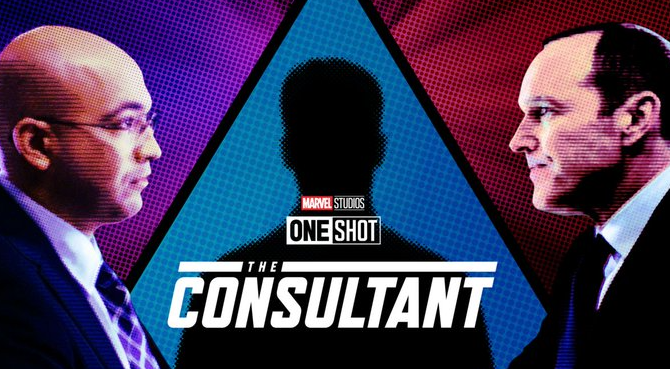
5) The Consultant (September 13, 2011)
The Consultant is a strong Marvel One-Shot. While seated at a diner, Agents Coulson and Sitwell discuss how they intend to prevent General Ross from freeing his friend, Emil Blonsky (The Abomination from The Incredible Hulk). Sitwell suggests that he could be a patsy and sabotage General Ross’s plot to free Blonsky, and then Coulson counters by sending in someone to irritate Ross so much that he’ll flub the assignment. Sitwell suggests the titular “Consultant” (or Tony Stark), and eventually, Ross and Stark share an uncomfortable exchange. Mission accomplished.
Interesting tidbit: Coulson and Sitwell subtly hint at a future MCU plot point. When Coulson first talks about “the mission,” he doesn’t reveal everything he knows about the situation. Sitwell states he has Level Six Clearance and that there is no such thing as Level Seven Clearance. When Coulson returns after the events of The Avengers and sets up the Agents of S.H.I.E.L.D. television series, he reveals that he’s alive again and says, “Welcome to Level Seven Clearance.”
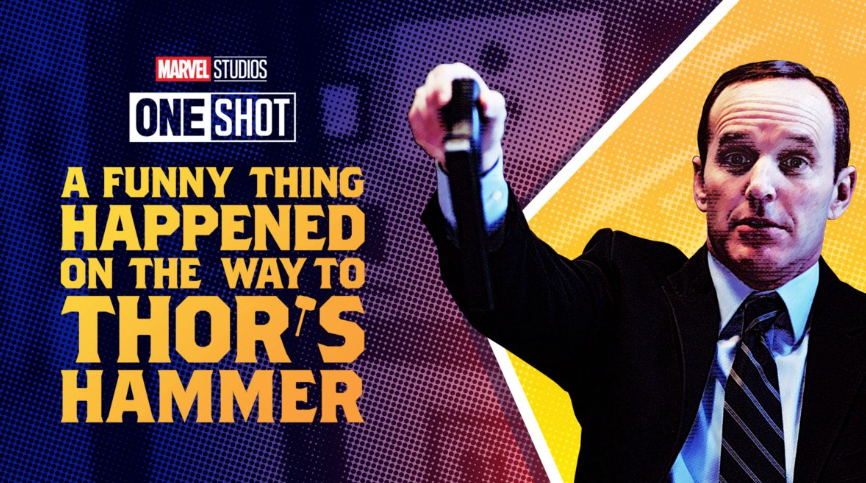
4) A Funny Thing Happened on the Way to Thor’s Hammer (October 25, 2011)
A Funny Thing Happened on the Way to Thor’s Hammer edges out The Consultant because it uses straightforward storytelling. Set before the events of Thor, A Funny Thing Happened on the Way to Thor’s Hammer begins with Agent Coulson stopping for gas. A stick-up takes place, and Agent Coulson defuses the situation. Actually, he turns into full-on John Wick and knocks out the armed robbers. Afterwards, he pays for his snacks and advises the store clerk not to tell the police he was there. A Funny Thing Happened on the Way to Thor’s Hammer shows Agent Coulson in a different light. He’s more than a pencil pusher at S.H.I.E.L.D., and this sequence was a sign of things to come.
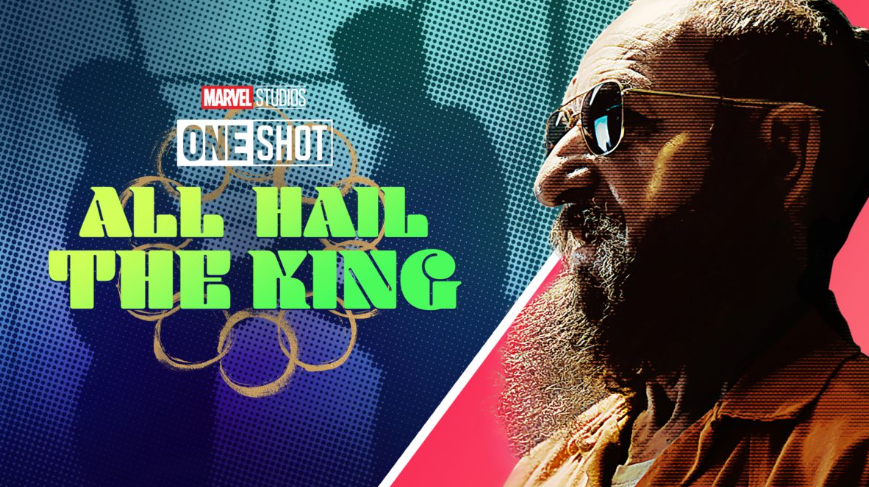
3) All Hail The King (February 4, 2014)
Before making this list, I thought All Hail The King would land at number one, but there are two other Marvel One-Shots that edge out this much-needed retcon for Iron Man’s nemesis, The Mandarin. Ben Kingsley reprises his role as Trevor Slattery. Because of his role in Iron Man 3, Slattery is locked up in Seagate Prison. But it turns out that Slattery has a fan club and a butler named Herman, so Trevor isn’t exactly doing hard time.
Documentary filmmaker Jackson Norriss chronicles Slattery’s life, but he’s not all he appears to be. During his interview, Norriss takes out a hidden gun (from his camera), shoots all the guards, and Slattery’s butler. In classic Slattery fashion, he begs Norriss not to kill him. Norriss reveals that he’s breaking Slattery out of prison. The one whose name Slattery stole (the Mandarin) will have the honor of killing the cheesy actor.
I like that All Hail The King improves the Mandarin’s origin from Iron Man 3. All Hail The King has more than one call-back from the Iron Man franchise. During a mid-credits scene, Justin Hammer scoffs at Slattery’s performance in the prison cafeteria. Hammer wonders what makes Slattery so special. What indeed, Hammer. What indeed.
2) Item 47 (September 25, 2012)
Item 47 centers on a couple just scraping by, Bennie and Claire, who find a functional Chitauri gun. Using the alien technology, the pair go on a bank-robbing spree until Agent Sitwell of S.H.I.E.L.D. tracks them down. Instead of pressing charges, Sitwell recruits the pair into S.H.I.E.L.D. Item 47 features another straightforward plot, but where this One-Shot shines is its character development. You get a sense of who Bennie and Claire are and a seldom-seen glimpse at what “normal people” experience in a world dominated by superheroes and supervillains.
Item 47’s story arc laid the foundation for the Vulture in Spider-Man: Homecoming, and it indirectly began the television series Agents of S.H.I.E.L.D.. I knew Item 47 would rank high on this list. I had forgotten how influential Item 47 was to the MCU. It may take the top spot for most influential Marvel One-Shot, but one short just narrowly beats it for number one.
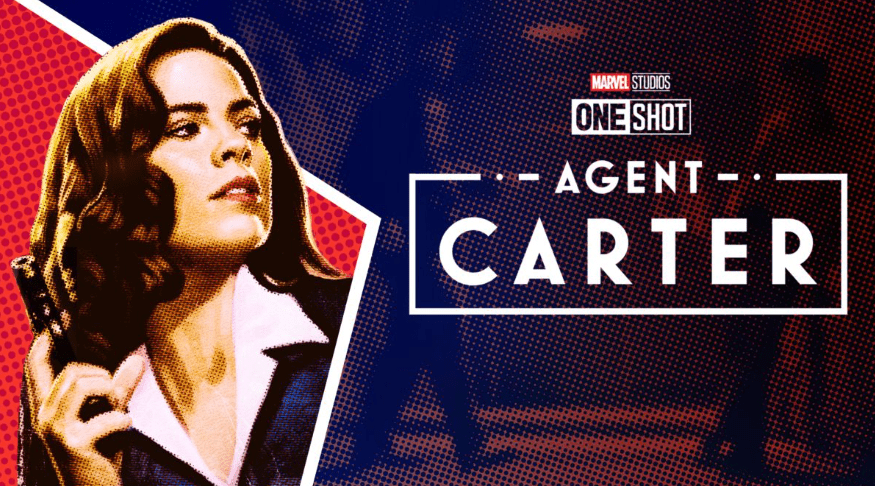
1) Agent Carter (September 3, 2013)
Hayley Atwell reprises her role as Peggy Carter (Steve Rogers’ love interest in the original Captain America) in Agent Carter. This is another Marvel One-Shot that started a television show, this time of the same name. To be fair, Marvel had intended to produce an Agent Carter television show. The Agent Carter One-Shot’s popularity sealed the deal.
I’ll be honest. I forgot the Agent Carter One-Shot existed. It does a great job of showing Peggy Carter navigating the loss of Steve Rogers and a hostile work environment filled with misogynists. S.H.I.E.L.D.’s early days were no picnic for a woman secret agent. Peggy single-handedly takes on an important, time-sensitive mission that S.H.I.E.L.D. believes is a 3-5 agent job. At first, the job seems routine, but things take a turn for the worse when she encounters Zodiac.
By Agent Carter’s end, Peggy is one of the few running S.H.I.E.L.D. with Howard Stark. Agent Carter features over-the-top action and campy set designs. It reminds me of a comic strip from the 1940s or 50s. It claims our top spot because it allows Peggy Carter to escape Captain America’s shadow. And it’s fun.
So, that’s our list. How would you rank the Marvel One-Shots? Let us know in the comments. Thank you for reading, and wherever you are, I hope you’re having a great day.
Hey, hey, Geekly Gang! Kyra Kyle here. Today marks the third Geekly Casting post we’ve made with the new format, and the movie we’re casting today is the upcoming live-action Legend of Zelda movie. We almost have another two years before this movie releases in theaters, but that doesn’t mean we can’t speculate who should play each role. As usual, I’ll kick off this post with modern actors, and then Skye will step in with some historical actors for a dream casting. Feel free to share who you think should portray the characters in the upcoming live-action Legend of Zelda movie.
The Legend of Zelda doesn’t have as many recurring characters as other video game franchises, but we’ll need to set up a few ground rules before determining which roles to cast. Namely, which Legend of Zelda games will comprise the characters for the movie’s script?
Our resident movie geek, Skye, who has also happened to play most Legend of Zelda games, and I narrowed the games to Ocarina of Time and Breath of the Wild. Most moviegoers will know Breath of the Wild (along with Tears of the Kingdom, Breath of the Wild is the most recent Zelda video game duology), while Ocarina of Time is one of the first classic Zelda games that added a healthy dose of mythology. Both are stellar games. We couldn’t decide on one over the other, but the Legend of Zelda movie could pull from more than one video game. Let’s merge Ocarina of Time and Breath of the Wild.
Note: Kyra Kyle wrote their segment well before the official Legend of Zelda movie cast its Link and Zelda. They chose to keep their original actors in their roles instead of listing who got cast. Oh. What could’ve been?
Young Adult Link: Morgan Davies
Morgan Davies is a young actor with many high-profile roles in his short career. Danny from Evil Dead Rise and Koby from the Netflix live-action One Piece series top his resume. With his experience, Morgan Davies should have no problem pulling off a twenty-something Link. It doesn’t matter if the Legend of Zelda’s director chooses for Link to be a silent protagonist (like early-era Zelda games) or if Link will have a speaking role. Davies has the talent and the look for Link. He also pairs well (in age) with who I have planned for Princess Zelda.
I know. I know. Morgan Davies is one half of the Link/Zelda meme that’s going around, and I’m going with the other half, too. This pairing is too perfect.
Princess Zelda: Hunter Schafer
Yes! I went with Hunter Schafer as Princess Zelda. She looks just like her. I couldn’t believe those were her actual ears. I love it. Schafer also has a small but impressive experience. Tigris Snow in The Hunger Games: The Ballad of Songbirds & Snakes and Jules Vaughn in Euphoria top her resume. She’s an actress with the ability and the look to pull off the title character, Princess Zelda. I don’t care if Hunter Schafer as Princess Zelda is a meme at this point. Schafer, in this role, makes too much sense. Make this happen, Nintendo.
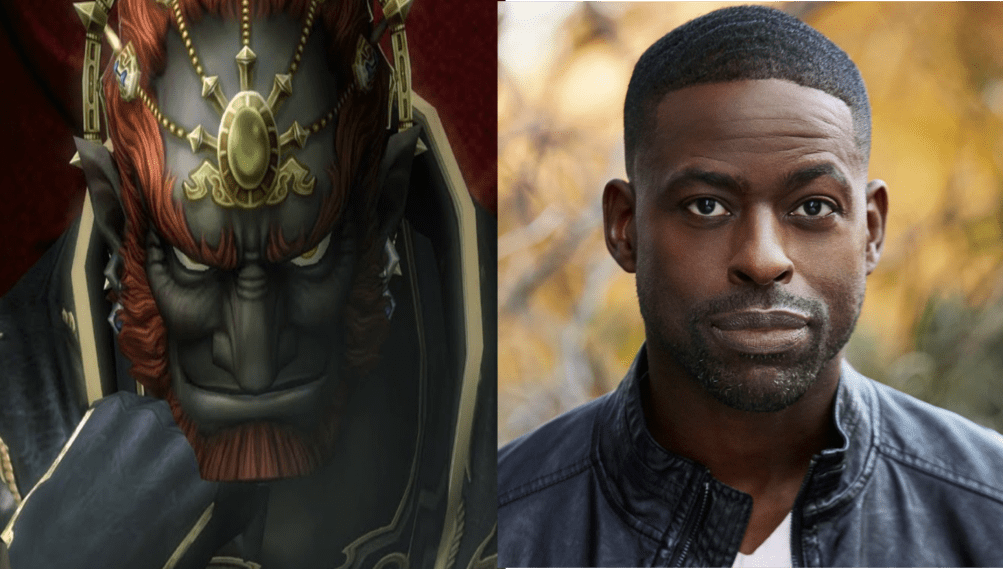
Ganon/Ganondorf: Sterling K. Brown
I cast Sterling K. Brown in a lot of different roles. That’s because the This Is Us actor is phenomenal, and I’d love to see him in just about anything. Sterling K. Brown will bring a layered approach to the role of Ganon or Ganondorf (depending on which Legend of Zelda story the movie chooses). My fear is that Ganon could be boiled down to a cardboard cutout villain. Sterling K. Brown wouldn’t let that happen. He’d give us a Ganon performance for the ages.
Young Link: Christian Convery
I’m including Christian Convery as Young Link because the main game mechanism in Ocarina of Time is that Link goes back to when he’s a child. We may need a Young Link. Christian Convery (star of the Netflix series Sweet Tooth) looks like a young Morgan Davies and could hold his own as an actor, but he could age out of the role. Young Link is definitely one of those roles you could cast an unknown.
Impa: Michelle Yeoh
The incomparable Michelle Yeoh would make a great Impa at any age. Impa is one of those characters whose age varies greatly from one Legend of Zelda game to the next. Everything, Everywhere, All at Once’s Yeoh has had plenty of experience portraying action roles (at various ages) and has the acting chops to pull off one of Princess Zelda’s loyal protectors. My only doubt in casting Yeoh as Impa is that it could be seen as typecasting. But I love Impa as a character, and Yeoh would be fantastic in this role.
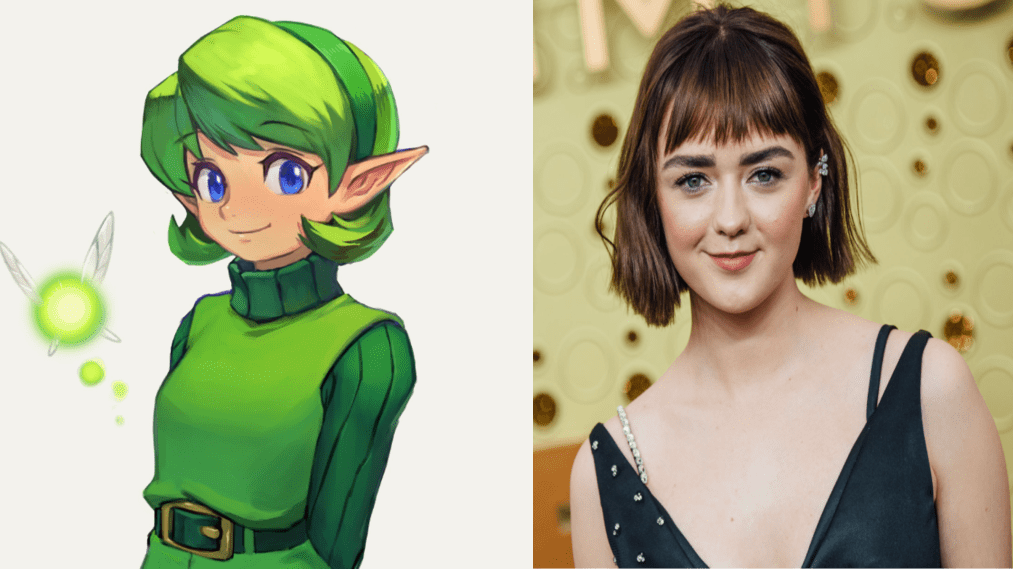
Saria: Maisie Williams
Saria is one of the first sages Link meets during Ocarina of Time. She’s even the sage who presents Link with his very own fairy, Navi. More on Navi in a minute. Maisie Williams has plenty of history acting in a fantasy setting. See her work as Arya in Game of Thrones. Williams has a knack for playing characters who defy social norms. Saria is the only sage to stand up for Link when Mido spread rumors that Link was responsible for the Great Deku Tree’s death. Saria is added in sealing away Ganon during the Ocarina of Time’s finale.
Navi: Awkwafina
I’m doing this one for the LOLs. Many argue that Awkwafina gets cast as a voice actor far too often. In fact, she was in ten animated movies or television shows in two years. Some people claim that Awkwafina getting cast in yet another voice acting role would be so annoying. Enter Navi, one of the most annoying characters in video game history. Hey! Listen! Can you hear Awkwafina screaming, Hey, Listen over and over again? I can. It’s hilarious.
Skull Kid: Elliot Page
There’s a debate as to whether Skull Kid makes an appearance in Ocarina of Time or not. Even if you believe Skull Kid doesn’t appear in Ocarina of Time, you can always tease the antagonist of a future Zelda movie by giving Skull Kid (the main antagonist during the events of Majora’s Mask) a cameo. Over his long, illustrious career, we haven’t seen Elliot Page portray too many villains. Page could make for a great dark and twisted version of Link.
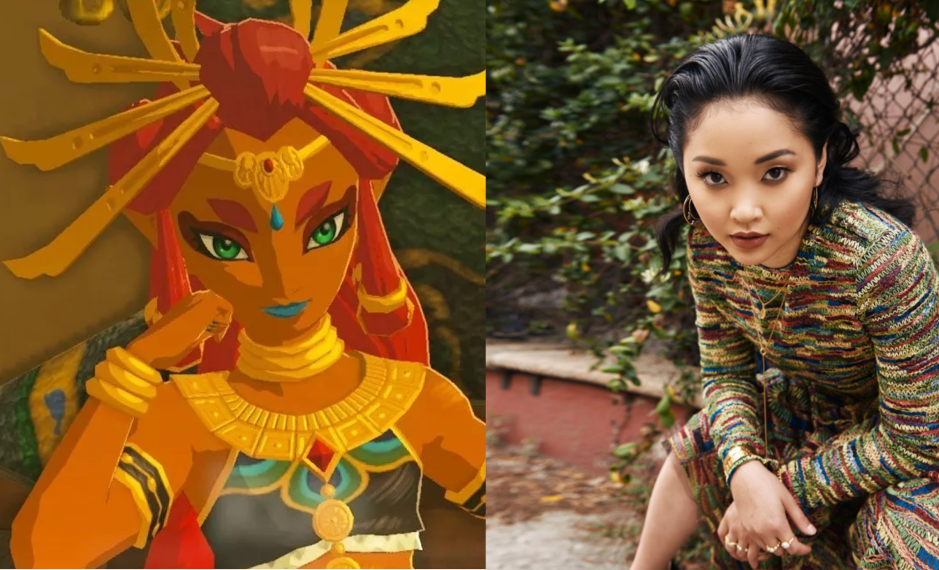
Riju: Lana Condor
Lana Condor made her acting debut as Jubilee in the X-Men film franchise, but she gained international stardom with the All the Boys series. Despite Riju being one of the youngest leaders in Breath of the Wild, she rules with kindness and wisdom beyond her years. Lana Condor has built a solid resume that shows her versatility. She’ll need to tap into all of that experience while playing Riju.
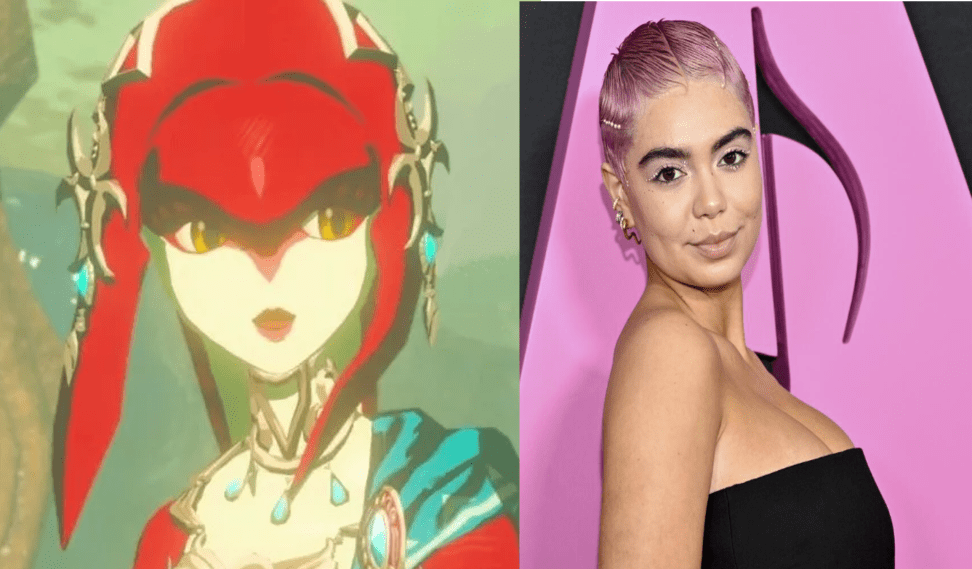
Mipha: Auli’i Cravalho
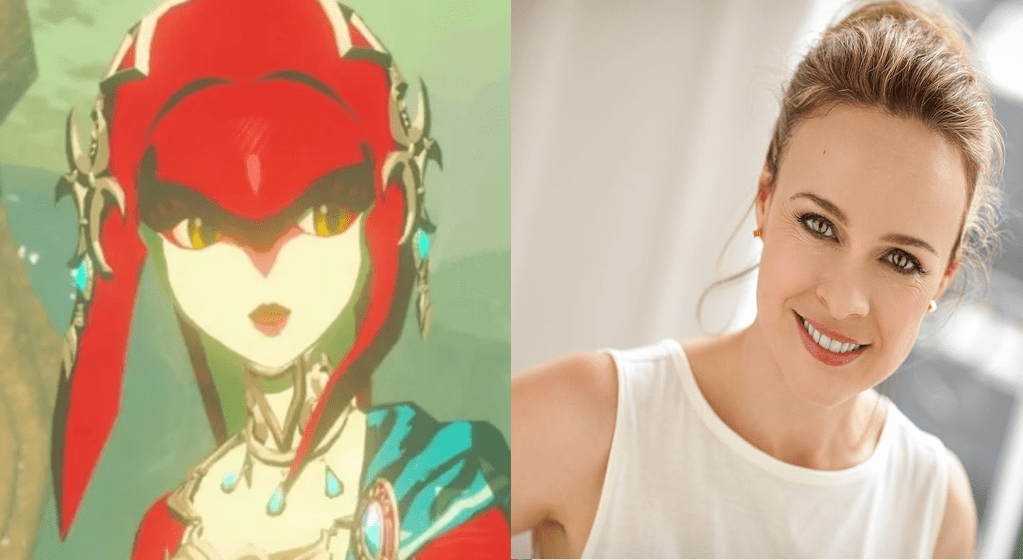
Mipha rules a tribe of half-human, half-dolphin species. Reserved and introverted, Mipha is fiercely loyal to her friends, especially Link. In fact, during events in Breath of the Wild, Mipha insists that she and Link schedule some one-on-one time after the final battle. Auli’i Cravalho got her big break as the voice actor behind Moana. She’s kept busy in Hollywood and Broadway as a triple-threat (acting, singing, and dancing). Cravlho could easily pull off the strong but kind Mipha.
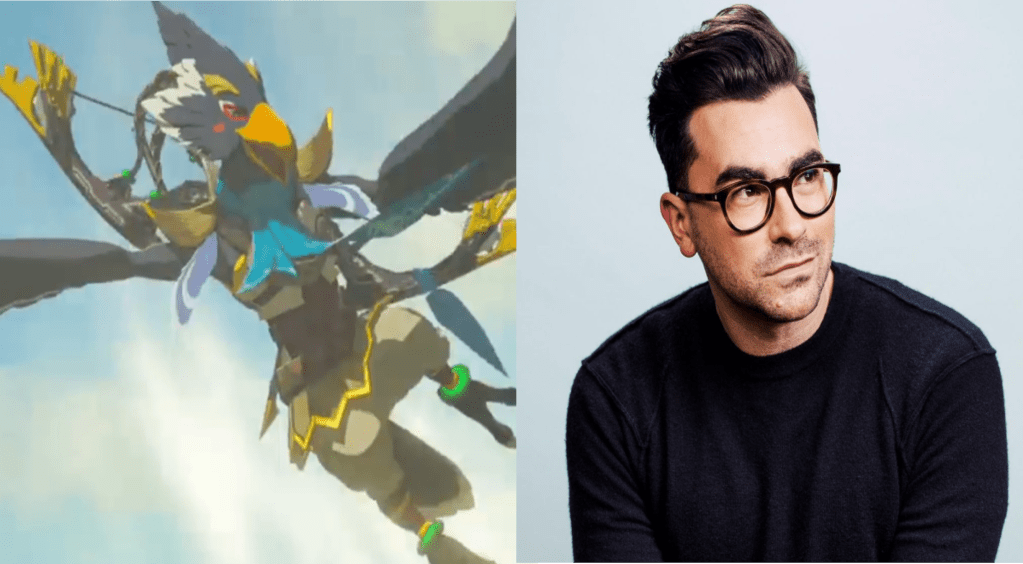
Revali: Dan Levy
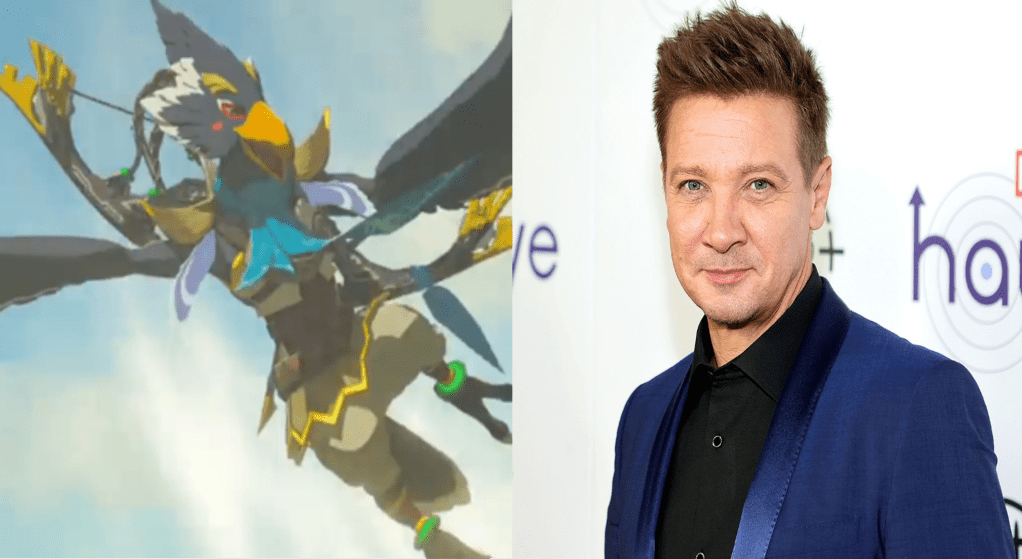
Humanoid bird Revali will be full CGI, so it doesn’t matter if the actor portraying him looks similar to the character. Revali’s temperament is more in play. The champion of the Rito tribe is arrogant and has a sardonic outward personality, especially when he’s around Link. Dan Levy could easily pull off such a character, and he gets extra points because Revali looks like he’s a fully transformed version of Moira Rose’s (Catherine O’Hara’s) role in The Crowening, which is a reference to Dan Levy’s television mother in Schitt’s Creek.
Prince Sidon: Lamorne Morris
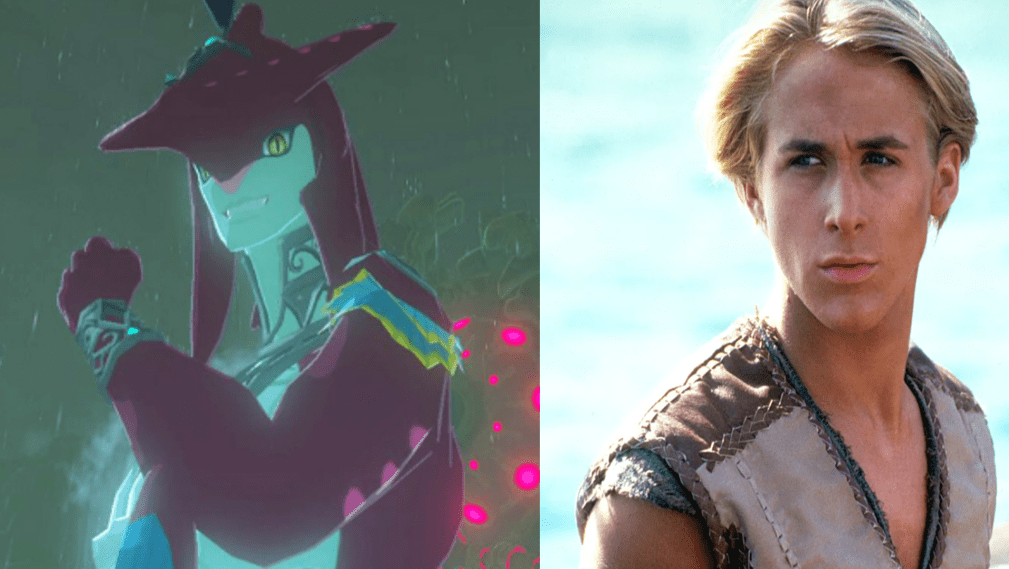
Lamorne Morris may be too old to portray Prince Sidon, but this role will use heavy CGI. That means that it matters if Morris’s vibe matches Sidon. The prince of the Zora people is enthusiastic and sees the sunny side of situations. That reminds me of Morris’s character on New Girl. He brings energy to all of his roles and would make a fantastic Prince Sidon.
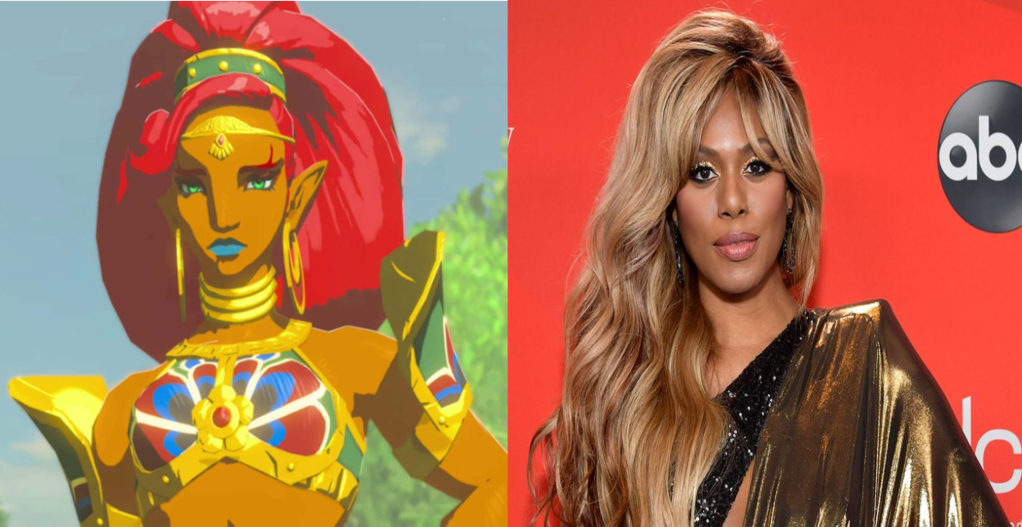
Urbosa: Laverne Cox
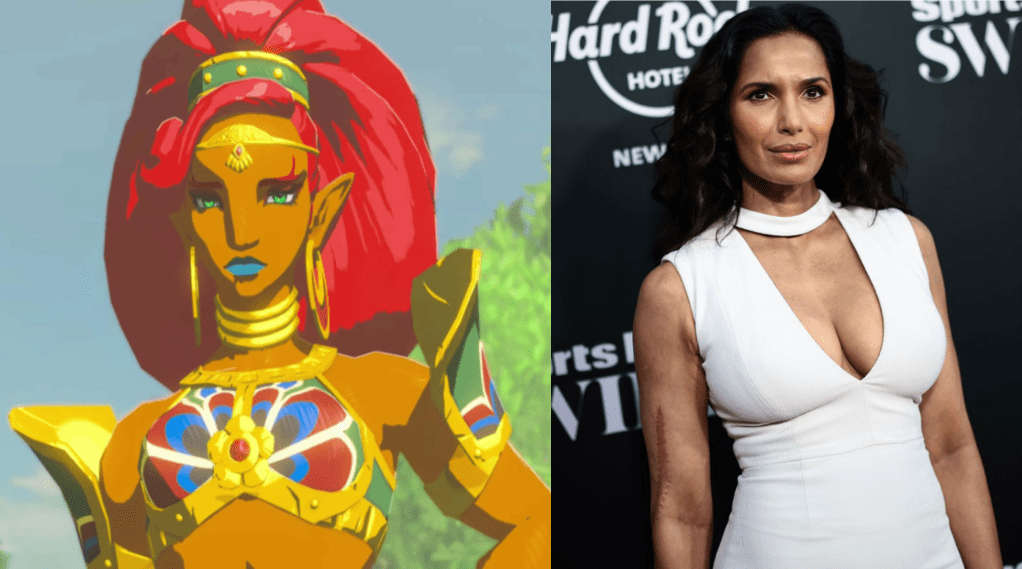
Champion of the Gerudo, Urbosa is an imposing figure. Tall, slender, and muscular, Urbosa’s frame doesn’t match her personality. She’s a gentle and kind leader who only uses her strength and combat prowess when needed. Orange is the New Blacks’ Laverne Cox would make a perfect Urbosa. Laverne Cox deserves to be in more franchises. Watching her act opposite Sterling K. Brown’s Ganon would be a joy.
That’s all I have for my Legend of Zelda casting. Let’s see what Skye has in store.
Skye’s Picks
The choices I made for this casting call were my trickiest yet. In the past, the roles I’ve cast have been well-developed with complex backstories and personalities. For The Legend of Zelda, the characters aren’t “people” so much as “archetypes.” Not that I dislike these characters, but being a symbol as opposed to a person makes it harder for me to find people to fill these roles. I’m happy with the choices I made, but wow. I spent way longer on this than any sane person should have. Either way, these are my choices.
Link: Josh Hutcherson
Link was the last role I filled. It took me a while to figure out who could be both young enough and old enough to pull off Link’s look while having enough acting experience for a non-speaking role. In the end, Josh Hutcherson felt like a good choice. He’s been acting since he was a child and at an age where he can pass as a young adult. That’s perfect for Link. Also, if the filmmakers decided to keep Link mute, Hutcherson has the expressions and body language to come across as strong and stoic.
Zelda: Hunter Schafer
Zelda was the easiest role for me to cast. I had heard talk online about the possibility of Hunter Schafer playing Zelda, and I was on board as soon as I saw her. Just look at her. That’s not an actress playing Zelda, that’s literally Zelda. Case closed. I knew that Kyra Kyle was going to choose her for this role as well, so I spent a while considering who else I thought could fit this role. In the end, I just couldn’t find anyone. Hunter Schafer is living proof of the existence of the Goddess Hylia.
Ganon/Ganondorf: Alan Rickman (Posthumously)
Ganon was an interesting role to cast. I’m unsure which version of Zelda the film will be based on, but Alan Rickman could’ve made a great Ganon in more ways than one. If they’re going for a ruthless monster, Alan Rickman could’ve done it. If they’re going for a sly, calculating Ganondorf, Alan Rickman would’ve been amazing. In more ways than one, Alan Rickman could’ve given us a layered and interesting villain with his interpretation of Ganon/Ganondorf. Unfortunately, we’ll never see it. Rest in peace.
Young Link: (Young) Haley Joel Osment
Haley Joel Osment was the go-to child actor back in the 90s. He had loads of experience as a young actor. Given that, I don’t think he ever did a non-speaking role, so the possibility of Haley Joel Osment as Young Link could’ve been attention-getting. To me, he exudes the energy of having a lot of potential, hidden wisdom, and a good heart, which is exactly what you want for Young Link. Can I live in the timeline where Haley Joel Osment plays Young Link?
Impa: Uma Thurman
Impa has been portrayed in a variety of different ways in the Zelda series. If the filmmakers decide to go the route of Ocarina of Time, Uma Thurman would be a great Impa. Given her experience in several movie roles over her prolific career, Thurman could easily pass as the attendant/protector/guide of Princess Zelda. With Thurman’s expertise as a character actress, I have no doubt she could pull off a wise, measured, and strong character like Impa.
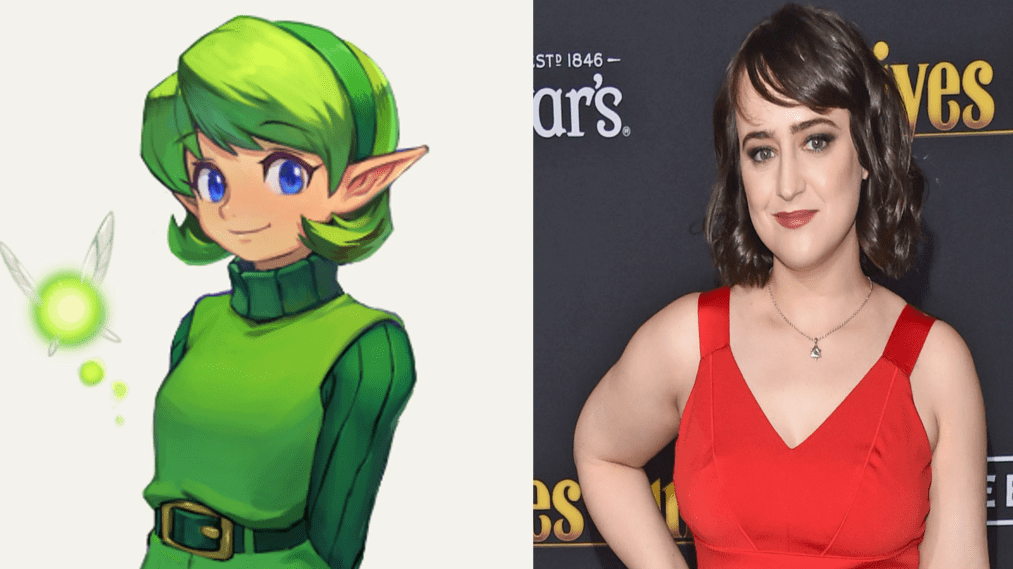
Saria: Mara Wilson
Mara Wilson is yet another prolific 90s child actor. I’m not going to act like every role she had in her heyday was great, but Wilson brought a Saria-esque energy to each of them. Although I have more confidence that she could play Saria now than before. Since The Legend of Zelda’s story is constantly in flux, I’m sure the writers could find an excuse for Saria to be older than she originally appeared in Ocarina of Time. That’s what I like about Zelda. Just look at that side-by-side. Need I say more?
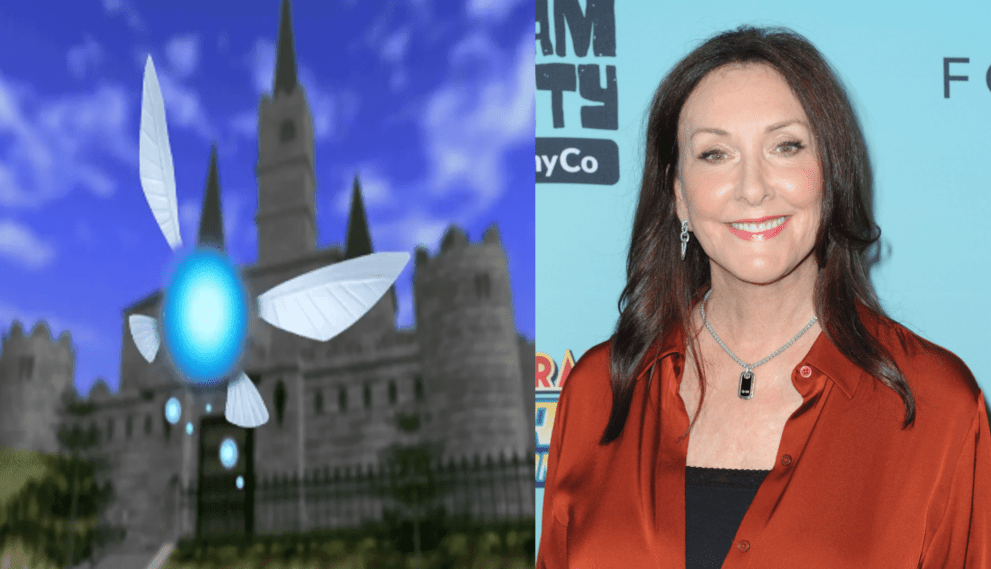
Navi: Tress MacNeille
Speaking of having fun with things, Navi was my favorite role to cast. After hearing Kyra Kyle’s choice for the role, I thought it made a lot of sense. I gave it some thought, and I feel like I found another comedically inclined actress. Putting Tress MacNeille’s experience aside, she has the comedic chops and vocals to add a much-needed sense of levity to the film. While Navi is known for her pesky nature, Tress MacNeille could be a great balance of funny, annoying, and lovable.
Skull Kid: (Young) Jim Carrey
On the surface, I think it’s unlikely for the filmmakers to go the Majora’s Mask route. It’s a bit too niche of a Zelda title and not emblematic of the whole series. However, a young Jim Carrey would make a great Skull Kid if they did. Since Skull Kid’s face is rarely shown, much of his personality would come through his physicality, and that screams young Jim Carrey to me. He could pull off a combination of funny, mischievous, creepy, and dramatic all in one role. Also, the fact he’d be wearing a mask would be a fun in-joke to his 1994 film, The Mask.
Riju: Naomi Scott
I don’t care for the 2019 Aladdin. Who does? However, Naomi Scott as Jasmine is a notable strength of the film. Scott showed dedication to her craft despite a lack of script support, and making her Riju in The Legend of Zelda movie could give her a real chance to shine. Riju, as the chieftain of the Gerudo Tribe, has a fearless disposition and commands authority. Since Riju recently became chieftain, Naomi Scott could convey that, despite her inexperience, Riju is trying her best.
Mipha: Tami Stronach
It’s been a minute since I’ve played Breath of the Wild and, by proxy, seen what Mipha looks like. After I saw images of her, I couldn’t get the thought of The Child-Like Empress from NeverEnding Story out of my head. So, I’m going with Tami Stronach as Mipha. As time has passed, Stronach has accepted more producing roles, but she does act here and there. Since she defined what royalty looked like for one generation, she could do the same for another as Mipha.
Revali: Jeremy Renner
There isn’t much explanation behind my choice of Jeremy Renner as Revali. Even in Breath of the Wild, Revali didn’t get much development or an identity. He was the ancient champion of the Rito (bird) tribe. He’d likely be created through make-up, CGI, or a combination of the two. Pretty much any actor who plays Revali would work. It’s funny for me to imagine Jeremy Renner getting typecast as a bow user. That’s the only reason I picked Renner. Tee-hee!
Prince Sidon: (Young) Ryan Gosling
When I imagine the character of Prince Sidon, he’s the goofball partner who enriches your adventure while having your back. That’s why I couldn’t help but imagine a younger Ryan Gosling in this role. Back in the day, Gosling had a way of portraying characters with likable personalities, charming relationships, and a comedic edge. Gosling still has those capabilities, but a younger version of him would be a better fit for this role. Sidon is also meant to be Mipha’s younger brother.
Urbosa: Padma Lakshmi
Unfortunately, Padma Lakshmi doesn’t have many mainstream roles today, but the Urbosa role has her written all over it. As the ancient champion of the Gerudo Tribe, Urbosa is a gallant, stalwart, and authoritative fighter. Urbosa has the strength, finesse, and know-how to bring her enemies to their knees, and that’s why I can’t help but imagine Padma Lakshmi as her. While Lakshmi’s age may put limits on what she’s physically capable of, her personality is perfect. It would also be great to see her in another mainstream film.
Hey, hey! Kyra Kyle here again. Those are our picks for the upcoming Legend of Zelda movie. Who would you cast in these roles? Heck, would add anyone else to this cast of characters? Let us know in the comments. Thank you for reading, and wherever you are, I hope you’re having a great day.






























 jkgeekly.com