Happy Friday, Geekly Gang! Kyra Kyle here with another game design brain dump. Our first of the year. Yay! Recently, I watched Netflix’s Delicious in Dungeon. I even shared it during one of our Watcha Watching posts. And instantly, I had a new idea for a board game. Well, Dungeon Chef is a variant of an old game design idea I had years ago. Let’s dish. Great. Now, I’m hungry.
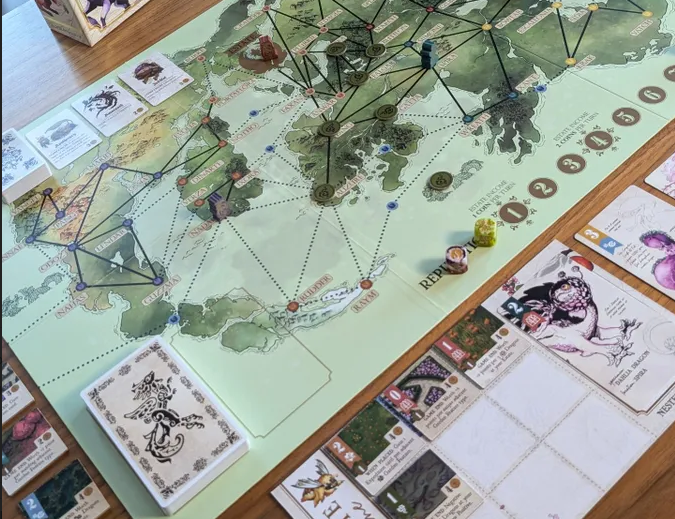
Above is an image of Food Court Hustle’s most recent iteration. Yes, Food Court Hustle was the game’s original name. Food Court Hustle was a card-drafting game where players manage restaurants in a food court. It played quickly, had plenty of Take That elements, and never took itself too seriously. I liked the concept and loved the name. But food courts are a little dated. That was the biggest complaint I heard from playtesters. The concept for Food Court Hustle’s game mechanisms was to give players more control during card drafting. Each round, players would choose one card to play (for its effect) and then choose a card to discard for its ingredients, only every player–not just you–gains the ingredient.
Like most card-drafting games, Food Court Hustle plays swiftly. Simultaneous play helps with game speed. Seriously. This was one of the few games I never felt the need to incessantly time. And that’s a good rule of thumb when designing games. Always time your games. You want to waste as little of your players’ time as possible. I’m not saying you can’t design a two-hour or longer epic board game, but the game should earn its play time. Getting back to Food Court Hustle, something beyond the theme was missing.
Tangent: the image above is Dungeon Chef’s player board, and the previous image was of a Food Court Hustle player board. The scale of these two images is almost what it should be, so I managed to shrink the player’s space while ditching customers. Yes. The original game included customer cards that wouldn’t always appear when players wanted to make a dish. Another gameplay gripe. You could have the ingredients and not be able to make a meal. Dungeon Chef gets rid of that layer of randomness. I also got rid of a lot of the Take That mechanisms and replaced them with global effects.
Above is a sample Dungeon Chef card. The top half is the action you may choose to play. The number indicates the player’s initiative for that turn. All cards in the three day decks are numbered 1-50. The higher the number, the quicker the action. I’ve seen players choose a card for its initiative, which is wild. The bottom half is the monster parts you may add to the communal ingredients. You wouldn’t be the only one gaining a man-eating plant. Everyone at the table gains a chunk of man-eating plant. And returning to the action on this card, you can turn up the temperature of the communal stove. That’s right. Most game elements in Dungeon Chef have global effects. Half the game is steering the game state in your direction.
Players can select a recipe by spending the ingredients on the recipe card. Then, they add the recipe to their player board, lining up the wok with the flame. And near the end of each turn, move the recipe card up the number of spaces indicated by the communal stove’s temperature. Players can take their active recipe off the stove and claim the victory points indicated on the card at any time. But beware, if a player leaves their meal on the stove too long, they could burn their meal, and it goes into the trash, costing them 10 points at the end of the game. Whoever has the most points at the end of three days wins. There’s little more to Dungeon Chef. I tried to keep it short, easy to understand, and stick to the Delicious in Dungeon theme as best I could.
We’ll see where this design goes. And who knows? Perhaps I’ll be at a gaming convention near you. Let me know which convention I should attend. If you made it this far, you’re awesome. We all know it. Thank you for reading, and wherever you are, I hope you’re having a great day.
Happy Wednesday, Geekly Gang! Kyra Kyle here. During today’s post, our writers share what they’ve been reading over the past month. Feel free to share what you’ve been reading in the comments. We’re all part of the Geekly Gang. I’ll start off with what I’ve been reading this past month.
Kyra’s Nonfiction
I don’t think I included reading a tabletop game (board game) design book in my New Year’s Resolutions, but I meant to add reading at least one board game design book this year (there aren’t that many, to be honest). Building Blocks of Tabletop Game Design: An Encyclopedia of Mechanisms is required reading for anyone wanting to design board games. Geoffrey Engelstein set the groundwork for the game mechanisms mentioned on boardgamegeek.com, so it makes sense he cowrites this encyclopedia. And Building Blocks of Tabletop Game Design reads like an encyclopedia.
I’ve found multiple game mechanisms I didn’t know had an official name, and seeing all the terms in one spot inspires me to try designing games with mechanisms I’ve never tried. Heck, Building Blocks of Tabletop Game Design offers ideas on how to use each mechanism. Hmm. I may have some game designs to steal. I mean, create.
Kyra’s Poetry
I love Come on All You Ghosts by Matthew Zapruder. The poems within this collection manage to pack a literary punch while delving into geek culture. Come on All You Ghosts was the first poetry collection I read that proved one could embrace their inner geek, and poetry can be approachable. Don’t be surprised if you find references to Blade Runner, Lovecraftian Horror, or the Seattle Seahawks’ quarterback of the 1970s Jim Zorn. All the while, Come on All You Ghosts shows Zapruder at his poetic best. He uses startling imagery, and his enjambments are second to none. You can’t finish Come on All You Ghosts without wanting to play with words. And yet, Zapruder remains direct, which makes the poems within this collection easy to understand and digest. If you’ve ever been intimidated by poetry, give Come on All You Ghosts a read.
I’ve been reading other books, but I haven’t finished any others–yet–so I’ll save them for a future month. Let’s check in with Skye.
Skye’s Fiction
I’ve never read Maus. While I’ve been meaning to read Maus for a while, and I anticipated reading it since grade school for an assignment, it never happened. So, I decided there’s no time like the present. Let’s be fair; I probably don’t even need to introduce Art Spiegelman’s Maus to y’all. Either you’ve heard about Maus on account of its impressive accolades (the first graphic novel to earn a Pulitzer), or (unlike me) your teachers were cool and went over it in class. Despite the heavy themes contained within Maus, now might be the best time to re-examine the horrors of what took place in fascist Germany. It might shed some light on our current political climate.
Skye’s Nonfiction
Writing Arguments (Twelfth Edition) makes my list this month. Be you didn’t see that one comin’, huh? I didn’t either. I’m taking English Composition II this semester. This might be cheating, but you can’t deny it’s also funny. At least I thought it was. Despite being a general education course, I’ve enjoyed reading through my assigned chapters and already learned a lot. Writing Arguments isn’t just about solving disputes for the sake of passing a class; Writing Arguments takes these ideas to the next level and expands one’s understanding of perspective. So far, Writing Arguments has done a fantastic job. I look forward to learning more. You know, I might be a nerd. Aren’t we all nerds? At least I’m in good company. 😉
Hey, hey! Kyra Kyle back again. That wraps up what our writers have been reading over the past month. What’ve you been reading? Let us know in the comments. Thank you for reading, and wherever you are, I hope you’re having a great day.
Hey, hey, Geekly Gang! Kyra Kyle here. We’ve tackled the idea of live-action television shows based on comic books over a decade ago with Top 5 Live-Action TV Shows Based on Comics. It’s a good idea to update this post. Our reasoning is three-fold: 1, it’s been long enough and more shows have been produced since 2015; we increased the number of shows on this list from five to ten; and Geekly forgot about a few shows inspired by comic books in the previous list. Whoops! Before we get into the shows, let’s set down some ground rules for this list.
1: Cultural relevance will play a role, as will the show’s overall quality.
2: Some of these shows don’t stack up in cinematic quality even with their contemporaries, but they’re outstanding just the same.
3: We’ll have to stick with one show from a franchise (or specific character) because we wouldn’t want a list that includes only Batman and Spider-Man.
Without further ado, let’s get to the top 10 live-action television shows based on comic books.
Honorable Mention 2) iZombie (2015-2019)
I’ll admit it. I have a soft spot for iZombie. Geekly covered the show when it first aired, and I like the combination of zombies and weekly detective work. Throw in some ongoing drama and a heavy dose of comedy, and you have one addictive show. iZombie won’t be too many people’s first choice for live-action television show based on a comic book, and that’s why I wanted to mention it here. It doesn’t hurt that iZombie’s intro theme, “I’m Already Dead” by Deadboy & The Elephantmen lives rent-free in my head.
Honorable Mention 1) Sandman (2022-2025)
Sandman adapts the source material in a fresh way that also remains faithful to the comic book. Tom Sturridge does the unthinkable and captures the essence of Dream. Kirby makes a great Death. Mason Alexander Park is Desire. I could go on. Sandman has a stellar cast, but it misses our list for a couple of reasons. 1) The Netflix effect. Netflix used to be The Place for creative freedom; now, it’s a place for rehashed ideas, and any original show is likely to get canceled too soon and have little chance of another streaming platform picking up the franchise. 2) The Neil Gaiman effect. I have yet to watch Sandman’s second season because of the ick associated with Gaiman. Still, Sandman deserves a mention.
10) The Umbrella Academy (2019-2024)
The Umbrella Academy had a brilliant five-year run on Netflix. As one of the more recent entries on this list, I struggled to place it any higher on this list. The other thing going against The Umbrella Academy is that it’s a Netflix show. The Netflix effect claims another victim. Time could see The Umbrella Academy rise in the standings, because there’s a lot to love.
The Umbrella Academy blends quirky humor, bizarre storylines, balls-to-the-wall action, and pitch-perfect character development. The third season incorporated Elliot Page’s gender identity respectfully and made it work for the show’s story. It also doesn’t hurt that the show is based on the comic book of the same name by My Chemical Romance lead singer Gerard Way. That gives The Umbrella Academy an extra layer of cool.
9) The Walking Dead (2010-2022)
The Walking Dead made our last list over a decade prior, but the show may have hung on for too long. Those early seasons of The Walking Dead were some of the small screen’s best. Despite any flaws, this show focused on interpersonal relationships. The drama within The Walking Dead stemmed from its human characters. And let’s face it. The Walking Dead ignited zombie-mania. You can’t take a breath without huffing on a walker.
The Walking Dead started an empire. I’ve lost track of how many spinoff series this show spawned: Fear the Walking Dead (2015-23), The Walking Dead: World Beyond (2020-21), Tales of the Walking Dead (2022), The Walking Dead: The Ones Who Live (2024), The Walking Dead: Dead City (2023-present), and The Walking Dead: Daryl Dixon (2023-present). The Walking Dead became so popular that a secondary character from the original series, Daryl Dixon, got his own spin-off. Talk about cultural relevance.
8) ThePenguin (2024)
Despite bearing the name of one of Batman’s iconic villains, ThePenguin doesn’t even feel like a television show based on a comic book. The Penguin borrows a lot from Breaking Bad and The Sopranos. Watching Oz Cobb ascend–or descend, depending on the lens you use to view his story–to mafia royalty was a joy to watch. Cristin Milioti’s turn as Sofia Falcone was excellent. Sofia Falcone (from The Long Halloween fame) was another comic book character I didn’t expect anyone to pull off well, but Milioti is fabulous in ThePenguin.
When I first learned The Penguin got greenlit, I wondered what more there was to say. Apparently, a lot. The Penguin took an interesting enough character from 2022’s The Batman and built a mythos around a character that didn’t receive enough love on the big or small screen. Penguin is one of my favorite Batman villains, and The Penguin captured a certain slimy iteration of the character. The Penguin is well worth watching.
7) Arrow (2012-2020)
Arrow is another show that stayed a little too long. It suffered the fate of many CW shows and descended into melodrama. After a season, Olicity (the shipping of Oliver Queen and Felicity Smoak) turned my stomach. But Arrow started strong. Manu Bennett may still be the definitive Slade Wilson/Deathstroke, and the “You have failed this city” and Ollie’s time on the island storylines of the first few seasons proved that a lesser DC Comics character like Green Arrow could anchor a show. Not just a show, an entire franchise. Arrow began the Arrowverse.
The Flash may have taken over as the flagship title for the Arrowverse, but Arrow led to The Flash, Supergirl, Legends of Tomorrow, Black Lightning, Batwoman, and the web series Vixen and Freedom Fighters: The Ray. I don’t know when or if I’ll return to Arrow, but I have fond memories of early Arrow seasons. And with Arrow’s cultural impact, no one can deny its place among the top 10 live-action television shows based on comic books.
6) Smallville (2001-2011)
We go from Arrow, which spawned the Arrowverse, to Smallville, which introduced a wider audience to Green Arrow in the first place. Justin Hartley’s Green Arrow guest-starred in numerous Smallville episodes. In fact, Smallville introduced numerous DC Comics Universe characters to television viewers in the early 2000s. I’m still waiting for another actor to take on the role of Booster Gold.
Smallville’s premise wore thin for some people. The show features a Clark Kent before he becomes Superman. In fact, Smallville had the mandate “No Tights, No Flights.” Viewers had to wait a decade for Superman to make his first flight, and by that time, Smallville had seen Aquaman, Green Arrow, and even Booster Gold have a turn in full costume. Even if the “No Tights, No Flights” mandate rubbed you the wrong way, you can’t deny Smallville’s significance.
5) Batman (1966-1968)
We go way back in time for this next entry. Batman may not have aged the best, but that was never the point. Batman was pure camp. It resurrected characters in the comic book. The Riddler hadn’t been seen in a comic book since the 1950s. The 1960s Batman made The Riddler relevant. Few live-action television shows based on comic books can make that claim.
The Batman-mania of the 1960s proved there was an appetite for comic book media beyond the page. And Batman featured a lot of A-list actors. Cesar Romero, Burgess Meredith, Frank Gorshin, Vincent Price, and many others read like a who’s who of character actors. Batman rejuvenated and launched numerous acting careers. Be honest. When you saw the picture of Batman above, did you not hear Batman’s theme?
4) Doom Patrol (2019-2023)
Doom Patrol. Doom Patrol? How is Doom Patrol this high? I didn’t expect to like Doom Patrol as much as I did, but it’s easily one of the DCEU’s best projects. Doom Patrol may have released just before The Umbrella Academy, but the source material, the Doom Patrol comic book, inspired The Umbrella Academy, so that’s one of the reasons Doom Patrol makes it this high on the list.
The other reason is Doom Patrol resurrected Brendan Fraser’s career. Fraser’s turn as Cliff Steele/Robotman was fantastic. Fraser’s final scene in Doom Patrol never fails to turn on the waterworks. I bawl every time I watch it. The rest of Doom Patrol’s cast is top-notch. I like Matt Bomer in most things, and Timothy Dalton is an acting legend. But I need to give Diane Guerrero’s performance as Crazy Jane some praise. It may be a low bar, but Crazy Jane may be the best representation of dissociative identity disorder I’ve seen in a television show or movie. And I hope Joivan Wade gets another chance to portray Victor Stone/Cyborg. He was another stand-out. Everyone was. I liked April Bowlby’s portrayal of Rita Farr/Elasti-Woman. Doom Patrol is one of the few shows on this list that I’ll happily rewatch.
3) WandaVision (2021)
Marvel’s Disney+ shows had so much promise after they leapt off the screen with WandaVision. Sure, WandaVision is a continuation of the MCU, but the exploration of Wanda Maximoff’s mental state can’t be overstated. Kathryn Hahn had a star turn as Agnes/Agatha, and the rest of the cast was a joy. WandaVision is another show I’ll rewatch. Its use of sitcoms through the decades felt organic; it was more than nostalgia.
But there were plenty of call-outs to sitcoms and MCU properties. Evan Peters, pseudo-reprising his role as Pietro Maximoff was a nice touch. WandaVision did the source material proud. Hints of House of M (comic books) lead into Vision Quest (also from the comics), which will become another WandaVision spinoff Disney+ series. Vision Quest will mark two spinoffs to date. The first was Agatha All Along. I cringe at Wanda’s descent into madness, but I can’t look away.
2) The Boys (2019-present)
The Boys is the rare television show that’s better than its source material. The Boys comic book was okay. A bit gory and over-the-top, but okay, and let’s not get this twisted, the original comic book was written at the height of the Bush Administration, and it shows. The world has changed. The Boys television show adapted with it. And despite that, The Boys didn’t lose sight of what made the original comic book fun. That and Homelander scares the poop out of me. Seriously, Antony Starr’s Homelander haunts my dreams.
Writing on The Boys strikes a delicate balance of mixing over-the-top violence, black humor, deft plots, and character work. The Boys can be a big, dumb superhero show, but it also be a nuanced look at humanity and how we deal with trauma.
1) Daredevil (2015-2018)
Daredevil rises above the Netflix effect to claim the top spot. I can’t believe it, but Daredevil hadn’t yet released its first episode when we posted our original Top 5 Live-Action Comic Book Shows. My goodness, Geekly’s been around for some time. Daredevil claims the top spot in part because it’s been revived and will resurrect other Netflix Marvel shows with it on Disney+, like Punisher, Jessica Jones, and Luke Cage. Except for a few moments, Daredevil’s writing was on point. Charlie Cox embodied the role so much that I can’t see anyone else portraying Daredevil. And the action sequences and filmography made me feel every punch through the screen. I’ve never felt that before or since Daredevil.
And Daredevil showcased some amazing acting. Cox’s Daredevil was fabulous, while Vincent D’Onofrio was menacing. You know what? I can’t see anyone else portraying Kingpin other than D’Onofrio. Woll’s Karen Page and Henson’s Foggy Nelson rounded out a stellar main cast. And just when I’d think Daredevil would take too many leaps by adding Bernthal’s Punisher or Yung’s Elektra or Bethel’s Bullseye, the actors would turn in character-defining performances. There’s a reason why Daredevil: Born Again was 2025’s most anticipated comic book series. It had some huge shoes to fill.
That’s our list of the top 10 live-action television shows based on comic books. I’m sure yours differs from ours. Let us know which shows you’d add or take away from this list. Thank you for reading, and wherever you are, I hope you’re having a great day.
Happy Sunday, Geekly Gang! Kyra Kyle here with the first Geekly News of the year. The year is still ramping up, so we only have a few new releases. We’ll get to the new board games and video games, but first, let’s check in with the MCU and the upcoming Mutant Saga. There’s a lot to discuss.
MCU Reveals Its Blueprint for The X-Men
We’ve been radio silent about the MCU for a while, not because the MCU had few updates, but because those updates didn’t feel large enough. Black Panther had a recasting rumor. We still don’t know for sure if Shuri (Letitia Wright) will remain as the Black Panther beyond Avengers: Doomsday. Heck, a new Black Panther could reveal themselves during the next Avengers film. Ryan Reynolds is working on a new Deadpool or Deadpool and Wolverine movie. Hugh Jackman will return as Wolverine for at least the next Deadpool film and potentially a new Wolverine solo film. But the biggest MCU news may be Marvel’s direction for the X-Men.
According to trusted industry insider Daniel RPK, Marvel will release solo projects for the core X-Men members, leading up to an X-Men team movie. Marvel wants to avoid the errors they made during the Multiverse Saga. Going back to what made people care about the Avengers during the MCU Phase One is a step in the right direction. Unlike Avengers actors (who were in their forties and fifties), Marvel intends to cast younger actors in X-Men roles, even a younger Wolverine. Speaking of Wolverine, rumors suggest he won’t be included in the first X-Men film. That may be for the best.
We still don’t know how Marvel plans to introduce the upcoming X-Men characters. My guess is that we may see more Marvel Studios Special Presentations. Disney/Marvel will want to cash in on The X-Men as soon as they can, and some sources suggest the first MCU X-Men film will release a year or two after Avengers: Secret Wars. That doesn’t leave the studio too much time to introduce these characters. Several 1-hour specials could help.
And speaking of Marvel Studios Special Presentations, the Punisher Special will build off of the second season of Daredevil: Born Again and should also tie into Spider-Man: Brand New Day. This news, added with the rumors of upcoming X-Men character solo projects, makes it appear that the MCU may require viewers to–once again–do some small homework in preparation for upcoming movies and shows. I’m torn. I’ve liked the MCU’s recent trend of not requiring a lot of homework ahead of watching a movie or show. On the other hand, I’d love to see more Special Presentations. And there was a time when Marvel fans didn’t mind doing a little homework. Hopefully, the X-Men will find a good balance.
Yokai Forest Duel Launches on Gamefound
Bring on the games. Two to eight players face off in fast-paced tournaments or league-style matchups. Outsmart your rivals through clever strategy, deduction & bluffing with mind games as you fight for victory in intense best-of-three duels. Be careful though: investing too much time in your current match and your opponent might crush you before you even reach the finals.
Yokai Forest Duel’s concept reminds me of a character-driven version of Challengers!, and if that’s the case, Yokai Forest Duel will be loads of fun. Godot Games claims Yokai Forest Duel can be learned in under three minutes but offers plenty of strategic choices. Again, this reminds me of Challengers!. Yay! The artwork and game graphics differ, and so does the fact that players assume the role of a specific character. I don’t know how any of the characters work, but Yokai Forest Duel features eight different 80-card decks. Yokai Forest Duel’s pledges range from $27 to $74. If you’re interested in Yokai Forest Duel, check out its Gamefound page.
The Last in the Woods Launches on GameFound
Forget comfort. The Last in the Woods is about survival. You’ll have no safety net. As the game’s name suggests, you’re handed a few tools, and you compete against the other players to be the last in the woods. I’m unsure if The Last in the Woods includes direct player versus player combat. Typically, I don’t care for direct combat between players. But I love the idea of a competitive survival game, and if that involves a little PVP combat, I’m all for it.
Variable player powers (like the one for George, who only needs one stone to craft a knife, pictured above) should give The Last in the Woods a little spice. But this isn’t the only element The Last in the Woods uses to shake up the gameplay of each game. Random events and equipment allow for diverse strategies during each playthrough. As of writing this post, The Last in the Woods hasn’t listed their pledge rates. I can’t imagine the game costing more than $40. It could cost as little as $20. We’ll see. If you’re interested in The Last in the Woods, check out its GameFound page.
Code Violet Releases on PlayStation 5
During Code Violet, players uncover the secrets of the Aion colony, who use time travel technology to kidnap women in the past. These women are then used as surrogate mothers in an attempt to save humanity from destruction. I love this hook. Code Violet combines story elements of Children of Men and The Handmaid’s Tale with a time-travel twist. Excellent! Add in the fact that Code Violet is a third-person action-horror game and the spiritual successor to Dino Crisis, and Code Violet may be a PlayStation 5 title to place on your radar.
And that’s a great thing because Code Violet is our only new video game release for this week. I wasn’t kidding when I mentioned 2026 hasn’t yet fully launched. Plenty of great board games and video games are on the horizon. We just may need to wait another week or two. Or even a month or two.
That’s all the geek news we have for you this week. Which MCU project are you the most excited for? Let us know in the comments. Thank you for reading, and wherever you are, I hope you’re having a great day.
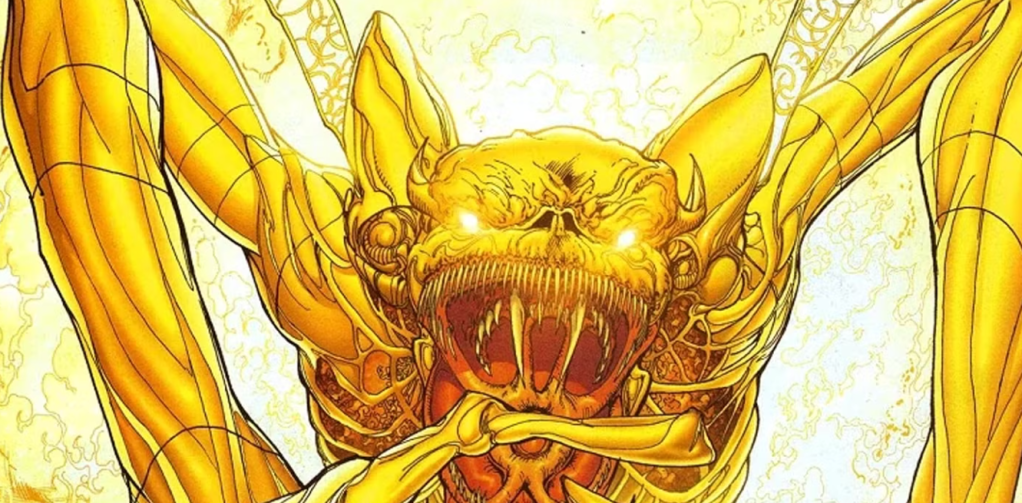
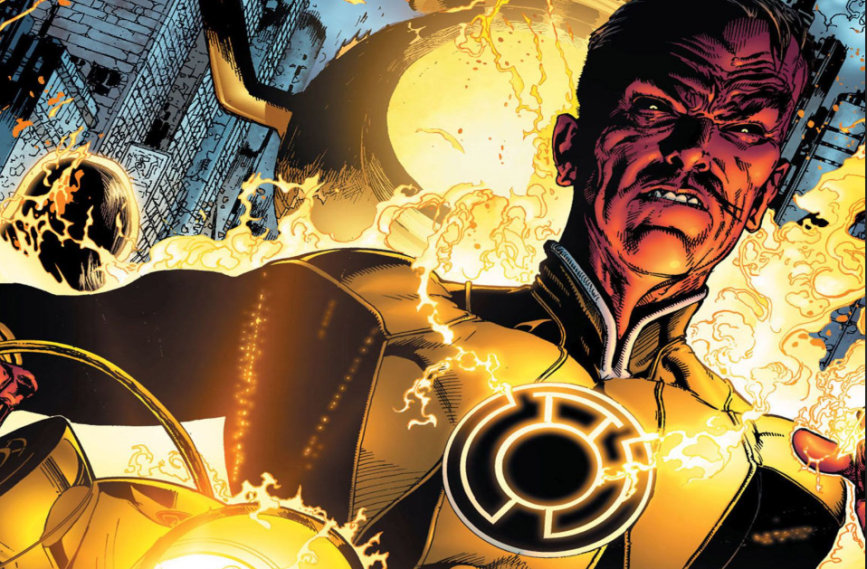
Hey, hey, Geekly Gang! Kyra Kyle here. I’m writing this post months in advance (in preparation for writing/editing novels during the final months of 2025), and Geekly doesn’t yet know when Lanterns will release on HBO Max. We only have a release date of First Quarter 2026. It doesn’t matter. Lanterns will feature at least three Green Lanterns (Hal Jordan, John Stewart, and Guy Gardner), so we’re releasing Green Lantern Starter Stories for all three characters over the next few months, just in case you want to get started reading Green Lantern comics. We’re starting with Hal Jordan.
Green Lantern is somewhat of a special case. We’ll be seeing Geoff Johns’s name show up a lot on this list. Johns did a lot for Hal Jordan as a character, but other writers contributed to Jordan’s mythos, so I listed a handful of Johns’s storylines, and then did my best to show some of the other amazing writers who have worked on the character. The result is an extra-long list of Green Lantern (Hal Jordan) starter stories. If you’re lucky, you can find the 2020 Green Lantern one-shot 80th anniversary, Green Lantern: Will. It collects a lot of incredible Green Lantern stories that may or may not have made this list. Let’s get to the stories that did make this list.
Single Issue
“S.O.S. Green Lantern” (Showcase #22; written by John Broome/art by Gil Kane; October 1959)
Per usual, we begin with Hal Jordan’s first appearance in “S.O.S. Green Lantern.” It’s a simple story. Abin Sur lands on Earth. As the alien lies dying, he commands his Green Lantern ring to find a worthy successor (one who is fearless and strong-willed). The ring finds Hal Jordan. It transports Hal to Abin, and Abin Sur grants Hal Jordan his power as the Green Lantern.
Not going to lie, “S.O.S. Green Lantern” could refer to Hal Jordan’s problematic relationship with Carol Ferris. She rejects his advances (because she needs to prove herself as a worthy successor to her father Carl Ferris, and that she can run Ferris Aircraft), but Hal pushes the issue. You’re coming on a little strong, Hal. Still, “S.O.S. Green Lantern” sets up Hal Jordan as a character, and this origin story has seen few tweaks over the decades. Maybe with less misogyny.
Storyline
“Green Lantern/Green Arrow” (Green Lantern/Green Arrow #76-89; written by Denny O’Neal and Neal Adams; 1970-1972)
“Green Lantern/Green Arrow” was my first introduction to Hal Jordan as a character. Denny O’Neal’s team-up story revolves around Hal Jordan losing any concept of what being an Earthling is. As a Green Lantern, Hal serves as an intergalactic cop (something we’ll see with Grant Morrison’s take on the character later). Green Arrow serves as a pseudo-Robin Hood. It makes sense, both characters use a bow and arrow. “Green Lantern/Green Arrow” may have done the most to show me the world is nuanced.
The first issue in our collection shows Green Lantern stopping poor people protesting outside a slum lord’s mansion. Green Lantern breaks up the demonstration, only to have Green Arrow tell him he’s misguided. The world isn’t black and white. My favorite moment must be the iconic panel where a poor black man approaches Green Lantern. He says, “I been readin’ about you how you work for the blue skins, and how on a planet someplace you helped out the orange skins, and you done considerable for the purple skins! Only there’s skins you never bothered with, the black skins! I want to know how come? Answer me that, Mr. Green Lantern!”
Hal can’t, but he spends the rest of this series figuring out how he can help the Earth become more equitable.
“Emerald Twilight” (Green Lantern Vol 3 #48-50; written by Ron Marz/art by Bill Willingham, Fred Haynes, and Darryl Banks; 1994)
We go from one iconic Green Lantern storyline to another. “Emerald Twilight” is the storyline where Parallax possesses Hal Jordan and turns him into an ultimate super villain. Hal destroys his home, Coastal City, with a smile on his face. He single-handedly dismantles the Green Lantern Corps. Dozens of familiar faces perish in Hal’s rampage through the universe.
“Emerald Twilight” introduces us to Kyle Raynor as the new Green Lantern. Kyle picks up the pieces and brings honor to the Green Lantern name. After Hal’s actions, can you blame anyone for not trusting anyone with a Green Lantern ring? DC Comics intended to uphold Ron Marz’s vision. Hal snapped. But fan backlash forced the creative team to retcon Hal Jordan being possessed by a separate entity named Parallax, instead of naming himself Parallax. Despite losing some of the story’s original bite, “Emerald Twilight” showed a different side of Hal Jordan, and ultimately, introduced one of Green Lantern’s greatest villains, Parallax.
“Rebirth” (Green Lantern: Rebirth #1-6 and Green Lantern Vol 4 #1-4; written by Geoff Johns; art by Ethan Van Sciver, Jesus Merino, and Carlos Pacheco; 2004-2005)
“Rebirth” is where Geoff Johns made his mark on Green Lantern. The Green Lantern Corps is in a state of disrepair, but Johns fixes Hal Jordan’s backstory. Johns is the one who retconned Parallax as one of the Green Lantern Corps’ greatest enemies. Ironically, Green Lantern: Rebirth did as much to rewrite Hal’s history and keep all the remaining Green Lanterns relevant. Without this story, the Lanterns television show wouldn’t be possible.
Before “Rebirth,” only one Green Lantern was allowed to exist at one time. “Rebirth” changed that. This story turned the Green Lantern character into the Green Lantern Corps.
“Secret Origin” (Green Lantern Vol 4 #29-35; written by Geoff Johns; art by Ivan Reis; 2008)
As the name may suggest, “Secret Origin” recontextualizes Hal Jordan’s origin. You may even decide to skip reading the 1959 issue and read “Secret Origin” instead. “Secret Origins” features one of Hal Jordan’s earliest starts as a Green Lantern. Abin Sur and (modern classic Green Lantern villain) Atrocitus play a role in turning Hal Jordan into the hero we know today.
Not only does “Secret Origin” manage to say something new with Hal’s origin, it sets up the next story on our list, “Blackest Night.” Geoff Johns was on a roll with Hal Jordan and the Green Lantern Corps as characters. This almost decade-long run may be the best Green Lantern run.
“Blackest Night” (Blackest Night Vol 1 #0-8; written by Geoff Johns; art by Ivan Reis; 2009-2010)
“Blackest Night” resurrects Nekron, the Lord of the Unliving, and watches him create the Black Lantern Corps. During Johns’s run of Green Lantern, he established the Emotional Spectrum of the DC Universe. The emotional spectrum, based on colors of the rainbow, added a unique twist. The Black Lantern Corps is an extension of the Emotional Spectrum. The Black Lantern Corps resurrects heroes and villains across the galaxy and consumes their still-beating hearts.
“Blackest Night” combines zombie elements with the Green Lantern mythos. This storyline brought an underused DC Comics villain, Nekron, back into the spotlight. This DC Comics crossover event was epic. It may be one of the greatest crossover events DC Comics has ever seen, and Hal Jordan is at its center.
“Green Lantern: Earth One” (Green Lantern: Earth One #1-2; written by Gabriel Hardman and Corinna Bechko; art by Hardman; 2018-2020)
In a world where humans have made their way to space, Hal Jordan is a space miner for Ferris Industries when he runs across a spaceship that changes his life forever. “Green Lantern: Earth One” is a major departure from what we think of Green Lantern. I struggled with including this story in this list, but “Green Lantern: Earth One” is a phenomenal stand-alone story. DC Comics offers plenty of Elseworlds stories (stories that diverge from the main storyline), and “Green Lantern: Earth One” is a must-read. It may be one of the best.
“Green Lantern: Earth One” recasts the Green Lantern Corps in the role of freedom fighters, battling against the more powerful Manhunters (the same ones who would slaughter Atrocitus’s people, leading him to a path of mayhem). The Manhunters have all but conquered the universe. “Green Lantern: Earth One” is a gripping tale from beginning to end. While I can only see elements of this story used in the DCU, it’s worth the read, and with any luck, DC Studios will give us a version of this story.
“Intergalactic Lawmen” (The Green Lantern #1-12; written by Grant Morrison; art by Liam Sharp; 2019-2020)
Writer Grant Morrison has a knack for taking characters in bizarre directions. Handing him the reins of Green Lantern could only lead to some of the craziest Hal Jordan stories. “Intergalactic Lawmen” brings Hal Jordan back to his roots. Jordan travels from case to case (like a space cop), across the multiverse as he takes down criminals, fighting against conspiracies, and taking powerful cosmic threats head-on. Composed of two volumes and an interquel miniseries (of the main Green Lantern line of comics), “Intergalactic Lawmen” is for Green Lantern fans who want cosmic fun.
This Green Lantern universe feels strange in the best ways. “Intergalactic Lawmen” reinvents Hal’s adventures, the Green Lantern Corps, and the planet Oa. Yes, few of the storylines on this list tackle the idea of the Planet Oa (home world and base of operations of the Guardians of the Universe). “Intergalactic Lawmen” pulls away from the rigid rules of the Geoff Johns era. The Green Lantern ring was once again capable of the impossible, like storing an entire universe.
Those are the Hal Jordan Green Lantern stories that made our list. We’ll be covering John Stewart and Guy Gardner’s starter stories in the next two months. Are there any Hal Jordan Green Lantern stories you would add to this list? Let us know in the comments, Geekly Gang. Thank you for reading, and wherever you are, I hope you’re having a great day.
Hey, hey, Geekly Gang! Kyra Kyle here. I’m late to the action, mostly because I didn’t know if we would retain Amazon Prime Video long enough for me to watch the end of Fallout Season 2 (scheduled for the beginning of February 2026). But hey, turns out we will keep Prime Video just long enough to watch Fallout Season 2, so I have some catching up to do. Let’s begin with my reaction (or review) of the first episode, “The Innovator.”
Fallout Season 2, “The Innovator”
Thank you, Todd Howard, for making an announcement everyone knew before Fallout Season 2 dropped: the Fallout series is canon and will affect future games in the franchise. Did the sarcasm come across? I don’t much care for Todd Howard. Why does he still helm Bethesda? Anyway, I love it when the Fallout series builds on the video game’s lore, and episode one, “The Innovator,” does just that. It opens with a bang. A bar airs a news report with Mr. House, but there’s another Mr. House (who doesn’t quite look like the television Mr. House) in the bar. Could there be more than one?
Before I answer that, I need to address one amazing line, “Every dollar spent is a vote cast.” Chef’s kiss, fantastic. Canonically, there is more than one Mr. House. Robert House has a brother, Anthony, who ran H&H Tools Company, which gets a shout-out in this opening scene. There is a chance Anthony is somehow involved, and what we see in this opening scene, where “Mr. House” injects a construction worker with a mind-control device, could play into a missable storyline (via journal entries one can read) in Fallout: New Vegas. In the game New Vegas, Anthony appears to have schizophrenia or paranoia. He’s worried his brother intends to use mind control on him and constantly wears foil hats. The device used in this scene would make me paranoid, too.
The Novac scene with the Khans serves as a great callback to Fallout: New Vegas. It’s a testament to how much has changed since the video game. The Khans were nowhere near Novac. Yikes! And the Fallout series does a great job of reestablishing two of its main characters, Lucy and The Ghoul, during this scene. The Ghoul devised a plan to kill all the Khans, while Lucy breaks away from the plan and attempts to persuade the Khans to let them go. Perfect! I almost wouldn’t need to watch the recap to gain my bearings. And again, I love how Fallout incorporates the game’s lore into the show. The Ghoul makes a comment about a store that used to exist in Novac about 25 years back. Evidently, The Ghoul bought a soda pop from the Dino Bite gift shop. I wonder what Cliff Briscoe is doing. Wait. He’s probably dead.
The Ghoul also mentions a woman named Darla behind the counter. There is a Darla in Fallout 4. She’s a gun lover and gun moll of Triggerman boss Skinny Malone. It’s possible she could’ve been in New Vegas at the same time as The Ghoul. And I smiled when Marty Robbins’s “Big Iron” played. Oh, and how The Ghoul healed his rope burn (by hanging) with radiation. Nice nods.
I don’t want to go into too much detail with each scene. We have three other episodes to get through, so I’ll pick up the pace.
“The Innovator” continues to do a great job of weaving in threads from last season’s flashbacks and recontextualizing them. Seriously, I’m unsure if a recap was necessary. We get a lot of the same information sprinkled through the narrative of this first episode. I like the mind control device throughline and Lucy’s quest to find her father, which is a very Bethesda-flavored Fallout storyline to showcase. How many people are searching for a family member in Bethesda Fallout games? Lol.
Anyway, I am concerned with the number of storylines Fallout attempts to juggle at once. Brotherhood of Steel Knight Maximus doesn’t even make an appearance during the first episode. I can’t imagine Fallout sporting too many episodes where every character gets time to shine. It’s not a problem yet. Since most characters reside in vastly different locations (similar to Game of Thrones), it is easier to keep track of who’s doing what. But some characters could become lost in the shuffle. Ultimately, “The Innovator” is a solid opening episode for Fallout season two. I can’t wait to see what Hank MacLean does with Mr. House’s experiments.
Fallout Season 2, “The Golden Rule”
Aw! I’ve always loved Jo Stafford’s “You Belong to Me.” The Fallout series (television and video games) features amazing music. And I love the glimpse we get of Maximus’s life before the bombs fell.
Not going to lie. Maximus falls short of his parents’ example in “The Golden Rule’s” opening scene. I don’t have an issue with Maximus joining the Brotherhood and following Elder Cleric Quintus. This season’s Brotherhood doesn’t land the same in this episode. They’re less like a military operation and more like a gussied-up raider gang. The showrunners/screenwriters threw in too many jokes. I chuckled the first time or two I saw the Brotherhood make a goof, but there were so many included (especially when the Brotherhood discovers Area 51) that it undermined the organization’s stature. The pelvic thrusts were a step too far.
The scene from Maximus’s past is fantastic and heartbreaking. I don’t want to spoil it here, but it’s well worth the watch, and the way Hank MacLean’s backstory ties into Maximus’s past is amazing. Fallout Season Two’s first two episodes have some banger cold opens. As far as the Brotherhood of Steel is concerned, I have hope their interpretation improves deeper into the season. I like the idea of a potential Brotherhood of Steel civil war. That can drive Maximus’s story and should affect the Mojave Wasteland.
We get our first glimpse of radscorpions in the Fallout TV show. Yay! Note: I watched with subtitles on and found they called bark scorpions “baby radscorpions.” Ah. No. We see two different species of radscorpions. Bark scorpions and radscorpions seldom play nice together in Fallout: New Vegas. It was a fun nod when the radscorpion eats the bark scorpion. Nice!
Overall, “The Golden Rule” makes for another strong entry. Hank MacLean furthers his “scientific” research, we catch our first glimpse of Caesar’s Legion, and I like where Norm’s storyline is headed. And “The Golden Rule” does a great job of juggling its various plotlines. It balances heart-wrenching storylines with lighthearted ones. The pacing is on point. And while I may not care for the current portrayal of the Brotherhood of Steel, there’s time for improvement.
Fallout Season 2, “The Profligate”
Thaddeus (pictured above) is a nice guy, but he’s running a sweatshop. Sam Cooke’s “Chain Gang” fits for “The Profligate’s” opening. I love the one kid asking Thaddeus for water, and Thaddeus replying with just drink the soda. And I squeed when I saw Sunset Sarsaparilla.
I’ll briefly mention the number of POV characters. Again, this could become a problem. It’s not one yet. Some major characters won’t feature for an episode or two, but if a major character disappears for five or more episodes, that could become a problem. And at the risk of small spoilers, I did like how Thaddeus and Maximus’s stories merged.
I also like the use of “The Profligate” as a title. The word occurred in the previous episode, and Macauley Culkin’s Legate drops the episode’s title after we meet him. Profligate is a perfect antiquated term Caesar’s Legion would use. I love how New Vegas is a mess. The Legion has splintered. That makes sense, especially in the manner the Fallout series suggests. The New California Republic (NCR) is all but gone. Even Victor (Mr. House’s pet Mr. House’s pet Securitron) has gathered dust. Throw in some Brotherhood of Steel shenanigans, and you’ve got yourself a party.
Overall, I like how most factions are depicted. I still think the Brotherhood isn’t the same one we got from the previous season. Lucy and The Ghoul taking jabs at The Legion made me guffaw more than once: Lucy with her knowledge of history books (Caesar’s Legion doesn’t adhere to the Ancient Romans), and The Ghoul’s line that the Legion dislikes soft Cs. And I love The Ghoul’s backstory and how it interplays with what occurs in the present day. Fallout has done a great job fleshing out most of its characters.
Fallout Season 2: “The Demon in the Snow”
I don’t believe I mentioned this in the previous episode’s write-up, but Maximus has redeemed himself. I had few doubts. But the past two episodes are a return to form, and the Brotherhood of Steel thread within “The Demon in the Snow” drives this episode. Minor spoiler: I worried that the scene of the Brotherhood airship crashing into the Mojave Desert wouldn’t be earned; “The Demon in the Snow” assuaged my worries. While I’ll miss Scribe Dane (they really grounded Maximus), they get a great send-off, and I love the scene they share with Maximus.
I’m glad we lost Knights Bevis and Butthead. Seriously. The two unnamed Brotherhood Knights playing with grenades made little sense. Like I said above (for episode two), they were funny the first time or two, but it got old. Conversely, Lucy makes for better comedic relief. We’re going into spoiler territory again. You’ve been warned. Lucy gets addicted to Buffout, and she’s equal parts PSA and junkie. Hilarious. This works because Lucy has no experience with any wasteland drug. I wonder how The Kings (a gang of Elvis impersonators in Fallout: New Vegas) transformed into ghouls (pictured above). But the Fallout series does take place twenty years into the future. A lot can happen in twenty years. Watching Lucy headshot each of The Kings was fun.
The Ghoul does little to help her. I loved how he laughed at her handiwork and how that contrasts with the pair running across their first living Deathclaw by the episode’s end. Lucy doesn’t think much of whatever is making the growling from within a casino (Buffout brain), and The Ghoul (who experienced a Deathclaw before the bombs fell) knew to fear the beast. Lucy even sobered up a little after the Deathclaw emerged. What is it with Fallout sticking Deathclaws inside buildings? This issue persists within the video games. I didn’t buy the Salem museum still standing in Fallout 4, and I don’t buy this building remaining intact during “The Demon in the Snow.” Deathclaw don’t turn doorknobs.
Finally, we see some progression with the vaults. Norm will find out more about Vault-Tec’s pre-war plans. He won’t discover anything pleasant. Vaults 32 and 33 are about to go to war. Yes! Bring on the chaos. “The Demon in the Snow” has a knack for ending each story thread on a good to phenomenal cliffhanger.
That’s all I have for the first four episodes of Fallout Season Two. From this week forward, we should be keeping up with the series weekly, but these reviews/reactions should be released on Saturdays instead of Fridays. I need to get back to my writing and game design diaries on Fridays. Our next Fallout episode review should occur on January 17, 2026. See you there. Thank you for reading, and wherever you are, I hope you’re having a great day.
Happy Wednesday, Geekly Gang! Kyra Kyle here. Today, our writers share what they’ve been playing over the past month. We should have plenty of games to share because our Christmas haul of games was immense. I’ll start things off, but don’t be shy with sharing what you’ve been playing over the past month. We’re all part of the Geekly Gang.
Kyra’s Board Games
I heard of Abomination: The Heir of Frankenstein, but never got around to playing it, and honestly, I forgot it existed. I love the theme. Abomination occurs twenty years after the events of Frankenstein. Players assume the role of scientists tasked by the creature to build them a partner. The game pulls few punches. It leans into its subject matter, seldom shying away from gore. Abomination: The Heir of Frankenstein’s choice of Paris as its setting is perfect. I like how execution via the guillotine factors into the gameplay. Yes. Abomination is on the longer side (and some turns can feel repetitive after a handful of rounds), but I can see myself breaking out this game every four to six weeks.
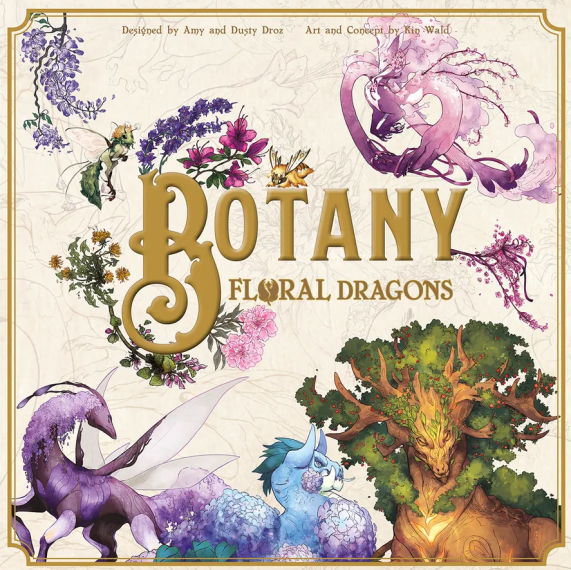
Canvas is another game I knew about and was interested in, but never played, and forgot about it. Despite picking up a 3D printer this year (I may have to share pictures of some of my 3D prints), my Christmas haul of board games rocked. In short, Canvas is gorgeous. Just look at that cover. We may need to do a battle of beautiful board game covers this upcoming March for March Madness. Anyway. Canvas’s core mechanism revolves around adding transparent cards (with painting elements to them) to set backgrounds inside card sleeves. The game’s scoring feels familiar. And while the game’s core mechanism leans toward simplicity, Canvas stays engaging. This is one competitive game I don’t mind losing. I care more about making an awesome painting. And it doesn’t hurt that each completed piece earns a name. I’ll take “Whimsical Nightmare” for zero points, because it’s Whimsical Freaking Nightmare. Metal!
I didn’t know what to expect with Challengers!. Yet another game on my to-be-tried list that made it under the tree. Challengers! accommodates up to eight players. I don’t have a lot of games that do that–outside of party games–and I suppose Challengers! can be considered party game adjacent. Turns and rounds are quick. The game plays out like the classic card game War with plenty of fun twists. Players attempt to capture the flag from their opponents. The last player with the flag–or the last player standing in one of up to four arenas–earns a trophy for the round. The player with the most points after seven rounds wins. The name of Challengers!’s developer, 1 More Time Games, fits. I seldom play just one game of Challengers!. And I can see why Challengers! was a Spiel des Jahres finalist.
I knew little about Hex Effects. It’s a small card game one can find at Barnes & Noble, but Hex Effects surprised me. I love the tarot cards. Not enough games use this card size. They feel great in your hands. And I love the theme. In Hex Effects, players have accidentally hexed themselves and must cure themselves before any other player can do the same. I’ve only played Hex Effects with two or three players. I can only imagine how zany turns can get with more players. Hex Effects plays up to eight players. Another new eight-player game. But I can see Hex Effects dragging with more players. If someone gets close to curing their final Hex, I can see the remaining players ganging up on them. At two and three players (maybe even four) Hex Effects works. This is another game I’ve never only played once during a sitting.
Rolling Realms is the only board game I’m including on this list that I didn’t get at Christmas. But it is yet another game I forgot–only this time, I forgot I owned a copy. Not only is Rolling Realms a great series of roll-and-write mini games (think Yahtzee meets WarioWare), it’s a great marketing tool. Jamey Stegmaier seldom makes a bad board game, and each Rolling Realms mini game is a fun and simplistic roll-and-write variant of a previously published Stonemaier Game. Each turn, one player rolls two standard six-sided dice. Then, players simultaneously plug the numbers on the dice into two of the three mini games. Some game combinations are better (or easier to score) than others, but I love the challenge of getting the highest possible score. And Rolling Realms is a lightning-fast game. Any game with simultaneous play skews toward shorter run time.
I could go on about other board games, but I’ll let Season share which games she got for Christmas. Before I pass this post to Season, I’ll share the one notable video game I began playing again this past month.
Kyra’s Video Game
It has been almost two years since I last played Apex Legends. It’s official. I stink at the game. Despite some gripes with the updated battle pass system and a new in-game currency (both of these are money-grubbing tactics🙄), I enjoy Apex Legends’s core gameplay. Sure. I’ve experienced plenty of lag. Matchmaking is atrocious at times. And the Apex Legends community may have gotten more toxic in the past two years. I encountered plenty of people who were salty that not enough people play the game. Maybe, don’t be jerks.
Then, there’s Respawn itself. They punish people for leaving meaningless games (we’re not talking ranked games with the casual play of mix tape), even when other players cheat, and plenty of players cheat. I’m tempted to report people who pickoff others at respawn points (if you play long enough, you’ll know where people respawn). I don’t know how many times I die before I reload into a game because I have just enough latency for someone else to take advantage. This reminds me of a famous video game design quote: When given the chance, players will optimize the fun out of a game. This quote sums up Apex Legends.
But don’t report anyone who cheats. The devs are so brain dead that they’ll ban the person who reported a player, rather than the actual player who cheated. And still, Apex Legends’s mechanisms hold up years after its initial release. Oddly enough, few legends were new to me despite my nearly two-year hiatus. I have no idea what the meta is, but I’m having fun–whenever everything works correctly, and no, being the beneficiary of cheaters on my team isn’t fun either. I hop into a handful of mixed tape matches most days. I don’t know if I’m back for good. An Apex Legends lobby can be hell on Earth.
Oh. And delete Control from mixed tape. The other two game modes within mixed tape’s rotation (Team Deathmatch and Gun Run) have ten-minute time limits. Control has a thirty-minute time limit. Cue Sesame Street. One of these things is not like the other.
Now, I’m ready to hand over the post to Skye. Let’s see what games she’s been playing over the past month.
Skye’s Video Games
I hope y’all had a good Holiday Season. Mine resulted in quite a few new games for me to play, with Resident Evil 2 being among them. I’ve had a blast (literally and figuratively) running and gunning my way through the virus-riddled streets of Racoon City. Despite my masochistic tendencies to start all my games on the hardest difficulty setting, I somehow managed to make my way through Resident Evil 2. It was a hard-fought but satisfying battle. While Resident Evil 2 is supposed to be played multiple times from both protagonists’ perspectives, I decided to hold off for the time being. I have plenty of other games to get through anyway, such as the next game on my list.
Huh, I suppose it was a very game-sequel Christmas for me. Either way, both Resident Evil and Silent Hill are game franchises I’ve been meaning to play for a while. With Resident Evil, I decided that it’d be fine to skip the first one since it’s not very story-driven and more of a proof-of-concept for the series. In Silent Hill’s case, I wanted to start with the first one. I just couldn’t find a copy of it that was compatible with any of my consoles. Bummer. But Silent Hill 2 is just as good, if not even better than the original. I’ve been on edge every moment. Resident Evil 2 could be tense and thrilling, but Silent Hill 2 is legitimately creepy. There’s fog everywhere, no explanation for anything that’s going on, enemies on the prowl, and all you have is a stick for protection. Hold me.
Hey, hey! Kyra Kyle here again. That’s all our writers have for the video games and board games we’ve played this past month. Let us know what you’ve been playing in the comments. Thank you for reading, and wherever you are, I hope you’re having a great day.
Hey, hey! Kyra Kyle here. I have signed up for HBO Max and have been catching up and keeping up on DC Universe (DCU) content, so Geekly should have plenty of DCU content going forward. After Superman (2025), the DCU is back. Woo hoo! Or at least it’s back enough for a cinematic universe to bloom. Sure, Superman’s final box office numbers may not be where Warner Bros. and DC want them to be, but superhero movies seldom crack the $1 billion mark anymore. Captain Marvel was the last solo superhero movie to reach that mark. That was in 2019. What happened in 2020? That’s on the tip of my COVID. The movie industry has yet to recover from the pandemic. But 2025 was a banner year for superhero films.
I’m writing this post early (super early, as I take a break from writing posts for the final four months of the year to write a novel). As I’m writing this, the final box office numbers have yet to be reported. There’s the slimmest of chances Superman reaches a $1 billion. Even if it doesn’t, Superman is a success in the modern film landscape, and it did enough to get me excited for the DCU’s upcoming projects. Let’s talk about the DCU’s 2026 slate of films and shows.
Quick update: I revisited this post closer to its release date and adapted the proposed release dates.
Supergirl: Woman of Tomorrow (June 26, 2026)
Supergirl: Woman of Tomorrow is scheduled for a June 26, 2026, release. We caught a glimpse of Milly Alcock’s Supergirl in Superman (2025). Alcock’s portrayal and the upcoming film’s title, Supergirl: Woman of Tomorrow, suggest that the movie will follow the events of Tom King’s run of Supergirl. If you haven’t yet read Supergirl: Woman of Tomorrow, you should. It’s an excellent read, and this film sounds amazing.
Quick spoiler warning. I will delve a little into the Supergirl: Woman of Tomorrow graphic novel. If you want to go into the Supergirl: Woman of Tomorrow film blind, feel free to jump to the next entry. Superman was launched as a baby from Krypton. Kara (Supergirl) was a teenager and watched her world fall apart. Neighbors and loved ones were swallowed by earthquakes and explosions. Her father managed to build a barrier around Argo City (Kara’s home city), only to see Krypton’s remaining residents die as the now asteroid turned into kryptonite. Kara lost her world twice. So, the DCU’s Supergirl will struggle with PTSD and will claw her way out from rock bottom. This should make for a very different Supergirl and a riveting story.
Lanterns (Late Summer 2026)
I’ve been waiting for a Green Lanterns show for years. The DCEU teased one for almost a decade, promising to take the bad taste of Ryan Reynolds’s Green Lantern out of our mouths, and never delivered. Rejoice, because the DCU made Lanterns a priority. It should be the third or fourth DCU project (depending on whether you count Krypto shorts), and I’m here for it. Teaming Hal Jordan and John Stewart together in a buddy cop way gives me classic 80s Green Lantern/Green Arrow vibes.
Lanterns showrunner Chris Mundy has described the show as a “huge HBO-quality event” in the style of True Detective. Yes, please. Nathan Fillion will return as Guy Gardner–I loved his hair in Superman–and there’s a chance we could see more Green Lanterns in this series. But that’s not a guarantee. Lanterns will be an Earth-based detective story, so alien Green Lanterns may not fit in the first season’s narrative. I may have to wait for Kilowog. I’m unsure if Lanterns was affected by the Netflix sale or if some other issues occurred, but Lanterns has been bumped from an early 2026 to a late summer 2026 release. My guess is that the DCU wants to continue the momentum of Superman (2025), being followed by the second season of Peacemaker.
Clayface (September 11, 2026)
We know little about the upcoming Clayface film, and that may be for the best. I love that DC Comics doesn’t shy away from films based on villains. I doubted Joker after it was first announced, but I’m holding back any judgment with a Clayface film. Mike Flanagan penned the script; he’s best known for his work on Netflix horror series: The Haunting of Hill House, The Haunting of Bly Manor, Midnight Mass, The Midnight Club, and The Fall of the House of Usher. Clayface director James Watkins has a history of horror with The Woman in Black, Speak No Evil, and one of the most disturbing episodes of Black Mirror, “Shut Up and Dance.”
While I would’ve liked to have seen Clayface in a Batman movie, I’ll take Clayface getting a stand-alone film. James Gunn’s right-hand man, Peter Safran, likened Clayface to the classic horror film, The Fly. I can see that working. We’ve heard conflicting reports as to whether Clayface will exist within The Batman’s universe. Time will tell if Clayface truly is a stand-alone film or part of a larger universe. Considering who’s behind the project and Clayface’s premise, I can’t wait to watch.
That’s all we have for DCU projects that should release in 2026. We could see other DCU shows crop up, like the animated series My Adventures with Green Lantern. We’ll keep you posted. Which one of these DCU projects has you the most excited? Let us know in the comments. Thank you for reading, and wherever you are, I hope you’re having a great day.
Hey, hey, Geekly Gang! I haven’t done a free-to-play video game review in a handful of months and figured I’d give the treatment to a game I played a lot of this past summer, Clicker Heroes. Yes. Clicker Heroes has been out for over a decade, but it’s still available on multiple platforms: PC, mobile, PlayStation 4, and Xbox One. Clicker Heroes started as a Flash game, so this free-to-play video game has been around for some time. But just because a game is “free-to-play,” does that mean that it’s free-to-play friendly? Let’s subject Clicker Heroes to our review criteria.
Mechanisms: 2/10
Clicker Heroes doesn’t cover new ground, so its mechanisms score suffers as a result. Don’t get me wrong, I like idle games. I played the heck out of AdVenture Capitalist. I did the same with Clicker Heroes. I sunk hundreds of hours into this game, but it doesn’t do anything more than click on heroes, like the game’s name suggests, allow you to upgrade the heroes, and then face the next goofy-looking boss monster.
I do like how you can choose to upgrade your heroes by factors of 1, 10, 25, and 100 levels each time. This makes leveling up lesser heroes like Cid, the Helpful Adventurer (your first Hero), a breeze. Goldfish and Bees will flash on the screen with button prompts, but this does little to shake up the stale gameplay.
Above Image from GameDesigning.Org
Gameplay Loop: 2/10
I know I just said I sunk hundreds of hours into Clicker Heroes, but most of that time I spent AFK (away from keyboard), and that’s by design. Clicker Heroes is one of those games you log in once, maybe twice, a day, check on your heroes, and put the game back to sleep.
You’re encouraged to “ascend” your world, which erases much of your progress, and then you must climb back to where you just were. This is what keeps Clicker Heroes’ gameplay loop score from reaching even lower, because Clicker Heroes’ most engaging gameplay is at the beginning. Waiting for your power-ups to recharge or your characters to defeat enough monsters to upgrade your heroes becomes tedious.
After some time, you can use hero souls (from ascending) and purchase Ancients that can help you progress faster in the game, but once you reach Level 300, you’re given the choice to “transcend” your world. This is another layer of ascending that erases your gilded heroes (upgraded heroes through relics) and your Ancients. So, after “ascending,” you go all the way back to the game’s tedious beginnings.
But you do obtain “Outsiders,” which are supposed to be stronger Ancients, but it takes a long time to accrue enough ancient souls, what you get for “transcending,” before you begin to see a tangible difference. Plenty of websites offer ideas on how to speed this process, but I don’t imagine too many players will sink enough time into learning Clicker Heroes’ math to take full advantage. Clicker Heroes becomes a slog.
Respecting Time: 1/10
Clicker Heroes is an idle game, so it’s supposed to be more of a time waster, and it does indeed do that. I can forget Clicker Heroes exists for several days and return to my heroes. But Clicker Heroes makes upgrading your world so difficult that it goads gamers into either spending hours of research to get the perfect set-up or spending money to make the hurting stop. Is the drop of juice you get worth the tens of billions of squeezes? I don’t think so.
True Cost: 3/10
While Clicker Heroes offers skins for auto-clickers (Why would anyone want that?, but okay), it gains most of its money through the purchase of rubies. Fortunately, players can earn rubies by sending mercenaries on missions, opening relics, and clicking on goldfish. But I still struggled with how to grade Clicker Heroes’ “True Cost” or its “free-to-play friendliness,” because I can see players getting caught in a trap. Heck, I got baited into that same trap: reviving mercenaries.
Every once in a while, one of your mercenaries may perish while on a mission. You can spend rubies to revive a mercenary, but there’s some math (I haven’t done the research) where the mercenary’s level and/or the amount of time they have remaining for a mission dictates the number of rubies you’ll need to revive them. In my experience, reviving mercenaries takes a mountain of rubies. Players have little chance of having enough rubies to revive advanced mercenaries, like the “Demigod +13 level” mercenary pictured above with the low, low revival price of almost 5000 rubies. Looks like time to open another credit card and buy 5000 rubies for about $400.
With one exception, outside of reviving mercenaries, I see little use for spending rubies. That one exception is a one-time damage boost for your Heroes. This costs somewhere between 50-100 rubies, and once you buy it, you’ll have it for the duration of the game. 100 rubies or less is a steal.
But the remaining ruby purchases involve buying gilded Heroes, which will reset after you ascend, some version of speeding up Clicker Heroes’ glacial pace, or buying an auto-clicker. Eh. I almost gave Clicker Heroes an average score for “True Cost.” Reviving mercenaries aside, few of the other ruby purchases can be avoided.
User Interface: 2/10
Clicker Heroes doesn’t have that many menus and submenus, but what is there is confusing and difficult to navigate. I’ve played the game for months and still get turned around, not knowing where I can find certain information. I can’t imagine a noob looking at the screen above and being able to tell what does what. And several buttons have multiple functions, so it’s easy to misclick.
Graphics: 3/10
While simplistic, Clicker Heroes’ graphics are pleasant. I’m grading this one on a little bit of a curve, because Clicker Heroes is over ten years old. But the game hasn’t received too many graphic updates through the years, so I can’t get too crazy with this score.
Audio: 6/10
I had to average Clicker Heroes’ audio score. Clicker Heroes has epic music. It often gets stuck in my head. But the sound effects are as annoying and repetitive as clicking a button thirty-five times a second. Ow! My ears. Those moments when I don’t use an ability and listen to Clicker Heroes’ soundtrack make all the difference for this score.
Aggregated Score: 2.72
Clicker Heroes is an idle game, so don’t expect much. While it has charm, the graphics haven’t been upgraded too much to keep up with modern devices. Clicker Heroes can be a slog if you don’t research how to maximize your Heroes or spend money, and I worry about gamers who fall into the ruby pit of reviving their “good” mercenaries.
Happy New Year’s…Eve, Geekly Gang! The holiday happens to fall on the fifth Wednesday of December, and whenever a month has five Wednesdays, our writers share personal updates. So, today sounds like a great day for New Year’s Resolutions. Feel free to share your New Year’s Resolutions in the comments. I’ll get us started.
Kyra’s Resolutions
I may have spoiled some of my resolutions with a previous writing brain dump, so you may find some repeats here. I’ll try to keep this short.
1) Write something every week. First, this needs to be something outside Geekly. Yes. I write something every week–or at least most weeks–for the site, so this is personal writing like a short story or chapter in a novel. But this could be as little as a single word. I’m not putting a word count on this resolution. My idea is that one word usually leads to a sentence, which will lead to much more.
2) Work on a game every week. This could be playtesting, developing an existing design, or even designing a new game. Again, the simple act of working on a game every week should lead to more than a single design or development session.
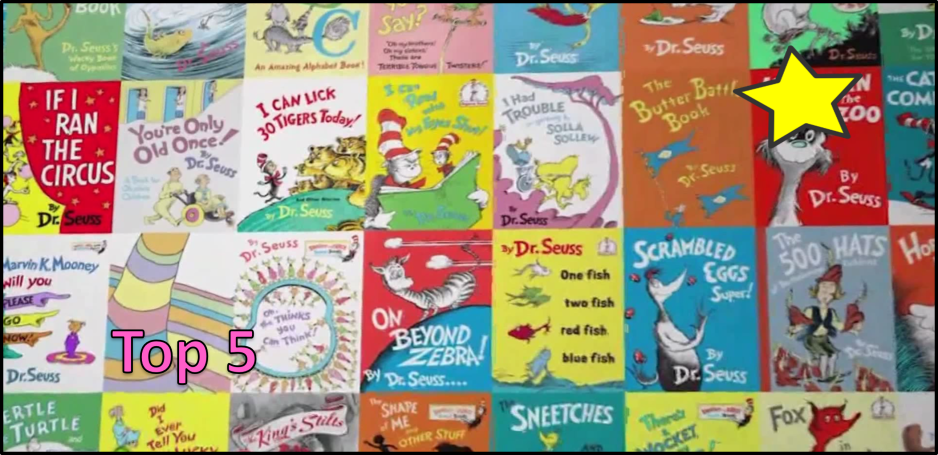
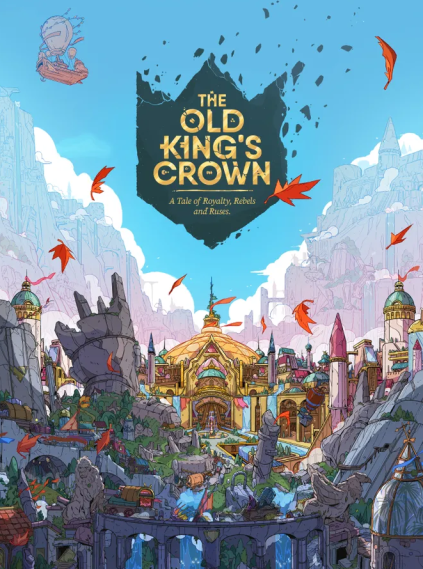
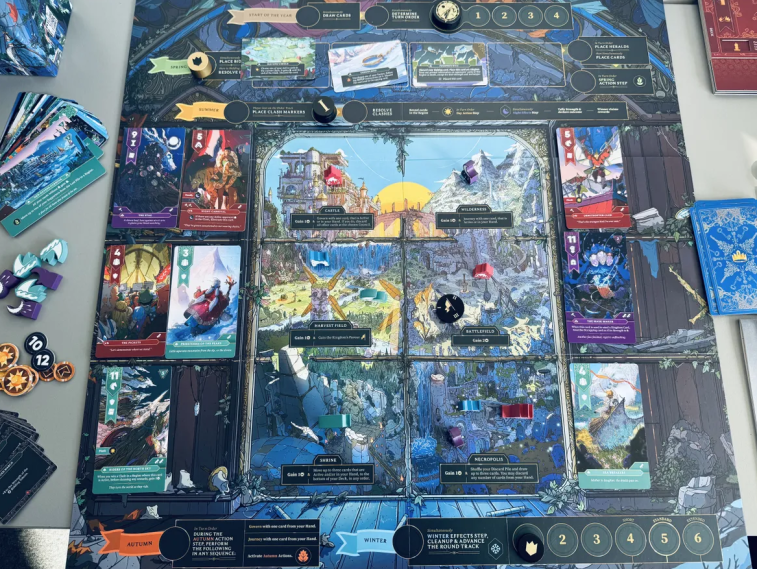
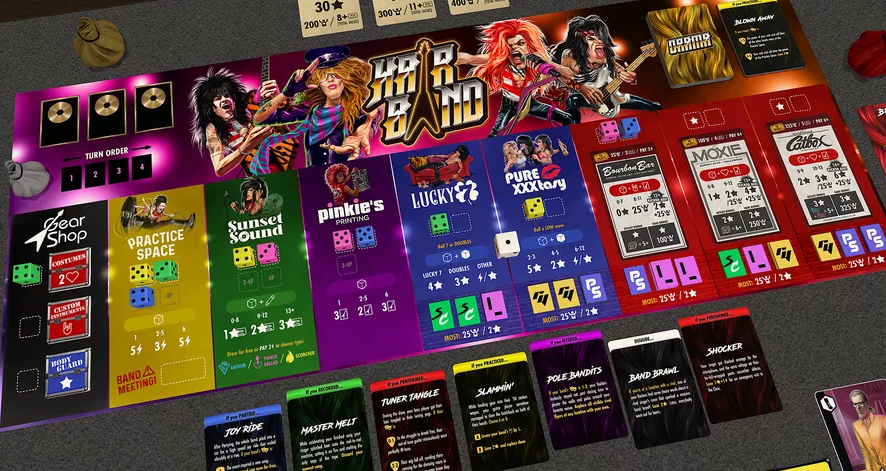
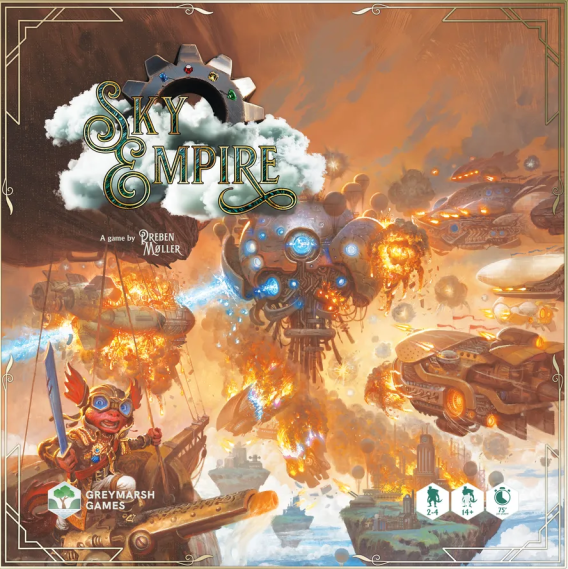
3) The above images remind me that I need to be more consistent with posting brain dumps–at least one of each per month.
4) Read one book a month in a genre that I write or a genre I’m interested in writing. It’s always a good idea to stay current with what sells. And reading helps with one’s writing. Don’t worry about reading another person’s writing impacting your writing. You have your own unique perspective.
5) Read one writing craft book or publishing business book next year. 2025’s book was Strunk and White’s The Elements of Style, and I barely got that one under the wire. Reading about the act of writing is crucial if one wants to write. And I could stand to learn more about the writing/publishing business.
6) Read at least one book next year in a genre I don’t intend to write. This past year, I read I Got Abducted by Aliens and Now I’m Trapped in a Rom-Com. I don’t know if I’ll ever write a romantacy novel, but I’m glad I read this title. Kimberly Lemming did a great job balancing comedy, steamy romance, and social commentary. Kudos! And romantacy sells. I needed to read at least one book from the genre. I may read another one or two in 2026. Romance and fantasy are two of the best-selling genres. Put them together, and you get a powerful combination.
7) Play at least six board games with themes or mechanisms I don’t usually gravitate toward. This is the board game design equivalent of the previous resolution. Nuff said.
8) Get something published. This resolution is largely out of my control, but I’m not so sure. If I don’t share a publication in a literary journal or board game through a publisher in the next twelve months, I may post a short story or poem on JK Geekly by the end of 2026. Let me know if you’d be interested in this style of content. I’ll even offer this invitation to our other Geekly writers. I can’t wait to see what they have in store.
9) I have plenty of other personal goals, like staying active and volunteering more with Extra Life, but I’ll still primarily focus on writing and board game design with these resolutions. Case in point, I’ll be at ScroogeCon in Lincoln, NE, January 10, 2026, with Extra Life. If you’re in the area, stop by and say hi. I helped raise thousands of dollars for the Children’s Hospital in 2025 and hope to raise even more this upcoming year.
Looks like I’m flying solo this week. Season and Skye aren’t sharing any New Year’s Resolutions in this post. I guess that means they won’t fail at any resolutions by next Friday. They don’t have to sweat Quitter’s Day (January 9, 2026). Smart.

What are your New Year’s Resolutions, Geekly Gang? Let us know in the comments. Thank you for reading this past year, and wherever you are, I hope you’re having a fantabulastical New Year’s Celebration.