Geekly TV: November 3, 2014

Bobs

Bob’s Burgers

Kyle’s Review

Bob’s Burgers cooks up the most laughs as Fox’s best animated sitcom. This week’s episode marks the ubiquitous Halloween show and the return of the tortured burger puns.

We haven’t seen a new chuckle-inducing burger name on the white board in quite a while, but “Tina and the Real Ghost” gives us four: Texas Chainsaw Massa-Chard Burger, Human Polenta-pede Burger, Kales from the Crypt Burger, and the Paranormal Pepper-Jack-tivity Burger. I’m not sure I’d eat any of these. But they’re fun to read.

This episode was classic Louise, Bob, Linda, and even Tina. Bob hires a bug exterminator, and the exterminator doesn’t do his job as he believes that the restaurant’s haunted. Everyone in the family, except Bob and Louise, buys into the haunted restaurant.

At first, Bob tries to get the restaurant de-bugged but eventually goes with the haunted theme as customers dig the paranormal investigators who appear and take up residence at Bob’s Burgers. Louise feeds into everyone’s paranoia and convinces the entire town that a ghost inhabits a shoe box. Ever oblivious Linda doesn’t realize how much in pain Tina is when Tina’s ghost boyfriend—who lives in the shoebox—picks Tammie over her. But Tina overcomes and drops a little perspective when things get just zany enough at the local graveyard.

The show even maintains a little continuity which is odd for a sitcom. Tina stated in last year’s Halloween episode that it’d be her last year for Trick-or-Treating, and this season she never planned to Trick-or-Treat. I don’t know if this was by plan or by accident, but it’s nice to see.

I don’t know why we had a hiatus of more than a month between episodes one and two, but let’s hope Bob’s Burgers airs on a weekly basis. It’s one of the better shows.

Verdict: Despite a month off, Bob’s Burgers picks up where it left off by tickling our funny bone.
Grimm

Grimm

Kyle’s Review

The season premiere focused on Nick, Trubel, and Octoface, but the second episode doesn’t just touch on the other disparate stories, it dives into them. While I dig some of these side stories, I’m not so crazy about all of them.

I like the main story arc, let’s call it the one with Nick losing his Grimm powers. He struggles with the loss of his abilities, and this makes sense. He didn’t have a choice before and now he does—kinda. This episode hits us over the head with what he’ll choose in the next one—we’ll discuss this later—but I like how they don’t resolve this issue in the first two episodes, and they show Nick contemplate whether or not he even wants to be a Grimm.

As an extension to the main arc Juliette’s desire for Nick not to turn back into a Grimm makes sense, and it’s handled well. But I also buy Monroe’s and Rosalee’s response to Juliette asking them not to search for a spell reverse. They know the danger ahead for the former Grimm, and thankfully, they don’t spell it out for the viewer. Another small mercy.

Trubel still isn’t as annoying as I feared—as the plucky fill-in-Grimm—but her impetuous nature gets on my nerves. I don’t know if I buy Nick and Hank getting to her in time to save her bacon either. It felt like a convenient time warp with clunky pacing. She should’ve been Octofood. Then, she gets into trouble again at episode’s end, and we know this will force Nick’s hand to become a Grimm again. Trubel gets kidnapped by an FBI/magical faction spook.

Looks like this season traded in the soap opera love for a tangled web of spy versus spy. I don’t know whether the FBI wesen works for the resistance—which we’ve heard of since season two but didn’t see in earnest until last season—or if she works for the royals or another faction we haven’t met so far. That’s all we need is a third faction.

We do get the royals in Austria again. Adalind does her best Lorde impersonation as she gets locked up for being the lesser half of a union between a royal and a hexenbeast. Hopefully, she’ll stay locked up for a while, but that serves as little respite. She’s linked with Nick, since she cast the woogie that took Nick’s powers.

Then, we find that Octoface was into espionage. For the Canadians? Or did he act as a spy in Canada, and it took him a few years to cross the border? I’m a little fuzzy on who he actually worked for and spied against. Perhaps he worked for yet another faction. Who knows? But I do know that I didn’t like how Trubel stopped him. He tried to suck the memories from her head and freaked out by the Grimm things she had seen. Really? That’s all it took. If that’s what it took to defeat him, you should’ve offered him Grimm brain a la mode days ago.

Speaking of days ago, it’s hard to believe that Sergeant Wu didn’t figure out that something was up days ago, too. That may be the main reason I don’t care for that story arc either. So many people know about the magical world or are part of the magical world that Wu comes off as stupid. I hope they don’t drag out this story arc. But that’s not the only one I wouldn’t mind seeing dropped. Minor Spoiler: Captain Renard survived because his mother brought him back to life. Are we going to see everyone’s mom in this show?

Grimm still holds my interest despite all these flaws. I like what they’re doing with Nick. Most of the supporting cast does a fine job, and even Trubel has her moments.

Verdict: Still off to a shaky start, but I like how they haven’t resolved Nick’s issues yet.

Constantine

Constantine

Kyle’s Review

We had some nice developments with Constantine: John Constantine travels outside Atlanta, the dialogue improves, and Zed Martin (played by Angelica Celaya) enters the fray.

I was worried that Constantine would stick to the greater Atlanta area, so the shift to a small town outside of Pittsburgh, PA was a welcomed change. Malevolent spirits—we don’t see too much of them until the very end, and that’s a good thing—haunt the miners of this town. While casing the place, Constantine runs into Zed, who was the woman drawing pictures of Constantine at the end of the pilot. I loved the paintings of Hellblazer comic book covers in Zed’s apartment. Constantine has done a great job of dropping Easter eggs for fanboys and fangirls.

Still, Constantine and Zed share some awkward moments. I’m not sure how planned their clumsiness on screen was at first, but they settled into their roles toward the end of the episode and watching them work together—when they actually did work together—put a smile on my face. Zed is a much better choice of companion than last week’s Liv Aberdine. But there was one companion conspicuously missing from this episode: Chas.

Chas drives Constantine around everywhere, but this episode showed a glimpse of him. I guess it makes sense for him to take a backseat to introducing Zed, but I’d like to know more about how he survived last week’s attack. Chas got a power line through his chest and lived to talk about it. Granted, you can over explain things, but you have to give us something about Chas and his powers.

Then, there were the demons of the week. They weren’t as much demons as they were guardian spirits warped into doing a sorcerer’s bidding. Spoiler: I liked how the lady sorcerer used the word Romani to describe herself. Too often we hear Gypsy. Of course, Constantine uses the term Gypsy to describe her later on in the episode, so the effect isn’t as strong.

The special effects continue to impress. You have to have great special effects to pull off a character like Constantine. Nothing spells disaster faster than a lame looking demon. And nothing spells “not Constantine” than having the titular character without a cigarette in his mouth. We catch a glimpse of Constantine with a cigarette hanging from his lips this week. As I mentioned last week, TV shows can’t show someone smoking. This was a clever way to show the visual of the character with a cigarette.

But I wish they had done more with the character himself. This Constantine has faults and gives us a feel for the character, but he doesn’t quite live up to his comic book counterpart. He kind of comes off as a flawed and darker version of the character that comes on TV just before him: Nick of Grimm.

We’ll see if Constantine will explore its main character more. If it does, John Constantine could find himself in bed with Zed one week and with a boyfriend the next.

Verdict: Constantine continues its strong start but let’s hope for some more character growth.

Quiz Answers: Lame Super Heroes 1

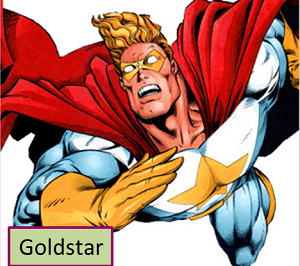
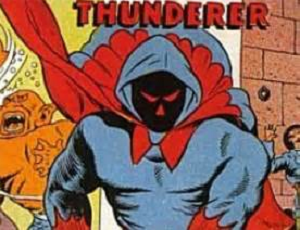
1) Dogwelder: C; 2) Hindsight Lad: A; 3) Brother Power the Geek: D; 4) Codpiece: B; 5) Goldstar: A; 6) Thunderer: C

Welds dogs to villains’ faces.

Dogwelder01


Knows how events could have played out but can’t do anything to change them.

HindsightLad01

A ventriloquist dummy brought to life with powers comparable to Superman.

BrotherPowerTheGeek01

Suffering from penis envy, he wields rocket cannons, spring-loaded boxing gloves, and giant drills—from his pants.

CodPiece01

Hands out magical gold stars that brighten people’s days and makes them nice to one another.

Goldstar01

Yells real loud with a microphone hidden in his costume.

Thunderer01

Lame Super Heroes Quiz 1

For the month of November we want to be thankful for the great superheroes and super villains we have and also give thanks for the lame heroes and villains who didn’t stick around for long. We’ll start by giving you the name of a lame hero and a group of lame—sometimes gross, sometimes offensive—powers they may have. You have to guess which one’s the real power. Yes. These heroes have existed or still exist today.

1) Dogwelder
a) A welder who has an army of dogs—take that, Aquaman.
b) Welds several dogs together to make super dogs—Who wouldn’t want a LabraPoodlePugADoodle?
c) Welds dogs to villains’ faces—evil can’t escape the wet, burnt dog smell.
d) Reanimates dogs he welded from pet cemetery corpses.

2) Hindsight Lad
a) Knows how events could have played out but can’t do anything to change them—and the point of this is?
b) Reminds you of the mistakes you’ve made—the most hated member of any superhero team.
c) Time travels to the past so he can relive mistakes—because some people can’t let go.
d) Can see everyone’s posterior in a room with a single glance—some guys are all about the booty.

3) Brother Power the Geek
a) Our brother from another mother who works as an intern at JK Geekly.
b) A comic book geek who received powers comparable to Superman—if you wish hard enough, it’ll happen.
c) A pimply-faced boy Power Man and Iron Fist met on the street, befriended, and then mentored in the art of Kung Fu—Who says you can’t meet nice people in back alleys?
d) A ventriloquist dummy brought to life with powers comparable to Superman.

4) Codpiece
a) Wields a sonic gun that causes foes to flop on the deck like a fish.
b) Suffering from penis envy, he wields rocket cannons, spring-loaded boxing gloves, and giant drills—from his pants.
c) Shoots fish with a super-sized cod cannon—take a whiff of Justice at low tide.
d) A cop who keeps a gun stashed in his pants—double check the safety.

5) Goldstar
a) Hands out magical gold stars that brighten people’s days and makes them nice to one another.
b) He sits atop the Baxter Building’s Christmas tree—shine on, you crazy diamond.
c) Dresses like a star whose light blinds all evildoers.
d) With Superman-like powers Goldstar outshines his brother Silverstar.

6) Thunderer
a) Causes lightning and thunder with his oversized divining rod.
b) Causes seismic activity with every step he takes.
c) Yells real loud with a microphone hidden in his costume—and he has a beautiful man’s voice, too.
d) Knows where a storm is just by hearing the thunder—a useful skill to calm sidekick children.

GeeklyAnswers

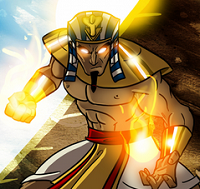
Spotlight: The Mighty Ra

Ra04First Appearance: Sentinels of the Multiverse: Base Game
Who he is: He’s the Egyptian god of the sun, and also Dr. Blake Washington, Jr. So, he’s kind of like Marvel’s Thor.
Innate Power: Pyre: Ra deals 1 target 2 fire damage
Primary Damage Type: Fire
Secondary Damage Type: Projectile
Nemesis: The Ennead and Calypso


Deck Concept: Ra’s a simple god. He wants to deal fire damage and a lot of it. He doesn’t have much else going for his deck, but he doesn’t need much else. Start with The Staff of Ra to get his hit points up, and then get Imbued Fire in play (to get everyone else in on the fire damage game), followed by Flesh of the Sun God, so Ra’s immune to fire damage. Then you could add Solar Flare to increase Ra’s damage again and start fire blasting people.
Deck Strength: He causes a lot of damage, and he can aid his teammates with making some noise as well. And he has plenty of copies of The Staff of Ra in his deck as well as several ways for you to draw into The Staff of Ra.
Best Team Support Card: Imbued Fire: All fire damage is increased by 1. Change the damage type of damage dealt by heroes to fire. Power: Destroy this card.
Best Personal Support Card: The Staff of Ra: Increase all damage dealt by Ra by 1. Increase Ra’s maximum HP by 5. Power: Ra deals 1 target 3 projectile damage. Destroy this card.
Best Attack: Fire Blast: Ra deals 1 target 5 fire damage.
Deck Weakness: He doesn’t have a lot of ways to get rid of ongoing cards or have a way to heal or even negate damage outside of The Staff of Ra giving him 5 HP and Flesh of the Sun God. In fact, you almost have to hope that he’s going up against a villain that spews fire. Then there are some heroes who don’t like having their damage type changed, so Imbued Fire isn’t always the best choice.
Worst Card: Wrathful Gaze: Power: Destroy 1 target with 2 or fewer HP.
Ultimate Team-up: Ra loves it when he can perform more than one power per turn. Fanatic’s Embolden works well with Ra as it gives him fire damage, and so long as Flesh of the Sun God is in play, Fanatic’s drawback doesn’t affect Ra. Ra works well with Absolute Zero too, but you have to be careful with using Imbued Fire.

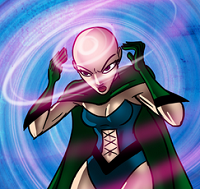
Spotlight: The Visionary

Visionary04First Appearance: Sentinels of the Multiverse: Base Game
Who she is: She’s the time traveling adventurer with telekinetic and telepathic powers in the Multiverse.
Innate Power: Enlighten: 1 player draws 2 cards. Then discards 1 card.
Primary Damage Type: Psychic
Secondary Damage Type: Anything really
Nemesis: The Dreamer and Major Flay

 
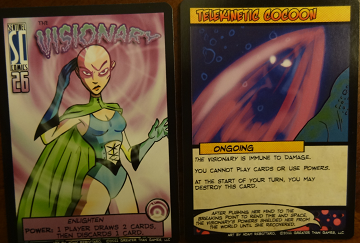
Deck Concept: She’s the quintessential support member, but she’s got a few tricks up her sleeve. Her innate power Enlighten grants card draw to any teammate who needs it, but her main jam is dictating the flow of the game. Precognition allows her to mess with the villain deck. Prophetic Vision does the same for the environment deck. She can nullify damage from the environment with Mass Levitation, and the addition of Decoy Projection and Telekinetic Cocoon makes her an unlikely tank.

Visionary05
Deck Strength: Some people always have to be in control and that’s something The Visionary does really well in the game. Twist the Ether has several uses. You can reduce or increase damage and change damage type depending on the flow of the game. Absolute Zero can get the damage he needs to pull of his abilities. Ra can accept fire damage while immune to said damage with his Flesh of the Sun God.
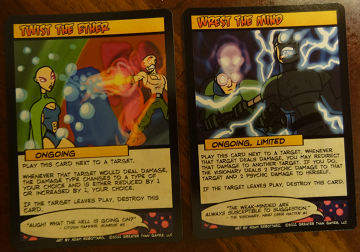
Best Team Support Card: Twist the Ether: Play this card next to a target. Whenever that target would deal damage, the damage type changes to a type of your choice and is either reduced by 1 or increased by 1, your choice. If the target leaves play, destroy this card.

Visionary03Best Personal Support Card: Decoy Projection: 5HP: Whenever The Visionary would be dealt damage, redirect that damage to this card instead.
Best Attack: Wrest the Mind: Play this card next to a target. Whenever that target deals damage, you may redirect that damage to another target. If you do, The Visionary deals 2 psychic damage to that target and 2 psychic damage to herself. If the target leaves play, destroy this card.

Visionary02Deck Weakness: The Visionary doesn’t work in every scenario. If she doesn’t have a good target for Wrest the Mind or you need to kill something immediately, she won’t be that helpful. And between Brain Burn and Wrest the Mind, she deals a lot of damage on herself. Sometimes her control powers won’t help much—like against Spite who has few ongoing cards she can target—so you’ll have to find other ways for her to contribute. Twist the Ether is usually a safe bet for almost any battle. Finally, she can’t destroy environment cards. She can only manipulate them or negate their effectiveness. If you have an environment card in play, she can’t help to get rid of it.
Worst Card: Foresight: Power: Look at the top 3 cards of your deck. Put 1 in your hand, 1 on the top of your deck, and 1 on the bottom of your deck.

Visionary01
Ultimate Team-up: Anyone. The Visionary’s everyone’s buddy. Enlighten helps Tachyon and Absolute Zero get what they need from their deck. The aforementioned Twist the Ether has many uses. But if she’s teamed up with The Wraith or Tempest, she can lock down the villain deck.

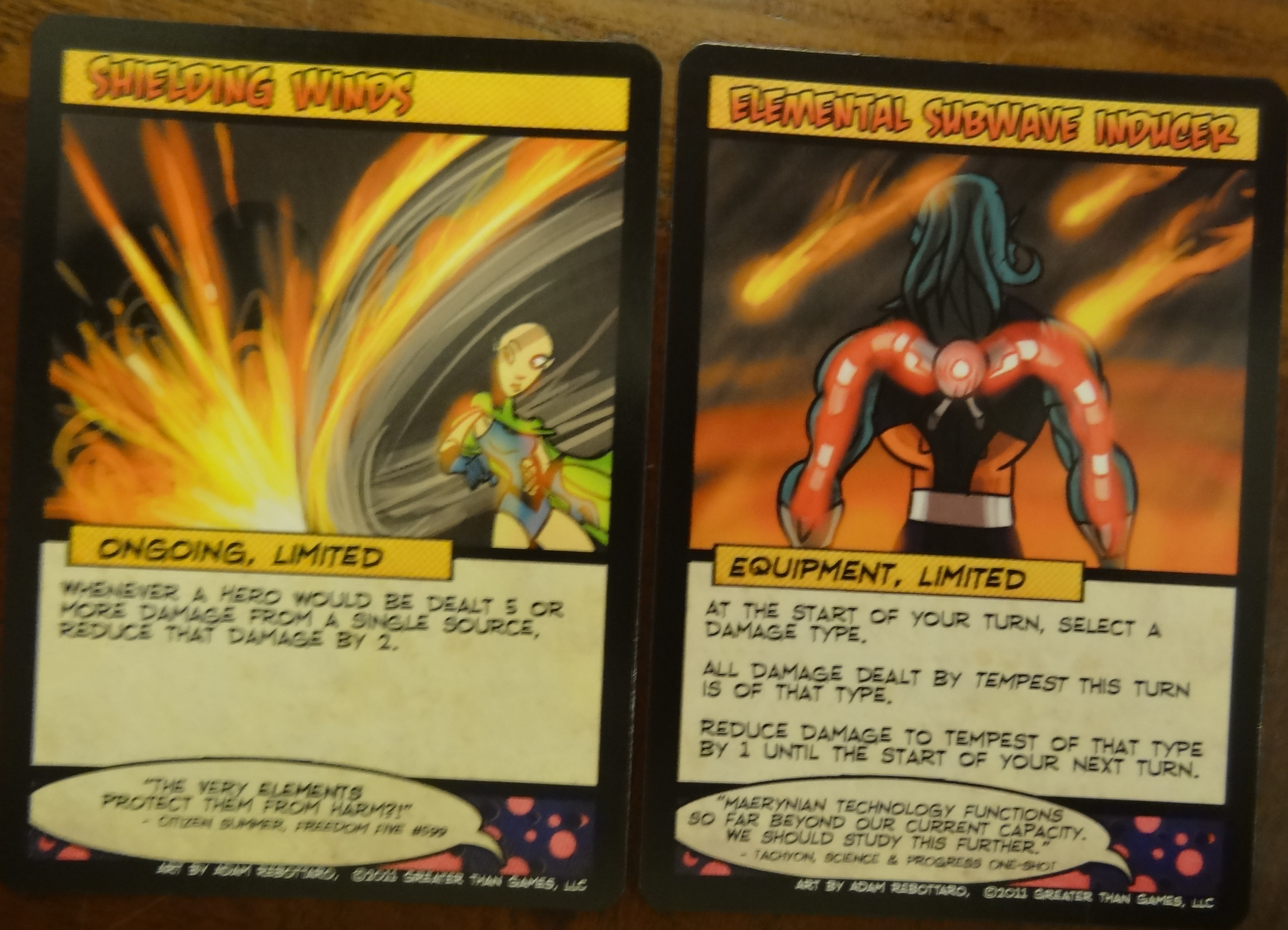
Spotlight: Tempest

Tempest05First Appearance: Sentinels of the Multiverse: Base Game
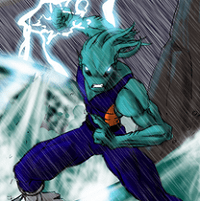
Who he or she is: He or she is an outer space alien version of Aquaman, and the Maeryninan Ambassador.
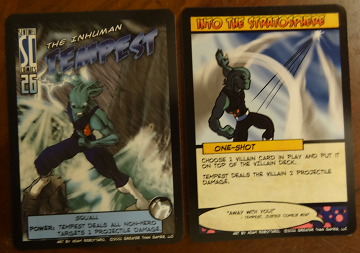
Innate Power: Squall: Tempest deals all non-hero targets 1 projectile damage.
Primary Damage Type: Projectile and Lightning
Secondary Damage Type: Cold and Any
Nemesis: Grand Warlord Voss, Iron Legacy, and Vyktor


Deck Concept: A little bit of this, a little bit of that, and a whole lot of everything. Tempest can deal damage when he has to, protect his teammates from damage, or even heal his teammates. You’ll pretty much have to gauge how the game’s going to know how best to use Tempest. Into the Stratosphere may slow down the villain, and Cleansing Downpour regenerates the hero team’s HP, but your teammates will love you for playing Reclaim from the Deep, which allows every player to move a card from their discard to the top of their deck.

Tempest04
Deck Strength: Tempest is the grand master flex of global damage. Many of his attacks—including his innate power—deal damage to all non-hero targets or to a lot of targets all at once. And did I mention that he can do just about anything? Well, he can. Let’s add stalling the villain deck and destroying ongoing cards to the mix too.

Tempest02
Best Team Support Card: Into the Stratosphere: Choose 1 villain card in play and put it on top of the villain deck.
Best Personal Support Card: Gene-Bound Shackles: Increase damage dealt by Tempest to the villain character card by 2.

Tempest01
Best Attack: Localized Hurricane: Increase damage dealt to Tempest by 1. Power: Tempest deals up to 2 targets 3 projectile damage each. You may draw 2 cards. Power: Destroy this card.
Deck Weakness: While you have some card draw with Tempest’s deck, you don’t get as much as you might like. His deck’s versatile, but you may have a hard time drawing into the card you need. Then there’s the issue with Tempest’s global damage. With global damage there comes little damage to each target. If your targets have armor—and a lot of them do–you could be in trouble.

Tempest03
Worst Card: Electrical Storm: At the start of your turn, Tempest deals each non-hero target 1 lightning damage.
Ultimate Team-up: Card draw is nice, but I’d go with anyone who boosts damage. A damage boost will make Tempest’s global attacks all the more lethal.

Zombie Dice

Designer: Steve Jackson
Publisher: Steve Jackson Games
Date Released: 2010

Number of Players: 2 or more (2-99 on the box)
Age Range: 8 and up (10 and up on the box)
Setup Time: none
Play Time: 10 minutes or less

Game Mechanics:
Dice Rolling
Press Your Luck

Game flow:
Not many games have you take the role of a zombie, but Zombie Dice does just that. You’re on the hunt for “brains.” Cue the shuffling zombies.

ZombieDice03The goal is simple. You have to collect brains before your victims run away or shoot you. The rules are equally simple. At the start of your turn you grab three zombie dice from the dice canister. Each die has different colors—representing how difficult the victim is to kill with green the easiest, yellow the intermediate victim, and red the hardened cuss of a victim—and these dice have three faces: brain, shotgun blast, and feet.

ZombieDice01You try to roll brains, while not rolling shotgun blasts or feet. If you roll three shotgun blasts, your turn is over and you lose all of the brains you accumulated during the turn. So while it is possible to roll three shotgun blasts in a single roll, you usually won’t get that many, and you’ll have to decide whether or not to press your luck with another roll of three dice. Any feet you roll are returned to the dice canister.

A game ends when one player rolls at least 13 brains. Every other player gets to take one more turn to see if they can tie or beat the player who passed the 13 mark.

Perfect for families, children or even if you want a quick game to fill the time, Zombie Dice doesn’t take long to play, but it’s hard to play just one game.

ZombieDice02

Review:

There isn’t a lot of strategy involved in Zombie Dice besides when to hold the points you accumulated and when you should press your luck and roll another three dice. I’ve found that 12 brains is the best total. You can hover just before the 13 brains that will start the end game and see if you can’t bring your total to 15 or 16 before passing the finish line, or if someone passes you while you have 12 brains, you have a great position to overtake them with your final turn.

Zombie merchandise is hot right now. If you’re looking for an involved zombie game, look elsewhere. But if you’re looking for a fun, easy game, it doesn’t get a lot better than Zombie Dice.

Verdict: A quick, easy game where you are a zombie hungry for brains. It may not have a lot of strategy or complexity, but it makes up this shortcoming with a healthy dose of fun.

Geekly TV: October 31, 2014

ArrowArrow

Kyle’s Review

Something’s off with Arrow. Perhaps it’s hard to separate it from The Flash—especially with Fecility Smoak guest starring on The Flash this week and showing up for about two minutes in this week’s episode of Arrow—when this week’s episode of The Flash got the blood pumping despite some clunky dialogue. But even when you take Arrow as its own entity, you’ll find something off about it. It lacked excitement.

Perhaps it’s the way the writers dropped everything from last episode besides Thea, Merlyn, and Nyssa al Ghul getting put back into the fold. Perhaps it’s how Merlyn returned to Starling City. Ollie had made the trip to Corto Maltese and managed to avoid any contact with Merlyn, and then Merlyn makes his way to Starling City with everyone but Ollie knowing he was there. The whole transition felt artificial. Perhaps it’s the fact that the writing staff insists on turning Laurel into the Black Canary. News flash: she can’t pull off a hard-boiled action hero. With her doe eyes Laurel hands us a soft-boiled character and we’re left asking our waiter, “Did I order this?”

I thought Ollie and Thea had a genuine moment last week in Corto Maltese, but now that she’s back in Starling City, the moment lost its luster. While I like the idea of Ollie and Thea working under the guise of “no more secrets” while both of them are keeping things from each other, it bugs me that Thea outright lies to Ollie.

She underwent assassin training to get stronger, but it looks like getting stronger really means people don’t lie to me, I lie to other people. All this I’m going to keep the truth from this person, while they keep the truth from me borders on soap opera drama. Or it’s comical like one episode of Friends, “They don’t know that we know that they know that we know.” Just cut it out or scale it back.

Speaking of comical, the one cool spin move Roy pulls off lands him face first on the ground, after Nyssa hits him with a League of Assassin knockout dart. What’s not as funny is that Roy is one of the most earnest characters in Arrow, and Thea repeatedly lies to him.

The episode had great action sequences, especially when they got Ollie, Merlyn, and Nyssa in one space, which happened a lot. But the action felt hollow. I knew how it was going to end. Ollie would never take the kill shot, Nyssa would declare Ollie an enemy when he wouldn’t, and Merlyn would escape because Ollie would eventually take arms against Nyssa because Nyssa would try to kill Merlyn. The episode even choreographed the introduction of Ra’s al Ghul through forced dialogue. The good news is that we dig deeper into the League of Assassins, and maybe that storyline can progress.

But the brightest spot for this episode has to be Ollie’s Hong Kong flashbacks. We get some nice developments. Ollie makes his first kill at Amanda Waller’s request. Then, instead of contacting his family and the outside world, Ollie helps the Yamashiro family when he borrows their laptop. We see more of Ollie becoming the man he is in Starling City. Ollie even stands up to Waller and learns more about Edward Fyers which builds on Season 1’s flashbacks. I loved that they revisited this material.

Verdict: This episode had so many flaws that the introduction of Ra’s al Ghul was more of a whimper than a gong. But Arrow has a lot to build on with Merlyn in town and Ollie’s new war with the League.

TheFlashThe Flash

Kyle’s Review

I had mixed feelings over this week’s episode. On one hand we get the beginning of the Flash’s Rogues—which is fitting since the episode’s title is “Going Rogue”—and that’s a great thing, but on the other hand, we get an over-the-top performance by this week’s villain, Captain Cold (played by Wentworth Miller of Prison Break fame). Cold’s one liners like “you lost your cool” were too close to Arnold Schwarzeneggar’s Mr. Freeze of Batman and Robin infamy for my taste. Fortunately, Cold doesn’t drop too many of these lines.

I was worried that The Flash could go cornball and/or over-the-top as a series with its meta-human super powers, but still the Flash lends itself to goofiness. The on-going gag in the comic is that he’s the fastest man alive, but he’s always late. This episode takes full advantage of this brevity, and it also tests the limits of what’s corny and what’s a little goofy. I believe the show performed this tightrope walk well for the most part.

We had some genuine funny moments: Barry showing off for Felicity on the treadmill, the awkward moment between Detectives West and Thawne while they wait in their car, and even a few one-liners that hit their mark. I loved the moment when Captain Cold put innocent lives in danger and said that he knows the Flash’s true weakness: trying to save everyone. The moment rang true, and I’m hoping it’s a sign of what’s to come. We haven’t seen the last of Captain Cold.

Harrison Wells remains ambiguous. There are plenty of theories as to who he is, and I even mentioned a couple of names before, but I won’t bore you with any of them right now. We get a better sense of the Flash’s group dynamic in this episode.

Cisco created the freeze gun (Captain Cold buys off the black market) to stop Barry before he knew what kind of person Barry was. Another great choice. Jesse L. Martin delivers another layered performance as Detective Joe West. He doesn’t just dislike his daughter Iris dating his partner because he’s protective of her; he doesn’t want his partner’s relationship with his daughter to cloud his ability as a cop. Great stuff.

And then there’s Felicity. I already enjoy Emily Bett Rickards’s portrayal of Felicity Smoak on Arrow—there’s a reason people lobby for her character to get with Oliver: Olicity—and that’s because she has great chemistry with the Arrow cast, but she has just as much chemistry with Grant Gustin’s Flash. Too bad she can’t be a permanent fixture on The Flash.

Verdict: While it has its share of clunky dialogue and some questionable moments, The Flash continues to deliver the goods on a weekly basis.

Gotham01Gotham

Kyle’s Review

I’d find this episode entertaining if I could separate it from the previous Gotham episodes and the Batman franchise as a whole. I can’t do either, so like episodes of Gotham before it, I’m left going hunh?

Finally, we get an episode focused on Bullock instead of Gordon. We learn what kind of detective he was when he first held a badge—a lot like Gordon as it turns out—and we see the contrast of how far he’s fallen. This would’ve been a great place to first introduce the character. From here we could see his deterioration as a police officer and buy into the cop he’s become. But this isn’t the first time we’ve met Bullock in Gotham, and he’s fallen so far in ten years—and we’re given little to show us why and how he’s done so—that the flashbacks don’t do the character enough justice.

And speaking of justice, why does everyone take the law into their own hands? Batman was supposed to be somewhat of an original, but Gotham has shown countless people pulling a Batman before Batman. Even the villain in this episode, the Spirit of the Goat, targets the wealthy because Gotham’s wealthy are corrupt and need punishment, but the lameness of the Goat doesn’t stop there.

The Goat is more hokey than scary, the villain’s scheme marries Occupy Wall Street (by pushing back against the 1%) with The Penguin’s final plan in 1992’s Batman Returns (kill all the first born), and then we find an odd twist at the end that isn’t as much gasp as it is duh-dun-dumb.

I’ve said it before, and I’m saying it again. This Gotham feels like Batman’s Gotham not Gordon’s. You can even catch Gordon say that “Gotham needs something else (than a good cop),” and it shouldn’t be at that level yet.

Even though Gordon takes a backseat in this episode, we do see him reconcile with Barbara for some reason. So, they’re on again, but I don’t know or care enough about their relationship. Barbara stands by Gordon even when she knows he’s going to get arrested for Oswald Cobblepot’s murder, but even if we don’t buy her relationship with Gordon, we know why she would support him. Bullock’s willingness to go to jail indefinitely, after getting charged with conspiracy for murder, versus his anger at Gordon when he sees the Penguin waltz into the precinct makes less sense.

Sure, Bullock may get sprung from jail by Falcone, but we just saw an entire episode where Bullock is at least a competent police officer, and then that’s thrown out the window in one second. Even if Bullock was ticked at Gordon, I don’t think he’d come to blows with him in the precinct. He would’ve waited until they were alone.

Like I said earlier, this episode doesn’t even follow Gotham’s internal logic let alone the history of Batman. It negates everything it built in the last episode—of Maroni using the Penguin to take down Falcone—the moment The Penguin waddles into the precinct.

Here are some quick side notes for the episode:
There’s no Fish Mooney. Yay! Bruce isn’t in the episode much. Double Yay! But he does show off as The Batboy. Groan. Alfred not only doesn’t care for Bruce’s wellbeing, he doesn’t even check to see if all the windows are locked in Wayne Manor. Ugh. Tweenage Catwoman slips through the window Alfred left unlocked—or even left wide open—and circles the twelve-year-old Bruce. Seriously, she does everything but lick him. Ew. Edward Nygma’s hot for a bookish coworker. Hunh? And he stalks her like Catwoman hunts Bruce. Ahh. I think I’m going to be sick.

Despite all these problems, this episode could be entertaining if you forget everything you know about the Gotham series so far and refuse to believe in Batman.

Verdict: Gotham doesn’t have much direction, and what little direction it has is misplaced. There were some nice choices in this episode if the series started here, but Gotham needs to find what it is and stick with it.


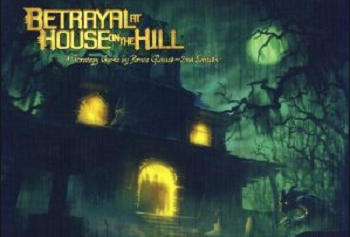
Betrayal at House on the Hill

Designer: Rob Daviau, Bruce Glassco, Bill McQuillan, and Mike Selinker
Publisher: Avalon Hill (Hasbro)
Date Released: 2004

Number of Players: 3-6
Age Range: 12 and up
Setup Time: about 10 minutes
Play Time: about 60 minutes

Game Mechanics:
Cooperative Play
Dice Rolling
Modular Board
Partnerships
Tile Placement
Variable Player Powers/Abilities

Game flow:
Betrayal at House on the Hill plays like the movie The Cabin in the Woods and every haunted house story caught in a blender.

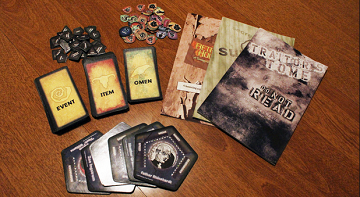
Betrayal01Each player picks a character. But each of these characters has varying stats that will help them navigate the house. Speed, might, sanity, and knowledge come into play with the random encounters you face, and when you take damage, you take damage in one of these stats. If any stat reaches zero, you’re character dies.

All the characters are on the same team in the beginning, but as the name suggests, someone will betray the group. No one knows who’ll be the betrayer. That’s decided randomly when the haunt begins, but the haunt doesn’t begin until it’s triggered. And how can you possibly trigger the haunting when, at the start of the game, there are only three rooms: the entrance, the upper landing, and the basement landing.

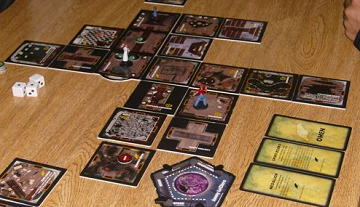
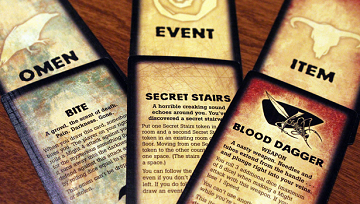
Betrayal02Players explore the house, laying down a new tile adjacent to a door space in the room they currently occupy. Most of the rooms have icons on them, and these icons indicate whether you pick up an item, trigger an event, or get the heeby-jeebies and draw an omen card.

Omen cards stay in play and are linked with triggering the haunt. Most of these cards are pretty useful, granting the character that pulls them with a great ability, but after every drawn omen, you have to make a haunt roll. The player who drew the last omen card counts the total number of omens in play, and then they have to roll a higher number on the dice than there are omens.

Betrayal04Once the haunt begins, Betrayal transforms from an exploration game where everyone’s cooperating, to a competitive game of everyone versus the traitor and whatever evil has just been unleashed. There are only fifty or so combinations of omen cards to rooms with an omen symbol. When the haunt begins, you match the room with the omen to determine which haunt you’ll play. The explorers are given one book, while the traitor gets another. Both sides know certain things about the other, but most of the haunts don’t give away too much of either side. You are literally taking the point of view of either an explorer or a traitor.

Betrayal06

Review:

Taking on the point of view of a character is the beauty of Betrayal at House on the Hill. I’ve played several games where the traitor thinks one thing about the explorers, but the truth the traitor knows about the explorers is way off, and at the same time, what the explorers think the traitor is trying to do is not what they’re trying to accomplish. Mayhem ensues, a win condition is met (variable with each haunt), and usually you’ll be tickled to see how wrong you were about the other side.

Betrayal03Betrayal is very text heavy, so younger players may have trouble. Plus the theme of a haunted house may not go over well with really young players—there is some graphic but not foul language—but for those who love horror movies, this is a must play.

Most major horror movie archetypes—and even some obscure ones—are represented with Betrayal’s fifty haunts. But there doesn’t seem to be a lot of strategy until after the haunt begins. I will say that a larger house makes it easier for the traitor, while a smaller house—or at least finding a route to and from the basement—makes stopping the traitor easier. But who knows who will be the traitor?

Verdict: Fantastic theme game that nails the feeling of exploring a haunted house, and then stepping in some bad juju with the house coming to life.

Timeline: Alan Moore

It’s only two days before Halloween, so today’s Timeline follows comic great and spooky writer Alan Moore. Can you name the following work of Moore’s in the order they were released?

Watchmen01   VForVendetta01   SwampThing01

KillingJoke01   LostGirls01   LeagueOfExtraordinaryGentlemen01

GeeklyAnswers