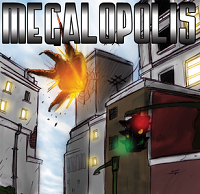
Spotlight: Megalopolis

Megalopolis01First Appearance: Sentinels of the Multiverse: Base Game
Where it is: Superman has his Metropolis, and the Multiverse had to one up him with their Megalopolis
Primary Damage Type: Non-specific
Secondary Damage Type: Melee


Deck Concept: Expect a lot of delays as civilians enter the playing field, and the heroes protect them. There are some discard mechanics but not as many as other environment decks.
Biggest Global Effect: Rooftop Combat: Increase all damage dealt by 1. When this card enters play, destroy all other environment cards. While this card is in play, environment cards cannot be played. Deal the Villain character card 10 or more damage in a single round to destroy this card.
Worst Card (for the Heroes): Targeting Innocents: At the start of the environment turn, this card deals each hero target 3 fire damage. Look through the environment trash for a copy of the card “Impending Casualty” and put it in play. Deal the villain character card 5 or more damage in a single round to destroy this card.

Megalopolis02Oddest Way to Win (Achievement Time): Police Backup: At the end of the environment turn, this card deals 1 projectile damage to the villain character card. Whenever a villain card would force a player to discard a card, this card is destroyed.
How to Escape: You’ll have to gauge which targets (heroes, villains, or environment) have the most HP as you navigate “Plummeting Monorail.” Since Megalopolis interrupts the flow of the hero turn, you may need to meet a criteria like discarding a card (“Paparazzi on the Scene” and “Impending Casualty”) or focus damage on an environment target (“Traffic Pileup”), but Megalopolis is one of the hero friendlier environments in the Multiverse.

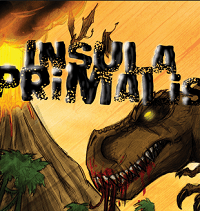
Spotlight: Insula Primalis

InsulaPrimalis01First Appearance: Sentinels of the Multiverse: Base Game
Where it is: Ripping a page from Michael Crichton, Insula Primalis is the Multiverse’s Jurassic Park.
Primary Damage Type: Melee
Secondary Damage Type: Fire
Deck Concept: Dinosaurs rob you of your equipment as they take cheap shots. Volcanic events get heroes skipping turns, discarding cards, and/or discarding equipment.


Biggest Global Effect: Volcanic Eruption: At the start of the environment turn, this card deals each target 7 fire damage. At the start of their turn, a player may skip the rest of their turn to destroy this card. When this card is destroyed, look through the environment trash for a copy of the card “Obsidian Field” and put it into play.
Worst Card (for the Heroes): Pterodactyl Thief (5 HP): At the start of the environment turn, destroy all equipment cards. Put any cards destroyed this way beneath this card. At the end of the environment turn, this card deals each hero target 1 sonic damage per card beneath this card. When this card is destroyed, return the equipment cards beneath this card to the players’ hands.

InsulaPrimalis02Oddest Way to Win (Achievement Time): Enraged T-Rex (15 HP): At the end of the environment turn, this card deals the target with the second highest HP 5 melee damage.
Bonus Odd Way to Win: Velociraptor Attack (5 HP): At the end of the environment turn, this card deals the non-environment target with the lowest HP 2 melee damage for each copy of “Velociraptor Attack” in play.
How to Escape: Any time you have the option to skip a turn or discard cards and/or equipment consider taking the option. It stinks, but usually the alternative hurts a lot worse.

Trading

Games with the trading mechanic have the players exchange game items between each other. Players in Settlers of Catan trade resources with each other.

Geekly TV: November 7, 2014

Arrow

Arrow

Kyle’s Review

Arrow made up for not having Felicity in last week’s episode by featuring her in this week’s episode. And there was much rejoicing.

We get more of Felicity’s backstory than we’ve ever gotten before and for the most part the flashbacks were handled well—they did slow the pace of the episode a tad, but it’s Felicity getting the flashback treatment, so I’ll overlook this shortcoming. This self-contained story gives viewers a breather from the usual last episode built off of the episode before it and now this episode builds off the last. Arrow hasn’t had a self-contained story, and while I enjoyed that aspect, I thought they could’ve gone somewhere more exciting with Felicity’s ex-boyfriend. Him coming back from the dead felt canned, and the final confrontation fell flat.

Just because the main conflict in this episode gets tied up in a nice bow doesn’t mean that other elements Arrow’s played with up to this point don’t show up. In the beginning of the episode we catch Arrow training with Arsenal, Thea sparring with Merlyn, and Laurel flailing at her boxing instructor Wildcat. Everything introduced in these training sessions comes back in satisfying ways—for the most part.

Arsenal isn’t at his best. He claims that he hasn’t been getting a lot of sleep. I won’t spoil it, but you’ll have a strong reaction to how this seemingly minor detail returns.

Thea reconciles with Ollie. She cuts out some of her lies but keeps the biggest one from Ollie—she’s training with Malcolm Merlyn—and we see Merlyn stalking Ollie and Thea. Creepy much? I’m not sure of the entire relationship between Thea and her father. Ollie does call Merlyn’s fortune blood money, so it’ll be interesting to see how Thea behaves in future episodes. And Ollie calling her Speedy felt odd. Sure, he’s called her that before, but it felt forced here. Yes. We know that Thea’s training will eventually turn her into the character Speedy.

Then, Laurel comes clean with Wildcat—not her father—about Sarah’s death. I’m still not on board with this. Is it worse for Captain Lance to find out that his youngest daughter’s dead, or that his youngest daughter’s dead and his eldest daughter has been lying to him about it for months? He will find out eventually.

Laurel’s confession prompts Wildcat to offer her a gi: one red, one black. Guess which one Laurel picks. The black one—definitely black—as in Black Canary. I don’t see Laurel jumping from rooftop to rooftop until at least the mid-season break, so I might have time to wrap my head around this.

Taking a cue from other DC Comics shows this fall, Arrow drops some nice Easter eggs.

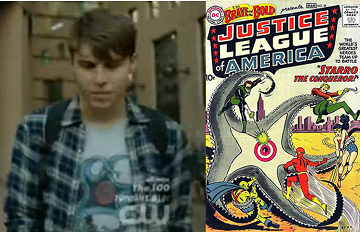
1) Felicity’s boyfriend from college wears a Starro t-shirt. I’m wondering if Starro won’t be the first Justice League movie villain. He was the team’s first foil in the comics.

Starro03

2) The episode’s name is “The Secret Origin of Felicity Smoak,” when DC Comics has a tradition of entitling their comics “The Secret Origin of…”

3) The watch Ray Palmer gives to Felicity’s mother is more like a mega-computer, complete with its own wi-fi signal. It may be a stretch, but is this watch the beginning of Ray Palmer’s (a.k.a. The Atom) miniaturization technology?

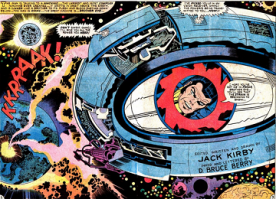
4) In the comics Brother Eye is a self-aware satellite with connections with the character OMAC. Should we be expecting an appearance from OMAC? Brother Eye and the OMAC Project served as major antagonists in stories like Futures End and Infinite Crisis. And The Flash has already had a tipping of the hat to Infinite Crisis. Furthermore, in the run-up to Infinite Crisis Blue Beetle Ted Kord—the character Arrow had in place of Ray Palmer before rewrites—died attempting to stop Brother Eye after discovering that Checkmate—an organization with ties to Amanda Waller and A.R.G.U.S.—was abusing the satellite. This seems way too convenient to be coincidental.
BrotherEye01

5) Felicity says (about the super-virus she created), “I wrote it five years ago.” Futures End takes place five years into the future, so everything that happens now happened five years ago for that story line.

6) Lyla’s not around to take care of baby Sarah because she’s in Santa Prisca, which just happens to be the fictional South American nation where Bane was born in prison.

7) Felicity’s ex-boyfriend’s name is Cooper Seldon, which sounds an awful lot like Sheldon Cooper of The Big Bang Theory.

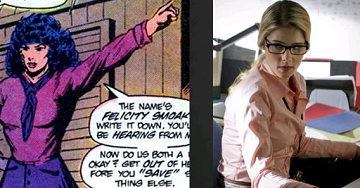
8) Felicity’s natural hair is black, just like in the comics.

Smoak02

9) This one isn’t as much an Easter egg as it is a question. We see Felicity’s mom, but they’re cagey about who her dad is. That leads me to believe that Felicity’s dad may be familiar to DC Comics fans, especially since he’s uber-intelligent. It could be a former leader of A.R.G.U.S.: Lex Luthor. Felicity’s mom did seem enamored by billionaires.

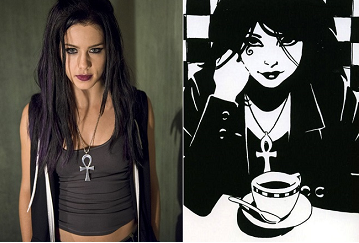
10) And tell me Felicity doesn’t look like Lady Death from Sandman in this promo picture.
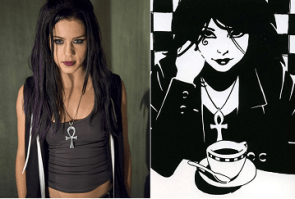
Smoak01

I wouldn’t be upset if they cast Emily Bett Rickards for the part in the upcoming movie. Rickards! Rickards! Rickards!

Verdict: I love the idea of dedicating an episode to Felicity, and this is the strongest episode of Arrow so far this season. The predictable plot and disappointing final conflict furthers the show’s stumbling out of the gate, but it ends in a twist that has me intrigued. Plus, there’s plenty of fan service with all the Easter eggs.

Gotham01

Gotham

Kyle’s Review

Similar to the Arrow episode this week, Gotham focused on a couple of strong characters which is a good thing. To date Gotham has staked any watchability on the fact that they’re drawing from the Batman mythos, so they can roll out fifty or so characters in one episode, not even give lip service to any of them, and then add ridiculous plots and tortured dialogue to the mix. This episode may not live up to its name “Penguin’s Umbrella,” but it does an adequate job of slowing down the pace and building on a few characters.

The show revolves around Cobblepot’s elaborate plans to bring war to the city of Gotham. We get more of the halfhearted noir aesthetic in this episode with all its backstabbing, gun-pointing, and late-show flashback that fills in everything we didn’t know behind the scenes. We find out that Cobblepot’s been working for Falcone ever since he was caught snitching on Mooney. Even though the pacing is improved, it’s still clunky, and I don’t quite buy the plot. Why would Falcone trust Cobblepot so fully? I know they explained it, but their explanation sounds hollow and trite. Furthermore, it makes little sense for either Cobblepot or Falcone to keep Jim Gordon alive. The only reason to do so is that he’s Jim Gordon and has to survive. This is a testament to the show suffering from not having Batman in it. It’s handcuffed.

As always the performances are strong from John Doman (Falcone) and the stellar Robin Lord Taylor (Cobblepot). But I’m troubled by the portrayal of Cobblepot as the demonized homosexual. When Cobblepot gives one of his victims kiss on the head, his cohorts exchange a weird look. Mobsters give the kiss of death to a lot of people, so the glance was out of place. And besides, who cares if Cobblepot’s gay? He’s deliciously selfish, and his gait is perfect. I love the way he steals almost every scene he’s in with his awkward yet devilish demeanor.

We get more of the buddy cop banter between Gordon and Bullock. This makes sense as buddy cops work best when they’re up to their eyeballs in trouble. The two feel more like real people as they both invade Falcone’s home, but they do it for different reasons. I almost want to say that we see progress with that, but let’s not get too crazy.

Despite the fact that this is the best episode of Gotham so far, it has very little at stake—partially because of the show’s domineering mythos and clunky writing. I didn’t care that Barbara got caught by Victor Zsasz. Barbara’s an unlikeable character whose only goal is to complicate Jim Gordon’s character with her half-baked plotlines. We also get hit over the head with Montoya’s stilted line “Are you sure she’s safe?” when she talks with Gordon about Barbara in another low point of the show. Zsasz says “Please?” Bullock uses the term good guys. Is he eight-years-old? Please.

Some quick ones:

1) Barbara screws up everything by staying in Gotham, and the one good cop—who just happens to be a woman—on the GCPD gets killed by Zsasz. It sucks to be a woman in Gotham. Is Frank Miller writing this?

2) Mister Zsasz’s ring tone is “Funky Town.” Really?

3) Alfred takes down an agent. He’s so ninja.

4) Fish Mooney gives the most important word in the English language all the time and space it deserves. That word: Bitch.

Verdict: Despite its flaws, Gotham was palatable this week. But I won’t go so far as to say that it’s showing progress.

Quiz Answers: Fantasy Book Timeline

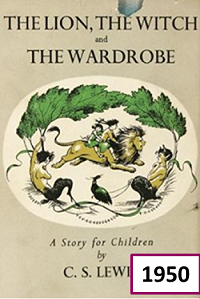
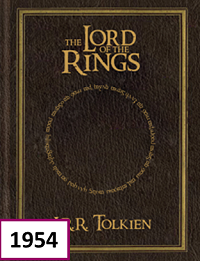
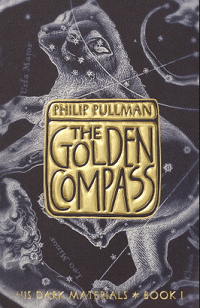
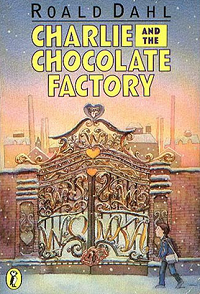
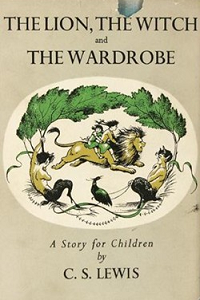
LionWitchWardrobe02   LordOfTheRings02   CharlieAndTheChocolateFactory02

GoldenCompass02   GameOfThrones02   HarryPotter02

Did you know your Hogwarts from your Wonka Bars? Let’s see how we did.

All 6 correct) You’ve got a golden ticket. Hope you survive the chocolate factory tour.

4-5 correct) You bought everything on the Honeydukes Express, but all the chocolate frogs escaped.

2-3 correct) Good news: you’ve inherited jewelry that makes you invisible. Bad news: it’s more of an obligation than a present.

0-1 correct) You’ve been invited to a wedding but the attendees are less likely to cry as they are to bleed.

Timeline: Fantasy Books

The holiday season’s upon us. It’s a magical time of year, so let’s celebrate with these magical books. Can you name the following fantasy books in the order they were released?

GameOfThrones01  LordOfTheRings01  HarryPotter01

GoldenCompass01  CharlieAndTheChocolateFactory01  LionWitchWardrobe01

GeeklyAnswers

King of Tokyo

Designer: Richard Garfield
Publisher: IELLO
Date Released: 2011

Number of Players: 2-6
Age Range: 8 and up
Setup Time: less than 5 minutes
Play Time: less than 30 minutes

Game Mechanics:
Card Drafting
Dice Rolling
Player Elimination

Game flow:
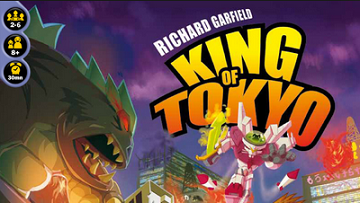
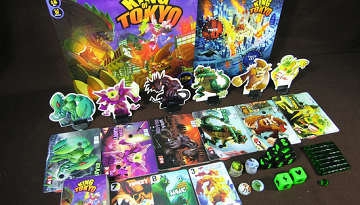
You play as mutated monsters, colossal robots, and weird aliens. Each creature goes on a rampage to see who can be the King of Tokyo.

KingTokyo02King of Tokyo borrows a lot from the classic playground game King of the Mountain. You gain control of Tokyo if you damage another player while the city remains void of an opponent. The first person to twenty victory points wins the game, and if you have control of Tokyo, you gain bonus victory points at the start of your turn. It pays to be King of Tokyo.

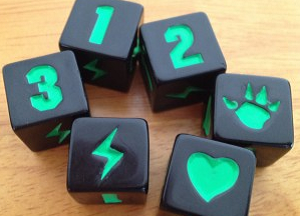
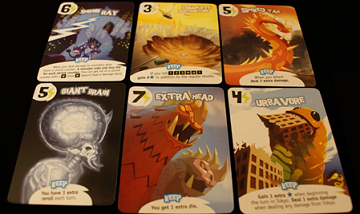
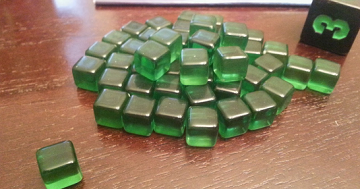
KingTokyo04You begin each turn by rolling six dice. Each die face has a lightning bolt, a claw, a heart, or a number printed on it. You have to roll three of the same kind of number to gain that many victory points, you take one energy cube—which you use as currency for cards—for each lightning bolt you keep, a claw deals one damage to an opponent (all creatures have 10 hit points unless a card says otherwise), and a heart lets you heal one damage. But you can’t heal by means of the die when you’re in Tokyo. Thankfully, some cards let you heal.

KingTokyo03You can reroll each die or some dice twice. Your position on the board dictates which die rolls you’ll keep. If you’re in Tokyo, you won’t want to keep any hearts—they’re worthless. If you’re outside Tokyo and half dead, you may want to roll as many hearts as you can. But if you’re healthy and smell blood dripping from Tokyo, you may want to go for the kill, keeping as many claws as possible.

KingTokyo05

Review:

King of Tokyo doesn’t take long to play—thirty minutes of gameplay is very generous—but it’s a fun thematic game. Too much of the game depends on luck to where the only strategy you’ll find is when you should conquer Tokyo, and when should you stay out of Tokyo and heal.

KingTokyo01Verdict: If you’re looking for a quick, easy and fun thematic game, it doesn’t get better than King of Tokyo. If you’re looking for a game with more strategy or sustenance, you may want to look elsewhere.

Machi Koro

Designer: Masao Suganuma
Publisher: IDW Games
Date Released: 2012

Number of Players: 2-4
Age Range: 8 and up (7 and up on the box)
Setup Time: less than 5 minutes
Play Time: less than 30 minutes

Game Mechanics:
Card Drafting
Dice Rolling

Game flow:
You’re the mayor of Machi Koro, and you’ll have to meet the demands of your citizens. You can build cheese factories, restaurants, radio towers, or even a theme park. This proves difficult as you only start the game with a wheat field, a bakery and a single die.

MachiKoro03Machi Koro marries card drafting with a bit of deck/pool building. I found it difficult to classify the game as either of these mechanics, but card drafting fits a little better. You begin the game with the aforementioned cards and a die, but all players are given a catalog of cards with which to purchase—this is where the deck/pool building mechanic comes into play, but any similarities to deck building end there. Your goal is to be the first to build four major town features: a train station, a shopping mall, an amusement park, and a radio station.

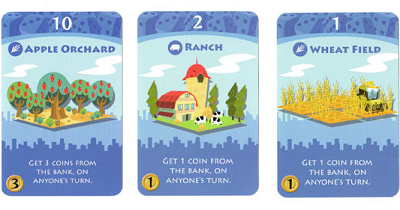
MachiKoro01Gameplay is simple. Similar to Settlers of Catan each player rolls at the beginning of their turn, and then you react to whatever was rolled on the die. Only town features that share a number with what was rolled activate on a turn. For example, Wheat Fields give you one coin from the bank whenever a 1 is rolled by any player, but Bakeries net you one coin from the bank when you roll a 2 or 3 on your turn only. You can buy a new feature with the coins you earn. Each feature card has a coin in the lower left-hand corner with a number in it.

You may want to start by building the train station. It allows you to roll one or two dice in a turn, and you can tell that some numbers—like 9 or 10—are impossible to roll on one six-sided die. But you could stick with the dinky features and nickel and dime your opponents.

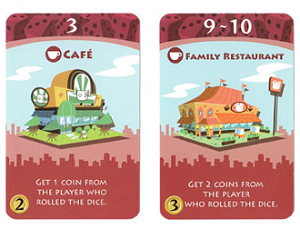
MachiKoro05Each feature is color-coded, illustrating how each card works. Blue features work on anyone’s turn. You only collect money from green features when you roll the number indicated on your turn. Red features only work on your opponents’ turn, and you don’t collect coin from the bank, you steal coin from your opponents. Purple features have special abilities that can boost your other features, swap features with your opponents, or even steal a feature outright.

MachiKoro04

Review:

Machi Koro’s gameplay is fast and furious. I put thirty minutes as the play time, but most games don’t take nearly that long. And as I mentioned before, Machi Koro has plenty of strategic elements. What works in one game, may not work in another. One of the issues with Settlers of Catan and other strategy games is that they take a long time to set up and play. Machi Koro does a nice job of condensing a top-notch strategy game into a short window of time. The $20 price tag doesn’t hurt either.

MachiKoro02Verdict: A great strategy game condensed into thirty minutes of gameplay.

Pattern Building

Pattern Building games have players place game components in specific patterns in order to gain specific or variable game results. Takenoko is a popular modern board game that uses Pattern Building. Players tend to a bamboo garden represented by color-coded tiles. One way for players to earn points is by matching the color patterns on cards in their hand with the color-coded tiles of the board.

Action Point Allowance System

Action Point (AP) Allowance System games grant each player a certain number of points per turn. APs can be spent on available actions during a player’s turn—given that the player has enough points to perform the action—until all points are spent. The AP Allowance System affords greater freedom for players over how they execute their turn. Forbidden Desert is a great example of an AP Allowance System game. Players may choose between several actions: movement, fetching water, trading gear with another player, excavating a tract of land, digging out sand, and even some special abilities.