Geek Out

Top 5 Tabletop Games from 1993

1993 is another solid year for tabletop games. This year’s releases saw one massive title and a handful of titles for an older audience. As we dive deeper into the nineties, we’ll have a large pool of tabletop game titles with which to choose.

Hey, hey! Kyra Kyle here. Back with another Top 5 Tabletop Games. We’ll talk about the board games that this year’s list soon, but let’s recap the ground rules for which games make these lists before we start.

1: Cultural relevance plays as much of a factor as overall quality. A game might make a list that doesn’t hold up to others of its type, but you must admit the game is everywhere.

2: Only one game from a franchise makes the list. This will become more of an issue the closer we get to games with expansions.

3: Longevity plays a role, too. A game doesn’t have to fly off the shelves today, but it had to have some widespread appeal for a decent time.
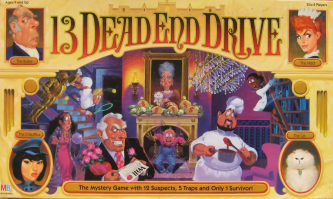
5: 13 Dead End Drive (1993)

13 Dead End Drive is the only board game on this list that could be considered a child’s game. We’re getting to the adult-themed games soon enough. 13 Dead End Drive has a murder theme. The death of a wealthy old woman triggers a feud over her will. Players use traps located on the board (the mansion), to kill characters controlled by other players to claim the estate.

Players are dealt all the “Character cards” which correspond to matching pawns on the board. Since there are 12 characters, players will control more than one character. Players don’t show which characters they were dealt. Matching “Portrait cards” determine who is the current favorite for the inheritance. The third type of cards are “Trap cards” which are used to spring traps and eliminate characters.
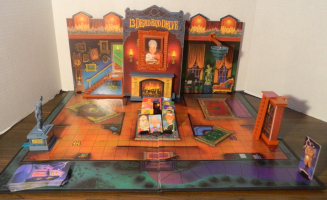
During each turn, a player rolls two dice and moves two pawns, one pawn for each die. It is legal for players to move a pawn that isn’t theirs, especially if the move places a pawn on a Trap space. Characters must end their turn on a Trap space by exact count, and a player must play a matching Trap card for the Trap to take effect. Players win by being the last character standing, escaping the Mansion while one’s character’s Portrait is displayed, or having the final character’s Portrait displayed when the Detective reaches the front door (at the end of 10 rounds).

Despite, the macabre premise, 13 Dead End Drive uses humor and goofy characters to make the game approachable. The game also marks an interesting twist to a murder-themed board game. While games like Clue (or Cluedo) has players trying to figure out who committed a murder, 13 Dead End Drive empowers players by committing a dozen murders.

No. Seriously, this is a game geared toward a younger audience.

4: Europa Universalis (1993)

Europa Universalis is a monster of a board game. The official playing time listed on the game box is six hours, but the game can last for weeks. Board Game Geek estimates the playing time to be 15 days. Europa Universalis is a geopolitical strategy game set from 1492 to 1792. Players take control of European powers during this period. Each country has unique events, objectives, and special rules, for example, Russia’s military power is limited until the arrival of Peter the Great, and England has access to powerful privateers.
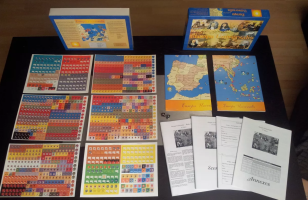
Europa Universalis has plenty of freedom of choice. It offers control over economics, military, maintenance (yes, you’ll have to maintain your country), discoveries, and colonial investment. But this leads to a major drawback, the game has a lot of calculation and management during the game for income, price changes, maintenance (of your regions), and the purchasing of military resources. Europa Universalis may work better as a video game. Fortunately, Swedish video game developer Paradox Development Studio (along with the help of the board game’s designer Philippe Thibaut) adapted Europa Universalis into a video game in 2000. This long-running video game challenges Civilization as the top civilization simulator.

3: Call My Bluff (Liar’s Dice) (1993)

Call My Bluff (Liar’s Dice) has an odd history. The Liar’s Dice class of games has existed since the 15th century (originally named Dudo from the Incan Empire). A variant of Liar’s Dice was published by Milton Bradley six years prior in 1987. Call My Bluff is a remake of the original Liar’s Dice, which was then in the public domain. Richard Borg earned the 1993 Spiel des Jahres (the German Board Game of the Year) for his adaptation of this classic game.

Five dice are used per player with dice cups used for concealment. In each round, every player rolls a “hand” of dice under their cup and looks at their hand while keeping it concealed from the other players. The first player begins bidding, announcing any face value and the minimum number of dice that the player believes are showing that value, under all of the cups in the game. Ones are often wild, always counting as the face of the current bid.

Turns rotate in clockwise order. Each player has two choices. They can make a higher bid or challenge the previous bid, typically with a call of “liar,” hence the name Liar’s Dice. Once a bid is challenged, all dice are revealed. If the bid is valid (at least as many of the face value and any wild aces as the player’s bid), the bidder wins. Otherwise, the challenger wins. The player who loses a round loses one of their dice. The last player with dice at the end of the game wins. Call My Bluff’s simplicity and entertainment value earned it the Spiel des Jahres. If the rules sound familiar, the video game series Red Dead Redemption includes a version of Call My Bluff.

2: We the People (1993)

We the People simulates the American Revolution. I’m sensing a simulation theme with 1993 board games. Published by Avalon Hill and designed by Mark Herman, We the People was the first wargame to use cards as the primary means of controlling the pace and tempo of play; the card play introduces a strong element of fog of war through hidden card information.

One player controls the British, while the other plays as the Continentals/Americans. The map has a web of cities and towns connected by lines along which armies can move. We the People marks one of the first times a designer used a point-to-point movement system, which has become standard with a lot of games. Tens of thousands of modern board games use a point-to-point movement system, and not just war games. The cooperative game about stopping a global pandemic, aptly named Pandemic, may be the most famous game to use a point-to-point movement similar to the one Mark Herman pioneered.

We the People has inspired other war games like Richard Borg’s Command and Colors series. Yes, this is the same Richard Borg who designed the previous game on this list Call My Bluff. But We the People may have influenced GMT Games the most. GMT has produced numerous games implementing Herman’s card-driven combat. Their games include The Napoleonic Wars, Here I Stand, Virgin Queen, and Twilight Struggle, which remains one of the highest-ranked board games on Board Game Geek.
1: Magic: The Gathering (1993)

Magic: The Gathering takes the top spot. No other game that was released during 1993 could’ve taken this spot from the granddaddy of all collectible card games. Magic: The Gathering beget a flurry of collectible card games in the following decade: Pokémon, Yu-Gi-Oh!, Legend of the Five Rings, and World of Warcraft (eventually rebranded as Hearthstone) to name a few. Magic: The Gathering’s designer Richard Garfield even made a few more collectible card games to add to his tally like Netrunner, BattleTech, Vampire: The Eternal Struggle, and the original Star Wars Trading Card Game.

Not going to lie. I played most of these collectible card games at one point or another. Magic: The Gathering has stood the test of time. Sure, Pokémon and Yu-Gi-Oh! have endured, but they were released years after Magic. Magic has outlived most of the games it inspired.

The greatest testament to Magic: The Gathering topping this list is that most people read Magic: The Gathering and nodded yes. Magic is the right answer. Magic is the only answer for top tabletop game for 1993.

Did we get the list right, for the most part? Let us know which games you’d add in the comments. And wherever you are, I hope you’re having a great day.

Check out the other lists in this series:
Top 5 Tabletop Games Prior to the 1930s
Top 5 Tabletop Games of the 1930s
Top 5 Tabletop Games of the 1940s-50s
Top 5 Tabletop Games from the Early 1960s
Top 5 Tabletop Games from the Late 1960s
Top 5 Tabletop Games from the Early 1970s
Top 5 Tabletop Games from 1980-1981
Top 5 Tabletop Games from 1982-1983
Top 5 Tabletop Games from 1984-1985
Top 5 Tabletop Games from 1986-1987
Top 5 Tabletop Games from 1988-1989
Top 5 Tabletop Games from 1990-1991
Top 5 Tabletop Games from 1992

Whatcha Reading, Geekly?

We’re switching things around a little bit this month with our Whatcha Wednesday series. Today marks our second Whatcha Reading post. Hey, hey! Kyra Kyle here. The Geekly Gang may not have as many books to cover this month as we did last month (it’s only been two weeks since our last Whatcha Reading). Whatcha Reading can include novels, poetry, short stories, essays, comic books, and anything in between. As always, feel free to share what you’ve read recently. We’re all part of the Geekly Gang.

Kyra’s Reads

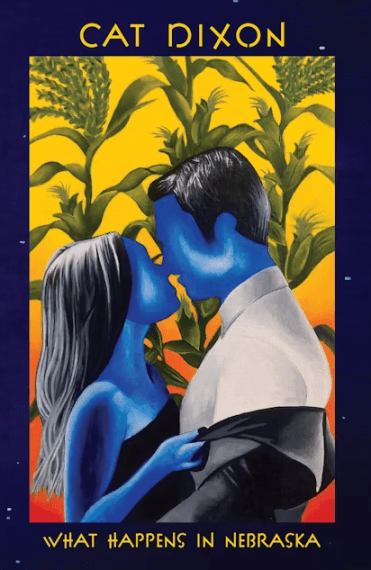
I mentioned The King in Yellow in last month’s Whatcha Reading, but I put it on hold for the moment. A new Barnes & Noble opened up, and I’ve picked up several new titles. One of my favorite aspects of Barnes & Noble is that your local store will carry books by local authors, and one of the poetry books I read last month is What Happens In Nebraska by Cat Dixon.

What Happens In Nebraska by Cat Dixon

Dixon’s What Happens In Nebraska doesn’t pull any punches. Each poem is raw, a wound that refuses to heal. But that doesn’t stop Dixon from playing with her poetry. “Keep Your Options Open” may be the first Choose Your Own Poem I’ve ever seen. It shows that a poet can explore pain while maintaining a sense of whimsy. I also love it when a writer gets specific, and I enjoyed the details in “Missed Connection.” It’s uniquely Omaha. It gives the poem authenticity and the universal theme of loss. What Happens In Nebraska has a lot of highlights; too many to list here, but I’ll share one more. “Horror Movie” begins with a new romance before it descends into the horror of a modern relationship. There’s a reason rom-coms end when the couple gets married.

Letters to a Young Poet by Rainer Maria Rilke

I also picked up Rainer Maria Rilke’s Letters to a Young Poet during my recent trip to Barnes & Noble. I haven’t yet finished Letters to a Young Poet, but what I have read makes it a great companion piece to What Happens In Nebraska. Letters to a Young Poet compiles a series of letters Rainer Maria Rilke wrote to a young officer cadet (Franz Xaver Kappus), advising him on writing, love, suffering, and the nature of advice. Rilke’s dense and poetic letters can inspire any artist.

I love Barnes & Noble’s selection of local authors, and they have a great selection of tabletop games. Super Boss Monster, which just shipped to Kickstarter backers, is already available at Barnes & Noble. Usually, tabletop games that go to Kickstarter take a handful of months to reach stores. Barnes & Noble gets many titles early. Be sure to check out your local Barnes & Noble.

Let’s see what Skye has been reading. Take it away, Skye.

Skye’s Reads

Anathema by Keri Lake

After a recent trip to the library, I found some interesting literature. Among them is Anathema. While I’m not far into it, some elements stand out. I like how the author pointed out that this was her first experience with gothic fantasy. Thank you, author, for telling us up front. Trying out new genres and getting outside our comfort zones can only lead to self-improvement.

While I have progressed too far in the novel, he author clearly knows how to start a story. The first sentence of the first chapter: “The forest hadn’t eaten in a while.” That’s one of those sentences that ignites the imagination. And it makes me want to keep reading.

Three Dark Crowns by Kendare Blake

Another suggestion from my local librarian. Thanks for the recommendation! Also, support your local library. Like Anathema, Three Dark Crowns falls firmly in the fantasy genre. Considering these stories were released after The Lord of the Rings, both have Tolkien-esque qualities. Bonus points to Three Dark Crowns for not starting off with worldbuilding that feels like homework.

What sets this story apart from Anathema is its premise. Three Dark Crowns focuses on royalty (shocker), but in the context of three princesses who are sisters. One will become queen. Only one. She’ll do so by killing her two sisters. This concept has been done before, but it immediately hooked me. From the introduction onward, tension builds. I look forward to exploring it more alongside Anathema.

Kyra Kyle again. Season doesn’t have an entry this week. She’s preparing to graduate from college. Woo hoo! I’m sure she’ll return soon. Thank you for reading, and wherever you are, I hope you’re having a great day.

Getting Into Comics: Scarlet Witch Starter Stories

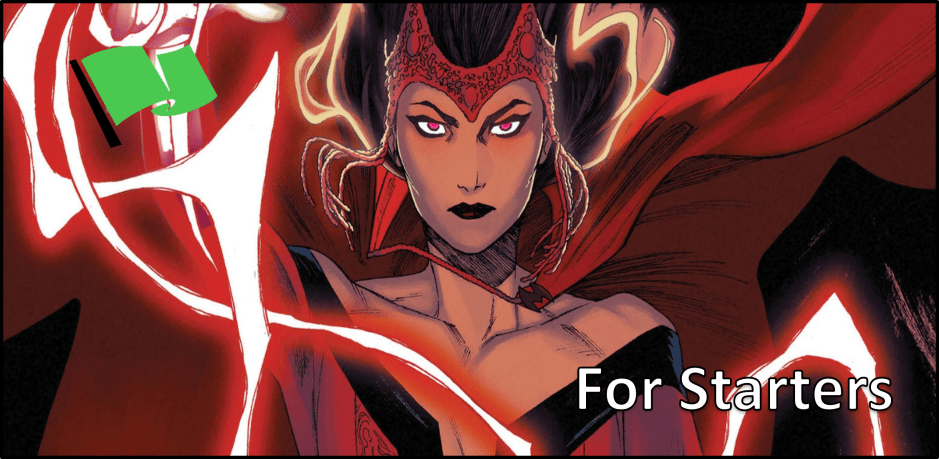
Today is Miss Kyra’s birthday. I asked her which comic book character’s history she wanted Geekly to cover today, and she picked another character with a complicated past, Scarlet Witch. Yes. Today will be covering comic books for new readers of the Scarlet Witch.

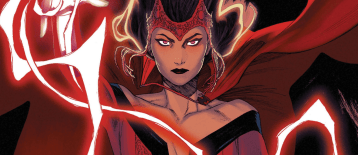
Hey, hey! Kyra Kyle here. Like many X-Men characters, Scarlet Witch has played jump rope with being a villain and a hero. Wanda Maximoff has even had moments of turning into an otherworldly being. She’s been a member of the Brotherhood of Evil Mutants, the Avengers, and Defenders. Scarlet Witch blurs the line between superpowers and magic. She has the power to bend reality.

Single Issues

We’ve split this list into single issues and longer stories. Let’s begin with single issues.

The Brotherhood of Evil Mutants (Uncanny X-Men #4, written by Stan Lee/art by Jack Kirby; March 1964)

Magneto proved a worthy adversary to the X-Men when he took on the team alone (Uncanny X-Men #1). The Brotherhood of Evil Mutants marks the team of the same name’s first appearance. Toad, Mastermind, Quicksilver, and Scarlet Witch join Magneto. But the team already shows cracks.

Quicksilver and Scarlet Witch want nothing to do with the Brotherhood. Magneto coerced them into joining. He reminds them of when he rescued the twins from an angry mob. The citizens of a small European town want to kill the Scarlet Witch for burning down a barn with her mutant powers. Magneto reminds the pair that humans would continue to hunt them for their abilities, which isn’t a complete lie.

The X-Men track down the Brotherhood to a palace in Santo Marco. The X-Men’s actions reinforce Magento’s claims that humanity will hunt down mutants. Mutants are hunting down other mutants who disagree with them. A quick battle ensues. Once the X-Men enter the palace, Magneto arms a series of bombs meant to destroy the palace and Santo Marco with it. Bystanders would be killed. Scarlet Witch and Quicksilver can’t abide by this plan, so as they escape, Quicksilver disarms the remaining bombs that would’ve taken the country. The Brotherhood of Evil Mutants shows Scarlet Witch’s tenuous relationship with Magneto.

The Old Order Changeth (Avengers #16, written by Stan Lee and Jack Kirby/art by Jack Kirby, Dick Ayers, and Carl Hubbell; March 1965)

Scarlet Witch makes good on her threat of leaving Magneto’s employ. It took her one year—almost to the day—from debuting as an X-Men villain to becoming a card-carrying member of the Avengers. The Old Order Changeth does what it says. The Master of Evil (the Avengers’ main antagonist team at the time) disbanded after burying their leader Baron “Heinrich” Zemo. (Note: the current Baron Zemo is Heinrich’s son, Helmut.) Wasp, Giant-Man/Ant-Man, Iron Man, and Thor leave the Avengers. Naturally, Hulk is missing. So, Captain America is chilling at the Avengers Mansion advertising that the team needs new members.

Hawkeye and Black Widow flip sides and join the Avengers. They had been duped into helping the Russians who wanted to disrupt the Avengers. Mission accomplished, I guess. Scarlet Witch and her twin brother Quicksilver also want to redeem their past as members of the Brotherhood of Evil Mutants and join. It may not seem like much but the Avengers changing their roster in just over a year (this issue is the sixteenth of a monthly comic) shook up the Marvel landscape.

What was Scarlet Witch’s role in this comic book issue? She doesn’t have a large role. While living in Switzerland, she learns about the Avengers needing new members. She travels by cruise ship to the U.S. and auditions for a spot with Tony Stark. The Old Order Changeth marks Wanda’s first step as a hero, and the first step is often the most important.

New Faces (The West Coast Avengers #45, written by John Byrne/art John Byrne; February 1989)

We jump a couple of decades to our next single issue New Faces. Surprise! The Avengers add a new member or two. US Agent (John Walker) joins the team which causes Hawkeye and Mockingbird to depart. This storyline has many layers and is worth the read, but we’re more interested in another storyline, the one between the Scarlet Witch and her husband Vision.

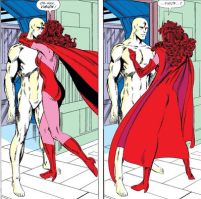
By the time of New Faces, Wanda and Vision have twin sons, Tommy and Billy. There’s a whole issue of Tommy and Billy going through a series of nannies who can’t manage to care for them. The nanny introduced in this issue, Mrs. Hunter, loses the twins in the nursery. We never see Mrs. Hunter again, so there’s a chance she got fired off-camera. The bigger issue rests with Vision. Vision needed to be reprogrammed. Unfortunately, while Vision has all the information, he lacks an emotional connection with that information. When Wanda hugs Vision, he asks her why. He no longer feels love.

Hank Pym explains that Vision misses one element, his brother Wonder Man’s brain patterns. Manipulated by Baron Zemo and then Black Talon, Wonder Man’s brain patterns had been used for Vision without his permission. Wonder Man refuses to help Vision because he had no control over his life for many years. While Wonder Man’s reason is understandable, Wanda is heartbroken when she sees the new Vision speaking monotonously, like he did when they first met. New Faces is the first time Vision wears all white. The MCU adopted a version of this costume with its current iteration of Vision.

Story Arcs

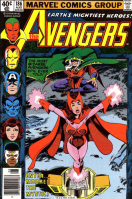
The Witch of Wundagore Mountain (The Avengers #185-187 written by Steven Grant, Mark Gruenwald, David Michelinie/art by John Byrne 1979)

The Witch of Wundagore Mountain is the first attempt at Scarlet Witch and Quicksilver’s origin story. The twins’ origin has been twisted and changed so many times, but this story marks the first real attempt at a Scarlet Witch origin. She wasn’t Magneto’s daughter. She even believed that her parents were the Whizzer (a Golden Age comic book hero with superspeed like Quicksilver) and Miss America. But the pair found that to be fiction.

A man named Django Maximoff claims to be her father, but she will soon learn that he’s her adoptive father. She was born on Mount Wundagore in the laboratory of the High Evolutionary. One of the High Evolutionary’s earliest creations, an anthropomorphic cow named Bova, cared for her. This is a bizarre story, and it takes many turns. Outside of flashbacks, Scarlet Witch becomes possessed by Chthon who, with the help of Scarlet Witch, holds the other Avengers prison.

We just scratched the surface with The Witch of Wundagore Mountain. It’s a harrowing tale.

Darker Than Scarlet (Avengers West Coast #56-57 & 60-62, written by John Byrne, Roy Thomas, and Dann Thomas/art by John Byrne and Paul Ryan; 1990)

After being a hero for most of her Marvel Comics tenure, Scarlet Witch hops over to the dark side during Darker Than Scarlet. She joins her would-be father Magneto, and at first, it seems like she isn’t the only one. The end of this storyline’s first issue shows Quicksilver joining Magento too. Toward the end of the story, we find that Quicksilver remained loyal to the Avengers, only joining his family to convince Scarlet Witch to reconsider and stop Magneto’s evil schemes.

While Scarlet Witch and Quicksilver have been on opposite sides before, Darker Than Scarlet is one of the few times that the twins have acted as enemies for a prolonged time. Typically, one of the twins would have a lapse of judgment before the other one eventually saved them, but Darker Than Scarlet shows Scarlet Witch reaching new levels of evil.

House of M #1-8 (written by Brian Michael Bendis/art by Olivier Coipel; 2005)

While Darker Than Scarlet was Scarlet Witch’s first big heel turn, House of M is her most infamous and had a profound impact on the greater Marvel Universe. Wanda becomes unhinged when she realizes that her children aren’t real. She loses control and uses her reality-altering powers, killing Vision, Hawkeye, and Scott Lang. These deaths cause the Avengers to fracture.

This new reality is unlike any other in the Marvel universe to that point. Wanda utters, “No more mutants,” which returns the world to the reality it had before, but with one significant change. Nearly all people who were mutants become normal humans. Only 198 mutants remain.

While Scarlet Witch plays a key role during House of M, Quicksilver works behind the scenes. He convinces Scarlet Witch to use her powers to reshape reality, and it is Quicksilver’s injuries at the hand of Magneto that inspire Scarlet Witch to wipe out most of mutantkind.

Avengers: Children’s Crusade #1-9 (written by Allan Heinberg/art by Jim Cheung; 2010-2012)

House of M and Avengers: Disassembled led Scarlet Witch into a dark period. Avengers: Children’s Crusade is Wanda’s first step to redemption. The story revolves around Speed and Wiccan, who believe they’re Wanda’s lost children. The Disney+ series Agatha All Along borrows aspects from Speed and Wiccan’s story here. Accompanying Speed and Wiccan is their grandfather, Magneto.

When the kids find their mother, she’s lost her memories and powers and is about to marry Victor Von Doom. When Scarlet Witch’s memories begin to return, she learns that her powers had overloaded when she worked with Doom to bring her children back from the dead. Scarlet Witch’s children redeem her. Once reunited, she seeks redemption for the chaos and destruction she had caused.

Rumors persist that Scarlet Witch may not have died during the events of Doctor Strange in the Multiverse of Madness. The MCU could reintroduce the character following the events of Agatha All Along and a subsequent series with Speed and Wiccan. If that happens, she will have a lot to atone.

Witches’ Road (Scarlet Witch #1-5 written by James Robinson/art by Vanesa Del Rey; 2016)

Witches’ Road has a simple premise: witchcraft is broken. Joined by Agatha Harkness’s spirit, Wanda travels the world to fix witchcraft. If this premise sounds familiar to MCU fans, a similar journey may be hinted at the end of Agatha All Along. Scarlet Witch had the moniker of witch but seldom associated herself with witchcraft until the events of Witches’ Road.

Thanks, Agatha All Along. Now all I hear when I say Witches’ Road is the song from the Disney+ series. Anyway. During the comic book storyline Witches’ Road, Wanda solves magical crimes and pieces witchcraft back together. She must solve the mystery of who broke magic.

I lost count of how many Scarlet Witch stories missed the cut. I added Witches’ Road at the last second or it could’ve been one more storyline. Scarlet Witch has had so many great stories. Let me know which Scarlet Witch stories you’d add to the list. Thank you for reading, and wherever you are, I hope you’re having a great day.

Geekly News: May 11 2025, World Video Game Hall of Fame Inductees

Happy Mother’s Day, Geekly Gang. We wish all the mothers out there a great day. Since today is Mother’s Day, we may go a little light on Geekly News. We may have some events we’ll have to do today.

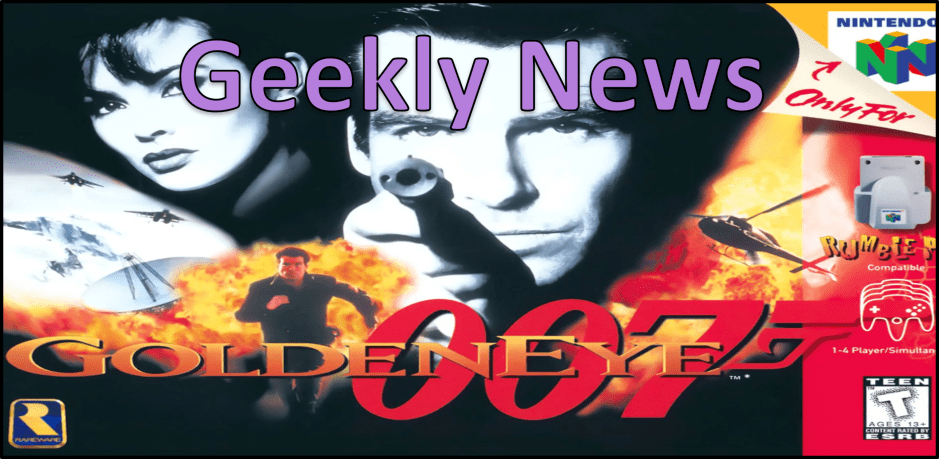
World Video Game Hall of Fame inducts Defender, Tamagotchi, GoldenEye 007, and Quake

The World Video Game Hall of Fame inducted four games this past week. All four video games are worthy additions. Defender raised the bar on difficulty in video games. The game might be too difficult for some people; I remember avoiding Defender while in the arcade. GoldenEye 007 was one of the best multiplayer first-person shooters. I would lose even while playing Odd Job. I’m sensing a pattern with these games. I stink at them. 🤪Quake ushered in a new generation of graphics, while Tamagotchi marked the first pet simulator. This list is impressive.

But so are the video games that didn’t quite make the cut. The World Video Game Hall of Fame competition was fierce. Finalist games included Age of Empires, Angry Birds, Call of Duty 4: Modern Warfare, Frogger, Golden Tee, Harvest Moon, Mattel Football, and NBA 2K. Some of these games should enter the hall next year.

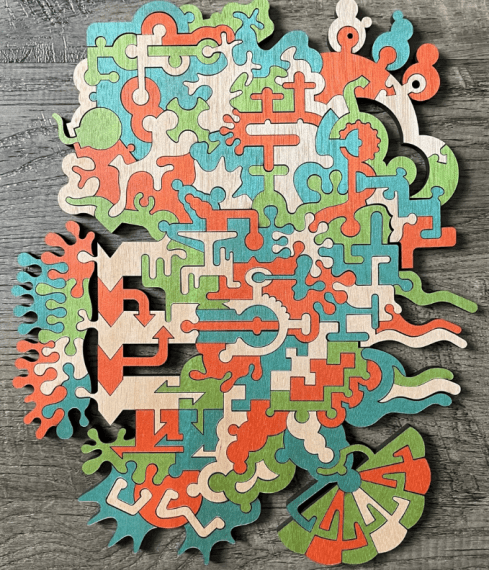
Bumfuzzled Set to Launch Early Next Week on Gamefound

We’re doing something a little different today. Bumfuzzled is a set of wooden puzzles that feature unusual piece shapes. It should launch some time next Tuesday (May 13, 2025), and I’m excited for these. The puzzles look amazing. And look at the piece shapes.

If you’re tired of the same old puzzles, give Bumfuzzled a try in a few days.

Allplay Announces Another Round of Kickstarter Games

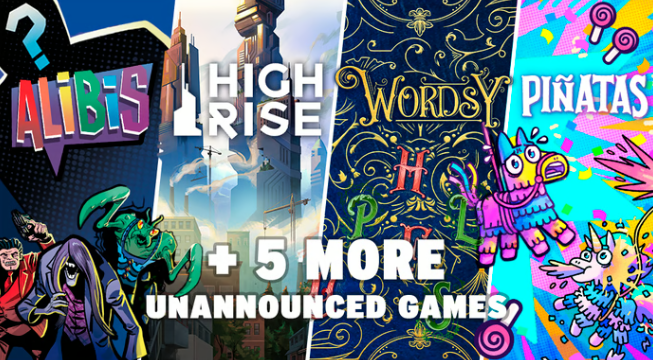
Allplay produces a lot of great games of various shapes and sizes. I mentioned Allplay as one of the board game companies that produces stocking stuffer games. Allplay also releases waves of these games on Kickstarter, and they just announced another nine games for a future Kickstarter campaign. Nine games! Wow! Seven of these nine games will be of the small box variety (great stocking stuffers). As of writing this post, there are no details about when these games will ship, but Allplay tends to ship bundles like these within a year. We only know of four games for sure: Alibis, High Rise, Wordsy, and Piñatas.

All of these games look promising. Alibis is designed by Don’t Mess With Cthulhu’s Yusuke Sato. Sato has done a great job with social deduction in the past, and Alibis appears to be a cooperative deduction game. Interesting. Allplay is reprinting two fantastic Gil Hova designs Wordsy (which is a well-regarded word game) and High Rise (a strategic city-building game with a touch of corruption). The final game is a new design by Reiner Knizia, Piñatas. Piñatas is another trick-taking game by the board game legend. I’ve been playing a lot of Knizia’s most recent trick-taking game, Don’t LLAMA. It’s a good bet that Piñatas will be excellent.

We’re keeping today’s Geek News brief. Happy Mother’s Day again. Thank you for reading, and whether you’re a mother or not, wherever you are, I hope you’re having a great day.

Quirky Video Game Review: Potion Craft

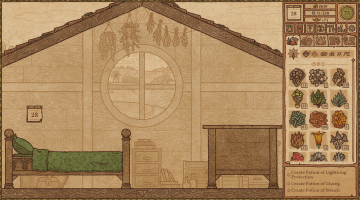
Potion Craft by indie game developer niceplay games created a craft system you want to play. Visuals inspired by medieval manuscripts blend with unique gameplay for concocting potions to form a singular video game experience.

Hey, hey! Kyra Kyle here. We’ll get back to another free-to-play game soon enough, but in the meantime, let’s cover another paid game. You can get a good deal on the game through sites like Steam or the PlayStation store (PS4/PS5). Usually, Potion Craft sells for around $20, even without a sale. Potion Craft’s unique graphics drew me in, but its stellar gameplay kept me engaged for hours. Let’s see how well Potion Craft stands up to our rating system.

Mechanisms: 10/10

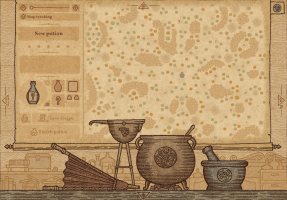
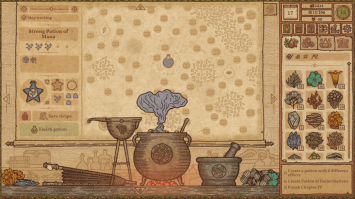
Potion Craft innovates on the tried and tired crafting game. The video game scene has seen an influx of alchemist simulator games in the last few years. Most of these alchemist simulators would have players accruing ingredients through exploration (through a dungeon mechanism separate from alchemy) and learning new potions through trial and error. Potion Craft streamlines this process. Players explore a perilous map by adding ingredients to their alchemy pot. Ingredients (that players obtain through farming or purchasing from vendors) move the player’s cursor on the map north, south, east, or west. But these ingredients seldom allow for traveling in a straight line. Spiral and zig-zag movements reign supreme. Once the bottle-shaped cursor reaches an ability, players can stoke the fire and boil their potion, so the potion gains that ability.

This simple, yet ingenious, twist puts the focus on alchemy. I waited for a second gameplay type where I played as my character dungeon diving for ingredients. That gameplay never came, and Potion Craft is the better for it. At times the gameplay can feel puzzly, but with the focus on what I put in my alchemy pot almost all the time, I felt more like an alchemist in Potion Craft than I’ve ever felt in any other video game of this ilk. And I’ve played a handful of alchemist simulators. If an alchemist simulator sounds intriguing to you, you owe it to yourself to play Potion Craft.

Gameplay Loop: 9/10

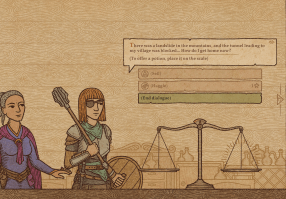
Pick ingredients from your alchemical garden. Then, tend to your garden. Serve your customers by guessing which potion would best fix their problem. You may haggle with the price if you want. Finally, explore the alchemy map to find new potion types or find better (more efficient) ways to produce potions.

Potion Craft is one of those notorious games for “just one more turn.” Everything seems as if it’s just one day (turn) or two away. Even when you know how to make a potion and save the potion’s recipe, you can create the potion, using fewer ingredients, so that you spend fewer future ingredients. That’s another great feature of Potion Craft. The ingredients you used when creating a potion recipe you saved will be used whenever you make potions from that saved recipe. There’s a reason to make the same potion twice. Let’s say that it took you three Waterblooms to make an Ice potion. But you unlocked Tangleweed and began farming that and it only takes you one of those to make an Ice potion. This can save you time, resources, and money in the long run. Brilliant!

Frequently, I’ll make a less-than-desirable recipe for a potion type just to have a means of making that potion. When I unlock the means to make that same potion on the cheap, I take it. And it feels good exploring the map through alchemy, even when I’ve already unlocked the ability I’m heading towards. Each day, experience boosts (in the form of alchemy books) reset, and players can collect them again. This allows you to level up your alchemy skills, and the skill tree, while basic, does a good job of giving players choices. Do you want to focus on selling potions, exploring the map, or farming? The choice is yours.

And then there are the customers. This dovetails into the Storytelling section (and less so for Narrative) but I’ll begin discussing the customers here. Customers often don’t tell you exactly what they want. Even when they do, there are often multiple ways to fix a problem. Light spoiler: a customer may say that they locked themselves out of their house; you can choose to give them an explosive potion or acid. I don’t know how many times I’ve seen Season pick a means of fixing a problem that didn’t cross my mind. And she’s said the same for ways that I’ve solved the occasional problem.

But the core element is map traversal through alchemy. I didn’t expect to like the map movement that much, but Potion Craft nails the explorative nature of throwing things in a pot and seeing what happens.

Narrative: 5/10

Potion Craft doesn’t have much in the way of a narrative, but I gave it a five because of its implied customer backstories. Sure, some customers have generic “my stomach hurts, do you have a potion for that?” But others have more sinister motives should you get to know them better. Others still have bizarre stories like why does a scuba diver exist in medieval times? Players will have to piece together scraps of story to make one that makes sense, but Potion Craft does have a loose-knit story.

Storytelling: 7/10

Like Papers, Please, which we covered last month, Potion Craft tells its story in the game’s negative space. Hidden within the string of customers who stop by for potions rests a deeper narrative for those characters and the town in which they live. I won’t spoil some of those stories here, but Potion Craft builds its world and its story through the people who stop by for magical potions. And I love this world.

Citizens solve mundane problems with magic. Why not? If magic is plentiful, why wouldn’t you solve any minor inconvenience with alchemy? Potion Craft runs with this premise. You can solve people’s issues at lower difficulty settings through multiple means. You may need a specific potion with multiple effects if you raise the difficulty. Unlocking abilities to converse with customers may yield even more backstory. And that’s where Potion Craft’s story lies: the characters’ backstories.

User Interface: 8/10

Potion Craft does a great job of showing players where their alchemical ingredients will lead them on the map. The locations are easy to navigate. The goals are easy to find and understand. In short, Potion Craft does a great job of showing its players how to play the game. But at the same time, it still gives players the freedom to come up with unique solutions to problems.

Like I said before, there’s more than one way to fix an issue, and Potion Craft gives players the time and space to explore those options. Potion Craft’s setup isn’t the hectic DMV hellscape as Papers, Please. It organizes things in a way for players to thrive. Potion Craft is a layback and chill game instead of a tense, don’t make a single mistake game like Papers, Please. While the two user interfaces work for the games that use them, I prefer Potion Craft’s interface. I’d rather a game show me exactly what I can do. Potion Craft does this better than most.

Graphics: 9/10

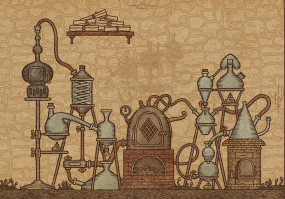
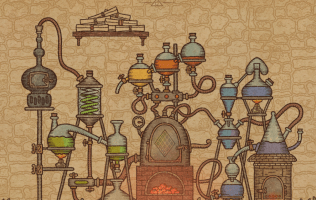
Potion Craft uses medieval documents and medical books as the basis for its graphics. While simplistic, the art amplifies Potion Craft’s subject matter. I don’t know if any other graphics would’ve worked for this game. You can tell that Potion Craft is a labor of love for the designers. The user interface and graphics merge intuitively. Part of the reason why the user interface works as well as it does is because the graphics feed into the user interface and the theme. I feel as if I’m grinding leaves, flowers, berries, and roots with a mortar and pestle. There were times when I swore, I could smell the herbs.

Audio: 6/10

I’m not going to lie. I played Potion Craft while muted most of the time, but when I did have the sound on, it worked well. I wouldn’t say that Potion Craft has the most memorable soundtrack. Its soundtrack is serviceable. Potion Craft’s sound effects are what give it an above-average audio rating. You can hear the crunch of leaves and fruit. Heating your potion is satisfying. Pouring water into your solution to thin your potion is visceral. Seriously, I had to go to the restroom after hearing pouring water on more than one occasion. Potion Craft amplifies its tactile gameplay with sound effects.

Replay Factor: 8/10

This is a difficult section to grade. Potion Craft may not offer much in terms of replays through different games. You can get by beating each difficulty setting once. As of this write-up, there are four different difficulties. This still gives you well over 100 hours of gameplay. I’m giving Potion Craft a higher replay factor score because of the replays during your initial play.

I mentioned before that you may want to optimize your potion recipes. That leads to numerous hours of gameplay. But Potion Craft has a sneaky other reason why you might play. Your alchemy shop has a reputation score. You could play an evil alchemist and only sell potions to people who have nefarious plans. I didn’t know who would order a Necromancy potion with my first play. Switching to an evil alchemist showed me who would order a Necromancy potion. It doesn’t look like it, but Potion Craft is a sandbox game.

Aggregated Score: 7.8

I enjoyed my multiple playthroughs of Potion Craft. It’s the preeminent alchemist simulator game. If you have any interest in an alchemist simulator game, give Potion Craft a try. With Potion Craft’s quirky graphics, I didn’t know what to expect. The streamlined nature of Potion Craft’s gameplay is a revelation. Developer niceplay games and publisher tinyBuild are on my radar. I can’t wait to see what this studio has planned for next.

Thunderbolts* Review

Thunderbolts* takes a familiar MCU formula and adds deep themes, allowing its characters to shine. Yes! The Geekly Gang has had a chance to watch Thunderbolts* on the big screen. Hey, hey! Kyra Kyle here. Happy Friday. Today we’ll be covering Geekly’s thoughts on the latest Marvel film to release, Thunderbolts*.

Thunderbolts* is indeed the sleeper hit I was hoping for at the beginning of the year (during our MCU preview). I’d even say it’s one of the better recent Marvel projects. We’ll get to some of the goodness here after a while, but I wanted to start by saying that I appreciated not needing to do MCU homework for this movie. Because Sentry can tap into others’ past trauma, the audience got a good introduction to most of the characters. No hundreds of hours of viewing necessary.

That alone was a relief. Florence Pugh’s Yelena Belova was an excellent choice for a primary point-of-view character. Thunderbolts* does bounce a little bit, but Yelena is the character the audience shares the most time. Thunderbolts*‘ Yelena isn’t the jovial Yelena from previous projects (like Hawkeye or Black Widow). This is a woman struggling with the loss of her sister (and by extension, her family). She’s lost and trying to find her place in the world. I said this during Geekly’s preview several months ago, and I’ll reiterate here: Yelena is relatable.

So many of the Thunderbolts* are relatable. They’ve fallen short of glory. They’re haunted by their demons. They find a way to endure and persevere. It’ll be difficult not to get preachy with this response, but I’ll try and restrain myself. In short, Thunderbolts* is about mental health.

I’ll try to stay as spoiler-free as I can. It’ll be difficult. I love how Thunderbolts* introduced Sentry. This could’ve handled Sentry’s introduction poorly, but Bob’s inclusion was handled with care. He battles demons of his own, and like I said prior, he can draw people into their past trauma. This will come back to bite the Thunderbolts in the future because every member has trauma. Sentry forces the team to face their past, and eventually, the Thunderbolts help Sentry battle his own self-loathing. Bob views it as an ever-present void. Again, for someone dealing with depression, this is relatable.

I don’t want to get into any further detail; it’ll get too spoilery. How the Thunderbolts assemble has shades of the Guardians of the Galaxy. It worked for the Guardians; it works for the Thunderbolts. There are a few exceptions, but most Thunderbolts are tasked with assassinating one of the other future members. Julia Louis-Dreyfus’s character (Valentina) is in the throes of impeachment trials and uses the various members to cover up her tracks. Her final loose ends are the Thunderbolts. Okay. That was kind of a spoiler. Thunderbolts* may use familiar tactics, but the way the movie executes these tactics feels fresh.

Thunderbolts* even manages to introduce small details earlier in the film that end up mattering more than the audience may have thought. That’s always fun. It’s like watching a puzzle piece fall into place. And Thunderbolts* does a good job of managing those puzzle pieces.

My only gripe is that I wish we had seen more of certain characters. To be fair, that’s a good problem to have. This is a minor spoiler, but one of the Thunderbolts dies early in the movie’s runtime. I see why Marvel did it. Fans didn’t care for this interpretation of the character, and knowing the multiverse, the character could return (even with the same actor) in some other form, hopefully one closer to the comic book.

And I wish we had gotten more screen time with Ghost. Again, I understand why Marvel went this direction. Ghost’s past is similar enough to Yelena’s (suffering from a childhood where she must do bad things). Thunderbolts* had a lot of characters to juggle, so someone had to draw the short stick. Ghost still had plenty of moments.

I don’t want to continue and risk spoiling any more of Thunderbolts*. It’s a great watch, one of the MCU’s better releases in recent years. Just be prepared with a box of tissues. Thunderbolts* covers some heavy topics.

I’m so glad Thunderbolts* was the first MCU movie I watched this year. I can’t wait for Fantastic Four: First Steps to release. Thank you for reading. Like Thunderbolts* tells us, be kind to yourself, and wherever you are, I hope you’re having a great day.