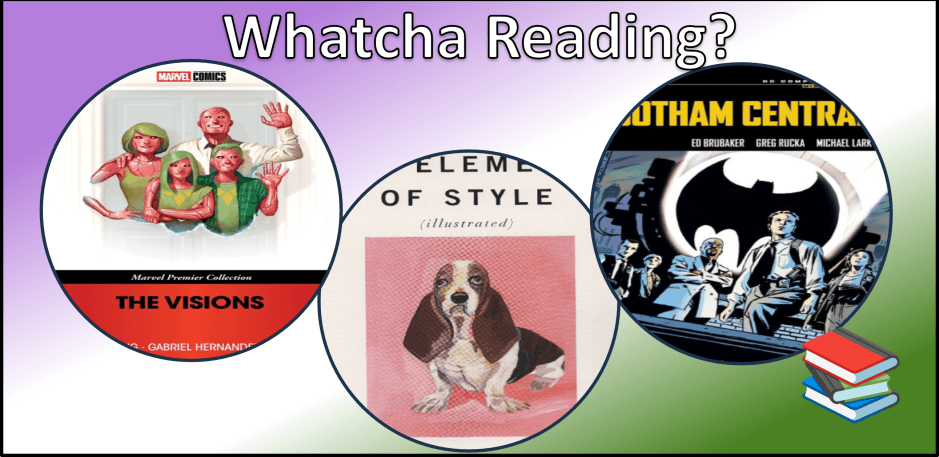
Whatcha Reading September 2026

Happy Wednesday, Geekly Gang! Kyra Kyle here, and today, our writers share what they’ve been reading over the past month. Feel free to share what you’ve been reading, because we’re all part of the Geekly Gang. I’ll kick off this post by sharing what I’ve been reading over the past month.
Kyra’s Fiction

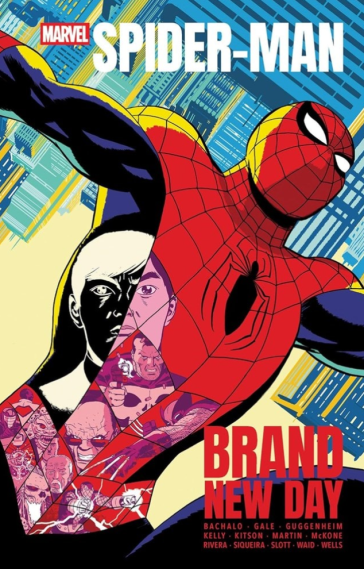
First off, I like how Marvel Comics has adopted DC Comics’ Compact Graphic Novel format. Yay! These volumes fit much nicer on the shelf, they pack a lot of story in smaller space, and they’re cheaper than full-size graphic novels. Compact graphic novels cost almost half that of full-size graphic novels, so I can pick up multiple volumes at a time. Hint: You’ll be seeing a lot of compact graphic novels on my list in the near future. My unsponsored plug for compact graphic novels has concluded, let’s get to Spider-Man: Brand New Day.

I can see why the MCU used the Spider-Man: Brand New Day title and none of the story. Don’t get me wrong, I enjoyed reading Spider-Man: Brand New Day, but the story was all over the place. The Spider-Man: Brand New Day comic book story arc plays out like a short story collection. The first story has little to nothing to do with the Mr. Negative storyline. Hammerhead’s tale builds up Mr. Negative as a shadowy figure working behind the scenes. Then, we get a yarn about a Bookie. While fun, the Bookie story doesn’t build off of Hammerhead’s. And then The Shocker shows up, and of course, he’s working with Mr. Negative. After that, we get an Anti-Venom comic, showing us who is Mr. Negative.

As you can tell, Spider-Man: Brand New Day is all over the place. Why does Anti-Venom reveal Mr. Negative’s identity? That reveal doesn’t carry much weight, because Spider-Man: Brand New Day sparingly shows Mr. Negative’s alter-ego and why Peter Parker would care. The original Sony Spider-Man Video Game does a much better job of telling Mr. Negative’s backstory. Heck, I only cared about the character because I played the video game first. You almost need to play the video game before reading the graphic novel for context. Spider-Man: Brand New Day defined Spidey for a generation. It may be rough around the edges, but it’s a good read.
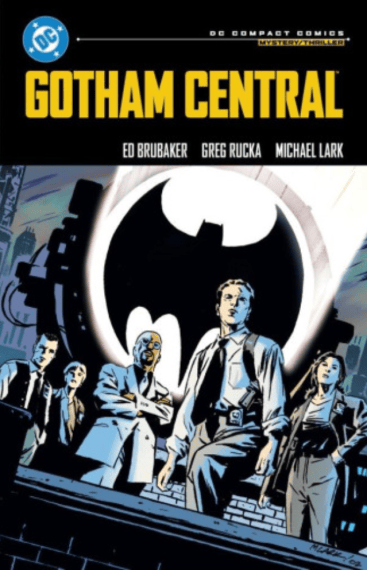
I had to read at least one DC compact graphic novel this month. Gotham Central beat out a couple of others in my TBR pile. I’m glad I chose this one. I can see why Gotham Central earned several accolades (including multiple Eisner Awards). These stories show the Gotham City Police Department (GCPD) working in a city that includes Batman. Some treat The Dark Knight as an extension of the GCPD. Others resent Batman. All of them navigate a criminal underground that includes heavy hitters like Poison Ivy and Mister Freeze. What can an ordinary cop do against someone like Mister Freeze? Gotham Central answers these questions.

Gotham Central also shows the inner workings of a city on fire. Crime is rampant. Death is everywhere. The GCPD officers we follow do their best. Renee Montoya (pictured above on the far right) is a standout, but Gotham Central fleshes out existing GCPD characters and introduces many others that remain staples in the Batman Mythos. You don’t see a lot of Batman in Gotham Central, but that’s the point. The Gotham television show made a half-hearted attempt at adapting Gotham Central. One of the show’s biggest issues may have been to age down Commissioner Gordon. Gotham Central ages up Gordon and showed the power vacuum left behind in Gordon’s absence. That would make for a good show.
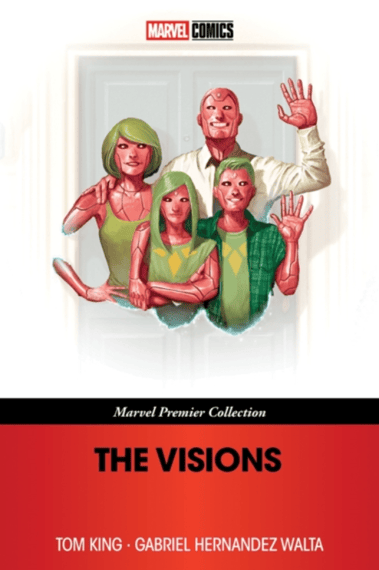
Spider-Man: Brand New Day was the first of Marvel Comics’ Compact Graphic Novels. The series would become the Marvel Premier Collection, and the covers look similar to the one pictured above. Since I discovered Marvel’s compact graphic novel line, I read two of them this past month. I enjoyed The Visions more than I thought I would. I shouldn’t doubt Tom King (Supergirl: Woman of Tomorrow). You can see some of The Visions’ influence on the MCU’s WandaVision, but I’d like to VisionQuest take different elements from this storyline. I don’t want to spoil too much in this write up; you should read The Visions when you get the chance.

After gaining a new title (Avengers’ Ambassador to the Pentagon), The Vision moves to Washington DC with his family. The Visions explores what happens when a synthezoid constructs a family of his own. What could go wrong? Turns out, everything. The Visions does a great job placing us where The Vision is as a character. I am grateful for that. The Vision has one of the messier comic book origins you’ll find, but The Visions walks the reader through decades of confusing continuity. You don’t need a heap of comic book lore to know what makes him tic. Kudos to Tom King for making The Visions accessible.

The Visions is a page-turner. Each issue presents a new twist. Each issue ends on a moment you can’t wait to see what happens next. The Visions may have been my fastest read from this past month. It may have little to do with the greater Marvel Universe, but that makes The Visions endearing. It dives into who The Vision is and what kind of synthezoid family he’d create. The Visions explores what is to be human. Funny how a story about a synthetic person lends itself to examining humanity.

Elements of Style Book Cover

Kyra’s Nonfiction

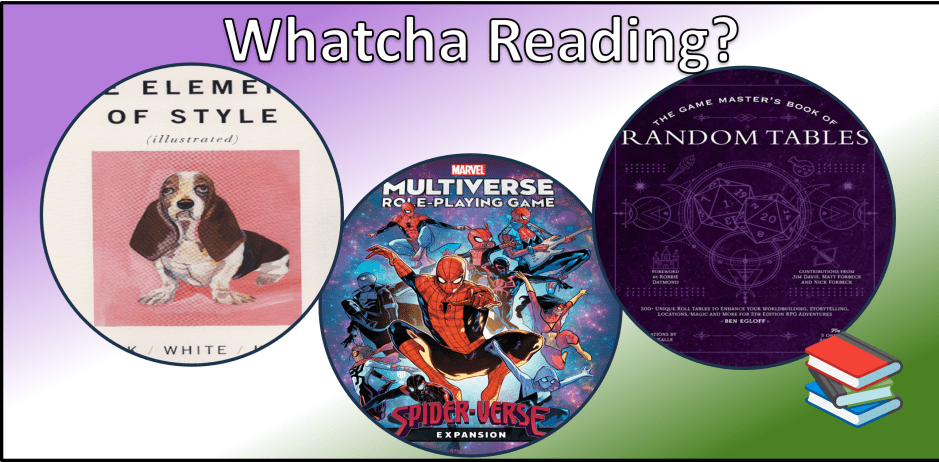
It’s the summer, so I reread Strunk and White’s The Elements of Style. I don’t do this every year, but I do it most years. I’ve mentioned The Elements of Style last year, I believe. I love my illustrated copy. The pictures aren’t neccessary. You can buy a cheaper copy of The Elements of Style for less than five dollars, but if you want to splurge, the illustrations (by Kalman) add whimsy. Reading books like The Elements of Style may be more vital this year than in past years.

AI writing is everywhere. One of the ways you can spot AI writing is its overuse and misuse of em dashes (–). Em dashes are valid forms of punctuation. But you shouldn’t use em dashes in place of a semi-colon, colon, parentheses, or commas. Right now, large language models (LLMs or AI) abuse em dashes. Programmers can change which forms of punctuation their LLMs will overuse and misuse. You’ll need to read style books like The Elements of Style to make sure you don’t sound like a toaster or the slur The Visions introduced, a Socket Lover.

Those are all the books I’ve read or finished this month. I started a couple of others but didn’t want to include them until I was closer to finished. Looks like I’m on my own this month. Hopefully, Season and Skye will join us for next month. Thank you for reading, and wherever you are, I hope you’re having a great day.
Whatcha Reading, Geekly? May 2026

Happy Wednesday, Geekly Gang! Kyra Kyle here. Today, our writers share what they’ve been reading over the last month. Feel free to share what you’ve been reading this past month, too, because we’re all part of the Geekly Gang. I’ll get things started with what I’ve been reading this past month.

Kyra’s Reads

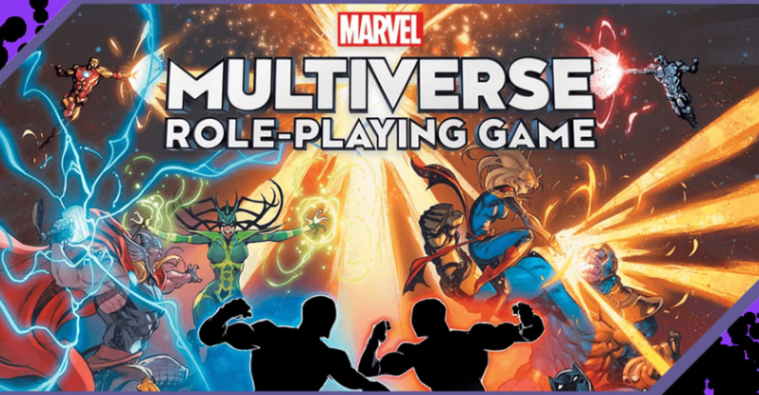
I have a Marvel Multiverse Role-Playing Game session planned at a public event this Saturday (May 16, 2026, at the Bellevue, Nebraska, Public Library), and while I could’ve read one or two core books, I fell down a rabbit hole. I’m sure I read something else this past month. I’ll probably remember it while I’m typing this entry, but picking up four 300-page rulebooks for a tabletop role-playing game is a good reading load. Throw in multiple auxiliary role-playing game books, and it becomes a lot of reading.

One feature I like about the Marvel Multiverse RPG books is that their pages are color-coded. At first, I didn’t care for these color-coded pages. They look garish on the shelf. But those colors help with quickly locating chapters. Rules can be found at the beginning. These page colors may be difficult to spot at first because the chapters are really small (the Marvel Multiverse RPG is a rules-light game), but you’d expect rules to exist at the beginning of a TTRPG book. The larger sections are for Powers, Characters, and World Building. I know to look at the red pages for a character and the purple pages for Powers and so forth. Color-coded pages may look weird on your shelf, but I’ll sacrifice aesthetics for functionality.

I picked up the core rulebook, and you don’t even need to do that if you want to get started playing the Marvel Multiverse RPG. The company uploaded a quick-start book on its website. Just click the “Try Free” button, and a laundry list of content loads. I was surprised by how much content Marvel made available for players. Sure, other sites like Fuzzy on the Details offer copious fan-made content for the game, and you can check them out here if you’re interested. But Marvel gives players everything they need to demo the game before buying.

The Quick-Start Book with a Thunderbolts* Adventure is a great place to begin. The Quick-Start Book offers an abridged version of the rules, everything you need to get playing. And the Thunderbolts* Adventure introduces game elements almost like a video game tutorial. My group is choosing a different starting adventure, the Marvel Rivals Timestream Adventure.

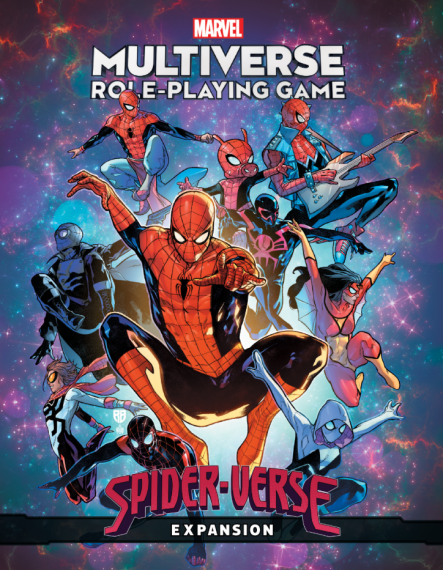
I talked about the Marvel Rivals Timestream Adventure in last week’s Whatcha Playing, so I won’t repeat what I said in that post here. But I will say that I like the Adventure’s flexibility. It can be a one-shot or the beginning of a longer campaign if we choose to continue the story. Getting back to the major Expansion books, I picked up Spider-Verse and X-Men. I prefer X-Men to the Spider-Verse because this Expansion adds more powers. More options. I was a little disappointed that we didn’t get any new abilities in Spider-Verse. Even so, Spider-Verse is solid.

All Marvel Multiverse Role-Playing Game’s bigger books have a third to almost half of their pages dedicated to character entries. This could change in the future, but you’ll be seeing a lot of red pages. And that makes the Marvel Multiverse RPG different from many other TTRPGs. With so many choices of pre-constructed characters, why would anyone make their own character? That’s not to say that the Marvel Multiverse RPG doesn’t have a good character creation system. It does. I can easily whip up a compelling character in short order, and I’m in the process of converting the TSR Marvel RPG rolling charts to aid with character creation. After I’m done, I may post those charts here. Let me know if you’d be interested in that. But the Marvel Multiverse RPG lends itself to players assuming the role of established characters.

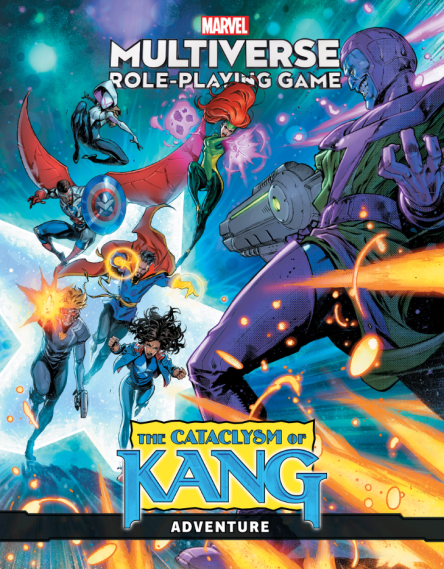
How you play the Marvel Multiverse RPG will depend on your gaming group. I also picked up The Cataclysm of Kang. This Adventure differs from the others (one-shots) I mentioned earlier. The Cataclysm of Kang requires hundreds of gameplay hours to complete. It’s a massive campaign, and fewer players will have interest or patience for this long a campaign. Note: I picked up The Cataclysm of Kang because it could play out like an alternative MCU Kang storyline. What could’ve happened if the MCU didn’t biff that villain? Just like the other hardbacks in the Marvel Multiverse RPG, The Cataclysm of Kang offers plenty of pre-generated characters. $40-$50 is a lot if you’re only interested in more characters. Fortunately, DriveThruRPG offers $5 deals on just the characters. The site even sells easier-to-print versions of the game’s maps. And while you’re on DriveThruRPG, check out some of the other free content.

You could play the Marvel Multiverse RPG without ever buying the core book or any of the expansions. Or you could drop considerably less money than I have and pick up some essentials and cheaper content on sites like DriveThruRPG and FuzzyOnTheDetails. You also don’t need to be the biggest Marvel buff. No one will quiz you on Marvel lore. You could take a show or movie you liked from anything Marvel, even the stuff that predates the MCU, and ask what if.

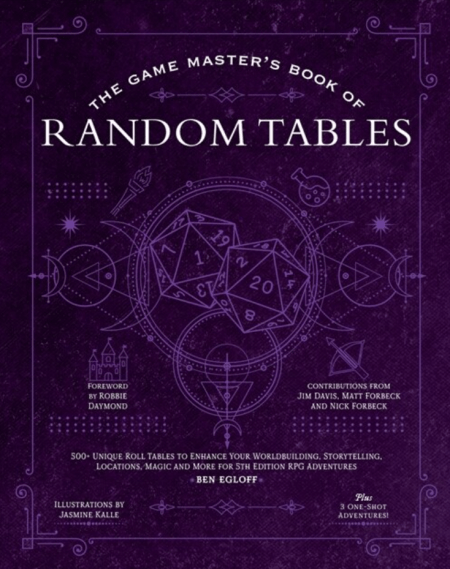
I continued with The Game Master’s Book Of series with Random Tables and a handful of other titles. Like I said, I went down a rabbit hole. Send help! Naturally, I’ve been converting some of these random roll tables for the Marvel Multiverse RPG, but if you’re running a high fantasy role-playing game, you shouldn’t need to adapt anything found in this book. I love The Game Master’s Book Of Series. They provide so much for any role-playing game. Sure, they do lean toward Dungeons & Dragons, but most of these books–except for the dragons book, but who doesn’t love dragons?–can be useful for numerous RPGs. I read the Proactive Roleplaying and Collaborative Campaign Design books last month. Those two are paperback, but the hardback books are only $25 or less, and they’re high-quality books. You can’t beat The Game Master’s Book Of series’ value.

I did read something else this month. I started re-reading Strunk and White’s The Elements of Style. I read this book so often that I forget to include it in these lists. Strunk and White’s The Elements of Style is a great book to refresh one’s grammar. And I need all the help I can get.

That’s all I have for what I’ve been reading this past month. I’m sure I forgot several other books on my list, but hey, that’ll give me something to talk about next month. And it looks like I’m on my own for this week. We’ll have to check in with Season and Skye next month with their reads. But let us know what you’ve been reading in the comments, Geekly Gang. Thank you for reading, and wherever you are, I hope you’re having a great day.