Geekly News: March 16, 2025; CMON Games Could Lose $2 Million for 2024

Crowdfunding Board Game Giant CMON Games Claims They Could Lose $2 Million for 2024

CMON’s board issued a profit warning to the Hong Kong Stock Exchange earlier this week. It estimates its losses for 2024 at between $1.4m and $2.1m, with the final, audited total expected by the end of this month. $2 Million is a large number. Several factors have contributed to CMON Games claiming a loss for 2024. We’ll give a quick rundown on what led CMON in this direction.

A Quick History

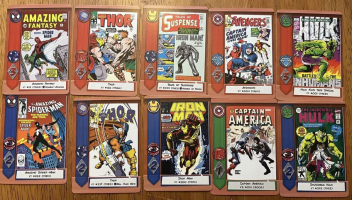
CMON Games quickly bounced back from the pandemic. It suffered a 17.5% revenue drop to $25.1m in 2020 because of the pandemic. In 2022, CMON reached $45.3m and almost duplicated that success the next year due to multimillion-dollar Kickstarter campaigns for its long-running Zombicide series and games based on huge IPs such as Marvel and DC Comics.

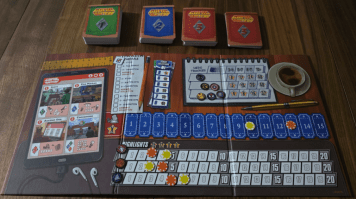
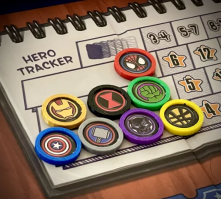
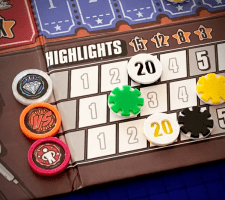
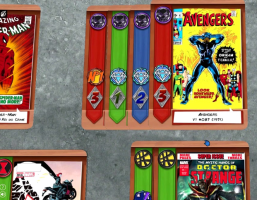
Marvel United Box Close Up Board Game Review

Last September, CMON’s mid-year revenue had fallen for the first time since the pandemic, to just over $15.9m with slumping wholesale earnings putting a dent into the company’s H1 results. CMON’s wholesale revenue sank 39% to $5.9m in H1 2024 compared to the same period in 2023, while revenue from its crowdfunding campaigns fell by about 9.7% to just over $9.9m.

What CMON Claims Caused this Loss

CMON Games says the biggest contributing factor to this loss is the rising cost of living, which is eating into its revenue from tabletop game sales. They believe people aren’t buying as many board games because the cost of living has increased. Cost of living can and does play a role in reduced board game sales. But this can’t be the only factor.

CMON Switches from Kickstarter to Gamefound

CMON switched its crowdfunding strategy in February 2024 when it ended 12 years of running campaigns on Kickstarter. They chose to sign an exclusivity deal with Kickstarter’s crowdfunding competitor Gamefound. CMON had raised more than $108 Million in total on Kickstarter.

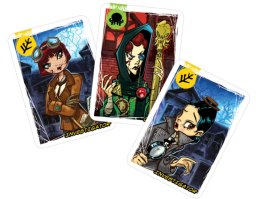
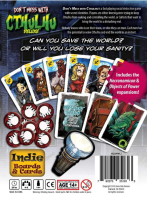
CMON’s first year on Gamefound began slowly. Large campaigns like DC Super Heroes United and Cthulu: Death May Die, Forbidden Reaches helped push CMON closer to the money they raised on Kickstarter the previous year.

At the mid-point of the year, the 2024 losses would almost wipe out CMON’s $1.8m profits across the previous three years combined, marking the first time the company suffered a loss since the pandemic.

Personal aside: I backed one of CMON’s projects on Gamefound and followed several others. The company had issues navigating Gamefound’s backend. There were growing pains but the year ended better than it could have. Different consumers use Gamefound and Kickstarter. Switching crowdfunding providers could contribute to a dip in sales. Gamefound also offers what equates to layaway, so certain Kickstarter marketing tactics CMON Games has cultivated over 12 years may not work as well on Gamefound.

CMON Bought IPs Last Year

CMON made two significant acquisitions last year. They bought Japon Brand, the Japanese board game collective that published Love Letter and Machi Koro and picked up the intellectual property rights to a pair of stalled Kickstarter projects from Mythic Games in January 2024.

The two games from Mythic Games, Hel and Anastyr, raised a combined $3.2 Million on Kickstarter. Per CMON Games, both games require extensive playtesting and editing to reach their standards for print. CMON Games plans to ship Hel and Anastyr to Kickstarter backers if the customers who originally backed the game are still interested. This created another issue with CMON Games switching from Kickstarter to Gamefound. Original backers of Hel and Anastyr haven’t received a single update since CMON Games acquired the rights to produce these games because CMON no longer uses Kickstarter.

Tariffs on Board Games

Geekly mentioned a month ago that tariffs on Chinese goods have complicated board game production. We belong to several board game groups and know several publishers. Many board game publishers have cited up to $2000 for a crowdfunded board game making $100,000. CMON deals in crowdfunding projects in the millions of dollars, and the company has at least seven completed campaigns that it will fulfill by the end of 2025. The company could lose at least $500,000 in tariffs alone.

CMON Agreed to Sell IPs

CMON started 2025 by agreeing to sell some of its intellectual properties in a $12 Million deal, with two new shareholders investing around $1.39 Million into the business by picking up a combined 16.66% stake in the company. CMON had entered a non-binding agreement to sell the unspecified IPs last August, but terminated the arrangement last month after CMON and the unnamed buyer failed to agree to terms.
CMON also revealed last week that the new shareholders had failed to hand over the money for their stakes and said it was seeking legal advice on how to cancel the process. CMON added at the time that it was now seeking other fundraising means to increase its general working capital in order to enlarge its capital base, increase the overall liquidity of its shares, and strengthen the company’s financial position.

Final Thoughts

Regardless of which factors affected their sales the most, CMON Games finds itself in a tight spot. One of board gaming’s dominant companies (especially post-pandemic) is struggling. But CMON has taken steps to get on the right track.

In January this year, CMON hired the CEO of tabletop gaming YouTube channel Man vs Meeple as its new global director of marketing. David Waybright will work full-time on promoting upcoming crowdfunding and retail releases from CMON while continuing to run Man vs Meeple, which specializes in previewing upcoming crowdfunded games. Fingers are crossed that CMON Games recovers.

Split Fiction Video Game Sells 2 Million Copies Its First Week

Split Fiction is the follow-up to Hazelight’s critically acclaimed It Takes Two (2021). It sold 2 million copies during its first week. Split Fiction was first announced at the 2024 Game Awards by studio chief Josef Fares, but began development immediately after Hazelight released It Takes Two. Like its predecessor, Split Fiction features dual protagonists who must work together, either locally (couch co-op) or online.

Split Fiction’s protagonists are named after Fares’ real-life daughters. Written by director and Hazelight studio chief Josef Fares and Sebastian Johansson, Split Fiction blends fantasy and science fiction, following a pair of authors trapped in the worlds they wrote. Split Fiction features unique gameplay mechanics involving split-screen combat, platforming challenges, and differing abilities for each character.

Steam’s Spring Sale Takes Up to 75% Off Your Favorite Games

Spring starts early, thanks to Valve. Steam begins its annual Spring Sale, and while most of the games featured in this sale aren’t new, there are some classics you may consider purchasing if you don’t already own a copy.

You can pick up a copy of Square Enix’s Chrono Trigger in honor of the SNES RPG’s 30th anniversary. Cyberpunk 2077 is down to $42.76 (almost $40 off), which includes the expansion Phantom Liberty that significantly improves the gameplay. The 2016 Doom reboot is going for $1.99. I may have my eye on some deck-builder games. Slay the Spire is $6.24, while Inscryption is going for $7.99. Both of these games offer great mechanisms and blend in roguelike elements.
Steam’s Spring Sale ends March 20th so be sure to check out the store before then.

Wasteland Degenerates Launches on Kickstarter

Tabletop Role-Playing Game Wasteland Degenerates launched on Kickstarter this week and was funded within hours. Wasteland Degenerates takes inspiration from the MÖRK BORG and CY_Borg systems. It features easy-to-roll-up characters, and dice rolls that can take out a character in seconds. If you want to explore the wastes, finding treasure from trash, and fight gnarly mutants, Wasteland Degenerates has you covered. While Wasteland Degenerates is based on, and compatible with, the award-winning MÖRK BORG and CY_Borg systems, it does not require any other books to play. You can learn more about this project on its Kickstarter page.

Modiphius Announces New Star Trek Adventures Sourcebook

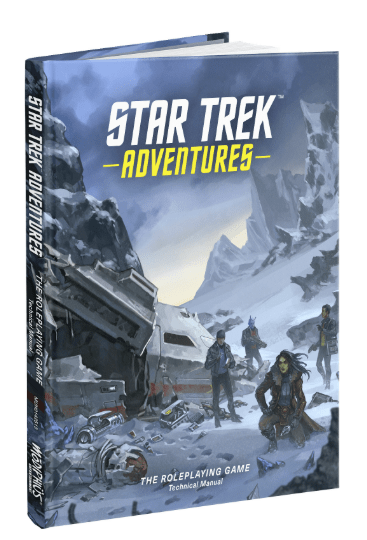
Take your Star Trek Adventures 2nd Edition RPG to the next level with the upcoming Technical Manual. Modiphius Entertainment announced that the new sourcebook will be released in June 2025.

This 129-page full-color hardcover book covers gear from across the Star Trek universe. The Technical Manual will cover details on Starfleet, Klingon, Romulan, Orion, and more technology. Add just about any piece of tech from the Star Trek universe, from universal translators to tricorders. The manual also details medical technology and the engineering elements of transporters.

The Star Trek Adventures 2nd Edition Technical Manual will retail for $46.23. You can order your copy of the base game and the Technical Manual by following this link.

Steamforged Games Announces Helldivers II: The Board Game

Steamforged Games has a history of bringing several video game properties to the tabletop game space, and they continue by announcing a board game adaptation of the hit sci-fi shooter Helldivers II. Manning squads armed with pistols, machine guns, and flamethrowers, players protect Super Earth against alien threats. You’ll complete high-risk missions, navigate battlefields, and overcome enemy swarms.

The crowdfunding campaign will launch on Gamefound on April 8, 2025.

That’s all the geek news we have for this week. Thank you for reading, and wherever you are, I hope you’re having a great day.

Tabletop Game Review: Marvel United, Enter the Spider-Verse

Marvel United has copious amounts of expansions. It’s a CMON Games Kickstarter using the Marvel intellectual property. That’s bound to happen. Geekly won’t be covering every Marvel United expansion, but we will review the ones worth your time or the ones we believe people will most likely purchase. So, you could consider the Marvel United expansions we cover as ones you may want on your radar.

Hey, hey! Kyra Kyle here. In Marvel United, players act as iconic Marvel heroes who work together to stop the master plan of a powerful villain controlled by the game. Each villain has a unique master plan, cards that trigger various effects, and threats that make clearing locations difficult. Heroes clear missions, making the villain vulnerable, and finally take on the big bad villain before they complete their dastardly plan. Can you save the day in time? Enter the Spider-Verse puts players in the spandex of famous characters of the Spider-Man universe.

Before we get any further, we’ll take a side quest and discuss Enter the Spider-Verse’s less heroic details.

Marvel United Box Close Up Board Game Review

The Fiddly Bits

Designer: Andrea Chiarvesio and Eric M. Lang
Publisher: CMON Global Limited and Spin Master Ltd.
Date Released: 2021
Number of Players: 1-4
Age Range: 8 and up
Setup Time: 5-10 minutes
Play Time: 30-40 minutes

Game Mechanisms

Cooperative Play
Hand Management
Modular Board
Solo / Solitaire Game
Variable Player Powers

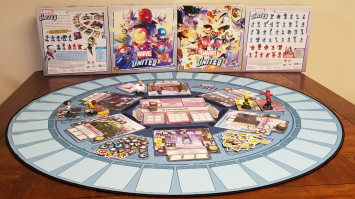
Marvel United Tabletop Game Set Up

Game Setup

We already covered the Game Setup and Game Flow in our Marvel United review (here’s a link to that review), so we’ll go over the basics in the following two sections. Let’s cover an abbreviated review of the game setup and rules.

Marvel United’s setup can change depending on which Villain and Heroes you choose to play. Each game consists of six locations. Typically, core sets have eight locations. Since Enter the Spider-Verse is an expansion, it only has six. You may choose your locations or shuffle them and choose six at random. Each Location card has spaces at the top for civilians and thugs and a rectangle with a block of text that will state “End of Turn” at the top of the box.

Place civilian/thug tokens on their matching spaces. Shuffle the Villain’s Threat deck and deal out each Threat face-up so that it covers the rectangle at the bottom of each location. You must clear this threat before gaining the “End of Turn” effect printed on a Location. Place health tokens where signified on threat cards and on the Villain dashboard. Place the three mission cards (Defeat Thugs, Rescue Civilians, and Clear Threats) face up under the villain dashboard where the text reads “Unlocked.”

Each player shuffles their hero decks and then draws three cards to form their hands. Shuffle the Villain’s Master Plan deck. Leave the Master Plan deck face down. This will be the villain’s draw pile.

Players place their miniatures on one of the six location cards, usually the centralmost location for each player (easy access). Then, they place the villain on the location card opposing the heroes.

Marvel United Game Flow Board Game Review

Game Flow

The villain(s) play first. Draw the top card of their master plan deck. The villain moves the number of spaces indicated. Resolve any BAM! Effects and these effects will be printed on a space within the villain’s dashboard. Then, place the civilian/thug tokens (if any) indicated at the bottom of the card. After all these effects are resolved, the heroes get their turn.

Heroes pick who goes first, and hero turns will continue around the table clockwise. At the beginning of each game, Heroes will get three turns before the villain receives another turn. During their turn, heroes play one card from their hand.

Resolve actions and the symbols printed at the bottom of the hero’s card in any order. The symbols at the bottom of a hero’s card will be shared with the next player, but any printed action will not be shared. Heroes will use these actions to complete missions. The game begins with three missions in play: Defeat Thugs, Rescue Civilians, and Clear Threats. Each mission card will have spaces for the tokens they require to complete. As soon as these spaces are filled, the card is discarded, and the mission is considered complete. Mission cards can be completed in any order.

Marvel United Three Mission Cards Board Game Review

After the heroes complete the first mission, the villain panics and will act (play a card) every two hero cards instead of every three hero cards. After the heroes complete the second mission, the villain becomes vulnerable to damage. The heroes can complete the third mission, but it isn’t necessary. If the heroes do complete the third mission, each hero immediately draws 1 card, increasing each player’s hand size by one.

Play continues back and forth until either the villain wins (by completing their unique master plan or anyone, heroes or villains, runs out of cards) or the heroes win by dealing enough damage to the villain after the villain becomes vulnerable to damage.

Enter the Spiderverse Marvel United

Review

Enter the Spider-Verse features a lot of fan-favorite characters (Spider-Man, Green Goblin, and Miles Morales). Since that’s the case, it’ll be one of the first expansions players will purchase. And it’s a great choice.

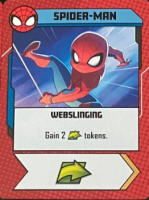
Let’s begin with the heroes. Spider-Man has a lot of potential token gain. I don’t know how many times I saved the day by playing Spider-Man. Seriously, I may have completed most of the games in my guides (here’s a link to Geekly’s Marvel United guides) with Spider-Man. Frankly, he’s a broken character. Broken in the best possible way. I’ve easily played Spider-Man more than any other character in Marvel United. He’s Spider-Man. It’s great that Marvel United made him a character you can return to again and again.

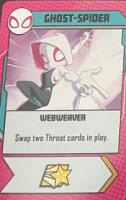
Ghost-Spider and Miles Morales may have more niche abilities, but given the right circumstances, they can be deadly. Ghost-Spider can swap in-play Threat cards (which could be nice for an ongoing ability), and she can defeat all Thugs in her location. Miles Morales’ strongest ability “Web” allows him to delay the Villain Turn by one card. “Web” is a more universal use. Miles may be my second-most played character. Then, there’s Spider-Ham. He’s a Kickstarter Exclusive and that’s okay. He stinks. Good news though. It’s okay if you purchase the retail version over the Kickstarter version. Spider-Ham’s inclusion is the only difference between the two versions, and you’re not missing much with Spider-Ham. Unless you’re a completist or you like Spider-Ham, buy the retail version of Enter the Spider-Verse.

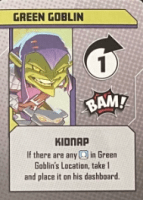
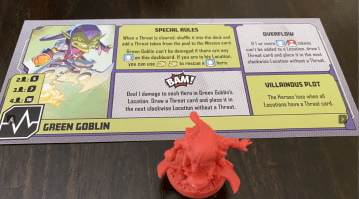
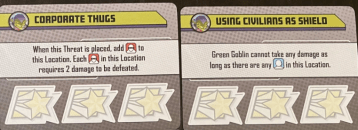
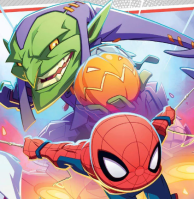
Enter the Spider-Verse’s sole villain Green Goblin is notoriously difficult to beat. I’ve only ever beaten Green Goblin by playing heroes and locations from the Enter the Spider-Verse expansion. Green Goblin has a special setup than the one above. Players don’t begin the game with threat cards in play on locations. Green Goblin will add them as he goes along, and he wins if each location has a threat card. This can lead to players clearing a particularly nasty threat card, like “Electro” or “Using Civilians as Shield,” and Green Goblin putting those cards back in play.

Even though Green Goblin wants to flood the field with threats, he’s just as comfortable throwing obstacles in the way to wait out the clock. “Using Civilians as Shield’s” ability is that Green Goblin will not take any damage as long as there are any Civilians at its location. “Corporate Thugs” make thugs more difficult to defeat. Green Goblin is a classic case of a villain who has multiple ways to defeat his enemies. The best way to stop Green Goblin is to load up on tokens, manipulate the villain deck, and delay the villain’s turn if you can. Fortunately, there are two heroes, and one location included in Enter the Spider-Verse expansion that do just that. Green Goblin earns his reputation as one of the initial Marvel United’s most difficult villains.

The new locations are classic Marvel New York ones. Brooklyn Bridge, Queens, the Daily Bugle, Oscorp Tower. These locations focus on extra tokens. This can be crucial in defeating certain Marvel United villains. Enter the Spider-Verse’s Green Goblin is one of these villains. The other three locations have healing (always appreciated), potentially rescuing a Civilian for free (always good for completing mission cards), and manipulating the villain deck. Couple these abilities with the heroes included in Enter the Spider-Verse, and you can see why this expansion tilts the playing field toward the heroes.

Each expansion adds a challenge card. Challenge cards add an extra layer of complexity to the game. Challenge cards may be small additions, but they can keep the game fresh with an extra rule or two added to the base game.  Enter the Spider-Verse introduces the “Secret Identity Challenge.” This is a classic challenge to add to any Marvel United game. Players must balance their crime-fighting life with their lives spent outside of spandex. This challenge is thematic, easy to understand, and adds just enough additional difficulty.

Enter the Spider-Verse Marvel United

Verdict

Even though I wouldn’t bother with finding the Kickstarter version unless you’re a completionist or a Spider-Ham fan, Enter the Spider-Verse is worth including in your Marvel United collection. The heroes and villain are some of the most powerful. The locations are iconic and pack a punch. And the Challenge Card adds a much-needed twist.

Top 5 Tabletop Games from 1990-1991

Plenty of top-notch board games were released in the nineties. This decade is the first where I could list a Top 5 Board Games for each year, and that will happen—closer to 1992 or 1994. But we will keep to 1990 and 1991 for this list of Top Tabletop Games.

Hey, hey! Kyra Kyle here. Back with another Top 5 Tabletop Games. Board games begin heating up in 1990 and 1991. We’ll talk about board games soon, but first, if you’ve forgotten our criteria for the Top 5 Tabletop Games, let’s reiterate the ground rules before we start.

1: Cultural relevance plays as much of a factor as overall quality. A game might make a list that doesn’t hold up to others of its type, but you must admit the game is everywhere.

2: Only one game from a franchise makes the list. This will become more of an issue the closer we get to games with expansions.

3: Longevity plays a role, too. A game doesn’t have to fly off the shelves today, but it had to have some widespread appeal for a decent time.

5: Crocodile Dentist (1990)

Crocodile Dentist was on and off this list. Ultimately, it makes this list of top board games of 1990 and 1991 because it was the best-selling toy of the 1991 Christmas season. Not just a bestselling game, but a bestselling toy. The toy factor for Crocodile Dentist is overwhelming.

The toy factor makes sense. Crocodile Dentist is a children’s game. In early versions of Crocodile Dentist, players take turns removing a crocodile’s teeth and eventually, the crocodile would snap its jaw shut. Whoever made the titular crocodile shut its jaw was the loser. Crocodile Dentist has a simple premise that makes serious adults groan or guffaw. The York Daily Record’s Mike Argento included Crocodile Dentist in his 1992 Bizarre Toy Awards. However, twelve years later, Argento admitted that the game had “passed into classic status.” And that’s what Crocodile Dentist is, a classic.

4: Tichu (1991)

Real talk. I’ve never played Tichu. It’s the one game on this last that I’ve never played. I would like to; Tichu makes this list because so many board gamers swear by this game. Tichu has a cult following if you will. What I know of Tichu is that it’s a shedding game, meaning that you’re trying to rid your hand of its cards. But Tichu is also a team-based game, so you and your partner are trying to shed your hands before your opponents.

I’ve never had the chance to play Tichu. Tichu is a four-player-only game. If you don’t have four players, you can’t play. And from what I’ve heard, a veteran Tichu player will destroy a noob, and since Tichu is a cult card game, it becomes one of those games where people either don’t play or they’ll only find enjoyment with other accomplished Tichu players. Still, Tichu remains one of the most endearing games on this list, and this list has nothing but endearing games. I’d like to play at least one game of Tichu before long. If anyone plays and you’re going to a board game convention that I’m going to, I’d be happy to learn Tichu.

3: Vampire: The Masquerade (1991)

I can’t remember if I included Dungeons & Dragons in an earlier list. If I didn’t, that was an oversight. But while D&D dominated early tabletop roleplaying games (and still does), the Nineties saw a ton of worthy competitors. Tabletop Roleplaying games saw a boom in the Nineties. The early Nineties only had ten major TTRPG releases. Vampire: The Masquerade is the most famed of these Dungeons & Dragons competitors. In short, Vampire: The Masquerade simulates the afterlife of a vampire.

The developers deliberately didn’t read Anne Rice’s Vampire Chronicles until late in their development process but admit that Rice most likely influenced the vampire films that inspire the game. Rice’s Vampire Chronicles and Vampire: The Masquerade ushered in a new era for vampire fiction and the vampire mythos. The Underworld film series borrows a lot from Vampire: The Masquerade. And the game’s influence was felt in the Nineties. The Goth underground scene flourished with the help of Vampire: The Masquerade and Rice’s Vampire Chronicles.

I still have my original copy and will often pour over the full-page artwork. Artist Tim Bradstreet’s artwork from Vampire: The Masquerade was the concept art for the Blade film series. Vampire: The Masquerade was the height of cool in the early Nineties.

2: Formula D (1991)

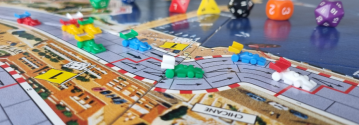
Formula D is a strong second on this list. Until some recent games (games from the 2010s and 2020), Formula D does the best job of simulating a race. Heck, Formula D measures up well against newer racing games. It uses specialized dice (d4, d6, d8, d12, d20, and d30) that represent different gears of a vehicle. Formula D uses an additional d20 for collisions and other course events (like weather). With each turn, players must roll a die that simulates which gear their car is in and must move the number of spaces they roll on that die. The core concept is simple. You’re trying to reach the finish line before anyone else. It would make sense to stay in the highest gear you can. The problem comes when calculating car damage.

Each player takes a “dashboard” for their car. This dashboard will track damage to the various parts of their car. Each track—and there are plenty of bonus tracks you can use for Formula D—will have twists and turns that you must navigate. Taking a turn at a higher speed will most likely cause players to accept damage. A little damage is no big deal. But you could take so much damage that your vehicle crashes.

I like Formula D’s addition of “Rules for Beginners.” It allows players to learn the basics of the game and only when they get accustomed to the base rules, can they then take on more complex rules. Formula D—like the game that claims our top spot—continues to see play, even though it’s over thirty years old.

1: Hoity Toity (1990)

Hoity Toity has gone by several names. Originally, it was released in Germany by the name Adel Verpflichtet or Noblesse Oblige. It was distributed in the United Kingdom under the name Fair Means or Foul and in the United States as By Hook or Crook. It wasn’t until its 2008 reprint that it became Hoity Toity. I’ll refer to it as Hoity Toity from this point forward. Hoity Toity tasks players as members of a pretentious Antique Club who wager which one of them can acquire—by purchase or theft—the most expensive collection of objets d’art in one day.

Hoity Toity deploys a nice combination of bluffing and silent auction. The game’s movement (there is a track players must navigate) feels unique, especially for the time it was released. There shouldn’t be any wonder that Hoity Toity won the 1990 Spiel des Jahres. Klaus Teuber had a dominant early Nineties. I earned another Spiel des Jahres in 1991—back-to-back awards—for Drunter und Drüber, which just missed this list and another Spiel des Jahres in 1995 for Catan. We haven’t gotten to 1995’s list yet, but Catan will make that list. Hoity Toity gets the nod over Drunter und Drüber because it stands the test of time. Most gamers would place Hoity Toity as the second-best board game of Teuber’s career. Hoity Toity earns that distinction.

Did we get the list right, for the most part? Let us know which games you’d add in the comments. And wherever you are, I hope you’re having a great day.

Check out the other lists in this series:
Top 5 Tabletop Games Prior to the 1930s
Top 5 Tabletop Games of the 1930s
Top 5 Tabletop Games of the 1940s-50s
Top 5 Tabletop Games from the Early 1960s
Top 5 Tabletop Games from the Late 1960s
Top 5 Tabletop Games from the Early 1970s
Top 5 Tabletop Games from 1980-1981
Top 5 Tabletop Games from 1982-1983
Top 5 Tabletop Games from 1984-1985
Top 5 Tabletop Games from 1986-1987
Top 5 Tabletop Games from 1988-1989

5 Great Word Board Games

Hey, hey! Kyra Kyle here. We’re going to do something a little different with this board game list. It’s not a list of starter board games of a specific type. If you want us to continue the starter board game series, let us know. It’s not a top 5 or top 10. Nope. This is a list of 5 great board games with a specific style. Today’s list is 5 Great Word Board Games.

Seeing as this isn’t a top 5 list, the games won’t be in any order. We’re also going to try and stick to different kinds of games within the same style, so this list of great word board games won’t be five different versions of Scrabble…hopefully. Without any further ado, here are the games.

Paperback

Paperback combines the idea of a traditional word board game (like Scrabble) with a deck-building game. Players must make words with the letter cards they draw (or a combination of letters on a card like “Th” or “Qu”) and they earn money with which to purchase victory point cards or more letter cards to add to their deck for future turns. Paperback balances its two elements well. A player who can slay at word games can dominate that section, but a player who has more experience and can shift their strategy to the cards present in the deck-building array (you’ll have different cards most turns) can use that to their advantage.

Paperback allows multiple paths to victory and that sets it apart from a lot of other board games centered around words.

Sixes Tabletop Game

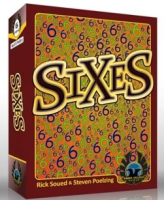
SiXeS

We recently reviewed SiXeS. (If you want to see that review, follow this link.) So, there’s a high probability that SiXeS would make this list. If you don’t want to read the review, that’s okay. We’ll break down the gameplay. SiXeS plays a lot like Scattergories with a twist. Players alternate turns where they want to match the answers to specific questions with their opponents with turns where they want to give unique answers. Unlike other games like Scattergories, SiXeS keeps the gameplay fresh by varying its gameplay each round.

Letter Go!

Like Paperback, Letter Go! combines a word game with another game type. But Letter Go! goes in a completely different direction. It combines a word game with a pseudo-dexterity game. While Paperback’s turns can be slow and methodical, Letter Go! is a real-time race to see who can spell a word using the cards at their disposal while following a rule on their dry-erase board. Some of these rules dictate that you must use your non-dominant hand. Others may say the word’s letters need to be wavy or look like flowers. Even more say that you must repeat all consonants you use but not the vowels.

Letter Go! shakes up the common word game. Just because you can think of a word quickly doesn’t mean that you’ll be able to also obey whatever rule card you draw. Talk about leveling the playing field.

Codenames

I know. I know. Codenames was everywhere for a few years. It’s the gamer’s word game, but there’s a good reason for that. Codenames melds several elements in a fun way. It combines the lateral thinking of TriBond. As the clue-giver, a series of cards with words printed on them stand before you. You can only give a single-word clue accompanied by a number (the number of the cards that match the clue you gave). Your teammates must guess which cards they believe match the clue you gave. But beware, there’s an assassin card. If your teammates choose that card, your team automatically loses.

Codenames has a nice push-your-luck element. As the clue-giver, do you add an extra word or two and make your clue broader? As the guessers, do you continue picking words you think fit the clue or stop after getting one correct? The other team is racing against yours to guess their words. Ultimately, the choice is yours. Choose wisely.

Say Anything

Say Anything is for those who like games like Apples to Apples or Cards Against Humanity. I don’t care for Cards Against Humanity that much, and I got as much out of Apples to Apples without needing to play it any longer. Both Apples to Apples and Cards Against Humanity use pre-printed question and answer cards. There are only so many word combinations you can come up with, but what if you could fill in the blank and provide your own answers? That’s exactly what Say Anything does. You no longer need to find the perfect joke answer for a question. You can write your own joke.

When you’re tired of the same old answers or you don’t want to buy expansion decks for Cards Against Humanity, try buying one copy of Say Anything. The only downside is that you may need to be sober—or at least coherent—to answer the questions.

Say Anything wraps up our collection of great word board games. I’m sure that there are plenty of your favorites that didn’t make the list. Be sure to let us know about them in the comments. And wherever you are, I hope you’re having a great day.

Geekly News: February 9, 2025, Fantastic Four: First Steps Trailer

We didn’t release a news post last week. We’re still figuring out how we’re going to cover Geekly News. This week, we’ll try a headliner story with other stories. Hey, hey! Kyra Kyle here, and we’re back with some Geekly News. Hopefully, I make some sense; I’ve been under the weather this past week.

MCU 2025 Preview Fantastic Four Art

Fantastic Four: First Steps Trailer Dropped

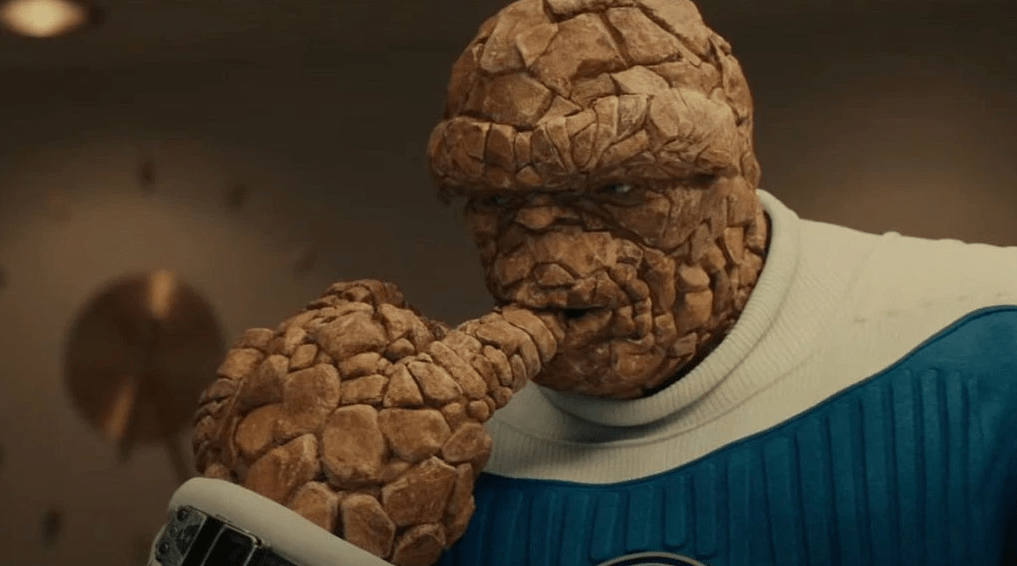
The official teaser trailer for Fantastic Four: First Steps was released on February 5th. The trailer left me equally excited and nervous about the upcoming film. The new movie appears to be the most faithful adaptation of Marvel’s first family. The Thing looks comic book accurate; I watched the trailer multiple times to hear the click of his lips and clack of his fingers. And H.E.R.B.I.E.’s inclusion made me smile. Sure, the special effects look on-point, especially when we get our first glimpse of Galactus, but the teaser’s best feature is how the Fantastic Four interacted. This team has been doing the superhero shtick for a while. They behave like a family and not just because Sue uses the word family. The scene between H.E.R.B.I.E. and The Thing shows us the team’s family dynamic.

Just in case you missed the Fantastic Four: First Steps teaser trailer, here’s the official teaser:

Let’s cover some details from the trailer.

Prior to the trailer’s release, if you happened to log into the live feed, you would’ve seen a countdown sponsored by the Future Foundation. In the comics, the Future Foundation was created by Reed to better serve humanity’s future, and the Fantastic Four’s space suits resemble their Future Foundation super suits. Most likely, the group works for the Future Foundation.

The movie is set in the 1960s and showcases a retro-futuristic look. The Fantastic Four are headquartered in the Baxter Building, just like in the comics. The Baxter Building may or may not replace Avengers/Stark Tower in this alternate reality. Director Matt Shakman manipulates the aspect ratio (when the scene shifts to our first view of the Baxter Building) much like he did in WandaVision.

While The Thing does cook in the comics every once and a while, it’s fun to see the connection between Ebon Moss-Bachrach and his role in The Bear.

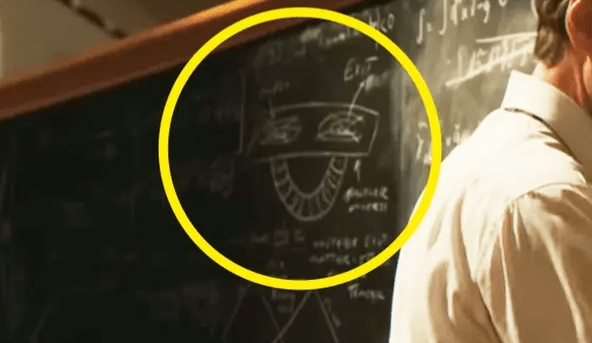
If you pause the scene where Reed works on an equation, you may notice a bridge to observe parallel worlds. This could explain how the Fantastic Four cross over into MCU’s reality.

The rocket the Fantastic Four takes in the trailer is known as Marvel-1. The Fantastic Four are indeed Marvel’s First Family. The company wasn’t even known as Marvel until after the group took to the skies in the Marvel-1. Fantastic Four: First Steps recreates the look of the original rocket.

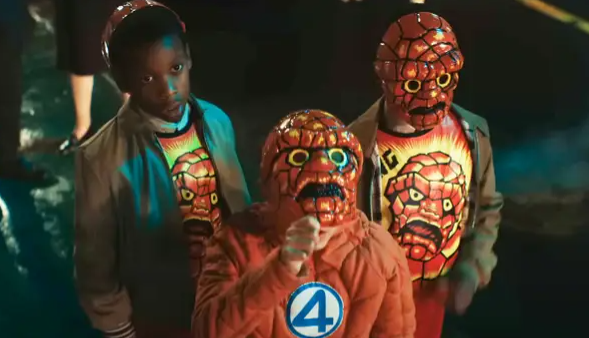
The Thing Halloween masks the three kids wear resemble a rare Thing face mask available in 1967.

The blue car that flies through the streets is most likely the Fantasticar. One can almost make out the name at the front of the car. The flying Fantasticar is the primary mode of transportation for the Fantastic Four.

John Malkovich’s character makes a brief appearance and while the movie hasn’t announced who he’s playing, he’s most likely portraying Ivan Kragoff/Red Ghost. I was relieved. I just finished the Fantastic Four Color Palette Quiz for July and debated if I should include Red Ghost. I thought, nah, no one will know who he is and there’s no way he’ll make an appearance in Fantastic Four: First Steps. Looks like I may have been wrong.

We have a Galactus sighting. Yay! He looks comic book accurate, unlike the cloud in Rise of the Silver Surfer.

Finally, we come to the stage the Fantastic Four stand on during what appears to be a television appearance. I say television appearance because the stage looks like the famous stage that The Beatles performed on during their first performance on The Ed Sullivan Show in 1964.

Like I said, the trailer has me hyped and a little worried. Please. Let this movie be good. It must be good.

PlayStation Network Outage

This is a developing issue and the latest addition to this geekly news break. Sony confirmed a Playstation Network (PSN) outage started on Friday, February 7th at 1900 EST. I’m writing this update on Saturday, February 8th, and the network is still down. Even if the outage returns before this post goes live, PSN would be down for over 24 hours.

The PlayStation Network outage impacts game sales, subscription sign-ups, and microtransactions across the PlayStation Store. Players can’t play live service games. This doesn’t just affect Sony. All third-party partners can’t sell games or content or run their live service games until the PlayStation Network returns.
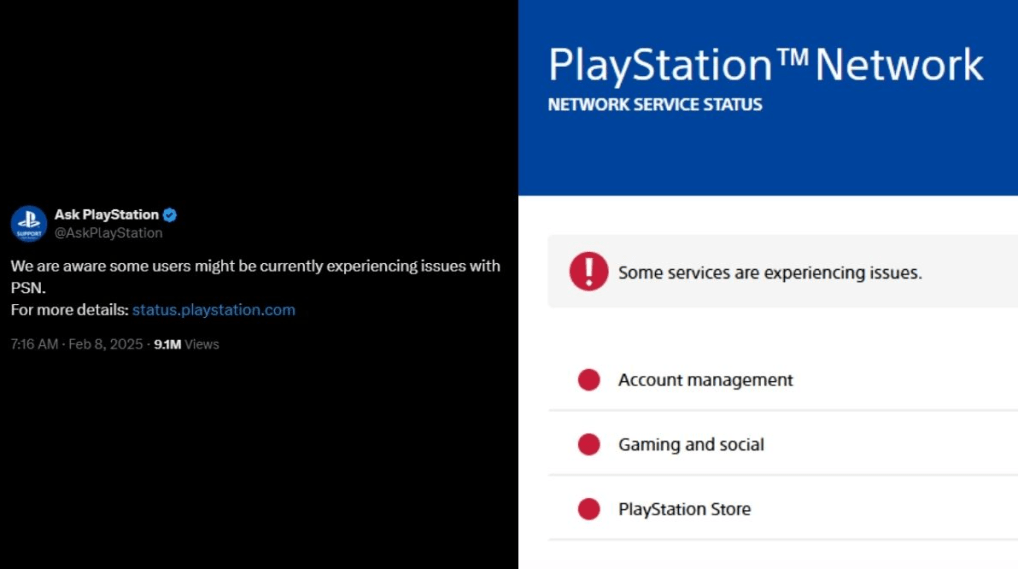
Sony gave a clipped and terse response on February 7th at 2043 EST. “We are aware some users might be currently experiencing issues with PSN.” The company didn’t give any updates or an estimate to when the servers will be restored. The company didn’t even announce that the outage was global. “Some users?” Try all users. If you’re still experiencing issues with PSN while reading this, be sure to check the PlayStation Network status page with this link.

This PSN outage of at least 24 hours marks the longest PSN outage since the infamous 2011 PlayStation Network outage. Back then, the PSN had been out for 24 consecutive days because the system got hacked. Hopefully, this outage doesn’t last as long as the 2011 outage or have as many repercussions.

Azur Promilia Misses Its Release Date

This news is a bit late, but Azur Promilia, one of my most anticipated video games of 2025 (and my most anticipated Gacha video game of 2025) missed its release date of January 25th. You may be asking, “Azur Promilia. What’s that?” Let’s discuss what the game is and what this delay could mean.

What is Azur Promilia?

Azur Promilia is an upcoming Gacha game by Chinese publisher Manjuu. Players recruit characters and form teams like Genshin Impact, sprinkle in some light farm simulation like Harvest Moon, and each character receives boosts from pets you can raise like Pokémon. You can breed these creatures that help you in combat. We don’t know if these critters inherit stats from their parents. If that’s the case, it could reduce the amount of grinding needed in a Gacha. Fingers crossed.

What we do know is there will be mounts, even flying mounts, to traverse a vast open world. The translation (into multiple languages to include English) is complete. The game will have a simultaneous launch (every region will get the game on the same day). It uses a free-to-play Gacha model. And pre-registration is open. You can pre-register for Azur Promilia on the game’s home page. Follow this link.

What does Azur Promilia’s Missed Release Date Mean?

In short, we don’t know. Chinese video game companies apply for a release date a year in advance. Manjuu applied for Azur Promilia’s license on January 25th, 2024, which means the company needed to release the game on or before January 25th, 2025. The cost to apply for a video game release is hefty. There is a chance that Manjuu applied for an extension for their current license, or they may have to reapply. Either way, there has been little word from Manjuu since Azur Promilia missed its release date.

Here comes some speculation. You’ve been warned. Since Manjuu has gone radio silent and China is in the middle of a holiday season, Azur Promilia will be released in April 2025 at the earliest. There is a chance that the game could be released next month (March 2025), but Manjuu will need to ramp up its promotion for Azur Promilia in advance of the game’s release. I wouldn’t mind streaming the game if Manjuu would like to send Geekly a key. Just saying.

If we hear something from Manjuu about a new release date in the next week, great. There’s a chance for a March release. If we don’t, I’d expect an April 2025 release date or later. I’ve been waiting for Azur Promilia for months. It looks fantastic. I can’t wait to get lost in another stunning world. Plus, dragons. I want my dragon mount already.

Dungeons & Dragons Monster Manual Releases

The 2024 version of Dungeons & Dragons Monster Manual will be officially released on February 18th, 2025, but many local gaming stores have had hard copies since February 5th, 2025. I know that the previous sentence doesn’t make sense. The 2024 version of D&D’s Monster Manual releases in 2025. All I can do is shrug. Publisher Wizards of the Coast has an odd release schedule for the 2024, 50th Anniversary Dungeon & Dragons core set.

The 50th Anniversary Dungeons & Dragons edition makes some changes to D&D 5th Edition. Think of it as 5.5 Edition. It caters to new players and streamlines certain aspects of 5th Edition. If you pre-ordered the book, you can pick up your copy. If you didn’t pre-order your copy of the Monster Manual, most local gaming stores will have additional copies. And if you haven’t picked up the rest of the core set (Players Handbook and Dungeon Masters Guide), you should be able to pick up the 50th Anniversary Dungeons & Dragons core set in its entirety. Happy gaming!

And that’s all I have for you this week for Geekly News. Thank you for reading, and wherever you are, I hope you’re having a great day.

Top 5 Tabletop Games from 1988-1989

Hey, hey! Kyra Kyle here. Back with another Top 5 Tabletop Games. 1988 and 1989 may not have as many top-notch games as our previous list, but there are plenty of culturally relevant games from these two years. We’ll talk about board games soon, but first, if you’ve forgotten our criteria for the Top 5 Tabletop Games, let’s reiterate the ground rules before we start.

1: Cultural relevance plays as much of a factor as overall quality. A game might make a list that doesn’t hold up to others of its type, but you must admit the game is everywhere.

2: Only one game from a franchise makes the list. This will become more of an issue the closer we get to games with expansions.

3: Longevity plays a role, too. A game doesn’t have to fly off the shelves today, but it had to have some widespread appeal for a decent time.

5: Merchant of Venus (1988)

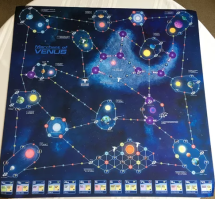
Merchant of Venus is a pun on the Shakespeare play Merchant of Venice. Despite the name, the planet Venus doesn’t appear in the game. Merchant of Venus is set in an unexplored part of the galaxy. Players take on the roles of galactic traders. They move around the board, buying and selling goods. The game begins with players discovering the identity of the cultures in fourteen solar systems available for trade. They often find valuable artifacts from an earlier period of civilization. Once the board has been revealed, the game focuses on moving goods from cultures that build to other races that demand goods.

Merchant of Venus’s turn from exploration to commerce can be a satisfying volta. It reminds me of other games like 2004’s Betrayal on House on the Hill and 2007’s Galaxy Trucker. Both games might also make their year’s respective lists. While it can run a little long (2 to 6 hours), Merchant of Venus can be a lot of fun.

4: Taboo (1989)

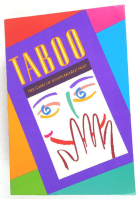
Taboo works a lot like a team-based version of the Ten Thousand Dollar Pyramid game show. It’s played by two even-numbered teams from four to ten. Players sit in alternating teams, forming a circle. One player takes the role of “giver,” who gives their teammates clue words. The “giver” attempts to get their teammates to guess the word printed on the card, but there are “taboo” words. These are words the “giver” can’t say.

While the “giver” can’t say those taboo words, their teammates can make as many guesses as they want with no penalties for wrong guesses. Once the team correctly guesses the word exactly as written on the card, the “giver” moves on to the next word. Teams try to get as many words on a card before time runs out. The playing team gets one point for each correct guess and loses a point each time the “giver” says a “taboo” word. I never liked the buzzer for Taboo. The other team hovers over the “giver” with the buzzer in hand and the obnoxious buzzer they wielded gives me nightmares. Nightmares!

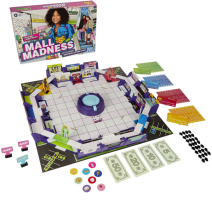
3: Mall Madness (1988)

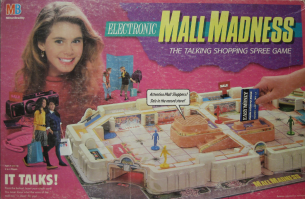
Mall Madness has a simple but fun concept: finish your shopping spree before anyone else. It doesn’t hurt that the game has a 3D board, and the original (back in 1988) had a computer that would dole out player movement and could even keep track of money. The 80s game even came with four different credit cards in addition to traditional paper money.

Players didn’t have to move by exact count to enter each shop, and once you bought something from a shop, you couldn’t reenter the same shop. Mark off the items on our list using plastic pegs in a punch board, and as soon as you’ve bought your six items, race to your parking space. I didn’t play too much of Mall Madness when it was first released. My parents didn’t care for the premise (they didn’t want us kids learning too soon about credit cards), but Mall Madness has left an indelible mark on the board game industry. It’s been in print steadily since its release and has had plenty of themed variants like Hannah Montana and Littlest Pet Shop.

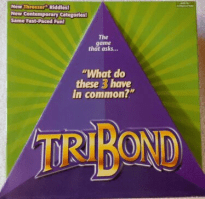
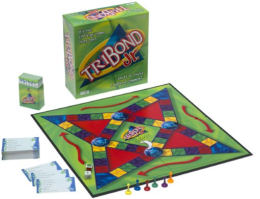
2: TriBond (1989)

We have a second word game for this list, TriBond. But TriBond does something a little different. The game’s main feature is the TriBond “Threezer,” an invented word by the producer to describe the three-word clues players must analyze and determine what all three clues have in common. So, you may get a set of three clues like “Olive, Forest, and Kelly.” They’re all shades of green. Or you may get another set of clues like “Tootsie, Hook, and Rain Man.” All Dustin Hoffman movies.

TriBond adds a little bit of lateral thinking to the classic word game. While I think the word “Threezer” is a bit much, the concept is a great one. And I like the idea that a player can “challenge” another player ahead of them in one of the board’s three tracks. TriBond uses dice, one to determine how far you’ll move on one of three tracks and another to determine your questions category (Entertainment, Sports and Recreation, Academics, and Miscellaneous). The “challenge” allows players to take some of the random luck out of the classic rolls, spin, and move.

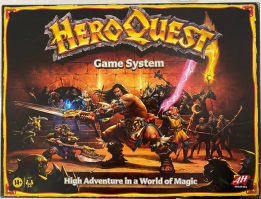
1: HeroQuest (1989)

I have so many fond memories of HeroQuest. HeroQuest plays like a stripped-down version of Dungeons & Dragons. One player assumes the role of the evil wizard Zargon/Morcar. They use the map taken from the game’s quest book to run the game. The remaining players select their character from the four available.

I was a tween when HeroQuest was first released, and since I read the rules, I ran the game as Zargon. That was my first taste of being a dungeon master and D&D. Even though I have great memories of HeroQuest, it is a game for newcomers. Its adventures are pre-programmed and lack the creative impulses of a D&D game, but HeroQuest has a massive toy factor and does an amazing job of distilling the essence of D&D into a digestible, approachable game for younger players. HeroQuest serves as a great gateway into tabletop role-playing games. Fortunately, it’s received a received a reprint.

Did we get the list right, for the most part? Let us know which games you’d add in the comments. And wherever you are, I hope you’re having a great day.

Check out the other lists in this series:
Top 5 Tabletop Games Prior to the 1930s
Top 5 Tabletop Games of the 1930s
Top 5 Tabletop Games of the 1940s-50s
Top 5 Tabletop Games from the Early 1960s
Top 5 Tabletop Games from the Late 1960s
Top 5 Tabletop Games from the Early 1970s
Top 5 Tabletop Games from 1980-1981
Top 5 Tabletop Games from 1982-1983
Top 5 Tabletop Games from 1984-1985
Top 5 Tabletop Games from 1986-1987
Top 5 Tabletop Games from 1990-1991

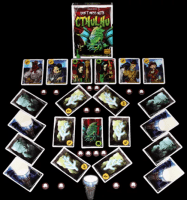
Tabletop Game Review: Don’t Mess with Cthulhu

Hey, hey! Kyra Kyle here. I didn’t realize that I hadn’t reviewed today’s game, so we’ll fix that. Today’s review is another party game: Don’t Mess with Cthulhu.

Don’t Mess with Cthulhu is a social deduction game with secret identities. Players assume the role of investigators or cultists. The investigators must uncover all the Elder Signs to win, while the Cultists win when Cthulhu is revealed or if the game ends before all the Elder Signs are discovered.

Before we venture further into madness, let’s discuss Don’t Mess with Cthulhu’s details.

The Fiddly Bits

Designer: Yusuke Sato
Publisher: Indie Boards & Cards
Date Released: 2014
Number of Players: 4-6
Age Range: 10 and up
Setup Time: Less than a minute
Play Time: 1-30 minutes

Game Mechanisms

Bluffing
Card Game
Deduction
Party Game
Negotiation

Game Setup

You’ll have a different number of investigators and cultists, and various numbers of futile investigation and Elder Sign cards based on the number of players. Consult the charts in the rulebook to determine how many of each needs to be in the game.

Shuffle the appropriate number of Character tokens, dealing one to each player face down. Each player secretly looks at the role assigned to them on the Character token. Place any unused tokens out of play without revealing them.

Then, shuffle the appropriate number of Investigation cards, dealing five to each player face down. Beginning with the starting player (who will have the starter player token, which is a flashlight), each player secretly looks at their Investigation cards and declares (truthfully or not) the number of Elder Sign and Cthulhu cards they were dealt. (Note: there’s only one Cthulhu card in the deck, but that doesn’t mean that more than one player can “claim” to have a Cthulhu card.)

Everyone shuffles their Investigation cards and places them in front of themselves, face down.

Game Flow

Each turn consists of the Active player selecting any Investigation card in front of any player other than themselves. They place the flashlight token on the card they wish to reveal. Other players should feed the player information, keeping in mind that players with the Investigator role want to find Elder Signs, while Cultists want to reveal Cthulhu.

The chosen card is revealed and placed in the center of the play area so everyone can see it. Check to see if the game ends (all the Elder Signs are revealed or if Cthulhu makes an appearance). Play continues with the player whose card was just revealed. They take their turn the same way and this continues until the round comes to an end.

The round ends after the number of actions taken in that round equals the number of players in the game. After the round ends, the remaining Investigation cards are shuffled together and dealt evenly between the players. Again, the players secretly look at their Investigation cards and place them in front of themselves face down.

The game ends immediately if the Cthulhu card is revealed or if all Elder Sign cards are revealed. If neither condition is met, the game ends after four rounds.

If all Elder Sign cards are revealed, the Investigators win. If Cthulhu is revealed or four rounds are played without all Elder Sign cards being revealed, the Cultists win.

Review

Like most party games, Don’t Mess with Cthulhu has a quick setup and playtime. I’ve played this game quite a bit over the years and found that you don’t always need to bluff when playing—but it helps. And it’s fun when more than one person claims that they have Cthulhu. I’ve played a round where three people at the table said they had Cthulhu and then the next round, everyone said they had Cthulhu. It’s a goofy game that doesn’t take long.

And the reason why I say that you don’t have to bluff if you don’t want to is that chance plays a huge role in Don’t Mess with Cthulhu. Even if everyone tells the truth, you still must select the right card, or the game ends and the game can end in the way you don’t want. My family struggles with bluffing in games. Don’t Mess with Cthulhu gives players an option to bluff or not bluff. This leads to some great metagaming. I’ve heard many players say, you never tend to bluff but you did this time and fooled everyone. I’ve also seen the opposite. Don’t Mess with Cthulhu may get better the more games you play with a group.

The stakes are low with Don’t Mess with Cthulhu. Most games last about fifteen minutes with some games going as short as less than one minute. I’ve seen plenty of games where the first or second card the active player chooses is the Cthulhu card. It doesn’t matter. Laugh it off, shuffle the cards, and play again.

Too Long; Didn’t Read

Don’t Mess with Cthulhu is a great change-of-pace game for most gaming groups. It won’t be a group’s main game, but I’ve seen many game nights where this game caps off the session. It’s endlessly replayable and has low stakes. Don’t Mess with Cthulhu’s goofy fun doesn’t force you to bluff—but bluffing doesn’t hurt.

Geekly News: Finspan Board Game Geek Reviews

Stonemaier Games announced a new spinoff game from their wildly popular board game series Wingspan. The series is headed to the depths of the ocean with Finspan. Like Wyrmspan before Finspan, Wingspan’s original designer, Elizabeth Hargrave, is involved. And a funny thing tends to happen with Board Game Geek (BGG) and its review system whenever a Wingspan spin-off gets announced. The game gets an equal number of people who review bomb the spin-off (giving the game a 1 out of 10) and people who give the game top marks.

I came late to the party before I took the above screen capture of Finspan’s rating distribution. The numbers were almost perfectly even between 1s and 10s yesterday. Finspan truthers have more than doubled since then. But Finspan hasn’t yet been released. The game is scheduled for a January 22nd release date. This begs the question, should you rate a game that hasn’t been released?

Quick note: Board game companies do give reviewers advanced copies of games, but these numbers pale in comparison to video games (whose companies give out keys for downloads) because postage is involved. There’s a zero percent chance that the above numbers come exclusively from board game reviewers with advanced copies of Finspan.

To answer that previous question, no. You don’t have enough knowledge to rate a game that hasn’t been released unless you are one of the few board game reviewers with an advanced copy. Board game enthusiasts have been arguing about Finspan‘s rating for the past few days. Some argue that it’s too high. Others that it’s too low. Most people suggest that the problem lies with Board Game Geek.

I don’t buy that. Board Game Geek allows board game companies to upload their upcoming games to the site. This allows companies to lock in a name for a board game, so we won’t get a competing Finspan from some other company. BGG also allows people to write reviews for upcoming games because these games are seen before launch. Undoubtedly, Stonemaier Games brought some version of Finspan to a convention or two, and people demoed it. Some of the above scores may be legitimate.

Then, there’s the question of when does a game officially release? Finspan’s release date of January 22nd is more concrete than many other board games because of a lack of crowdfunding. Does a game’s release date coincide with when the first Kickstarter backer receives their copy? Or is it when the game reaches retail? Maybe the game never reaches retail. Does that mean that it will forever be unreleased, even though thousands of people own a copy?

Blaming Board Game Geek for allowing upcoming games on their site isn’t the issue. The issue stems from people who will rate a game unseen.

How often does this happen? Often. Make no mistake. Wyrmspan received the exact same criticism and scores before its release, and it became one of the most highly rated games from last year (2024). So, why do Wingspan spin-offs get all this hate?

Few other game series get the same vitriol as a Wingspan spin-off. Numerous games have introduced “Duel” or “Duet” versions (2-player variants) of popular games: Splendor, 7 Wonders, King of Tokyo, and Cosmic Encounter. No one bats an eye. Many other games have spawned countless spin-offs: Catan, Ticket to Ride, and even Gloomhaven. Review bombs do occur with these titles but not in the sheer number of a Wingspan spin-off. Why is that?

Not going to lie. Finspan looks cool; I’ll have to try it at least once.

Quick note: I’m not one of the board game reviewers who received an advanced copy; most board game reviewers who do receive advanced copies produce video content (note to self: start a YouTube channel or TikTok account).

I used to think that Stonemaier Games got flak for producing spin-off games because they’re a smaller company. If Days of Wonder released spin-offs during their years of producing one game per year, I would get upset about a spin-off for one year. But Stonemaier has a full slate of board games planned (far more than one) for 2025 that don’t include Finspan. Finspan is extra content.

Furthermore, Gloomhaven has received multiple spin-off board games, and most people cheer for those upcoming games. Cephalofair Games is a much smaller company and produces far fewer games per year than Stonemaier Games. So, “small board game company” can’t be the main reason.

I like to think the reason is closer to people respecting Stonemaier Games and wanting the company to innovate with each one of their games. This is the kind reason why Wyrmspan and Finspan received blowback. I mentioned Days of Wonder’s stretch of “one game per year” for a reason. Days of Wonder was the preeminent board game company at that time. When you saw a Days of Wonder title (this would’ve been about the 2000s and into the early 2010s), you knew the game was high quality. I would’ve been a little upset if Days of Wonder only released a spin-off game at that time because I would’ve wanted a different game to play.

Spin-off board games work like movie sequels. They tend to print money. Wyrmspan sure did last year, and I expect Finspan to do the same. While I can see why some may be disappointed with a spin-off game, Stonemaier Games needs to stay afloat financially. Finspan may be a spin-off game, but it affords Stonemaier Games to take other risks with different titles.

Again, Stonemaier Games has a full slate of games for 2025 that don’t include Finspan. If the innovation reason is why someone rated Finspan low, wait for the game’s release. Wyrmspan tweaked Wingspan’s base gameplay. I expect Finspan to do the same.

There is a penultimate group of people who review a board game on BGG before the game’s release. These folks try to affect the scoring’s bell curve. Some folks refuse to give an unreleased game a perfect or high score, so they tank the score to even out the final rating. This mentality can work the other way, and I think it did with people rating Finspan a 10, even though they’ve never played the game. These are Stonemaier Games truthers who believe in the company. To be fair, Stonemaier Games has earned that trust.

This behavior is odd. BGG doesn’t include a game in its ultimate Geek List until many people review the game or have logged plays of it. There used to be–and sometimes there still is–a time component. A game cannot be listed on the final Geek List unless it’s been released for several months. This does compensate for this odd behavior. Regardless of how BGG’s Geek List works, these games typically get aggregated sufficiently in the end.

In short, I wouldn’t worry about a minority of gamers who would rate a game before the game’s release.

Note: There was one person who claimed, “I don’t like Stonemaier Games,” so there are gamers who don’t like Stonemaier, and that’s fair.

Let’s swim into deeper waters here. Some of you may need a trigger warning for the following darkness. Fair warning, I’m not suggesting that most people who rated Finspan a 1 on BGG belong to this camp. Unfortunately, the number isn’t zero.

Elizabeth Hargrave is a woman. She’s even an outspoken woman who designs board games, and she has a megahit with the Wingspan series. Some people are jealous. Others don’t want to give credit to a woman trying to break into a predominantly boys’ club. I hope the number of people who review bombed Finspan belongs to any of the previous camps, but I’m going to be real. Most likely, at least one person review bombed Finspan because it’s a spin-off game from an outspoken woman board game designer.

So, what are our takeaways? BGG isn’t to blame for review bombing or inflating. Listing a game is great for publicity. I guess even bad publicity is publicity. Whatever the reason someone may review bomb a popular board game series release, people need to chill. Stonemaier will produce multiple games not named Finspan this year. BGG scores will even out after Finspan’s release. There’s room for multiple people of all kinds at the gaming table. Diversity makes our hobby great.

And if you’re picking up a copy of Finspan this month, you’re in the greater Omaha area, and you don’t mind teaching me the rules, I wouldn’t mind trying out Finspan. If it’s anything like Wyrmspan, I’ll play it once and then buy it later. And wherever you are, I hope you’re having a great day.

Tabletop Game Review: Sushi Boat

Hey, hey! Kyra Kyle here. It might be a little early for another tabletop game review, but we’re catching up on some of the backlog. Today’s review is one with a high toy factor (a board game with plenty of toy-like features): Sushi Boat.

Sushi Boat leans into its theme; the board is a sushi conveyor belt. Each turn, players perform their choice of actions, including taking plates of sushi off the revolving belt on the board, paying staff tiles for special effects, or buying side dishes. As they eat, players stack plates in front of them. Players score points by eating off matching (color) plates and for eating a variety of sushi types (set collection). The Wasabi Challenge shakes things up by adding a memory component that can swing the victory.

Before we get any further, we’ll set the table and discuss Sushi Boat details.

The Fiddly Bits

Designer: Dario Massarenti, Francesco Testini
Publisher: Japanime Games
Date Released: 2023
Number of Players: 2-5
Age Range: 9 and up
Setup Time: 15-20 minutes
Play Time: 30-75 minutes

Game Mechanisms
Memory
Set Collection
Worker Placement

Game Setup

Place the wooden sushi boat board (with a built-in “conveyor belt”); this board is the central visual element and will draw a crowd when placed on the board.

Mix the Staff tiles and randomly place 1 on each Staff space (these are pictured in the rulebook). Place all of the Wasabi cubes in the Wasabi Bowl (Sushi Boat includes ceramic bowls; the production value is insane). Each player chooses a color and takes the matching pawn and player mat. Place all of the Yen in the change tray (again, a ceramic tray), this is the bank. Give each player 2 Yen; players place their Yen on their player mats.

Put all the colored Plates in the bag and mix them well, leaving the white plates to the side for now. Then, randomly draw Plates and add them to the conveyor belt area of the board one at a time until the board is full. Then, draw 3 more plates and add them to the Trash beside the board. After filling the game board, add the white Sushi Plates to the bag and mix them in.

Separate the 4 Wasabi cards from the Side Dish cards and set them aside for the moment. Shuffle the Side cards. Then, depending on the number of players in the game, you will discard cards at random from this deck. Then, set aside a number of Side Dish cards equal to the number of players. Add the Wasabi cards to the Side Dish cards and shuffle them well. Create a face-down draw deck near the game board, and finally, place the Side Dish cards you set aside (not the discarded ones) and add them to the top of the face-down draw deck.

Game Flow

Beginning with the starting player, you’ll take turns going to the left. On your turn, you do the following steps in order:

1) You must turn over the top card of the Side Dish deck and refill the Sushi Boat
2) You must move your pawn to an empty seat
3) You may perform one action (from a selection of 3)
4) You must eat sushi

Let’s talk about the different steps in detail.

1) “You must turn over the top card of the Side Dish deck and refill the Sushi Boat.”

We’ll set the Wasabi card aside for the time being; they’re their own beast. Every other Side Dish card will have a symbol in the top right-hand corner. This will tell you how many sushi plates you’ll need to add to the belt. At the bottom, you’ll find effect text; this will give you a special ability if you choose to purchase the card (in a later step) and then use the card.

Wasabi Challenge:
The game stops temporarily. Each player tries to guess the color of the 2 plates hidden in the tunnel at the back of the Sushi Boat. First, take all of the Plates in the Trash and return them to the bag, mixing them well.

Then, each player takes 2 Wasabi Cubes from the bowl and secretly places them on their player mat to mark the colors they think match the hidden Plates. You may place both Wasabi Cubes on the same color if you think both Plates are that color. Finally, add Plates to the board until the two hidden Plates are fully revealed (this will most likely push some Plates into the Trash).

Each player compares their guess to the 2 Plates that were revealed. For each color you guessed correctly, you keep that Wasabi Cube. Any Wasabi Cubes on incorrect guesses get returned to the Wasabi Bowl.

2) “You must move your pawn to an empty seat”

You must move your pawn every turn. You can move it to any seat on the board that isn’t already occupied. But you could pay another player 1 Yen to return their pawn to their player board, so you can claim their seat.

3) “You may perform one action” (from a selection of 3)

A) Visit the Staff: If you’re on a space with a staff member, you can pay 1 Yen to perform their special ability.
B) Buy the top Side Dish: Pay 1 Yen to buy the top card of the Side Dish deck; this will most likely be the card you revealed at the beginning of your turn. Note: Players cannot buy Wasabi Challenge cards.
C) Take 1 Yen from the bank.

4) “You must eat sushi”

Take the Plate from the conveyor belt space that is next to the seat your pawn is on. Typically, you will add these plates to the top of your stack of Sushi Plates. (Some Side Dish Cards allow you to break this rule.)

Play continues like this until the Side Dish Deck runs out. When this happens, the game ends. Players score points for the number of consecutive-colored plates in a row, minus 1. So, a stack of 4 red plates would be worth 3 points. You may have multiple stacks of colored plates. (White plates don’t count for or against a consecutive-colored plate stack.) Then, you add up the sets of sushi you claimed (the unique sushi dishes depicted on the plate; there are 7 sushi types). After that, players get bonuses for playing the most Side Dish cards and some Side Dish cards add a victory point. Finally, each Wasabi Cube is worth 1 point each.

Whoever has the most points wins.

Review

Sushi Boat is a great game with an immense toy factor. This game’s production value is over the top. It may even be too nice—if there is such a thing. Ceramic bowls? Are you kidding me? My oldest daughter just returned from Japan and had plenty of real Yen to replace the punchboard Yen included with the game. Even without that, Sushi Boat has fantastic components.

Sushi Boat balances its elements well. I didn’t think memory and worker placement would work, but it does. I’ve found that younger players (ahem, children, ahem) have an advantage during Wasabi Challenges. I tend to focus on the mechanical aspects of the game like special abilities (through the staff and Side Dish cards) and forget to keep track of which plates have slid under the tunnel. This is the one aspect I’ve found most children gravitating toward. This typically gives a child player an extra three or four points.

Speaking of the tunnel and the titular sushi boat, the sushi boat looks fantastic. Sliding Sushi Plates across the “conveyor belt” feels great. I’ve even visited a sushi boat restaurant since playing this game. They use colored plates to tally your bill. Ingenious. And that’s what Sushi Boat’s central board is, too. Ingenious.

The one negative I’ve found is the setup and rules explanation. I’m not lying when I cited the setup time in “Fiddly Bits” as “15-20 minutes.” That’s a little long for Sushi Boat’s weight and game length. I almost feel compelled to play more than one game at a time. The rules explanation for new players can also take a little extra time than what I’d like for a game of Sushi Boat’s length, too. But retaining the rules from one play to the next is easy. Barely an inconvenience. The actions that players perform in Sushi Boat are so thematic that it makes it easier to relearn the game, even if you haven’t played in months.

Verdict

Setup and initial rules explanation can be on the long side, but the effort is well worth it for a game this thematic. While an odd combination, the game’s mechanisms work well together and level the playing field for children. And the board. Look at the board!