



We’re back with another Marvel United expansion review. Marvel United is a CMON Games Kickstarter using the Marvel intellectual property. We’ll have plenty of chances to cover more expansions like today’s focus, Return of the Sinister Six. Geekly won’t be covering every Marvel United expansion, but we will review the ones worth your time or the ones we believe people will most likely purchase. So, you could consider the Marvel United expansions we cover as essential.
Hey, hey! Kyra Kyle here. In Marvel United, players act as iconic Marvel heroes who work together to stop the master plan of a powerful villain controlled by the game. Each villain has a unique master plan, cards that trigger various effects, and threats that make clearing locations difficult. Heroes clear missions, making the villain vulnerable, and finally take on the big bad villain before they complete their dastardly plan. Can you save the day in time? Return of the Sinister Six pits players against more than one villain at a time. With this expansion, you have the option to take on the iconic villain team The Sinister Six.
Before we get any further, we’ll take a side quest and discuss Return of the Sinister Six’s dastardly details.
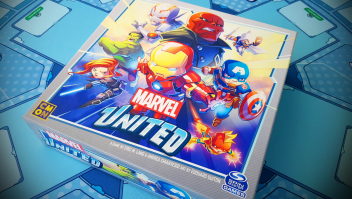
Designer: Andrea Chiarvesio and Eric M. Lang
Publisher: CMON Global Limited and Spin Master Ltd.
Date Released: 2021
Number of Players: 1-4
Age Range: 8 and up
Setup Time: 5-10 minutes
Play Time: 30-40 minutes
Cooperative Play
Hand Management
Modular Board
Solo / Solitaire Game
Variable Player Powers
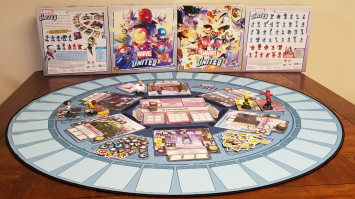
We already covered the Game Setup and Game Flow in our Marvel United review (here’s a link to that review), so we’ll go over the basics in the following two sections. Let’s cover an abbreviated review of the game setup and rules.
Marvel United’s setup can change depending on which Villain and Heroes you choose to play. Each game consists of six locations. Typically, core sets have eight locations. Since Enter the Spider-Verse is an expansion, it only has six. You may choose your locations or shuffle them and choose six at random. Each Location card has spaces at the top for civilians and thugs and a rectangle with a block of text that will state “End of Turn” at the top of the box.
Place civilian/thug tokens on their matching spaces. Shuffle the Villain’s Threat deck and deal out each Threat face-up so that it covers the rectangle at the bottom of each location. You must clear this threat before gaining the “End of Turn” effect printed on a Location. Place health tokens where signified on threat cards and on the Villain dashboard. Place the three mission cards (Defeat Thugs, Rescue Civilians, and Clear Threats) face up under the villain dashboard where the text reads “Unlocked.”
Each player shuffles their hero decks and then draws three cards to form their hands. Shuffle the Villain’s Master Plan deck. Leave the Master Plan deck face down. This will be the villain’s draw pile.
Players place their miniatures on one of the six location cards, usually the centralmost location for each player (easy access). Then, they place the villain on the location card opposing the heroes.

The villain(s) play first. Draw the top card of their master plan deck. The villain moves the number of spaces indicated. Resolve any BAM! Effects and these effects will be printed on a space within the villain’s dashboard. Then, place the civilian/thug tokens (if any) indicated at the bottom of the card. After all these effects are resolved, the heroes get their turn.
Heroes pick who goes first, and hero turns will continue around the table clockwise. At the beginning of each game, Heroes will get three turns before the villain receives another turn. During their turn, heroes play one card from their hand.
Resolve actions and the symbols printed at the bottom of the hero’s card in any order. The symbols at the bottom of a hero’s card will be shared with the next player, but any printed action will not be shared. Heroes will use these actions to complete missions. The game begins with three missions in play: Defeat Thugs, Rescue Civilians, and Clear Threats. Each mission card will have spaces for the tokens they require to complete. As soon as these spaces are filled, the card is discarded, and the mission is considered complete. Mission cards can be completed in any order.
After the heroes complete the first mission, the villain panics and will act (play a card) every two hero cards instead of every three hero cards. After the heroes complete the second mission, the villain becomes vulnerable to damage. The heroes can complete the third mission, but it isn’t necessary. If the heroes do complete the third mission, each hero immediately draws 1 card, increasing each player’s hand size by one.
Play continues back and forth until either the villain wins (by completing their unique master plan or anyone, heroes or villains, runs out of cards) or the heroes win by dealing enough damage to the villain after the villain becomes vulnerable to damage.

Return of the Sinister Six has no heroes, locations, or challenge cards. Instead, Return of the Sinister Six doubles down with villains. You can play each villain one at a time like normal or you could face the Sinister Six as a team. Taking on the entire team at once is not for the faint of heart.
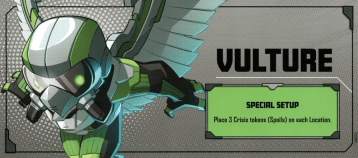
Let’s begin with the villains as individuals before we discuss the Sinister Six as a team. Vulture may be the most difficult Marvel United villain within the game’s initial run. He takes crisis tokens (Spoils) from Locations (each Location begins with 3) and wins the game if he reaches a certain number of Spoils (based on the number of Heroes). Early Marvel United characters had precious few ways of discarding crisis tokens. That’s changed a bit with the X-Men and Multiverse releases, but characters who specialize in crisis token mitigation are rare. Vulture’s abilities suggest that players must rush him. Finish the missions quickly and then bombard him with damage. This is easier said than done. Vulture has several ways of stealing crisis tokens, avoiding damage, dealing damage to heroes, and moving to the opposite side of the board. If you want a challenge, Vulture is your villain.

Return of the Sinister Six introduces a lot of interesting game mechanism twists with its villains. Eric Lang and company stretch the limits of the Marvel United core rules with this expansion. Doc Ock is no different. He wins if he destroys 4 or more Locations. While this can be difficult for him to accomplish, the fact that the board shrinks is a lot of fun. His Threat cards lean heavily on henchmen, so you’ll see many members of the Sinister Six. Mysterio as a henchman proves particularly difficult. Doc Ock can deal damage in a hurry and the shrinking board—if the players allow the board to shrink—can make Doc Ock formidable. I like Doc Ock’s change of play and the new challenge.
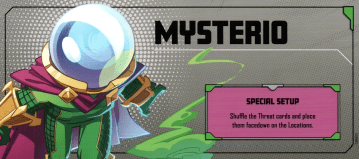
Speaking of change of play and a new challenge, Mysterio is up next. He’s the only villain in the original release that places Threat cards face down on Locations. Players must flip over Mysterio’s Threat cards (by spending any single action) and clear at least two Threats before Mysterio can be damaged. Mysterio doesn’t have a special win condition like Vulture (stealing enough Spoils) or Doc Ock (destroying 4 Locations); he makes up for this by delaying the heroes and speeding up his deck. Mysterio is the first Marvel United villain to use a speeding deck as a mechanism. He’s perfect for players who have grown accustomed to the game’s flow and timing. Mysterio can cause the game to end suddenly. I love Return of the Sinister Six’s gameplay variety.

Enter Kraven the Hunter. As his name suggests, Kraven actively hunts the heroes. He wins if he KOs the heroes at the same time. This sounds difficult, but Kraven’s deck works perfectly to achieve this end. While players may be thinking of the game clock ending too soon with Mysterio or the game’s board shrinking with Doc Ock, Kraven gets the heroes thinking about self-preservation. This is a very different mindset than most other villains in the original Marvel United’s run. Kraven can even deal extra damage if a Location lacks Civilian and Thug tokens. Up to this point, players are encouraged to keep Civilian/Thug spaces empty. Kraven turns this idea on its head.

That gets us to Sandman who may have the most irritating ability from the Return of the Sinister Six expansion. He gains health through various means and wins if his health ever reaches 20. Thankfully, Sandman mostly focuses on soaking up damage, so players are encouraged to pick heroes who can deal buckets of damage. Even with a stellar team, defeating Sandman is easier said than done. I don’t know if I was able to defeat any villain inside the Return of the Sinister Six expansion on my first try. This leads to some excellent replayability.
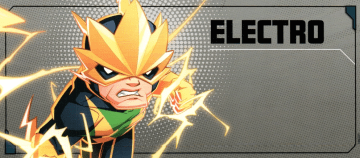
Electro may seem like the easiest villain to defeat, but he can fool you. He wins if all Locations in play have a crisis token. He has limited means with which to place crisis tokens, but Electro’s overflow ability is one of those ways, and he places a lot of Civilian and Thug tokens. It’s easy for Electro to cause an overflow. He can also deal a lot of damage. In fact, Electro has some of the highest potential damage output in Marvel United’s original run, and if Electro KOs a hero, he places yet another crisis token. Electro may sound like a lot of other Marvel United villains, but he stands out. Electro doesn’t deal damage to heroes at his Location. He deals damage to heroes in the Location opposite to his Location. This change-up gets me every time.
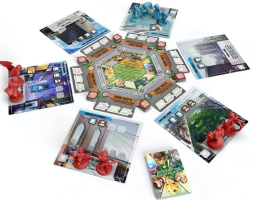
We’ve come to the Sinister Six as a villain team. They’re brutal. As of this write-up, I have yet to beat the Sinister Six. Typically, I write a guide for a Marvel United villain after I’ve defeated them (quick shout out to our Marvel United guides, check them out here with this link). I have yet to post a guide to the Sinister Six team. Hopefully, that will change soon.
The individual team members of the Sinister Six may have scaled-down powers, fewer hit points, and a streamlined means of defeating each one, but they play similarly to their solo villain counterparts. I got ahead of myself, let’s talk about weakening each of these villains so you can deal damage to them. Each one has a Weak Spot card, which functions similarly to a Threat Card. All the heroes must do is match the symbols on the corresponding Weak Spot card, travel to the same Location as the villain, and then deal damage.

It both is and isn’t that simple. The Sinister Six will trigger their effects, or at least the top two members listed on the Sinister Six card will. And if you think the Sinister Six members’ abilities were difficult one at a time, they’re worse all at once. Or at least two at a time. You’ll need to defeat the Sinister Six in a specific order. This is getting into guide territory. I know the order, even if I haven’t yet defeated the Sinister Six. I’ve gotten so close multiple times. Ugh!
Knowing the best order to defeat the Sinister Six doesn’t guarantee a victory. I can see the Return of the Sinister Six expansion providing me with a worthy challenge for years. If you own any of the Marvel United core boxes, I recommend picking up the Return of the Sinister Six because of its gameplay variations and increased challenge. If you’re a Spider-Man fan and own any of the Marvel United core boxes, I can’t imagine you not picking up the Return of the Sinister Six expansion. It’s a must-buy.

Return of the Sinister Six is a must-buy Marvel United expansion, especially if you’re a Spider-Man fan. The included villains have some of the most unique game mechanisms from the original Marvel United run. The villain team provides a challenge that will shake up Marvel United for years.
And you don’t need to take my word for it. Board Game Geek (where great games and their expansions receive average scores of 6 or 7 out of 10) gives this expansion an 8.6 (as of writing this post).

Today marks our first post for Geekly’s Whatcha Playing series. In this series, the Geekly Gang will share which games (board games and video games) they played over the last thirty or so days. We welcome you to join the Geekly Gang and share the games you played this past month.
Before I get started, I’m not going to include any of my prototypes. Of course, I’ve played my prototypes plenty of times this past month, but I’ll include those games with our upcoming “Fifth Wednesday, Personal Updates” post. Until then, I’ll discuss the games I’ve played this past month that I didn’t design.

I fell down The Survivalists rabbit hole. For a week last month, I spent almost every day trying to build each structure and cook every recipe. I’ve never played The Escapists. The Survivalists are set in the same world, and I don’t think I missed too much for not having played the game that inspired its world. This game plays like a low-pressure version of Ark: Survival Evolved. Obviously, I like this game. I played almost forty hours in just over a week. Yikes!
I’ve been keeping up with Wuthering Waves and Honkai: Star Rail. Geekly has a review on both of these gacha games. I haven’t played too many video games this past month besides these three games. I’ve mostly played board games.

I played Dice Throne for the first time this past month. It’s a little too combat-heavy for me; I would’ve liked a few more things to do besides worrying about positioning, defense, and damage output, but what’s there is intriguing. I like how each character’s dice are unique, but they retain a six-sided die’s classic numbering. Players can trigger abilities by matching symbols or using numbers. This is a clever mechanism. It makes most die rolls useful, and I like purposing my dice each turn.

I also played We’re Doomed! for the first time, too. We’ll have a review on this one in the coming months. We’re Doomed! is a raucous party game with a real-time element. The world is doomed. You need to work together to build a large enough spaceship for everyone to leave the planet, or you could screw over the players. Players take on the roles of world leaders. Each player has the same five options for actions each round, but the role a player has gives them a bonus for one of those actions. The game’s event cards can disrupt the game flow to a point where the game breaks, but We’re Doomed! is dumb fun.

From one silly little game to another. Don’t L.L.A.M.A. Card Game is designed by board game legend Reiner Knizia. It reminds me a bit of Uno with a twist. You attempt to rid your hand of cards by matching the number on top of the discard or playing a card higher than the card showing. The cards are numbered 1-6. Llama cards count as 7s. Don’t L.L.A.M.A. Card Game is a quick, award-winning filler card game. I highly recommend it.
I could list more but I’ll let Season and Skye share their games. Thanks for reading.
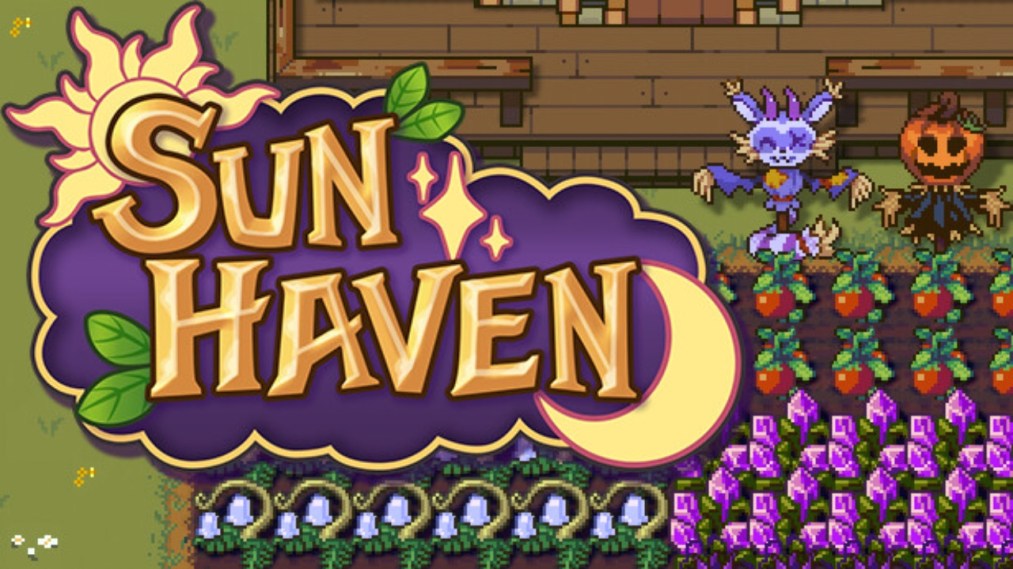
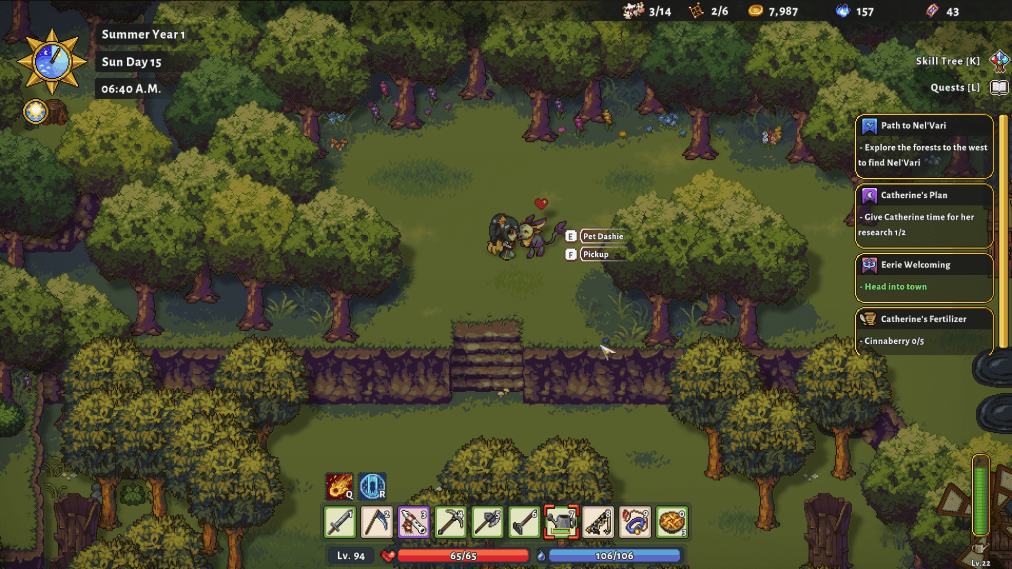
I don’t think I’ve mentioned this before, but I’m a fan of RPG style farming sims (similar to the Harvest Moon franchise). I’ve lost count of how many I’ve played. I picked up Sun Haven during Steam’s spring sale. It’s got a much larger map than what I’m used to from an RPG farming sim and has options for mounts, pets, and accessories. I’m a sucker for all of these things.
One feature I appreciate about Sun Haven is the ability to choose your race, class, and free initial customization options. Your race and class give you bonuses in the game based on how you want to play. When I say, “free initial customization,” I mean you just design a character without picking a gender. You don’t even get the option to pick a gender, like most of these games require. All romance-able characters are available for the player to choose from and you can increase your bond with them based on picking dialogue options they like in addition to gifts.
I’ve also been playing Honkai Star Rail and Wuthering Waves regularly. They’re a staple of my video game diet, so I won’t go into detail. Good luck on all of your 50/50’s to those of you who play either/both of these games.
Okay. I know this is a collectible card game (CCG). I recently played Magic: The Gathering with a friend and got hit with a wave of nostalgia when I got to play with my fifteen-year-old decks. I’ve only played commander a couple of times in the past, which is the standard way to play Magic: The Gathering now. You have a powerful creature (your commander) who starts the game off the field while the rest of your deck is ninety-nine cards, all of which must be unique (outside of basic land cards). It plays like a normal games of Magic: The Gathering, but you can summon your commander even if it dies, as long as you have the mana.
I’ve played a few prototypes last month, but haven’t played as many board games as I would have liked. I’ve been settling into a new position at my day job, so I haven’t had as much time/energy for board games. I’m hoping to play more this month.
Hello, Geekly Gang! Yes. I also enjoy games. So here are some that I’ve been playing lately.

Gacha friends, rejoice. I have returned to Wuthering Waves and Honkai: Star Rail. While I’ve always enjoyed these games, they can sometimes be difficult to keep up with. That’s why I took a break from gacha games. Now that I’m trying to loosen up, I thought it was a good time to revisit them. I’m so glad I did!
No gacha game is perfect, but the simple act of building your teams, finding secrets, and yes, owning as many characters as possible is enough to keep me hooked. Since I’ve circled back around to them, it’s been difficult for me to put them down. I’ll admit that grinding gets old. Please implement more multiplayer options. I’m desperate!

Speaking of loosening up, Pixel Art is my go-to relaxation app. While not technically a game, coloring to your heart’s content is comforting. My favorite aspect of the app is the ability to create your own pixel art creations using images from your phone’s camera roll. Lately, Pixel Art has been my primary method of preserving my memories. Who needs photo albums when you have Pixel Art?

Ever since I was a kid, I always loved the Final Fantasy series (even if it was vicariously through watching my parents play it). Lately, I’ve started playing the original Final Fantasy. Since the first Final Fantasy game I played was VII, I’ve taken it upon myself to play each one that came before it. Thankfully, my sister has the Final Fantasy I-VI Pixel Remaster Collection for PlayStation4, so thank you for letting me borrow it. 😉
It’s surreal to see where this behemoth of a franchise started. The story doesn’t always make sense, but the gameplay is still fun. My favorite part is that even though (then) SquareSoft didn’t understand what it was at the time, the game is still clearly a Final Fantasy title. I can see why this is SquareEnix’s golden goose.
Like other Geekly members, I’ve taken up this quaint yet satisfying game. Since I’ve been a long-time fan of survival sandbox games, it’s been fun seeing Team 17’s interpretation of one. Like most Gen Zers, my first survival sandbox game was Minecraft. It wasn’t hard for me to fall in love with The Survivalists.
Like most survival sandbox games, The Survivalists can become stale after a while. It can take an hour to get things done. If you’re a fan of the genre like me, you’re used to that. The Survivalists will soon join the roster of survival sandbox staples like Terraria, Don’t Starve, ARK: Survival Evolved, and Minecraft. Also, this one has monkeys. Monkey butlers. What more do you want?
Thank you for reading, and wherever you are, I hope you’re having a great day.

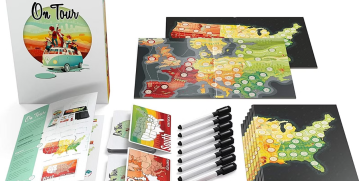
On Tour puts you in a rock band. You’re living the dream. You must schedule the band’s stops over your 100-day tour, visiting as many states (or countries depending on the map you choose) as possible. Roll the dice and chart a course with the most concerts.
Hey, hey! Kyra Kyle here. Today’s tabletop game review is the roll-and-write game by All Play (BoardGameTables.com at the time of its original print) On Tour. We’ll set off on our tour soon, but first, let’s handle some of On Tour’s behind-the-scenes details.
Designer: Chad DeShon
Publisher: BoardGameTables.com
Date Released: 2019
Number of Players: 1-8
Age Range: 8 and up
Setup Time: Less than a minute
Play Time: 20 minutes
Bingo
Dice Rolling
Line Drawing
Network and Route Building
Push Your Luck
Simultaneous Action Selection
Solo/Solitaire Game

1) Give each player their own player board and a dry-erase marker.
2) Shuffle the cards and place them in the center of the table.
3) Roll the dice (2 large 10-sided dice). For setup only, re-roll doubles.
4) Combine the results to form two different 2-digit numbers (i.e. 1 & 4 combine to form 14 & 41).
5) One player draws a card. All players write the lower dice combination on that state.
6) Draw another card and all players write the higher dice combination on that state.
7) Each player circles both numbers.
8) Repeat steps 3-7.
9) Remove the four cards from the game.
Choose a player to begin the game by rolling the dice first.

With each turn, the rolling player draws 3 cards and reveals the cards for all players. If the deck ever empties, reshuffle the deck to form a new deck.
The rolling player rolls both dice. Combine the results to form two different 2-digit numbers (i.3. 5 & 6 combine to form 56 & 65). All players simultaneously write each of those numbers in two empty states (or countries) on their board.
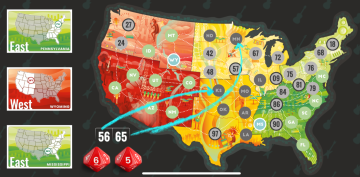
When writing numbers, players choose two of the three cards. The numbers must be written in one of the regions on the displayed cards (like North and Central). If you write a number on the same state displayed on the card, circle it. When writing numbers, a different card must be used for each number.
If all three cards display the same region OR if doubles are rolled, each player draws one star in any one empty state on their board instead of writing numbers. The state must be in the same region as shown on the card. You may still circle the star if you use an exact state from a card.
When all players have written their two numbers, discard the revealed cards and pass the dice to the next person clockwise.
When only one or two empty states remain, do not flip cards, instead roll dice. Players may freely write numbers in any remaining states, following the usual rules.

When all states are filled, the game ends. Beginning in any state, draw a continuous route for your tour. The line must continue to any adjacent state with a number equal to or greater than the previous state you started in. Stars are wild and count as any number.
You can never return to a state that you have already visited. You can never go to a state with a lower number.
Score one point for each state you visit and an additional point for each circled star or number on your route. The highest score is the winner.
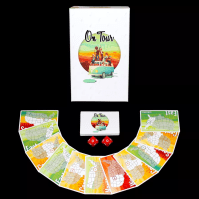
First, I didn’t change much from the rulebook in the game setup and game flow sections. I always use a game’s rulebook as a point of reference when writing these sections. Typically, I need to reword or condense multiple passages in a board game’s rulebook to make it easier to read or to get the gist of how a game is played. On Tour’s rulebook, like many other All Play (formerly boardgametables.com) rulebooks, is easy to read. The company has a mission of making board games accessible to more people. Their well-written rulebooks go a long way toward that end.
I like On Tour’s twist on the roll-and-write or flip-and-write mechanism. Note: roll-and-writes have Yahtzee as a basis, where players roll dice and then fill in the results on their player boards, while flip-and-writes typically replace dice with cards. On Tour combines both mechanisms flawlessly and that leads to each game playing differently. I’ve played plenty of On Tour, mostly solo, and each game presents a different challenge. I may get the card I need, but not the right numbers or I may get the numbers I need, but not the right card. Some combination of this will happen in every game but each game feels fresh.
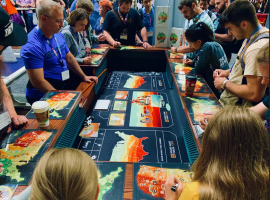
I enjoy On Tour’s solo mode, but the game plays better with multiple players. Like most roll-and-writes, players fill in their maps at the same time and this accommodates larger player counts. Playing with a full complement of eight players may only add ten or so gameplay minutes. Knowing the map helps make decisions easier. I don’t take long to fill in my map, but a new player would take a hot second to make their decision. But I wouldn’t say that knowing a map gives a player an unfair advantage. It’s an advantage but not a huge one. I’ve lost plenty of times to noobs. That may say more about my inability to play On Tour well.
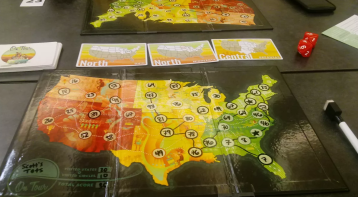
The player boards are two-sided. One side depicts the United States, while the other is a map of Europe. New players should start with the United States. The regions are easier to spot (North, South, East, West, and Central). The straight boundaries of Colorado, Wyoming, and other mid-western and western states help.
I add a rules variant and allow players to chart their route as they fill in states (countries). You can always erase a route if you choose to go in a different direction. The end game (of figuring out which route you’ll take) can take almost as long as the game itself. Filling in a tentative route as you go shortens the time you need for final scoring. It also leads to table talk where someone undoubtedly says, “Well, I guess I’m cut off from Washington (or some other state).” Since you’re using a dry-erase marker, these tentative routes can be altered.
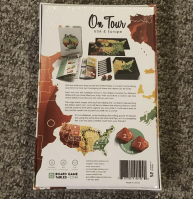
I often bring On Tour while on vacation. While On Tour is one of All Play’s standard box-size games, these boxes are still roughly 7 x 11 inches, making it easy to pack in a suitcase. And its price of $40 is nice. All Play games skew toward wider appeal (code for lighter games), but one can’t question the company’s quality of games and its commitment to cheaper price points.
On Tour blends roll-and-write and flip-and-write mechanisms for a fresh take on both game mechanisms. While knowing one of the maps can help with making faster decisions, veteran players don’t gain too much of an advantage over newer players. The game plays well as a solo game but sings at large player counts. On Tour continues All Play games’ mission of making board games accessible to a wider audience.

Comic Hunters casts players as comic book collectors trying to collect the most impressive comic book collection over a single weekend. Comic Hunters also marks the first of several games I picked up over Christmas. I’ve had enough time to play these games for a review so be on the lookout for more games I picked up over the holidays.
Hey, hey! Kyra Kyle here. We’re taking a break from playing as superheroes to collecting the works in which they appear. Comic Hunters has an intriguing premise. It also features a heap of iconic Marvel comic book covers. I can’t want to get into the review, but before we get any further, let’s look at Comic Hunters’ fine print.
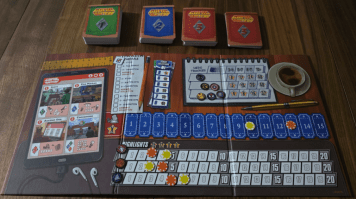
Designer: Robert Coelho
Publisher: Arcane Wonders and Spin Master Ltd.
Date Released: 2020
Number of Players: 1-4
Age Range: 10 and up
Setup Time: 5-10 minutes
Play Time: 45 minutes
Auction: Turn Order Until Pass
Closed Drafting
Hand Management
Open Drafting
Set Collection
Comic Hunters has special setup rules for games with fewer than four players. It even has a solo game variant. These rules aren’t too difficult (mostly removing cards and other bits from play that relate to the removed cards). We won’t include those special rules here. We’ll continue the game setup section as if you’re playing with four players.

Comic Hunters has three card types that represent different comic book eras: level 1 (2000-present), level 2 (1980s and 1990s), and level 3 (1960s and 1970s). Each of these card types (with unique card backings) also represents locations: level 1 (comic book stores), level 2 (flea markets), and level 3 (auction websites). Shuffle each one of these three decks separately. Without looking at the cards, take ten cards from each of these decks to make a fourth deck. Shuffle this fourth deck. This will be the convention deck.

Place the checkmark token in the first Schedule box of the first round. You will play rounds according to the Schedule.
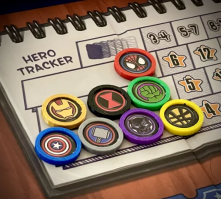
Assemble and organize the 8 Hero Tokens on the Hero Tracker Table. In a 4-player game, draw and place 1 Hero token for the first row, 3 Hero Tokens for the second row, and 4 Hero Tokens for the third row. The value of these heroes’ comic books will vary with the top row being the most valuable and the bottom the least valuable.
Each player takes their Player Token of their chosen color and places it on the “15” space of the Secret Stash track. This will be your money with which to buy lots during auctions. Any of your remaining stash becomes victory points at the end of the game.
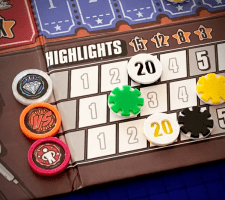
Next, setup the Highlights section. Draw one of the Highlight Tokens and place it on the leftmost space of the top row. Do the same for the next two rows. Each of these Highlight Tokens denotes something special about a comic book. They can be a character’s first appearance, the first issue of a series, an epic battle, a new look (for a character), or a special edition. Players will score points depending on who has the most comic books that match the in-play highlights. Since there are five tokens and you’ll only play with three Highlight tokens, scoring changes from game to game.
Finally, hand one player the First-Player Token. The rules suggest that the player who’s last seen a Marvel Movie or read a Marvel Comic should go first, but you can choose the first player randomly.

Comic Hunters is divided into 3 rounds. Each round has 2 stages: Treasure Hunting and Assemble Your Collections. During the Treasure Hunting stage, players will visit 3 of the 4 possible locations to acquire comic book cards. All you must do is follow the rules of the location indicated by the schedule. Once the first location is played move the schedule to the next location. Each location plays differently from the next.
The comic book store plays with classic closed drafting rules (like Sushi Go). Players get dealt four cards from the level 1 deck. They select one card and pass the cards they didn’t choose to the player to their left. This continues until there are no more cards left to pass.
In this location, players take turns, clockwise, starting with the player holding the “First-Player” token. To set up the Flea Market, make a column from the level 2 deck equal to the number of players. Reveal a card from the level 2 deck to place in the first position of each Row. When it’s your turn, you must perform one of two possible actions: reveal a card from the deck and place it to the right of the rightmost, available space in one of the rows, or pick up all the cards from one Row of your choice. Rows can have up to four cards.

To set up the auction website, lay out four rows of the level 3 cards. The first row must contain 5 cards. The last row must contain 3 cards. The middle two rows contain 4 cards. These rows are Lots up for auction. The player with the First Player Token selects which Lot to bid during the round. They open the bidding with at least 1 (of their secret stash). The auction website plays like a traditional “bid or pass auction.” On their turn, a player either bids higher than the current bid or passes (and they’re out for the rest of the auction). Highest bid wins. Whenever one lot remains, the player who hasn’t obtained a lot gains the last lot. They must spend three of their secret stash if they can.
To set up the Convention, take 24 cards from the top of the Convention deck and arrange them into a grid with 5 columns and 5 rows, leaving the center position empty. Starting with the first player and then going clockwise, each player will take turns doing the following in order: slide one card left, right, up, or down in the grid, moving it through the empty spaces to a new position, and then select all the cards in a column or row that contain the same hero you name. So, you could select all the Spider-Man comics in a row or all the Black Panther comics in a column and so forth. Each player will have two opportunities to perform this action. The catch is that the player who selects last will select twice in a row and the second selection will occur in reverse turn order.
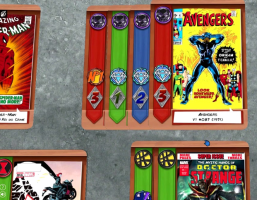
In this selection, player put cards from their hands down on the table, starting comic book collections for a specific hero or adding comic book cards to existing collections. Player will pay the market value for each card (1 for level 1 cards, 2 for level 2 cards, etc.) with an equal number of cards of that same value. So, you could pay for 3 level 1 cards by discarding 1 level 3 cards. Any cards that you discard or choose not to buy will be added and then shuffled into the Convention deck. Cards in your hand do not carry over to the next round, only cards in collections remain.
After the final “Assemble Your Collections” action on the schedule, players score their collections. There are several ways to score: collection size (and value of specific heroes), varied collections (collections of different heroes), highlights, and secret stash. I won’t go into detail for each of these here, but there are plenty of ways to score a bucket of points. The person with the most buckets of points wins.
Comic Hunters uses a lot of ways to accrue cards and just as many ways to score those cards after you obtain them. For the most part, the various locations work well enough to simulate the experience of their locations. An auction mechanism is a no-brainer for an auction website. The flea market feels right. And comic book conventions can be the wild, wild west when it comes to what kind of comics are on offer. So, the random comic book cards found during the Convention phases track. I enjoy all of that, but it comes at a cost. The various ways of acquiring cards can get clunky.
I struggle to shift from one mode to the next. While I like the variety, I focused means of acquiring cards could’ve worked better. I would’ve gotten into a better flow state faster with Comic Hunters. These various means with which to obtain cards also made setup and explaining the rules more difficult. Each ruleset is easy enough to explain, but the best way I found for teaching the game was giving a quick rules explanation before each location like I’m the “about the game” page before a Mario Party minigame. And these disparate mechanisms made Comic Hunters feel like a collection of minigames instead of a cohesive experience.

You may have gathered by how I explained the rules above, but the comic book store and auction website locations are lackluster. I like them from the standpoint that I could point to other games that use those same mechanisms, but those mechanisms are old hat. The flea market and convention locations are a lot more interesting and fun. I would’ve loved to play those two locations multiple times (lowering the number of minigames from four to two). I also like the idea that you must spend card values to play cards into a collection. This was a clever touch and lowers the number of bits needed. Despite any of its shortcomings, I enjoyed Comic Hunters. When it tries new things, those new things are fun.
But I can’t move to the verdict without mentioning the quality, or lack of quality, of Comic Hunters’ components. I’ve seen board game manufacturers’ sample products, and most of these companies don’t offer punch board as thin as the tokens found in Comic Hunters. Furthermore, the cards are off-center so you can see the white space between cards, and they slant at odd angles. The card material feels cheap. I don’t usually care about component quality, I’ve played my fair share of prototypes with ripped pieces of paper as chits, but I was shocked by the shoddiness of Comic Hunters’ production value.
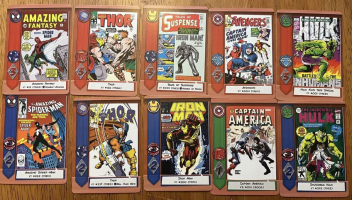
Comic Hunters has a fun premise and contains some interesting game mechanisms. Unfortunately, the game also deploys some tired game mechanisms that feel clunky, and the production value leaves much to be desired. Still, its low price point ($20-$25) means that Comic Hunters packs a lot of game per penny.
Hey, hey! Kyra Kyle here. We’re a little light on geek news this week. I’m sure things will heat up as we approach convention season, spring replacement shows, and summer blockbusters.
On a personal note, I’ve been preparing for upcoming conventions, so my focus is split at the moment. 😅 I’ll be sharing some updates in the coming weeks.
Sunset is a fancy and nice way of saying shutting down. Had Dungeons & Dragons adopted a 3D virtual tabletop five years earlier during the pandemic lockdown, Sigil would’ve been used by every D&D gaming group. Sigil uses the Unreal 5 engine while integrating the game’s online database D&D Beyond. The graphics and physics of the system impress, but the product is rough around the edges, and with the announcement that D&D plans to shudder the project, Sigil will never reach its lofty expectations. Wizards of the Coast claimed that Sigil would be like you were meeting in person for a tabletop RPG. But let’s be real. Playing a tabletop RPG is best done in person.

A virtual tabletop can only go so far. If anything, D&D was hoping for a second pandemic or another wave of the previous pandemic and that’s a risky business move. During the pandemic, people were willing to take on new hobbies. They were willing to accept a virtual tabletop with all its flaws and often used virtual tabletops inferior to Sigil. Had Sigil released over five years ago, tens of thousands, if not hundreds of thousands, of gamers, would’ve downloaded Sigil. Many of those same gamers may have continued to use the system after the quarantine lifted. Sigil missed its window. Unfortunately, Wizards of the Coast announced that they laid off the 30-person team behind Sigil. Best of luck to these talented designers. They did a great job with an unfinished Sigil.
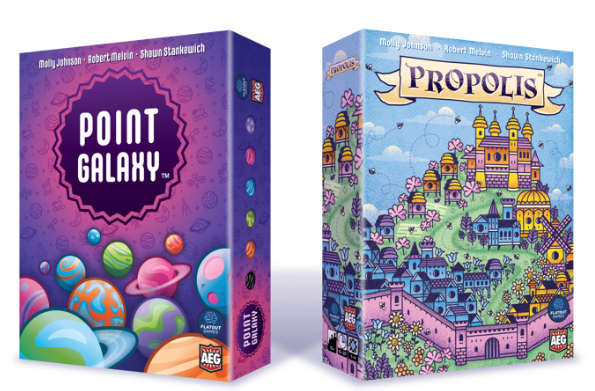
The Point series returns with Point Galaxy. Like Point Salad and Point City before it, players draft double-sided cards to build their galaxies in Point Galaxy. This time, whenever you draft a card, you choose to add the card to an existing galaxy or create a new galaxy. The front of the cards will have celestial bodies like planets and suns, but the card backs will feature unique ways for players to score with the galaxies they build. Spaceship tokens add more complexity to the scoring, making Point Galaxy fast-paced and strategic. I’ve always liked Point Salad. Point Galaxy builds on the base game. Flatout Games manages to put a lot of game in a small box.
Propolis, also from Flatout Games, has me intrigued. It combines worker placement and resource management, two game mechanisms found in heavy European games (games with a lot of strategic choices) in another fast and approachable game. The design team of Molly Johnson, Robert Melvin, and Shawn Stankewich is one to keep on a gamer’s radar. They’re also behind the Point series. In Propolis, players control worker bees. You may place your bees on actions and gain resources or use those resources to build structures. Structures give workers bonuses and score points at the end of the game. Simple and fun.
My favorite game mechanism in Propolis is that at the end of each round, players gain a wild resource for each row where they have the most workers. This serves as quick area majority or area control. It can turn the tide but not break the game. Point Galaxy and Propolis are live on Kickstarter and can be purchased separately or together. Individually, they cost $19. Together, players can pledge $35.
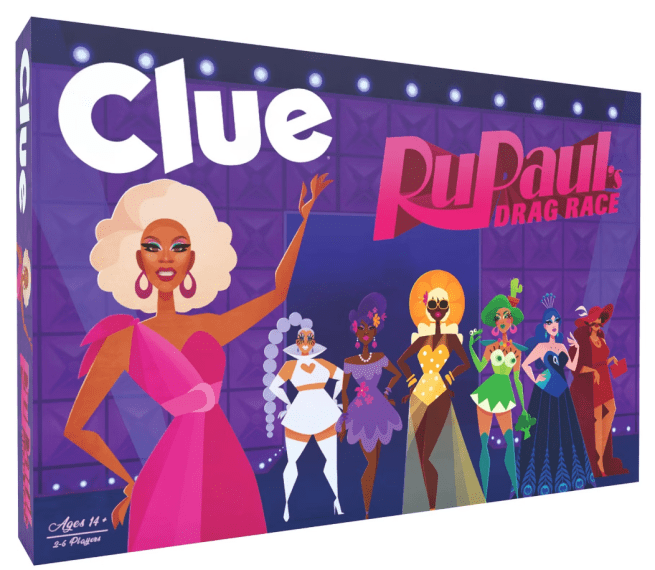
Ordinarily, Geekly wouldn’t report on a new version of Clue being released, but this is RuPaul’s Drag Race, and Season will spend $45 to snag a copy. One of six drag queens has stolen the crown. Figure out who stole the crown, where the crown was discovered, and what dazzling accessory helped the thief escape.

Instead of the standard Clue pawns, Clue: RuPaul’s Drag Race includes standees of the various queens you can play and accuse. The six characters include Madam Mustard, Pepper La Peacock, Crystal White, Sir Lady Scarlet, Marsha P. Plum, and Geraldine Green. All of these drag names are fabulous. My favorite is Marsha P. Plum. I call dibs. Sashay away to iconic Drag Race locations like the main stage, the untucked lounge, and the ladies’ room when Clue: RuPaul’s Drag Race releases later this year.
That’s all we have for this week in geek news. Thank you for reading, and wherever you are, I hope you’re having a great day.
Board gamers tend to see the same game mechanisms from one game to another, so it made us wonder which board game mechanisms are the most common. Knowing this will allow new players (and older players) the kinds of game mechanisms they can expect to find in board games. Fortunately, the data required for this list is a lot easier to obtain and compile than our most common fantasy creatures post last year. Thank you, Board Game Geek.
Hey, hey! Kyra Kyle here. I checked the hundreds—and I mean hundreds—of game mechanisms listed on Board Game Geek and ran quick searches to see how many games are listed on the site with each mechanism. At the time of this post (early 2025), Board Game Geek caps its search results to the top 5,000 games that fit a search’s criteria. Almost thirty of the hundreds of game mechanisms searched yielded 5,000 results, which means each of these mechanisms could be in hundreds, if not thousands, of more games. Yikes!
Some mechanisms found in at least 5,000 games are movement-based or mundane, like “it uses paper and pencil” or “dice rolling,” which means that the game includes dice. We won’t bother covering those game mechanisms. But that still leaves dozens of interesting game mechanisms for multiple posts like this. We’ll cap this first post to ten of the most used game mechanisms. This doesn’t include mechanisms with over 3500 games like worker placement. I think this means that we need more worker placement games. I like worker placement games, so it’ll probably make the next list. But which board game mechanisms made this list? Let’s find out.
Board games that use action points grant players a supply of action points each turn. Players may choose to use these action points in a variety of ways, typically there’s a list of options. Usually, players can spend their points any way they please. You could take the same action multiple times (or even take the same action for their entire turn) or mix and match actions from the player’s options. The options may cost the same number of action points, or their point value can differ.
Action points give players agency. Your turn can look completely different than your opponent/teammate. I mention “teammate” here because I’ve seen several cooperative board games use action points. The agency (giving players a meaningful choice, which affords those players power) granted by the action points game mechanism is why this game mechanism is so popular in board games. Everyone likes to feel as if they have some control.
Pandemic, Takenoko, Horrified, Dinosaur Island, and Sleeping Gods

Usually, games that include deck/bag/pool building begin with each player owning a similar deck of cards (if the game uses cards) or a similar number and type of chits or dice (if the game uses a bag or pool). Over time, players will acquire new cards (or the like) and add them to their deck, bag, or pool. Eventually, each player will own a deck or bag unique to them. Each player will use their deck to pursue their path toward victory.
Deck building differs from deck construction (another popular game mechanism) because players build their deck during the game, while decks within a deck construction game have players build their decks before playing.
When done well, deck, bag, and pool building games offer endless replays, due to the countless ways players can build their decks. The best players are the ones who can adapt. They’re the ones who can see patterns form with the cards and what may counter an opponent’s deck. Because of this, veteran players of specific deck building games can exploit their knowledge to gain an edge, but there is a hint of randomness. You must draw into what you need. This randomness evens the playing field a touch.
Dominion, Orleans, Challengers!, Thunderstone, and Aeon’s End
Games that use hand management reward players for playing their cards in certain sequences or groups. The optimal sequence may vary depending on board position, cards held, and cards played by opponents. Managing your hand means that you gain the most value out of available cards given your current circumstance. Often, these cards have multiple purposes, so this further complicates an “optimal” sequence.
Hand management could’ve been dismissed as a mundane game mechanism. Any game that includes a hand of cards will innately have hand management. But hand management is unique from this subset of board game mechanisms. Other mechanisms like dice rolling and paper and pencil mean that these physical elements exist within a game. Hand management suggests that players must take an active role in this game mechanism. And as the description says, this game mechanism is rewarding when players find the perfect sequence for their circumstances. Hand management also happens to show up the most on Board Game Geek’s Top 10-ranked games.
Brass: Birmingham, Ark Nova, Gloomhaven, Terraforming Mars, and Twilight Struggle
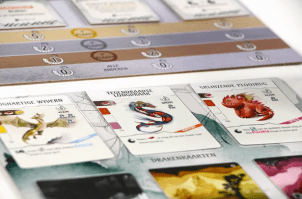
Board games using open drafting have players pick (or purchase) cards (or tiles, dice, etc.) from a common pool to gain an advantage or assemble collections that meet objectives. Since the drafting occurs in the open, the identity of these cards (or other similar item) is known to other players. Drafting gives players a choice and the ability to gain a card another player may want, denying them something they wanted.
Open drafting differs from closed drafting, which is also known as “select and pass.” Everyone can see the item you gain as you obtain it.
Open drafting provides an immediate back-and-forth between players. Since you know what your opponents select each turn, and your opponents know what you select, a meta-game (or game within the game) takes shape. Like the two previous game mechanisms, players must adapt to what options are available during their turns and what they believe their opponents are planning to do. This back-and-forth can lead to table talk (talking between players at the table about the game they’re playing) and builds tension.
The Castle of Burgundy, Everdell, Wingspan, Blood Rage, and Splendor
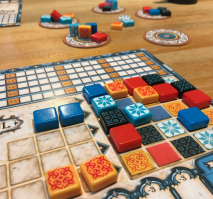
Games that use pattern building task players with configuring game components to achieve sophisticated patterns. These patterns can score points or trigger actions. Unlike most other game mechanisms on this list, pattern building is synonymous with another game mechanism on this list (tile placement), which we’ll cover later. Often, players want to link similar component types together or as mentioned above, create elaborate patterns.
Pattern building is the most puzzle-based mechanism on this list. The shifting tiles (and sometimes cards) lead to tasty combinations. So many games that fall into this category can be visually stunning. If you must build a pattern, the pattern should be easy on the eyes. This leads to why a lot of modern games use pattern building. Puzzle + Beautiful Patterns = Popular Game.
Azul, Cascadia, The Isle of Cats, Harmonies, and Welcome To…

With push your luck games, players decide between settling for existing gains or risking them all for further rewards. Games of this type feature an amount of output randomness or luck. We mention the two types of luck in a previous post (link to the two types of luck, input and output luck here). Players focus on progressing and maximizing their results. But typically, the stakes rise. If things go wrong, you lose it all.
Push your luck can add spice to an otherwise dull series of mechanisms. Double or quit, keep going or stop, cash your gains or bet them. This isn’t a new idea. Plenty of gambling games, like Blackjack, make use of the push your luck mechanism. Heck. Many of you may have read the description and immediately thought of Blackjack. Gambling games aren’t the only games that use the push your luck mechanisms. In fact, board games that use the push your luck mechanism can be good for gamers who want the feeling of gambling without involving any real-world money. These games can create a similar rush.
Heat: Pedal to the Metal, King of Tokyo, The Quacks of Quedlinburg, Lost Cities, and Return to Dark Tower
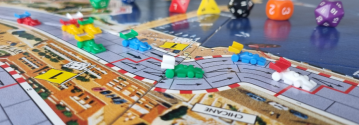
Roll/spin and move games deploy the use of dice (rolling) or spinners (spin) and then move in some capacity. Historically, players roll or spin and move their playing pieces per the number (or other result) rolled (or spun). Countless classic board games have used the roll/spin and move mechanism as a key ingredient. Most people outside the board game community may expect roll/spin and move within all board games. A roll/spin and move game is what most people outside the board game community think of when they think of board games. Board games like Monopoly and The Game of Life popularized roll/spin and move.
People within the board game community often use “roll/spin and move” as a derogatory term. People who do this imply that there is no thought involved with this mechanism. While this is the case for a lot of older games (there are some exceptions like Backgammon), modern board games have taken the roll/spin and move mechanism into new territory. I agree that players lose their agency (power and ability to make meaningful choices) if they must roll or spin and move the spaces indicated on a die (or spinner) with no additional input. But some newer games add other forms of movement to this formula. Other newer games allow players to manipulate the results. Even more modern board games have players roll dice ahead of a turn and then assign the dice results to an array of actions.
Roll/spin and move isn’t an inherently poor mechanism. How a designer uses roll/spin and move makes all the difference. The key to making roll/spin and move work is maintaining a player’s agency.
Jamaica, Camel Up, Formula D, Stuffed Fables, and Colosseum

Board games that use the set collection mechanism often make the set worth points. The value of the items is dependent on being part of a set. These sets can either be the quantity of a specific item type or a type’s variety. In some cases, board games can use contracts that urge players to pick up certain items to fulfill the contract.
The set collection mechanism breeds external tension between players. One may pick up a resource or item to prevent an opponent from fulfilling a contract or gaining more points by having more of a resource (or item) than anyone else. Or two players may fight each other for the ability to pick up these items because they both want to accomplish the same goal.
The set collection mechanism by itself may fall flat, but set collection seldom shows up on its own. Set collection complements a host of other board game mechanisms. It can give a built-in reason for players to choose a course of action or a sudden gain of a lot of one item or an array (variety) of items can tempt players to change their strategy or tactics. Board gamers often overlook the value of the set collection mechanism, but several popular games use set collection.
Great Western Trail, Ticket to Ride, 7 Wonders, Lords of Waterdeep, and Tokaido
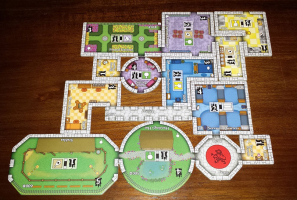
Tile placement games feature placing a piece (or tile) to score victory points or trigger actions. Usually, adjacent pieces or pieces in the same group/cluster or keying off non-spatial properties like color, a feature’s completion, and cluster size trigger the action or scoring. Pattern building often accompanies tile placement, but there are some notable exceptions, specifically, games that use modular boards and exploration.
While some tile placement games (like 1986’s Labyrinth and Dominos) existed before the modern board game boom (the mid-1990s and beyond), tile placement (and a few other mechanisms like worker placement and deck building) have taken the place of the roll/spin and move mechanism as modern board games’ dominant game mechanism. Just because the tile placement mechanism can be found in countless modern board games doesn’t mean that each game uses the mechanism the same way. Some games have a shared space for players to place tiles. Other games give each player a private building space. And several games do a little bit of both. Despite tile placement’s explosion after Carcassonne popularized it as a central game mechanism in 2000, tile placement remains a vibrant board game mechanism.
Carcassonne, A Feast for Odin, Galaxy Trucker, Betrayal on House on the Hill, and Castles of Mad King Ludwig

The variable player powers game mechanism grants different abilities or paths to victory to each player. Each player has a unique power. Games that use variable player powers reward players who exploit their unique abilities while compensating for their abilities’ shortcomings.
The variable player powers game mechanism is perfect for any player who wants to stand out from their opponents. Because each character (or faction) within the game plays differently from each other, games that use variable player powers have a lot of replay opportunities. On a similar note, players may gel with a specific power over another one so playing a second game and trying a different player power could lead to better results.
Unlike other game mechanisms on this list (except for deck building and Dominion), variable player powers haven’t been around as long. Games that use the variable player powers mechanism also dominate Board Game Geek’s Top 10 ranked board games.
Gloomhaven, Twilight Imperium: Fourth Edition, Dune: Imperium, Pandemic Legacy: Season 1, and Cosmic Encounter
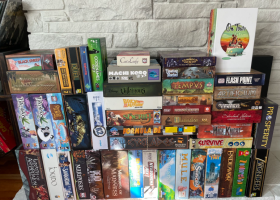
This was a longer list than I expected. It would be even longer if I didn’t cut the list of common board game mechanisms in half or into thirds. Let me know if you’d like to see more lists like this in the future.
Looking at the board game mechanisms listed on Board Game Geek allows for a macro view of the board game hobby. We can see trends. We can examine what makes a board game mechanism popular. A lot of these board game mechanisms grant some form of player choice or player empowerment. But that’s what I think. What do you think? Let us know in the comments.
Geekly may have another series in the offing. We’ll craft another set of surveys and reach out to board game designers to discover their thoughts about each of these game mechanisms (and game mechanisms that may find themselves on a future list like this one). I hope you found something useful in the post. And wherever you are, I hope you’re having a great day.

CMON’s board issued a profit warning to the Hong Kong Stock Exchange earlier this week. It estimates its losses for 2024 at between $1.4m and $2.1m, with the final, audited total expected by the end of this month. $2 Million is a large number. Several factors have contributed to CMON Games claiming a loss for 2024. We’ll give a quick rundown on what led CMON in this direction.
CMON Games quickly bounced back from the pandemic. It suffered a 17.5% revenue drop to $25.1m in 2020 because of the pandemic. In 2022, CMON reached $45.3m and almost duplicated that success the next year due to multimillion-dollar Kickstarter campaigns for its long-running Zombicide series and games based on huge IPs such as Marvel and DC Comics.

Last September, CMON’s mid-year revenue had fallen for the first time since the pandemic, to just over $15.9m with slumping wholesale earnings putting a dent into the company’s H1 results. CMON’s wholesale revenue sank 39% to $5.9m in H1 2024 compared to the same period in 2023, while revenue from its crowdfunding campaigns fell by about 9.7% to just over $9.9m.
CMON Games says the biggest contributing factor to this loss is the rising cost of living, which is eating into its revenue from tabletop game sales. They believe people aren’t buying as many board games because the cost of living has increased. Cost of living can and does play a role in reduced board game sales. But this can’t be the only factor.

CMON switched its crowdfunding strategy in February 2024 when it ended 12 years of running campaigns on Kickstarter. They chose to sign an exclusivity deal with Kickstarter’s crowdfunding competitor Gamefound. CMON had raised more than $108 Million in total on Kickstarter.

CMON’s first year on Gamefound began slowly. Large campaigns like DC Super Heroes United and Cthulu: Death May Die, Forbidden Reaches helped push CMON closer to the money they raised on Kickstarter the previous year.
At the mid-point of the year, the 2024 losses would almost wipe out CMON’s $1.8m profits across the previous three years combined, marking the first time the company suffered a loss since the pandemic.
Personal aside: I backed one of CMON’s projects on Gamefound and followed several others. The company had issues navigating Gamefound’s backend. There were growing pains but the year ended better than it could have. Different consumers use Gamefound and Kickstarter. Switching crowdfunding providers could contribute to a dip in sales. Gamefound also offers what equates to layaway, so certain Kickstarter marketing tactics CMON Games has cultivated over 12 years may not work as well on Gamefound.
CMON made two significant acquisitions last year. They bought Japon Brand, the Japanese board game collective that published Love Letter and Machi Koro and picked up the intellectual property rights to a pair of stalled Kickstarter projects from Mythic Games in January 2024.
The two games from Mythic Games, Hel and Anastyr, raised a combined $3.2 Million on Kickstarter. Per CMON Games, both games require extensive playtesting and editing to reach their standards for print. CMON Games plans to ship Hel and Anastyr to Kickstarter backers if the customers who originally backed the game are still interested. This created another issue with CMON Games switching from Kickstarter to Gamefound. Original backers of Hel and Anastyr haven’t received a single update since CMON Games acquired the rights to produce these games because CMON no longer uses Kickstarter.

Geekly mentioned a month ago that tariffs on Chinese goods have complicated board game production. We belong to several board game groups and know several publishers. Many board game publishers have cited up to $2000 for a crowdfunded board game making $100,000. CMON deals in crowdfunding projects in the millions of dollars, and the company has at least seven completed campaigns that it will fulfill by the end of 2025. The company could lose at least $500,000 in tariffs alone.
CMON started 2025 by agreeing to sell some of its intellectual properties in a $12 Million deal, with two new shareholders investing around $1.39 Million into the business by picking up a combined 16.66% stake in the company. CMON had entered a non-binding agreement to sell the unspecified IPs last August, but terminated the arrangement last month after CMON and the unnamed buyer failed to agree to terms.
CMON also revealed last week that the new shareholders had failed to hand over the money for their stakes and said it was seeking legal advice on how to cancel the process. CMON added at the time that it was now seeking other fundraising means to increase its general working capital in order to enlarge its capital base, increase the overall liquidity of its shares, and strengthen the company’s financial position.

Regardless of which factors affected their sales the most, CMON Games finds itself in a tight spot. One of board gaming’s dominant companies (especially post-pandemic) is struggling. But CMON has taken steps to get on the right track.
In January this year, CMON hired the CEO of tabletop gaming YouTube channel Man vs Meeple as its new global director of marketing. David Waybright will work full-time on promoting upcoming crowdfunding and retail releases from CMON while continuing to run Man vs Meeple, which specializes in previewing upcoming crowdfunded games. Fingers are crossed that CMON Games recovers.
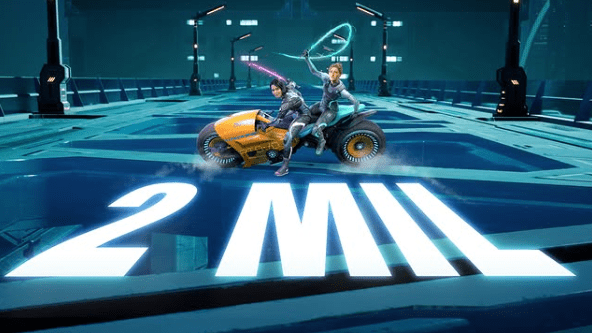
Split Fiction is the follow-up to Hazelight’s critically acclaimed It Takes Two (2021). It sold 2 million copies during its first week. Split Fiction was first announced at the 2024 Game Awards by studio chief Josef Fares, but began development immediately after Hazelight released It Takes Two. Like its predecessor, Split Fiction features dual protagonists who must work together, either locally (couch co-op) or online.
Split Fiction’s protagonists are named after Fares’ real-life daughters. Written by director and Hazelight studio chief Josef Fares and Sebastian Johansson, Split Fiction blends fantasy and science fiction, following a pair of authors trapped in the worlds they wrote. Split Fiction features unique gameplay mechanics involving split-screen combat, platforming challenges, and differing abilities for each character.
Spring starts early, thanks to Valve. Steam begins its annual Spring Sale, and while most of the games featured in this sale aren’t new, there are some classics you may consider purchasing if you don’t already own a copy.
You can pick up a copy of Square Enix’s Chrono Trigger in honor of the SNES RPG’s 30th anniversary. Cyberpunk 2077 is down to $42.76 (almost $40 off), which includes the expansion Phantom Liberty that significantly improves the gameplay. The 2016 Doom reboot is going for $1.99. I may have my eye on some deck-builder games. Slay the Spire is $6.24, while Inscryption is going for $7.99. Both of these games offer great mechanisms and blend in roguelike elements.
Steam’s Spring Sale ends March 20th so be sure to check out the store before then.
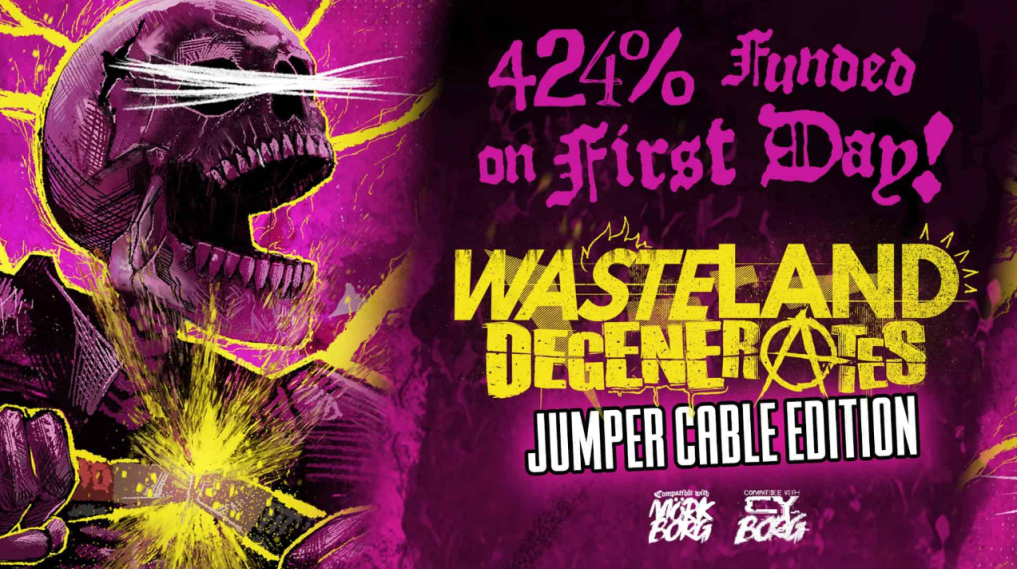
Tabletop Role-Playing Game Wasteland Degenerates launched on Kickstarter this week and was funded within hours. Wasteland Degenerates takes inspiration from the MÖRK BORG and CY_Borg systems. It features easy-to-roll-up characters, and dice rolls that can take out a character in seconds. If you want to explore the wastes, finding treasure from trash, and fight gnarly mutants, Wasteland Degenerates has you covered. While Wasteland Degenerates is based on, and compatible with, the award-winning MÖRK BORG and CY_Borg systems, it does not require any other books to play. You can learn more about this project on its Kickstarter page.
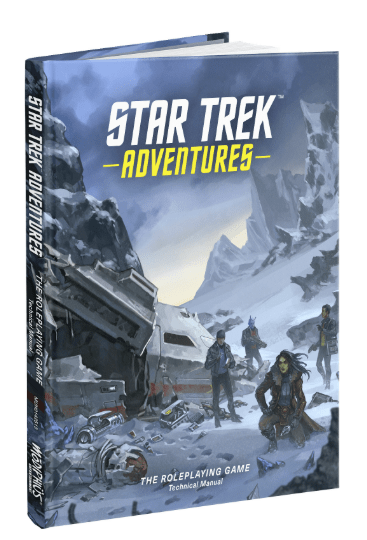
Take your Star Trek Adventures 2nd Edition RPG to the next level with the upcoming Technical Manual. Modiphius Entertainment announced that the new sourcebook will be released in June 2025.
This 129-page full-color hardcover book covers gear from across the Star Trek universe. The Technical Manual will cover details on Starfleet, Klingon, Romulan, Orion, and more technology. Add just about any piece of tech from the Star Trek universe, from universal translators to tricorders. The manual also details medical technology and the engineering elements of transporters.
The Star Trek Adventures 2nd Edition Technical Manual will retail for $46.23. You can order your copy of the base game and the Technical Manual by following this link.

Steamforged Games has a history of bringing several video game properties to the tabletop game space, and they continue by announcing a board game adaptation of the hit sci-fi shooter Helldivers II. Manning squads armed with pistols, machine guns, and flamethrowers, players protect Super Earth against alien threats. You’ll complete high-risk missions, navigate battlefields, and overcome enemy swarms.
The crowdfunding campaign will launch on Gamefound on April 8, 2025.
That’s all the geek news we have for this week. Thank you for reading, and wherever you are, I hope you’re having a great day.

Marvel United has copious amounts of expansions. It’s a CMON Games Kickstarter using the Marvel intellectual property. That’s bound to happen. Geekly won’t be covering every Marvel United expansion, but we will review the ones worth your time or the ones we believe people will most likely purchase. So, you could consider the Marvel United expansions we cover as ones you may want on your radar.
Hey, hey! Kyra Kyle here. In Marvel United, players act as iconic Marvel heroes who work together to stop the master plan of a powerful villain controlled by the game. Each villain has a unique master plan, cards that trigger various effects, and threats that make clearing locations difficult. Heroes clear missions, making the villain vulnerable, and finally take on the big bad villain before they complete their dastardly plan. Can you save the day in time? Enter the Spider-Verse puts players in the spandex of famous characters of the Spider-Man universe.
Before we get any further, we’ll take a side quest and discuss Enter the Spider-Verse’s less heroic details.
Designer: Andrea Chiarvesio and Eric M. Lang
Publisher: CMON Global Limited and Spin Master Ltd.
Date Released: 2021
Number of Players: 1-4
Age Range: 8 and up
Setup Time: 5-10 minutes
Play Time: 30-40 minutes
Cooperative Play
Hand Management
Modular Board
Solo / Solitaire Game
Variable Player Powers
We already covered the Game Setup and Game Flow in our Marvel United review (here’s a link to that review), so we’ll go over the basics in the following two sections. Let’s cover an abbreviated review of the game setup and rules.
Marvel United’s setup can change depending on which Villain and Heroes you choose to play. Each game consists of six locations. Typically, core sets have eight locations. Since Enter the Spider-Verse is an expansion, it only has six. You may choose your locations or shuffle them and choose six at random. Each Location card has spaces at the top for civilians and thugs and a rectangle with a block of text that will state “End of Turn” at the top of the box.

Place civilian/thug tokens on their matching spaces. Shuffle the Villain’s Threat deck and deal out each Threat face-up so that it covers the rectangle at the bottom of each location. You must clear this threat before gaining the “End of Turn” effect printed on a Location. Place health tokens where signified on threat cards and on the Villain dashboard. Place the three mission cards (Defeat Thugs, Rescue Civilians, and Clear Threats) face up under the villain dashboard where the text reads “Unlocked.”
Each player shuffles their hero decks and then draws three cards to form their hands. Shuffle the Villain’s Master Plan deck. Leave the Master Plan deck face down. This will be the villain’s draw pile.
Players place their miniatures on one of the six location cards, usually the centralmost location for each player (easy access). Then, they place the villain on the location card opposing the heroes.
The villain(s) play first. Draw the top card of their master plan deck. The villain moves the number of spaces indicated. Resolve any BAM! Effects and these effects will be printed on a space within the villain’s dashboard. Then, place the civilian/thug tokens (if any) indicated at the bottom of the card. After all these effects are resolved, the heroes get their turn.
Heroes pick who goes first, and hero turns will continue around the table clockwise. At the beginning of each game, Heroes will get three turns before the villain receives another turn. During their turn, heroes play one card from their hand.
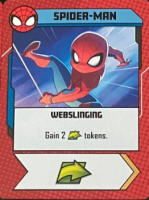
Resolve actions and the symbols printed at the bottom of the hero’s card in any order. The symbols at the bottom of a hero’s card will be shared with the next player, but any printed action will not be shared. Heroes will use these actions to complete missions. The game begins with three missions in play: Defeat Thugs, Rescue Civilians, and Clear Threats. Each mission card will have spaces for the tokens they require to complete. As soon as these spaces are filled, the card is discarded, and the mission is considered complete. Mission cards can be completed in any order.

After the heroes complete the first mission, the villain panics and will act (play a card) every two hero cards instead of every three hero cards. After the heroes complete the second mission, the villain becomes vulnerable to damage. The heroes can complete the third mission, but it isn’t necessary. If the heroes do complete the third mission, each hero immediately draws 1 card, increasing each player’s hand size by one.
Play continues back and forth until either the villain wins (by completing their unique master plan or anyone, heroes or villains, runs out of cards) or the heroes win by dealing enough damage to the villain after the villain becomes vulnerable to damage.
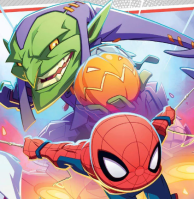
Enter the Spider-Verse features a lot of fan-favorite characters (Spider-Man, Green Goblin, and Miles Morales). Since that’s the case, it’ll be one of the first expansions players will purchase. And it’s a great choice.

Let’s begin with the heroes. Spider-Man has a lot of potential token gain. I don’t know how many times I saved the day by playing Spider-Man. Seriously, I may have completed most of the games in my guides (here’s a link to Geekly’s Marvel United guides) with Spider-Man. Frankly, he’s a broken character. Broken in the best possible way. I’ve easily played Spider-Man more than any other character in Marvel United. He’s Spider-Man. It’s great that Marvel United made him a character you can return to again and again.
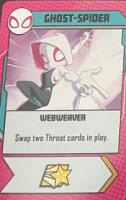

Ghost-Spider and Miles Morales may have more niche abilities, but given the right circumstances, they can be deadly. Ghost-Spider can swap in-play Threat cards (which could be nice for an ongoing ability), and she can defeat all Thugs in her location. Miles Morales’ strongest ability “Web” allows him to delay the Villain Turn by one card. “Web” is a more universal use. Miles may be my second-most played character. Then, there’s Spider-Ham. He’s a Kickstarter Exclusive and that’s okay. He stinks. Good news though. It’s okay if you purchase the retail version over the Kickstarter version. Spider-Ham’s inclusion is the only difference between the two versions, and you’re not missing much with Spider-Ham. Unless you’re a completist or you like Spider-Ham, buy the retail version of Enter the Spider-Verse.
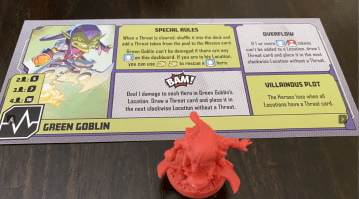
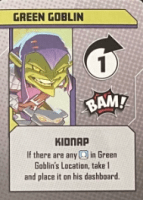
Enter the Spider-Verse’s sole villain Green Goblin is notoriously difficult to beat. I’ve only ever beaten Green Goblin by playing heroes and locations from the Enter the Spider-Verse expansion. Green Goblin has a special setup than the one above. Players don’t begin the game with threat cards in play on locations. Green Goblin will add them as he goes along, and he wins if each location has a threat card. This can lead to players clearing a particularly nasty threat card, like “Electro” or “Using Civilians as Shield,” and Green Goblin putting those cards back in play.
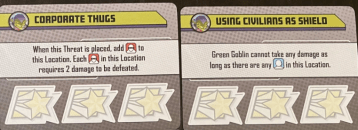
Even though Green Goblin wants to flood the field with threats, he’s just as comfortable throwing obstacles in the way to wait out the clock. “Using Civilians as Shield’s” ability is that Green Goblin will not take any damage as long as there are any Civilians at its location. “Corporate Thugs” make thugs more difficult to defeat. Green Goblin is a classic case of a villain who has multiple ways to defeat his enemies. The best way to stop Green Goblin is to load up on tokens, manipulate the villain deck, and delay the villain’s turn if you can. Fortunately, there are two heroes, and one location included in Enter the Spider-Verse expansion that do just that. Green Goblin earns his reputation as one of the initial Marvel United’s most difficult villains.

The new locations are classic Marvel New York ones. Brooklyn Bridge, Queens, the Daily Bugle, Oscorp Tower. These locations focus on extra tokens. This can be crucial in defeating certain Marvel United villains. Enter the Spider-Verse’s Green Goblin is one of these villains. The other three locations have healing (always appreciated), potentially rescuing a Civilian for free (always good for completing mission cards), and manipulating the villain deck. Couple these abilities with the heroes included in Enter the Spider-Verse, and you can see why this expansion tilts the playing field toward the heroes.

Each expansion adds a challenge card. Challenge cards add an extra layer of complexity to the game. Challenge cards may be small additions, but they can keep the game fresh with an extra rule or two added to the base game. Enter the Spider-Verse introduces the “Secret Identity Challenge.” This is a classic challenge to add to any Marvel United game. Players must balance their crime-fighting life with their lives spent outside of spandex. This challenge is thematic, easy to understand, and adds just enough additional difficulty.

Even though I wouldn’t bother with finding the Kickstarter version unless you’re a completionist or a Spider-Ham fan, Enter the Spider-Verse is worth including in your Marvel United collection. The heroes and villain are some of the most powerful. The locations are iconic and pack a punch. And the Challenge Card adds a much-needed twist.

Plenty of top-notch board games were released in the nineties. This decade is the first where I could list a Top 5 Board Games for each year, and that will happen—closer to 1992 or 1994. But we will keep to 1990 and 1991 for this list of Top Tabletop Games.
Hey, hey! Kyra Kyle here. Back with another Top 5 Tabletop Games. Board games begin heating up in 1990 and 1991. We’ll talk about board games soon, but first, if you’ve forgotten our criteria for the Top 5 Tabletop Games, let’s reiterate the ground rules before we start.
1: Cultural relevance plays as much of a factor as overall quality. A game might make a list that doesn’t hold up to others of its type, but you must admit the game is everywhere.
2: Only one game from a franchise makes the list. This will become more of an issue the closer we get to games with expansions.
3: Longevity plays a role, too. A game doesn’t have to fly off the shelves today, but it had to have some widespread appeal for a decent time.

Crocodile Dentist was on and off this list. Ultimately, it makes this list of top board games of 1990 and 1991 because it was the best-selling toy of the 1991 Christmas season. Not just a bestselling game, but a bestselling toy. The toy factor for Crocodile Dentist is overwhelming.
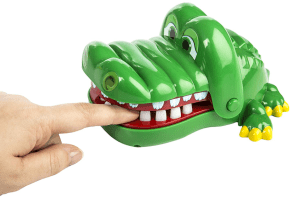
The toy factor makes sense. Crocodile Dentist is a children’s game. In early versions of Crocodile Dentist, players take turns removing a crocodile’s teeth and eventually, the crocodile would snap its jaw shut. Whoever made the titular crocodile shut its jaw was the loser. Crocodile Dentist has a simple premise that makes serious adults groan or guffaw. The York Daily Record’s Mike Argento included Crocodile Dentist in his 1992 Bizarre Toy Awards. However, twelve years later, Argento admitted that the game had “passed into classic status.” And that’s what Crocodile Dentist is, a classic.

Real talk. I’ve never played Tichu. It’s the one game on this last that I’ve never played. I would like to; Tichu makes this list because so many board gamers swear by this game. Tichu has a cult following if you will. What I know of Tichu is that it’s a shedding game, meaning that you’re trying to rid your hand of its cards. But Tichu is also a team-based game, so you and your partner are trying to shed your hands before your opponents.

I’ve never had the chance to play Tichu. Tichu is a four-player-only game. If you don’t have four players, you can’t play. And from what I’ve heard, a veteran Tichu player will destroy a noob, and since Tichu is a cult card game, it becomes one of those games where people either don’t play or they’ll only find enjoyment with other accomplished Tichu players. Still, Tichu remains one of the most endearing games on this list, and this list has nothing but endearing games. I’d like to play at least one game of Tichu before long. If anyone plays and you’re going to a board game convention that I’m going to, I’d be happy to learn Tichu.

I can’t remember if I included Dungeons & Dragons in an earlier list. If I didn’t, that was an oversight. But while D&D dominated early tabletop roleplaying games (and still does), the Nineties saw a ton of worthy competitors. Tabletop Roleplaying games saw a boom in the Nineties. The early Nineties only had ten major TTRPG releases. Vampire: The Masquerade is the most famed of these Dungeons & Dragons competitors. In short, Vampire: The Masquerade simulates the afterlife of a vampire.

The developers deliberately didn’t read Anne Rice’s Vampire Chronicles until late in their development process but admit that Rice most likely influenced the vampire films that inspire the game. Rice’s Vampire Chronicles and Vampire: The Masquerade ushered in a new era for vampire fiction and the vampire mythos. The Underworld film series borrows a lot from Vampire: The Masquerade. And the game’s influence was felt in the Nineties. The Goth underground scene flourished with the help of Vampire: The Masquerade and Rice’s Vampire Chronicles.
I still have my original copy and will often pour over the full-page artwork. Artist Tim Bradstreet’s artwork from Vampire: The Masquerade was the concept art for the Blade film series. Vampire: The Masquerade was the height of cool in the early Nineties.

Formula D is a strong second on this list. Until some recent games (games from the 2010s and 2020), Formula D does the best job of simulating a race. Heck, Formula D measures up well against newer racing games. It uses specialized dice (d4, d6, d8, d12, d20, and d30) that represent different gears of a vehicle. Formula D uses an additional d20 for collisions and other course events (like weather). With each turn, players must roll a die that simulates which gear their car is in and must move the number of spaces they roll on that die. The core concept is simple. You’re trying to reach the finish line before anyone else. It would make sense to stay in the highest gear you can. The problem comes when calculating car damage.
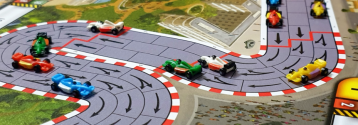
Each player takes a “dashboard” for their car. This dashboard will track damage to the various parts of their car. Each track—and there are plenty of bonus tracks you can use for Formula D—will have twists and turns that you must navigate. Taking a turn at a higher speed will most likely cause players to accept damage. A little damage is no big deal. But you could take so much damage that your vehicle crashes.
I like Formula D’s addition of “Rules for Beginners.” It allows players to learn the basics of the game and only when they get accustomed to the base rules, can they then take on more complex rules. Formula D—like the game that claims our top spot—continues to see play, even though it’s over thirty years old.

Hoity Toity has gone by several names. Originally, it was released in Germany by the name Adel Verpflichtet or Noblesse Oblige. It was distributed in the United Kingdom under the name Fair Means or Foul and in the United States as By Hook or Crook. It wasn’t until its 2008 reprint that it became Hoity Toity. I’ll refer to it as Hoity Toity from this point forward. Hoity Toity tasks players as members of a pretentious Antique Club who wager which one of them can acquire—by purchase or theft—the most expensive collection of objets d’art in one day.

Hoity Toity deploys a nice combination of bluffing and silent auction. The game’s movement (there is a track players must navigate) feels unique, especially for the time it was released. There shouldn’t be any wonder that Hoity Toity won the 1990 Spiel des Jahres. Klaus Teuber had a dominant early Nineties. I earned another Spiel des Jahres in 1991—back-to-back awards—for Drunter und Drüber, which just missed this list and another Spiel des Jahres in 1995 for Catan. We haven’t gotten to 1995’s list yet, but Catan will make that list. Hoity Toity gets the nod over Drunter und Drüber because it stands the test of time. Most gamers would place Hoity Toity as the second-best board game of Teuber’s career. Hoity Toity earns that distinction.
Did we get the list right, for the most part? Let us know which games you’d add in the comments. And wherever you are, I hope you’re having a great day.
Check out the other lists in this series:
Top 5 Tabletop Games Prior to the 1930s
Top 5 Tabletop Games of the 1930s
Top 5 Tabletop Games of the 1940s-50s
Top 5 Tabletop Games from the Early 1960s
Top 5 Tabletop Games from the Late 1960s
Top 5 Tabletop Games from the Early 1970s
Top 5 Tabletop Games from 1980-1981
Top 5 Tabletop Games from 1982-1983
Top 5 Tabletop Games from 1984-1985
Top 5 Tabletop Games from 1986-1987
Top 5 Tabletop Games from 1988-1989

