

Happy Friday, Geekly Gang! Kyra Kyle here with another writing brain dump. Last month, I talked about how I journal. I’ve continued with that journaling method, and it’s helped me get back into writing. Today, I wanted to discuss a story’s shape. I’ve always been interested in the shapes stories can take. Yay! Are you ready to geek out with me about story structure?
Fabula versus Shuzhet
I’m going to borrow a couple of terms from Russian playwriting: fabula and shuzhet. Russians contributed a lot to theater, most notably Konstantin Stanislavski, who recontextualized acting, but the Moscow Art Theatre also had plenty of groundbreaking playwrights who explored the shape of stories. Russian writers like Anton Chekov loved structure. Remember Chekov’s Gun? Anyway, the Russian story shape concept revolves around how the fabula (chronology of events) interacts with the shuzhet (how the writer or playwright arranges the events). In other words, the fabula is the timeline, and the shuzhet is how the writer presents that timeline. I’ll muddy the water even more by saying the fabula could also be viewed as phases divorced from time. What?
Don’t worry. I’m sharing pictures/graphs and will bring up a few examples where the fabula doesn’t fall neatly into time or the chronology of events. These examples will largely be in movie form because the fabula/shuzhet pairing came from the Moscow Art Theatre. But we can still apply these concepts to any writing. Let’s begin with our first narrative structure: three acts.
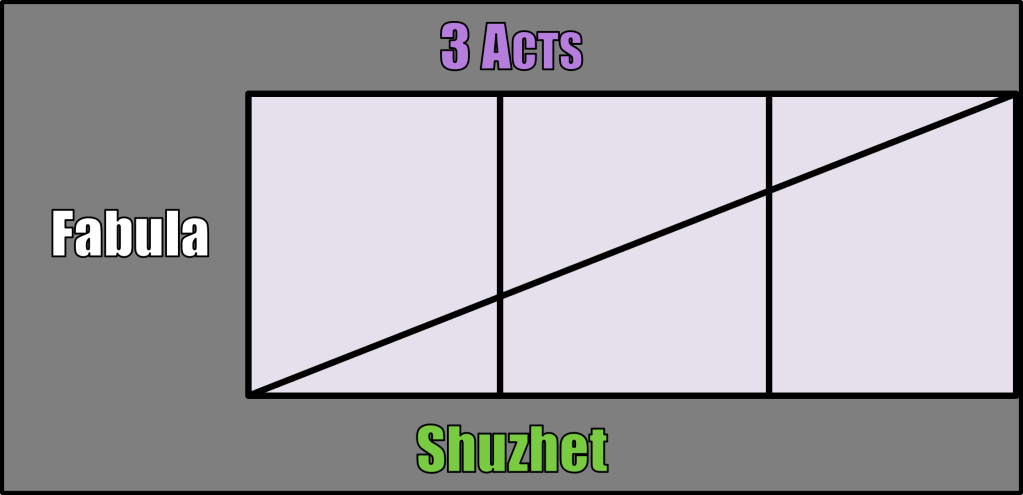
Three Acts
We begin with the easiest story structure to explain, the three-act play. This method is ubiquitous. Most of us have heard of the first act (Setup), the second act (Complication), and the third act (Crisis or Climax) that leads to the denouement (or falling action). Yeah, what’s pictured above doesn’t do the three acts justice. I only included this as a visual representation of what’s happening chronologically (fabula) versus the shuzhet. As you can see, pretty straight-forward.
Stories that use Three Acts:
Die Hard
Jaws
Raiders of the Lost Ark
All three stories above have well-defined setups, complications, and climaxes. The three-act system is easy to follow. There’s a reason why so many writers choose this story shape. In Die Hard, we receive John McClaine’s backstory in short order (he’s estranged from his wife, and he wants to reconcile). This happens quickly because Die Hard is an action film. The complication occurs when German radical Hans Gruber and his armed team overtake Nakatomi Plaza. The climax takes place near the beginning of the third act before the story ties up loose ends.
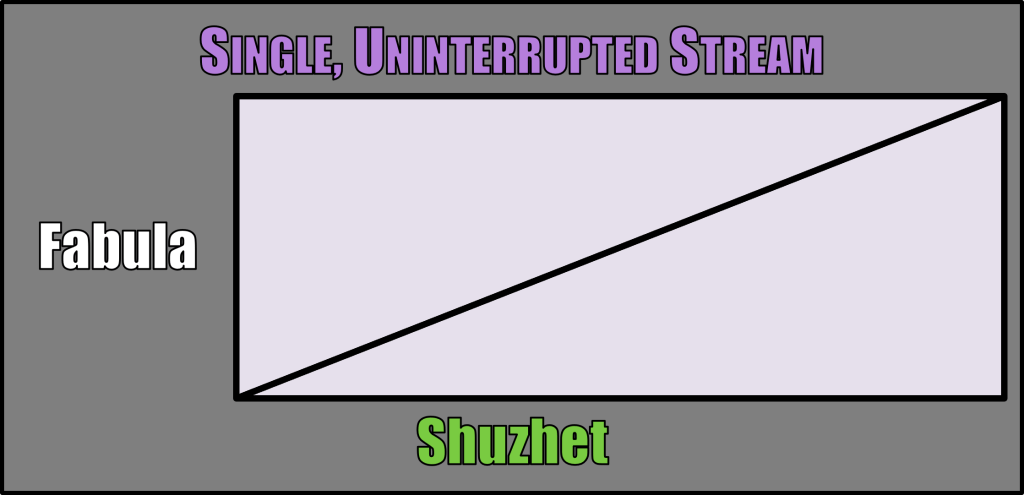
Single, Uninterrupted Stream
As you can see with the image above, a single, uninterrupted stream behaves similarly to three acts. The big difference is that the scene is uninterrupted. While three acts can edit out any fluff or lulls in the action, a single, uninterrupted stream will not jump any moments.
Stories that use a Single, Uninterrupted Stream:
High Noon
12 Angry Men
Before Sunset
I was going to break down High Noon or 12 Angry Men. Both are excellent. Both occur during real time. But I’ll switch gears with a sitcom, my favorite Friends episode, “The One Where No One’s Ready.” You’ll see that this episode also uses a three-act structure, but it occurs in real-time. We get the setup with Ross’s event, and no one else is ready. Complications arise, like Phoebe’s dress getting the hummus. Finally, our climax occurs when, after Ross yelled at her, Rachel refuses to go unless he drinks the fat. Three acts are tidy. They even work on a twenty-minute episode. This episode also happens to occur in real-time without breaks.
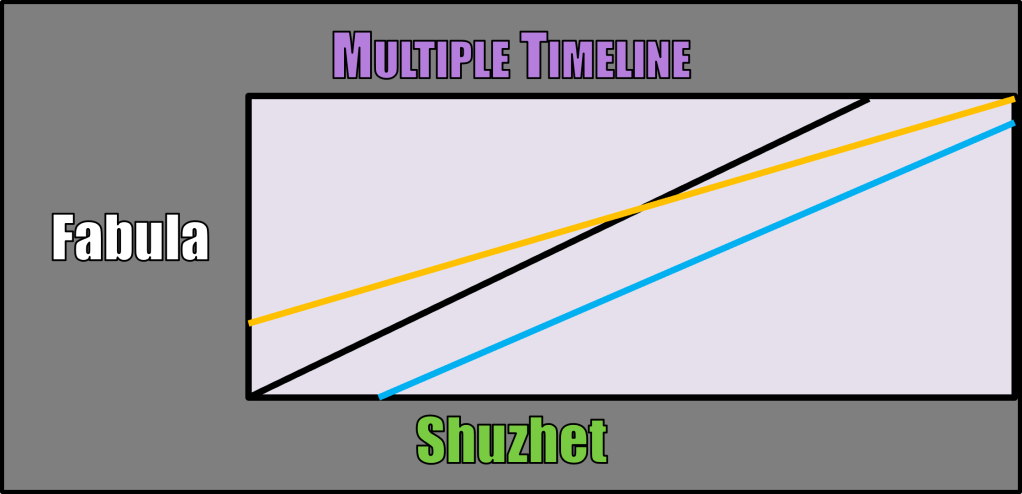
Multiple Timeline
Here’s where things get interesting (from a charting perspective, that is). Multiple timelines do what they suggest. The reader or viewer follows multiple timelines, presumably different characters, but not always. I love what N.K. Jemison did in The Fifth Season, which is a good example of multiple timelines within a novel. The reader follows three timelines of the same main character during different phases of her life. Brilliant! And with this example, you can see how the definition of the fabula or even the shuzhet can shift. There’s always room for a writer to play.
Stories that use a Multiple Timeline Structure:
The Godfather, Part II
The Fountain
Cloud Atlas
The Godfather, Part II contrasts the lives of Michael (son) and Vito (father) Corleone. We’re introduced to Michael Corleone and wonder how he could become this much of a monster. Watching Vito’s early life unfold informs us of Michael’s past and present. So good. There’s a reason The Godfather, Part II is a classic. It also provides an important question. Ask yourself if the multiple timelines build on one another. If they do, you’re good to go. If not, figure out a way for the timelines to build on one another.
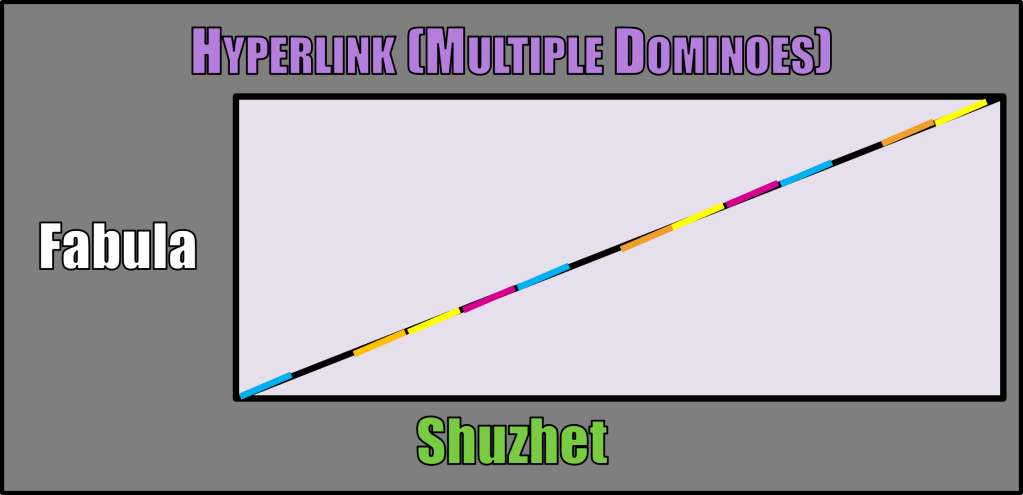
Hyperlink (Multiple Dominoes)
I struggled with how to visually represent the hyperlink story shape. The image above doesn’t quite do it justice. With a hyperlink story, the narrative doesn’t need to progress in a linear fashion. You can expect swirls. Perhaps the term multiple dominoes works better. One domino falls against another, causing a chain reaction. You’ll need to connect the dots for this one, but when it happens, something magical can happen.
Stories that use a Hyperlink Structure:
Ajami
Magnolia
Under the Skin
It’s been a while since I’ve seen any of the movies I used as an example. I’ll try to recall Ajami as best I can. Ajami was written and directed by Scandar Copti and Yaron Shani. As Palestinian and Jewish people, the two used their lived experiences to explore the animosity between these two groups in Ajami. One act of violence from one group leads to another act of violence by the other. The cycle continues like dominoes until neither side remembers what caused the conflict. I may need to rewatch Ajami. I love its message.
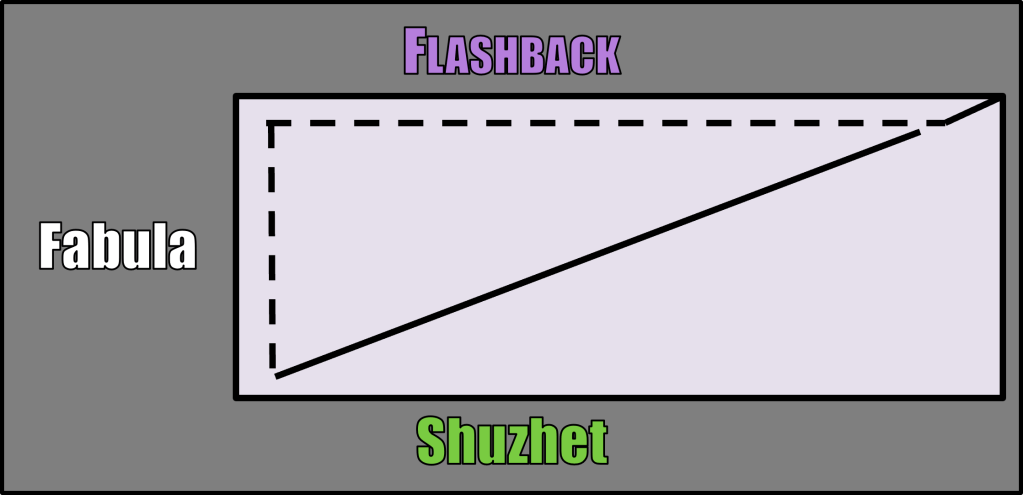
Flashback
Uh oh. These story shapes can be tricky. I’m unsure of what I was trying to do with the image above. It gets better. I swear. Flashback stories start near the end and send us back in time toward the beginning. The story will then progress as usual. While the graphic may make flashback stories look complicated, plenty of stories use them. Like the ones below.
Stories that use a Flashback Structure:
Citizen Kane
Fight Club
Forest Gump
I’ll stick with another classic, Citizen Kane, for this example. Famously, Citizen Kane begins with the title character’s death. That would be toward the end of a story. Then, we go back in time, watching Kane’s life unfold. We already know what will become of Kane. We watch to understand why.
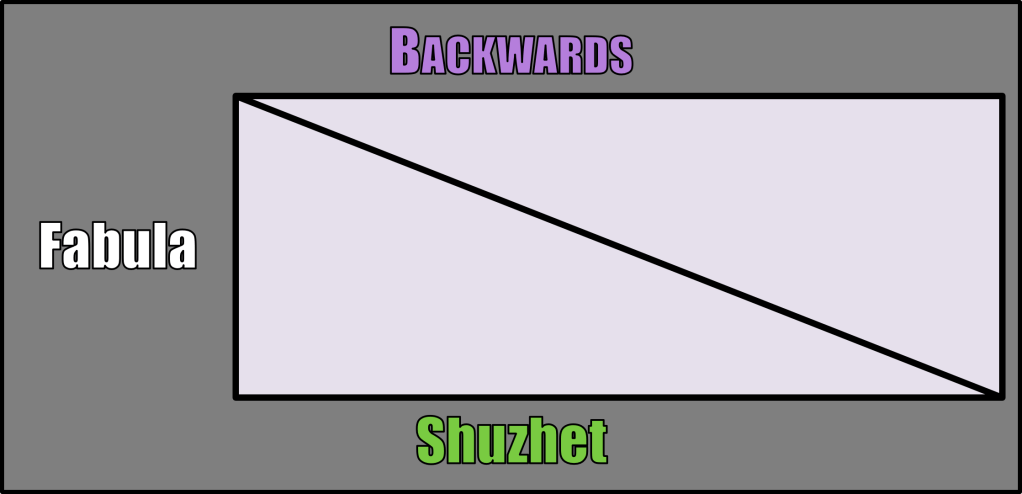
Backwards
This one was easier to represent. Backwards tells its story in reverse. The concept is simple; execution is not simple. You almost need to write the story forward first and then rearrange it so that it’s told in reverse. And if you’re going to do that, you’ll need a compelling reason to do so. Fortunately, we have plenty of stories that do just that.
Stories that use a Backwards Structure:
Irreversible
Memento
Eternal Sunshine of a Spotless Mind
All three of these stories have some narrative reason why the story would be told backwards. The main character in Memento has short-term memory loss. Eternal Sunshine of a Spotless Mind is a sci-fi movie where people can erase their memories, beginning with the latest. Again, a great reason for telling a story backwards, but I’m going to focus on Irreversible. This French film is difficult to get through.
Trigger and Spoiler Warning: It deals with rape. There will be a scene where you may need to turn away. Irreversible shows a couple on a rampage, and the audience wonders why, only to reveal the couple’s loved one was raped. Before that reveal at the end, the audience questions why anyone would do what the couple we follow does. By the end, you’ll question why they didn’t take it further.
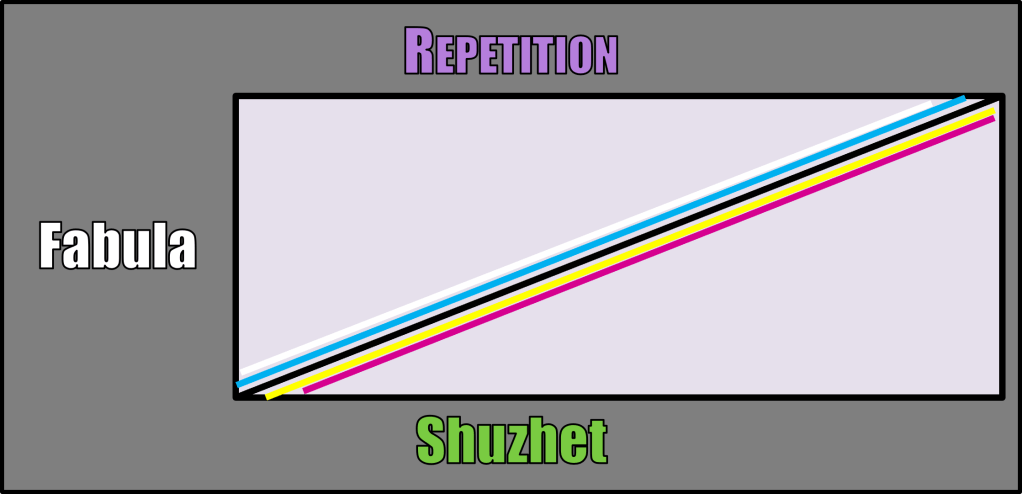
Repetition
Repetition is a powerful tool. Repetition is a powerful tool. Be honest, you read those two lines differently. JK
Repetition more or less repeats the same story or story elements more than once. It can and has been used to remarkable effect. Don’t knock repetition until you try it. If you don’t believe me, check out the following stories that use repetition.
Stories that use Repetition:
Rashomon
Mr. Nobody
JFK
Akira Kurosawa, the Japanese grand master of film himself, used repetition in his classic Rashomon. The audience receives several stories as to how a samurai died. Each storyteller in Rashomon has their own spin. Any of these stories could be true. Any of them could contain elements of truth. They all could be crap. Ultimately, which story you choose to believe or don’t believe says a lot about you.
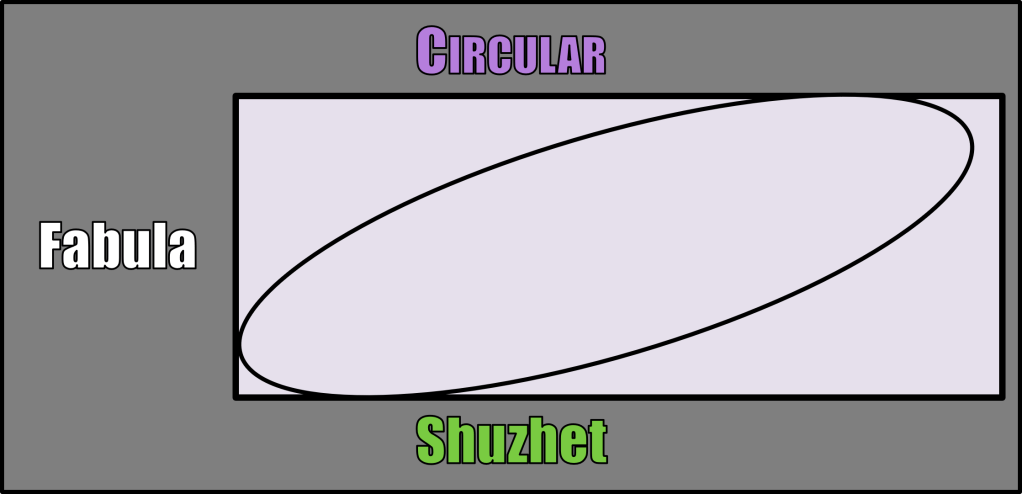
Circular
We’ve gone full circle. I’m sure most of you have your “insert favorite time loop story here” as an example of a story using a circular structure. Sure, time loop stories do use a circular structure, but a time loop isn’t a prerequisite for this type of story.
Stories that use a Circular Structure:
Before the Rain
12 Monkeys
Inside Llewyn Davis
Of course, I’m going to use a non-time loop story as my example here. The Serbian film Before the Rain centers on a pair of childhood friends. At first, they’re just friends. When they hit puberty, they become each other’s first lover. War descends, and it drives the pair from their home. After the war, the two became a romantic couple, despite one of them being married. Eventually, the pair discovers they should be just friends. Before the Rain uses the couple’s relationship as the loop, refraining from inventing time travel.
It’s okay if you want to include time travel, but the circular structure does allow for other avenues.
Non-Linear
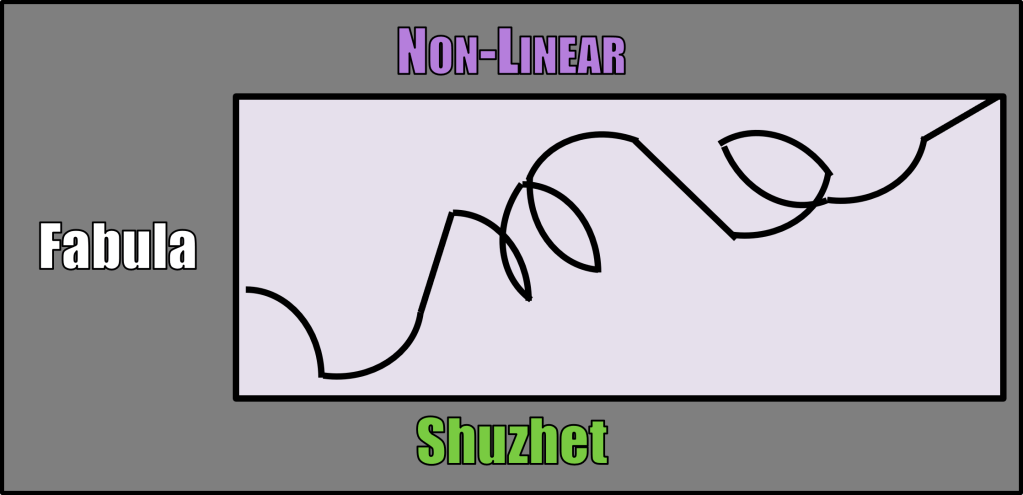
Non-linear stories go back and forth in time, so you’ll see the fabula doing all sorts of crazy movements. Plenty of stories use non-linear storytelling to great avail. I like thinking of the non-linear structure as the structure for trauma. One thing can trigger another. Soon, you’re experiencing everything all at once.
Stories that use a Non-Linear Structure:
The Sweet Hereafter
Pulp Fiction
Slaughterhouse-Five
I love all the stories above, but let’s focus on The Sweet Hereafter. The story is about a school bus that careens off an icy bridge. Half the children on the bus survive. The other half don’t. The Sweet Hereafter explores the survivor’s guilt the living children have. Why did they live while their friend across from them died? I’m getting choked up thinking about it. If you do decide to read or watch The Sweet Hereafter, make sure you have tissues ready.
Oneiric
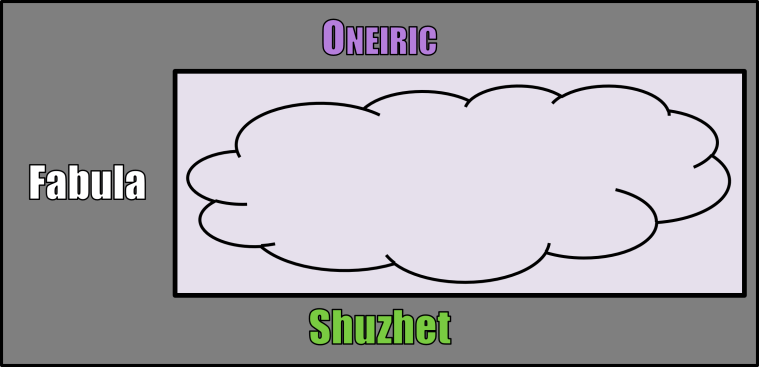
I don’t know how to express oneiric through a chart, so I stuck a cloud in the box. Oneiric pertains to dreams. So, the oneiric structure is one of dreams. Strange, non-sequiturs occur. The dream’s logic may make little sense in the real world, but that doesn’t mean that it doesn’t have its own interior logic. The trick is finding logic in the illogical.
Stories that use an Oneiric Structure:
Mirror
Enter the Void
Tree of Life
The Adventures of Alice in Wonderland is easily the most famous story that uses an oneiric structure, but I decided to go in a different direction. We started with Russian writers and playwrights, and we’ll end with one. Andrei Tarkovsky’s 1975 film Mirror (or Zerkalo) pushed countless boundaries. Semi-autobiographical (and based on Tarkovsky’s father), Mirror follows a poet nearing death. His memories pop in and out like dreams. The titular mirror doesn’t show what it should. Rain falls inside a house with no obvious hole in the roof. Mirror is one of those films you can watch hundreds of times, never quite know what Tarkovsky meant with some of his imagery, and come away with discovering something new.
Side note: I love a mirror as an object in a poem or story. The possibilities are endless.
And those are ten story structures or shapes. Wow! That was long. If you’ve made it this far, you’re awesome. We all know it. Let me know in the comments if I missed a story structure or another ten. I’m certain I did. Thank you for reading, and wherever you are, I hope you’re having a great day.
 jkgeekly.com