Ticket to Ride: Heart of Africa

Forge a path across Africa by means of rail. Days of Wonder’s at it again with its map expansion Ticket to Ride: Heart of Africa.

We’ll get to the review in a bit, but first, here are some board game specifications.

The Fiddly Bits
Designer: Alan R. Moon
Publisher: Days of Wonder
Date Released: 2012
Number of Players: 2-5
Age Range: 8 and up
Setup Time: 5-10 minutes
Play Time: 45 minutes to an hour
Game Mechanics:
Card Drafting
Hand Management
Route/Network Building
Set Collection

TicketToRideAfrica

Game Flow:

We won’t go into too much detail with the basic Ticket to Ride game flow, since we covered the base game earlier. If you missed it, here’s a link to our review. Basically, you form a long route across the African continent using trains. Players collect colored train cards in order to place their colored, plastic train cars on the board from location to location, which in turn, completes destination ticket cards. With that brief synopsis out of the way, we’ll focus on what makes Ticket to Ride: Heart of Africa different from any other Ticket to Ride game—in a word, terrain.
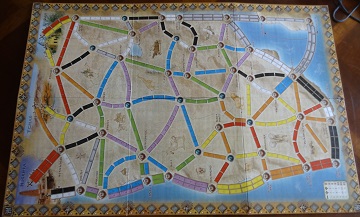
TicketToRideAfricaOverview
Overview of Ticket To Ride: Africa Board

Days of Wonder color-coded Africa by terrain. Red, orange, and yellow routes are in the desert. The two masses of hot colors on the board represent the Sahara and Namibian Deserts, respectively. Blue, purple, and green are jungle, so you’ll find a lot of those colors around the Congo, while black, white, and grey are mountainous regions. Mount Kilimanjaro, anyone? These terrains are not only represented on the board; they find their way on Ticket to Ride: Africa’s terrain cards.
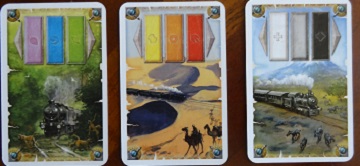
TicketToRideAfricaDestinationCards
Close-up of Terrain Cards

A player can collect and use train cards as normal, but they may also use terrain cards, if the route they’re trying to claim is of that terrain. If a player uses terrain cards, they get double points for the route. Sound too good to be true? Are you thinking what the catch is? The catch is simple. A player’s hand of train cards are hidden from view of other players, but players must keep their terrain cards face up and that is because if a player wants to use a terrain card on a route, they must have the most cards of that type than any other player. So, let’s see how this affects the gameplay in our review.

Game Review:

Ticket to Ride: Africa reminds me a lot of Ticket to Ride: Asia: the tweaks they made to the core gameplay were worthy attempts, but they didn’t fare as well as I would have liked.

If you mess up with tallying any other Ticket to Ride score, you can always look at the board and the tickets you own to see where you erred, but with Ticket to Ride: Africa, if you don’t take note of the routes you scored that were double points, you’ll never get the correct score. This doesn’t happen often but when it does, arguments ensue. This phenomenon also causes anxiety with score keeping that doesn’t exist in any other Ticket to Ride title.
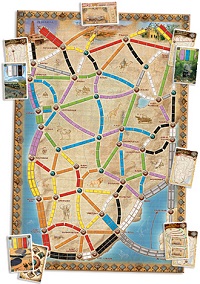
TicketToRideAfricaDaysOfWonder
Overview of Ticket to Ride: Africa

Additionally, the terrain cards slow down the speed of the game. Ticket to Ride is known as a quick game, but the terrain cards force players to compete with each other to see who can grab the most of those cards, which in turn, drags out the game’s length.

I will say that Ticket to Ride: Africa does add some strategy to the series and if you can handle a slightly longer playtime and the need to keep accurate score as you go, it is fun to play. And that’s why we play games in the first place.

Verdict:

Not my favorite title in the franchise, but Ticket to Ride: Africa can add a nice changeup to Ticket to Ride’s core gameplay, and I am a fan of the board. It’s gorgeous—as always—but the colored routes depicting terrain is a nice touch.
Grimm Review – “Double Date”

Grimm

Kyle’s Review

Grimm had an iffy outing with this week’s “Double Date.” We’ve seen the dualities of the Wesen of the week in the past, but I didn’t completely buy the tapeworm-like Wesen with both a male and a female half. It felt disingenuous.

But before we go more into the Wesen of the week, let’s talk about some other elements. The ongoing story arcs continued: Juliette’s Hexenbiestness, Adalind’s new baby, and Juliette and Nick on the rocks. We even got introduced to a new arc of Renard’s touch with death causing ripples in his life. I’m not sure about Renard’s side story—I kind of liked only have two-three major ones—but all of those recurring stories got lost with this week’s over-the-top Wesen outcast.

I didn’t mind Grimm trying to tackle gender identity, but usually, Nick and his gang search for a middle ground. Yes, the tapeworm Wesen hustled unsuspecting men. Yes, one of their marks died (accidently) as a result and justice had to be upheld. But Team Grimm’s solution was more barbaric than normal. Nick shoots the Wesen with a testosterone-filled arrow, denying the Wesen of their female half and forcing them to remain male. You feel sorry for the Wesen, at the end, as it pleads for its female half to return, but those emotional heartstrings Grimm tries to pluck aren’t earned.

Verdict:

A worthy effort that fell short, but hopefully, Grimm bounces back next week.

Archer Review – “Drastic Voyage: Part 1”

Archer

Kyle’s Review

Archer and company get tasked with removing a life-threatening blood clot from an important comatose scientist. ISIS doesn’t have any doctors in their employ—even Krieger will tell you that he’s a doctor-ish but he doesn’t have a degree (whatever those are)—so they don’t perform surgery. No, the logical course of action is to shrink the gang and inject them into the man at the clot’s source. What we get for twenty minutes is typical Archer madness.

Krieger shined brightest in this episode. He felt disrespected, because the other “doctors” gave him the meaningless tasks because he doesn’t have an “MD,” and fouled up the mission at every turn. The rest of the episode pushed beyond the Lana-Archer love angle and to multiple “What will happen to their daughter Aubergine if both Lana and Archer die” scenarios. The third thread is “How does ISIS fit with the CIA?”

We’ve seen the former two threads often this year, but Archer occasionally dropped the CIA angle and whenever they did mentioned the CIA this season, the arc got twisted and disjointed. Case in point, we went from Archer and Lana screwing up their Wales mission last week to this week’s jump cut in a laboratory. We knew this season had to lead to ISIS’s falling in or falling out with the CIA, but why has the CIA put up with them for this long? I’m all for suspension of disbelief—especially in a comedy—but this pushes things a little too far and I could do without it.

Verdict:

The individual parts of this episode worked but this season’s impending climax leaves a lot to be desired.

The Flash Secrets: March 26, 2015

GoldenGlider

Here comes the Golden Glider

There is a Lisa Snart in DC Comics but she doesn’t have a gold gun. In the comics, she was a figure skater, fueled by vengeance, who turned to a life of crime. She locked horns with The Flash on a normal basis—that’s probably because she’s Captain Cold’s sister. She started with specialty skates that created their own ice so she could glide her way into the fray. Then, she became a meta-human that could fly.

A gold gun might look weird, but I would’ve doubled over if I saw a soaring figure skater. Fly, Lisa, fly!

“More like me”

We get another line of reused dialogue in The Flash. Mark Mardon delivered the line “I didn’t know there were more like me,” which echoed what his brother said in the pilot. Nice.

TheFlashOnATreadmill

Cosmic Treadmill

We mentioned in last week’s secrets page that the Flash owned a time-traveling treadmill and this week, we saw it.

Um…did Barry use an ice pack?

Apparently, Eddie hit Barry so hard that Barry had to ice his face. Is Barry’s healing factor on the fritz? Maybe he should check his warranty.

FlashPointTheFlash

“How many more people could die if your mother lives?”

If we can believe Flashpoint, a lot.

According to the event miniseries, the world is filled with hurt if Barry went back in time and successfully saved his mother. We’ll see if The Flash takes this turn—even if only for an episode or two.

The Flash’s Deal with the Rogues

The Flash and the Rogues have had a long-standing agreement in the comics where they try to stop each other, but nobody gets hurt. We’ve seen the books get a lot of play out of the idea that the Rogues might break the arrangement, but this was more of a guideline in the comics. The two sides never got together to determine which trees marked the end zone for their game of football.

Lightning Psychosis

I see this excuse for Barry’s behavior coming up again and again in the near future.

Want to head back to our Flash review? Click here.

Geekly TV: March 27, 2015

TheFlash

The Flash

Jim’s Review

With last week’s cliffhanger or Barry being back in time, we were handed a pretty big clue as to whether or not the events of last week’s episode would stick. This week’s episode wastes no time in getting to that point, and while it makes sense, I came away from this episode just feeling like the stakes had been lowered in a very big way.

It’s not as though last week’s episode is completely irrelevant now, but the only thing that seemed to leave a lasting impact on the narrative was Barry’s moment with Iris, which is naturally undone now. With that said, Barry’s handing of the situation felt out of character and more awkward than I think the writers planned for.

Captain Cold and his gang are clearly the season’s big baddies, and that’s fine, but the show still needs to do more to sell me on the threat Cold poses to The Flash. Flash can dodge a bullet, but not an ice ray? The inclusion of Barry’s identity into the mix does something for their rivalry, and the confrontation with Cisco offered some satisfying development for the loveable techie, even with the clichéd time-travel mantra of, “don’t mess with the timeline,” this episode felt more like an average villain-of-the-week affair, and pales in comparison to what we were teased with a week ago. It wasn’t a bad episode, it just didn’t build on what the last one started.

Oh, and a quick addendum: The gold gun was something that should never have been attempted.

Kyle’s Take

I wasn’t as invested in last week’s episode of The Flash because I knew little—if anything—would stick this week. When you introduce a time-travel mechanism, you can’t trust the events of a show. I’m hoping The Flash doesn’t pull a Dallas and erase an entire season. That would be terrible. Losing most of last week’s episode wasn’t too bad.

With that said, I agree with Jim. We lost any tension from last episode with The Flash’s quick fix this week. We still have seven or eight shows before the season finale, and I think last week served as a sneak peak at what might be in store.

I can’t say that I like Captain Cold and his gang as this season’s baddies either. Cold became less dangerous after his first episode. Part of what made Cold difficult to handle was that he calculated The Flash’s moves. Since his gang accrued more than one gun, they’ve leaned on their toys. It also doesn’t help that The Pied Piper was more menacing and clever. He’s my pick for the leader of the Rogues.

Oh, and I agree with Jim about the gold gun. But what were they going to do, make the Golden Glider ice skate on Snart’s gun blasts? A gold gun was less hokey than skates…maybe.

Verdict:

This was a down week for The Flash. Let’s hope they pick up the pieces next week.

Dart over to our secrets page to get more of The Flash.

Powers

Powers

Kyle’s Review

Well, that escalated quickly. Walker trapped Wolfe in the drainer cell, Johnny Royalle escaped the prison, Walker may or may not have regained his powers, Triphammer is no longer with us, and Zora took all the credit for locking up the big, bad Wolfe. Throw in some flashbacks when Royalle, Walker, and Wolfe were all friends, and that’s a lot happening in a Powers episode (“Paint It Black”) with the shortest runtime.

If you didn’t follow all of that, you’re in good company. I didn’t either—the first time. It took me a second viewer to see Wolfe go ape on Triphammer with Triphammer’s own mechanical arm. The flashbacks gave the audience a breather but they often posed more questions than answers.

It remains to be seen if dispensing the most powerful and deadly villain Powers has to offer will let out the sails, but I like how the show isn’t afraid to shake up things. They may be another source of tension on the horizon—the old Powers telling the new Powers to get off their lawn—and I like how they didn’t flinch when getting rid of a character as pivotal as Triphammer. Or did they?

Powers is a show based on a comic book, so it’s not out of the realm of possibility that Triphammer makes another appearance post death.

Verdict:

Another solid episode but I’m not sure where the show’s heading, now that Wolfe is in custody again and the Triphammer/Royalle angle of getting rid of powers or improving them might have reached an apex.

iZombie

iZombie

Kyle’s Review

iZombie tallied another good episode with “Brother, Can You Spare a Brain?,” but it wasn’t without some minor hiccups. Liv’s narration got on my nerves a bit and I’m glad they cut that out by mid-episode. Why do you need to narrate when the main character expresses her inner monologue? And there was a scene of lesbian sexual tension. Liv caught a glimpse of a male victim’s dalliance with a caramel skinned lover, and then Liv fell for the same woman when they met. This moment bordered on exploitation, but Liv’s powers have made her do some things that she normally wouldn’t (kleptomania making her steal things), so I didn’t mind this too much. It also helped that Liv didn’t suddenly turn into a fulltime lesbian—that would’ve sensationalized the moment.

The murder case was by the numbers, but the introduction of David Anders as Blaine DeBeers was the show’s highlight. Blaine is a drug dealer turned zombie, trying to turn his unlife around. He tried to turn legit by his past caught up with him. We even learned through Blaine that there’s a larger zombie world out there. We knew Liv wasn’t alone, but there may be more here than we first thought.

Verdict:

Despite some bumps in the road, iZombie turned in another good episode and stayed grounded in the world of detective work.

Arrow

Arrow

Kyle’s Review

This week’s Arrow was entertaining, if you find watching a train wreck entertaining.

I’ll try to make this short as I don’t like to harp on a show’s inadequacies. We got reintroduced to the Suicide Squad and ARGUS this week and neither reunion was a happy one. Cupid needs to go—that’s all I’ll say about her. I didn’t like Deadshot’s flashbacks because they didn’t do enough. You can’t introduce a soldier with a troubled past in two, one minute flashbacks. Lawton went from unsure father to raging alcoholic in sixty seconds. Why? Team Arrow had three years to develop his character and they didn’t: lazy writing.

Then you have to wonder who ARGUS works for. The US Military refused to consult on The Avengers movie because they didn’t like not knowing how SHIELD fits into a command structure (thanks for that info, Jim), but we know less about ARGUS than we do about SHIELD. Worse than that, we don’t know how ARGUS fits—if it does at all—into Arrow’s end game this season: again, lazy writing.

I hope Ray Palmer didn’t get a nose bleed on his high horse. His hypocrisy had a heavier hand than the one he donned in his suit. “The police won’t stop the vigilante, so I’ll stop him myself.” That’s known as vigilante justice, Ray-Ray: even more lazy writing.

I did like one, unintentionally funny moment. Ollie put his bow away after chastising Ray. Then, he walked off, while Roy is knocked unconscious in the gutter. Ollie doesn’t check to see if Roy’s still breathing. He doesn’t nudge Roy to see if he stirs. Ollie just walks off, and Roy’s going to wake up a few hours later, wet and alone, saying WTF. Dude, that’s cold blooded.

Verdict:

That was an awful lot of suck for having very little Laurel.

Want more Arrow? Check out our secrets page.

Arrow Secrets: March 26, 2015

SenatorCrayArrow

Who was that heartless politician?

Arrow introduced Senator Joseph Cray who first appeared in 1988’s Suicide Squad Vol. 1 #11. This power-mad politician has used the Suicide Squad to unwittingly help him in his ambitions, so it’s no surprise that he used the squad here.

But I wonder how much he had to pay those civilians to not talk. I see future payments in his future.

Extra note: Joseph Cray had a son named Adam, who briefly served as The Atom. Coincidence?

News 52

The classic news report returns in this episode. It pays homage to DC’s the New 52 and it’s been on Arrow off and on all three seasons.

CupidTheArrow

Cupid

Not only did Cupid return this episode, she took the place of Harley Quinn. In the Suicide Squad comics, Harley crushes on Deadshot, but Deadshot doesn’t share her feelings. Sound familiar? Yeah, it should.

So Arrow teases us with Harley Quinn and then borrows a page from her book for Cupid. I’m thinking this has something to do with the “Don’t mention mister pointy ears” agreement they have.

BradMeltzer

Meltzer Power Plant

That would be a reference to American political thriller novelist and comic book writer, Brad Meltzer. Meltzer wrote for Green Arrow in the early 2000s and then switched to the Justice League of America.

RickFlag

Lyla’s Friend Rick

Diggle mentioned one of Lyla’s friends in passing. It might be a coincidence that her friend’s name is Rick, but Lyla works with the Suicide Squad and so does Rick Flag.

Suicide Squad on Hiatus

With the motion picture in the offing, Arrow might be planning to put the Suicide Squad on ice for a while. Deadshot died—but do comic book characters stay dead? Diggle and Lyla cut ties with their employers—yeah, right. But we have a lot of unresolved plotlines.

Did I just hear Deadshot mention HIVE? Yeah, he did. That’s another huge and mysterious organization. Who knows? The Diggles might start their own group.

Check out our Arrow review here.

Samurai Spirit

Great news: Samurai Spirit converts Seven Samurai into board game form. Not-so-great news: Samurai Spirit converts Seven Samurai into board game form. If you’ve ever watched the Kurosawa classic, you know that things don’t end well for the samurai in question.

We’ll get back to katana wielding in a minute but first, here’s some info about the game.

The Fiddly Bits
Designer: Antoine Bauza
Publisher: Funforge
Date Released: 2014
Number of Players: 1-7
Age Range: 10 and up (9 and up on the box)
Setup Time: About 10 minutes
Play Time: About 30 minutes
Game Mechanisms:
Cooperative Play
Partnerships
Variable Player Powers

SamuraiSpirit04

Game Flow:

There are multiple ways to lose Samurai Spirit and only one way to win.

Each player takes on the role of a samurai sworn to defend a village. The village consists of three family members, six shelters, and barricades. You win by fighting off three days of marauders. You lose the game if all family members die, or if you lose all the shelters (barricades help to defend those), or if any one of the samurai perish.

SamuraiSpiritOverviewOfDaisuke


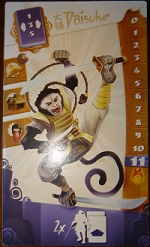
Overview of a Samurai (Daisuke)

You have four options on your turn: fight a marauder, use your innate ability, share your innate ability with a teammate or pass, which I don’t recommend since you’re a samurai and samurai wouldn’t leave a fight.

If you choose to fight a marauder (and most turns will have you fighting a marauder), flip a marauder card from the draw deck and once revealed, you may choose to fight the marauder and accept the damage he deals, placing him on the right of your samurai, or you may add him to the left of your samurai (placing him in either the hat, family member, or shelter slot) to prove that you defended those sections of your village that day.

You can only take a certain amount of damage (based on your samurai’s health) before you get knocked out. It also behooves you to collect all of the left side’s symbols as you will accrue penalties for not doing so.

Fight a Marauder

For example: Let’s say that you draw a marauder card with a damage level of 2 and a family member symbol.

SamuraiSpiritLevel2Marauder


Overview of Marauder Card

You have the option of accepting two points of damage. If you choose to do this, you place the marauder card to your samurai’s right and move your damage marker down two.

SamuraiSpiritCloseUpOf2Damage


Deal two damage to your samurai

You can also add the marauder card to your family member symbol slot, depicting that you saved a family member that day.

SamuraiSpiritCloseUpOfFamilyMember


Match like symbols

Note: The penalty for not having a marauder card with a family member symbol to the left of your samurai is that a family member dies. Remember that there are only three family members and everyone in your samurai team has to collect these symbols or face the consequences, so it’s important to save those family members.

Once you deal with your marauder card, play continues with the samurai to your left. Your teammates have the same options as you and they deal with their marauders in turn. Play continues in a clockwise manner and when it’s your turn you’ll have the same options.

Use your Innate Ability

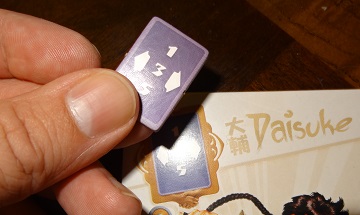
But let’s say that you want to use your innate ability. Using this same samurai as an example, Daisuke has the ability to move a marauder card that he draws to the samurai on his left or right so long as the marauder has a damage rating of 1, 3, or 5.

SamuraiSpiritCloseUpOfLevel1Marauder


Overview of Level 1 Marauder

In this case, Daisuke drew into a level one marauder who also has a family member symbol. We know that your teammates have to collect family members too, so Daisuke passes his marauder to the player on his left or right, and his teammate adds the marauder card to their family member slot.

Share your Innate Ability

You can also skip the drawing of a marauder card by passing your innate ability to another player. There are countless reasons why you might want to do this—not the least of which is manipulating damage to you or your teammate(s). If you choose to do this, you hand your ability token to any of your teammates and your turn ends.

SamuraiSpiritCloseUpOfSharingInnateAbility


Sharing your Innate Ability

One more Ability—Kiai!

If you manage your damage well, you can reach your samurai’s max health points by exact count. When this happens, he goes Super Saiyan. You discard the topmost card in your damage count, reduce the damage your samurai has by the amount on the card, and unleash a powerful attack or ability, a Kiai. Some Kiai discard cards from the marauder draw pile, others construct barricades, and still others can heal you or your teammates.

This is how it could look before you release your Kiai.

SamuraiSpiritCloseUpOfKiai


Reaching your samurai’s max health by exact count: Kiai!

Ending the Round/Day and Winning

The round ends when you run out of marauder cards in the marauder draw pile. If this is the third round and you survived, congrats, you won. If this isn’t the end of third round/day, you’ll have to tally up who has which symbols.

The Symbols to Your Samurai’s Left and their Penalties

Various things happen if you don’t collect a particular symbol. Here’s a chart that depicts what happens.

SamuraiSpiritSymbolsAndPenalties

Samurai’s Spirit Animals

Finally, we come to the samurais’ spirit animals. If your samurai receives two wounds, your samurai flips over and becomes their spirit animal. This trumps up your samurai’s Kiai power and gives them more damage they can take. But be careful as two more wounds will kill your samurai.

SamuraiSpiritOverviewOfDaisukeAnimalSpirit


Overview of Daisuke’s Animal Spirit

Game Review:

Samurai Spirit is unbalanced. It plays two-seven players, but the experience is a lot different for a game with few players than it is for a game with a lot.

It plays too easy for two or three players, and it’s close to impossible for six or seven. You’d think four or five players is the game’s sweet spot, but Samurai Spirit could beat you down (and it plays like a six or seven player game) or the game could take it easy on you. The game devolves into simple chance.

SamuraiSpirit03


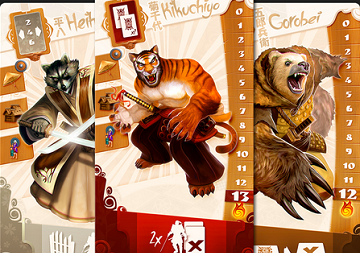
More Samurai Cards

Then you have the possibility of an alpha gamer. Alpha gamers are those people who take over a cooperative game because they think they know what’s best. I’ve had more games of Samurai Spirit with alphas than games without them. This could be because of the makeup of my various gaming groups, but I think Samurai Spirit lends itself to this phenomenon.

“If you want to be an alpha,” I say, “go ahead. It’s on you if we lose.” I don’t blame these people actually. I’ve had to assume the alpha gamer role a few times, when my kids couldn’t decide what to do. You can only watch their heads spin like Linda Blair for so long before helping them out.

All the Seven Samurai in Kurosawa’s classic film die. If you have six or seven samurai at the table with this game, you will die.

Samurai Spirit captures the theme, but it’s frustrating.

Verdict:

A rare, uneven game by Antoine Bauza, Samurai Spirit can be fun when you don’t want to pull out your hair, and it’s a lot of game for $25.

Jamaica

After a long pirate career, Captain Henry Morgan gets appointed Governor of Jamaica. He’s tasked with ridding the Caribbean of pirates. Instead, Morgan invites his former colleagues to join him in retirement. He institutes a race around Jamaica, where each pirate ship can loot and pillage at their leisure. The first one to make it around the island first, wins.

We’ll get to the race in a little while but first, we have to plunder the technical bits.

The Fiddly Bits

Designer: Malcolm Braff, Bruno Cathala, Sebastien Pauchon
Publisher: Asmodee and GameWorks
Date Released: 2007
Number of Players: 2-6
Age Range: 8 and up
Setup Time: less than 5 minutes
Play Time: around 45 minutes
Game Mechanisms:
Dice Rolling
Simultaneous Action Selection

JamaicaBoardGame

Game Flow:

Each player has a hand of three cards and a board depicting the five “holds” of their ship. Each card has two symbols, representing actions, one on the left and one on the right, which you perform on a turn. Players store goods in their holds, and each good serves a purpose. Food provides sustenance for your crew and lets you move from space to space. Gold allows you to pay port costs (also allowing to sometimes) and counts as victory points. Cannonballs beef up your ship’s attack.

JamaicaCloseUpOfHolds

Close Up of cargo hold and goods

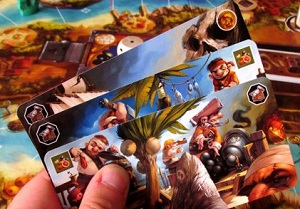
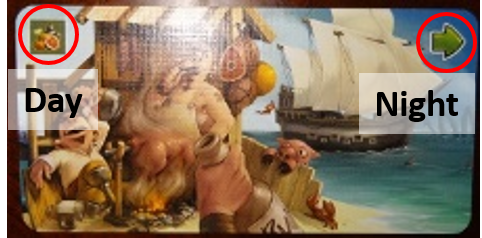
On a turn, one player is designated as “captain,” and the captain rolls two normal D6 dice (six-sided dice that number 1 through 6). After they roll, the captain arranges the dice in an area on the board labeled “day” and “night.” Each player simultaneously selects a card from their hand and places them face down in front of them. Your “day” action is on your card’s left, while your “night” action is on the right. You have to do everything you can do on your card.

JamaicaCloseUpExampleOfHand

Close Up of a Hand

For example, if the captain rolls a six and a two, places the six on “day” and the two on “night,” whatever action is to the left on your card you do six of and then you do two of whatever action is on the right.

JamaicaCloseUpOfDiceAndDayNightAssignment

Close Up of dice and Day/Night Assignment

Let’s say that I play a card that has “food” for the day action and then “move forward” for the night action.

JamaicaCloseUpOfACard

Close Up of Jamaica Card

I would gather six food from the bank and then move forward up to two spaces (however many spaces I can move forward up to two that I can pay for with food).

JamaicaCloseUpOfCargoHoldPlus6Food

Add six food to one hold: Day Action

JamaicaMoveTwoSpaces

Squares on the board denote food needed to move into that space, so I pay five food and move two spaces: Night Action

A turn starts with the captain resolving their actions first, followed by the player to the captain’s left until everyone gets a turn. Once everyone’s cards are resolved, the player to the captain’s left becomes the new captain, and the next turn begins.

There are two uncommon occurrences on a turn: treasure and combat. If a player lands on a treasure space by exact count during one of their turn’s actions, they earn a treasure card. These cards can give you combat bonuses, grant you extra victory points, or even increase your ship’s cargo hold.

JamaicaTreasureCardsCloseUp

Close Up of Treasure Cards

If you land on another player by exact count, the two players fight. You roll a special D6 (a six-sided die with odd numbers on it, except for one automatic win face) and players can add cannonballs to their roll to improve their chances. The winner steals a treasure or goods from the loser, and in the case of a tie, nothing happens.

Play continues until someone crosses the finish line. Players finish their turn—if they haven’t taken them before the player crosses the finish line—and you tally victory points to find the winner.

Game Review:

I love Jamaica. It has elements that remind me of board games past but it etches its own path at the same time. Jamaica works as a great gateway game, a game that’ll get non-gamers into tabletop games. It’s fast and easy-to-learn, and that’s a good thing because it’s also gorgeous.

I’ve taken Jamaica to gaming groups and it attracted onlookers because of its sleek appearance, but people stayed around the table because of how well the game plays. And who doesn’t like playing a pirate?

JamaicaOverview

Overview of Jamaica

I do have one small gripe and you might guess what it is based on the game flow. At its heart, Jamaica is a racing game but the winner is determined by victory points. You can earn victory points by collecting treasure, cashing in your doubloons, and by how far you went around the island. You earn 15 points for passing the finish line and the point value decreases the farther you are from the finish line until you reach a red line on the board. If you’re on the wrong side of the red line, you get negative points.

JamaicaCloseUp

Red line at far left (-5 points)

While I’ve never seen anyone win—yet—that received negative points from the distance they traveled (or didn’t travel), the winner of the race seldom wins the actual game. The winner is usually someone hanging back a few spaces from the finish line with a heap of doubloons and some high point value treasure.

Still, Jamaica’s a wonderful game that you have to try at least once.

Verdict:

A fantastic game by Bruno Cathala, Jamaica provides a beautiful experience.

Geekly TV: March 23, 2015

Grimm

Grimm

Kyle’s Review

Grimm didn’t quite live up to the episode that aired just before its spring break, but “Bad Luck” did progress the main arcs. While I liked Grimm’s interesting (and disturbing) twist of a “lucky rabbit’s foot,” the Wesens of the week paled in comparison to the continuing Adalind and Juliette drama.

In fact, Wesen having fertility issues so they switch to magical means to conceive by means of severing a rabbit-person’s left foot feeds into Adalind’s baby issues, which in turn feeds into Juliette and Nick’s relationship. I didn’t buy Juliette forcing Nick to accept her hesenbiestness in a 24-hour period. She didn’t accept Nick as a Grimm right away, so that was unfair and yet, I think they’ll get through it. Here comes a spoiler: Adalind as Nick’s baby momma will be harder to overcome—end of spoiler.

I do like how Rosalee and Monroe conducting reconnaissance might stir cross-Wesen breeding to the fore, and I can see Grimm drudging up Wesen-race issues again. All of that’s working, but I agree with Renard, when he said that Adalind doesn’t care for their baby as much as she says (or thinks) she does. For an episode centered on families and how they protect each other, Adalind has a cold, disconnected aura between her and her daughter. I’m not sure if this works or not.

One could argue that hesenbiests can’t love, but that would mean that Juliette will fall victim to this fact, or one could say that Adalind never had someone to love her, so she can’t love anyone else. It’s a classic nature versus nurture argument. We’ll have to wait and see how Grimm responds.

Verdict:

A solid outing that might have brought up some points that’ll drive Grimm to a strong finish.

Archer

Archer

Kyle’s Review

At first glance, this week’s episode of Archer (“Achub Y Morfilod”) looked like it abandoned the Katya hijinks of last week. The first scene deserts Archer’s penthouse apartment—where we left him and Lana—for Archer driving a foreign car across a lush, countryside. We think Archer’s alone, talking to his mother, but soon, Lana wakes up in the car’s backseat.

Archer drugged Lana and brought her to Wales. He thought that a romantic and neutral site would give him the chance to explain how Katya’s unmentionables ended up in his apartment. It’s never that easy with Archer. In addition to a romantic getaway in Wales, he abducted Lana for a new CIA mission. Things get nutty as the mission blows up in Archer and Lana’s face—when does that not happen?—because the two entangle their personal lives with getting the job done.

In the end, Archer and Lana are on the rocks, and their status with the CIA might be in danger. It looks like another crazy Archer finale’s in the works in the next couple of weeks.

Verdict:

Archer ups the ante in more ways than one as it heads toward the end of its sixth season.

Bobs

Bob’s Burgers

Kyle’s Review

Bob’s Burgers continued its eighties nostalgia year with “Runway Club.” It was only a matter of time before the Belchers and company took on the classic Breakfast Club, but this episode was underwhelming. The cast split up into adults and children—another thing that’s happened a lot this season—and instead of the show hinting at its film’s namesake, it recreated most of the plot. And it didn’t do it well. The two biggest problems with this episode are that the kids don’t fit neatly into the Breakfast Club’s archetypes (a brain, an athlete, a basket case, a princess, and a criminal), and it foregoes the multiple reasons for the children being in detention for a single instance.

While it’s usually a good thing that Bob’s Burgers doesn’t pigeon hole its characters, it makes the Breakfast Club motif a tough fit. The movie started with those stereotypes and then the characters tore through them with the myriad of reasons why they ended up troubled in the first place. Bob’s Burgers never put up those walls, but it also cheapened the source material for not having something with more weight than Tina and Tammy’s beef.

Despite these problems, I liked the attempt to mash up Breakfast Club and Project Runway—I just wished they didn’t trade the group essay of Breakfast Club for a group fashion show. I guess the lesson here is that when you take on a classic, you must bring your “A” material.

Verdict:

“Runway Club” did manage to capture some of the Breakfast Club and Project Runway’s feel, but it tripped on its train and fell flat.

Geekly TV: March 20, 2015

iZombie

iZombie

Kyle’s Review

iZombie upheld the CW’s season of outstanding pilots. It blended more genres in a tasty way than a Long Island Iced Tea mixes liquor.

The protagonist Liv comes off as an undead Veronica Mars: acerbic and unaffected. She even narrates as she goes along. Then iZombie infuses the zombie motif and I say motif because there’s just enough of a hint of zombie so you know that she’s undead but the focus isn’t on brain eating. That may be a deal breaker for true zombie fans but I’m not so sure. At the heart of every zombie fan is the feeling that you don’t belong—werewolves are the jocks; vampires are the heartthrobs everyone wants to be with—so iZombie captures the essence of being a zombie while not showcasing the gore. But my favorite genre twist is iZombie’s inclusion of a police procedural. Even though you get plenty of the buddy cop flavor, iZombie turns the genre on its ear by having one of the partners a zombie, masquerading as a psychic.

Who knew that there could be side effects from eating brains? Liv gains the memories, proclivities and abilities of the people whose brains are in her system. She found out who killed a Jane Doe by using visions from the victim’s memory, became a kleptomaniac that also factored in pinpointing the victim, and her sudden knowledge of Romanian helped in the interrogation process. In a word, Genius.

I even like how iZombie used comic panel stills just to remind folks that this is yet another great addition to the DC Comics TV Universe. Okay, iZombie comes from a DC Comics subsidiary Vertigo but it’s still a great show.

Verdict:

Another wonderful DC Comics TV Universe (err…Vertigo) pilot and it makes me yearn for the CW programming shifting to non-stop DC Comics shows.

TheFlash

The Flash

Jim’s Review

Well, as we get closer to the end of Flash’s first season, the show is doing a couple of really nice things. I like that after this week’s episode, Iris finally knows Barry’s big secret. On the one hand, it can be argued that far too many people know Flash’s identity, but Iris being clued in feels overdue. Additionally, I’m glad that there wasn’t some big moment to it. It felt like it came out because it had to, and really, it did.

The other nice thing this show is doing is raising the stakes. If last week’s episode has a big knock against it, it’s that the second Weather Wizard was underwhelming, to say the least. Dr. Wells’ big moment with Cisco did something to pick that slack up, though.

With the device of time travel introduced, it’s hard to imagine Cisco’s death being a permanent development, but I will say the scene was effective nonetheless. I think the only disappointment with Wells’ character is that because we saw him stare down the yellow suit a number of episodes ago, I wanted the truth behind his identity to be a little more complicated than it has proven to be. Still, this week’s episode provided some very real momentum for the show’s first season, and I am anticipating a strong finish.

Kyle’s Take

Stop me if this sounds familiar. This week’s villain of the week didn’t do a whole lot–stop. But Harrison Wells saved the tension by giving us some great moments–stop. Yeah, those two things have happened a lot this season.

I’m also not convinced that Cisco’s death will stay permanent because of the time travel element but the same can be said of Iris knowing Barry’s secret. Anything of note in this episode occurred after Barry met his speed mirage, so if Barry changes the pattern of events, Cisco will no longer be dead, Captain Singh won’t be in the hospital, the Weather Wizard will not have gone wild in Central City yet, Harrison Wells will not have revealed his identity (I agree that it was too straight forward of any explanation anyway), and Iris won’t know that Barry’s the Flash.

The only thing that happened prior to the speed mirage is that horrible double date at the bowling alley. For all its fireworks, this episode could be null and void, except for the first and last few minutes.

Verdict:

An exciting show that may or may not have made progress.

Do you want more Flash? Check out our secrets page here.

Powers

Powers

Kyle’s Review

Powers continued its upward swing this week with the curiously named episode “Devil in a Garbage Bag.” All heck broke loose when Wolfe ran amok in the Powers prison and all the threads that were introduced in the previous three episodes germinated in this one.

Johnny Royalle revealed the secret behind his Sway and how his actions aided in Wolfe’s escape. The great thing is that Royalle didn’t plan Wolfe’s escape as hinted at the end of last week’s episode; it was a mistake. Johnny resumed his role of misunderstood villain, while Wolfe added his name to that list.

Wolfe proved to be a Galactus type. He doesn’t mean to hurt people; he’s just hungry. He even viewed himself as a boy throughout the episode and hurt the people who had been hurting him. I loved following him through the labyrinth of a prison, trying to remember why and how he was placed there, but I’m not sure if Powers can continue this arc for another six episodes. Still, there’s plenty to work with the Walker-Wolfe angle.

Walker and Pilgrim looked like they had finally bridged the gap between awkward partners to full-fledged partners when Walker took Sway, trying to regain his lost powers. We knew it was only a matter of time before he tried something like that. Long story short: it didn’t end well for Walker. He spent most of the episode psychically linked with Wolfe—that’s how we see Wolfe’s depiction of himself as a child. We’re not sure how Walker and Royalle plan to deal with Wolfe—and that’s a good thing.

We found out how Triphammer and Retro-Girl intended to deal with Wolfe. Triphammer’s drainer took center stage, while Retro-Girl exited stage right. Sprinkle in some good airtime for Calista and Krispen and you get the most engaging episode of Powers yet.

Powers’ first season may act a lot like Arrow’s inaugural season. It started off shaky and now it may have found its legs.

Verdict:

Powers continues to get better week after week. Let’s hope it doesn’t peak too soon.

Arrow

Arrow

Kyle’s Review

This week’s episode of Arrow, “The Offer,” suffers from one key plot device but there were some good, small developments. Let’s get the one major weakness out of the way first.

I didn’t buy Ra’s Al Ghul slumming it, asking Ollie to be the next Demon’s Head before the spring break (How do you go from the DC Comics icon Batman to the tertiary character Green Arrow?), and I don’t believe Ra’s trying to sabotage the Arrow’s gig in Starling City now. Arrow’s asking me to suspend disbelief a little too much. And I while think Ra’s tearing down Ollie has enough legs to propel Arrow to the end of the season, this feels like a series reboot. Captain Lance didn’t like Arrow in the first season and a half and hunted him, and now it looks like he’ll start hunting Arrow again by this season’s end. With that aside, I did like some of the other developments.

Thank you, Ollie, for cementing Roy’s crime fighting nickname. He’s officially Arsenal and there was much rejoicing. Roy had a particularly good episode as he and Thea got back together. It was only a matter of time and it felt right here. I’m not sure about Thea’s mental state—I don’t think she is either—and she needs a rock. Outside of Diggle, Roy’s the well-adjusted member of Team Arrow. But Roy and Thea are two characters I like. Let’s talk about one member of Team Arrow I wished wasn’t part of the cast.

Laurel had few lines—that’s good. She had a lot of over-the-top action sequences—that’s better. And she asked a Nyssa without a home to be her new trainer. Nyssa as Laurel’s trainer is both smart for Laurel—we don’t say that too often about her—and Arrow needed a friendly link to Ra’s. Ra’s daughter Nyssa aiding Ollie should even out Ra’s trying to damage Ollie’s reputation.

Verdict:

Arrow took some steps toward a solid end game, but it wasn’t the end game we wanted.

Check out our Arrow secrets page here.