Top 5 Stocking Stuffer Board Game Companies

Hey, hey! Kyra Kyle here. We’re in the middle of the Christmas season. There aren’t that many days until the holiday, so I decided to go with another purchasing guide: stocking stuffer board games. But I don’t want to just do individual games. No, no. Let’s discuss board game companies known for producing good games that can fit inside a stocking.

We’ll have to set some ground rules.

1) The packing must be small enough to fit in at least 50% of stockings.

2) The games must be good. While smaller packaging can lead to compromises, who wants to play a bad game?

3) Extra points for companies that produce various games. It’s easy to find a formula and produce multiple versions of the same game, but I’m handing out brownie points to any company capable of stretching their creative muscles.

With all that out of the way, let’s get to the games, or the board game companies.

5: The Game Crafter (Mint Tin Games)

On the Game Crafter, aspiring game designers can buy board game components for their prototypes. But it also functions as a store for indie board game designers to sell their games. The Game Crafter is a great place to support smaller game companies and indie board game designers directly. We’ll be covering their Mint Tin Games line. These games fit inside a mint tin. Perfect for a stocking.

Price: Varies between $20-$35. Board game designers set their own prices, so mint tin games vary wildly.

Quality: It’s a mixed bag. That’s why Mint Tin Games are fifth on this list. But there is a silver lining. The Game Crafter gives their stamp of approval to any game they view as worth your time.

Variety: Tons! Mint Tin Games are the Wild, Wild West of board games. Think of it as the board game equivalent of the indie video games on Steam. You’ll find games here that you can’t find anywhere else.

Size: 4-inch by 2 1/2-inch mint tins. You can fit these tins into any stocking. I’m surprised by the amount of games you can find that fit inside this packing.

Titles: Again, I’d look at anything that gets the Game Crafter seal, but here are some standouts. I’ve found a ton of excellent solo games. Doom Machine is fantastic. Mint Knight is a fan favorite and a sandbox RPG. What? Astro Asterid’s Quick Shuttle Repair is a fast-paced resource management game. And Deck 52: Space Wrecked is a fun dungeon crawl.

Store Link: (https://www.thegamecrafter.com/games?query=mint&hitsPerPage=18) The Game Crafter (Mint Tin Games).

4: Pack O Game

We had a game series in a mint tin. Pack O Game fits inside a box of chewing gum. How do make a game fit in that tight of a space?

Price: $7 each. By far the cheapest set of games on this list. You can’t beat $7 for a game.

You can also buy a bundle for $50, but that includes 8 games and a pod that can hold all the games from a set, and there are three sets. Even though the pod can hold all the games in a set, it’s still small enough to fit into any stocking.

Quality: Most of the games in this line are good. There can be some duds, but for $7, you can buy a few. And the stellar titles can be fantastic.

Variety: These games use cards shaped like sticks of chewing gum. Despite that, there are plenty of game mechanisms represented in this line.

Size: Don’t worry about it. These are tiny games. These game boxes measure around 5-inch by 1-inch. Crazy small!

Titles: I haven’t played much from the second and third sets, but I played plenty of the first one. Shh must be the best of the bunch; it’s a cooperative word game. Hue and Fly are also good, but I have a soft spot for TKO.

Store Link: Pack O Game by Perplext.

3: All Play Games (Small Box Line)

For the most part, All Play has two sizes of games. We’ll be discussing the smaller (square-shaped) games with this listing. But the larger boxed games are worth perusing as well.

Price: Under $20. Great value for the amount of game inside these small boxes. It’s also a great price for a stocking stuffer.

Quality: While not all the games of this line suit my tastes, the games in All Play’s small box line are baseline good. If something sounds interesting, it’s well worth the price tag.

Variety: All Play has some of the best gameplay variety on this list. You’ll find plenty of themes and gameplay mechanisms that are sure to meet your board game enthusiasts’ preferences.

Size: This is what makes All Play’s small box games third place. This line dominates all the other criteria, but size could be an issue. The small boxes measure 5-inch by 5-inch. That could fit in at least 50% of stockings. Maybe? If you have extra-large stockings, no problem. And who cares if the box protrudes from the stocking’s top?

Titles: I mentioned Chomp in our “Getting Starting with Tile-Laying Games” (you can check out that write-up here); Chomp is an excellent game. Sequoia is another great title. Ghosts of Christmas may be a good thematic game for the season. And I’ve heard great things about Mountain Goats.

Store Link: (https://www.allplay.com/board-games/) All Play Games. Look for the square-shaped game boxes.

2: Button Shy Games

Board game rockstar Elizabeth Hargrave (Wingspan) got her start with Button Shy Games’s Wallet Game line. To date, she has more than one game in the Wallet Game line. As the name suggests, these games fit inside a wallet, so they will definitely fit inside a stocking.

Price: $12 each. Another cheap option with some great games on offer.

Quality: Like All Play’s small box line, most games in Button Shy Games’s Wallet Game line are good. But there are some standouts.

Variety: Most, if not all, of the games in this line use 18-card decks. Each game does something different with its 18-cards but it can get repetitive if you pick up too many at once.

Size: The size of a slim wallet, roughly 5-inches by 3-inches. You won’t have an issue fitting any of these games into your stockings.

Titles: Hargrave’s first published game Tussie Mussie is not in stock before Christmas 2024, but you can pre-order the next printing set for an April 2025 release. But she does have another great game named Picky PixieMysticana uses a nice twist on rock-paper-scissors, and it has plenty of expansion should you enjoy the core gameplay. Sprawlopolis is a great city-building game. It’s sold out, but its stand-alone sequel Agropolis is available.

Store Link: Button Shy Games Wallet Games line

1: Oink Games

Oink Games have a lot of quirky little games in their line. They have plenty of games that come from East Asia.  More than a few of those will get a mention in the Titles section.

Price: Most are $23, but there are a few that can be a little higher or lower in price.

Quality: Another company that has baseline good games with some standouts.

Variety: Except for All Play’s small box line, Oink Games may have the most variety of any game company (or line) on this list.

Size: The boxes are about 3.5 inches by 2.5 inches. Bigger than most other lines on this list except All Play’s.

Titles: I covered Deep Sea Adventure some time ago with our “Getting Started with Pickup and Delivery Games” writeup (here’s a link); it’s a great title. Scout earned the 2022 Spiel Des Jahres; I may have to check out that one. A Fake Artist Goes to New York is a ton of fun; everyone draws a picture together, but one person (the fake artist) doesn’t know what the group is drawing.

Store Link: Oink Games

That concludes our list. There are a lot of games worth trying. There may even be some that I may have to purchase…as a gift. A gift that’s TOTALLY for someone else.

Did we get the list right? Let us know which companies you would add in the comments. And wherever you are, I hope you’re having a great day.

Top 5 Underrated DC Villains

Hey, hey! Kyra Kyle here. We’re doing something very different this week and posting a much older post by our resident Star Trek Geek, Jim Plath. He shared his Top 5 Underrated DC Villains years ago, and I just found the copy. Sorry about that, Jim. Without further ado, here is the Top 5 Underrated DC Villains.

This one ended up being trickier than I expected. When you start digging, you can make a case for just about any villain of Batman’s not named Joker, Ra’s, Deathstroke, or Superman’s not named Lex, Doomsday, Darkseid, or Brainiac. Here’s my list though.

5) Cheetah:

You could make a case for just about any DC female villain not named Harley Quinn these days, but given that she’s really an anti-hero now, she might not make the list anyway. Cheetah’s history with Wonder Woman is pretty front-and-center in Wonder Woman’s current arc, and it’s doing wonders for drawing attention to her sympathetic qualities. As a character, she’s tragic, and as a villain, she’s got Wonder Woman’s durability and the speed of, well, a cheetah. That makes her a worthy adversary for a good portion of the Justice League.

4) Brother Eye

The OMACs/Brother MK1/Brother Eye have been used similarly to Marvel’s Sentinels. They’ve been involved in some great Justice League stories over the years, played a pivotal role in Infinite Crisis and Final Crisis, and always generate hefty stakes.

3) Mongul

Mongul is something of an ersatz Darkseid. In fact, that’s most likely why he’s underrated. Like a lot of characters, his backstory changes slightly here and there, but he’s proven himself a threat to each member of the Justice League individually, and given them a run for their money as a group. He even once destroyed Hal Jordan’s hometown of Coast City.

2) Psycho Pirate

With the power to affect people’s states of mind, he probably gets passed over too often for villains like Scarecrow, but Psycho Pirate’s powers are broader. He’s been shown to mollify hostile characters, even pacify Bruce Wayne and Jim Gordon. It isn’t always about fear with the Psycho Pirate.

1) Vandal Savage

When it comes to men made untouchable to father time, the bulk of the spotlight goes to Ra’s al Ghul these days. Some of that is the influence of the Arkham video game franchise, and the Christopher Nolan Dark Knight trilogy, but another factor is Savage is far more powerful. There just aren’t many DC heroes who can make a match for him, so he doesn’t get as many shots at the bigtime.

Do you agree with Jim’s list? Who would you add or remove? Let us know in the comments. And wherever you are, I hope you’re having a great day.

Top 5 Marvel United Expansions to Buy

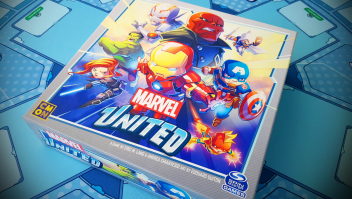
Hey, hey! Kyra Kyle here. We discussed Marvel United, a cooperative board game designed by Eric Lang, less than a week ago. If you want to see our review of the core set box, here’s a link to that review (link to the review). We also started a guide to Marvel United; you can check that out here (link to the guide page). But today, let’s discuss which Marvel United Expansions are best to purchase first. Think of this as a Marvel United Purchase Guide.

Marvel United has a ton of expansions, so we need to narrow down which ones—in general—are the expansions you should look for. Disclaimer: Eric Lang is one of my favorite designers, and he did a brilliant thing with this game. (I may be biased, so sue me.) Lang put more of his design focus on the villains and not the heroes. That must’ve made the design and iteration process easier. He worked smarter, not harder: brilliant. This isn’t to say that the heroes don’t have personality, they do, but the villains add more wrinkles to Marvel United’s gameplay and with that said…

1) Expansions with more villains feature more prominently on this list. The more villains, the more unique ways to play Marvel United.

2) Boxes with unique gameplay (outside of more villains) will also rate high on this list.

3) I won’t include core sets. These aren’t expansions; they are base games needed to play Marvel United. With that said, you need at least one core set to play Marvel United. Pick the one that looks the most interesting. I like the original Core Set and the X-Men Core Set.

4) If you have a favorite Marvel character, get the box with that character. It doesn’t matter which boxes I say are the best to have. If your collection isn’t complete without your favorite character, get your favorite character.

5) If CMON Games releases another Marvel United campaign on Kickstarter or Gamefound (which is unlikely because they began DC Heroes United, which will be compatible with Marvel United, so crossover battles!), you should be able to get past Kickstarter exclusives. Fingers crossed that CMON will run a second print run for any of the campaigns. That’s more of a possibility than a fourth Marvel United set.

5: X-Men First Class

Spoiler Alert: We’ll see more than one Marvel United X-Men expansion on this list. Many of the runners-up come from the X-Men; that’s what you get when you add the Fantastic Four to the X-Men campaign (the Fantastic Four just missed the list). X-Men First Class has a whopping five heroes, which is rare for an expansion. It also features a double boss in Quicksilver and Scarlet Witch. And it even includes Danger Room Challenges to spice up the gameplay even further.

X-Men First Class has a little bit of everything. Its only downside is that it’s a Kickstarter exclusive. This will be a theme for the list. It’ll be difficult to find X-Men First Class for cheap, but well worth the purchase if you can find it. Or you could wait for a second print run. Again, fingers crossed.

4: Days of Future Past

Another X-Men expansion makes the list. Days of Future Past brings the classic X-Men story of the same name to life. (In case you missed it, here’s our list of X-Men Starter Stories; “Days of Future Past” made the list.) Days of Future Past adds sentinels. And these sentinels (three large ones sporting different poses) are almost to scale. This marks the first time Marvel United attempted a larger model type. Ahem. The largest model shows up later on this list.

Add in Nimrod, a futuristic and enhanced Sentinel model, as the main villain and you have the recipe for another great Marvel United expansion. Again, Days of Future Past is a Kickstarter exclusive. Why does CMON keep locking this great content behind Kickstarter exclusivity? C’mon, CMON. I know why they do it: money. I just wanted to say C’mon, CMON.

3: Maximum Carnage

Maximum Carnage has the most villains in an expansion, not including the promo boxes of Kickstarter exclusives. It includes a staggering seven villains (with one of those villains, Morbius, who’s also playable as a hero). Yikes! And Maximum Carnage isn’t a Kickstarter exclusive. Maximum Carnage builds on a playstyle that will show up again on this list; it introduces a New Sinister Six.

If you have the Kickstarter exclusive (there is a difference between the retail and Kickstarter versions of Maximum Carnage), you can interchange the various members of the Sinister Six. If you don’t have the Kickstarter-exclusive Maximum Carnage expansion and you have everything else need, you could print off the New Sinister Six cards from the Marvel United Wiki and add them to your game. I’m not condoning that behavior. I’m just saying you can. Wink.

You could just have a core set and most of the Spider-Man expansions and have a game of Marvel United that you could play for decades. The Sinister Six Module is fantastic.

2: The Coming of Galactus

Galactus is the largest Marvel United model to date, and The Coming of Galactus adds a new threat to the game. Namely, Galactus. But Galactus does have heralds, and The Coming of Galactus includes four of these heralds: Nova (Frankie Raye), Terrax, Firelord, and Air-Walker. Silver Surfer was released in the Fantastic Four expansion, which again, barely missed this list. If you have Silver Surfer, he can be added as one of Galactus’s heralds. Yay!

Since Galactus is a world-level threat, the gameplay surrounding him is on a global scale. The heroes don’t defeat Galactus. Not many can defeat Galactus. Instead, the heroes convince Galactus not to consume Earth. The Coming of Galactus is thematic and worth the buy, even if you just want a massive Galactus standing on the moon.

1: Return of the Sinister Six

Return of the Sinister Six includes the original members of the Spider-Man’s Sinister Six. Six villains are always a nice addition. Add in a new way to play, the villains are on a team, and this easily makes Return of the Sinister Six the best of the original Marvel United campaign’s expansions. While I could’ve moved any number of the expansions higher on this list and one of the expansions (Maximum Carnage) improves upon this gameplay style, Return of the Sinister Six deserves the top honors.

Unironically, Vulture may be one of the most difficult villains to defeat, whether a part of the Sinister Six or on his own. He gives me nightmares. And this is such a great expansion.

So, did we get the list right? Which expansions would you include in your Top 5 Marvel United Expansions? Let us know in the comments. And wherever you are, I hope you’re having a great day.
Gacha Game Review: Wuthering Waves

Hey, hey! Kyra Kyle here. I’m breaking away from Hoyoverse games with this week’s Gacha game review. Wuthering Waves (WuWa) by Kuro Games is a worthy challenger to Genshin Impact. But how does it stack up against our updated Gacha game review system? If you want to see how came up with the Gacha game review criteria, check out this older post (link here). Let’s see how WuWa fairs.

Mechanisms

Mechanisms: 8/10

Unlike what Genshin Impact did with Zelda: Breath of the Wild, Wuthering Waves does more than just copy Genshin’s mechanisms. Sure, the core gameplay works similarly. A Genshin player won’t be confused moving around WuWa’s world. But movement may be the first improvement Wuthering Waves makes to Genshin’s formula.

Wuthering Waves adds two elements to its movement: a grappling hook and speed running up mountain faces. Genshin Impact has the occasional character that has a grappling hook ability, and Sumeru and the newly added Natlan have the occasional grappling areas. But WuWa gives each player access to a grappling hook. This may not seem like much, but it makes navigating the world a lot easier. And speed running up mountain faces is a blast. Naturally, you run out of stamina faster by running up mountain faces, but I don’t mind. Nothing beats Naruto running up a mountain.

Wuthering Waves even speeds up the glider. I’d like it if the glider were even faster but the fact that Kuro Games, Wuthering Waves’ publisher, listened to fans during their beta test phase and increased the glider’s speed from what it was is a step in the right direction.

Kuro Games has a knack for spicing up combat. Early reviews dubbed Wuthering WavesGenshin Impact meets Dark Souls,” and that’s a bit much. Wuthering Waves has intricate combat, but it’s nowhere near as punishing as Dark Souls. The upper-level content does get close to Dark Souls level. One false move and you lose. Wuthering Waves certainly takes more skill to play than Genshin Impact. The big combat addition Kuro Games makes is intro and outro skills. Each character has one, so team synergy matters.

I’m saving the best for last. Instead of your standard equipment, Wuthering Waves uses an Echo system. Echoes are in-world creatures/entities you can hunt, absorb their essence, and then use them to power up your characters. The Echo system acts like a cross between Pokémon and Final Fantasy VIII’s Guardian Forces. Gotta catch ‘em all.

Gameplay Loop

Above Image from GameDesigning.Org

Gameplay Loop: 9/10

The gameplay loop that makes Genshin Impact fun also makes Wuthering Waves fun. It doesn’t hurt that you can play WuWa longer each day than you can Genshin. But I mentioned what makes Wuthering Waves’ gameplay loop better in the previous segment: Gotta catch ‘em all. Echoes are fun to capture. At some point, they do become repetitive. WuWa hasn’t been released very long, so there aren’t as many Echoes to catch as I would like. But as soon as a patch drops, the addictiveness of collecting Pokémon transfers to Wuthering Wave and elevates its baseline gameplay loop.

This simple addition can sometimes make me forget about the grind needed to farm the Echo with the stats and substats I need. And if I get bored, I can hunt for shiny Echoes. Yes. WuWa has shiny Echoes that can spawn occasionally. I want—no need—all the shinies.

Respectful of a Player's Time

Respecting Time: 4/10

The other shoe has dropped. Wuthering Waves improved on some of Genshin’s shortcomings as it pertains to wasting time, but it doesn’t do enough. In other words, WuWa may be too close to Genshin Impact in this category.

The improvements: players auto collect all treasure and loot and faster movement. But players still need to fight domains to use their daily energy and collect leveling materials.  Wuthering Waves has no auto-finish capability. The game assumes a similar stance to Genshin Impact. They created a beautiful world and tasked the player with busy work that could’ve been a click of a button. But, hey, the world looks gorgeous. But I don’t want to fight the same low-level enemy fifty times to gain character upgrades.

Furthermore, some upgrade materials only be obtained by fighting overworld enemies. This becomes tedious. Fast. I also don’t like tracking an enemy to collect those five extra rings I need to ascend Calcharo’s abilities.

Can I include continued slow load times in this category? I will. Wuthering Waves’ launch was mired with crashes and slow load times. Kuro Games has improved WuWa since its launch, but it’s far from perfect. I can still do all my dailies for Honkai: Star Rail while I wait for Wuthering Waves to load its first screen. I’ve tried WuWa on my iPad recently, and I can say that the game still has crashing issues on mobile platforms. Good luck trying to play Wuthering Waves on anything but a PC. Granted, I do believe WuWa plays best on a PC, but I’d like the option.

Battle Pass: 4/10

Most Gacha games have awful battle passes. Sure, you can get some useful items, even some level items that could take you hours to collect in the overworld, but nothing stands out. The battle pass weapons are okay. I have the broadsword equipped to Calcharo. I even like the idea of bonus Echoes. But players get nothing unique from the Wuthering Waves’ battle pass.

Correction: you receive a specialty nameplate the first time you purchase the battle pass. Yeah, that’s not enough. I like getting more stuff, but most of WuWa’s battle pass gives you a reprieve from playing the tedious parts of the game. I’d like it more if Wuthering Waves eliminated more tedious gameplay and added more unique rewards for finishing a battle pass. This would be a great place to add alternate skins. Why don’t any of these AAA Gacha games include skins in their battle passes?

Furthermore, Wuthering Waves’ battle pass inherited Honkai: Star Rail’s battle pass issue. The last dozen or so levels offer the same rewards. Similarly, this makes finishing the battle pass less stressful. I don’t feel like I’m missing out if I don’t finish the final handful of battle pass levels. But it feels worse when you complete WuWa’s battle pass. You’re left with asking, Is that all there is?

Video Game's True Cost

True Cost: 8/10

Wuthering Waves’ Gacha system uses a similar structure to Hoyoverse’s Gacha system. 160 in-game currency gets a player 1 turn of the Gacha crank. But WuWa lowers the turns needed to get a guaranteed 5-Star from 100 to 80. This is a game-changer because Wuthering Waves has a similar flow of in-game currency as a Hoyoverse game, and Kuro Games hands out several free Gacha turns each patch. They’ve even given players a free 5-star, Xiangli Yao.

Furthermore, Wuthering Waves’ weapon banner guarantees the featured weapon on the banner. No more 50-50 chances. Not even a 75-25 chance like Honkai: Star Rail. There’s no need to cross your fingers that you’ll get the weapon on a banner. If you use enough Gacha crank turns (no more than 80), you WILL get the weapon pictured on the banner. WuWa continues this trend with the standard weapon banner. Players choose which weapon they want on the standard banner whenever they get a 5-Star. I’ve used this banner to round out the weapons I have in my inventory, because again, Kuro Games hands out a lot of Gacha turns. Some of these turns can be used for the featured banner, but some can only be used for the standard banners. I’ll use these standard banner turns on the weapons. No question.

Story or Narrative

Narrative: 5/10

No one plays Wuthering Waves for its story. That said, WuWa’s story has improved since the first chapter. That first chapter was brutal. The second chapter, which was also released at launch, elevated Wuthering Waves’ story to about a 3 or 4. Kuro Games has improved the story with each patch, raising the score to average. If things continue this way, WuWa could reach Hoyoverse narrative levels and hopefully beyond.

But that first chapter. I won’t sugarcoat it. You won’t be able to finish it fast enough.

Storytelling

Storytelling: 4/10

Wuthering Waves doesn’t struggle as much as Genshin Impact does with telling their story, but Honkai: Star Rail has a much better setup for a serialized story. WuWa marks time far too long before the story gets off the ground. I had to dock the storytelling quite a bit. The pacing leaves a lot to be desired. I believe there is a skip function; you may want to use that a lot in the early going.

While the story picks up as you get deeper into the narrative, Wuthering Waves hasn’t found its balance between providing beats that progress the story forward, character backstory, and reintroducing characters. I feel like I’m always meeting Chixia, Yangyang, and Baizhi for the first time, and not in a good way. Every time WuWa reintroduces a character, it plays out like an anime recap. Skip!

You could skip a story beat, but you may not know if you’ll miss something important. I tend not to skip, and I shouldn’t have to skip. Wuthering Waves needs to drop their recaps. I also worry that Abby, the potential WuWa mascot, could turn into another Paimon. I like Abby more than Paimon. That’s not hard to do. But I still worry that Wuthering Waves will push a somewhat obnoxious character. We were doing so well without one of these in the game. Note: Abby was introduced in the most recent chapter.

Presentation; User Interface: 8/10

Wuthering Waves continues the trend of good but could be improved user interfaces in Gacha games. It even has a quick radial menu like Honkai: Star Rail’s for its gadgets. It’s too bad WuWa doesn’t continue this with the rest of its menus like HSR does for theirs. I still gave Wuthering Waves an 8 for User Interface because it does a better job than Genshin Impact. The menus have fewer sub-subcategories than Genshin. That’s a huge plus. I’d like to see even fewer sub-subcategories.

I can’t imagine playing Wuthering Waves on a small screen. While the character portraits in the top right-hand corner work, they can get lost in a busy screen. PC players don’t have too much issue with this, and my iPad does well enough. A phone would be impossible—at least for me. I already keep the sound on so I can hear the chime that lets me know my other characters have their intro skills ready.

Presentation; Graphics and Audio: 8/10

Speaking of sound, that brings us to the audio and graphics. Wuthering Waves has superior graphics to Honkai: Star Rail, let alone Genshin Impact. But it scores lower because of its audio. While WuWa’s main theme does get stuck in my head, the rest of the music is mostly forgettable. The music is good, don’t get me wrong. But Kuro Games hasn’t reached the same level with their music storytelling as Hoyoverse either. I don’t think any Gacha game company will reach Hoyoverse’s music storytelling unless that company invests millions of dollars in the music alone. That could be the case for Kuro Games’ next release because Wuthering Waves has made a lot of money.

As I said, Wuthering Waves has superior graphics to Honkai: Star Rail. But the graphics alone don’t make up for Hoyoverse’s audio. And I’m a little weirded out by WuWa’s giggle physics. I get that giggling breasts act as fan service, but some character models like Zhezhi and Baizhi have breasts that never stop moving. What is this, Perpetual Motion Boobs? I can’t stop laughing at the absurdity. Every player obtains Baizhi. I challenge you to click on her character profile as if you were going to upgrade her abilities and start a stopwatch to see how long her breasts move. She’s not even moving. Perpetual Motion Boobs. PMB, y’all.

Aggregated Score: 6.44

Wuthering Waves is a worthy challenge to Genshin Impact. I call it the superior game, but I also get that Genshin has a loyal fanbase of several years. I don’t believe WuWa will ever reach Genshin levels of popularity. But it doesn’t need to. It can cater to the fans who like the flow of Genshin Impact but want more of a challenge.

Kuro Games has proven that they want to give their gamers the best experience they can. Wuthering Waves had a disastrous launch, and Kuro Games did everything they could to improve the game and listen to fans. You can tell Kuro Games cares about Wuthering Waves. And that’s refreshing. I can’t wait to see what Kuro Games plans to do in the future.

Top 5 Tabletop Games from 1982-1983

Hey, hey! Kyra Kyle here. Back with another Top 5 Tabletop Games. 1982 and 1983 may not have the same heavy hitters as the previous two years, but there are still has some gems. You know the drill by now, let’s talk about some games.

But first, in case you’ve forgotten our criteria for the Top 5 Tabletop Games, let’s reiterate the ground rules again before we get started.

1: Cultural relevance plays as much of a factor as overall quality. A game might make a list that doesn’t hold up to others of its type, but you must admit the game is everywhere.

2: Only one game from a franchise makes the list. This will become more of an issue the closer we get to games with expansions.

3: Longevity plays a role, too. A game doesn’t have to fly off the shelves today, but it had to have some widespread appeal for a decent time.

5: Take It Easy (1983)

You could describe Take It Easy (designed by Peter Burley) as a strategic Bingo. Each player gets a board with 19 hexagonal cells and a set of 27 tiles which have different combinations of colored/numbered paths. The paths cross each other, and players try to continue the colored paths from one end of their boards to the next. The longer the paths go without being interrupted, the more points the player scores at the end of the game.

What makes Take It Easy a strategic Bingo, is that one player is the caller. They draw a tile randomly from a bag. Players will place the same tile simultaneously on their boards. Once a tile is placed, it can’t be moved. Take It Easy has a simple concept but challenges each player to place their tiles in the most optimal configuration. There’s even a Take It Easy app you can download.

4: Scotland Yard (1983)

Like Ogre a few lists ago, Scotland Yard uses asymmetric play. One player is Mr. X, who tries to escape London without being caught, while the rest of the players play as the police who try to capture Mr. X. So many games use this setup. 2006’s Mr. Jack casts one player as Jack the Ripper and the other player as the detective trying to deduce his identity. I haven’t yet made the 1987 list, but there’s a good chance The Fury of Dracula will make that list.

In short, Scotland Yard has influenced several board games. It may be an older game, but Scotland Yard does a great job of simplifying secret movement. And I like games that use secret movement. We may be seeing a lot more games of this type in the future.

3: Empire Builder (1982)

I wanted to put Empire Builder much higher on this list, but two other games edge it out because of their cultural impact. Empire Builder (designed by Darwin Bromley and Bill Fawcett) is THE crayon rails game. A crayon rails game is a board game that has players draw train tracks on a map with erasable markers. Empire Builder features a map of the 48 contiguous United States drawn to scale. There is a lot of strategic depth to Empire Builder. Players gain benefits by connecting their lines to specific locations. Do you want to dominate the trade of oranges? Canvas Florida with your train tracks. Do you want access to oil? You may want to build a route to Texas.

Gary Gygax (co-creator of Dungeons & Dragons) may have said it best in his review from Dragon Issue 65 (September 1982): “In my opinion (Empire Builder) is the best (board game) available, being more complex and challenging than the simpler sort and not as tedious and complicated as those at the other end of the spectrum.”

Empire Builder may be simpler than a lot of other heavy strategy games at the time, but it takes a while to play. You will dedicate hours to finish a game. But it’s worth it.

2: Talisman (1983)

If you ever wondered what game the cast of The Big Bang Theory had on their coffee table with the miniatures running around a track, chances are it was Talisman. Designer Robert Harris made Talisman to amuse himself and his friends. The game originally had a boys’ school theme, and the players wanted to become the school’s prefect.

Thankfully, the game was recast as fantasy and renamed Talisman. Players move about the board, trying to be the last hero standing. The spaces a player lands on dictate what action they can take for their turn. Like Empire Builder, Talisman is another longer game. And like Monopoly and Clue, Talisman has a lot of intellectual properties that have their version of Talisman. I may have to try the Kingdom Hearts variant.

1: Warhammer (1983)

Warhammer started a miniatures revolution. Before Warhammer’s release, most games used cardboard chits to indicate their combat units. I have fond memories of my family playing some World War II or American Civil War games; its map would stretch across a large dinner table. Anyway, there were a handful of miniature games that were released before Warhammer, but Warhammer began a craze.

Let’s be honest. Of all the names of games on this list, Warhammer must be the most well-known. Plenty of video games and novels have set their stories in Warhammer’s dark and gritty world. I never got into miniature games because they can get costly. Someone can easily drop hundreds of dollars on a set of minis and then spend another mint getting those minis painted. I marvel at some of the artwork.

Even though I’ve never paid for a miniatures army, I have played my fair share of miniature games. Most people in the hobby are happy to share their minis with people interested in the hobby. You can search for a game shop or café near you and see if they have a miniatures game night. They can be a lot of fun. You can’t beat chucking a heap of dice. I love dice.

Did we get the list right, for the most part? Let us know in the comments. And wherever you are, I hope you’re having a great day.
Check out the other lists in this series:
Top 5 Tabletop Games Prior to the 1930s
Top 5 Tabletop Games of the 1930s
Top 5 Tabletop Games of the 1940s-50s
Top 5 Tabletop Games from the Early 1960s
Top 5 Tabletop Games from the Late 1960s
Top 5 Tabletop Games from the Early 1970s
Top 5 Tabletop Games from 1980-1981
Top 5 Tabletop Games from 1984-1985
Top 5 Tabletop Games from 1986-1987
Top 5 Tabletop Games from 1988-1989
Top 5 Tabletop Games from 1990-1991

All Friends Thanksgiving Episodes Ranked

Hey, hey! Kyra Kyle here. Happy Thanksgiving, to everyone who celebrates the holiday. For everyone else, Happy Thursday!

Whenever Thanksgiving rolls around, I think of the sitcom Friends. The show had a tradition of Thanksgiving episodes. What started as a network mandate became a labor of love. Friends Thanksgiving episodes were some of the best, but I’ve never ranked them before. I never thought about doing that before. It’s Thanksgiving. Let’s give it a whirl.

10: Season 1, Episode 9 “The One Where Underdog Got Away”

Season One’s Thanksgiving episode is low-hanging fruit. It’s the ninth-ever episode of Friends. The actors haven’t settled into their characters yet. The writers and directors haven’t either. And the studio demanded a Thanksgiving episode. The cast and crew still turn out a solid episode with “The One Where Underdog Got Away.”

Monica’s plans for a quiet Thanksgiving quickly fall apart as all the characters end up at her apartment. Each of the friends wanted a different type of potato, and Monica didn’t want to cook Thanksgiving dinner in the first place. Monica’s headspace parallels the writers and directors. The episode earns its title when the Underdog float breaks free during the parade, and the gang accidentally locks themselves out of their apartment.

Best Moment: I feel Monica’s growing frustration in this episode and appreciate Chandler’s speech in the episode’s closing moments: “I’m thankful that all your Thanksgivings sucked.” The moment is earned and finally lets Monica off the hook for a ruined Thanksgiving dinner.

9: Season 7, Episode 8 “The One Where Chandler Doesn’t Like Dogs”

“The One Where Chandler Doesn’t Like Dogs” falls flat. I don’t know if it’s because the guest at the table—outside the core six characters—mostly shows up in only Season Seven (Rachel’s assistant Tag). Or it could be that Rachel only invited Tag to Thanksgiving dinner because she wanted to hook up with her subordinate; that’s not a good look. It might even be the reason why “Chandler Doesn’t Like Dogs.” He’s afraid of them?

That could work but the reasoning Chandler gives doesn’t make a lot of sense. They’re jumpy and needy and you don’t know what they want most of the time. I was expecting that a dog attacked him when he was younger. Ross’s reason for not liking ice cream makes more sense. It’s too cold. Fair. Weird but fair.

Best Moment: Chandler wearing the pink fuzzy sweater Monica bought for him. The guy in the catalog may have pulled off the look; Chandler did not.

8: Season 2, Episode 8 “The One with the List”

I forgot “The One with the List” was a Thanksgiving episode. Season Two is early enough in Friends’ existence to claim that Thanksgiving episodes were a studio request and not yet a labor of love. The gang doesn’t even sit down for Thanksgiving dinner. That may be why I forget this episode’s status as a Thanksgiving episode. More likely, it’s the A Story. The main plotline (A Story) centers around a list of pros and cons Ross wrote about Rachel and Ross’s then-girlfriend Julie. This episode steers heavily into melodrama territory. Friends does a good job of skirting melodrama most of the time, but “The One with the List” gets a little too heavy, especially for a Thanksgiving episode.

Ironically, it’s the B Story that feels more at home in a Thanksgiving episode. Monica attempts to incorporate “Mockloate,” a synthetic chocolate, into Thanksgiving recipes. The B Story does all it can to lighten the A Story’s high drama. It doesn’t quite work.

Best Moment: The roll credits scene. The same company that wanted Monica to make Mockloate recipes has created another unholy food alternative, Fishaschios. They’re like pistachios. Michael McKean (as the sleazy corporate exec) is brilliant.

McKean (as he hands Monica a Fishaschio): You aren’t allergic to anything?
Monica: Just cat hair.
McKean: Oh. You shouldn’t eat that.

7: Season 4, Episode 8 “The One with Chandler in a Box”

“The One with Chandler in a Box” is another Friends Thanksgiving episode that tries to balance drama and comedy. The story’s titular Chandler in a Box comes from Chandler kissing Joey’s then-girlfriend Kathy. The drama with this storyline doesn’t hurt the episode as much as the Ross and Rachel one from Season Two. Ross and Rachel had a way of sucking out all the oxygen in early Friends episodes. And you knew Chandler and Joey would make up in the end. They were the ones who instigated the term bromance.

The issue this time comes with the B Story. Monica injures her eye while preparing dinner. She meets her eye doctor Timothy, who happens to be the son of her ex, Richard. Monica invites Timothy to Thanksgiving dinner, and the two share a kiss. Unfortunately, the kiss reminds Monica of Richard, and she doesn’t want to pursue the relationship. That’s understandable; this even puts a nice bow on Monica and Richard’s relationship. Good stuff. The headscratcher happens when Timothy says that Monica’s kiss reminds him of his mom. What? I repeat. WHAT?!

Best Moment: Another roll credits scene. The gang sits on the couch. Monica remembers the kiss she shared with Timothy, and she shivers. I’m with you, Monica.

6: Season 8, Episode 9 “The One with the Rumor”

This one will be controversial. So many people rank “The One with the Rumor” as the best Friends Thanksgiving episode. There’s one reason for this: Brad Pitt guest stars. Clearly, Pitt has fun on the set as do the rest of the cast. But Pitt is out of his element. He can’t keep it together. It’s almost like watching Jimmy Fallon cracking up on every skit during his stint on Saturday Night Live.

The A Story revolves around Pitt’s character, Will Colbert. It works well enough. Colbert used to be overweight in high school, and Rachel (Jennifer Aniston’s character) bullied him. Come to think of it, Aniston didn’t keep her composure in any of her scenes with her then-husband Brad Pitt either. Strangely enough, Pitt has better moments with Joey, who features in the B Story. Joey single-handedly eats a 19-pound turkey.

Best Moment: Any time Joey talks about his Mount Everest of a turkey. I especially like the introduction of the turkey. Joey: How big is that? Monica: Nineteen pounds. Joey: That’s like me when I was born.

5: Season 3, Episode 9 “The One with the Football”

“The One with the Football” is problematic. Most of this comes from the B Story. Chandler and Joey trying to woo the same woman. Many of these jokes haven’t aged well.

The A Story works and generates a lot of unforgettable moments. The group plays a not-so-friendly football game, which brings up memories of the Geller Bowl for Monica and Ross. The sibling rivalry overtakes the game, and the two continue to wrestle over the ball long after the rest of the gang leaves to eat dinner. That all works. I especially like the inclusion of Monica’s competitive nature.

Up to this point, Friends played with Monica’s competitive streak. “The One with the Football” removes all doubt. It even makes her competitive nature a family trait. Ross is no better.

Best Moment: The Geller Bowl had a trophy named the Geller Cup, and I love the reveal.

Chandler: Is everyone else seeing a Troll doll nailed to a 2×4?

4: Season 10, Episode 8 “The One with the Late Thanksgiving”

“The One with the Late Thanksgiving,” like many of these Friends’ Thanksgiving episodes, is difficult to rank. I didn’t care for it for the longest time because I knew the show was coming to an end. But it’s a solid episode that has 3 storylines. To be fair, two smaller plotlines branch from the main one, but Friends usually goes with two plotlines, not one. The main plot centers around Monica and Chandler getting furious with the rest of the group for showing up late to Thanksgiving dinner.

Ross and Joey go to a Rangers game, while Phoebe and Rachel enter Emma (Rachel and Ross’s child) in a baby beauty contest. I prefer the Phoebe and Rachel story arc more, but the Ross and Joey has its moments, too. The episode comes to a head when Ross, Joey, Phoebe, and Rachel show up 45 minutes late for dinner. A rapid-fire exchange ensues. Eventually, Joey crashes into the dinner. But, Monica and Chandler’s mood quickly changes when they receive the news they’ve been selected to adopt a baby.

So, you could say there’s a hidden fourth storyline added to “The One with the Late Thanksgiving.”

Best Moment: Phoebe, Rachel, Ross, and Joey sticking their heads in the door as far as the chain will allow. Classic!

3: Season 9, Episode 8 “The One with Rachel’s Other Sister”

The final two seasons of Friends had stellar Thanksgiving episodes. I don’t typically like guest stars (unless they’re recurring characters; we’ll see a couple in the next entry), but Christina Applegate as Amy Green is a delight. She starts a fight over who gets Emma if anything happens to Rachel and Ross. The crux of the fight stems from Ross and Rachel being willing to give Emma to Monica, even if Chandler was no longer in the picture, but refusing to do so if Chandler was around but Monica wasn’t. Applegate adds a great dynamic to the group. Amy Green shows who Rachel Green used to be before almost a decade of living on her own. Amy Green shows Rachel’s growth.

Best Moment: Chandler breaking Monica’s good china and saying, “Well, what do you know, I guess, I’ll be the one who dies first.” Still a great line. But I’ve got to admit, the quote hits differently now. Rest in peace, Matthey Perry. Thank you for the laughs.

2: Season 6, Episode 9 “The One Where Ross Got High”

Christine Pickles and Elliott Gould as Jack and Judy Geller join the group for Thanksgiving in “The One Where Ross Got High.” The Gellers don’t know that Monica and Chandler are dating. Monica’s parents don’t like Chandler. Chandler attempts to impress the Gellers but finds out they think he’s a pothead based on Ross’s lie in college. That’s the first of the silliness, but “The One Where Ross Got High” doesn’t stop there.

Ross and Joey want to go to a second Thanksgiving dinner with Joey’s new dancer roommate and her friends, Phoebe had a sex dream with Jack Geller the night before, and Rachel makes a questionable trifle with a layer of beef. All of this comes to a head with the episode’s best moment.

Best Moment: Everyone blurts out their inner secrets/desires at the Gellers. Monica spills the beans about Ross smoking pot, and Ross comes clean.

Monica: Dad, do you know that mailman you got fired? He didn’t steal your Playboys. Ross did.
Ross: Yeah, well Hurricane Gloria didn’t break the porch swing. Monica did.
Monica: Ross hasn’t worked at the museum for a year.
Ross: Monica and Chandler are living together.
Monica: Ross married Rachel in Vegas and got divorced. Again!
Phoebe: I love Jacques Custeau. (She switched crushes from Jack to Custeau, because Jack dream cheated on her.)
Rachel: I wasn’t supposed to put beef in the trifle.
Joey: I want to go.
Judy Geller: That’s a lot of information to get in 30 seconds.

1: Season 5, Episode 8 “The One with All the Thanksgivings”

The only Friends Thanksgiving episode that can dethrone the previous one is “The One with All the Thanksgivings.” Ross complains about his divorce and eviction and that prompts the others to tell their stories of their worst Thanksgivings. Chandler reminds everyone of the Thanksgiving when his parents told him they were getting a divorce. Phoebe tops his story by recounting a past life where she lost an arm, and Ross disqualifies her story. “In this life, Phoebe.” Rachel claims that she knows Monica’s worst Thanksgiving. The rest of the episode has everyone guessing which Thanksgiving was Monica’s worst.

The stories include one absurd twist after another. Joey has a turkey stuck on his head, and Chandler has his toe severed when Monica accidentally drops a kitchen knife on his wicker shoe. Monica and Chandler take turns getting upset with each other, but it all ends well with what I believe is this episode’s best moment.

Best Moment: Monica puts a turkey on her head and dances for Chandler to cheer him up. The ruse works, and Chandler tells Monica for the first time that he loves her.

Thank you for reading this far. Since it’s Thanksgiving, I’d like to send out a few thank yous:

Happy Thanksgiving

I’m thankful for my family first and foremost. I’m also thankful for tabletop games and the return of JK Geekly. We are so back. I’m thankful for the Omaha Writers League (OWLs); they’re a local writing group. And I’m almost done with the first draft of this year’s National Novel Writing Month (NaNoWriMo) novel. So, thank you, NaNoWriMo. Even though the organization behind NaNoWriMo hasn’t done the best this past year. Again, thank you so much, my fellow OWLs.

I’m also thankful for getting further than I’ve ever gone before with my literary agent submissions and the submissions to publishers with my tabletop games. If I haven’t heard from them yet, it doesn’t matter. I’m enjoying every part of this writing and board game design journey. I should hear back soon. Fingers crossed.

I’ll cut off the list here because I could go on for paragraphs. Getting back to the list of Friends Thanksgiving episodes, did we get the list right? Let us know in the comments. I hope you’re having a great day even if you don’t celebrate Thanksgiving. And if you do, Happy Thanksgiving!

Tabletop Game Review: Marvel United

Hey, hey! Kyra Kyle here. We haven’t done a tabletop game review in quite some time. We’ll rectify that with a board game review of a game we began writing a guide for Marvel United. Excelsior!

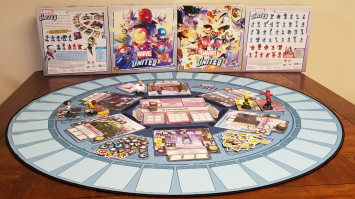
Players act as iconic Marvel heroes who work together to stop the master plan of a powerful villain controlled by the game. Each villain has a unique master plan, cards that trigger various effects, and threats that make clearing locations difficult. Heroes clear missions, making the villain vulnerable, and finally take on the big bad villain before they complete their dastardly plan. Can you save the day in time? Let’s find out with Marvel United.

Before we get any further, we’ll take a side quest and discuss Marvel United’s less heroic details.

The Fiddly Bits

Designer: Andrea Chiarvesio and Eric M. Lang
Publisher: CMON Global Limited and Spin Master Ltd.
Date Released: 2020
Number of Players: 1-4
Age Range: 8 and up
Setup Time: 5-10 minutes
Play Time: 30-40 minutes

Game Mechanisms:

Cooperative Play
Hand Management
Modular Board
Solo / Solitaire Game
Variable Player Powers

Game Flow:

The villain begins the game with a turn. A villain plays their turn by drawing the top card of their master plan deck.

1) The villain moves the number of spaces indicated.
2) Resolve any BAM! Effects (if any) and these effects will be printed on a space within the villain’s dashboard and vary from villain to villain.
3) Then, place the civilian/thug tokens (if any) indicated at the bottom of the card. The target symbol signifies the location where the villain ended their move. Villains usually place tokens on their location or locations adjacent to them.

After all these effects are resolved, the heroes get their turn.

Heroes pick who goes first, and hero turns will continue around the table clockwise. At the beginning of each game, Heroes will get three turns before the villain receives another turn. During their turn, heroes play one card from their hand.

Hero cards are simple.

1) Some cards (three cards in each of the core set hero decks) may have an effect that will exist in a box overlapping the hero’s picture.
2) But all cards have an arrow-shaped box pointing to the right on the bottom. The symbols on the bottom box depict the actions the hero can take that turn.

The reason the arrow points to the right is that the next player will play their card to the right of the first player and so on, and the next player gains the symbols/actions on the bottom of the card they played that turn and the previously played card. Marvel United is a cooperative game through in through.

Move Marvel United

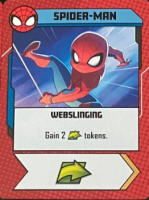
So, what do the symbols mean? The Green Arrows are Move actions; the Hero can Move one space for each arrow.

Heroics Marvel United

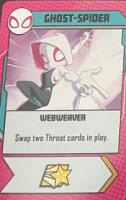
The Yellow Stars are Heroics actions; Heroics allow Heroes to rescue civilians (if there are any in their location) or help clear Threat cards.

Attack Marvel United

Red Fists give the Hero one Attack, which deals one damage and can be used against the main villain (after they become vulnerable to damage—more on that in a minute), any henchmen like “Bob Agent of Hydra,” or defeat thugs (again if there are any thugs in their location).

Wild Token Marvel United

The final symbol with all three colors is a Wild action; Wild actions can be used for Move, Heroics, or Attack. Heroes may resolve the effect (if they played the card on their turn) and any symbols in any order they choose.

Heroes will use these actions to complete missions. The game begins with three missions in play: Defeat Thugs, Rescue Civilians, and Clear Threats. Each mission card will have spaces for the tokens they require to complete. As soon as these spaces are filled, the card is discarded, and the mission is considered complete. Mission cards can be completed in any order.

After the heroes complete the first mission, the villain panics and will act (play a card) every two hero cards instead of every three hero cards. After the heroes complete the second mission, the villain becomes vulnerable to damage. The heroes can complete the third mission, but it isn’t necessary. If the heroes do complete the third mission, each hero immediately draws 1 card, increasing each player’s hand size by one.

Play continues back and forth until either the villain wins (by completing their unique master plan or anyone, heroes or villains, runs out of cards) or the heroes win by dealing enough damage to the villain after the villain becomes vulnerable to damage.

Marvel United Core Set

Review:

Marvel United scratches a similar itch as a game like X-Men: Under Siege. We covered X-Men: Under Siege in a previous review a decade ago (link to the review). Unlike X-Men: Under Siege, Marvel United functions as a board game system rather than a stand-alone game. Any number of intellectual properties can use this same system, which allows for plenty of crossovers. Case in point, CMON ran a DC Heroes United campaign earlier this year. I can see Teenage Mutant Ninja Turtles, Masters of the Universe, Star Wars, and any number of other IPs in the United System’s future.

The system has intuitive rules that allow for quick teaching times. Since Marvel United is a cooperative game, it benefits from even shorter rules explanation. I always feel like I need to teach everyone everything about a competitive game, otherwise I may have an unfair advantage. Players work together in a cooperative game. New players can learn as they go. And I’ve found Marvel United simple to pick up and relearn. The relearn feature becomes more important the older I get. I have so many games that seldom make it off my shelf because I don’t want to relearn the game. Marvel United makes that easy.

The gameplay itself can be a joy. The first time I played with my oldest daughter, she insisted that we play for hours until we defeated Red Skull. I don’t know why, but Red Skull eeked out a victory time after time. Red Skull is Marvel United’s choice for the first villain new players face first.

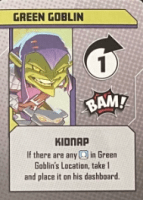
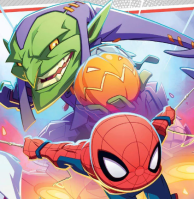
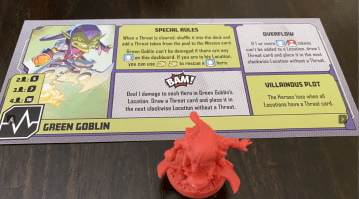
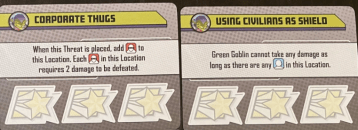
Marvel United’s heroes have just enough flavor to let people know who they’re playing, but Marvel United’s villains are the game’s showstoppers. Each villain has a unique flair. Kraven will actively hunt you. That makes sense, he’s a hunter. Ultron tries to win by flooding the field with civilians and thugs, putting these people’s lives in danger. That tracks for Ultron. Green Goblin will do a little bit of kidnapping, toss out dangerous henchmen, and try to throw out more Threats than the heroes can clear. Again, that feels a lot like Green Goblin. Each villain presents a unique challenge.

Marvel United incentivizes players to clear Threats. Doing so unlocks “End of Turn” abilities, which can further boost a hero’s power. I like this inclusion. Most expansions will add locations that can help with defeating the villains included in that expansion. Great choice.

The missions work well, too. Depending on the board state and the villain you’re facing, you may want to “Rescue Civilians” and “Clear Threats” or “Clear Threats” and “Defeat Thugs.” This adds to the puzzle of each villain. Some villains will add more civilians than thugs or vice versa and steer the gameplay in that direction. This furthers the uniqueness of each villain. Another great choice.

The one minor gripe I have is that not all the villains scale at every player count. Green Goblin is easier to play at 1-2 players and becomes increasingly more difficult the more heroes who join the fight. This should be expected. Marvel United boasts a massive line-up of characters. Hundreds! And even though Green Goblin becomes more difficult at higher player counts, he doesn’t break the game. You’re just less likely to defeat him.

Each Marvel United box includes challenges to spice up the gameplay if it ever becomes a little stale. The core set boxes have generic challenges, but if you pick up any expansion, you’ll find some great alternative ways to play the game. My favorite from the original launch comes from the Tales of Asgard expansion, where players deal out Loyalty Cards, with one of the cards being Traitor. Essentially, one of the players is Loki in disguise. Fantastic and very thematic.

Return of the Sinister Six Marvel United

Finally, we come to the issue of expansions. This may be yet another small gripe of mine. CMON hid a lot of the better expansions within Kickstarter Exclusives. That means that you must add them to your pledge on Kickstarter instead of being able to buy the expansion via retail (Amazon, Game Nerdz, Target/Wal-Mart, or your local board game shop). Marvel United started the trend with The Return of the Sinister Six, which was easily the best expansion from the first wave. Marvel United continued that trend with Marvel United: X-Men. X-Men: First Class, Days of Future Past, and Fantastic Four were all Kickstarter Exclusives. CMON has a knack for inducing FOMO (fear of missing out).

That said, you don’t need everything to enjoy Marvel United. You could buy one of the core sets (Original, X-Men, or the newest one Multiverse) and add a few expansions that you can find at retail and have a game you can play for decades. I may or may not have started a spreadsheet of all my games. And I started a guide for Marvel United. You can check out the link here.

Marvel United Tabletop Game Set Up

Verdict:

Easy to learn, teach, and recall, Marvel United introduces a board game system that will facilitate countless fantastic and future crossovers. The heroes have just enough personality, but the villains steal the show. Each villain feels unique and well worth their puzzle.

Top 5 Tabletop Games from 1980-1981

Hey, hey! Kyra Kyle here. Back with another Top 5 Tabletop Games. As you can see from this post’s title, we’re doing things a little differently with this list. These upcoming lists will lump two years today, rather than splitting the decade in half. The 1980s saw an increase in board game production. A lot of new games hit shelves in this decade, and with the introduction of the Spiel des Jahres (Germany’s game of the year) award, the quality of board games also increased.

In case you’ve forgotten our criteria for the Top 5 Tabletop Games, let’s reiterate the ground rules again before we get started.

1: Cultural relevance plays as much of a factor as overall quality. A game might make a list that doesn’t hold up to others of its type, but you must admit the game is everywhere.

2: Only one game from a franchise makes the list. This will become more of an issue the closer we get to games with expansions.

3: Longevity plays a role, too. A game doesn’t have to fly off the shelves today, but it had to have some widespread appeal for a decent time.

We have an honorable mention for this list: Dark Tower (1981) by Roger Burten, Alan Coleman, and Vincent Erato. Dark Tower deserves a mention because it uses an amazing tower as its centerpiece and incorporates a lot of innovative electronic elements. A sequel released in 2022, Return to Dark Tower, brought the original back to prominence.

I almost split 1980 and 1981 into two different lists; if I did, Dark Tower would’ve made a 1981-only list. There’s even a television commercial featuring Orson Welles for the board game. Yikes!

Here’s a link to that Orson Welles Dark Tower commercial.

5: Upwords (1981)

Upwords originally played on an 8×8 square board with 64 letter tiles. The board expanded to a 10×10 board to accommodate languages with longer words like German and Dutch. Eventually, the game shifted exclusively to the 10×10 board. Upwords plays similar to Scrabble. The big difference is that the letter tiles can stack on top of the ones previously used. All words must read horizontally from left to right, or vertically from top to bottom.

I like the twist Upwords made to Scrabble. It doesn’t change the core rules too much, but the inclusion of elevation leads to interesting plays.

4: Civilization (1980)

Not to be confused with the Sid Meier video game of the same name, the original 1980 Civilization board game (designed by Hartland Trefoil) introduces the concept of a technology tree (or tech tree). This tech tree is the centerpiece of the video game Civilization that released over a decade later. Sid Meier’s Civilization isn’t the only board game or video game to use a tech tree. Any game that uses that concept owes a debt to Trefoil’s Civilization. And there are a lot of games that use tech trees.

I find it interesting that a game designed in 1980 has a streamlined yet strategically satisfying tech tree. Is it any wonder that Civilization was chosen for inclusion in the 2007 book Hobby Games: The 100 Best? There is little luck involved in Civilization. This is one of the first crunchy—and lengthy—strategy games. And it won’t be the last.

3: Axis & Allies (1981)

We didn’t have to wait long for another lengthy strategy game on this list. Axis & Allies (designed by Larry Harris) casts players as the major belligerents of World War II: Germany, Japan, the Soviet Union, the United Kingdom, and the United States. The Axis & Allies Anniversary Edition (released in 2008) included Italy as the third Axis power and China as the fourth Allied power.

The combat could get convoluted and intense. Players would roll dice to hit and if a unit scores a hit, the opponent chooses which unit gets destroyed. I like the idea of a unit performing a retaliation before death. It took the sting out of losing a piece. Combat resolves when either side loses all their units or the attacker retreats. I enjoyed this one growing up, but my family never finished a game. Axis & Allies was one of those games where you needed a table just for the game, so you could keep it set up for future plays.

2: Can’t Stop (1980)

Can’t Stop is yet another Sid Sackson design. What can I say, the man deserves to be in the Academy of Adventure Gaming Arts & Design’s Hall of Fame. Can’t Stop has a wonderful press-your-luck mechanism. Players roll four dice on their turn and then group the dice however they see fit. If you were to roll a 1, 2, 3, and 6, you could group them as 5 and 7, 4 and 8, or 3 and 9. Once the player makes their decision of which pairs they want, they move their marker up columns on the board for those numbers. The press-your-luck comes into play with a potential second roll. If at any time you can’t move your markers any higher on a column, you bust and lose all your progress that round.

As soon as a player claims the top space in a column, no one can claim that number again. The game ends when one player has claimed the top spot for three numbers. Can’t Stop is such a great game. And Sid Sackson is a board game legend.

1: Trivial Pursuit (1981)

I struggled with which game should claim the top spot, but ultimately, Trivial Pursuit was the biggest cultural phenomenon from 1980 and 1981. Trivial Pursuit is the grandfather of all trivia-style board games. Heck, it’s the grandfather of all trivia games.

Each of the Trivial Pursuit playing pieces has spaces for six wedges. Players compete by answering trivia questions from six different categories, matched with a different color. In the classic version, Blue is Geography, Pink is Entertainment, Yellow is History, Brown is Arts & Literature, Green is Science & Nature, and Orange is Sports.

To this day, trivia games—even trivia video games—will assign similar colors to the same categories. I’m looking at you, Trivia Crack. Trivial Pursuit has spawned numerous copycats and more than one game show. It’s the one game on this list that most people will know. I had to make it number one. My hands were tied.

Did we get the list right, for the most part? Let us know in the comments. And wherever you are, I hope you’re having a great day.

Check out the other lists in this series:
Top 5 Tabletop Games Prior to the 1930s
Top 5 Tabletop Games of the 1930s
Top 5 Tabletop Games of the 1940s-50s
Top 5 Tabletop Games from the Early 1960s
Top 5 Tabletop Games from the Late 1960s
Top 5 Tabletop Games from the Early 1970s
Top 5 Tabletop Games from 1982-1983
Top 5 Tabletop Games from 1984-1985
Top 5 Tabletop Games from 1986-1987
Top 5 Tabletop Games from 1988-1989
Top 5 Tabletop Games from 1990-1991

Top 5 Superman Villains

Hey, hey! Kyra Kyle here. We’re back with another Top 5 Villains List. This time we’re covering Superman’s rogues gallery. We mentioned Supe’s rogues in a previous Top 5, the Top 5 Most Powerful Rogues Gallery. But Superman’s villains are getting their list today. Let’s see who made the list.

5: Darkseid

You may think that Darkseid is way too low on this list, but I view him more as a Justice League villain if not a DC universe-wide villain. But Darkseid needs to make the list. I struggled with that. I wanted to include Parasite or Cyborg Superman or even Toy Man or Mister Mxyzptlk. Consider them the honorable mentions. Oh. Spoiler alert: those villains didn’t quite make the list. Getting back to Darkseid, he inspired Marvel’s Thanos. So, Darkseid is a heavy hitter. Unless the writer powers down the villain, Superman often needs help when dealing with Darkseid.

4: Doomsday

What more can be said of the villain who killed Superman? He belongs on the list; he may even be too low like Darkseid. Next.

Just kidding. We’ll discuss Doomsday a bit more. Doomsday is an engineered being from the depths of prehistoric Krypton. Is everyone still on board with genetic experiments? Doomsday’s creator imbued him with few feelings, mostly hate and a desire for destruction, which led to him destroying worlds and eventually finding Earth. Doomsday can’t die. He adapts every time he gets defeated. He can’t be reasoned with. Of Superman’s mindless foes (or his foes who are forces of nature), Doomsday tops them all and makes this list.

3: General Zod

Since he’s a Kryptonian, General Zod has powers comparable to Superman. And as his name suggests, he’s a general. So, he has military training. That makes General Zod a Superman-powered general who desires to subjugate humanity and turn Earth into a New Krypton. Yep. He’s terrifying.

General Zod may even be my choice for Superman’s first major villain if I were to reboot the character. He ties in perfectly with Supe’s past. General Zod knew Kal-El’s birth parents after all. And he hated them. It made sense that Man of Steel featured General Zod as its main antagonist. Too bad the movie wasn’t better.

2: Brainiac

There have been many Brainiacs and with that several origins for the character. No matter the origins or version, Brainiac is often considered Superman’s second-greatest villain. You can probably guess who takes the top spot. Usually, writers depict Brainiac as a superintelligent android or cyborg from the planet Colu who is obsessed with collecting all knowledge in the known universe. He even goes so far as to shrink cities like Kandor, the capital of Superman’s home planet Krypton, and Brainiac has destroyed countless civilizations.

If his body ever gets destroyed, Brainiac uploads his artificial consciousness into a new body and begins anew. This makes Brainiac pseudo-immortal and a major threat to Superman. One of my favorite versions of Brainiac comes from the Superman Animated Series. Brainiac was an AI present when Krypton exploded. We learn that Brainiac destroyed Krypton so he and he alone would have the knowledge that Krypton ever existed. This put him at odds immediately with Superman. And the reveal was fantastic. Sorry. Spoilers for an almost thirty-year-old cartoon series.

1: Lex Luthor

What more can I say about the man who would be Superman? Most people know Lex Luthor. He’s one of Comicbook’s greatest villains, let alone Superman’s greatest villain. CEO of LexCorp, Lex Luthor as I mentioned in the Most Powerful Rogues Gallery Top 5 is DC Comics’s version of Tony Stark if Iron Man decided to go a different path. Lex hates how much the world loves Superman. He doesn’t trust all that power belonging to an alien. While I could mention several large-scale, DC Comics affecting schemes, my favorite Lex Luthor story, the one that shows how evil he can be, comes from a much smaller story.

Lex visits a diner outside Metropolis. He offers a waitress at the diner a large sum of money to sleep with him. The waitress knows who Lex is, everyone knows him and what he’s done, and she’d rather not sleep with the devil. But the money Lex offered was too good to pass. As soon as she decides to sleep with Lex, he leaves the diner. Lex’s chauffeur asks why he left before completing the “transaction,” and Lex said—and I’m paraphrasing—She will always know that she would’ve slept with me. Now she hasn’t a penny to show for it.

Like Outkast once said, what’s cooler than being cool? Ice cold. That sums up Lex Luthor.

Did we get the list right? Let us know who you would add or remove in the comments. And wherever you are, I hope you’re having a great day.
Gacha Game Review: Honkai: Star Rail

Hey, hey! Kyra Kyle here. I return with another Gacha game review. This week’s review will cover Hoyoverse’s Honkai: Star Rail (HSR).

HSR improves upon Genshin Impact’s graphics (if you want to read our review on Genshin Impact, follow this link) and merges elements of older Gacha games with the improved production quality found in modern Gacha games. How does Honkai: Star Rail hold up against our updated video game criteria? (If you’d like to see the Gacha game review criteria, you can follow this link.) Let’s see how Honkai: Star Rail fairs.

Mechanisms

Mechanisms: 7/10

Honkai: Star Rail is a turn-based JRPG (Japanese Role-Playing Game) at its core. It doesn’t deviate too much from the formula set by games like classic Final Fantasy titles, Dragon Quest, Octopath Traveler, and the Pokemon series. Turn-based JRPGs inspired many of the first Gacha game titles, so again, HSR doesn’t stray too far from its roots, but it does a couple of things that elevate its Mechanisms score beyond an average five.

Like Pokemon, all enemies have an elemental Weakness. Using a character with an element that matches an enemy’s weakness will result in extra damage. Nothing out of the ordinary yet. Honkai: Star Rail shakes this up just a bit by adding a Weakness bar to each enemy. If a player lowers the Weakness bar (which functions like a second health bar), the enemy becomes vulnerable and won’t attack for at least one round.

Honkai: Star Rail characters not only have an element, but they also have a path they follow. These paths aid players in building teams. Abundance path characters heal. Preservation characters shield themselves/teammates. Path of Harmony characters buff teammates, while Nihility characters debuff enemies. The remaining three paths (Destruction, The Hunt, and Erudition) feature HSR’s main damage dealers. Honkai: Star Rail explores what each one of these paths means, so it gets more convoluted than this. Overall, the path system works.

Gameplay Loop

Image from GameDesigning.Org

Gameplay Loop: 7/10

Honkai: Star Rail’s region-based map (as opposed to an open-world map) does mean that players can run out of things to do faster than in Genshin Impact. But I appreciate that. I’ll go more into that in the next segment. Getting back to HSR’s gameplay loop, it uses a lot of the same tricks as classic turn-based JRPGs. You’ll need to grind, but the grinding gets time-gated, meaning that you can only do so much grinding each day. Honkai: Star Rail includes an auto-battle system, which improves the grinding experience even more. Again, I’ll discuss that in “Respecting Time.”

I enjoy the events and timed content in Honkai: Star Rail more than Genshin Impact or even Wuthering Waves. HSR reduces the element of FOMO (fear of missing out) by allowing players to play older and major timed events. You can even play an event, not finish it, and return to it months later. This is a game-changer. I can duck out from Honkai: Star Rail and return to it not feeling like I missed too much. Some older Gacha games included a catalog of older events. I don’t know why Gachas like Genshin Impact and Wuthering Waves insist that their player base will play every event or suffer the consequences.

Respectful of a Player's Time

Respecting Time: 8/10

In this first group of Gacha games I covered, Honkai: Star Rail does the most to respect a player’s time. The auto-battle system I mentioned before is a godsend. I can set up a battle and let the game play itself. There’s little to no need for me to do actual grinding. This system reminds me of auto-battling in the original Final Fantasy Tactics. I let my Playstation run overnight and ended up with a powerful team the next morning. Honkai: Star Rail’s system doesn’t allow for that, but it’s close enough.

I like the auto-battle system a lot, but I would prefer a system more like Punishing: Gray Raven’s (part of the second set of Gachas I’ll cover), which allows players to clear a domain once and then auto-clear the domain again, multiple times in seconds. But an auto-battle system is better than forcing gamers to play the same domain over and over like Genshin or Wuthering Waves. I’ll take it. But the lack of an auto-clear function lowers Honkai: Star Rail’s “Respecting Time” score.

Honkai: Star Rail also has a better character-build suggestion system than Genshin Impact or even Wuthering Waves. Gamers can see suggestions for the equipment they should use for each character at a glance. Genshin added this function years later, but HSR included this system at launch and HSR’s system is more robust. Again, I’d like to see HSR adopt another Punishing: Gray Raven function, which allows gamers to see which team compositions other players use. This wouldn’t stop me from looking up guides online, but it would immediately after picking up a new character. I like having a brief roadmap.

Then, there are a few smaller things that add up. Honkai: Star Rail uses an assignment system like Genshin. The assignment system has gamers sending their characters out on expeditions once daily. After the time elapses, gamers receive the items the characters went out on assignment for. Unlike, Genshin, gamers receive more items they’ll want Honkai. Things like character upgrade materials. Items from chests, breakable items, and enemies are automatically collected by the gamer. No need to run around a mountain face collecting treasure. Players can set their playable character as sprinting, so they will run faster consistently, instead of sprinting for a second and forcing the player to constantly press sprint.

While there is at least one other Gacha that respects its player’s time more, Honkai: Star Rail does a great job at minimizing the tedium. HSR deserves a high “Respecting Time” rating.

Battle Pass: 4/10

Hoyoverse, Honkai: Star Rail’s publisher, doesn’t do the best with battle passes. I gave Genshin Impact an identical score. I could’ve given HSR a five instead because they did include self-modeling resin (which allows players to craft equipment with specific main stats), but the battle pass weapons (light cones in this case) leave a lot to be desired, and Hoyoverse hasn’t changed Honkai: Star Rail’s battle pass since its launch a little over a year ago. I hold little hope that Hoyoverse will improve HSR’s battle pass.

That said, it’s far more difficult to complete HSR’s battle pass than it is Genshin’s. That’s because Genshin’s BP can be completed in a couple of weeks. Another element that lowers Honkai: Star Rail’s battle pass score is that gamers receive the same reward for the last twenty or so levels of the battle pass. Wuthering Waves does a similar thing. This does make finishing the battle pass less stressful. I don’t feel like I’m missing out if I don’t finish the battle pass because I’m just getting the same thing. But it does feel worse when you complete HSR’s battle pass. There must be a good middle ground.

Video Game's True Cost

True Cost: 6/10

While not as generous as other games (I’m looking at you, Wuthering Waves), Honkai: Star Rail does a great job of keeping the Gacha costs lower. HSR beats the pants off Genshin. That’s not saying much. The character banner stays mostly unchanged from Genshin to Honkai: Star Rail. I never had too much of a problem with Genshin’s character banner. A 50-50 chance of getting a banner character followed by a guaranteed banner character after failing to win the 50-50 is fair. The game needs to make money.

Genshin’s issue stems from its weapon banner. Honkai: Star Rail reduces the number of times a gamer needs to lose the featured light cone from twice to once. Furthermore, HSR increases the likelihood of gaining a featured light cone from the banner from 50-50 to 75-25. Players are almost guaranteed the banner weapon the first time. Again, Wuthering Waves ups the ante by making it a guarantee, but we’ll get to our Wuthering Waves review. I promise.

Honkai: Star Rail also provides enough stellar jade (the currency needed for Gacha turns) to get at least one five-star character or light cone. The five-star may not be the one featured on the banner, but each player is almost guaranteed one five-star each patch. Genshin players sport less. Couple the fact that Honkai: Star Rail gave away Dr. Ratio, a stellar five-star damage unit, and the rumor that they intend to do something similar on HSR’s next anniversary and can’t deny that HSR is above average for “True Cost.”

Keeping the needed Gacha turns to guarantee a five-star on a banner at 100 prevents Honkai: Star Rail from getting an even better score. I don’t see this changing. Hoyoverse is married to 100 Gacha turns.

Story or Narrative

Narrative: 6/10

I like the Genshin storyline slightly more than the Honkai: Star Rail story. That doesn’t mean that HSR’s story is horrible. It’s quite good. I may also need to play more of the story. Genshin has a few more years of storytelling on Honkai: Star Rail. What exists in the story is great. It even facilitates the flow of a Gacha better than Genshin.

In Genshin, gamers search for their missing sibling. The sibling story gets lost when exploring new regions. In HSR, the player’s character gets a mysterious object named a Stellaron placed inside their body. Stellarons function like planetary cancers. Each planet the player visits will have a Stellaron wreaking havoc on it, so each planet links the player character’s story with what’s happening during that specific planet’s story. Gachas release their stories slowly and over time, almost like serial storytelling. Honkai: Star Rail’s premise works better with a serial story.

That said, Hoyoverse doesn’t deliver the best stories in gaming. I may grade HSR harsher because it follows a turn-based JRPG lineage. Turn-base JRPGs are known for better stories.

Storytelling

Storytelling: 5/10

I mentioned this in the previous segment: Honkai: Star Rail has a better setup for serialized storytelling. Hoyoverse still manages the story, and Hoyoverse exhibits horrible storytelling tendencies. Honkai: Star Rail doesn’t have a single character as annoying as Paimon. A few over-the-top characters like March 7th, Bailu, and Yunli do pick up the annoying slack. And you still can’t skip any of the dialogue.

Also like Genshin, HSR does a great job with character stories. I get more out of individual characters than I do from the main storyline. And the storytelling tends to get chopped into pieces and thrown around. But not as much as Genshin’s. I can keep up with the story by watching HSR’s official YouTube channel. That’s a huge plus. Still, I’d like to have gotten more of Acheron and Black Swan’s meeting in Honkai: Star Rail’s gameplay. There are fewer places to search for HSR’s story. But I shouldn’t have to search for Honkai: Star Rail’s story.
The most recent couple of patches (2.4 and 2.5 as of me writing this) concern me in terms of HSR’s storytelling going forward. One patch started a filler storyline of a villain escaping their jail cell. Our main cast is stuck in prison with this villain at the prison’s entrance, and the story stops. To be continued flashed across the screen. I don’t like that. It took me out of the story as I could play these characters outside of the prison. There’s no way a story chopped up like that can keep gamers immersed.

The funny thing is that I don’t recall the main storyline having that hard of a break from one patch to the next. Honkai: Star Rail did a good enough job of leaving the main party in a precarious spot, keeping me wanting more, but also giving me an out for continued play until the next patch release. Why do something like this for a filler patch’s story?

Presentation; User Interface: 8/10

Honkai: Star Rail continues the example set by Genshin Impact. HSR has a clean interface that’s easy to read and comprehend. It still has a few too many sub-subcategories, but not as many Genshin Impact. HSR does a good job of showing the most pertinent information. The quick-select menu is where Honkai: Star Rail puts in the most innovation.

Full disclosure: I play HSR primarily on PlayStation 5. The quick-select menu may work a bit differently on another platform, but Honkai: Star Rail allows me to hold down one button and rotate a joystick around to select what I want from a circular menu. Genshin tries this but I prefer moving a cursor as opposed to pressing two buttons at once. With Genshin’s quick select menu, I must read what each button does. HSR’s quick select menu is far more intuitive.

Presentation; Graphics and Audio: 10/10

Honkai: Star Rail’s graphics improve upon Genshin’s graphics. But graphics aren’t the reason why HSR receives a perfect score. The audio can’t be beat. Honkai: Star Rail’s soundtrack does double duty. It’s memorable but also adds to HSR’s storytelling. I struggled with adding HSR’s soundtrack to its storytelling score. Music theory YouTuber Jonathan Barouch does a great job of breaking down what makes Jarilo VI’s soundtrack so amazing. You should check out his deep dive with this link. So good!

Spoiler alert for Jonathan’s video: he shows the viewer how Honkai: Star Rail music reflects the story’s characters. No fooling. So much thought and care went into the making of HSR’s music. This won’t be the last time you’ll hear from me that Hoyoverse invests a lot into their audio production. Also, make sure you check out Jonathan Barouch’s channel. Hoyoverse soundtracks feature a lot in his work, but he covers more than Hoyoverse games. I like his videos about the NieR series, too.

Aggregated Score: 6.78

Honkai: Star Rail suffers from many of the same shortcomings as Genshin. Storytelling and battle pass issues persist. But HSR takes several steps in the right direction (not wasting as much time) to make me think that future Hoyoverse projects can and will get better. HSR even manages to improve upon one of Genshin’s strengths, the user interface.

Hoyoverse tends to shift its assets and focus to newer projects, but Honkai: Star Rail is new enough that it’ll take some time before it begins to suffer from brain drain. I’ll enjoy the ride while HSR continues delivering the goods.