Happy Wednesday, Geekly Gang! Kyra Kyle here. During today’s post, our writers share what they’ve been reading over the past month. Feel free to share what you’ve been reading, too. We’re all part of the Geekly Gang. I’ll kick things off with what I’ve been reading over this past month.
Kyra’s Reads
It’s the holidays. Naturally, I was out shopping for others, but that doesn’t mean I can’t pick up something relatively cheap for myself. I picked up Ornithography for under $5. Bird lore and symbolism sounded interesting, and Ornithography hasn’t disappointed. Each bird entry includes an illustration of the bird, its scientific name, and a brief legend about it. To say Ornithography is a quick read is an understatement. Just look at this sample page.
I figured Orinithography would yield some writing ideas, and it has shaken some things loose there. The only issue I’ve found is that the bird write-ups can contradict each other. One culture may view a bird as lucky and another unlucky. But that’s part of the fun.
Keeping my trend of quick to read and illustrated alive, my next entry is Strunk and White’s The Elements of Style. At one point, I read The Elements of Style once a year. It’s a writing style handbook and well worth the read. We can’t depend on AI to catch every mistake. This past month marks the first time I’ve read The Elements of Style in over two years. Yikes! I may need to get back into the habit of reading this must-read for any writer.
Yes. Style has changed somewhat, but most of what Strunk and White (and that’s E.B. White, the author of Charlotte’s Web) holds up today. And I love the gentle humor the two manage to give the subject. Writing style books can be a chore to get through. Strunk and White make it enjoyable.
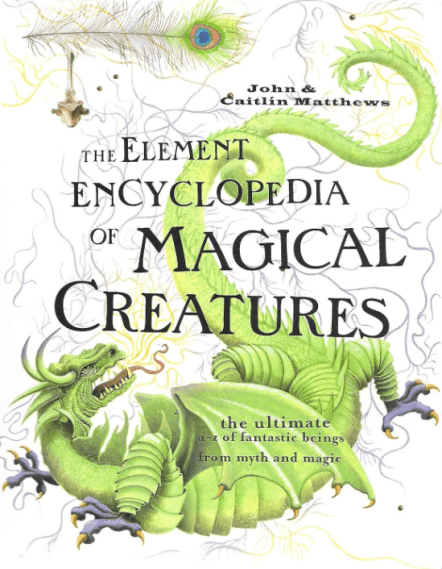
The Element Encyclopedia of Magical Creatures makes one of these lists again. I won’t go into too much detail. As the title suggests, this encyclopedia chronicles magical and mythical creatures. Entries in this book mirror Ornithography’s. I had a book type this month.
That’s all I have for this month’s Watcha Reading. Let’s see what Season’s been reading.
Season’s Read
I participated in the Black Friday/Cyber Monday boycott this year, only purchasing essentials. This boycott also extended to streaming services. I rewatched my DVD box set of Death Note on my computer with a USB disc reader and remembered I’d picked up a copy of Death Note Short Stories. Death Note Short Stories is a collection written by the author of the main Death Note series (with the same artist), so I consider all of these stories canon.
I’m not a fan of the Taro Kagami story since it includes a “death eraser,” which brings people back to life if they haven’t been cremated. In Japan, there isn’t enough land mass to bury the dead, so people are cremated, with their crematory bits kept separate from their memorial site. I’d assume the same logic would apply to someone whose body is in pieces. That’d make for a weird zombie.
The first story was interesting. It’s set nine years after the end of Death Note, and features Donald Trump buying the “power of Kira (Death Note)” from a mysterious seller in Japan (Minoru Tanaka). Death Note is a fantastical series, but this is the most realistic story in the franchise. No notes.
The last couple of stories feature background information on L, such as his upbringing and daily life. This man tumbles in a human-sized washing machine every day as his “shower” because physically taking a shower is too bothersome. I mean, I don’t always want to shower, but a washing machine? That’s definitely a choice.
Hey, hey! Kyra Kyle here again. That’s all we have for Whatcha Reading this week. Let us know what you’ve been reading in the comments. Thank you for reading, and wherever you are, I hope you’re having a great day.
Happy Holidays, Geekly Gang! Season here. This month’s plushie review is special to me. I got a Playskool Glo Worm (1996) as a present on my first Christmas, and I still have it. My Glo Worm’s name is “Baga,” so I’ll be using that title throughout this review.
Before we begin, let’s review the categories. I’ll be looking at size, softness, kid-friendliness, and cuddliness. There won’t be an aggregated score.
Size
Baga is on the smaller side and fits perfectly in your lap if you’re sitting cross-legged as an adult. Baga rivals newborns in size.
Softness Versus Firmness
Baga has— or, in my case, had — a music box inside that plays “Twinkle, Twinkle, Little Star,” and when activated, his face lights up. This, plus his hard head, puts him toward the middle of the soft versus firm scale. In my biased opinion, he’s super soft, but I’ve worn him down over the years.
Kid Friendly Versus Adult Only
Since he’s designed for infants, Baga is kid-friendly. He gets docked a few points for small pieces like the zipper on his back, which could be ripped off by a rambunctious child. I used him to fight my other toys when I was two. It was war, I tell you.
Cuddle Buddy Versus Desk Buddy
Baga is definitely a cuddle buddy. That’s part of his design. Since Playskool doesn’t make him anymore, I could see him as a collector’s item. Playskool intended for Baga to be a cuddle buddy, so he’s a cuddle buddy.
Final Thoughts
I tried to be as unbiased. Let me know your opinions of Playskool’s Glo Worm in the comments. I have a baby picture of me with Baga when I got him. Would you like to see that picture, Geekly Gang? Let me know. Thank you for reading, and have an amazing holiday season.
Happy Sunday, Geekly Gang! Kyra Kyle here! I haven’t done a Geekly News article in a week or two, so we may have a handful of new releases (board games and video games) to cover. But before we get to new releases, we just received big news. Netflix buys Warner Bros. What? I was surprised by Warner Bros. putting itself up for sale a couple of months ago, and the twist of the streaming giant Netflix purchasing Warner Bros. is shocking.
Netflix Buys Warner Bros.
The Warner Bros. sale escalated quickly. In October 2025, Paramount had offered a large deal (rumored to be around $100 billion) for the entirety of Warner Bros. Discovery. Quick question. How many banks/investors would be needed to raise $100 billion? Anyway, the deal fell through, and Warner Bros. Discovery suggested splitting its various business pieces. This allowed Netflix to enter the bidding.
Netflix was only ever interested in Warner Bros.’ streaming business and studios, and (according to a Hollywood Reporter article) early Friday (December 5, 2025) Netflix purchased Warner Bros.’ streaming business and studios for $82.7 billion, financing $59 billion through banks and investors. After Warner Bros. suggested splitting its assets, the Netflix purchase was less of a surprise. While Netflix hides its viewing numbers from the public, it has shared that Warner Bros.’ titles have dominated Netflix viewing numbers in recent months. Why not buy the studio? It makes great sense from a business perspective. But this merger raises concerns.
The first concern is that mid-sized, legacy studios–like Warner Bros.–cannot survive in the current media landscape. The second is that Netflix never releases films in movie theaters, and if it continues this trend with Warner Bros.’ properties, this could be the death knell for movie theaters. And currently, the European Union questions whether this merger works within its anti-monopoly statutes. There’s a lot to discuss. I’ll try and be brief.
First, it doesn’t look good for mid-sized studios. The media landscape has been mirroring the United States’ wealth gap for well over a decade. You’re either a massive studio or you’re an indie filmmaker. Sorry, Fox. There is no middle class. Netflix’s acquisition of Warner Bros. furthers this trend.
Second, I’ve always enjoyed going to movie theaters. It’s a vibe. But I’ve gone to fewer movies at the theater in the last several years. Call it a COVID hangover. Major cities will most likely have a movie theater or two, but smaller cities may lose theirs. Again, this was already happening. Disney demands more profits than other studios, especially for Star Wars and Marvel movies (making these films less profitable for theaters), while Netflix refuses to release films in theaters at all. We’ll have to wait and see if Netflix will extend its policy to Warner Bros. releases. I’ll be sad if the next Wonder Woman movie never makes it to a theater near me, but at least the DCU will continue. More on that later.
Third, monopolies are on the rise. Okay. Some folks may correct me and say that these are oligopolies (a market structure with few competitors controlling most of the market), not monopolies. True, but semantics. Fewer competitors mean that these companies have more power during negotiations. You know, like Disney demanding more profits from theaters. These negotiations also extend to consumers. While Netflix insists it will not raise its subscription price (yet), I imagine a $59 billion loan might tempt it to raise prices in the not-so-distant future.
What does this mean for the future? Nothing much will change in the next year or two. Famous last words. The DCU’s slate of shows and movies remains the same, as far as we know. I can’t wait for Lanterns in early 2026. I can’t imagine Netflix firing James Gunn or Peter Safran. They’ll stay onboard for the DCU’s next chapter. And there have been some hints that the Snyderverse could return. What?
Netflix has stated that some of its newly acquired intellectual properties (including DC Comics and DC Studios) will allow other creatives to release content for those IPs on Netflix. Fans of the Snyderverse interpreted this statement as the Snyderverse returning. And it makes sense if it does. James Gunn has already okayed a second The Batman movie, despite actively casting a new Batman for the DCU. No. We still don’t know if Gunn has cast anyone as Batman. We’ll keep you posted. Gunn fully embraces the Elseworlds framework. So, multiple interpretations of the same characters can exist. Bring on the Snyderverse.
Ultimately, I can see why Netflix’s acquisition of Warner Bros. has people on edge. I’m concerned, too. We lost one more mid-sized, legacy film studio. That sucks. Thanks for the memories, Fox and Warner Bros.. Netflix insists it won’t stop releasing Warner Bros. films in theaters. Perhaps. Fingers crossed. Netflix also says it won’t raise its monthly subscription cost. But $59 billion is a lot of money to repay. We’ll wait and see.
The Great Library Launches on KickStarter
The dynamic duo of game designer Vital Lacerda and artist Ian O’Toole reunite with The Great Library. I have yet to play a Lacerda original, and The Great Library looks as if it’s right up my alley. Players attempt to reconstruct the fabled Great Library of Alexandria. I adore this theme.
Lacerda is known for his strategic board games, and O’Toole is one of my favorite board game artists. The biggest reason why I’ve hesitated to pick up a Lacerda/O’Toole collaboration is that I fear I may make a wrong move on turn one that’ll come back and bite me. But I may make an exception for The Great Library. Look at the detail in this game. There’s a reason O’Toole is one of my favorite board game artists.
With a little context, one could make out what they can do during a turn. O’Toole is one of the best at graphic interpretations of game rules. The Great Library offers a couple of pledge levels. The base pledge of $118 offers a few add-ons. It’ll ship around September of next year, but gamers could back the advanced copy pledge at $225 and receive The Great Library a month earlier. If you’re interested in The Great Library,check out its KickStarter page.
Queen of Spies Launches on GameFound
I love historical board games. Queen of Spies is based–loosely–on Louise de Bettigries, who is known as the Queen of Spies. The Queen of Spies board game has players organize a network of spies to turn the tide of World War I in Belgium. Bettigries did exactly that during World War I. I love it! A solo game steeped in history should surprise no one with a Salt and Pepper game. This board game publisher has produced some of the best historical games in recent memory: The Voynich Puzzle, Witchcraft!, and Resist!.
Ah! I know little about Queen of Spies’ gameplay, but I can’t wait to get my hands on this game. Gamefound campaigns are notorious for showing little of the game before launch. We also know little–if anything–about Queen of Spies’ pledge levels before its release. If you’re interested in Queen of Spies, check out its Gamefound page.
Byzantion: The Justinian Era Launches on Gamefound
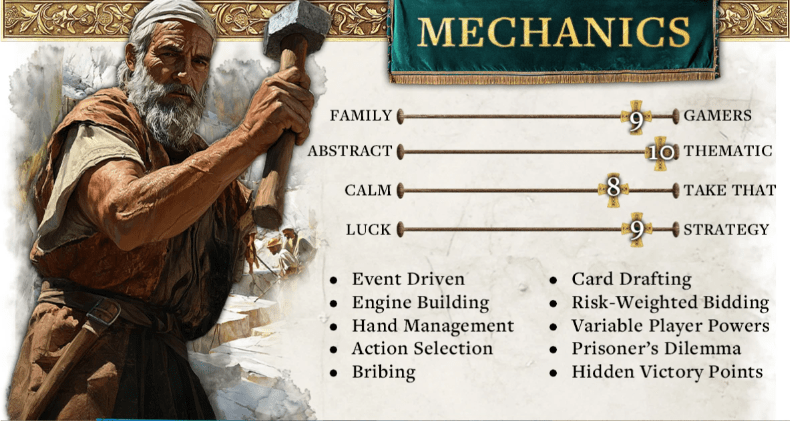
Truth time. I hate Take That as a mechanism, especially when used in a longer game. So, when I saw the following image on Byzantion: The Justinian Era, I cooled on the project.
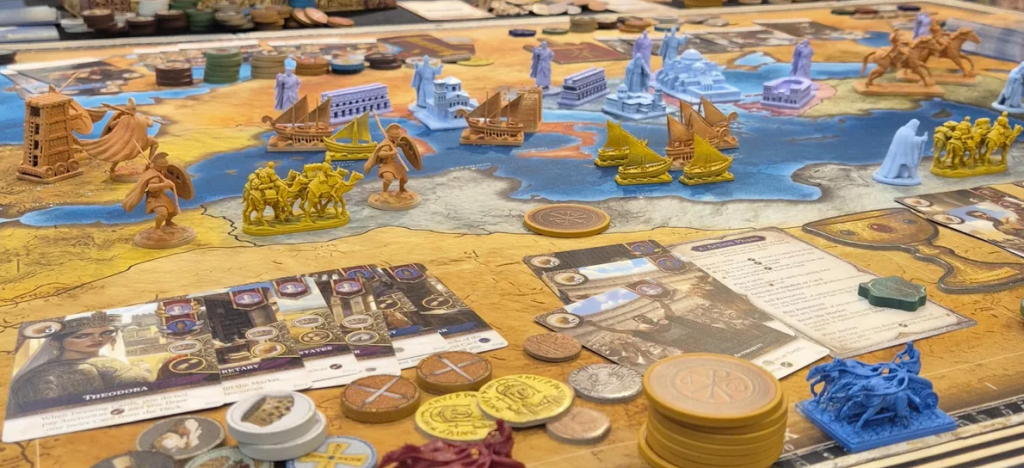
Everything else looks amazing with Byzantion: The Justinian Era. I’d like more board game companies to include graphics like the one above. This gives players an idea of what kind of game to expect. While I may dislike strong Take That in an hour-plus game, other games may enjoy it. And to be honest, everything else on this graphic looks like it’d be something I’d play, so I could overlook the strong Take That. And why not? While publisher Meeple Pug is new to the gaming space, they’ve had some interesting releases over the past year with Mesopotamia and Dark Blood. Meeple Pug games include stellar miniatures, and Byzantion: The Justinian Era is no exception.
While the image above is most likely from a digital tabletop engine like Tabletop Simulator, one can’t generate files like this without files from the core game. I love the upstart Greek board game publisher Meeple Pug. They stick to their roots, and I can’t wait to see what they release next. If you’re interested in Byzantion: The Justinian Era, check out its GameFound page.
Dragon Eclipse: The Grand Quest Ventures onto GameFound
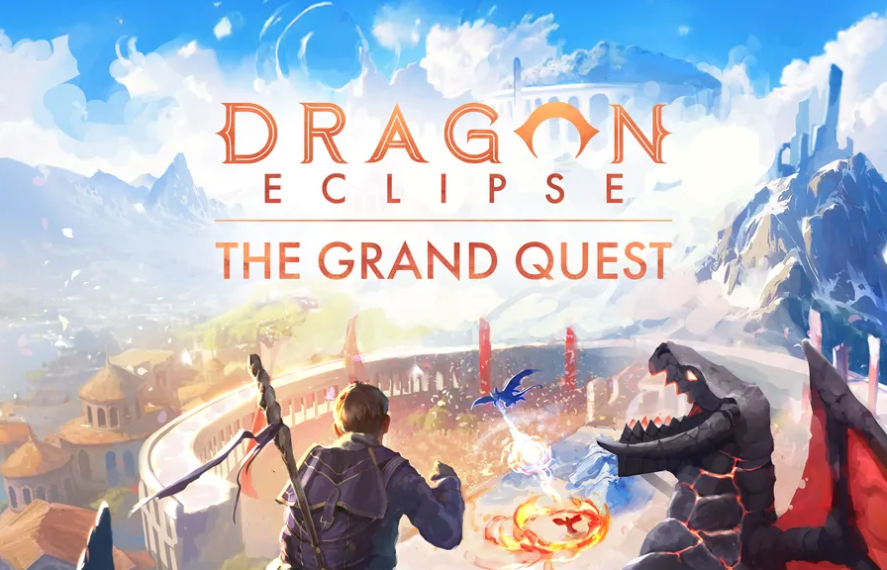
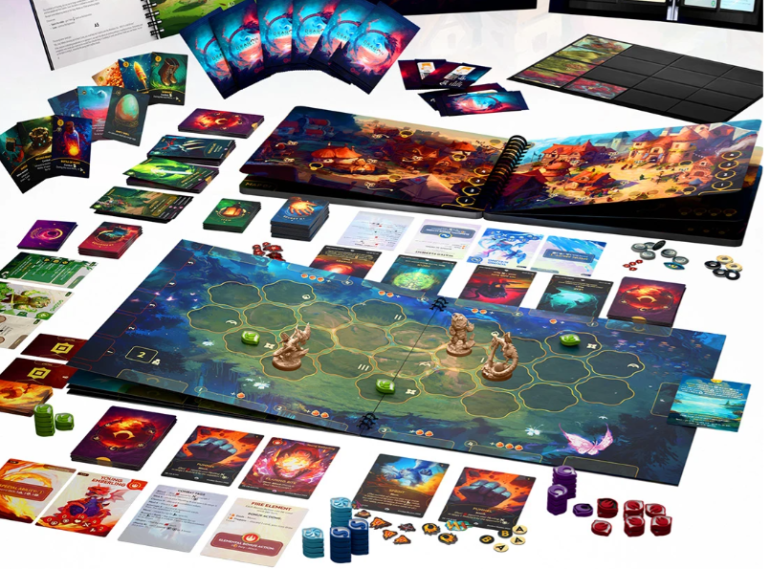
Dragon Eclipse returns with its first full sequel, Dragon Eclipse: The Grand Quest. Honestly, I haven’t considered too many Awakened Realms games, because they tend to get pricey. Like hundreds of dollars pricey. If that doesn’t give a frame of reference for how expensive Awakened Realms games can get, Awakened Realms is the board game publisher attached to GameFound, the crowdfunding site that thinks board games should be so expensive that games should be able to pay for them in monthly installments. But Dragon Eclipse’s standalone sequel, Dragon Eclipse: The Grand Quest, is affordable. About $70 for the standard edition and $139 for the deluxe.
At $70, I may pick up a copy of Dragon Eclipse: The Grand Quest. From what I hear, Dragon Eclipse plays like a fusion between Gloomhaven and Pokémon. And I dig the storybook feel. Ah! My heart skipped a beat. My biggest issue with Gloomhaven is its setup, and two flipbooks should limit the amount of setup. And I love Pokémon. I may not have grown up with Pokémon–like my children–but I have a soft spot for cute mythical creatures, and Dragon Eclipse: The Grand Quest has plenty of cute mythical creatures. If you’re interested in Dragon Eclipse: The Grand Quest, check out its GameFound page.
Marvel: Cosmic Invasion Releases
Classic video game arcade players, rejoice. Marvel: Cosmic Invasion captures the feel of classic arcade games like The X-Men, The Simpsons, and Teenage Mutant Ninja Turtles. Side-scroll fight your way through the levels and defeat denizens of the Negative Zone. Not gonna lie. Annihilus (ruler of the Negative Zone) is one of my favorite Marvel villains, and I’m stoked for this game. I didn’t know Marvel: Cosmic Invasion existed before writing this post, but I’m so in.
Let me at those bad guys. As I write this entry, I have no idea what the reviewers will say about this game. Does it matter? If classic side-scroll combat interests you, Marvel: Cosmic Invasion may interest you. Depending on the version you purchase, the cost varies from $40 to $60. Marvel: Cosmic Invasion is available for PC, PlayStation 4, PlayStation 5, Nintendo Switch, Nintendo Switch 2, and Xbox Series S/X.
Sleep Awake Releases
I didn’t know Blumhouse made video games. Surprise! Undoubtedly, as a result of Blumhouse’s involvement, Sleep Awake was included in the 2025 Tribeca Film Festival. How many video games are included in a prestigious film festival? Not many. I don’t know much about Sleep Awake other than people disappear in their sleep, and it’s up to you to save the last remaining people on Earth. From the designer of the stellar Spec Ops: The Line, Cory Davis, and featuring the music of Robin Finck of Nine Inch Nails, Sleep Awake blurs the lines between dream and reality.
Like Marvel: Cosmic Invasion, I knew little about this game, but the more I learn, the more I want to see more of Sleep Awake. Sleep Awake is available on PC, PlayStation 4, and Xbox Series S/X.
Metroid Prime 4: Beyond Releases
Metroid Prime 4: Beyond needs no introduction. The Metroid series is one of Nintendo’s greatest, and we haven’t seen a new entry in this series in over a decade. No. I don’t count Metroid Prime: Federation Force, released for the Nintendo 3DS. Handhelds are a separate animal. The last main console release for a Metroid game came in 2007, Metroid Prime 3: Corruption for the Wii. The Wii!
And I’m grateful that Metroid Prime 4: Beyond will be available for the Nintendo Switch as well as the Nintendo Switch 2. I can hold off upgrading my Switch. I picked up my Switch late in its cycle. I deserve to have the occasional high-profile game. And Metroid Prime 4: Beyond is certainly a high-profile Nintendo release. Let’s hope it lives up to the hype.
Octopath Traveler 0 Releases
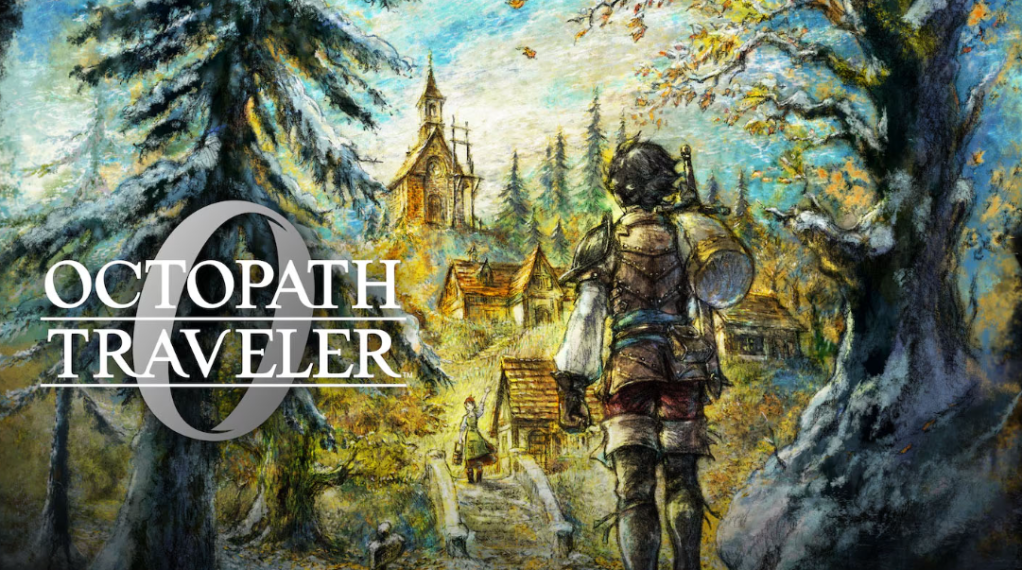
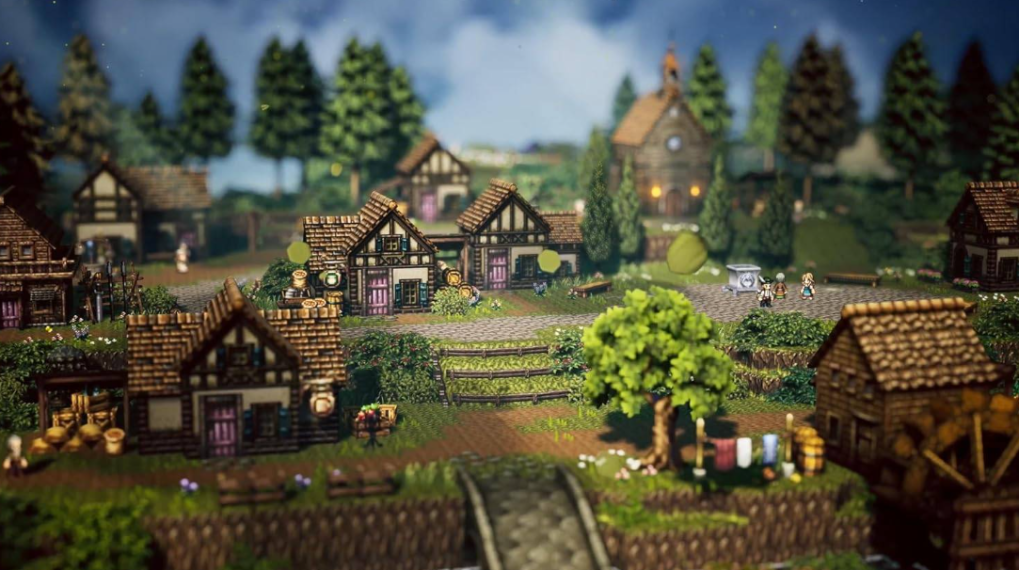
Okay. Another truth time. I picked up Octopath Traveler for the Nintendo Switch several years ago and have yet to play it. Eek! The series looks amazing. Sure, Octopath Traveler features pixel art, and even though I have written for a website called The Pixels (they tended to give every pixel art game a baseline 8 out of 10 for graphics that I’d call 4 out of 10), I don’t automatically say a game is gorgeous because it uses pixel art. But look at Octopath Traveler’s pixel art. It’s stunning. Look at that detail. It’s delicious.
I love the graphics, and from what I hear, Octopath Traveler has an amazing story to match these graphics. Yes! Octopath Traveler 0 is a prequel to the original game. While I’m not a fan of prequels, I can enjoy them, given the proper context. I don’t yet know what the context is for Octopath Traveler 0, but we’ll keep you informed. What I do know is that Octopath Traveler 0 features town-building gameplay. What? Players may construct 500 buildings on the Nintendo Switch 2 and 250 buildings on the original Nintendo Switch. This is yet another title I love that gets an original Nintendo Switch release, despite the older system’s limitations. But players may also pick up a copy of Octopath Traveler 0 on PC, PlayStation 4, PlayStation 5, and Xbox Series X/S.
That’s all the Geek News we have for this week. Thank you for reading, and wherever you are, I hope you’re having a great day.
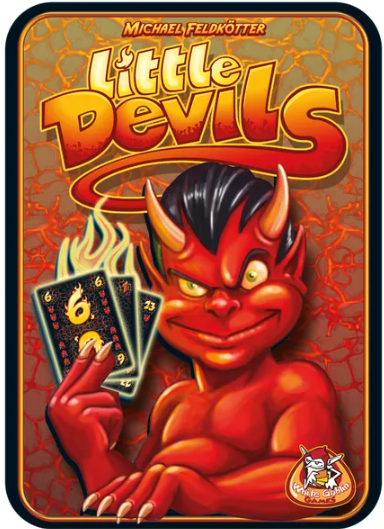
Hey, hey, Geekly Gang! Kyra Kyle here with another board game review. Today’s game is Michael Feldkötter’sLittle Devils, a quick trick-taking game with a twist. Little Devils has no suits. Instead, players must follow the first card (in a series of 54 numbered cards) that’s played per round. The second card dictates which direction every other player must follow (up or down from the original number). The player who either plays in the wrong direction (up instead of down) or plays the furthest number from the original card wins the trick; you’re trying to win as few tricks as possible. Little Devils takes a simple concept and bakes in some interesting choices.
Before we get any further, we’ll get devilish with Little Devils’ details.
The Fiddly Bits
Designer: Michael Feldkötter Publisher: Arclight Games, Stronghold Games, White Goblin Games Date Released: 2012 Number of Players: 3-6 Age Range: 8 and up Setup Time: Less than a minute Play Time: About 15 minutes
Little Devils consists of a 54-card deck. Depending on the number of players, remove a number of cards numbered between 28-54 from the game. The rulebook will state which specific cards need to be removed at each player count. Ultimately, players will be dealt 9 cards each, which should be the entire deck.
After you’ve prepared the deck, deal out all the cards.
Game Flow
For the first round, the player to the left of the dealer begins the trick; for every round after the first, whoever “won” the previous trick, begins the next trick. The first player starts the trick by playing any card from their hand that doesn’t have five little devils beneath the number. Quick note: most cards in Little Devils will have at least one little devil underneath its number. Players cannot lead a trick with a card with five little devils, unless they have no other card in their hand.
The player to the left of the starting player will play a card from their hand. If the second player plays a higher card, all other players must play cards valued higher than the first card if possible. Whoever played the highest card gets the trick, unless a player is unable to play a higher card. This player will get the trick unless more players are unable to play higher cards. If a player (or players) plays a card in the opposite direction of the second player, the player with the furthest valued card from the original card wins the trick.
After all cards have been played, a round ends. Players score the number of little devils from their tricks. As soon as someone scores 200 points, play ends, and whoever has the fewest points wins.
Review
Little Devils has a built-in catch-up mechanism: the player who wins a trick can’t possibly win the next one; they begin the next trick. I love that. It’s simple and offers plenty of strategic choices. I could play a card closer to the low or high end, thinking the players in front of me (on the scoreboard) might get stuck with a trick or two. There are even cards that have no little devils on them. Often, when I know I’m going to get stuck with a trick, I’ll play one of the one devil or no devils cards to net the fewest little devils I can.
While you could card count during Little Devils, it doesn’t matter that much. Little Devils plays quickly. It’s more fun to play a second game. Even when I’ve finished last (triggered the end game), I feel like I did something if I stiffed someone else with a bunch of points during one round. Little Devils is a great filler game. It may get overshadowed by Cat in the Box (we still need to review that game), but it requires less setup, is an easier teach, and I’ve found more gamers catch on to Little Devils a lot faster.
Too Long; Didn’t Read
Quick to pick up and easy to teach, Little Devils is an excellent trick-taking game that offers plenty of strategic choices, a brilliant built-in catch-up mechanism, and fun gotcha moments.
Happy Friday, Geekly Gang! Kyra Kyle here. I haven’t done a writing brain dump in a few weeks. I’m still going through the slog of editing the Rustbucket novel on a macro level, but I’ve hit a wall.
Truthfully, I’ve struggled to make much headway with the project. There are multiple reasons why. I distracted myself with holiday cleaning. I may not have made much progress with the Rustbucket novel, but my house looks and smells amazing. I may not have completed a single task I wanted to in November, but my study is so organized.
I feel stuck in Monty Python’s “Cheese Sketch.” My cheese shop is the best in the region. Why do you say that? It’s so clean. It’s certainly unsullied by cheese.
Distractions aside, I can’t get out of my own head, and that’s the real cause for writer’s block. So, I’m recommitting myself to my writing schedule. I may put the Rustbucket novel on hold for a short time and begin a new project. Who knows? Something I write during this project could provide the fuel I need for Rustbucket.
I’m not going to include any writing tips or tricks I’ve been using, because I hit a wall. Maybe I’ll dirty up my organized study with some writing, and I’ll have something more to share in a couple of weeks, when hopefully, I’ll post another writing brain dump.
I hope you all had a great Novel November. Thank you for reading, and keep writing.
Happy Wednesday, Geekly Gang! Kyra Kyle here! Today, our writers share the games (video games and board games) they’ve been playing over the past month. Feel free to share which games you’ve been playing this past month, because we’re all part of the Geekly Gang. I’ll start off this post with what I’ve been playing this past month.
Kyra’s Video Games
I received Final Fantasy Tactics: The Ivalice Chronicles two weeks ago. Thank you, Season. And it didn’t take me long to finish the game and earn the platinum PlayStation trophy. Oh, yeah!
I’ve played most–if not every–rendition of Final Fantasy Tactics. It’s one of my favorite video games of all time, and Final Fantasy Tactics: The Ivalice Chronicles does a fantastic job of updating this classic. Let’s begin with some of Final Fantasy Tactics: The Ivalice Chronicles’ best new additions.
It’s easier than ever to see turn order during combat. Character portraits line the left-hand side. Numbers show whose turn is coming next. When you choose an action that requires any charge time, like a spell or jumping as a Dragoon or aiming as an Archer, you’ll see where your action would fall in turn order, should you choose to pick it. I love this update. In an instant, I can see if I want to commit to an action or not. While many of the charge times have been reduced (making some classes like Dragoon and its jump viable and borderline overpowered), the Archer’s aim ability still takes too long. Better luck next time, Archers.
I went into Final Fantasy Tactics: The Ivalice Chronicles knowing I would enjoy the game’s combat (and mix-matching job abilities, like dual-wielding monks), but I didn’t anticipate how this version would step up the game’s story. I always liked Final Fantasy Tactics’ story, but with The Ivalice Chronicles’ “State of the Realm” interactive map, I can better follow the story. If you’ve ever struggled to keep Final Fantasy Tactics’ political intrigue clear, The Ivalice Chronicles may be the perfect edition. Throw in some great voice acting–by whom my spouse dubs as out-of-work Shakespearean actors–and Final Fantasy Tactics: The Ivalice Chronicles elevates a story that may resonate more today than when the original was first released in 1997.
Even with all the great additions Final Fantasy Tactics: The Ivalice Chronicles brings to the table, I do have some gripes. I loved the War of the Lions’ cutscenes. The art is unique and has an ethereal quality. These cutscenes are available in Final Fantasy Tactics: The Ivalice Chronicles, but gamers need to surf submenus to find them. I don’t think many gamers will do this. I would prefer an option to insert these cutscenes during my playthrough. This could be included in a simple update. Speaking of simple updates, Final Fantasy Tactics: The Ivalice Chronicles brings back all original unlockable characters and jobs. I’d like the game to include all the unlockable characters and jobs from every version, making Final Fantasy Tactics: The Ivalice Chronicles a definitive version.
I could go on with other nitpicks. I love the fast-forward option, but I’d like it as a toggle button, not as something I need to press and hold down, and there are a handful more, but Final Fantasy Tactics: The Ivalice Chronicles does more things right than things wrong. If you’ve been holding off playing this classic, Final Fantasy Tactics: The Ivalice Chronicles is the closest to a definitive version of the game. And I’ve heard that Square Enix may release a sequel if Final Fantasy Tactics: The Ivalice Chronicles does well. Fingers crossed!
Auto Chess just had a major update (November 30, 2025, literally a few days ago). When this update posts, I’ll still be trying to understand all the balance changes. In short, I’m not enjoying this new update. Egersis is eliminated from the normal unit pool, but you can still gain Egersis units through a relic. That’s kind of good. Unfortunately, a couple of unit types have gained similar abilities to Egersis, so effectively, Auto Chess has quadrupled down on the game mechanism I hate. Great!
Certain units (like the Hill Clan Swordsman or the God of War) would dominate Auto Chess lobbies in the early to mid-game before this patch. After the patch, these units may have gained more power. Again, I haven’t had much time to play this new major patch, but there are far too many match-ups where I don’t know why I lost. That’s bad. I should at least know why I’m losing. Maybe I have inferior units or poor synergies or fewer units in general. But during the early stages of this latest patch, I’ve lost to opponents who had no synergies (poor or not), cheaper units, and fewer units. Evidently, my seven great units with six good synergies can’t defeat a team of four weenies with no synergies. I’m left scratching my head with Auto Chess.
Maybe I didn’t add the correct weenie.
Kyra’s Board Games
This past month, I’ve played board/card games I forgot I enjoyed. I rediscovered some favorites. The first of these favorites is Rüdiger Dorn’s Las Vegas. I remembered shockingly little about Las Vegas’s scoring rules. Lol! Players roll standard six-sided dice, take turns placing all the dice of one number on one of six casinos (numbered 1-6, corresponding to the numbers players can roll). Whoever has the most dice in a casino wins the pot. The player with the most money after four rounds wins.
And that’s how to play–for the most part. Las Vegas has simple to learn rules but offers plenty of strategy. After playing Las Vegas for the first time in years, I remembered why I love it so much. It’s a game I love bringing on road trips. In fact, I believe I brought Las Vegas to my Vegas trip almost ten years ago. Who needs to gamble when you can play Las Vegas?
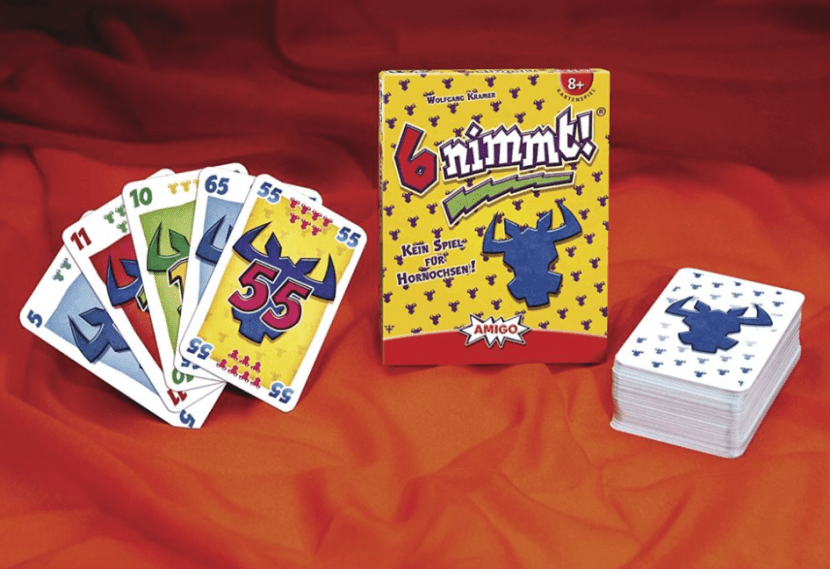
Wolfgang Kramer’s 6 nimmt! is another classic I played this past month. I’m going to take this moment to thank one of our game night regulars (Kenneth) for remembering how to play Las Vegas and 6 nimmt!. 6 nimmt! was another game where I could remember how the game was played but forgot to explain specific rules or edge cases. In 6 nimmt!, points are bad. You want the fewest points. Small bullheads (shown in the middle of the top and bottom of each card) score players points at the end of each round. Every round, players are dealt 10 cards. You will be playing all cards. Players simultaneously pick one card to play and then, in number order, play those cards to rows. If a row gets filled (has five cards and you would then play a sixth card), you claim all five cards in that row and start a new row with the sixth card you played.
6 nimmt! is another easy to learn game with plenty of strategy. Who am I kidding? 6 nimmt! is pure chaos. You may attempt to play a card, squeezing it into a tight window of numbers, only to find someone else played a card that torpedoed your plans. And that’s the fun.
There are equal parts strategy and luck with 6 nimmt!. Are you the least bullheaded?
Those are the games I played this past month. Let’s see what Season has been playing.
Season’s Video Games
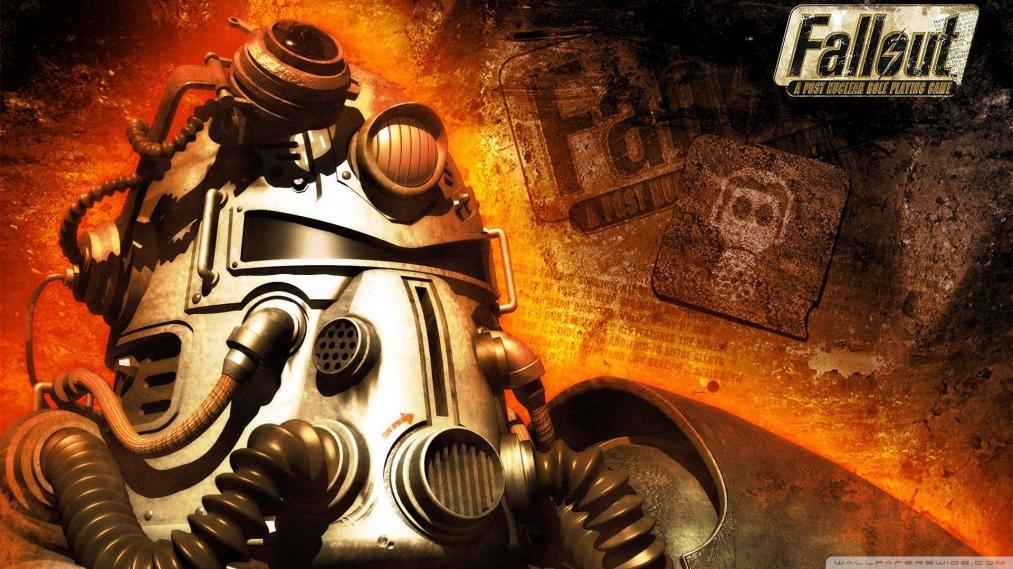
I’ve been getting into Fallout lore lately, so I decided to try the first Fallout game. I know Wasteland came before Fallout, but I’ve yet to check it out.
Fallout was a different experience from other games of the franchise after Bethesda took over. I like the isometric movement. It’s definitely reminiscent of earlier computer games. I get distracted easily in video games, so side questing and taking my time to explore the world is what I’m used to. I wasn’t anticipating being put on a timer to find the water chip. I think this adds to Fallout’s replayability. If I don’t get to everything, I’ll definitely play again.
What have you been playing, Skye?
Skye’s Video Games
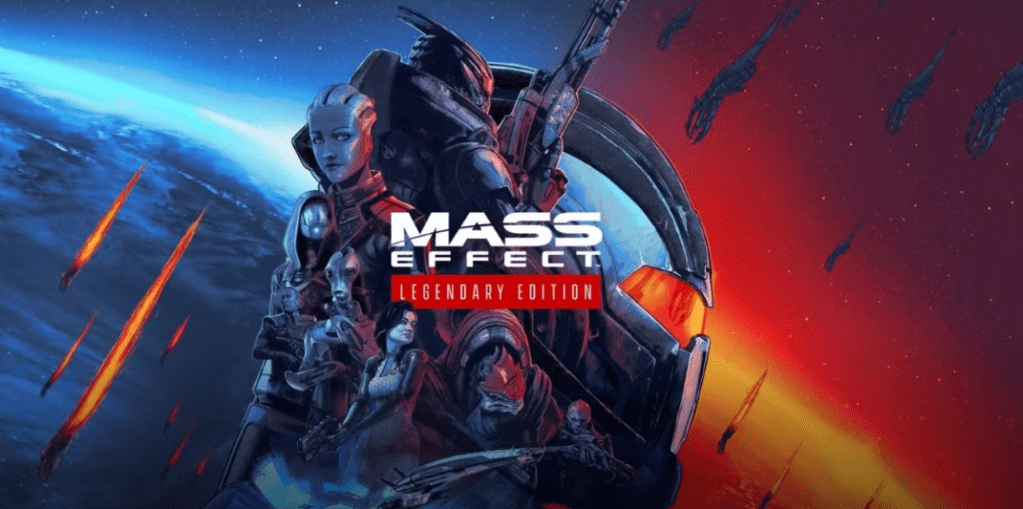
Mass Effect is my newest video game obsession. “Obsession” is the right term. Mass Effect suddenly fell into my lap. I’m lucky enough to have a copy of the Legendary Edition, which contains the three games from the original Mass Effect trilogy. I’m fully submerged in the Mass Effect rabbit hole, and I don’t expect to be out until mid-2026. Especially since, if I really like a game, I’ll grind until I get all three Platinum Trophies. Wish me luck!
Skye’s Board Games
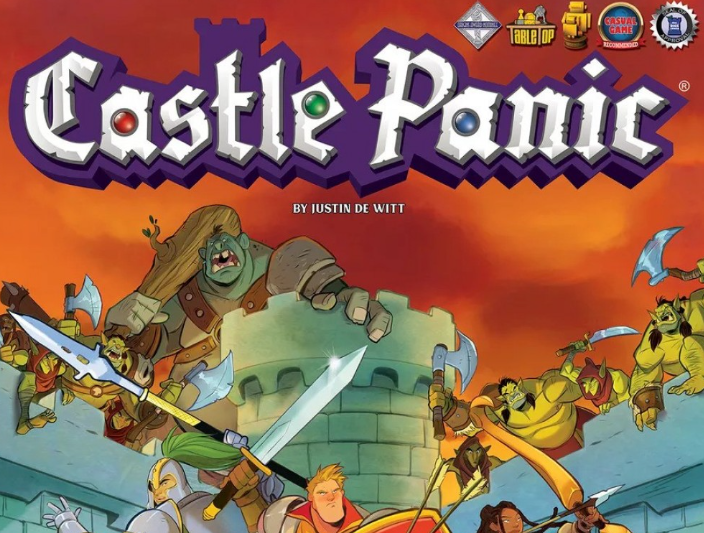
I played Castle Panic during this week’s game night, and it was a fun and engaging experience. I enjoyed the amount of planning and collaboration involved, which made each of our team members feel important. A lot of what happens in Castle Panic is discussion about which threats are the most pressing and how to deal with them. In a way, Castle Panic felt like we were all military commanders deliberating in the war room. Despite the good experience I had with Castle Panic, I can see how the game can turn sour. Castle Panic could suffer from Alpha Gamer Syndrome (one player making decisions for everyone). Remember to stay calm, work together, and get rid of those monsters. The kingdom is at stake!
And I’m hungry now. Pizza Roles is a party game that leans hard into its premise. The game is quick and entertaining. While I don’t see myself regularly playing Pizza Roles, I’d be happy to argue with a large group of friends about which toppings do and don’t belong on pizza. In a lighthearted way, of course. Since Pizza Roles can be played competitively or cooperatively, one can tailor the game to almost any friend group. Just make sure you order pizza.
Hey, hey! Kyra Kyle here again! Those are the games (video games and board games) our writers have played over the past month. Let us know what you’ve been playing in the comments, Geekly Gang. Thank you for reading, and wherever you are, I hope you’re having a great day.
Inspired by tile-laying board games, Dorfromantik offers the relaxing gameplay of creating a pastoral landscape of trees, villages, water, railroads, and fields. Designed by four German and Swiss students (Timo Falcke, Sandro Heuberger, Luca Langenberg, and Zwi Zausch) in a game design master’s program at HTW Berlin, Dorfromantik is a peaceful, minimalist game that lives up to the title, cozy. Hey, hey! Kyra Kyle here. We’re back with another cozy video game review. Even though Dorfromantik has crossed over into an award-winning board game, we’ll be discussing the equally stellar indie video game by Toukana Interactive. Get ready to build a gorgeous landscape with Dorfromantik.
Game Mechanisms: 7/10
Dorfromantik takes a simple concept of tile laying and does it exceptionally well. I’d wager the idea of Dorfromantik stemmed from playing board games like Carcassonne. Dorfromantik’s game mechanisms lend themselves well to board games, so there is an excellent, cooperative board game by the same name. Sometimes, you don’t need an elaborate set of mechanisms to make a game sing. Sometimes, you just need to do a simple concept well, and Dorfromantik does just that.
Chain similar land types with each other to gain points and finish goals (that the game presents) to score even more points and to increase the number of tiles you have to draw from. Dorfromantik can be played competitively–there is a leaderboard–or you could watch the countryside bloom as you place tiles. Dorfromantik‘s ability to make me invested in a landscape reminds me of another cozy video game we covered, Terra Nil.
Gameplay Loop: 9/10
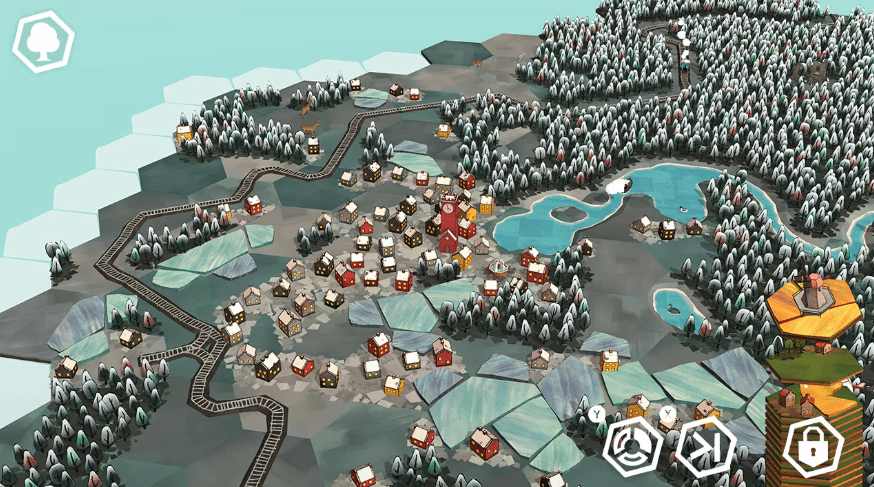
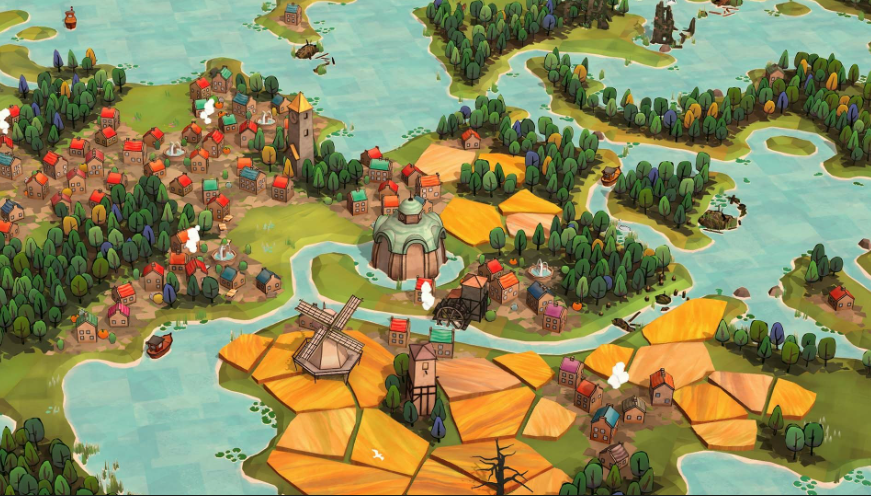
Whether you play Dorfromantik to get the highest score possible or casually place tiles and find your Zen, you can’t deny Dorfromantik’s gameplay loop. Once you get started, you won’t build just one pastoral scene. You’ll want to go farther with your next run, reveal new tiles like the windmill (pictured above), or watch your boats and trains traverse the landscape. And yes, the scene above is animated. It’s so neat watching your creation come to life.
Because the tiles can come out in different orders, no two scenes in Dorfromantik are exactly the same. This adds spice to the simplistic gameplay. Dorfromantik is an easy game to get into, but a difficult one to master if you want to climb that leaderboard. Or you could be like me. I just want to discover new tiles and watch my landscape get bigger and more diverse. I’m so glad Dorfromantik has been ported over to the Switch. It’s the perfect game to play on the go.
Narrative/Storytelling: 1/10
I should’ve excluded this element, but I didn’t with other video games that had little to no story, so narrative/storytelling is staying in the lineup. Let us know what you’d replace this element with for games that have little to no story. Dorfromantik has no story to speak of, so it receives a low mark in this category.
User Interface: 10/10
Dorfromantik has a stripped-down but effective user interface. The tiles feel great to manipulate. They almost feel like placing a board game’s tiles. The picture above shows how Dorfromantik will highlight the spaces where a tile can be placed. Gamers can only place the tile on top of the draw pile. Dorfromantik does an excellent job of not only showing where a tile can be placed, the callouts show where you can gain extra points, and whenever you hover a tile over a space and begin rotating it, Dorfromantik will make the matching tiles shimmer.
Dorfromantik’s elegant and minimalistic user interface makes it accessible. Like I said, Dorfromantik may use a familiar board game mechanism in tile placement, but every element Dorfromantik adds is handled with care and purpose. I had to give Dorfromantik top marks for user interface.
Graphics: 8/10
Dorfromantik has excellent graphics for a top-down isometric video game. The art style works well, and I appreciate the small details. Look at the clock towers, cottages, and windmills in the image above. Like I mentioned before, Dorfromantik uses small animations to denote movement. The boats (if you’ve unlocked the boats) move along the waterways. Smoke puffs from chimneys. While all of this is great, Dorfromantik does venture into cartoony graphics.
These cartoony graphics work well when one zooms out and sees more of the landscape, so I understand why Dorfromantik chose a minimalistic, cartoon-like art style. Players are meant to take a macro view of their village. But I dock Dorfromantik a point or two for graphics because the game doesn’t quite hold up on closer inspection.
Audio: 7/10
Dorfromantik’s music exudes the concept of a cozy game. I’ve listened to Dorfromantik’s soundtrack to fall asleep. It’s that soothing. Unfortunately, the game’s sound effects detract from this calm. The clacking and clicking of the tiles often takes me out of the game’s vibe. I would’ve preferred more pastoral sound effects accompanying the mechanical sounds of turning and placing tiles on the board. Yes, I could reduce the sound effects’ volume or turn them off altogether, but that would eliminate half of Dorfromantik’s audio. We’re grading the game’s entire audio. If we were only grading Dorfromantik’s soundtrack, its audio would score much higher.
Replay Factor: 10/10
Dorfromantik has an addictive gameplay loop, so the replay factor is through the roof. I can see myself playing Dorfromantik on my Switch while waiting in line. Heck, I’m surprised Dorfromantik hasn’t yet made it to the mobile game space. I could see plenty of people playing Dorfromantik on their phones. It may be an even better game for smartphones. The Switch tends to be a game’s first foray into mobile gaming. Fingers crossed that this cozy game classic makes it onto more mobile devices.
Aggregated Score: 8.6
Sure, I gave Dorfromantik a story/narrative score, but I’m not including that score with its aggregated score. Sometimes you need a cozy video game to find your Zen. Dorfromantik is a great game for that. I’m hoping more gamers will have the opportunity to play Dorfromantik on other platforms soon.
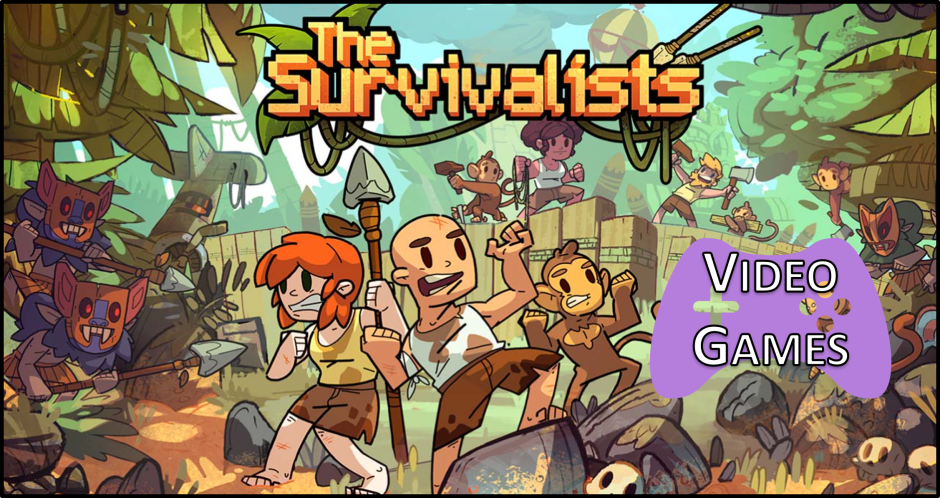
Team 17 produced The Survivalists as a cooperative adventure game set in the Escapists universe. The player wakes up marooned on a mysterious island. You must adapt to your new surroundings. Prepare your defenses against island threats. Explore, hunt, build, craft, and train monkeys with up to three friends as you do your best to survive.
Hey, hey! Kyra Kyle here. Today’s post is a follow-up of sorts. Months ago, I mentioned during one of our Whatcha Playing segments that I’ve been playing The Survivalists. I finished the game and figured I’d share my thoughts. I played The Survivalists on PlayStation (so most of my comments will reflect that), but The Survivalists is also available for Xbox, Nintendo Switch, and Steam. Typically, it retails for about $25, but The Survivalists tends to go on sale for as low as $5. I snagged a copy when it was this cheap. Let’s see how The Survivalists measures up in our review criteria.
Mechanisms: 8/10
Full disclosure: I’m not the biggest survival game fan; that’s more Skye’s video game genre. Survival games often frustrate me. It takes a while to make progress (I’m impatient), and your progress can be foiled with a single false move, which causes the game to devolve into a frustration simulator. I usually like to chill whenever I play video games. Most survival games have no chill. That’s where The Survivalists is different.
The Survivalists takes a laid-back approach to the survival game genre. Sure. You can–and most likely will–die in the game, and after respawning, you’ll have to travel back to where you lost your belongings, but The Survivalists is more forgiving. Upgrades don’t take as long, eliminating one of the barriers for me. If you train monkeys, these upgrades take a fraction of the time. Monkeys are The Survivalists’ single best addition. It took me a while to figure out how to train a monkey (the controls are a little wonky), but once you get the knack, you’re no longer alone on this island. Even if you play The Survivalists solo, you have allies.
The Survivalists’ monkeys element is enough to give it an above-average score in mechanisms, but the game doesn’t add too much to the survival video game genre, so I couldn’t give it higher than an eight out of ten. Still, I enjoyed my time with The Survivalists, and the game’s mechanisms kept me engaged.
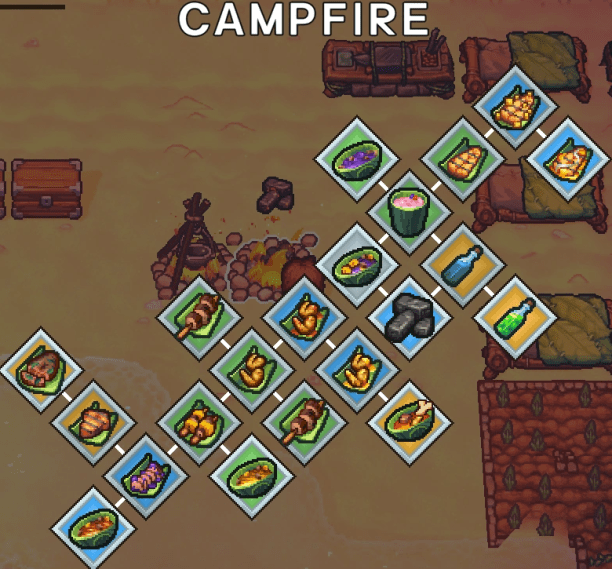
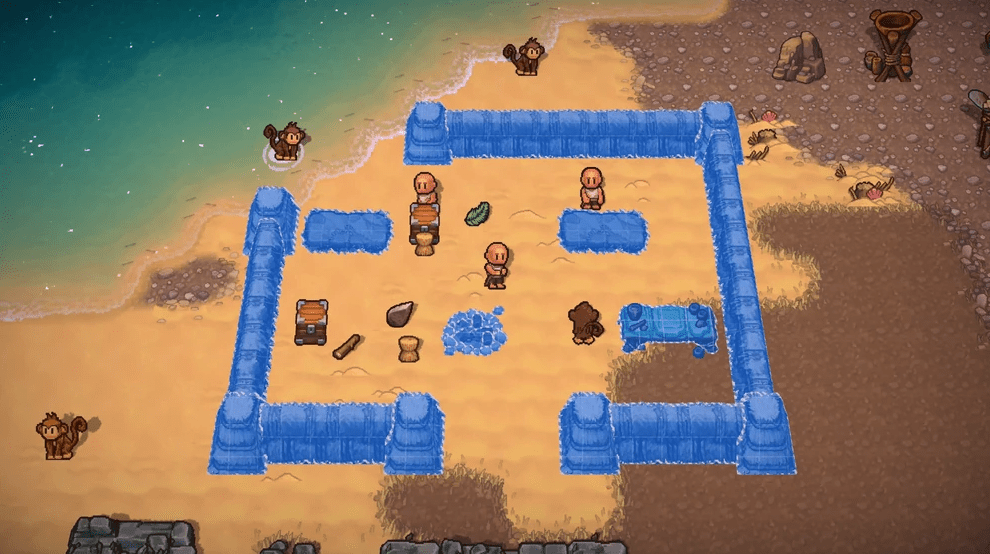
Above Image from GameDesigning.Org
Gameplay Loop: 8/10
The Survivalists has the same addictive gameplay loop as most survival games. While I love the addition of monkeys, you can get stuck waiting for your monkeys to finish constructing key materials. That holds back this score a bit. The missions can also get too specific; one also doesn’t receive credit for a task unless they have the mission in their questline. The Beast Master is notorious for this. Kill 10 Bats. I already have; I guess I must hunt for 10 more. And the Beast Master’s questlines (in particular) don’t appear to have a linear progression. You can go from slaying a mid-level boss to hunting wolves, and then to taming animals, which transitions to killing warthogs (an equivalent animal to wolves). These mission progressions tend to be head-scratching.
Still, The Survivalists has a satisfying gameplay loop. The world resets after every few days (after a blood moon). So, if you must hunt wolves for their pelts (or to finish a quest), you may need to wait for them to respawn after a blood moon. The morning after a blood moon, you’ll be attacked by natives. Perishing during one of these raids isn’t too big of a deal, provided you’re at or near one of your camps. You’ll lose the items in your inventory, but your attackers will vanish, and you’ll respawn at your nearest camp. Easy.
Sailing can be tricky to master. I was fifteen hours into the game before I could navigate the waters well. Once you get the hang of sailing, exploring becomes a blast. I couldn’t wait to discover a new island or the materials I could find on the island. This is a hallmark of survival games. Perhaps I should give more of them a try.
At first, obtaining a new monkey can be exciting, but you’ll end up with well over 15 monkeys. That’s a lot of monkeys. The number of monkey companions will become unruly, and monkeys have a range limit. The Survivalists doesn’t do a good job of marking this range. I lost count of the times I’d task a monkey to do something like chop down trees, only to see the monkey skip a tree to knock one farther away. Make the monkey’s range make sense. I’ll also get a monkey falling me a little too long, and then they’ll randomly swim on the beach on a foreign island. It’s a good thing monkeys can’t die.
Narrative: 6/10
The Survivalists has a basic premise with little story beyond that, but it doesn’t need a lot of story beyond a person marooned on a distant island. I do enjoy the ending. It’s not a true ending, because you can continue playing after this moment, and the credits roll. I won’t spoil what happens here, but The Survivalists has an adorable cutscene after the player rebuilds the Galleon and sets off for home.
Storytelling: 7/10
Even though The Survivalists has little story, the story it has is done well. Flavor snippets from the labyrinths and vaults sprinkled through the various islands do a lot to build The Survivalists’ world. My favorite parts of The Survivalists’ story are piecing together a story from the random objects I encountered. This game allows players to fill in certain blanks in its story. As of writing this post, I have yet to play The Escapists. I’ve heard that there are references from the previous games set in this universe. If so, that’s fun.
User Interface: 9/10
The Survivalists’ user interface works well. With few exceptions (I mentioned a lack of showing the player their monkey’s range), the game provides ample information in a digestible manner. The volume of information a survival game needs to convey is staggering. Players can get lost in menus and submenus. While that can happen occasionally with The Survivalists, it doesn’t happen as often as other survival video games. This contributes to The Survivalists‘ ease of play.
The well-laid-out GUI gives players the information they need. Yes. I could locate my missing monkeys if I wanted; I just didn’t want to retrieve them. The map allows for customized markers, which makes remembering where things are easy enough. Furthermore, you don’t really need too many personalized markers because the taskmasters have unique markers, and they spawn on the game’s five islands: Mysterious Strange at the player’s island, Beast Master at the Badlands, Survival Gourmand in the Swamp, The Collector at the Volcano, and The Salesman at the final island shaped like a skull and is a combination of all the biomes. The Survivalists also labels all the labyrinths and vaults, so the randomized map is clearly marked.
One can also mark a recipe and know when they’ve collected the necessary materials. I only have a few gripes, like the lack of a monkey range display. The Survivalists did their homework and included enough features from other survival video games to make playing this game enjoyable.
Graphics: 9/10
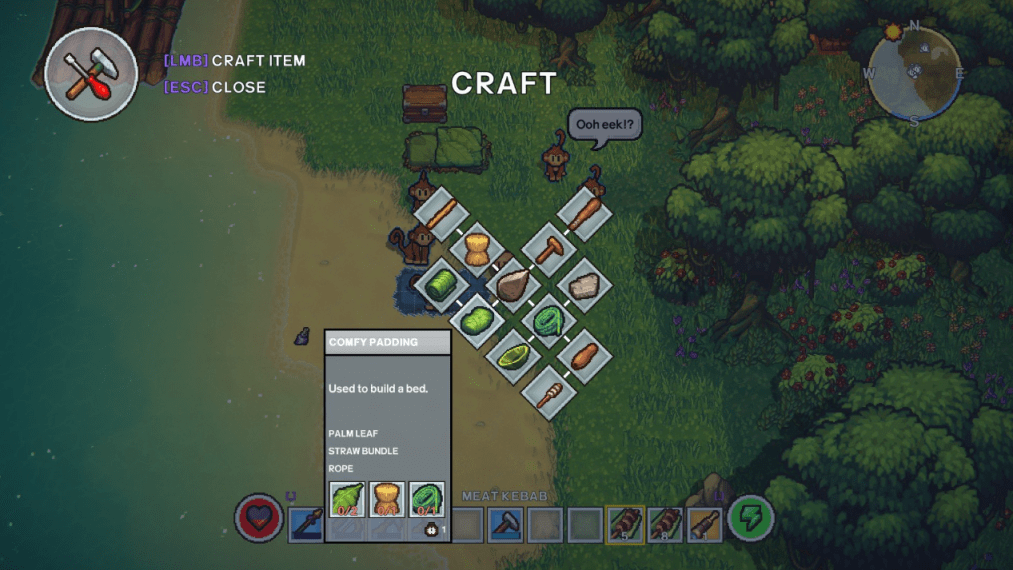
In keeping with The Escapists’ universe, The Survivalists uses a cute pixel art style. I don’t tend to like pixel art because the art style sacrifices detail for the sake of the designer not wanting to include detail (it tends to be cheaper), and it taps into nostalgia. A stripped-down look is a key feature of pixel art; it makes the art more abstract, which can allow players to see themselves in the graphics. Somehow, The Survivalists’ graphics maintain a level of detail despite using pixel art. That’s impressive.
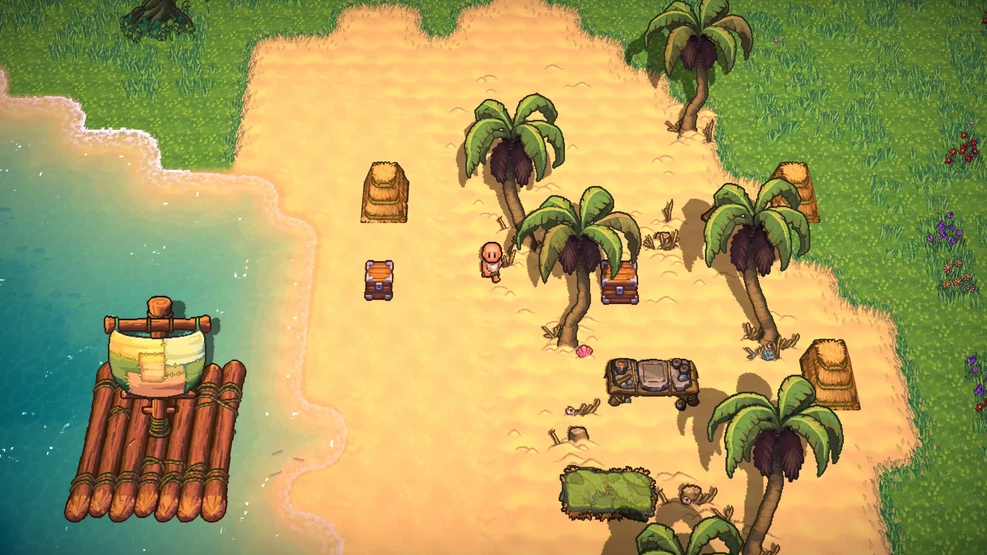
As you can see in the image above, The Survivalists uses a mock 16-bit art style, but the shadows from the trees have detail, the water ripples, and the grass shifts. The Survivalists has enough detail to make its world breathe, but it has enough abstraction for players to see themselves in their protagonist. This is pixel art done right.
Audio: 8/10
Truth time. I predominantly played The Survivalists muted. The times when I had the sound on, the effects sounded natural. The music is solid and suitable, except for the sailing tune. That song alone raises the audio score a full two or three points. I would sail from island to island just to hear this tune. The Survivalists’ sailing music feels like an adventure, and that’s what I wanted from this game. Don’t believe me? Check out the audio on YouTube. The track is titled “Adventure Awaits.” That’s so fitting. I can almost smell the salt from the ocean.
Replay Factor: 8/10
The Survivalists’ ability to be played cooperatively raises this score a lot. I don’t know how often I’d play it as a solo experience. If you have no desire to play The Survivalists in co-op mode, I could see you dropping this score a point or two, but I do like playing this game as a co-op experience. Since the game randomly generates the islands each time, The Survivalists becomes a different puzzle. During my solo play, I had plenty of rocks for masonry but not enough trees for lumber at the game’s start. The inverse was true during my co-op playthrough. Plenty of other game elements, like the labyrinths and vaults, change too, so each play of The Survivalists is different.
I enjoyed my time on the island and wouldn’t mind returning after several months. If you need me, I’ll be listening to “Adventure Awaits” while heading out on a road trip.
Happy Wednesday, Geekly Gang! Today, our writers share what they’ve been listening to over the past month. Feel free to share what you’ve been listening to, Geekly Gang. I’ll begin by sharing my monthly tunes.
Kyra’s Tunes
Typically, I don’t pay much attention to the Rock & Roll Hall of Fame, but this year’s class was an interesting one. Headliners include Cyndi Lauper, Soundgarden, Joe Cocker, The White Stripes, Chubby Checker, Outkast, and Warren Zevon. Wow! What a group! I’m surprised it took Warren Zevon over 30 years to make the Hall. Notable exclusions like the Excitable Boy himself are the biggest reason why I don’t pay much attention to the Hall’s Inductees. Zevon’s Excitable Boy is a hallmark Rock album. “Ah-woo! Werewolves of London.” And I love “Lawyers, Guns, and Money.” The latter song is as pertinent today as it was when it was first released.
Many members of this inductee class are no longer with us, so several other artists paid tribute. Iggy Pop was hilarious when he sang the beat of The White Stripes’ “Seven-Nation Army.” The entire crowd joined the fun. And while there was a great version of Soundgarden’s “Black Hole Sun,” Lily Cornell Silver’s rendition of “Fell On Black Days,” with a picture of her father (Soundgarden’s lead singer, Chris Cornell) over her shoulder, sends chills.
While “Black Hole Sun” is a banger, I much prefer “Fell On Black Days.” It better explores Cornell’s range. Both Cornells. Lily did her father proud.
I’m getting choked up again. Chris Cornell (and his close friend Linkin Park frontman Chester Bennington) was always upfront about his depression. We lost Cornell and Bennington too soon.
My second entry pulls double duty: it’s a meme and a song. The Remix Brothers did a great job poking fun at President Trump’s Autism announcement from a handful of weeks ago. Here’s a link if you’d like to check out the remix. In short, the study President Trump references during this announcement says the exact opposite of what Trump declares. There is no correlation between Tylenol and Autism. Autism is hereditary. I’m a good example of the rise of Autism diagnoses. My daughter was diagnosed. I had some markers, and there’s a biological component to Autism, so I got checked myself and was diagnosed later in life. Tylenol is the only safe fever reducer pregnant women can take. Unchecked fevers can lead to issues far worse than Autism. Don’t listen to Trump. Returning to The Remix Brothers’ video, it’s eerie how they’re able to make Trump sound like Eminem. The Trump in this video has flow.
Sometimes one must laugh at the Idiocracy The United States has become. The Remix Brother’s “Trump Autism Remix” does a great job of doing that. Trump doesn’t need a third term. Can we get Dwayne Elizondo Mountain Dew Camacho as the 2028 Republican candidate for President?
That’s all I have for this month. Let’s check in with Skye.
Skye’s Tunes
It’s been a minute since I first heard The Rise and Fall of a Midwest Princess, and I was happy to revisit it this month. I forgot how much I enjoyed it. Listening to songs like “Femininomenon,” “After Midnight,” “Pink Pony Club,” and “Casual” reminds me of why this album is in my vinyl collection. I specifically own the Peaches & Cream version, which contains the songs “Super Graphic Ultra Modern Girl,” “HOT TO GO,” “My Kink is Karma,” “Picture You,” and “Kaleidoscope.” While it’s nice knowing I’m lucky to have bonus content, it feels weird having an album with an odd number of sides. I need to remind myself that the D Side is blank, and I’m worried one of these days I’m gonna scratch it by accident.
Despite my love of upbeat pop songs, I enjoy mellow vibes and soothing tracks. Enter The Very Best of Roberta Flack. Songs like “Killing Me Softly with His Song,” “Feel Like Makin’ Love,” “Where Is the Love,” and “If I Ever See You Again” are great for soothing vibes. Some people say that a nap is all you need after a long day of work, but The Very Best of Roberta Flack is all I need. I’ve been meaning to pay homage to Roberta Flack after her passing earlier this year. We’ve lost too many legends recently. Rest in peace.
On a lighter note, Olivia Rodrigo’s SOUR has been another of my staples this month. Rodrigo’s musical stylings are easy to jam to. I get lost in the melodies of songs like “Traitor,” “Drivers License,” “1 Step Forward, 3 Steps Back,” and “Enough for You” while I’m busy working on projects. I can’t deny that part of me is transported back to my teenage years whenever I pop in SOUR. I can’t imagine why that is. I still relate to many themes present in SOUR. Wherever Olivia is, I hope she’s okay.
Sublime is another classic album from my childhood. Understandably, my parents never shared the entire album with me and my sister, but certain (clean) songs quickly became staples. We would sing “Santeria” or “What I Got” as loud as we could. Being a kid, I never understood anything these songs were saying, but I loved them just because we were having fun. I love the nostalgic feelings I get from this album.
That’s all we have for this month’s Geekly Tunes. Let us know what music you’ve been listening to over the past month, Geekly Gang. Thank you for reading, and wherever you are, I hope you’re having a great day.
Happy Monday, Geekly Gang! We’re bringing back the Geekly Casting series, and today’s subject is a live-action Mega Man film. There were talks about a Netflix Mega Man film, but we haven’t heard much about this project since late 2021. A lot has changed since then. Mega Man even had an episode in Amazon Prime’s Secret Level series, a television series based on random video games. But the Blue Bomber deserves a big screen adaptation. Kyra Kyle here. As usual, I’ll start this post and share modern actors who could play the various roles, and Skye, our movie geek, will search Hollywood’s past and present for the best possible actors to play each role.
Our first order of business is figuring out which characters we need to cast. We’ll keep Rock’s supporting cast short: Dr. Light, Roll, and maybe another character or two. We won’t bother casting Rush. He’ll be a robo-dog, so they’ll record random dog noises. Dr. Wily’s an obvious inclusion. We’ll skip casting Yellow Devil; he’ll mostly grunt. The Robot Masters pose a difficult challenge. Skull Man must make the cast because he was a main antagonist in Mega Man’s manga, but the other Robot Masters should have a balanced power set and come from popular games in the Mega Man series. This is a tall order. We’ll do our best.
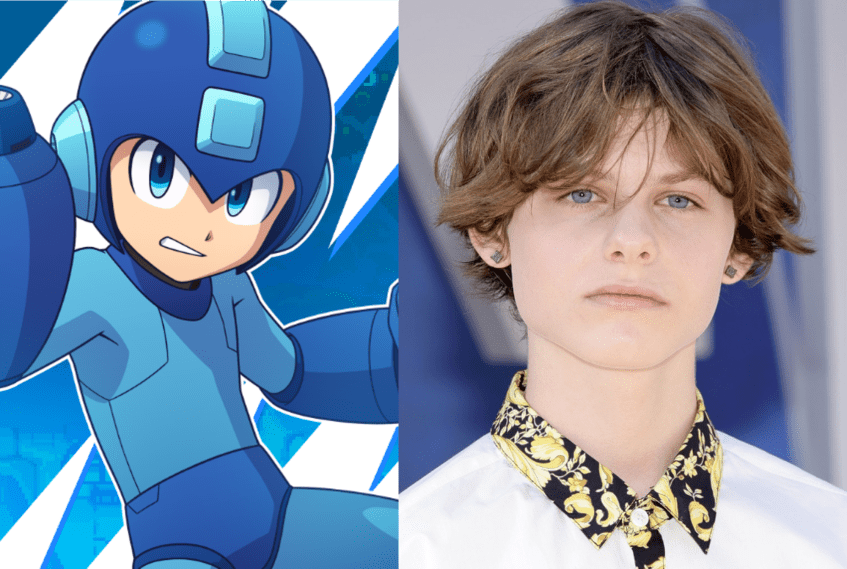
Mega Man/Rock: Cameron Crovetti
I considered several actors to play the title role in Mega Man. Malachi Barton’s range intrigued me. I could even see an unknown take on the role, but I landed on Cameron Crovetti.
Crovetti is best known for his role on the Amazon Prime series The Boys. He portrays Homelander’s son, so Crovetti has experience with characters with questionable backgrounds. While Mega Man doesn’t go as dark as The Boys, Rock has a conflicted relationship with humanity. Crovetti has several comedic roles under his belt, too, so he has range. I could see him portray the Blue Bomber.
Honestly, the Crovetti family could sport more than one role in Mega Man. Cameron’s twin brother, Nicholas, portrayed Max Wright in Big Little Lies. If Mega Man included Copy Robot, and the production company wanted to avoid using CGI to make Copy Robot look eerily similar to Mega Man, Nicholas Crovetti makes sense. The Crovetti brothers have an older sister, Isabella, who could portray Roll. Roll and Rock (Mega Man) are considered siblings in the Mega Man universe, so it makes sense for Isabella Crovetti to play Roll, but let’s go with a different actor.
Roll: Lulu Wilson
Lulu Wilson is best known for horror films and television series like Ouija: Origin of Evil, Annabelle: Creation, The Haunting of Hill House, and Fall of the House of Usher. Wilson even portrayed a young Gloria Steinem in The Glorias. Despite a short career, she has an impressive filmography. Wilson also has a handful of comedic roles under her belt, specifically the dark comedy Wyrm. So, Wilson has the range to pull off Rock’s older sister Roll.
Typically, Roll comes off as compassionate and patient, but Mega Man 11, the most recent entry in the mainline Mega Man series, shows her giving Auto (another Mega Man side character who could make an appearance) a hard time. Let’s face it. Roll can be brutal toward Auto in Mega Man 11. Roll also doesn’t mind joining Rock (Mega Man) in battle. Lulu Wilson could pull off a Roll who looks overtly demure, but has a hidden edge, begging to be set free.
Dr. Thomas Light: Pierce Brosnan
Honestly, I could’ve gone with the Mega Man fan consensus and picked Jeff Bridges. Bridges has been the lovable bearded man for decades; he would make a great Dr. Light. Instead, I’m going with Pierce Brosnan. Mega Man depicts Dr. Light as a kind-hearted father figure and little else. After all, Light created Rock, Roll, and X. Brosnan has portrayed father figures in the past, but he may bring another layer to the character that a generic fatherly actor wouldn’t. Don’t ask me what that layer is. That’s up to Brosnan to pull deep from his acting experience.
Dr. Albert Wily: Willem Dafoe
Willem Dafoe as Dr. Albert Wily may be typecasting. Who cares? I went off-center with Brosnan as Dr. Light; Dafoe is at his best when his character has a tenuous grasp on reality. Whoever portrays Dr. Wily needs a disconnect with reality. Only a madman would put the world at risk by turning robots (who were minding their own business) against humanity. Dafoe could easily pull off an unhinged Dr. Wily.
Skull Man: Javier Bardem
We’ve reached the Robot Masters. Woo hoo! Whoever fills these roles won’t need to match the look of their counterpart. The Robot Masters will predominantly be CGI.
We begin with Skull Man. Unlike most Robot Masters, Skull Man was designed specifically for combat. Dr. Wily built Skull Man to take down Mega Man. While other Robot Masters have personalities outside of “must destroy Mega Man” (other Robot Masters are coerced or brainwashed), Skull Man is a killer who will stop at nothing to end Mega Man. Again, this may be typecasting, but Javier Bardem has been that level of cold-blooded killer.
Skull Man shows little emotion. He struggles to make a connection with any of the other Robot Masters. He has a hollow, inhuman affect. Like many other actors on this list, Bardem would give Skull Man an extra layer of character.
Metal Man: Peter Dinklage
Even when he isn’t brainwashed, Metal Man is a jerk. Sarcasm is Metal Man’s first language. He treats the other Robot Masters like buffoons, cracking jokes at their expense. To be fair, few of the other Robot Masters figure out they’re the butt of Metal Man’s joke. Yep. Peter Dinklage could easily pull off an affable, wisecracking Metal Man. Dinklage could find the perfect blend of fun and danger. Couldn’t you see Dinklage tossing saw blades like they’re Frisbees?
Splash Woman: Kristen Bell
Splash Woman first appeared in the Mega Man comic book. She began as a hero. The Mega Man comic built up Splash Woman’s stakes ahead of Mega Man 9, so when she gets brainwashed in the game, players would care. Splash Woman is Mega Man’s karaoke-loving bestie. She may have been constructed for underwater repairs, but musical theater is Splash Woman’s passion. Kristen Bell has the musical training and comedic timing to pull off Splash Woman. Bell’s Splash Woman could be a villain in the first Mega Man film, or she could be converted in the sequel. Hmm.
Fire Man: Nikolaj Coster-Waldau
Nikolaj Coster-Waldau and Peter Dinklage could have a mini Game of Thrones reunion. That would be fun. It would also be fun to watch Coster-Waldau take on Fire Man, a Robot Master who believes he’s the hero. That’s right. Fire Man suffers from main character syndrome. Game of Thrones had several “main characters,” so Coster-Waldau as Fire Man works on a meta storytelling level. I can see Mega Man jokingly follow Fire Man as the main character for a scene. I can also see Nikolaj Coster-Waldau playing a hot-headed–a little on the nose–Fire Man.
Elec Man: Joaquin Phoenix
Were some of these Robot Masters brainwashed, or were they nudged? Conceited and egotistical, Elec Man walks a tightrope between kindhearted and sadistic freak. Joaquin Phoenix has portrayed his fair share of characters like Elec Man. I can hear Phoenix pull off a line like, “To watch my beautiful bolts fly to the top of your head. To hear your delightful shrieks.” Woah! Elec Man may have some issues.
Ice Man: Neil Patrick Harris
Ice Man loves to show off for the crowd. The world’s a stage, and he’ll give Splash Woman a run for her money as Mega Man’s best singer. Neil Patrick Harris has a flair for the dramatic. I’ve heard he’s a good singer, too. Wink. Harris’s Ice Man and the actor who I have playing Bomb Man could have more than one musical number. One of them needs to be a Mega Man variant of “Anything You Can Do, I Can Do Better.” Make it happen.
Guts Man: Terry Crews
Built for construction, Guts Man takes his job seriously. While he may perform physical labor, Guts Man is smarter than he looks. He can be over-dramatic with a penchant for sudden outbursts, but Guts Man cares deeply for his coworkers. Underneath his bulky exterior, Guts Man’s a big softy, just like my pick to portray him, Terry Crews. Sure, I want to see Crews in more films. But you read Guts Man’s description. Tell me that doesn’t scream Terry Crews.
Bomb Man: Wayne Brady
Bomb Man is another Robot Master with a flair for the dramatic. While he doesn’t necessarily sing in the Mega Man series, who says he can’t in the movie? I have mixed feelings about How I Met Your Mother, but Wayne Brady and Neil Patrick Harris would be another fun reunion. Brady and Harris’s chemistry is undeniable, and I’d love to see how Bomb Man and Ice Man would interact with each other. They’re too similar, fighting for the same spotlight. Anything you can freeze, I can explode!
That’s the cast I have for Mega Man. Let’s check in with our film geek, Skye.
Skye’s Picks
I’m not well-versed in the Mega Man game series. I’ve beaten the first one and gotten halfway through the second, so my knowledge of the lore and characters is limited. Because of that, all my picks for this post were actors who made me giggle. My version of Mega Man is more kid-friendly and goofy. I hope these picks aren’t blasphemous. Either way, enjoy my picks for a Mega Man feature film adaptation.
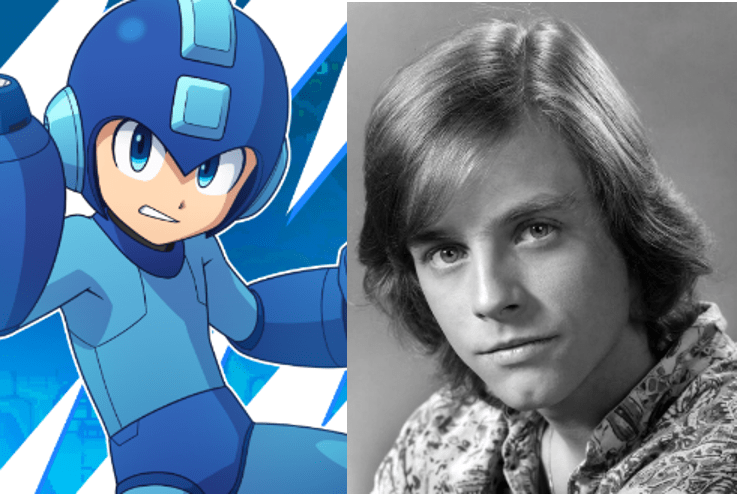
Mega Man/Rock: Mark Hamill (Young)
Let’s see, someone who’s fresh-faced, eager to explore, lovable in his ignorance with just the right amount of whininess sprinkled in. I couldn’t help but imagine young Mark Hamill playing Mega Man. I’m unsure if that’s the best representation of Mega Man’s character (please refer to my intro), but it’s at least compelling. If nothing else, we know Hamill started his career playing that exact archetype. Seeing him learn and upgrade himself as he “cuts” (hehe) through the various bosses would be believable. With the tutelage of Obi-Wan–I mean Dr. Light–young Hamill could easily become another iconic sci-fi protagonist.
Roll: Dakota Fanning (Younger)
Roll was tricky for me to cast, but I remembered I had cast Fanning’s sister in a previous casting call (Geekly Casting: X-Men in the MCU). Since I prefer not to repeat actors I’ve already cast, why not Dakota? Like her younger sister, Elle, Dakota Fanning has had a storied acting career. I could see her pulling off Roll’s kind-hearted and bubbly personality. Since I cast young Mark Hamill as Mega Man/Rock, I thought it would make more sense to cast Fanning in her 20s. Rock n’ Roll are meant to be siblings, so it’d be a bit weird if they weren’t close in age. She’s got the look, style, and personality, so let’s give her the Roll. See what I did there?
Dr. Thomas Light: Patrick Stewart
I shouldn’t have to explain this one. Come on, it’s Patrick Stewart. Patrick Stewart is one of the go-to actors for good-natured, smart old dudes. Dr. Light would be no exception. Stewart has unrivaled on-screen charisma, a decades-long career under his belt, and the ability to make any movie he’s in better. Stewart works as Dr. Light. I won’t even bother naming them all, y’all already know. The only issue is his distinct lack of hair, but it’s Hollywood. They can figure out something.
Dr. Albert Wily: Ian McKellen
After casting Patrick Stewart as Dr. Light, it only felt right to go with Ian McKellen as Dr. Wily. If you’re a member of the Geekly Gang, you probably know why I made this choice. Not only are Patrick Stewart and Ian McKellen two peas in a pod, but they work off each other in ways unlike any other acting duo in Hollywood. They’ve had several roles and done countless productions together, but the rivalry between Light and Wily is mostly why I went with McKellen. Given their past playing Professor X and Magneto, Stewart and McKellen would foil each other perfectly for the Light/Wily rivalry. Now, I badly want to watch this Mega Man movie. Make it so, Hollywood!
Skull Man: Ken Page (Posthumously)
If we’re going the kid-friendly and goofy route, Ken Page as Skull Man makes a marketable, mildly intimidating, and memorable choice. I admit it. I was thinking about Page’s role as Oogie Boogie in The Nightmare Before Christmas. Skull Man wouldn’t have to sing, per se, but Ken Page could still bring a unique voice to the character. I can easily imagine kids growing up watching this Mega Man adaptation and having their sense of villainy shaped by Page’s interpretation of Skull Man, like Oogie Boogie. Hopefully, Skull Man would receive more screen time, allowing Page to properly define his character. Rest in peace.
Metal Man: Robert Downey Jr.
Just lean into it. That’s the theme of my picks. Since Robert Downey Jr. is more available than he was 10 years ago, why not take the opportunity to be another metal man? This time literally Metal Man. As soon as I heard about a jerky robot in a metal suit, I picked Robert Downey Jr.. Downey Jr. has also shown interest in expanding his types of characters, as we’ve seen with his new role as Dr. Doom in Avengers: Doomsday. Yes, join Ethan Hawke on the dark side. I hear they have cookies. If they do happen to make a legitimate Mega Man film adaptation, getting Robert Downey Jr. would also be a highly marketable first step. The kids would have to see it then!
Splash Woman: Halle Bailey
Anyone who’s forced to act in a Disney live-action remake deserves a better role. Is Splash Woman that role? Splash Woman could be a better role than Ariel in a live-action Little Mermaid. Splash Woman could also be a good opportunity to set the record straight for Halle Bailey and show how talented she is when Disney isn’t putting her on a self-righteous diversity pedestal. Imagine the not-so-subtle jabs Bailey could take at Disney in the role of a robot mermaid. I’m already laughing!
Fire Man: Jason Lee
This choice is difficult to defend, even for me. After researching boss robot personalities, Jason Lee came to mind. Fire Man is more of a wannabe hero with a short temper. Does that sound like Lee’s character from The Incredibles, Buddy Pines/Syndrome? Lee has experience. Also, Jason Lee hasn’t been given many major roles in recent years. Considering (arguably) his best role was Syndrome in 2004, I’d like to see him make a comeback. Like Brendan Fraser, he has untapped potential for high-profile films. I don’t want to remember him as Dave from Alvin and the Chipmunks. Can I get some brain bleach for those movies?
Elec Man: Tom Hiddleston
Like my last choice, Tom Hiddleston as Elec Man was a fitting conclusion after some light research. And why not one more Marvel actor? Elec Man is an arrogant, overdramatic narcissist, which sounds like Loki in the MCU. While Hiddleston has experience playing these character types, he’s been branching out. I’m confident that Hiddleston would give a good performance as Elec Man. Given my layperson’s perspective, Hiddleston seems like a good fit.
Ice Man: David Bowie (Posthumously)
Ice Man was a fun role to cast. Sure, I still don’t have a solid understanding of his character, but I got the idea after Kyra discussed their pick. They had chosen Neil Patrick Harris for the role in part due to Ice Man’s flair for the theatrical. It doesn’t get more theatrical than David Bowie. That and Ice Man would’ve been a great way to reintroduce Bowie to another generation as a kids’ movie icon. They would need to let Ice Man sing. Bowie would probably write the song too, and I’d buy the vinyl. Rest in peace.
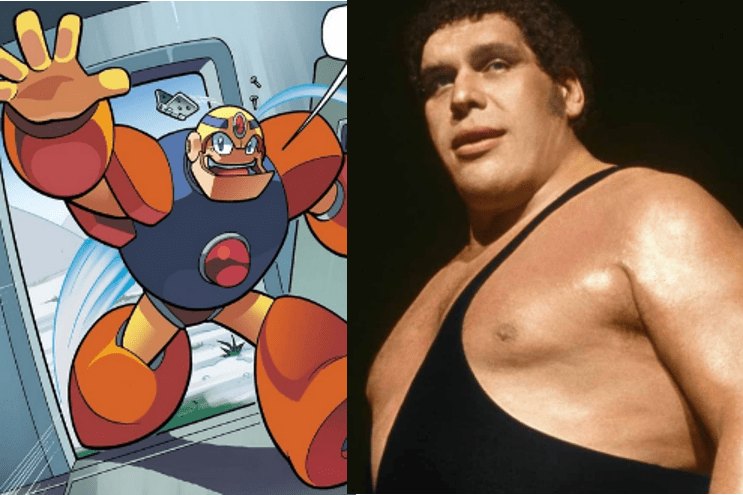
Guts Man: André the Giant (Posthumously)
Here comes another choice influenced by Kyra’s pick. Thanks, Kyra. You helped me out a lot on this one. They described Guts Man as a lumbering meat-head with a soft and gentle side. If he was still with us, I would’ve enjoyed watching André the Giant in this role. The iconic ex-wrestler had both in equal measure, and that was depicted in his personality and role choices. I fell in love with André’s personality after watching The Princess Bride. If he brought the same energy to his portrayal of Guts Man, it would’ve been great. Who knows, he could’ve been as big a star as Dwayne Johnson is today if he were still with us. Rest in peace.
Bomb Man: Dwayne Johnson
Speaking of Dwayne Johnson, he happens to be my pick for Bomb Man. Like Guts Man, Bomb Man is a larger robot intended to carry heavy loads and work primarily in construction. Based on physique alone, Johnson is a solid fit. Although, I mainly picked Johnson for Bomb Man for his personality. Bomb Man seems like a lighthearted robot with a good sense of humor, which would make Dwayne Johnson a great choice. Bomb Man and Guts Man are also supposed to be close friends, because their abilities play off each other. I wanted Dwayne Johnson to play Bomb Man since I think he and André the Giant would make great on-screen friends. I struggle to process the cuteness.
Kyra Kyle here again. That’s all we have for today’s Geekly Casting. Who would you cast in the various roles, Geekly Gang? Would you like to see a part two for any of these castings? Let us know in the comments. Thank you for reading, and wherever you are, I hope you’re having a great day.



































































 jkgeekly.com