Geek Out

April 2025 Update

Here is the second of our quarterly JK Geekly updates. I don’t know if we’ll continue doing these. Let me know if you like to see them coming. I figured this would be a good way to let folks know what we’re up to and what we have planned.

Hey, hey! Kyra Kyle here. Geekly has been chugging along with our new editor Season and new writer Skye. We’re staying a good couple of months out with our schedule. By the time you’re reading this, we’re probably working on summer posts. Yay!

Our regularly scheduled content being set this far in advance affords us to review the occasional TV show or movie. We’ve increased our weekly content.

Quizzes

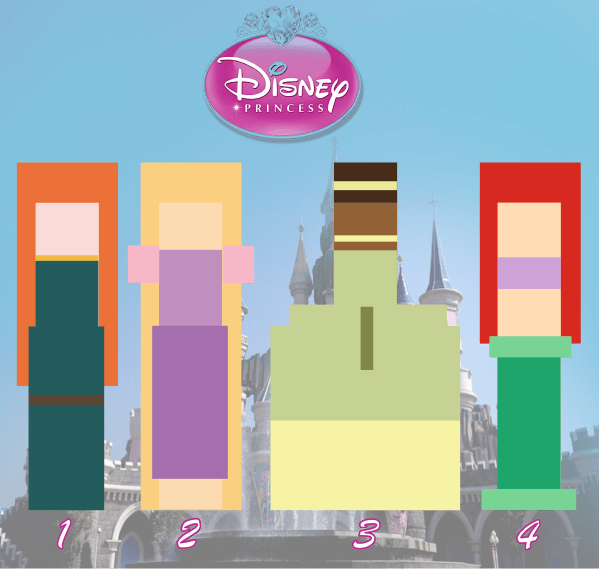
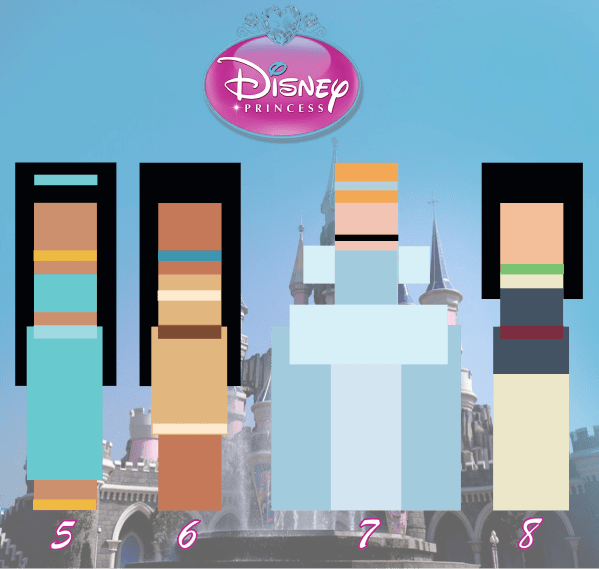
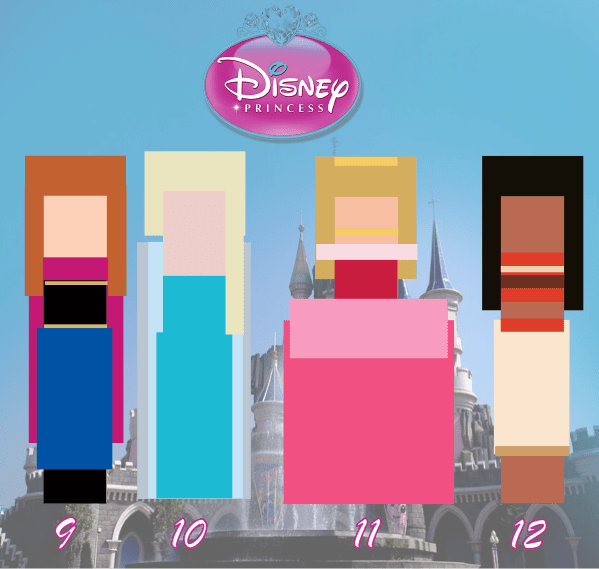
Disney Princess Color Palette 01

We’ve been releasing color palette quizzes for the past few months. We hope you’re enjoying them. Here’s a link to the ones we’ve already produced. A new color palette quiz has been released each Thursday. Which ones are your favorite? Which franchises would you like to see get a color palette quiz?

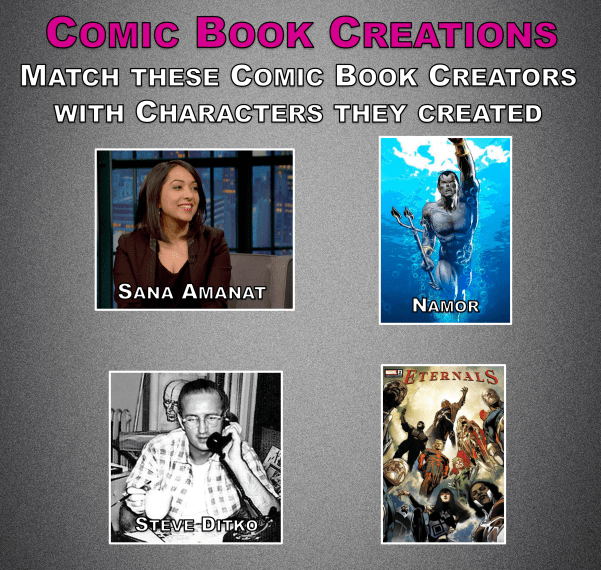
We also reintroduced older quizzes that Geekly used to make and began posting alternating quizzes (among multiple-choice, matching, and timeline quiz types) every Tuesday. Since we have plenty of color palette quizzes (to match the number of the other quizzes), we’ll begin cycling through all four quiz types (to include color palettes) every Tuesday and Thursday. We’ll continue with this schedule until at least the next update in July. Let us know which quiz type you like best.

TV Show and Movie Reviews

Geekly has been keeping up with the weekly release of Disney+ and Max shows centered around the Marvel and DC Universe. We plan on covering some more movies, specifically ones that will release this summer. We can’t wait for Fantastic Four and Superman. Summer 2025 movies are looking great.

Let us know if there are any shows or movies you’d like for us to cover that we aren’t already covering.

Geekly News

We’re still figuring out how we want to present Geekly News. Should we go with a big headline with smaller stories throughout the week or weeks? Or should we come out with focused news stories for individual topics? We could always do a weekly Geekly News with no headline, too. In short, Geekly News is a work-in-progress.

New Weekly Posts

The Geekly Gang is filling out the rest of its weekly schedule with two different types of posts. We’ll start with the Whatcha Wednesday posts. Each Wednesday, the Geekly Gang will share which games they’ve played, shows/movies they’ve watched, books they’ve read, and even which songs made the previous month’s soundtrack. Feel free to join in the fun, because you’re part of the Geekly Gang, too.

Our other weekly post is inspired by Harper Ross, one of JK Geekly’s commenters. These posts will be called Geekly Casting and will be released one Friday each month, starting with April 18, 2025. Skye’s our resident movie geek, so she’ll share her ideas on who should play certain roles. Season likes to conduct research, so she’ll unearth casting rumors. And my contributions may vary. We’ll see. Again, you’re more than welcome to share who you think should play which role, Geekly Gang.

But Geekly Casting will only post on one Friday of each month. The rest of the Fridays will have various posts. We’ll make it up as we go for Potpourri Friday.

Fantasy and Mythological Creatures

We’ve struggled to get the fantasy and mythological creatures series off the ground. We figured this might be the case. It’s difficult to coordinate with more people, but we will produce this series whenever we get the chance.

Stop me if you’ve heard this before, but Geekly intends to release a series of game mechanism posts where we send game designers a questionnaire about specific game mechanisms. XD We do intend to do this and hopefully, the pitfalls we encountered with the fantasy and mythological creatures project will inform us on what to do with the board game mechanism series.

JK Geekly Discord Server

We started a JK Geekly Discord Server. We’ll try to be active on this server as much as possible. Discord could help with reaching out to potential content creators and you. We’re all part of the Geekly Gang. Let us know what kind of posts you’d like to see. We could even hang out on the server and play games. Who knows?

Closing Thoughts

That’s all we have for now. We’ll have another one of these posts ready for July. Until then, stay safe, thank you for reading, and wherever you are, we hope you’re having a great day.

Tabletop Game Review: On Tour

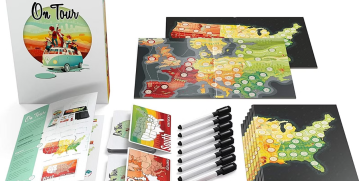
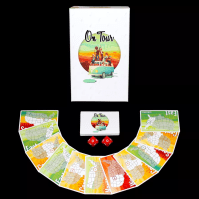
On Tour puts you in a rock band. You’re living the dream. You must schedule the band’s stops over your 100-day tour, visiting as many states (or countries depending on the map you choose) as possible. Roll the dice and chart a course with the most concerts.

Hey, hey! Kyra Kyle here. Today’s tabletop game review is the roll-and-write game by All Play (BoardGameTables.com at the time of its original print) On Tour. We’ll set off on our tour soon, but first, let’s handle some of On Tour’s behind-the-scenes details.

The Fiddly Bits

Designer: Chad DeShon
Publisher: BoardGameTables.com
Date Released: 2019
Number of Players: 1-8
Age Range: 8 and up
Setup Time: Less than a minute
Play Time: 20 minutes

Game Mechanisms

Bingo
Dice Rolling
Line Drawing
Network and Route Building
Push Your Luck
Simultaneous Action Selection
Solo/Solitaire Game

Game Setup

1) Give each player their own player board and a dry-erase marker.

2) Shuffle the cards and place them in the center of the table.

3) Roll the dice (2 large 10-sided dice). For setup only, re-roll doubles.

4) Combine the results to form two different 2-digit numbers (i.e. 1 & 4 combine to form 14 & 41).

5) One player draws a card. All players write the lower dice combination on that state.

6) Draw another card and all players write the higher dice combination on that state.

7) Each player circles both numbers.

8) Repeat steps 3-7.

9) Remove the four cards from the game.

Choose a player to begin the game by rolling the dice first.

Game Flow

With each turn, the rolling player draws 3 cards and reveals the cards for all players. If the deck ever empties, reshuffle the deck to form a new deck.

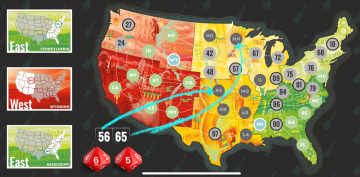
The rolling player rolls both dice. Combine the results to form two different 2-digit numbers (i.3. 5 & 6 combine to form 56 & 65). All players simultaneously write each of those numbers in two empty states (or countries) on their board.

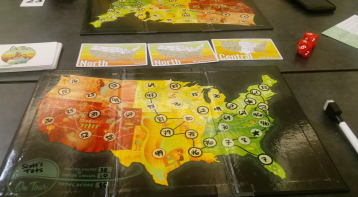
When writing numbers, players choose two of the three cards. The numbers must be written in one of the regions on the displayed cards (like North and Central). If you write a number on the same state displayed on the card, circle it. When writing numbers, a different card must be used for each number.

If all three cards display the same region OR if doubles are rolled, each player draws one star in any one empty state on their board instead of writing numbers. The state must be in the same region as shown on the card. You may still circle the star if you use an exact state from a card.

When all players have written their two numbers, discard the revealed cards and pass the dice to the next person clockwise.

When only one or two empty states remain, do not flip cards, instead roll dice. Players may freely write numbers in any remaining states, following the usual rules.

When all states are filled, the game ends. Beginning in any state, draw a continuous route for your tour. The line must continue to any adjacent state with a number equal to or greater than the previous state you started in. Stars are wild and count as any number.

You can never return to a state that you have already visited. You can never go to a state with a lower number.

Score one point for each state you visit and an additional point for each circled star or number on your route. The highest score is the winner.

Review

First, I didn’t change much from the rulebook in the game setup and game flow sections. I always use a game’s rulebook as a point of reference when writing these sections. Typically, I need to reword or condense multiple passages in a board game’s rulebook to make it easier to read or to get the gist of how a game is played. On Tour’s rulebook, like many other All Play (formerly boardgametables.com) rulebooks, is easy to read. The company has a mission of making board games accessible to more people. Their well-written rulebooks go a long way toward that end.

I like On Tour’s twist on the roll-and-write or flip-and-write mechanism. Note: roll-and-writes have Yahtzee as a basis, where players roll dice and then fill in the results on their player boards, while flip-and-writes typically replace dice with cards. On Tour combines both mechanisms flawlessly and that leads to each game playing differently. I’ve played plenty of On Tour, mostly solo, and each game presents a different challenge. I may get the card I need, but not the right numbers or I may get the numbers I need, but not the right card. Some combination of this will happen in every game but each game feels fresh.

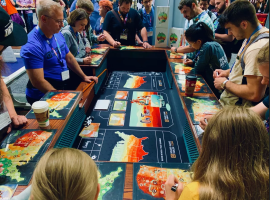
I enjoy On Tour’s solo mode, but the game plays better with multiple players. Like most roll-and-writes, players fill in their maps at the same time and this accommodates larger player counts. Playing with a full complement of eight players may only add ten or so gameplay minutes. Knowing the map helps make decisions easier. I don’t take long to fill in my map, but a new player would take a hot second to make their decision. But I wouldn’t say that knowing a map gives a player an unfair advantage. It’s an advantage but not a huge one. I’ve lost plenty of times to noobs. That may say more about my inability to play On Tour well.

The player boards are two-sided. One side depicts the United States, while the other is a map of Europe. New players should start with the United States. The regions are easier to spot (North, South, East, West, and Central). The straight boundaries of Colorado, Wyoming, and other mid-western and western states help.

I add a rules variant and allow players to chart their route as they fill in states (countries). You can always erase a route if you choose to go in a different direction. The end game (of figuring out which route you’ll take) can take almost as long as the game itself. Filling in a tentative route as you go shortens the time you need for final scoring. It also leads to table talk where someone undoubtedly says, “Well, I guess I’m cut off from Washington (or some other state).” Since you’re using a dry-erase marker, these tentative routes can be altered.

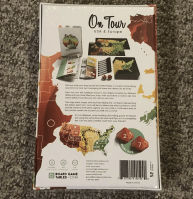
I often bring On Tour while on vacation. While On Tour is one of All Play’s standard box-size games, these boxes are still roughly 7 x 11 inches, making it easy to pack in a suitcase. And its price of $40 is nice. All Play games skew toward wider appeal (code for lighter games), but one can’t question the company’s quality of games and its commitment to cheaper price points.

Too Long, Didn’t Read

On Tour blends roll-and-write and flip-and-write mechanisms for a fresh take on both game mechanisms. While knowing one of the maps can help with making faster decisions, veteran players don’t gain too much of an advantage over newer players. The game plays well as a solo game but sings at large player counts. On Tour continues All Play games’ mission of making board games accessible to a wider audience.

Geekly News: March 30, 2025, Blade Movie Cancelled

Hey, hey! Kyra Kyle here. We’ll go lighter on Geekly News for the next few weeks. Protospiel Kansas City is next weekend. We’re keeping our fingers crossed that we don’t miss a News post.

MCU Cancels Blade Movie

On one hand, the MCU cancelling Blade comes as a surprise. A trusted insider announced a day prior that Blade had a new director, but then another trusted insider, World of Reel, made the announcement that Blade was nixed. No one has questioned World of Reel’s claim…yet. Blade has had the worst luck in the past few years. Actors have committed and then de-committed. The same goes for directors. And the script has been chopped up and rewritten so many times that it looks like someone tried to reconstruct a ream of paper from the confetti dumped on Times Square during New Year’s. In short, the MCU’s Blade was cursed.

I’m glad Marvel ended the failing production. Blade should return. He’s a popular character, and I’d like to see the MCU’s take on Blade. Rumors persist that Blade will appear in a team-up movie like Avengers: Doomsday or Midnight Sons. But if Blade were to get his own vehicle, perhaps Marvel could give him a Special on Disney+. Marvel hasn’t released a Special on the streaming platform since 2022’s Guardians of the Galaxy Christmas Special. I didn’t care for the Christmas Special; it played like the Star Wars Christmas Special. Yuck! But Marvel’s previous special, October 2022’s Werewolf By Night, was among the best productions in the MCU’s Phase Four.

Werewolf By Night saw even more success after it became part of 2023’s Huluween. This proves that the format works and has legs. An annual (or a series of annual) Marvel After Dark Special(s) could also work to organize the MCU’s release schedule. Spectacles get movie releases. Street-level heroes receive a TV series. Horror/macabre characters feature in Marvel Specials. Blade would fit in with Werewolf By Night, Man-Thing, and Elsa Bloodstone. We’ll see many of these characters (including Blade) in Midnight Sons, but I’d like to see more of Marvel’s darkest corners. Even though Blade won’t get a solo movie, and that’s disappointing, it could lead to something special.

Black Panther 3 to be Released February 2028

Ryan Coogler, director of the first two Black Panther films, said in an interview (with Shannon Sharpe and Chad Ochocinco) that Black Panther 3 is closer than movie-goers think. The MCU plans to introduce Prince T’Challa, Chadwick Boseman’s character’s son, in the upcoming movies. Avengers: Doomsday is a little soon, but Prince T’Challa could make an appearance in Avengers: Secret Wars.

Two Marvel comic book crossover series have been named “Secret Wars,” one in 1984 and another in 2015. The Russo brothers have stated that they will pull from both comics. T’Challa plays a pivotal role in the second “Secret Wars,” so it would make sense if Prince T’Challa is in play for that movie or both films: Doomsday and Secret Wars.

In a previous Geekly News post, we shared that Denzel Washington will feature in Black Panther 3. We mentioned a few characters Washington could portray. Here’s a quick recap. Achebe is a brilliant and unhinged adversary from the Black Panther comics. The First Black Panther Bashenga could explore Wakanda’s lore. Or perhaps he could play the Shadow King, a powerful telepathic mutant villain.

But (in that same interview with Sharpe and Ochocinco) Coogler teased that Washington could portray a role that could shake the entire MCU. He dropped a few hints, and internet sleuths have deduced that Coogler could be alluding to Denzel Washington playing Magneto. This wouldn’t be the first time that Wakanda went head-to-head with a leader who only wants what’s best for their people and may take drastic measures to protect them. 2022’s Black Panther: Wakanda Forever’s Namor strikes a similar chord. Washington would be a great choice for Magneto. Regardless of Washington’s role, we can’t wait for Black Panther 3.

Six Sojourns: An Eight-Minute Empire Game

Red Raven Games revisits one of their earliest designs, Eight-Minute Empire. Six Sojourns builds on the short area control game. The original game’s title is a misnomer. It takes about forty minutes to play Six Sojourns, not eight minutes, but forty minutes is a short game for the game type. Six Sojourns features tough choices, allows for creative strategies and tactics, and promotes high player interaction.

Ryan Laukat serves as the illustrator and game designer of Six Sojourns. He’s had board game hits like Above and Below, Near and Far, Sleeping Gods, and Now or Never. Six Sojourns showcases Laukat’s unique artwork. My favorite feature from Six Sojourns is its three double-sided maps: Red Rock Islands, Volcano, and Northern Seas. Six Sojourns is available now on Gamefound.

G.I. Joe: Operation Cobra

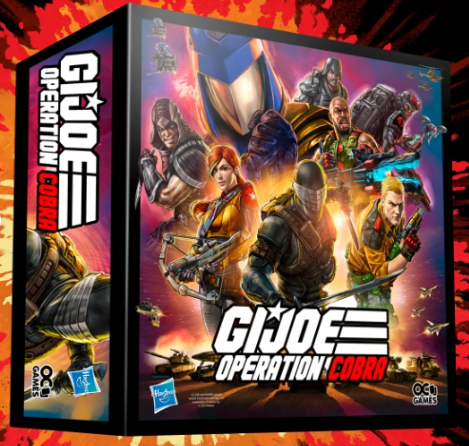
OC Games launched G.I. Joe: Operation Cobra this past week. The game features cooperative tactical action and has plenty of miniatures. OC Games was founded last year, so G.I. Joe: Operation Cobra is one of their first releases. The company focuses on adapting intellectual properties from the 80s and 90s into board games. I can’t speak to the quality of their games yet, but they did capture the look of G.I. Joe from the 80s.

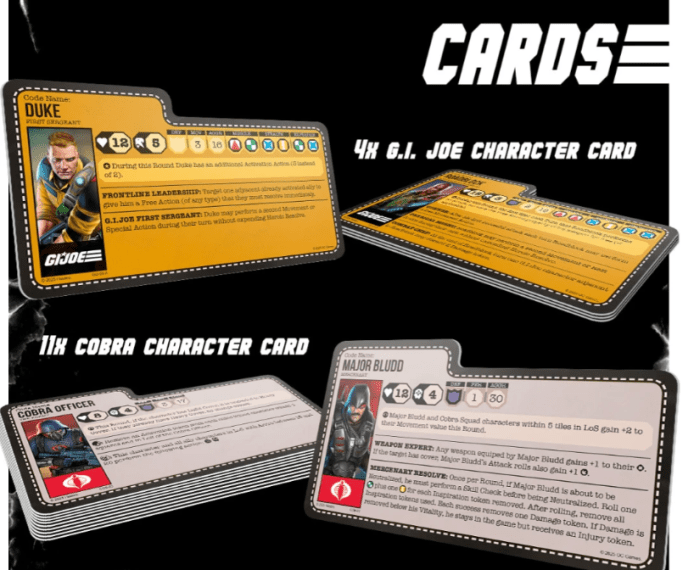
The character cards look like the cards one could cut out from the back of a G.I. Joe toy. OC Games has a knack for tapping into nostalgia. At one point, OC Games had posted G.I. Joe: Operation Cobra on Tabletop Simulator (TTS) so players could demo the game. OC Games’ website has loading issues, I’ll post their update on Gamefound for their Tabletop Simulator announcement. If you’d like to see the game’s pretty miniatures, check out the game’s page on Gamefound.

Funko Bitty Pop Arcade

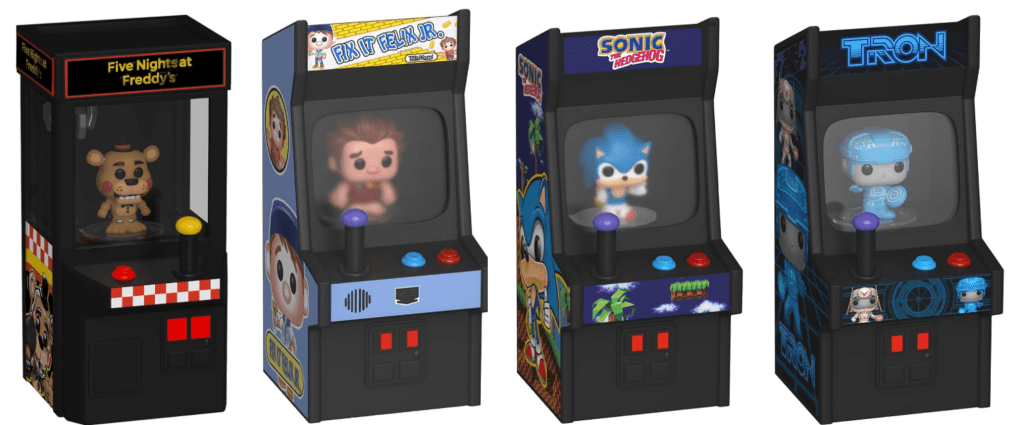
Funko Pop expands its number of collectible series with Funko Bitty Pop Arcade. Classic cabinet arcade systems inspire these collectibles. The first series of Funko Bitty Pop Arcade will include Wreck-It Ralph, Sonic the Hedgehog, Tron, and Five Nights at Freddy’s. The Five Nights at Freddy’s collectible is the oddball of the bunch as it resembles a claw machine. At $8 apiece, Funko Bitty Pop Arcades are a frugal way to start a collection. These items will be released in early July 2025, and you can pre-order them from Amazon.

That’s all the geek news we have for this week. Hopefully, we’ll have a news post next week. Until next time, thank you for reading, and wherever you are, I hope you’re having a great day.

Top 5 Members of Marvel Comics’ Illuminati

Hey, hey! Kyra Kyle here. The MCU introduced Marvel Comic’s Illuminati in Doctor Strange in the Multiverse of Madness. I don’t know if the Illuminati will continue in the MCU, but they’ve done a lot of work behind the scenes during major Marvel Comics crossovers. The Illuminati’s first appearance (New Avengers #7, July 2005) features each member of the group protecting one of the Infinity Gems. The Illuminati also factor into 2015’s Secret Wars. So, there’s a chance we’ll see more of them on the big screen. Who are the best characters from this group of Marvel Comic’s most powerful beings working in secret, shaping the superhuman world and protecting Earth from catastrophe?

But first, an honorable mention or two. I like Tony Stark/Iron Man a lot as a character. He’s also done a lot with the Illuminati, but he’s not the first name I think of when discussing the Illuminati, even though he’s a founding member. You’ll find another major exclusion on this list: Doctor Strange. His story may have introduced the Illuminati to the MCU, but I think the Illuminati works best when it’s composed of people who represent different demographics, kind of like a Marvel Comics version of the United Nations. And most of the Illuminati’s members fit this bill.

Let’s see who made the list.

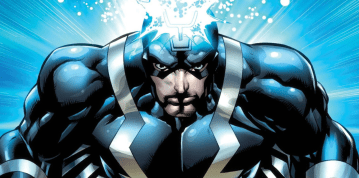
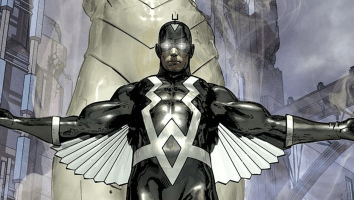
5: Black Bolt

The Inhumans occupy an important part of the Marvel Universe. They may have existed before humanity or at least they had a higher level of intelligence and awareness before humanity during Earth’s earliest history. This history also involved extraterrestrial and cosmic encounters. Enter Black Bolt. He’s the Inhumans’ current monarch and boasts incredible power. Black Bolt was born with a voice so strong that it can obliterate planets. Since this is the case, he seldom speaks, opting to have Medusa, another powerful Inhuman, speak on his behalf.

Fortunately, the Illuminati’s creator, Brian Michael Bendis, shared his reasoning for each of the original member’s inclusion. Here’s what Bendis has to say about Black Bolt (I’m paraphrasing to some extent):

“King of the Inhumans, who are an important part of Marvel history and play an important part in events that have not yet come to pass. He also represents a ruler/king archetype.”

The Inhumans television show didn’t fare well, but let’s hope the Inhumans will find new life in some other form. They’re too important to vanish from the MCU entirely.

4: Namor

Namor is yet another monarch. He rules the underwater nation of Atlantis and adds a different perspective for the Illuminati. The ocean claims more area than land on Earth, and Namor is its unquestioned ruler. He’s a member of another ancient civilization, one featured in Black Panther: Wakanda Forever, but missing from the Illuminati’s brief stint in Doctor Strange in the Multiverse of Madness. Like the Inhumans, I hope we get to see more of Namor in future MCU projects.

Let’s see why Bendis included Namor in the original Illuminati:

“Namor is the King of Atlantis and the Seven Oceans and represents the antihero mindset.”

He certainly does that. Namor is an ally to none. His only wish is to have his people’s voices heard. Namor served on Norman Osborn’s Cabal at the same time as his stint on the Illuminati. His role in the Illuminati mirrors his earlier team-up with the Invaders. The Invaders signaled Atlantis’s desire to be known to the outside world, the world of the land dwellers. The Invaders could be another group that could factor into the MCU’s future.

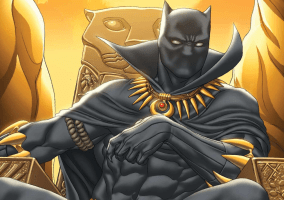
3: Black Panther

Black Panther is the only member of the Illuminati (on this list) who wasn’t in the original roster, but that wasn’t from lack of trying. Tony Stark recruited T’Challa to become an original member and the representative of Wakanda, but T’Challa turned Stark down. Black Panther would later join the Illuminati to face the Incursions.

Wakanda is one of the most prosperous nations on Earth and the main supplier of the world’s Vibranium. Black Panther is calm, fair, and reasonable while boasting no ego. In short, T’Challa differs from most members of the Illuminati. You can call Tony Stark, Mr. Fantastic, and Dr. Strange many things, but ego-less is not one of them.

T’Challa’s relationship with the others in the group can get strained because of the others’ lack of control. Black Panther isn’t easily manipulated. Again, Black Panther is another character I’d like to see more of in the MCU. If that includes a second incarnation of the Illuminati, so be it.

2: Professor X

Professor X needs no introduction. He’s the founder and leader of the X-Men and fights for equal rights for mutant-kind. Charles Xavier boasts a level of intellect and wisdom that’s rarely matched. His ability to read minds, while usually not used against members of the group, proves vital when obtaining intelligence. Because of his role as peacemaker and arbitrator, Professor X often takes a prominent leadership role in the Illuminati.

Eventually, future events in the comics prevent Xavier from participating in the Illuminati, which leads to the group’s gradual demise. Yeah. The comic book version of the Illuminati didn’t dissolve because an omega-powered mutant turned rogue and killed them all in a fit of rage. Spoilers for Doctor Strange in the Multiverse of Madness.

Let’s have Bendis weigh in on why he included Professor X in the Illuminati:

“Leader of the X-Men, Charles Xavier is in the group on behalf of the mutant community.”

Fair enough. And with mutants playing a larger role in the MCU going forward, Professor X’s inclusion in a second Illuminati could prove fruitful.

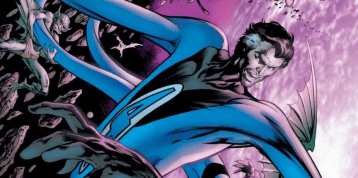
1: Mister Fantastic

Reed Richards (Mister Fantastic) is the one entry that doesn’t represent a group of people, a country, or both. Reed is only one of the smartest minds on the planet and the leader of the Fantastic Four. He has a long history in the Marvel Universe. Richards’s scientific capabilities are almost unmatched and his desire to see a better tomorrow makes him a prominent member within the Illuminati. He meshes well with Tony Stark, but the two can often butt heads because they can’t put aside their egos.

Reed even reasoned with Iron Man’s original proposition for the Illuminati as a “United Nations” of superheroes. Richards argued that the idea presented too many logistical and bureaucratic issues, but he also acknowledged the need for efficient information exchange between the world’s greatest minds. Mister Fantastic represents the scientific community of the Marvel Universe. He knows more about alternate realms and the cosmos than most, usually because he conducts reckless experiments and kicks a hornet’s nest or two. Annihilus wouldn’t know humans or Earth existed if Reed hadn’t bumbled into the Negative Zone. Thanks, Reed.

I can’t wait for the Fantastic Four to make their MCU debut. I wouldn’t mind more Mister Fantastic screen time. A second Illuminati could give us more FF goodness.

Which member of the Illuminati do you think should’ve made the list? Let us know in the comments. And wherever you are, I hope you’re having a great day.

Daredevil: Born Again, “Excessive Force” Review

Daredevil: Born Again’s second episode this week, “Excessive Force,” ties several loose ends, and Daredevil makes his triumphant return in costume. Hey, hey! Kyra Kyle here. I apologize for the delay this week. Everything ran smoothly with the family issue on Wednesday, so we’re back with more Daredevil: Born Again.

This week’s tandem of episodes had a similar feel to Daredevil: Born Again’s debut. If Disney+ had only released “With Interest,” fans may have been miffed (the first episode didn’t go far with the main storyline), but the streaming service dropped two episodes this week with “Excessive Force,” and I can see fans happier with the second offering. I enjoyed “Excessive Force.” As I said in the intro, it ties up several loose ends. That’s always appreciated. Wilson Fisk and Matt Murdock’s journey to find their true selves, their inner Kingpin and Daredevil, mirrors each other’s journey.

The inevitable fight sequence at the end has choreography that harkens to the original Daredevil Netflix series. Kingpin unleashes his baser instincts on Adam, the man with whom Fisk’s wife, Vanessa, cheated on him, while Daredevil rescues Angela Del Toro, Hector Ayala’s (White Tiger’s) niece, from Muse. Both scenes are earned. Earlier in “Excessive Force,” Vanessa and Wilson have an exchange that suggests Kingpin has Vanessa’s okay to revert to his mob boss ways, while Del Toro approached Murdock for help, letting him know where her uncle thinks a serial killer (Muse) is hiding, and Murdock has the idea to “f*** it” and rescue Del Toro himself as Daredevil. Since the police killed her uncle, Del Toro doesn’t trust the police.

I liked that Daredevil: Born Again brought back Angela Del Toro. In the comics, Del Toro dons her uncle’s White Tiger costume, and there’s a chance that Camila Rodriguez (who portrays Del Toro) could do the same. Del Toro does a good job of giving Murdock the kick he needs in the hindside. Running parallel to Del Toro’s mistrust of the police is that Fisk runs the police, and he’s formed a task force of dirty cops to find Muse. As I said, plenty of loose ends. Hamish Allan-Headley’s Officer Powell joins the newly formed task force. Powell has been one of the better side characters introduced in Daredevil: Born Again, but that’s because he’s had a handful of pivotal scenes. And that’s where Daredevil: Born Again has had issues.

Matt’s love interest (Heather Glenn) asks him if he knows any vigilantes he could introduce her to for a book she plans to write about vigilantes. While this could’ve worked, it came out of nowhere. We’ve met Heather Glenn more often than Officer Powell, and this is the first we’ve heard of this intention. Officer Powell’s motives are better developed. Angela Del Toro approaching Matt Murdock to help stop Muse makes sense (her character is well developed despite this episode being her second appearance), but Cherry (Matt’s ex-cop friend/employee) serves little more than a plot device when he warns Murdock against fighting Muse as Daredevil. We know next to nothing about Cherry. Even though he’s physically been in the series three times as much as Del Toro, I forgot he existed.

I mentioned the vlogger vignettes in a previous review. The shaky-cam on the street works better in a Spider-Man property. It’s out of place in Daredevil: Born Again, but further than that, it doesn’t do enough to show New York’s citizens. I don’t know if the audience should know who the vlogger is and follows them as another character (perhaps a friend of Murdock’s) or if the vlogger could attempt to interview Mayor Fisk, which could serve double-duty as a scene transition, or omit those scenes and show Murdock serve more citizens (than the one Fiddle Faddle thief) as a lawyer. Personally, I’d choose the latter. Showing Murdock trying to fix NYC’s issues as a lawyer, but needing to do more, would further the idea that the city needs Daredevil.

Those couple of sticky points aside, Daredevil: Born Again is a great Marvel show. “Excessive Force” saw the return of Tony Dalton’s Jack Duquesne/Swordsman. He’s an underused superhero (last seen in 2021’s Hawkeye as Kate Bishop’s wealthy stepfather), and I’m glad he gets another chance to shine. Thank you, MetalAusten (on BlueSky), for straightening out Geekly’s misunderstanding of Daredevil: Born Again’s schedule. The show WILL return next week, and we can’t wait. Thank you for reading, and wherever you are, I hope you’re having a great day.

Daredevil: Born Again, “With Interest” Review

Brief schedule alert: Geekly will cover the first of the Daredevil: Born Again two-episode finale today and the second episode on Friday. Kyra, who covers Daredevil: Born Again, has a family issue on Wednesday morning and will need another day or two to cover the second episode. With that said, let’s discuss the first of Daredevil: Born Again’s finale, “With Interest.”

Hey, hey! Kyra Kyle here. Daredevil: Born Again nears the close of its first season break. I’m still unsure how the program plans to continue after this. The last I heard, Daredevil: Born Again will have another four or six episodes next year, hopefully near the beginning of next year. Will this be the second half of season one? Since there’s a year gap in release, wouldn’t that make those next four or six episodes season two? Anyway, “With Interest” serves as a divergence if you’re charitable. It’s a filler episode if you’re less charitable. I lean more towards the former, but I was left wanting. “With Interest” shows Matt Murdock continuing down the crime-fighter path, and weaves his story into the greater MCU, and it’s the weaving of Daredevil: Born Again into the greater MCU that chafes.

Yusuf Khan, Kamala Khan’s (Ms. Marvel’s) father, makes a guest appearance in “With Interest.” This episode’s story revolves around Khan and the bank where he works. Bank robbers begin a heist immediately after Khan denies Murdock a loan for Murdock & McDuffie (Matt’s new law firm). Convenient. Before then, Khan talks about his daughter Kamala, Jersey City, and Jersey City’s own superhero Ms. Marvel. He spills the tea about what Kamala is up to (visiting friends in California, which could be Kamala recruiting Kate Bishop in San Francisco), and I half-expected him to brag that his daughter and Ms. Marvel were one and the same when he dug out his Ms. Marvel Funko Pop.

Matt chuckles at Khan’s antics. He gives him an annoyed chuckle that mirrors my own. Don’t get me wrong. I like Mohan Japur’s portrayal of Yusuf. He does a good job of conveying a doting father. My issue is with Khan’s inclusion. It felt forced. While a solidly written, acted, and directed episode, “With Interest” isn’t needed. One could’ve omitted “With Interest,” and season one of Daredevil: Born Again would’ve remained the same. It felt like a bottle episode that didn’t need to happen. I felt the showrunner marking time for the final episode.

The only two things I can say that “With Interest” adds to this season’s story are that Murdock’s law firm matches his (eventual) crimefighting, and Daredevil: Born Again exists within the MCU. Thank you for making it abundantly clear that Daredevil: Born Again exists within the MCU. Other nods occurred earlier this season to suggest that, but perhaps some viewers in the back row needed to be force-fed that information. As Yusuf says in this episode, Murdock takes on a lot of cases that don’t make enough money to sustain his business. That reinforces the idea that Matt does things because they’re the right things to do, kind of like his crimefighting. From a storytelling standpoint, the latter has more merit.

But I could’ve seen this played out in a smaller or different scene. I know it sounds like I didn’t care for “With Interest.” The opposite is true. Taken by itself, “With Interest” is a fun romp. Matt Murdock thwarts a group of bank robbers and saves the hostages within the bank. There may be something I didn’t catch with the bank robbers themselves. The one who orchestrated the heist gets away. I hope she plays a bigger role later. My opinion of “With Interest” could change slightly if that’s the case. But until that happens, I’m viewing “With Interest” as a fun diversion before the main meal.

That main meal will have to wait. I won’t be reviewing the second episode of Daredevil: Born Again’s finale until Friday, March 28th. Until then, feed me some fake or real spoilers for the final episode. Thank you for reading, and wherever you are, I hope you’re having a great day.

Tabletop Game Review: Comic Hunters

Comic Hunters casts players as comic book collectors trying to collect the most impressive comic book collection over a single weekend. Comic Hunters also marks the first of several games I picked up over Christmas. I’ve had enough time to play these games for a review so be on the lookout for more games I picked up over the holidays.

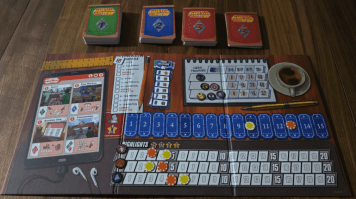
Hey, hey! Kyra Kyle here. We’re taking a break from playing as superheroes to collecting the works in which they appear. Comic Hunters has an intriguing premise. It also features a heap of iconic Marvel comic book covers. I can’t want to get into the review, but before we get any further, let’s look at Comic Hunters’ fine print.
The Fiddly Bits

Designer: Robert Coelho
Publisher: Arcane Wonders and Spin Master Ltd.
Date Released: 2020
Number of Players: 1-4
Age Range: 10 and up
Setup Time: 5-10 minutes
Play Time: 45 minutes

Game Mechanisms

Auction: Turn Order Until Pass
Closed Drafting
Hand Management
Open Drafting
Set Collection

Game Setup

Comic Hunters has special setup rules for games with fewer than four players. It even has a solo game variant. These rules aren’t too difficult (mostly removing cards and other bits from play that relate to the removed cards). We won’t include those special rules here. We’ll continue the game setup section as if you’re playing with four players.

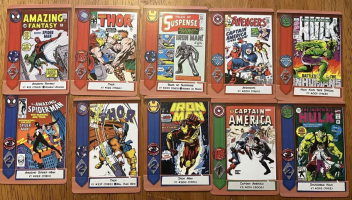
Comic Hunters has three card types that represent different comic book eras: level 1 (2000-present), level 2 (1980s and 1990s), and level 3 (1960s and 1970s). Each of these card types (with unique card backings) also represents locations: level 1 (comic book stores), level 2 (flea markets), and level 3 (auction websites). Shuffle each one of these three decks separately. Without looking at the cards, take ten cards from each of these decks to make a fourth deck. Shuffle this fourth deck. This will be the convention deck.

Place the checkmark token in the first Schedule box of the first round. You will play rounds according to the Schedule.
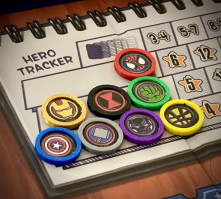
Assemble and organize the 8 Hero Tokens on the Hero Tracker Table. In a 4-player game, draw and place 1 Hero token for the first row, 3 Hero Tokens for the second row, and 4 Hero Tokens for the third row. The value of these heroes’ comic books will vary with the top row being the most valuable and the bottom the least valuable.

Each player takes their Player Token of their chosen color and places it on the “15” space of the Secret Stash track. This will be your money with which to buy lots during auctions. Any of your remaining stash becomes victory points at the end of the game.
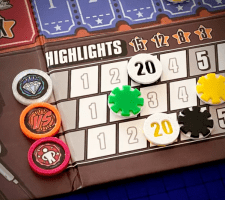
Next, setup the Highlights section. Draw one of the Highlight Tokens and place it on the leftmost space of the top row. Do the same for the next two rows. Each of these Highlight Tokens denotes something special about a comic book. They can be a character’s first appearance, the first issue of a series, an epic battle, a new look (for a character), or a special edition. Players will score points depending on who has the most comic books that match the in-play highlights. Since there are five tokens and you’ll only play with three Highlight tokens, scoring changes from game to game.

Finally, hand one player the First-Player Token. The rules suggest that the player who’s last seen a Marvel Movie or read a Marvel Comic should go first, but you can choose the first player randomly.

Game Flow

Comic Hunters is divided into 3 rounds. Each round has 2 stages: Treasure Hunting and Assemble Your Collections. During the Treasure Hunting stage, players will visit 3 of the 4 possible locations to acquire comic book cards. All you must do is follow the rules of the location indicated by the schedule. Once the first location is played move the schedule to the next location. Each location plays differently from the next.

Treasure Hunting

Comic Book Store

The comic book store plays with classic closed drafting rules (like Sushi Go). Players get dealt four cards from the level 1 deck. They select one card and pass the cards they didn’t choose to the player to their left. This continues until there are no more cards left to pass.

Flea Market

In this location, players take turns, clockwise, starting with the player holding the “First-Player” token. To set up the Flea Market, make a column from the level 2 deck equal to the number of players. Reveal a card from the level 2 deck to place in the first position of each Row. When it’s your turn, you must perform one of two possible actions: reveal a card from the deck and place it to the right of the rightmost, available space in one of the rows, or pick up all the cards from one Row of your choice. Rows can have up to four cards.

Auction Website

To set up the auction website, lay out four rows of the level 3 cards. The first row must contain 5 cards. The last row must contain 3 cards. The middle two rows contain 4 cards. These rows are Lots up for auction. The player with the First Player Token selects which Lot to bid during the round. They open the bidding with at least 1 (of their secret stash). The auction website plays like a traditional “bid or pass auction.” On their turn, a player either bids higher than the current bid or passes (and they’re out for the rest of the auction). Highest bid wins. Whenever one lot remains, the player who hasn’t obtained a lot gains the last lot. They must spend three of their secret stash if they can.

Convention

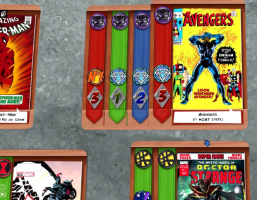
To set up the Convention, take 24 cards from the top of the Convention deck and arrange them into a grid with 5 columns and 5 rows, leaving the center position empty. Starting with the first player and then going clockwise, each player will take turns doing the following in order: slide one card left, right, up, or down in the grid, moving it through the empty spaces to a new position, and then select all the cards in a column or row that contain the same hero you name. So, you could select all the Spider-Man comics in a row or all the Black Panther comics in a column and so forth. Each player will have two opportunities to perform this action. The catch is that the player who selects last will select twice in a row and the second selection will occur in reverse turn order.
Assemble Your Collections

In this selection, player put cards from their hands down on the table, starting comic book collections for a specific hero or adding comic book cards to existing collections. Player will pay the market value for each card (1 for level 1 cards, 2 for level 2 cards, etc.) with an equal number of cards of that same value. So, you could pay for 3 level 1 cards by discarding 1 level 3 cards. Any cards that you discard or choose not to buy will be added and then shuffled into the Convention deck. Cards in your hand do not carry over to the next round, only cards in collections remain.

Final Scoring

After the final “Assemble Your Collections” action on the schedule, players score their collections. There are several ways to score: collection size (and value of specific heroes), varied collections (collections of different heroes), highlights, and secret stash. I won’t go into detail for each of these here, but there are plenty of ways to score a bucket of points. The person with the most buckets of points wins.

Review

Comic Hunters uses a lot of ways to accrue cards and just as many ways to score those cards after you obtain them. For the most part, the various locations work well enough to simulate the experience of their locations. An auction mechanism is a no-brainer for an auction website. The flea market feels right. And comic book conventions can be the wild, wild west when it comes to what kind of comics are on offer. So, the random comic book cards found during the Convention phases track. I enjoy all of that, but it comes at a cost. The various ways of acquiring cards can get clunky.

I struggle to shift from one mode to the next. While I like the variety, I focused means of acquiring cards could’ve worked better. I would’ve gotten into a better flow state faster with Comic Hunters. These various means with which to obtain cards also made setup and explaining the rules more difficult. Each ruleset is easy enough to explain, but the best way I found for teaching the game was giving a quick rules explanation before each location like I’m the “about the game” page before a Mario Party minigame. And these disparate mechanisms made Comic Hunters feel like a collection of minigames instead of a cohesive experience.

You may have gathered by how I explained the rules above, but the comic book store and auction website locations are lackluster. I like them from the standpoint that I could point to other games that use those same mechanisms, but those mechanisms are old hat. The flea market and convention locations are a lot more interesting and fun. I would’ve loved to play those two locations multiple times (lowering the number of minigames from four to two). I also like the idea that you must spend card values to play cards into a collection. This was a clever touch and lowers the number of bits needed. Despite any of its shortcomings, I enjoyed Comic Hunters. When it tries new things, those new things are fun.

But I can’t move to the verdict without mentioning the quality, or lack of quality, of Comic Hunters’ components. I’ve seen board game manufacturers’ sample products, and most of these companies don’t offer punch board as thin as the tokens found in Comic Hunters. Furthermore, the cards are off-center so you can see the white space between cards, and they slant at odd angles. The card material feels cheap. I don’t usually care about component quality, I’ve played my fair share of prototypes with ripped pieces of paper as chits, but I was shocked by the shoddiness of Comic Hunters’ production value.
Too Long; Didn’t Read

Comic Hunters has a fun premise and contains some interesting game mechanisms. Unfortunately, the game also deploys some tired game mechanisms that feel clunky, and the production value leaves much to be desired. Still, its low price point ($20-$25) means that Comic Hunters packs a lot of game per penny.