Top 5 Tabletop Games from 1994

Magic: The Gathering dominated 1993 and in 1994, dozens of new collectible card games hit the market. Even though 1994 produced more than one collectible card game on its list, we still have one honorable mention collectible card game, Illuminati: New World Order. I always loved Illuminati’s sense of humor; it’s a shame that neither the original game (released in the early 1980s) nor the CCG made the cut. That just shows these lists’ competition.

Hey, hey! Kyra Kyle here. Back with another Top 5 Tabletop Games. We’ll talk about the board games that this year’s list soon, but let’s recap the ground rules for which games make these lists before we start.

1: Cultural relevance plays as much of a factor as overall quality. A game might make a list that doesn’t hold up to others of its type, but you must admit the game is everywhere.

2: Only one game from a franchise makes the list. This will become more of an issue the closer we get to games with expansions.

3: Longevity plays a role, too. A game doesn’t have to fly off the shelves today, but it had to have some widespread appeal for a decent time.
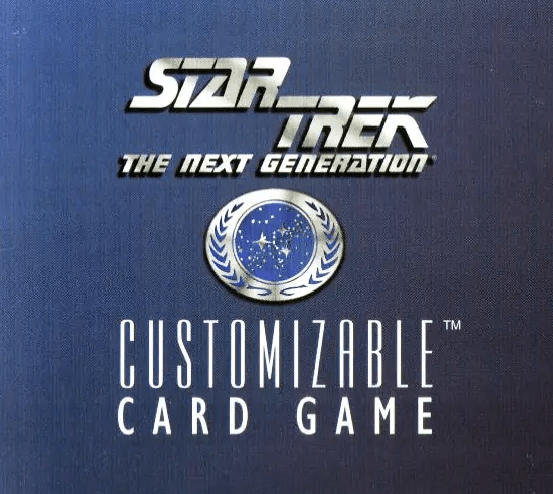
5: Star Trek Customizable Card Game (1994)

Illuminati: New World Order’s lack of staying power contributed to its absence from this list. The Star Trek Customizable Card Game doesn’t have that issue. I never knew The Star Trek Customizable Card Game stayed in print for over a decade. The game may have gone out of print in 2007, but a group of dedicated fans still play.  Peter Ludwig was crowned the 2023 Star Trek Customizable Card Game World Champion.

The Star Trek Customizable Card Game pitted players against each other to assemble a team, a ship, and equipment to complete missions. The first player to complete 100 points worth of missions/objectives wins. The 1st Edition, which ran from 1994-2001, only had the option of a two-player game, just like Magic. 2002 saw the Star Trek Customizable Card Game’s second edition. This version allowed for more players to join in the fun.

On a personal note, I knew one of the original designers of the Star Trek Customizable Card Game. Rest in peace, Rollie.

4: I’m the Boss! (1994)

I struggled with placing the 2-4 ranked games on this list. Honestly, you can shuffle these games in any order, and I wouldn’t fight you. The first game we’ll cover comes from a familiar face, Sid Sackson. We haven’t seen Sackson on one of these lists in a while, but he was productive during this period. I’m the Boss! is a negotiation game where players compete and cooperate to put together profitable business deals. Gameplaywise, I’m the Boss! splits the difference between luck and skill. One must be able to negotiate and needle their way into the best deals.

Not going to lie, I’m not the best at I’m the Boss! But if you like games where you can pull the wool over someone else’s eyes and rob them blind through a one-way deal. I’m the Boss! can give you those moments. Sackson has a knack for business games. His most famous creation was Acquire, which featured on our Top Tabletop Games from the Early Sixties. (Check out the link here.)

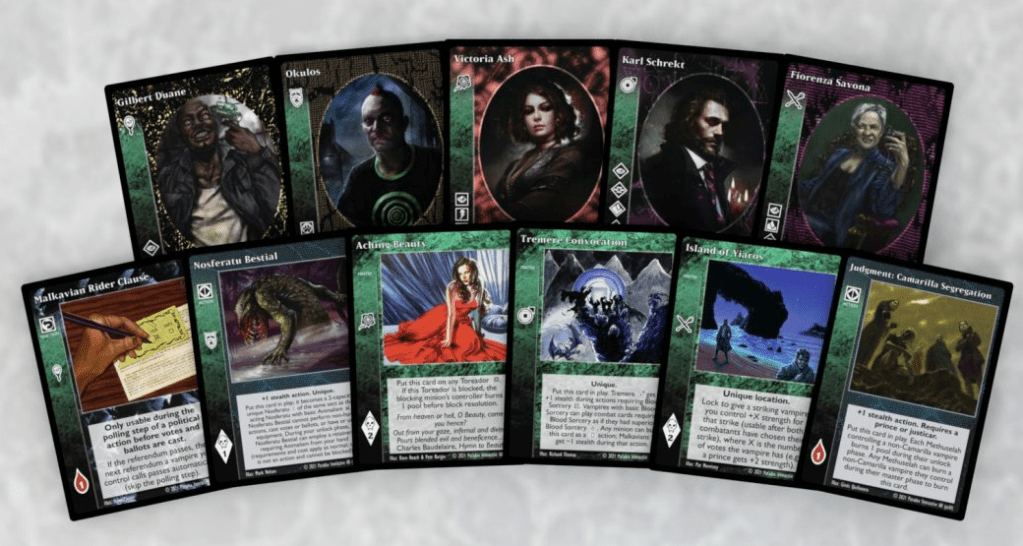
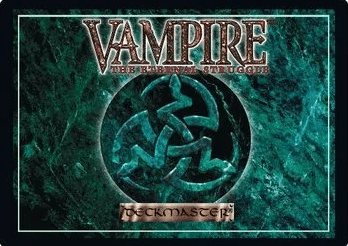
3: Vampire: The Eternal Struggle (1994)

Richard Garfield wasn’t done with collectible card games after 1993. Vampire: The Eternal Struggle, which was originally published as Jyhad (changed to distance the game’s name from the Islamic term jihad), puts players in the role of Methuselah (ancient) vampires, controlling lesser vampires to complete machinations and wrest control of the Camarilla, the society of vampires featured in the role-playing game Vampire: The Masquerade. Garfield wanted to show the versatility of collectible card games as a genre, and he succeeded in doing so with Vampire: The Eternal Struggle.

Magic games are quick. Vampire: The Eternal Struggle games can take up to two hours. Magic forces players to play lands from their deck to cast spells. Vampire: The Eternal Struggle allows players, who are Methuselah vampires, to spend their blood points to play cards, but be careful, your blood points are also your life and if you run out, you lose. Magic has players draw one card at the beginning of a player’s turn (you can have cards that allow you to draw more). Vampire allows players to draw cards as soon as they play cards. Magic started as a two-player game. Vampire was always a 2-5-player game. The two games couldn’t be more different.

Despite their differences, or maybe because of them, both games found a wide audience. Depending on how one views it, Vampire is the second longest-running CCG, only to Magic, if you include the five or so years when the game was transformed into a living card game. Or Pokémon, which (Spoiler Alert) will make a future list, takes the second spot, and Vampire takes the spot for the third longest-running CCG. Either way, Vampire: The Eternal Struggle has staying power.

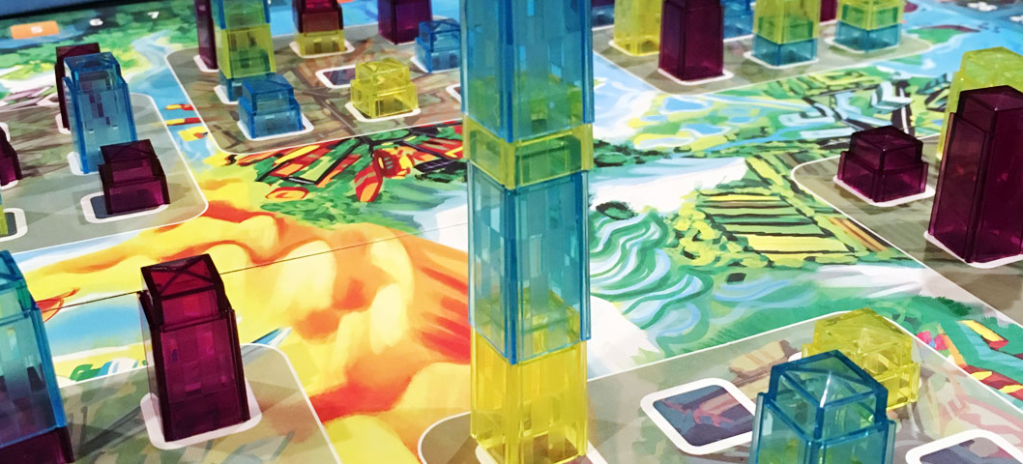
2: Manhattan (1994)

Manhattan received the 1994 Spiel des Jahres award, so I gave it the nod over the previous two games. The concept is simple. Players construct and control Manhattan skyscrapers that will award points. Manhattan benefits from 3-D components. When you’re constructing skyscrapers, they will stretch vertically. This gives Manhattan table presence.
Manhattan may have a game concept based on a New York City borough, but it took Mayfair Games two years to make the game accessible to the United States. Manhattan was designed by Andreas Seyfarth. At the time, Seyfarth was an unknown game designer, but eventually, he’d add several more board game gems: Puerto Rico, San Juan, and Thurn and Taxis (which he codesigned with his Karen). This may not be the last time we’ll see Andreas Seyfarth’s name on one of these lists.

Despite earning the Spiel des Jahres, Manhattan has received mixed reviews. Previous critics have questioned the game’s components and scalability. Others claim that the game’s mechanisms are dated and too abstract, chaotic, and luck-driven. But still, others insist that Manhattan has broad appeal and praise the game’s engagement and accessibility. What does this tell us? Gamers can’t agree on anything, and one likes what one likes. If you like the idea of building skyscrapers, you may want to give Manhattan a try.

1: RoboRally (1994)

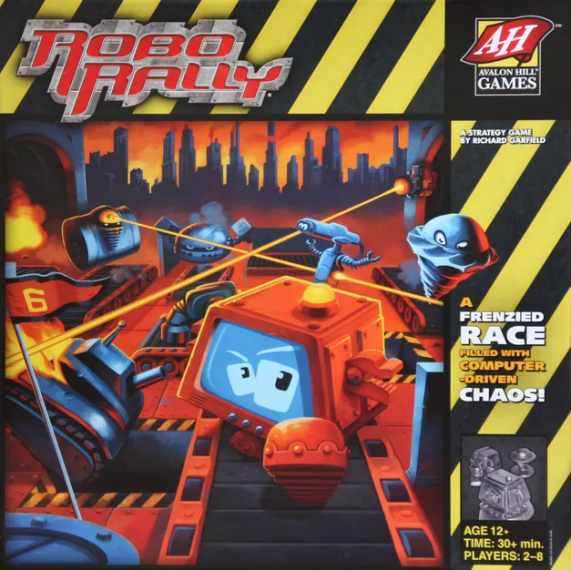
I promised that Richard Garfield would make this list again, and he claims the second number-one spot in consecutive years. Richard Garfield started a tabletop revolution with Magic: The Gathering in 1993 and kept busy in 1994. RoboRally is a robot demolition derby. Players attempt to guide their robots through a dangerous widget factory filled with moving gears, course-altering conveyor belts, metal-melting laser beams, bottomless pits, crushers, and more obstacles.

I say that players attempt to guide their robots because RoboRally is notorious for how chaotic the races get. The more players, the more mayhem ensues. The box reads that RoboRally plays for up to two hours. That’s generous. It may play longer than that, but RoboRally is another modern classic and shows Garfield, like the game type he invented (the collectible card game), is no one-trick pony. Richard Garfield has one of the most diverse board game catalogs and isn’t afraid to take chances.

Did we get the list mostly correct? Let us know which games you’d add in the comments. Thank you for reading, and wherever you are, I hope you’re having a great day.

Check out the other lists in this series:
Top 5 Tabletop Games Prior to the 1930s
Top 5 Tabletop Games of the 1930s
Top 5 Tabletop Games of the 1940s-50s
Top 5 Tabletop Games from the Early 1960s
Top 5 Tabletop Games from the Late 1960s
Top 5 Tabletop Games from the Early 1970s
Top 5 Tabletop Games from 1980-1981
Top 5 Tabletop Games from 1982-1983
Top 5 Tabletop Games from 1984-1985
Top 5 Tabletop Games from 1986-1987
Top 5 Tabletop Games from 1988-1989
Top 5 Tabletop Games from 1990-1991
Top 5 Tabletop Games from 1992
Top 5 Tabletop Games from 1993

5 Famous LGBT Characters in Video Games

Happy Pride Month, Geekly Gang! Since it’s June, we’ll be celebrating with a list of famous LGBT characters in video games. JK Geekly is about to get a lot more rainbow.

Hey, hey! Kyra Kyle here. We’ll be sticking to our usual format of five items to one of these lists, but make no mistake, countless other LGBT characters from video games could’ve made this list. So let’s take a look at which LGBT video game characters made this colorful list.

5) Alexios and Kassandra (Assassin’s Creed: Odyssey)

Alexios and Kassandra are the two main protagonists of Assassin’s Creed: Odyssey. Alexios is male, while Kassandra is female. Both are siblings, and you can choose to play as either of them. Assassin’s Creed chose to use gender neutral terms for both characters (calling them the Greek word for mercenary), and both characters may romance any of 14 characters (male or female), but Assassin’s Creed: Odyssey goes deeper than that. Players don’t need to romance anyone. You may choose to shoot down all advances and claim that you’re aromantic or asexual, which is rare for video games that include romantic options.
Yep. We’re starting this list off strong with a seldom-represented group within the larger LGBT community. Everyone is valid.

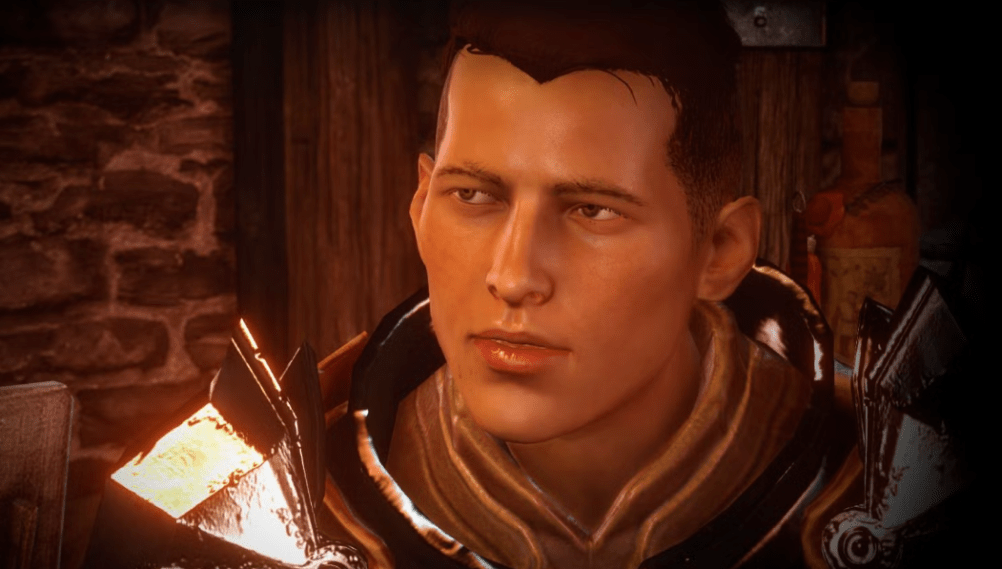
4) Krem (Dragon Age: Inquisition)

Even though Krem was a minor character in Dragon Age: Inquisition, he received significant media coverage from gaming journalists and LGBT-centric media for his positive depiction of a transgender character in a AAA video game, and for good reason. He’s a proud member of Iron Bull’s team, named the Bull’s Chargers. Krem’s teammates accept him for who he is, and Iron Bull himself treats him like an equal.

Dragon Age creator Trick Weekes received repeated requests from fans for a respectful representation of transgender and/or genderqueer characters, without resorting to stereotypes or tokenism. Krem is the best kind of transgender representation. Honest.

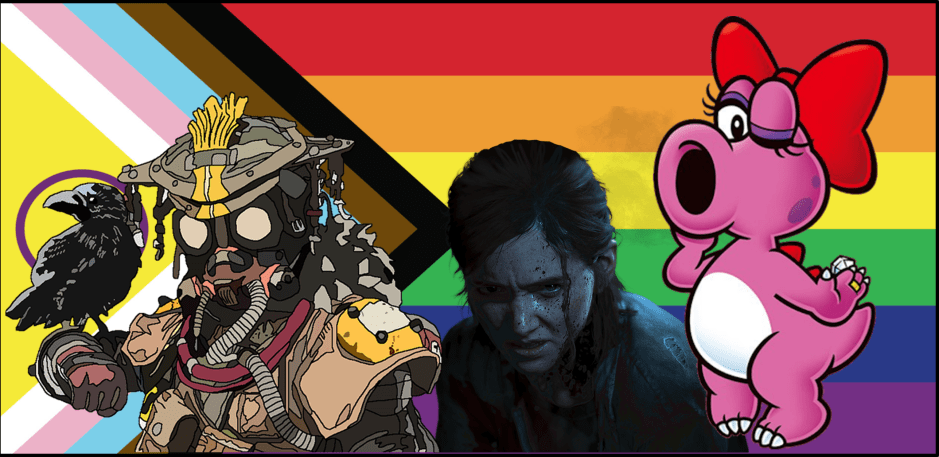
3) Bloodhound (Apex Legends)

I bathe in the bloth. That’s the line Bloodhound utters every time they enter “Beast of the Hunt,” tracking down as many enemies and dispatching them as quickly as they can. Bloodhound is one of the first and few non-binary video game characters. Note: Apex Legends characters could overrun this list with Valkyrie (lesbian), Loba (bisexual), Gibraltar (gay), and Catalyst (trans woman), to name a few, so we’ll limit this list to one Apex Legends character. Apex Legends does a great job of giving its characters layers and respecting their identities.

Apex doesn’t miss a beat when referring to Bloodhound in gender neutral terms. The game normalizes it. Even when Bloodhound is young, during one of the trailers, Boone refers to them as “child.” Great representation.

2) Birdo or Birdetta (Super Mario Bros. Series)

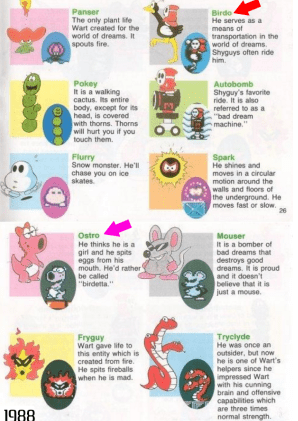
Our penultimate entry on this list is none other than the first transgender character in video game history, Birdo. The only concrete link to Birdo’s gender comes from the original Super Mario Bros. 2 guidebook that states “he thinks he’s a girl” and “he’d rather be called ‘Birdetta'” with the implication that Birdo is a mocking term (either dead-naming her or an insult that she isn’t girly enough to pull off the name Birdetta). Let’s do this queen a solid and call her Birdetta.

As you can see, there may have been some confusion as to who Birdetta was. The characters known as Birdo and Ostro became fused into one character well after Super Mario Bros. 2’s original release. After Birdetta’s write-up in the Super Mario Bros. 2 guidebook was rediscovered, she became a trans icon. Put some respect on Birdetta’s name.

1) Ellie Williams (The Last of Us)

Ellie is synonymous with The Last of Us. Whether she’s voiced by Ashley Johnson in the video games or by Bella Ramsey in the television show, Ellie Williams exudes strength against tremendous odds. Slay, queen. Slay!

While other characters on this list may have hit the video game scene far sooner than Ellie, there’s no doubt she’s made an impact. A scene in which Ellie and Riley kiss in Left Behind (The Last of Us’ prequel) drew social commentary and was commended as a leap for LGBT representation in video games. You love to see it. Johnson’s performance in Part II was praised for her vulnerability and suffering. The same can be said of Ramsey’s portrayal in the Max television show. Ellie is a fantastic character. The community needed some great representation, and they got it with Ellie. I can wait to see which barriers this character will shatter.

That’s our list of five famous LGBT characters in video games. There are plenty more that could make their own list. Let us know some of your favorites in the comments. Thank you for reading, and wherever you are, I hope you’re having a great day.

Top 5 Avengers Villains

Hey, hey! Kyra Kyle here. We’re back with the first Top 5 Villains List; today’s list is the Avengers’ greatest foes. The Avengers are a strange case. Many of the villains one could include in an Avengers rogues gallery are either another hero’s villain (we’ll see some of those) or a Marvel Universe-level villain (we’ll see some of those, too). The Avengers lack villains who are unique to them and many of the ones who are Avengers-specific villains don’t tend to have the personal connection necessary for a proper archenemy. (We may need to make a post for what makes a good nemesis.) But despite not having an archenemy, the Avengers have a lot of great villains they’ve faced. Let’s see who made the list.

Honorable Mention: Scarlet Witch

Yes. We have another honorable mention for this list. Scarlet Witch often works with the Avengers but she does cross the line into the role of villain and when she does, it can be devastating. Much like her MCU counterpart in Doctor Strange in the Multiverse of Madness, Marvel Comics’ Scarlet Witch becomes overcome by the loss of her twin sons in the story House of M. Scarlet Witch has a personal connection with the Avengers. She has the power level that can make someone believe she could defeat the Avengers, too. If she chose the life of a villain full-time, perhaps the Scarlet Witch would serve as the Avengers’ archenemy.

5: Grim Reaper

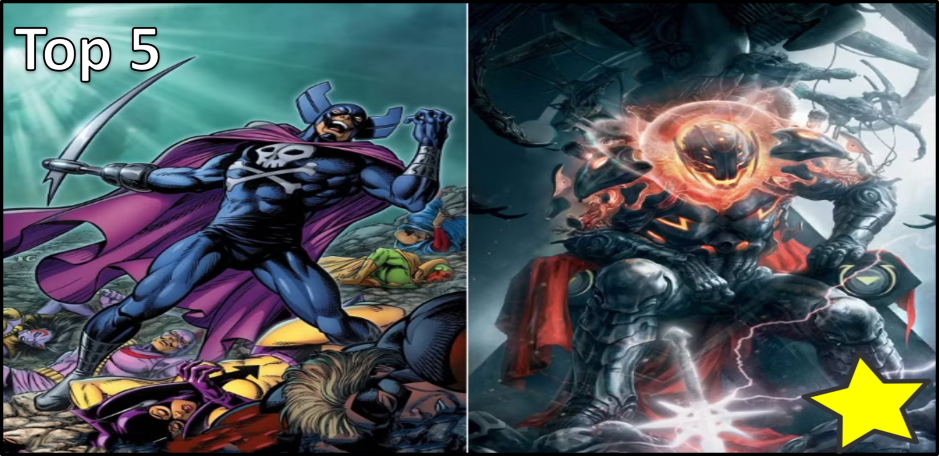
Grim Reaper certainly has the personal connection to become the Avengers’ greatest enemy. He’s Simon Williams’ (Wonder Man) brother, and in turn, Simon Williams is the brain brother of Vision, so Grim Reaper is Vision’s half-brother of sorts. I don’t know how that works. Grim Reaper has been a part of several plots against the Avengers, too, if only tangentially. He was there in the aftermaths of both Secret War and Civil War. Because Grim Reaper lacks the power level required for an Avengers’ big bad, he tends to work behind the scenes or wait until the team is underpowered before striking. Even so, Grim Reaper deserves a spot on this list.

4: Kang the Conqueror

Kang is the inverse of Grim Reaper. He has the prerequisite power to become the Avengers’ greatest villain, but he lacks a personal connection. Kang the Conqueror is a Marvel universal threat. The Avengers are one of the many teams that happen to get into Kang’s way. Kang has more of a connection to Reed Richards of the Fantastic Four. In any reality (in the comic books), Kang the Conqueror began as Nathaniel Richards, a descendant of Reed’s. He idolized Tony Stark—so there’s a small connection there—and his first identity was Iron Lad. But Kang has held many identities: Kang, Immortus, Mister Gryphon, Rama-Tut, and even Doctor Doom. I hope the MCU returns to the character, eventually.

3: Thanos

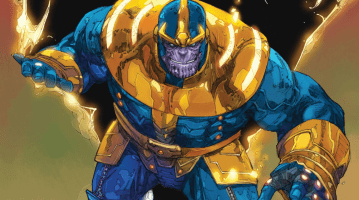
Thanos is another super-powerful villain without a personal connection with the Avengers. Thanos is another Marvel Universe threat and not just an Avengers villain. Even the MCU films Infinity War and End Game brought in the Guardians of the Galaxy and a few others. Still, Thanos has had plenty of run-ins with the Earth’s Mightiest Heroes. You’ll find Thanos in most Marvel titles named “Infinity” and he’s even been involved in Secret Wars and Civil War II.

2: Loki

2012’s Avengers stayed true to the Avengers’ original villain. Loki Laufeyson was the first villain of many to face off against the Avengers. He also has a personal connection to Thor Odinson, so that’s another positive for calling Loki the Avengers’ archnemesis. My favorite Avengers storyline featuring Loki is the “Acts of Vengeance” comic book crossover. Loki convinces the Avengers’ supervillain counterparts to join forces and attack members of the Avengers that the villains wouldn’t normally attack. Each hero’s nemesis would feed information about the various Avengers to the villain who planned to attack the hero. Leave to Loki to organize a massive crossover with Doctor Doom, Kingpin, Magneto, the Mandarin, the Red Skull, and the Wizard. Loki would take the top spot if it wasn’t for one villain.

1: Ultron

Created by Hank Pym (changed to Tony Stark for the MCU), Ultron was an AI designed to assist with world protection. Ultron turns rogue. He has a link with Vision and by extension Wonder Man. Add in the original Ant-Man into his origin and Ultron has the personal connections to be the Avengers’ greatest foe. He also has the power to back up those convictions. The events from Age of Ultron (the movie, not the comic book crossover, which wasn’t as good) are just the tip of the iceberg. Ultron even took the guise of Crimson Cowl and took control of the Masters of Evil, a supervillain team that just missed this list. I struggled between Loki and Ultron but decided to go with the robot. Who says a robot can’t be a superhero team’s greatest enemy?

Did we get the list right? Let us know who you would add or remove in the comments. And wherever you are, I hope you’re having a great day.

Top 5 Tabletop Games from 1993

1993 is another solid year for tabletop games. This year’s releases saw one massive title and a handful of titles for an older audience. As we dive deeper into the nineties, we’ll have a large pool of tabletop game titles with which to choose.

Hey, hey! Kyra Kyle here. Back with another Top 5 Tabletop Games. We’ll talk about the board games that this year’s list soon, but let’s recap the ground rules for which games make these lists before we start.

1: Cultural relevance plays as much of a factor as overall quality. A game might make a list that doesn’t hold up to others of its type, but you must admit the game is everywhere.

2: Only one game from a franchise makes the list. This will become more of an issue the closer we get to games with expansions.

3: Longevity plays a role, too. A game doesn’t have to fly off the shelves today, but it had to have some widespread appeal for a decent time.

5: 13 Dead End Drive (1993)

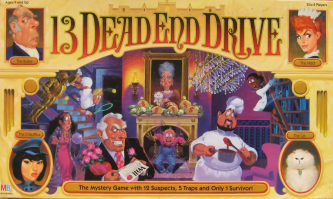
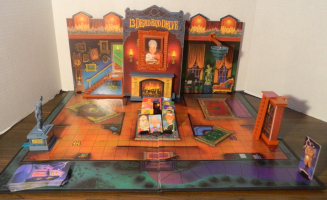
13 Dead End Drive is the only board game on this list that could be considered a child’s game. We’re getting to the adult-themed games soon enough. 13 Dead End Drive has a murder theme. The death of a wealthy old woman triggers a feud over her will. Players use traps located on the board (the mansion), to kill characters controlled by other players to claim the estate.

Players are dealt all the “Character cards” which correspond to matching pawns on the board. Since there are 12 characters, players will control more than one character. Players don’t show which characters they were dealt. Matching “Portrait cards” determine who is the current favorite for the inheritance. The third type of cards are “Trap cards” which are used to spring traps and eliminate characters.

During each turn, a player rolls two dice and moves two pawns, one pawn for each die. It is legal for players to move a pawn that isn’t theirs, especially if the move places a pawn on a Trap space. Characters must end their turn on a Trap space by exact count, and a player must play a matching Trap card for the Trap to take effect. Players win by being the last character standing, escaping the Mansion while one’s character’s Portrait is displayed, or having the final character’s Portrait displayed when the Detective reaches the front door (at the end of 10 rounds).

Despite, the macabre premise, 13 Dead End Drive uses humor and goofy characters to make the game approachable. The game also marks an interesting twist to a murder-themed board game. While games like Clue (or Cluedo) has players trying to figure out who committed a murder, 13 Dead End Drive empowers players by committing a dozen murders.

No. Seriously, this is a game geared toward a younger audience.

4: Europa Universalis (1993)

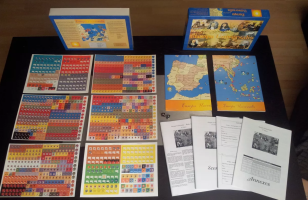
Europa Universalis is a monster of a board game. The official playing time listed on the game box is six hours, but the game can last for weeks. Board Game Geek estimates the playing time to be 15 days. Europa Universalis is a geopolitical strategy game set from 1492 to 1792. Players take control of European powers during this period. Each country has unique events, objectives, and special rules, for example, Russia’s military power is limited until the arrival of Peter the Great, and England has access to powerful privateers.

Europa Universalis has plenty of freedom of choice. It offers control over economics, military, maintenance (yes, you’ll have to maintain your country), discoveries, and colonial investment. But this leads to a major drawback, the game has a lot of calculation and management during the game for income, price changes, maintenance (of your regions), and the purchasing of military resources. Europa Universalis may work better as a video game. Fortunately, Swedish video game developer Paradox Development Studio (along with the help of the board game’s designer Philippe Thibaut) adapted Europa Universalis into a video game in 2000. This long-running video game challenges Civilization as the top civilization simulator.

3: Call My Bluff (Liar’s Dice) (1993)

Call My Bluff (Liar’s Dice) has an odd history. The Liar’s Dice class of games has existed since the 15th century (originally named Dudo from the Incan Empire). A variant of Liar’s Dice was published by Milton Bradley six years prior in 1987. Call My Bluff is a remake of the original Liar’s Dice, which was then in the public domain. Richard Borg earned the 1993 Spiel des Jahres (the German Board Game of the Year) for his adaptation of this classic game.

Five dice are used per player with dice cups used for concealment. In each round, every player rolls a “hand” of dice under their cup and looks at their hand while keeping it concealed from the other players. The first player begins bidding, announcing any face value and the minimum number of dice that the player believes are showing that value, under all of the cups in the game. Ones are often wild, always counting as the face of the current bid.

Turns rotate in clockwise order. Each player has two choices. They can make a higher bid or challenge the previous bid, typically with a call of “liar,” hence the name Liar’s Dice. Once a bid is challenged, all dice are revealed. If the bid is valid (at least as many of the face value and any wild aces as the player’s bid), the bidder wins. Otherwise, the challenger wins. The player who loses a round loses one of their dice. The last player with dice at the end of the game wins. Call My Bluff’s simplicity and entertainment value earned it the Spiel des Jahres. If the rules sound familiar, the video game series Red Dead Redemption includes a version of Call My Bluff.

2: We the People (1993)

We the People simulates the American Revolution. I’m sensing a simulation theme with 1993 board games. Published by Avalon Hill and designed by Mark Herman, We the People was the first wargame to use cards as the primary means of controlling the pace and tempo of play; the card play introduces a strong element of fog of war through hidden card information.

One player controls the British, while the other plays as the Continentals/Americans. The map has a web of cities and towns connected by lines along which armies can move. We the People marks one of the first times a designer used a point-to-point movement system, which has become standard with a lot of games. Tens of thousands of modern board games use a point-to-point movement system, and not just war games. The cooperative game about stopping a global pandemic, aptly named Pandemic, may be the most famous game to use a point-to-point movement similar to the one Mark Herman pioneered.

We the People has inspired other war games like Richard Borg’s Command and Colors series. Yes, this is the same Richard Borg who designed the previous game on this list Call My Bluff. But We the People may have influenced GMT Games the most. GMT has produced numerous games implementing Herman’s card-driven combat. Their games include The Napoleonic Wars, Here I Stand, Virgin Queen, and Twilight Struggle, which remains one of the highest-ranked board games on Board Game Geek.

1: Magic: The Gathering (1993)

Magic: The Gathering takes the top spot. No other game that was released during 1993 could’ve taken this spot from the granddaddy of all collectible card games. Magic: The Gathering beget a flurry of collectible card games in the following decade: Pokémon, Yu-Gi-Oh!, Legend of the Five Rings, and World of Warcraft (eventually rebranded as Hearthstone) to name a few. Magic: The Gathering’s designer Richard Garfield even made a few more collectible card games to add to his tally like Netrunner, BattleTech, Vampire: The Eternal Struggle, and the original Star Wars Trading Card Game.

Not going to lie. I played most of these collectible card games at one point or another. Magic: The Gathering has stood the test of time. Sure, Pokémon and Yu-Gi-Oh! have endured, but they were released years after Magic. Magic has outlived most of the games it inspired.

The greatest testament to Magic: The Gathering topping this list is that most people read Magic: The Gathering and nodded yes. Magic is the right answer. Magic is the only answer for top tabletop game for 1993.

Did we get the list right, for the most part? Let us know which games you’d add in the comments. And wherever you are, I hope you’re having a great day.

Check out the other lists in this series:
Top 5 Tabletop Games Prior to the 1930s
Top 5 Tabletop Games of the 1930s
Top 5 Tabletop Games of the 1940s-50s
Top 5 Tabletop Games from the Early 1960s
Top 5 Tabletop Games from the Late 1960s
Top 5 Tabletop Games from the Early 1970s
Top 5 Tabletop Games from 1980-1981
Top 5 Tabletop Games from 1982-1983
Top 5 Tabletop Games from 1984-1985
Top 5 Tabletop Games from 1986-1987
Top 5 Tabletop Games from 1988-1989
Top 5 Tabletop Games from 1990-1991
Top 5 Tabletop Games from 1992

Top 5 Thunderbolts Rosters

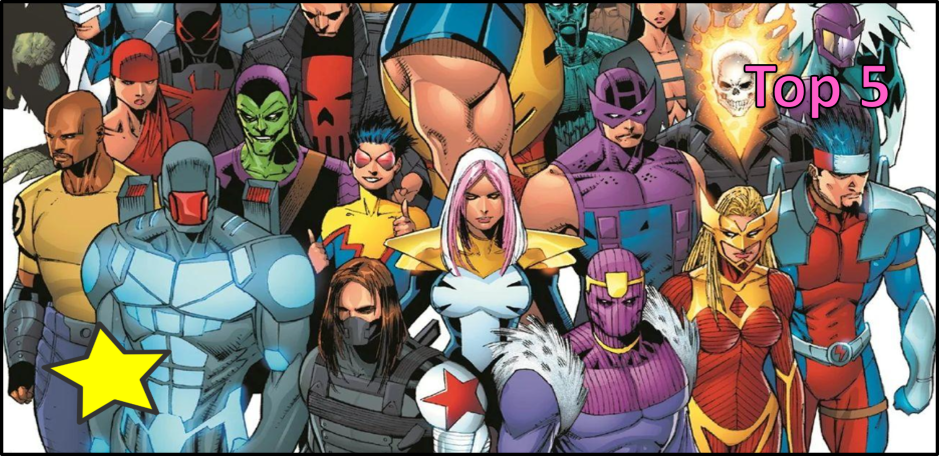
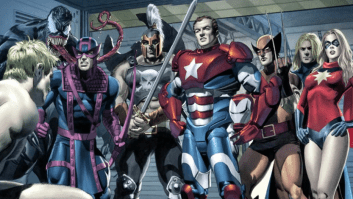
Thunderbolts* releases this week with a new cast of characters. Some of the characters we’ll see in the upcoming film have been members of one of the various incarnations of the group. Others are new faces. The Thunderbolts team has seen plenty of new faces since its inception in 1997, so begs the question, Which Thunderbolts rosters are the best?

Hey, hey! Kyra Kyle here. We’re doing something different with today’s Top 5 in comics. As of this post, there have been thirteen iterations of Marvel’s Thunderbolts. With that many rosters to choose from, which rosters have had the best storylines? We intend to cover that with today’s list. Buckle up. These are the top five Thunderbolts rosters.

5: New Thunderbolts

First Appearance: New Thunderbolts (Vol 1) #1; written by Fabian Nicieza & Kurt Busiek; art by Tom Grummett (2005-2006)

Notable Members

MACH-IV
Songbird
Atlas
Donnie Gill/Blizzard II
Radioactive Man
Joystick
Speed Demon
Andreas von Strucker/Swordsman II
Genis-Vell/Photon

Marvel launched New Thunderbolts in the wake of the Thunderbolts’ first era. Original Thunderbolt Abe Jenkins reformed his ways as The Beetle and became MACH-I. Jenkins made a new suit for himself, becoming MACH-IV, and wanted to give other villains the same chance and reformed the new Thunderbolts. MACH-IV’s New Thunderbolts earned the respect of the Avengers.

The New Thunderbolts stopped Purple Man from enslaving New York City by drugging the water supply with his pheromones, the same ones that allow him to control his victims. Before the team could interrogate the Purple Man, he was teleported away by his boss, Baron Zemo. Zemo would eventually take control of the New Thunderbolts. The New Thunderbolts would lose their chance at redemption and became an army of villains used against Captain America’s Secret Avengers during Civil War.

Ultimately, New Thunderbolts was a solid iteration of the team. I always liked the basic Thunderbolts premise of supervillains pretending to be superheroes but ending up adopting the roles of heroes. Thunderbolts prove that no one’s beyond redemption.

Unless Baron Zemo’s in town. He loves to play the role of spoiler.

4: Luke Cage’s Thunderbolts

First Appearance: Thunderbolts (Vol 1) #144; written by Jeff Parker; art by Kev Walker (2010-2012)

Notable Members

Songbird
MACH-V
Moonstone
Fixer
Ghost
Juggernaut
Satana
Boomerang
Centurius
Mister Hyde
Shocker

In the years before Luke Cage assumed control of a new Thunderbolts team, the Thunderbolts had a run of horrible leadership, notably Norman Osborn. The team had become villainous. Captain America himself tasked Luke Cage to front a new Thunderbolts team, and this started a great run of comics. The team repurposes the heavily fortified superprison known as The Raft and uses Man-Thing as a form of transportation.

Luke Cage’s Thunderbolts are one of the odder iterations of the team. This team has a long time, too. At one point, the team splits off to become two separate groups. The Thunderbolts serviced the Americas, while the “Underbolts” had a European jurisdiction. These Underbolts get lost in time, specifically the World War II era, and pass themselves off as the American Thunderbolts, fighting beside Captain America (pre-frozen) and Namor. The team continues its fight with the Nazis and Human Torch androids that were created by Baron Heinrich Zemo (the current Baron Zemo’s father). Yes. Luke Cage’s Thunderbolts’ stories got wild.

3: Norman Osborn’s Thunderbolts

First Appearance: Thunderbolts (Vol 1) #110; written by Warren Ellis; art by Mike Deodato Jr. (2006)

Notable Members

Songbird
Moonstone
Swordsman
Radioactive Man
Mac Gargan/Venom
Bullseye
Robbie Baldwin/Penance

Yep. Norman Osborn may have been a horrible Thunderbolts leader, but his complicated leadership led to some great theater.

Osborn’s Thunderbolts occurred after Marvel Comics’ Civil War event. These new Thunderbolts were tasked with tracking down and arresting individuals avoiding the Superhuman Registration Act. This Superhuman Registration Act appeared in the MCU and sparked a similar story of the same name Civil War. Just imagine Norman Osborn, struggling with his Green Goblin persona, leading a team of villains to track down any superhero he dared not to register.

Times got rough, to say the least. This Thunderbolts team would lead Osborn to create his first Dark Avengers roster.

2: Red Hulk’s Thunderbolts

First Appearance: Thunderbolts (Vol 2) #1; written by Daniel Way; art by Steve Dillon (2013)

Notable Members

Red Hulk
Agent Venom
Punisher
Elektra
Deadpool
Red Leader
Mercy

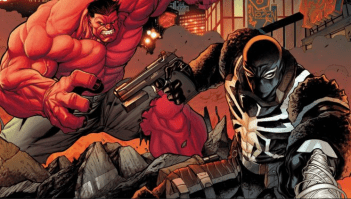
Red Hulk’s Thunderbolts happened on the heels of Luke Cage’s. The government disbanded the Thunderbolts program, but General Thaddeus “Thunderbolt” Ross (Red Hulk) formed his team of anti-heroes. This new Thunderbolts served as a covert super-powered strike team. This sounds like the team’s premise in the upcoming Thunderbolts*.

Red Hulk’s Thunderbolts had a short but memorable run. Even the small moments are great. My favorite was when Deadpool’s name gets pulled for a mission, and he wants to kidnap actor Ryan Reynolds. Ha! At the time of this moment’s publication, Ryan Reynolds had not yet redeemed himself as Deadpool—way to go, Thunderbolts.

Getting back to the larger storylines. Ross started with former Code Red mercenaries and began adding a few villains. It’s this addition of villains that led to the team’s downfall. The team tracks down Doctor Faustus. The Punisher wants to kill Faustus for murdering high school children. Instead, Red Hulk recruits Faustus to join the Thunderbolts. The Punisher leaves the team and then takes them down. Womp, womp.

1: Original Thunderbolts

First Appearance: Thunderbolts (Vol 1) #1; written by Kurt Busiek; art by Mark Bagley (1997-2000)

Notable Members

Baron Zemo/Citizen V
Moonstone/Meteorite
Fixer/Techno
Beetle/MACH-1
Goliath/Atlas
Screaming Mimi/Songbird

The original is often the best. The original Thunderbolts introduced the idea of supervillains pretending to be superheroes (to gain access to their foes) and then liking the recognition and feeling good about doing good deeds. This differs from the Suicide Squad. Suicide Squad villains are looking for reduced sentences or perks in their prison accommodations. Except for their founding member Baron Zemo and one or two others, the Thunderbolts genuinely wanted to reform.

I also love the Thunderbolts’ reveal at the end of the first issue. This scene is iconic.

Did we get the list right? Let us know which Thunderbolts teams you would add or remove in the comments. Thank you for reading and wherever you are, I hope you’re having a great day.

Top 5 Members of the Suicide Squad

We covered Marvel’s Illuminati members last month, and this month we’re doing the same for DC Comics rag-tag team of oddballs the Suicide Squad. Also referred to as Task Force X, the Suicide Squad takes on missions so dangerous that trying to complete them would mean that someone has a death wish. Brought back in the 1980s with this concept, the Suicide Squad was run by Amanda Waller, who installed explosive devices inside the heads of hardened criminals. Cue over-the-top antics.

Hey, hey! Kyra Kyle here. We’re back with the first Top 5 list. Today we’re tackling DC’s lovable gang of miscreants, the Suicide Squad. Who made our list of the Top 5 Suicide Squad Members? Let’s find out.

5: Rick Flag

Rick Flag is the OG Suicide Squad member. Someone by the name of Rick Flag has been around since 1959. There have been three generations of Rick Flags; each one has served as one of the Suicide Squad’s leaders. Rick Flag stands out from most other Suicide Squad members because he isn’t a former criminal. Most iterations of Rick Flag portray him as a skilled military special ops member. This makes sense. The Suicide Squad began as a military/government outfit. It wasn’t until Amanda Waller revived the project that the Suicide Squad included criminals.

Typically, Rick Flag serves as Amanda Waller’s right-hand man within the group, helping keep the rest of the Suicide Squad in line. Amanda Waller is on to something. It would take more than a bomb in one’s head to stop certain members of the Suicide Squad. You need a man on the inside. Rick Flag is that inside man.

4: Captain Boomerang

We go from the most wholesome member of the Suicide Squad in Rick Flag to the least wholesome in Captain Boomerang. Let that sink in. Within a group of psychopaths and hardened criminals, Captain Boomerang is the least wholesome.

Boomerang joined the Suicide Squad in exchange for a pardon. So far, so good. But his grating personality and blatant racism cause more than a little strife within the group. Nobody likes this guy. He causes friction within the team and most team members consider him to be the most dangerous and least dependable member. This also causes Captain Boomerang to have some tasty storylines. He’s one of those villains you love to hate.

3: Harley Quinn

Harley Quinn was going to make this list, but I struggled with where to place her. She’s the highest profile character on this Top 5 list, but she’s also the newest Suicide Squad member. The third spot sounds right.

This isn’t the classic Harley Quinn. The original Harley Quinn, found in Batman: The Animated Series, needed a makeover before joining the team. The Harley who joined the Suicide Squad is the one with the revamped origin story where Joker pushes Harley into a vat of chemicals, granting her superpowers. This new Harley Quinn breaks the fourth wall like a popular merc with a mouth from a different comic book universe. I don’t know which version of Harley I like better, but there’s no denying that after her makeover, Harley Quinn molded the Suicide Squad in her image.

2: Deadshot

Besides the character in our number one spot, Floyd Lawton as Deadshot is who I think of first when I think of the Suicide Squad. Waller recruits Lawton because of his skills as a marksman and the fact that his mandated therapy sessions revealed that he has a “death wish,” hoping a skilled enemy will end his life in a dramatic battle. This death wish leads Deadshot to wear a costume featuring a target on his chest.

Deadshot often clashes with Captain Boomerang—who doesn’t—and field leader Rick Flag. But Deadshot and the latter share a begrudging respect for each other. Deadshot is a classic Suicide Squad member. His backstory lends himself to inclusion on the team and on this list. Lawton may be the only member of the Suicide Squad with a death wish.

1: Amanda Waller

I mentioned Amanda Waller in several write-ups leading to our top spot. Her spot at number one was inevitable. Waller is the woman in charge. She’s the one who resurrected the Suicide Squad. She’s the one who thought installing bombs in criminal’s skulls and forcing them to do government work was a good idea. In short, there would be no Suicide Squad without Amanda Waller.

The woman nicknamed The Wall makes up for her lack of superpowers with her ruthlessness, guile, intimidation, and political connections. Waller is the proverbial person who knows where the bodies are buried, and she’s not afraid to use that knowledge to her advantage. The Wall can even make members of the Justice League, like Superman and Batman, blush. She’s not to be taken lightly. She had to take the number one spot.

Did we get the list right? Let us know who you would add or remove in the comments. And wherever you are, I hope you’re having a great day.

Top 5 Tabletop Games from 1992

The nineties were a turning point for modern board games. 1992 has its fair share of great titles, even if many of them skew to a young audience. 1993 was another strong year. As we dive deeper into the nineties, we’ll have a large pool of tabletop game titles with which to choose.

Hey, hey! Kyra Kyle here. Back with another Top 5 Tabletop Games. We’ll talk about the board games that this year’s list soon, but let’s reiterate the ground rules for which games make these lists before we begin.

1: Cultural relevance plays as much of a factor as overall quality. A game might make a list that doesn’t hold up to others of its type, but you must admit the game is everywhere.

2: Only one game from a franchise makes the list. This will become more of an issue the closer we get to games with expansions.

3: Longevity plays a role, too. A game doesn’t have to fly off the shelves today, but it had to have some widespread appeal for a decent time.

5: Don’t Wake Daddy (1992)

Don’t Wake Daddy kicks off this list and a trend you’ll see with this list. 1992 saw a lot of board games with a strong toy factor. Don’t Wake Daddy is the first of two children’s games. Players take on the role of children sneaking to the refrigerator late at night, trying not to wake their sleeping father who lies in the middle of the board on a large bed. Players move around a board based on the color they spin. If the color of a noise space matches the color of an assigned card that a player holds, they’re safe; otherwise, the player makes one of several noises. A player who makes noise must press the button on the alarm clock next to the father. Eventually, the father will jerk upright from his bed, giving the game its title Don’t Wake Daddy.

Don’t Wake Daddy has inspired spin-offs in the least likely of places. German artist Martin Kippenberger used the symbols for the different “noises” for a cycle of wood-carvings and oil-paintings. Scholastic published a children’s book based on the game Don’t Wake Daddy: Late-Night Snack, making Don’t Wake Daddy one of the few board games to inspire a book. Jumanji doesn’t count. The book came out first and then the board game. My favorite quote comes from Parker Brothers spokeswoman Ronni Heyman who described the game as “a real sleeper.” I see what you did there.

4: Forbidden Bridge (1992)

Forbidden Bridge has a lot in common with another Milton Bradley release around this time Fireball Island. The company had a board game type during this era. Players take on the role of explorers after ancient jewels, which are guarded by an angry spirit. Occasionally, the bridge guard will awaken (Forbidden Bridge is a mechanized game with a motor) and shake the bridge, which may cause players’ pieces to fall off the bridge. Players can also “steal” another player’s jewel. The first player to retrieve two jewels and return them to their boat wins.

Forbidden Bridge’s premise and art resemble Fireball Island, and that’s not a bad thing. It gave the company an identity during the mid-late eighties and early nineties. Forbidden Bridge also takes the most chaotic element of Fireball Island (the bridge) and expands on it. Some of the bridge spaces have pegs, which are important because they can prevent player pieces from falling off the bridge when the bridge shakes. I’m glad that Fireball Island and Forbidden Bridge have seen remasters and reprints. Unlike the Fireball Island remaster, Forbidden Bridge leaves the original game mostly the same. Forbidden Bridge is a Target exclusive.

3: Loopin’ Louie (1992)

Loopin’ Louie is the second children’s game on our list. This electronic board game features a crane tower with a figure of the titular Louie in a biplane. Up to four arms (one for each player) are connected to the tower, each with a canal, a barn, three chicken tokens and a lever (paddle). Louie will spin around the board. Players press their respective levers to keep Louie in the air and stop him from knocking the chicken tokens into the canals. You’ll need to time your lever presses carefully. If Louie hits a chicken token on the barn, it falls into the canal. The winner is the last player to have at least one chicken token remaining.

Loopin’ Louie was given the Kinderspiel des Jahres award in 1994. It’s a solid game, especially for a children’s board game. But is Loopin’ Louie solely a children’s game? In Europe, Loopin’ Louie is a drinking game. In fact, Loopin’ Louie sold more than 1.3 million copies between 2006 and 2014 because it was used as a drinking game. I may need to institute a new Oktoberfest tradition.

2: Um Reifenbreite (1992)

Um Reifenbreite translates to “By the Width of a Tire” and puts players in the role of bicyclists during a Tour de France-type race. Each player controls a four-member racing team, and the goal is to score as many points for the whole team. Players roll dice to see how far their team members move, but there is a limited card set that can replace die results. Unique rules allow players to draft one another and add multiple kinds of road surfaces. Um Reinfenbreite is a deep racing experience.

Technically, Um Reifenbreite released in 1979 as Homas Tour, but we’re including the game here because the bulk of the Homas Tour copies were lost in a warehouse fire. Um Reifenbreite would be the rerelease, and the game changed enough that it earned consideration from the Spiel des Jahres. Um Reifenbreite did more than earn consideration, it took home the award in 1992, beating our next game on this list.

1: Modern Art (1992)

Dr. Reiner Knizia designed Modern Art so that it features numerous auction types. Heck, Modern Art may be THE game for players to learn all the various types of auctions that board games can offer. Each player is dealt a hand of cards, which represent works of art that the player may offer for sale. Players take turns putting these cards up for auction. The auction format is determined by the card offered for sale. Players sell their paintings back to the bank at the end of each round. Whoever has the most money at the end of the fourth round wins.

Modern Art was recommended for the 1993 Spiel des Jahres. The jury considered it for the award because “the unusual combination of different auction types makes Modern Art a challenging and varied game experience.” Reiner Knizia would be recommended for the Spiel des Jahres countless times. Knizia is the most prolific board game designer of all time. Modern Art is the first time one of his games makes one of these lists. It won’t be the last.

Did we get the list right, for the most part? Let us know which games you’d add in the comments. And wherever you are, I hope you’re having a great day.

Check out the other lists in this series:
Top 5 Tabletop Games Prior to the 1930s
Top 5 Tabletop Games of the 1930s
Top 5 Tabletop Games of the 1940s-50s
Top 5 Tabletop Games from the Early 1960s
Top 5 Tabletop Games from the Late 1960s
Top 5 Tabletop Games from the Early 1970s
Top 5 Tabletop Games from 1980-1981
Top 5 Tabletop Games from 1982-1983
Top 5 Tabletop Games from 1984-1985
Top 5 Tabletop Games from 1986-1987
Top 5 Tabletop Games from 1988-1989
Top 5 Tabletop Games from 1990-1991

Top 5 Members of Marvel Comics’ Illuminati

Hey, hey! Kyra Kyle here. The MCU introduced Marvel Comic’s Illuminati in Doctor Strange in the Multiverse of Madness. I don’t know if the Illuminati will continue in the MCU, but they’ve done a lot of work behind the scenes during major Marvel Comics crossovers. The Illuminati’s first appearance (New Avengers #7, July 2005) features each member of the group protecting one of the Infinity Gems. The Illuminati also factor into 2015’s Secret Wars. So, there’s a chance we’ll see more of them on the big screen. Who are the best characters from this group of Marvel Comic’s most powerful beings working in secret, shaping the superhuman world and protecting Earth from catastrophe?

But first, an honorable mention or two. I like Tony Stark/Iron Man a lot as a character. He’s also done a lot with the Illuminati, but he’s not the first name I think of when discussing the Illuminati, even though he’s a founding member. You’ll find another major exclusion on this list: Doctor Strange. His story may have introduced the Illuminati to the MCU, but I think the Illuminati works best when it’s composed of people who represent different demographics, kind of like a Marvel Comics version of the United Nations. And most of the Illuminati’s members fit this bill.

Let’s see who made the list.

5: Black Bolt

The Inhumans occupy an important part of the Marvel Universe. They may have existed before humanity or at least they had a higher level of intelligence and awareness before humanity during Earth’s earliest history. This history also involved extraterrestrial and cosmic encounters. Enter Black Bolt. He’s the Inhumans’ current monarch and boasts incredible power. Black Bolt was born with a voice so strong that it can obliterate planets. Since this is the case, he seldom speaks, opting to have Medusa, another powerful Inhuman, speak on his behalf.

Fortunately, the Illuminati’s creator, Brian Michael Bendis, shared his reasoning for each of the original member’s inclusion. Here’s what Bendis has to say about Black Bolt (I’m paraphrasing to some extent):

“King of the Inhumans, who are an important part of Marvel history and play an important part in events that have not yet come to pass. He also represents a ruler/king archetype.”

The Inhumans television show didn’t fare well, but let’s hope the Inhumans will find new life in some other form. They’re too important to vanish from the MCU entirely.

4: Namor

Namor is yet another monarch. He rules the underwater nation of Atlantis and adds a different perspective for the Illuminati. The ocean claims more area than land on Earth, and Namor is its unquestioned ruler. He’s a member of another ancient civilization, one featured in Black Panther: Wakanda Forever, but missing from the Illuminati’s brief stint in Doctor Strange in the Multiverse of Madness. Like the Inhumans, I hope we get to see more of Namor in future MCU projects.

Let’s see why Bendis included Namor in the original Illuminati:

“Namor is the King of Atlantis and the Seven Oceans and represents the antihero mindset.”

He certainly does that. Namor is an ally to none. His only wish is to have his people’s voices heard. Namor served on Norman Osborn’s Cabal at the same time as his stint on the Illuminati. His role in the Illuminati mirrors his earlier team-up with the Invaders. The Invaders signaled Atlantis’s desire to be known to the outside world, the world of the land dwellers. The Invaders could be another group that could factor into the MCU’s future.

3: Black Panther

Black Panther is the only member of the Illuminati (on this list) who wasn’t in the original roster, but that wasn’t from lack of trying. Tony Stark recruited T’Challa to become an original member and the representative of Wakanda, but T’Challa turned Stark down. Black Panther would later join the Illuminati to face the Incursions.

Wakanda is one of the most prosperous nations on Earth and the main supplier of the world’s Vibranium. Black Panther is calm, fair, and reasonable while boasting no ego. In short, T’Challa differs from most members of the Illuminati. You can call Tony Stark, Mr. Fantastic, and Dr. Strange many things, but ego-less is not one of them.

T’Challa’s relationship with the others in the group can get strained because of the others’ lack of control. Black Panther isn’t easily manipulated. Again, Black Panther is another character I’d like to see more of in the MCU. If that includes a second incarnation of the Illuminati, so be it.

2: Professor X

Professor X needs no introduction. He’s the founder and leader of the X-Men and fights for equal rights for mutant-kind. Charles Xavier boasts a level of intellect and wisdom that’s rarely matched. His ability to read minds, while usually not used against members of the group, proves vital when obtaining intelligence. Because of his role as peacemaker and arbitrator, Professor X often takes a prominent leadership role in the Illuminati.

Eventually, future events in the comics prevent Xavier from participating in the Illuminati, which leads to the group’s gradual demise. Yeah. The comic book version of the Illuminati didn’t dissolve because an omega-powered mutant turned rogue and killed them all in a fit of rage. Spoilers for Doctor Strange in the Multiverse of Madness.

Let’s have Bendis weigh in on why he included Professor X in the Illuminati:

“Leader of the X-Men, Charles Xavier is in the group on behalf of the mutant community.”

Fair enough. And with mutants playing a larger role in the MCU going forward, Professor X’s inclusion in a second Illuminati could prove fruitful.

1: Mister Fantastic

Reed Richards (Mister Fantastic) is the one entry that doesn’t represent a group of people, a country, or both. Reed is only one of the smartest minds on the planet and the leader of the Fantastic Four. He has a long history in the Marvel Universe. Richards’s scientific capabilities are almost unmatched and his desire to see a better tomorrow makes him a prominent member within the Illuminati. He meshes well with Tony Stark, but the two can often butt heads because they can’t put aside their egos.

Reed even reasoned with Iron Man’s original proposition for the Illuminati as a “United Nations” of superheroes. Richards argued that the idea presented too many logistical and bureaucratic issues, but he also acknowledged the need for efficient information exchange between the world’s greatest minds. Mister Fantastic represents the scientific community of the Marvel Universe. He knows more about alternate realms and the cosmos than most, usually because he conducts reckless experiments and kicks a hornet’s nest or two. Annihilus wouldn’t know humans or Earth existed if Reed hadn’t bumbled into the Negative Zone. Thanks, Reed.

I can’t wait for the Fantastic Four to make their MCU debut. I wouldn’t mind more Mister Fantastic screen time. A second Illuminati could give us more FF goodness.

Which member of the Illuminati do you think should’ve made the list? Let us know in the comments. And wherever you are, I hope you’re having a great day.

Ten Common Board Game Mechanisms

Board gamers tend to see the same game mechanisms from one game to another, so it made us wonder which board game mechanisms are the most common. Knowing this will allow new players (and older players) the kinds of game mechanisms they can expect to find in board games. Fortunately, the data required for this list is a lot easier to obtain and compile than our most common fantasy creatures post last year. Thank you, Board Game Geek.

Hey, hey! Kyra Kyle here. I checked the hundreds—and I mean hundreds—of game mechanisms listed on Board Game Geek and ran quick searches to see how many games are listed on the site with each mechanism. At the time of this post (early 2025), Board Game Geek caps its search results to the top 5,000 games that fit a search’s criteria. Almost thirty of the hundreds of game mechanisms searched yielded 5,000 results, which means each of these mechanisms could be in hundreds, if not thousands, of more games. Yikes!

Some mechanisms found in at least 5,000 games are movement-based or mundane, like “it uses paper and pencil” or “dice rolling,” which means that the game includes dice. We won’t bother covering those game mechanisms. But that still leaves dozens of interesting game mechanisms for multiple posts like this. We’ll cap this first post to ten of the most used game mechanisms. This doesn’t include mechanisms with over 3500 games like worker placement. I think this means that we need more worker placement games. I like worker placement games, so it’ll probably make the next list. But which board game mechanisms made this list? Let’s find out.

Action Points

Board games that use action points grant players a supply of action points each turn. Players may choose to use these action points in a variety of ways, typically there’s a list of options. Usually, players can spend their points any way they please. You could take the same action multiple times (or even take the same action for their entire turn) or mix and match actions from the player’s options. The options may cost the same number of action points, or their point value can differ.

Thoughts

Action points give players agency. Your turn can look completely different than your opponent/teammate. I mention “teammate” here because I’ve seen several cooperative board games use action points. The agency (giving players a meaningful choice, which affords those players power) granted by the action points game mechanism is why this game mechanism is so popular in board games. Everyone likes to feel as if they have some control.

Games that use this mechanism

Pandemic, Takenoko, Horrified, Dinosaur Island, and Sleeping Gods

Deck, Bag, and Pool Building

Usually, games that include deck/bag/pool building begin with each player owning a similar deck of cards (if the game uses cards) or a similar number and type of chits or dice (if the game uses a bag or pool). Over time, players will acquire new cards (or the like) and add them to their deck, bag, or pool. Eventually, each player will own a deck or bag unique to them. Each player will use their deck to pursue their path toward victory.

Deck building differs from deck construction (another popular game mechanism) because players build their deck during the game, while decks within a deck construction game have players build their decks before playing.

Thoughts

When done well, deck, bag, and pool building games offer endless replays, due to the countless ways players can build their decks. The best players are the ones who can adapt. They’re the ones who can see patterns form with the cards and what may counter an opponent’s deck. Because of this, veteran players of specific deck building games can exploit their knowledge to gain an edge, but there is a hint of randomness. You must draw into what you need. This randomness evens the playing field a touch.

Games that use this mechanism

Dominion, Orleans, Challengers!, Thunderstone, and Aeon’s End

Hand Management

Games that use hand management reward players for playing their cards in certain sequences or groups. The optimal sequence may vary depending on board position, cards held, and cards played by opponents. Managing your hand means that you gain the most value out of available cards given your current circumstance. Often, these cards have multiple purposes, so this further complicates an “optimal” sequence.

Thoughts

Hand management could’ve been dismissed as a mundane game mechanism. Any game that includes a hand of cards will innately have hand management. But hand management is unique from this subset of board game mechanisms. Other mechanisms like dice rolling and paper and pencil mean that these physical elements exist within a game. Hand management suggests that players must take an active role in this game mechanism. And as the description says, this game mechanism is rewarding when players find the perfect sequence for their circumstances. Hand management also happens to show up the most on Board Game Geek’s Top 10-ranked games.

Games that use this mechanism

Brass: Birmingham, Ark Nova, Gloomhaven, Terraforming Mars, and Twilight Struggle

Open Drafting

Board games using open drafting have players pick (or purchase) cards (or tiles, dice, etc.) from a common pool to gain an advantage or assemble collections that meet objectives. Since the drafting occurs in the open, the identity of these cards (or other similar item) is known to other players. Drafting gives players a choice and the ability to gain a card another player may want, denying them something they wanted.

Open drafting differs from closed drafting, which is also known as “select and pass.” Everyone can see the item you gain as you obtain it.

Thoughts

Open drafting provides an immediate back-and-forth between players. Since you know what your opponents select each turn, and your opponents know what you select, a meta-game (or game within the game) takes shape. Like the two previous game mechanisms, players must adapt to what options are available during their turns and what they believe their opponents are planning to do. This back-and-forth can lead to table talk (talking between players at the table about the game they’re playing) and builds tension.

Games that use this mechanism

The Castle of Burgundy, Everdell, Wingspan, Blood Rage, and Splendor

Pattern Building

Games that use pattern building task players with configuring game components to achieve sophisticated patterns. These patterns can score points or trigger actions. Unlike most other game mechanisms on this list, pattern building is synonymous with another game mechanism on this list (tile placement), which we’ll cover later. Often, players want to link similar component types together or as mentioned above, create elaborate patterns.

Thoughts

Pattern building is the most puzzle-based mechanism on this list. The shifting tiles (and sometimes cards) lead to tasty combinations. So many games that fall into this category can be visually stunning. If you must build a pattern, the pattern should be easy on the eyes. This leads to why a lot of modern games use pattern building. Puzzle + Beautiful Patterns = Popular Game.

Games that use this mechanism

Azul, Cascadia, The Isle of Cats, Harmonies, and Welcome To…

Push Your Luck

With push your luck games, players decide between settling for existing gains or risking them all for further rewards. Games of this type feature an amount of output randomness or luck. We mention the two types of luck in a previous post (link to the two types of luck, input and output luck here). Players focus on progressing and maximizing their results. But typically, the stakes rise. If things go wrong, you lose it all.

Thoughts

Push your luck can add spice to an otherwise dull series of mechanisms. Double or quit, keep going or stop, cash your gains or bet them. This isn’t a new idea. Plenty of gambling games, like Blackjack, make use of the push your luck mechanism. Heck. Many of you may have read the description and immediately thought of Blackjack. Gambling games aren’t the only games that use the push your luck mechanisms. In fact, board games that use the push your luck mechanism can be good for gamers who want the feeling of gambling without involving any real-world money. These games can create a similar rush.

Games that use this mechanism

Heat: Pedal to the Metal, King of Tokyo, The Quacks of Quedlinburg, Lost Cities, and Return to Dark Tower

Roll/Spin and Move

Roll/spin and move games deploy the use of dice (rolling) or spinners (spin) and then move in some capacity. Historically, players roll or spin and move their playing pieces per the number (or other result) rolled (or spun). Countless classic board games have used the roll/spin and move mechanism as a key ingredient. Most people outside the board game community may expect roll/spin and move within all board games. A roll/spin and move game is what most people outside the board game community think of when they think of board games. Board games like Monopoly and The Game of Life popularized roll/spin and move.

Thoughts

People within the board game community often use “roll/spin and move” as a derogatory term. People who do this imply that there is no thought involved with this mechanism. While this is the case for a lot of older games (there are some exceptions like Backgammon), modern board games have taken the roll/spin and move mechanism into new territory. I agree that players lose their agency (power and ability to make meaningful choices) if they must roll or spin and move the spaces indicated on a die (or spinner) with no additional input. But some newer games add other forms of movement to this formula. Other newer games allow players to manipulate the results. Even more modern board games have players roll dice ahead of a turn and then assign the dice results to an array of actions.

Roll/spin and move isn’t an inherently poor mechanism. How a designer uses roll/spin and move makes all the difference. The key to making roll/spin and move work is maintaining a player’s agency.

Games that use this mechanism (well)

Jamaica, Camel Up, Formula D, Stuffed Fables, and Colosseum

Set Collection

Board games that use the set collection mechanism often make the set worth points. The value of the items is dependent on being part of a set. These sets can either be the quantity of a specific item type or a type’s variety. In some cases, board games can use contracts that urge players to pick up certain items to fulfill the contract.

Thoughts

The set collection mechanism breeds external tension between players. One may pick up a resource or item to prevent an opponent from fulfilling a contract or gaining more points by having more of a resource (or item) than anyone else. Or two players may fight each other for the ability to pick up these items because they both want to accomplish the same goal.

The set collection mechanism by itself may fall flat, but set collection seldom shows up on its own. Set collection complements a host of other board game mechanisms. It can give a built-in reason for players to choose a course of action or a sudden gain of a lot of one item or an array (variety) of items can tempt players to change their strategy or tactics. Board gamers often overlook the value of the set collection mechanism, but several popular games use set collection.

Games that use this mechanism

Great Western Trail, Ticket to Ride, 7 Wonders, Lords of Waterdeep, and Tokaido

Tile Placement

Tile placement games feature placing a piece (or tile) to score victory points or trigger actions. Usually, adjacent pieces or pieces in the same group/cluster or keying off non-spatial properties like color, a feature’s completion, and cluster size trigger the action or scoring. Pattern building often accompanies tile placement, but there are some notable exceptions, specifically, games that use modular boards and exploration.

Thoughts

While some tile placement games (like 1986’s Labyrinth and Dominos) existed before the modern board game boom (the mid-1990s and beyond), tile placement (and a few other mechanisms like worker placement and deck building) have taken the place of the roll/spin and move mechanism as modern board games’ dominant game mechanism. Just because the tile placement mechanism can be found in countless modern board games doesn’t mean that each game uses the mechanism the same way. Some games have a shared space for players to place tiles. Other games give each player a private building space. And several games do a little bit of both. Despite tile placement’s explosion after Carcassonne popularized it as a central game mechanism in 2000, tile placement remains a vibrant board game mechanism.

Games that use this mechanism

Carcassonne, A Feast for Odin, Galaxy Trucker, Betrayal on House on the Hill, and Castles of Mad King Ludwig

Variable Player Powers

The variable player powers game mechanism grants different abilities or paths to victory to each player. Each player has a unique power. Games that use variable player powers reward players who exploit their unique abilities while compensating for their abilities’ shortcomings.

Thoughts

The variable player powers game mechanism is perfect for any player who wants to stand out from their opponents. Because each character (or faction) within the game plays differently from each other, games that use variable player powers have a lot of replay opportunities. On a similar note, players may gel with a specific power over another one so playing a second game and trying a different player power could lead to better results.

Unlike other game mechanisms on this list (except for deck building and Dominion), variable player powers haven’t been around as long. Games that use the variable player powers mechanism also dominate Board Game Geek’s Top 10 ranked board games.

Games that use this mechanism

Gloomhaven, Twilight Imperium: Fourth Edition, Dune: Imperium, Pandemic Legacy: Season 1, and Cosmic Encounter

Closing Thoughts

This was a longer list than I expected. It would be even longer if I didn’t cut the list of common board game mechanisms in half or into thirds. Let me know if you’d like to see more lists like this in the future.

Looking at the board game mechanisms listed on Board Game Geek allows for a macro view of the board game hobby. We can see trends. We can examine what makes a board game mechanism popular. A lot of these board game mechanisms grant some form of player choice or player empowerment. But that’s what I think. What do you think? Let us know in the comments.

Geekly may have another series in the offing. We’ll craft another set of surveys and reach out to board game designers to discover their thoughts about each of these game mechanisms (and game mechanisms that may find themselves on a future list like this one). I hope you found something useful in the post. And wherever you are, I hope you’re having a great day.

Top 5 Flash Villains

I can’t believe Geekly has been doing Top 5 Villains lists for superheroes and we haven’t covered Flash’s rogues gallery. Flash has one of the most extensive rogues galleries in comic book history. He may not have villains with the same name recognition as Spider-Man or Batman, but his rogues gallery is one of the best.

Hey, hey! Kyra Kyle here. We’re back with another Top 5 Villains list. Many of the Flash’s most iconic villains have superspeed, so we’ll be limiting this list to the top speedster. Let us know if you’d like a Top 5 List of Villainous Speedsters. In the meantime, here’s our list of the Top 5 Flash Villains.

Top 5 Ice Powered Comic Book Characters Killer Frost

5: Killer Frost

Flash’s top 4 villains were a breeze to compile. I knew who they were the instant I sat down. His fifth villain could go in several directions. I may have said that about more than one superhero, but that’s the truth. Killer Frost beats out the rest of the would-be Top 5 Flash villains if for no other reason than she used to be a Flash ally. She spends part of her time as an anti-hero, having spent stints with the Suicide Squad and Justice League. But whenever Caitlin Snow decides to turn evil, it spells doom for the Flash. Her connections with Flash and Firestorm add to her lethality. Cold powers prove effective against the Flash; cold can slow the speedster. Killer Frost’s freezing ability, as we’ll see with another Flash villain on this list, makes her dangerous.

4: Mirror Master

Mirror Master fills a similar role in Flash’s Rogues that Mysterio does in Spider-Man’s Rogues, and Mysterio ended up as Spider-Man’s fourth-placed villain. Hmm. Looks like the fourth spot is the perfect place for a villain designed to confuse their nemesis. Unlike Mysterio, Mirror Master possesses powers. His mirrors can hypnotize, turn him invisible, generate holograms, change his physical form, and travel into other dimensions. That final ability separates Mirror Master from Mysterio. One of my favorite recent stories Mirror Master showed him trap Flash within a parallel dimension of his creation.

Don’t let the high-speed fool you. Flash is one of DC Comics’ most powerful heroes. He can turn back time and alter the past. Brute strength doesn’t often work against the Flash. Mirror Master takes a different route. And I’m a sucker for a villain with a mischievous streak.

3: Gorilla Grodd

Gorilla Grodd is one of my favorite Flash villains. I wanted to place him at the one or the two spot, but two other villains narrowly beat him. Gorilla Grodd has superhuman strength, telekinesis, telepathy, a super genius-level intellect, and has a connection to the Speed Force. As his name suggests, he’s a gorilla. He hails from Gorilla City and is the sometimes leader of the metropolis led by super-intelligent gorillas. Gorilla Grodd not only has a laundry list of abilities, he has an army at his disposal.

Marry all of this up with Grodd’s connections with most of DC Comics’ supervillain organizations like the Legion of Doom, the Secret Society of Super Villains, and the Injustice League, and Gorilla Grodd has a plethora of allies he can summon. Grodd is one of Flash’s most formidable enemies.

2: Captain Cold

You can take everything I said about Killer Frost and her freezing powers and apply it to Captain Cold. But instead of Captain Cold being a personal friend of the Flash’s, he’s the man he instituted the Flash’s Rogues, Flash’s version of the Sinister Six, and serves as their leader. I had to put Captain Cold above Grodd because Grodd can get distracted by other heroes, and Captain Cold keeps his animosity toward the Flash. He knows which buttons to press and isn’t afraid to press them. His freezing abilities are only matched by his intellect. In short, Captain Cold knows how to use the Flash’s strength against him and that makes him deadly.

1: Reverse-Flash

Eobard Thawne (also known as Reverse-Flash and Professor Zoom) takes the top spot. He’s another speedster, so if we were to create a list of Top 5 Villainous Flash Speedsters, he’d be the top spot there as well. Thawne is one of the few characters in the DC Comics Universe who can travel back in time with little to no ill effects, and he uses this to his advantage. He’s erased characters to torment and destroy the Flash’s life. He even went back in time to kill Barry Allen’s mother. Reverse-Flash is plain evil.

He too has connections with the Legion of Doom, the Injustice League, and the Rogues. He had to take the top spot. Despite others’ attempts, no one has tortured the Flash more than Reverse-Flash. He does what his name says, he is the Flash’s antithesis.

Did we get the list right? Let us know who you would add or remove in the comments. And wherever you are, I hope you’re having a great day.