



Stacklands merges a survival/civilization game with the skeleton of a collectible card game, and the results are interesting. Developed by indie designer Sokpop Collective, Stacklands takes these disparate themes and mechanisms and makes sense of them. Prepare to drag cards on a board and stack them on top of each other for numerous interactions.
Hey, hey! Kyra Kyle here. Today, I’m reviewing a quirky video game I’ve meant to cover for a while. Full disclosure: I’ve played a heap of Stacklands on Steam. I purchased all the DLC–we’ll only touch on some of the bonus content–and spent countless hours watching my card-sharped citizens build an empire. But how does Stacklands stack up against our review criteria? Let’s find out.

Quirky indie video games tend to sport fresh game mechanisms, and Stacklands is no different. Stacklands combines a collectible card game and a civ builder into a cohesive whole. The experience is a great loop of exploration and optimization for your villagers. I’ve never had this much fun stacking one card on top of another card and getting something in return. One chicken on top of another chicken yields an egg. Place that egg card on a campfire and produce a cooked egg. Sounds simple, but a multitude of these actions may occur at once. Players must manage the timers for each interaction and generate enough food at the end of the day to feed their civilians. Any items you don’t use or can’t use may be sold for coins that are used to purchase new card packs. Card packs contain new items and ideas.
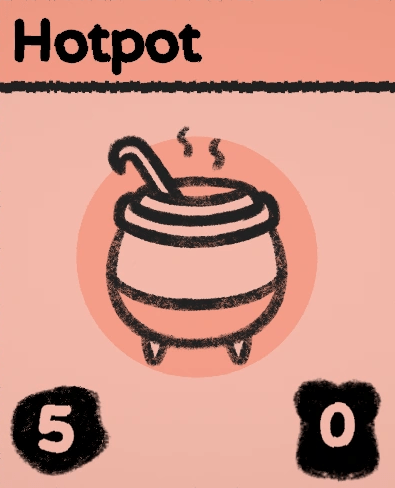
The gameplay loop and exploration (of what I can put together to make something exciting and new) are addictive. Earlier versions of Stacklands proved difficult to manage some of these elements, but later patches fixed many of these issues. I have as much fun optimizing my little village as I do discovering new ideas. If you were to construct a hotpot, you could place food into the pot that you wish for your villagers to eat first. This way, you can keep more valuable food items. Small upgrades like this add strategy.
And Stacklands is full of small and large upgrades ready to make your village strong enough to fight off invaders. Yes. There will be invaders who will randomly attack your village, but usually after the first five or six moons (or days). Enemy cards are indicated by red backgrounds. You may choose to fight these enemies unarmed (like the picture below) or upgrade your Villagers with weapons that will change their job title from Villager to something fancier, like Warrior or Swordsman.

Stacklands also has a knack for ramping up the difficulty. Most difficulty spikes happen organically; you won’t face a stronger creature unless you spend money to buy a more expensive pack that may contain the stronger creature. The largest of these difficulty spikes is at the player’s discretion. I don’t know how many times. I’ve accidentally summoned a demon and watched in horror as the demon decimated my villagers.
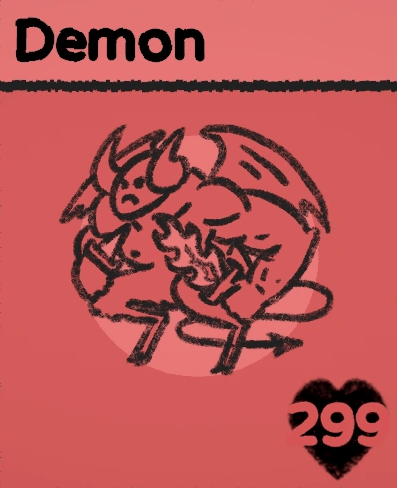
But I was the one who summoned the Demon. I’ll know for next time not to do the thing that summoned the Demon until after I’m prepared to defeat an enemy with 300 health. Like many survival games, you’ll need to restart your Stacklands village when you have no more living Villagers, but when you do restart your village, you don’t need to relearn skills and ideas. I don’t mind this. It lessens the danger, and often, I’ll have a better item I’ve unlocked and can outfit my villagers with better gear or a more optimized village. Heck. I’ve let a larger enemy torpedo my village, so I could start over.

Above Image from GameDesigning.Org
I’ve already mentioned Stacklands’ gameplay loop. Combining collectible card packets with building a civilization of card villagers is fantastic. Stacklands also manages its difficulty spikes well. Players have more control over what they’ll face. Buying more expensive packs could mean stronger enemies appear, but you’ll want to unlock every card in each packet type and as quickly as possible.

Collecting cards like Pokémon mixed with exploration is a potent combination. And since Stacklands has so many hidden tech trees (the game doesn’t spell out its tech trees in a diagram), you’ll find hours of enjoyment reverse engineering a recipe. How do I get a gold bar? I need a smelter and gold ore. How do I make a smelter, and which booster pack contains gold ore? Stacklands has so many rabbit holes to explore.

Stacklands has a few side stories that make up a somewhat larger narrative, but it doesn’t have a traditional storyline. There’s the demon I mentioned earlier. The demon isn’t too difficult to defeat if you have the proper equipment and a large enough army. You’ll also have to challenge a witch who summons monsters from a strange portal. Defeating the witch is the closest thing the base Stacklands game has to a larger story.

Players must construct a stable portal so they can enter the witch’s realm and fight her seemingly endless army of baddies. The army the player sends may choose to return home after each level of witch minions. Defeat the final level and then the witch. Players will receive a “you completed the game” notification, but that’s not the end. You may continue playing Stacklands and its DLC. The only location you can access without buying DLC is the island. This has a “story” similar to the witch on the mainland, but it’s the paid DLC that has fleshed out stories. I’m not including the DLC in this review, but if I did, this score would rise a point or two.

Stacklands‘ storytelling is no better than average. I promised I wouldn’t include the paid DLC (which only costs a few dollars) in this score. The base game’s story is okay. The DLC ventures into some interesting territory. I talk briefly about them. One alternate plane deals with waste; you’ll need to optimize your village so you won’t produce too much pollution. Another plane centers around death. A third pivots hard into combat and rage. Stacklands‘ DLC is well worth the price (if you like the base game), but it’s the base game’s storytelling we’re grading here, so it’s average.
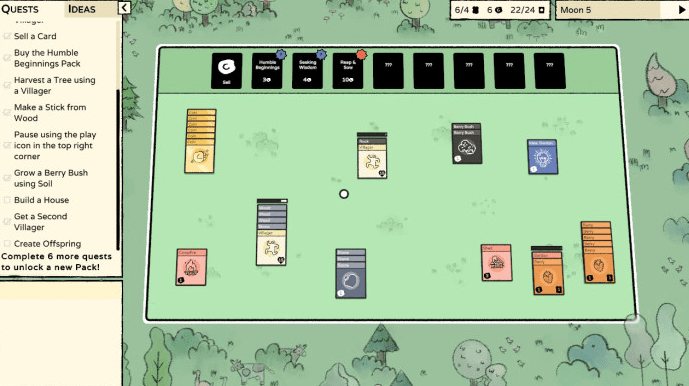
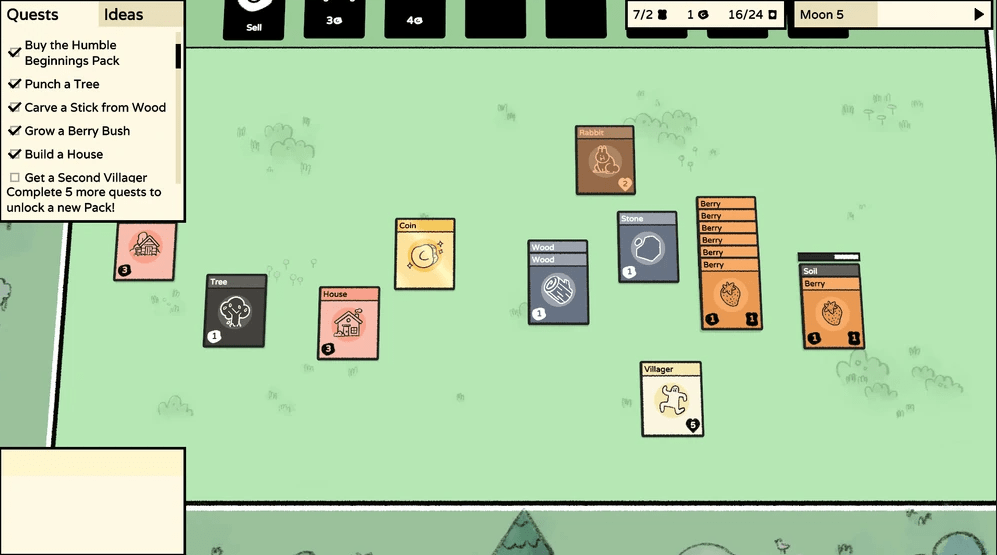
While Stacklands has a lot going on at once, it does a good job of presenting these options to the player. In the top left, you’ll find tabs for Quests and Ideas. The quests are self-explanatory. If you don’t know what to do next, check out your active quests.

Ideas are the recipes you know. Stacklands does a great job of grouping similar recipes into tabs. You may expand these tabs to see individual recipes or collapse them if you’re not looking for that recipe type.

In the far right corner, you’ll find out which day (moon) you’re on, and the symbol on the right of this box lets you dictate how fast time moves. To the left of the moon, you’ll find your village’s vitals (food, coin, and how many cards you may have in your village–booster packs don’t count toward this total). The image above may be from Moon 5, so there aren’t as many cards in play, but Stacklands has so many ways to optimize your village that you can build one that minimizes your number of cards and is almost automatic.
Once you find a consistent source of food, you’ll be able to focus on other things Stacklands offers, and there are plenty of choices. Stacklands rewards trial and error. Don’t be afraid to make mistakes.

While I enjoy Stacklands‘ graphics, they are minimal. Stacklands chooses legibility over style. Even though that’s the right choice for a game like this, I can’t tell you that Stacklands has amazing graphics. The game’s graphics are crisp, at times adorable, and most importantly, functional.

You like lo-fi chill jams, don’t you? Who am I kidding? Of course you do. Stacklands’ soundtrack makes great background music. To be honest, I hardly notice it while I’m playing. Where this score gets a bump is when considering Stacklands’ sound effects: card shuffling, ripping open a booster pack, the little bloopy combat noises, and adorable animal calls. Sokpop Collective took time and care with Stacklands’ sound effects, and it shows.
Stacklands has plenty of DLC, and that DLC has its own puzzles for you to solve. The DLC adds a good ten to twenty gameplay hours. But the base game has tons of replay value in its own right. Even if you defeat the witch and the demon, you may want to beat the time it took you to defeat the witch and the demon. I’ve also discovered numerous recipes after beating these two, which then prompted another playthrough. Sure, I beat the game, but I figured out how to make a resource magnet. That would optimize my village to the fullest.
Again, I may be biased. I put a heap of time into Stacklands, but it has a fair amount of replay value. Each new play can lead to a different path to success.
Happy Mother’s Day, Geekly Gang. We wish all the mothers out there a great day. Since today is Mother’s Day, we may go a little light on Geekly News. We may have some events we’ll have to do today.

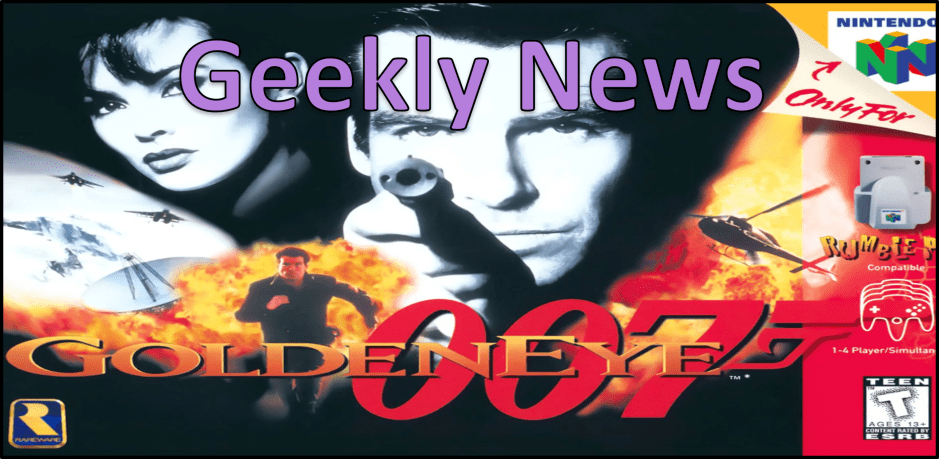
The World Video Game Hall of Fame inducted four games this past week. All four video games are worthy additions. Defender raised the bar on difficulty in video games. The game might be too difficult for some people; I remember avoiding Defender while in the arcade. GoldenEye 007 was one of the best multiplayer first-person shooters. I would lose even while playing Odd Job. I’m sensing a pattern with these games. I stink at them. 🤪Quake ushered in a new generation of graphics, while Tamagotchi marked the first pet simulator. This list is impressive.
But so are the video games that didn’t quite make the cut. The World Video Game Hall of Fame competition was fierce. Finalist games included Age of Empires, Angry Birds, Call of Duty 4: Modern Warfare, Frogger, Golden Tee, Harvest Moon, Mattel Football, and NBA 2K. Some of these games should enter the hall next year.
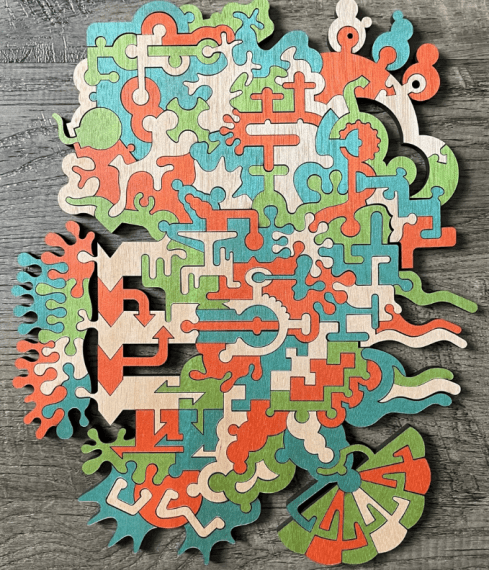
We’re doing something a little different today. Bumfuzzled is a set of wooden puzzles that feature unusual piece shapes. It should launch some time next Tuesday (May 13, 2025), and I’m excited for these. The puzzles look amazing. And look at the piece shapes.

If you’re tired of the same old puzzles, give Bumfuzzled a try in a few days.

Allplay produces a lot of great games of various shapes and sizes. I mentioned Allplay as one of the board game companies that produces stocking stuffer games. Allplay also releases waves of these games on Kickstarter, and they just announced another nine games for a future Kickstarter campaign. Nine games! Wow! Seven of these nine games will be of the small box variety (great stocking stuffers). As of writing this post, there are no details about when these games will ship, but Allplay tends to ship bundles like these within a year. We only know of four games for sure: Alibis, High Rise, Wordsy, and Piñatas.
All of these games look promising. Alibis is designed by Don’t Mess With Cthulhu’s Yusuke Sato. Sato has done a great job with social deduction in the past, and Alibis appears to be a cooperative deduction game. Interesting. Allplay is reprinting two fantastic Gil Hova designs Wordsy (which is a well-regarded word game) and High Rise (a strategic city-building game with a touch of corruption). The final game is a new design by Reiner Knizia, Piñatas. Piñatas is another trick-taking game by the board game legend. I’ve been playing a lot of Knizia’s most recent trick-taking game, Don’t LLAMA. It’s a good bet that Piñatas will be excellent.
We’re keeping today’s Geek News brief. Happy Mother’s Day again. Thank you for reading, and whether you’re a mother or not, wherever you are, I hope you’re having a great day.

Potion Craft by indie game developer niceplay games created a craft system you want to play. Visuals inspired by medieval manuscripts blend with unique gameplay for concocting potions to form a singular video game experience.
Hey, hey! Kyra Kyle here. We’ll get back to another free-to-play game soon enough, but in the meantime, let’s cover another paid game. You can get a good deal on the game through sites like Steam or the PlayStation store (PS4/PS5). Usually, Potion Craft sells for around $20, even without a sale. Potion Craft’s unique graphics drew me in, but its stellar gameplay kept me engaged for hours. Let’s see how well Potion Craft stands up to our rating system.

Potion Craft innovates on the tried and tired crafting game. The video game scene has seen an influx of alchemist simulator games in the last few years. Most of these alchemist simulators would have players accruing ingredients through exploration (through a dungeon mechanism separate from alchemy) and learning new potions through trial and error. Potion Craft streamlines this process. Players explore a perilous map by adding ingredients to their alchemy pot. Ingredients (that players obtain through farming or purchasing from vendors) move the player’s cursor on the map north, south, east, or west. But these ingredients seldom allow for traveling in a straight line. Spiral and zig-zag movements reign supreme. Once the bottle-shaped cursor reaches an ability, players can stoke the fire and boil their potion, so the potion gains that ability.
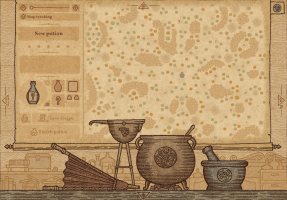
This simple, yet ingenious, twist puts the focus on alchemy. I waited for a second gameplay type where I played as my character dungeon diving for ingredients. That gameplay never came, and Potion Craft is the better for it. At times the gameplay can feel puzzly, but with the focus on what I put in my alchemy pot almost all the time, I felt more like an alchemist in Potion Craft than I’ve ever felt in any other video game of this ilk. And I’ve played a handful of alchemist simulators. If an alchemist simulator sounds intriguing to you, you owe it to yourself to play Potion Craft.

Pick ingredients from your alchemical garden. Then, tend to your garden. Serve your customers by guessing which potion would best fix their problem. You may haggle with the price if you want. Finally, explore the alchemy map to find new potion types or find better (more efficient) ways to produce potions.
Potion Craft is one of those notorious games for “just one more turn.” Everything seems as if it’s just one day (turn) or two away. Even when you know how to make a potion and save the potion’s recipe, you can create the potion, using fewer ingredients, so that you spend fewer future ingredients. That’s another great feature of Potion Craft. The ingredients you used when creating a potion recipe you saved will be used whenever you make potions from that saved recipe. There’s a reason to make the same potion twice. Let’s say that it took you three Waterblooms to make an Ice potion. But you unlocked Tangleweed and began farming that and it only takes you one of those to make an Ice potion. This can save you time, resources, and money in the long run. Brilliant!
Frequently, I’ll make a less-than-desirable recipe for a potion type just to have a means of making that potion. When I unlock the means to make that same potion on the cheap, I take it. And it feels good exploring the map through alchemy, even when I’ve already unlocked the ability I’m heading towards. Each day, experience boosts (in the form of alchemy books) reset, and players can collect them again. This allows you to level up your alchemy skills, and the skill tree, while basic, does a good job of giving players choices. Do you want to focus on selling potions, exploring the map, or farming? The choice is yours.

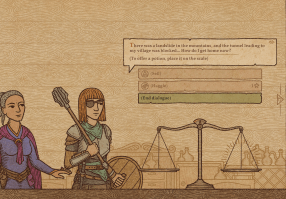
And then there are the customers. This dovetails into the Storytelling section (and less so for Narrative) but I’ll begin discussing the customers here. Customers often don’t tell you exactly what they want. Even when they do, there are often multiple ways to fix a problem. Light spoiler: a customer may say that they locked themselves out of their house; you can choose to give them an explosive potion or acid. I don’t know how many times I’ve seen Season pick a means of fixing a problem that didn’t cross my mind. And she’s said the same for ways that I’ve solved the occasional problem.
But the core element is map traversal through alchemy. I didn’t expect to like the map movement that much, but Potion Craft nails the explorative nature of throwing things in a pot and seeing what happens.
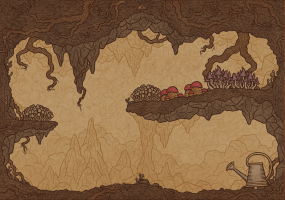
Potion Craft doesn’t have much in the way of a narrative, but I gave it a five because of its implied customer backstories. Sure, some customers have generic “my stomach hurts, do you have a potion for that?” But others have more sinister motives should you get to know them better. Others still have bizarre stories like why does a scuba diver exist in medieval times? Players will have to piece together scraps of story to make one that makes sense, but Potion Craft does have a loose-knit story.
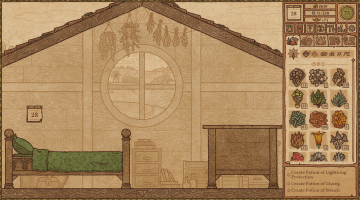
Like Papers, Please, which we covered last month, Potion Craft tells its story in the game’s negative space. Hidden within the string of customers who stop by for potions rests a deeper narrative for those characters and the town in which they live. I won’t spoil some of those stories here, but Potion Craft builds its world and its story through the people who stop by for magical potions. And I love this world.
Citizens solve mundane problems with magic. Why not? If magic is plentiful, why wouldn’t you solve any minor inconvenience with alchemy? Potion Craft runs with this premise. You can solve people’s issues at lower difficulty settings through multiple means. You may need a specific potion with multiple effects if you raise the difficulty. Unlocking abilities to converse with customers may yield even more backstory. And that’s where Potion Craft’s story lies: the characters’ backstories.
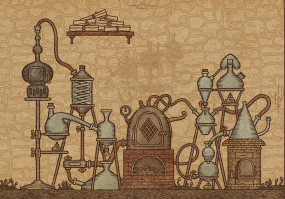
Potion Craft does a great job of showing players where their alchemical ingredients will lead them on the map. The locations are easy to navigate. The goals are easy to find and understand. In short, Potion Craft does a great job of showing its players how to play the game. But at the same time, it still gives players the freedom to come up with unique solutions to problems.
Like I said before, there’s more than one way to fix an issue, and Potion Craft gives players the time and space to explore those options. Potion Craft’s setup isn’t the hectic DMV hellscape as Papers, Please. It organizes things in a way for players to thrive. Potion Craft is a layback and chill game instead of a tense, don’t make a single mistake game like Papers, Please. While the two user interfaces work for the games that use them, I prefer Potion Craft’s interface. I’d rather a game show me exactly what I can do. Potion Craft does this better than most.

Potion Craft uses medieval documents and medical books as the basis for its graphics. While simplistic, the art amplifies Potion Craft’s subject matter. I don’t know if any other graphics would’ve worked for this game. You can tell that Potion Craft is a labor of love for the designers. The user interface and graphics merge intuitively. Part of the reason why the user interface works as well as it does is because the graphics feed into the user interface and the theme. I feel as if I’m grinding leaves, flowers, berries, and roots with a mortar and pestle. There were times when I swore, I could smell the herbs.
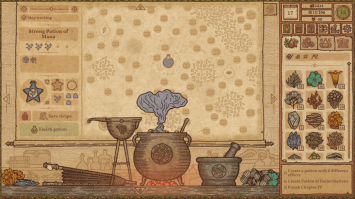
I’m not going to lie. I played Potion Craft while muted most of the time, but when I did have the sound on, it worked well. I wouldn’t say that Potion Craft has the most memorable soundtrack. Its soundtrack is serviceable. Potion Craft’s sound effects are what give it an above-average audio rating. You can hear the crunch of leaves and fruit. Heating your potion is satisfying. Pouring water into your solution to thin your potion is visceral. Seriously, I had to go to the restroom after hearing pouring water on more than one occasion. Potion Craft amplifies its tactile gameplay with sound effects.
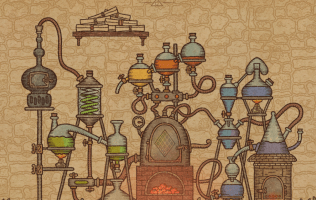
This is a difficult section to grade. Potion Craft may not offer much in terms of replays through different games. You can get by beating each difficulty setting once. As of this write-up, there are four different difficulties. This still gives you well over 100 hours of gameplay. I’m giving Potion Craft a higher replay factor score because of the replays during your initial play.
I mentioned before that you may want to optimize your potion recipes. That leads to numerous hours of gameplay. But Potion Craft has a sneaky other reason why you might play. Your alchemy shop has a reputation score. You could play an evil alchemist and only sell potions to people who have nefarious plans. I didn’t know who would order a Necromancy potion with my first play. Switching to an evil alchemist showed me who would order a Necromancy potion. It doesn’t look like it, but Potion Craft is a sandbox game.

I enjoyed my multiple playthroughs of Potion Craft. It’s the preeminent alchemist simulator game. If you have any interest in an alchemist simulator game, give Potion Craft a try. With Potion Craft’s quirky graphics, I didn’t know what to expect. The streamlined nature of Potion Craft’s gameplay is a revelation. Developer niceplay games and publisher tinyBuild are on my radar. I can’t wait to see what this studio has planned for next.

Hey, hey, Geekly Gang! Kyra Kyle here. Today’s post is a Whatcha Playing, where we’ll ask our writers what they’ve been playing (tabletop games and video games) over the past month. As always, you’re part of the Geekly Gang, too. Feel free to share which games you’ve played over the last month.
I’ll preface my entries by saying that I won’t include my board game prototypes (of course, I’ve played these games many times recently) or any of the gacha games I still play (Wuthering Waves and Honkai: Star Rail). If I ever stop playing these games, I’ll let you know. With that said, let’s begin with the tabletop games I’ve played over the last month.
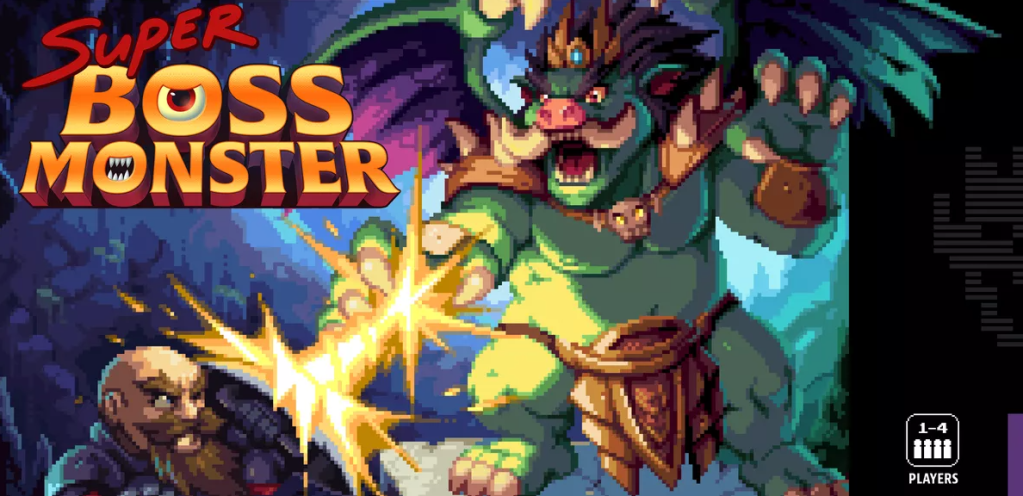
Someone from my game group received their copy of Super Boss Monster and brought it to the table. I love the original Boss Monster despite some of the cards being stronger than others. Super Boss Monster tries to balance cards more than the original, but most notably, it adds worker placement by giving each player a minion they can control and take an action from the town. The town becomes more than the place where heroes are generated.
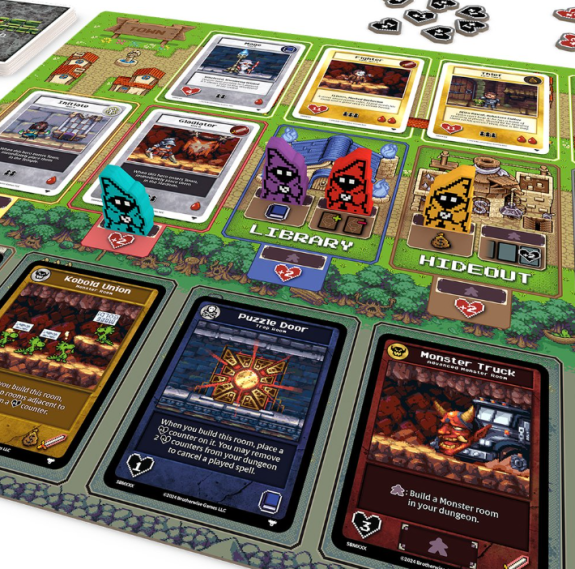
Of course, that still happens, but now I can choose to give myself more perks during a turn, and as you can see at the bottom of the above picture, players draft cards into their hands, giving players more agency. But I was left a little wanting. While these new additions are great in theory, they slowed the game down to a crawl. The original Boss Monster plays in about thirty minutes. Super Boss Monster took two and a half hours. Granted, none of us played the new additions before, but there are so many new additions to Super Boss Monster, and the game adds phases to each turn that I can’t see the game speeding up too much, even if we knew how to play. I was hyped for Super Boss Monster. It’s a good game, but I’ll hold onto my original copy.

Another one of my game group members received their copy of Monty Python and the Holy Grail: The Game. This game has the prerequisite silliness needed to call itself a Monty Python game. It even comes with a set of coconuts, or should I say, horseshoes. If that wasn’t silly enough, Monty Python and the Holy Grail: The Game also comes with a catapult and animeeples shaped like cows, chickens, and pigs. You will be catapulting your enemies.

I wanted to say that I liked Monty Python and the Holy Grail: The Game more than I did, but our gaming group was workshopping ways to streamline how the game played. Most members in this gaming group aren’t designers. I’m a part of game designer groups, and I’d expect discussion on how to streamline a new game. I wasn’t expecting this with Monty Python and the Holy Grail: The Game. I’m also certain I was winning the game (we ended the game early because it ran long), and I did so by abusing the “bring out your dead” space. I waited for the followers’ discard pile to fill up, head to “bring out your dead,” and gained victory points for every follower I shuffled back into the draw deck (that’s how “bring out your dead” works). It felt cheap.
Perhaps we played the game wrong, but Monty Python and the Holy Grail: The Game played longer than it should. The catapult, while fun, slowed the game down further. I liked several elements of this game, but it didn’t make a cohesive whole.
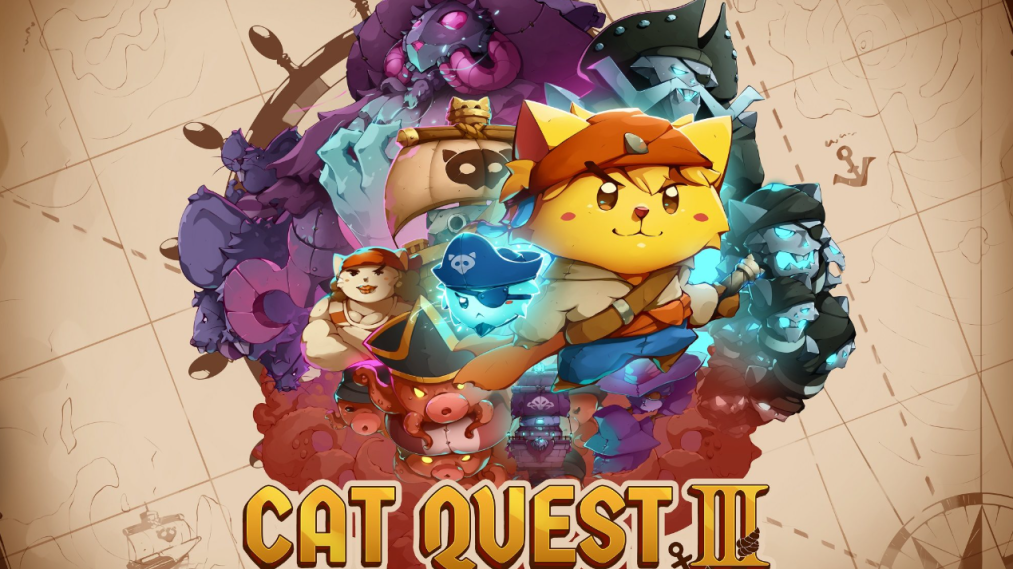
I went trophy hunting this past month. As a result, many of the video games I played weren’t that good. The Cat Quest series is the one exception. Are the trophies easy to obtain? Yes. Very easy. The story is a little thin as well, but the gameplay is addictive. I had a lot of fun playing each entry of the series.
The first Cat Quest allows the player to fly by flapping their arms. Watching a cartoon cat flap their arms and fly is freaking adorable and hilarious. It’s hilarable. The second Cat Quest brings in a dog character to pair with the cat. Cat Quest II had the most strategic value of the trilogy (unsure if there will be a fourth Cat Quest). But Cat Quest III has the best theme (cat pirates), the shortest runtime that promotes multiple playthroughs, and takes all the fun elements of the previous games and builds upon them. Cat Quest may have an easy-to-obtain platinum trophy, but it’s also a fun game series.
That’s all I have for tabletop and video games this month. I’ll pass this post over to Season and Skye, so we can see what they’ve been playing.
Before I dive in, I’m going to level with you, Geekly Gang. I’ve hardly played anything outside of my gacha games this last month. I don’t think a single board game hit the table for me. Finals have been ramping up, graduation is imminent, and there’s a huge conversion project going on at my day job. Without further ado, I’ll share my games.

Thank you to Gigi for recommending Legends of Elysium. This is a beautiful game. It combines tile laying, cards, and mana. It’s sort of like a Magic: The Gathering board game. I didn’t play too much of it, but I enjoyed learning a few strategies and crawling across the map to defeat my opponent. I don’t think there’s a campaign mode to play against the CPU. It’s more along the lines of Marvel Snap and only has PvP available. I’ll have to play some more of Legends of Elysium and collect cards. I definitely want to see more of what Legends of Elysium has to offer.

The other game I’ve been casually playing is Birushana: Rising Flower of Genpei. It’s a visual novel set during the Genpei War in medieval Japan. I stopped by GameStop and thought the art was pretty, so I figured, sure. I’ll take a gander. It is a romance visual novel that allows the player to romance characters who are based on actual historical figures. Not going to lie: I Googled the heck out of the Genpei War and the figures featured in the game because history is cool. I haven’t gotten all the endings yet but, if you’re into romance, period pieces, and great voice acting (Japanese only), I’d recommend Birushana: Rising Flower of Genpei. Also, there’s blood because, you know, war and stuff.
I wish I had more to share this time around. Skye, whatcha been playing?
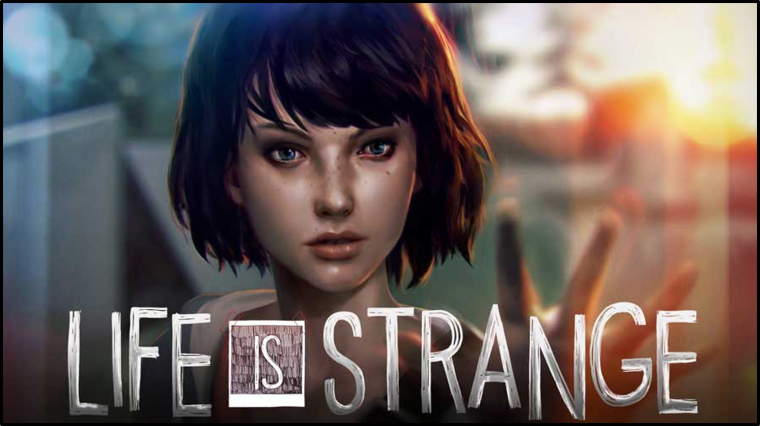
I know I’m late with playing Life is Strange. I’m glad I finally got around to playing it. Life is Strange was released a decade ago, but the game remains relevant and rich in story, characters, and atmosphere. Story-driven games are great at making the player question their own morals, and Life is Strange is no exception. In fact, player choices are even more complicated by allowing players to rewind time and try for the best possible outcome.
Life is Strange wasn’t the first game to feature player choice, but it popularized the genre. For good reason, too. My favorite part is collecting all the Polaroids. I wanna make my Max the best photographer she can be. Life is Strange also happens to have an easy Platinum Trophy to obtain. Don’t judge me! A plat is a plat.

Ghost of Tsushima is another game that’s been a long time coming, and worth it. Ghost of Tsushima has been one of those games that’s difficult for me to put down. One of my favorite aspects of open-world RPGs (or JRPGs in this case) is the exploration. I love gallivanting into the unknown and, bit by bit, uncovering every piece of the map.
Not only is it fun to explore, but Ghost of Tsushima’s combat is stellar (with a learning curve), the story is interesting, and I love its setting of 1300s Japan. The first thing you’ll notice about Ghost of Tsushima is that it’s gorgeous. I haven’t had much time to play any other games, but I’m glad I managed to check Life is Strange and Ghost of Tsushima off my list.
Hey, hey! Kyra Kyle again. That’s what we’ve been up to in terms of board games and video games this past month. Be sure to let us know what you’ve been playing because we’re all part of the Geekly Gang. Thank you for reading, and wherever you are, I hope you’re having a great day.

Hey, hey, Geekly Gang! Kyra Kyle here. It’s another Sunday, so we have another week of Geek News. There is plenty of tariff news and updates, but we talk about that a lot. Let’s sandwich those stories with more cheerful news.
Thunderbolts* becomes the first MCU movie in history to receive advanced screenings for fans. Typically, advanced screenings are reserved for critics, who must sign a non-disclosure agreement and a gag order preventing them from leaking any information about the movie. Advance movie screenings are meant for critics to form an opinion and write a review in advance of the movie’s release. Those reviews will feature zingers the studio can use in future trailers and teasers. But Thunderbolts*’ advanced screening includes fans. Fans don’t care about a gag order.

In fact, the MCU may be banking on fans talking, generating word-of-mouth buzz. It takes a week or so for word-of-mouth to take effect. Thunderbolts* dropping advanced screenings with fans will accelerate this effect. But be careful on the internet. Thunderbolts* may become the MCU movie with the most spoilers.
Geekly has no idea what this development means for the MCU or the Thunderbolts* movie. Will this become the norm? Is Marvel so confident about Thunderbolts* that they’re comfortable with whatever fans will say? Who knows? I will say that heading into this year’s slate of films, Thunderbolts* had me intrigued. Thunderbolts* wasn’t one of the MCU’s make-or-break 2025 titles, but in our 2025 MCU Preview, I listed it as a potential sleeper hit.
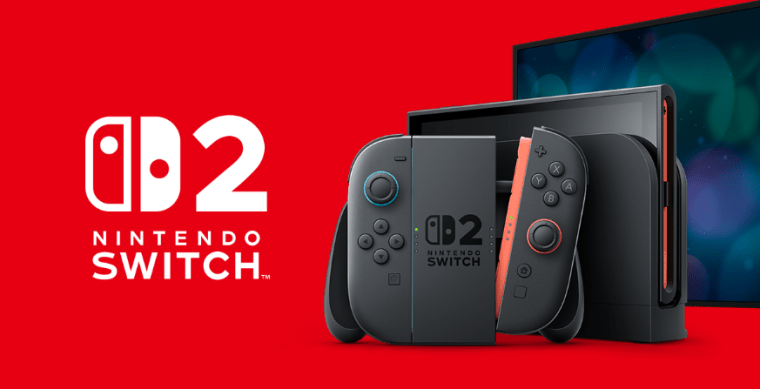
On Thursday, April 24, 2025, Nintendo opened United States pre-orders for its latest hybrid game console, the Switch 2. Pre-orders continued until the order quota was reached. Taking current United States trade policies into consideration, the order quota was based on how many copies the video game company thought would yield the best results.
The Switch 2’s United States pre-order wave one lasted less than one day. Customers who were able to buy a copy won’t receive their systems until June 2025. Don’t worry if you weren’t one of the lucky few who snagged a copy. Nintendo intends to run another Switch 2 pre-order within another eight months (in time for the holidays), when the company believes it can turn a profit by sending systems to the United States. Unfortunately, staged releases for the United States are the new normal.

Rising shipping costs and tariffs have caused tech companies like Nintendo to re-evaluate their business with United States customers. This has become an issue with other business types; Geekly covers geek culture, so we’re interested in video games and board games. We’ll have more on board games in the next segment. Getting back to the Switch 2, most of Geekly’s statistics are derived from an interview with a GameStop manager. I live in the greater Omaha area, and according to the GameStop manager, the Midwest quad-state region (Nebraska, Iowa, Kansas, and Missouri) received 2,000 total Nintendo Switch 2 systems. That is 2,000 Switch 2s for a population of over 14 million. Granted, most of the 14 million people living in those four states have no desire to purchase a Switch 2 at this time, but Wal-Mart overordered and had to issue tens of thousands of refunds in the Midwest quad-state region alone.
Geekly will keep you posted on when the next waves of United States Switch 2 pre-orders will occur. Good luck to all of you who want a copy. We’ll also give updates on any new developments. Hopefully, there will be a resolution to the United States’ trade war soon.

We’ve discussed board game companies and the effect rising tariffs have had on them in the past; this will be a quick update. Final Frontier Games and Boardlandia have closed their doors. Greater Than Games and CMON Games have suspended all future crowdfunding campaigns and board games under development, and laid off countless employees until a viable manufacturing/shipping option becomes available. Small board game publisher, Rookie Mage Games, joined forces with three other indie board game companies in suing President Trump over his new tariffs.

According to Jordan McLaughlin, founder of Rookie Mage Games (via The Columbus Dispatch), “I will not stand by and allow my years of hard work and the hard work of many other small businesses to be ruined in a desperate political ploy for attention and ego validation.” McLaughlin continues, “Attempting to move manufacturing jobs back to the United States is a worthwhile effort. There are smart ways to do it, and there are dumb ways.” Numerous board game companies, including Stonemaier Games (producer of Wingspan and Scythe) have joined Rookie Mage Games’ lawsuit. We’ll keep you posted on this emerging story.

The award-winning board game adaptation of This War of Mine returns to Gamefound. This War of Mine features countless morally gray choices for players to make while they attempt to survive in a war-torn country. Since the game is fully cooperative, players share the experience and the consequences.

This War of Mine, Second Edition showcases numerous updated maps to explore. Producer Awaken Realms is known for its ornate miniatures, and This War of Mine, Second Edition includes additional scenario books. Countless hours of griping stories await. This War of Mine, Second Edition has plenty of pledge options on its Gamefound page.

I love the increased number of great solo board games. Dicemancy looks interesting. It’s a tower defense game with plenty of combotastic abilities. That’s music to my ears. Players construct unique spells they think will help them ward off enemies. I like the domino-style spell cards players can stack for power-ups. Dicemancy plays quickly (about 45 minutes), has minimal setup, and doesn’t appear to take up too much table space.
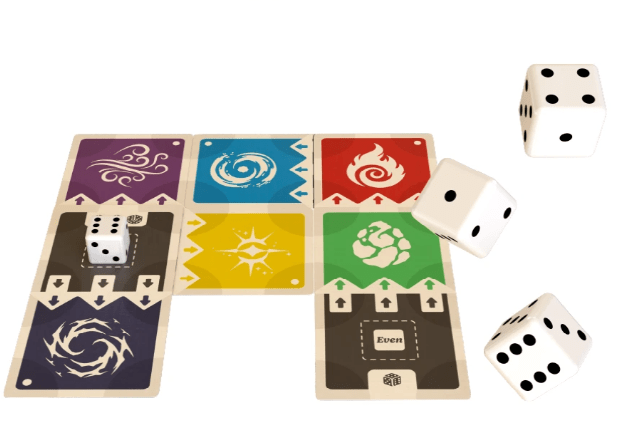
Dicemancy features adorable art, and at $25 (plus $5 for shipping), it’s a low-cost option for a new board game. Feel free to give Dicemancy’s Gamefound page a look.
That’s all we have for Geekly News this week. Thank you for reading, and wherever you are, I hope you’re having a great day.
Today’s video game cult classic is a pet simulator. Something like Nintendogs may come to mind when you think about pet simulators. Fighting pet simulators? Pokémon dominates fighting pet simulators, but I’m thinking about a lesser-known fighting pet simulator. That’s right. Monster Rancher is making an appearance on this month’s Video Game Cult Classics.
Hoppy Easter, everyone! Season here. We’ve got another video game series that spawned an anime and, coincidentally, came out in the ‘90s. Don’t worry. I’ll branch out. Monster Rancher (or Monster Farm in Japan) is a game that allows the player (rancher) to raise one monster at a time from a baby to an adult. Monster Rancher is like a cross between a Tamagotchi and Pokémon (later iterations incorporate more Pokémon like features). Like the last cult classic we covered (Culdcept), for a video game to make this series, we’ll consider its reception, relevance, and accessibility. Prepare your monsters for battle, and let’s delve into gameplay.
Quick note: most of the gameplay you’ll see comes from Monster Rancher and Monster Rancher 2. I’m most familiar with these two games, and they embody the series’ core concepts. There are a few offshoot games I’ll mention in the accessibility section, but they won’t be the focus.
Monster Rancher has gameplay that’s easy enough to pick up on, but has a learning curve for those interested in getting the most out of their monsters. In Monster Rancher and Monster Rancher 2, players assume the role of a rancher and work with an assistant. Monster Rancher 2 has a quiz for players to take at the beginning of the game, but it doesn’t affect the gameplay.
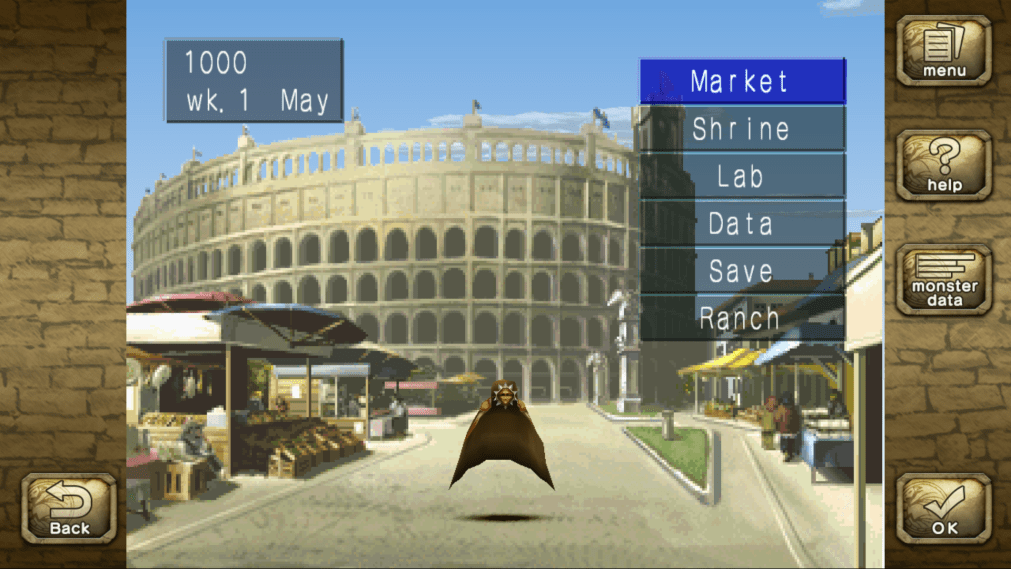
Once players get their assistant (Holly in Monster Rancher and Colt in Monster Rancher 2), they’re ready for their monster. Players can either go to the Market or the Shrine to acquire a monster. Players can also obtain new monsters at the Lab, but they’ll need to have two frozen monsters (that they can combine) to birth a new one.
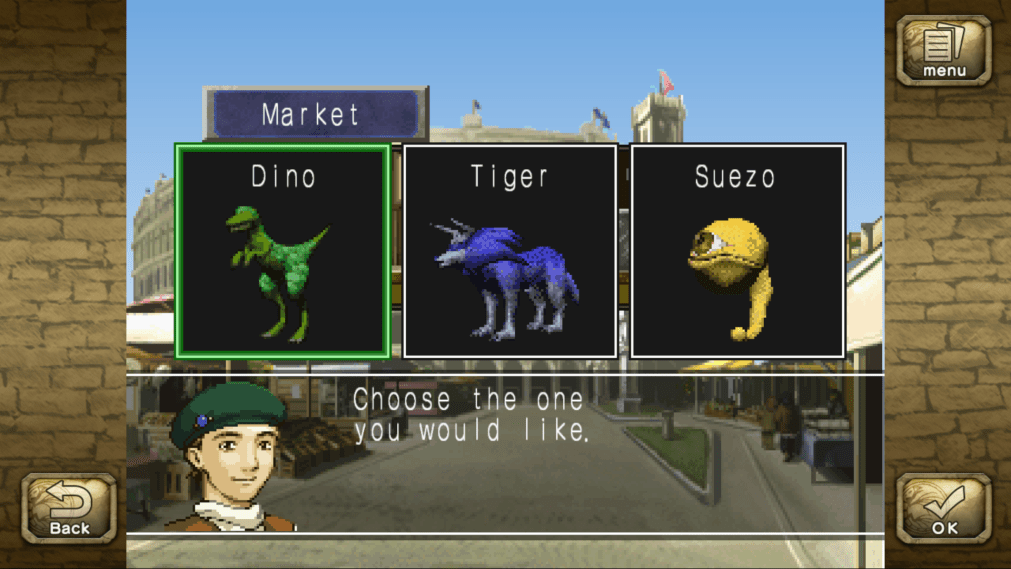
Monsters in the Market are seasonal. These monsters will be base species with not-so-great battle stats. Pictured above, we have a baseline Dino, Tiger, and Suezo. These monsters are good options for players who don’t have many CDs/PS1 game discs, or if you want something simple for a starter monster.
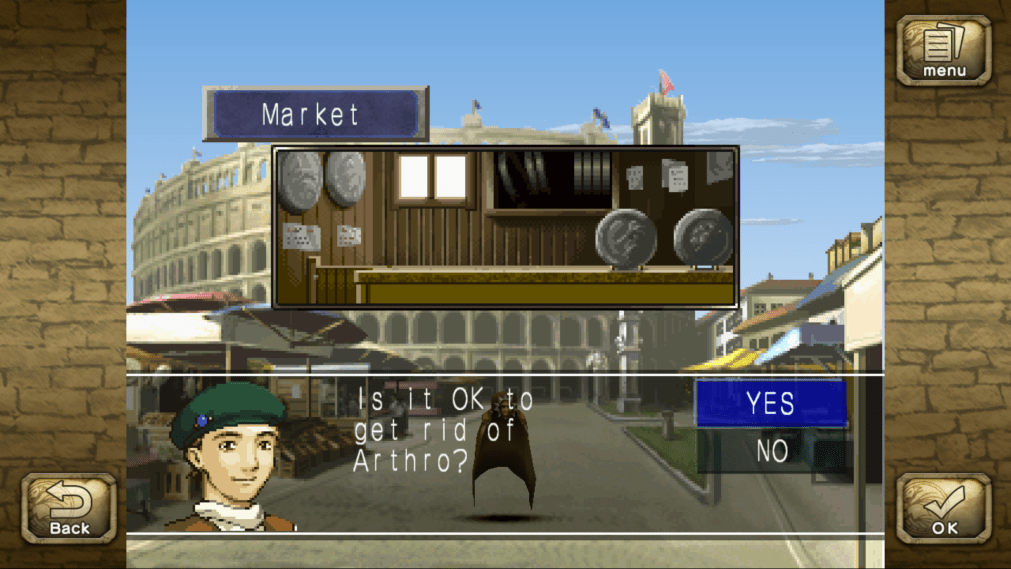
Players may also give up a monster to the Market if they no longer wish to keep the one they currently have. Personally, I never do this because I get attached to my virtual pets. If this happens on accident, there’s no need to worry. Autosave won’t screw anyone over.

The Shrine is where the magic happens. At least, that’s where it happened for me when I played as a kid. Who am I kidding? It still happens. At the Shrine, players can select a CD/PS1 disc to put into their system to get a random monster. After the game reads the disc, it generates a monster based on the disc data. The same monster will be generated from each disc. In other words, if the player remembers which monster was generated from a specific disc, they’ll get the same monster with the same stats every time.
If the same monster gets generated from a different disc (it happens a lot), the monster will likely have different stats. Make sure to remember the discs that have the stats you want to keep.
Players can visit the Lab at the start of the game, but there’s no need to unless they want to generate two different monsters and try to get something different at the Lab. The Lab is more useful after a player has fully raised at least two monsters who have learned many fighting techniques (we’ll get to those later). The following images for the Lab section are taken from Monster Rancher 2.

At the Lab, players have the option to combine monsters to get a new monster, freeze the monster they have with them, revive a frozen monster, delete a frozen monster, or analyze the monster they have with them. Analyzing a monster gives the player insight into how to raise their current monster and its personality.

It costs 500G to combine monsters. 500G is a hefty sum at the start of the game; it’s not so bad later on, once a player’s monsters compete in tournaments and win money. Players will select two of their frozen monsters to combine (players may have up to twenty frozen monsters at a time).
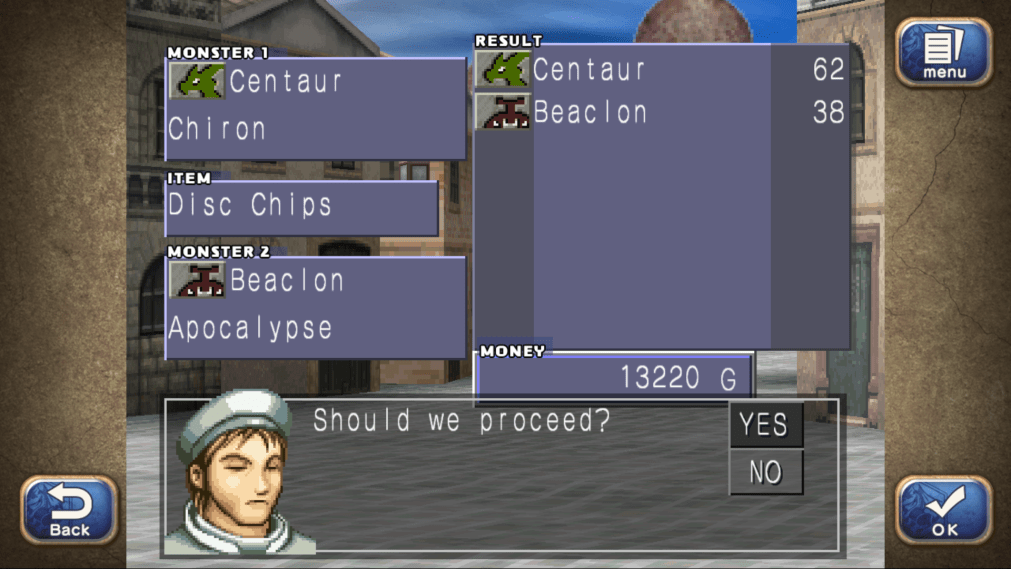
In Monster Rancher 2, once the two monsters are selected, the game will ask if the player wants to use an item as a secret seasoning. Secret seasonings (such as Disc Chips) can offer the player other options for monsters. In this case, even though I used Disc Chips, Dragon isn’t offered as an option. This is because the monsters I chose can’t be combined into a Centaur with a Beaclon as a sub-species and vise-versa. Since they’re not compatible anyway, adding Disc Chips from another monster won’t grant me additional outcomes. They also don’t have many matching stats (the stat levels don’t match per monster).
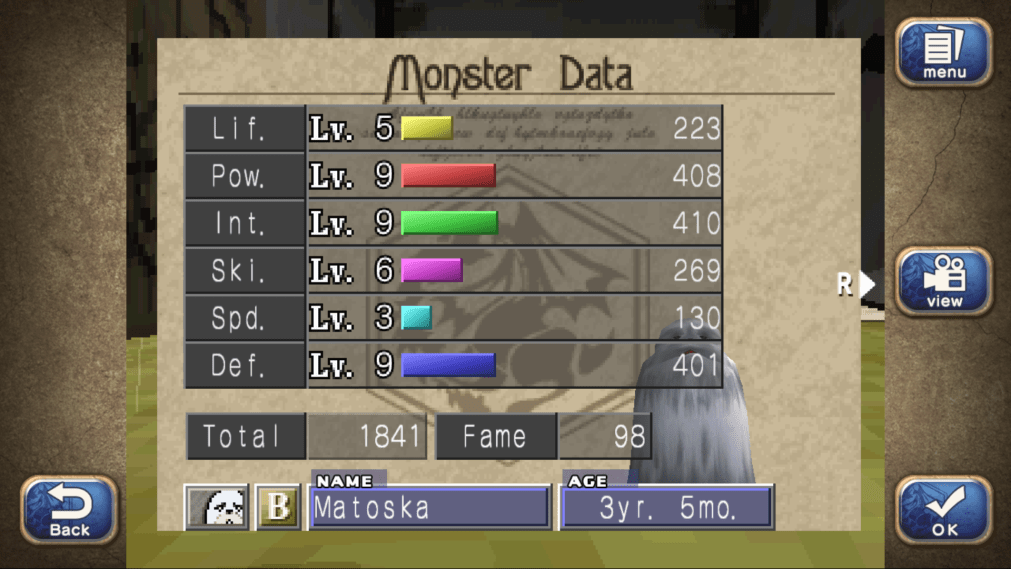
There are a total of six stats, so to get the best possible outcome, the two chosen monsters must have all six stats at matching levels. The levels here are shown next to each stat.
Here’s a quick rundown of each stat:
Life (Lif) is a monster’s hit points.
Power (Pow) is how strong a monster’s Power-type attacks are.
Intelligence (Int) measures how strong a monster’s Intelligence-type attacks hit.
Note: Power and Intelligence are interchangeable, depending on the monster’s technique types.
Skill (Ski), also called Accuracy (Acc) in later games, is the likelihood of how often your monster’s attacks hit.
Speed (Spd) affects your monster’s ability to avoid attacks.
Defense (Def) determines how much damage your monster receives.

As we can see, I ended up with a terrible outcome. That’s not bad in the Pow. and Def. department, though. Looks like I’ll have to specialize in Power-type attacks.

Back to the first Monster Rancher. Once the player returns to their Ranch, there are options for their monster. Monster Rancher operates in a week-by-week system, so players may select one thing for their monster to do each week. During Week 1 of every month, players must feed their monsters. In Monster Rancher 2, players may check the monster’s data to see what the monster likes and dislikes. Usually, food will be listed as a like or a dislike, but there are exceptions. If a player feeds the monster food it doesn’t like, it’ll be less likely to perform well.
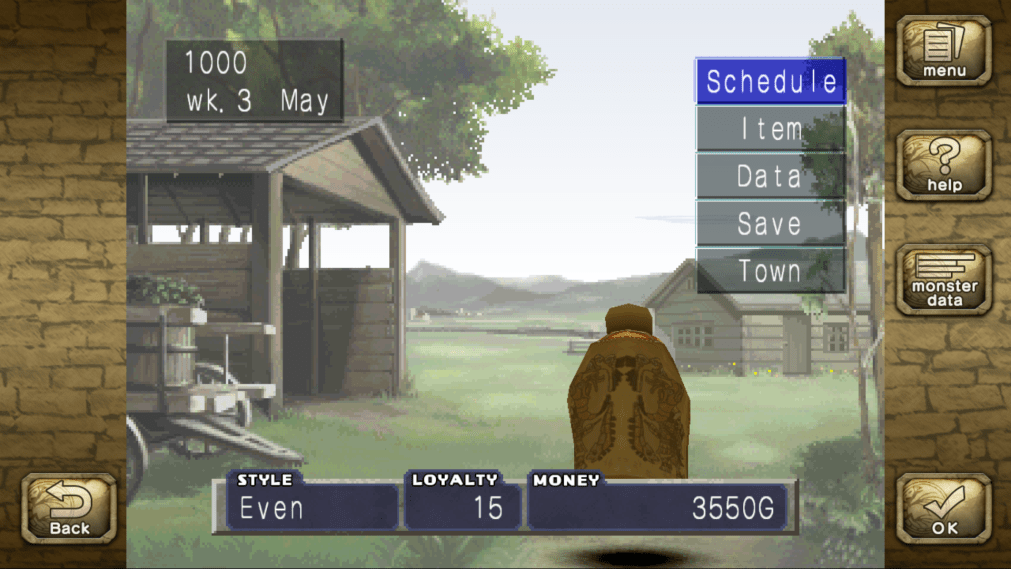
We’ll skip over Schedule for now since it’s going to be lengthier and lead into battles. Starting with the Item option, this will allow players to either buy/sell items from the shop or give an item to their monster. Be careful which item you select as monsters can only accept one item per week.

The Data option allows players to view their monster’s stats, history, and techniques. It also shows the players’ information about themselves through Breeder, such as their rancher grade, the number of monsters they’ve raised (including species), and what their monsters’ final ranks were before they either pass away or get frozen.

The Book subsection shows the player information about monsters at the market and monsters they’ve raised with some flavor text. Players may also view the monsters in action, as well as their species.
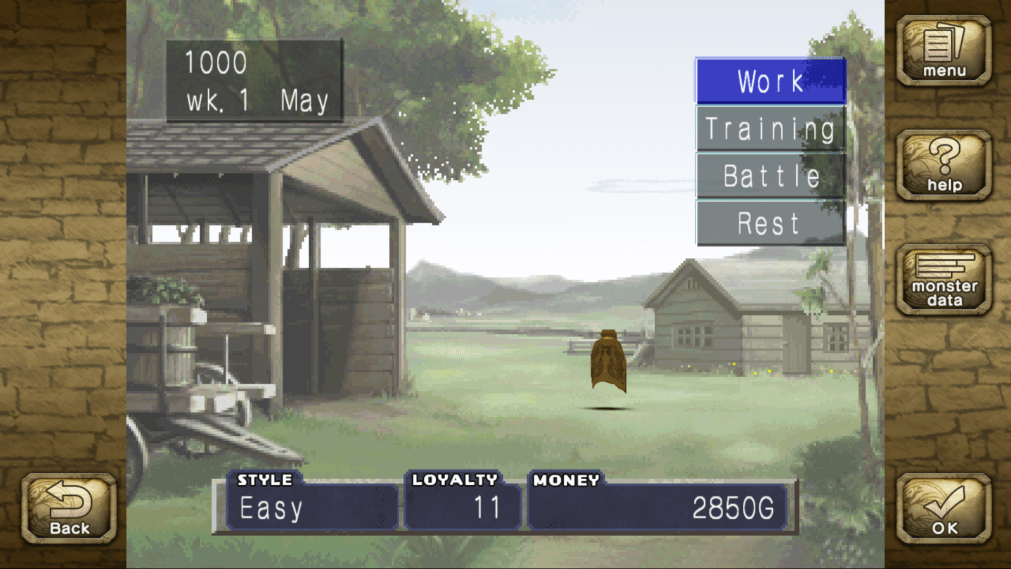
The Schedule option on the menu lets players either train monsters, battle in a tournament, or rest for one week.
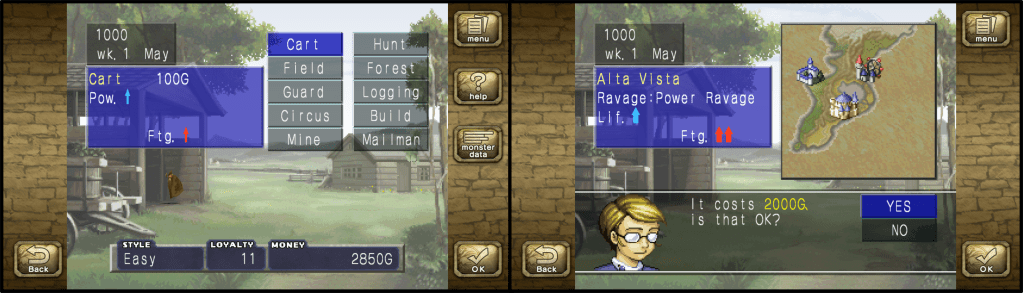
The Work option (or Drill in Monster Rancher 2) is for one week and allows the monster to train in one or two stats at a time. For Training (Errantry in Monster Rancher 2) allows the player to select a location to send their monster for one month. This will normally cost the player 2,000G, but will sometimes be at a discount for 1,000G. In Monster Rancher 2, this allows monsters to learn new techniques. In Monster Rancher, monsters must be old enough and have high enough stats to learn new techniques with a trainer in town (through the Adventure option).
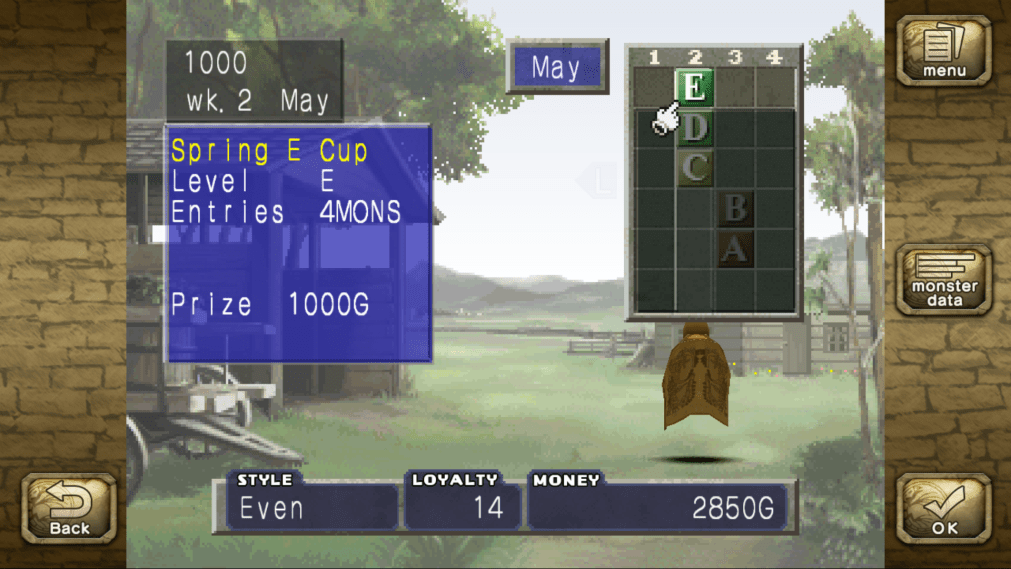
The Battle option allows players to send their monster into a tournament to win some cash and, occasionally, an item. Before any battle, the player can ask Holly about their opponent (usually their highest stat), how to execute a technique, and how to move their monster. Holly will ask if the player wants to give instructions to their monster. If the player selects no, the monster will battle by itself. If the player selects yes, they control their monster during battle.

Each battle starts by showing stats for both monsters. Arthro has more Intelligence-type techniques, so I’ll prioritize Intelligence during its training.
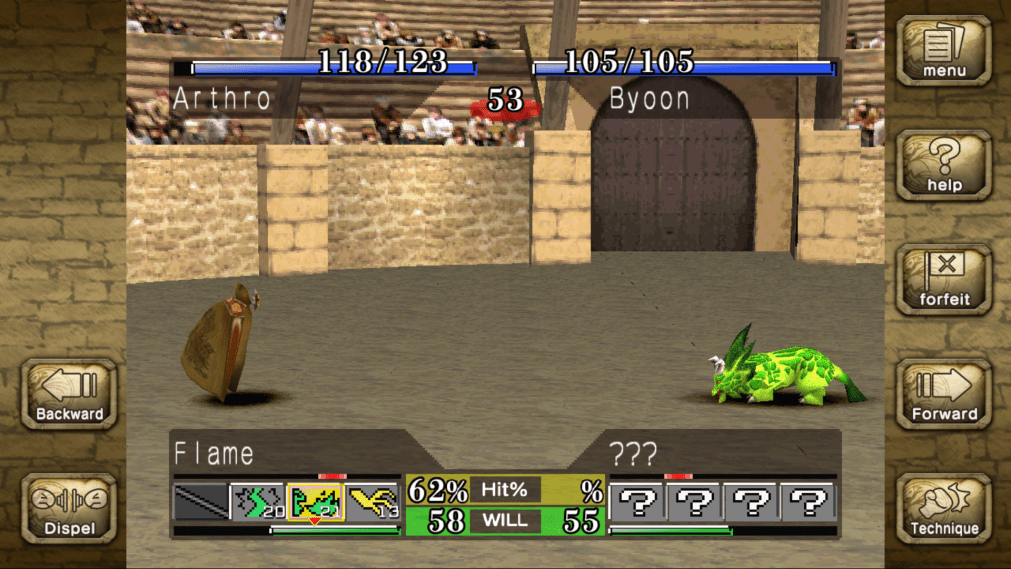
During battle, monsters have four zones (depending on their distance from their opponent) in which they may attack. Not all zones will be occupied by techniques, but that may change after a monster learns new techniques. Monsters execute techniques depending on how much Will they have (Guts in future Monster Rancher games). Techniques require a certain amount of Will, which gradually regenerates during battle, so choose techniques carefully.
Each technique also has a hit percentage, which will tell the player how likely that technique is to hit the opponent. Flame has a 62% chance to hit my opponent here and costs 21 Will. Also, what Byoon is doing in this picture is called “Foolery” (not listening to their rancher). This frequently happens when monsters don’t have much loyalty to their rancher.

Tournament battles last for sixty seconds. When time is up, the winner is determined by who has the most Life remaining. If a monster gets knocked out, a battle can end sooner. Yay! Arthro won!
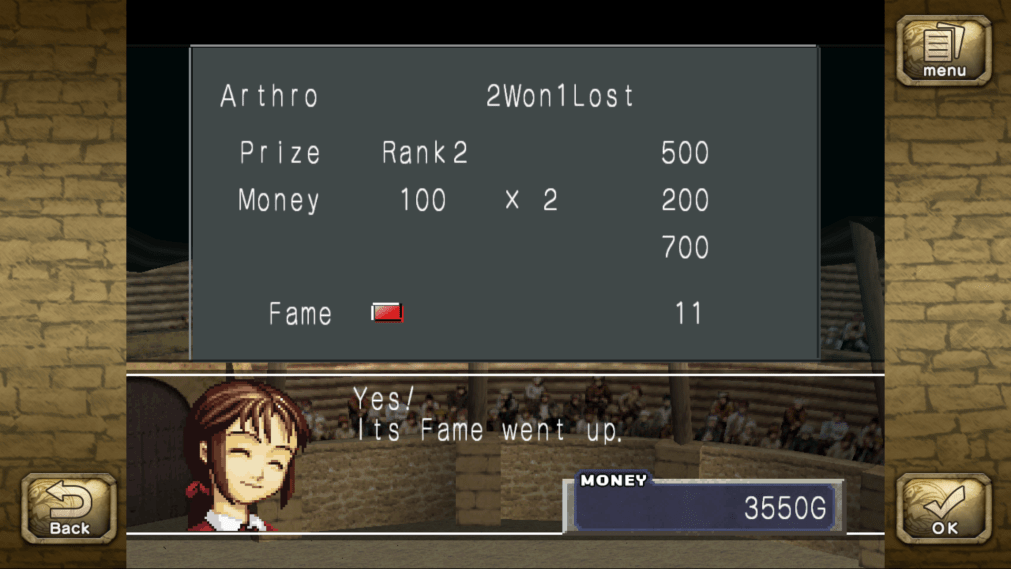
When a tournament ends, prize money is doled out based on the monster’s rank, determined by the monster’s wins. Players also receive bonus money for battles won. Here, I got second place. Notice the monster also has Fame. Fame goes up the higher a monster places in a tournament, which can lead to things as the judges awarding a player’s monster a win during a close battle and increased prize money. In Monster Rancher 2, Fame allows monsters to go on adventures and discover items necessary to unlock new monster species.
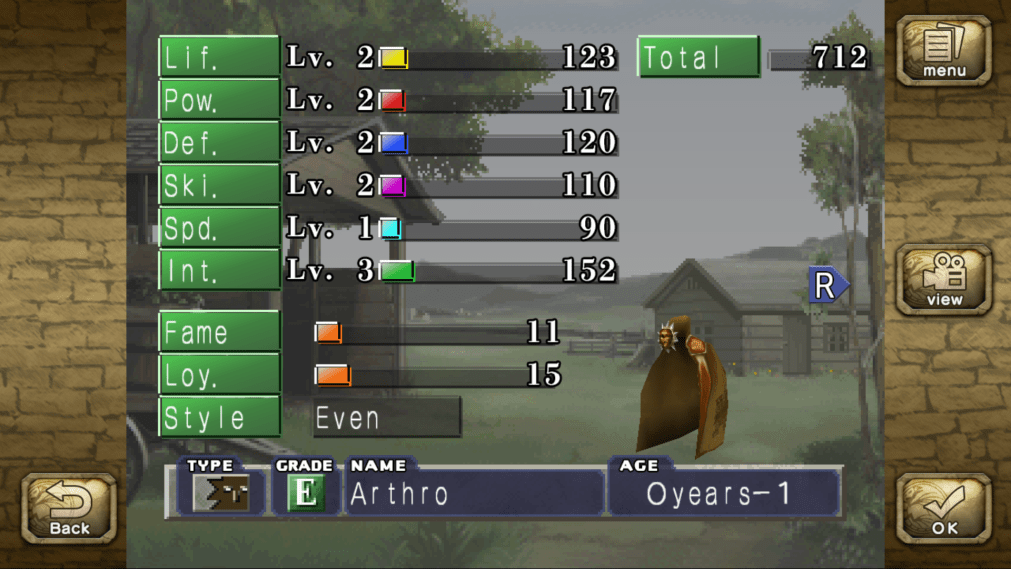
I’ll touch briefly on official tournaments. Monsters can be ranked from E (lowest) to S (highest). Every baby monster starts out at E rank. Official tournaments allow monsters to raise their rank. These tournaments occur at the end of every quarter. They include more opponents but offer less prize money. Official tournaments are essential for monsters to compete at more prestigious tournaments and to unlock more species of monsters. Since Artho is a baby, it’s an E rank.
The lifespan of a monster depends on the monster’s species and how it’s raised. Their lifespan also affects when each monster reaches their prime, which is the point in a monster’s life when training gives them the most stat boosts.

Monster Rancher has fifteen games spanning from 1997-2022. The original Monster Rancher sold over one million copies before 2000. It was a popular game that capitalized on people collecting discs. It filled a niche that exploited the success of Tamagotchi and disc collection. In later Monster Rancher games, such as Monster Rancher EVO, people could use DVDs in addition to CDs and PS1/PS2 discs. There were some other strange releases, like the platformer Monster Rancher Hop-A-Bout that played similarly to Super Mario Bros. Honestly, I’m not sure what they were thinking with that one.

During the height of Monster Rancher’s popularity, an anime series was produced from 1999-2000. The series consists of seventy-three episodes over two seasons. It follows a boy named Genki Sakura and Holly, the assistant from the original Monster Rancher.
Monster Rancher lost steam during the transition from people collecting discs to streaming and became irrelevant. People no longer collect discs. Okay. We have a bookshelf full of discs at my house, but that’s an anomaly. Monster Rancher jumped on the Tamagotchi bandwagon, raked in the cash, and then faded. It’s still popular inside Japan, and Koei Tecmo Games keeps Monster Rancher relevant by catering to their Japanese audience.

Monster Rancher’s original producer, Tecmo, merged with Koei to create Koei Tecmo Games in 2009. The Tecmo part of Koei Tecmo was dissolved in 2010. The company used the Tecmo name until 2016. This may have contributed to the direction of the Monster Rancher franchise.

If one were to look online or in their local game store for a copy of Monster Rancher, it’s slim pickings. These games are available for purchase online, but at an increased price. Original copies cost the same as a new video game. Despite this, Monster Rancher and Monster Rancher 2 are accessible to the public through Steam. That’s right. All of the screenshots I’ve taken for this article are from Monster Rancher 1 & 2 DX on Steam.
These ports differ slightly from the original games (such as monster lifespans), but they’re so similar to the originals that it feels nostalgic. The Steam ports also have an option to search their database for discs to read, so there are hundreds of options that wouldn’t be available to someone who doesn’t collect discs.
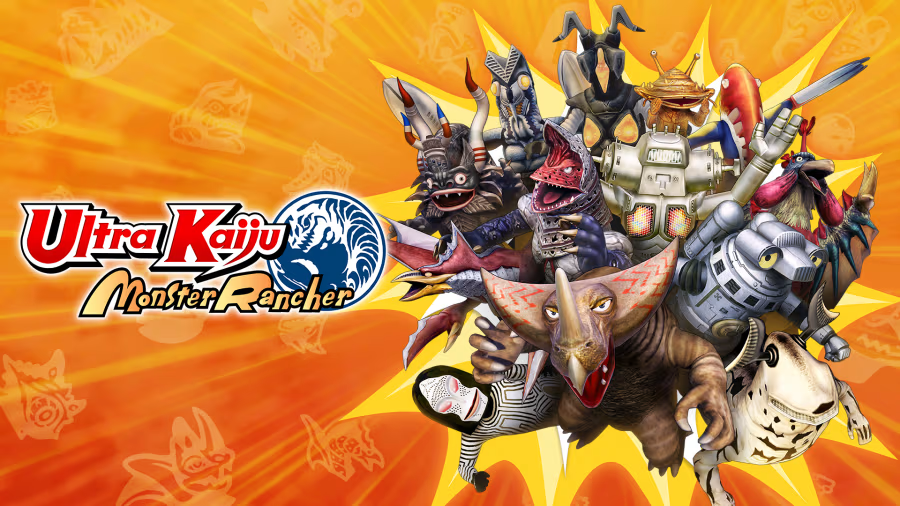
Other games in the Monster Rancher franchise are less accessible. Ultra Kaiju Monster Rancher is the most recent entry. Players raise kaiju monsters the same way they would monsters from the original games. I’ve never heard of this game before conducting research, but it’s available to download from the Nintendo e-shop. As of the time of this posting, it’s on sale until April 28, 2025.
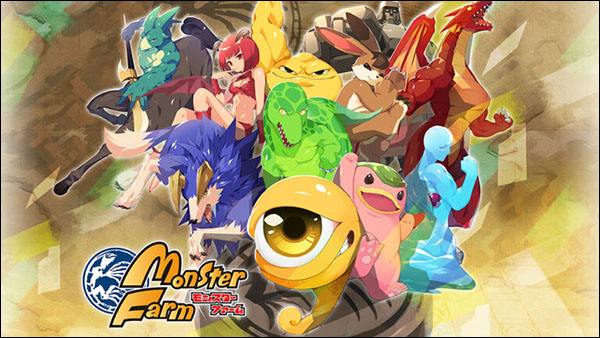
As of this post, a Monster Rancher mobile game will release in Japan only later this year. This game will be available on the popular East Asian messaging platform, LINE. I’m unsure of this game’s inner workings, but it seems like players will be able to interact with their monsters directly. Maybe it has some sort of AR model like Pokémon Go.
One last thing. If anyone is interested in the anime side of things, Monster Rancher is available to watch on Amazon Prime Video without ads for Prime members.
Monster Rancher is a franchise I grew up with, and it’s one of my favorite pet simulation games. It’s great for casual and hardcore players. There’s a science behind raising these monsters that players can learn. It can get tedious, especially when you get a new monster and must start the raising process again. It takes time to unlock new content. There are always new mysteries to solve in Monster Rancher, and every monster is unique.
Do you have a preferred breed/species of monster? What’s your favorite monster you’ve raised in Monster Rancher? If there are any cult classics you’d like to see covered in future posts, let us know in the comments. Thanks for reading and have an amazing rest of your day.

Happy Easter if you celebrate the holiday. If not, happy Sunday. We have another week of geek news. What better way to celebrate than to cover the second Fantastic Four: First Steps trailer and reveal its Easter eggs?
Hey, hey! Kyra Kyle here. We may go light on geek news this week, Geekly Gang. I’m not going to lie. I’ll be eating my body weight in sweets, but the MCU dropped the second Fantastic Four trailer, so let’s dish.

The biggest reveal the second Fantastic Four: First Steps trailer gave us was the upcoming movie’s basic plot. Speculate no further. The movie will revolve around Galactus visiting this version of Earth. This story looks like it may parallel the Avengers’ Battle of New York during their first movie. Aliens invade. The world’s protectors need to intervene. But while the Avengers were either unknowns or distrusted, the Fantastic Four are treated as celebrities, as evidenced by their appearance on the Ted Gilbert Show and how civilians treat them. I love the interactions we see during this montage. Gilbert says, We can never repay them, but we can celebrate them. And the Fantastic Four are celebrated.

I also like that the show host’s name is Ted Gilbert, which is an obvious play on the Ed Sullivan Show. We mentioned in our post about the first trailer that the Fantastic Four are introduced on a stage similar to the Beatles when they played on the Ed Sullivan Show. Ted Gilbert is the perfect name for an alternate timeline Ed Sullivan. I love the Gilbert and Sullivan reference. I may have to rewatch The Pirates of Penzance.
“I am the very model of a Modern Major-General…”

I’ll stop.
Ted Gilbert succinctly breaks down the Fantastic Four’s origin. Four brave astronauts head up into space and come back forever changed. We’ll probably see snippets of the Fantastic Four’s origin, but I like that First Steps won’t go into the team’s origin in great detail. I also like that Fantastic Four: First Steps takes place on an alternate Earth. Moviegoers won’t need to watch (or rewatch) hours of MCU content to prepare for Fantastic Four: First Steps. Sure. There will be nods to the multiverse. The Fantastic Four will approach this subject because they’ll need to mosey over to the main MCU timeline, but there should be little to no “MCU homework.”
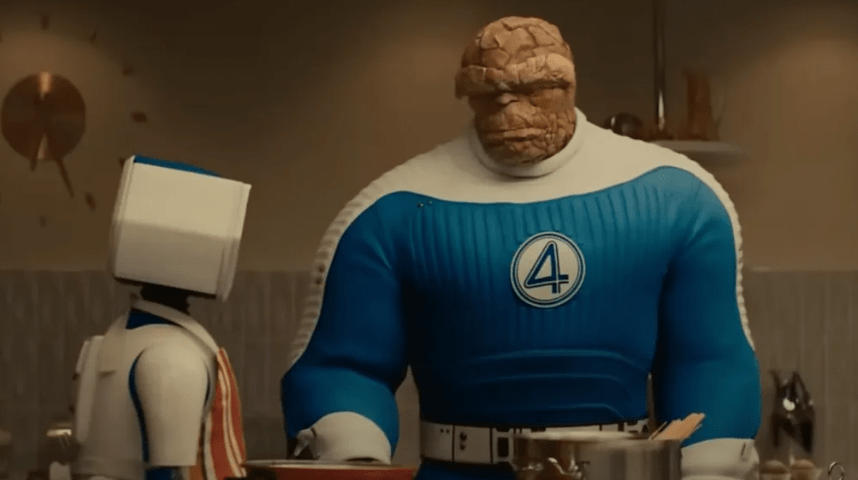
The second trailer revisits the dinner scene from the first trailer, but we receive a bombshell of a plot thread. Sue is pregnant with Franklin Richards. This could be huge. First, Franklin Richards is a mutant, so he’ll fit right in with the upcoming Mutant Saga. Second, Franklin Richards would be one of the most powerful characters introduced in the MCU, and that includes Asgardians and even Galactus. Third, there is a storyline where Franklin controls Galactus.

Yes! I like that this Fantastic Four is a veteran team, and we may not need to wait too long for Franklin and Valeria (von Doom) Richards’ mayhem. Oh, yeah. Valeria has a mean streak like her godfather Victor. This should be fun. During the second trailer, Reed Richards mentions that the Fantastic Four may have stretched the boundaries of space, and they (Galactus and his heralds) heard. I like this angle. Typically, Reed gets the Fantastic Four and the Earth at large into trouble that he must then get them out of, but there may be another reason Galactus chooses to visit Earth. The MCU may be setting up a Galactus-Franklin Richards dynamic.

Galactus looks great in the little we see of him. I’m less thrilled about Shalla-Bal’s look. Shalla-Bal is the woman Silver Surfer. In the comics, Shalla-Bal is the empress of the planet Zenn-La, the planet where Norrin Radd (Silver Surfer) originates. Shalla-Bal was introduced as a character in the 1960s (she’s also in the underrated ’90s Silver Surfer cartoon, which is available on Disney+), and she’s Radd’s longtime love interest.
Shalla-Bal has powers comparable to the Silver Surfer and has served as one of Galactus’s heralds, but she is a different character. Shalla-Bal’s inclusion leaves the door open that Norrin Radd could appear in the MCU’s future. Getting back to my original point, Shalla-Bal’s CGI looks rough. I hope this is an issue with the trailer and not the movie, and the final graphics for the movie look better. Movies work on their graphics until the film is released. Fingers crossed.
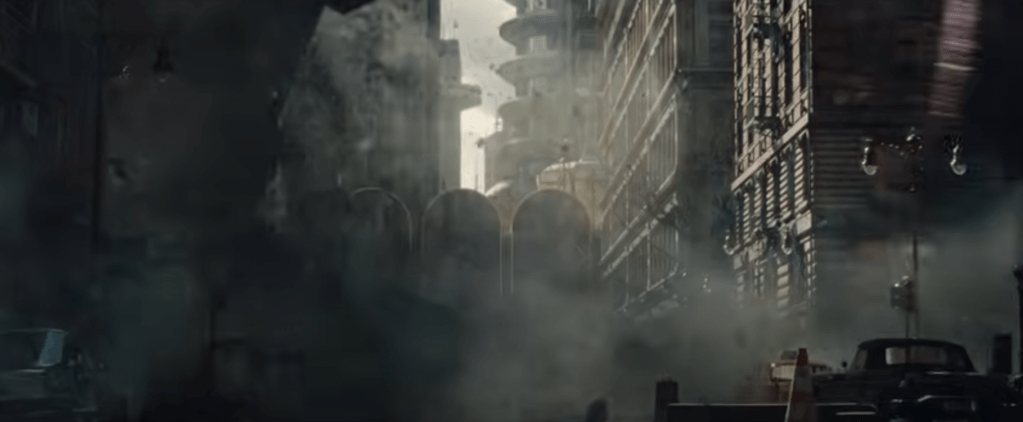
The second trailer ends with Galactus taking a stroll in downtown New York City. This could be a nod to Godzilla or the Stay Puft Marshmallow Man from Ghostbusters. Classic.
If you can’t tell, I’m hyped for Fantastic Four: First Steps. This second trailer introduces some great plot points but holds back enough for the audience to discover when the movie releases in July.

In Quorum, players take on the role of Roman senators who share the power of Rome and its provinces. The goal is to be the most powerful and influential senator by gaining victory points, which are awarded in various areas of influence over twelve rounds.

Designed by Raul Franco and Fran Martinez, Quorum accommodates 2-4 players and lasts about 45 minutes. The game’s double-sided cards show a province on one side (which will score points in that province on the central board) and on the opposite side show one of four groups: military, intrigue, architecture, and commerce, which grant different bonuses when placed in the player’s personal zone. Players are presented with interesting choices each turn. Quorum is easy to learn and quick to play, but offers plenty of strategy.
Check out your local game store or Devir Games’ website.

We have another interesting board game release this week, Hutan: Life in the Rainforest. Inspired by the Indonesian rainforest, Hutan allows players to step into the rainforest’s natural splendor.
Each player controls their own patch of rainforest, where they will plant seeds that, over time, will grow into towering trees. When a habitat is created, an iconic forest animal arrives: the orangutan, the Sumatran tiger, the rhinoceros hornbill, the cassowary, or the Sumatran rhino. Hutan plays over nine rounds. All players have two turns each round. On your turn, you may take a flower card from the shared market and place the flowers into your rainforest. If you place a flower on top of a matching flower, you grow a tree. When an area has nothing but trees, the last tree is replaced by an animal. The player with the most animals wins.
Hutan: Life in the Rainforest accommodates one to four players and lasts about 45 minutes. Check your local game store or OP Games’ website.
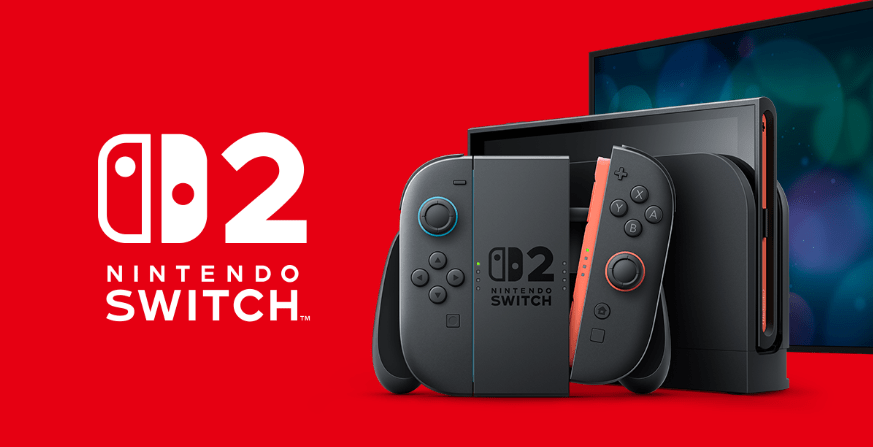
After several weeks of deliberation (over tariffs and price hikes), Nintendo announced that customers in the United States can preorder their Switch 2 starting April 24, 2025. Pricing for the a la carte console and bundle with Mario Kart World will not change, but prices for accessories like extra Joy-Cons, a Switch 2 Dock, and the new pro controller received price bumps between $5 and $10.
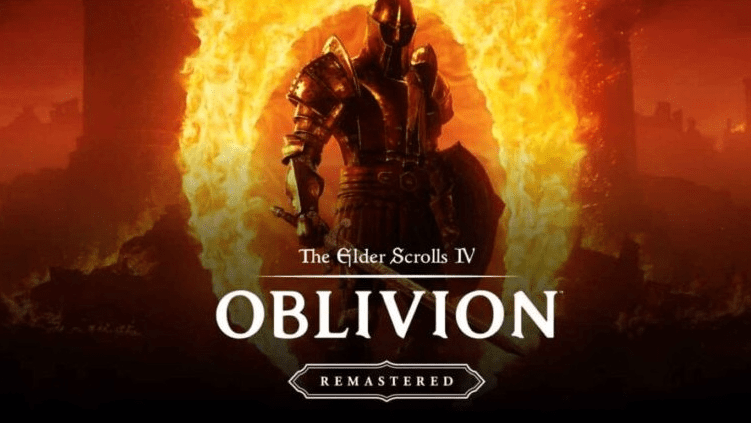
The rumored Oblivion remaster/remake that will release soon had some screenshots leaked this week on the developer’s website. An Oblivion remaster/remake has been believed to be in production for the past several years. Some wondered if the game would release last year for the holiday season. It doesn’t appear that Bethesda/Zenimax will wait for next holiday season. Check out the screenshot below.
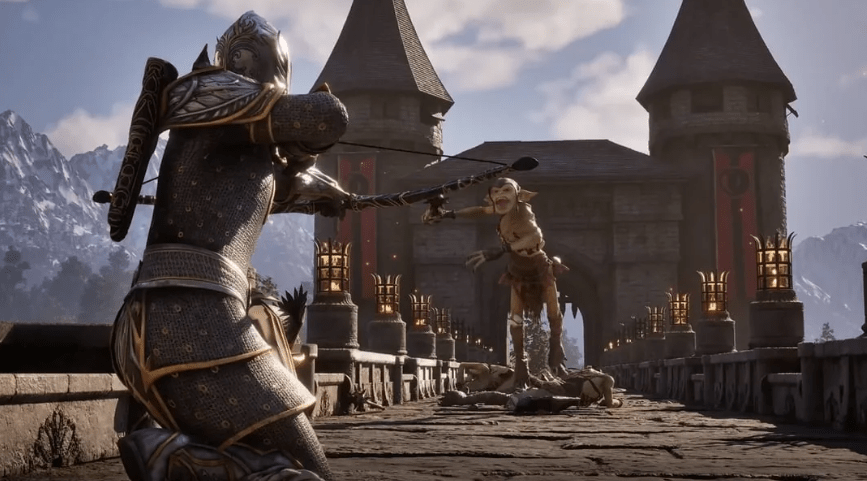
The new rumor is that the Oblivion remaster/remake will be announced and released next week. I may have some gaming to do. If you need me, I’ll be in Cyrodiil.
That’s all the geek news we have for you this week, Geekly Gang. Thank you for reading, and wherever you are, I hope you’re having a great day.

Today marks our first post for Geekly’s Whatcha Playing series. In this series, the Geekly Gang will share which games (board games and video games) they played over the last thirty or so days. We welcome you to join the Geekly Gang and share the games you played this past month.
Before I get started, I’m not going to include any of my prototypes. Of course, I’ve played my prototypes plenty of times this past month, but I’ll include those games with our upcoming “Fifth Wednesday, Personal Updates” post. Until then, I’ll discuss the games I’ve played this past month that I didn’t design.

I fell down The Survivalists rabbit hole. For a week last month, I spent almost every day trying to build each structure and cook every recipe. I’ve never played The Escapists. The Survivalists are set in the same world, and I don’t think I missed too much for not having played the game that inspired its world. This game plays like a low-pressure version of Ark: Survival Evolved. Obviously, I like this game. I played almost forty hours in just over a week. Yikes!
I’ve been keeping up with Wuthering Waves and Honkai: Star Rail. Geekly has a review on both of these gacha games. I haven’t played too many video games this past month besides these three games. I’ve mostly played board games.

I played Dice Throne for the first time this past month. It’s a little too combat-heavy for me; I would’ve liked a few more things to do besides worrying about positioning, defense, and damage output, but what’s there is intriguing. I like how each character’s dice are unique, but they retain a six-sided die’s classic numbering. Players can trigger abilities by matching symbols or using numbers. This is a clever mechanism. It makes most die rolls useful, and I like purposing my dice each turn.

I also played We’re Doomed! for the first time, too. We’ll have a review on this one in the coming months. We’re Doomed! is a raucous party game with a real-time element. The world is doomed. You need to work together to build a large enough spaceship for everyone to leave the planet, or you could screw over the players. Players take on the roles of world leaders. Each player has the same five options for actions each round, but the role a player has gives them a bonus for one of those actions. The game’s event cards can disrupt the game flow to a point where the game breaks, but We’re Doomed! is dumb fun.

From one silly little game to another. Don’t L.L.A.M.A. Card Game is designed by board game legend Reiner Knizia. It reminds me a bit of Uno with a twist. You attempt to rid your hand of cards by matching the number on top of the discard or playing a card higher than the card showing. The cards are numbered 1-6. Llama cards count as 7s. Don’t L.L.A.M.A. Card Game is a quick, award-winning filler card game. I highly recommend it.
I could list more but I’ll let Season and Skye share their games. Thanks for reading.
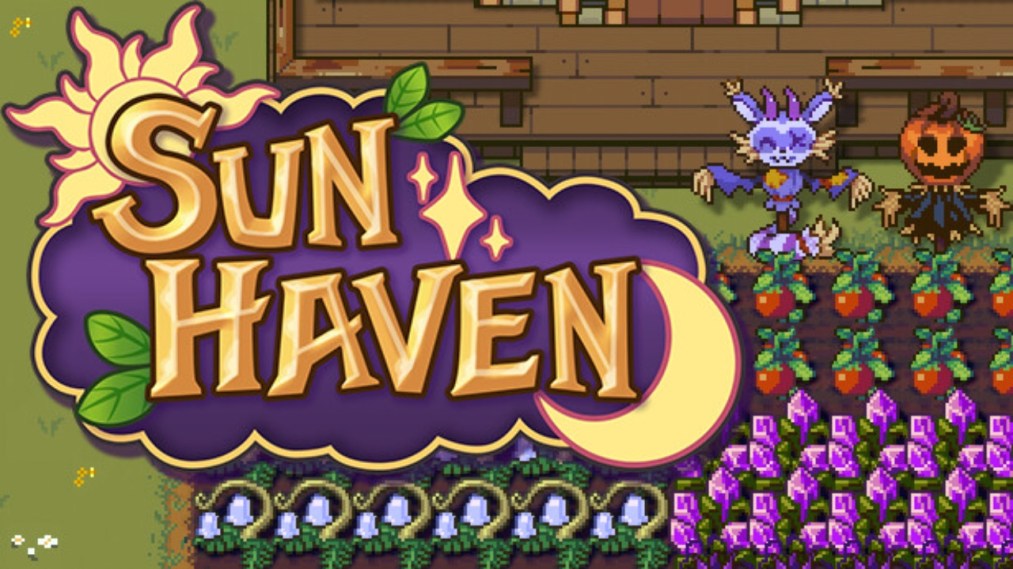
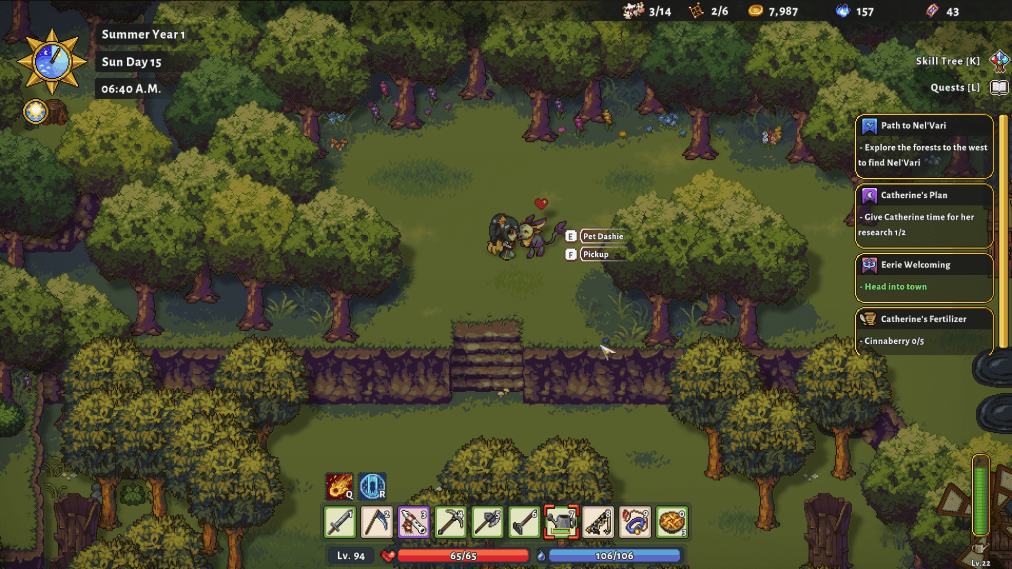
I don’t think I’ve mentioned this before, but I’m a fan of RPG style farming sims (similar to the Harvest Moon franchise). I’ve lost count of how many I’ve played. I picked up Sun Haven during Steam’s spring sale. It’s got a much larger map than what I’m used to from an RPG farming sim and has options for mounts, pets, and accessories. I’m a sucker for all of these things.
One feature I appreciate about Sun Haven is the ability to choose your race, class, and free initial customization options. Your race and class give you bonuses in the game based on how you want to play. When I say, “free initial customization,” I mean you just design a character without picking a gender. You don’t even get the option to pick a gender, like most of these games require. All romance-able characters are available for the player to choose from and you can increase your bond with them based on picking dialogue options they like in addition to gifts.
I’ve also been playing Honkai Star Rail and Wuthering Waves regularly. They’re a staple of my video game diet, so I won’t go into detail. Good luck on all of your 50/50’s to those of you who play either/both of these games.
Okay. I know this is a collectible card game (CCG). I recently played Magic: The Gathering with a friend and got hit with a wave of nostalgia when I got to play with my fifteen-year-old decks. I’ve only played commander a couple of times in the past, which is the standard way to play Magic: The Gathering now. You have a powerful creature (your commander) who starts the game off the field while the rest of your deck is ninety-nine cards, all of which must be unique (outside of basic land cards). It plays like a normal games of Magic: The Gathering, but you can summon your commander even if it dies, as long as you have the mana.
I’ve played a few prototypes last month, but haven’t played as many board games as I would have liked. I’ve been settling into a new position at my day job, so I haven’t had as much time/energy for board games. I’m hoping to play more this month.
Hello, Geekly Gang! Yes. I also enjoy games. So here are some that I’ve been playing lately.

Gacha friends, rejoice. I have returned to Wuthering Waves and Honkai: Star Rail. While I’ve always enjoyed these games, they can sometimes be difficult to keep up with. That’s why I took a break from gacha games. Now that I’m trying to loosen up, I thought it was a good time to revisit them. I’m so glad I did!
No gacha game is perfect, but the simple act of building your teams, finding secrets, and yes, owning as many characters as possible is enough to keep me hooked. Since I’ve circled back around to them, it’s been difficult for me to put them down. I’ll admit that grinding gets old. Please implement more multiplayer options. I’m desperate!

Speaking of loosening up, Pixel Art is my go-to relaxation app. While not technically a game, coloring to your heart’s content is comforting. My favorite aspect of the app is the ability to create your own pixel art creations using images from your phone’s camera roll. Lately, Pixel Art has been my primary method of preserving my memories. Who needs photo albums when you have Pixel Art?

Ever since I was a kid, I always loved the Final Fantasy series (even if it was vicariously through watching my parents play it). Lately, I’ve started playing the original Final Fantasy. Since the first Final Fantasy game I played was VII, I’ve taken it upon myself to play each one that came before it. Thankfully, my sister has the Final Fantasy I-VI Pixel Remaster Collection for PlayStation4, so thank you for letting me borrow it. 😉
It’s surreal to see where this behemoth of a franchise started. The story doesn’t always make sense, but the gameplay is still fun. My favorite part is that even though (then) SquareSoft didn’t understand what it was at the time, the game is still clearly a Final Fantasy title. I can see why this is SquareEnix’s golden goose.
Like other Geekly members, I’ve taken up this quaint yet satisfying game. Since I’ve been a long-time fan of survival sandbox games, it’s been fun seeing Team 17’s interpretation of one. Like most Gen Zers, my first survival sandbox game was Minecraft. It wasn’t hard for me to fall in love with The Survivalists.
Like most survival sandbox games, The Survivalists can become stale after a while. It can take an hour to get things done. If you’re a fan of the genre like me, you’re used to that. The Survivalists will soon join the roster of survival sandbox staples like Terraria, Don’t Starve, ARK: Survival Evolved, and Minecraft. Also, this one has monkeys. Monkey butlers. What more do you want?
Thank you for reading, and wherever you are, I hope you’re having a great day.



 jkgeekly.com