Top 5 Tabletop Games from 1993

1993 is another solid year for tabletop games. This year’s releases saw one massive title and a handful of titles for an older audience. As we dive deeper into the nineties, we’ll have a large pool of tabletop game titles with which to choose.

Hey, hey! Kyra Kyle here. Back with another Top 5 Tabletop Games. We’ll talk about the board games that this year’s list soon, but let’s recap the ground rules for which games make these lists before we start.

1: Cultural relevance plays as much of a factor as overall quality. A game might make a list that doesn’t hold up to others of its type, but you must admit the game is everywhere.

2: Only one game from a franchise makes the list. This will become more of an issue the closer we get to games with expansions.

3: Longevity plays a role, too. A game doesn’t have to fly off the shelves today, but it had to have some widespread appeal for a decent time.
5: 13 Dead End Drive (1993)

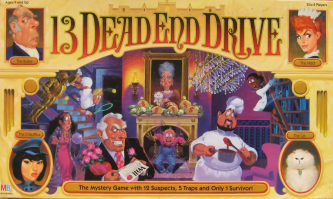
13 Dead End Drive is the only board game on this list that could be considered a child’s game. We’re getting to the adult-themed games soon enough. 13 Dead End Drive has a murder theme. The death of a wealthy old woman triggers a feud over her will. Players use traps located on the board (the mansion), to kill characters controlled by other players to claim the estate.

Players are dealt all the “Character cards” which correspond to matching pawns on the board. Since there are 12 characters, players will control more than one character. Players don’t show which characters they were dealt. Matching “Portrait cards” determine who is the current favorite for the inheritance. The third type of cards are “Trap cards” which are used to spring traps and eliminate characters.
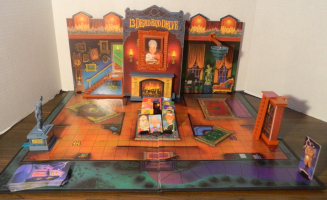
During each turn, a player rolls two dice and moves two pawns, one pawn for each die. It is legal for players to move a pawn that isn’t theirs, especially if the move places a pawn on a Trap space. Characters must end their turn on a Trap space by exact count, and a player must play a matching Trap card for the Trap to take effect. Players win by being the last character standing, escaping the Mansion while one’s character’s Portrait is displayed, or having the final character’s Portrait displayed when the Detective reaches the front door (at the end of 10 rounds).

Despite, the macabre premise, 13 Dead End Drive uses humor and goofy characters to make the game approachable. The game also marks an interesting twist to a murder-themed board game. While games like Clue (or Cluedo) has players trying to figure out who committed a murder, 13 Dead End Drive empowers players by committing a dozen murders.

No. Seriously, this is a game geared toward a younger audience.

4: Europa Universalis (1993)

Europa Universalis is a monster of a board game. The official playing time listed on the game box is six hours, but the game can last for weeks. Board Game Geek estimates the playing time to be 15 days. Europa Universalis is a geopolitical strategy game set from 1492 to 1792. Players take control of European powers during this period. Each country has unique events, objectives, and special rules, for example, Russia’s military power is limited until the arrival of Peter the Great, and England has access to powerful privateers.
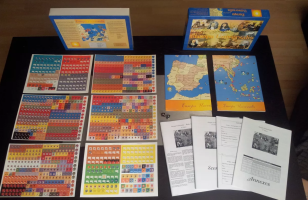
Europa Universalis has plenty of freedom of choice. It offers control over economics, military, maintenance (yes, you’ll have to maintain your country), discoveries, and colonial investment. But this leads to a major drawback, the game has a lot of calculation and management during the game for income, price changes, maintenance (of your regions), and the purchasing of military resources. Europa Universalis may work better as a video game. Fortunately, Swedish video game developer Paradox Development Studio (along with the help of the board game’s designer Philippe Thibaut) adapted Europa Universalis into a video game in 2000. This long-running video game challenges Civilization as the top civilization simulator.

3: Call My Bluff (Liar’s Dice) (1993)

Call My Bluff (Liar’s Dice) has an odd history. The Liar’s Dice class of games has existed since the 15th century (originally named Dudo from the Incan Empire). A variant of Liar’s Dice was published by Milton Bradley six years prior in 1987. Call My Bluff is a remake of the original Liar’s Dice, which was then in the public domain. Richard Borg earned the 1993 Spiel des Jahres (the German Board Game of the Year) for his adaptation of this classic game.

Five dice are used per player with dice cups used for concealment. In each round, every player rolls a “hand” of dice under their cup and looks at their hand while keeping it concealed from the other players. The first player begins bidding, announcing any face value and the minimum number of dice that the player believes are showing that value, under all of the cups in the game. Ones are often wild, always counting as the face of the current bid.

Turns rotate in clockwise order. Each player has two choices. They can make a higher bid or challenge the previous bid, typically with a call of “liar,” hence the name Liar’s Dice. Once a bid is challenged, all dice are revealed. If the bid is valid (at least as many of the face value and any wild aces as the player’s bid), the bidder wins. Otherwise, the challenger wins. The player who loses a round loses one of their dice. The last player with dice at the end of the game wins. Call My Bluff’s simplicity and entertainment value earned it the Spiel des Jahres. If the rules sound familiar, the video game series Red Dead Redemption includes a version of Call My Bluff.

2: We the People (1993)

We the People simulates the American Revolution. I’m sensing a simulation theme with 1993 board games. Published by Avalon Hill and designed by Mark Herman, We the People was the first wargame to use cards as the primary means of controlling the pace and tempo of play; the card play introduces a strong element of fog of war through hidden card information.

One player controls the British, while the other plays as the Continentals/Americans. The map has a web of cities and towns connected by lines along which armies can move. We the People marks one of the first times a designer used a point-to-point movement system, which has become standard with a lot of games. Tens of thousands of modern board games use a point-to-point movement system, and not just war games. The cooperative game about stopping a global pandemic, aptly named Pandemic, may be the most famous game to use a point-to-point movement similar to the one Mark Herman pioneered.

We the People has inspired other war games like Richard Borg’s Command and Colors series. Yes, this is the same Richard Borg who designed the previous game on this list Call My Bluff. But We the People may have influenced GMT Games the most. GMT has produced numerous games implementing Herman’s card-driven combat. Their games include The Napoleonic Wars, Here I Stand, Virgin Queen, and Twilight Struggle, which remains one of the highest-ranked board games on Board Game Geek.
1: Magic: The Gathering (1993)

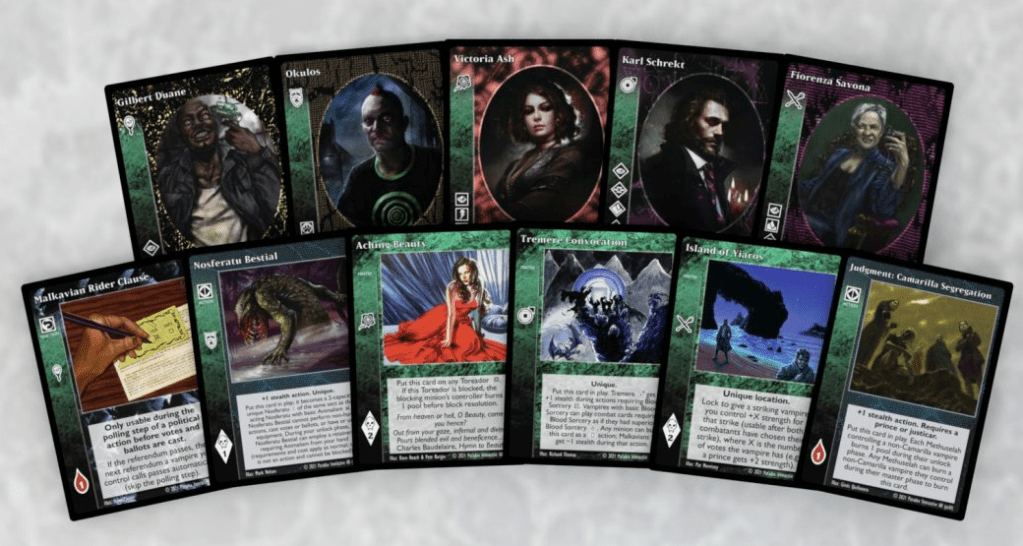
Magic: The Gathering takes the top spot. No other game that was released during 1993 could’ve taken this spot from the granddaddy of all collectible card games. Magic: The Gathering beget a flurry of collectible card games in the following decade: Pokémon, Yu-Gi-Oh!, Legend of the Five Rings, and World of Warcraft (eventually rebranded as Hearthstone) to name a few. Magic: The Gathering’s designer Richard Garfield even made a few more collectible card games to add to his tally like Netrunner, BattleTech, Vampire: The Eternal Struggle, and the original Star Wars Trading Card Game.

Not going to lie. I played most of these collectible card games at one point or another. Magic: The Gathering has stood the test of time. Sure, Pokémon and Yu-Gi-Oh! have endured, but they were released years after Magic. Magic has outlived most of the games it inspired.

The greatest testament to Magic: The Gathering topping this list is that most people read Magic: The Gathering and nodded yes. Magic is the right answer. Magic is the only answer for top tabletop game for 1993.

Did we get the list right, for the most part? Let us know which games you’d add in the comments. And wherever you are, I hope you’re having a great day.

Check out the other lists in this series:
Top 5 Tabletop Games Prior to the 1930s
Top 5 Tabletop Games of the 1930s
Top 5 Tabletop Games of the 1940s-50s
Top 5 Tabletop Games from the Early 1960s
Top 5 Tabletop Games from the Late 1960s
Top 5 Tabletop Games from the Early 1970s
Top 5 Tabletop Games from 1980-1981
Top 5 Tabletop Games from 1982-1983
Top 5 Tabletop Games from 1984-1985
Top 5 Tabletop Games from 1986-1987
Top 5 Tabletop Games from 1988-1989
Top 5 Tabletop Games from 1990-1991
Top 5 Tabletop Games from 1992

Top 5 Thunderbolts Rosters

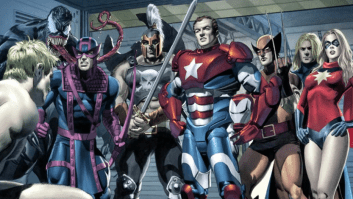
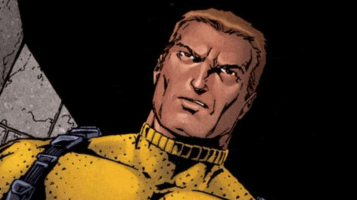
Thunderbolts* releases this week with a new cast of characters. Some of the characters we’ll see in the upcoming film have been members of one of the various incarnations of the group. Others are new faces. The Thunderbolts team has seen plenty of new faces since its inception in 1997, so begs the question, Which Thunderbolts rosters are the best?

Hey, hey! Kyra Kyle here. We’re doing something different with today’s Top 5 in comics. As of this post, there have been thirteen iterations of Marvel’s Thunderbolts. With that many rosters to choose from, which rosters have had the best storylines? We intend to cover that with today’s list. Buckle up. These are the top five Thunderbolts rosters.

5: New Thunderbolts

First Appearance: New Thunderbolts (Vol 1) #1; written by Fabian Nicieza & Kurt Busiek; art by Tom Grummett (2005-2006)

Notable Members

MACH-IV
Songbird
Atlas
Donnie Gill/Blizzard II
Radioactive Man
Joystick
Speed Demon
Andreas von Strucker/Swordsman II
Genis-Vell/Photon

Marvel launched New Thunderbolts in the wake of the Thunderbolts’ first era. Original Thunderbolt Abe Jenkins reformed his ways as The Beetle and became MACH-I. Jenkins made a new suit for himself, becoming MACH-IV, and wanted to give other villains the same chance and reformed the new Thunderbolts. MACH-IV’s New Thunderbolts earned the respect of the Avengers.

The New Thunderbolts stopped Purple Man from enslaving New York City by drugging the water supply with his pheromones, the same ones that allow him to control his victims. Before the team could interrogate the Purple Man, he was teleported away by his boss, Baron Zemo. Zemo would eventually take control of the New Thunderbolts. The New Thunderbolts would lose their chance at redemption and became an army of villains used against Captain America’s Secret Avengers during Civil War.

Ultimately, New Thunderbolts was a solid iteration of the team. I always liked the basic Thunderbolts premise of supervillains pretending to be superheroes but ending up adopting the roles of heroes. Thunderbolts prove that no one’s beyond redemption.

Unless Baron Zemo’s in town. He loves to play the role of spoiler.

4: Luke Cage’s Thunderbolts

First Appearance: Thunderbolts (Vol 1) #144; written by Jeff Parker; art by Kev Walker (2010-2012)

Notable Members

Songbird
MACH-V
Moonstone
Fixer
Ghost
Juggernaut
Satana
Boomerang
Centurius
Mister Hyde
Shocker

In the years before Luke Cage assumed control of a new Thunderbolts team, the Thunderbolts had a run of horrible leadership, notably Norman Osborn. The team had become villainous. Captain America himself tasked Luke Cage to front a new Thunderbolts team, and this started a great run of comics. The team repurposes the heavily fortified superprison known as The Raft and uses Man-Thing as a form of transportation.

Luke Cage’s Thunderbolts are one of the odder iterations of the team. This team has a long time, too. At one point, the team splits off to become two separate groups. The Thunderbolts serviced the Americas, while the “Underbolts” had a European jurisdiction. These Underbolts get lost in time, specifically the World War II era, and pass themselves off as the American Thunderbolts, fighting beside Captain America (pre-frozen) and Namor. The team continues its fight with the Nazis and Human Torch androids that were created by Baron Heinrich Zemo (the current Baron Zemo’s father). Yes. Luke Cage’s Thunderbolts’ stories got wild.

3: Norman Osborn’s Thunderbolts

First Appearance: Thunderbolts (Vol 1) #110; written by Warren Ellis; art by Mike Deodato Jr. (2006)

Notable Members

Songbird
Moonstone
Swordsman
Radioactive Man
Mac Gargan/Venom
Bullseye
Robbie Baldwin/Penance

Yep. Norman Osborn may have been a horrible Thunderbolts leader, but his complicated leadership led to some great theater.

Osborn’s Thunderbolts occurred after Marvel Comics’ Civil War event. These new Thunderbolts were tasked with tracking down and arresting individuals avoiding the Superhuman Registration Act. This Superhuman Registration Act appeared in the MCU and sparked a similar story of the same name Civil War. Just imagine Norman Osborn, struggling with his Green Goblin persona, leading a team of villains to track down any superhero he dared not to register.

Times got rough, to say the least. This Thunderbolts team would lead Osborn to create his first Dark Avengers roster.

2: Red Hulk’s Thunderbolts

First Appearance: Thunderbolts (Vol 2) #1; written by Daniel Way; art by Steve Dillon (2013)

Notable Members

Red Hulk
Agent Venom
Punisher
Elektra
Deadpool
Red Leader
Mercy

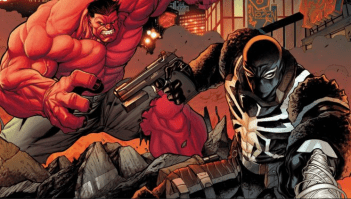
Red Hulk’s Thunderbolts happened on the heels of Luke Cage’s. The government disbanded the Thunderbolts program, but General Thaddeus “Thunderbolt” Ross (Red Hulk) formed his team of anti-heroes. This new Thunderbolts served as a covert super-powered strike team. This sounds like the team’s premise in the upcoming Thunderbolts*.

Red Hulk’s Thunderbolts had a short but memorable run. Even the small moments are great. My favorite was when Deadpool’s name gets pulled for a mission, and he wants to kidnap actor Ryan Reynolds. Ha! At the time of this moment’s publication, Ryan Reynolds had not yet redeemed himself as Deadpool—way to go, Thunderbolts.

Getting back to the larger storylines. Ross started with former Code Red mercenaries and began adding a few villains. It’s this addition of villains that led to the team’s downfall. The team tracks down Doctor Faustus. The Punisher wants to kill Faustus for murdering high school children. Instead, Red Hulk recruits Faustus to join the Thunderbolts. The Punisher leaves the team and then takes them down. Womp, womp.

1: Original Thunderbolts

First Appearance: Thunderbolts (Vol 1) #1; written by Kurt Busiek; art by Mark Bagley (1997-2000)

Notable Members

Baron Zemo/Citizen V
Moonstone/Meteorite
Fixer/Techno
Beetle/MACH-1
Goliath/Atlas
Screaming Mimi/Songbird

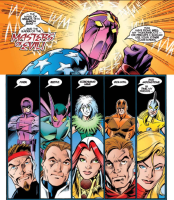
The original is often the best. The original Thunderbolts introduced the idea of supervillains pretending to be superheroes (to gain access to their foes) and then liking the recognition and feeling good about doing good deeds. This differs from the Suicide Squad. Suicide Squad villains are looking for reduced sentences or perks in their prison accommodations. Except for their founding member Baron Zemo and one or two others, the Thunderbolts genuinely wanted to reform.

I also love the Thunderbolts’ reveal at the end of the first issue. This scene is iconic.

Did we get the list right? Let us know which Thunderbolts teams you would add or remove in the comments. Thank you for reading and wherever you are, I hope you’re having a great day.

Top 5 Members of the Suicide Squad

We covered Marvel’s Illuminati members last month, and this month we’re doing the same for DC Comics rag-tag team of oddballs the Suicide Squad. Also referred to as Task Force X, the Suicide Squad takes on missions so dangerous that trying to complete them would mean that someone has a death wish. Brought back in the 1980s with this concept, the Suicide Squad was run by Amanda Waller, who installed explosive devices inside the heads of hardened criminals. Cue over-the-top antics.

Hey, hey! Kyra Kyle here. We’re back with the first Top 5 list. Today we’re tackling DC’s lovable gang of miscreants, the Suicide Squad. Who made our list of the Top 5 Suicide Squad Members? Let’s find out.

5: Rick Flag

Rick Flag is the OG Suicide Squad member. Someone by the name of Rick Flag has been around since 1959. There have been three generations of Rick Flags; each one has served as one of the Suicide Squad’s leaders. Rick Flag stands out from most other Suicide Squad members because he isn’t a former criminal. Most iterations of Rick Flag portray him as a skilled military special ops member. This makes sense. The Suicide Squad began as a military/government outfit. It wasn’t until Amanda Waller revived the project that the Suicide Squad included criminals.

Typically, Rick Flag serves as Amanda Waller’s right-hand man within the group, helping keep the rest of the Suicide Squad in line. Amanda Waller is on to something. It would take more than a bomb in one’s head to stop certain members of the Suicide Squad. You need a man on the inside. Rick Flag is that inside man.

4: Captain Boomerang

We go from the most wholesome member of the Suicide Squad in Rick Flag to the least wholesome in Captain Boomerang. Let that sink in. Within a group of psychopaths and hardened criminals, Captain Boomerang is the least wholesome.

Boomerang joined the Suicide Squad in exchange for a pardon. So far, so good. But his grating personality and blatant racism cause more than a little strife within the group. Nobody likes this guy. He causes friction within the team and most team members consider him to be the most dangerous and least dependable member. This also causes Captain Boomerang to have some tasty storylines. He’s one of those villains you love to hate.

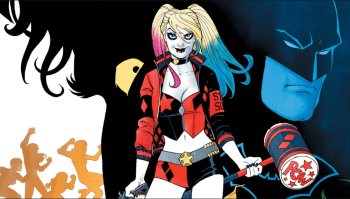
3: Harley Quinn

Harley Quinn was going to make this list, but I struggled with where to place her. She’s the highest profile character on this Top 5 list, but she’s also the newest Suicide Squad member. The third spot sounds right.

This isn’t the classic Harley Quinn. The original Harley Quinn, found in Batman: The Animated Series, needed a makeover before joining the team. The Harley who joined the Suicide Squad is the one with the revamped origin story where Joker pushes Harley into a vat of chemicals, granting her superpowers. This new Harley Quinn breaks the fourth wall like a popular merc with a mouth from a different comic book universe. I don’t know which version of Harley I like better, but there’s no denying that after her makeover, Harley Quinn molded the Suicide Squad in her image.

2: Deadshot

Besides the character in our number one spot, Floyd Lawton as Deadshot is who I think of first when I think of the Suicide Squad. Waller recruits Lawton because of his skills as a marksman and the fact that his mandated therapy sessions revealed that he has a “death wish,” hoping a skilled enemy will end his life in a dramatic battle. This death wish leads Deadshot to wear a costume featuring a target on his chest.

Deadshot often clashes with Captain Boomerang—who doesn’t—and field leader Rick Flag. But Deadshot and the latter share a begrudging respect for each other. Deadshot is a classic Suicide Squad member. His backstory lends himself to inclusion on the team and on this list. Lawton may be the only member of the Suicide Squad with a death wish.

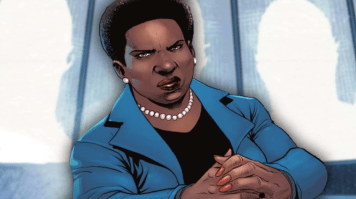
1: Amanda Waller

I mentioned Amanda Waller in several write-ups leading to our top spot. Her spot at number one was inevitable. Waller is the woman in charge. She’s the one who resurrected the Suicide Squad. She’s the one who thought installing bombs in criminal’s skulls and forcing them to do government work was a good idea. In short, there would be no Suicide Squad without Amanda Waller.

The woman nicknamed The Wall makes up for her lack of superpowers with her ruthlessness, guile, intimidation, and political connections. Waller is the proverbial person who knows where the bodies are buried, and she’s not afraid to use that knowledge to her advantage. The Wall can even make members of the Justice League, like Superman and Batman, blush. She’s not to be taken lightly. She had to take the number one spot.

Did we get the list right? Let us know who you would add or remove in the comments. And wherever you are, I hope you’re having a great day.

Top 5 Tabletop Games from 1992
The nineties were a turning point for modern board games. 1992 has its fair share of great titles, even if many of them skew to a young audience. 1993 was another strong year. As we dive deeper into the nineties, we’ll have a large pool of tabletop game titles with which to choose.
Hey, hey! Kyra Kyle here. Back with another Top 5 Tabletop Games. We’ll talk about the board games that this year’s list soon, but let’s reiterate the ground rules for which games make these lists before we begin.

1: Cultural relevance plays as much of a factor as overall quality. A game might make a list that doesn’t hold up to others of its type, but you must admit the game is everywhere.

2: Only one game from a franchise makes the list. This will become more of an issue the closer we get to games with expansions.

3: Longevity plays a role, too. A game doesn’t have to fly off the shelves today, but it had to have some widespread appeal for a decent time.

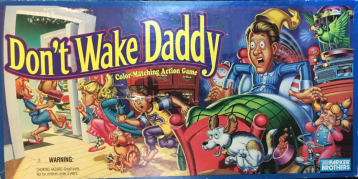
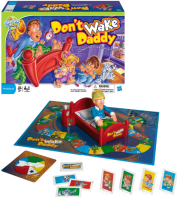
5: Don’t Wake Daddy (1992)

Don’t Wake Daddy kicks off this list and a trend you’ll see with this list. 1992 saw a lot of board games with a strong toy factor. Don’t Wake Daddy is the first of two children’s games. Players take on the role of children sneaking to the refrigerator late at night, trying not to wake their sleeping father who lies in the middle of the board on a large bed. Players move around a board based on the color they spin. If the color of a noise space matches the color of an assigned card that a player holds, they’re safe; otherwise, the player makes one of several noises. A player who makes noise must press the button on the alarm clock next to the father. Eventually, the father will jerk upright from his bed, giving the game its title Don’t Wake Daddy.

Don’t Wake Daddy has inspired spin-offs in the least likely of places. German artist Martin Kippenberger used the symbols for the different “noises” for a cycle of wood-carvings and oil-paintings. Scholastic published a children’s book based on the game Don’t Wake Daddy: Late-Night Snack, making Don’t Wake Daddy one of the few board games to inspire a book. Jumanji doesn’t count. The book came out first and then the board game. My favorite quote comes from Parker Brothers spokeswoman Ronni Heyman who described the game as “a real sleeper.” I see what you did there.

4: Forbidden Bridge (1992)

Forbidden Bridge has a lot in common with another Milton Bradley release around this time Fireball Island. The company had a board game type during this era. Players take on the role of explorers after ancient jewels, which are guarded by an angry spirit. Occasionally, the bridge guard will awaken (Forbidden Bridge is a mechanized game with a motor) and shake the bridge, which may cause players’ pieces to fall off the bridge. Players can also “steal” another player’s jewel. The first player to retrieve two jewels and return them to their boat wins.

Forbidden Bridge’s premise and art resemble Fireball Island, and that’s not a bad thing. It gave the company an identity during the mid-late eighties and early nineties. Forbidden Bridge also takes the most chaotic element of Fireball Island (the bridge) and expands on it. Some of the bridge spaces have pegs, which are important because they can prevent player pieces from falling off the bridge when the bridge shakes. I’m glad that Fireball Island and Forbidden Bridge have seen remasters and reprints. Unlike the Fireball Island remaster, Forbidden Bridge leaves the original game mostly the same. Forbidden Bridge is a Target exclusive.

3: Loopin’ Louie (1992)

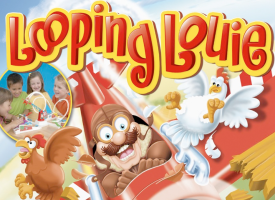
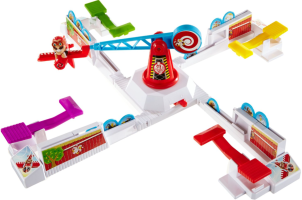
Loopin’ Louie is the second children’s game on our list. This electronic board game features a crane tower with a figure of the titular Louie in a biplane. Up to four arms (one for each player) are connected to the tower, each with a canal, a barn, three chicken tokens and a lever (paddle). Louie will spin around the board. Players press their respective levers to keep Louie in the air and stop him from knocking the chicken tokens into the canals. You’ll need to time your lever presses carefully. If Louie hits a chicken token on the barn, it falls into the canal. The winner is the last player to have at least one chicken token remaining.

Loopin’ Louie was given the Kinderspiel des Jahres award in 1994. It’s a solid game, especially for a children’s board game. But is Loopin’ Louie solely a children’s game? In Europe, Loopin’ Louie is a drinking game. In fact, Loopin’ Louie sold more than 1.3 million copies between 2006 and 2014 because it was used as a drinking game. I may need to institute a new Oktoberfest tradition.

2: Um Reifenbreite (1992)

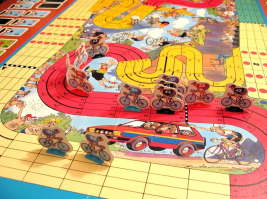
Um Reifenbreite translates to “By the Width of a Tire” and puts players in the role of bicyclists during a Tour de France-type race. Each player controls a four-member racing team, and the goal is to score as many points for the whole team. Players roll dice to see how far their team members move, but there is a limited card set that can replace die results. Unique rules allow players to draft one another and add multiple kinds of road surfaces. Um Reinfenbreite is a deep racing experience.

Technically, Um Reifenbreite released in 1979 as Homas Tour, but we’re including the game here because the bulk of the Homas Tour copies were lost in a warehouse fire. Um Reifenbreite would be the rerelease, and the game changed enough that it earned consideration from the Spiel des Jahres. Um Reifenbreite did more than earn consideration, it took home the award in 1992, beating our next game on this list.

1: Modern Art (1992)

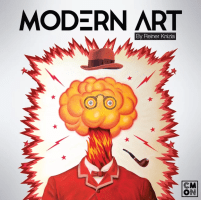
Dr. Reiner Knizia designed Modern Art so that it features numerous auction types. Heck, Modern Art may be THE game for players to learn all the various types of auctions that board games can offer. Each player is dealt a hand of cards, which represent works of art that the player may offer for sale. Players take turns putting these cards up for auction. The auction format is determined by the card offered for sale. Players sell their paintings back to the bank at the end of each round. Whoever has the most money at the end of the fourth round wins.

Modern Art was recommended for the 1993 Spiel des Jahres. The jury considered it for the award because “the unusual combination of different auction types makes Modern Art a challenging and varied game experience.” Reiner Knizia would be recommended for the Spiel des Jahres countless times. Knizia is the most prolific board game designer of all time. Modern Art is the first time one of his games makes one of these lists. It won’t be the last.

Did we get the list right, for the most part? Let us know which games you’d add in the comments. And wherever you are, I hope you’re having a great day.

Check out the other lists in this series:
Top 5 Tabletop Games Prior to the 1930s
Top 5 Tabletop Games of the 1930s
Top 5 Tabletop Games of the 1940s-50s
Top 5 Tabletop Games from the Early 1960s
Top 5 Tabletop Games from the Late 1960s
Top 5 Tabletop Games from the Early 1970s
Top 5 Tabletop Games from 1980-1981
Top 5 Tabletop Games from 1982-1983
Top 5 Tabletop Games from 1984-1985
Top 5 Tabletop Games from 1986-1987
Top 5 Tabletop Games from 1988-1989
Top 5 Tabletop Games from 1990-1991

Top 5 Flash Villains

I can’t believe Geekly has been doing Top 5 Villains lists for superheroes and we haven’t covered Flash’s rogues gallery. Flash has one of the most extensive rogues galleries in comic book history. He may not have villains with the same name recognition as Spider-Man or Batman, but his rogues gallery is one of the best.

Hey, hey! Kyra Kyle here. We’re back with another Top 5 Villains list. Many of the Flash’s most iconic villains have superspeed, so we’ll be limiting this list to the top speedster. Let us know if you’d like a Top 5 List of Villainous Speedsters. In the meantime, here’s our list of the Top 5 Flash Villains.

Top 5 Ice Powered Comic Book Characters Killer Frost

5: Killer Frost

Flash’s top 4 villains were a breeze to compile. I knew who they were the instant I sat down. His fifth villain could go in several directions. I may have said that about more than one superhero, but that’s the truth. Killer Frost beats out the rest of the would-be Top 5 Flash villains if for no other reason than she used to be a Flash ally. She spends part of her time as an anti-hero, having spent stints with the Suicide Squad and Justice League. But whenever Caitlin Snow decides to turn evil, it spells doom for the Flash. Her connections with Flash and Firestorm add to her lethality. Cold powers prove effective against the Flash; cold can slow the speedster. Killer Frost’s freezing ability, as we’ll see with another Flash villain on this list, makes her dangerous.

4: Mirror Master

Mirror Master fills a similar role in Flash’s Rogues that Mysterio does in Spider-Man’s Rogues, and Mysterio ended up as Spider-Man’s fourth-placed villain. Hmm. Looks like the fourth spot is the perfect place for a villain designed to confuse their nemesis. Unlike Mysterio, Mirror Master possesses powers. His mirrors can hypnotize, turn him invisible, generate holograms, change his physical form, and travel into other dimensions. That final ability separates Mirror Master from Mysterio. One of my favorite recent stories Mirror Master showed him trap Flash within a parallel dimension of his creation.

Don’t let the high-speed fool you. Flash is one of DC Comics’ most powerful heroes. He can turn back time and alter the past. Brute strength doesn’t often work against the Flash. Mirror Master takes a different route. And I’m a sucker for a villain with a mischievous streak.

3: Gorilla Grodd

Gorilla Grodd is one of my favorite Flash villains. I wanted to place him at the one or the two spot, but two other villains narrowly beat him. Gorilla Grodd has superhuman strength, telekinesis, telepathy, a super genius-level intellect, and has a connection to the Speed Force. As his name suggests, he’s a gorilla. He hails from Gorilla City and is the sometimes leader of the metropolis led by super-intelligent gorillas. Gorilla Grodd not only has a laundry list of abilities, he has an army at his disposal.

Marry all of this up with Grodd’s connections with most of DC Comics’ supervillain organizations like the Legion of Doom, the Secret Society of Super Villains, and the Injustice League, and Gorilla Grodd has a plethora of allies he can summon. Grodd is one of Flash’s most formidable enemies.

2: Captain Cold

You can take everything I said about Killer Frost and her freezing powers and apply it to Captain Cold. But instead of Captain Cold being a personal friend of the Flash’s, he’s the man he instituted the Flash’s Rogues, Flash’s version of the Sinister Six, and serves as their leader. I had to put Captain Cold above Grodd because Grodd can get distracted by other heroes, and Captain Cold keeps his animosity toward the Flash. He knows which buttons to press and isn’t afraid to press them. His freezing abilities are only matched by his intellect. In short, Captain Cold knows how to use the Flash’s strength against him and that makes him deadly.

1: Reverse-Flash

Eobard Thawne (also known as Reverse-Flash and Professor Zoom) takes the top spot. He’s another speedster, so if we were to create a list of Top 5 Villainous Flash Speedsters, he’d be the top spot there as well. Thawne is one of the few characters in the DC Comics Universe who can travel back in time with little to no ill effects, and he uses this to his advantage. He’s erased characters to torment and destroy the Flash’s life. He even went back in time to kill Barry Allen’s mother. Reverse-Flash is plain evil.

He too has connections with the Legion of Doom, the Injustice League, and the Rogues. He had to take the top spot. Despite others’ attempts, no one has tortured the Flash more than Reverse-Flash. He does what his name says, he is the Flash’s antithesis.

Did we get the list right? Let us know who you would add or remove in the comments. And wherever you are, I hope you’re having a great day.

Top 5 Daredevil Villains

While Daredevil: Born Again is ongoing, let’s discuss the best villains the Man Without Fear has ever had. Hey, hey! Kyra Kyle here. We’re back with the first Top 5 Villains List. Daredevil doesn’t have the most robust rogues gallery, but he does have a handful of standout villains. Here’s our list of the Top 5 Daredevil Villains.

5: Mr. Fear

Frankly, the top four Daredevil villains are set in stone—for the most part. The only variable I could find was at the fifth spot. I’ve said it a lot in previous Top 5s, but I could’ve gone in several directions. I almost feel like the bottom villain in a hero’s Top 5 villains must bring something a little different. Mr. Fear does that. You’d think that a villain whose gimmick involves fear would be no issue for Daredevil: The Man Without Fear, but Mr. Fear has posed a threat on more than one occasion. My favorite version of the Mr. Fear must be Matt Murdock’s old classmate, Larry Cranston. Cranston once gave Matt’s ex-wife Mia Donovan an overdose of a fear-inhibiting drug that led her to take an innocent’s life. Mr. Fear does more than hold his own with Daredevil’s typical martial arts-savvy characters.

4: Typhoid Mary

Ann Nocenti created Typhoid Mary. She’s a deadly and intriguing villain. Mary’s a mutant with telekinetic abilities and suffers from dissociative identity disorder, which gives her three different identities, a soft-spirited one (Mary), a violent one (Typhoid), and a sadistic one (Bloody Mary). Mary was once a soap opera actress and briefly in a relationship with Matt Murdock. One doesn’t know which one of Typhoid Mary’s personas is in control. Mary’s condition makes her unpredictable. Her mutant powers coupled with her innate mutant abilities make her a force. Season three of the Netflix Daredevil series included a version of Typhoid Mary. Typhoid Mary could make for an interesting foil with the MCU heading toward a Mutant Saga.

3: Elektra

Elektra Natchios is arguably the love of Matt Murdock’s life. Daredevil may have had a lot of girlfriends throughout the years—including the previous entry Typhoid Mary—but Elektra stands alone as Matt Murdock’s most iconic lover. Elektra’s the Catwoman to Matt’s Batman. As the daughter of a Greek ambassador to the United States, Elektra could’ve been anything. She chooses to be a villain for hire. Like Catwoman, Elektra always seems on the cusp of redemption, before showing Daredevil her ruthless nature. Elektra constantly switches sides. And her death at the hands of Bullseye remains one of the most iconic moments in Daredevil comics history.

2: Bullseye

No villain may have caused more pain and suffering for Matt Murdock than the contract killer Bullseye. This is the man that Daredevil tortured by playing Russian Roulette with an empty gun. Bullseye’s hands make anything a lethal weapon. He’s built his reputation on his perfect aim, throwing knives and other sharp objects with insane accuracy. He also helps that Bullseye’s skeleton is coated in adamantium, like Wolverine’s. Despite his physical prowess, Bullseye strives to inflict emotional pain. He’s taken away two of the loves of Matt Murdock’s life, Elektra and Karen Page, and joked about it afterward. Bullseye is the worst kind of villain. He takes pleasure in what he does, and what he does can be sickening.

1: Kingpin

Kingpin started as a Spider-Man villain, but Frank Miller’s run on Daredevil changed the course of the villain’s life. Since Miller’s run on Daredevil, the pair love to hate each other. In the “Born Again” comic book series, Fisk learns Daredevil’s identity and dismantles every aspect of his life, stripping Matt of his law license and even blowing up his apartment. Kingpin’s actions drove Matt Murdock to the brink of insanity. But Fisk has always managed to outsmart and maneuver his way around Daredevil. During the “Return of the King” storyline, he weasels his way into an alliance with Daredevil. He does so intending to betray the Man Without Fear at the most opportune moment. Kingpin may be one of Marvel’s greatest villains, but over the past several decades, he’s been a thorn in Daredevil’s side and worthy of the top spot.

Did we get the list right? Let us know who you would add or remove in the comments. And wherever you are, I hope you’re having a great day.

Top 5 Tabletop Games from 1990-1991

Plenty of top-notch board games were released in the nineties. This decade is the first where I could list a Top 5 Board Games for each year, and that will happen—closer to 1992 or 1994. But we will keep to 1990 and 1991 for this list of Top Tabletop Games.
Hey, hey! Kyra Kyle here. Back with another Top 5 Tabletop Games. Board games begin heating up in 1990 and 1991. We’ll talk about board games soon, but first, if you’ve forgotten our criteria for the Top 5 Tabletop Games, let’s reiterate the ground rules before we start.

1: Cultural relevance plays as much of a factor as overall quality. A game might make a list that doesn’t hold up to others of its type, but you must admit the game is everywhere.

2: Only one game from a franchise makes the list. This will become more of an issue the closer we get to games with expansions.

3: Longevity plays a role, too. A game doesn’t have to fly off the shelves today, but it had to have some widespread appeal for a decent time.

5: Crocodile Dentist (1990)

Crocodile Dentist was on and off this list. Ultimately, it makes this list of top board games of 1990 and 1991 because it was the best-selling toy of the 1991 Christmas season. Not just a bestselling game, but a bestselling toy. The toy factor for Crocodile Dentist is overwhelming.

The toy factor makes sense. Crocodile Dentist is a children’s game. In early versions of Crocodile Dentist, players take turns removing a crocodile’s teeth and eventually, the crocodile would snap its jaw shut. Whoever made the titular crocodile shut its jaw was the loser. Crocodile Dentist has a simple premise that makes serious adults groan or guffaw. The York Daily Record’s Mike Argento included Crocodile Dentist in his 1992 Bizarre Toy Awards. However, twelve years later, Argento admitted that the game had “passed into classic status.” And that’s what Crocodile Dentist is, a classic.

4: Tichu (1991)

Real talk. I’ve never played Tichu. It’s the one game on this last that I’ve never played. I would like to; Tichu makes this list because so many board gamers swear by this game. Tichu has a cult following if you will. What I know of Tichu is that it’s a shedding game, meaning that you’re trying to rid your hand of its cards. But Tichu is also a team-based game, so you and your partner are trying to shed your hands before your opponents.

I’ve never had the chance to play Tichu. Tichu is a four-player-only game. If you don’t have four players, you can’t play. And from what I’ve heard, a veteran Tichu player will destroy a noob, and since Tichu is a cult card game, it becomes one of those games where people either don’t play or they’ll only find enjoyment with other accomplished Tichu players. Still, Tichu remains one of the most endearing games on this list, and this list has nothing but endearing games. I’d like to play at least one game of Tichu before long. If anyone plays and you’re going to a board game convention that I’m going to, I’d be happy to learn Tichu.

3: Vampire: The Masquerade (1991)

I can’t remember if I included Dungeons & Dragons in an earlier list. If I didn’t, that was an oversight. But while D&D dominated early tabletop roleplaying games (and still does), the Nineties saw a ton of worthy competitors. Tabletop Roleplaying games saw a boom in the Nineties. The early Nineties only had ten major TTRPG releases. Vampire: The Masquerade is the most famed of these Dungeons & Dragons competitors. In short, Vampire: The Masquerade simulates the afterlife of a vampire.

The developers deliberately didn’t read Anne Rice’s Vampire Chronicles until late in their development process but admit that Rice most likely influenced the vampire films that inspire the game. Rice’s Vampire Chronicles and Vampire: The Masquerade ushered in a new era for vampire fiction and the vampire mythos. The Underworld film series borrows a lot from Vampire: The Masquerade. And the game’s influence was felt in the Nineties. The Goth underground scene flourished with the help of Vampire: The Masquerade and Rice’s Vampire Chronicles.

I still have my original copy and will often pour over the full-page artwork. Artist Tim Bradstreet’s artwork from Vampire: The Masquerade was the concept art for the Blade film series. Vampire: The Masquerade was the height of cool in the early Nineties.

2: Formula D (1991)

Formula D is a strong second on this list. Until some recent games (games from the 2010s and 2020), Formula D does the best job of simulating a race. Heck, Formula D measures up well against newer racing games. It uses specialized dice (d4, d6, d8, d12, d20, and d30) that represent different gears of a vehicle. Formula D uses an additional d20 for collisions and other course events (like weather). With each turn, players must roll a die that simulates which gear their car is in and must move the number of spaces they roll on that die. The core concept is simple. You’re trying to reach the finish line before anyone else. It would make sense to stay in the highest gear you can. The problem comes when calculating car damage.

Each player takes a “dashboard” for their car. This dashboard will track damage to the various parts of their car. Each track—and there are plenty of bonus tracks you can use for Formula D—will have twists and turns that you must navigate. Taking a turn at a higher speed will most likely cause players to accept damage. A little damage is no big deal. But you could take so much damage that your vehicle crashes.

I like Formula D’s addition of “Rules for Beginners.” It allows players to learn the basics of the game and only when they get accustomed to the base rules, can they then take on more complex rules. Formula D—like the game that claims our top spot—continues to see play, even though it’s over thirty years old.

1: Hoity Toity (1990)

Hoity Toity has gone by several names. Originally, it was released in Germany by the name Adel Verpflichtet or Noblesse Oblige. It was distributed in the United Kingdom under the name Fair Means or Foul and in the United States as By Hook or Crook. It wasn’t until its 2008 reprint that it became Hoity Toity. I’ll refer to it as Hoity Toity from this point forward. Hoity Toity tasks players as members of a pretentious Antique Club who wager which one of them can acquire—by purchase or theft—the most expensive collection of objets d’art in one day.

Hoity Toity deploys a nice combination of bluffing and silent auction. The game’s movement (there is a track players must navigate) feels unique, especially for the time it was released. There shouldn’t be any wonder that Hoity Toity won the 1990 Spiel des Jahres. Klaus Teuber had a dominant early Nineties. I earned another Spiel des Jahres in 1991—back-to-back awards—for Drunter und Drüber, which just missed this list and another Spiel des Jahres in 1995 for Catan. We haven’t gotten to 1995’s list yet, but Catan will make that list. Hoity Toity gets the nod over Drunter und Drüber because it stands the test of time. Most gamers would place Hoity Toity as the second-best board game of Teuber’s career. Hoity Toity earns that distinction.

Did we get the list right, for the most part? Let us know which games you’d add in the comments. And wherever you are, I hope you’re having a great day.

Check out the other lists in this series:
Top 5 Tabletop Games Prior to the 1930s
Top 5 Tabletop Games of the 1930s
Top 5 Tabletop Games of the 1940s-50s
Top 5 Tabletop Games from the Early 1960s
Top 5 Tabletop Games from the Late 1960s
Top 5 Tabletop Games from the Early 1970s
Top 5 Tabletop Games from 1980-1981
Top 5 Tabletop Games from 1982-1983
Top 5 Tabletop Games from 1984-1985
Top 5 Tabletop Games from 1986-1987
Top 5 Tabletop Games from 1988-1989

Top 5 Captain America Villains

Hey, hey! Kyra Kyle here. We’re preparing for the upcoming Captain America: Brave New World with another Top 5 Villains List. Captain America has an interesting group of villains, to say the least.

We’ll have two official honorable mentions, but I’m going to cheat a bit and add a few in this introduction: MODOK, Batroc, and Adolph Hitler. MODOK stands for Mental Organism Designed Only for Killing. I’d shorten it to MODOK, too. MODOK is a floating head. Batroc’s full name is Batroc the Leaper. He leaps. And Adolph Hitler needs no introduction. Cap spent most of his early days punching Adolph Hitler in the face. With those villains out of the way, let’s get to our official honorable mentions.

Honorable Mention 2: Winter Soldier

Spoiler Alert for one of the MCU’s best films Captain America: The Winter Soldier. Steve Rodgers’ old friend Bucky Barnes is the Winter Soldier. He didn’t make the top villains list properly because even though he was the title villain in one of the greatest Captain America stories and recontextualized Captain America’s past, he became a hero. And he’s stayed a hero for the most part. The Winter Soldier even became Captain America in the comics for a time.

Honorable Mention 1: Serpent Society

The Serpent Society is a supervillain group rather than one villain, but they deserve a mention, especially since they’ll receive their MCU introduction in Captain America: Brave New World. Several factions exist within the Serpent Society. That’s to be expected since the group consists of dozens of snake-themed villains. Sidewinder, Princess Python, Anaconda, Constrictor, Fer de Lance, Puff Adder, Death Adder, Bushmaster, Asp, Cottonmouth, Rattler, and many, many more are part of the Serpent Society. We’ll have to see what the Serpent Society’s plot will be in the upcoming movie, but I wager it won’t be poisoning Washington DC’s water supply to turn everyone into Snake-People. That happened in the comics once. It took Diamondback rebelling against Madame Hydra’s rule to put an end to the plot.

5: Crossbones

Crossbones is often viewed as a Red Skull henchman—another spoiler, Red Skull will make the list—and he often gets attributed as a Sharon Carter villain. But Crossbones instigated Captain America’s assassination in the comics. Crossbones takes pleasure in murder. He even laughs when the Winter Soldier and Falcon take him down following Cap’s death. In the MCU, Crossbones (Brock Rumlow) was the one who hinted that HYDRA may have infiltrated S.H.I.E.L.D. Near the beginning of Captain America: Civil War, he laughs about the torture he put Bucky through when Captain America apprehends him. Crossbones wears a suicide vest, and Scarlet Witch hurls him toward a building filled with Wakandan relief workers, which causes a rift within the Avengers. Crossbones is more than your average henchman.

4: Arnim Zola

Originally a HYDRA scientist, Arnim Zola conducted numerous biochemical experiments. He messed around with the genes of human subjects and even brought back Adolph Hitler. Zola has a mean streak. He doesn’t care who he teams up with so long as he can continue his experiments. Most of what Zola does is in service of these experiments. He even uploaded his mind into a robot body, granting himself a type of immortality. Don’t let Zola’s goofy appearance of a giant TV screen with arms and legs fool you. Zola is one the deadliest villains in comic book history.

3: Baron Strucker

It was Baron Strucker all along. Baron Wolfgang von Strucker founded Hydra in the 1800s. He fought for Germany during World War I and brought the Red Skull into the fold during World War II. It was Strucker who recruited Arnim Zola. Following the end of World War II, Strucker became near-immortal by obtaining the Satan Claw, a strength-enhancing gauntlet. Strucker infiltrated S.H.I.E.L.D. with HYDRA agents. For years S.H.I.E.L.D. fell under HYDRA’s corruption, feeding the villainous group all its information. Decade after decade, Baron von Strucker earned his place as one of the greatest criminal masterminds in comics.

2: Baron Zemo

Two characters have taken the name Baron Zemo, a father-son tandem of Heinrich (father) and Helmut (son). I’m cheating—a little—by combining the two characters for this entry. Father Heinrich Zemo was one of the most despicable figures of the Third Reich. He, like Zola earlier on this list, loved testing inventions like ray cannons and disintegration guns on innocent people. He founded the Master of Evil, a thorn in the side of the early Avengers, and eventually killed—or at least we believed he killed—Steve Rodgers’ best friend Bucky Barnes. Following Bucky’s “death,” Captain America kills Heinrich Zemo. Heinrich’s son Helmut Zemo swears vengeance on Captain America. Where Captain America wants to make the world better for everyone, Zemo strives to ruin it because of his vendetta against one man. Helmut Zemo formed the original Thunderbolts, which were villains masquerading as heroes.

1: Red Skull

Red Skull appeared in the first-ever Captain America comic book. No other villain has come close to capturing the menace and imagination as Johann Schmidt, the Red Skull. The Red Skull is the antithesis of Captain America. He’s the super soldier experiment gone wrong. His imagery of a bloody skull dressed in a black coat contrasts the symbology of Captain America’s outfit. While Captain America represents the American ideal, the Red Skull did the same for Nazi Germany. Post World War II, the Red Skull has joined forces with HYDRA, a Nazi stand-in, and he continues to clash with one of the oldest comic book characters. No Captain America villain has ever reached the Red Skull’s status and malice.

Who is your favorite Captain America villain? Let us know who you would add or remove in the comments. And wherever you are, I hope you’re having a great day.

Top 5 Tabletop Games from 1988-1989

Hey, hey! Kyra Kyle here. Back with another Top 5 Tabletop Games. 1988 and 1989 may not have as many top-notch games as our previous list, but there are plenty of culturally relevant games from these two years. We’ll talk about board games soon, but first, if you’ve forgotten our criteria for the Top 5 Tabletop Games, let’s reiterate the ground rules before we start.

1: Cultural relevance plays as much of a factor as overall quality. A game might make a list that doesn’t hold up to others of its type, but you must admit the game is everywhere.

2: Only one game from a franchise makes the list. This will become more of an issue the closer we get to games with expansions.

3: Longevity plays a role, too. A game doesn’t have to fly off the shelves today, but it had to have some widespread appeal for a decent time.

5: Merchant of Venus (1988)

Merchant of Venus is a pun on the Shakespeare play Merchant of Venice. Despite the name, the planet Venus doesn’t appear in the game. Merchant of Venus is set in an unexplored part of the galaxy. Players take on the roles of galactic traders. They move around the board, buying and selling goods. The game begins with players discovering the identity of the cultures in fourteen solar systems available for trade. They often find valuable artifacts from an earlier period of civilization. Once the board has been revealed, the game focuses on moving goods from cultures that build to other races that demand goods.

Merchant of Venus’s turn from exploration to commerce can be a satisfying volta. It reminds me of other games like 2004’s Betrayal on House on the Hill and 2007’s Galaxy Trucker. Both games might also make their year’s respective lists. While it can run a little long (2 to 6 hours), Merchant of Venus can be a lot of fun.

4: Taboo (1989)

Taboo works a lot like a team-based version of the Ten Thousand Dollar Pyramid game show. It’s played by two even-numbered teams from four to ten. Players sit in alternating teams, forming a circle. One player takes the role of “giver,” who gives their teammates clue words. The “giver” attempts to get their teammates to guess the word printed on the card, but there are “taboo” words. These are words the “giver” can’t say.

While the “giver” can’t say those taboo words, their teammates can make as many guesses as they want with no penalties for wrong guesses. Once the team correctly guesses the word exactly as written on the card, the “giver” moves on to the next word. Teams try to get as many words on a card before time runs out. The playing team gets one point for each correct guess and loses a point each time the “giver” says a “taboo” word. I never liked the buzzer for Taboo. The other team hovers over the “giver” with the buzzer in hand and the obnoxious buzzer they wielded gives me nightmares. Nightmares!

3: Mall Madness (1988)

Mall Madness has a simple but fun concept: finish your shopping spree before anyone else. It doesn’t hurt that the game has a 3D board, and the original (back in 1988) had a computer that would dole out player movement and could even keep track of money. The 80s game even came with four different credit cards in addition to traditional paper money.

Players didn’t have to move by exact count to enter each shop, and once you bought something from a shop, you couldn’t reenter the same shop. Mark off the items on our list using plastic pegs in a punch board, and as soon as you’ve bought your six items, race to your parking space. I didn’t play too much of Mall Madness when it was first released. My parents didn’t care for the premise (they didn’t want us kids learning too soon about credit cards), but Mall Madness has left an indelible mark on the board game industry. It’s been in print steadily since its release and has had plenty of themed variants like Hannah Montana and Littlest Pet Shop.

2: TriBond (1989)

We have a second word game for this list, TriBond. But TriBond does something a little different. The game’s main feature is the TriBond “Threezer,” an invented word by the producer to describe the three-word clues players must analyze and determine what all three clues have in common. So, you may get a set of three clues like “Olive, Forest, and Kelly.” They’re all shades of green. Or you may get another set of clues like “Tootsie, Hook, and Rain Man.” All Dustin Hoffman movies.

TriBond adds a little bit of lateral thinking to the classic word game. While I think the word “Threezer” is a bit much, the concept is a great one. And I like the idea that a player can “challenge” another player ahead of them in one of the board’s three tracks. TriBond uses dice, one to determine how far you’ll move on one of three tracks and another to determine your questions category (Entertainment, Sports and Recreation, Academics, and Miscellaneous). The “challenge” allows players to take some of the random luck out of the classic rolls, spin, and move.

1: HeroQuest (1989)

I have so many fond memories of HeroQuest. HeroQuest plays like a stripped-down version of Dungeons & Dragons. One player assumes the role of the evil wizard Zargon/Morcar. They use the map taken from the game’s quest book to run the game. The remaining players select their character from the four available.

I was a tween when HeroQuest was first released, and since I read the rules, I ran the game as Zargon. That was my first taste of being a dungeon master and D&D. Even though I have great memories of HeroQuest, it is a game for newcomers. Its adventures are pre-programmed and lack the creative impulses of a D&D game, but HeroQuest has a massive toy factor and does an amazing job of distilling the essence of D&D into a digestible, approachable game for younger players. HeroQuest serves as a great gateway into tabletop role-playing games. Fortunately, it’s received a received a reprint.

Did we get the list right, for the most part? Let us know which games you’d add in the comments. And wherever you are, I hope you’re having a great day.

Check out the other lists in this series:
Top 5 Tabletop Games Prior to the 1930s
Top 5 Tabletop Games of the 1930s
Top 5 Tabletop Games of the 1940s-50s
Top 5 Tabletop Games from the Early 1960s
Top 5 Tabletop Games from the Late 1960s
Top 5 Tabletop Games from the Early 1970s
Top 5 Tabletop Games from 1980-1981
Top 5 Tabletop Games from 1982-1983
Top 5 Tabletop Games from 1984-1985
Top 5 Tabletop Games from 1986-1987
Top 5 Tabletop Games from 1990-1991

Top 5 Spider-Man Villains

Hey, hey! Kyra Kyle here. We’re back with the first Top 5 Villains List of the new year. I can’t believe we lasted this long before mentioning Spider-Man’s top villains. Let’s rectify that. Here’s our list of the Top 5 Spider-Man Villains.

5: Carnage

We could’ve gone several different directions here. I wanted to put a classic Spider-Man at the fifth spot, someone like Electro, Sandman, Kraven, or even Vulture, but Carnage trumps each of them. The alien symbiote that merged with Cletus Kasady Carnage may be the offspring of another character on this list (spoilers, I guess), but Carnage is a formidable Spider-Man villain and worthy of this list. If we were to discuss Spider-Man’s most violent villains, Carnage would be atop that list.

Carnage has had some stellar storylines, some of the best Spider-Man stories in the past three decades or so since his first appearance: Absolute Carnage, Maximum Carnage, and Carnage, U.S.A. to name a few. Carnage rampages his way near the top of Spider-Man’s rogues.

4: Mysterio

I always liked Mysterio as a villain. Quentin Beck’s penchant for the dramatic and choosing to manipulate and confuse Spider-Man instead of trying to out science or beat Spidey to a pulp made Mysterio unique. Beck spent years on Spidey’s back catalog of villains. Wearing a fishbowl as a helmet couldn’t help.

Even with a ridiculous outfit—or perhaps because of a ridiculous outfit—Mysterio has been in some great Spider-Man stories. The five-issue mini-series Symbiote Spider-Man rescued Mysterio from obscurity. He even returned from the dead in “Mysterioso” (Amazing Spider-Man #618). This story bridged the gap from the goofy Silver Age version of Mysterio to the more sinister character in “Guardian Devil.” And the 2019 MCU film Spider-Man: Far From Home did a lot to improve Mysterio’s image to non-diehard Spidey fans.

3: Doctor Octopus

There was a time when Doctor Octopus would’ve dominated this list, or he’d at least be second to another character we’ll see later, but Otto Octavius finds himself in the third spot. Many comic book characters have changed their looks and even their backstory, but Doctor Octopus may be the king of makeovers. He’s been an Atlantean, an octopus-like monster, and he’s even been Spider-Man before in the storyline Superior Spider-Man.

Many of Spider-Man’s villains may know his identity as Peter Parker, but Doctor Octopus was one of the first. And he used that knowledge to torture Peter. Add in the fact that Doc Ock assembled the original Sinister Six and that makes him a no-brainer for this list.

2: Venom

Venom got teased in the Carnage write-up. When an alien symbiote merged with Eddie Brock to form Venom, it shook up the Spider-Man mythos. Since Spidey has such a great rogues gallery, Venom is the only modern Spider-Man villain who can sneak into the top three. One could argue that Venom is equal parts hero and villain, and many of Venom’s best stories cast them as a hero. Venom Vs. Carnage and Maximum Carnage pit them against their offspring Carnage. I especially liked Venom’s turn as a hero in the latter story because it forced Venom to join forces with their hated enemy Spider-Man. But I always thought Venom worked best as a villain.

Since Venom is a symbiote, more than one character has formed an alliance with the alien. Famously, Peter Parker was Venom’s first host. Other hosts include Mac Gargan (Scorpion), Flash Thompson, and even Mysterio. And since the symbiote has merged with Peter Parker Spider-Man in the past, Venom typically knows Spider-Man’s identity, which makes them even deadlier. Throw in the fact that Spidey’s spider-sense can’t detect Venom, and they’re easily a top villain.

1: Green Goblin

Could it be anyone else? Green Goblin takes a lot of what makes the villains on this list formidable and combines them into one character. Norman Osborn knows Peter’s identity. He isn’t afraid to use his knowledge of Spider-Man’s identity to his advantage and has leveraged Spider-Man’s identity on multiple occasions. He has a personal connection with Spider-Man through his son Harry Osborn being one of Peter’s friends. He can manipulate, out-science, and even overpower Spider-Man physically. Green Goblin even killed Peter Parker’s first girlfriend Gwen Stacy.

I could go into numerous Green Goblin stories here, but that may need a future list. Simply put, Green Goblin was the obvious choice for the first Spider-Man big-screen adaptation.

Did we get the list right? Let us know who you would add or remove in the comments. And wherever you are, I hope you’re having a great day.