Your Friendly Neighborhood Spider-Man: “If This Be My Destiny…” Review

Season’s Thoughts

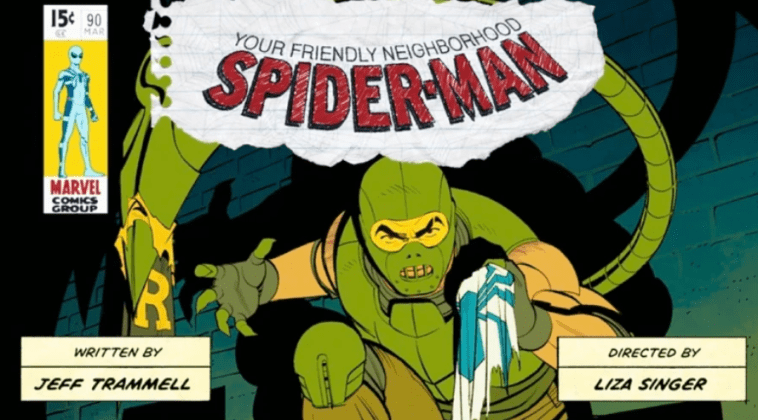
We’ve come full circle in the season finale of Your Friendly Neighborhood Spider-Man. I thought we were building up to a Green Goblin debut, but I was pleasantly surprised.

The entirety of Season 1 of Your Friendly Neighborhood Spider-Man felt like a pseudo-rendition of the Hero’s Journey. We started with Venom and ended with Venom. Granted, the characters are in different stages of growth now than they were at the beginning of Season 1, but things are calming down while they set up Season 2 of Your Friendly Neighborhood Spider-Man. It’s debatable how big a role Venom will play in Season 2. I’m guessing we’ll see more Venom given the setup at the end of “If This Be My Destiny…”

Since we didn’t see Green Goblin in Season 1, I suspect we’ll see him in Season 2 now that Norman has Spider-Man’s DNA. We may even see Chameleon in Season 2. While Osborn didn’t go full Green Goblin on us this time, he let his destructive ambition with the space door slip through the cracks.

One last thing I want to touch on is Dr. Strange. His making an appearance and time traveling with Spider-Man makes Season 1 of Your Friendly Neighborhood Spider-Man feel like a time loop. Peter’s own DNA was used in creating Spider-Man. Freaky.

Skye’s Take

These folks really know how to end a season. Going off what Season mentioned, this episode made the season feel much more satisfying. While I hadn’t thought of it as a “Hero’s Journey” before, I absolutely saw it as its own self-contained story. Everything coalesces in this episode which makes the wait feel earned.

Of course, my favorite detail in this episode was how it tied back to the first. I imagine most people who saw this had similar thoughts. What I liked about it was that it proved that this story has been carefully constructed since episode one. As an unassuming viewer, I didn’t know what plans the writers had in mind, but it’s obvious now they know what they’re doing. Kudos!

Also, my inner fangirl went crazy seeing those last-minute developments at the end of the episode. I could list them here, but I won’t. There’s just too many of them. Given what they showed us, I can’t wait for Season 2’s premiere. Sure, I still have small issues here and there with some aspects of the writing, but I think focusing on them is doing the show a disservice.

It’s safe to say that Your Friendly Neighborhood Spider-Man has strung me up in a web of childhood nostalgia. Can’t wait to see y’all next time!

Thank you for reading. If you’d like to dive deeper into Your Friendly Neighborhood Spider-Manfollow this link for episodes 9 and 10’s Secrets (Easter Eggs).

Your Friendly Neighborhood Spider-Man: “Hero or Menace” Review

Season’s Thoughts

Well, we certainly have a lot to unpack in Your Friendly Neighborhood Spider-Man’s “Hero or Menace.” Will Lonnie embrace his life of crime after seemingly taking over the 110? Will Spider-Man’s DNA be used against him? Highly likely. Let’s swing into “Hero or Menace.”

Who knew Big Donovan was such a coward? He seemed fine with taking other people’s lives in one way or another but, when it came to his own, he turned tail and ran. I thought this was done rather well since you never know how somebody’s going to behave when their life is in jeopardy. I’m not sure if Lonnie will become an anti-hero or a straight up villain. I’m leaning toward anti-hero, but that could change.

Nico and Peter making up was a sweet moment. I hope we get to see some spellcasting in the coming episodes from Nico. I feel like she’d fit right in with Spider-Man’s crime fighting. The pacing for Your Friendly Neighborhood Spider-Man has been consistent, so we may see more of a focus on Nico in Season 2.

Norman visiting Otto in jail to gloat was gold. I know their feud is serious and is affecting people’s lives, but this encounter was comedic for me. I’m anticipated full-on Green Goblin in “If This Be My Destiny…” That sinister cackle Norman gave at the end of “Hero or Menace” is very telling.

Skye’s Take

Alright! We have solid action, relatable characters, big-name villains, and a compelling story. Your Friendly Neighborhood Spider-Man is coming along well. By this point, the animation has grown on me. That and the frequent build-up for future villains.

In the case of “Hero or Menace,” I was mostly surprised with how Lonnie’s character progressed. At this point, it’s nice to see that he still has enough morality in him to help Spider-Man take down Gargan. However, I’m in no way holding my breath that it’ll stay this way. I’m actually hoping that Lonnie will become full-fledged Tombstone because that would create more complexity for his and Peter’s relationship. Don’t get me wrong, I’m sure I’ll still cry when that happens. If you can’t tell, Lonnie’s still my favorite.

That aside, there were a couple standard things in this episode. Not bad necessarily, just standard. They showed Peter and Nico make-up and Spider-Man almost killing Gargan. I think the Peter/Nico thing made sense and fit well in the show. At the same time, it’s a standard friend breakup you know isn’t going to last. Peter and Nico are still cute, but it’s a commonly used trope.

Then there’s the Spider-Man/Gargan battle. I have few issues with this fight. It’s well laid out, tense, and gets you invested in the action. The only thing that’s standard about it is how it ends. Spider-Man has the opportunity to kill Gargan, but Lonnie talks him out of it. While this ties into the struggles we’ve seen Peter go through in previous episodes, the “what it means to be a hero” trope has been done, especially with Spider-Man.

In fairness, this episode got me excited. After seeing it, I can’t wait to dive into the next episode. Stick around and see our review drop at 11:00am.

Thank you for reading. If you’d like to dive deeper into Your Friendly Neighborhood Spider-Manfollow this link for episodes 9 and 10’s Secrets (Easter Eggs).

Way Overdue Update

Hey, hey, folks! Long time, no upload. I’m Kyra Kyle, and JK Geekly has returned.

A lot has happened since we last updated this website. Some events spanned the globe like the pandemic and the ensuing lockdown. Glad that’s over.

I had a few personal events occur. I’ve been diagnosed as autistic and ADHD. I didn’t know one could have both, but I’m an AuDHDer. Is that how I spell it? The two don’t always play well with each other. I attended the Origins Game Fair last year and was alternately over and under stimulated. Meltdowns are fun. Other times, the two play too well with each other. I paced a trail into the carpet. It’s okay; we needed new carpet.

Pacing aided me to finish writing a novel or two. I’m pitching my first novel, Crooked as a Dogwood, to agents. I’ve gotten further than I’ve ever gone before with this process, so that’s great. I’m unsure if it’ll get picked up but that hasn’t stopped me from editing the next one and writing the one after that. Just keep writing. Just keep writing. Autism loves the routine; ADHD wants some strange. So, I’ll pace in between stories.

Speaking of stories, my short stories and poems have been published in several journals since the last update. I’ll have to look back and see which ones were published in which journals over these past several years. I’m fighting the urge to backtrack these past few years. No. I’ll do it later. Ack! I’m so bad at making shameless promotions for my work. Consider this a generic, hopefully modified soon plug.

On a somber note, my mom passed away last year. I’m still processing the loss over a year later, but I’ll do something in her memory, perhaps a top five tabletop games that she liked to play on her birthday in November. Or a list of games that I play that remind me of her. There may be at least a few games that have been released around or since her passing that Mom would’ve enjoyed.

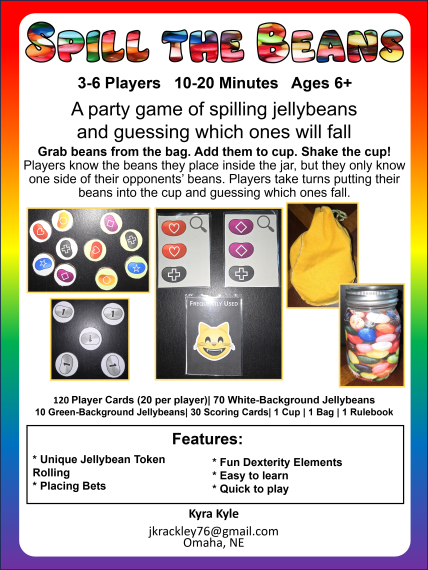
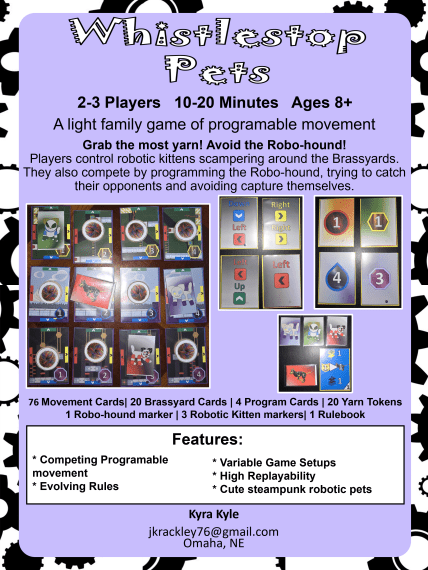
Mom also liked that I design tabletop games, and it turns out that I’m also pitching multiple games. I’m less familiar with this medium’s pitch process, but I’ll learn. One company has already expressed interest in Spill the Beans, but as of this post, I have yet to sign a contract, so I’m still pitching until a deal is reached. Here’s an initial Spill the Beans sell sheet.


And here’s the sell sheet for a second game I’m pitching to board game companies, Whistlestop Pets.


Whistlestop Pets factors into one of the books I’m working on as well. There may be some crossover possibilities.

I have several other projects (both game designs and writing) that aren’t as far along or I’m not at a stage where I’m comfortable talking about them here, but I’ll keep you updated. Hopefully.

And that brings me to the last point: What will happen to JK Geekly? In short, I don’t know. The site can go in many directions. I have one article I want to upload this November (love you, Mom), but aside from that I don’t know. I’ll probably try several things. If anyone has any suggestions, leave them in the comments.

I hope that wherever you are, you’re having a great day.

~ Kyra

My Favorite Storytelling Elements Spider-Man “Kraven’s Last Hunt”

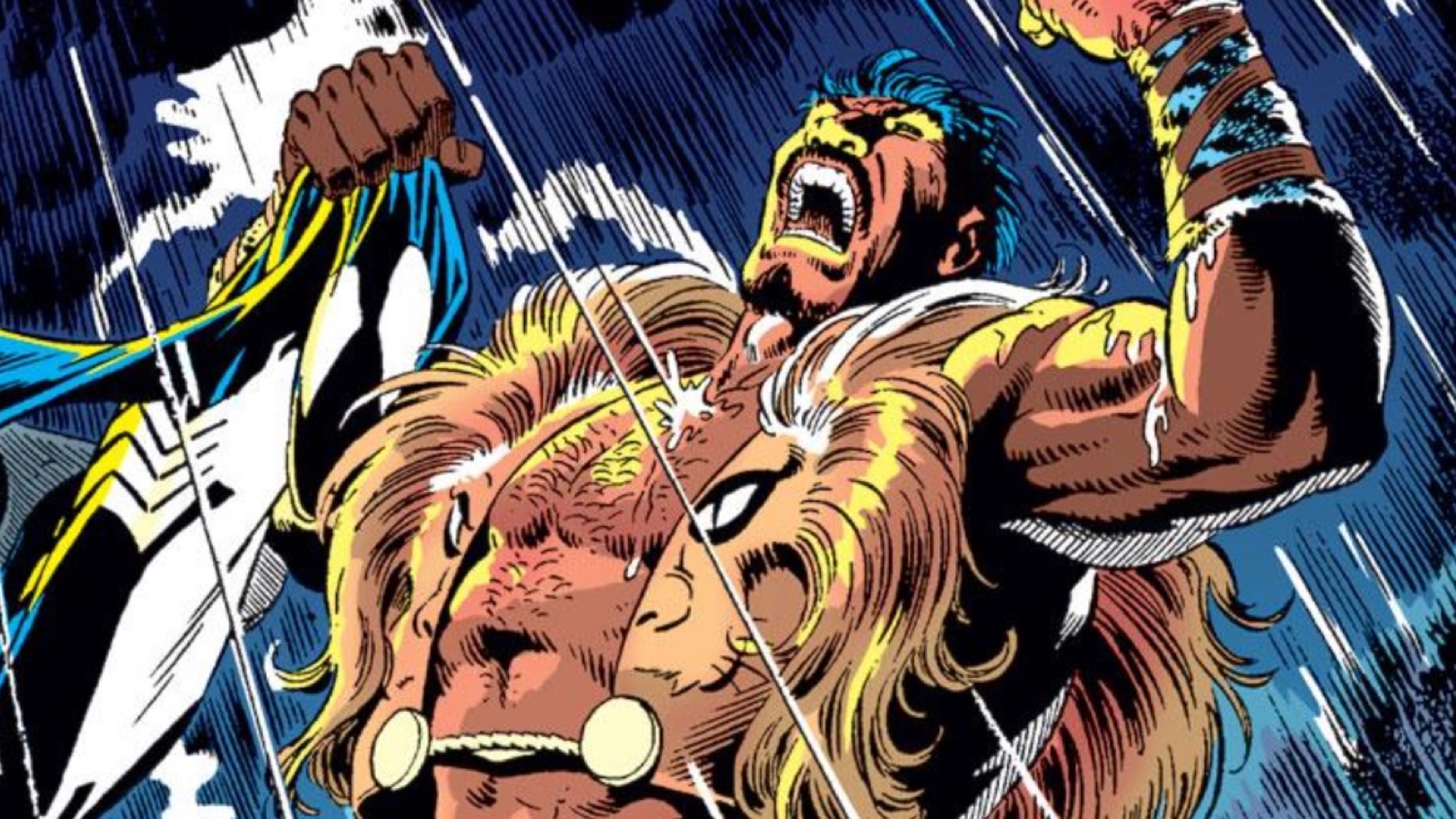
Most critics dub “Kraven’s Last Hunt” the greatest Kraven story ever told and one of the best Spider-Man stories. It features plenty of comic book action, but the character studies are what set “Kraven’s Last Hunt” from other Spidey tales.

The world no longer appreciated Kraven’s physical prowess. It no longer marveled at his courage, and most animal rights activists condemned him—he was a hunter after all—and the world he lived in no longer made sense. Before he met Spider-Man he’d never known defeat or humiliation. Now Kraven has fallen ill. He knows the end is near, but before he goes, he vows to reclaim his honor and prove his superiority over Spider-Man. He went out for one last hunt.

spider-man_kraven

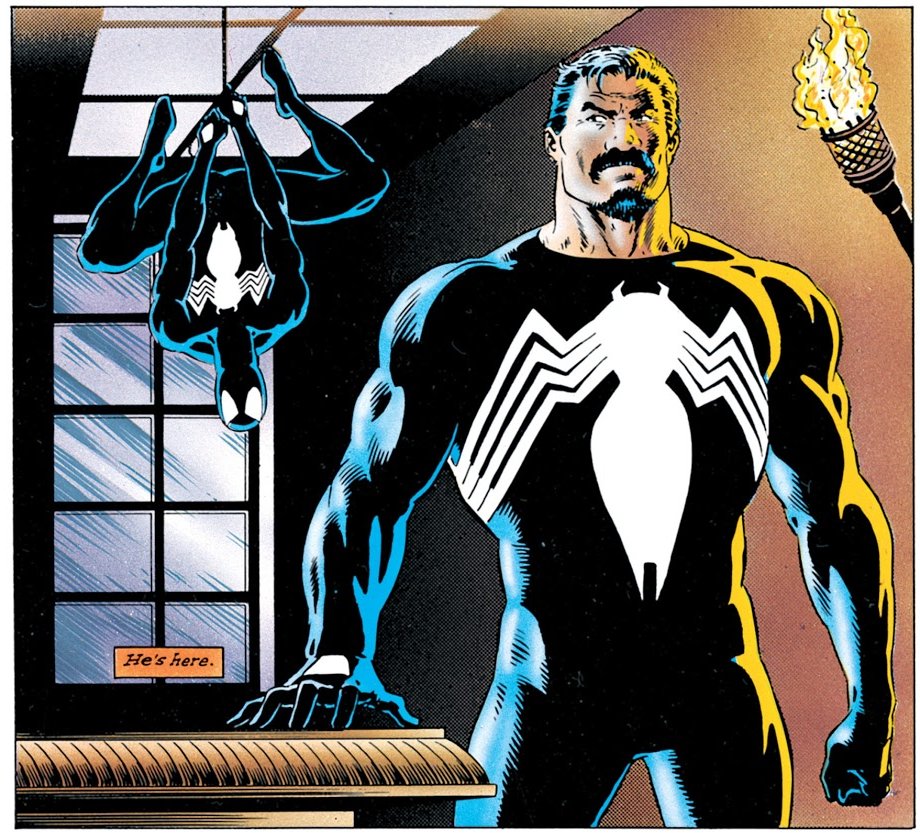
“Kraven’s Last Hunt” embraces Kraven’s personal struggles. It blends aspects from classic literature and recurring themes to find a deeper truth. Kraven doesn’t just want to kill Spider-Man. In fact, Kraven doesn’t kill Spidey when he has the chance. He buries Spidey alive on his complex and assumes his identity. There’s even a moment where Kraven rescued Mary Jane, Spidey’s new wife, and she can see through Kraven’s disguise. Kraven falls short of being a hero. He never was one. This is a story that questions what it means to be a hero.

Kraven also thinks he can drive Spider-Man past the point where he ceases to be a hero. A rat-like monster named Vermin stalks the streets of New York while Spidey rests six-feet under. Kraven beats the creature unconscious, brutalizes him, and takes him prisoner. After Spidey comes to, he wants revenge for the time Kraven took from him. His anger leads him to Vermin, who Kraven uses as pawn to see if Spidey is strong enough to do unto Vermin what he did. Spidey proves that he’s strong enough not to.

spider-man_kraven_in_spider-mans_suit

There are so many themes of what makes a hero and what makes a good person that it’s easy to see why “Kraven’s Last Hunt” is high on most critics lists of Spider-Man stories. It not only portrays Kraven at both the height of his powers and the lowest, it does a great job in its portrayal of Peter and Mary Jane’s young marriage.

Readers see how MJ deals with Peter’s disappearance and how she’d react if Peter ever died in action. It’s a great window into the life of someone who must stay up late, worrying if their loved one is okay. In short, “Kraven’s Last Hunt” is a triumph and a must read for any Spider-Man fan or Spidey newbie.

Is there anything about “Kraven’s Last Hunt” that you liked that I didn’t mention? If there is, message me and I’ll give you Jim’s phone number to complain to him. Or you could let us know in comments.

Geekly’s Free Video Game Summer: August 21, 2016

FreeVideoGame6

Hi, guys. I didn’t forget you, I’ve just been dealing with housing issues (my house is constantly under construction) but you don’t want to know about that. You want more games. This week’s Geekly’s Free Video Game Summer is brought to you by video game versions of collectible card games. I know I cover tabletop games with my other reviews, but there are plenty of free-to-play video games that use the collectible card game model. Just to clarify, you collect cards (of varying rarity) in a collectible card game and make decks out of the cards you collect. It’s a decent game model for a free-to-play game and there are plenty of free-to-play collectible card games out there. Let’s get started.
FinalFantasyPortalApp

Final Fantasy Portal: Triple Triad

Full disclosure: there’s a lot more to the Final Fantasy Portal besides Triple Triad, but the only thing I’m covering here is Triple Triad. Ah, I loved Triple Triad in Final Fantasy VIII. It’s the collectible card game within the role playing game. Players would collect cards of characters found within the game and challenge random non-player characters to card duels. The rules are simple.

You play on a 3×3 grid. Every card has four values for each one of its sides (left, right, up, and down) and these values are printed in the upper right-hand corner of the card. You play cards in the 3×3 grid and if your card’s value on one side is greater than your opponent’s you take control of their card (kind of like Othello). Whoever owns the most cards at the end of the match wins. In the original game, players only obtained characters from Final Fantasy VIII, but Final Fantasy Portal’s version of Triple Triad includes all numbered entries in the Final Fantasy franchise and that’s a lot of fun.

The original Triple Triad weaved in elemental play—the card based on the Brothers summon had an earth element and its values were doubled against cards with a lightning element—but Final Fantasy Portal’s Triple Triad omits elements and adds same and plus to the gameplay. Same is okay; if you play a card that matches the values on cards that share two or more sides, you flip over any opponent’s cards adjacent to the card you played. Plus functions similarly to Same but you add the values of the cards on all sides and if the sum is the same, you flip over all opponent cards. I hate the Plus rule.

Plus can negate any good card you may have. If one side is an 8 and the other is a 9, all your opponent has to do is play a 2 to the 9 while playing a 3 to the 8; both sides would equal 11 and you just lost some of your best cards. You can dictate which rules you play in versus mode, so you can avoid the Plus rule and it doesn’t diminish my enjoyment of Triple Triad, but how hard would it have been to assign an element to each character? Still, Final Fantasy Portal’s Triple Triad is a faithful port of the popular Final Fantasy mini game. And wouldn’t want to construct a deck with the best characters from Final Fantasy lore? This one’s staying in my collection, but I’m not sure how often I’ll play.
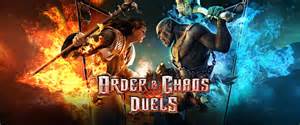
OrderAndChaosDuels

Order & Chaos Duels

On the surface, Order & Chaos Duels looks like a Hearthstone clone, but there’s more going on beneath the surface—not much but a little. Like Hearthstone, you assume control of a hero who has their own innate ability and you’re trying to knock your opponent’s hero’s health to zero. You cast minions and spells to buff your minions or debuff your opponent’s minions. All of this should sound familiar to Hearthstone fans. Order & Chaos’s twist is that it matters where you play a minion.

You have five locations (one row consisting of five spots) you can play your minions, each minion has attack and health, and if you lower your opponent’s minion to zero health in a spot or there is no minion in the spot, your minion attacks your opponent directly. This simple addition offers more strategy, and that’s a good thing, but I never felt as if I had agency in a game of Order & Chaos.

Sure, you set up your minions to defeat your enemy, but unlike Hearthstone or Magic: The Gathering, there’s no way to counter anything your opponent does—or at least these counters are few and far between. Most of the time you’ll set up your minions during your planning phase, pass the turn to your attack phase, and once you’re done attacking, your turn’s finished.

There are also alternate ways of winning in both Hearthstone and Magic: The Gathering (namely you helping your opponent run out of cards: milling their deck) that just doesn’t exist in any tangible way in Order & Chaos. The play styles don’t offer much variety either, so I’d say Order & Chaos is a pass.
EpicCardsBattle

Epic Cards Battle

I’m not sure if Epic Cards Battle even qualifies as a collectible card game. Sure, you collect cards but you don’t build a deck so much as you pick your best card or two and play them ad nauseam.

If I didn’t like the lack of agency in Order & Chaos, I hate the lack of agency in Epic Cards Battle. All you do is pick the card(s) that has the best combination of attack, health, and speed and see these cards battle it out on their own with no input from the player. Some of these characters/cards have special abilities but gameplay boils down to those three statistics and whose cards have the better of those statistics. Epic Cards Battle puts more emphasis on scantily clad women than it does gameplay. If you’re into that sort of thing, Epic Cards Battle might be a decent game. If you want something more from your gaming experience, I’d skip it.
CardLordsApp

Card Lords

Card Lords combines elements from several games in this review and it does so in a satisfying way. It could be that it deploys a similar art style as Card Wars 2 (which I’ll cover later: foreshadowing, baby) and I like that art style, but it does use the best part of Order & Chaos, which is “card placement matters.”

Akin to Epic Cards Battle, Card Lords has players select their best cards. Unlike Epic Cards Battles, it feels more like you’re building a deck, or at least assembling a team with abilities that play off each other well. There’s a lot of repetition to Card Lords’ gameplay but it’s enjoyable in small doses, and players will get small doses because Card Lords also uses the ubiquitous energy resource found in free-to-play games. You’ll play a few matches before you have to wait an hour or so—or spend money (and that’s how the developer’s get paid). But unlike most free-to-play games that use energy, you don’t have to wait long; it’s literally an hour or less.

The last element Card Lords introduces is developing your cards. You can power up your cards so they’ll gain special abilities (another thing we’ll see again in Card Wars 2) and you get a sense of developing your team/deck. You also have slightly more control in Card Lords than you do in the previous two entries (Epic Cards Battle and Order & Chaos), but it still doesn’t have as much strategy as I would like. There are few moments when you wouldn’t use your cards’ special ability as soon as it’s available to you and battles still come down to who has the best stats. Still, Card Lords is worth a look.
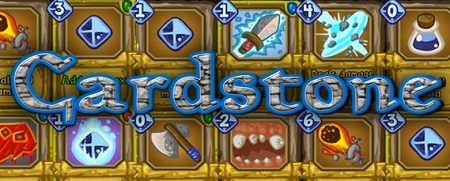
Cardstone

Cardstone

Cardstone is a Rogue-like dungeon crawl that just happens to use cards as its means of combat. You collect cards as you journey deeper into the dungeon, but if you die, your deck resets and you have to rebuild your deck the next time you enter the dungeon. That’s curious.

Cardstone plays more like a deck-builder game (a game with set cards and you build your deck each time you start a new game) instead of a collectible card game (a game where you build your deck over time and your deck remains the same unless you make changes to it). I like the idea of a free-to-play deck-builder game, but I’m not sure if Cardstone’s combat works as well as I would like.

Players face a new creature in the dungeon with each round. Sometimes a creature will run away if you have too high a level—you do gain levels and increase your health, even if your deck resets—but when a creature stills around, you cycle through your deck on a timer. Every three or four seconds, you draw a new card from your deck. You’ll see that card rotate on the screen until you use it or it disappears (gets discarded). This mechanism leads to players drawing healing cards when they need to deal damage and damage cards when they need healing. It doesn’t matter early in the dungeon, but the deeper you get in the dungeon, the harder your opponents get and the less likely it is you’ll get the right cards. Funny how that works. This perceived cheating by the AI makes Cardstone the most frustrating game of this bunch. I don’t know how many times I fought a creature to a first one who deals damage wins scenario, only to draw into five consecutive healing cards. Note: do not play Cardstone if you’re easily irritated.

I like Cardstone’s concept but I’m not sure how long it’ll stay in my collection. It’s another game that’s worth a look. You may find it enjoyable.
DengenChronicles

Dengen Chronicles

I was intrigued when I first downloaded Dengen Chronicles. It’s a collectible card game, but the cards are hexagonal shaped and the board is laid out like a honeycomb. Unfortunately, there’s little to no strategy.

Like many other games in this list, the winner of Dengen Chronicles boils down to who has the best stats: attack and health. But the board factors into the equation. Character/card placement matters, but it matters in the worst possible way. During the first turn, whoever has a character/card in the top point of the star deals damage first to the first, opponent character/card located clockwise on the star. So, whoever gets to play their card/character first typically wins. Sure, the next round shifts who deals damage first to the next point clockwise on the star, but by then the damage is already done.

Dengen Chronicles overlays a convoluted element chart on the board. Each section of the honeycomb represents a specific element and only characters with that element can be played there—you get bonus attack if they have multiple copies of that element printed on their card—but all you have to do is build a deck that has a strong showing in the first, third, and fifth elements, and you can dominate most games.

The only issue with that strategy is that everyone tries to use it (player versus player) and who wins is the person who goes first. At that rate you may as well flip a coin and call heads or tails instead of playing Dengen Chronicles. For me this game is a strong pass.
CardWars

Card Wars 2

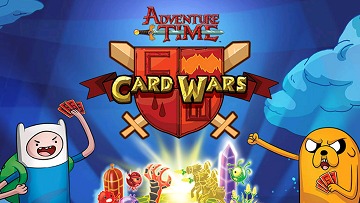
Full disclosure: there is a physical, printed version of this game and I haven’t yet played it, but I have seen Adventure Time and like the Card Wars episodes. Card Wars 2 is one of those few games where I don’t ever mute the game. John DiMaggio’s Jake the Dog walks you through the tutorial and the rest of the cast voice the characters they portray in the cartoon.

The game itself is a good representation of the Card Wars found in the animated series. They’ve got everything, including Jake’s favorite element: Corn. You can pick any element you want to play. Each element has a distinct play style, which is something that’s missing in many of the other games on this list. You can even mix-match cards from various elements to build an awesome deck, and it’s a lot of fun to experiment. Compared to the other games on this list, Card Wars 2 is a must play.

But Card Wars 2 isn’t all sunshine. It uses an energy system, which isn’t bad, and players can also upgrade their cards. I’m not against upgrading cards either but how you upgrade cards matters, and with how Card Wars 2 is set up, you could spend real-world dollars trying to upgrade your cards the preferred way. The first way you can upgrade your cards is by leveling them up. The problem with this method is that your decks are capped off at a certain numeric level, based on your player level. So if you level up your cards, you might only be able to put a 40 levels of cards in a deck, and if you have a card you want to use that’s level 40, one card could be your entire deck. The better way to upgrade your cards is to enhance them, and to do that you’ll have to collect items and merge them with your card. These items are difficult to acquire and this is where Card Wars 2 tempts players to make in-game purchases.

If you’re patient with leveling yourself up as a player and then leveling up your cards, Card Wars 2 can be enjoyable and free. If you’re impatient, you could spend a lot of real-world money or you could get frustrated. Card Wars 2 is the most enjoyable game on this list and a must play for an Adventure Time fan.

Well, I hope this longer group of games makes up for the couple of weeks I missed. Until next we meet, thanks for reading.
Geekly’s Quirky Video Games: June 3, 2016

QuirkyVideoGame

We’ve neglected video games up to this point on JK Geekly because readers might get confused between video game and tabletop game reviews or news, but I don’t see why we can’t have the occasional video game post. So let’s begin a series of posts that cover quirky video games. We read plenty of reviews or thoughts about mainstream, big budget games, so let’s explore some weird.

These quirky games are ones that have interesting mechanics, stories, or tackle seldom discussed or covered topics. Some are great, others are not so good, and there may be a few that I’ll discuss that some readers won’t even consider a “game,” but all of them are intriguing on some level. The great thing is that a fair number of these under-the-radar games have a small price tag. That’s part of the appeal—my tabletop game habit leaves me a little cash poor. Without further ado, let’s get to this week’s quirky video games.

TheStanleyParable

The Stanley Parable

This one’s not really an under-the-radar game. Video game enthusiasts often mention The Stanley Parable when discussing bizarre video games. Even though you may want to slap the smug look off of their face—and I imagine that some of you are thinking the same thing about me right now—when a video game aficionado says you should try The Stanley Parable, they aren’t wrong. You should try The Stanley Parable.

You play as the titular Stanley as he attempts to escape his drab office space and soul crushing job. A voice-over narrates his every action, and The Stanley Parable does a great job of marrying voice acting with the action on the screen. The unnerving narration functions as comedic relief one moment and bone chilling dread the next. If you download The Stanley Parable from Steam, you’ll even experience a little meta-gaming. You’ll find such achievements as don’t play The Stanley Parable for a year, play The Stanley Parable for the duration of a Tuesday, and click on office 430’s door five times, but the narrator berates you for trying to earn such an easy achievement and coaxes you into doing more tasks.

I probably said too much already. I don’t want to spoil anything else but let’s just say that The Stanley Parable is equal part slipstream and modern Aesop’s fable. It fits the bill for a quirky video game.

LifeIsStrange

Life is Strange

It’s difficult to discuss a storytelling episodic video game without mentioning Telltale Games, because they invented the genre, but I’ll try to limit my mentioning of Telltale while covering Life is Strange.

Life is Strange may have perfected the Telltale Games episodic model. This game tweaked a single mechanic: you can reverse time. Life is Strange’s protagonist can turn back time the duration of a scene—about 5-10 minutes—so you can see what the short term effects of a decision are, but since you can’t reverse time to any moment in the game’s narrative, you won’t know the long-term ramifications of your actions.

Adding that twist could make it sound as if decision making in Life is Strange would be easier than your typical Telltale Game, but it’s the opposite. There are moments where you agonize over which course of action is the best. During an interview, one of Telltale Game’s executives said, and I paraphrase, that Telltale judges the writing of their games based on whether or not gamers will have close to a 50% split between two disparate actions in a scenario. Since you can see these percentages at the end of each episode (for both Telltale and Life is Strange), you can tell that there are three to eight decisions where Telltale episodic game series yield an even split.  Life is Strange has five to eight decisions each episode that meet those statistics. Life is Strange out does Telltale in the one statistic Telltale Games uses to gauge the effectiveness of their writing.

Okay. Let’s put a pin in Telltale talk and discuss over aspects of Life is Strange. The time reversal mechanism also yields some interesting puzzles. You control time, not space, so you can walk some place, warp back in time, and you’re elsewhere when the rest of the world catches up to you. That’s trippy, and the resulting puzzles and problem solving are fun. You also have to show how observant you are so you can convince people of your powers. Those moments presented a nice memory game. In fact, there were plenty of subplots and side games to be had with Life is Strange. The writing—for the most part—and the gameplay’s variety are strengths. You play as a teenage girl, and Life is Strange captures what it’s like to be a teenager. That could be a good or bad thing, but regardless, Life is Strange is an earnest game.

It isn’t all sunshine. The voice acting leaves a little to be desired. The lip syncing between the audio and visuals can be distracting too. I don’t mind it when voices don’t match lips—that could be an anime fan thing—but since I noticed the lips not syncing, that could be a deal breaker for some folks. Life is Strange also suffers from the inevitable time travel plot holes, and the last episode, to be polite, was shaky in the writing department, but the overall experience is top notch. If you have any interest in episodic storytelling games, you should give Life is Strange a try.

TheStaticSpeaksMyName

the static speaks my name

The last quirky video game for this week may be one of those “games” that aren’t really games. the static speaks my name is more of an experience that plays out in ten minutes. Seriously, you’ve spent more time reading this post than the time it’ll take to play this game. I just heard some of you groan through cyber space and appreciate you guys reading this post. Really, I do.

Anyway—the static speaks my name is dark and morbid. You play as a man who’s obsessed with a painting of twin palm trees on a small island. You learn more about him and his mental state (similar to Stanley in The Stanley Parable), and I’ll stop there so I don’t spoil it for you. the static speaks my name is a free game on Steam and you can play the “game” as quickly as I can ruin the ending.

I will say that the real psychological game comes at the very end. I know that what I’m about to say is fuzzy (if you haven’t played the game), but if you play this game, take your time during the ending. It’s disturbing, but you could discover something about yourself.

That’s all I have for Geekly’s quirky video games. Hopefully, this will be an ongoing post. Thanks for reading.