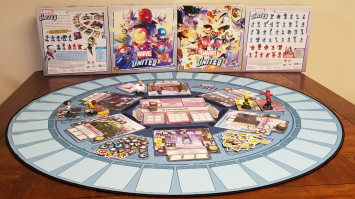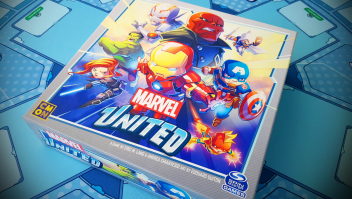
Tabletop Game Review: Marvel United, Rise of the Black Panther

Has it been long enough since we’ve covered a Marvel United expansion? It’s been one month? Eh, why not cover one of the final expansions from the original release, Rise of the Black Panther? Like I said in our last expansion review, Geekly won’t be covering every Marvel United expansion, but we will review the ones worth your time or the ones we believe people will most likely purchase. In short, you may want to consider these expansions.

Hey, hey! Kyra Kyle here. In Marvel United, take on the roles of iconic Marvel heroes who work together to stop the master plan of a powerful villain controlled by the game. Each villain has a unique master plan, cards that trigger various effects, and threats that make clearing locations difficult. Heroes clear missions, making the villain vulnerable, and finally take on the mastermind before they complete their evil plot. Can you save the world from impending doom? Let’s find out with Rise of the Black Panther.


Wait. Before we leap into the fray, we should look at Rise of the Black Panther’s fine print.

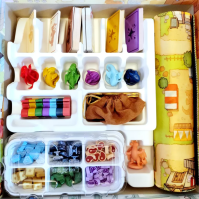
Marvel United Box Close Up Board Game Review

The Fiddly Bits

Designer: Andrea Chiarvesio and Eric M. Lang
Publisher: CMON Global Limited and Spin Master Ltd.
Date Released: 2021
Number of Players: 1-4
Age Range: 8 and up
Setup Time: 5-10 minutes
Play Time: 30-40 minutes

Game Mechanisms

Cooperative Play
Hand Management
Modular Board
Solo / Solitaire Game
Variable Player Powers

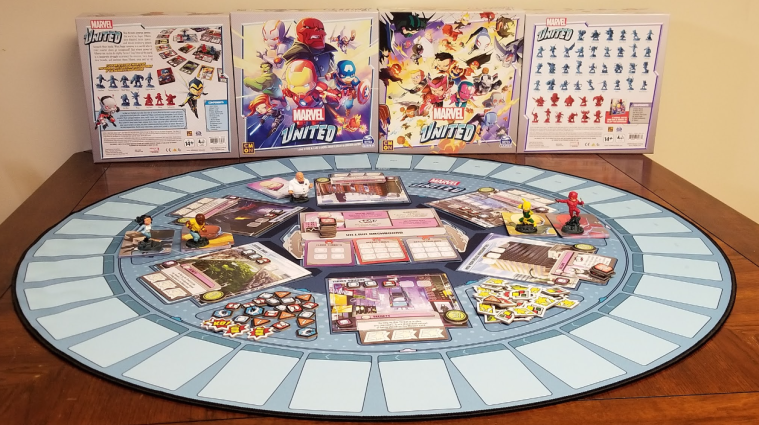
Marvel United Tabletop Game Set Up

Game Setup

We already covered the Game Setup and Game Flow in our Marvel United review (here’s a link to that review), so we’ll go over the basics in the following two sections. Let’s cover an abbreviated review of the game setup and rules.

Marvel United’s setup can change depending on which Villain and Heroes you choose to play. Each game consists of six locations. Typically, core sets have eight locations. Since Rise of the Black Panther is an expansion, it only has six. You may choose your locations or shuffle them and choose six at random. Each Location card has spaces at the top for civilians and thugs and a rectangle with a block of text that will state “End of Turn” at the top of the box.

Place civilian/thug tokens on their matching spaces. Shuffle the Villain’s Threat deck and deal out each Threat face-up so that it covers the rectangle at the bottom of each location. You must clear this threat before gaining the “End of Turn” effect printed on a Location. Place health tokens where signified on threat cards and on the Villain dashboard. Place the three mission cards (Defeat Thugs, Rescue Civilians, and Clear Threats) face up under the villain dashboard where the text reads “Unlocked.”

Each player shuffles their hero decks and then draws three cards to form their hands. Shuffle the Villain’s Master Plan deck. Leave the Master Plan deck face down. This will be the villain’s draw pile.

Players place their miniatures on one of the six location cards, usually the centralmost location for each player (easy access). Then, they place the villain on the location card opposing the heroes.

Marvel United Game Flow Board Game Review

Game Flow

The villain(s) play first. Draw the top card of their master plan deck. The villain moves the number of spaces indicated. Resolve any BAM! Effects and these effects will be printed on a space within the villain’s dashboard. Then, place the civilian/thug tokens (if any) indicated at the bottom of the card. After all these effects are resolved, the heroes get their turn.

Heroes pick who goes first, and hero turns will continue around the table clockwise. At the beginning of each game, Heroes will get three turns before the villain receives another turn. During their turn, heroes play one card from their hand.

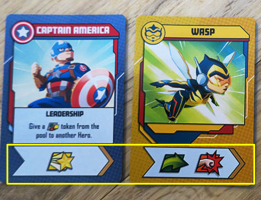
Resolve actions and the symbols printed at the bottom of the hero’s card in any order. The symbols at the bottom of a hero’s card will be shared with the next player, but any printed action will not be shared. Heroes will use these actions to complete missions. The game begins with three missions in play: Defeat Thugs, Rescue Civilians, and Clear Threats. Each mission card will have spaces for the tokens they require to complete. As soon as these spaces are filled, the card is discarded, and the mission is considered complete. Mission cards can be completed in any order.

Marvel United Three Mission Cards Board Game Review

After the heroes complete the first mission, the villain panics and will act (play a card) every two hero cards instead of every three hero cards. After the heroes complete the second mission, the villain becomes vulnerable to damage. The heroes can complete the third mission, but it isn’t necessary. If the heroes do complete the third mission, each hero immediately draws 1 card, increasing each player’s hand size by one.

Play continues back and forth until either the villain wins (by completing their unique master plan or anyone, heroes or villains, runs out of cards) or the heroes win by dealing enough damage to the villain after the villain becomes vulnerable to damage.

Review

Rise of the Black Panther has some stellar heroes in its ranks. The Challenge Card uses some interesting game elements that I haven’t seen Marvel United use before or since. Killmonger can be a tricky villain and one of my favorites to defeat. It’s an accomplishment to defeat Killmonger. But Rise of the Black Panther’s Locations may be the biggest reason why Geekly’s covering this specific expansion. We’ll start with Locations.

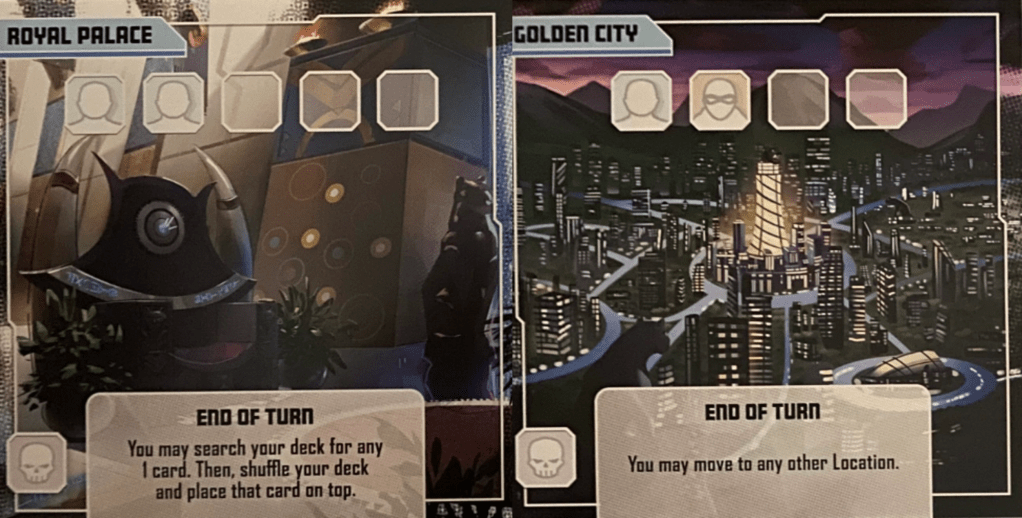
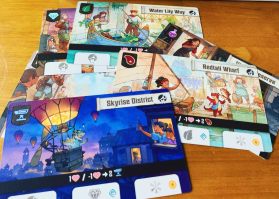
Jabari Village and Warrior Falls have solid “End of Turn” abilities. One gives you a Wild token while the other allows you to deal one damage at that Location. Not bad. But it doesn’t hold a candle to the remaining four Locations. Golden City lets players move to any other Location at the end of their turn. This gives players extra movement. I love that. That gives me one less resource to manage and I can focus on Heroics and Attack. Royal Palace allows players to search their deck for a card and place that card at the top of their deck. Fantastic! This would be a strong ability in most card games with decks. But the Great Mound and Shuri’s Lab puts Rise of the Black Panther Locations over the top.

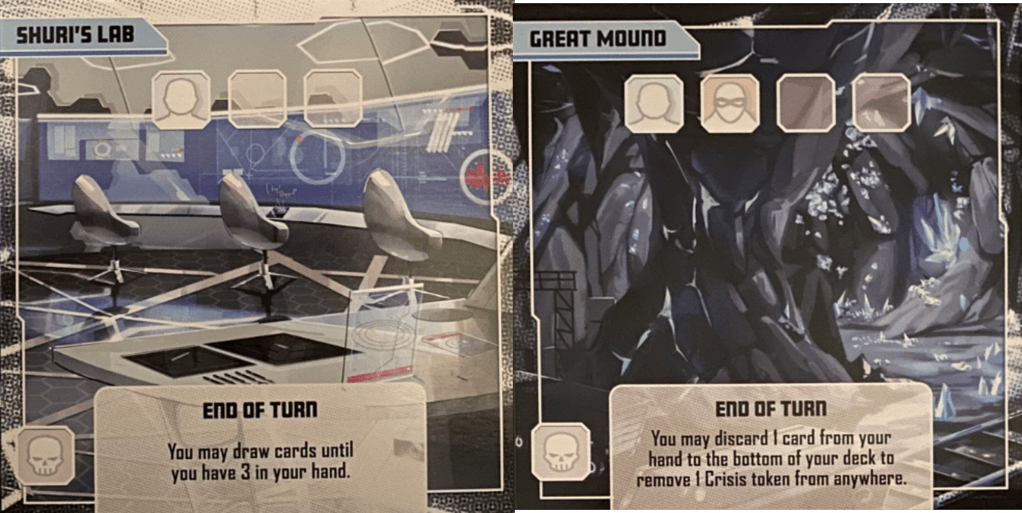
Great Mound is one of the only ways to manipulate Crisis Tokens in the original Marvel United release. Full stop. If you have a villain who has pesky Crisis Token abilities (one of those is Killmonger included in Rise of the Black Panther) and you only have the original Marvel United release, Great Mound is a must. Its “End of Turn” ability allows players to discard a card from their hand to the bottom of their deck to remove 1 Crisis Token anywhere. Shuri’s Lab creates a great tandem of Location abilities. Its “End of Turn” ability grants players the ability to draw up to their maximum hand size, negating any ill effects from the Great Mound and giving players a way to heal. I like Enter the Spider-Verse’s Locations a lot, but they pale in comparison to Rise of the Black Panther’s.

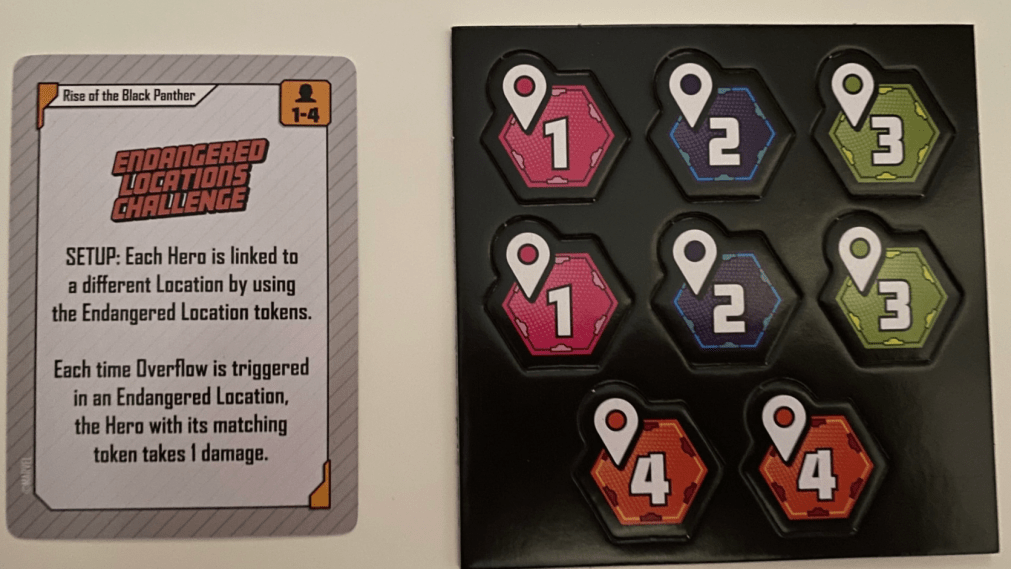
As mentioned in previous Marvel United reviews, Challenge cards provide optional rules to spice up the core gameplay. Rise of the Black Panther’s “Endangered Locations” is a simple and engaging rule twist. During Setup, Each Hero is linked to a different Location by using the included Endangered Location tokens. During play, each time Overflow is triggered in a Location, the Hero with its matching token takes 1 damage. This makes each Location mean something to certain players. This Challenge card could influence players to keep one Location clear of tokens over another Location. I love it because it raises the stakes and adds a dash of strategy and something else for players to navigate.

Killmonger Marvel United

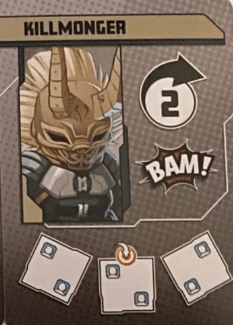
We’ll get to the heroes in a bit, but let’s talk about one of the MCU’s better villains, Killmonger. Killmonger also happens to be an intriguing villain in Marvel United. He wins when four or more Locations have 3 or more Crisis Tokens, and he adds Crisis Tokens in various ways. His Overflow and BAM! abilities replace Civilian/Thug Tokens with Crisis Tokens, which will make clearing missions (in order to make Killmonger vulnerable to damage) more difficult. The “Weapon Smuggling” Threat card has a similar action. And his Master Plan deck adds plenty of Civilian/Thug tokens, which can trigger Overflows, while his “Overthrow” ability can convert multiple Civilian tokens into Crisis Tokens. In short, Killmonger can turn the tide of battle in short order.

Furthermore, Killmonger has plenty of ways of dealing additional damage to Heroes, which can cause players to race toward Shuri’s Lab for some heals. Killmonger has one of the higher potential damage outputs of Marvel United’s original set. As I said prior, beating Killmonger is an accomplishment.

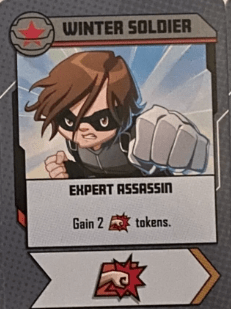
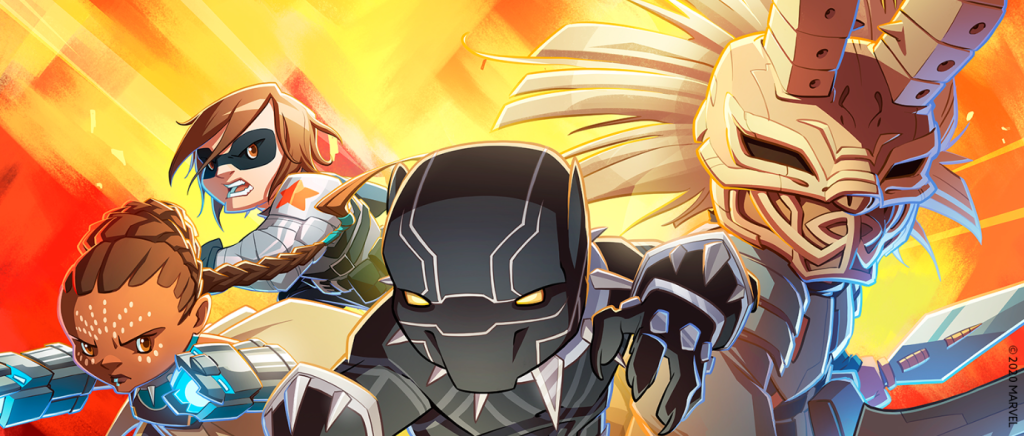
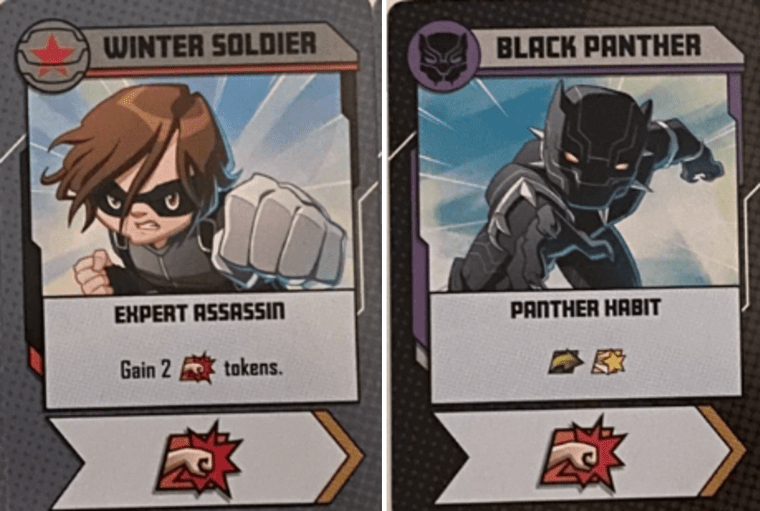
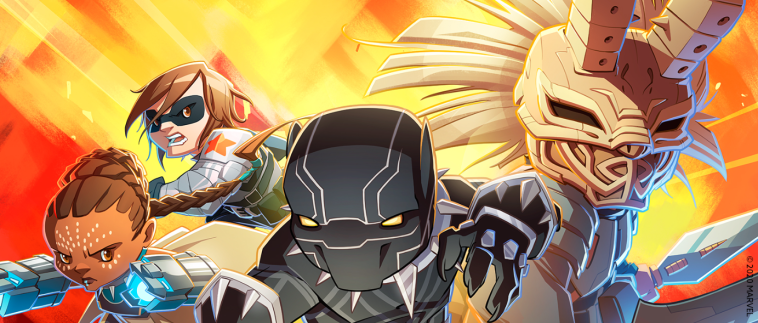
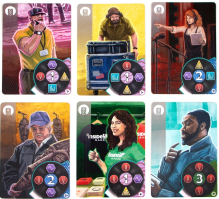
Rise of the Black Panther’s Heroes are darn good and should be up for the task of defeating Killmonger. Black Panther tends to focus on giving himself bonus actions, but his Movement is so good that he’s a good choice for teams choosing specialists (All Attack or All Heroics), and the other two Heroes in this expansion happen to be specialists. Winter Soldier is one of the better pure damage dealers from Marvel United’s original set. His deck tends to be the most self-centered of the Rise of the Black Panther heroes. He gives himself Attack tokens. This can also make Winter Soldier the easiest Hero to play. Of the Rise of the Black Panther heroes, Shuri is easily my favorite.

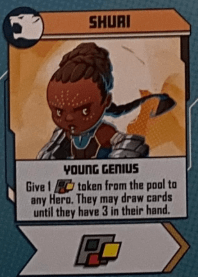
Shuri has a stunning five cards with Wild symbols on the bottom. This gives her and her teammates options whenever they take their turns. The remainder of her deck centers around Heroics. Winter Soldier is the fighter; Shuri is the helping hand. And Shuri’s one special effect “Young Genius” certainly lends a helping hand. She gives one Hero (she can target herself) a wild token and the player may draw cards until they have 3 cards. Not only does she hand out an extra wild token, but Shuri heals a Hero up to their full health. This is huge. I don’t know how many times Shuri’s ability saved my party’s bacon. She is Rise of the Black Panther’s standout Hero.

Too Long, Didn’t Read

Rise of the Black Panther has some of the original Marvel United set’s best Locations. Its Challenge card adds a simple but compelling wrinkle to gameplay. Killmonger is a worthy adversary. The Heroes provide variety, but Shuri can turn the tide of battle.

Tabletop Game Review: We’re Doomed!

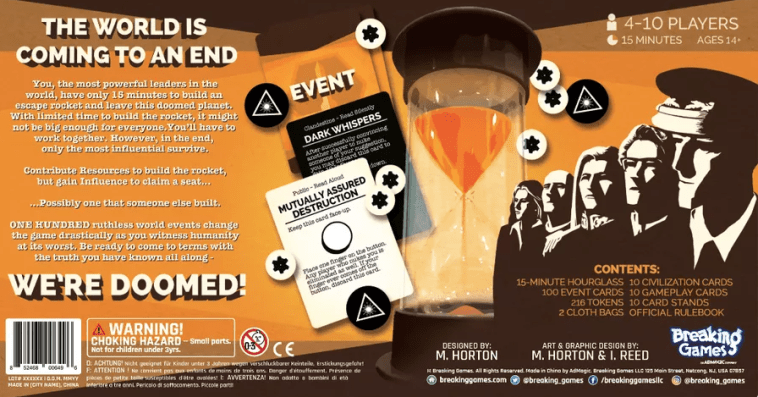
Earth is doomed. The leaders of the world’s most powerful nations have created a scenario where humans need to escape in a rocket ship before the planet implodes. You play the role of one of the world’s leaders. That’s the premise of today’s tabletop game review, We’re Doomed!.

Hey, hey! Kyra Kyle here. Geekly hasn’t had a new board game review in quite some time. Today’s game is a silly party game with a quirky theme. Played in a real-time 15 minutes (the game includes a 15-minute hourglass), We’re Doomed! tasks players with generating enough resources to build a rocket ship big enough for all the players at the table or if you have the most influence and there’s only seating for one player, you become the only one to board the rocket ship. The choice is yours. Work together or backstab the other players.

Before we go any further, let’s prepare this rocket for takeoff and discuss We’re Doomed!’s details.

The Fiddly Bits

Designer: Mike Horton
Publisher: Breaking Games; Magellan
Date Released: 2019
Number of Players: 4-10
Age Range: 12 and up
Setup Time: Less than a minute
Play Time: 15 minutes (timed)

Game Mechanisms

Party Game
Card Game
Negotiation
Player Elimination
Variable Player Powers

Game Setup

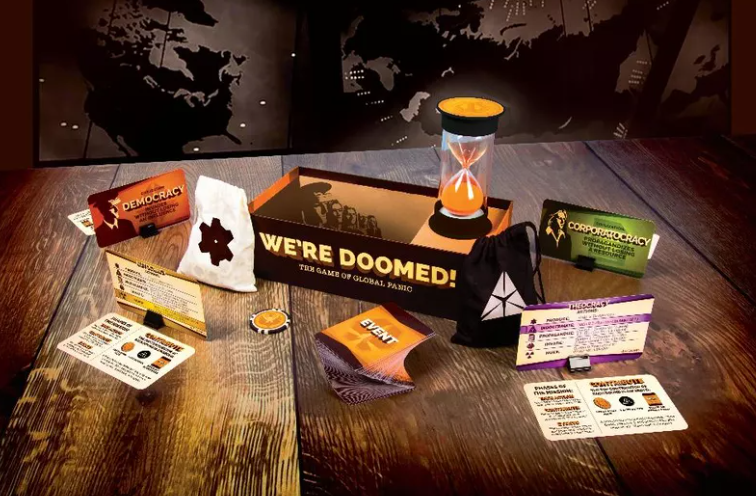
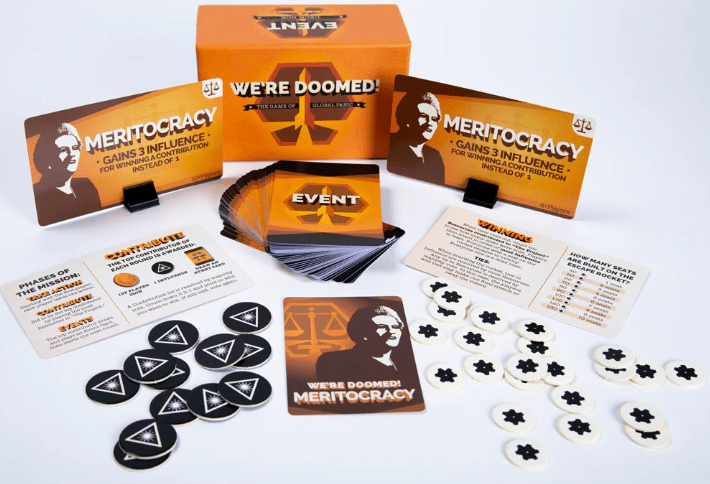
We’re Doomed! has a minimal setup. Each player receives one Leader card that they display for others to see. Form piles of influence and resource tokens so every player can access them. The hourglass is set up so that all the sand is on the bottom (before it gets flipped), and the first player token rests on top of the hourglass.

Randomly select one player to go first, or someone could flip over the hourglass and claim the first-player token for themselves. You have 15 minutes before time runs out. Go!

Game Flow

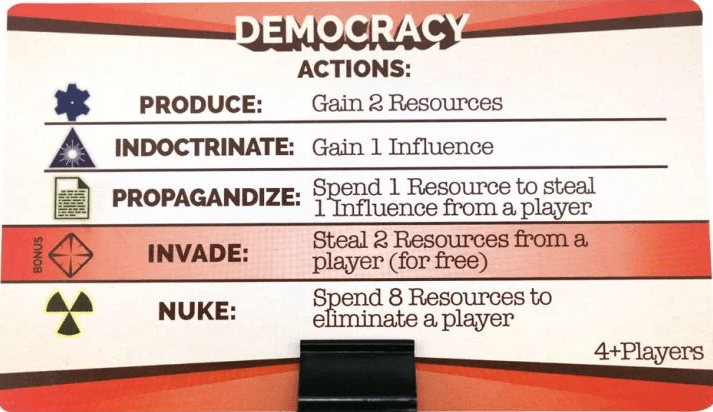
We’re Doomed! is played in rounds until time runs out. Each round is split into two phases: Actions and Contribution. The action phase is played in turn order, starting with the first player. Unless the rules (which can evolve) say otherwise, each player has access to the same five actions: Produce, Indoctrinate, Propagandize, Invade, and Nuke. The first four actions revolve around gaining resources, which can be used to build seats on the rocket ship or gain influence, denoting who’s first to board the ship. The first two (Produce and Indoctrinate) allow players to take resources or influence from the supply. The second set of two (Propagandize and Invade) lets players steal those tokens from other players. The Nuke action allows players to spend resources to eliminate a player.

Each nation’s leader has a bonus for one of these five actions. For example, whenever the Democracy “Invades” they steal 2 Resources from another player for free instead of having to spend an influence token. The Theocracy gets a bonus Influence whenever they “Indoctrinate,” and the Technocracy gains an additional resource whenever they “Produce.”

After each player chooses one of the five actions, play moves to the Contribution Phase. In this phase, players simultaneously choose how many of their resources they donate to the Project, building a bigger rocket ship. The player who donates the most for the round gains the first player token (and will begin the Action phase next round), earns an influence token from the supply, and draws an event card.

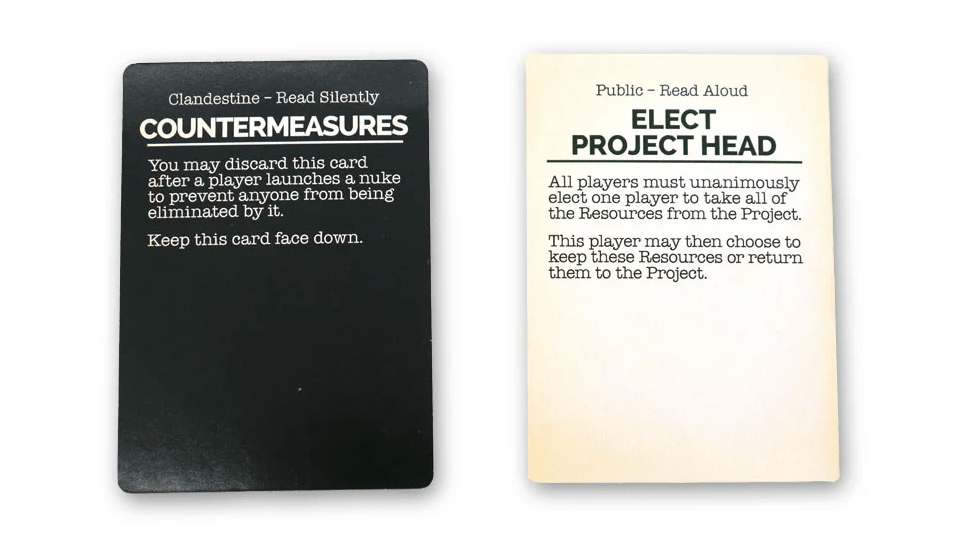
There are two types of event cards: ones read aloud and ones read privately. Follow the rules on the card (reading aloud if you are told to read aloud) and after the event is resolved, the new round begins. Keep going until time runs out.

Review

If you’re anything like me, seeing the “player elimination” game mechanism waved a red flag, but remember, We’re Doomed! is a real-time game that lasts exactly 15 minutes. I don’t mind player elimination as a game mechanism if the game is short. And the idea that you can nuke another player is fun and thematic. We’re Doomed! is a fun and thematic game.

Given the proper gaming group, that’d be gamers who don’t mind backstabbing, negotiating, and loose alliances, We’re Doomed! can be a hit. Quick and tense turns are a feature. We didn’t mention this in the game flow, but there is an additional rule where players can claim another player is taking too long (or stalling). If this happens, everyone takes a vote, counting to three, and votes thumbs up or down to eliminate the player. This makes sense because time is of the essence in We’re Doomed. A similar voting system is used whenever there’s a tie during an event card.

Speaking of the event cards, they can swing the game wildly, making We’re Doomed! a fragile game. Fragile in the sense that the wrong combination of event cards can break the game in an unintended manner. During one playthrough, the first event negated influence. The player who became “The Executor” dictated the sequence of who boarded the rocket ship. Then, the very next event “Too Big To Fail” gave one player (I was voted to be that player) six resources at the beginning of the round if they had no resources. Since I was the Technocracy, that meant that I produced nine resources each round. I could’ve eliminated players (spend 8 resources) and nuke them all or donate all the resources, rescuing everyone. I chose to do the latter. Even though we played a five-player game, we had enough resources for ten.

Typically, I don’t care for games that can be this fragile, but We’re Doomed! isn’t meant to be taken seriously. It’s great for some dumb—and I mean dumb—fun. As I said before, with the proper gaming group, We’re Doomed! can be a hit. But with the wrong gaming group, it can be doomed to fail. We’re Doomed! isn’t a game for everyone. Heck. I must be in the right headspace for the game to land, but when it does land, it’s good for a laugh. One of my favorite chuckles came from someone drawing the “Trickle Down Economics” event card that reads, take six resources from The Project. You may choose to keep the resources or distribute them with any number of players. The person who drew the card asked, why wouldn’t I just pocket the resources? This card’s effect doesn’t seem right. Another player responded that’s why the card name is “Trickle Down Economics.” That sounds like Reagan. We’re Doomed!’s strength is that it doesn’t take itself too seriously.

Verdict

While not for everyone, We’re Doomed! can be a bunch of fun with the right gaming group. The game takes no more than 15 minutes (timed with an hourglass). Your gaming group must like backstabbing, negotiating, and loose alliances…and like games that don’t take themselves too seriously.

Top 5 Tabletop Games from 1994

Magic: The Gathering dominated 1993 and in 1994, dozens of new collectible card games hit the market. Even though 1994 produced more than one collectible card game on its list, we still have one honorable mention collectible card game, Illuminati: New World Order. I always loved Illuminati’s sense of humor; it’s a shame that neither the original game (released in the early 1980s) nor the CCG made the cut. That just shows these lists’ competition.

Hey, hey! Kyra Kyle here. Back with another Top 5 Tabletop Games. We’ll talk about the board games that this year’s list soon, but let’s recap the ground rules for which games make these lists before we start.

1: Cultural relevance plays as much of a factor as overall quality. A game might make a list that doesn’t hold up to others of its type, but you must admit the game is everywhere.

2: Only one game from a franchise makes the list. This will become more of an issue the closer we get to games with expansions.

3: Longevity plays a role, too. A game doesn’t have to fly off the shelves today, but it had to have some widespread appeal for a decent time.

5: Star Trek Customizable Card Game (1994)

Illuminati: New World Order’s lack of staying power contributed to its absence from this list. The Star Trek Customizable Card Game doesn’t have that issue. I never knew The Star Trek Customizable Card Game stayed in print for over a decade. The game may have gone out of print in 2007, but a group of dedicated fans still play.  Peter Ludwig was crowned the 2023 Star Trek Customizable Card Game World Champion.

The Star Trek Customizable Card Game pitted players against each other to assemble a team, a ship, and equipment to complete missions. The first player to complete 100 points worth of missions/objectives wins. The 1st Edition, which ran from 1994-2001, only had the option of a two-player game, just like Magic. 2002 saw the Star Trek Customizable Card Game’s second edition. This version allowed for more players to join in the fun.

On a personal note, I knew one of the original designers of the Star Trek Customizable Card Game. Rest in peace, Rollie.

4: I’m the Boss! (1994)

I struggled with placing the 2-4 ranked games on this list. Honestly, you can shuffle these games in any order, and I wouldn’t fight you. The first game we’ll cover comes from a familiar face, Sid Sackson. We haven’t seen Sackson on one of these lists in a while, but he was productive during this period. I’m the Boss! is a negotiation game where players compete and cooperate to put together profitable business deals. Gameplaywise, I’m the Boss! splits the difference between luck and skill. One must be able to negotiate and needle their way into the best deals.

Not going to lie, I’m not the best at I’m the Boss! But if you like games where you can pull the wool over someone else’s eyes and rob them blind through a one-way deal. I’m the Boss! can give you those moments. Sackson has a knack for business games. His most famous creation was Acquire, which featured on our Top Tabletop Games from the Early Sixties. (Check out the link here.)

3: Vampire: The Eternal Struggle (1994)

Richard Garfield wasn’t done with collectible card games after 1993. Vampire: The Eternal Struggle, which was originally published as Jyhad (changed to distance the game’s name from the Islamic term jihad), puts players in the role of Methuselah (ancient) vampires, controlling lesser vampires to complete machinations and wrest control of the Camarilla, the society of vampires featured in the role-playing game Vampire: The Masquerade. Garfield wanted to show the versatility of collectible card games as a genre, and he succeeded in doing so with Vampire: The Eternal Struggle.

Magic games are quick. Vampire: The Eternal Struggle games can take up to two hours. Magic forces players to play lands from their deck to cast spells. Vampire: The Eternal Struggle allows players, who are Methuselah vampires, to spend their blood points to play cards, but be careful, your blood points are also your life and if you run out, you lose. Magic has players draw one card at the beginning of a player’s turn (you can have cards that allow you to draw more). Vampire allows players to draw cards as soon as they play cards. Magic started as a two-player game. Vampire was always a 2-5-player game. The two games couldn’t be more different.

Despite their differences, or maybe because of them, both games found a wide audience. Depending on how one views it, Vampire is the second longest-running CCG, only to Magic, if you include the five or so years when the game was transformed into a living card game. Or Pokémon, which (Spoiler Alert) will make a future list, takes the second spot, and Vampire takes the spot for the third longest-running CCG. Either way, Vampire: The Eternal Struggle has staying power.

2: Manhattan (1994)

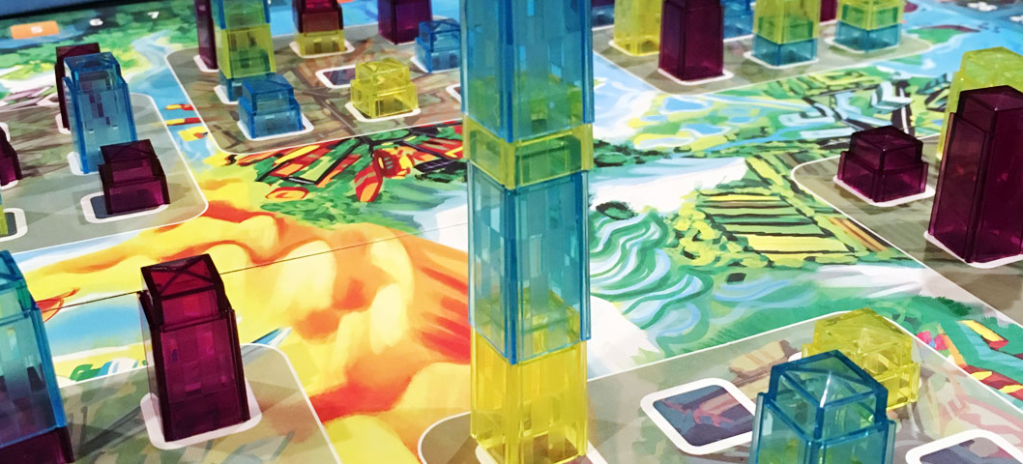
Manhattan received the 1994 Spiel des Jahres award, so I gave it the nod over the previous two games. The concept is simple. Players construct and control Manhattan skyscrapers that will award points. Manhattan benefits from 3-D components. When you’re constructing skyscrapers, they will stretch vertically. This gives Manhattan table presence.

Manhattan may have a game concept based on a New York City borough, but it took Mayfair Games two years to make the game accessible to the United States. Manhattan was designed by Andreas Seyfarth. At the time, Seyfarth was an unknown game designer, but eventually, he’d add several more board game gems: Puerto Rico, San Juan, and Thurn and Taxis (which he codesigned with his Karen). This may not be the last time we’ll see Andreas Seyfarth’s name on one of these lists.

Despite earning the Spiel des Jahres, Manhattan has received mixed reviews. Previous critics have questioned the game’s components and scalability. Others claim that the game’s mechanisms are dated and too abstract, chaotic, and luck-driven. But still, others insist that Manhattan has broad appeal and praise the game’s engagement and accessibility. What does this tell us? Gamers can’t agree on anything, and one likes what one likes. If you like the idea of building skyscrapers, you may want to give Manhattan a try.

1: RoboRally (1994)

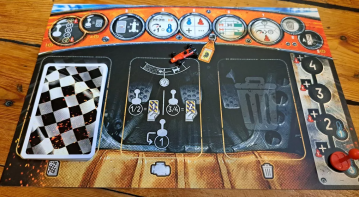
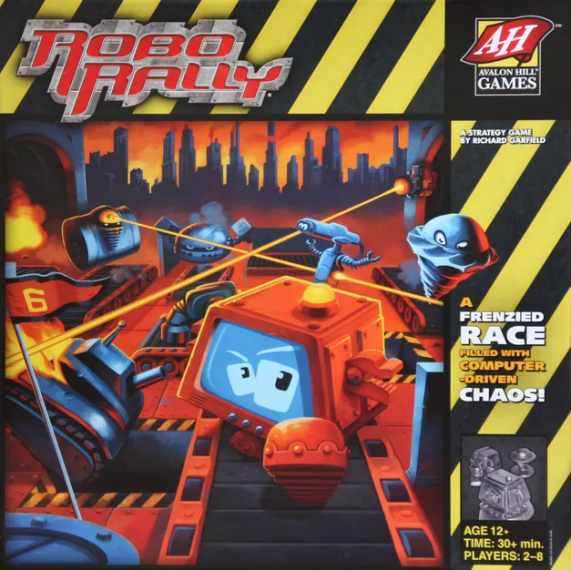
I promised that Richard Garfield would make this list again, and he claims the second number-one spot in consecutive years. Richard Garfield started a tabletop revolution with Magic: The Gathering in 1993 and kept busy in 1994. RoboRally is a robot demolition derby. Players attempt to guide their robots through a dangerous widget factory filled with moving gears, course-altering conveyor belts, metal-melting laser beams, bottomless pits, crushers, and more obstacles.

I say that players attempt to guide their robots because RoboRally is notorious for how chaotic the races get. The more players, the more mayhem ensues. The box reads that RoboRally plays for up to two hours. That’s generous. It may play longer than that, but RoboRally is another modern classic and shows Garfield, like the game type he invented (the collectible card game), is no one-trick pony. Richard Garfield has one of the most diverse board game catalogs and isn’t afraid to take chances.

Did we get the list mostly correct? Let us know which games you’d add in the comments. Thank you for reading, and wherever you are, I hope you’re having a great day.

Check out the other lists in this series:
Top 5 Tabletop Games Prior to the 1930s
Top 5 Tabletop Games of the 1930s
Top 5 Tabletop Games of the 1940s-50s
Top 5 Tabletop Games from the Early 1960s
Top 5 Tabletop Games from the Late 1960s
Top 5 Tabletop Games from the Early 1970s
Top 5 Tabletop Games from 1980-1981
Top 5 Tabletop Games from 1982-1983
Top 5 Tabletop Games from 1984-1985
Top 5 Tabletop Games from 1986-1987
Top 5 Tabletop Games from 1988-1989
Top 5 Tabletop Games from 1990-1991
Top 5 Tabletop Games from 1992
Top 5 Tabletop Games from 1993

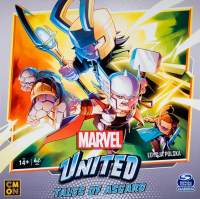
Tabletop Game Review: Marvel United, Tales of Asgard

We haven’t covered a Marvel United expansion in a couple of months. It’s about time we returned to the series. Geekly won’t be covering every Marvel United expansion, but we will review the ones worth your time or the ones we believe people will most likely purchase. So, you could consider the Marvel United expansions we cover as ones you may want on your radar.

Hey, hey! Kyra Kyle here. In Marvel United, players act as iconic Marvel heroes who work together to stop the master plan of a powerful villain controlled by the game. Each villain has a unique master plan, cards that trigger various effects, and threats that make clearing locations difficult. Heroes clear missions, making the villain vulnerable, and finally take on the big bad villain before they complete their dastardly plan. Can you save the day in time? Tales of Asgard casts players as Marvel versions of Nordic mythology.

Hark, brave do-gooder. Before we doth continue further, thou must first indulge Tales of Asgard’s finest of prints.

Marvel United Box Close Up Board Game Review

The Fiddly Bits

Designer: Andrea Chiarvesio and Eric M. Lang
Publisher: CMON Global Limited and Spin Master Ltd.
Date Released: 2021
Number of Players: 1-4
Age Range: 8 and up
Setup Time: 5-10 minutes
Play Time: 30-40 minutes

Game Mechanisms

Cooperative Play
Hand Management
Modular Board
Solo / Solitaire Game
Variable Player Powers

Marvel United Tabletop Game Set Up

Game Setup

We already covered the Game Setup and Game Flow in our Marvel United review (here’s a link to that review), so we’ll go over the basics in the following two sections. Let’s cover an abbreviated review of the game setup and rules.

Marvel United’s setup can change depending on which Villain and Heroes you choose to play. Each game consists of six locations. Typically, core sets have eight locations. Since Tales of Asgard is an expansion, it only has six. You may choose your locations or shuffle them and choose six at random. Each Location card has spaces at the top for civilians and thugs and a rectangle with a block of text that will state “End of Turn” at the top of the box.

Place civilian/thug tokens on their matching spaces. Shuffle the Villain’s Threat deck and deal out each Threat face-up so that it covers the rectangle at the bottom of each location. You must clear this threat before gaining the “End of Turn” effect printed on a Location. Place health tokens where signified on threat cards and on the Villain dashboard. Place the three mission cards (Defeat Thugs, Rescue Civilians, and Clear Threats) face up under the villain dashboard where the text reads “Unlocked.”

Each player shuffles their hero decks and then draws three cards to form their hands. Shuffle the Villain’s Master Plan deck. Leave the Master Plan deck face down. This will be the villain’s draw pile.

Players place their miniatures on one of the six location cards, usually the centralmost location for each player (easy access). Then, they place the villain on the location card opposing the heroes.

Marvel United Game Flow Board Game Review

Game Flow

The villain(s) play first. Draw the top card of their master plan deck. The villain moves the number of spaces indicated. Resolve any BAM! Effects and these effects will be printed on a space within the villain’s dashboard. Then, place the civilian/thug tokens (if any) indicated at the bottom of the card. After all these effects are resolved, the heroes get their turn.

Heroes pick who goes first, and hero turns will continue around the table clockwise. At the beginning of each game, Heroes will get three turns before the villain receives another turn. During their turn, heroes play one card from their hand.

Marvel United Sample Hero Turns Gacha Game Review

Resolve actions and the symbols printed at the bottom of the hero’s card in any order. The symbols at the bottom of a hero’s card will be shared with the next player, but any printed action will not be shared. Heroes will use these actions to complete missions. The game begins with three missions in play: Defeat Thugs, Rescue Civilians, and Clear Threats. Each mission card will have spaces for the tokens they require to complete. As soon as these spaces are filled, the card is discarded, and the mission is considered complete. Mission cards can be completed in any order.

After the heroes complete the first mission, the villain panics and will act (play a card) every two hero cards instead of every three hero cards. After the heroes complete the second mission, the villain becomes vulnerable to damage. The heroes can complete the third mission, but it isn’t necessary. If the heroes do complete the third mission, each hero immediately draws 1 card, increasing each player’s hand size by one.

Play continues back and forth until either the villain wins (by completing their unique master plan or anyone, heroes or villains, runs out of cards) or the heroes win by dealing enough damage to the villain after the villain becomes vulnerable to damage.

Review

In the comics and the MCU’s first phase, Thor is a part of the core three Avengers: Captain America, Iron Man, and Thor. We’re mostly covering the Tales of Asgard expansion because plenty of people will want to have Thor as part of their heroic line-up, especially since the original core box contains Cap and Iron Man. That said, I think the gameplay highlights for Tales of Asgard are its villain, Loki, and oddly enough the Challenge card. Let’s begin with this unique Challenge.

Traitor Challenge Marvel United

The Traitor Challenge is a hint of what would come in the X-Men Marvel United set. Each player gets 1 Allegiance card, 1 Suspicion Token, and a Wild Token. Three Allegiance cards show “Loyal,” while one is a “Traitor.” The Traitor card must be in play and shuffled with enough Loyal cards to hand out to every other player. Naturally, there’s a three-player minimum with this challenge. If you play a two-player game, it’s obvious who the traitor is. Players may choose to play a Hero card facedown (gaining no benefit from it) to discard their Suspicion Token. This matters because once 2 Missions are complete, all Loyal Heroes still with a Suspicion Token take damage until they’re KO’d. This leads to players who are loyal wanting to discard their Suspicion Token. A player who doesn’t care to do that may be the traitor.

Another thing that happens after 2 missions are complete is that the players guess who the Traitor is. If correct, each Loyal Hero gains 1 Wild Token. The Traitor’s hero is removed from play and now plays as the Villain, drawing 2 Master Plan cards and playing 1 each turn. This is the hint of X-Men Marvel United. Marvel United’s next set allows players to assume a villainous role. The Traitor Challenge is a precursor to this playstyle, and it still works even with future sets. If you enjoy the idea of one player being the Traitor, this challenge is perfect. And it works well with Tales of Asgard’s villain. Loki often assumes the visage of others, so the Traitor Challenge is thematic.

Loki Marvel United

Loki’s a great villain whether you choose to play with the Traitor Challenge or not. Loki is a bit faster than the villains found in the original core set. That makes sense. He’ll hop around the map, making it difficult to deal damage after he’s vulnerable. He also has an “Illusion” Threat Card that makes dealing damage to Loki (while he’s at that location) impossible. While not as powerful as some villains (who have Threat Cards that make their villains impervious to damage for the card existing at all on the board), this, combined with Loki’s movement, makes him a challenge.

Loki Henchman 01 Frost Giants Marvel United

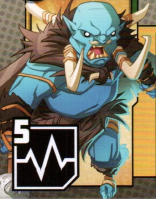
The “Master Trickster” and “Frost Giant” Threats are standard fare. Effective but nothing too special. The “Frost Giant” has more health (5) than most Henchmen, so they can be a chore to dispatch. Loki’s Master Plan deck features a lot of “Each Hero alone in their Location” or “Each Hero not alone in their Location” takes 1 damage, and if the previous statement is untrue, draw another Master Plan card and add it facedown in the Storyline. Both actions can prove fatal because Loki likes running out of cards in his deck by placing Master Plan cards facedown and dealing damage to Heroes whittles a player’s hand and feeds into Loki trying to speed up the clock.

Loki Overflow Effect Marvel United

Loki’s Overflow ability can also get annoying. If 1 or more Tokens can’t be added to a Location, Loki gains 1 additional Health (may go above his starting value). While Loki has below-average health for a main villain, his Overflow ability gives him more survivability. Loki surviving an extra round could mean that he may run out of cards and win.

I mentioned that Loki has a lot of movement. Fortunately, the Locations included in the Tales of Asgard expansion sport a lot of movement for their “End of Turn” abilities. “Heimdall’s Observatory,” “Throne Room,” and “Bifrost Bridge” have some form of mass movement. That’ll help when trying to catch up with Loki. The “Odin’s Vault” and “Valhalla” Locations have card draw which can be helpful, while “Asgardian Palace” has an underwhelming “You may add up to 2 Civilian and/or 2 Thug Tokens to any Location.” “Asgardian Palace” can help if you’re facing a Villain who doesn’t place enough Tokens, but most Marvel United villains place ample Tokens, and other Locations allow players to add a Token and clear a token in one action.

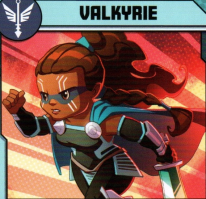
Valkyrie Marvel United

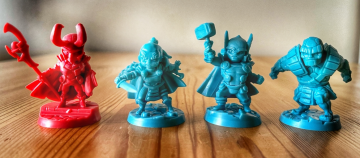
I waited long enough. Here are the Heroes. Surprisingly, Valkyrie is the most balanced character of the bunch. She has a fair amount of Heroics and plenty of movement with her “Warsong” special abilities. The other two Heroes from the base Tales of Asgard expansion, Thor and Korg, focus on Attack. While this makes sense, they do come off as one-note characters. Thor has a little more Heroics and Movement, while Korg allows players to target multiple enemies at once. Both Heroes are situational, but I’d give Thor the nod as a more universal character.

But Thor doesn’t quite claim the top spot as a Hero. If you happen to get the Kickstarter exclusive of Tales of Asgard, you’ll also get Beta Ray Bill. Bill is almost identical to Thor, but I prefer his “Stormbreaker” ability to Thor’s “Mjolnir.” I know, that’s sacrilege. Mjolnir beats Stormbreaker. But “Stormbreaker” gives players more choice with where they assign damage and grants more card draw. Both of those edge out Thor’s “Mjolnir.” Even without the Kickstarter exclusive, Tales of Asgard has some solid Heroes.

Too Long Didn’t Read

The Kickstarter version of Tales of Asgard includes one of the better characters in this expansion, Beta Ray Bill, but Thor and Bill are close enough to each other and serve a similar purpose. The Traitor Challenge Card shows where Marvel United will go in the future, while Loki serves as an interesting villain.

Five Underused Board Game Mechanisms

Geekly discussed commonly used board game mechanisms last month (here’s a link to that post if you missed it), so let’s switch things up and talk about some interesting, underused game mechanisms. We turned to Board Game Geek again to find some good board game mechanisms that don’t appear in enough board games. Thank you again, Board Game Geek.

Hey, hey! Kyra Kyle here. I scoured the hundreds—and I mean hundreds—of game mechanisms listed on Board Game Geek and ran searches to see how many games are listed on the site with each mechanism. Several game mechanisms have thousands of games that use them. That’s a lot. We aren’t looking at those today. We’re giving some love to those game mechanisms that are used in less than 300 games. I baseline like most of these mechanisms. It helps a game mechanism to make this list if I like it, but I included some mechanisms that I thought were in a lot more games. Which board game mechanisms made this list? Let’s find out.

Crayon Rail System

Number of games

171

Description

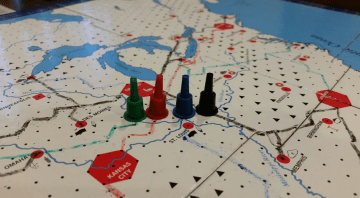
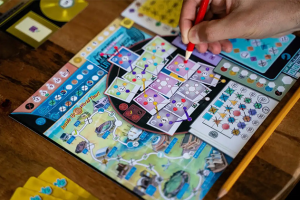
The Crayon Rail System is a subcategory of Route/Network Building. This game mechanism uses crayons or another non-permanent method of drawing lines on a board. Typically, the route/network constructed in games that use this mechanism are railroad tracks. Empire Builder is the most popular Crayon Rail game.

Thoughts

We begin this list with a game mechanism that’s a subcategory or variant of a more prominent game mechanism. The Crayon Rail System deviates from Route/Network Building just enough. I like Route/Network Building, and by extension, the Crayon Rail System. Real talk. The mechanism has one major issue: most games that use the Crayon Rail System are almost always train games. I like train games. I have over a dozen train games and have played dozens more. However, a game mechanism needs more than one theme to be used by more games. The Crayon Rail System is too niche.

I’ve played a handful of games that use the Crayon Rail System mechanism. The ones I’ve played were a joy. There must be themes other than trains that can use this mechanism. Free the Crayon Rail System.

Games that use this mechanism

Empire Builder, Iron Dragon, Nippon Rails, Eurorails, and Empire Express

I Cut, You Choose

Number of Games

175

Description

I Cut, You Choose is a game mechanism where one player divides a set of resources into different groups, and then, the other players choose which group they want first. Typically, drafting continues with the player who divides the resources into the groups receiving the final group. A group could include abstract resources, like turn order. Stamp Swap includes a first-player token. Many other games that use the I Cut, You Choose mechanism will include a “swap rule” to minimize a first-player advantage. In Hex, after the first player moves, the second player can choose to switch sides (taking over the first player’s color as well as their first move).

Thoughts

Less than 200 games use the I Cut, You Choose game mechanism. That’s shocking. Okay. Technically, the I Cut, You Choose mechanism is a drafting variant (like the Crayon Rail System is a variant of Route Building), but I Cut, You Choose adds so much to the drafting game mechanism that it feels unique. I love playing head games with my opponents. I Cut, You Choose is almost like playing Chicken with your opponents. Can I nudge you to pick one group over another? Can I psyche you out over picking a group because you’re worried about why I split the groups the way I did? Games that use the I Cut, You Choose game mechanism often have a lot of table talk. Table talk gives board games a spark.

Before my research, I didn’t know of Hex. I may have to try that one or a game that allows for the second player to swap moves with the first player. That sounds like another layer of messing with one’s opponent. Why did they pick that move? Should I swap with them? I love that kind of tension.

Games that use this mechanism

New York Slice, Dice Hospital, Castles of Mad King Ludwig, Tussie Mussie, and Stamp Swap

Mancala

Number of Games

208

Description

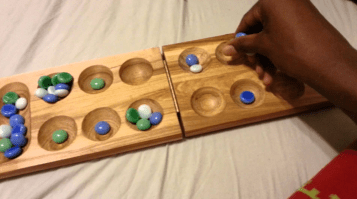
Typically, a game featuring the Mancala mechanism will have players picking up tokens in one space and then place them one-by-one in spaces in a specific direction around a circle with the space that receives the last token having special significance. The Mancala mechanism gets its name from the original game Kalah which dates back to Ancient Egypt.

Thoughts

Several games using the Mancala mechanism have been released recently. I was shocked the Mancala game mechanism made this list. Is it a favorite of mine? Not exactly. The Mancala game mechanism is elegant. I respect the heck out of it. But something with this game mechanism and my brain doesn’t click. Lol, I stink at games that use the Mancala game mechanism. Picking a game that uses the Mancala game mechanism when you play against me is the easiest way to secure a victory.

My inability to play games with this mechanism well aside, more games should include the Mancala mechanism. I like the tactile feel of dropping tokens one-by-one in consecutive spaces. Games that use the Mancala mechanism also include playing head games with your opponent. Spatial awareness is key. Because you move tokens into spaces one-by-one on your turn, making a move could empower your opponent to make an even better move on their turn. I love it when a game gives me feedback on how I lost. You can lose some board games and tally it up to luck. In games that feature a Mancala mechanism, you give your opponent the ability to defeat you.

Games that use this mechanism

Five Tribes: The Djinns of Naqala, Trajan, A Fistful of Meeples, Gold West, and Finca

Programmed Movement

Number of Games

267

Description

Typically, board games that feature programmed movement have players simultaneously program movement, reveal, and then execute their movement. Chaos can ensue, and players who have good spatial relations tend to benefit from programmed movement. Robo Rally uses this game mechanism to good effect.

Thoughts

The description of programmed movement took me by surprise. I gathered these definitions from various sources, including Board Game Geek, so I can’t take sole credit. The simultaneous nature of programmed movement is what got me. This eliminates games like Space Alert (I checked BGG and as of the time of this post; it doesn’t qualify as having the programmed movement). Space Alert has players select actions for their characters in real-time (there’s an actual countdown that occurs) and after the timer sounds, they execute their actions. Except for “revealing and then executing movement,” the mechanism works the same. It’s a head-scratcher.

Space Alert isn’t alone with its programmed movement adjacent mechanism. This could be why there are fewer games with programmed movement as a mechanism, but even if one made the description broader, games with programmed movement would still have fewer than 400 games.  Getting back to the mechanism as defined, I like programmed movement a lot. The chaotic nature of programming something and then watching your plans crumble can cause frustration, but it can be a joy.

Games that use this mechanism

Robo Rally, Mechs vs. Minions, Flamme Rouge, Colt Express, and Space Cadets

Rondel

Number of Games

268

Description

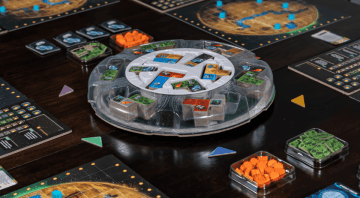
Rondels are wheel-shaped game mechanisms that contain multiple actions players can take. Player choice is limited to their ability to move around the rondel and select the action depicted on the rondel’s wedge. Typically, the rondel mechanism prevents players from taking the same action in consecutive turns. Board games that feature rondels tend to allow players to move further around the rondel by paying a cost.

Thoughts

While many games include a “don’t take the same action in consecutive turns,” rondel games are subtle. They don’t tell you, “Don’t take the same action.” Rondels nudge players not to play the same action and to try more of the actions the game has to offer.

Many rondel games do allow players to pay for additional movement around the rondel, but making a complete trip around the rondel (to claim the same action) is usually cost-prohibitive. I hope you really want that action because it’ll cost you half your victory points or in-game currency to claim it again. I always thought of the rondel mechanism as one of those game designer’s game mechanisms. I enjoy rondels. I also thought they showed up in thousands of games because the circles I play games with love talking about the latest game that uses a rondel. I agree with them. Game designers need to increase the number of games that use rondels. Double the number of games. Triple them!

Games that use this mechanism

Planet Unknown, Wonderland’s War, Unconscious Mind, Merchants of the Dark Road, and New York Zoo

Closing Thoughts

We shortened this list from the 10 Common Board Game Mechanisms list a month ago. Ten may have been too many mechanisms. While some of these mechanisms make sense that they wouldn’t show up in too many games, I’m looking at you, Crayon Rail System, others like the Mancala game mechanism should be in a lot more games. I’m shocked that with the tabletop game industry’s current climate that the Mancala mechanism doesn’t have at least 500 games to its name.

Like the game mechanisms that made the most popular list, we’ll be handing out board game designers a questionnaire to get their thoughts on each game mechanism. This may still be a month or two away from happening, but we’ll let you know when this series is ready. Until then, let us know of any board game mechanisms you think should be in more games. I hope you found something useful in the post. And wherever you are, I hope you’re having a great day.

Top 5 Tabletop Games from 1993

1993 is another solid year for tabletop games. This year’s releases saw one massive title and a handful of titles for an older audience. As we dive deeper into the nineties, we’ll have a large pool of tabletop game titles with which to choose.

Hey, hey! Kyra Kyle here. Back with another Top 5 Tabletop Games. We’ll talk about the board games that this year’s list soon, but let’s recap the ground rules for which games make these lists before we start.

1: Cultural relevance plays as much of a factor as overall quality. A game might make a list that doesn’t hold up to others of its type, but you must admit the game is everywhere.

2: Only one game from a franchise makes the list. This will become more of an issue the closer we get to games with expansions.

3: Longevity plays a role, too. A game doesn’t have to fly off the shelves today, but it had to have some widespread appeal for a decent time.

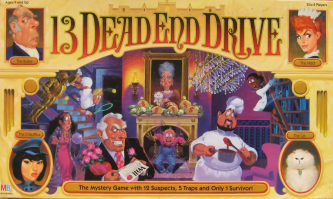
5: 13 Dead End Drive (1993)

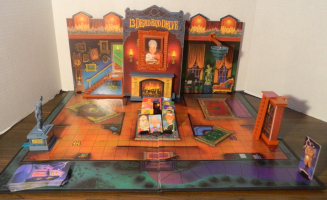
13 Dead End Drive is the only board game on this list that could be considered a child’s game. We’re getting to the adult-themed games soon enough. 13 Dead End Drive has a murder theme. The death of a wealthy old woman triggers a feud over her will. Players use traps located on the board (the mansion), to kill characters controlled by other players to claim the estate.

Players are dealt all the “Character cards” which correspond to matching pawns on the board. Since there are 12 characters, players will control more than one character. Players don’t show which characters they were dealt. Matching “Portrait cards” determine who is the current favorite for the inheritance. The third type of cards are “Trap cards” which are used to spring traps and eliminate characters.

During each turn, a player rolls two dice and moves two pawns, one pawn for each die. It is legal for players to move a pawn that isn’t theirs, especially if the move places a pawn on a Trap space. Characters must end their turn on a Trap space by exact count, and a player must play a matching Trap card for the Trap to take effect. Players win by being the last character standing, escaping the Mansion while one’s character’s Portrait is displayed, or having the final character’s Portrait displayed when the Detective reaches the front door (at the end of 10 rounds).

Despite, the macabre premise, 13 Dead End Drive uses humor and goofy characters to make the game approachable. The game also marks an interesting twist to a murder-themed board game. While games like Clue (or Cluedo) has players trying to figure out who committed a murder, 13 Dead End Drive empowers players by committing a dozen murders.

No. Seriously, this is a game geared toward a younger audience.

4: Europa Universalis (1993)

Europa Universalis is a monster of a board game. The official playing time listed on the game box is six hours, but the game can last for weeks. Board Game Geek estimates the playing time to be 15 days. Europa Universalis is a geopolitical strategy game set from 1492 to 1792. Players take control of European powers during this period. Each country has unique events, objectives, and special rules, for example, Russia’s military power is limited until the arrival of Peter the Great, and England has access to powerful privateers.

Europa Universalis has plenty of freedom of choice. It offers control over economics, military, maintenance (yes, you’ll have to maintain your country), discoveries, and colonial investment. But this leads to a major drawback, the game has a lot of calculation and management during the game for income, price changes, maintenance (of your regions), and the purchasing of military resources. Europa Universalis may work better as a video game. Fortunately, Swedish video game developer Paradox Development Studio (along with the help of the board game’s designer Philippe Thibaut) adapted Europa Universalis into a video game in 2000. This long-running video game challenges Civilization as the top civilization simulator.

3: Call My Bluff (Liar’s Dice) (1993)

Call My Bluff (Liar’s Dice) has an odd history. The Liar’s Dice class of games has existed since the 15th century (originally named Dudo from the Incan Empire). A variant of Liar’s Dice was published by Milton Bradley six years prior in 1987. Call My Bluff is a remake of the original Liar’s Dice, which was then in the public domain. Richard Borg earned the 1993 Spiel des Jahres (the German Board Game of the Year) for his adaptation of this classic game.

Five dice are used per player with dice cups used for concealment. In each round, every player rolls a “hand” of dice under their cup and looks at their hand while keeping it concealed from the other players. The first player begins bidding, announcing any face value and the minimum number of dice that the player believes are showing that value, under all of the cups in the game. Ones are often wild, always counting as the face of the current bid.

Turns rotate in clockwise order. Each player has two choices. They can make a higher bid or challenge the previous bid, typically with a call of “liar,” hence the name Liar’s Dice. Once a bid is challenged, all dice are revealed. If the bid is valid (at least as many of the face value and any wild aces as the player’s bid), the bidder wins. Otherwise, the challenger wins. The player who loses a round loses one of their dice. The last player with dice at the end of the game wins. Call My Bluff’s simplicity and entertainment value earned it the Spiel des Jahres. If the rules sound familiar, the video game series Red Dead Redemption includes a version of Call My Bluff.

2: We the People (1993)

We the People simulates the American Revolution. I’m sensing a simulation theme with 1993 board games. Published by Avalon Hill and designed by Mark Herman, We the People was the first wargame to use cards as the primary means of controlling the pace and tempo of play; the card play introduces a strong element of fog of war through hidden card information.

One player controls the British, while the other plays as the Continentals/Americans. The map has a web of cities and towns connected by lines along which armies can move. We the People marks one of the first times a designer used a point-to-point movement system, which has become standard with a lot of games. Tens of thousands of modern board games use a point-to-point movement system, and not just war games. The cooperative game about stopping a global pandemic, aptly named Pandemic, may be the most famous game to use a point-to-point movement similar to the one Mark Herman pioneered.

We the People has inspired other war games like Richard Borg’s Command and Colors series. Yes, this is the same Richard Borg who designed the previous game on this list Call My Bluff. But We the People may have influenced GMT Games the most. GMT has produced numerous games implementing Herman’s card-driven combat. Their games include The Napoleonic Wars, Here I Stand, Virgin Queen, and Twilight Struggle, which remains one of the highest-ranked board games on Board Game Geek.

1: Magic: The Gathering (1993)

Magic: The Gathering takes the top spot. No other game that was released during 1993 could’ve taken this spot from the granddaddy of all collectible card games. Magic: The Gathering beget a flurry of collectible card games in the following decade: Pokémon, Yu-Gi-Oh!, Legend of the Five Rings, and World of Warcraft (eventually rebranded as Hearthstone) to name a few. Magic: The Gathering’s designer Richard Garfield even made a few more collectible card games to add to his tally like Netrunner, BattleTech, Vampire: The Eternal Struggle, and the original Star Wars Trading Card Game.

Not going to lie. I played most of these collectible card games at one point or another. Magic: The Gathering has stood the test of time. Sure, Pokémon and Yu-Gi-Oh! have endured, but they were released years after Magic. Magic has outlived most of the games it inspired.

The greatest testament to Magic: The Gathering topping this list is that most people read Magic: The Gathering and nodded yes. Magic is the right answer. Magic is the only answer for top tabletop game for 1993.

Did we get the list right, for the most part? Let us know which games you’d add in the comments. And wherever you are, I hope you’re having a great day.

Check out the other lists in this series:
Top 5 Tabletop Games Prior to the 1930s
Top 5 Tabletop Games of the 1930s
Top 5 Tabletop Games of the 1940s-50s
Top 5 Tabletop Games from the Early 1960s
Top 5 Tabletop Games from the Late 1960s
Top 5 Tabletop Games from the Early 1970s
Top 5 Tabletop Games from 1980-1981
Top 5 Tabletop Games from 1982-1983
Top 5 Tabletop Games from 1984-1985
Top 5 Tabletop Games from 1986-1987
Top 5 Tabletop Games from 1988-1989
Top 5 Tabletop Games from 1990-1991
Top 5 Tabletop Games from 1992

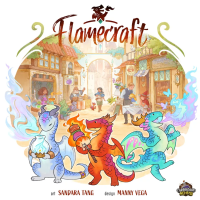
Tabletop Game Review: Flamecraft

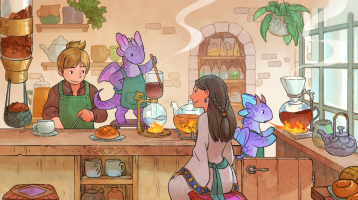
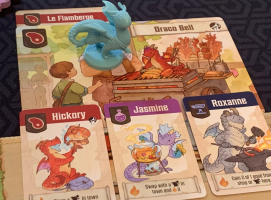
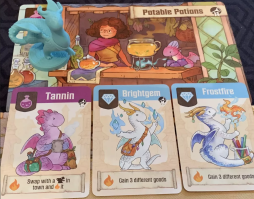
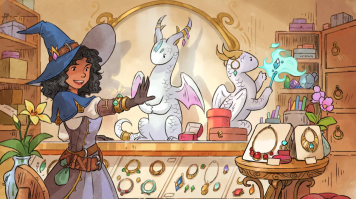
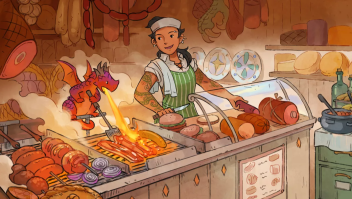
In Flamecraft, players take on the role of Flamekeepers, gathering items, placing dragons, and casting enchantments to enhance the town’s shops. Dragons specialize in bread, meat, iron, crystals, plants, and potions, and the Flamekeepers know which shops are the best for each dragon type. Can you build the most reputation and become the Master of Flamecraft?

Hey, hey! Kyra Kyle here. The tabletop game we’re reviewing today has plenty of cute dragons and fantasy puns galore. Flamecraft took home some awards in the past two years, including 2022 Origins Awards Fan Favorite, and was nominated for several more. A world of dragons awaits, but before we explore further, let’s look at Flamecraft’s details.

The Fiddly Bits

Designer: Manny Vega
Publisher: Cardboard Alchemy and Lucky Duck Games
Date Released: 2022
Number of Players: 1-5
Age Range: 8 and up
Setup Time: 10-15 minutes
Play Time: About 60 minutes

Game Mechanisms

Contracts
Hand Management
Modular Board
Set Collection
Solo/Solitaire Game
Worker Placement

Game Setup

Flamecraft’s rulebook has a well-written Game Setup section. It features large, well-marked pictures that help set up the game. All one needs to do is follow the directions, step by step. I began to re-write what was written in the rulebook but thought a “Too Long, Didn’t Read” version was more appropriate here. If you’re interested in the full rulebook, here’s a link.

Roll out the Town mat so that it’s in the middle of the table.

Place the Starter Shops (with a bugle symbol on them) faceup on any 6 Shop spaces in Town and do the same with the Starter Artisan Dragons, which have the same symbol.

Place the Goods tokens in a spot (or spots) where all players have access to them and then place the Coin tokens on the fountain.

You’ll have to sort the various shop types into piles based on the icons in the top left corner. Make a pile for each of the 6 Goods icons and a seventh pile for all other icons. Flip all 7 piles facedown and separately shuffle them. Take 1 card from each of the Goods Shops and 4 from the 7th pile to make the Shop deck and then shuffle the Shop deck and place it to the side of the Town mat.

The Artisan Dragon deck has special rules for 2 and 3-player games. Follow those guidelines if you’re playing with fewer than 4 players to make the Artisan Deck. Don’t do anything with a larger player-count game. Shuffle the deck and place it on its designated spot on the Town mat. Reveal the top 5 cards and place them faceup in the Park.

Shuffle the Fancy Dragon cards and place them on the marked space next to the Fountain.

Shuffle the Enchantment deck (use the purple one for new players) and place it on the marked space inside the Reputation track. Reveal the top 5 cards and place them in a faceup row next to the deck.

Give each player a player token (dragon), a Reputation marker (heart), and a player aid card in a matching color. Place all Reputation markers near the start of the Reputation track.

Deal each player 3 Artisan Dragons and 2 Fancy Dragons. Each player chooses 1 Fancy Dragon to keep and returns the Fancy Dragon they didn’t choose to the bottom of the deck.

Game Flow

Flamecraft’s rulebook also does a good job of explaining the game’s flow. I’ll try to be as brief as possible here. Again, you can check out the full rulebook with the link above.

Goal

You want to become the most successful Flamekeeper in town by having the highest Reputation. Visit Shops, place Artisan Dragons, cast Enchantments, and satisfy the goals of your secret Fancy Dragons. The player who is furthest ahead on the Reputation track wins.

Taking a Turn

On your turn, you must visit a Shop. Then choose to either Gather or Enchant there. At the end of your turn, you must check if you need to expand the Town (more on that later), discard down to your Dragons (cards) and Goods (resource) limit, and refresh the faceup Enchantments and Artisan Dragons.

Visiting a Shop

Move your player token onto a Shop card. You must choose a different Shop than the one you visited on your last turn. If another player (or players) are visiting the shop you move to, you must give each player at that shop 1 Good of your choice or 1 Coin from your supply. If you don’t have enough Goods to give 1 to each player, you must choose a different shop to visit.

First Option after Visiting: Gathering from a Shop

If you choose to Gather from the Shop, follow these steps in order:

1) Gather Goods, Coins, and Dragons printed on the shop and from each Artisan Dragon and Enchantment there.
2) (Optional) Place a Dragon: You may place 1 Dragon from your hand into a Dragon slot with a matching icon and then gain the rewards on that slot.
3) (Optional) Fire up a Dragon: You may use the Fire ability of any 1 Artisan Dragon at the Shop.
4) (Optional) Use Shop Ability: You may use the Shop’s ability if it has one.

Second Option after Visiting: Enchanting a Shop

If you decide to Enchant the Shop you visit, follow these steps in order:

1) Cast Enchantment: Choose an Enchantment card from the faceup row that matches the Shop’s icon. Pay its Goods cost to tuck it behind the Shop and gain the rewards printed on the Enchantment.
2) (Optional) Fire Up All Dragons: You may use the Fire abilities of any number of Artisan Dragons at the Shop.

End of Turn

After Gathering or Enchanting, take the following steps to clean up for the next player’s turn:

1) Expand Town: Flip any new Shops you drew during your turn faceup. (Note: If you filled the final spot for an Artisan Dragon on your turn, draw a new Shop.)
2) Dragons & Goods: Return Dragons and Goods until you have no more than 6 Artisan Dragons and 7 Goods of each type. (Note: Fancy Dragons do not have a limit.)
3) Refresh Park & Enchantments: Draw new faceup Artisan Dragons and Enchantments until there are 5 of each.

End of the Game

When the last card in either the Artisan deck or Enchantment deck is drawn or revealed, this triggers the end of the game. Each player gets 1 final turn, including the player who triggered the game’s end.

Once all players have had a final turn, gain end-game Reputation as follows:

1) Leftover Coins: Each player gains one Reputation for each Coin.
2) Fancy Dragons: Each player reveals each Fancy Dragon with a Moon icon whose goals they’ve fulfilled and scores the indicated amount of Reputation.

Whoever has the highest Reputation wins.

Review

As you might tell from the game setup and flow, Flamecraft has a lot going on, but it isn’t too much for younger players and players unfamiliar with tabletop games to understand. The Board Game Geek community lists Flamecraft’s suggested age as 8 and up, while the game box lists the age as 10 and up. I usually side with BGG. This gap doesn’t seem like much, but it depends on how well-versed a child is with tabletop games. Kids familiar with tabletop games can play Flamecraft at 8; I’d go with a year or two older if the child isn’t as familiar with tabletop games. Why do I place so much emphasis on this? Flamecraft is what the tabletop game community calls a gateway game. Gateway games bridge the gap between new and seasoned board game players. In this regard, Flamecraft is fantastic.

Would I pick Flamecraft above all other games of its ilk (middle-weight games that feature worker placement, set collection, hand management, and others)? Maybe. Maybe not. But there aren’t many games of this type that can be classified as middle-weight. A large divide has formed with modern board games. They either skew heavier and more complex for a hardcore audience or go the opposite direction and streamline into simpler games for a mainstream audience. Flamecraft is one of the few recent board games in the middle. Games like Flamecraft are necessary for the hobby.

I also like how Flamecraft’s various game mechanisms work together. You can find these game mechanisms in other games and in similar combinations to Flamecraft, but Flamecraft has found the right balance to introduce a player to these concepts. My favorite twist on an older mechanism is that Flamecraft uses worker placement, but it eliminates action blocking. You can go to a space with other players, but you’ll need to pay a fee. This can lead to an action being functionally blocked, but there isn’t a hard rule of action blocking.

Flamecraft also uses a newer type of game mechanism, and I like the direction that tabletop games are headed. The board is a shared space. Anything you do to improve the game state can help your opponent. This leads to interesting choices. Will this upgrade help me more than my opponent? If so, I’ll do it. If not, I may choose another option. This combination of a kinder version of older game mechanisms (worker placement) and the introduction of a rising game mechanism (the board as a shared space) makes Flamecraft a fabulous example of where board games have been and a glimpse of what could be their future.

I can’t believe it’s taken me this long to get to the art, but the art is phenomenal. Sandara Tang did a great job of making Flamecraft feel as cozy as the cozier options for older game mechanisms. I like the Neoprene mat more than I would’ve expected. Does it curl at the edges? Sure. Does it struggle to lay flat? Indubitably. However, the mat’s unruliness doesn’t detract from the game and works for its aesthetic; the soft feel of the mat matches the game’s color palette. The mat also makes the game easier to store. And the dragons. Who doesn’t love cute dragons? If you’re a dragon fan, you owe it to yourself to give Flamecraft a try.
Too Long Didn’t Read

Flamecraft occupies a shrinking spot in the tabletop gaming space: middle-weight game. It combines old and new gaming elements with a fun and approachable theme. My favorite elements are the lack of “action blocking” with worker placement (which works well for a younger player demographic) and the idea that the board is a shared space. Any action you choose could help your opponent. This leads to interesting choices.

Tabletop Game Review: Draft & Write Records

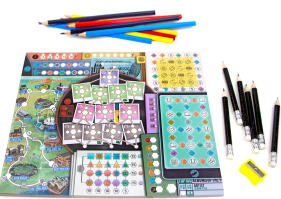
Geekly has played quite a few roll-or-draft and write games (we’ve picked up a couple of great ones over the holidays), and we’ve yet to cover one. In Draft & Write Records players assume the role of a rock band manager. You’ll scout performers, crew, and producers to outperform your competition.

Hey, hey! Kyra Kyle here. We reviewed a new board game for this month (I don’t count expansions, no matter how awesome), so we’re back with another board game review. Draft & Write Records’ name derives from the mechanisms it uses. Players draft and pass cards (which represent band members and important events) and then they write down what the card they drafted said on a massive score sheet (like Yahtzee only way more dynamic). The player with the most points at the end of the game wins.

Before we get any further, we’ll take a quick break from the road and discuss Draft & Write Records’ fine print.

The Fiddly Bits

Designer: Bruno Maciel
Publisher: Inside Up Games
Date Released: 2024
Number of Players: 1-6
Age Range: 12 and up
Setup Time: 5-10 minutes
Play Time: 30-60 minutes

Game Mechanisms

Automatic Resource Growth
Chaining
Closed Drafting
Grid Coverage
Hidden Victory Points
Paper-and-Pencil
Pattern Building
Set Collection
Simultaneous Action Selection

Game Setup

1) Each player takes a Band (Score) Sheet and one pencil (with regular lead).

2) Place the colored pencils within reach of all players.

3) Choose and Record your Band Name. This is optional but fun. I like having players state what they named their bands before play begins.

4) Each player selects a starting color at random and fills in the circle to the left of their band name with one of the colored pencils. Multiple players can choose the same color.

5) Set up the “Play Stack” by looking at each Play Card (gold-backed cards). You’ll find a number in the bottom right-hand corner of the card’s front. This number (if there is one) will let you know how many players are needed to use that card in the game. In a 3-player game, return the cards with 4+, 5+, and 6 indicators to the box.

6) Shuffle the remaining Play Cards to form the “Play Stack.”

7) Shuffle all the Goal Cards (blue-backed cards) and place them in the middle of the table to create the “Goal Stack.”

8) From the Goal Stack, draw and place the top four cards faceup to the right of the Goal Stack to create a line of publicly available Goals.

9) Then, deal two cards from the Goal Stack to each player. Each player selects one card to keep as their personal goal, placing it facedown near their Band Sheet, and the remaining cards are shuffled back into the Goal Stack.

10) Get ready to ROCK!

Game Flow

Each round of Draft and Write Records is divided into two phases: the Week Phase and the Weekend Phase.

Week Phase

During the Week Phase, players draft cards to take actions on their Band Sheet. At the beginning of this phase, deal each player five cards from the Play Stack (the gold-backed cards). Players will select one of these cards and pass the remaining cards to the next player. Each round, the direction players pass their cards changes (to the left, then to the right, and so forth).

During the “Week,” each player will draft four cards in total and discard the last remaining card to their personal discard pile next to their Band Sheet.

1) Players will denote which card they selected by placing the card they chose facedown next to their Band Sheet.

2) Once all players have placed a card facedown, those cards are revealed. Each player takes the action corresponding to the card they chose and records it on their Band Sheet.

We won’t go into detail about all the actions a player can take (there are a lot), but these actions will be indicated by an icon and color on the top left-hand side of each card. These symbols will match symbols found on a player’s Band Sheet.

3) Once all players have taken their action (or chain of actions if they have any), they pass the remaining cards from their hand to the next player.

4) Players repeat this process until they only have two cards remaining. They then choose one of those two cards and discard the other one.

Weekend Phase

During the weekend, players can claim publicly available Goals. If anyone can claim the Goal, they do so, marking the points on their Band Sheet and taking any additional bonuses (like Money). Multiple players can claim a publicly available Goal during a round, but as soon as even one player claims a Goal, it gets scored (by all players who accomplished it), discarded, and a new goal from the Goal Stack takes its place.

Once this is done, and if no one has triggered the end game, another Week begins.

End Game

Play continues until at least one of three end-game triggers occurs.

1) A player claims their sixth Goal.

2) A player checks their fifth Fail. (While there are Fail cards in the Play Stack, a Fail can occur if a player doesn’t or can’t play one of the cards they drafted.)

3) A player fills all 12 of their Crew posts.

After this happens, end-game scoring occurs. We won’t go into detail what these sections are. There are six sections where you can score points and then you subtract the points indicated in your Fail section. Draft and Write Records does a good job of indicating where these sections are and what they mean. The scoring section uses the same icons as the rest of the Band Sheet.

Whoever has the most points at the end of the game wins.

Review

There are many ways to score in Draft and Write Records, so many that I didn’t bother to list the ways. And while it’s easy to tell where to fill in actions on your Band Sheet as you play cards, the sheer number of ways to score can be overwhelming. You won’t have more than five cards in your hand and that helps, but early hands in a round can overload players with too many choices. Draft and Write Records is a game you’ll need to play a few times to get comfortable. Conversely, it’s this same number of scoring means that gives Draft and Write Records ample replayability.

Draft and Write Records is a joy. Its rounds don’t take long. You can expect that with closed drafting games. End of the round scoring (checking to see if someone finished a Goal) doesn’t take long either. I don’t check what other players have filled into their Band Sheets. I could see some players doing that and then feeding the players to their right or left (depending on the round) cards they cannot use. But the Play Cards do that to you anyway. Draft and Write Records forces players to make the best choices they can with the information given. Outside of the time it takes to learn the rules and then the game’s nuances, the game’s biggest issue can be the inability of players to recover from a bad strategy. You may commit to a plan early that will not work and then you’re stuck with that plan.

Fortunately, Draft and Write Records doesn’t take that long to play. The box reads that the game can take up to 60 minutes, but I’ve played it at max player counts and it took about an hour with rules explanation. The fewer players, the less time it will take to play. Lower player count games take closer to thirty minutes. I could see someone take a wrong turn and redeem themselves in round two. There’s a good chance of a round two.

Draft and Write Records’ use of colored pencils is a nice touch. The harmony game mechanism tied to the colored pencils proves crucial. The game didn’t add colored pencils for the sake of adding them. It matters if colors match, creating harmonies, and leading to more chain effects. And chain effects reign supreme. If you like making one good play that sets up another, Draft and Write Records has you covered. I’ve lost count of how many times I’d create a harmony, take the bonus, and that bonus (like producing a record or single) would lead to another bonus and another. Lather, rinse, repeat. And it’s this combotastic gameplay that makes Draft and Write Records shine.

Not going to lie. Draft and Write Records is one of those games where I’ll talk to myself while filling in a long play, and I relish the time it takes for me to go from one bonus to the next, and everyone must watch me fill in blanks until I’m done. The longer it takes for me to fill in my play, the more potential points I just earned. In short, this draft and write game has many combos, and those combos are satisfying.

Verdict

While it may take a couple of playthroughs to understand the rules enough to exploit its numerous ways to score, Draft and Write Records takes little time to play, even at higher player counts. Its harmony game mechanism shines and headlines a series of chain reaction scoring. Draft and Write Records is combotastic.

Top 5 Tabletop Games from 1992

The nineties were a turning point for modern board games. 1992 has its fair share of great titles, even if many of them skew to a young audience. 1993 was another strong year. As we dive deeper into the nineties, we’ll have a large pool of tabletop game titles with which to choose.

Hey, hey! Kyra Kyle here. Back with another Top 5 Tabletop Games. We’ll talk about the board games that this year’s list soon, but let’s reiterate the ground rules for which games make these lists before we begin.

1: Cultural relevance plays as much of a factor as overall quality. A game might make a list that doesn’t hold up to others of its type, but you must admit the game is everywhere.

2: Only one game from a franchise makes the list. This will become more of an issue the closer we get to games with expansions.

3: Longevity plays a role, too. A game doesn’t have to fly off the shelves today, but it had to have some widespread appeal for a decent time.

5: Don’t Wake Daddy (1992)

Don’t Wake Daddy kicks off this list and a trend you’ll see with this list. 1992 saw a lot of board games with a strong toy factor. Don’t Wake Daddy is the first of two children’s games. Players take on the role of children sneaking to the refrigerator late at night, trying not to wake their sleeping father who lies in the middle of the board on a large bed. Players move around a board based on the color they spin. If the color of a noise space matches the color of an assigned card that a player holds, they’re safe; otherwise, the player makes one of several noises. A player who makes noise must press the button on the alarm clock next to the father. Eventually, the father will jerk upright from his bed, giving the game its title Don’t Wake Daddy.

Don’t Wake Daddy has inspired spin-offs in the least likely of places. German artist Martin Kippenberger used the symbols for the different “noises” for a cycle of wood-carvings and oil-paintings. Scholastic published a children’s book based on the game Don’t Wake Daddy: Late-Night Snack, making Don’t Wake Daddy one of the few board games to inspire a book. Jumanji doesn’t count. The book came out first and then the board game. My favorite quote comes from Parker Brothers spokeswoman Ronni Heyman who described the game as “a real sleeper.” I see what you did there.

4: Forbidden Bridge (1992)

Forbidden Bridge has a lot in common with another Milton Bradley release around this time Fireball Island. The company had a board game type during this era. Players take on the role of explorers after ancient jewels, which are guarded by an angry spirit. Occasionally, the bridge guard will awaken (Forbidden Bridge is a mechanized game with a motor) and shake the bridge, which may cause players’ pieces to fall off the bridge. Players can also “steal” another player’s jewel. The first player to retrieve two jewels and return them to their boat wins.

Forbidden Bridge’s premise and art resemble Fireball Island, and that’s not a bad thing. It gave the company an identity during the mid-late eighties and early nineties. Forbidden Bridge also takes the most chaotic element of Fireball Island (the bridge) and expands on it. Some of the bridge spaces have pegs, which are important because they can prevent player pieces from falling off the bridge when the bridge shakes. I’m glad that Fireball Island and Forbidden Bridge have seen remasters and reprints. Unlike the Fireball Island remaster, Forbidden Bridge leaves the original game mostly the same. Forbidden Bridge is a Target exclusive.

3: Loopin’ Louie (1992)

Loopin’ Louie is the second children’s game on our list. This electronic board game features a crane tower with a figure of the titular Louie in a biplane. Up to four arms (one for each player) are connected to the tower, each with a canal, a barn, three chicken tokens and a lever (paddle). Louie will spin around the board. Players press their respective levers to keep Louie in the air and stop him from knocking the chicken tokens into the canals. You’ll need to time your lever presses carefully. If Louie hits a chicken token on the barn, it falls into the canal. The winner is the last player to have at least one chicken token remaining.

Loopin’ Louie was given the Kinderspiel des Jahres award in 1994. It’s a solid game, especially for a children’s board game. But is Loopin’ Louie solely a children’s game? In Europe, Loopin’ Louie is a drinking game. In fact, Loopin’ Louie sold more than 1.3 million copies between 2006 and 2014 because it was used as a drinking game. I may need to institute a new Oktoberfest tradition.

2: Um Reifenbreite (1992)

Um Reifenbreite translates to “By the Width of a Tire” and puts players in the role of bicyclists during a Tour de France-type race. Each player controls a four-member racing team, and the goal is to score as many points for the whole team. Players roll dice to see how far their team members move, but there is a limited card set that can replace die results. Unique rules allow players to draft one another and add multiple kinds of road surfaces. Um Reinfenbreite is a deep racing experience.

Technically, Um Reifenbreite released in 1979 as Homas Tour, but we’re including the game here because the bulk of the Homas Tour copies were lost in a warehouse fire. Um Reifenbreite would be the rerelease, and the game changed enough that it earned consideration from the Spiel des Jahres. Um Reifenbreite did more than earn consideration, it took home the award in 1992, beating our next game on this list.

1: Modern Art (1992)

Dr. Reiner Knizia designed Modern Art so that it features numerous auction types. Heck, Modern Art may be THE game for players to learn all the various types of auctions that board games can offer. Each player is dealt a hand of cards, which represent works of art that the player may offer for sale. Players take turns putting these cards up for auction. The auction format is determined by the card offered for sale. Players sell their paintings back to the bank at the end of each round. Whoever has the most money at the end of the fourth round wins.

Modern Art was recommended for the 1993 Spiel des Jahres. The jury considered it for the award because “the unusual combination of different auction types makes Modern Art a challenging and varied game experience.” Reiner Knizia would be recommended for the Spiel des Jahres countless times. Knizia is the most prolific board game designer of all time. Modern Art is the first time one of his games makes one of these lists. It won’t be the last.

Did we get the list right, for the most part? Let us know which games you’d add in the comments. And wherever you are, I hope you’re having a great day.

Check out the other lists in this series:
Top 5 Tabletop Games Prior to the 1930s
Top 5 Tabletop Games of the 1930s
Top 5 Tabletop Games of the 1940s-50s
Top 5 Tabletop Games from the Early 1960s
Top 5 Tabletop Games from the Late 1960s
Top 5 Tabletop Games from the Early 1970s
Top 5 Tabletop Games from 1980-1981
Top 5 Tabletop Games from 1982-1983
Top 5 Tabletop Games from 1984-1985
Top 5 Tabletop Games from 1986-1987
Top 5 Tabletop Games from 1988-1989
Top 5 Tabletop Games from 1990-1991

Tabletop Game Review: Marvel United, Return of the Sinister Six

We’re back with another Marvel United expansion review. Marvel United is a CMON Games Kickstarter using the Marvel intellectual property. We’ll have plenty of chances to cover more expansions like today’s focus, Return of the Sinister Six. Geekly won’t be covering every Marvel United expansion, but we will review the ones worth your time or the ones we believe people will most likely purchase. So, you could consider the Marvel United expansions we cover as essential.

Hey, hey! Kyra Kyle here. In Marvel United, players act as iconic Marvel heroes who work together to stop the master plan of a powerful villain controlled by the game. Each villain has a unique master plan, cards that trigger various effects, and threats that make clearing locations difficult. Heroes clear missions, making the villain vulnerable, and finally take on the big bad villain before they complete their dastardly plan. Can you save the day in time? Return of the Sinister Six pits players against more than one villain at a time. With this expansion, you have the option to take on the iconic villain team The Sinister Six.

Before we get any further, we’ll take a side quest and discuss Return of the Sinister Six’s dastardly details.

Marvel United Box Close Up Board Game Review

The Fiddly Bits

Designer: Andrea Chiarvesio and Eric M. Lang
Publisher: CMON Global Limited and Spin Master Ltd.
Date Released: 2021
Number of Players: 1-4
Age Range: 8 and up
Setup Time: 5-10 minutes
Play Time: 30-40 minutes

Game Mechanisms

Cooperative Play
Hand Management
Modular Board
Solo / Solitaire Game
Variable Player Powers

Marvel United Tabletop Game Set Up

Game Setup

We already covered the Game Setup and Game Flow in our Marvel United review (here’s a link to that review), so we’ll go over the basics in the following two sections. Let’s cover an abbreviated review of the game setup and rules.

Marvel United’s setup can change depending on which Villain and Heroes you choose to play. Each game consists of six locations. Typically, core sets have eight locations. Since Enter the Spider-Verse is an expansion, it only has six. You may choose your locations or shuffle them and choose six at random. Each Location card has spaces at the top for civilians and thugs and a rectangle with a block of text that will state “End of Turn” at the top of the box.

Place civilian/thug tokens on their matching spaces. Shuffle the Villain’s Threat deck and deal out each Threat face-up so that it covers the rectangle at the bottom of each location. You must clear this threat before gaining the “End of Turn” effect printed on a Location. Place health tokens where signified on threat cards and on the Villain dashboard. Place the three mission cards (Defeat Thugs, Rescue Civilians, and Clear Threats) face up under the villain dashboard where the text reads “Unlocked.”

Each player shuffles their hero decks and then draws three cards to form their hands. Shuffle the Villain’s Master Plan deck. Leave the Master Plan deck face down. This will be the villain’s draw pile.

Players place their miniatures on one of the six location cards, usually the centralmost location for each player (easy access). Then, they place the villain on the location card opposing the heroes.

Marvel United Game Flow Board Game Review

Game Flow

The villain(s) play first. Draw the top card of their master plan deck. The villain moves the number of spaces indicated. Resolve any BAM! Effects and these effects will be printed on a space within the villain’s dashboard. Then, place the civilian/thug tokens (if any) indicated at the bottom of the card. After all these effects are resolved, the heroes get their turn.

Heroes pick who goes first, and hero turns will continue around the table clockwise. At the beginning of each game, Heroes will get three turns before the villain receives another turn. During their turn, heroes play one card from their hand.

Resolve actions and the symbols printed at the bottom of the hero’s card in any order. The symbols at the bottom of a hero’s card will be shared with the next player, but any printed action will not be shared. Heroes will use these actions to complete missions. The game begins with three missions in play: Defeat Thugs, Rescue Civilians, and Clear Threats. Each mission card will have spaces for the tokens they require to complete. As soon as these spaces are filled, the card is discarded, and the mission is considered complete. Mission cards can be completed in any order.

After the heroes complete the first mission, the villain panics and will act (play a card) every two hero cards instead of every three hero cards. After the heroes complete the second mission, the villain becomes vulnerable to damage. The heroes can complete the third mission, but it isn’t necessary. If the heroes do complete the third mission, each hero immediately draws 1 card, increasing each player’s hand size by one.

Play continues back and forth until either the villain wins (by completing their unique master plan or anyone, heroes or villains, runs out of cards) or the heroes win by dealing enough damage to the villain after the villain becomes vulnerable to damage.

Review

Return of the Sinister Six has no heroes, locations, or challenge cards. Instead, Return of the Sinister Six doubles down with villains. You can play each villain one at a time like normal or you could face the Sinister Six as a team. Taking on the entire team at once is not for the faint of heart.

Vulture Dashboard Marvel United Guide

Let’s begin with the villains as individuals before we discuss the Sinister Six as a team. Vulture may be the most difficult Marvel United villain within the game’s initial run. He takes crisis tokens (Spoils) from Locations (each Location begins with 3) and wins the game if he reaches a certain number of Spoils (based on the number of Heroes). Early Marvel United characters had precious few ways of discarding crisis tokens. That’s changed a bit with the X-Men and Multiverse releases, but characters who specialize in crisis token mitigation are rare. Vulture’s abilities suggest that players must rush him. Finish the missions quickly and then bombard him with damage. This is easier said than done. Vulture has several ways of stealing crisis tokens, avoiding damage, dealing damage to heroes, and moving to the opposite side of the board. If you want a challenge, Vulture is your villain.

Doctor Octopus Marvel United Guides

Return of the Sinister Six introduces a lot of interesting game mechanism twists with its villains. Eric Lang and company stretch the limits of the Marvel United core rules with this expansion. Doc Ock is no different. He wins if he destroys 4 or more Locations. While this can be difficult for him to accomplish, the fact that the board shrinks is a lot of fun. His Threat cards lean heavily on henchmen, so you’ll see many members of the Sinister Six. Mysterio as a henchman proves particularly difficult. Doc Ock can deal damage in a hurry and the shrinking board—if the players allow the board to shrink—can make Doc Ock formidable. I like Doc Ock’s change of play and the new challenge.

Mysterio Dashboard Marvel United Guide

Speaking of change of play and a new challenge, Mysterio is up next. He’s the only villain in the original release that places Threat cards face down on Locations. Players must flip over Mysterio’s Threat cards (by spending any single action) and clear at least two Threats before Mysterio can be damaged. Mysterio doesn’t have a special win condition like Vulture (stealing enough Spoils) or Doc Ock (destroying 4 Locations); he makes up for this by delaying the heroes and speeding up his deck. Mysterio is the first Marvel United villain to use a speeding deck as a mechanism. He’s perfect for players who have grown accustomed to the game’s flow and timing. Mysterio can cause the game to end suddenly. I love Return of the Sinister Six’s gameplay variety.

Kraven Dashboard Marvel United Guide

Enter Kraven the Hunter. As his name suggests, Kraven actively hunts the heroes. He wins if he KOs the heroes at the same time. This sounds difficult, but Kraven’s deck works perfectly to achieve this end. While players may be thinking of the game clock ending too soon with Mysterio or the game’s board shrinking with Doc Ock, Kraven gets the heroes thinking about self-preservation. This is a very different mindset than most other villains in the original Marvel United’s run. Kraven can even deal extra damage if a Location lacks Civilian and Thug tokens. Up to this point, players are encouraged to keep Civilian/Thug spaces empty. Kraven turns this idea on its head.

Sandman Dashboard Marvel United Guide

That gets us to Sandman who may have the most irritating ability from the Return of the Sinister Six expansion. He gains health through various means and wins if his health ever reaches 20. Thankfully, Sandman mostly focuses on soaking up damage, so players are encouraged to pick heroes who can deal buckets of damage. Even with a stellar team, defeating Sandman is easier said than done. I don’t know if I was able to defeat any villain inside the Return of the Sinister Six expansion on my first try. This leads to some excellent replayability.

Electro Dashboard Marvel United Guide

Electro may seem like the easiest villain to defeat, but he can fool you. He wins if all Locations in play have a crisis token. He has limited means with which to place crisis tokens, but Electro’s overflow ability is one of those ways, and he places a lot of Civilian and Thug tokens. It’s easy for Electro to cause an overflow. He can also deal a lot of damage. In fact, Electro has some of the highest potential damage output in Marvel United’s original run, and if Electro KOs a hero, he places yet another crisis token. Electro may sound like a lot of other Marvel United villains, but he stands out. Electro doesn’t deal damage to heroes at his Location. He deals damage to heroes in the Location opposite to his Location. This change-up gets me every time.

We’ve come to the Sinister Six as a villain team. They’re brutal. As of this write-up, I have yet to beat the Sinister Six. Typically, I write a guide for a Marvel United villain after I’ve defeated them (quick shout out to our Marvel United guides, check them out here with this link). I have yet to post a guide to the Sinister Six team. Hopefully, that will change soon.

The individual team members of the Sinister Six may have scaled-down powers, fewer hit points, and a streamlined means of defeating each one, but they play similarly to their solo villain counterparts. I got ahead of myself, let’s talk about weakening each of these villains so you can deal damage to them. Each one has a Weak Spot card, which functions similarly to a Threat Card. All the heroes must do is match the symbols on the corresponding Weak Spot card, travel to the same Location as the villain, and then deal damage.

It both is and isn’t that simple. The Sinister Six will trigger their effects, or at least the top two members listed on the Sinister Six card will. And if you think the Sinister Six members’ abilities were difficult one at a time, they’re worse all at once. Or at least two at a time. You’ll need to defeat the Sinister Six in a specific order. This is getting into guide territory. I know the order, even if I haven’t yet defeated the Sinister Six. I’ve gotten so close multiple times. Ugh!

Knowing the best order to defeat the Sinister Six doesn’t guarantee a victory. I can see the Return of the Sinister Six expansion providing me with a worthy challenge for years. If you own any of the Marvel United core boxes, I recommend picking up the Return of the Sinister Six because of its gameplay variations and increased challenge. If you’re a Spider-Man fan and own any of the Marvel United core boxes, I can’t imagine you not picking up the Return of the Sinister Six expansion. It’s a must-buy.

Marvel United The Return of the Sinister Six Miniatures Top Expansions to Buy

Verdict

Return of the Sinister Six is a must-buy Marvel United expansion, especially if you’re a Spider-Man fan. The included villains have some of the most unique game mechanisms from the original Marvel United run. The villain team provides a challenge that will shake up Marvel United for years.

And you don’t need to take my word for it. Board Game Geek (where great games and their expansions receive average scores of 6 or 7 out of 10) gives this expansion an 8.6 (as of writing this post).