
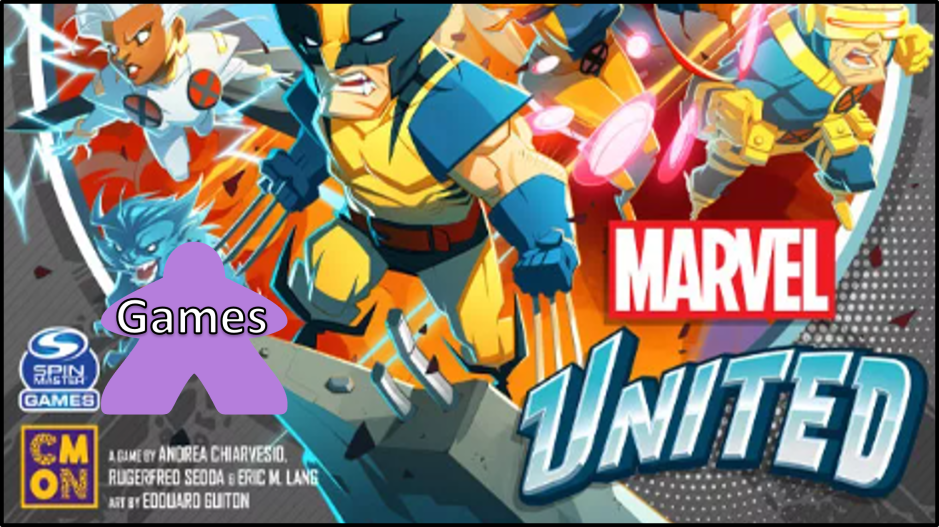
We’ve discussed many Marvel United expansions from the game’s initial set; it’s time to talk about Marvel United: X-Men. This version of Marvel United adds team play and a one versus many option, where one player controls the villain while the others play the heroes. This increases gameplay options and allows for a fifth player to join in on the fun.
Hey, hey! Kyra Kyle here. In Marvel United: X-Men, players act as iconic X-Men heroes who work together to stop the master plan of a powerful villain controlled by the game and in some cases another player. Each villain has a unique master plan, cards that trigger various effects, and threats that make clearing locations difficult. Heroes clear missions, making the villain vulnerable, and finally take on the big bad villain before they complete their master plan. Can you save the day in time? Marvel United: X-Men adds Marvel’s merry mutants to the fray.
Before we get any further, we’ll take a side quest and discuss Marvel United: X-Men’s less heroic details.

The Fiddly Bits
Designer: Andrea Chiarvesio, Eric M. Lang, and Francesco Rugerfred Sedda
Publisher: CMON Global Limited and Spin Master Ltd.
Date Released: 2021
Number of Players: 1-5
Age Range: 8 and up
Setup Time: 5-10 minutes
Play Time: 30-40 minutes
Game Mechanisms
Cooperative Play
Hand Management
Modular Board
Solo / Solitaire Game
Team-Based Game
Variable Player Powers

Game Setup
We already covered the Game Setup and Game Flow in our original Marvel United review (here’s a link to that review), so we’ll go over the basics in the following two sections. Let’s cover an abbreviated review of the game setup and rules.
Marvel United: X-Men’s setup can change depending on which Villain(s) and Heroes you choose to play. Each game consists of six locations. Eight locations are included because Marvel United: X-Men is a core set. You may choose your locations or shuffle them and choose six at random. Each Location card has spaces at the top for civilians and thugs and a rectangle with a block of text that will state “End of Turn” at the top of the box.
Place civilian/thug tokens on their matching spaces. Shuffle the Villain’s Threat deck and deal out each Threat face-up so that it covers the rectangle at the bottom of each location. You must clear this threat before gaining the “End of Turn” effect printed on a Location. Place health tokens where signified on threat cards and on the Villain dashboard. Place the three mission cards (Defeat Thugs, Rescue Civilians, and Clear Threats) face up under the villain dashboard where the text reads “Unlocked.”
Each player shuffles their hero decks and then draws three cards to form their hands. Shuffle the Villain’s Master Plan deck. Leave the Master Plan deck face down. This will be the villain’s draw pile.
Players place their miniatures on one of the six location cards, usually the centralmost location for each player (easy access). Then, they place the villain on the location card opposing the heroes. If one player chooses to play as the villain, hand the Super Villain cards to them, and the Heroes gain access to Super Hero cards. These new card times can be played if the game state triggers their use (for example, “You play a Master Plan card” or “Any Hero has 4 or more cards in their hand at the end of the Hero Turn.” Timing is key.

Game Flow
The villain(s) play first. Draw the top card of their master plan deck. The villain moves the number of spaces indicated. Resolve any BAM! Effects and these effects will be printed on a space within the villain’s dashboard. Then, place the civilian/thug tokens (if any) indicated at the bottom of the card. If a player has taken the role of the villain, they get a hand of cards and can choose which card they play. The heroes get their turn after all the villain’s effects are resolved.
Heroes pick who goes first, and hero turns will continue around the table clockwise. At the beginning of each game, Heroes will get three turns before the villain receives another turn. During their turn, heroes play one card from their hand.

Resolve actions and the symbols printed at the bottom of the hero’s card in any order. The symbols at the bottom of a hero’s card will be shared with the next player, but any printed action will not be shared. Heroes will use these actions to complete missions. The game begins with three missions in play: Defeat Thugs, Rescue Civilians, and Clear Threats. Each mission card will have spaces for the tokens they require to complete. As soon as these spaces are filled, the card is discarded, and the mission is considered complete. Mission cards can be completed in any order.
After the heroes complete the first mission, the villain panics and will act (play a card) every two hero cards instead of every three hero cards. After the heroes complete the second mission, the villain becomes vulnerable to damage. The heroes can complete the third mission, but it isn’t necessary. If the heroes do complete the third mission, each hero immediately draws 1 card, increasing each player’s hand size by one.
Play continues back and forth until either the villain wins (by completing their unique master plan or anyone, heroes or villains, runs out of cards) or the heroes win by dealing enough damage to the villain after the villain becomes vulnerable to damage.
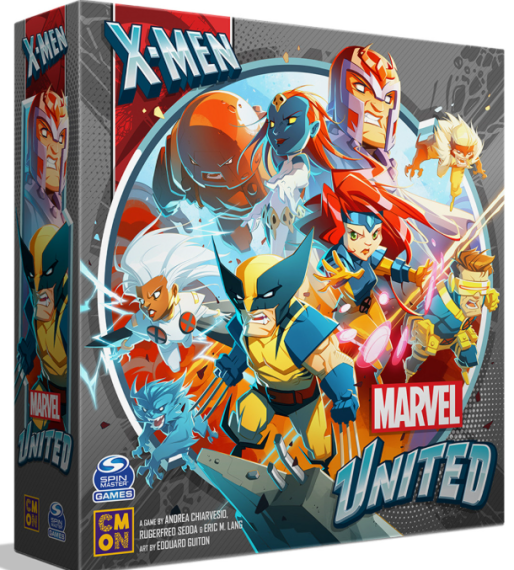
Review
Marvel United: X-Men features many new game concepts for the United game system. Having one player take on the role of the villain is the most obvious. I like that Spin Master and CMON games include a chart that allows gamers to play villains from the previous set. Since X-Men characters have a knack for flip-flopping their allegiance, it makes sense that Marvel United: X-Men began the trend of purple miniatures (anti-heroes who can be played as heroes or villains). This feature is crucial to the game design, as I forgot it began with Marvel United’s second wave (X-Men). Marvel United: X-Men also adds a team element with its Blue and Gold Team expansions. That doesn’t factor in too much with the core set. We’ll talk more about the X-Men Blue and Gold Teams in the future.
Power creep is a real thing in Marvel United: X-Men. In the original set, players were lucky if they had three unique abilities and anything more than three cards in their deck with special abilities. Marvel United: X-Men heroes have a minimum of four cards in their deck with special abilities and at least two unique special effects, but there are plenty of heroes with way more than four special ability cards. Marvel United: X-Men also includes plenty of powers that deal with crisis tokens. The original set had a few ways to deal with crisis tokens; most of the methods came in the form of Location “End of Turn” abilities. I like the inclusion of heroes with crisis token abilities. The heroes in Marvel United’s second way had plenty of new ways to affect the game state.

Beginning with the anti-heroes (the purple miniatures who can be heroes or villains), let’s get into specific heroes you can find in the Marvel United: X-Men Core Set. Mystique features few Heroics but plenty of Move and Attack. Her two special abilities (two copies of each card) allow her to prevent new tokens (Thugs or Civilians) from being added by the next Master Plan card, and she can redirect damage from herself to Henchmen or Thugs. This plays into Mystique’s ability as an infiltrator. Typically, Marvel United: X-Men does a good job of showing each anti-hero as their heroic and villainous selves. Magneto is the other anti-hero included in the Core Set. Like Mystique, he has little Heroics but can zoom around the board and deal copious amounts of damage. I like Magneto’s ability to convert symbols into Wild symbols. This makes him versatile.

Perhaps because of the increased number of powers within hero decks, Marvel United: X-Men does an even better job of capturing its heroes. Wolverine begins the game with a healing factor. Cyclops uses Leadership, while Beast also has a regenerating factor (not as persistent as Wolverines) and he specializes in heroics and movement. So far, far thematic, but I really like Storm, Jean Grey, and Professor X. Storm can reposition the entire team, Jean Grey can manipulate the Storyline with Telekinesis, and Professor X may be the most powerful hero in the X-Men Core Set. He’s surprisingly mobile with a penchant for heroics. He can also use Telepathy to manipulate the Storyline, give tokens with Leadership, turn symbols into Wilds, and even turn Thugs into Civilians.
In short, the heroes of Marvel United: X-Men have more personality than the previous set. Professor X may be overly powerful. Half of the cards in his deck possess special abilities, and two of the other six cards feature wild symbols. The villains in the X-Men Core Set provide plenty of twists for gameplay, but that’s to be expected from Marvel United villains. The villains have always represented this game’s most intriguing design space. Sabretooth hunts heroes, while Juggernaut charges from one location to the next, damaging everyone in his way. Magneto is especially difficult to stop. He can nullify all Hero effects and hand out crisis tokens to heroes, damaging them for each crisis token the hero possesses. But Mystique may be the most interesting villain from this lot. She targets Senator Kelly, and the heroes lose if she carries out her assassination.
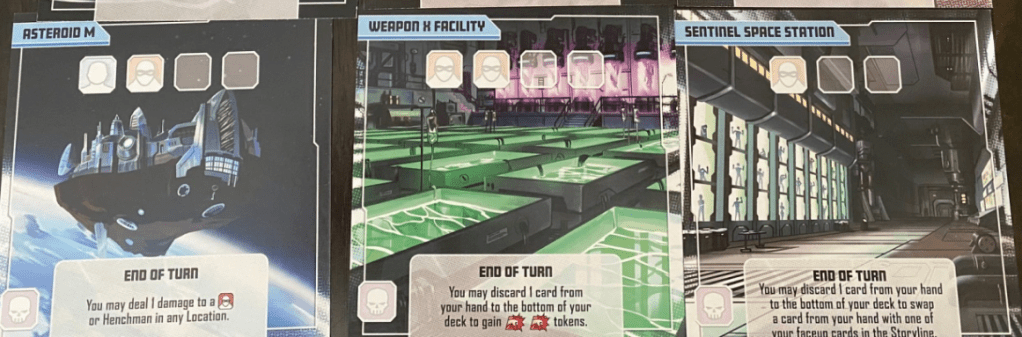
Marvel United: X-Men’s Locations have varied “End of Turn” abilities. Token draw, healing, moving to another location, rescuing a Civilian, and dealing damage to a Thug/Henchman are standard fare by this point, but Marvel United: X-Men’s Locations gives these mechanisms a few twists. But my favorite “End of Turn” ability may be Sentinel Space Station’s. You may discard 1 card from your hand to the bottom of your deck to swap a card from your hand with one of your face-up cards in the Storyline. This ability is a hint of what one can expect in other Marvel United: X-Men expansions. The Marvel United: X-Men Core Set does enough to show what the second United wave of games offers. It does a great job of building on a solid foundation.

Too Long; Didn’t Read
Marvel United: X-Men adds numerous wrinkles to the United Series’ gameplay. A player can take the role of the villain, team play is possible, and antihero characters can be either heroes or villains. The heroes within Marvel United’s second wave have more personality, while the villains remain stellar. Mystique’s mission of assassinating Senator Kelly is fantastic.
Thank you for reading, and wherever you are, I hope you’re having a great day.
 jkgeekly.com