




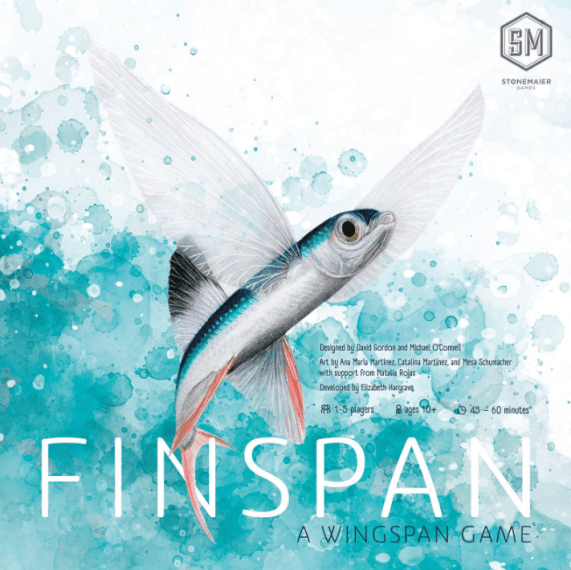
Stonemaier Games announced a new spinoff game from their wildly popular board game series Wingspan. The series is headed to the depths of the ocean with Finspan. Like Wyrmspan before Finspan, Wingspan’s original designer, Elizabeth Hargrave, is involved. And a funny thing tends to happen with Board Game Geek (BGG) and its review system whenever a Wingspan spin-off gets announced. The game gets an equal number of people who review bomb the spin-off (giving the game a 1 out of 10) and people who give the game top marks.

I came late to the party before I took the above screen capture of Finspan’s rating distribution. The numbers were almost perfectly even between 1s and 10s yesterday. Finspan truthers have more than doubled since then. But Finspan hasn’t yet been released. The game is scheduled for a January 22nd release date. This begs the question, should you rate a game that hasn’t been released?
Quick note: Board game companies do give reviewers advanced copies of games, but these numbers pale in comparison to video games (whose companies give out keys for downloads) because postage is involved. There’s a zero percent chance that the above numbers come exclusively from board game reviewers with advanced copies of Finspan.
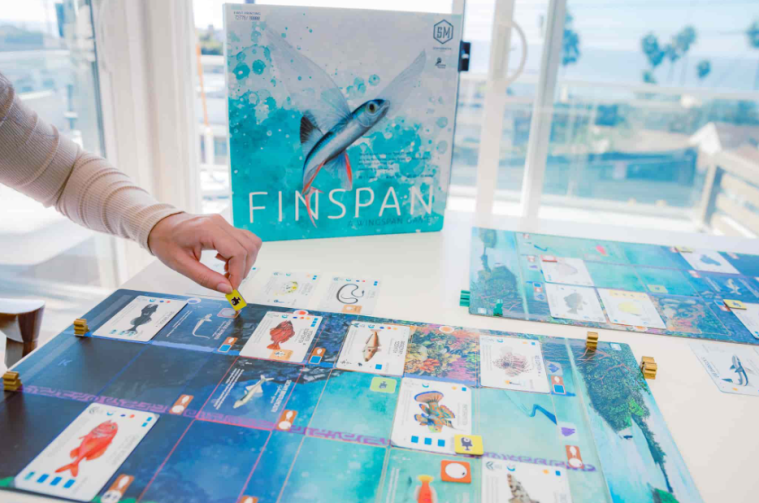
To answer that previous question, no. You don’t have enough knowledge to rate a game that hasn’t been released unless you are one of the few board game reviewers with an advanced copy. Board game enthusiasts have been arguing about Finspan‘s rating for the past few days. Some argue that it’s too high. Others that it’s too low. Most people suggest that the problem lies with Board Game Geek.
I don’t buy that. Board Game Geek allows board game companies to upload their upcoming games to the site. This allows companies to lock in a name for a board game, so we won’t get a competing Finspan from some other company. BGG also allows people to write reviews for upcoming games because these games are seen before launch. Undoubtedly, Stonemaier Games brought some version of Finspan to a convention or two, and people demoed it. Some of the above scores may be legitimate.
Then, there’s the question of when does a game officially release? Finspan’s release date of January 22nd is more concrete than many other board games because of a lack of crowdfunding. Does a game’s release date coincide with when the first Kickstarter backer receives their copy? Or is it when the game reaches retail? Maybe the game never reaches retail. Does that mean that it will forever be unreleased, even though thousands of people own a copy?
Blaming Board Game Geek for allowing upcoming games on their site isn’t the issue. The issue stems from people who will rate a game unseen.

How often does this happen? Often. Make no mistake. Wyrmspan received the exact same criticism and scores before its release, and it became one of the most highly rated games from last year (2024). So, why do Wingspan spin-offs get all this hate?
Few other game series get the same vitriol as a Wingspan spin-off. Numerous games have introduced “Duel” or “Duet” versions (2-player variants) of popular games: Splendor, 7 Wonders, King of Tokyo, and Cosmic Encounter. No one bats an eye. Many other games have spawned countless spin-offs: Catan, Ticket to Ride, and even Gloomhaven. Review bombs do occur with these titles but not in the sheer number of a Wingspan spin-off. Why is that?

Not going to lie. Finspan looks cool; I’ll have to try it at least once.
Quick note: I’m not one of the board game reviewers who received an advanced copy; most board game reviewers who do receive advanced copies produce video content (note to self: start a YouTube channel or TikTok account).
I used to think that Stonemaier Games got flak for producing spin-off games because they’re a smaller company. If Days of Wonder released spin-offs during their years of producing one game per year, I would get upset about a spin-off for one year. But Stonemaier has a full slate of board games planned (far more than one) for 2025 that don’t include Finspan. Finspan is extra content.
Furthermore, Gloomhaven has received multiple spin-off board games, and most people cheer for those upcoming games. Cephalofair Games is a much smaller company and produces far fewer games per year than Stonemaier Games. So, “small board game company” can’t be the main reason.

I like to think the reason is closer to people respecting Stonemaier Games and wanting the company to innovate with each one of their games. This is the kind reason why Wyrmspan and Finspan received blowback. I mentioned Days of Wonder’s stretch of “one game per year” for a reason. Days of Wonder was the preeminent board game company at that time. When you saw a Days of Wonder title (this would’ve been about the 2000s and into the early 2010s), you knew the game was high quality. I would’ve been a little upset if Days of Wonder only released a spin-off game at that time because I would’ve wanted a different game to play.
Spin-off board games work like movie sequels. They tend to print money. Wyrmspan sure did last year, and I expect Finspan to do the same. While I can see why some may be disappointed with a spin-off game, Stonemaier Games needs to stay afloat financially. Finspan may be a spin-off game, but it affords Stonemaier Games to take other risks with different titles.
Again, Stonemaier Games has a full slate of games for 2025 that don’t include Finspan. If the innovation reason is why someone rated Finspan low, wait for the game’s release. Wyrmspan tweaked Wingspan’s base gameplay. I expect Finspan to do the same.

There is a penultimate group of people who review a board game on BGG before the game’s release. These folks try to affect the scoring’s bell curve. Some folks refuse to give an unreleased game a perfect or high score, so they tank the score to even out the final rating. This mentality can work the other way, and I think it did with people rating Finspan a 10, even though they’ve never played the game. These are Stonemaier Games truthers who believe in the company. To be fair, Stonemaier Games has earned that trust.
This behavior is odd. BGG doesn’t include a game in its ultimate Geek List until many people review the game or have logged plays of it. There used to be–and sometimes there still is–a time component. A game cannot be listed on the final Geek List unless it’s been released for several months. This does compensate for this odd behavior. Regardless of how BGG’s Geek List works, these games typically get aggregated sufficiently in the end.
In short, I wouldn’t worry about a minority of gamers who would rate a game before the game’s release.
Note: There was one person who claimed, “I don’t like Stonemaier Games,” so there are gamers who don’t like Stonemaier, and that’s fair.

Let’s swim into deeper waters here. Some of you may need a trigger warning for the following darkness. Fair warning, I’m not suggesting that most people who rated Finspan a 1 on BGG belong to this camp. Unfortunately, the number isn’t zero.
Elizabeth Hargrave is a woman. She’s even an outspoken woman who designs board games, and she has a megahit with the Wingspan series. Some people are jealous. Others don’t want to give credit to a woman trying to break into a predominantly boys’ club. I hope the number of people who review bombed Finspan belongs to any of the previous camps, but I’m going to be real. Most likely, at least one person review bombed Finspan because it’s a spin-off game from an outspoken woman board game designer.

So, what are our takeaways? BGG isn’t to blame for review bombing or inflating. Listing a game is great for publicity. I guess even bad publicity is publicity. Whatever the reason someone may review bomb a popular board game series release, people need to chill. Stonemaier will produce multiple games not named Finspan this year. BGG scores will even out after Finspan’s release. There’s room for multiple people of all kinds at the gaming table. Diversity makes our hobby great.
And if you’re picking up a copy of Finspan this month, you’re in the greater Omaha area, and you don’t mind teaching me the rules, I wouldn’t mind trying out Finspan. If it’s anything like Wyrmspan, I’ll play it once and then buy it later. And wherever you are, I hope you’re having a great day.
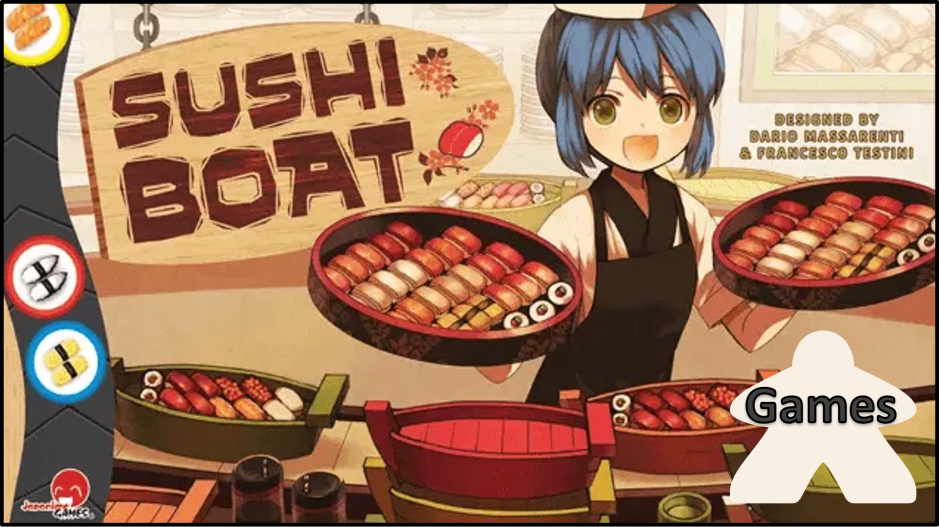
Hey, hey! Kyra Kyle here. It might be a little early for another tabletop game review, but we’re catching up on some of the backlog. Today’s review is one with a high toy factor (a board game with plenty of toy-like features): Sushi Boat.
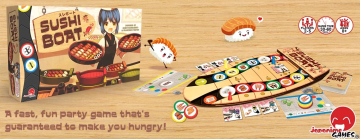
Sushi Boat leans into its theme; the board is a sushi conveyor belt. Each turn, players perform their choice of actions, including taking plates of sushi off the revolving belt on the board, paying staff tiles for special effects, or buying side dishes. As they eat, players stack plates in front of them. Players score points by eating off matching (color) plates and for eating a variety of sushi types (set collection). The Wasabi Challenge shakes things up by adding a memory component that can swing the victory.
Before we get any further, we’ll set the table and discuss Sushi Boat details.

Designer: Dario Massarenti, Francesco Testini
Publisher: Japanime Games
Date Released: 2023
Number of Players: 2-5
Age Range: 9 and up
Setup Time: 15-20 minutes
Play Time: 30-75 minutes
Game Mechanisms
Memory
Set Collection
Worker Placement
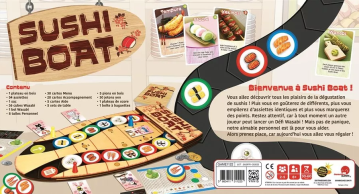
Place the wooden sushi boat board (with a built-in “conveyor belt”); this board is the central visual element and will draw a crowd when placed on the board.
Mix the Staff tiles and randomly place 1 on each Staff space (these are pictured in the rulebook). Place all of the Wasabi cubes in the Wasabi Bowl (Sushi Boat includes ceramic bowls; the production value is insane). Each player chooses a color and takes the matching pawn and player mat. Place all of the Yen in the change tray (again, a ceramic tray), this is the bank. Give each player 2 Yen; players place their Yen on their player mats.

Put all the colored Plates in the bag and mix them well, leaving the white plates to the side for now. Then, randomly draw Plates and add them to the conveyor belt area of the board one at a time until the board is full. Then, draw 3 more plates and add them to the Trash beside the board. After filling the game board, add the white Sushi Plates to the bag and mix them in.
Separate the 4 Wasabi cards from the Side Dish cards and set them aside for the moment. Shuffle the Side cards. Then, depending on the number of players in the game, you will discard cards at random from this deck. Then, set aside a number of Side Dish cards equal to the number of players. Add the Wasabi cards to the Side Dish cards and shuffle them well. Create a face-down draw deck near the game board, and finally, place the Side Dish cards you set aside (not the discarded ones) and add them to the top of the face-down draw deck.
Beginning with the starting player, you’ll take turns going to the left. On your turn, you do the following steps in order:
1) You must turn over the top card of the Side Dish deck and refill the Sushi Boat
2) You must move your pawn to an empty seat
3) You may perform one action (from a selection of 3)
4) You must eat sushi
Let’s talk about the different steps in detail.
1) “You must turn over the top card of the Side Dish deck and refill the Sushi Boat.”
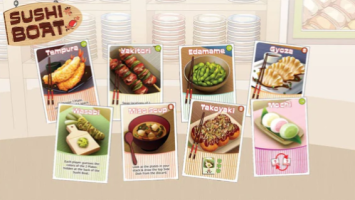
We’ll set the Wasabi card aside for the time being; they’re their own beast. Every other Side Dish card will have a symbol in the top right-hand corner. This will tell you how many sushi plates you’ll need to add to the belt. At the bottom, you’ll find effect text; this will give you a special ability if you choose to purchase the card (in a later step) and then use the card.
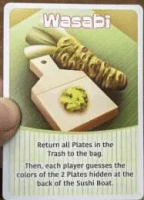
Wasabi Challenge:
The game stops temporarily. Each player tries to guess the color of the 2 plates hidden in the tunnel at the back of the Sushi Boat. First, take all of the Plates in the Trash and return them to the bag, mixing them well.
Then, each player takes 2 Wasabi Cubes from the bowl and secretly places them on their player mat to mark the colors they think match the hidden Plates. You may place both Wasabi Cubes on the same color if you think both Plates are that color. Finally, add Plates to the board until the two hidden Plates are fully revealed (this will most likely push some Plates into the Trash).

Each player compares their guess to the 2 Plates that were revealed. For each color you guessed correctly, you keep that Wasabi Cube. Any Wasabi Cubes on incorrect guesses get returned to the Wasabi Bowl.
2) “You must move your pawn to an empty seat”
You must move your pawn every turn. You can move it to any seat on the board that isn’t already occupied. But you could pay another player 1 Yen to return their pawn to their player board, so you can claim their seat.
3) “You may perform one action” (from a selection of 3)
A) Visit the Staff: If you’re on a space with a staff member, you can pay 1 Yen to perform their special ability.
B) Buy the top Side Dish: Pay 1 Yen to buy the top card of the Side Dish deck; this will most likely be the card you revealed at the beginning of your turn. Note: Players cannot buy Wasabi Challenge cards.
C) Take 1 Yen from the bank.
4) “You must eat sushi”
Take the Plate from the conveyor belt space that is next to the seat your pawn is on. Typically, you will add these plates to the top of your stack of Sushi Plates. (Some Side Dish Cards allow you to break this rule.)

Play continues like this until the Side Dish Deck runs out. When this happens, the game ends. Players score points for the number of consecutive-colored plates in a row, minus 1. So, a stack of 4 red plates would be worth 3 points. You may have multiple stacks of colored plates. (White plates don’t count for or against a consecutive-colored plate stack.) Then, you add up the sets of sushi you claimed (the unique sushi dishes depicted on the plate; there are 7 sushi types). After that, players get bonuses for playing the most Side Dish cards and some Side Dish cards add a victory point. Finally, each Wasabi Cube is worth 1 point each.
Whoever has the most points wins.
Sushi Boat is a great game with an immense toy factor. This game’s production value is over the top. It may even be too nice—if there is such a thing. Ceramic bowls? Are you kidding me? My oldest daughter just returned from Japan and had plenty of real Yen to replace the punchboard Yen included with the game. Even without that, Sushi Boat has fantastic components.
Sushi Boat balances its elements well. I didn’t think memory and worker placement would work, but it does. I’ve found that younger players (ahem, children, ahem) have an advantage during Wasabi Challenges. I tend to focus on the mechanical aspects of the game like special abilities (through the staff and Side Dish cards) and forget to keep track of which plates have slid under the tunnel. This is the one aspect I’ve found most children gravitating toward. This typically gives a child player an extra three or four points.
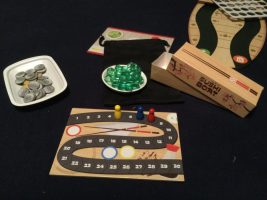
Speaking of the tunnel and the titular sushi boat, the sushi boat looks fantastic. Sliding Sushi Plates across the “conveyor belt” feels great. I’ve even visited a sushi boat restaurant since playing this game. They use colored plates to tally your bill. Ingenious. And that’s what Sushi Boat’s central board is, too. Ingenious.
The one negative I’ve found is the setup and rules explanation. I’m not lying when I cited the setup time in “Fiddly Bits” as “15-20 minutes.” That’s a little long for Sushi Boat’s weight and game length. I almost feel compelled to play more than one game at a time. The rules explanation for new players can also take a little extra time than what I’d like for a game of Sushi Boat’s length, too. But retaining the rules from one play to the next is easy. Barely an inconvenience. The actions that players perform in Sushi Boat are so thematic that it makes it easier to relearn the game, even if you haven’t played in months.
Setup and initial rules explanation can be on the long side, but the effort is well worth it for a game this thematic. While an odd combination, the game’s mechanisms work well together and level the playing field for children. And the board. Look at the board!

Hey, hey! Kyra Kyle here. Back with another Top 5 Tabletop Games. 1986 and 1987 have a lot more games for us to choose from. These two years may have too many games to talk about. Why couldn’t some of these games be released over the previous two years? Ugh! This is a good problem to have. I may have at least one honorable mention this year. Let’s talk board games.
But first, in case you’ve forgotten our criteria for the Top 5 Tabletop Games, let’s reiterate the ground rules again before we get started.
1: Cultural relevance plays as much of a factor as overall quality. A game might make a list that doesn’t hold up to others of its type, but you must admit the game is everywhere.
2: Only one game from a franchise makes the list. This will become more of an issue the closer we get to games with expansions.
3: Longevity plays a role, too. A game doesn’t have to fly off the shelves today, but it had to have some widespread appeal for a decent time.
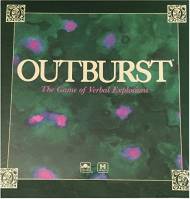
Outburst plays a bit like Family Feud. Two teams compete over multiple rounds to reach 60 points by guessing items listed on a Topic Card within a time limit. Outburst’s simple concept puts it firmly in the party game category, and games like this bring people into the hobby of tabletop games. And they can just be fun.

Outburst was featured in Games magazine’s Best Games of 1988. Scott Marley praised Outburst for its clever topics and team-based gameplay. Marley concluded that “Though Outburst is easy to learn, many topics are too hard—and occasionally too spicy—for children.” This may have prompted 1989’s Outburst Junior.
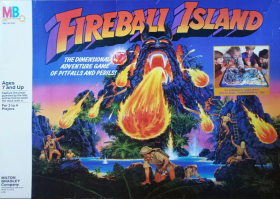
I remember getting the original Fireball Island for Christmas in 1986. The box is ginormous. The plastic game board had undulating paths where the titular fireballs (marbles) would travel down and knock players down, causing the player to lose any items. The object of Fireball Island is to escape the island with the jewel, which players must steal from the top of the Vul-Kar’s mountain. Fireball Island only has one jewel, so once a player grabs it, they become the target of others. And boy, do they become a target.
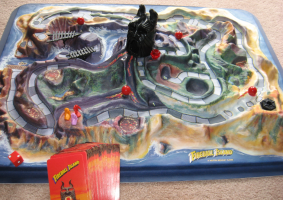
Players are incentivized to knock the jewel out of the hands of the player who possesses it. The reimagining of Fireball Island by Restoration Games in 2018 doesn’t place as much emphasis on the jewel. Players can win by other means. Unsponsored quick plug: Restoration Games does great work. They’ve brought back many games on this list and even a couple of honorable mentions like Dark Tower (from the 1980-1981 list) and Thunder Road (which just missed this list).
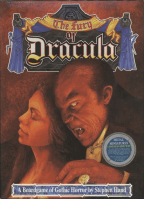
I mentioned a few lists ago (1983-1984) that Scotland Yard inspired many asymmetric games with hidden movement; The Fury of Dracula is one of the most prominent. I like the theme, but the name “Fury” is a bit of a misnomer. Dracula travels on a hidden board while the hunters move across the game board openly and try to deduce where Dracula is, all the while collecting the means with which to slay Dracula (stakes, garlic, and holy water). The Fury of Dracula ends with an epic showdown.

The Fury of Dracula has been updated multiple times. The second edition changes a lot of the gameplay, while the third edition streamlines the rules to make it easier to play and get into. 2019’s Fourth Edition of The Fury of Dracula gave the game a facelift; it didn’t change much in the way of gameplay. I recommend either the third or fourth editions.

Not to be confused with the 1946 marble game, Labyrinth, which was originally stylized as THE aMAZEing LABYRINTH, uses a 7×7 grid where tiles get placed on one end of a column or row and displaces the tile on the opposite side of the column or row, hence the German name for the game Das verrückte Labyrinth, which is a pun on the German words “ errücken” (displace) and “verrückt” (crazy).

Players move their pieces along the ever-shifting path. Many of the tiles will have treasures printed on them. These treasures will match the cards dealt to players at the beginning of the game. The first player to obtain all the treasures in their deck wins. Labyrinth looks simple at first, but it gets puzzlely real fast. It’s a great problem-solving game for children, but when played by adults, the game can become more strategic and cutthroat. Labyrinth’s shifting tiles is one of the most unique game mechanisms from this era.
Returning to the naming, I wonder if Labyrinth avoided calling itself that in 1986 to avoid a lawsuit or confusion with Jim Henson’s Labyrinth movie that was released the same year. I remember a Labyrinth marble game variant tying into the movie that year.

I didn’t realize how old Arkham Horror was until I started compiling this list. Designer Richard Launius originally submitted the concept as Call of Cthulhu: The Board Game. This won’t be the first time Launius will make a game based on H.P. Lovecraft. He made a faster-pace, dice version of Arkham Horror in Elder Sign. Launius may be the person most responsible for making H.P. Lovecraft so popular in tabletop gaming. Arkham Horror is an early, thematic cooperative board game. Before Arkham Horror, I don’t recall seeing too many popular cooperative board games.

Because of this, Arkham Horror introduced a lot of staple cooperative board game concepts. Not the least of which is a “Doom Track.” Players work against the clock before the Ancient One breaks through its plane and into Arkham. Come to think of it, a game clock—of one persuasion or another—exists in most cooperative board games. Launius reinvented Arkham Horror into a Living Card Game in 2005.
Did we get the list right, for the most part? I didn’t mention Blood Bowl (1987); I’ll mention it here as another honorable mention. Let us know which games you’d add in the comments. And wherever you are, I hope you’re having a great day.
Check out the other lists in this series:
Top 5 Tabletop Games Prior to the 1930s
Top 5 Tabletop Games of the 1930s
Top 5 Tabletop Games of the 1940s-50s
Top 5 Tabletop Games from the Early 1960s
Top 5 Tabletop Games from the Late 1960s
Top 5 Tabletop Games from the Early 1970s
Top 5 Tabletop Games from 1980-1981
Top 5 Tabletop Games from 1982-1983
Top 5 Tabletop Games from 1984-1985
Top 5 Tabletop Games from 1988-1989
Top 5 Tabletop Games from 1990-1991

Hey, hey! Kyra Kyle here. We haven’t done too many tabletop game reviews over the past several years—before our Marvel United review last month (here’s the link for that review if you missed it). Today’s review is a much shorter game, but one that packs a punch: SiXeS.
Played over six rounds, SiXeS is a party game where players predict what their opponents will write that will match—or not match—depending on whether you’re in a “match” round or a “unique” round. The player with the most points after six rounds, wins.
Before we proceed, we’ll prep the party and discuss SiXeS’s details.
Designer: Steven Poelzing and Rick Soued
Publisher: Eagle-Gryphon Games and Hobby World
Date Released: 2016
Number of Players: 3-8
Age Range: 12 and up
Setup Time: Less than a minute
Play Time: 15-20 minutes
Party Game
Card Game
Word Game
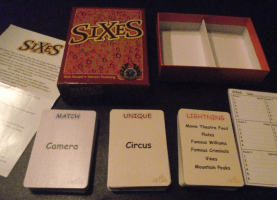
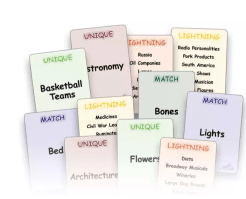
SiXeS consists of three decks of cards: “Match,” “Unique,” and “Lightning” decks and a scoring pad. Each player gets a sheet from the scoring pad and a writing utensil. Shuffle all three decks. Each card is double-sided with one side easier than the other. SiXeS’s rulebook shows which side to use for each round.
You’ll also need a means to keep time; you can use a minute-long sand timer (SiXeS doesn’t include one) or set your phone’s timer for a minute. Some of the rest of “Game Setup” can fall under “Game Flow,” so let’s continue with the next section.
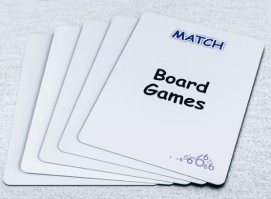
On the scorecard, you’ll find rounds 1-6 marked. Each round has spaces for six answers. Play begins with a “Match” card. After the timer starts, players will think of things that fit the category’s criteria (this will be the word or words printed on the card). For instance, a category like “Sandwiches” can yield answers like “Peanut Butter and Jelly,” “Hero,” or even “Knuckle.” You’re going to have to match at least one other person’s answer at the table, so you may not want to get fancy with which words you use during a “Match” round.
Players find out if they matched anyone else at the table by sharing their answers. You receive a point for each answer that matches another player. If all six of your answers have at least one match, you receive a “Crooked Six.” That’s a seven. You get seven points if you match all six answers. I guess the designers wanted to maintain SiXeS’s theme by calling a seven a “Crooked Six.”

The objective changes with “Unique” rounds. “Unique” rounds play a lot like Scattergories, but you aren’t forced to begin each of your answers with the same letter. In “Unique” rounds, you receive points for each answer that matches no one at the table. You can also earn a “Crooked Six” if no one else puts down your valid answer.
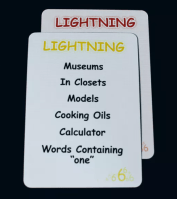
The final card type, “Lightning” has six different categories. You will answer each category in the order in which they appear on the card, and players will try to match answers with at least one other player at the table.
The player with the most points at the end of six rounds wins.
SiXeS resembles Scattegories but with a twist. I like how the rounds vary. As a result, I find it easier to continue playing multiple rounds of SiXeS over Scattegories.
I have yet to play a game of SiXeS that doesn’t include someone getting miffed that no one else chose their cromulent answer or at least one round ending with multiple people unable to fill in all six spots on their scorecard. SiXeS can be frustrating at times but also engages a group of gamers. It’s a great ice-breaker game. It fits into the party game category and a “getting-to-know-you” game. I can see companies using SiXeS as a morale-building tool.

SiXeS’s box says you can play 3-8 players. I wouldn’t recommend three players. Four and five players can be a lot of fun, but SiXeS’s works the best at higher player counts. There’s nothing preventing someone from playing SiXeS with more than eight players. No one’s stopping you from handing out extra scorecards and writing utensils.
That said, beyond the eight-player mark is where SiXeS either becomes super easy and super hard, depending on the round. Matching one out of ten or eleven players would be easy—too easy—but coming up with a unique answer among ten or eleven players can be nearly impossible. I’d stick to as close to eight players as I can. You could convince me into a nine or ten-player game of SiXeS, but the game begins to crumble under the weight of eleven or more players.
Easy to learn and fast to play with great replayability, SiXeS gives Scattegories a much-needed twist. It’s also highly portable. I won’t mind taking SiXeS with me on future trips.
Hey, hey! Kyra Kyle here. Back with another Top 5 Tabletop Games. 1984 and 1985 had even fewer games for this list than the 1982-1983 list. These two years saw a lot of games that got overlooked in previous years find an audience. Axis & Allies was one such game, but it was originally produced in 1981 and made that list. Even the Spiel des Jahres winners for 1984 and 1985 were games from prior years. That said, I still found a handful of games. Let’s talk games.
But first, in case you’ve forgotten our criteria for the Top 5 Tabletop Games, let’s reiterate the ground rules again before we get started.
1: Cultural relevance plays as much of a factor as overall quality. A game might make a list that doesn’t hold up to others of its type, but you must admit the game is everywhere.
2: Only one game from a franchise makes the list. This will become more of an issue the closer we get to games with expansions.
3: Longevity plays a role, too. A game doesn’t have to fly off the shelves today, but it had to have some widespread appeal for a decent time.
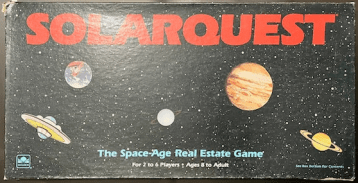
SolarQuest is a fancy space-age version of Monopoly. Players purchase and develop planets, space stations, and moons set in our solar system. SolarQuest has found renewed interest because of eBay. So much so that it’s recently had a successful Kickstart campaign in 2016. SolarQuest makes a notable addition with fuel. Players must watch their ship’s fuel level because they automatically lose the game if they get stranded with no means to refuel.

Outside of fuel, most of SolarQuest is Monopoly set in space. It can be fun, especially when someone runs out of fuel.
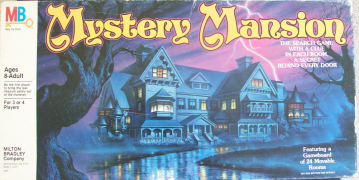
I still quote the mechanical voice of the 1990s version of Mystery Mansion. The original game uses a modular board, one of the first times that a major board game company (Milton Bradley) used a modular board. Mystery Mansion came with 24 cardboard tiles representing different rooms in the mansion: 8 First Floor rooms, 8 Second Floor rooms, and 8 rooms in the cellar.
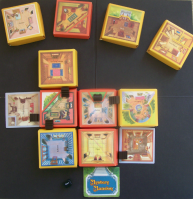
Each room has different doors and objects that come into play during the game, and players must search the items in the room to find the treasure hidden within. The electronic voice version replaces the modular board (the cardboard tiles) for a fixed layout reminiscent of Cluedo (Clue for Americans). In this version, the electronic device will tell the players which items are in the room, so the setup to the house isn’t the same each time. Other than the board and the mechanical voice, everything else remains the same from the original Mystery Mansion.
Fun Factoid: During the 2015 music competition Iron Composer, where composers have five hours to write a piece of music, finalist Ryan Keebaugh used the mechanic voice from the 1990s Mystery Mansion as his “secret ingredient” for his piece.

Balderdash is a variant of a classic parlor game, Fictionary, but it counts as a 1984 release. Seriously, there weren’t that many major games that came out these two years. Anyway, Balderdash is a game of obscure words. Players must create definitions for words seldom used in the dictionary and gain points for guessing the correct definition or having other players select their invented definition.
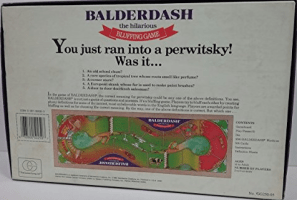
Balderdash can be great fun but like Trivial Pursuit, if you play the game enough, you’ll learn many of the words and their definitions. Hey! That’s a fun way to increase your vocabulary.

Abilene is set in the city of Abilene during 1870. This was the time and place for the main transshipment point for the herds of Texan cattle barons. Players assume the role of ranchers who, with the help of their cowboys, drives their herds to Abilene, trying to capture parts of their opponents’ herd along the way.

Abilene has a few twists on this concept. First, players can capture their opponents’ herds as mentioned, but second, your cattle can be diseased. Players have a certain number of diseased cattle in their herd and whenever a herd makes it to Abilene, one’s opponents guess how much of the herd is diseased. Abilene received consideration for the 1985 Spiel des Jahres. Not bad for a game set in Texas. (Note: games set in the United States at this time didn’t fare well in the Spiel des Jahres.)
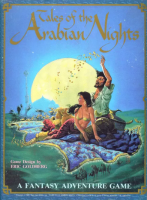
Tales of the Arabian Nights is getting its 40th anniversary glow-up next year. You can sign up for the Gamefound project preview here (https://gamefound.com/en/projects/play-to-z/tales-of-arabian-nights-40th-anniversary-edition).
Tales of the Arabian Nights uses paragraphs to tell a story where each player travels through the Arabian desert and partakes in adventures from One Thousand and One Nights. Players gain and lose statuses from these adventures and collect Story and Destiny Points. Once you earn enough points to become sultan, you can return to Baghdad to win the game.

Many board game enthusiasts swear by this game as one of the best storytelling games. Every generation, we receive a new version of the game. I’m glad Play to Z has an upcoming new version.
Did we get the list right, for the most part? Let us know in the comments. And wherever you are, I hope you’re having a great day.
Check out the other lists in this series:
Top 5 Tabletop Games Prior to the 1930s
Top 5 Tabletop Games of the 1930s
Top 5 Tabletop Games of the 1940s-50s
Top 5 Tabletop Games from the Early 1960s
Top 5 Tabletop Games from the Late 1960s
Top 5 Tabletop Games from the Early 1970s
Top 5 Tabletop Games from 1980-1981
Top 5 Tabletop Games from 1982-1983
Top 5 Tabletop Games from 1986-1987
Top 5 Tabletop Games from 1988-1989
Top 5 Tabletop Games from 1990-1991

Hey, hey! Kyra Kyle here. We’re in the middle of the Christmas season. There aren’t that many days until the holiday, so I decided to go with another purchasing guide: stocking stuffer board games. But I don’t want to just do individual games. No, no. Let’s discuss board game companies known for producing good games that can fit inside a stocking.
We’ll have to set some ground rules.
1) The packing must be small enough to fit in at least 50% of stockings.
2) The games must be good. While smaller packaging can lead to compromises, who wants to play a bad game?
3) Extra points for companies that produce various games. It’s easy to find a formula and produce multiple versions of the same game, but I’m handing out brownie points to any company capable of stretching their creative muscles.
With all that out of the way, let’s get to the games, or the board game companies.

On the Game Crafter, aspiring game designers can buy board game components for their prototypes. But it also functions as a store for indie board game designers to sell their games. The Game Crafter is a great place to support smaller game companies and indie board game designers directly. We’ll be covering their Mint Tin Games line. These games fit inside a mint tin. Perfect for a stocking.
Price: Varies between $20-$35. Board game designers set their own prices, so mint tin games vary wildly.
Quality: It’s a mixed bag. That’s why Mint Tin Games are fifth on this list. But there is a silver lining. The Game Crafter gives their stamp of approval to any game they view as worth your time.

Variety: Tons! Mint Tin Games are the Wild, Wild West of board games. Think of it as the board game equivalent of the indie video games on Steam. You’ll find games here that you can’t find anywhere else.
Size: 4-inch by 2 1/2-inch mint tins. You can fit these tins into any stocking. I’m surprised by the amount of games you can find that fit inside this packing.
Titles: Again, I’d look at anything that gets the Game Crafter seal, but here are some standouts. I’ve found a ton of excellent solo games. Doom Machine is fantastic. Mint Knight is a fan favorite and a sandbox RPG. What? Astro Asterid’s Quick Shuttle Repair is a fast-paced resource management game. And Deck 52: Space Wrecked is a fun dungeon crawl.
Store Link: (https://www.thegamecrafter.com/games?query=mint&hitsPerPage=18) The Game Crafter (Mint Tin Games).

We had a game series in a mint tin. Pack O Game fits inside a box of chewing gum. How do make a game fit in that tight of a space?
Price: $7 each. By far the cheapest set of games on this list. You can’t beat $7 for a game.
You can also buy a bundle for $50, but that includes 8 games and a pod that can hold all the games from a set, and there are three sets. Even though the pod can hold all the games in a set, it’s still small enough to fit into any stocking.

Quality: Most of the games in this line are good. There can be some duds, but for $7, you can buy a few. And the stellar titles can be fantastic.
Variety: These games use cards shaped like sticks of chewing gum. Despite that, there are plenty of game mechanisms represented in this line.
Size: Don’t worry about it. These are tiny games. These game boxes measure around 5-inch by 1-inch. Crazy small!
Titles: I haven’t played much from the second and third sets, but I played plenty of the first one. Shh must be the best of the bunch; it’s a cooperative word game. Hue and Fly are also good, but I have a soft spot for TKO.
Store Link: Pack O Game by Perplext.

For the most part, All Play has two sizes of games. We’ll be discussing the smaller (square-shaped) games with this listing. But the larger boxed games are worth perusing as well.
Price: Under $20. Great value for the amount of game inside these small boxes. It’s also a great price for a stocking stuffer.
Quality: While not all the games of this line suit my tastes, the games in All Play’s small box line are baseline good. If something sounds interesting, it’s well worth the price tag.
Variety: All Play has some of the best gameplay variety on this list. You’ll find plenty of themes and gameplay mechanisms that are sure to meet your board game enthusiasts’ preferences.
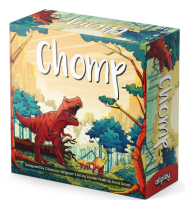
Size: This is what makes All Play’s small box games third place. This line dominates all the other criteria, but size could be an issue. The small boxes measure 5-inch by 5-inch. That could fit in at least 50% of stockings. Maybe? If you have extra-large stockings, no problem. And who cares if the box protrudes from the stocking’s top?
Titles: I mentioned Chomp in our “Getting Starting with Tile-Laying Games” (you can check out that write-up here); Chomp is an excellent game. Sequoia is another great title. Ghosts of Christmas may be a good thematic game for the season. And I’ve heard great things about Mountain Goats.
Store Link: (https://www.allplay.com/board-games/) All Play Games. Look for the square-shaped game boxes.

Board game rockstar Elizabeth Hargrave (Wingspan) got her start with Button Shy Games’s Wallet Game line. To date, she has more than one game in the Wallet Game line. As the name suggests, these games fit inside a wallet, so they will definitely fit inside a stocking.
Price: $12 each. Another cheap option with some great games on offer.
Quality: Like All Play’s small box line, most games in Button Shy Games’s Wallet Game line are good. But there are some standouts.
Variety: Most, if not all, of the games in this line use 18-card decks. Each game does something different with its 18-cards but it can get repetitive if you pick up too many at once.
Size: The size of a slim wallet, roughly 5-inches by 3-inches. You won’t have an issue fitting any of these games into your stockings.
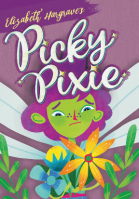
Titles: Hargrave’s first published game Tussie Mussie is not in stock before Christmas 2024, but you can pre-order the next printing set for an April 2025 release. But she does have another great game named Picky Pixie. Mysticana uses a nice twist on rock-paper-scissors, and it has plenty of expansion should you enjoy the core gameplay. Sprawlopolis is a great city-building game. It’s sold out, but its stand-alone sequel Agropolis is available.
Store Link: Button Shy Games Wallet Games line

Oink Games have a lot of quirky little games in their line. They have plenty of games that come from East Asia. More than a few of those will get a mention in the Titles section.
Price: Most are $23, but there are a few that can be a little higher or lower in price.
Quality: Another company that has baseline good games with some standouts.
Variety: Except for All Play’s small box line, Oink Games may have the most variety of any game company (or line) on this list.
Size: The boxes are about 3.5 inches by 2.5 inches. Bigger than most other lines on this list except All Play’s.

Titles: I covered Deep Sea Adventure some time ago with our “Getting Started with Pickup and Delivery Games” writeup (here’s a link); it’s a great title. Scout earned the 2022 Spiel Des Jahres; I may have to check out that one. A Fake Artist Goes to New York is a ton of fun; everyone draws a picture together, but one person (the fake artist) doesn’t know what the group is drawing.
Store Link: Oink Games
That concludes our list. There are a lot of games worth trying. There may even be some that I may have to purchase…as a gift. A gift that’s TOTALLY for someone else.
Did we get the list right? Let us know which companies you would add in the comments. And wherever you are, I hope you’re having a great day.
Hey, hey! Kyra Kyle here. Back with another Top 5 Tabletop Games. 1982 and 1983 may not have the same heavy hitters as the previous two years, but there are still has some gems. You know the drill by now, let’s talk about some games.
But first, in case you’ve forgotten our criteria for the Top 5 Tabletop Games, let’s reiterate the ground rules again before we get started.
1: Cultural relevance plays as much of a factor as overall quality. A game might make a list that doesn’t hold up to others of its type, but you must admit the game is everywhere.
2: Only one game from a franchise makes the list. This will become more of an issue the closer we get to games with expansions.
3: Longevity plays a role, too. A game doesn’t have to fly off the shelves today, but it had to have some widespread appeal for a decent time.

You could describe Take It Easy (designed by Peter Burley) as a strategic Bingo. Each player gets a board with 19 hexagonal cells and a set of 27 tiles which have different combinations of colored/numbered paths. The paths cross each other, and players try to continue the colored paths from one end of their boards to the next. The longer the paths go without being interrupted, the more points the player scores at the end of the game.

What makes Take It Easy a strategic Bingo, is that one player is the caller. They draw a tile randomly from a bag. Players will place the same tile simultaneously on their boards. Once a tile is placed, it can’t be moved. Take It Easy has a simple concept but challenges each player to place their tiles in the most optimal configuration. There’s even a Take It Easy app you can download.

Like Ogre a few lists ago, Scotland Yard uses asymmetric play. One player is Mr. X, who tries to escape London without being caught, while the rest of the players play as the police who try to capture Mr. X. So many games use this setup. 2006’s Mr. Jack casts one player as Jack the Ripper and the other player as the detective trying to deduce his identity. I haven’t yet made the 1987 list, but there’s a good chance The Fury of Dracula will make that list.
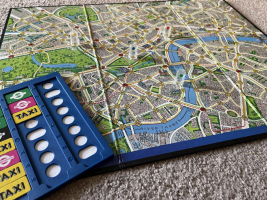
In short, Scotland Yard has influenced several board games. It may be an older game, but Scotland Yard does a great job of simplifying secret movement. And I like games that use secret movement. We may be seeing a lot more games of this type in the future.
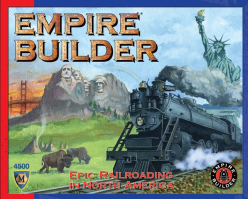
I wanted to put Empire Builder much higher on this list, but two other games edge it out because of their cultural impact. Empire Builder (designed by Darwin Bromley and Bill Fawcett) is THE crayon rails game. A crayon rails game is a board game that has players draw train tracks on a map with erasable markers. Empire Builder features a map of the 48 contiguous United States drawn to scale. There is a lot of strategic depth to Empire Builder. Players gain benefits by connecting their lines to specific locations. Do you want to dominate the trade of oranges? Canvas Florida with your train tracks. Do you want access to oil? You may want to build a route to Texas.

Gary Gygax (co-creator of Dungeons & Dragons) may have said it best in his review from Dragon Issue 65 (September 1982): “In my opinion (Empire Builder) is the best (board game) available, being more complex and challenging than the simpler sort and not as tedious and complicated as those at the other end of the spectrum.”
Empire Builder may be simpler than a lot of other heavy strategy games at the time, but it takes a while to play. You will dedicate hours to finish a game. But it’s worth it.

If you ever wondered what game the cast of The Big Bang Theory had on their coffee table with the miniatures running around a track, chances are it was Talisman. Designer Robert Harris made Talisman to amuse himself and his friends. The game originally had a boys’ school theme, and the players wanted to become the school’s prefect.

Thankfully, the game was recast as fantasy and renamed Talisman. Players move about the board, trying to be the last hero standing. The spaces a player lands on dictate what action they can take for their turn. Like Empire Builder, Talisman is another longer game. And like Monopoly and Clue, Talisman has a lot of intellectual properties that have their version of Talisman. I may have to try the Kingdom Hearts variant.

Warhammer started a miniatures revolution. Before Warhammer’s release, most games used cardboard chits to indicate their combat units. I have fond memories of my family playing some World War II or American Civil War games; its map would stretch across a large dinner table. Anyway, there were a handful of miniature games that were released before Warhammer, but Warhammer began a craze.
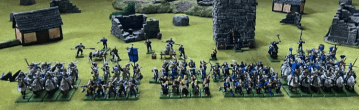
Let’s be honest. Of all the names of games on this list, Warhammer must be the most well-known. Plenty of video games and novels have set their stories in Warhammer’s dark and gritty world. I never got into miniature games because they can get costly. Someone can easily drop hundreds of dollars on a set of minis and then spend another mint getting those minis painted. I marvel at some of the artwork.
Even though I’ve never paid for a miniatures army, I have played my fair share of miniature games. Most people in the hobby are happy to share their minis with people interested in the hobby. You can search for a game shop or café near you and see if they have a miniatures game night. They can be a lot of fun. You can’t beat chucking a heap of dice. I love dice.
Did we get the list right, for the most part? Let us know in the comments. And wherever you are, I hope you’re having a great day.
Check out the other lists in this series:
Top 5 Tabletop Games Prior to the 1930s
Top 5 Tabletop Games of the 1930s
Top 5 Tabletop Games of the 1940s-50s
Top 5 Tabletop Games from the Early 1960s
Top 5 Tabletop Games from the Late 1960s
Top 5 Tabletop Games from the Early 1970s
Top 5 Tabletop Games from 1980-1981
Top 5 Tabletop Games from 1984-1985
Top 5 Tabletop Games from 1986-1987
Top 5 Tabletop Games from 1988-1989
Top 5 Tabletop Games from 1990-1991
Hey, hey! Kyra Kyle here. Back with another Top 5 Tabletop Games. As you can see from this post’s title, we’re doing things a little differently with this list. These upcoming lists will lump two years today, rather than splitting the decade in half. The 1980s saw an increase in board game production. A lot of new games hit shelves in this decade, and with the introduction of the Spiel des Jahres (Germany’s game of the year) award, the quality of board games also increased.
In case you’ve forgotten our criteria for the Top 5 Tabletop Games, let’s reiterate the ground rules again before we get started.
1: Cultural relevance plays as much of a factor as overall quality. A game might make a list that doesn’t hold up to others of its type, but you must admit the game is everywhere.
2: Only one game from a franchise makes the list. This will become more of an issue the closer we get to games with expansions.
3: Longevity plays a role, too. A game doesn’t have to fly off the shelves today, but it had to have some widespread appeal for a decent time.
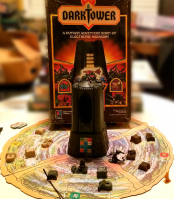
We have an honorable mention for this list: Dark Tower (1981) by Roger Burten, Alan Coleman, and Vincent Erato. Dark Tower deserves a mention because it uses an amazing tower as its centerpiece and incorporates a lot of innovative electronic elements. A sequel released in 2022, Return to Dark Tower, brought the original back to prominence.
I almost split 1980 and 1981 into two different lists; if I did, Dark Tower would’ve made a 1981-only list. There’s even a television commercial featuring Orson Welles for the board game. Yikes!
Here’s a link to that Orson Welles Dark Tower commercial.
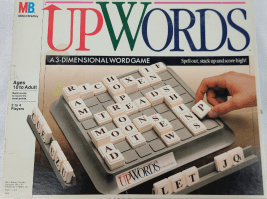
Upwords originally played on an 8×8 square board with 64 letter tiles. The board expanded to a 10×10 board to accommodate languages with longer words like German and Dutch. Eventually, the game shifted exclusively to the 10×10 board. Upwords plays similar to Scrabble. The big difference is that the letter tiles can stack on top of the ones previously used. All words must read horizontally from left to right, or vertically from top to bottom.

I like the twist Upwords made to Scrabble. It doesn’t change the core rules too much, but the inclusion of elevation leads to interesting plays.
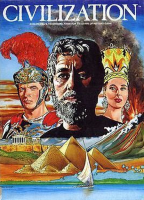
Not to be confused with the Sid Meier video game of the same name, the original 1980 Civilization board game (designed by Hartland Trefoil) introduces the concept of a technology tree (or tech tree). This tech tree is the centerpiece of the video game Civilization that released over a decade later. Sid Meier’s Civilization isn’t the only board game or video game to use a tech tree. Any game that uses that concept owes a debt to Trefoil’s Civilization. And there are a lot of games that use tech trees.

I find it interesting that a game designed in 1980 has a streamlined yet strategically satisfying tech tree. Is it any wonder that Civilization was chosen for inclusion in the 2007 book Hobby Games: The 100 Best? There is little luck involved in Civilization. This is one of the first crunchy—and lengthy—strategy games. And it won’t be the last.

We didn’t have to wait long for another lengthy strategy game on this list. Axis & Allies (designed by Larry Harris) casts players as the major belligerents of World War II: Germany, Japan, the Soviet Union, the United Kingdom, and the United States. The Axis & Allies Anniversary Edition (released in 2008) included Italy as the third Axis power and China as the fourth Allied power.
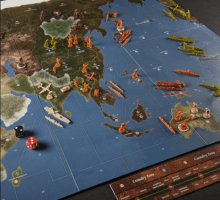
The combat could get convoluted and intense. Players would roll dice to hit and if a unit scores a hit, the opponent chooses which unit gets destroyed. I like the idea of a unit performing a retaliation before death. It took the sting out of losing a piece. Combat resolves when either side loses all their units or the attacker retreats. I enjoyed this one growing up, but my family never finished a game. Axis & Allies was one of those games where you needed a table just for the game, so you could keep it set up for future plays.
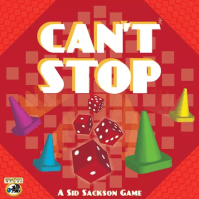
Can’t Stop is yet another Sid Sackson design. What can I say, the man deserves to be in the Academy of Adventure Gaming Arts & Design’s Hall of Fame. Can’t Stop has a wonderful press-your-luck mechanism. Players roll four dice on their turn and then group the dice however they see fit. If you were to roll a 1, 2, 3, and 6, you could group them as 5 and 7, 4 and 8, or 3 and 9. Once the player makes their decision of which pairs they want, they move their marker up columns on the board for those numbers. The press-your-luck comes into play with a potential second roll. If at any time you can’t move your markers any higher on a column, you bust and lose all your progress that round.
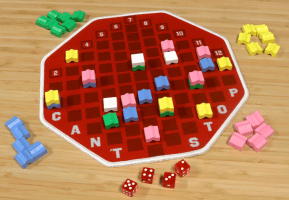
As soon as a player claims the top space in a column, no one can claim that number again. The game ends when one player has claimed the top spot for three numbers. Can’t Stop is such a great game. And Sid Sackson is a board game legend.

I struggled with which game should claim the top spot, but ultimately, Trivial Pursuit was the biggest cultural phenomenon from 1980 and 1981. Trivial Pursuit is the grandfather of all trivia-style board games. Heck, it’s the grandfather of all trivia games.
Each of the Trivial Pursuit playing pieces has spaces for six wedges. Players compete by answering trivia questions from six different categories, matched with a different color. In the classic version, Blue is Geography, Pink is Entertainment, Yellow is History, Brown is Arts & Literature, Green is Science & Nature, and Orange is Sports.
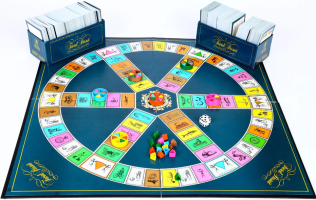
To this day, trivia games—even trivia video games—will assign similar colors to the same categories. I’m looking at you, Trivia Crack. Trivial Pursuit has spawned numerous copycats and more than one game show. It’s the one game on this list that most people will know. I had to make it number one. My hands were tied.
Did we get the list right, for the most part? Let us know in the comments. And wherever you are, I hope you’re having a great day.
Check out the other lists in this series:
Top 5 Tabletop Games Prior to the 1930s
Top 5 Tabletop Games of the 1930s
Top 5 Tabletop Games of the 1940s-50s
Top 5 Tabletop Games from the Early 1960s
Top 5 Tabletop Games from the Late 1960s
Top 5 Tabletop Games from the Early 1970s
Top 5 Tabletop Games from 1982-1983
Top 5 Tabletop Games from 1984-1985
Top 5 Tabletop Games from 1986-1987
Top 5 Tabletop Games from 1988-1989
Top 5 Tabletop Games from 1990-1991

Hey, hey! Kyra Kyle here. Back with another Top 5 Tabletop Games of an era. We’re keeping the trend of breaking a decade into two halves—for now. Today’s list will be the Top 5 Tabletop Games from the Late 1970s (1975-1979)
In case you’ve forgotten our criteria for the Top 5 Tabletop Games, let’s reiterate the ground rules again before we get started.
1: Cultural relevance plays as much of a factor as overall quality. A game might make a list that doesn’t hold up to others of its type, but you must admit the game is everywhere.
2: Only one game from a franchise makes the list. This will become more of an issue the closer we get to games with expansions.
3: Longevity plays a role, too. A game doesn’t have to fly off the shelves today, but it had to have some widespread appeal for a decent time.

Guess Who? kicks off this list with a simple guessing game. Players pick a card with a character depicted on it, and their opponent guesses who their opponent’s character is before their opponent can do the same. Guess Who’s? game board features several rows of cartoon characters, each with distinct looks. Players ask yes/no questions about their opponent’s character (typically about their opponent’s hair color, eye color, hair style, hats, etc.) and flip down the portrait of characters who don’t match the answer their opponent gave.
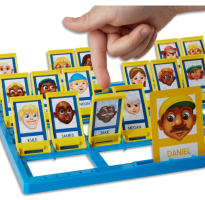
Guess Who? like many other children’s games (like Operation) has spawned a lot of brand-themed versions. Disney princesses, the Marvel Cinematic Universe, and even Cars 2 have had variants of Guess Who?. Guess Who? is a quick and easy game to learn and yet another game that has introduced many to the tabletop game hobby.

Ogre is the first Steve Jackson design to make one of these lists, but we’ll most likely see more of his work in future lists. Ogre is a tactical ground combat game set in the not-so-distant future. Combat has become faster and deadlier in the year 2085. Hovercraft, tanks, and infantry dole out damage with tactical nuclear devices, but no weapon is as feared as the giant cybernetic (pretty much AI-driven) tank called the OGRE.

One player takes control of a military force with infantry and armor. They must defend a command post. The other player has only one unit, the OGRE. Ogre plays with asymmetric powers. It may even be one of the first to do so on a grand scale.

Dungeon! plays out a lot like Dungeons & Dragons, if D&D was simplified and converted to a board game. Players explore the titular dungeon that is divided into levels of increasing difficulty. Players fight monsters for treasure. As you journey deeper into the dungeon, the monsters grow in difficulty and the more valuable treasure you’ll find. Dungeon! uses a lot of the class-types one may find in Dungeons & Dragons.
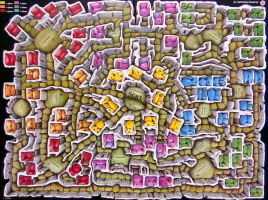
Each character’s fighting style is unique and suited for specific regions in the dungeon. The winner is the first player to bring a certain amount (value) of treasure back to the Dungeon’s entrance. Dungeon! holds a special place for me. It was my first exposure to the world of Dungeons & Dragons, sort of. While the game shares plenty of similarities, Dungeon! doesn’t follow D&D to the letter. And it plays fast and furious.

Rummikub holds the distinction of being the first recipient of the Spiel des Jahres (German Board Game of the Year) in 1980. You may notice that Rummikub was published in 1977. It didn’t become widely published until a year or two later. Rummikub plays similar to several other central European card games (like Rummy) which are played with two decks of playing cards. Ephraim Hertzano invented the tile game Rummikub in the 1940s when Communists outlawed card playing.
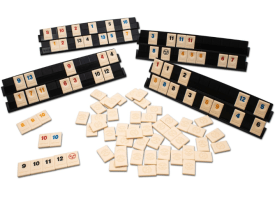
Rummikub didn’t catch on in the rest of the world until after Hertzano published his 1978 Official Rummikub Book. Like Rummy, you try to get rid of all your tiles by forming numbers into runs of 3 tiles or more, or 3 to 4 of a kind. The colors of the numbers on the tiles function like card suits.
Rummikub proves that people want to play games, especially when an over-bearing regime tells them they can’t. This act of rebellion made Rummikub the perfect first recipient of the Spiel des Jahres.

Cosmic Encounter takes the top spot because it popularized one of the most beloved game mechanisms of all time: Variable Player Powers. Each player takes control of a unique alien race with a special power. They battle each other for galaxy supremacy.
But Cosmic Encounter is far more than just combat. To win Cosmic Encounter, players spread themselves onto five foreign worlds. Players will often enlist the aid of opponents to take out another opponent or allow them to accomplish one of many challenges. Alien powers, which are unique to each race, give players ways to bend or outright break the game’s rules. The game continues until one player occupies five planets. Shared victories are possible, and a player doesn’t need to occupy their own system to win.

Like I implied, Cosmic Encounter has inspired so many modern board games. The Variable Player Powers mechanism tends to sell board games. And even games like Magic: The Gathering owes their inception to Cosmic Encounter. These alien powers allowed players to break the rules; one of the statements in Cosmic Encounter’s rulebook suggested that if an alien power deviated from the rulebook, follow the rules on the alien power. That’s like Magic’s golden rule of cards. Whenever a card’s text directly contradicts these rules, the card takes precedence. Collectible Card Games owe their existence to Cosmic Encounter. It had to take the top spot.
Did we get the list right, for the most part? Let us know in the comments. And wherever you are, I hope you’re having a great day.
Check out the other lists in this series:
Top 5 Tabletop Games prior to the 1930s
Top 5 Tabletop Games of the 1930s
Top 5 Tabletop Games of the 1940s-50s
Top 5 Tabletop Games of the Early 1960s
Top 5 Tabletop Games of the Late 1960s
Top 5 Tabletop Games of the Early 1970s
Top 5 Tabletop Games from 1980-1981
Top 5 Tabletop Games from 1982-1983
Top 5 Tabletop Games from 1984-1985
Top 5 Tabletop Games from 1986-1987
Top 5 Tabletop Games from 1988-1989
Top 5 Tabletop Games from 1990-1991
 jkgeekly.com