
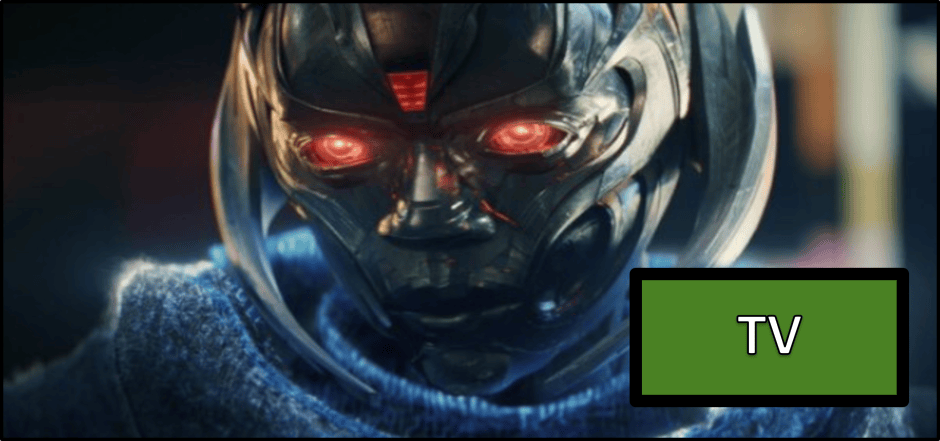
Hey, hey, Geekly Gang! Kyra Kyle here with another review/reaction of a VisionQuest episode, “Deadlock.” If you want to see my thoughts on VisionQuest’s previous episode, “Firewall,” check out this link. VisionQuest “Deadlock” begins where many episodes of VisionQuest begin: inside one of the synthezoids’ mind spaces. “Deadlock” begins with Jocasta’s mind space. On the heels of last episode, Ultron left Vision’s mind space for somewhere else. It makes sense that he’d want to join Jocasta. I love this narrative construction. It fits with a synthezoid. It almost gives VisionQuest a novel approach. Novel meaning both unique and like a book. VisionQuest found a way to show a character’s interiority. That’s cool. But the show may be leaning on this a little too much at times. Equal parts of the show occur in the real world and a character’s mind space. This worked at the beginning. I hoped for the show to pivot.
Quick Note: Spoiler Alert VisionQuest “Deadlock” is in effect. You’ve been warned.
Again, I love VisionQuest’s mind space narrative structure, but we’re six episodes (out of an eight-episode run) into the series. VisionQuest should’ve reduced the amount of time spent in a synthezoid’s headspace by now. I think, we are shifting from that because most of Vision’s AI buddies have flown the coop. The majority of VisionQuest’s mind space minutes occurred in Jocasta’s head. Again, this makes some sense. We watch Ultron and Jocasta find a connection, more on that in a minute, and see what the pair have planned for humanity. Nothing good. But their scheme makes sense for both characters and who they are. I questioned VisionQuest going the route of Ultron and his bride, but the show has proven my doubts unfounded.
I may have been too hard on VisionQuest sticking with its mind space structure. The show maintains good pacing, a rare thing for a Marvel television series. Ultron and Jocasta have revealed their plan for humanity: make humans more robotic. “I got the idea turned round,” Jocasta said. “Instead of making synths more human, we should inject machine into them (humans).” This is a subtle shift to Ultron’s original goal. It fuses Jocasta’s backstory (which we learn in “Deadlock”) with wanting to fix what ails humanity.
We see Lisa Molinari (Tommy’s love interest) infected with one of Jocasta’s nanobots. She loses most, if not all, of her autonomy. While Ultron shares Jocasta’s viewpoint that humanity is flawed, I can see the two finding a disagreement. Ultron convinces Jocasta not to use her nanobot on Tommy. Ultron plays this off as not wanting to upset Vision, but it run deeper. Ultron wants humanity. He yearns to live, taste, and experience things as a human. I can’t see this desire jiving with robbing humanity of its mortal experience. If everyone thinks the same, what would happen to the artists that Ultron loves?
I can see VisionQuest incorporating some form of Ultron not wanting to rid humans of their humanity. I don’t know if it will involve artists or family or some other aspect of the human experience, but I can’t imagine Ultron going on a journey (like entering Jocasta’s mind space) and not changing. Change is a main theme in VisionQuest. Tommy has embraced his dual identity (Thomas Shepard and Tommy Maximoff). Vision tries to relate to Tommy as a father. Even Ultron wants to feel what the people feel; in VisionQuest, Ultron takes his first sip of a real alcoholic beverage. E.D.I.T.H. even tells Paladin’s Tactical A.I. (played by Diane Morgan) that the “Strongest don’t always survive, but the ones most willing to change.”
Family is the other of VisionQuest’s major themes. I can’t imagine Ultron turning his back on his family (Vision and Tommy) when the moment of truth arrives. And I like what Lisa Molinari said about Vision being a father to Tommy. We learn by doing. I feel like this can apply to Vision and Ultron as father figures.
VisionQuest “Deadlock” had plenty of great moments. I like how the episode began with Jocasta trapping Ultron, or at least, she tried to imprison him. Jocasta’s actions run counter to what Ultron said Vision did in the previous episode. Vision called his locking up Ultron a mercy. Even though Ultron’s prison was short-lived, he could tell the difference between what Vision did and what Jocasta planned to do. Tommy namedrops his codename: Speed. I like how he called Keanu Reeves’s character in Speed, Speed, and how the Paladin had to correct him. And Paladin’s handler being a Tactical A.I. made sense, and E.D.I.T.H. taking her place fit. And it was fun.
VisionQuest “Deadlock” managed to bring many of the show’s disparate storylines together. Paladin returns but may now be in a tentative alliance with Vision. Paladin’s former employer is back in play and made a plea directly to the synthezoid. We still don’t know who exactly is hunting Vision, but I’m sure that will be revealed soon. We know what Ultron and Jocasta have planned and most of what our heroes need to overcome in the final two episodes. Lisa’s life is in the balance, and humanity may become more like machines. And Tommy and Vision have reengaged as father and son. Vision has finally told Tommy everything about his past.
This show may have done the near-impossible. Ultron was not the most inspired villain in the MCU. Avengers: Age of Ultron was one of the weakest Avengers films. And yet, VisionQuest has made Ultron cool. Like most Marvel Cinematic Universe properties VisionQuest has some pacing issues, but it’s better than most MCU vehicles, and this trilogy of mini series (WandaVision, Agatha All Along, and VisionQuest) are the strongest modern MCU properties. Most of that comes from each series focusing on its characters, even the ones who aren’t human.
Those are my thoughts on VisionQuest “Deadlock.” What did you think of this episode? Let us know in the comments. Thank you for reading, and wherever you are, I hope you’re having a great day.

