Top 5 Tabletop Games of the 1930s

We’ve covered the top ancient tabletop games and now we’ve reached tabletop games’ modern era. The 1930s may not have introduced a lot of tabletop games, but the decade did see some tabletop game giants.

Let’s set some ground rules before we get started.

1: Cultural relevance plays as much of a factor as overall quality. A game might make the list that doesn’t hold up to others of its type, but you can’t escape or ignore the game.

2: Only one game from a franchise makes the list. We’ll save our Fifty Shades of Monopoly for another list.

3: Longevity plays a role, too. A game doesn’t have to fly off the shelves today, but it had to have some widespread appeal for a decent time period.

5) Wahoo (1930)
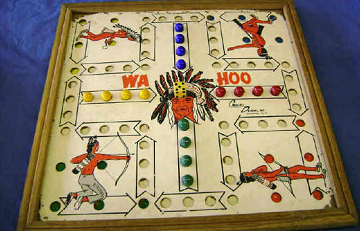
Originating in the Appalachian hills, Wahoo took the cross and circle game mechanics of Pachisi and converted the playing pieces to marbles. While Parker Brothers sold a variant of Wahoo, marketing it for decades as Aggravation, Wahoo maintains a cult following as many people create custom-made boards.
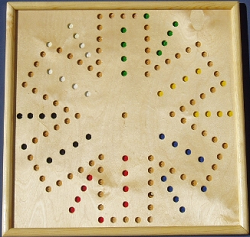
Wahoo02Many of these home-made boards feature a Native-American theme. I don’t know if this is an attempt to give the game American roots, a play on the word Wahoo’s origins, a rebranding of an Indian board game to an American Indian theme, or a mixture of all three. Whatever the reason for this theme Wahoo earns a place on this list as it sees plenty of play.
Wahoo014) Battleship (Early 1930s)
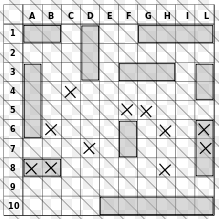
We had a sneaky addition to the games prior to the 1930s and now we get another sneaky inclusion to this list. Battleship started as a pencil and paper guessing game in the 1930s, but Milton Bradley – they were culprits for The Game of Life’s shifty inclusion in the last list – released the plastic board game we know today in 1967.
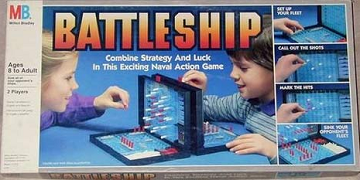
Battleship02Still, the core game mechanics didn’t change much between the 1930s and 1967. Folks have been sinking battleships and referencing the game in movies and TV ever since. Battleship has seen its share of video games, spinoffs, and even its own sci-fi movie in 2012 starring Rihanna.
Battleship013) Sorry! (1934)
Sorry! is another board game based on the ancient Indian cross and circle game of Pachisi. But unlike Wahoo – which also made this list – Sorry! trades the roll mechanic for a deck of cards.
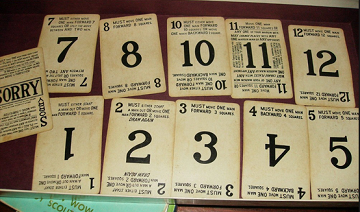
Sorry04The most significant addition to the original Pachisi gameplay is the ability to move backwards on the board. This allows players to move from their starting position and move backwards toward their safe area.
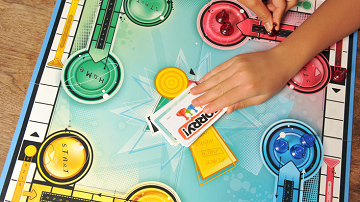
Sorry03But I have to admit that this one’s a possible sneaky add to this list. The earliest additions of the game Sorry! can be traced back to England in 1929. The product first moved to Canada in 1933, and then Parker Brothers bought the rights, mass-marketing the product to the United States in 1934.

Sorry02Still, there isn’t much difference between the two dates, and Sorry! gained its popularity in the 30s, a popularity that has continued to this day as Sorry! has seen several incarnations and is one of the bestselling tabletop games of all time.

2) Scrabble (1938)
What’s in a name? Alfred Mosher Butts based Scrabble on a game he created earlier in the 1930s Lexiko. Lexiko didn’t sell well, but Scrabble (originally released in 1938) has dominated all word-based games. On a different note, I wonder if Alfred had the nickname “Big Al,” that way he’d be Big Al Butts.
Scrabble03Anyway, Scrabble – like Lexiko – wasn’t an instant success. It took James Brunot purchasing a copy and then modifying the rules before a board game company would even look at the game. And still no board game company – including the two giants Milton Bradley and Parker Brothers – wanted anything to do with the game. Brunot had to produce the game by himself for years.
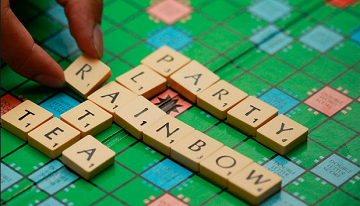
Scrabble02Fourteen years after its initial release, Scrabble hit the big time when Jack Straus, the president of Macy’s, played the game on vacation. Straus placed a huge order of the game in early 1952, and Brunot couldn’t meet the production demand.
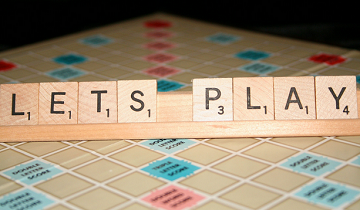
Scrabble01Brunot had to sell the manufacturing rights to Selchow and Righter – another one of the manufacturers who originally passed on the game – to keep up with the production and to say “I told you so” and “Neener-neener-neener, you should’ve bought my game.”

The rest is history. Numerous game shows, video games, and cultural references have kept Scrabble at the forefront of the American lexicon.

1) Monopoly (1933)
I’m sure most of you saw this one coming. How can we possibly have a list of the best tabletop games of the 1930s and not include the juggernaut that is Monopoly?
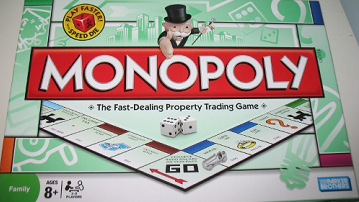
Monopoly01Monopoly is based on The Landlord’s Game by Elizabeth (Lizzie) J. Magie Phillips. She self-published her game as a means to illustrate the negative aspects of concentrating land in private monopolies. Her game didn’t sell well, but that wasn’t the point. She wanted folks to see the dangers of land grabbing and showcase its consequences. Though the game has changed immensely, you can see Phillips’ original goal through people going bankrupt and that there can only be one winner.
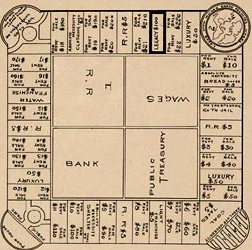
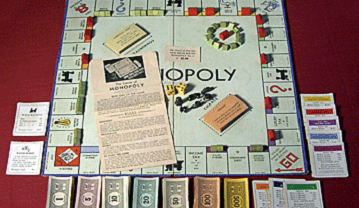
Monopoly03Getting back to Monopoly as we know it today, Charles Darrow gets credit for creating the game, even though the game’s concepts take more than a little bit from The Landlord’s Game, and players in the Midwest and East Coast during the 1930s and 1940s contributed to the game’s design and evolution. You could say it was a collaborative effort.

Monopoly04Today, Monopoly is everywhere. It doesn’t matter if you’re looking for an easy merchandise tie-in, playing the McDonald’s game or a prisoner of war during World War II using the game box to hide maps, compasses, and real money. You can’t escape the pull of the ever present Monopoly. It deserves its place atop our list.
Monopoly02Did we get the list right? Let us know which games you’d include in this Top Five or suggest ideas for new Top Fives.

Check out the other lists from this series:

Top 5 Games prior to the 1930s
Top 5 Games from the 1940s-50s
Top 5 Games from the early 1960s
Top 5 Games from the late 1960s
Top 5 Games from the early 1970s
Top 5 Games from the late 1970s
Top 5 Games from 1980-1981
Top 5 Games from 1982-1983
Top 5 Games from 1984-1985
Top 5 Games from 1986-1987
Top 5 Games from 1988-1989
Top 5 Games from 1990-1991

 

Top 5 Animated TV Shows Based on Comics

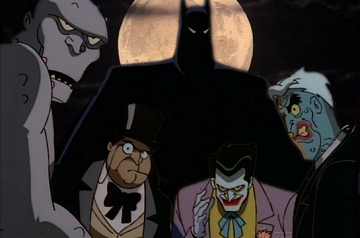
Cartoons have given us some of the best portrayals of super heroes. Until recently, the only way to get a good look at a guy or gal with super speed was to animate them. There are so many animated TV shows based on comic books, but which one’s the best?

AnimatedDC01JK Geekly will give you the skinny on these shows in a bit, but let’s cover some ground rules.

1: As with our best live-action TV shows based on comics, cultural relevance plays a role as does overall quality.

2: Some of these shows’ animation doesn’t stack up to even its contemporaries, but they’re outstanding just the same.

3: We’ll have to stick with one show from a franchise because we wouldn’t want a list of nothing but Batman and Spider-man.

5) Teen Titans (2003-2006)
Be honest. When you read Teen Titans, you sang the theme song.

TeenTitans03This fusion of Japanese anime and western comics exploded on the scene in 2003 with its light hearted style and self-referential humor. But not every episode was zany. An Easter Egg on the season 3 DVD revealed that the Japanese version to the theme song meant that the following episode would be silly, while the English version to the theme song meant the show would be serious.

TeenTitans04And if you caught a serious episode, you had the chance of meeting Deathstroke. Even though he’s the main foil in the first two seasons of Arrow, Deathstroke got his start in the Teen Titans comic book. The creators wanted to see how Robin would react to an even darker Batman—one who would kill. Teen Titans might not have reached that depth, but it isn’t all fluff and you see some great characters – like Raven, Cyborg, and Beast Boy from The Doom Patrol – who don’t always get the credit they deserve.

TeenTitans02You know that a show’s popular when it gets rebooted. Teen Titans got its reboot a few years after the original ended with a straight-up comedy version of the show Teen Titans Go!

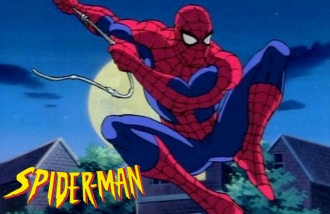
4) Spider-man (1994-1998)
You might think that the Spider-man cartoon of the nineties is a strange addition to this list, but it edges out the classic sixties and eighties versions because of its importance as Marvel Studios first and only cartoon production.

Spiderman01The animation wasn’t the best, and Spider-man suffered from heavy censorship. Spidey couldn’t even through a punch. But no other Spider-man cartoon has spanned the full spectrum of the character like this series, and since it was Marvel Studios first production attempt, the studio used it as a proving ground.

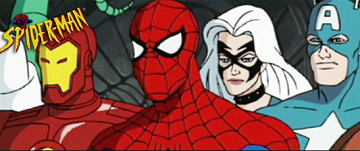
Spiderman03Spider-man had crossovers with all other Marvel properties that had cartoons at the time – The X-Men, The Hulk, Iron Man, and Fantastic Four – and the Marvel Studio gained first-hand knowledge on how to develop several characters, leading to the writing and creative juices behind the Avengers movies.

Spiderman043) X-Men (1992-1997)
Like the Spider-man series before it on this list, X-Men didn’t have the best animation even for its day, but that didn’t matter.

X-Men-1If you caught the interview between past X-Men creators on a Pizza Hut VHS, you’d find out why Stan Lee thought X-Men was so unique. “You had youngsters, oldsters, men, women, black, and white (on the same team).” The characters drove this series, and you couldn’t have a show based on a comic steeped in tolerance without having a diverse group of characters. The X-Men had this diversity.

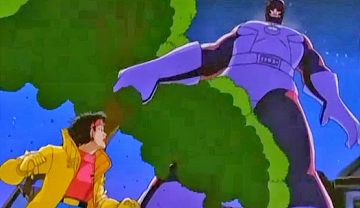
X-Men03In fact, the first episode of X-Men gave significant air time to three X-Women: Jubilee, Storm, and Rogue. That’s odd due to Wolverine’s status as Marvel’s most popular character at the time. But the characters were so rich that no one cared.

X-Men04X-Men broke a lot of rules. They killed off a character in the first episode – well, it looked like they killed off a character – and this shocked parents enough that it led to the heavy censorship of the nineties Spider-man.

X-Men02X-Men didn’t shy away from the comic’s epic tales either. Days of Future Past and the Phoenix Saga made appearances. It was X-Men’s willingness to commit to the source material that has led to familiar tales on both the small and big screens.

2) Teenage Mutant Ninja Turtles (1987-1996)
Sure, Teenage Mutant Ninja Turtles (also known as TMNT) was a little known Eastman comic before it became a cartoon, but the cartoon brought relevance to the comic.

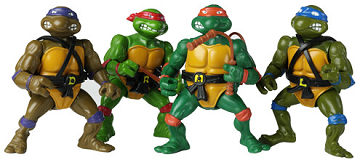
TMNT01All the other entries on this list had a successful comic to its name before it hit the screen. These totally tubular teen turtles are only famous because of their Saturday morning cartoon that became so popular, it moved more plastic than an eighties cosmetic surgeon.

TMNT05Seriously, if you had one of the turtles (action figures), you had to have the other three plus Casey Jones, April O’Neal, Shredder, and a few Foot Soldiers. Unless you played like my neighborhood and you had a B.Y.O.F.S. (bring your own Foot Soldier) policy.

TMNT03This show differed from its comic in several ways. In the comic, the turtles didn’t have colorful headbands to tell them apart, they were foul mouthed, and while they were fond of pizza, the pizzas didn’t have vibrant toppings like chocolate ice cream and anchovies.

TMNT04The ensuing live action movie may have pulled a lot more from the original source material, but the Teenage Mutant Ninja Turtles cartoon of the eighties and nineties makes this list as most people hear “He’s a radical rat,” “Turtle power,” and “Cowabunga!” whenever they think of TMNT.

1) Batman: The Animated Series (1992-1995)
Was there any doubt? Batman: TAS tops our list because of its beautiful visuals, on-point voice acting, and superb writing.

BAS03It doesn’t matter that Christian Bale and Ben Affleck have worn or will wear the suit. Kevin Conroy is Batman to generations of fans. Mark Hamill was finally able to shed his Luke Skywalker clothes only to put on Joker garb, and the character Harley Quinn (who got her start in Batman: TAS) became a constant fixture in DC Comics long after the show ended.

BAS02Batman: TAS also inspired a Superman: The Animated Series, built interest for the Justice League series (which Conroy reprised his role as Batman), and even had a cartoon that jumped the storyline decades into the future with Batman Beyond. Conroy played Bruce Wayne yet again in Batman Beyond, and we considered that show – since it’s highly underrated – for inclusion on this list, but according to rule three, we can only have one show from a franchise. So, we had to stick with the original.

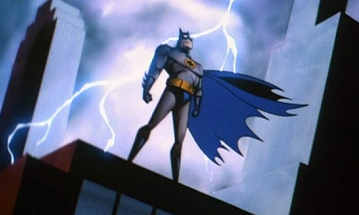
BAS04And when you think of Batman: TAS’s opening sequence, the word that comes to mind is original. That opening, featuring Danny Elfman’s music from Tim Burton’s Batman, marked the first time that any TV show or movie began without the title on the screen. You just see Batman in silhouette atop a skyscraper. Lightning flashes and you see full frontal Batman for a second, and then he’s back in the shadows. The perfect beginning to a perfect Batman.

BAS01Did we get the list right? Let us know which shows you’d include in this Top Five or suggest ideas for new Top Fives.

Top 5 Live-Action TV Shows Based on Comics

We all love to see our favorite super heroes – and other comic book characters – don spandex and burst on our small screens in weekly installments. Regardless of whether you share my spandex fetish or not, without TV we’d have to wait years between a super hero’s exploits, so it’s a joy to see so many shows based on popular comic books today. But which live-action TV shows based on comics are the best of all time?

ComicTVShows01JK Geekly will break down these shows in a bit, but we’ll set a few ground rules first.

1: Cultural relevance plays as much of a factor as overall quality. This could mean that the show inspired another show, directly led to another show or has even been parodied.

2: Some of these shows haven’t aged well, so the quality of the show’s effects will be graded on a scale.

3: Only one show from a franchise makes the list. Sorry, Superman. Lois and Clark, The Adventures of Superman, and Smallville can’t all make the cut.

4: Longevity plays a large role, too. A show doesn’t necessarily have to last a long time, but a series with only one season doesn’t cut the mustard.

5) The Walking Dead (2010-Present)
Who doesn’t like a good zombie apocalypse? Viewers of the AMC phenomenon sure do. When this show first aired, fans couldn’t get enough of the deep characters and the moral dilemmas they faced while trying to survive.

TheWalkingDead02Despite not having many likeable characters – there was strong support for Rick’s wife Lori to die – this ragtag group struck a chord with viewers, and it remains a ratings giant that should continue for the foreseeable future. It will accomplish this feat, even though anachronisms abound:

a) How could a new model Kia exist in a world that stopped producing them ten years ago?
b) How many people died from zombie attacks while keeping every lawn manicured?
c) It’s nice to see that women still shave their arm pits, even though they don’t know where they’re getting their next meal.
d) Don’t get me started with the physics behind a helicopter landing on the roof of a building and there’s no strain on the roof, but you add 100 pounds of zombie and TIMBER.

TheWalkingDead03But who cares about reality? The Walking Dead does a nice job of capturing the tenor of the Image comic on the small screen and deserves a spot on our list. It also spawned a talk show, The Talking Dead that airs afterward and raises awareness of its host Chris Hardwick (who also hosts Comedy Central’s @midnight). And that’s a great thing.

4) Arrow (2012-Present)
Arrow tells two stories at once. One is set in the present while the other ventures into the titular Ollie’s past. The two storylines converge in satisfying ways – for the most part – and ask questions about what it means to be human and a hero.

Arrow02While these morality tales can be heavy-headed or preachy, they work for a comic book character that dispensed his philosophies to anyone who’d listen. Let’s face it. Green Arrow/Green Lantern got preachy at times, but it was one of the best comics of the silver age, and Arrow captures that magic.

The sledding hasn’t always been smooth. It took Arrow mid-way through its first season to find the right balance between the flashback story and the one told in real-time, and the third season has had some hiccups, too. But Arrow is the harbinger of a new and improved DC Comics TV Universe.

Arrow03Despite being the most junior member on this list, Arrow has already had a spin-off show The Flash, and introduced cast members of the upcoming Suicide Squad movie. That’s not bad, considering that most comic fans viewed Green Arrow as a tertiary character.

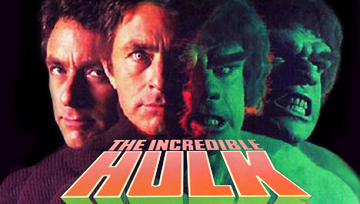
3) The Incredible Hulk (1978-1982)
The Incredible Hulk of the seventies, eighties, and nineties was the only successful live-action Marvel hero TV show or movie during its time. That’s odd to say when you consider that the two Hulk films of the new millennium tanked, and we’ve had three Hulks in nine years since. But Bill Bixby and Lou Ferrigno teamed up to be David Banner/The Hulk for the TV show, and then reprised their roles for multiple made-for-TV movies that stretched into the early nineties.

Hulk01The effects were cheesy to downright horrific – Ferrigno’s makeup in particular was ghastly the first few episodes – but The Incredible Hulk absolutely nailed the characters like no other show on this list. When the theme song is “The Lonely Man,” you know you’re dealing with an isolated character, and the heart-wrenching music matched Banner’s feeble attempts at human contact. You felt his pain as the new-age Jekyll and Hyde.

Hulk02This show has been parodied many times, and the movies of the 2000s borrowed somewhat from it. Banner’s father from the 2003 Hulk movie was named David as a tip of the hat to Bixby’s character, but the second movie made a stronger attempt to capture the tenor of the TV series. Unfortunately, neither film could ground the character like Bixby.

Hulk03The Incredible Hulk gets our nod as the third best live-action TV show based on comics because of its acting performances and no other show on this list can hold a candle to its guest stars. Both Stan Lee and Jack Kirby (co-creators of most of the Marvel universe) made appearances.

2) Smallville (2001-2011)
When you ask the Superman of a generation Christopher Reeve to green light your Superman project, you stand a good chance of making the Man of Steel for a younger generation. Smallville did and in turn handled the Superman mythos with style and grace.

Smallville01Smallville gave the then WB (CW today) its greatest debut for a series at 8.4 million viewers. It chronicled a young Clark Kent on his journey of becoming Superman and showed him struggle between personal desire and obligation. Something few live-action Superman stories have done. In fact, the character was so well-grounded; you’d believe a man could fly. Just not in this show. Smallville had a strict “No tights, no flight” policy.

Smallville02But even though it didn’t show Superman flying about, Smallville weaved elements of the greater DC Comics Universe into its storylines, providing the blueprint for shows that came after it like The Flash and Arrow. And speaking of Arrow, it should come as no surprise that the CW chose the Green Arrow as their first main character for rebuilding the DC Comics TV Universe. Oliver Queen was in Smallville.

Smallville04Smallville has garnered countless awards (including Emmys), but it almost didn’t happen. When the series was first pitched to the WB, the creators wanted to show what happened to Bruce Wayne after his parents were murdered. The WB thought that was a terrible idea and chose Smallville over Gotham.

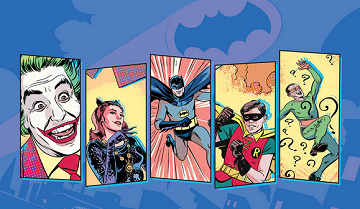
1) Batman (1966-1968)
Okay. This one’s graded on a sliding scale in terms of its special effects, make-up, and writing. The Batman TV show of the sixties was a product of its time. It didn’t even have that long of a lifespan, but it “biffed,” “bammed,” and “boomed” its way into viewers hearts at the same bat-time, same bat-channel.

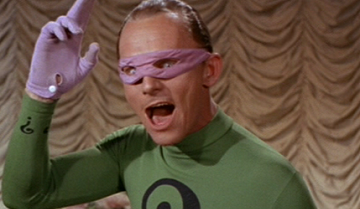
BatmanTV03Batman’s greatest charm is Adam West’s delivery. Halfway between earnest and sardonic, West’s portrayal of the Caped Crusader remains an E. Nigma wrapped up in a Riddler, and West has used this delivery to great effect in other shows: Family Guy, and The Boondocks to name a couple.

BatmanTV02Every generation takes something different from Batman. You may suffer from nostalgia. The show can be considered surrealist pop art. It’s been accused of being art by means of camp. Or you could think of West as one sarcastic SOB and love it when he Batusis. The creators of Bob’s Burgers loved Batman’s puns so much that they use similar tortured puns for the show’s burger of the day.

BatmanTV04It may sound like Batman hasn’t had that much of an impact on other comic-based TV shows, but there isn’t a live-action TV show or movie based on a comic book that doesn’t use the Batman scale to determine whether or not an idea is too silly. Too bad they went the other way with the Batman and Robin movie.

BatmanTV01And Batman has affected change in comics. When the producer of Batman saw the comic that would inspire him to make the series, the issue in question was eight or nine year old and had The Riddler on the cover. That comic just happened to be the last appearance of The Riddler at the time before Batman reintroduced The Riddler as a major part of the Dark Knight’s Rogues Gallery.

BatmanTV05Did we get the list right? Let us know which shows you’d include in this Top Five or suggest ideas for new Top Fives.

Top 5 Tabletop Games Prior to the 1930s

We’re continuing our top tabletop games through the years with the next list of Common Era games that first saw publication before the 1930s. There may be some debate as to when these games first hit shelves, but these games definitely fit the bill of a Common Era game that predates the modern board game era—we think.

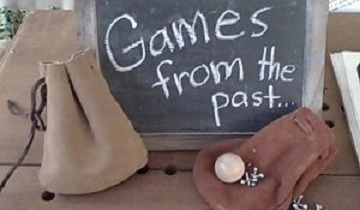
PastGames01As with our Tabletop Games from Before Common Era list, let’s set some ground rules.

1: Cultural relevance plays as much of a factor as overall quality. A game might make the list that doesn’t hold up to others of its type, but the game in question is everywhere, and you can’t ignore it.

2: Only one game from a franchise makes the list. We’re still too early in history for this to be a big issue, but we don’t want to have lists of nothing but Risk, Monopoly and Clue tie-ins.

3: Longevity plays a role, too. A game doesn’t have to fly off the shelves today, but it had to have some widespread appeal for a decent time period.

5) Mahjong (Early Ming Dynasty: 14th or 15th Century)
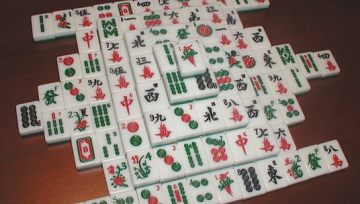
People can’t agree who created Mahjong, when it first hit game tables, or even how to play the game, but you can’t deny the appeal of these colorful tiles.

Traditional Mahjong functions similar to Rummy where players keep their tiles on trays and try to complete sets. In fact, Rummy may owe its existence to this tile game. Many other folks play Mahjong by shuffling the tiles and placing them in playful patterns and then they make matches, getting rid of tiles from the patterns and freeing new tiles as they go.

Mahjong02Mahjong had a gambling aspect to it and that led the Chinese government to ban the playing of the game for many years. Coincidentally, the West was first introduced to Mahjong in the 1920s, but the game didn’t gain popularity until the 1940s which was when the Chinese ban was implemented. So while westerns learned the joy of Mahjong, the country of the game’s origin wasn’t able to play.

Mahjong01China lifted the ban in the 1980s and it’s as popular now as it was in centuries past. Mahjong is also the most played tabletop game in Japan.

4) The Game of Life (1860)
This one’s a sneaky addition for this list. Sure, The Game of Life first hit shelves in 1860, but Milton Bradley called it The Checkered Game of Life and it had a sinister side. The Milton Bradley Company reissued a modern, lighthearted version of the game for its hundred year anniversary in 1960, and that’s the version we all know today.

GameOfLife01But I stand by The Game of Life’s inclusion on this list as it’s the only major board game created by Milton Bradley himself. Bradley only made the game as a means to recoup money he lost after a failed lithograph business. He had sold numerous copies of a little-known Republican presidential nominee Abraham Lincoln, but Bradley had taken the pictures of Lincoln before he grew his trademark beard, and folks demanded their money back because they were sure the picture wasn’t of Lincoln as Lincoln had grown his beard for the presidential race.

GameOfLife02This failure drove Bradley to create The Checkered Game of Life that deviated from previous new world games that promoted moral virtue to a game that focused on material gain. While The Checkered Game of Life saw its share of success, the modern Game of Life flew off shelves, receiving a lot of publicity from Art Linkletter, so I guess you could say “Kids Play the Darndest Things.” But games like Monopoly owe a lot to The Game of Life and that’s why it makes our list.

3) Snakes and Ladders (16th Century)
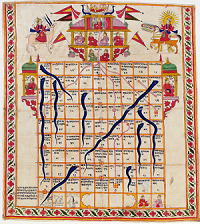
Snakes and Ladders takes the moral high ground. Unlike The Game of Life, Snakes and Ladders has its roots in morality lessons. Players make progress on the board that mimics a life journey. Ladders denote virtues, while snakes represent vices. The original ancient Indian game board showcased what can happen when you fall from the moral path and what you can gain if you stay virtuous and true.

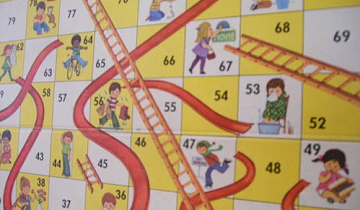
SnakesAndLadders01Originally called Moksha Patam in India, the game became popular in England at the turn of the 20th century as Snakes and Ladders. Americans were first introduced to the game in 1943 by means of the Milton Bradley Company, but the game experienced another name change: Chutes and Ladders. Apparently, Americans get squeamish around snakes.

ChutesAndLadders01Regardless of what you call it, Snakes and Ladders has influenced countless games that came after it.

2) Parcheesi or Pachisi (500)
We have back-to-back Indian board games on this list. This time it’s the Royal Game of India: Pachisi.

Pachisi is called the Royal Game of India because India’s royalty would dress up their servants to use them as human-sized game pieces on large outdoor boards. Talk about deluxe size.

Parcheesi02We had to include Pachisi to this list as it introduced the gaming world to the roll (or spin) and move mechanic that has been used in so many games – like Monopoly, Clue, and The Game of Life – that came after it. Pachisi has had plenty of copycats as well. But perhaps the most famous Pachisi copycat (Sorry!) comes from Parker Brothers the manufacturer that introduced Americans to the game of Pachisi as Parcheesi.

Parcheesi01I guess you can’t have enough of a good thing.

1) Chess (1475)
Chess is played by hundreds of millions of people worldwide in homes, parks, clubs, online, and in tournaments. It’s even become a part of some school curricula. Is it any wonder why it tops our list?

Chess02Chess also happens to be the third consecutive Indian board game on our list—sort of. Many historians believe it originated in Eastern India around 280-550CE in the Gupta Empire as the game Chaturanga (literally four divisions {of the military}: infantry, cavalry, elephants, and chariotry). The game went through several evolutions – most of which occurred in Eastern Europe – before settling on the modern units and rules which first appeared in 1475.

Numerous people have written literature on Chess. The game spawned the first group of professional board game leagues, and when computers were first programmed to play games with people, Chess was one of the first games that made the cut.

Chess01It doesn’t matter if you’re a noble during the Renaissance, Bobby Fischer, Deep Blue, or a kid in the fifth grade, you’ve probably played at least one game of Chess. That’s why it gets our top spot.

Did we get the list right? Let us know which games you’d include in this Top Five or suggest ideas for new Top Fives.

Check out the other lists from this series:
Top 5 Games from the 1930s
Top 5 Games from the 1940s-50s
Top 5 Games from the early 1960s
Top 5 Games from the late 1960s
Top 5 Games from the early 1970s
Top 5 Games from the late 1970s
Top 5 Games from 1980-1981
Top 5 Games from 1982-1983
Top 5 Games from 1984-1985
Top 5 Games from 1986-1987
Top 5 Games from 1988-1989
Top 5 Games from 1990-1991
 

Top 5 Tabletop Games from Before Current Era

Tabletop games have been around for millennia, but which games are the best of all time? JK Geekly will try to narrow down this powder keg of topic by era. We’ll start with the games that predate gun powder with this list: The Top 5 Tabletop Games from Before Current Era (BCE).

AncientGames01We’ll get to the games in a bit, but let’s set some ground rules.

1: Cultural relevance plays as much of a factor as overall quality. This could mean that a game makes the list that isn’t as good as some others of its type, but the game in question was omnipresent, and you can’t ignore it.

2: Only one game from a franchise makes the list. That won’t matter so much in the early-going of these lists, but you can imagine a Top Five Shades of Monopoly.

3: Longevity plays a role, too. A game doesn’t have to fly off the shelves today, but it had to have some widespread appeal for a decent time period.

4: This last one’s more of a note of caution. There’s plenty of speculation as to when some of these games were created, but we’ll stick to ones that have multiple sources linking the game to this time period.

5) Liu Bo (1st Millennium BCE)
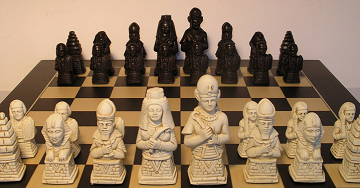
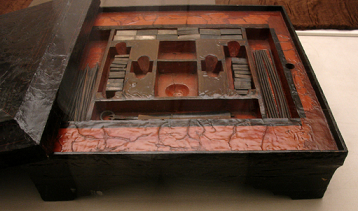
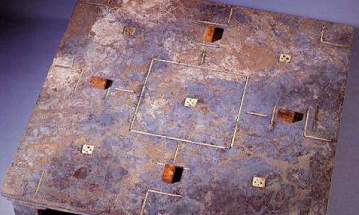
Folks can’t agree on how Liu Bo’s played or when it first adorned people’s tables. It’s one of those games last in history. But we do know that it had a beautiful board, it was one of the few things that would survive in ancient Chinese tombs, and it inspired several games that came after it.

Liu Bo01How do we know that? The game of Liu Bo was described in the mid-3rd century BCE “Summons of the Soul” in the Songs of Chu:

Then with bamboo dice and ivory pieces the game of Liu Bo is begun;
Sides are taken; they advance together; keenly they threaten each other.
Pieces are kinged and the scoring doubled. Shouts of “five white!” arise

Could these game pieces be the first playing pieces? Are these the first dice included in a game? When you say a piece is kinged, that reminds me of Checkers.

LiuBo02We may never know everything we’d like to know about this game, but we do know that it was such an important possession that people took it with them in the afterlife.

4) Jacks, Fivestones, or Knucklebones (At least by 500 BCE)

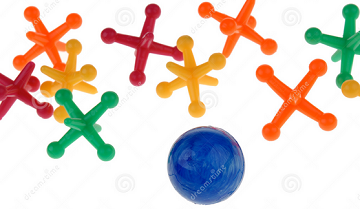
Knucklebones01No one knows when this game first originated – people can’t even decide on a single name –, but Sophocles attributes the invention of Knucklebones to Palamedes (the prince who led the Nauplians in the Trojan War). Both the Iliad and the Odyssey allude to games similar to Knucklebones. That places this game of bouncing or throwing a small object and then snatching as many smaller objects strewn on the ground as you can firmly with the Ancient Greeks.

Jacks01The modern game of Jacks replaced the ankle bone of a sheep (or astragalus) for a rubber ball and added five more small objects for you to catch to bring the total up to ten. Sure, most folks don’t play Jacks on a table, but you could and you can’t deny the game’s cultural relevance and longevity. People have been “riding the elephant,” throwing “peas in the pod” or “horses in the stable” for centuries. They’ll continue for centuries to come whether they play Astragaloi, Dibs, Chuckstones, Onesies, Kugelach, or Snobs.

3) Tic-Tac-Toe or Noughts and Crosses (At least by 100 BCE)
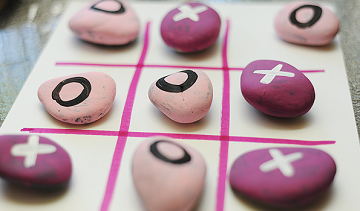
We know the ancient Romans played Tic-Tac-Toe or as they liked to call it Terni Lapilli – you can find ancient chalk grids of three by three in Rome – but Tic-Tac-Toe may predate the Romans. Evidence presented by Claudia Zaslavsky in her book Tic Tac Toe: And Other Three-In-A-Row Games from Ancient Egypt to the Modern Computer places the game’s origin to Ancient Egypt. Regardless, Tic-Tac-Toe is a very old game. It’s gone by many names, too, but the Brits named it Nought and Crosses, and that name stuck for centuries. The U.S. renamed the game Tic-Tac-Toe in the 20th century.

TerniLapilli01Outside of young children, you don’t see too many people playing Tic-Tac-Toe. Most folks discover that two evenly matched players, playing their best, usually tie each or other, or the cat gets the game. But despite Tic-Tac-Toe’s limited appeal to older players, it holds a special place in cultural history.

Game shows have used its game mechanics numerous times, Connect Four is a reimagined Tic-Tac-Toe played on a larger grid, and one of the first – if not the first – known video game was a Tic-Tac-Toe derivative OXO.

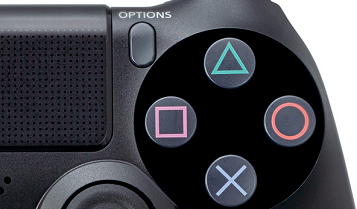
TicTacToe01Still, the most endearing legacy Tic-Tac-Toe has left behind has to be the logic behind most video games. While you think you’re fighting a dragon in a fantasy land, the computer-controlled dragon you’re playing against is playing a complicated game of Tic-Tac-Toe. If they do this, I’ll do this. It’s no coincidence that the most commonly used buttons on a Playstation controller are X and O.

PSController012) Checkers (3000 BCE)
King me.

Also known as Droughts, Checkers almost tops our list as the Before Common Era tabletop game king. It derives from the Middle Eastern game Alquerque (the oldest copy of the game was found in the city of Ur and was dated around 3000 BCE) and has become one of the best – if not the best – known abstract strategy games of all time.

Checkers01Checkers has influenced countless games that came after it, including the ubiquitous Chess which uses a similar game board. Players sit opposite each other and move their pieces diagonally, capturing their opponent’s pieces. If a piece makes it to an opponent’s side of the board, they become a king and can move backwards or forwards.

Checkers02In most non-English languages, Draughts is called Dame, Dames, Damas, or another term that has ties to ladies. Even so, the pieces are still called men or stones, but when they’re promoted to kings, they’re called dames or ladies which are the terms for the queen in Chess for these same areas.

1) Go (1st Millennium BCE)

The only game that can circle the wagons against Checkers is the game of Go.

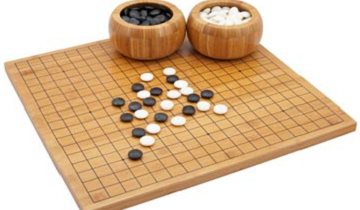
Originating in ancient China between 1046-256 BCE, Go was so revered that it was considered one of the four essential arts of a cultured Chinese scholar. I don’t think anyone would say that of my mad Catan skills.

Go01The rules are simple: place your playing pieces (or stones) so they encircle your opponent’s stones in order to occupy more area on the board. Despite these simple rules, a game of Go can take numerous hours to play, but that doesn’t stop it from being one of the most played games in the world today. As of 2009, there are well over 40 million Go players worldwide – most of which live in Eastern Asia – and 74 countries are part of the International Go Federation.

Go02Like many other games on this list, Go has influenced many games and game designers. Othello (or Reversi) uses game mechanics similar to Go, and Go has joined Chess and Backgammon as the three oldest games that enjoy worldwide popularity. Backgammon is billed as a “Man vs. Fate” contest with its strong reliance on chance. Chess embodies “Man vs. Man.” But even the best Go players will only win half of their games, so you have to play the best way you know how, learning as you go, leading to Go as the embodiment of “Man vs. Self.”

Very few games match Go’s emphasis on self-improvement and that makes Go our top game from Before the Common Era.

Did we get the list right? Let us know which games you’d include in this Top Five or suggest ideas for new Top Fives.

Top 5 TV: December 2014

5TV_Dec2014

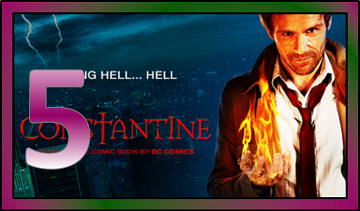
5) Constantine
Hallelujah! Constantine has improved these last two weeks. It stays at the 5 spot this month because of a major show crossover, a great show figuring out scheduling conflicts, and a fourth show displaying a bit more character. If Constantine continues with its gray morality stories to match its protagonist, it should climb the ladder.

4TV_Dec2014

4) Grimm
Grimm edges out Constantine. If we didn’t include the entire month of episodes, Constantine’s last two episodes would’ve propelled it to this spot. That’s not a knock on Grimm. It’s done a solid job of tying up loose ends, while complicating the main story. We’ll have to see if Trubel’s exit breathes life into the series or takes away the breathable air.

3TV_Dec2014

3) Arrow
Arrow got a much needed shot of adrenaline from its Flash/Arrow crossover this month. Sure, the storylines of Ollie’s tragic past and humanity come off as overbearing and “preachy,” but that’s who Green Arrow is in the comics. Here’s hoping he continues to testify.

2TV_Dec2014

2) The Flash
The Flash continues to outperform most other shows – it doesn’t hurt that we had a Flash/Arrow crossover recently, too – because it has a strong foundation with its writing, acting, and some of the best visuals we’ve seen from the CW. We care about the main characters and await a few more surprises from team Flash.

1TV_Dec2014

1) Bob’s Burgers
Bob’s Burgers has fixed its scheduling problem. We’ve had the first full month of episodes and most of them were gems. The Belcher family packs more character into thirty minutes of air time than most shows include in a full hour.

Top 5 TV: November 2014

TV1_Nov14

The Flash

Why It’s Number 1:
The Flash isn’t perfect but let’s be honest: there aren’t many shows that are perfect. The Flash does deliver entertainment on a weekly basis, key roles exhibit strong acting, and the show’s headed in an exciting direction. Despite some clunky dialogue, The Flash has a solid foundation with its writing. And Central City feels a lot different than Arrow’s Starling City. We’re not sure The Flash will stay on top, but we won’t be surprised if stays in the Top 5 for most of the year.

TV2_Nov14

Bob’s Burgers

Why It’s Number 2:
Bob’s Burgers should be number 1, but its infrequent schedule keeps it from our top spot. Despite lengthy breaks between episodes, we feel right at home with the characters as soon as they hit the screen. That’s why Bob’s Burgers leapfrogs over some other good shows to claim the second spot on our list.

TV3_Nov14

The Awesomes

Why It’s Number 3:
The Awesomes wrapped up their second season a while ago (available on Hulu Plus); otherwise it’d be higher on our list. The show also lost its way during the season, but once we got to a blitz of character introductions, we received some great character development. There were only ten episodes in the season, and when the last three episodes knock off your socks, the show has to be on a top five list somewhere. Another show should take The Awesomes’ place next month, but it’s our number three pick this month.

TV4_Nov14

Arrow

Why It’s Number 4:
We almost wanted to put Arrow at four this month, but it edges out Constantine by a small margin. Arrow puts far too much emphasis on Laurel becoming the new Black Canary that it’s difficult to place it any higher than fourth. And probably shouldn’t be fourth. Still, Arrow has some great action sequences, and the Felicity heavy episode gave some much needed fan-service.

TV5_Nov14

Constantine

Why It’s Number 5:
We don’t know if it’s a sign of the end times that Constantine makes our list, but there aren’t a lot of great geekly TV shows out there at the moment, so it rounds out our Top 5. We knew Constantine couldn’t follow the source material too closely as it’s a major network show. It does an okay job giving viewers a Hellblazer-light flavor. And Matt Ryan does a good job as the titular character despite some spotty dialogue and character development.