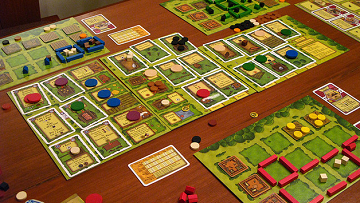

Bang!

Designer: Emiliano Sciarra
Publisher: ABACUSSPIELE
Date Released: 2002

Number of Players: 4-7
Age Range: 11 and up (8 and up on the box)
Setup Time: 5 minutes or less
Play Time: 30-45 minutes

Game Mechanics:
Hand Management
Partnerships
Player Elimination
Variable Player Powers

Game Flow and Review:
Take a social game like Villagers and Werewolves, add a card element to it, and you get this fun old-fashioned spaghetti western shootout.

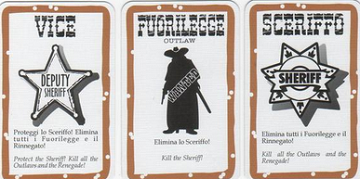
Each player randomly receives a character card that will determine their special ability and a secret role card to determine what it’ll take for them to win the game. There are four roles: Sheriff, Deputy, Outlaw, and Renegade. The Sheriff needs to kill all the Outlaws and the Renegade, while the Deputy—whose life isn’t as important as the Sheriff—protects the Sheriff and kills any Outlaws. Outlaws need to kill the Sheriff—plain and simple. Renegades have to be the last person standing.
Bang03

With the exception of the Sheriff, these roles are secret, so you won’t know who has which role until the player does something to reveal who they are. Since the Sheriff is known to everyone at the table, if someone attacks him on their turn, you can guess that the person who attacks the Sheriff is an Outlaw or Renegade—unless they’re the world’s worst Deputy.

Then, there’s the social game element of players throwing off other players as to who they are. The Renegade has the largest mountain to climb for victory, but he or she can pretend to be anyone but the Sheriff as they have to eliminate all of the players at the table. There are moments when a Sheriff can off all of his/her Deputies and have to face the Outlaws and the Renegade alone.
Bang02

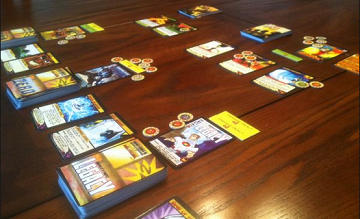
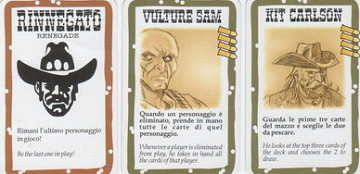
All of the deck cards have Italian names as a tip of the hat to the great Italian directors who popularized spaghetti westerns, and each one has interesting abilities. The most common cards are Bang and Missed. You can only attack another player with a Bang card, and as you can probably surmise, Missed cards are played in defense and cause your opponent to miss.

Bang07

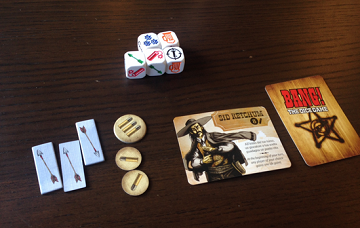
Usually you can only fire once, but the Volcanic weapon card allows you to fire as many times as you have Bang cards. A player’s hand is determined by how many bullets (or life points) the player has, so you want to stay as healthy as you can—Sheriffs gain an additional bullet, since they’ll be the target of a lot of players. Other cards can send one of your opponents to jail, give you a barrel to hide behind, or even a mustang to ride away from danger.
Bang05

I played in a large and a small game of Bang!, and I must say that a larger game beats the chaps off of a smaller game. If you have fewer players, your games will devolve into a cutthroat game of everyone trying to kill everyone else without the benefit of figuring out who is playing which role.

Verdict:
The core game mechanics of Bang! are simple hand management, hit point and player elimination, but it’s the added element of a social game that makes it shine. As such, you should only play Bang! if you intend to play it in larger groups.
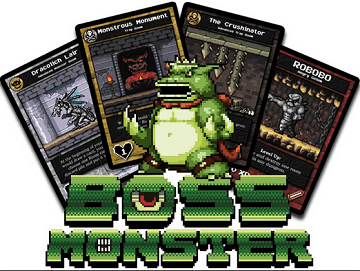
Boss Monster: The Dungeon Building Card Game

Designer: Johnny O’Neal and Chris O’Neal
Publisher: Brotherwise Games
Date Released: 2013

Number of Players: 2-4
Age Range: 8 and up
Setup Time: Less than 5 minutes
Play Time: 15 minutes or less

Game Mechanics:
Auction/Bidding
Hand Management

Game Flow and Review:
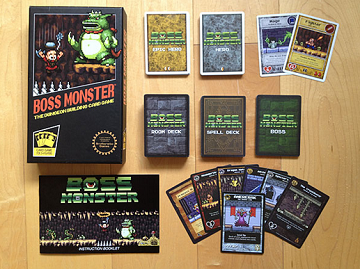
You are the Boss Monster at the end of an 8-pixel video game dungeon. You compete with other Boss Monsters to gain the souls of dead adventurers, while avoiding these heroes’ attack.

I have to be honest. This game tugs at my heart strings. The 8-pixel art and inside video game jokes are priceless. A card by the name of Cheat Codes had arrows in the background with the old Konami game cheat—that’s up, up, down, down, left, right, left, right, B, A, start for younger video gamers—and as the Cheat Code card attests, Boss Monster respects classic video game tropes.

BossMonster03

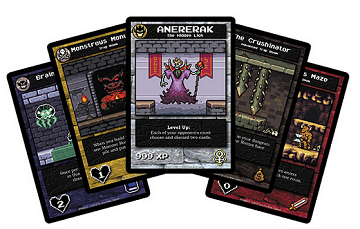
The gameplay is easy to pick up and fast to play. You balance constructing the best possible dungeon with attracting heroes to your dungeon. There are four basic card types: Boss, Room, Spell, and Hero. You pick your boss at the start of the game. Then, you’re dealt five room cards and two spell cards, discarding two cards of either type from your hand.

Each Boss has an XP value, which is important since it’s used for tie-breaker purposes, an effect text when they level up (you need to build five rooms to level up), and a treasure type which lures a certain kind of hero to your dungeon. Room cards have damage values in the lower left-hand corner, a treasure type (which also lures heroes to your dungeon), and effect text. Spell cards have icons showing when they can be played in the lower left-hand corner and have effect text. Then, you have heroes, who only have health and a hero type.

BossMonster04

During a round, heroes enter play in town. The heroes chill in town until players build their rooms for the round. Players place their room cards facedown to the left of their Boss. This promotes strategy as you won’t know what kind of treasure the rooms your opponents’ are playing have, so you have to guess in order to attract the resident heroes. And of course you play these rooms to the left of your Boss because this is a side scrolling, dungeon after all. Players reveal their rooms at the same time. Then, you lure the heroes to who has the highest value of the hero’s favorite treasure. If you have a tie or no one has the hero’s treasure type, the hero kicks back another ale and stays in town.

Once all the heroes have made their moves, you start the adventure stage. When a hero enters your dungeon, they move from left to right, taking damage from your rooms. Hopefully, you’ll take them out before they reach your Boss, and you take their soul, but if they do survive your dungeon and reach your Boss, they deal damage to you. The first player to reach ten souls wins. But you lose the game after receiving your fifth wound.

BossMonster01

The gameplay can be unforgiving. Some of the cards are overpowered and unbalanced. There’s a basic room card that deals three damage. You can’t upgrade this room, but why would you want to. And many of the spell cards turn the tide of the game in a blink of an eye. Fortunately, you have more room card draw than spell card draw, but you can generate spell card draw through Boss abilities, making these bosses more desirable.

And speaking of desirable, during the game’s opening stages; you’ll want to attract fewer heroes as your dungeon won’t be that strong. This makes a two player game brutal. Picking a monster that shares a treasure icon similar with the only heroes on the board will have you scrambling to improve your fledgling dungeon.

Verdict:
Boss Monster is a great—even though it’s unbalanced—8-pixel romp. While you can play this game with two players, it works best with three or four players; otherwise you end up with the same player attracting the most heroes every time. Again, this is a balancing issue with the core game play as well as the cards themselves.

Krash Karts

Designer: Sean Dallas McDonald
Publisher: Self-published
Date Released: 2014

Number of Players: 2-6
Age Range: 8 and up
Setup Time: About 5 minutes
Play Time: About 20 minutes

Game Mechanics:
Grid Movement
Pattern Recognition
Tile Placement
Variable Player Powers

Game Flow and Review:

Krash Karts is Mario Kart in tabletop form. Racers dash to the finish line, pummeling each other with quirky attacks, and the whimsical characters have their own abilities that will give them an edge on the track. When you try to mimic something like Mario Kart, you have to keep things simple, fast and fun. Krash Karts accomplishes this.

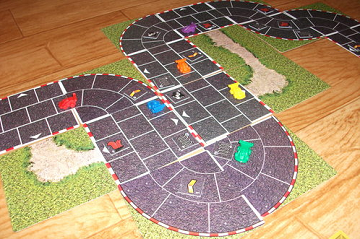
Players get handed a certain number of track tiles (determined by how many players are in the game), and on each turn, they have three actions at their disposal. Five things constitute an action: moving one space (each tile has smaller movement squares printed on them), drawing an item, using an offensive item (more on this later), discarding an item (either offensive or defensive) so you can lay down more track ahead of you, and moving your cart from its side to right-side up because some yahoo oil slicked you.

KrashKarts02

You can use any combination of these five things to make up your three actions for the turn. Want to turn on the afterburners? Use three straight actions for movement. Want to load up on items? Take a couple of items (you can only have two items equipped at a time: one offensive, one defensive) from the draw pile. How you play the game is up to you. But players win the game when they run out of track tiles, and they cross the last bit of track before their competitors.

Movement is self-explanatory (you move from one adjacent space to the next, using an action with each space), so let’s get into items and knocking people silly. When you choose to draw an item, the pile you choose from corresponds with which position you currently hold. Like Mario Kart, if you’re in last place, you have a better chance of using an item that will derail everyone in front of you, or if you’re in first place, you most likely will get items like an oil slick that will slow down your pursuers.

KrashKarts04

If an item has a shield, it can be used as a defensive item, warding off an offensive item. You can stash an offensive item as a defensive item, but it won’t do you any good unless it has a shield in the upper right-hand corner of the tile. Some items have no business in your defensive position. The bomb goes off if someone hits you with something else, so it’s never a good idea to have the bomb on defense.
Then, there’s discarding items to lay down track ahead of you. Some items have a discard number in their lower left-hand corner. When you discard items, add the value of these numbers to determine how much track you can lay down. You can use these track tiles for several purposes. If an opponent is about to cross the finish line, you can add another tile of track to extend the game. You can use shortcut tiles to make the track shorter for you (but you have to have enough points from your discarded items to facilitate the construction of the entire shortcut). Or you could build a lot of your track tiles in advance, so all you have to do is cross the finish line. You have many ways to win the game, and the addition of Krash Karts’ colorful characters adds to your options.

KrashKarts01

The characters of Krash Karts come from other Kickstarter projects. If you aided another Kickstarter in the past, you may see one of the characters you helped produce in this game. The abilities are silly and over-the-top. But what Mario Kart inspired tabletop game wouldn’t have silly and over-the-top abilities for their characters?

Verdict:
Krash Karts is a fun game to pass the time if you have only a few minutes and plenty of table space. If you enjoy Mario Kart and always wished someone would come up with a tabletop version, then Krash Karts should be on your Christmas list.

Samurai Spirit

Designer: Antoine Bauza
Publisher: Funforge
Date Released: 2014

Number of Players: 1-7
Age Range: 10 and up (9 and up on the box)
Setup Time: About 10 minutes
Play Time: About 30 minutes

Game Mechanics:
Cooperative Play
Partnerships
Variable Player Powers

Game Flow and Review:
Great news: Samurai Spirit converts Seven Samurai into board game form. Not-so-great news: Samurai Spirit converts Seven Samurai into board game form. If you’ve ever watched the Kurosawa classic, you know that things don’t end well for the seven samurai in question.

Yes. This game is difficult—heck, there are three ways to lose the game (more on that later) and only one way to win—but each time you play it, you get a little more addicted to seeing how far your party can get—or how badly you’ll crash and burn this time. And if you happen to beat the game, you experience a sense of accomplishment and a touch of euphoria.

SamuraiSpirit05

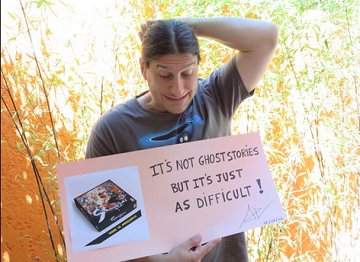
That would be a picture of the game’s creator, Antoine Bauza, holding up an early review of his game. Believe me. This game is worth the trials it puts you through.

Each player takes on the role of a samurai sworn to defend a village. The village consists of three family members, six shelters, and barricades. You lose the game as soon as all family members die, or if you lose all the shelters (barricades help to defend those), or if any one of the samurai perish. You are a team after all. You win if you and your team, at least one family member, and one shelter survive three days of attacks by marauders.

SamuraiSpirit04

You have four options on your turn: fight a barbarian, use your innate ability (only some innate abilities take up your action for the turn), share your innate ability with a teammate (by handing them your ability token) or pass—which usually isn’t an option I’d recommend since you’re a samurai and samurai wouldn’t leave a fight.

If you choose to fight a barbarian, flip a barbarian card from the draw deck, and once revealed, you may choose to fight the barbarian and accept the damage he deals, placing him on the right of your samurai, or you may add him to the left of your samurai to prove that you defended your village that day.

SamuraiSpirit02

Let’s say you want to fight the barbarian you drew. Your samurai will have a specific amount of damage they can take before they either get knocked out or they unlock their Kiai power. If you assume your samurai’s max damage exactly, they perform their Kiai power which greatly shifts the tide of battle. Examples of kiai powers are healing your teammate’s damage, discarding cards from the draw pile (so you don’t have to fight those barbarians), and manipulating the draw pile so you know which barbarians are in the deck. If you take more than your max damage, your samurai gets knocked out and can no longer help in the fight for that round or day. A day ends when you get through the entire barbarian deck.

Now let’s say that you want to add the barbarian card to the left-hand side of your samurai. There are three symbols, a hat, shelter and a family member, to the bottom left of your samurai’s picture. You can only put one of each of these symbols on your samurai, so if there’s already a card sharing the symbol of your current barbarian card to the left of your samurai, you can’t put another one there.

SamuraiSpirit03

Various things happen if you don’t collect a particular symbol. No hat? You receive one wound, and you only get four before you’re samurai dies. No shelter? A shelter in the village burns to the ground. No family member? One of the family members dies. And the effects of not having the shelter and family member symbols add up with each player who doesn’t have the symbol, so it’s possible that you can die on the first day.

Then, there are innate powers. Some innate powers take up your action for one turn. Examples of these kinds of powers are ones that allow you to pass a barbarian card to one of your neighbors. Other powers allow you to ignore the ability of certain barbarians. There’s even one that loves fighting so much that they can choose to battle two barbarians in one turn. Keep in mind that sharing your innate power always takes up your action for your turn.

Finally, we come to the samurais’ spirit animals. If your samurai assumes a second wound, your samurai flips over and becomes their spirit animal. This trumps up your samurai’s kiai power and gives them more damage they can take. Be careful as two more wounds will kill your samurai.

Verdict:
Bauza doesn’t miss with his games, and this is no exception. His competitive games leave gamers satisfied because he gives you plenty of ways to win, while his cooperative games also satisfy because you have plenty of ways to lose. Besides, what would a faithful rendition of Kurosawa’s Seven Samurai be without hopeless odds?

Ticket to Ride

Designer: Alan R. Moon
Publisher: Days of Wonder
Date Released: 2004

Number of Players: 2-5
Age Range: 8 and up
Setup Time: 5-10 minutes
Play Time: 45 minutes or less

Game Mechanics:
Hand Management
Route/Network Building
Set Collection

Game Flow and Review:
Take a cross-country train adventure. Collect and play matching train cards to claim railways across North America.

This simple premise and core gameplay has resulted in a new renaissance of U.S. board games. Ticket to Ride exploded into game stores in 2004, ten years prior to this review, spawned over ten spin-offs and expansions to date and fueled its publisher Days of Wonder to become one of the modern board game industry’s giants.

TicketToRide03

The rules are easily learned in minutes. Each player begins the game with a collection of adorable, colored, plastic train pieces (each player chooses their color), a hand of four train cards (color-coded to match the point-to-point routes between the cities on the game board), and five destination ticket cards. Five train cards are dealt face-up for a draw pile.

At the start of the game, players keep which destinations they have in their hand that they think they can complete in the game, and return the rest of the cards to the ticket pile. A destination ticket has two cities printed on it, and if the player chooses to complete the ticket, earning the points indicated on the card, they must construct a continuous route with their plastic train pieces across North America from one of the two cities to the other. Obviously, a route from New York to Los Angeles would be worth more points than a route from Vancouver, Canada to Portland, Oregon. But you lose points, equal to the points you would’ve gained, for every ticket you don’t complete.

TicketToRide05

Each connection between the two cities has a color-coded route, and players must match the colored route with the same colored train cards in their hand. Locomotive cards are wild and extremely valuable.

A player can do one of three things on their turn: claim a route with their train pieces, draw more train cards from either the draw pile or the deck, or draw more destination tickets (they have to keep at least one ticket). Play continues until someone runs out of train pieces.

TicketToRide01

Those are the rules. Well, I should mention that each route you claim has its own point value, and the longer the individual route (from city to city), the more points you receive. You don’t necessarily have to complete all the tickets you have. You could build one continuous route across the entire country, blocking off your opponents and earning the longest continuous route bonus. You also have to be sneaky.

TicketToRide04

Since you can only claim one route at a time, cross-country destination tickets are difficult to claim. Your opponents can see which direction you’re headed and they can cut you off from your goal. If you take train cards from the face-up pile, your opponents can also glean which route you’re eyeing.

Ticket to Ride is simple, elegant and difficult to master. All of these characteristics result in an evergreen, a game that never loses the green it earns.

Verdict:
A must play for any designer game (a game that puts its designer’s name in a place of honor like an author of a book) enthusiast. You can learn the rules to Ticket to Ride in minutes, but it’ll take you a long to time to master them.

Quarriors!

Designer: Mike Elliott and Eric M. Lang
Publisher: WizKids Games
Date Released: 2011

Number of Players: 2-4
Age Range: 12 and up (14+ on the box)
Setup Time: About 10 minutes
Play Time: 30 minutes or less

Game Mechanics:
Deck/Pool Building
Dice Rolling

Game Flow and Review:
Take one of the hottest game mechanics, deck building, and add the random mayhem and speed of dice rolling, and you get one exciting game: Quarriors. Or should I add the title’s exclamation point: Quarriors!?

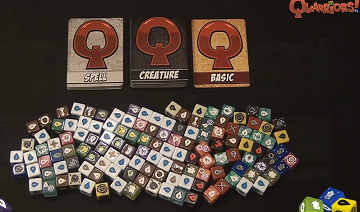
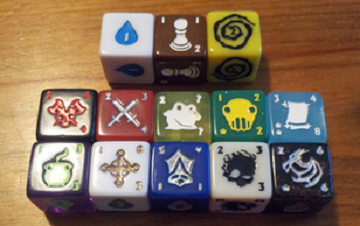
Like the deck building games that came before it, a game of Quarriors! starts with each player owning a pool of basic dice. These basic dice even the playing field, giving each player the same quantity of Quiditity (dice used for currency with which to purchase other dice, cast spells and summon creatures) and Assistants (the pawn-like creatures of Quarriors!). The players take turns, purchasing dice from the wilds a communal set of dice where players can add to and upgrade the dice in their personal dice pool, and dealing damage to their opponents with their spells and creatures.

Quarriors03

Each die you can claim from the wilds has variable statistics and abilities depending on which face of the die you roll. The wilds are composed of three types of dice: basic, spell, and creature dice. The basic dice include more of the ones you start the game with and portal dice that allow players to grab more dice out of their dice bag per turn. Very helpful. The spell and creature dice complicate the Quarriors! gameplay further because each one of these come with four corresponding cards of different power levels. These cards explain what special effects the dice have, and the twist on gameplay provided by these cards assures a different gaming experience every time you roll the dice. There are thousands of combinations.

Quarriors02

Players win the game by scoring glory points, and players score glory points at the beginning of each turn, and the glory a player scores is dependent on the number and type of creatures they have in play. Stronger creatures, like the dragon, net you more glory points, can take more damage, and deal more damage to opposing creatures, so these dice are desirable, but these bigger creatures also have a higher price tag than their weaker counterparts.

Conversely, the smaller creatures, like the goblin, can be purchased and summoned for a lot less and they—sometimes because of the variable abilities printed on the four cards associated with the goblin dice—receive defensive and offensive bonuses based on the number of goblin dice in play. This makes for some fast-paced, sharp decision making.

As if this wasn’t enough, Quarriors! has levels on most of their creature dies, so you may not roll into the side of a goblin die that will give you a bonus. If this is the case, you have to make a decision whether to keep the weaker goblin with no effect or return the goblin die to your bag in the hopes of rolling a better goblin in the future.

Quarriors06

Spell dice are little more straightforward. Players only pay for them once (creatures have an initial cost to purchase the die and a summoning cost). Spells only have whatever effect is written on their corresponding card, and some of these abilities can cut down a large creature. The death spell—sometimes because of the various cards for the dice—can instantly kill an opponent’s creature die. There’s more than one way to slay a dragon.

Other spells can boost the amount of glory points you earn per turn, heal your creatures, or allow you to purchase more than one die from the wilds. It takes gaming experience to see a winning combination of dice and their abilities at the onset of a game, and even then you may lose to another tactic.

But there are certain dice you’ll want to have if you can purchase them before your opponents. The weakest dragon is still better than most other creature dies. The death spell that instantly kills is a great die to pick up, too, but the other versions of the spell leave a little to be desired. The goblin works well, but you have to have a boosting mechanic.

Then, there are dice like the wizard, who must be more of an alchemist because he’s giving his owner fool’s gold. He’s almost as expensive as a dragon and his abilities look amazing on paper until you try to pulling off his power in the middle of a game. But I’ve seen people win games with the wizard. That’s a testament to Quarriors! balance.

Quarriors05

Games can get lopsided. The winner may be determined within minutes of gameplay, but this is a bearable problem. Quarriors! is so fast, you’ll be playing another game in fifteen minutes or so. And there’s no way you’ll play the same game twice.

Verdict:
Some creatures and spells are usually better than others, but the inclusion of dice rolling, levels to the creature dice, and the variable powers dictated by the die’s associated cards create a singular gaming experience each time you play Quarriors!. This deck/pool building game isn’t a one trick pony. You’ll find multiple ways to win any given play through of this shot of adrenaline.

Sentinels of the Multiverse

Designer: Christopher Badell, Paul Bender, and Adam Rebottaro
Publisher: Greater Than Games, LLC
Date Released: 2011

Number of Players: 1-5
Age Range: 10 and up (8+ on the box)
Setup Time: About 10 minutes
Play Time: 10-90 minutes

Game Mechanics:
Cooperative Play
Hand Management
Variable Player Powers/Abilities

Game Flow and Review:
Assemble your friends and play as a team of super heroes. If you’ve ever wanted to be a member of the Justice League or the Avengers, Sentinels of the Multiverse comes close to fulfilling that dream. Really. Team members of the Sentinels are quirky amalgams of Avengers and Justice League members. But no, nothing comes close to having your own superpowers, but Sentinels comes as close as you can get to having powers without getting pelted with cosmic rays.

Sentinels03

Sentinels takes the variable player power mechanic (where each player has their own hand of cards and powers) found in games like Munchkin and adds a co-operative element. To be fair, Sentinels acts a little like a Bridge version of Munchkin, where players have their own deck and team up to play against two dummy decks (the villain and environment decks: more on these two decks in a moment). But who knew that helping your buddies can be more fun than stabbing them in the back?

Players choose a hero. Each hero deck tweaks the basic rules and flow of the game, so you should try each hero to tell which style of play you prefer. These decks have different twists to them, so it doesn’t feel like everyone’s playing the exact same hero, but there is some overlap in powers.

Sentinels05

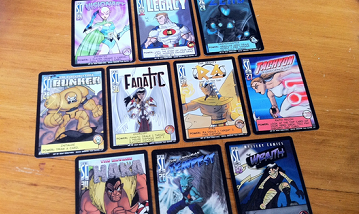
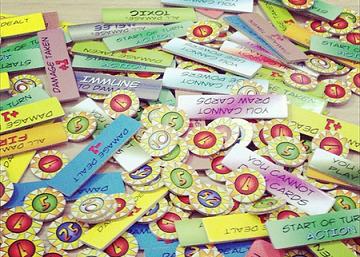
Some of the heroes have a natural rapport: Wraith and Tachyon need draw power to get the most out of their decks, and The Visionary’s ability grants draw power to other players. Other heroes don’t work as well together. There are so many possible poor combinations, but the most glaring one would be having Fanatic—who should be renamed Martyr—in play and not have another hero who soaks up or redistributes some of the damage dealt by the villain. Speaking of which, there are a few heroes that can dictate who receives damage: Bunker, Legacy and Haka can act as bullet shields and re-directors, while The Visionary can generate decoys and even take herself out of battle until you draw into a better hand. But almost all of the heroes can deal massive damage to the villain given the proper circumstances. It’s finding the right conditions to meet these circumstances that can be frustrating and leads to the single concern of the game.

As I mentioned in the data above, games range between 10-90 minutes. That’s a huge window of time. Some games are over before they begin with the heroes or heaven help you, the villain with the decided advantage, while other games can slog on for close to two hours. Most games clock in between thirty minutes to just under an hour, so it’s rare that a game ends too quickly or drags, but it does happen.

Sentinels02

Then there’s the added spice of the villain and environment decks. Both the villain and environment have turns and at the beginning of each of their respective turns you must play the top card of the corresponding deck. Each in play villain card resolves every villain turn, while the same is true of environment cards during the environment turn. Environment decks, based on locations like Metropolis and Jurassic Park, are for the most part neutral. Some environments favor the heroes, but if an environment does favor one side, it’s usually the villains.

Just like the superhero team, villains win if all the heroes are knocked out of the game, but some villains have win conditions separate from total domination, and that’s where hero abilities become important. Baron Blade (a mad scientist type) can win the game if he has 15 cards in his discard pile. (This win condition is explained as Blade’s villain trash fueling his tractor beam which causes the moon to collide with Earth.) But every time a hero defeats one of Blade’s minions, the minion’s card is placed in the trash, so you either have to take a lot of damage from Blade’s lackeys, focusing all the heroes’ damage on Baron Blade or someone has to play as The Visionary and use one of her abilities to shuffle the villain trash into the villain deck to avoid the villain’s win condition.

Sentinels04

The publisher Greater Than Games adds new twists to the Sentinels of the Multiverse gameplay on a regular basis. They released an iOS app to keep track of hit points which is a godsend. Without this app you’ll clutter your table with several dice or counters. But my favorite addition to this game is the accomplishments page which mimics trophies for video games. I played a game with some friends on the Insula Primalis environment (the Jurassic Park look-a-like), and our team was getting owned by whatever villain we were playing, but then a hungry T-Rex from the environment deck was played and dealt the killing blow to the villain. We were upset that we didn’t actually win the game outright until we found out that “Let the T-Rex win” was an accomplishment, and we marked it on our accomplishment sheet as being completed.

Verdict: Yes. The gameplay can be unbalanced from time to time, and you’re flying blind when you first start this game (we’ll start a new blog series of which heroes work best together and against certain villains in the near future), but Sentinels is a blast to play with friends or by yourself if you’re hard up for other players. Besides, you get to have superpowers.

Agricola

Designer: Uwe Rosenberg
Publisher: Z-Man Games
Date Released: 2007

Number of Players: 1-5
Age Range: 12 and up (14+ on the box; 10+ for a family game)
Setup Time: 5-10 minutes
Play Time: 45-60 minutes (less for a family game)

Game Mechanics:
Area Enclosure
Card Drafting
Hand Management
Worker Placement or Action Drafting

Game Flow and Review:
Settle the land. Build a farm and a home. Raise animals. Start a family.

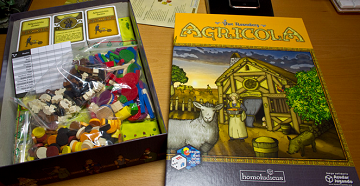
If any of these things appeal to you, Agricola will strike your fancy bone. Even if none of the things above sound tempting, Agricola’s solid gold gameplay, get-you-playing-in-five-minutes rules, top-notch strategic elements, and more versatility than you can shake a Swiss army knife at will put a smile on your face. In fact, Agricola is a rare game that offers a solo option (we’ll have a review of the solo game in a minute) which is always a good thing, especially if you can’t find someone to play with or you want to learn the rules by playing the game by yourself and then teach others the joy that is Agricola.

Agricola01Players start the game with a plot of land, a two room wooden house, two family members (a momma and a papa), and a hand composed of occupation and minor improvement cards. Players take turns improving their homestead with a catalog of actions, available to all the players, and with the cards in their hand. Once a player selects one of the cataloged actions, by placing their family member playing piece on the action space, no other player can take that action that round. This is the core mechanic of the game. Agricola offers many options to this game mechanic, but the options that work best build off of worker placement/action drafting.

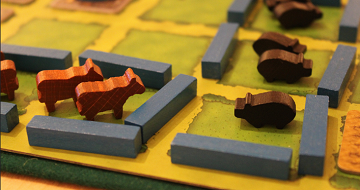
Your workers can improve your land by gathering supplies, plowing fields, building fences for pastures (area enclosure), adding more rooms to your house and upgrading the house you have. Animals give you options for food, but you have to have fences for your animals. Children give you more actions per turn, but you have to have room in your house for the newborn and you have to be able to feed all the members of your family come harvest time. Every action is tied to multiple other actions. This forces players to plan their farms carefully and allows the player who picks before you the option to screw you over by selecting the action you needed that round. Agricola rewards players at the end of the 14 round game by the variety of things you did to improve your homestead. It pays to diversify.

Agricola03

Speaking of diversity, Agricola has several options for gameplay. Agricola offers three sets of cards: the basic set (marked with an E), the complex set (K), and the interactive set (I). You can pick and choose the sets of cards you want to include in your game which is a great thing. Most of the basic cards (E) work well with the worker placement/action drafting mechanic, affording the player with new options per round. The complex set (K) is more fifty-fifty in terms of how well it plays with the core mechanic. Some of these cards have the player go down a bunny hole, wasting multiple rounds to pull off the card’s requirements, and the player, having forsaken other options they needed leading up to the card, can never crawl out of the hole. The interactive set (I) tends to be worse than the complex set as it tries to offer collectible card game players, who love a dynamic and direct interaction with their opponents, a gaming option. Most of the cards in this set deviate too much from the core game play, but there are still some gems. One card may allow you to take an action that has already been taken that round, but that plays into the worker placement game mechanic. Stick to the core gameplay whenever possible.

Agricola02Finally, we come to the family game mode and the solo version of Agricola. The family mode omits all cards and makes the game playable by younger gamers (possibly as young as ten-years-old). The solo game plays like most other solo game offerings. You get a hint of the game’s flavor, but some of the spice is lost without human interaction. Lack of a human element also adds to a repetitive play complaint. Still, this is a solid game even with one player.

Verdict: Agricola deserves its place atop, or near the top of, modern board games. There’s a reason worker placement/action drafting games have grown in recent years. That reason is Agricola.