Dixit

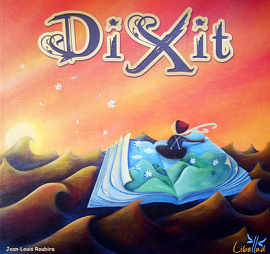
Dixit means to show, point out, declare, or refer to and that’s exactly what you do in the party game Dixit, where you use oversized cards with breathtaking art on them to get imaginations running.

Before we get any further, we’ll make a pit stop at the unimaginative details.

The Fiddly Bits
Designer: Jean-Louis Roubira
Publisher: Asmodee
Date Released: 2008
Number of Players: 3-6
Age Range: 8 and up
Setup Time: nominal
Play Time: less than 30 minutes
Game Mechanisms:
Simultaneous Action Selection
Voting
Dixit
Game Flow:
Players have a hand of six picture cards, and each player takes turns as the storyteller. The storyteller picks one card from their hand and judging by the picture on the card, gives an audible clue to the other players. These clues can be as complex as a few sentences or as simple as a sound effect, but the clue has to relate to the picture on the card. Once the storyteller picks their card and gives their clue, they put their card face down on the table.

Then, the other players pick a card from their hand that best matches the clue the storyteller gave and puts their cards face down, next to the storyteller’s card. The storyteller shuffles the cards and reveals them in a line face up, labeling them with numbered chips. Every player – besides the storyteller – has to vote for which card they think is the storyteller’s card.

DixitVoting

If the clue was too on the nose and everybody finds the correct card or the clue was too obscure and no one finds the correct card, the storyteller gets no points, and the other players score points. But if one or more players find the correct card, but not everyone, the storyteller gets 3 points, the player(s) who guessed correctly get 3 points, and players (who aren’t the storyteller) score 1 point for every vote for the card they played.

DixitOverview

At the end of each round, players draw up to their hand size of six cards, and the duty of storyteller passes to the player on the left. The game ends when a player reaches 30 points or if you run out of cards. The player with the most points wins.

Review:
Dixit is weird, but it’s a great weird. You can have fun just looking at the pretty pictures on the cards, and people’s clues grant a portal into their brain. That might not be as good of a thing.

DixitCards

I only have two complaints with Dixit: I don’t know how to classify the game, and it gets repetitive if you play the same cards with the same group of people. Both of these things aren’t real knocks on the game, and thankfully, Dixit has plenty of expansions to jazz up the cards. It’s fun and easy to play and learn. You can even mix up the gameplay. I played a game where we only used movie titles as the clues for the cards, and we had a heap of laughs.

Then, you have the wooden bunnies as play pieces. I think the first words out of my mouth when I opened the box were “Pink? I can be a pink bunny? Oh, I have to be the pink bunny.” Every game should offer pink.

Verdict:
A gorgeous game that makes your mind work in ways it doesn’t always work. You get to flex your imagination with this creative game.
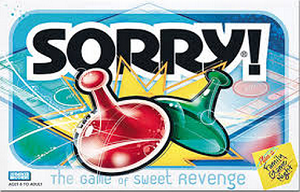
Sorry!

SorryBoardGame

You have to say Sorry with that sardonic, nasally voice. Learn how not to be sorry with this popular children’s game from the 1930s. Sorry may be derivative of the classic game Pachisi, but it’s a modern classic in its own right.

We apologize, but we interrupt this review for technical details.

The Fiddly Bits
Designer: Paul T. Haskell, Jr. and William Henry Storey
Publisher: Parker Brothers
Date Released: 1929
Number of Players: 2-4
Age Range: 6 and up
Setup Time: nominal
Play Time: around 30 minutes
Game Mechanisms:
Card Drafting
Point to Point Movement
Roll/Spin and Move

SorryBoardGameOverview
Sorry! Overview

Game Flow:
Players pick a color. Each player starts the game in an area, matching the color they chose. Players must navigate the board and send their pieces to their base at the opposite end of the board from their starting area. To accomplish this, players draw cards from a communal deck and move their pieces in accordance to the cards. The first player to get all their pieces in their base wins.

Review:
I give Sorry some credit for replacing the dice movement of Pachisi with cards. But that’s all I can say for it. Sorry still uses a roll/spin and move mechanism just without the rolling or spinning, and the card draw actually makes it worse for me. At least when I’m rolling a die or spinning a wheel, I have the tactical goodness of those two activities. The deck of cards eliminates the joy of rolling or spinning. Plus, some cards make you go backwards. While that’s a good thing in the early going, you don’t want to go backwards when you’re almost home.

SorryBoardGameCard
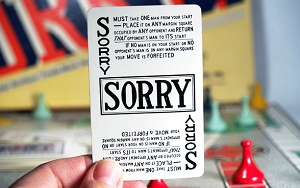
Close-up of Sorry! card

And then there’s the title. You’re not sorry when you bump into someone, but that’s what the card says, so that’s what people say (in that sarcastic, nasally voice I talked about earlier) when they take your piece off the board. You could give Sorry the tagline: teaching children how to be punks since 1929.

Verdict:
How this game remains a family favorite for as long as it has is beyond my comprehension. There are so many better activities you could do instead of Sorry, like reading a book or taking a walk on thin ice.

7 Wonders

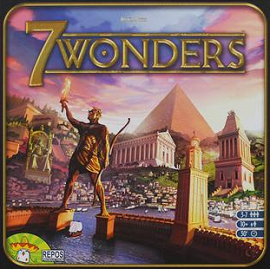
7WondersBoardGame
Take control of one of history’s most accomplished city/states and lead them to victory as a civilization that’ll stand the test of time. Okay, the last bit came from Civilization the video game, but that’s because 7 Wonders plays like a half-hour, tabletop version of Civilization. The one thing that keeps me from playing more Civ is the game length (and I’m sure the same holds true for many of you), so 7 Wonders steers like a dream. Or does it?

We’ll get to the game review in a bit, but we have to pay homage to the game detail demigods first.

The Fiddly Bits
Designer: Antoine Bauza
Publisher: Asmodee
Date Released: 2010
Number of Players: 2-7
Age Range: 10 and up
Setup Time: about 10 minutes
Play Time: around 30 minutes
Game Mechanisms:
Card Drafting
Set Collection
Simultaneous Action Selection
Variable Player Powers

Game Flow:
Players either choose their city/states or pick them at random. A game of 7 Wonders is split into three rounds—or, eras. At the beginning of each era, players get dealt seven cards – for seven wonders, get it? – from a unique deck for each era, and these cards yield building materials, manufactured products, or straight-up victory points.

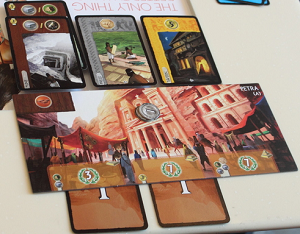
7WondersOverview
7 Wonders Overview

Once a round – err, era – gets going, you select one card from your hand and pass the rest to the player on your left (if it’s the first or third era) or to your right (if it’s the second era). Before picking up their new hand of cards, players reveal which card they chose from their previous hand and play it, then they repeat the process until only one card remains in each players’ hand. These last cards get discarded to a communal pot (there are player abilities that allow you to snatch cards from this communal discard pile).

After all three eras are complete, tally victory points to determine the winner.

Review:
7 Wonders plays fast, real fast. You have so many ways to win that you can fall prey to analysis paralysis, a condition where you can’t decide which card to pick and play. But despite the many varied ways to win, some victory points are easier to come by than others.

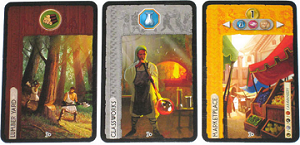
7WondersEra1Cards
Era 1 Resource Cards

Military conquest only requires basic resources, so if you have a warlike city/state, it’s real easy to rack up points this way. Science victory points take a longer build. There are city/states that emphasis science, but it’s a lot trickier to accrue more points than your opponent(s). Cultural victory points are the ones you get straight up from cards. These don’t stack like military and science points, but you don’t need them to stack. Then, there’s a hidden set of victory points available only during the third era: guild cards. These cards piggyback on whatever your opponents have built throughout the game.

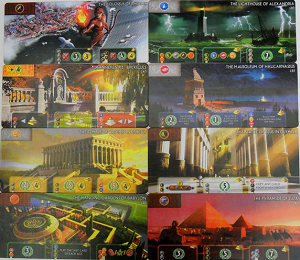
7WondersCityStates
Eight 7 Wonders City-States

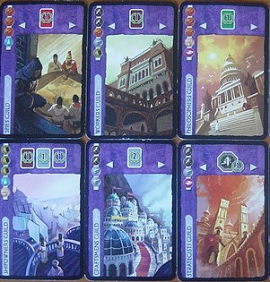
7 Wonders has fantastic balance. But the guild cards can disrupt this equilibrium. I’ve played plenty of games where I built a stellar city/state only to have my neighbor construct guilds that give them victory points for the number of science cards I had or for my cultural achievements. I’ve also built these guilds myself. These cards feel like catch-up cards, and the victories they give paint your win hollow.

7WondersGuildCards
7 Wonders Guild Cards

I’m all for close games. A 16-15 extra innings win in baseball is a lot more interesting to watch than a 20-0 shellacking, but 7 Wonders doesn’t need this. Every game doesn’t have to be close. I can withstand the occasional beat down in exchange for a well-earned win. The game only lasts at most thirty minutes. There’s always the potential of a rematch.

7WondersTitle

One last minor gripe: 7 Wonders lacks a strong theme. Don’t get me wrong, the game’s gorgeous, and it looks like you’re building one of these famous city/states, but you could strip away the theme and add a new one, and it’d work. Fortunately, underneath the pretty is a world-class card-drafting game.
Verdict: Light on theme but strong on gameplay, 7 Wonders deserves its Spiel des Jahres Kennerspiel (Connoisseurs Game of the Year).

Trivial Pursuit

TrivialPursuit

Trivial Pursuit started the trivia game genre and popularized the party game. Many people know how to play, but for those of you who don’t: Players test their knowledge of little known facts, traveling a spoke and wheel board in order to earn pie pieces, representing the various slices of factual tidbits. Mmm…trivia pie.

We’ll get to the game’s review in a bit, but first, here’s a word from our game specifications overlords.

The Fiddly Bits

Designer: Scott Abbot and Chris Haney
Publisher: Hasbro
Date Released: 1981
Number of Players: 2-24
Age Range: 12 and up
Setup Time: nominal
Play Time: up to 90 minutes

Game Mechanisms:
Roll/Spin and Move
Set Collection

Game Flow:

Players pick a circular playing piece with six pie-shaped holes. You roll a single six-sided die and travel the wheel and spoke board, hoping to land on “pie spaces.” Each space – including the pie spaces – is color-coded to denote the kind of question you’ll be asked by your opponents. You must collect all pie pieces by answering a trivia question correctly while on a “pie space” and then travel to the board’s center (the same space in which you started) and answer a final question chosen by your opponents.

TrivialPursuitOverview
Trivial Pursuit Overview

Review:

I liked Trivial Pursuit as a kid. I grew up with it, and it introduced me to both the trivia and party game genres, but it hasn’t aged well.

It suffers from the roll/spin and move mechanism and best illustrates why this mechanism frustrates gamers. You can correctly answer fifty questions in a row, but none of them count unless you get the pie space question right. Why? This places too much emphasis on dumb luck and less on actual knowledge, skill, or strategy. That’s not a good thing for a trivia game.
TrivialPursuitPieSpace
Close Up of Pie Space

Then there’s the problem that plagues most trivia games, the one when you play with the guy or gal that has too much meaningless knowledge for their own good. You never want to play against that person. It tips the balance of play to much in their favor.

Despite these shortcomings, Trivial Pursuit has inspired countless games. Cranium sidestepped the randomness of a pie space question by having a separate deck for more important scenarios. Wits and Wagers – the game that inspired Are You Smarter Than a Fifth Grader – evens the playing field against those know-it-alls by having a player answering a question and the others betting whether or not they got it right.

WitsAndWagers

But even though there are a lot of better options, I still enjoy the occasional game of Trivial Pursuit. We have to play with house rules (like so many correct answers on non-pie-spaces equals a pie piece), so the game doesn’t drag for hours.

Verdict: Another roll/spin and move game that hasn’t aged well. It also falls victim to the pitfalls of a trivia game, but remains a classic none-the-less.

Pandemic

Pandemic

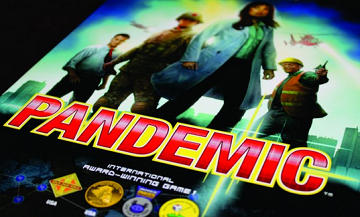
Today, we review the cooperative game phenomenon, Pandemic. Four virulent diseases rip their way through the world at the same time, and it’s up to you and your teammates – the other players at the table – to save humanity from annihilation.

We’ll get to the exciting parts in a bit but first, we have to feed you some technical jargon.

The Fiddly Bits

Designer: Matt Leacock
Publisher: Z-Man Games
Date Released: 2007
Number of Players: 2-4
Age Range: 8 and up
Setup Time: Less than 5 minutes
Play Time: 45 minutes or so
Game Mechanics:
Action Point Allowance System
Cooperative Play
Hand Management
Point to Point Movement
Set Collection
Variable Player Powers

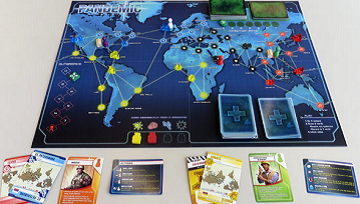
PandemicOverview
Pandemic Overview

Game Flow:

Players choose their role or pick one at random. Each role comes with a playing piece and a special ability unique to them. Place your playing pieces on Atlanta (since that’s the home of the Center for Disease Control), and then you set up the board.

Each city depicted on the board has its own infection card that you could see in the infection card deck. Pull three infection cards from the top of the deck and place three disease cubes on each of the cities shown on these cards. Then, draw another three infection cards and put two disease cubes on these cities. After that, you draw yet another three infection cards and place one disease cube on each one of these cities. All drawn infection cards go to the discard pile, and you’re ready to play.

PandemicInfectionCardsAndRate
Infection Cards and Rate

You get four actions during a turn and you can spend an action moving from one city to another, removing a disease cube from a city, building a research center, or curing a disease. Once you complete your actions, you have to draw two cards for your hand and then a certain number of infection cards based on the game’s infection level.

Diseases can spread with epidemics and outbreaks, and there are plenty of ways to lose: running out of a particular color of disease cube, exhausting your player card draw pile, or the planet experiencing too many outbreaks. But there’s only one way to win: cure all four diseases.

PandemicCureDiseaseTokens
Cure Disease Tokens

Review:

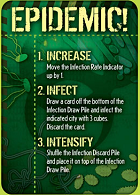
Pandemic appeals to a wide variety of gamers. Whether you think of Ebola wiping out humanity or zombie apocalypse, Pandemic is topical and hip. I love the game mechanisms behind the Epidemic cards. Each Epidemic card has you move up the infection rate, infect a new city from the bottom of the infection deck, and shuffle the infection cards in the discard pile and place them on top of the infection deck. This escalates the spread of disease and incubation intensity.

PandemicEpidemicCard
Epidemic Card

The game’s easy to learn and since Pandemic is a cooperative game, you can teach someone as you go. Like most Matt Leacock games, Pandemic has various difficulty settings. With Pandemic, you can play with all or some of the Epidemic cards, so you can ease newbies into its fast-paced gameplay. You feel the pressure of saving the world.

Verdict:

Pandemic doesn’t just earn its cooperative game phenomenon status; it serves as a great gateway game for people who don’t play a lot of tabletop games: a must play.

Battleship

Designer: Clifford Von Wickler
Publisher: Milton Bradley
Date Released: 1931

Number of Players: 2
Age Range: 8 and up
Setup Time: About 5 minutes
Play Time: Around 30 minutes

Game Mechanics:
Dice Rolling
Secret Unit Deployment

Game flow:
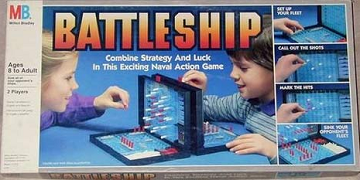
Originally a pencil and paper game known by various names, Battleship became the renowned game we know today in 1967 when Milton Bradley traded pencil and paper grid for plastic grids with holes where players could place pegs to record their guesses.

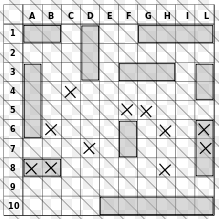
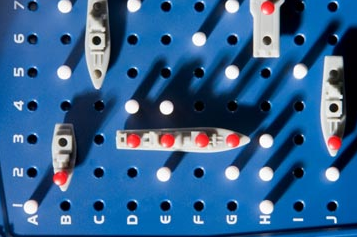
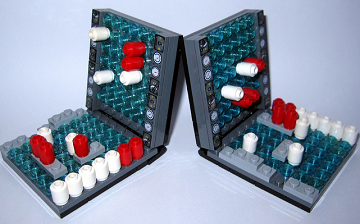
Battleship01A game of Battleship begins with each player deploying their ships (which vary in lengths of 2 to 5 squares) secretly on a square grid. Once their ships are deployed, players take turns shooting at the other player’s grid by calling out a location. The defending responds with whether or not the turn player “Hit” or “Missed” one of their ships.

Players deduce where their enemy’s ships are through deductive reasoning and previous shots. The first player to sink all of their opponent’s ships wins.

Review:
Battleship is a classic modern tabletop game that’s seen its share of rule changes and promotional tie-ins. It even had an action movie, starring Rihanna, based on it in 2012.

Battleship02The core gameplay is solid – I’ve even played some of the pencil and paper variants of the game – and it has inspired numerous games that have come after it. The how many did I get right versus how many did I get wrong mechanic gets a twist in games like Mastermind of the 1970s. Battleship even popularized the secret unit deployment game mechanic which was used with great success in 1947’s Stratego. Further still, a game’s duration doesn’t take long which was odd for games of the time. See Monopoly.

Battleship03But Battleship has limited strategy. You don’t have to thing a whole lot to play it. There are surefire ways to locate another player’s ships (like going in a checkboard pattern on the grid), and you can only hide your ships for so long. A lot of the gameplay comes down to luck, too. If you take down a couple of the smaller ships by dumb luck, you’ll have a much easier time locating the larger ships.

Battleship04Some of the modern variants have – that have done things like adding islands to the grid, increasing ship placement strategy – have reduced game times further, but even with the shortcoming of a lack of strategy, Battleship remains a classic tabletop game. It deserves its status.


Verdict: A classic tabletop game light on strategy and critical thinking, but strong with two player fun and introduced the world to some game mechanics that are still used today.

Munchkin: Cthulhu

Designer: J.H.G. Hendriks and Steve Jackson
Publisher: Steve Jackson Games
Date Released: 2007

Number of Players: 3-6
Age Range: 10 and up
Setup Time: minimal
Play Time: Around 90 minutes

Game Mechanics:
Dice Rolling
Trading
Variable Player Powers

Game flow:
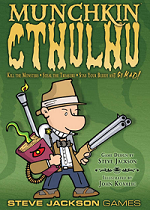
Munchkin: Cthulhu is a full spin-off game from the game Munchkin. I won’t bother with a full review of the game flow here, but if you missed our review of the original Munchkin, you can read our review of it here.

Review:
The twist Munchkin: Cthulhu makes with the Munchkin franchise is a refreshing one. There’s a reason it has the most expansions of any Munchkin spin-off. It does the rare thing of improving on the original.

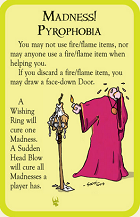
MunchkinCthulhu03Munchkin: Cthulhu adds madness cards to the mix, and these cards act as double-edged swords. Kleptomania forces a player to attempt to steal another player’s item at the beginning of their turn, and if you fail to steal an item, you suffer the consequences. Other madnesses alter the gameplay in humorous and intriguing ways, but Munchkin: Cthulhu throws in a lot more odd game mechanics.

MunchkinCthulhu02Even the classes get a facelift with the cultist. You could be trying to convert everyone or get bonuses for the number of characters who are cultists. There’s just enough weird to Munchkin: Cthulhu that it shines on a crazy diamond.

MunchkinCthulhu04Verdict: A bizarre and delightful entry for the Munchkin family.

Risk

Designer: Albert Lamorisse and Michael I. Levin
Publisher: Parker Brothers
Date Released: 1959

Number of Players: 2-6
Age Range: 10 and up
Setup Time: 10-15 minutes
Play Time: Up to 120 minutes

Game Mechanics:
Area Control/Area Influence
Area Movement
Dice Rolling
Partnerships
Player Elimination
Set Collection

Game flow:
The goal is simple. Conquer the world.

A game of Risk begins with all the territory cards getting shuffled and then dealt evenly to each player. The cards in your hand will match regions on the board, and these are the regions you control at the beginning of the game. Each player then places at least one military unit on each region they control and they have spare units to deploy where ever they see fit.

Risk01During a player’s turn, they begin by gaining reinforcements through the number of regions they hold, the number of continents they own, and turning in sets of cards (one card is earned each turn if the player whose turn it is conquers a land). Then, the player has the option to attack another player.

Risk02You can only attack a region from an adjacent region, and combat is resolved by a simple roll of standard six-sided dice. Whoever rolls the highest number wins. Defenders win all ties. A player can attack several times on their turn, and once they’re done attacking, they can move any number of military units (in excess of one unit) from one region the player owns to another region they own so long as there is a continuous route of regions the player owns from the starting location to the end location.

Risk03Play continues until all players are eliminated except for one. There can be only one.

Review:
Risk is another classic modern tabletop game that has aged pretty well. Even though the combat mechanics are not as sophisticated or as nuanced as other area control games, it has enough strategy elements to remain relevant in today’s tabletop market.

Risk04Still, there are some tried and true strategies that trump most others; so many games of Risk give you a feeling of déjà vu. That’s where the lack of gameplay nuance comes in. There just isn’t enough variety outside some unbelievable dice rolling that’ll leave you thinking that the game you played yesterday went a lot differently than the one you played today. Then, there’s the issue of player elimination. Not too many games practice this mechanic today, because today’s games have switched to a victory point mechanic in the hopes to engage every player, especially if it has a one to two hour playtime. The worst thing that can happen in a game of Risk is to get eliminated after one hour of play, but there’s another hour or two of gameplay left. Would you still be interested in who wins the game? I don’t think so.

Risk05Risk – like so many other early tabletop games – has had plenty of tie-ins. Halo, Lord of the Rings, and even The Walking Dead have their own flavor of Risk. My personal favorite is Risk Legacy that allows for ongoing house rules that adapt to previous plays of the game, hence the name Legacy.

Verdict: Risk has left a lasting legacy on area control games that have endured today. It may have been surpassed by some of its offspring, but Risk remains an enjoyable game.

Discount Salmon

Designer: Cara Heacock and Marcus Ross
Publisher: Water Bear Games
Date Released: 2013

Number of Players: 2-6
Age Range: 8 and up
Setup Time: minimal
Play Time: Around 10 minutes

Game Mechanics:
Hand Management

Game flow:
Players take on the role of a fish monger. They must fish in the only water source at their disposal Lake Miasma. Unfortunately, the fish in Lake Miasma have something wrong with them. They could be dry, toxic, ugly, smell, or have any combination of ailments, but that doesn’t stop a fish monger.

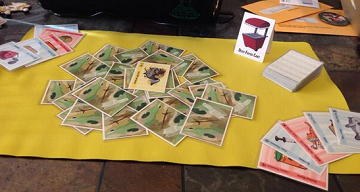
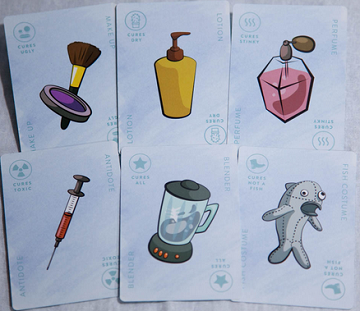
DiscountSalmon01The player designated to go first flips over one of the fish cards of Lake Miasma (which are face down, scrambled in a pool). Then, all the players try to fix whatever’s wrong with the fish with the cards in their hand. If the fish is dry, rub lotion on it. If the fish stinks, spritz it with a little perfume. The first player to get the fish to a sellable fish (no ailments) keeps the fish – and all the other cards associated with the fish – in their score pile. Whoever won the last fish flips over the next fish in Lake Miasma.

DiscountSalmon04But what if you don’t have what will fix the fish in your hand? You can make the fish even more of a wreck. You may have a sun card in your hand that’ll make the fish dry. Or you can have a mustache that’ll make the fish ugly. A fish isn’t won until the fish has no more problems.

Play continues until you run out of fish in Lake Miasma. The player with the most fish wins.

Review:
Discount Salmon has a wonderful premise, more character than you can shake a dorsal fin at, easy-to-learn gameplay, and defies the classification of a trick-winning game. Clocking in at less than 10 minutes, it may be the fastest games we’ve ever reviewed, but it definitely is one of those games that one person may have the knack for it and others will bend to their will. Don’t be surprised if you get skunked.

DiscountSalmon03Reflexes play a huge role. Someone may play a card before you’ve realized that a fish has even been flipped. A common strategy is to have a negative card (with the corresponding cure) at the ready and slap the negative card on the fish no matter which fish shows. Then, after someone has fixed what was initially wrong with the fish, you fix the new problem.

DiscountSalmon02The problem with this strategy is that you’ll often play a negative card on a fish that already has the negative aspect you’re trying to play. A fish can’t be extra dry or extra toxic. Arguments will ensue, and with some gaming group, you may want to have an impartial judge.

Don’t expect your cards to make it without a few bends and tears. And don’t ever sleeve these cards. Fish will fly whenever you flip or play a card.

Despite these minor issues, Discount Salmon is a lot of fun, and it isn’t a large investment of your time. There isn’t a lot of strategy, but that makes it a great game for younger gamers.

Verdict: A fast and fun game with limited strategy that’s great for younger gamers or an amusing change-of-pace game between longer gaming engagements.

Clue

Designer: Anthony E. Pratt
Publisher: Parker Brothers
Date Released: 1949

Number of Players: 3-6
Age Range: 8 and up
Setup Time: 10-15 minutes
Play Time: Around 45 minutes

Game Mechanics:
Grid Movement
Hand Management
Memory
Paper and Pencil
Roll/Spin and Move

Game flow:
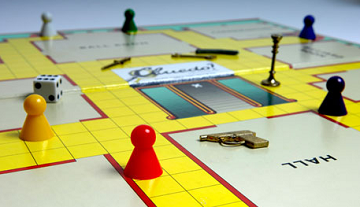
Players assume the role of a character invited to a mansion, but a murder has occurred. Someone has killed Mr. Body, and it’s up to the players to figure out who killed him, what weapon they used to kill him, and in which room the murder occurred.

Clue05Players receive character, weapon, and location cards after the top card from each card type is secretly placed in the confidential file in the middle of the board. Players must move to a room and then make an accusation against a character saying that the character did it in the room that the accuser is in with a specific weapon.

The player to the accuser’s left must prove the accuser wrong if they can by showing a card that disproves the accusation so long as the card exists in the player’s hand. Through deductive reasoning (and a handy notepad with which to take notes) each player must figure out which character, weapon, and location are in the confidential file.

Clue02Once a player believes they’ve solved the murder, they attempt to solve the case by declaring their solution at the end of their turn. If they’re right, they win. If they’re wrong, they’re eliminated and play continues. The first player to successfully guess the right combination of cards in the confidential file wins.

Review:
Clue has aged better than a lot of other early modern tabletop games. Its classic gameplay has inspired several whodunit games since and even a 1985 comedic movie.

Despite the untarnished core gameplay, Clue still suffers from the roll/spin and move mechanic. Any time a game resorts to this mechanic, at best the game has eliminated one possibility for a strategic element for the randomness of rolling a die or worse, tempted players to manipulate the rolling of said die.

Clue03Regardless, the elegance of obtaining clues, the bluffs that ensue (which leads to many strategies), and the colorful characters lead to a fun game that doesn’t take as long as you might think. Clue isn’t Monopoly. While a game could take longer than an hour, most games clock in at forty-five minutes or so. But like Monopoly, Clue has seen its share of marketing tie-ins.

Clue01Verdict: This evergreen suffers under roll/spin and move but delivers enough fresh game mechanics to keep it relevant in today’s tabletop game market.